



3,930 products added recently
Page 23 - Reading Lesson Plans
Inspire your students with reading lesson plans that incorporate a variety of genres and interactive activities. These resources aim to improve fluency, vocabulary, and comprehension. Use these plans to create an engaging reading environment where students develop a lifelong love for literature.

 Show filters

Trains Reading Comprehension Passage - Cored Ed Encyclopedia
ELA, Language Development, Reading Comprehension, Reading, Science, Technology, Engineering, History, Social Studies, Physics, Grade 2, 3, 4, 5, Worksheets & Printables, Worksheets, Teacher Tools, Centers, Activities, Writing Prompts, Assessments, Quizzes and Tests, Quizzes, Lesson Plans
This trains reading comprehension with lesson plan includes: Visualization (on the front cover) Start your lesson by taking a minute to think and share something about the topic. Read the script aloud (slowly), perhaps prepare some music or sound effects. Student close their eyes and let their imaginations wander. Students open their eyes, read the question aloud and give them a few minutes to complete. Ask a few students to share or keep answers until the end to compare with what they learn in the passage. Quick pause—thousands of Cored Education products are included with your TeachSimple membership. Download links and encyclopedia index available here. Pre-Reading Trivia Students will write down one thing they already know about the subject and then read five more facts and discuss. These facts are fun, and the students will enjoy learning about the subject before reading more. Give 1 minute for students to write what they already know (no pressure—best guess is fine). Read the five facts together. After each fact, do ask a student for their opinion, was it surprising? Set a purpose by asking students to highlight/underline one fact they want to learn more about during the reading. Reading Passage The text is a high-interest reading passage with set paragraphs, roughly three to four paragraphs long. It contains a variety of themes about the topic, anywhere from history to technology. The passage is between 250 and 350 words in length. First, ask students to look at the headings and see what they’ll learn about today. What do they know about the topic/heading? First read options: Teacher read-aloud (best for support). Partner reading (paragraph by paragraph). While reading, students underline important details, and vocabulary words they think may come up in the questions section. Mixed Questions The first question page contains four multiple-choice questions, each with a choice of four answers, and three written response questions that require a sentence or two from the student. Students complete the mcqs first independently, then review quickly as a class. For the 3 written responses, try to get students giving the answer with some form of evidence: “I think ___ because the text says ___.” If students get stuck, send them back to check the passage. Vocabulary Questions Practice seven key words from the text in this section across two activities. First section is scrambled words where students will unscramble three words given a clue for each. The second section is a word to meaning matching activity. Before starting, have some students read out words they underlined in the passage. Ask students to say the word and read aloud the sentence(s) around each word. Ask students to do scrambled words and the matching exercise in pairs then go through answers as a class. For the scrambled spelling task, get four pairs to come up to the board and write the words for extra practice with the other student reading out the clue. For the matching task, prompt students to give full sentences: “I matched ___ with ___ because ___.” Creative Writing In this question, the student will be required to write a five to eight sentence paragraph on a question related to the topic. Before starting, ask students write down 3 key ideas they are going to include in their piece. Ask students for ideas to share around the class to help those struggling. Pro writing expectations: 5–8 sentences At least 2 facts or details from the passage At least 2 vocabulary words from the previous page Students read their paragraphs while classmates listen for facts and vocabulary words. Extension Activities This page is optional for fast finishers or to take home. There are several activities, each one requiring a different skill. Do some, do none, do all, completely optional - but you will feel reassured knowing every possibility is planned for. Includes summary writting question. Answer Key There are answers for the multiple-choice questions, written response questions have sample answers, vocabulary answers and if there is a summary question then a sample summary will be provided as well. Lesson Plan Included Customized lesson plan for this lesson is included. Lesson Snapshot Title: Trains Genre: Nonfiction (informational text) Subject: Science (Technology & Engineering) Primary Topic: How rails and train power changed over time Estimated Guided Reading Level (A–Z): R What This Lesson Teaches Best Explains how smooth rails reduce “rubbing,” helping heavy loads move more easily than wagons on muddy roads. Uses a real historical example (the Stockton and Darlington Railway opening in 1825) to show steam trains carrying coal and people. Describes how a steam locomotive works (water becomes steam, steam pushes pistons, pistons help turn wheels). Compares train power types—steam, diesel (engine spins a generator), and electric (overhead wire or third rail). Shows how high-speed rail was designed for speed (special tracks, trains shaped to slice through wind), including Japan’s Tōkaidō Shinkansen (1964) “bullet train.” QA check (support pages vs. passage): The pre-reading trivia uses the word “friction,” but the main passage describes the idea as “rubbing.” Other questions and vocabulary (boiler, pistons, diesel, generator, third rail, high-speed rail) match the passage. Learning Goals Students will explain why smooth rails helped heavy loads move with less rubbing. Students will identify what happened in 1825 with the Stockton and Darlington Railway. Students will describe how steam in a boiler can help power wheel movement using pistons. Students will compare steam, diesel, and electric explanations of how trains get power in the text. Students will describe how train design and tracks can increase speed, using details about high-speed rail. Key Vocabulary From the Text locomotive — the front engine that pulls the train cars. boiler — the part where water is heated to make steam. pistons — parts steam pushes to help turn the wheels. generator — a machine that makes electricity for the train. soot — black dirty particles in the air from smoke. FULL CATALOG OF DOWNLOAD LINKS AND ENCYCLOPEDIA INDEX HERE
Author Cored Education
Rating
Tags Vocabulary, Reading Comprehension, Reading Passages, Lesson Plans, Ela Lesson Plans, Reading Comprehension Lesson Plans, Pre-reading, History, History Lesson Plans, Physics
Special Olympics: A Gathering of Special People: A Cross-Curricular Unit
ELA, Reading, Grade 5, 6, Teacher Tools, Lesson Plans
Special Olympics: A Gathering of Special People - A Cross-Curricular Unit This is a unique teaching resource designed to enlighten students in grades 5 and 6 about the Special Olympics. The distinct feature of this material is its ability to blend reading with other subjects in an interactive manner. The product narrates a story of Emily who goes through a journey discovering the Special Olympics. This narrative consumes seven pages and contributes towards an enriching language arts experience for your students. Cross-Curricular Worksheets Beyond the compelling readings, included in this unit are cross-curricular worksheets synchronised with both the narrative and knowledge on the games. These tools can be extremely impactful for teachers trying to amalgamate several learning disciplines together. Bonus Activities In addition to passages and worksheets, there are multiple activity ideas adding more depth into classroom engagement strategies. These activities could be used during classroom discussions, small team activities or even serve as excellent homework assignments reinforcing previously studied concepts. The resources material is delivered in PDF format ensuring suitability for every educator's needs- being easy-to-store & ready-to-print whenever necessary. No matter which spectrum you fall under from experienced educators looking for fresh approaches or homeschooling parents seeking inclusive content- 'Special Olympics: A Gathering of Special People' fits seamlessly into all education plans. "Equipping future generations with knowledge about important worldwide events promoting inclusivity like these games should be done innovatively while keeping them engaged throughout their journey."-- precisely what this unit promises.
Author Classroom Complete Press
Tags Reading Passage, Reading Worksheet, Special Olympics, Charts, Storytelling

Fiction Adventure Story Unit: Fort McHenry in Maryland
ELA, Reading, Grade 5, 6, 7, Lesson Plans, Teacher Tools
Fiction Adventure Story Unit: Fort McHenry in Maryland This fiction adventure story unit allows students to explore reading comprehension, vocabulary, social studies, and science through an engaging cross-curricular resource. Ideal for grades 5-7, the unit contains various worksheets and activities that could be implemented over 2-3 weeks. Teachers can utilize the fiction story and accompanying materials in whole group, small group, or individual settings through reading, writing, discussion, and project-based learning. Detailed teacher preparation guidelines and implementation directions facilitate seamless delivery of content. By interweaving multiple subjects in a creative format, this resource enables important real-world connections while building literacy skills. With bundles available for 50 unique adventure stories, the Mission X series offers dynamic learning across the curriculum .
Author TrilogyTeacher
Tags Fort McHenry, Cross-curricular, Fiction Adventure, Short Stories, Assessments

ESL Teaching Resource Lesson Plan on Climate Change
ELA, Reading, Reading Comprehension, Language Development, ESL, Writing, Creative Writing, Vocabulary, Grade 7, 8, 9, 10, 11, 12, Teacher Tools, Lesson Plans
ESL EFL Lesson Plan on Climate Change This ESL EFL Lesson Plan on Climate Change (PDF Digital Lesson 14 slides + answer key) can be Great to help stimulate English Learning within Newcomers or any English as a Second Language Student. Ideal participants for this Activity are Foreign Languages Students at Middle School and early High School (teens). This Product can also be Great for ESL Centers Abroad and ESL Tutors or private teachers. This ESL EFL TESOL TEFL Lesson Plan on Climate Change can be more than great for intermediate, advanced English as a Second or Foreign Language Students. This Stimulating ESL EFL Lesson Plan on Climate Change (14 slides + Answer Keys in the last slide) includes: 1 Introduction to Climate Change and the issues it brings 1 Warm-Up Picture Description ESL EFL TESOL Activity given of 3 scenes (flood in Times Square in New York City, a drought with dying crops and wildfires in the Amazon Rainforest) 1 Listening comprehension Activity (with answers keys in the last slide) with QR Code-Linked YouTube Video 1 Writing Activity with 2 Essay Prompts (writing about ideas to develop with family, class or community to improve Carbon Footprint + writing about future scenarios with new climate changes environmental conditions and new solutions) This ESL, EFL, TESOL, TEFL PDF Digital Teaching Resource Lesson Plan on Climate Change (14 slides + answer keys in the last slide) can be great for Intermediate Advanced English as a second or foreign language learners. Its aim is to make students exercise and improve their Listening comprehesion and Writing English as a second language Skills. Learning with Alan is a Brand New Teaching Resources Store whose aim is to help English as a Second or foreign Language Teachers, Educators and Tutors (be it online or offline) to achieve their teaching objectives while creating a fun and stimulating environment. Never Forget! Learning is fun, So should English! Always If you want to browse more of my PDF ESL, EFL, TESOL Teaching Resources, click here Learning with Alan!
Author Learning with Alan
Tags ESL, Climate Change, English, English Second Language, Teaching Resource, Lesson, Lesson Plan, Teens, Writing, Listening
High School Rock Legends and Alternative Voices Reading Passage Bundle
ELA, Reading, Writing, Research, Resources for Teachers, Social Studies, History, High School, Homeschool Resources, Worksheets & Printables, Writing Prompts, Teacher Tools, Assessments, Lesson Plans, Quizzes and Tests
As a homeschool mom navigating high school literature and history with my 9th grader, I know firsthand how tough it can be to find materials that actually grab our kids' attention. That is exactly why I created this High School Rock Legends & Alternative Music Reading Passages Bundle - because music has this amazing way of connecting with teenagers that dusty textbooks just can't touch. This three-resource collection takes students on a real journey through influential musical movements and artists, diving way deeper than basic biographical facts to explore the cultural significance, artistic evolution, and social commentary that made these musicians legendary. Whether you are a fellow homeschool parent wanting to energize your curriculum or you are just looking for something that will genuinely engage your teenager, this High School Rock Legends & Alternative Music Reading Passages Bundle delivers content that sparks actual discussions, gets them thinking critically, and connects historical events to issues that matter to them today - all while challenging them to explore themes of identity, authenticity, and overcoming obstacles that really resonate with their own experiences. INCLUDED IN THIS RESOURCE: British Alternative Music John Michael Osbourne Falling in Reverse All answer keys include detailed explanations and sample responses for guided discussion TOPICS COVERED: British alternative music movement and cultural impact (The Smiths, Radiohead, Arctic Monkeys, The Cure) Heavy metal origins and artistic evolution through pioneering musicians Contemporary rock themes of redemption, authenticity, and second chances Cultural movements, industry evolution, and the intersection of art and controversy This comprehensive High School Rock Legends & Alternative Music Reading Passages Bundle represents more than just music history—it is a tool for developing the kind of critical thinking, analytical writing, and cultural literacy that will serve students/homeschoolers throughout their academic careers and beyond. By connecting academic skills to topics that genuinely interest teenagers, these resources create learning experiences that feel meaningful and relevant rather than simply assigned. The combination of engaging content, rigorous questioning, and thorough support materials makes this collection an invaluable addition to any high school curriculum seeking to bridge the gap between academic excellence and student/homeschooler engagement. If you and your students/homeschoolers enjoyed this resource, please leave a review. Thank you for your support! Tina - Big Easy Homeschooling Mom
Author Homeschool with Big Easy Homeschooling Mom
Rating
Tags British Alternative Music Cultural Revolution Reading Passage, John Michael Osbourne Heavy Metal Legend Biography Study, Falling In Reverse Contemporary Rock Critical Analysis, British Alternative Music Smiths Radiohead Educational Materials, Heavy Metal Origins Cultural Impact Lesson Plans, Contemporary Rock Redemption Themes Analytical Questions, High School English Resources, Homeschool Music Resources, Homeschool Music Curriculum
Video Games Reading Comprehension Passage - Cored Ed Encyclopedia
ELA, Language Development, Reading Comprehension, Reading, Pre-Reading, Science, Technology, Engineering, History, Social Studies, Grade 2, 3, 4, 5, Worksheets & Printables, Worksheets, Teacher Tools, Centers, Activities, Writing Prompts, Assessments, Quizzes and Tests, Quizzes, Lesson Plans
This video games reading comprehension with lesson plan includes: Visualization (on the front cover) Start your lesson by taking a minute to think and share something about the topic. Read the script aloud (slowly), perhaps prepare some music or sound effects. Student close their eyes and let their imaginations wander. Students open their eyes, read the question aloud and give them a few minutes to complete. Ask a few students to share or keep answers until the end to compare with what they learn in the passage. Quick pause—thousands of Cored Education products are included with your TeachSimple membership. Download links and encyclopedia index available here. Pre-Reading Trivia Students will write down one thing they already know about the subject and then read five more facts and discuss. These facts are fun, and the students will enjoy learning about the subject before reading more. Give 1 minute for students to write what they already know (no pressure—best guess is fine). Read the five facts together. After each fact, do ask a student for their opinion, was it surprising? Set a purpose by asking students to highlight/underline one fact they want to learn more about during the reading. Reading Passage The text is a high-interest reading passage with set paragraphs, roughly three to four paragraphs long. It contains a variety of themes about the topic, anywhere from history to technology. The passage is between 250 and 350 words in length. First, ask students to look at the headings and see what they’ll learn about today. What do they know about the topic/heading? First read options: Teacher read-aloud (best for support). Partner reading (paragraph by paragraph). While reading, students underline important details, and vocabulary words they think may come up in the questions section. Mixed Questions The first question page contains four multiple-choice questions, each with a choice of four answers, and three written response questions that require a sentence or two from the student. Students complete the mcqs first independently, then review quickly as a class. For the 3 written responses, try to get students giving the answer with some form of evidence: “I think ___ because the text says ___.” If students get stuck, send them back to check the passage. Vocabulary Questions Practice seven key words from the text in this section across two activities. First section is scrambled words where students will unscramble three words given a clue for each. The second section is a word to meaning matching activity. Before starting, have some students read out words they underlined in the passage. Ask students to say the word and read aloud the sentence(s) around each word. Ask students to do scrambled words and the matching exercise in pairs then go through answers as a class. For the scrambled spelling task, get four pairs to come up to the board and write the words for extra practice with the other student reading out the clue. For the matching task, prompt students to give full sentences: “I matched ___ with ___ because ___.” Creative Writing In this question, the student will be required to write a five to eight sentence paragraph on a question related to the topic. Before starting, ask students write down 3 key ideas they are going to include in their piece. Ask students for ideas to share around the class to help those struggling. Pro writing expectations: 5–8 sentences At least 2 facts or details from the passage At least 2 vocabulary words from the previous page Students read their paragraphs while classmates listen for facts and vocabulary words. Extension Activities This page is optional for fast finishers or to take home. There are several activities, each one requiring a different skill. Do some, do none, do all, completely optional - but you will feel reassured knowing every possibility is planned for. Includes summary writting question. Answer Key There are answers for the multiple-choice questions, written response questions have sample answers, vocabulary answers and if there is a summary question then a sample summary will be provided as well. Lesson Plan Included Customized lesson plan for this lesson is included. Lesson Snapshot Title: Video Games Genre: Nonfiction (Informational text) Subject: Science & Technology / Media Literacy Primary Topic: How video games changed from dots to VR Estimated Guided Reading Level (A–Z): P Story text location: Reading Passage on page 3. Support pages included: Visualization prompt (p.1), Pre-Reading Trivia (p.2), Mixed Questions (p.4), Vocabulary (p.5), Creative Writing (p.6), Extension Activities (p.7), Answers (p.8). Support-page QA check: The questions, vocabulary tasks, and answer key match the passage’s details (dates, examples, and key terms). What This Lesson Teaches Best Early video games grew from science tools and big computers: Describes room-sized computers and a “game screen” idea using an oscilloscope. Timeline of key early games and places: Connects Tennis for Two (1958), Spacewar! at MIT (1962), Computer Space (1971), and Atari’s Pong (1972). How cartridges changed home gaming: Explains that swapping cartridges let one system play many different games, and names early cartridge consoles (Fairchild system, Atari 2600). Technology improvements changed how games look, sound, and where they are played: Notes smoother movement, clearer pictures, richer sound, and games moving to handheld screens, computers, consoles, and phones. Games became many types of experiences: Lists examples like puzzles, team sports, building sets, long stories with choices, and virtual reality. Learning Goals Students will describe how Tennis for Two worked and what device showed the moving dot. Students will identify major milestones in early video game history by placing key examples in order. Students will explain how cartridges helped video games spread at home. Students will summarize how video games changed as computers became smaller and stronger. Students will give examples of different kinds of games mentioned in the passage. Key Vocabulary From the Text oscilloscope — a screen tool that can show moving signals. physicist — a scientist who studies matter and energy. arcades — public places where people play games. cartridges — plastic game boxes you swap into a system. virtual — computer-made, not physically real. FULL CATALOG OF DOWNLOAD LINKS AND ENCYCLOPEDIA INDEX HERE
Author Cored Education
Rating
Tags Vocabulary, Reading Comprehension, Reading Passages, Lesson Plans, Ela Lesson Plans, Reading Comprehension Lesson Plans, Pre-reading, Science Lesson Plans, Technology, History Lesson Plans

The Golden Kite, The Silver Wind: Full Lesson Plan w/ PowerPoints & Graphic Organizers
ELA, Reading, Grade 9, 10, 11, 12, Lesson Plans, Teacher Tools
The Golden Kite, The Silver Wind: Full Lesson Plan Bundle for Ray Bradbury's Short Story This comprehensive bundle contains everything educators need to teach Ray Bradbury's thought-provoking short story "The Golden Kite, The Silver Wind." Includes a complete reading lesson plan to guide analysis, worksheets to check comprehension, graphic organizers to dissect plot, characters, themes and more, plus PowerPoint slide decks to support lessons on symbolism, theme interpretation, narrator and voice, characterization, and beyond. Implementation ideas provided, like using components for whole-group instruction, small-group discussion, or independent practice. Offered as editable Word and PDF files for flexibility. Perfect for exploring this rich literary work with high school students.
Author Quality Teaching Products
Tags Reading Lesson, Fiction Text, Narrator Voice, Symbolism, Graphic Organizers

Literary Devices - Digital Lesson Plan Gr. 5-8 | MAC Software
ELA, Reading, Grade 3, 4, 5, 6, 7, 8, Teacher Tools, Lesson Plans
The Literary Devices - Digital Lesson Plan Gr. 5-8 | MAC Software This comprehensive teaching resource is designed specifically for educators, both in public schools and in homeschooling settings. Perfectly suited to students between grades 5 and 8, this interactive learning tool focuses on enhancing the understanding of literature mechanics. An immersive learning experience covering a whopping 80 screen-pages, this module offers extensive tutorials on key storytelling components such as: Characterization Setting plot development Theme creation Point of view establishment Foreshadowing mechanisms Symbols integration Irony infusion strategies . Beyond just theory-based lessons, it includes practical examples accompanied by pre-and post-reading interactive activities to reinforce learning. A unique feature that encourages learners to apply their knowledge within actual scenarios. Educational Tools Included: Crosswords puzzles & word searches games for revision. A test prep section aids students' performance levels. A special text-to-speech function allows users to audibly consume content promoting auditory learning paths. Further backed up by video-audio support system providing varied content formats to suit different learner types. All resources bundle into one neat zip file exclusively formatted for MAC operating systems; serving as the perfect language arts curriculum support focusing specially on reading skills development for middle schoolers. Incorporating state educational standard alignments coupled with its structured design based on Blooms Taxonomy principles, The Literary Devices - Digital Lesson Plan Gr. 5-8 | MAC Software is an essential tool for educators irrespective of their teaching environment. Experience this unique learning pathway to enable students unravel the true meaning and purpose across different literature genres by understanding their fundament building blocks.
Author Classroom Complete Press
Tags Literary, Devices, Reading Skills, Digital Lesson Plan, Reading Lesson, Activities To Teach Literary Devices
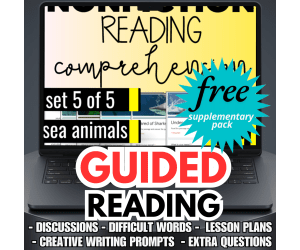
Guided Reading Activities and Lesson Plan Nonfiction Set 5 Sea Animals
ELA, Reading, Reading Comprehension, Common Core, ESL, Language Development, Pre-Reading, Vocabulary, Resources for Teachers, Grade 4, 5, Worksheets & Printables, Worksheets, Lesson Plans, Teacher Tools, Activities
Guided Reading Activities with Lesson Plans Nonfiction Set 5 Note: This download DOES NOT include the passages themselves. If you have not already done so, download in a format of your choice in the "reading links" section below. Overview The perfect companion materials for Cored Education reading comprehension downloads. This collection provides structured lessons designed to enhance students' reading, comprehension, vocabulary, and creative thinking. Each lesson follows a consistent format that includes pre-reading activities to engage students, vocabulary-building exercises, comprehension checks, creative writing prompts, and discussion topics that promote critical thinking. The lessons are designed to foster active participation, encourage reflection, and develop key literacy skills through interactive and immersive learning experiences. The series is ideal for guided reading sessions, providing teachers with a comprehensive toolkit to engage students in both individual and group activities, enhancing their understanding of text and expanding their language skills. Includes Guided Reading Materials For: 1.Stingray 2.That's Electric 3.Whale Shark 4.Scared of Sharks 5.Under the Sea 6.All About Jellyfish Reading Links: This is the guided reading materials version and DOES NOT include the passages themselves. The passages related to this download are available here in GOOGLE Docs, GOOGLE Forms, GOOGLE Slides. PDF, PPT, WORD. Google Docs Google Forms Google Slides PDF PPT Word Key Features: Engaging Lesson Structure: Each lesson follows a clear and predictable format, which includes pre-reading discussions, vocabulary exercises, reading activities, and creative tasks to maintain student engagement. Vocabulary Development: Focus on introducing and applying new vocabulary in context, helping students internalize new words and use them effectively. Comprehension and Reflection: The lessons include comprehension questions and reflective prompts that encourage students to think critically about the text and its themes. Creative Writing and Discussion: Opportunities for students to express themselves through writing and group discussions, reinforcing their understanding while fostering creativity. Interactive and Student-Centered: The activities are designed to be interactive, allowing students to engage directly with the content and each other, promoting active learning. FULL CATALOG OF DOWNLOAD LINKS HERE Grade 4/5 Links Fiction Set 1 - Animals Google Docs Google Forms Google Slides PDF PPT Word Guided Reading Materials Fiction Set 2 - Family Google Docs Google Forms Google Slides PDF PPT Word Guided Reading Materials Fiction Set 3 - Friends Google Docs Google Forms Google Slides PDF PPT Word Guided Reading Materials Fiction Set 4 - School Google Docs Google Forms Google Slides PDF PPT Word Guided Reading Materials Fiction Set 5 - Sports Google Docs Google Forms Google Slides PDF PPT Word Guided Reading Materials Nonfiction Set 1 - Birds Google Docs Google Forms Google Slides PDF PPT Word Guided Reading Materials Nonfiction Set 2 - Insects Google Docs Google Forms Google Slides PDF PPT Word Guided Reading Materials Nonfiction Set 3 - Mammals Google Docs Google Forms Google Slides PDF PPT Word Guided Reading Materials Nonfiction Set 4 - Nature Google Docs Google Forms Google Slides PDF PPT Word Guided Reading Materials Nonfiction Set 5 - Sea Animals Google Docs Google Forms Google Slides PDF PPT Word Guided Reading Materials Reading Passages Overview Each passage is especially written for Grade 4-5 students, including key vocabulary required for this age group. Topics are varied and are accompanied by colorful graphics. Topics are meant to educate, yet entertain the modern student. These passages are perfect for the modern classroom. Whereas textbooks can become outdated in no time, any changes to technology or the world will result in updates to this product. Mixed Questions The mixed questions section of each lesson includes a variation of five comprehension, vocabulary and math questions. In addition, key reading strategies are frequently covered including cause & effect, summarizing, compare & contrast and making conclusions. Two or three of the questions will be MCQs and other questions will require a written response of some kind. Full answers and example responses appear at the end of the lesson. Spelling & Vocab Each reading passage contains a variety of words and phrases designed for Grade 4-5 students. Spelling and vocab activities provide the opportunity to build fluency with these words. As it can become quite mundane doing the same activities over and over, each lesson in a set will contain a different spelling and vocab activity . Activities include: spelling games, sentence match-ups, mixed-up text and decoding words from the lesson. Writing Prompts Writing prompts are designed to continue the theme or lessons learned in the story. Students are persuaded to write in a variety of ways and each prompt includes several cues to help. As with the spelling/vocab section, writing prompts will vary. This includes research pieces, reading responses, poetry and creative writing prompts. Full Answer Keys Full answer keys and sample responses are provided so no matter how busy you are, you know you're covered! Mixed question answers provide evidence from the text, math questions contain the relevant workings. Answers are designed for use by the teacher, but also suitable as a handout to the student. Just for Fun Each lesson will have a bonus extension exercise. This is something fun to extend the lesson with. You can find these at the end of each lesson, titled Just for Fun. Just for Funs are optional. Some you may like, some you may not. Either way, they are there to do with as you wish. For similar downloads and other frees, do check out Cored Group on TeachSimple.
Author Cored Education
Tags Elementary, Reading, Comprehension, Vocabulary, Answers, Ccss, Guided Reading, Guided Reading Activity, Guided Reading Lesson Plans, Guided Reading Lesson Plan
Over the Hill | Figurative Language Activity | Micro-Learning Deck
ELA, Reading, Reading Comprehension, Grade 4, 5, 6, 7, Teacher Tools, Lesson Plans
Over the Hill Figurative Language Learning Deck This teaching resource allows students to explore the figurative language term "over the hill" in an engaging way. The learning deck includes a short video lesson that explains the key language concept to provide students with background knowledge. Next, a reading passage featuring audio allows learners to apply their understanding of the figurative term. The passage is followed by reading comprehension questions and a quick write activity that lets students reflect on their learning. This self-contained micro lesson can be used flexibly—in whole group instruction, small group literacy circles, or as an independent learning activity. The learning deck format allows educators to reinforce figurative language concepts through repeated, focused practice. Suitable for upper elementary and middle school grades, this resource provides an enjoyable way for students to build fluency with figurative terms.
Author Teach Me This
Tags Over The Hill, Figurative, Language, Learning Deck, Comprehension

Egypt The Gift of the Nile: Guided Reading Level R with Lesson Plan
ELA, Resources for Teachers, Reading Comprehension, Reading, Science, Geography, Social Studies, History, Earth and Environmental Sciences, Technology, Grade 3, 4, 5, Worksheets & Printables, Worksheets, Teacher Tools, Centers, Activities, Literacy Readers, Quizzes, Quizzes and Tests, Assessments, Lesson Plans
This Egypt: The Gift of the Nile (level r) guided reading book with lesson plan includes: Guided Reading Color Label (front cover x1) This is a quick way to match the book’s demands to what students can generally handle.. The overall goal is to use the level/color to pick books for several smaller groups. To qualify for a certain level, a student is expected to read a book from that level with about 90–94% accuracy. If a student is consistently accurate and understands, move up a level. If the student is struggling at that level, drop down and add more support. Each student will improve at completely different rates, but it is generally one of the best ways to check progress across the class. DOWNLOAD THE CATALOG TO VIEW ALL GUIDED READING BOOKS AVAILABLE (SORTED LEVELS A-Z) Pre-Reading Question (x1) Teacher asks the prompt aloud, can be while showing the cover or first page. Students share what they already know, or make educated guesses from the cover. Prompt them to use the target vocabulary. Write some of their responses on the board to look back at during the reading. Vocabulary Words (x5) Introduce the five words, best doing it one at a time. Start by saying it, while students repeat and then see if anyone knows what it means before reading further. Read through the meaning and try to briefly connect each word to a picture or gesture so it’s meaningful. Ask students to flip through the book pages and point to where they see each of the vocabulary words. While reading the book pause upon coming across one of the vocab words or read the sentence twice to make sure students understand the word has appeared. Optional: Ask students to raise hands whenever they see/hear one of the new words. Guided Reading Pages (x10) Check the book snapshot (below) for: primary topic - do you need to prep extra reading or intro materials on this? what is taught best - decide on 1-2 bullets to focus on, use the prompt or words provided here for best results. learning goals - what you are checking for students to be able to do after the session, elicit answers using prompts or words provided. key vocabulary (see section above). questions overview - so you know what is coming up and if you need to prep extra materials to assist understanding. Run the lesson You may have already looked at a few of the pages together, but you can show them some of the pictures again first to set meaning. Depending on how much time you have and how familiar your students are with guided reading class, you may want to read the book aloud first with the group first. Students whisper or partner read, while you listen in. If time, do it as a group, one student reading a page each. Use the guided page’s prompts to coach: “Check the picture / does it make sense?” “Point under the words / try the first sound” “Reread the sentence smoothly”. Try to focus more on one student per session (rotating every time), so you can work out if they are ready to move up or need to move down a level. Comprehension Questions (back cover x3) This is your way to check that students didn’t just say the words, but actually understood the text. First, let students answer by pointing to the page/picture and saying a short sentence. After any answer, follow with: “Show me where you found that in the text.” In bigger groups, have partners answer first (10–20 seconds), then call on 2–3 students to share. Differentiation tips: Emerging speakers/struggling readers: oral + pointing On-level: oral in a full sentence Higher: one written sentence or draw + label Book Snapshot Title: Egypt: The Gift of the Nile Genre: Nonfiction Subject: Social Studies (Geography/History) Primary Topic: How the Nile shaped ancient and modern Egypt Estimated Guided Reading Level (A–Z): R What This Book Teaches Best How Egypt’s desert environment (Sahara Desert, little rain) made a single water source essential for a thriving civilization. Why the Nile River’s yearly floods mattered, including how receding water left fertile silt for growing food. Major symbols of ancient Egypt and what the text says they were for or represented (Great Pyramid of Giza; Great Sphinx). Key beliefs and systems of ancient Egypt, including pharaohs, the afterlife, hieroglyphics, and mummification. Connections between past and present by describing modern Cairo, the Suez Canal, tourism, and archaeologists’ discoveries. Learning Goals Students will describe Egypt’s location and explain how the Sahara Desert affects the land. Students will explain how Nile floods helped farmers grow food by using the text’s details about silt. Students will identify what the Great Pyramid of Giza was built for and describe one detail about its construction. Students will describe how ancient Egyptians recorded history and managed government using hieroglyphics and scribes. Students will explain why mummification was developed and describe what the text says happened during the process. Students will describe two details that show Egypt is a modern nation today (for example, Cairo and the Suez Canal). Key Vocabulary From the Text receded — moved back after being higher. silt — rich dark soil left by water. monumental — very large and important. hieroglyphics — picture symbols used as a writing system. mummification — preserving a body by drying and wrapping. Discussion Prompts Pre-reading question: How might a river help people live and farm in a desert place? Comprehension questions: What did the Nile River’s floods leave behind when the water receded, and why did that help farmers? Comprehension questions: What does the text say the Great Pyramid of Giza was built for? Comprehension questions: What two details from the text show Egypt is a modern nation today? Printing Tips 1. Best Printing Method (Recommended) “Booklet” Printing (Best if Available) If your printer or PDF viewer supports Booklet Printing , use this. Settings to use: Print mode: Booklet Paper size: Letter or A4 (either works) Orientation: Landscape Print on both sides: Yes Flip on: Short edge Scaling: Fit to printable area Booklet subset: First test: Front sides only Then: Back sides only This will automatically: Pair pages correctly Put the cover on the outside Align everything for folding After printing, fold in half and staple along the spine . 2. If “Booklet” Printing Is NOT Available You can still print this correctly with manual duplex printing . Step-by-step: Open the PDF. Choose Print . Set: Orientation: Landscape Pages per sheet: 1 Print on both sides: Yes Flip on: Short edge Print all pages . Because each PDF page already contains two facing book pages, the result will still fold cleanly into a book. Thousands of Cored Education products are included with your TeachSimple membership. Download links and encyclopedia index available here.
Author Cored Education
Rating
Tags Reading Comprehension, Reading Passages, Reading, Guided Reading, Guided Reading Lesson Plan, Guided Reading Activity, Pre-reading, Social Studies, Geography, History

Darts Reading Comprehension Passage - Cored Ed Encyclopedia
ELA, Language Development, Reading Comprehension, Reading, Pre-Reading, History, Social Studies, Math, Sports, P.E. & Health, Grade 2, 3, 4, 5, Worksheets & Printables, Worksheets, Teacher Tools, Centers, Activities, Writing Prompts, Assessments, Quizzes and Tests, Quizzes, Lesson Plans
This darts reading comprehension with lesson plan includes: Visualization (on the front cover) Start your lesson by taking a minute to think and share something about the topic. Read the script aloud (slowly), perhaps prepare some music or sound effects. Student close their eyes and let their imaginations wander. Students open their eyes, read the question aloud and give them a few minutes to complete. Ask a few students to share or keep answers until the end to compare with what they learn in the passage. Quick pause—thousands of Cored Education products are included with your TeachSimple membership. Download links and encyclopedia index available here. Pre-Reading Trivia Students will write down one thing they already know about the subject and then read five more facts and discuss. These facts are fun, and the students will enjoy learning about the subject before reading more. Give 1 minute for students to write what they already know (no pressure—best guess is fine). Read the five facts together. After each fact, do ask a student for their opinion, was it surprising? Set a purpose by asking students to highlight/underline one fact they want to learn more about during the reading. Reading Passage The text is a high-interest reading passage with set paragraphs, roughly three to four paragraphs long. It contains a variety of themes about the topic, anywhere from history to technology. The passage is between 250 and 350 words in length. First, ask students to look at the headings and see what they’ll learn about today. What do they know about the topic/heading? First read options: Teacher read-aloud (best for support). Partner reading (paragraph by paragraph). While reading, students underline important details, and vocabulary words they think may come up in the questions section. Mixed Questions The first question page contains four multiple-choice questions, each with a choice of four answers, and three written response questions that require a sentence or two from the student. Students complete the mcqs first independently, then review quickly as a class. For the 3 written responses, try to get students giving the answer with some form of evidence: “I think ___ because the text says ___.” If students get stuck, send them back to check the passage. Vocabulary Questions Practice seven key words from the text in this section across two activities. First section is scrambled words where students will unscramble three words given a clue for each. The second section is a word to meaning matching activity. Before starting, have some students read out words they underlined in the passage. Ask students to say the word and read aloud the sentence(s) around each word. Ask students to do scrambled words and the matching exercise in pairs then go through answers as a class. For the scrambled spelling task, get four pairs to come up to the board and write the words for extra practice with the other student reading out the clue. For the matching task, prompt students to give full sentences: “I matched ___ with ___ because ___.” Creative Writing In this question, the student will be required to write a five to eight sentence paragraph on a question related to the topic. Before starting, ask students write down 3 key ideas they are going to include in their piece. Ask students for ideas to share around the class to help those struggling. Pro writing expectations: 5–8 sentences At least 2 facts or details from the passage At least 2 vocabulary words from the previous page Students read their paragraphs while classmates listen for facts and vocabulary words. Extension Activities This page is optional for fast finishers or to take home. There are several activities, each one requiring a different skill. Do some, do none, do all, completely optional - but you will feel reassured knowing every possibility is planned for. Includes summary writting question and additional facts. Answer Key There are answers for the multiple-choice questions, written response questions have sample answers, vocabulary answers and if there is a summary question then a sample summary will be provided as well. Lesson Plan Included Customized lesson plan for this lesson is included. Lesson Snapshot Title: Darts Genre: Nonfiction (informational text with headings) Subject: Reading (Informational Text) / Math (numbers & scoring context) Primary Topic: History, dartboard design, and how scoring works Estimated Guided Reading Level (A–Z): Q What This Lesson Teaches Best Explains how darts began as indoor throwing at targets in England and became a friendly challenge in taverns and homes. Teaches key dartboard features (20 pie-shaped sections, thin wires, double/triple rings, and a bull’s-eye that can be 50 points). Builds real-world math context by describing common game formats (301 or 501) where points are subtracted each turn. Uses a cause-and-claim structure to discuss uncertainties and evidence (a debated story about why numbers are scrambled; a court case about skill vs luck). Connects materials/technology to sports equipment (sisal fibers that close up; tungsten barrels for a slimmer grip) and modern leagues/championships. Learning Goals Students will summarize how the text describes darts’ early history and where people played. Students will identify key parts of a dartboard in the text and explain what they do for scoring. Students will explain how a 301 or 501 game works in the passage, including what happens each turn. Students will describe why the dartboard numbers might be scrambled and explain what the text says is uncertain about that story. Students will explain what happened in 1908 and how it relates to whether darts is luck or skill. Students will cite details about modern boards and darts (sisal fibers, tungsten barrels, leagues/championships). Key Vocabulary From the Text taverns — places where people gather for food and drink. oche — the throwing line you stand behind. subtracted — taken away from a total number. sisal — strong fibers used to make dartboards. tungsten — a dense metal used for slimmer dart barrels. Discussion Prompts FULL CATALOG OF DOWNLOAD LINKS AND ENCYCLOPEDIA INDEX HERE
Author Cored Education
Rating
Tags Vocabulary, Reading Comprehension, Reading Passages, Lesson Plans, Ela Lesson Plans, Reading Comprehension Lesson Plans, Pre-reading, Sports, History, Social Studies Lesson Plans
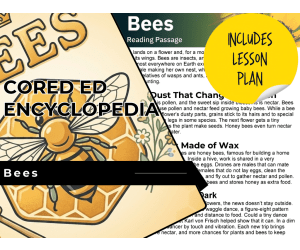
Bees Reading Comprehension Passage - Cored Ed Encyclopedia
ELA, Language Development, Reading Comprehension, Reading, Writing, Pre-Reading, Science, Insects, Life Sciences, Vocabulary, Grade 2, 3, 4, 5, Worksheets & Printables, Worksheets, Teacher Tools, Centers, Activities, Writing Prompts, Assessments, Quizzes and Tests, Quizzes, Lesson Plans
This bees reading comprehension with lesson plan includes: Visualization (on the front cover) Start your lesson by taking a minute to think and share something about the topic. Read the script aloud (slowly), perhaps prepare some music or sound effects. Student close their eyes and let their imaginations wander. Students open their eyes, read the question aloud and give them a few minutes to complete. Ask a few students to share or keep answers until the end to compare with what they learn in the passage. Quick pause—thousands of Cored Education products are included with your TeachSimple membership. Download links and encyclopedia index available here. Pre-Reading Trivia Students will write down one thing they already know about the subject and then read five more facts and discuss. These facts are fun, and the students will enjoy learning about the subject before reading more. Give 1 minute for students to write what they already know (no pressure—best guess is fine). Read the five facts together. After each fact, do ask a student for their opinion, was it surprising? Set a purpose by asking students to highlight/underline one fact they want to learn more about during the reading. Reading Passage The text is a high-interest reading passage with set paragraphs, roughly three to four paragraphs long. It contains a variety of themes about the topic, anywhere from history to technology. The passage is between 250 and 350 words in length. First, ask students to look at the headings and see what they’ll learn about today. What do they know about the topic/heading? First read options: Teacher read-aloud (best for support). Partner reading (paragraph by paragraph). While reading, students underline important details, and vocabulary words they think may come up in the questions section. Mixed Questions The first question page contains four multiple-choice questions, each with a choice of four answers, and three written response questions that require a sentence or two from the student. Students complete the mcqs first independently, then review quickly as a class. For the 3 written responses, try to get students giving the answer with some form of evidence: “I think ___ because the text says ___.” If students get stuck, send them back to check the passage. Vocabulary Questions Practice seven key words from the text in this section across two activities. First section is scrambled words where students will unscramble three words given a clue for each. The second section is a word to meaning matching activity. Before starting, have some students read out words they underlined in the passage. Ask students to say the word and read aloud the sentence(s) around each word. Ask students to do scrambled words and the matching exercise in pairs then go through answers as a class. For the scrambled spelling task, get four pairs to come up to the board and write the words for extra practice with the other student reading out the clue. For the matching task, prompt students to give full sentences: “I matched ___ with ___ because ___.” Creative Writing In this question, the student will be required to write a five to eight sentence paragraph on a question related to the topic. Before starting, ask students write down 3 key ideas they are going to include in their piece. Ask students for ideas to share around the class to help those struggling. Pro writing expectations: 5–8 sentences At least 2 facts or details from the passage At least 2 vocabulary words from the previous page Students read their paragraphs while classmates listen for facts and vocabulary words. Extension Activities This page is optional for fast finishers or to take home. There are several activities, each one requiring a different skill. Do some, do none, do all, completely optional - but you will feel reassured knowing every possibility is planned for. Includes summary writting question and additional facts. Answer Key There are answers for the multiple-choice questions, written response questions have sample answers, vocabulary answers and if there is a summary question then a sample summary will be provided as well. Lesson Plan Included Customized lesson plan for this lesson is included. Lesson Snapshot Title: Bees Genre: Nonfiction (informational passage) Subject: Life Science Primary Topic: Pollination, hive roles, and waggle-dance communication Estimated Guided Reading Level (A–Z): S What This Lesson Teaches Best Bees as insects with many kinds (more than 20,000) living almost everywhere on Earth except **Antarctica. How bees help plants make seeds by moving pollen from flower to flower while gathering nectar and pollen for baby bees. How honey bees live in organized hives with shared jobs (queen, drones, and worker bees doing specific tasks). How honey bees turn nectar into honey and store it for later as extra food. How the waggle dance can share direction and distance to food, supported by the work of Karl von Frisch. Learning Goals Describe where bees live and how many kinds the passage says there are. Explain how pollen gets from one flower to another in the passage. Identify what pollen and nectar do for growing baby bees. Describe how jobs are shared in a honey bee hive, including the queen, drones, and workers. Explain what the waggle dance communicates and how other bees follow it in a dim hive. Describe how honey is made and stored, using details from the passage. Key Vocabulary From the Text pollen — yellow dust that helps plants make seeds. nectar — sweet liquid inside blossoms. colony — a group of bees living together. larvae — baby insects before they become adults. vibration — shaking that can be felt as movement. FULL CATALOG OF DOWNLOAD LINKS AND ENCYCLOPEDIA INDEX HERE
Author Cored Education
Rating
Tags Vocabulary, Reading Comprehension, Reading Passages, Lesson Plans, Ela Lesson Plans, Reading Comprehension Lesson Plans, Pre-reading, Science Lesson Plans, Life Science, Insects

Keep Me in the Loop | Figurative Language Activity | Micro-Learning Deck
ELA, Reading, Reading Comprehension, Grade 4, 5, 6, 7, Teacher Tools, Lesson Plans
This resource allows students to explore figurative learning in a fun way. The figurative language term for this learning deck is "Keep Me in the Loop." Through close reading and a reading passage with audio, your students will better comprehend figurative language! Included: -Video lesson on language concept -Reading passage w/ audio Comprehension -Quick write
Author Teach Me This
Tags Keep Me In The Loop, Figurative, Language, Comprehension Activity, Digital Reading Lesson

Revolutionary War on Wednesday (Magic Tree House #22 Lesson Plan, Activities)
Social Studies, ELA, History, History: USA, Reading, Reading Comprehension, Grammar, Literature, Language Development, Vocabulary, Spelling, Writing, Grade 1, 2, 3, Lesson Plans, Teacher Tools
A 5-day NO PREP novel study of Revolutionary War on Wednesday (Magic Tree House #22). This comprehensive book companion includes a lesson plan, chapter comprehension questions, vocabulary practice, and many other activities. You can easily customize lessons based on student age, reading and comprehension level, interests, and learning style! Additionally, all worksheets can be completed in an interactive notebook or simply discussed aloud if you desire to reduce the number of pages you print. THIS RESOURCE COVERS: Art (drawing, coloring, arts & crafts) Comprehension English language arts Geography Grammar History Reading Research Social studies Spelling Writing Includes: A 5-day lesson plan List of required materials and optional supplements Curated videos Chapter comprehension quizzes Chapter vocabulary (2 options) Pre-reading, during reading, and post-reading worksheets and activities Interactive notebook pieces (6 options) Book review reports (6 options) Writing craftivity
Author Heather Huhman
Tags Revolutionary War On Wednesday, Magic Tree House, George Washington, Revolutionary War, Book Companion, Novel Study, Revolutionary War Activities
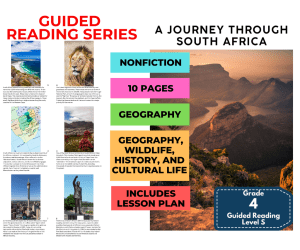
Journey Through South Africa: Guided Reading Level S with Lesson Plan
ELA, Resources for Teachers, Reading Comprehension, Reading, Science, Geography, Social Studies, History, Life Sciences, Government, Grade 3, 4, 5, Worksheets & Printables, Worksheets, Teacher Tools, Centers, Activities, Literacy Readers, Quizzes, Quizzes and Tests, Assessments, Lesson Plans
This A Journey Through South Africa (level s) guided reading book with lesson plan includes: Guided Reading Color Label (front cover x1) This is a quick way to match the book’s demands to what students can generally handle.. The overall goal is to use the level/color to pick books for several smaller groups. To qualify for a certain level, a student is expected to read a book from that level with about 90–94% accuracy. If a student is consistently accurate and understands, move up a level. If the student is struggling at that level, drop down and add more support. Each student will improve at completely different rates, but it is generally one of the best ways to check progress across the class. DOWNLOAD THE CATALOG TO VIEW ALL GUIDED READING BOOKS AVAILABLE (SORTED LEVELS A-Z) Pre-Reading Question (x1) Teacher asks the prompt aloud, can be while showing the cover or first page. Students share what they already know, or make educated guesses from the cover. Prompt them to use the target vocabulary. Write some of their responses on the board to look back at during the reading. Vocabulary Words (x5) Introduce the five words, best doing it one at a time. Start by saying it, while students repeat and then see if anyone knows what it means before reading further. Read through the meaning and try to briefly connect each word to a picture or gesture so it’s meaningful. Ask students to flip through the book pages and point to where they see each of the vocabulary words. While reading the book pause upon coming across one of the vocab words or read the sentence twice to make sure students understand the word has appeared. Optional: Ask students to raise hands whenever they see/hear one of the new words. Guided Reading Pages (x10) Check the book snapshot (below) for: primary topic - do you need to prep extra reading or intro materials on this? what is taught best - decide on 1-2 bullets to focus on, use the prompt or words provided here for best results. learning goals - what you are checking for students to be able to do after the session, elicit answers using prompts or words provided. key vocabulary (see section above). questions overview - so you know what is coming up and if you need to prep extra materials to assist understanding. Run the lesson You may have already looked at a few of the pages together, but you can show them some of the pictures again first to set meaning. Depending on how much time you have and how familiar your students are with guided reading class, you may want to read the book aloud first with the group first. Students whisper or partner read, while you listen in. If time, do it as a group, one student reading a page each. Use the guided page’s prompts to coach: “Check the picture / does it make sense?” “Point under the words / try the first sound” “Reread the sentence smoothly”. Try to focus more on one student per session (rotating every time), so you can work out if they are ready to move up or need to move down a level. Comprehension Questions (back cover x3) This is your way to check that students didn’t just say the words, but actually understood the text. First, let students answer by pointing to the page/picture and saying a short sentence. After any answer, follow with: “Show me where you found that in the text.” In bigger groups, have partners answer first (10–20 seconds), then call on 2–3 students to share. Differentiation tips: Emerging speakers/struggling readers: oral + pointing On-level: oral in a full sentence Higher: one written sentence or draw + label Book Snapshot Title: A Journey Through South Africa Genre: Nonfiction Subject: Social Studies (Geography/Culture/History) Primary Topic: South Africa’s geography, wildlife, history, and cultural life Estimated Guided Reading Level (A–Z): S What This Book Teaches Best Country overview and civics detail: South Africa’s location at Africa’s southernmost tip and its unusual system of three capital cities (Pretoria, Cape Town, Bloemfontein). Landforms and unique plant life: Table Mountain as a major landmark and part of a national park with many plant species found nowhere else. Habitats, wildlife, and conservation: Coastal habitats (including African penguins) and inland grasslands/savannas connected to the “Big Five” and protection of animals and environments. Modern cities and historical change: Johannesburg’s growth after gold discovery and South Africa’s journey from apartheid toward equality and democracy through Nelson Mandela’s leadership. Culture and identity through arts and community life: Traditions, music, and dance (Zulu and Xhosa) plus artistic expression like Ndebele painting and beadwork with special meanings. Learning Goals Students will identify South Africa’s three capital cities and explain each city’s role as described in the text. Students will describe two natural features or habitats in South Africa (for example, Table Mountain or the coastline) using details from the text. Students will explain how the text describes South Africa’s coastline and name the oceans it includes. Students will describe the inland grasslands and savannas and identify animals included in the text’s “Big Five.” Students will explain what apartheid was and describe how the text says South Africa moved toward equality and democracy. Students will describe at least two examples of South African culture or identity from the text (music/dance, art/beadwork, sports, or national symbols). Key Vocabulary From the Text southernmost — farthest to the south. administrative — related to running a government or system. savannas — wide grassy areas with some trees. apartheid — unfair system that separated people by race. resilience — strength to recover and keep going. Discussion Prompts Pre-reading question: What do you think you will learn about South Africa’s people, places, and animals? Comprehension questions: What are the three capital cities of South Africa named in the text? Comprehension questions: Which two oceans does the text say border South Africa’s coastline? Comprehension questions: What is the name of the system that separated people by race in South Africa? Printing Tips 1. Best Printing Method (Recommended) “Booklet” Printing (Best if Available) If your printer or PDF viewer supports Booklet Printing , use this. Settings to use: Print mode: Booklet Paper size: Letter or A4 (either works) Orientation: Landscape Print on both sides: Yes Flip on: Short edge Scaling: Fit to printable area Booklet subset: First test: Front sides only Then: Back sides only This will automatically: Pair pages correctly Put the cover on the outside Align everything for folding After printing, fold in half and staple along the spine . 2. If “Booklet” Printing Is NOT Available You can still print this correctly with manual duplex printing . Step-by-step: Open the PDF. Choose Print . Set: Orientation: Landscape Pages per sheet: 1 Print on both sides: Yes Flip on: Short edge Print all pages . Because each PDF page already contains two facing book pages, the result will still fold cleanly into a book. Thousands of Cored Education products are included with your TeachSimple membership. Download links and encyclopedia index available here.
Author Cored Education
Rating
Tags Reading Comprehension, Reading Passages, Reading, Guided Reading, Guided Reading Lesson Plan, Guided Reading Activity, Pre-reading, Social Studies, Geography, History

Nonfiction Text Features: Index Lesson
ELA, Reading, Grade 1, 2, 3, 4, Teacher Tools, Lesson Plans
Introducing a Nonfiction Text Features: Index Lesson Engage your students with an interactive lesson that teaches them about indexes, an important nonfiction text feature. This resource aims to create concrete understanding through class discussions and hands-on practice. Over the course of the lesson, students will learn what an index is, why it is useful, and how to identify it within nonfiction texts. The slides incorporate discussions, think-pair-share opportunities, and activities that allow students to apply their new knowledge. Whether using this as an introduction or a review, the lesson is sure to reinforce this key concept. With customizable Google Slides, speaker notes, and ready-to-go student handouts, integrating this resource into your language arts or reading curriculum is seamless. Use it for whole-group teaching, small groups, or even independent practice. Suitable for grades 1-4. Expand your nonfiction text feature instruction with companion resources on captions, glossaries, tables of contents, titles, title pages, and more. Discover engaging interactive lessons that are teacher-created and classroom-tested.
Author Ezee 101
Tags Index, Vocabulary, Nonfiction, Text Features, Concept Development, Student Engagment, Interactive, Nonfiction Text Feature

A Crush Text: Full Lesson Plan w/ PowerPoints & Graphic Organizers
ELA, Reading, Grade 3, 4, 5, 6, Lesson Plans, Teacher Tools
A Crush Reading Lesson Plan Bundle for Grades 3-6 This comprehensive reading lesson plan bundle for the short story A Crush by Cynthia Rylant provides educators everything they need to teach the text. The resource includes a complete lesson plan, student worksheet, answer key, 15 graphic organizers , and 8 PowerPoint presentations to aid in analyzing the story. Teachers can use the materials for whole-class instruction, small group work, or independent assignments. The lesson supports teaching key English Language Arts standards like theme, plot, characterization, figurative language, and more in an engaging way. With multiple file types offered, the reading bundle offers flexibility for diverse classroom needs.
Author Quality Teaching Products
Tags Peer Evaluation, Short Story, A Crush, Symbolism Chart, Reading Lesson Plan

Let’s READ about ZEBRAS
ELA, Reading, Grade 3, 4, 5, Teacher Tools, Lesson Plans
Let's READ about ZEBRAS Let's READ about ZEBRAS is an authentic teaching resource, specifically designed for captivating students in Grade 3 through Grade 5. This comprehensive guide explores the intriguing world of zebras and serves as a pivotal resource for educators focusing on language arts and reading lessons. The resource uses non-fictional material and factual info to enhance children's understanding of the delightful animal kingdom. Zebra Texts This educational package provides two unique, captivating text passages focused on zebras: The zebra - Simpler vocabulary suitable for Grades 2 or 3 or upper elementary students with reading difficulties. Dearing Zebras - More complex sentences for Grade 4 learners or those at higher levels. Tackling Reading Comprehension Strategies Included in the Let’s READ about ZEBRAS bundle are different comprehension strategies noted in red letters on page three. These aim at not only improving understanding but also enhancing recognition and pronunciation skills among children, boosting their confidence level while reading. Inclusive Worksheets Activities Packets Besides these texts is a pack of five engaging worksheets teeming with activities that foster reading comprehension enhancement. These exercises help validate that teachers can gauge student progress effectively while learners can review at their individual pace. Versatile Teaching Ideas Proposal Over Four Days Periods . . . This PDF product proposes an assortment of teaching ideas meant to inspire creativity when delivering lesson plans over four days periods. The goal is to encourage engagement among all levels of readers both individually during whole group settings, optimizing its versatility! Conclusion . . . In essence, Let's READ about ZEBRAS is a blend of educational content poised on strengthening literacy among young learners and sparking their interest in wildlife exploration.
Author Teach To Heaven, Reoulita.com
Tags Zebras, Non-fiction, Reading Comprehension, Vocabulary, Teaching Resource
Out of the Woods | Figurative Language Activity | Micro-Learning Deck
ELA, Reading, Reading Comprehension, Grade 4, 5, 6, 7, Teacher Tools, Lesson Plans
Out of the Woods Figurative Language Learning Activity This informative PowerPoint resource allows educators to teach students about figurative language using the phrase "out of the woods." Through close reading of a passage with audio and a short video lesson, learners will comprehend the meaning of this common idiom. Educators can implement this resource in various ways - as a whole group introductory lesson on figurative language, a small group activity to reinforce comprehension, or even as a homework assignment for independent practice. The passage, comprehension questions, and quick write prompt provide a concise learning experience aimed at grades 4-7. This learning deck allows teachers to explore figurative language in an engaging way.
Author Teach Me This
Tags Figurative, Language, Out Of The Woods, Comprehension Lesson, Reading Activity
Cowboy Hats, Boots and Books Gr. K-2
ELA, Reading, Grade 1, Teacher Tools, Lesson Plans
Cowboy Hats, Boots and Books Gr. K-2 An exciting teaching resource offering enriched learning experiences for Kindergarten through 2nd-grade students. This product is specifically created for Language Arts with a core focus on Reading. Product Inclusions: Two big books and corresponding little books Patterns for student bookmaking Interactive songs and rebus chants Cowboy Clip Art: A fun feature that introduces students to different parts of a cowboy's attire. Cowpoke of the Day Bulletin Board: A tool designed to recognize outstanding contributions or participation during cowboy-themed class discussions. Literacy Contents: Big Book — Counting Cowboy, Little Book — Counting Cowboy, Big Book — One Good Cowboy Hat, Little Book— One Good Cowboy Hat. These contents stimulate children's interest in reading and enhance their numeracy skills by incorporating counting elements within the narratives. Cowboy-Themed Songs & Chants: Included in the product file can be used during whole group instruction or smaller study groups. Student Bookmaking Patterns: A feature that allows young learners to craft their miniature books from scratch. This comprehensive package comes in an easy-to-use PDF format available exclusively at TeachSimple.com, making it readily accessible online from public school classroom computers or hard-at-work homeschooling setups.
Author Classroom Complete Press
Tags PDF

ESL Lesson Plan on Fast Food
ELA, Reading, Reading Comprehension, Language Development, ESL, Writing, Creative Writing, Vocabulary, Grade 7, 8, 9, 10, 11, 12, Teacher Tools, Lesson Plans
ESL Lesson Plan on Fast Food This ESL EFL Lesson Plan on Fast Food (PDF Digital Lesson 14 slides + answer key) can be Great to help stimulate English Learning within Newcomers or any English as a Second Language Student. Ideal participants for this Activity are Foreign Languages Students at Middle School and early High School (teens). This Product can also be Great for ESL Centers Abroad and ESL Tutors or private teachers. This ESL EFL TESOL TEFL Lesson Plan on Fast Food can be more than great for intermediate, advanced English as a Second or Foreign Language Students. This Stimulating ESL EFL Lesson Plan on Fast Food (14 slides + Answer Keys in the last slide) includes: 1 Introduction to Fast Food 1 Warm-Up Picture Description ESL EFL TESOL Activity given of 3 scenes (boy who eats a burger and watches the TV at the same time, obese man "enjoying" his fast food and eating even more and two people dressed for running who eat a burger instead) 1 Listening comprehension Activity (with answers keys in the last slide) with QR Code-Linked YouTube Video 1 Writing Activity with 3 Essay Prompts (writing about your relation with fast food + writing about other issues with fast food + writing and argue some tips to balance fast food and healthy food) This ESL, EFL, TESOL, TEFL PDF Digital Teaching Resource Lesson Plan on Fast Food (14 slides + answer keys in the last slide) can be great for Intermediate Advanced English as a second or foreign language learners. Its aim is to make students exercise and improve their Listening comprehesion and Writing English as a second language Skills. Learning with Alan is a Brand New Teaching Resources Store whose aim is to help English as a Second or foreign Language Teachers, Educators and Tutors (be it online or offline) to achieve their teaching objectives while creating a fun and stimulating environment. Never Forget! Learning is fun, So should English! Always If you want to browse more of my PDF ESL, EFL, TESOL Teaching Resources, click here Learning with Alan!
Author Learning with Alan
Tags ESL, English, Lesson, Fast Food, Burger, Listening, Comprehension, Writing, Activity, Essay

High School Amphibians Reading Passage Bundle
ELA, Reading, Reading Comprehension, Science, Life Sciences, Animals, Biology, Resources for Teachers, High School, Homeschool Resources, Teacher Tools, Assessments, Worksheets & Printables, Writing Prompts, Quizzes and Tests, Rubrics, Lesson Plans
As a homeschool mom of a high schooler and a passionate resource creator, I know firsthand how challenging it can be to find engaging, rigorous science materials that truly captivate older learners. That exact struggle inspired me to design this comprehensive, High School Amphibians Reading Passage Bundle resource focused entirely on the fascinating biology of amphibians. Whether you are guiding your teenager through independent study or building a robust weekly science unit, this High School Amphibians Reading Passage Bundle resource transforms complex ecological concepts into clear, digestible learning milestones. Furthermore, my goal was to save you countless hours of planning by bundling an information-rich reading passage, extensive critical thinking prompts, note-taking sheets, academic vocabulary tools, and a complete assessment framework into one cohesive bundle. INCLUDED IN THIS RESOURCE: Comprehensive text covering amphibian biology and evolution. Analytical questions with paragraph-format answer keys. Forty terms with parts of speech, definitions, and quizzes. Detailed grading structures, scales, and complex rubrics. TOPICS COVERED: Gas exchange via permeable skin barriers. Thyroxine-driven developmental transformations. Predator-prey dynamics in global food webs. Chytrid fungi and anthropogenic extinction threats. Investing in this carefully curated High School Amphibians Reading Passage Bundle will elevate your high school science curriculum while bringing excitement back into your daily homeschool routine. By combining rigorous academic content with practical, time-saving printables and transparent rubrics, you can foster a genuine appreciation for evolutionary biology without the stress of heavy lesson planning. Truly, this resource bridges the gap between high-level scientific inquiry and accessible home education, ensuring both you and your teenager achieve academic success. Grab your copy today and watch your high schooler transform into a confident, scientifically literate steward of the natural world. If you and your students/homeschoolers enjoyed this resource, please leave a review. Thank you for your support! Tina - Big Easy Homeschooling Mom
Author Homeschool with Big Easy Homeschooling Mom
Rating
Tags Biology Lesson

Go Overboard | Figurative Language Activity | Micro-Learning Deck
ELA, Reading, Reading Comprehension, Grade 4, 5, 6, 7, Teacher Tools, Lesson Plans
Go Overboard Figurative Language Learning Activity This helpful resource allows upper elementary and middle school students to explore the figurative language term "go overboard" through an engaging, multi-sensory approach. Learners first watch an explanatory video breaking down the meaning of this nautical idiom. Next, they read or listen to a passage containing "go overboard" used in context, building comprehension of how this colorful phrase adds style and emotion to writing. Finally, students respond to what they learned by completing a quick write activity reflecting on the passage and applying their new knowledge of figurative language. This self-paced lesson can be used flexibly for whole class instruction, small groups, or independent learning to boost literacy skills.
Author Teach Me This
Tags Figurative, Language, Comprehension, Reading Lesson, Learning Deck