
Gradient of the tangent
PowerPoint presentation , 14 slides explaining to understand the meaning of the slope of a curve at a point.




248 resources
Explore sub-categories
4 sub-categories · 248 resources
PowerPoint presentation , 14 slides explaining to understand the meaning of the slope of a curve at a point.

A 12-slide PowerPoint presentation teaching high school calculus students how to find second, third, and higher-order derivatives, including notation and worked examples.
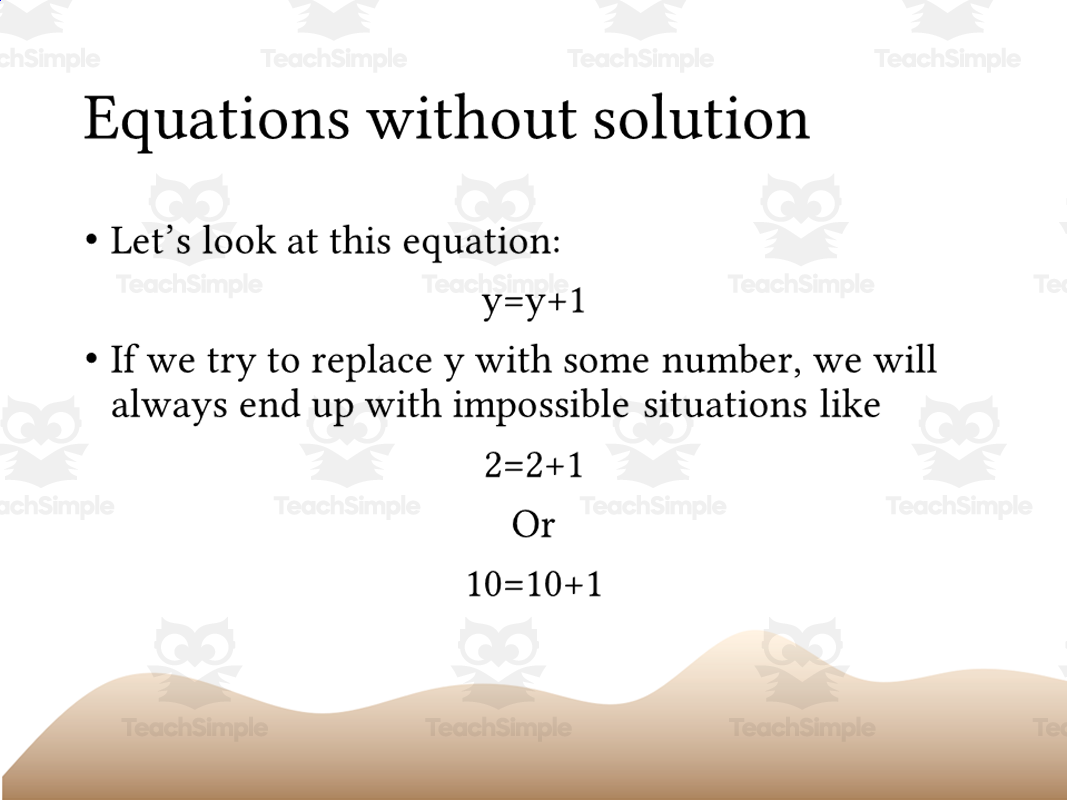
This PowerPoint presents equations without solutions and equations with infinite number of solutions. Course 8.EE .C.7.A
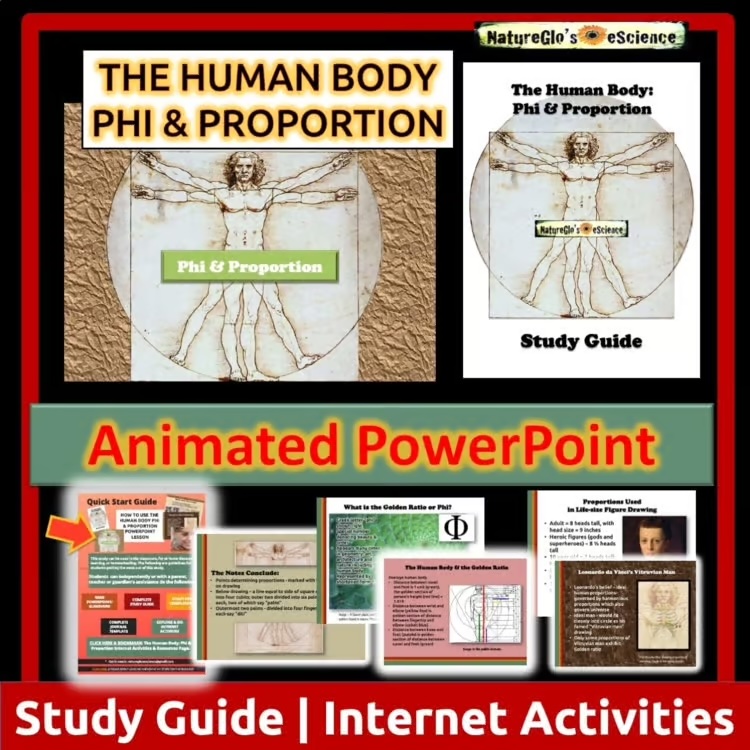
A math/interdisciplinary PowerPoint lesson exploring the Golden Ratio (Phi, 1.618) as it appears in the human body and in Leonardo da Vinci's Vitruvian Man, connecting math, art, and history.
PowerPoint presentation , explaining what happened when a limit goes to infinity clarifying the concept of infinite limits and the concept of vertical asymptote.

In this Intro to Logarithms Activity, high school students will begin think about the topic of logarithms in a simple way. Logarithms are so different than what students are used to, it can be a challenge to teach.

This presentation connects metric prefixes with models showing the factor-of-ten relationship between adjacent units. Worked examples lead students toward recognizing conversion patterns before they try further problems. Use the staircase as a reference at first, then ask students to explain the multiplication or division behind a conversion.

This is a 49 page PowerPoint which is a complete teaching lesson. This is a 5th grade lesson which covers the Common Core Standard: Measurement and Data 5.MD Convert like measurement units within a given meaurement system. 1.
A 25-slide PowerPoint lesson that teaches multiplying fractions both conceptually (using 'of' models, e.g. finding 1/4 of 1/2) and via the standard multiply-numerators/multiply-denominators algorithm, standard 5.NBT/5.NF.4a.

This is a 70 slide PowerPoint Lesson is for the introduction of zero and negative exponents. Students are given a step - by - step explanation for understanding fof the properties of zero and negative exponents.
PowerPoint presentation , 8 slides explaining to Understand the meaning of derivative function

Introduce limits with a rational function that is undefined at x = 1 but approaches 2. Students complete a calculator table before viewing the answers, then follow three worked examples using substitution, factoring and one-sided graph behavior. Compare approaching a value with evaluating the function at that value, and use the final example to explain why opposite infinite one-sided behavior gives no two-sided limit.

An introductory mini-lesson (video plus guided notes and a summary sheet) teaching the basics of exponent notation -- base, exponent, and the concept of repeated multiplication -- as a lead-in to a Laws of Exponents lesson series.

Lesson 1 of a Laws of Exponents series: a video-supported guided-notes lesson teaching the zero-exponent rule and the negative-exponent rule (moving powers across a fraction bar) and how to simplify expressions using both.
Lesson 2 of a Laws of Exponents series: a video-supported guided-notes lesson teaching the product rule (adding exponents of like bases when multiplying powers), including expressions with coefficients and multiple variables.

Lesson 3 of a Laws of Exponents series: a video-supported guided-notes lesson teaching the quotient rule (subtracting exponents of like bases when dividing powers), including expressions with coefficients and multiple variables and negative-exponent results.

If you are about to begin teaching Laws of Exponents to your math students, this is a great series of lessons that will guide and/or complement your instruction. This is Lesson 4: Power Rule.
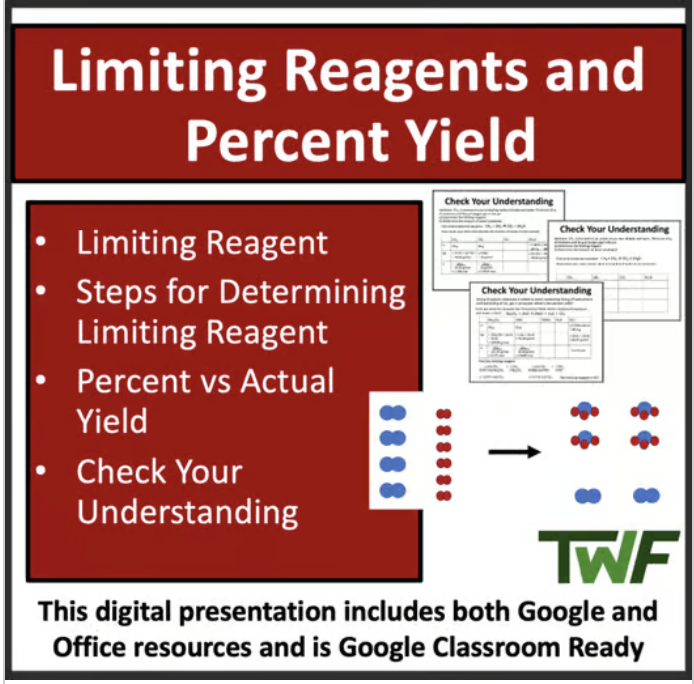
A senior chemistry lesson teaching limiting reagents, excess reagents, the steps for determining a limiting reagent, and percent vs. actual (theoretical) yield in stoichiometry.

The slides review exponential end behavior before working through limits at infinity, including expressions with polynomial exponents and exponential fractions. Worked examples show how to identify and factor a dominant term when direct evaluation is not enough. Use the sequence to connect symbolic manipulation with the behavior of a function and its possible horizontal asymptote.

PowerPoint presentation , 13 slides explaining how to calculate the limit of polynomial functions, as the function approaches either to positive or negative infinity.
Title: Limits at Infinity - Transcendental Functions Developed carefully for high school teachers, particularly those instructing Grades 10 through 12, the resource Limits at Infinity - Transcendental Functions is designed to help…

Linear vs Nonlinear Functions PowerPoint for Math Course 8.F.A.3 An unexceptional teaching resource for Grade 8 educators, focusing on the enthralling sphere of functions, particularly linear and nonlinear variants.
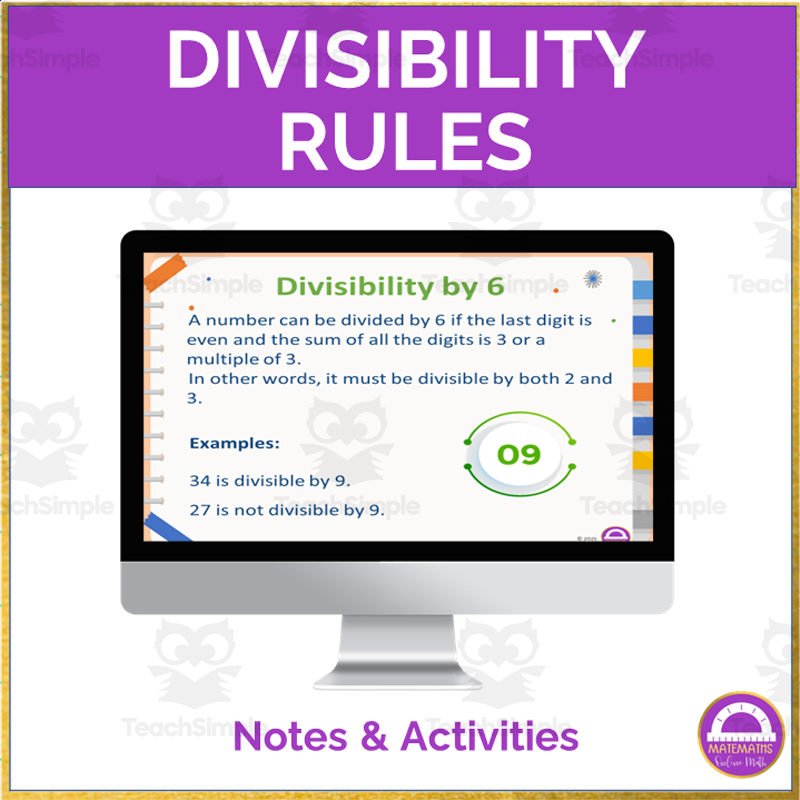
Discover a comprehensive and dynamic educational experience that will empower your students to master the intricate world of divisibility rules.

Math: Mesopotamia Thematic Unit is a great resource for students to explore early Babylonian mathematics!