resources by type
resources by grade
resources by subject
other resources

3,924 products added recently

Page 34 - Quizzes by Subject

Quizzes By Subject provide targeted assessments aligned with specific areas of study. Whether you teach math, science, language arts, social studies, or other subjects, you'll find quizzes designed to evaluate key concepts and skills within your curriculum. These specialized quizzes allow for precise measurement of student understanding, enabling you to tailor your teaching strategies accordingly. Incorporating subject-specific quizzes ensures that your assessments are relevant and supportive of your educational objectives.

Relevant
alt down
Any Time
alt down
filter by
alt down
All File Types
alt down
filter nav Show filters
Sort by: Relevant
CLEAR
resources by type
Activities
down arrow
Classroom Decor
down arrow
Teacher Tools
up arrow
Anchor Charts
Assessments
Charts
DBQ's
Diagrams
Graphic Organizers
Lesson Plans
Literacy Readers
Outlines
Presentations
Quizzes and Tests
up arrow
Quizzes
Tests
Rubrics
Templates
Worksheets & Printables
down arrow
resources by grade
Early Learning
down arrow
Pre-K
down arrow
Elementary
down arrow
Middle School
down arrow
High School
down arrow
Adult Education
Not Grade Specific
resources by subject
Creative Arts
down arrow
ELA
down arrow
Holiday & Seasonal
down arrow
Life Studies
down arrow
Math
down arrow
P.E. & Health
down arrow
Social Studies
down arrow
Special Resources
down arrow
Science
down arrow
Foreign Languages
down arrow
Resources for Teachers
down arrow
other resources
Common Core
Homeschool Resources
down arrow
Montessori
Research
STEM
Integer Fluency Quizzes

Integer Fluency Quizzes
, Grade 7, Quizzes, Quizzes and Tests, Teacher Tools

Use these quizzes weekly to keep your students' integer skills sharp! Each quiz contains a mix of all four operations with positive and negative integers.

Author The Math Cafe

Tags Integers, Quiz, Fluency

UK/Aus English Pronouns Practice Questions - Year 6-7 (PPT)

UK/Aus English Pronouns Practice Questions - Year 6-7 (PPT)
ELA, Language Development, ESL, Grammar, Common Core, Resources for Teachers, Grade 5, 6, 7, Quizzes and Tests, Teacher Tools, Tests, Assessments, Activities, Quizzes, Presentations

THIS IS THE UK/AUS ENGLISH SPELLING VERSION. CHECK THE CATALOG FOR THE ORIGINAL AMERICAN ENGLISH VERSION. Pronouns Grammar Practice MCQS ELA MCQS Overview: In this series of lessons, students will embark on an engaging journey to explore the grammar skills that make our language vibrant and expressive. These lessons are crafted to help students identify, comprehend, and effectively apply language arts skills in both writing and speech. This UK/Aus English version is especially useful for schools, teachers, and families working with British-based spelling and language conventions. It is a helpful option for classrooms using UK curriculum expectations, international programmes influenced by British English, or any setting where learners need to practise the correct capitalisation and punctuation forms for that version of English. Pronouns Overview: Includes: Indefinite Pronouns Intensive Pronouns Interrogative Pronouns Reflexive Pronouns Relative Pronouns PPT Version This is the PPT editable and interactive version. There is a fillable answer sheet at the end. This download is available in GOOGLE Docs, GOOGLE Forms, GOOGLE Slides. PDF, PPT, WORD, check the links below for more details. FULL CATALOG OF DOWNLOAD LINKS HERE ELA Review Questions Overview Each review test includes three answer choices for every question, which helps keep things simple and manageable for students. The layout is clear and easy to follow, so students can focus on the questions instead of figuring out what to do. A few pictures are included on each test to make the pages feel a little more inviting and less overwhelming. A review sheet is also included, giving students a chance to go back over many of the main skills covered in the resource. Introduction or Example Sheet Each topic comes with an introduction or example sheet to look at before students begin. This gives students a clear starting point and helps them feel more prepared. It also lets them see what to expect before moving into the main work. For many students, it is a helpful way to quickly refresh the key ideas before they start practicing on their own. Full Answer Keys Full answer keys are included to make marking and checking work faster and easier. Sample responses are also provided where needed, especially for open-ended tasks. This can be a real time-saver on busy days and makes the resource more practical to use. Everything is there to help make planning, teaching, and checking student work feel a little more straightforward. For More Like This For similar downloads and other frees, do check out Cored Group on TeachSimple.

Author Cored Education

Rating

Tags Elementary, Answers, Ccss, Common Core, Grammar, Tests, Test Prep, Assessment, Grade 5, Grade 6

Area & Circumference of Circles QUIZ

Area & Circumference of Circles QUIZ
Math, Geometry, Grade 7, Quizzes, Quizzes and Tests, Teacher Tools

This resource was developed to meet the requirements of the 7th Grade Geometry Standard below: CCSS.MATH.CONTENT.7.G.B.4 Know the formulas for the area and circumference of a circle and use them to solve problems; give an informal derivation of the relationship between the circumference and area of a circle.

Author The Math Cafe

Tags Circles, Quiz, Google Forms, Circles Test

Rigid Motions and Congruence - Digital Quiz

Rigid Motions and Congruence - Digital Quiz
Math, Geometry, Grade 8, Quizzes, Quizzes and Tests, Teacher Tools

Are you a middle school math teacher during distance learning? Thisself graded, digital middle school math quiz is perfect for your paperless, digital classroom. It will seriously make your life easier and you'll be giving instant feedback to students. This is a Google Form. You can use this digital math quiz for practice, homework, math centers , pre-tests, post-tests, quizzes, or for other activities that you decide on for your students. I teach grades 6 and 8 math, and I've used these resources both during distance learning and in a regular, face-to-face classroom. This resource is completely editable and comes with 1 quiz version. Make sure to check out the preview to make sure this product is right for you. Math Content Note: This quiz is about rigid motions and congruence This is a fairly basic, lower-level quiz Great for students learning English Great for students with IEPs References translations, reflections, rotations, and dilations. (Dilations are used as non-examples of rigid motions.) Uses the congruence symbol, the angle symbol, and the triangle symbol. PLEASE READ! This is a digital-only resource. Youcannot print these activitiesand use them as a paper-pencil activities.

Author Sheltered Language Resources

Tags Digital Math Quiz, Math Assessment, Geometry Quiz, Rigid Motions, Congruence

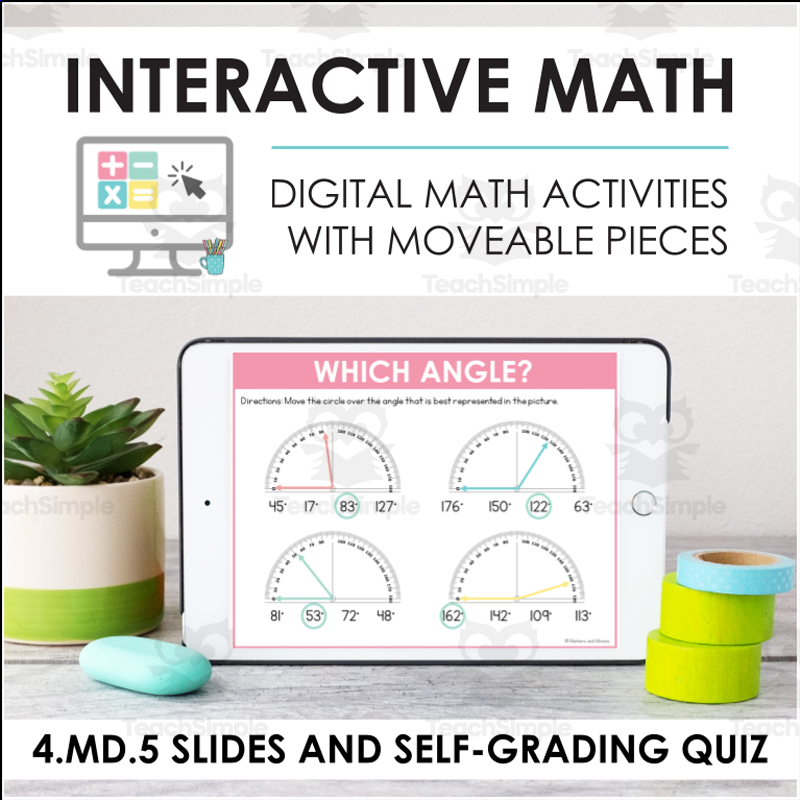
Digital Math for 4.MD.5 - Understand and Measure Angles (Slides + Self-Grading Quiz)

Digital Math for 4.MD.5 - Understand and Measure Angles (Slides + Self-Grading Quiz)
Math, Measurements, Grade 4, Quizzes, Quizzes and Tests, Teacher Tools

Digital Math for 4.MD.5 - Understand and Measure Angles A practical, user-friendly tool designed specifically for educators. This comprehensive teaching aid offers innovative approaches to reinforce the understanding and measurement of angles, following the 4.MD.5 standard. It's suitable for Grade 4 students who are studying mathematics, particularly with a focus on measurements. Features of this Resource Interactive digital slides: These math lessons integrate technology into the learning process through digital slides available in both PowerPoint and Google Slides formats. The dynamic slide content engages students with fun drag-and-drop activities and image sorting exercises that help illustrate mathematical concepts visually. Paperless resource: Requiring zero physical preparation, this resource is ideal for any learning environment - from in-person classrooms to virtual sessions via Google Classroom. Serves multiple purposes: These interactive slides are versatile teaching aids that can serve as review materials before exams or additional practice after regular lectures, assisting both group classes or independent learners at home schools. This product also includes an accompanying self-grading quiz hosted on Google Forms. Immediate feedback makes it easier for teachers to evaluate student comprehension relative to angle measurements. Balancing Instruction Delivery Styles Across Diverse Learning Contexts The Digital Math solution for 4.MD.5 - Understandable and Measurable Angles (Slides + Self-Grading Quiz), brings about a balance between instruction delivery styles across various learning contexts including traditional classroom environments as well as modern remote-learning options thus aligning with demands of 21st-century education without compromising teaching quality.

Author Markers and Minions

Tags Interactive Slides, Digital Math, Angle Measurement, Formative Assessment, Teaching Aid

Benjamin Franklin's Notebook of Virtues: Social Studies Passage (Docs)

Benjamin Franklin's Notebook of Virtues: Social Studies Passage (Docs)
ELA, Reading, Reading Comprehension, Strategies, Resources for Teachers, Social Studies, History, History: USA, Grade 6, 7, 8, 9, Writing Prompts, Worksheets & Printables, Centers, Activities, Teacher Tools, Assessments, Quizzes and Tests, Quizzes, Tests

Benjamin Franklin's Notebook of Virtues: Social Studies Reading Comprehension Passage (Docs) This resource introduces a unique Social Studies reading comprehension passage with questions about Benjamin Franklin's Notebook of Virtues. The passage is carefully designed to bridge the gap between social studies and literacy through strengthening reading comprehension and sparking knowledge curiosity in middle school students. Each passage blends English Language Arts skills with accurate social studies content . Ideal for interdisciplinary learning in ELA and Social Studies. Suitable for Grade 9 review, too! Student Tasks throughout the passage: 5 multiple-choice questions targeting the following skills: main idea, key details, inference, vocabulary in context, and use of evidence 5 vocabulary matching items with clear, student-friendly definitions 5 text-based questions that require citing specific lines or facts 1 summary prompt that asks students to condense central ideas accurately Full answer key for every section Available Formats for this Resource: PDF Fillable PDF Word Docs FULL CATALOG OF DOWNLOADING LINKS HERE Social Studies Reading Comprehension Collection Links: 1. Ancient Civilizations PDF Fillable PDF Word Docs Google Docs 2. Early Empires and Trade Networks PDF Fillable PDF Word Docs Google Docs 3. The Founding of the United States PDF Fillable PDF Word Docs Google Docs 4. Language, Culture, and Meaning PDF Fillable PDF Word Docs Google Docs 5. Psychology and Society PDF Fillable PDF Word Docs Google Docs 6. Global Festivals and Traditions PDF Fillable PDF Word Docs Google Docs 7. Extreme Environments and People PDF Fillable PDF Word Docs Google Docs 8. Food, Culture, and Preservation PDF Fillable PDF Word Docs Google Docs 9. Global Food Customs PDF Fillable PDF Word Docs Google Docs 10. Media, Communication, and Popular Culture PDF Fillable PDF Word Docs Google Docs 11. Human Impact on the Environment PDF Fillable PDF Word Docs Google Docs 12. Civic Action and Social Change PDF Fillable PDF Word Docs Google Docs 13. Fashion, Society, and Power PDF Fillable PDF Word Docs Google Docs 14. People, Places, and Unusual Histories PDF Fillable PDF Word Docs Google Docs Product Details: Length: 4 pages Grades: 6–8, also suitable for Grade 9 review Use cases: close reading, stations, homework, intervention, test prep, and sub plans Why Teachers Choose This Passage: Authentic social studies content paired with rigorous literacy practice Consistent task structure for easier planning and smoother student routines Clear, age-appropriate writing that builds confidence without oversimplifying Use this passage to reinforce ELA skills in social studies, to add literacy to your lessons, and to support independent work. The passage strengthens main idea, evidence use, vocabulary in context, inference, cause and effect, and summary writing. With ready-to-use assessments and complete answer keys, you can provide focused practice that is simple to run and fast to review.

Author Middle & High School - CORED Education

Rating

Tags Middle School, Reading Comprehension, Reading Strategies, ELA, Centers, Reading Passage, Assessments, Vocabulary, Social Studies, US HISTORY

Gr 4 and 5 Math: Adding and Subtracting Decimals Quiz and Project

Gr 4 and 5 Math: Adding and Subtracting Decimals Quiz and Project
Math, Addition and Subtraction, Addition, Subtraction, Decimals, Grade 4, 5, 6, Quizzes, Quizzes and Tests, Teacher Tools

This download is two items in one! It's perfect for your 4th Grade or 5th Grade math unit on adding and subtracting decimals to the thousandths. 1) The easy-to-use assessment/quiz requires students to estimate before calculating addition and subtraction of decimals to the thousandths. It’s quick and simple to mark out of 20 using the included answer key! I use this piece as a simple artifact to include in my students' math portfolios and to show parents during conferences. 2) The project allows students to plan a 5-day road trip including: o Calculating how much gas they need and how much it will cost (using metric: litres and km). o Finding hotels and calculating the total price per night including taxes. o Finding attractions to visit on the way. o Determining how much to spend on food on the 5-day trip. Grades to Use With: This product is designed for students in Grades 4 and 5 who are learning about decimal operations. It meets standards in both the USA and British Columbia, Canada for Grade 5 students. It could also be used as a review in Grade 6 classes or in middle school special education classrooms. How to Use: 1) I use the assessment at the end of a unit when students are comfortable with lining up decimals to add and subtract. There are some tricky questions where students need to add zeros after the last digit of a number. 2) I use the project over a couple of independent work periods. Students will need access to the internet to research distances, hotels, and attractions. You could also assess the project to see your students' comprehension. What's Included: 6 Page PDF Title Page Decimal Quiz Answer Key 3 Page Road Trip Project with tables and prompts If you enjoy this upper elementary math product, please check many others in my store!

Author Grace Under Pressure

Tags 4th Grade Math, 5th Grade Math, Adding Decmials, Subtracting Decimals, Decimal Operations, Thousandths, Math Project, Real Life Math, Math Quiz

Who Has It? – Chemical Elements Game (1–118) – 3 Levels of Differentia

Who Has It? – Chemical Elements Game (1–118) – 3 Levels of Differentia
STEM, Science, Chemistry, Physics, Life Sciences, Earth and Environmental Sciences, Basic Science, Special Resources, Social Emotional Learning (SEL), Special Education Needs (SEN), Homeschool Templates, Grade 6, 7, 8, 9, 10, 11, Activities, Games, Worksheets & Printables, Task Cards, Quizzes and Tests, Teacher Tools, Quizzes, Worksheets, Projects, Flashcards

Who Has It? – Chemical Elements Game (1–118) – 3 Levels of Differentiation A cooperative chemistry card game for grades 7–10 to review atomic numbers, element names, and symbols 🧪🎯 This resource is a classroom game that helps students become more confident with the chemical elements – from hydrogen to oganesson. The game follows the well-known “I have… who has?” format and is designed to reinforce students’ understanding of element names, symbols, and atomic numbers in a playful and interactive way. To support different learning levels, the material includes three differentiated versions of the full game, each with 118 element cards: With element names for both question and answer (beginner level) Only the “I have…” part includes the name , the question uses the symbol/number (intermediate level) Without element names – players must match based on symbol and atomic number alone (advanced level) Each version builds on the last and can be used flexibly depending on students' prior knowledge. The game works best with medium to large groups and encourages students to listen carefully, stay engaged, and support one another. What’s included: 3 full card sets (118 cards per set = 354 total) Differentiated by content and level of language support Clear instructions for printing, laminating, and use Ideal for individual, pair, or group work How I use it in class: I’ve played this game both at the end of a chemistry unit and as a fun opener when starting the periodic table. It’s also perfect for substitute lessons or for classes with mixed ability levels. Since each student needs to be ready when their card comes up, it fosters attention and collaboration. This is one of those games where learning happens almost by accident – students are so focused on playing that they internalize atomic numbers and symbols without even noticing. A simple, engaging way to bring structure, repetition, and movement into chemistry class – no extra prep needed. If you're looking for an easy way to help students become more confident with the periodic table, this might be worth trying in your classroom. Best, Heike from Lernfitness Did You Know? I teach with a certified therapy dog, and together we create a positive and welcoming learning environment. 🐶

Author Lernfitness

Rating

Tags Game, Educational Card Games, Chemistry, Physics, STEM Science Matching Game, Chemical Elements, Periodic Table Matching Game, Who Has It, STEM, Who Has It?

Digital Math for 3rd Grade MD Standards - (BUNDLE of Slides + Self-Grading Quiz)

Digital Math for 3rd Grade MD Standards - (BUNDLE of Slides + Self-Grading Quiz)
Math, Measurements, Grade 3, Quizzes, Quizzes and Tests, Teacher Tools

Interactive Math Slides provide review, practice, and enrichment in an engaging and meaningful way. These interactive slides are fully digital, providing you with paperless, no-prep resources! The mathematical concepts are represented visually as students will drag, drop, and sort images. A self-grading Google Forms quiz is also included for each standard as a follow-up that will provide you with valuable data. This is perfect for assigning in your virtual classroom! This bundle includes all of the digital, interactive math slides for the 3.MD.1 - 3.MD.8 standards in both PowerPoint and Google Slides formats. The Google Slides version is easy to assign on Google Classroom, and there are instructions included that will help you assign either the entire file or select slides at a time. There is also a Google Forms quiz that self-grades and assesses students on the standard.

Author Markers and Minions

Tags Telling Time, Reading Clocks, Measurement, Lengths, Math Bundle

Animal Skin, Cats, & T. Rex: SAMPLE Reading passage (PDF)
Free Download

Animal Skin, Cats, & T. Rex: SAMPLE Reading passage (PDF)
Science, ELA, Reading, Reading Comprehension, Strategies, Resources for Teachers, Life Sciences, Animals, Insects, Nature & Plants, Grade 6, 7, 8, 9, Writing Prompts, Worksheets & Printables, Centers, Activities, Teacher Tools, Assessments, Quizzes and Tests, Quizzes, Tests

This is a ONE PASSAGE SAMPLE. The following is the description of the FULL resource and the downloading links: Animal Skin, Cats, & T. Rex: Reading Comprehension Passages (PDF) This very engaging collection of life science reading passages about Animal Skin, Cats, & T. Rex is designed to bridge the gap between science and literacy through strengthening reading comprehension and sparking scientific curiosity in middle school students. Each passage blends English Language Arts skills with accurate science content that supports NGSS classroom practice. Ideal for interdisciplinary learning in ELA and Science. Suitable for Grade 9 review, too! What Is Included? There are (3) informational passages: Tyrannosaurus rex: The Tyrant Lizard King Step into the late Cretaceous and see T. rex up close, from its towering build and crushing bite to the clues fossils give about speed and feeding. CT scans, trackways, and healed injuries help scientists piece together how this predator lived. Cats and Sweetness: A Taste They Don’t Have A small change in a taste receptor means cats do not detect sugar. This trait fits a meat-first diet and helps explain why scent, texture, fats, and proteins matter more than sweetness. Animal Skin: A Tool for Survival Skin works as armor, thermostat, camouflage, warning, and display. Examples include the hippo’s natural sunscreen, zebra stripes that confuse attackers, and king snakes that copy coral snake colors to stay safe. Student Tasks for Each Passage: 5 multiple-choice questions targeting main idea, key details, inference, vocabulary in context, and use of evidence 5 vocabulary matching items with clear, student-friendly definitions 5 text-based questions that require citing specific lines or facts 1 summary prompt that asks students to condense central ideas accurately Full answer key for every section Available Formats for this Resource Word Docs Google Docs FULL CATALOG OF DOWNLOADING LINKS HERE Other Science Reading Collections and Topics You May Find in the Store: 1. Astronomy & Space Science 2. Volcanoes, Rocks, & Mountains 3. Rock Cycle, Soil, & Sinkholes 4. Mars, Glaciers, & Antarctica 5. Water Cycle, Acid Rain, & Wastewater 6. Insects, Animals, & Ecosystems 7. Bioluminescence & Insects 8. Animal Skin, Cats, & T. Rex 9. Human Body and Senses 10. Health & Applied Bioscience 11. Waves, Light, & Imaging 12. Electricity & Energy 13. Motion & Materials 14. Chemistry and Materials Science 15. Electromagnetism 16. Acids and Bases 17. Gas Laws 18. Biotechnology 19. Periodic Trends 20. Protists and Fungi 21. Microevolution 22. Blood 23. Chemical Bonding 24. Magnets 25. Muscles 26. Nuclear Chemistry 27. Electromagnetic Devices 28. Epigenetics 29. The Law of Conservation of Mass 30. Atomic Models 31. Isotopes and Ions 32. Light 33. Human-Environment Interaction 34. Theory of Evolution 35. Photosynthesis 36. Origins of Life and Early Earth 37. Gene Expression and Regulation 38. Thermochemistry 39. Allergies 40. Coevolution 41. Birth to Adulthood 42. Cells 43. Entropy and Free Energy 44. The Human Brain 45. Mixtures and Solutions 46. Invertebrates 47. Zoo Animals 48. Biochemistry 49. Animal Behavior 50. Population Ecology ...and many more engaging science reading passages that cover intriguing and important topics designed to spark curiosity and support student learning. Product Details Length: 1e pages total Grades: 6–8, also suitable for Grade 9 review Use cases: close reading, stations, homework, intervention, test prep, and sub plans Standards support: reinforces informational-text skills and supports NGSS-style sense making through observation, modeling, and clear use of claim, evidence, and reasoning Why Teachers Choose This Set Authentic science content paired with rigorous literacy practice Consistent task structure across all passages for easier planning and smoother student routines Clear, age-appropriate writing that builds confidence without oversimplifying Use this set to reinforce ELA skills in science, to add literacy to your lessons, or to support independent work. The passages strengthen main idea, evidence use, vocabulary in context, inference, cause and effect, and summary writing. With ready-to-use assessments and complete answer keys, you can provide focused practice that is simple to run and fast to review.

Author Middle & High School - CORED Education

Rating

Tags Middle School, Reading Comprehension, Reading Strategies, ELA, Centers, Reading Passage, Assessments, Vocabulary, Life Science, Dinosaurs

CATEGORY VOCABULARY WORD GAMES | ANAGRAM WORDSEARCH MATCHING QUIZ CARDS | FRUITS

CATEGORY VOCABULARY WORD GAMES | ANAGRAM WORDSEARCH MATCHING QUIZ CARDS | FRUITS
ELA, Language Development, Vocabulary, Preschool, Grade 1, 2, Quizzes, Quizzes and Tests, Teacher Tools

Category Vocabulary Word Games: A fruity resource for improving language skills through an array of interactive games and activities. Suitable for kindergarten to grade 2 students. Main Features: Language Arts focused, specifically on Vocabulary. Crafted with colorful illustration images. Includes worksheets in two variations: With headers: Includes title/name/date. Without headers: For tailored usage based on teaching needs or style. Covers capitalization rules through the inclusion of a capital letters version for each game . Multipurpose Usage: This 33-page PDF can be incorporated into various scenarios, including: In-class learning sessions:Can be used in both whole group and small group sessions. This versatility helps promote collective learning and facilitate focused discussion & collaborative problem-solving efforts respectively. \n \nIdeal for early birds as morning drills too! \n\n \n Distribute as homework assignments:Promotes home-based challenge games. > > > Additional Support: Each sheet from this bundle includes answer keys, helping educators monitor student progression while providing instant feedback for learners. \n\n \n\n \n&#169; 2023 by Digital Learning. Championship Partner.\n </tdanttqueen.\n/fontareter valid Capsule thought: "Embrace this comprehensive toolkit uniquely fashioned around fruits theme— infusing education with playfulness while empowering young minds’ language competency journey!",

Author WORDS ASIDE

Tags Vocabulary Games, Language Skills, Interactive Worksheets, Educational Resources, Fruit Theme, Vocabulary Matching Quiz

Physical Science Reading Comprehension Passage: Gas Laws (PDF)

Physical Science Reading Comprehension Passage: Gas Laws (PDF)
Science, ELA, Reading, Reading Comprehension, Strategies, Resources for Teachers, Chemistry, Physics, Grade 6, 7, 8, 9, Writing Prompts, Worksheets & Printables, Centers, Activities, Teacher Tools, Assessments, Quizzes and Tests, Quizzes, Tests

Physical Science Reading Comprehension Passage and Questions: Gas Laws (PDF) This very engaging science reading passage is about gas laws and how gases respond to changes in temperature, pressure, and volume . It explains that gas particles are always moving and create pressure when they collide with the surfaces of a container. The passage introduces Boyle’s Law, Charles’s Law, and Gay-Lussac’s Law through familiar examples such as squeezed balloons, cold car tires, sealed soda cans in the sun, and hot air balloons. It also explains why gas laws are useful in real life, including in tire pressure, pressurized containers, aviation, balloon operation, and medical equipment such as ventilators. This passage is designed to bridge the gap between science and literacy by strengthening reading comprehension while sparking scientific curiosity in middle school students. It blends English Language Arts skills with accurate science content, helping students build background knowledge, understand key concepts, use evidence from the text, and explain scientific ideas clearly. This resource supports science classroom practice while also reinforcing important literacy skills such as main idea, vocabulary, comprehension, and summarizing. Ideal for interdisciplinary learning in ELA and Science. Suitable for Grade 9 review, too! Student Tasks for The Passage: 10 multiple-choice questions targeting main idea, key details, science concepts, comparison, and real-world applications 10 True/False statements to check understanding and address common misconceptions 5 text-based short-answer questions that require students to explain important ideas from the passage 5 vocabulary matching items with clear, student-friendly definitions 1 summary prompt that asks students to condense the central ideas accurately Full answer key for every section Available Formats for this Resource Fillable PDF Word Docs Google Docs FULL CATALOG OF DOWNLOADING LINKS HERE Product Details Length: 7 pages total Grades: 6–8, also suitable for Grade 9 review Use cases: close reading, stations, homework, intervention, test prep, and sub plans Standards support: Reinforces informational-text skills and supports NGSS-style sense-making by helping students read scientific explanations, connect evidence to key concepts, interpret real-world examples, and explain cause-and-effect relationships in science. Why Teachers Choose This Set Authentic science content paired with rigorous literacy practice Consistent task structure across all passages for easier planning and smoother student routines Clear, age-appropriate writing that builds confidence without oversimplifying Other Science Reading Collections and Topics You May Find in the Store: 1. Astronomy &amp; Space Science 2. Volcanoes, Rocks, &amp; Mountains 3. Rock Cycle, Soil, &amp; Sinkholes 4. Mars, Glaciers, &amp; Antarctica 5. Water Cycle, Acid Rain, &amp; Wastewater 6. Insects, Animals, &amp; Ecosystems 7. Bioluminescence &amp; Insects 8. Animal Skin, Cats, &amp; T. Rex 9. Human Body and Senses 10. Health &amp; Applied Bioscience 11. Waves, Light, &amp; Imaging 12. Electricity &amp; Energy 13. Motion &amp; Materials 14. Chemistry and Materials Science 15. Electromagnetism 16. Acids and Bases 17. Gas Laws 18. Biotechnology 19. Periodic Trends 20. Protists and Fungi 21. Microevolution 22. Blood 23. Chemical Bonding 24. Magnets 25. Muscles 26. Nuclear Chemistry 27. Electromagnetic Devices 28. Epigenetics 29. The Law of Conservation of Mass 30. Atomic Models 31. Isotopes and Ions 32. Light 33. Human-Environment Interaction 34. Theory of Evolution 35. Photosynthesis 36. Origins of Life and Early Earth 37. Gene Expression and Regulation 38. Thermochemistry 39. Allergies 40. Coevolution 41. Birth to Adulthood 42. Cells 43. Entropy and Free Energy 44. The Human Brain 45. Mixtures and Solutions 46. Invertebrates 47. Zoo Animals 48. Biochemistry 49. Animal Behavior 50. Population Ecology ...and many more engaging science reading passages that cover intriguing and important topics designed to spark curiosity and support student learning. Use this passage to reinforce ELA skills in science, to add literacy to your lessons, and to support independent work. The passages strengthen main idea, evidence use, vocabulary in context, inference, cause and effect, and summary writing. With ready-to-use assessments and complete answer keys, you can provide focused practice that is simple to run and fast to review.

Author Middle & High School - CORED Education

Rating

Tags Middle School, Reading Comprehension, Reading Strategies, ELA, Centers, Reading Passage, Assessments, Vocabulary, Chemistry, Physical Science

Reading Comprehension for Science Articles – Critical Analysis

Reading Comprehension for Science Articles – Critical Analysis
Science, Basic Science, Inventors, Theories, Chemistry, Earth and Environmental Sciences, Earth Sciences, Environmental Science, Life Sciences, Nature & Plants, Grade 6, 7, 8, 9, 10, 11, 12, Worksheets & Printables, Workbooks, Worksheets, Word Searches, Teacher Tools, Assessments, Lesson Plans, Quizzes and Tests, Quizzes, Tests

This comprehensive literature unit on scientific article analysis will turn your students from being passive readers into critical thinkers! True scientific literacy—being able to evaluate evidence critically—has become the most important skill of our time due to the overwhelming amount of information and misinformation in today’s society. This unit is a complete, no-prep 5-day lesson plan that will help students in middle and high school understand how to break down scientific articles. With this unit’s help, students will learn how to look at methodological procedures; how to find biases; how to tell the difference between correlation and causation; and how to develop evidence-based arguments—all of which are necessary for success in AP classes, as well as in college! This unit is appropriate for the following classes: Biology, Chemistry, Environmental Science, Physics and as a cross-curricular project with ELA. This resource also correlates with the NGSS Science and Engineering Practices (Engaging in Argument Based on Evidence) and other Common Core Literacy standards. Included in this unit: 1. Educator &amp; Student Master Guide (47 pgs) : Part 1 consists of an in-depth detailed core instructional guide for teachers on Scientific Reading Theory. Core principles and concepts included: IMRAD (scientific structure) ; Hierarchy of Evidence ; Identifying Fallacies Part 2 consists of constructing 10 scaffolded, grade level appropriate worksheets using High-Interest/Relevant scientific reading materials. Examples include: Anatomy of an Abstract Isolation of Variable and Control Critique Methodology Interpret Data &amp; Statistical Literacy Correlation vs. Causation Identify Bias/Conflict of Interest Synthesize Competing Hypotheses Peer Review Simulation Part 3 consists of teacher support systems: 3 Visual Professional Anchor Charts/Posters (anatomy of a scientific argument, source credibility matrix, interrogating empirical graphics) Comprehensive Answer Key (all 10 worksheets) 5-Day Implementation/Teaching Plan: step-by-step plan to facilitate complete unit implementation successfully Will enable your students to read as scientists, question as reporters, and think as researchers; providing the necessary tools to assist in developing their confidence/skepticism towards the scientific world. How Parents and Schools Appreciate It: Teaches Skills for the 21st Century: Instead of teaching through rote memorization, this unit prepares students to learn to think critically. Students learn to use the problem-solving skills needed for success in college and their future career paths. Teaches Digital and Media Literacy: In this age of "fake news" and false claims, the unit provides students with tools to evaluate the credibility of scientific information they see online, including news headlines and social media posts. Prepares Students for Academic Challenge: The analytical skills that students develop (being able to analyze dense texts, understand research design, and base their opinion on credible evidence) give students a solid head-start into AP science classes and university studies. Comprehensive Teaching Tools for Teachers: The unit is a complete unit, and includes everything that teachers need to implement student learning. Each teacher will find all of the information and teaching materials necessary, along with a comprehensive teacher guide, ready-to-publish worksheets, visual aids, and answer key; which will save every teacher dozens of hours on the preparation and planning of each lesson. Audience: The Target Audience includes: Primary: Grades 8-12 Science (On Level); High School AP or Honors Biology; Chemistry; Environmental Science; Physics Secondary: Gifted or Advanced (Grades 6-7-Science), as the concepts may be difficult for Sixth-grade students who are not Advanced or Gifted; nevertheless, students classified as Advanced will do well. Cross-Curricular: High School ELA/ELA or Media Literacy planer interested in adding analysis of non-fictional/informational text to their plan. Copyright/Terms of Use: This Book is the property of Syed Hammad Rizvi, and it is provided as a resource for you to use in a personal and single classroom only. You cannot alter, redistribute or sell any part of this resource. Thereby, any part of this resource cannot be placed on the Internet where all can access (e.g., downloaded). If you would like to share this resource with colleagues, please purchase additional licenses from Teachsimple. Thank you for abiding by these terms. Syed Hammad Rizvi, thank you for bringing you (with a smile) this product.

Author Creative Book Store

Rating

Tags STEM, ScienceEducation, Education, Teaching, EdTech, STEMeducation, TeacherLife, Homeschool, BackToSchool, ScientificLiteracy

Angle Relationships in Parallel Lines NOTES, PRACTICE, QUIZ

Angle Relationships in Parallel Lines NOTES, PRACTICE, QUIZ
Math, Geometry, Grade 8, Quizzes, Quizzes and Tests, Teacher Tools

NOTE: Google Apps Options - Only the ASSESSMENTS and a few other specified activities have Google Apps options. This bundle is NOT ideal for "Distance Learning" unless you have special access to PDF editors that remove answer keys, etc. This resource was developed to partially meet the requirements of the 8th Grade Geometry standard below: CCSS.MATH.CONTENT.8.G.A.5 Use informal arguments to establish facts about the angle sum and exterior angle of triangles, about the angles created when parallel lines are cut by a transversal, and the angle-angle criterion for similarity of triangles

Author The Math Cafe

Tags Parallel Lines, Transversals, Notes, Practice, Quiz, Line And Angle Relationships Worksheets, Angle Relationships With Parallel Lines

Advanced Breathwork Patterns for Vagal Tone

Advanced Breathwork Patterns for Vagal Tone
Science, Life Sciences, Biology, Human Body, Physics, STEM, Special Resources, Life Skills, Social Emotional Learning (SEL), Special Education Needs (SEN), Homeschool Curriculum, Homeschool Templates, Grade 8, 9, 10, 11, 12, Worksheets & Printables, Workbooks, Worksheets, Word Searches, Teacher Tools, Lesson Plans, Quizzes and Tests, Quizzes, Tests, Assessments

Transform Student Stress into Focused Success with Science-Backed Breathwork! Are your high school students struggling with test anxiety, overwhelming stress, and an inability to focus? It's not just in their heads—it's in their biology. The modern academic landscape puts the adolescent nervous system in a constant state of "fight or flight," hijacking their ability to learn and perform. Introducing the Advanced Breathwork Patterns for Vagal Tone Curriculum —a revolutionary, science-based toolkit designed to empower students to take conscious control of their own physiology. This isn't just another mindfulness exercise; it's an applied neurobiology lesson that provides tangible, immediate results. This comprehensive 44-page digital PDF package moves beyond simple "calm down" instructions. It introduces Haptic Respiratory Pacing , a powerful method combining specific breathing protocols (like Box Breathing and the Physiological Sigh) with the kinesthetic act of tracing. This dual-coding mechanism anchors a student's focus, interrupts anxiety loops, and directly stimulates the vagus nerve to manually lower heart rate and calm the nervous system. What's Inside This Complete, "Done-For-You" Curriculum? PHASE 1: Core Content &amp; Theory (Educator/Student Guide): A deep dive into the "why" behind the techniques. This section explains the neurobiology of the stress response, the vagus nerve, and the mechanics of Box Breathing and the Physiological Sigh in clear, scientific terms. Perfect for engaging skeptical teens who want to know how it works. PHASE 2: Student Workbook (10 Rigorous Worksheets): A series of in-depth worksheets that blend academic learning with kinetic practice. Students will map neurobiological pathways, analyze data from their own heart rate, and apply these techniques to real-world scenarios like test-taking and athletic performance. PHASE 3: Visuals &amp; Teacher Resources: High-Fidelity Tracing Diagrams: Clean, printable visual guides for Box Breathing and the Physiological Sigh that students can trace with a finger or pen. Comprehensive Answer Key: A full answer key for every question in the student workbook, including model answers for open-ended questions. Rigorous Teacher Implementation Guide: A step-by-step guide on how to frame the lesson ("Hacking the Nervous System"), run a baseline data protocol to get student buy-in, and integrate the curriculum into different subjects. Trauma-Informed Considerations: Expert guidance on how to apply these techniques safely and effectively for all students. Empower your students with a lifelong skill to manage stress, improve focus, and master their emotional state. Download this resource today and bring the power of applied neuroscience into your classroom! Keywords: Social Emotional Learning (SEL), Stress Management, Anxiety Reduction, Test Anxiety, High School, Biology, Health, PE, School Counselor, Mindfulness, Breathwork, Vagus Nerve, Box Breathing, Physiological Sigh, Self-Regulation, Coping Skills, Neurobiology, Focus, Student Workbook, Digital Download, Printable. Why Parents/Schools Love It: Empowers Students with a Real-World Skill: This isn't just theory. It gives teens a practical, discreet tool they can use anywhere—before an exam, during a stressful social situation, or on the athletic field—to manage their own anxiety and improve performance. Science-Backed &amp; Data-Driven: The curriculum is grounded in real neurobiology, not abstract concepts. The included activities that have students measure their own heart rate provide concrete proof that the techniques work, ensuring high student engagement and buy-in. A Complete, Turnkey Solution: This 44-page PDF is a comprehensive, "plug-and-play" resource. It includes the theory, student worksheets, printable visuals, a full answer key, and a detailed implementation guide, saving teachers valuable prep time. Versatile and Easy to Integrate: The modules can be seamlessly integrated into various classes—Health, Biology, P.E., or even a 10-minute homeroom activity before a big school event. It directly supports school-wide Social-Emotional Learning (SEL) initiatives. Target Audience: Student Classes : Based on the sophisticated language, the scientific concepts, and the real-world examples (AP Calculus exams, athletic performance), target: Primary Target: Senior High School Students (Grades 10, 11, and 12). The content is perfectly matched for their cognitive level and the specific stressors they face. Secondary Target: Advanced 9th Graders in honors or gifted programs. Educators/Buyers: High School Health &amp; P.E. Teachers High School Biology &amp; Anatomy Teachers (excellent for a practical lab on the respiratory/nervous systems) School Counselors and Psychologists Test-Prep Coordinators and Tutors Homeroom/Advisory Teachers Copyright/Terms of Use: This Book was copyrighted by Syed Hammad Rizvi. This resource is for personal and single classroom use only. You may not alter, redistribute, or sell any part of this resource. In other words, you may not put it on the Internet where it could be publicly found and downloaded. If you want to share this resource with colleagues, please purchase additional licenses from Teachsimple. Thank you for respecting these terms of use. This product is happily brought to you by Syed Hammad Rizvi

Author Creative Book Store

Rating

Tags SEL, SocialEmotionalLearning, HighSchoolTeacher, StressManagement, AnxietyRelief, CopingSkills, VagusNerve, BoxBreathing, Neuroscience, ClassroomResources

Science Reading Comprehension Passage: Chemical Bonding (Docs)

Science Reading Comprehension Passage: Chemical Bonding (Docs)
Science, ELA, Reading, Reading Comprehension, Strategies, Resources for Teachers, Chemistry, Grade 6, 7, 8, 9, 10, Writing Prompts, Worksheets & Printables, Centers, Activities, Teacher Tools, Assessments, Quizzes and Tests, Quizzes, Tests

Science Reading Comprehension Passage and Questions: Chemical Bonding (Google Docs) This very engaging science reading passage is about chemical bonding and how atoms connect to form the materials people use every day . It explains how outer electrons influence bonding and introduces three major bond types: ionic bonds, covalent bonds, and metallic bonds. Students explore examples such as sodium chloride, water, copper wire, aluminum foil, and iron beams while learning how bonding affects properties such as conductivity, strength, flexibility, and reactivity. This passage is designed to bridge the gap between science and literacy by strengthening reading comprehension while sparking scientific curiosity in middle school students. It blends English Language Arts skills with accurate science content, helping students build background knowledge, understand key concepts, use evidence from the text, and explain scientific ideas clearly. This resource supports science classroom practice while also reinforcing important literacy skills such as main idea, vocabulary, comprehension, and summarizing. Ideal for interdisciplinary learning in ELA and Science. Suitable for Grade 9 review, too! Student Tasks for The Passage: 10 multiple-choice questions targeting main idea, key details, science concepts, comparison, and real-world applications 10 True/False statements to check understanding and address common misconceptions 5 text-based short-answer questions that require students to explain important ideas from the passage 5 vocabulary matching items with clear, student-friendly definitions 1 summary prompt that asks students to condense the central ideas accurately Full answer key for every section Available Formats for this Resource PDF Fillable PDF Word Docs FULL CATALOG OF DOWNLOADING LINKS HERE Product Details Length: 7 pages total Grades: 6–8, also suitable for Grade 9 review Use cases: close reading, stations, homework, intervention, test prep, and sub plans Standards support: Reinforces informational-text skills and supports NGSS-style sense-making by helping students read scientific explanations, connect evidence to key concepts, interpret real-world examples, and explain cause-and-effect relationships in science. Why Teachers Choose This Set Authentic science content paired with rigorous literacy practice Consistent task structure across all passages for easier planning and smoother student routines Clear, age-appropriate writing that builds confidence without oversimplifying Other Science Reading Collections and Topics You May Find in the Store: 1. Astronomy &amp; Space Science 2. Volcanoes, Rocks, &amp; Mountains 3. Rock Cycle, Soil, &amp; Sinkholes 4. Mars, Glaciers, &amp; Antarctica 5. Water Cycle, Acid Rain, &amp; Wastewater 6. Insects, Animals, &amp; Ecosystems 7. Bioluminescence &amp; Insects 8. Animal Skin, Cats, &amp; T. Rex 9. Human Body and Senses 10. Health &amp; Applied Bioscience 11. Waves, Light, &amp; Imaging 12. Electricity &amp; Energy 13. Motion &amp; Materials 14. Chemistry and Materials Science 15. Electromagnetism 16. Acids and Bases 17. Gas Laws 18. Biotechnology 19. Periodic Trends 20. Protists and Fungi 21. Microevolution 22. Blood 23. Chemical Bonding 24. Magnets 25. Muscles 26. Nuclear Chemistry 27. Electromagnetic Devices 28. Epigenetics 29. The Law of Conservation of Mass 30. Atomic Models 31. Isotopes and Ions 32. Light 33. Human-Environment Interaction 34. Theory of Evolution 35. Photosynthesis 36. Origins of Life and Early Earth 37. Gene Expression and Regulation 38. Thermochemistry 39. Allergies 40. Coevolution 41. Birth to Adulthood 42. Cells 43. Entropy and Free Energy 44. The Human Brain 45. Mixtures and Solutions 46. Invertebrates 47. Zoo Animals 48. Biochemistry 49. Animal Behavior 50. Population Ecology ...and many more engaging science reading passages that cover intriguing and important topics designed to spark curiosity and support student learning. Use this passage to reinforce ELA skills in science, to add literacy to your lessons, and to support independent work. The passages strengthen main idea, evidence use, vocabulary in context, inference, cause and effect, and summary writing. With ready-to-use assessments and complete answer keys, you can provide focused practice that is simple to run and fast to review.

Author Middle & High School - CORED Education

Rating

Tags Middle School, Reading Comprehension, Reading Strategies, ELA, Centers, Reading Passage, Assessments, Vocabulary, Chemistry, Atomic Structure

Digital Math for 1.OA.3 - Apply Properties of Operation (Slides + Self-Grading Quiz)

Digital Math for 1.OA.3 - Apply Properties of Operation (Slides + Self-Grading Quiz)
Math, Algebra, Grade 1, Quizzes, Quizzes and Tests, Teacher Tools

Digital Math for 1.OA.3 - Apply Properties of Operation This is a novel, interactive tool that adds depth to mathematical instruction in Grade 1 classrooms with a focus on the algebraic properties of operations. Compatibility and Usage: This resource features both PowerPoint and Google Slides compatibility making it easily accessible. Whether being used within classroom context, homeschooling, or distance learning programs; individual slides can be assigned all together or selectively based on the teaching plan. Automatic Self-Grading Quiz: An additional feature is an automatic self-grading quiz powered by Google Forms that once completed gives educators swift feedback about their students' understanding. List of Features: 24 Interactive Student Slides: The package contains slides with various mathematical problems that showcase multiple aspects of applying operational properties giving ample content for several teaching sessions. Nurturing Understanding: Packed with tasks involving dragging, dropping and sorting images help transform complex theoretical concepts into simpler understandable parts making math fun rather than intimidating for young learners. Versatility: This resource's adaptability shines not only in virtual classrooms but extends to function effectively during small group instructions at in-person math centers using hands-on manipulative strategized moments further reinforcing understanding. In conclusion, Digital Math for 1.OA.3 serves as a highly beneficial teaching aid lending automated convenience along with effective teaching techniques accommodating today's diverse educational landscapes.

Author Markers and Minions

Tags Digital Math, Properties Of Operation, Interactive Slides, Self-grading Quiz, Visual Stimulus

Guided Reading Level K - Using Your 5 Senses (with Lesson Plan)

Guided Reading Level K - Using Your 5 Senses (with Lesson Plan)
ELA, Resources for Teachers, Reading Comprehension, Reading, Pre-Reading, Language Development, Human Body, Life Sciences, Science, Vocabulary, Grade 1, 2, 3, Worksheets & Printables, Worksheets, Teacher Tools, Centers, Activities, Literacy Readers, Quizzes, Quizzes and Tests, Assessments

This Guided Reading Book - Using Your 5 Senses (Level K) with lesson plan includes: Guided Reading Color Label (front cover x1) This is a quick way to match the book’s demands to what students can generally handle.. The overall goal is to use the level/color to pick books for several smaller groups. To qualify for a certain level, a student is expected to read a book from that level with about 90–94% accuracy. If a student is consistently accurate and understands, move up a level. If the student is struggling at that level, drop down and add more support. Each student will improve at completely different rates, but it is generally one of the best ways to check progress across the class. DOWNLOAD THE CATALOG TO VIEW ALL GUIDED READING BOOKS AVAILABLE (SORTED LEVELS A-Z) Pre-Reading Question (x1) Teacher asks the prompt aloud, can be while showing the cover or first page. Students share what they already know, or make educated guesses from the cover. Prompt them to use the target vocabulary. Write some of their responses on the board to look back at during the reading. Vocabulary Words (x5) Introduce the five words, best doing it one at a time. Start by saying it, while students repeat and then see if anyone knows what it means before reading further. Read through the meaning and try to briefly connect each word to a picture or gesture so it’s meaningful. Ask students to flip through the book pages and point to where they see each of the vocabulary words. While reading the book pause upon coming across one of the vocab words or read the sentence twice to make sure students understand the word has appeared. Optional: Ask students to raise hands whenever they see/hear one of the new words. Guided Reading Pages (x10) Check the book snapshot (below) for: primary topic - do you need to prep extra reading or intro materials on this? what is taught best - decide on 1-2 bullets to focus on, use the prompt or words provided here for best results. learning goals - what you are checking for students to be able to do after the session, elicit answers using prompts or words provided. key vocabulary (see section above). questions overview - so you know what is coming up and if you need to prep extra materials to assist understanding. Run the lesson You may have already looked at a few of the pages together, but you can show them some of the pictures again first to set meaning. Depending on how much time you have and how familiar your students are with guided reading class, you may want to read the book aloud first with the group first. Students whisper or partner read, while you listen in. If time, do it as a group, one student reading a page each. Use the guided page’s prompts to coach: “Check the picture / does it make sense?” “Point under the words / try the first sound” “Reread the sentence smoothly”. Try to focus more on one student per session (rotating every time), so you can work out if they are ready to move up or need to move down a level. Comprehension Questions (back cover x3) This is your way to check that students didn’t just say the words, but actually understood the text. First, let students answer by pointing to the page/picture and saying a short sentence. After any answer, follow with: “Show me where you found that in the text.” In bigger groups, have partners answer first (10–20 seconds), then call on 2–3 students to share. Differentiation tips: Emerging speakers/struggling readers: oral + pointing On-level: oral in a full sentence Higher: one written sentence or draw + label Book Snapshot Title: Using Your 5 Senses Genre: Nonfiction (informational) Subject: Science (Human Body) / Reading Primary Topic: Using senses to gather clues and understand Estimated Guided Reading Level (A–Z): K What This Book Teaches Best How to observe like a detective by starting with a question and looking for an answer. How sight can gather evidence by noticing details like footprints and tiny clues. How hearing can provide information (like movement nearby) even when you can’t see. How smell, touch, and taste each give different kinds of information about the world. How thinking and logic connect clues “like pieces of a puzzle” to understand what happened. Learning Goals Students will explain how asking questions helps begin solving a mystery. Students will identify what sight, hearing, smell, touch, and taste can tell a person, using details from the text. Students will describe how a magnifying glass helps the eyes see “tiny details.” Students will explain how hearing can give information about something moving nearby. Students will describe how logic helps connect clues to make a clear picture of what happened. Key Vocabulary From the Text detective — a person who looks for clues to solve. evidence — facts or clues that show what happened. magnifying — making something look bigger to see details. rhythmic — having a steady, repeating beat or pattern. observation — watching carefully and noticing details. Discussion Prompts Pre-reading question: How can your senses help you find clues about the world? Comprehension questions: What does the book say sight helps you learn from a single footprint? How can hearing tell a detective something is moving nearby? According to the book, why are the five senses “keys to understanding the world”? Printing Tips 1. Best Printing Method (Recommended) “Booklet” Printing (Best if Available) If your printer or PDF viewer supports Booklet Printing , use this. Settings to use: Print mode: Booklet Paper size: Letter or A4 (either works) Orientation: Landscape Print on both sides: Yes Flip on: Short edge Scaling: Fit to printable area Booklet subset: First test: Front sides only Then: Back sides only This will automatically: Pair pages correctly Put the cover on the outside Align everything for folding After printing, fold in half and staple along the spine . 2. If “Booklet” Printing Is NOT Available You can still print this correctly with manual duplex printing . Step-by-step: Open the PDF. Choose Print . Set: Orientation: Landscape Pages per sheet: 1 Print on both sides: Yes Flip on: Short edge Print all pages . Because each PDF page already contains two facing book pages, the result will still fold cleanly into a book. Thousands of Cored Education products are included with your TeachSimple membership. Download links and encyclopedia index available here.

Author Cored Education

Rating

Tags Reading Comprehension, Reading Passages, Reading, Guided Reading, Guided Reading Lesson Plan, Guided Reading Activity, Pre-reading, Vocabulary, Life Science, Human Body

A Guide to Fish: Guided Reading Level Q with Lesson Plan

A Guide to Fish: Guided Reading Level Q with Lesson Plan
ELA, Resources for Teachers, Reading Comprehension, Reading, Science, Language Development, Life Sciences, Earth and Environmental Sciences, Pre-Reading, Vocabulary, Grade 3, 4, 5, Worksheets & Printables, Worksheets, Teacher Tools, Centers, Activities, Literacy Readers, Quizzes, Quizzes and Tests, Assessments, Lesson Plans

This A Guide to Fish (level q) guided reading book with lesson plan includes: Guided Reading Color Label (front cover x1) This is a quick way to match the book’s demands to what students can generally handle.. The overall goal is to use the level/color to pick books for several smaller groups. To qualify for a certain level, a student is expected to read a book from that level with about 90–94% accuracy. If a student is consistently accurate and understands, move up a level. If the student is struggling at that level, drop down and add more support. Each student will improve at completely different rates, but it is generally one of the best ways to check progress across the class. DOWNLOAD THE CATALOG TO VIEW ALL GUIDED READING BOOKS AVAILABLE (SORTED LEVELS A-Z) Pre-Reading Question (x1) Teacher asks the prompt aloud, can be while showing the cover or first page. Students share what they already know, or make educated guesses from the cover. Prompt them to use the target vocabulary. Write some of their responses on the board to look back at during the reading. Vocabulary Words (x5) Introduce the five words, best doing it one at a time. Start by saying it, while students repeat and then see if anyone knows what it means before reading further. Read through the meaning and try to briefly connect each word to a picture or gesture so it’s meaningful. Ask students to flip through the book pages and point to where they see each of the vocabulary words. While reading the book pause upon coming across one of the vocab words or read the sentence twice to make sure students understand the word has appeared. Optional: Ask students to raise hands whenever they see/hear one of the new words. Guided Reading Pages (x10) Check the book snapshot (below) for: primary topic - do you need to prep extra reading or intro materials on this? what is taught best - decide on 1-2 bullets to focus on, use the prompt or words provided here for best results. learning goals - what you are checking for students to be able to do after the session, elicit answers using prompts or words provided. key vocabulary (see section above). questions overview - so you know what is coming up and if you need to prep extra materials to assist understanding. Run the lesson You may have already looked at a few of the pages together, but you can show them some of the pictures again first to set meaning. Depending on how much time you have and how familiar your students are with guided reading class, you may want to read the book aloud first with the group first. Students whisper or partner read, while you listen in. If time, do it as a group, one student reading a page each. Use the guided page’s prompts to coach: “Check the picture / does it make sense?” “Point under the words / try the first sound” “Reread the sentence smoothly”. Try to focus more on one student per session (rotating every time), so you can work out if they are ready to move up or need to move down a level. Comprehension Questions (back cover x3) This is your way to check that students didn’t just say the words, but actually understood the text. First, let students answer by pointing to the page/picture and saying a short sentence. After any answer, follow with: “Show me where you found that in the text.” In bigger groups, have partners answer first (10–20 seconds), then call on 2–3 students to share. Differentiation tips: Emerging speakers/struggling readers: oral + pointing On-level: oral in a full sentence Higher: one written sentence or draw + label Book Snapshot Title: A Guide to: Fish Genre: Nonfiction (informational) Subject: Life Science Primary Topic: Fish structures and survival adaptations Estimated Guided Reading Level (A–Z): Q What This Book Teaches Best Explains how gills help fish breathe by extracting oxygen from water and releasing carbon dioxide. Describes how a fish’s streamlined shape and fins support efficient movement, stability, steering, and turning. Introduces the lateral line as a sensory system that detects vibrations and pressure changes to help fish navigate and find prey. Compares freshwater and saltwater habitats and explains how fish maintain the right internal balance of salt and water. Shows multiple survival strategies such as bioluminescence, camouflage, cartilaginous skeletons, and schooling (“safety in numbers”). Learning Goals Explain how fish breathe using gills and what happens as water passes over gill filaments. Describe how fins and a streamlined body shape help fish move, steer, and turn in water. Identify what the lateral line does and how it helps fish survive (navigation and finding prey). Compare how freshwater fish and saltwater fish manage water and salt in their bodies. Explain at least two survival adaptations described in the text (camouflage, bioluminescence, schooling). Describe what “cartilaginous fish” are and what the text says cartilage allows them to do. Key Vocabulary From the Text vertebrates — animals that have a backbone. specialized — made for a specific job or purpose. filaments — thin, threadlike parts of the gills. bioluminescence — the ability to make your own light. cartilaginous — having a skeleton made of cartilage, not hard bone. Discussion Prompts Pre-reading question: What body parts or behaviors might help fish survive in different kinds of water? Comprehension questions: What does the text explain that gills do for a fish? Comprehension questions: How does the lateral line help fish, according to the text? Comprehension questions: Why does the text say swimming in a school can help fish survive? Printing Tips 1. Best Printing Method (Recommended) “Booklet” Printing (Best if Available) If your printer or PDF viewer supports Booklet Printing , use this. Settings to use: Print mode: Booklet Paper size: Letter or A4 (either works) Orientation: Landscape Print on both sides: Yes Flip on: Short edge Scaling: Fit to printable area Booklet subset: First test: Front sides only Then: Back sides only This will automatically: Pair pages correctly Put the cover on the outside Align everything for folding After printing, fold in half and staple along the spine . 2. If “Booklet” Printing Is NOT Available You can still print this correctly with manual duplex printing . Step-by-step: Open the PDF. Choose Print . Set: Orientation: Landscape Pages per sheet: 1 Print on both sides: Yes Flip on: Short edge Print all pages . Because each PDF page already contains two facing book pages, the result will still fold cleanly into a book. Thousands of Cored Education products are included with your TeachSimple membership. Download links and encyclopedia index available here.

Author Cored Education

Rating

Tags Reading Comprehension, Reading Passages, Reading, Guided Reading, Guided Reading Lesson Plan, Guided Reading Activity, Pre-reading, Science Lesson Plans, Life Science, Earth Science

Remaking Plastic: Social Studies Reading Comprehension Passage (Docs)

Remaking Plastic: Social Studies Reading Comprehension Passage (Docs)
ELA, Reading, Reading Comprehension, Strategies, Resources for Teachers, Social Studies, Sociology, Grade 6, 7, 8, 9, Writing Prompts, Worksheets & Printables, Centers, Activities, Teacher Tools, Assessments, Quizzes and Tests, Quizzes, Tests

Remaking Plastic: Social Studies Reading Comprehension Passage (Word) This resource introduces a unique Social Studies reading comprehension passage with questions about Recycling and Remaking Plastic. The passage is carefully designed to bridge the gap between social studies and literacy through strengthening reading comprehension and sparking knowledge curiosity in middle school students. Each passage blends English Language Arts skills with accurate social studies content . Ideal for interdisciplinary learning in ELA and Social Studies. Suitable for Grade 9 review, too! Student Tasks throughout the passage: 5 multiple-choice questions targeting the following skills: main idea, key details, inference, vocabulary in context, and use of evidence 5 vocabulary matching items with clear, student-friendly definitions 5 text-based questions that require citing specific lines or facts 1 summary prompt that asks students to condense central ideas accurately Full answer key for every section Available Formats for this Resource: PDF Fillable PDF Word Docs FULL CATALOG OF DOWNLOADING LINKS HERE Social Studies Reading Comprehension Collection Links: 1. Ancient Civilizations PDF Fillable PDF Word Docs Google Docs 2. Early Empires and Trade Networks PDF Fillable PDF Word Docs Google Docs 3. The Founding of the United States PDF Fillable PDF Word Docs Google Docs 4. Language, Culture, and Meaning PDF Fillable PDF Word Docs Google Docs 5. Psychology and Society PDF Fillable PDF Word Docs Google Docs 6. Global Festivals and Traditions PDF Fillable PDF Word Docs Google Docs 7. Extreme Environments and People PDF Fillable PDF Word Docs Google Docs 8. Food, Culture, and Preservation PDF Fillable PDF Word Docs Google Docs 9. Global Food Customs PDF Fillable PDF Word Docs Google Docs 10. Media, Communication, and Popular Culture PDF Fillable PDF Word Docs Google Docs 11. Human Impact on the Environment PDF Fillable PDF Word Docs Google Docs 12. Civic Action and Social Change PDF Fillable PDF Word Docs Google Docs 13. Fashion, Society, and Power PDF Fillable PDF Word Docs Google Docs 14. People, Places, and Unusual Histories PDF Fillable PDF Word Docs Google Docs Product Details: Length: 5 pages Grades: 6–8, also suitable for Grade 9 review Use cases: close reading, stations, homework, intervention, test prep, and sub plans Why Teachers Choose This Passage: Authentic social studies content paired with rigorous literacy practice Consistent task structure for easier planning and smoother student routines Clear, age-appropriate writing that builds confidence without oversimplifying Use this passage to reinforce ELA skills in social studies, to add literacy to your lessons, and to support independent work. The passage strengthens main idea, evidence use, vocabulary in context, inference, cause and effect, and summary writing. With ready-to-use assessments and complete answer keys, you can provide focused practice that is simple to run and fast to review.

Author Middle & High School - CORED Education

Rating

Tags Middle School, Reading Comprehension, Reading Strategies, ELA, Centers, Reading Passage, Assessments, Vocabulary, Social Studies, Sociology

Social Studies Comprehension Passages: Media and Communication (Word)

Social Studies Comprehension Passages: Media and Communication (Word)
ELA, Reading, Reading Comprehension, Strategies, Resources for Teachers, Social Studies, Sociology, Grade 6, 7, 8, 9, Writing Prompts, Worksheets & Printables, Centers, Activities, Teacher Tools, Assessments, Quizzes and Tests, Quizzes, Tests

Social Studies Reading Comprehension Passages and Questions: Media, Communication, and Popular Culture (Word) This resource introduces a collection of Social Studies reading comprehension passages with questions about Media, Communication, and Popular Culture. The passages are carefully designed to bridge the gap between social studies and literacy through strengthening reading comprehension and sparking knowledge curiosity in middle school students. Each passage blends English Language Arts skills with accurate social studies content . Ideal for interdisciplinary learning in ELA and Social Studies. Suitable for Grade 9 review, too! What Is Included in this Collection? There are three informational passages (with full answer keys): Lights, Camera, Business: The Rise of Hollywood The LEGO Story: From Workshop to World Stage When Milk Cartons Became Message Boards For Each Passage, students will have multiple tasks to complete as follow: 5 multiple-choice questions targeting main idea, key details, inference, vocabulary in context, and use of evidence 5 vocabulary matching items with clear, student-friendly definitions 5 text-based questions that require citing specific lines or facts 1 summary prompt that asks students to condense central ideas accurately Available Formats for this Resource PDF Fillable PDF Google Docs FULL CATALOG OF DOWNLOADING LINKS HERE For more Social Studies Reading Passages, check the following Links: Ancient Civilizations PDF Fillable PDF Word Docs Google Docs Early Empires and Trade Networks PDF Fillable PDF Word Docs Google Docs The Founding of the United States PDF Fillable PDF Word Docs Google Docs Language, Culture, and Meaning PDF Fillable PDF Word Docs Google Docs Psychology and Society PDF Fillable PDF Word Docs Google Docs Global Festivals and Traditions PDF Fillable PDF Word Docs Google Docs Extreme Environments and People PDF Fillable PDF Word Docs Google Docs Food, Culture, and Preservation PDF Fillable PDF Word Docs Google Docs Global Food Customs PDF Fillable PDF Word Docs Google Docs Media, Communication, and Popular Culture PDF Fillable PDF Word Docs Google Docs Human Impact on the Environment PDF Fillable PDF Word Docs Google Docs Civic Action and Social Change PDF Fillable PDF Word Docs Google Docs Fashion, Society, and Power PDF Fillable PDF Word Docs Google Docs People, Places, and Unusual Histories PDF Fillable PDF Word Docs Google Docs Product Details Length: 15 pages total Grades: 6–8, also suitable for Grade 9 review Use cases: close reading, stations, homework, intervention, test prep, and sub plans Why Teachers Choose This Set Authentic social studies content paired with rigorous literacy practice Consistent task structure across all passages for easier planning and smoother student routines Clear, age-appropriate writing that builds confidence without oversimplifying Use this set to reinforce ELA skills in social studies, to add literacy to your lessons, and to support independent work. The passages strengthen main idea, evidence use, vocabulary in context, inference, cause and effect, and summary writing. With ready-to-use assessments and complete answer keys, you can provide focused practice that is simple to run and fast to review.

Author Middle & High School - CORED Education

Rating

Tags Middle School, Reading Comprehension, Reading Strategies, ELA, Centers, Reading Passage, Assessments, Vocabulary, Social Studies, Media Communication And Culture

Water Cycle, Acid Rain, & Wastewater: Reading Comprehension (PDF)

Water Cycle, Acid Rain, & Wastewater: Reading Comprehension (PDF)
Science, Earth and Environmental Sciences, ELA, Reading, Reading Comprehension, Strategies, Resources for Teachers, Environmental Science, Grade 6, 7, 8, 9, Writing Prompts, Worksheets & Printables, Centers, Activities, Teacher Tools, Assessments, Quizzes and Tests, Quizzes, Tests

Water Cycle, Acid Rain, &amp; Wastewater: Reading Comprehension Passages (PDF) This very engaging collection of environmental science reading passages about Water Cycle, Acid Rain, &amp; Wastewater is designed to bridge the gap between science and literacy through strengthening reading comprehension and sparking scientific curiosity in middle school students. Each passage blends English Language Arts skills with accurate science content that supports NGSS classroom practice. Ideal for interdisciplinary learning in ELA and Science. Suitable for Grade 9 review, too! What Is Included? There are (3) informational passages: Wastewater: From Drain to Clean Follow water from your sink to the treatment plant as screens pull out debris, grit settles, microbes break down leftovers, and disinfection makes the water safe to release or reuse. The Water Cycle: The Engine of Our Planet Watch water move through evaporation, condensation, precipitation, and runoff, with plants and soils helping store and move it. See how this cycle powers weather and refills rivers and aquifers. Acid Rain: Causes, Impacts, and Solutions Learn how certain air pollutants turn rain more acidic, what that means for lakes, forests, and buildings, and how cleaner energy and emission controls help damaged ecosystems recover. Student Tasks for Each Passage: 5 multiple-choice questions targeting main idea, key details, inference, vocabulary in context, and use of evidence 5 vocabulary matching items with clear, student-friendly definitions 5 text-based questions that require citing specific lines or facts 1 summary prompt that asks students to condense central ideas accurately Full answer key for every section Available Formats for this Resource Word Docs Google Docs FULL CATALOG OF DOWNLOADING LINKS HERE Other Science Reading Collections and Topics You May Find in the Store: 1. Astronomy &amp; Space Science 2. Volcanoes, Rocks, &amp; Mountains 3. Rock Cycle, Soil, &amp; Sinkholes 4. Mars, Glaciers, &amp; Antarctica 5. Water Cycle, Acid Rain, &amp; Wastewater 6. Insects, Animals, &amp; Ecosystems 7. Bioluminescence &amp; Insects 8. Animal Skin, Cats, &amp; T. Rex 9. Human Body and Senses 10. Health &amp; Applied Bioscience 11. Waves, Light, &amp; Imaging 12. Electricity &amp; Energy 13. Motion &amp; Materials 14. Chemistry and Materials Science 15. Electromagnetism 16. Acids and Bases 17. Gas Laws 18. Biotechnology 19. Periodic Trends 20. Protists and Fungi 21. Microevolution 22. Blood 23. Chemical Bonding 24. Magnets 25. Muscles 26. Nuclear Chemistry 27. Electromagnetic Devices 28. Epigenetics 29. The Law of Conservation of Mass 30. Atomic Models 31. Isotopes and Ions 32. Light 33. Human-Environment Interaction 34. Theory of Evolution 35. Photosynthesis 36. Origins of Life and Early Earth 37. Gene Expression and Regulation 38. Thermochemistry 39. Allergies 40. Coevolution 41. Birth to Adulthood 42. Cells 43. Entropy and Free Energy 44. The Human Brain 45. Mixtures and Solutions 46. Invertebrates 47. Zoo Animals 48. Biochemistry 49. Animal Behavior 50. Population Ecology ...and many more engaging science reading passages that cover intriguing and important topics designed to spark curiosity and support student learning. Product Details Length: 15 pages total Grades: 6–8, also suitable for Grade 9 review Use cases: close reading, stations, homework, intervention, test prep, and sub plans Standards support: reinforces informational-text skills and supports NGSS-style sense making through observation, modeling, and clear use of claim, evidence, and reasoning Why Teachers Choose This Set Authentic science content paired with rigorous literacy practice Consistent task structure across all passages for easier planning and smoother student routines Clear, age-appropriate writing that builds confidence without oversimplifying Use this set to reinforce ELA skills in science, to add literacy to your lessons, or to support independent work. The passages strengthen main idea, evidence use, vocabulary in context, inference, cause and effect, and summary writing. With ready-to-use assessments and complete answer keys, you can provide focused practice that is simple to run and fast to review.

Author Middle & High School - CORED Education

Rating

Tags Middle School, Reading Comprehension, Reading Strategies, Reading Passages, ELA, Centers, Reading Passage, Assessments, Vocabulary, Environmental Science

Who Was King Tut? (Lesson Plan, Quizzes, Vocabulary, Videos, Activities)

Who Was King Tut? (Lesson Plan, Quizzes, Vocabulary, Videos, Activities)
Social Studies, History, History: Ancient, Grade 3, 4, 5, 6, Quizzes, Quizzes and Tests, Teacher Tools

A 13-day NO PREP study of Who Was King Tut?. This book companion includes a lesson plan, curated videos, chapter comprehension questions, vocabulary practice, and many other activities. This PROJECT-BASED resource makes a great addition to your Ancient Egypt unit study, world geography lessons, or social studies or history class. Perfect for third grade, fourth grade, fifth grade, and sixth grade classrooms, homeschool families, and cooperatives. You can easily customize lessons based on student age, reading and comprehension level, interests, and learning style! Additionally, all chapter quizzes and vocabulary pages can be completed in an interactive notebook or simply discussed aloud if you desire to reduce the number of pages you print. THIS RESOURCE COVERS: Art (drawing, coloring, arts &amp; crafts) Comprehension Dictionary work English language arts Geography History Reading Research Social studies (ancient history) Writing

Author Heather Huhman

Tags King Tut, King Tutankhamun, Egypt, Ancient Egypt, Pharaohs, Book Companion, Geography, Africa

Guided Reading Level L - Solids, Liquids, and Gases

Guided Reading Level L - Solids, Liquids, and Gases
ELA, Resources for Teachers, Reading Comprehension, Reading, Science, Pre-Reading, Language Development, Physics, Grade 1, 2, 3, Worksheets & Printables, Worksheets, Teacher Tools, Centers, Activities, Literacy Readers, Quizzes, Quizzes and Tests, Assessments

This Guided Reading Book - Solids, Liquids, and Gases (Level L) includes: Guided Reading Color Label (front cover x1) This is a quick way to match the book’s demands to what students can generally handle.. The overall goal is to use the level/color to pick books for several smaller groups. To qualify for a certain level, a student is expected to read a book from that level with about 90–94% accuracy. If a student is consistently accurate and understands, move up a level. If the student is struggling at that level, drop down and add more support. Each student will improve at completely different rates, but it is generally one of the best ways to check progress across the class. DOWNLOAD THE CATALOG TO VIEW ALL GUIDED READING BOOKS AVAILABLE (SORTED LEVELS A-Z) Pre-Reading Question (x1) Teacher asks the prompt aloud, can be while showing the cover or first page. Students share what they already know, or make educated guesses from the cover. Prompt them to use the target vocabulary. Write some of their responses on the board to look back at during the reading. Vocabulary Words (x5) Introduce the five words, best doing it one at a time. Start by saying it, while students repeat and then see if anyone knows what it means before reading further. Read through the meaning and try to briefly connect each word to a picture or gesture so it’s meaningful. Ask students to flip through the book pages and point to where they see each of the vocabulary words. While reading the book pause upon coming across one of the vocab words or read the sentence twice to make sure students understand the word has appeared. Optional: Ask students to raise hands whenever they see/hear one of the new words. Guided Reading Pages (x10) Check the book snapshot (below) for: primary topic - do you need to prep extra reading or intro materials on this? what is taught best - decide on 1-2 bullets to focus on, use the prompt or words provided here for best results. learning goals - what you are checking for students to be able to do after the session, elicit answers using prompts or words provided. key vocabulary (see section above). questions overview - so you know what is coming up and if you need to prep extra materials to assist understanding. Run the lesson You may have already looked at a few of the pages together, but you can show them some of the pictures again first to set meaning. Depending on how much time you have and how familiar your students are with guided reading class, you may want to read the book aloud first with the group first. Students whisper or partner read, while you listen in. If time, do it as a group, one student reading a page each. Use the guided page’s prompts to coach: “Check the picture / does it make sense?” “Point under the words / try the first sound” “Reread the sentence smoothly”. Try to focus more on one student per session (rotating every time), so you can work out if they are ready to move up or need to move down a level. Comprehension Questions (back cover x3) This is your way to check that students didn’t just say the words, but actually understood the text. First, let students answer by pointing to the page/picture and saying a short sentence. After any answer, follow with: “Show me where you found that in the text.” In bigger groups, have partners answer first (10–20 seconds), then call on 2–3 students to share. Differentiation tips: Emerging speakers/struggling readers: oral + pointing On-level: oral in a full sentence Higher: one written sentence or draw + label Book Snapshot Title: Solids, Liquids, and Gases Genre: Nonfiction (informational) Subject: Science (Physical Science) Primary Topic: States of matter and how they change Estimated Guided Reading Level (A–Z): L What This Book Teaches Best Defines matter as anything that takes up space and has mass, made of tiny particles including atoms and molecules. Explains the three primary states of matter— solid, liquid, gas —and links each state to how closely particles are packed and how much energy they have. Describes key properties of each state (solids have definite shape/volume; liquids have definite volume but no fixed shape; gases have neither and expand to fill containers). Shows how heat/energy changes states (melting, freezing, evaporation at boiling point, and condensation into droplets). Connects science ideas to observable examples (liquids flow downward, gases can be compressed with pressure, dew as an example of condensation). Learning Goals Define matter using the book’s description (takes up space and has mass). Describe how particle spacing and energy relate to whether matter is a solid, liquid, or gas. Compare solids, liquids, and gases by shape and volume using details from the text. Explain what happens to particles when a solid is heated enough to melt into a liquid. Explain evaporation as described in the book when a liquid reaches its boiling point. Explain condensation as described in the book when a gas cools into droplets of liquid. Key Vocabulary From the Text matter — anything that takes up space and has mass. particles — tiny pieces everything is made of. molecules — very tiny groups of atoms that make up matter. evaporation — when a liquid changes into a gas. condensation — when a gas cools and turns into tiny drops of liquid. Discussion Prompts Pre-reading question: What are some things you think could be solids, liquids, or gases? Comprehension questions: What does the book say matter is? Comprehension questions: How does the book describe the particles inside a solid? Comprehension questions: According to the book, what is condensation? Printing Tips 1. Best Printing Method (Recommended) “Booklet” Printing (Best if Available) If your printer or PDF viewer supports Booklet Printing , use this. Settings to use: Print mode: Booklet Paper size: Letter or A4 (either works) Orientation: Landscape Print on both sides: Yes Flip on: Short edge Scaling: Fit to printable area Booklet subset: First test: Front sides only Then: Back sides only This will automatically: Pair pages correctly Put the cover on the outside Align everything for folding After printing, fold in half and staple along the spine . 2. If “Booklet” Printing Is NOT Available You can still print this correctly with manual duplex printing . Step-by-step: Open the PDF. Choose Print . Set: Orientation: Landscape Pages per sheet: 1 Print on both sides: Yes Flip on: Short edge Print all pages . Because each PDF page already contains two facing book pages, the result will still fold cleanly into a book. Thousands of Cored Education products are included with your TeachSimple membership. Download links and encyclopedia index available here.

Author Cored Education

Rating

Tags Vocabulary, Reading Comprehension, Reading Passages, Leveled Reading, Nonfiction, Reading, Guided Reading, Physics, States Of Matter, Water