



3,968 products added recently
Page 9 - 4th Grade Activities
Introduce your fourth-grade students to activities that challenge and inspire. These resources encourage analytical thinking, teamwork, and creative expression across subjects. Use them to elevate your teaching and engage students in meaningful learning experiences.

 Show filters

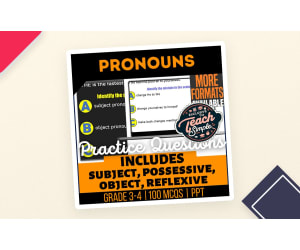
Pronouns Practice Questions - Grade 3-4 Grammar (PPT)
ELA, Language Development, ESL, Grammar, Common Core, Resources for Teachers, Grade 3, 4, Quizzes and Tests, Teacher Tools, Tests, Assessments, Presentations, Activities
Pronouns Grammar Practice MCQS ELA MCQS Overview: In this series of lessons, students will embark on an engaging journey to explore the grammar skills that make our language vibrant and expressive. These lessons are crafted to help students identify, comprehend, and effectively apply language arts skills in both writing and speech. Accompanied by free supplementary materials available for all topics, each lesson builds on the previous one, offering a balanced mix of direct instruction, interactive group activities, and independent practice. Through fun and creative tasks, students will learn to recognize grammar within sentences, understand their function, and use them to enrich their own writing and speech. Pronouns Overview: Includes: Subject Pronouns Possessive Pronouns Object Pronouns Reflexive Pronouns PPT Version This is the PPT editable and interactive version. There is a fillable answer sheet at the end. This download is available in GOOGLE Docs, GOOGLE Forms, GOOGLE Slides. PDF, PPT, WORD, check the links below for more details. FULL CATALOG OF DOWNLOAD LINKS HERE Grade 3/4 Links: Adjectives Google Docs Google Forms Google Slides PDF PPT Word Free Supplementary Materials Pack Adverbs Google Docs Google Forms Google Slides PDF PPT Word Free Supplementary Materials Pack Conjunctions Google Docs Google Forms Google Slides PDF PPT Word Free Supplementary Materials Pack Nouns Google Docs Google Forms Google Slides PDF PPT Word Free Supplementary Materials Pack Pronouns Google Docs Google Forms Google Slides PDF PPT Word Free Supplementary Materials Pack Verbs Google Docs Google Forms Google Slides PDF PPT Word Free Supplementary Materials Pack Sentence Structure Google Docs Google Forms Google Slides PDF PPT Word Free Supplementary Materials Pack Present Tense Google Docs Google Forms Google Slides PDF PPT Word Free Supplementary Materials Pack Past Tense Google Docs Google Forms Google Slides PDF PPT Word Free Supplementary Materials Pack Future Tense Google Docs Google Forms Google Slides PDF PPT Word Free Supplementary Materials Pack Context Clues Google Docs Google Forms Google Slides PDF PPT Word Free Supplementary Materials Pack Defining Words Google Docs Google Forms Google Slides PDF PPT Word Free Supplementary Materials Pack Fill the Blanks Google Docs Google Forms Google Slides PDF PPT Word Free Supplementary Materials Pack Homophones Google Docs Google Forms Google Slides PDF PPT Word Free Supplementary Materials Pack Synonyms Google Docs Google Forms Google Slides PDF PPT Word Free Supplementary Materials Pack ELA Review Questions Overview Questions have three answer choices. There are a handful of pictures on each test for aesthetic purposes, as well as a review sheet covering most of the topics covered in the product. Introduction or Example Sheet Each topic will include an introduction or example sheet to go through first with your students. Full Answer Keys Full answer keys and sample responses are provided so no matter how busy you are, you know you're covered! In the Supplementary Pack Interactive Ice Breakers: Fun, hands-on activities that get students thinking about adjectives right from the start. Guided Practice: Teacher-led exercises that reinforce the day’s lesson, ensuring students can confidently identify and use adjectives. Group and Partner Tasks: Collaborative activities that allow students to work together to solve problems, categorize adjectives, and create descriptive sentences. Independent Worksheets: Structured worksheets that provide individual practice and help solidify understanding of key concepts. Exit Tasks: Quick, reflective activities at the end of each lesson that assess understanding and encourage students to apply what they’ve learned. For similar downloads and other frees, do check out Cored Group on TeachSimple.
Author Cored Education
Tags Elementary, Answers, Ccss, Common Core, Grammar, Tests, Test Prep, Assessment, Grade 3, Grade 4

Reading Comprehension Passages Fiction Set 1 - Animals (PDF)
ELA, Reading, Reading Comprehension, ESL, Language Development, Spelling, Vocabulary, Children’s Literature, Literature, Resources for Teachers, Grade 4, 5, Worksheets & Printables, Worksheets, Writing Prompts, Assessments, Teacher Tools, Tests, Quizzes and Tests, Centers, Activities, Quizzes
Reading Comprehension Passages Fiction Set 1 Overview No prep reading comprehension lessons, with enjoyable stories and topics. Each lesson has a blend of post-reading activities. Mixed questions to check overall understanding. Vocabulary activities, plus a writing section. Lessons also contain a bonus extension exercise at the end. Some you may like, some you may not, either way they are there if you wish to use them. Full answer keys are provided. Passages Include 1.Donny's Glasses: Donny is being chased by a monster. Or so he thinks! 2.Hare & Bear: Hare & Bear have a cup of tea together in the warmth. 3.Maggie's Turtle: Maggie is desperate to win the fishing competition. 4.New Pup: Hugh finds out a new puppy isn't as fun as he hoped. 5.Naughty Cat: Lizzie can't find any of her stuff. Read this story to find outwhere it is. 6.Ella's Baseball Bat: Ella's dad is scared of bats, and now there is one in the house! 7.Ola the Rabbit: Read about Darla's newest pet in this lesson. 8.Ethan and the Puppies: Ethan gets ready for the puppies to arrive. 9.Endangered Animals: Sam learns all about endangered animals in this passage. 10.Chinese New Year: Jessie and Sally talk about the upcoming Chinese New Year. PDF Version This is the PDF uneditable version. This download is available in GOOGLE Docs, GOOGLE Forms, GOOGLE Slides. PDF, PPT, WORD. Browse the Complete Cored Catalog — 2,000+ Resources Included Reading Passages Each reading passage has been written specifically for students in Grades 4–5, using vocabulary and language that match their age and ability level. The collection covers a wide range of engaging topics, supported by colorful visuals that help bring the content to life. Every lesson is designed to build knowledge while keeping students interested and motivated to read. These resources are also designed with flexibility in mind. Unlike traditional textbooks that can quickly become outdated, lessons can be updated over time to reflect changes in technology, discoveries, and the world around us. Mixed Questions Every lesson includes a variety of questions that help students think more deeply about what they have read. The question section combines reading comprehension, vocabulary, and math skills, while also regularly reinforcing important reading strategies such as cause and effect, summarizing, compare and contrast, and drawing conclusions. Most lessons include a mix of multiple-choice and written-response questions, giving students opportunities to explain their thinking as well as select answers. Complete answer keys and sample responses are provided at the end of each lesson for quick and easy reference. Spelling & Vocabulary Each passage introduces students to useful words and phrases appropriate for Grades 4–5. To help build confidence and word knowledge, every lesson includes a spelling or vocabulary activity. Rather than repeating the same task throughout the collection, activities vary from lesson to lesson to keep practice fresh and engaging. Activities may include spelling challenges, sentence matching, decoding activities, mixed-up text exercises, and other vocabulary-building tasks connected directly to the reading. Writing Prompts Each lesson includes a writing activity that extends the ideas, themes, or topics explored in the passage. Students are encouraged to write in a variety of formats, with prompts providing helpful guidance and ideas to get them started. Writing tasks vary throughout the collection and may include creative writing, research activities, personal responses, poetry, opinion writing, and other engaging assignments. Full Answer Keys Complete answer keys and sample responses are included with every lesson, making planning and marking quicker and easier. Reading comprehension answers include evidence and support from the text, while math-based questions show the relevant working where appropriate. The answer keys are designed primarily for teachers but can also be shared with students when needed. Just for Fun Each lesson finishes with an optional extension activity called Just for Fun . These bonus activities provide an enjoyable way to extend learning beyond the main lesson and often encourage creativity, discussion, or independent thinking. They are completely optional, giving you the flexibility to use the activities that best suit your students and classroom needs. For similar downloads and other frees, do check out Cored Group on TeachSimple.
Author Cored Education
Rating
Tags Elementary, Reading, Comprehension, Vocabulary, Answers, Spelling, Writing, Passages, Reading Centers, Reading Comprehension Assessments
Science Reading Comprehension Passage: Food Chains and Food Webs PPT
Science, Life Sciences, Biology, Common Core, ESL, Language Development, ELA, Spelling, Reading Comprehension, Reading, Grade 2, 3, 4, Teacher Tools, Presentations, Tests, Quizzes and Tests, Activities
Free Reading Passage on Food Chains and Food Webs for Life Science What's inside this free product? Science Reading Comprehension Passage26 : Food Chains and Food Webs Independent PPT Version: This is the independent PPT version containingone lesson with full answer keys. Product Info: 27 SLIDES (US English with Answers) PPT Version Teaching Duration: Approximately 90 Minutes Science Reading Comprehension Outline: Targeted for students in 3rd and 4th grades, these reading passages are enhanced with illustrations and graphs to elucidate critical points. Each lesson aligns with the Common Core State Standards, allowing you to integrate science reading practice effortlessly, knowing that minimal preparation is needed on your part. Each passage comes with a variety of questions in different formats, including multiple-choice formats, data analysis, and fill-in-the-blanks. The topics covered strike a balance between engaging content and core curriculum-based science subjects. Versatile in application, these lessons are suitable for a variety of settings such as whole-class instruction, morning activities, independent desk work, small group discussions, contingency plans for substitute teachers, homework assignments, or even special holiday-themed tasks. FULL CATALOG OF DOWNLOAD LINKS HERE Grade 3/4 Links: Physical Science Part 1 - Properties of Objects and Materials Google Docs/Slides/Forms PDF PPT Word Free Supplementary Pack Accompanying Videos Physical Science Part 2 - Position and Motion of Objects Google Docs/Slides/Forms PDF PPT Word Free Supplementary Pack Accompanying Videos Physical Science Part 3 - Light, Heat, Electricity, Magnetism Google Docs/Slides/Forms PDF PPT Word Free Supplementary Pack Accompanying Videos Life Science Part 1 - Characteristics of Organisms Google Docs/Slides/Forms PDF PPT Word Free Supplementary Pack Accompanying Videos Life Science Part 2 - Life Cycles of Organisms Google Docs/Slides/Forms PDF PPT Word Free Supplementary Pack Accompanying Videos Life Science Part 3 - Organisms and Environments Google Docs/Slides/Forms PDF PPT Word Free Supplementary Pack Accompanying Videos Earth Science Part 1 - Properties of Earth Materials Google Docs/Slides/Forms PDF PPT Word Free Supplementary Pack Accompanying Videos Earth Science Part 2 - Changes in the Earth and Sky Google Docs/Slides/Forms PDF PPT Word Free Supplementary Pack Accompanying Videos Earth Science Part 3 - Objects in the Sky Google Docs/Slides/Forms PDF PPT Word Free Supplementary Pack Accompanying Videos For similar products and other frees, do check out Cored Group on TeachSimple .
Author Cored Education
Tags Science, Elementary, Reading, Comprehension, Vocabulary, Answers, Physics, Physical Science, Ccss, Common Core

Multiplication Practice Worksheets
Math, Multiplication and Division, Multiplication, Early Math, Basic Operations, Grade 1, 2, 3, 4, 5, 6, Activities, Teacher Tools, Assessments, Centers, Lesson Plans
Tired of hearing groans when it's multiplication time? These Multiplication Practice Worksheets turn “I don’t get it” into “I’ve got this!” With 36 pages of targeted practice, this resource is your secret weapon for building math confidence one problem at a time. Whether you’re tackling the times tables for the first time or reinforcing skills, these worksheets make math mastery achievable, and dare we say, enjoyable. Ways to Use: Daily Practice: Perfect for warm-ups, homework, or quick reviews. Math Centers: Keep students busy with purposeful practice during rotations. Test Prep: Ace those standardized tests with solid multiplication foundations. Early Finishers: Say goodbye to “I’m done! Now what?” chaos. Independent Work: Ideal for strengthening focus and self-reliance. Advantages: Comprehensive Coverage: All the key multiplication facts from 1 to 12, drilled to perfection. Engaging Design: Clean, easy-to-read layouts, because nobody needs extra math anxiety. No Prep Needed: Print and teach, spend less time prepping and more time sipping coffee. Flexible Use: Tailor it to fit your classroom schedule and needs. Confidence Boosting: Watch students go from struggling to “Look, I can do it!” Bring out the multiplication rock stars in your class with this no-nonsense, all-practice resource. Say goodbye to “Math is hard” and hello to “I’m crushing it!” Enjoy!
Author Ponder Palette Plazza
Tags Multiplication, Multiplication Worksheets, Multiplication Practice, Math Worksheets, Math Test, Multiplication Test, Mental Math, Basic Operations

Context Clues Supplementary Materials Grades 3-4 (PDF)
ELA, Language Development, ESL, Common Core, Resources for Teachers, Vocabulary, Grade 3, 4, Worksheets & Printables, Worksheets, Quizzes and Tests, Teacher Tools, Tests, Assessments, Lesson Plans, Activities
Context Clues Supplementary Materials Note: This download DOES NOT include the tests themselves. You can still make use of these materials without them but they are recommended. Download in a format of your choice in the "Links" section below. Outline Ice Breaker (5-10 minutes) Engaging, interactive activity to introduce the lesson’s theme. Examples: Matching games, sentence races, charades, or storytelling challenges. Guided Practice (10-15 minutes) Teacher-led exercises to reinforce the concept. Examples: Sorting sentences by tense, sentence transformations, or fill-in-the-gap exercises. Group or Partner Task (15 minutes) Collaborative activity to practice the lesson’s focus in a fun and engaging way. Examples: Role-play, storytelling, sentence-building games, or small-group discussions. Independent Worksheet (15 minutes) Individual written activity to solidify understanding. Examples: Sentence corrections, verb conjugation drills, or tense identification exercises. Exit Task (5 minutes) Quick reflective activity to assess understanding before students leave. Examples: Writing a sentence using the target concept, identifying a tense, or explaining a rule. Links: Includes: Definitions or Restatements Synonyms Antonyms or Opposites Examples or Explanations Google Docs Google Forms Google Slides PDF PPT Word FULL CATALOG OF DOWNLOAD LINKS HERE Grade 3/4 Links: Adjectives Google Docs Google Forms Google Slides PDF PPT Word Free Supplementary Materials Pack Adverbs Google Docs Google Forms Google Slides PDF PPT Word Free Supplementary Materials Pack Conjunctions Google Docs Google Forms Google Slides PDF PPT Word Free Supplementary Materials Pack Nouns Google Docs Google Forms Google Slides PDF PPT Word Free Supplementary Materials Pack Pronouns Google Docs Google Forms Google Slides PDF PPT Word Free Supplementary Materials Pack Verbs Google Docs Google Forms Google Slides PDF PPT Word Free Supplementary Materials Pack Sentence Structure Google Docs Google Forms Google Slides PDF PPT Word Free Supplementary Materials Pack Present Tense Google Docs Google Forms Google Slides PDF PPT Word Free Supplementary Materials Pack Past Tense Google Docs Google Forms Google Slides PDF PPT Word Free Supplementary Materials Pack Future Tense Google Docs Google Forms Google Slides PDF PPT Word Free Supplementary Materials Pack Context Clues Google Docs Google Forms Google Slides PDF PPT Word Free Supplementary Materials Pack Defining Words Google Docs Google Forms Google Slides PDF PPT Word Free Supplementary Materials Pack Fill the Blanks Google Docs Google Forms Google Slides PDF PPT Word Free Supplementary Materials Pack Homophones Google Docs Google Forms Google Slides PDF PPT Word Free Supplementary Materials Pack Synonyms Google Docs Google Forms Google Slides PDF PPT Word Free Supplementary Materials Pack ELA Review Questions Overview Questions have three answer choices. There are a handful of pictures on each test for aesthetic purposes, as well as a review sheet covering most of the topics covered in the product. Introduction or Example Sheet Each topic will include an introduction or example sheet to go through first with your students. Full Answer Keys Full answer keys and sample responses are provided so no matter how busy you are, you know you're covered! In the Supplementary Pack Interactive Ice Breakers: Fun, hands-on activities that get students thinking about adjectives right from the start. Guided Practice: Teacher-led exercises that reinforce the day’s lesson, ensuring students can confidently identify and use adjectives. Group and Partner Tasks: Collaborative activities that allow students to work together to solve problems, categorize adjectives, and create descriptive sentences. Independent Worksheets: Structured worksheets that provide individual practice and help solidify understanding of key concepts. Exit Tasks: Quick, reflective activities at the end of each lesson that assess understanding and encourage students to apply what they’ve learned. For similar downloads and other frees, do check out Cored Group on TeachSimple.
Author Cored Education
Tags Elementary, Answers, Ccss, Common Core, Tests, Test Prep, Grade 3, Grade 4, Vocabulary, Lesson Plan

Butterflies Know-It-Alls! Audio Book
Science, Life Sciences, Animals, Grade 2, 3, 4, Read Alouds, Activities
As part of the unique, science Know-It-Alls! Series that features interesting science facts, this audiobook puts the spotlight on Butterflies! Did you know that butterflies find food and locate a mate with their eyes, “smell” and sense vibrations with their antennae, and taste with their front feet? Learn all about how they look, where they live, how they change as they go through metamorphosis, and more. Awesome narration and sound effects plus many interesting facts, makes this audiobook fun and exciting for young science enthusiasts age 4 and up! Titles in the Know-It-Alls! Series include: Butterflies, Crocodiles, Dinosaurs, Farm Animals, Safari Babies, Snakes, Sharks, Spiders, Whales, Wolves, Puppies, Wild Cats, Bugs, Birds of Prey, Fish, Frogs, Apes, Seals, Bats, Bears, Predators, Mummies, Volcanoes, Lizards, Kittens and Horses.
Author Twin Sisters Digital Media
Tags Science, Learning, Insects, Butterlies, Fun

Articles and Activities about Protecting the Environment #3: Fuels, Acid Rain, and Erosion
Science, Earth and Environmental Sciences, Environmental Science, Grade 3, 4, 5, 6, Activities
Articles and Activities about Protecting the Environment #3: Fuels, Acid Rain, and Erosion A comprehensive teaching resource empowering educators to bring environmental science concepts into their classrooms. This set of three articles explores topics including alternative fuels, industrial revolution impacts such as acid rain, and erosion — critical subjects in environmental science education for 3rd to 6th grade students. Tailored for Young Minds: Delivering key understandings of our environment to young minds is made more accessible with this resource. The articles humanize scientific concepts by presenting them in a relatable manner suitable for younger audiences. Also providing a wider look at eco-friendly practices within reach of both learners and educators. Theory & Practice Combined: This is not just theory reading material! There are accompanying activities that enhance practical learning by incubating critical thinking skills. Whether it's leading a group discussion on sustainable energy use or giving an assignment focused on erosion control - these activities inspire powerful experiential learning moments. User-friendly Across Instructions: This versatile resource can easily be adapted across various instructional strategies: classroom-wide lectures small targeted group lessons , homework reference material where students can explore these important topics at their own pace . Accessible Format: Brought to you in PDF format securing ease across multiple usage platforms without the need for any special access requirements - except perhaps a cup of coffee as you marvel at its contents! In Conclusion... Packed with invigorating content that sparks interest; makes children curious & respect how their actions impact our earth - 'Articles and Activities about Protecting the Environment #3: Fuels, Acid Rain, and Erosion' equips educators with an excellent resource capable of addressing relevant standards which comes in a convenient all-in-one package.
Author Classroom Complete Press
Tags PDF
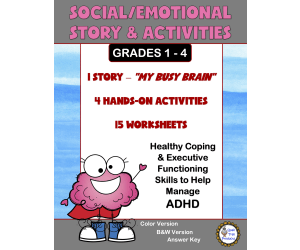
SOCIAL/EMOTIONAL ADHD STORY & ACTIVITIES
Social Emotional Learning (SEL), Special Resources, Grade 1, 2, 3, 4, Read Alouds, Activities, Worksheets & Printables
Are you a parent, counselor, therapist, or educator working with learners who struggle with ADHD? If so, this is perfect product to add to your social/emotional toolbox. Kids in grades 1 through 4 will be engaged with the story, “My Busy Brain”, and corresponding activities. With its kid-friendly graphics and rhyming structure, your learners will connect with the story’s main characters, George and Julia. From start to finish, your learners will witness the progression of common ADHD struggles and ways in which they can cope. The story’s ending will leave a smile on the reader’s face and a sense of hope that the multitude of emotions associated with ADHD can be overcome. As a means of extending the story’s message into learners’ lives, there are worksheets and hands-on activities available. Within these pages are real-life ways in which your learners can practice healthy coping and executive functioning skills. They’ll learn to identify 7 emotions, practice breathing techniques, list positive self-qualities, and have the opportunity to make their own fidget toy(s). Not only that, but they will also perform tasks in sequencing, telling time, and writing lists. This product was designed to meet the criteria for several of the SEL Core Competencies, making it a solid addition to your curriculum. All worksheets are print and go, and while the fidget toys do require prep work, your learners will love the hands-on sensory activities. For worksheets with definitive answers, an answer key is provided. Many worksheets are available in both color and black & white formats. In either case, laminating them provides an instant write-on/wipe-off activity that can be used time over time. For more details on this product’s content, take a look at the list below. STORY – “My Busy Brain” (version 1: George, version 2: Julia) FLASHCARDS – 7 emotions (multi-cultural kids, emotion words) WORKSHEET 1 : learners will read a scenario from the story and draw a line to the kid with the matching emotion. WORKSHEET 2 : learners will read a scenario from the story and write the emotion word they might feel in that situation. WORKSHEET 3 : learners will identify different types of weather and color the clothing item most appropriate to wear. WORKSHEET 4 : learners will write numbers to sequence daily tasks (brushing teeth, setting table, making pb&j sandwich. WORKSHEET 5 : learners will cut and glue alarm clocks showing the time for tasks in a daily routine. WORKSHEET 6 : learners will identify, write, and illustrate special qualities unique to their brains. WORKSHEET 7 : learners will illustrate a situation in which their mind might wander, then decorate the cloud with cotton balls. WORKSHEET 8 : learners will circle the hidden (lost) sports balls in the picture and use a check-off list as they find each ball. WORKSHEET 9 : learners will write and illustrate three facts about something of interest to them. WORKSHEET 10 : learners will identify and color the movement activities they enjoy. WORKSHEET 11 : learners will identify the benefits of water and decorate the water bottle. WORKSHEET 12 : learners will write a list of three tasks they complete each day. WORKSHEET 13 : learners will identify scents that are pleasing to them and practice a deep breathing exercise. WORKSHEET 14 : learners will write about and illustrate a new healthy coping skill to try. WORKSHEET 15 : learners will find words hidden in the wordsearch that were mentioned in the story and worksheets. ACTIVITIES : learners will have the opportunity to make their own fidget toy (4 options included)
Author Quail Trail Products
Rating
Tags ADHD, Coping Skills, Executive Functioning, Story, Worksheets, Hands-on Activities, Fidgets, Emotions, Brain, Character Building

Vegetables Reading Comprehension Passage - Cored Ed Encyclopedia
ELA, Language Development, Reading Comprehension, Reading, Pre-Reading, Science, Life Sciences, Health, P.E. & Health, Nature & Plants, Grade 2, 3, 4, 5, Worksheets & Printables, Worksheets, Teacher Tools, Centers, Activities, Writing Prompts, Assessments, Quizzes and Tests, Quizzes, Lesson Plans
This vegetables reading comprehension with lesson plan includes: Visualization (on the front cover) Start your lesson by taking a minute to think and share something about the topic. Read the script aloud (slowly), perhaps prepare some music or sound effects. Student close their eyes and let their imaginations wander. Students open their eyes, read the question aloud and give them a few minutes to complete. Ask a few students to share or keep answers until the end to compare with what they learn in the passage. Quick pause—thousands of Cored Education products are included with your TeachSimple membership. Download links and encyclopedia index available here. COMPANION VIDEO NOW AVAILABLE (EMBEDDED AFTER PREVIEW PICTURES IN PRODUCT DESCRIPTION) Pre-Reading Trivia Students will write down one thing they already know about the subject and then read five more facts and discuss. These facts are fun, and the students will enjoy learning about the subject before reading more. Give 1 minute for students to write what they already know (no pressure—best guess is fine). Read the five facts together. After each fact, do ask a student for their opinion, was it surprising? Set a purpose by asking students to highlight/underline one fact they want to learn more about during the reading. Reading Passage The text is a high-interest reading passage with set paragraphs, roughly three to four paragraphs long. It contains a variety of themes about the topic, anywhere from history to technology. The passage is between 250 and 350 words in length. First, ask students to look at the headings and see what they’ll learn about today. What do they know about the topic/heading? First read options: Teacher read-aloud (best for support). Partner reading (paragraph by paragraph). While reading, students underline important details, and vocabulary words they think may come up in the questions section. Mixed Questions The first question page contains four multiple-choice questions, each with a choice of four answers, and three written response questions that require a sentence or two from the student. Students complete the mcqs first independently, then review quickly as a class. For the 3 written responses, try to get students giving the answer with some form of evidence: “I think ___ because the text says ___.” If students get stuck, send them back to check the passage. Vocabulary Questions Practice seven key words from the text in this section across two activities. First section is scrambled words where students will unscramble three words given a clue for each. The second section is a word to meaning matching activity. Before starting, have some students read out words they underlined in the passage. Ask students to say the word and read aloud the sentence(s) around each word. Ask students to do scrambled words and the matching exercise in pairs then go through answers as a class. For the scrambled spelling task, get four pairs to come up to the board and write the words for extra practice with the other student reading out the clue. For the matching task, prompt students to give full sentences: “I matched ___ with ___ because ___.” Creative Writing In this question, the student will be required to write a five to eight sentence paragraph on a question related to the topic. Before starting, ask students write down 3 key ideas they are going to include in their piece. Ask students for ideas to share around the class to help those struggling. Pro writing expectations: 5–8 sentences At least 2 facts or details from the passage At least 2 vocabulary words from the previous page Students read their paragraphs while classmates listen for facts and vocabulary words. Extension Activities This page is optional for fast finishers or to take home. There are several activities, each one requiring a different skill. Do some, do none, do all, completely optional - but you will feel reassured knowing every possibility is planned for. Includes summary writting question. Answer Key There are answers for the multiple-choice questions, written response questions have sample answers, vocabulary answers and if there is a summary question then a sample summary will be provided as well. Lesson Plan Included Customized lesson plan for this lesson is included. Lesson Snapshot Title: Vegetables Genre: Nonfiction (Informational text) Subject: Science (Life Science: plants, nutrition) / Reading (informational text) Primary Topic: What vegetables are and why they matter Estimated Guided Reading Level (A–Z): N What This Lesson Teaches Best What counts as a vegetable (in this text): Defines vegetables as edible parts of plants people choose to eat, including roots (carrot), leaves (spinach), and flower buds (broccoli). Plant parts and categories: Explains that many vegetables come from soft-stemmed, herbaceous plants rather than woody trees, and that vegetables come in many shapes because plants have many useful parts. Early farming and seed-saving: Describes how people once gathered edible plants from the wild, then began planting and saving seeds (about 10,000–7,000 BC), keeping and sharing plants that tasted better or grew bigger. Science vs. everyday language (tomato debate): Contrasts the botanical definition of “fruit” (seed-bearing part formed from a flower’s ovary) with how “vegetable” often means a savory plant food served with meals, noting a U.S. court decision in 1893 calling tomatoes vegetables for a tax rule. Nutrition and food preservation: States vegetables are usually low in fat and calories, filling because they bring water and fiber, and may contain vitamins/minerals (examples include vitamin A and vitamin C); also notes chilling, freezing, or canning to keep vegetables longer. Learning Goals Students will define a vegetable using examples from the text (root, leaf, bud). Students will describe where many vegetables come from (soft-stemmed, herbaceous plants) and explain what that means. Students will explain how seed-saving helped wild plants become “garden favorites,” using details from the passage. Students will compare the botanical meaning of fruit with the cooking meaning of vegetable, using the tomato example. Students will identify two reasons vegetables can be filling and healthy (water, fiber, vitamins/minerals) based on the text. Key Vocabulary From the Text edible — safe and good to eat. herbaceous — soft-stemmed; not woody. botanists — scientists who study plants. ovary — flower part that can form fruit. fiber — nutrient that helps you feel full. FULL CATALOG OF DOWNLOAD LINKS AND ENCYCLOPEDIA INDEX HERE
Author Cored Education
Rating
Tags Vocabulary, Reading Comprehension, Reading Passages, Lesson Plans, Ela Lesson Plans, Reading Comprehension Lesson Plans, Pre-reading, Science Lesson Plans, Nature And Plants, Health
Self-Guided Logic Activities #2: Interpretations and Problem Solving:
, Grade 4, 5, 6, 7, 8, Activities
Self-Guided Logic Activities #2: Interpretations and Problem Solving A versatile teaching resource designed to stimulate the critical thinking skills of students mainly in grades 4 through 8. This packet presents an excellent means to achieve this essential educational goal. Units and Activities The activities contained in this learning tool are grouped across four units, each focusing on different areas: Geographical Comparisons: Engages students as they interpret various geographical facts and figures. Formulating Equations: Exercises that challenge them to formulate equations, pushing their mathematical faculty. Perception-based Tasks: Involving geometric figures as part of the resource for a more complete approach. (These activities suit both whole-class engagement or smaller groups who could benefit from enhanced problem-solving challenges) The Student Self-Check Feature An unique feature of this packet - the 'Student Self-Check' sections following each unit provide correct answers for progress checking along with stimulating deeper levels of contemplation among learners. Digital Convenience This product is available readily in PDF format containing 15 printable pages, avoiding any fuss over additional materials or preparation time. Suitable Teaching Scenarios An ideal solution for hands-on teaching experiences inside traditional classroom settings or homeschool environments - it's practical and purposeful!
Author Classroom Complete Press
Tags Logic Activities, Self-guided, Interpretations, Problem Solving, Critical Thinking

The Little Mermaid Lapbook Project Reading & Writing GRADE 3 4 5 ELA
ESL, Language Development, ELA, Literary Devices, Literature, Children’s Literature, Reading Comprehension, Reading, Grade 3, 4, 5, Centers, Activities, Crafts, Projects
Explore the wonders of the amazing tale of The Little Mermaid with this The Little Mermaid Lapbook Project made for Grades 3, 4, and 5 students, homeschoolers and EFL/ESL learners. This dynamic resource is packed full of use for your reading classes, reading centers, fairy tale units, reading comprehension supplemental project, story element lessons, sub plans and so much more! What’s Inside: •3 The Little Mermaid Lapbook Differentiated Reading Passages (Easy, Average, Hard) •4 The Little Mermaid Lapbook Themed Lapbook Covers for student choice •2 The Little Mermaid Lapbook Name Page Options •1 The Little Mermaid Lapbook Inner Overlap Panel •3 The Little Mermaid Lapbook Story Summary Templates •2 The Little Mermaid Lapbook Theme and Moral Pages •2 The Little Mermaid Lapbook The Little Mermaid Lapbook Sequence Pockets •6 The Little Mermaid Lapbook Illustrated Sequence Cards •3 The Little Mermaid Lapbook Difficulty-Tiered Card Sets •6 The Little Mermaid Lapbook Story Retelling Prompts •1 The Little Mermaid Lapbook Character Traits Foldout •1 The Little Mermaid Lapbook Setting Foldout •1 The Little Mermaid Lapbook Additional Information Fold •1 The Little Mermaid Lapbook Story Rating Page •1 The Little Mermaid Lapbook Personal Connection Fold
Author It's Teacher L
Rating
Tags The Little Mermaid, Reading Comprehension, Reading Centers Fairy Tales, Fairy Tales, Reading Centers, ELA Project

Animal Word Search 2nd, 3rd, 4th & 5th Grades Worksheet Activity
Spelling, Language Development, ELA, Vocabulary, Science, Animals, Life Sciences, Grade 2, 3, 4, 5, Worksheets & Printables, Word Searches, Worksheets, Games, Activities
This entertaining and interactive Animal Word Search is useful for 2nd, 3rd, 4th, and 5th Grades not only for students to practice animal vocabulary but also to help improve spelling and word recognition skills. 🦊🐼🐠 This is a perfect and quick, no-prep activity for classrooms or at home! 🎯 Objective: Students will: - Enhance their animal-related vocabulary 🐾 - Enhance their spelling and scanning skills 🔍 - Practice their attention to detail ✏️ - Gain confidence in their word recognition ✅ Order, Outline and Steps: - Provide students the puzzle (you can provide color or black & white). - Ask students to read the animal word list first. - Set the timer for 7–12 minutes and ask the students to complete the puzzle. - Have the students peer-check by switching papers. - Go over the answers together while referring to the answer key included. Grades or Ages: Ideal for 2nd – 5th Grade Grade (ages 7 - 11). There are differentiation options to help make it easier for you. Implementation Format: This can be used as beyond homework, or before or at the beginning of class, etc., for small groups or centers. Answer Keys: ✔️ Yes - included for easy grading / self-checking; most teachers just love them! How to Use / Variations: Speed challenge: Set a timer to see who can complete first. Partner check: Students take each other’s puzzle to check. Research extension: Pick one animal word and write one fact. Art connection: Draw your favorite animal from the puzzle. Game Version: Hide animal cards around the room to match the words. Standards: Aligned with CCSS.ELA-LITERACY.L.2–5 for vocabulary practice. Supports NGSS crosscutting concepts (patterns, observation). File Types: 📄 PDF (print ready) Number of Pages: 4 total pages, colored puzzle + answer key and black and white puzzle + answer key.
Author Classsim
Rating
Tags Animal Word Search Printable 2nd Grade, Animal Word Search 3rd Grade Worksheet, Animal Vocabulary Word Search 4th Grade, Animal Word Search 5th Grade Classroom Activity, No-prep Animal Word Search Printable, Animal Word Search Homework Pdf, Animal Word Search Center Activity Elementary, Colored Animal Word Search Printable, Black And White Animal Word Search Answer Key, Animal Word Search NGSS CCSS Literacy

Present Tense Practice Questions - Grade 3-4 Grammar (PPT)
ELA, Language Development, ESL, Grammar, Common Core, Resources for Teachers, Grade 3, 4, Quizzes and Tests, Teacher Tools, Tests, Assessments, Presentations, Activities
Present Tense Grammar Practice MCQS ELA MCQS Overview: In this series of lessons, students will embark on an engaging journey to explore the grammar skills that make our language vibrant and expressive. These lessons are crafted to help students identify, comprehend, and effectively apply language arts skills in both writing and speech. Accompanied by free supplementary materials available for all topics, each lesson builds on the previous one, offering a balanced mix of direct instruction, interactive group activities, and independent practice. Through fun and creative tasks, students will learn to recognize grammar within sentences, understand their function, and use them to enrich their own writing and speech. Present Tense Overview: Includes: Present Simple Present Continuous Present Perfect Mistake Finding PPT Version This is the PPT editable and interactive version. There is a fillable answer sheet at the end. This download is available in GOOGLE Docs, GOOGLE Forms, GOOGLE Slides. PDF, PPT, WORD, check the links below for more details. FULL CATALOG OF DOWNLOAD LINKS HERE Grade 3/4 Links: Adjectives Google Docs Google Forms Google Slides PDF PPT Word Free Supplementary Materials Pack Adverbs Google Docs Google Forms Google Slides PDF PPT Word Free Supplementary Materials Pack Conjunctions Google Docs Google Forms Google Slides PDF PPT Word Free Supplementary Materials Pack Nouns Google Docs Google Forms Google Slides PDF PPT Word Free Supplementary Materials Pack Pronouns Google Docs Google Forms Google Slides PDF PPT Word Free Supplementary Materials Pack Verbs Google Docs Google Forms Google Slides PDF PPT Word Free Supplementary Materials Pack Sentence Structure Google Docs Google Forms Google Slides PDF PPT Word Free Supplementary Materials Pack Present Tense Google Docs Google Forms Google Slides PDF PPT Word Free Supplementary Materials Pack Past Tense Google Docs Google Forms Google Slides PDF PPT Word Free Supplementary Materials Pack Future Tense Google Docs Google Forms Google Slides PDF PPT Word Free Supplementary Materials Pack Context Clues Google Docs Google Forms Google Slides PDF PPT Word Free Supplementary Materials Pack Defining Words Google Docs Google Forms Google Slides PDF PPT Word Free Supplementary Materials Pack Fill the Blanks Google Docs Google Forms Google Slides PDF PPT Word Free Supplementary Materials Pack Homophones Google Docs Google Forms Google Slides PDF PPT Word Free Supplementary Materials Pack Synonyms Google Docs Google Forms Google Slides PDF PPT Word Free Supplementary Materials Pack ELA Review Questions Overview Questions have three answer choices. There are a handful of pictures on each test for aesthetic purposes, as well as a review sheet covering most of the topics covered in the product. Introduction or Example Sheet Each topic will include an introduction or example sheet to go through first with your students. Full Answer Keys Full answer keys and sample responses are provided so no matter how busy you are, you know you're covered! In the Supplementary Pack Interactive Ice Breakers: Fun, hands-on activities that get students thinking about adjectives right from the start. Guided Practice: Teacher-led exercises that reinforce the day’s lesson, ensuring students can confidently identify and use adjectives. Group and Partner Tasks: Collaborative activities that allow students to work together to solve problems, categorize adjectives, and create descriptive sentences. Independent Worksheets: Structured worksheets that provide individual practice and help solidify understanding of key concepts. Exit Tasks: Quick, reflective activities at the end of each lesson that assess understanding and encourage students to apply what they’ve learned. For similar downloads and other frees, do check out Cored Group on TeachSimple.
Author Cored Education
Tags Elementary, Answers, Ccss, Common Core, Grammar, Tests, Test Prep, Assessment, Grade 3, Grade 4

Diving Reading Comprehension Passage - Cored Ed Encyclopedia
ELA, Language Development, Resources for Teachers, Reading Comprehension, Reading, Pre-Reading, Writing, Sports, P.E. & Health, Strategies, Grade 2, 3, 4, 5, Worksheets & Printables, Worksheets, Teacher Tools, Centers, Activities, Writing Prompts, Assessments, Tests, Quizzes and Tests, Quizzes
This diving reading comprehension contains the following: Pre-Reading Trivia Students will write down one thing they already know about the subject and then read five more facts and discuss. These facts are fun, and the students will enjoy learning about the subject before reading more. Reading Passage The text is a high-interest reading passage with set paragraphs, roughly three to four paragraphs long. It contains a variety of themes about the topic, anywhere from history to technology. The passage is between 250 and 350 words in length. Mixed Questions The first question page contains four multiple-choice questions, each with a choice of four answers, and three written response questions that require a sentence or two from the student. Creative Writing In this question, the student will be required to write a five to eight sentence paragraph on a question related to the topic. Extension Activities This page is optional for fast finishers. If there are five to ten minutes left at the end of the lesson, the student can choose one of three activities, each one requiring a different skill. Answer Key There are answers for the multiple-choice questions and three written response questions have sample answers. FULL CATALOG OF DOWNLOAD LINKS AND ENCYCLOPEDIA INDEX HERE Cored Ed Encyclopedia Overview The Cored Ed Encyclopedia is a weekly series of lessons that you can pick up and use right away. These short readings fit into whatever time you have available. Each one includes a warm-up, a reading, and a set of questions, but it’s flexible — you can do just the reading, the full lesson, or skip the writing section if you need to. Each lesson focuses on a single topic so students don’t get lost. The writing is clear but never childish, making it perfect for grades two through five. Topics range from animals and science to history, inventions, and everyday things. No matter the level of the student, everyone should take away at least one new idea or fact from each lesson. The materials are easy to print, easy to explain, and require no setup. They work well for whole-class teaching, partner work, or independent study.
Author Cored Education
Rating
Tags Vocabulary, Spelling, Reading Comprehension, Reading Passages, Cored Encyclopedia, Facts, Reading, Creative Writing, Diving, Sports

Reading Comprehension Fiction Set 5 Sample: Baseball Boy (PPT)
ELA, Reading, Writing, Common Core, Reading Comprehension, Creative Writing, ESL, Language Development, Resources for Teachers, Grade 4, 5, Teacher Tools, Presentations, Tests, Quizzes and Tests, Activities, Assessments
Reading Comprehension Passages Fiction Set 5 Sample Overview No prep reading comprehension lessons, with enjoyable stories and topics. Each lesson has a blend of post-reading activities. Mixed questions to check overall understanding. Vocabulary activities, plus a writing section. Lessons also contain a bonus extension exercise at the end. Some you may like, some you may not, either way they are there if you wish to use them. Full answer keys are provided. Passage Included 5.Baseball Boy: Mitch goes to watch the Chicago Hitters. Read about his day. PPT Version This is the PPT editable and fillable (when not in presentation mode) version. This download is available in GOOGLE Docs, GOOGLE Forms, GOOGLE Slides. PDF, PPT, WORD. FULL CATALOG OF DOWNLOAD LINKS HERE Grade 4/5 Links Fiction Set 1 - Animals Google Docs Google Forms Google Slides PDF PPT Word Guided Reading Materials Fiction Set 2 - Family Google Docs Google Forms Google Slides PDF PPT Word Guided Reading Materials Fiction Set 3 - Friends Google Docs Google Forms Google Slides PDF PPT Word Guided Reading Materials Fiction Set 4 - School Google Docs Google Forms Google Slides PDF PPT Word Guided Reading Materials Fiction Set 5 - Sports Google Docs Google Forms Google Slides PDF PPT Word Guided Reading Materials Nonfiction Set 1 - Birds Google Docs Google Forms Google Slides PDF PPT Word Guided Reading Materials Nonfiction Set 2 - Insects Google Docs Google Forms Google Slides PDF PPT Word Guided Reading Materials Nonfiction Set 3 - Mammals Google Docs Google Forms Google Slides PDF PPT Word Guided Reading Materials Nonfiction Set 4 - Nature Google Docs Google Forms Google Slides PDF PPT Word Guided Reading Materials Nonfiction Set 5 - Sea Animals Google Docs Google Forms Google Slides PDF PPT Word Guided Reading Materials Reading Passages Overview Each passage is especially written for Grade 4-5 students, including key vocabulary required for this age group. Topics are varied and are accompanied by colorful graphics. Topics are meant to educate, yet entertain the modern student. These passages are perfect for the modern classroom. Whereas textbooks can become outdated in no time, any changes to technology or the world will result in updates to this product. Mixed Questions The mixed questions section of each lesson includes a variation of five comprehension, vocabulary and math questions. In addition, key reading strategies are frequently covered including cause & effect, summarizing, compare & contrast and making conclusions. Two or three of the questions will be MCQs and other questions will require a written response of some kind. Full answers and example responses appear at the end of the lesson. Spelling & Vocab Each reading passage contains a variety of words and phrases designed for Grade 4-5 students. Spelling and vocab activities provide the opportunity to build fluency with these words. As it can become quite mundane doing the same activities over and over, each lesson in a set will contain a different spelling and vocab activity . Activities include: spelling games, sentence match-ups, mixed-up text and decoding words from the lesson. Writing Prompts Writing prompts are designed to continue the theme or lessons learned in the story. Students are persuaded to write in a variety of ways and each prompt includes several cues to help. As with the spelling/vocab section, writing prompts will vary. This includes research pieces, reading responses, poetry and creative writing prompts. Full Answer Keys Full answer keys and sample responses are provided so no matter how busy you are, you know you're covered! Mixed question answers provide evidence from the text, math questions contain the relevant workings. Answers are designed for use by the teacher, but also suitable as a handout to the student. Just for Fun Each lesson will have a bonus extension exercise. This is something fun to extend the lesson with. You can find these at the end of each lesson, titled Just for Fun. Just for Funs are optional. Some you may like, some you may not. Either way, they are there to do with as you wish. For similar downloads and other frees, do check out Cored Group on TeachSimple.
Author Cored Education
Tags Elementary, Reading, Comprehension, Vocabulary, Answers, Ccss, Common Core, Spelling, Writing, Passages

C-A-R-E Project: Conflict And Responsibility Education
Special Resources, Life Skills, Grade 1, 2, 3, 4, Projects, Activities
The C-A-R-E Project : Conflict And Responsibility Education is a pivotal teaching resource dedicated to preemptively creating a safer and more understanding school environment. This salient recourse focuses on the proactive measures of instilling conflict resolution skills early in elementary education, specifically targeting students from grades 1 to 4. Provided as an easy-to-print, 114-page PDF, this product covers critical life skills under the special resources section. The key intention is to nurture empathy, responsibility and effective communication from an early age. While it's heartrending that such lessons are necessary, they offer viable solutions to curb violence and aggression amongst young learners. A Reactive or Preventative Role? In the light of recent events spanning across different schools globally, teaching resilient lessons about conflict resolution has become painfully urgent. The role of this resource isn't merely reactionary; instead it leans heavily towards preventative measures by educating children on how best to handle disagreement peacefully without resorting to aggression. Versatile Usage This tool can guide whole group discussions as an avenue for constructive dialogue. This can function as background material for teachers during one-on-one sessions with students who may need extra assistance with interpersonal relationships. Homeschooling & Traditional Education Settings: For homeschoolers managing multi-grade learners simultaneously or educators looking for lesson plans that transcend traditional subject boundaries, the C-A-R-E Conflict And Responsibility Education project offers a comprehensive approach.It can be adapted as complementary homework matetrial fostering family dialogue about these important themes at home. Navigating Through Conflicts: At times when acknowledging emotions is becoming increasingly critical in shaping thriving citizens of tomorrow - providing ready-made flexible lessons equips teachers help their scholars navigate through potential conflicts effectively while embracing care and consideration for other’s feelings. Remember: A safe classroom community today blooms into a harmonious society tomorrow! Equip yourself with this valuable toolset designed not only encourage civility but also foster compassionate problem-solving techniques among your learner community!
Author Classroom Complete Press
Tags Conflict, Word Webs, Vocabulary Lesson, Missing Vowels, Friendship

UK/Aus Spelling Adjectives Practice Questions - Year 4-5 Grammar (PDF)
ELA, Language Development, ESL, Grammar, Common Core, Resources for Teachers, Grade 3, 4, Worksheets & Printables, Worksheets, Quizzes and Tests, Teacher Tools, Tests, Assessments, Centers, Activities
THIS IS THE UK/AUS ENGLISH SPELLING VERSION. CHECK THE CATALOG FOR THE ORIGINAL AMERICAN ENGLISH VERSION. Adjectives Grammar Practice MCQS ELA MCQS Overview: In this series of lessons, students will embark on an engaging journey to explore the grammar skills that make our language vibrant and expressive. These lessons are crafted to help students identify, comprehend, and effectively apply language arts skills in both writing and speech. Accompanied by free supplementary materials available for all topics, each lesson builds on the previous one, offering a balanced mix of direct instruction, interactive group activities, and independent practice. Through fun and creative tasks, students will learn to recognize grammar within sentences, understand their function, and use them to enrich their own writing and speech. This UK/Aus English version is especially useful for schools, teachers, and families working with British-based spelling and language conventions. It is a helpful option for classrooms using UK curriculum expectations, international programmes influenced by British English, or any setting where learners need to practise the correct capitalisation and punctuation forms for that version of English. Adjectives Overview: Includes: Identifying Adjectives Gap Filling Comparatives Superlatives Additional Practice PDF Version This is the PDF uneditable version. This download is available in GOOGLE Docs, GOOGLE Forms, GOOGLE Slides. PDF, PPT, WORD, check the links below for more details. FULL CATALOG OF DOWNLOAD LINKS HERE ELA Review Questions Overview Each review test includes three answer choices for every question. The format is clear and easy for students to follow. A small number of pictures are included on each test to make the pages feel more welcoming and less plain. A review sheet is also included to help students go back over many of the main skills covered in the product. Introduction or Example Sheet Each topic includes an introduction or example sheet to use before students begin. This gives students a clear starting point. It also helps refresh key ideas before they move into the practice. Full Answer Keys Full answer keys are included for easy checking. Sample responses are also provided where needed. This helps save time and makes the resource easier to use, even on busy days. In the Supplementary Pack Interactive Ice Breakers: Simple hands-on activities to help students start thinking about the topic. Guided Practice: Teacher-led work that helps students build understanding before working alone. Group and Partner Tasks: Activities that encourage discussion, shared ideas, and teamwork. Independent Worksheets: Extra practice pages for students to complete by themselves. Exit Tasks: Short end-of-lesson activities to check understanding and review learning. For similar downloads and other frees, do check out Cored Group on TeachSimple.
Author Cored Education
Rating
Tags Elementary, Answers, Ccss, Common Core, Tests, Test Prep, Assessment, Grade 3, Grade 4, British English

UK/Aus Spelling Homophones Practice Questions - Year 4-5 (PPT)
ELA, Language Development, ESL, Common Core, Resources for Teachers, Vocabulary, Grade 3, 4, Quizzes and Tests, Teacher Tools, Tests, Assessments, Presentations, Activities
THIS IS THE UK/AUS ENGLISH SPELLING VERSION. CHECK THE CATALOG FOR THE ORIGINAL AMERICAN ENGLISH VERSION. Homophones Vocabulary Practice MCQS ELA MCQS Overview: In this series of lessons, students will embark on an engaging journey to explore the grammar skills that make our language vibrant and expressive. These lessons are crafted to help students identify, comprehend, and effectively apply language arts skills in both writing and speech. This UK/Aus English version is especially useful for schools, teachers, and families working with British-based spelling and language conventions. It is a helpful option for classrooms using UK curriculum expectations, international programmes influenced by British English, or any setting where learners need to practise the correct capitalisation and punctuation forms for that version of English. PPT Version This is the PPT editable and interactive version. There is a fillable answer sheet at the end. This download is available in GOOGLE Docs, GOOGLE Forms, GOOGLE Slides. PDF, PPT, WORD, check the links below for more details. FULL CATALOG OF DOWNLOAD LINKS HERE ELA Review Questions Overview Each review test includes three answer choices for every question, which helps keep things simple and manageable for students. The layout is clear and easy to follow, so students can focus on the questions instead of figuring out what to do. A few pictures are included on each test to make the pages feel a little more inviting and less overwhelming. A review sheet is also included, giving students a chance to go back over many of the main skills covered in the resource. Introduction or Example Sheet Each topic comes with an introduction or example sheet to look at before students begin. This gives students a clear starting point and helps them feel more prepared. It also lets them see what to expect before moving into the main work. For many students, it is a helpful way to quickly refresh the key ideas before they start practicing on their own. Full Answer Keys Full answer keys are included to make marking and checking work faster and easier. Sample responses are also provided where needed, especially for open-ended tasks. This can be a real time-saver on busy days and makes the resource more practical to use. Everything is there to help make planning, teaching, and checking student work feel a little more straightforward. For similar downloads and other frees, do check out Cored Group on TeachSimple.
Author Cored Education
Rating
Tags Elementary, Answers, Ccss, Common Core, Tests, Test Prep, Assessment, Grade 3, Grade 4, Vocabulary

Xylophones Reading Comprehension Passage - Cored Ed Encyclopedia
ELA, Language Development, Reading Comprehension, Reading, Science, Physics, History, Social Studies, Music, Creative Arts, Grade 2, 3, 4, 5, Worksheets & Printables, Worksheets, Teacher Tools, Centers, Activities, Writing Prompts, Assessments, Quizzes and Tests, Quizzes, Lesson Plans
This xylophones reading comprehension with lesson plan includes: Visualization (on the front cover) Start your lesson by taking a minute to think and share something about the topic. Read the script aloud (slowly), perhaps prepare some music or sound effects. Student close their eyes and let their imaginations wander. Students open their eyes, read the question aloud and give them a few minutes to complete. Ask a few students to share or keep answers until the end to compare with what they learn in the passage. Quick pause—thousands of Cored Education products are included with your TeachSimple membership. Download links and encyclopedia index available here. Pre-Reading Trivia Students will write down one thing they already know about the subject and then read five more facts and discuss. These facts are fun, and the students will enjoy learning about the subject before reading more. Give 1 minute for students to write what they already know (no pressure—best guess is fine). Read the five facts together. After each fact, do ask a student for their opinion, was it surprising? Set a purpose by asking students to highlight/underline one fact they want to learn more about during the reading. Reading Passage The text is a high-interest reading passage with set paragraphs, roughly three to four paragraphs long. It contains a variety of themes about the topic, anywhere from history to technology. The passage is between 250 and 350 words in length. First, ask students to look at the headings and see what they’ll learn about today. What do they know about the topic/heading? First read options: Teacher read-aloud (best for support). Partner reading (paragraph by paragraph). While reading, students underline important details, and vocabulary words they think may come up in the questions section. Mixed Questions The first question page contains four multiple-choice questions, each with a choice of four answers, and three written response questions that require a sentence or two from the student. Students complete the mcqs first independently, then review quickly as a class. For the 3 written responses, try to get students giving the answer with some form of evidence: “I think ___ because the text says ___.” If students get stuck, send them back to check the passage. Vocabulary Questions Practice seven key words from the text in this section across two activities. First section is scrambled words where students will unscramble three words given a clue for each. The second section is a word to meaning matching activity. Before starting, have some students read out words they underlined in the passage. Ask students to say the word and read aloud the sentence(s) around each word. Ask students to do scrambled words and the matching exercise in pairs then go through answers as a class. For the scrambled spelling task, get four pairs to come up to the board and write the words for extra practice with the other student reading out the clue. For the matching task, prompt students to give full sentences: “I matched ___ with ___ because ___.” Creative Writing In this question, the student will be required to write a five to eight sentence paragraph on a question related to the topic. Before starting, ask students write down 3 key ideas they are going to include in their piece. Ask students for ideas to share around the class to help those struggling. Pro writing expectations: 5–8 sentences At least 2 facts or details from the passage At least 2 vocabulary words from the previous page Students read their paragraphs while classmates listen for facts and vocabulary words. Extension Activities This page is optional for fast finishers or to take home. There are several activities, each one requiring a different skill. Do some, do none, do all, completely optional - but you will feel reassured knowing every possibility is planned for. Includes summary writting question. Answer Key There are answers for the multiple-choice questions, written response questions have sample answers, vocabulary answers and if there is a summary question then a sample summary will be provided as well. Lesson Plan Included Customized lesson plan for this lesson is included. Lesson Snapshot Title: Xylophones Genre: Nonfiction (informational text) Subject: Music / Science of Sound (Informational Reading) Primary Topic: How xylophones make sound and their history Estimated Guided Reading Level (A–Z): Q Support pages present: Visualization prompt, pre-reading trivia, mixed questions, vocabulary activities, creative writing, extension activities, and an answer key. What This Lesson Teaches Best Explains how a xylophone’s “keys” are wooden bars that make notes when tapped with a mallet . Teaches the relationship between bar length and pitch (long bars = low sounds; short bars = high sounds). Shows a core sound concept: the wood vibrates to create the note, and resonators underneath help the sound carry. Builds historical understanding of xylophone-like instruments across Africa and Asia, including early designs using logs, pits, and gourds to boost sound. Connects music history and school use: the xylophone spread into Europe, appears in orchestras (including Camille Saint-Saëns and Danse Macabre), and is used in classrooms to learn melody and rhythm (including Orff-Schulwerk). Learning Goals Students will describe how tapping a bar with a mallet makes a xylophone note. Students will explain how bar length changes pitch using details from the text. Students will identify what resonators do and where they are located on some xylophones. Students will summarize how xylophone-like instruments were made long ago and how sound was boosted. Students will sequence key points in the xylophone’s timeline (early instruments, later written descriptions, and later orchestra use). Key Vocabulary From the Text resonators — tubes/shapes under bars that help sound carry. vibrates — shakes back and forth to make sound. documented — recorded in writing. orchestra — a large group of musicians playing together. octave — a set of notes from one pitch to next. FULL CATALOG OF DOWNLOAD LINKS AND ENCYCLOPEDIA INDEX HERE
Author Cored Education
Rating
Tags Vocabulary, Reading Comprehension, Reading Passages, Lesson Plans, Ela Lesson Plans, Reading Comprehension Lesson Plans, Pre-reading, History Lesson Plans, Physics, Music Lesson Plans
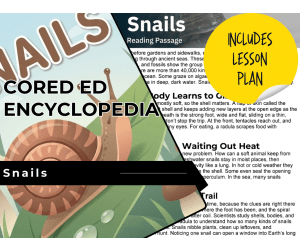
Snails Reading Comprehension Passage - Cored Ed Encyclopedia
ELA, Language Development, Reading Comprehension, Reading, Pre-Reading, Writing, Science, Animals, Life Sciences, Strategies, Grade 2, 3, 4, 5, Worksheets & Printables, Worksheets, Teacher Tools, Centers, Activities, Writing Prompts, Assessments, Quizzes and Tests, Quizzes, Lesson Plans
This snails reading comprehension includes: Visualization (on the front cover) Start your lesson by taking a minute to think and share something about the topic. Read the script aloud (slowly), perhaps prepare some music or sound effects. Student close their eyes and let their imaginations wander. Students open their eyes, read the question aloud and give them a few minutes to complete. Ask a few students to share or keep answers until the end to compare with what they learn in the passage. Quick pause—thousands of Cored Education products are included with your TeachSimple membership. Download links and encyclopedia index available here. Pre-Reading Trivia Students will write down one thing they already know about the subject and then read five more facts and discuss. These facts are fun, and the students will enjoy learning about the subject before reading more. Give 1 minute for students to write what they already know (no pressure—best guess is fine). Read the five facts together. After each fact, do ask a student for their opinion, was it surprising? Set a purpose by asking students to highlight/underline one fact they want to learn more about during the reading. Reading Passage The text is a high-interest reading passage with set paragraphs, roughly three to four paragraphs long. It contains a variety of themes about the topic, anywhere from history to technology. The passage is between 250 and 350 words in length. First, ask students to look at the headings and see what they’ll learn about today. What do they know about the topic/heading? First read options: Teacher read-aloud (best for support). Partner reading (paragraph by paragraph). While reading, students underline important details, and vocabulary words they think may come up in the questions section. Mixed Questions The first question page contains four multiple-choice questions, each with a choice of four answers, and three written response questions that require a sentence or two from the student. Students complete the mcqs first independently, then review quickly as a class. For the 3 written responses, try to get students giving the answer with some form of evidence: “I think ___ because the text says ___.” If students get stuck, send them back to check the passage. Vocabulary Questions Practice seven key words from the text in this section across two activities. First section is scrambled words where students will unscramble three words given a clue for each. The second section is a word to meaning matching activity. Before starting, have some students read out words they underlined in the passage. Ask students to say the word and read aloud the sentence(s) around each word. Ask students to do scrambled words and the matching exercise in pairs then go through answers as a class. For the scrambled spelling task, get four pairs to come up to the board and write the words for extra practice with the other student reading out the clue. For the matching task, prompt students to give full sentences: “I matched ___ with ___ because ___.” Creative Writing In this question, the student will be required to write a five to eight sentence paragraph on a question related to the topic. Before starting, ask students write down 3 key ideas they are going to include in their piece. Ask students for ideas to share around the class to help those struggling. Pro writing expectations: 5–8 sentences At least 2 facts or details from the passage At least 2 vocabulary words from the previous page Students read their paragraphs while classmates listen for facts and vocabulary words. Extension Activities This page is optional for fast finishers or to take home. There are several activities, each one requiring a different skill. Do some, do none, do all, completely optional - but you will feel reassured knowing every possibility is planned for. Includes summary writting question. Answer Key There are answers for the multiple-choice questions, written response questions have sample answers, vocabulary answers and if there is a summary question then a sample summary will be provided as well. Lesson Plan Included Customized lesson plan for this lesson is included. Lesson Snapshot Title: Snails Genre: Nonfiction (informational text with support pages) Subject: Science (Life Science) Primary Topic: Snail traits, habitats, and how they survive Estimated Guided Reading Level (A–Z): S What This Lesson Teaches Best What snails are (gastropods, “belly-footed” mollusks) and how they move using a strong foot on the bottom of their bodies. How snail body parts work, including the mantle making the shell, tentacles with tiny eyes, and a radula that scrapes food with many tiny teeth. How snails live in many habitats (mostly ocean; also land and freshwater), including near shore, on reefs, and in deep, dark water. How snails stay safe and survive tough conditions by pulling into their shell, becoming dormant, and sometimes sealing the opening with mucus or an operculum. How scientists use evidence (shell growth spirals and silvery trails) to study snails and understand how they live in so many places. Learning Goals Explain what “gastropods” means and how snails move using a strong foot. Describe how a snail’s mantle helps make and grow its shell. Identify what a radula is and how it helps a snail eat. Describe how land and freshwater snails avoid drying out and handle hot or cold weather. Use details from the passage to describe where snails live (near shore, reefs, deep water, and moist land places). Key Vocabulary From the Text gastropods — “belly-footed” animals that move using a strong foot. mantle — a flap of skin that makes the shell. radula — a scraper with many tiny teeth for eating. dormant — resting and not active for a while. operculum — a little door that can seal a shell opening. FULL CATALOG OF DOWNLOAD LINKS AND ENCYCLOPEDIA INDEX HERE
Author Cored Education
Rating
Tags Vocabulary, Reading Comprehension, Reading Passages, Reading, Creative Writing, Reading Strategies, Writing Prompts, Lesson Plans, Snails, Life Science

Guided Reading Level M - Acid Rain (with Lesson Plan)
ELA, Resources for Teachers, Reading Comprehension, Reading, Science, Technology, Physics, Life Sciences, Earth and Environmental Sciences, Environmental Science, Grade 2, 3, 4, Worksheets & Printables, Worksheets, Teacher Tools, Centers, Activities, Literacy Readers, Quizzes, Quizzes and Tests, Assessments, Lesson Plans
This Guided Reading Book - Acid Rain (Level M) with lesson plan includes: Guided Reading Color Label (front cover x1) This is a quick way to match the book’s demands to what students can generally handle.. The overall goal is to use the level/color to pick books for several smaller groups. To qualify for a certain level, a student is expected to read a book from that level with about 90–94% accuracy. If a student is consistently accurate and understands, move up a level. If the student is struggling at that level, drop down and add more support. Each student will improve at completely different rates, but it is generally one of the best ways to check progress across the class. DOWNLOAD THE CATALOG TO VIEW ALL GUIDED READING BOOKS AVAILABLE (SORTED LEVELS A-Z) Pre-Reading Question (x1) Teacher asks the prompt aloud, can be while showing the cover or first page. Students share what they already know, or make educated guesses from the cover. Prompt them to use the target vocabulary. Write some of their responses on the board to look back at during the reading. Vocabulary Words (x5) Introduce the five words, best doing it one at a time. Start by saying it, while students repeat and then see if anyone knows what it means before reading further. Read through the meaning and try to briefly connect each word to a picture or gesture so it’s meaningful. Ask students to flip through the book pages and point to where they see each of the vocabulary words. While reading the book pause upon coming across one of the vocab words or read the sentence twice to make sure students understand the word has appeared. Optional: Ask students to raise hands whenever they see/hear one of the new words. Guided Reading Pages (x10) Check the book snapshot (below) for: primary topic - do you need to prep extra reading or intro materials on this? what is taught best - decide on 1-2 bullets to focus on, use the prompt or words provided here for best results. learning goals - what you are checking for students to be able to do after the session, elicit answers using prompts or words provided. key vocabulary (see section above). questions overview - so you know what is coming up and if you need to prep extra materials to assist understanding. Run the lesson You may have already looked at a few of the pages together, but you can show them some of the pictures again first to set meaning. Depending on how much time you have and how familiar your students are with guided reading class, you may want to read the book aloud first with the group first. Students whisper or partner read, while you listen in. If time, do it as a group, one student reading a page each. Use the guided page’s prompts to coach: “Check the picture / does it make sense?” “Point under the words / try the first sound” “Reread the sentence smoothly”. Try to focus more on one student per session (rotating every time), so you can work out if they are ready to move up or need to move down a level. Comprehension Questions (back cover x3) This is your way to check that students didn’t just say the words, but actually understood the text. First, let students answer by pointing to the page/picture and saying a short sentence. After any answer, follow with: “Show me where you found that in the text.” In bigger groups, have partners answer first (10–20 seconds), then call on 2–3 students to share. Differentiation tips: Emerging speakers/struggling readers: oral + pointing On-level: oral in a full sentence Higher: one written sentence or draw + label Book Snapshot Title: Acid Rain Genre: Nonfiction (informational science text) Subject: Science (Earth & Environmental Science) Primary Topic: Causes, effects, and solutions for acid rain Estimated Guided Reading Level (A–Z): M What This Book Teaches Best Explains how human activities (factories, power plants, and vehicles) change the chemistry of the air by releasing gases into the sky. Describes a chemical reaction in the clouds where gases mix with water vapor and oxygen to form acids that stay suspended in the air. Defines acid rain as acids falling to the ground as rain or snow, and notes it can also fall as fog or as dry dust during a drought. Uses the pH scale to compare normal rain (about 5.6) to acid rain (often between 4.2 and 4.4). Shows environmental impacts on forests (nutrients dissolving; difficulty taking up water) and on lakes/streams (changes to water chemistry that affect fish and other animals). Learning Goals Describe how rain is part of the water cycle and helps plants and animals survive. Identify gases released by factories, power plants, and vehicles that contribute to acid rain. Explain how gases high in the clouds can react and form acids that stay in the air. Use details from the text to compare normal rain and acid rain using pH numbers. Describe how acid rain can affect forests, lakes, streams, fish, birds, and other animals. Explain one way people can help reduce acid rain by using cleaner energy sources. Key Vocabulary From the Text chemistry — how materials can change when they mix. atmosphere — the air that surrounds Earth. reaction — a change that happens when substances mix. drought — a long time with little or no rain. nutrients — substances living things need to grow healthy. Discussion Prompts Pre-reading question: What do you think might happen when gases from cars and factories mix with water in the air? Comprehension questions: What gases do factories and power plants release when they burn fuels like coal? Comprehension questions: What happens to these gases high in the clouds, according to the text? Comprehension questions: What is one way people can help reduce acid rain in this book? Printing Tips 1. Best Printing Method (Recommended) “Booklet” Printing (Best if Available) If your printer or PDF viewer supports Booklet Printing , use this. Settings to use: Print mode: Booklet Paper size: Letter or A4 (either works) Orientation: Landscape Print on both sides: Yes Flip on: Short edge Scaling: Fit to printable area Booklet subset: First test: Front sides only Then: Back sides only This will automatically: Pair pages correctly Put the cover on the outside Align everything for folding After printing, fold in half and staple along the spine . 2. If “Booklet” Printing Is NOT Available You can still print this correctly with manual duplex printing . Step-by-step: Open the PDF. Choose Print . Set: Orientation: Landscape Pages per sheet: 1 Print on both sides: Yes Flip on: Short edge Print all pages . Because each PDF page already contains two facing book pages, the result will still fold cleanly into a book. Thousands of Cored Education products are included with your TeachSimple membership. Download links and encyclopedia index available here.
Author Cored Education
Rating
Tags Reading Comprehension, Reading Passages, Reading, Guided Reading, Guided Reading Lesson Plan, Guided Reading Activity, Pre-reading, Science Lesson Plans, Earth Science, Physics

Guitars Reading Comprehension Passage - Cored Ed Encyclopedia
ELA, Language Development, Resources for Teachers, Reading Comprehension, Reading, Pre-Reading, Writing, Music, Creative Arts, Strategies, Grade 2, 3, 4, 5, Worksheets & Printables, Worksheets, Teacher Tools, Centers, Activities, Writing Prompts, Assessments, Tests, Quizzes and Tests, Quizzes
This guitars reading comprehension contains the following: Pre-Reading Trivia Students will write down one thing they already know about the subject and then read five more facts and discuss. These facts are fun, and the students will enjoy learning about the subject before reading more. Reading Passage The text is a high-interest reading passage with set paragraphs, roughly three to four paragraphs long. It contains a variety of themes about the topic, anywhere from history to technology. The passage is between 250 and 350 words in length. Mixed Questions The first question page contains four multiple-choice questions, each with a choice of four answers, and three written response questions that require a sentence or two from the student. Creative Writing In this question, the student will be required to write a five to eight sentence paragraph on a question related to the topic. Extension Activities This page is optional for fast finishers. If there are five to ten minutes left at the end of the lesson, the student can choose one of three activities, each one requiring a different skill. Answer Key There are answers for the multiple-choice questions and three written response questions have sample answers. FULL CATALOG OF DOWNLOAD LINKS AND ENCYCLOPEDIA INDEX HERE Cored Ed Encyclopedia Overview The Cored Ed Encyclopedia is a weekly series of lessons that you can pick up and use right away. These short readings fit into whatever time you have available. Each one includes a warm-up, a reading, and a set of questions, but it’s flexible — you can do just the reading, the full lesson, or skip the writing section if you need to. Each lesson focuses on a single topic so students don’t get lost. The writing is clear but never childish, making it perfect for grades two through five. Topics range from animals and science to history, inventions, and everyday things. No matter the level of the student, everyone should take away at least one new idea or fact from each lesson. The materials are easy to print, easy to explain, and require no setup. They work well for whole-class teaching, partner work, or independent study.
Author Cored Education
Rating
Tags Vocabulary, Spelling, Reading Comprehension, Reading Passages, Reading, Creative Writing, Reading Strategies, Writing Prompts, Guitars, Music
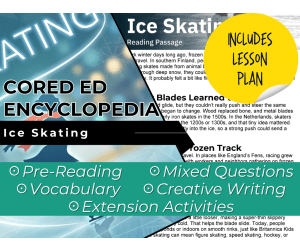
Ice Skating Reading Comprehension Passage - Cored Ed Encyclopedia
ELA, Reading Comprehension, Reading, Language Development, History, Social Studies, Science, Physics, Sports, P.E. & Health, Grade 2, 3, 4, 5, Worksheets & Printables, Worksheets, Teacher Tools, Centers, Activities, Writing Prompts, Assessments, Quizzes and Tests, Quizzes, Lesson Plans
This Ice Skating reading comprehension with lesson plan includes: Visualization (on the front cover) Start your lesson by taking a minute to think and share something about the topic. Read the script aloud (slowly), perhaps prepare some music or sound effects. Student close their eyes and let their imaginations wander. Students open their eyes, read the question aloud and give them a few minutes to complete. Ask a few students to share or keep answers until the end to compare with what they learn in the passage. Quick pause—thousands of Cored Education products are included with your TeachSimple membership. Download links and encyclopedia index available here. Pre-Reading Trivia Students will write down one thing they already know about the subject and then read five more facts and discuss. These facts are fun, and the students will enjoy learning about the subject before reading more. Give 1 minute for students to write what they already know (no pressure—best guess is fine). Read the five facts together. After each fact, do ask a student for their opinion, was it surprising? Set a purpose by asking students to highlight/underline one fact they want to learn more about during the reading. Reading Passage The text is a high-interest reading passage with set paragraphs, roughly three to four paragraphs long. It contains a variety of themes about the topic, anywhere from history to technology. The passage is between 250 and 350 words in length. First, ask students to look at the headings and see what they’ll learn about today. What do they know about the topic/heading? First read options: Teacher read-aloud (best for support). Partner reading (paragraph by paragraph). While reading, students underline important details, and vocabulary words they think may come up in the questions section. Mixed Questions The first question page contains four multiple-choice questions, each with a choice of four answers, and three written response questions that require a sentence or two from the student. Students complete the mcqs first independently, then review quickly as a class. For the 3 written responses, try to get students giving the answer with some form of evidence: “I think ___ because the text says ___.” If students get stuck, send them back to check the passage. Vocabulary Questions Practice seven key words from the text in this section across two activities. First section is scrambled words where students will unscramble three words given a clue for each. The second section is a word to meaning matching activity. Before starting, have some students read out words they underlined in the passage. Ask students to say the word and read aloud the sentence(s) around each word. Ask students to do scrambled words and the matching exercise in pairs then go through answers as a class. For the scrambled spelling task, get four pairs to come up to the board and write the words for extra practice with the other student reading out the clue. For the matching task, prompt students to give full sentences: “I matched ___ with ___ because ___.” Creative Writing In this question, the student will be required to write a five to eight sentence paragraph on a question related to the topic. Before starting, ask students write down 3 key ideas they are going to include in their piece. Ask students for ideas to share around the class to help those struggling. Pro writing expectations: 5–8 sentences At least 2 facts or details from the passage At least 2 vocabulary words from the previous page Students read their paragraphs while classmates listen for facts and vocabulary words. Extension Activities This page is optional for fast finishers or to take home. There are several activities, each one requiring a different skill. Do some, do none, do all, completely optional - but you will feel reassured knowing every possibility is planned for. Includes summary writting question and additional facts. Answer Key There are answers for the multiple-choice questions, written response questions have sample answers, vocabulary answers and if there is a summary question then a sample summary will be provided as well. Lesson Plan Included Customized lesson plan for this lesson is included. Lesson Snapshot Title: Ice Skating Genre: Nonfiction (informational text) Subject: Reading (Informational Text) / Science Primary Topic: How ice skating began and why blades glide Estimated Guided Reading Level (A–Z): R What This Lesson Teaches Best Explains how ice skating was first used for winter travel long ago (frozen lakes and rivers as “the easiest way to travel”). Describes how skates changed over time (from animal bones to wood to metal blades) and why sharpened edges mattered for control. Shows how skating shifted from travel to organized sport, including races, rules, championships, and the Olympic stage. Introduces a simple science idea for why skates glide: a super-thin slippery surface layer where ice molecules are a little looser. Uses text features (section headings) to chunk information and support comprehension. Learning Goals Identify the main idea and key details about how ice skating began and changed over time. Describe the difference between early bone skates and later skates with sharpened metal edges. Explain how sharpened edges helped skaters push, steer, and move with control. Explain, using the text, why a skate blade can slide well on ice. Describe how skating became an organized sport with rules, championships, and worldwide attention. Key Vocabulary From the Text blades — thin metal parts of skates that touch the ice. edges — sharpened sides that help a skate grip ice. molecules — tiny pieces that make up ice. championships — contests to find winners in a sport. standards — agreed rules that keep things consistent. FULL CATALOG OF DOWNLOAD LINKS AND ENCYCLOPEDIA INDEX HERE
Author Cored Education
Rating
Tags Vocabulary, Reading Comprehension, Reading Passages, Lesson Plans, Ela Lesson Plans, Reading Comprehension Lesson Plans, Pre-reading, History, P.e. Lesson Plans, Sports
Around the Home Word List Posters (PDF)
ELA, Language Development, Resources for Teachers, Vocabulary, Spelling, ESL, Grade 2, 3, 4, 5, Worksheets & Printables, Worksheets, Teacher Tools, Centers, Activities, Posters, Classroom Decor
Word List Poster Series This word list poster series is designed for students in grades 2–5. Each printable focuses on a clear, kid-friendly theme and features 8 target vocabulary words with short, student-friendly meanings or fun facts. The clean layout works as both an anchor chart and a write-in sheet, giving students a quick, visual reference they can revisit during centers and independent work. These posters are student-friendly, classroom-ready, and perfect for warmups, vocabulary walls, sub plans, or take-home reference. Display a single poster to support the day’s lesson, or group several to build a themed wall across your unit. Note: Each poster is a companion piece to its matching themed product in the series—pair it with the corresponding maze, wordsearch, or activity pack for a consistent set of 8 focus words. Around the Home Word List 1. Rooms in the House Kitchen, Living room, Bedroom, Bathroom, Dining room, Garage, Laundry room, Attic 2. Furniture & Appliances Chair, Table, Couch, Bed, Refrigerator, Oven, Lamp, Bookshelf 3. Things Found in a Home Clock, Mirror, Rug, Curtains, Doorbell, Pillow, Blanket, Fan 4. Outdoor Spaces Backyard, Porch, Garden, Fence, Driveway, Mailbox, Swing, Treehouse 5. Cleaning & Chores Sweep, Mop, Vacuum, Dust, Laundry, Trash, Dish, Organize 6. Family & Home Activities Bake, Set, Sing, Color, Puzzle, Stretch, Laugh, Snuggle PDF Version Other versions will appear here when available. Follow the store for the lastest on new products. How to Use These Word List Posters Perfect for: Morning work or early-finisher bins Vocabulary centers or anchor walls Holiday/seasonal review lessons Independent stations, sub plans, or take-home reference More Around the Home Themed Products CROSSWORDS WORD SEARCHES MAZES FULL CATALOG OF DOWNLOAD LINKS HERE Themed Word List Posters Links Addition PDF Animals PDF Around the Home PDF Birthday PDF Candy PDF Christmas PDF Cinco de Mayo PDF Clothes PDF Colors PDF Days and Months PDF Division PDF Earth Day PDF Easter PDF Easy Word List Posters PDF Fall PDF Father's Day PDF Food PDF Geography (Set 1) PDF Geography (Set 2) PDF Geography (Set 3) PDF Graduation PDF Health PDF History (Set 1) PDF History (Set 2) PDF History (Set 3) PDF Human Body PDF Kindness PDF Life Skills PDF Mother's Day PDF Multiplication PDF Science (Set 1) PDF Science (Set 2) PDF Science (Set 3) PDF Shapes PDF Social Skills PDF Spring PDF Sports PDF St. Patrick's Day PDF Subtraction PDF Summer PDF Thanksgiving PDF Transport PDF Valentine's Day PDF Winter PDF Word List Posters in Depth Structure Each poster is built around a focused sub-theme and presents 8 target words with short, student-friendly meanings or fun facts. The clean A4 portrait layout works as an anchor chart on your board or as a student reference at desks. These posters are designed as companion pieces to the matching themed products (mazes, wordsearches, activity packs), so the same vocabulary stays visible across your unit. Each poster set includes: A themed word list poster with 8 words + brief meanings/facts A clean, high-contrast layout for easy printing and display Space that can double as write-in/draw-to-show-meaning during centers Themes Included Seasons & Holidays (e.g., Halloween, Easter, Valentine’s Day) Everyday Topics (e.g., Animals, Weather, School) Math & Science Connections (e.g., Number Words, Simple Machines) Special Units (e.g., Health, Earth Day, Sports, Kindness) Each topic reflects real-life experiences and interests while strengthening vocabulary recognition and content understanding in a clear, visual way. Easy extensions (optional) Sketch it: students draw a quick icon for each word Sort it: group words by category (e.g., actions, objects) Star it: highlight “I already know” vs. “I’m learning” words Match it: point to examples in a reading, video, or picture set Say it: brief oral definition or example sentence during share-out Differentiation tips Pre-teach 2–3 anchor words; add the rest later in the week Offer picture cues or gestures for emerging readers/ELLs Let students choose 4 of 8 to focus on first, then build up Color-code by part of speech or concept family for quick scanning For similar downloads and other frees, do check out Cored Group on TeachSimple.
Author Cored Education
Rating
Tags Vocabulary, Spelling, Rooms In The House, Furniture, Home Activities, Posters, Ela Posters, Home Posters, Home Word Lists