



3,927 products added recently
Page 90 - 7th Grade Activities
Enhance your seventh-grade curriculum with activities that stimulate curiosity and intellectual growth. These resources cover diverse subjects and include projects that promote inquiry and analysis. Incorporate them to keep students motivated and invested in their learning.

 Show filters


Start Your Own Composter Activity
Earth and Environmental Sciences, Science, Environmental Science, Grade 3, 4, 5, 6, 7, 8, 9, 10, 11, Activities
Activity Introduction An amazing activity designed for the students to learn more about STEM. Start Your Own Composter Do you like STEM subjects? what is your favorite one? Have you ever tried to plant a seed? If yes, tell us more about it. Or have you ever tried to invent something? If yes, tell us more about it. And how do you think it will help us? Have you ever seen a microorganism under a microscope? What was it? And how it looked like? Mathematics is a marvelous subject. Let' sharpen our brains and solve some equations. Do you like timetable tricks? What is your favorite one? Do you know how to code? Have you ever created an app or a game before? If yes, how was it like? Start Your Own Composter Activity The activity is perfect for encouraging the researching skills for the students, while learning more about this fantastic topic. Start Your Own Composter This friendly designed worksheet is suitable for students at school, homeschooling, and as a group activity. Instructions Bring an old plastic bottle or box and start your composter by choosing the items you will add first, then complete the following journal. Format Available in a PDF format.
Author Educational Voice
Tags Start Your Own Composter Activity, Start Your Own Composter, Composter Activity, Composter, Composters, Composters Facts, Composter Facts For Kids, Environment, Environment Facts

Biomes Science BINGO Activity
Science, Earth and Environmental Sciences, Earth Sciences, Grade 6, 7, 8, 9, 10, 11, Activities
Your students will love this engaging science review activity. Everyone loves BINGO and it makes for a great review activity that is fun and competitive. This interactive game reinforces key scientific concepts and theories, ensuring curriculum relevance and accuracy. The game package includes 36 unique 4x4 bingo cards featuring essential terms and concepts from Biomes, a set of call-out cards with clear and concise definitions tailored to the students' level, and detailed gameplay instructions. To play, simply distribute the bingo cards to your students along with markers or chips. Read out the definitions from the call-out cards in a random order, and have students place a marker on the corresponding term on their card. The first student to complete a row or column exclaims "Bingo!" and emerges victorious. Following the game, engage in a discussion of the terms to reinforce understanding and clarify any misconceptions. The beauty of this game is that it allows for multiple rounds of learning and review. Here is a sample from the instructions. BINGO – Instructions, Terms, and Descriptions Cut out and distribute the BINGO cards to your students. Each student will get a unique card. Students can use markers or chips to cover squares that have been called. Print out and cut out each term/description below – these are the call-out cards. Fold each call-out card and place in a hat or box and remove one at a time. After you’ve read the call-out card description, your students are to place a marker on the term associated with the description located on their card. The first student to get 4 in a row horizontally or vertically, wins. Ensure accuracy by checking marked terms on student card to the called-out descriptions.
Author Teach With Fergy
Tags Science Bingo, Bingo Activity, Ecology, Ecosystems, Biomes

Physical Science SAMPLE Reading Passage: Electricity (FILLABLE PDF)
Science, ELA, Reading, Reading Comprehension, Strategies, Resources for Teachers, Physics, Grade 6, 7, 8, 9, Writing Prompts, Worksheets & Printables, Centers, Activities, Teacher Tools, Assessments, Quizzes and Tests, Quizzes, Tests
This is a ONE PASSAGE SAMPLE. The following is the description of the FULL resource and the downloading links: Electricity and Energy: Physical Science Reading Comprehension Passages and Questions (PDF) This very engaging and fillable collection of physical science reading passages about electricity and energy is designed to bridge the gap between science and literacy through strengthening reading comprehension and sparking scientific curiosity in middle school students. Each passage blends English Language Arts skills with accurate science content that supports NGSS classroom practice. Ideal for interdisciplinary learning in ELA and Science. Suitable for Grade 9 review, too! These worksheets are designed as fillable PDFs , which means students can type their answers directly into the document on any computer or tablet . Each page includes highlighted text fields that show them exactly where to type! What Is Included? There are (3) informational passages: The Lightning Rod: Turning Fear into Safety Eel Power: A Holiday Surprise Electricity: From Source to Socket Student Tasks for Each Passage: 5 multiple-choice questions targeting main idea, key details, inference, vocabulary in context, and use of evidence 5 vocabulary matching items with clear, student-friendly definitions 5 text-based questions that require citing specific lines or facts 1 summary prompt that asks students to condense central ideas accurately Full answer key for every section Available Formats for this Resource Word Docs Google Docs FULL CATALOG OF DOWNLOADING LINKS HERE Other Science Reading Collections and Topics You May Find in the Store: 1. Astronomy & Space Science 2. Volcanoes, Rocks, & Mountains 3. Rock Cycle, Soil, & Sinkholes 4. Mars, Glaciers, & Antarctica 5. Water Cycle, Acid Rain, & Wastewater 6. Insects, Animals, & Ecosystems 7. Bioluminescence & Insects 8. Animal Skin, Cats, & T. Rex 9. Human Body and Senses 10. Health & Applied Bioscience 11. Waves, Light, & Imaging 12. Electricity & Energy 13. Motion & Materials 14. Chemistry and Materials Science 15. Electromagnetism 16. Acids and Bases 17. Gas Laws 18. Biotechnology 19. Periodic Trends 20. Protists and Fungi 21. Microevolution 22. Blood 23. Chemical Bonding 24. Magnets 25. Muscles 26. Nuclear Chemistry 27. Electromagnetic Devices 28. Epigenetics 29. The Law of Conservation of Mass 30. Atomic Models 31. Isotopes and Ions 32. Light 33. Human-Environment Interaction 34. Theory of Evolution 35. Photosynthesis 36. Origins of Life and Early Earth 37. Gene Expression and Regulation 38. Thermochemistry 39. Allergies 40. Coevolution 41. Birth to Adulthood 42. Cells 43. Entropy and Free Energy 44. The Human Brain 45. Mixtures and Solutions 46. Invertebrates 47. Zoo Animals 48. Biochemistry 49. Animal Behavior 50. Population Ecology ...and many more engaging science reading passages that cover intriguing and important topics designed to spark curiosity and support student learning. How to Use These PDFs Click on the highlighted area to start typing your answer. Move to the next question by clicking in the next highlighted box. When you are finished, close the document and select SAVE so your answers stay recorded. If you want to keep a blank copy for later, choose Save As and give your completed version a new name. Product Details Length: 14 pages total Grades: 6–8, also suitable for Grade 9 review Use cases: close reading, stations, homework, intervention, test prep, and sub plans Standards support: reinforces informational-text skills and supports NGSS-style sense making through observation, modeling, and clear use of claim, evidence, and reasoning Why Teachers Choose This Set Authentic science content paired with rigorous literacy practice Consistent task structure across all passages for easier planning and smoother student routines Clear, age-appropriate writing that builds confidence without oversimplifying Use this set to reinforce ELA skills in science, to add literacy to your lessons, or to support independent work. The passages strengthen main idea, evidence use, vocabulary in context, inference, cause and effect, and summary writing. With ready-to-use assessments and complete answer keys, you can provide focused practice that is simple to run and fast to review.
Author Middle & High School - CORED Education
Rating
Tags Middle School, Reading Comprehension, Reading Strategies, ELA, Centers, Reading Passage, Assessments, Vocabulary, Physical Science, Physics
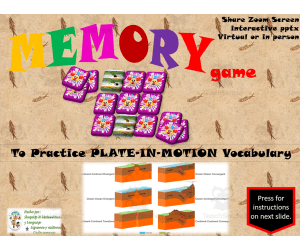
Free Science Interactive Memory Game / Plates in Motion Vocabulary
Science, Earth and Environmental Sciences, Basic Science, Environmental Science, Grade 7, Games, Activities
Plates in Motion Vocabulary Science Memory Game for 7th Grade Engage your 7th grade science students with this interactive memory game that helps them learn, practice, and review key vocabulary and concepts related to plate tectonics. With visual aids and multiple built-in reviews, this PowerPoint game strengthens understanding of terminology and relationships between plates, boundaries, motion, and more. Students will match coordinating image and text cards, using concentration and recall. Flip non-matches face down again to keep guessing until all 20 cards compile into 10 pairs. Replay as desired. Use game whole-group on classroom display, partners at stations, or individual review. Supports differentiation and formative assessment . From teacher-created store with diverse engaging activities for Spanish language learning.
Author ShapeUp-N-Matematicas y Lenguaje
Tags Plates In Motion, Earthquake, Geyser, Landformation, Eruption, Volcano, Volcanic Activity, Trench, Small Or Whole Group, Interactive Activity

Animal Cell Organelles – Labeled & Blank Diagrams Clipart
Science, Life Sciences, Biology, Grade 1, 2, 3, 4, 5, 6, 7, Activities, Classroom Decor
It doesn't have to be difficult to comprehend how a cell functions internally. A fundamental idea in any life science or biology curriculum, this Animal Cell Organelles handout provides students with a clear, high-resolution diagram that makes it simpler to comprehend and recognize the main structures present inside an animal cell. Two copies of the same intricate illustration are included in the collection. While the blank version pushes students to remember and apply what they've studied, making it excellent for independent practice, tests, or interactive scientific notebooks, the labeled diagram serves well as a study aid or reference chart in the classroom. The nucleus and nucleolus, mitochondria, ribosomes, Golgi apparatus, smooth and rough endoplasmic reticulum, lysosomes, vacuoles, cell membrane, and cytoplasm are all included. Students may concentrate on learning organelle names and locations without experiencing visual overload thanks to the layout's simplicity and cleanliness. This resource works well in a variety of teaching contexts; it prints neatly as a handout, looks good in digital presentations, and blends in nicely with more general biology courses that cover cell theory and cell structure. It works well with middle school science, beginning high school biology, homeschool curricula, and anatomy classes for students in grades 5 through 9. Having a precise, well-organized visual reference significantly improves students' confidence when studying for a test or when they are first exposed to animal cells. It works well with middle school science, beginning high school biology, homeschool curricula, and anatomy classes for students in grades 5 through 9. Having a well-organized, correct visual reference significantly influences how confidently students interact with the information, whether they are studying for an exam or seeing animal cells for the first time.
Author Teacher's Clipart
Rating
Tags Animal, Cell , Organelles, Animal Cell Organelles Labeled, Animal Cell Simple, Animal Cell With Organelles Labeled

Elements, Compounds, Chemical Symbols, Formulae and Naming Compounds Board Game
Science, Chemistry, Grade 6, 7, 8, 9, Activities, Games
With 48 question cards on atoms, molecules, elements, compounds, chemical symbols, formulae and naming compounds, this is an enjoyable and challenging board game for up to six players per set. It is suitable for all abilities. Included in this Pack Game board 48 Question cards with questions of varying difficulty Teacher answer sheet Instruction sheet. Preparation Photocopy Board onto A3 paper or card (Colour and greyscale versions included). Photocopy question sheets onto paper or card (Colour and greyscale versions included) and cut into question cards. How to Play Highest score of dice starts Pupils take turns and work their way around the board following the instructions in the squares. Certain squares indicate that the pupil takes a question card from the face down pile. If correct they move on 2 spaces. If a player thinks an answer given by an opponent is incorrect they can challenge. If the challenge is correct the challenger moves forward 2 spaces. If the challenge is wrong the challenger moves back two spaces. In the event of a challenge, pupils are encouraged to consult their books but the teacher has a quick-check answer sheet. See more Elf Off the Shelf resources on this topic and many others
Author Elf off the Shelf Resources
Tags Science Board Game, Chemistry Board Game, Elements And Compounds, Naming Compounds Board Game, Chemical Elements Game, Science Elements Game

Lightsaber Photoshop Activity
Science, Technology, Grade 7, 8, 9, 10, Activities
Students will work with digital tools in the Lightsaber Photoshop Activity . Students will take an ordinary scene and add in a glowing lightsaber. Step by step directions are included.
Author OK Products
Tags Lightsaber, Technology, Photoshop, Photopea, Computer Science, Graphic Design, Design Concepts

Astronomy: A student’s book: history & facts about telescopes project
Social Studies, ELA, Biographies, Writing, Science, Inventors, Earth and Environmental Sciences, Space, Grade 4, 5, 6, 7, Activities, Projects, Worksheets & Printables, Worksheets
Astronomy: A student’s book: history & facts about telescopes project This Astronomy: A student’s book: history & facts about telescopes project is a booklet on the history/facts about telescopes and the lives of seven different inventors! Students are to research the information necessary to complete this Astronomy: A student’s book: history & facts about telescopes. Students are sure to increase their knowledge concerning tools of astronomy as well as the parts of the telescope. Additionally, there are opportunities for students to practice their essay writing skills with specific topics. There are 2 Quizzes included in this booklet as well as the Answer keys for easy checking. This Astronomy: A student’s book: history & facts about telescopes project includes the following TABLE OF CONTENTS: 1 Just what is a telescope? 2 Terminology 3 Parts of a telescope (Refracting telescope-fill in 3 a Answer key: Parts of a Refracting telescope 3 b: Research/Respond: What are the parts of a Reflecting Telescope? 4 Essay #1: How do telescopes work 5 Different types of telescopes 6 Essay #2 7 Essay #3: What is Optics 8 What is an observatory? 9 What is a planetarium? 10 What is the difference between a telescope and a periscope? 11 Leonardo da Vinci 12 Galileo Galilei 13 Hans Lippershey 14 Zacharias Janssen 15 Isaac Newton 16 Lyman Spitzer 16 a Edwin Hubble: His discoveries/ Hubble Telescope 17 Word Jumble/ Science Vocabulary 18 Answer key: Word Jumble 19 Word Search 20 Quiz #1:Fill in Facts about telescopes 21 Answer key: Quiz: Facts about telescopes 22 Mystery Quote Challenge 23 Answer key: Mystery Quote Challenge 24 Quiz #2: James Webb Telescope 25 Answer key: Quiz #2: James Webb Telescope This Astronomy: A student’s book: history & facts about telescopes project contains 32 pages and it is ready to print and use!
Author THE LANTERN OF KNOWLEDGE
Tags Astronomy, Telescopes, Da Vinci, Galileo, Hans Lippershey
Thinking Games and Activities: Making Critical Thinking Fun for the Classroom
, Grade 5, 6, 7, 8, Activities, Games
Thinking Games and Activities: Making Critical Thinking Fun for the Classroom A comprehensive teaching resource designed to invigorate the learning experience in your classroom. This product has been crafted based on established research advocating that students learn more efficiently when exposed to a plethora of critical thinking skills, creative methodologies, varied study techniques, and metacognitive strategies. Resource Composition This resource comprises a collection of quick, no-prep or little-prep activities that engage key skills and strategies. Use these as individual assignments or class tasks flexibly fitting around your teaching style. Usage Variety Boost competitiveness within group work situations A perfect fit during spare moments during the school day like waiting for an assembly or end of class Easily adaptable into productive filler during bus travel times with students Possess repeatability factor due to its engaging nature stimulating request from students again! Bonus for Educators Increase longevity in lesson planning through recyclable worksheets saving educators time. Packaging & Designing: The package comes as a single PDF containing 88 pages ready-to-print worksheets filled with engaging activities designed specifically for Grade 5 through Grade 8 learners. This valuable asset provides teachers with diverse game types tailored towards enhancing critical thinking among their pupils in an enjoyable manner. In Summary, Thinking Games and Activities help make critical thinking not merely an academic pursuit but rather a fun part of daily learning – developing engaged learners whose intellectual curiosity gets encouraged by playing these games may well start their lifelong love affair with learning!
Author Classroom Complete Press
Tags Critical Thinking, Thinking Fun, Thinking Games, Class Activities, Group Games
Volcanoes, Rocks, & Mountains: SAMPLE Reading Passage (Word)
Science, Earth and Environmental Sciences, ELA, Reading, Reading Comprehension, Strategies, Resources for Teachers, Geology, Earth Sciences, Grade 6, 7, 8, 9, Writing Prompts, Worksheets & Printables, Centers, Activities, Teacher Tools, Assessments, Quizzes and Tests, Quizzes, Tests
This is a ONE PASSAGE SAMPLE. The following is the description of the FULL resource and the downloading links: Volcanoes, Rocks, & Mountains: Reading Comprehension Passages (Word) This very engaging collection of earth science reading passages about Mountains, Volcanoes, and Igneous Rocks is designed to bridge the gap between science and literacy through strengthening reading comprehension and sparking scientific curiosity in middle school students. Each passage blends English Language Arts skills with accurate science content that supports NGSS classroom practice. Ideal for interdisciplinary learning in ELA and Science. Suitable for Grade 9 review, too! What Is Included? There are (3) informational passages: Mountains: From Plates to Peaks See how plate collisions fold rock, faults lift blocks, and volcanism builds peaks. Learn how rivers, glaciers, and gravity continue to reshape ranges over time. How Volcanoes Shape Our World Examine hazards such as ash, gases, lahars, and pyroclastic flows, along with benefits like fertile soils, mineral resources, geothermal energy, and new land. Learn how monitoring and planning reduce risk. Igneous Rocks: From Fire to Everyday Life Compare intrusive and extrusive rocks, link cooling rates to crystal size and texture, and connect granite, basalt, pumice, and obsidian to everyday uses in buildings, roads, tools, and art. Student Tasks for Each Passage: 5 multiple-choice questions targeting main idea, key details, inference, vocabulary in context, and use of evidence 5 vocabulary matching items with clear, student-friendly definitions 5 text-based questions that require citing specific lines or facts 1 summary prompt that asks students to condense central ideas accurately Full answer key for every section Available Formats for this Resource PDF Google Docs FULL CATALOG OF DOWNLOADING LINKS HERE Other Science Reading Collections and Topics You May Find in the Store: 1. Astronomy & Space Science 2. Volcanoes, Rocks, & Mountains 3. Rock Cycle, Soil, & Sinkholes 4. Mars, Glaciers, & Antarctica 5. Water Cycle, Acid Rain, & Wastewater 6. Insects, Animals, & Ecosystems 7. Bioluminescence & Insects 8. Animal Skin, Cats, & T. Rex 9. Human Body and Senses 10. Health & Applied Bioscience 11. Waves, Light, & Imaging 12. Electricity & Energy 13. Motion & Materials 14. Chemistry and Materials Science 15. Electromagnetism 16. Acids and Bases 17. Gas Laws 18. Biotechnology 19. Periodic Trends 20. Protists and Fungi 21. Microevolution 22. Blood 23. Chemical Bonding 24. Magnets 25. Muscles 26. Nuclear Chemistry 27. Electromagnetic Devices 28. Epigenetics 29. The Law of Conservation of Mass 30. Atomic Models 31. Isotopes and Ions 32. Light 33. Human-Environment Interaction 34. Theory of Evolution 35. Photosynthesis 36. Origins of Life and Early Earth 37. Gene Expression and Regulation 38. Thermochemistry 39. Allergies 40. Coevolution 41. Birth to Adulthood 42. Cells 43. Entropy and Free Energy 44. The Human Brain 45. Mixtures and Solutions 46. Invertebrates 47. Zoo Animals 48. Biochemistry 49. Animal Behavior 50. Population Ecology ...and many more engaging science reading passages that cover intriguing and important topics designed to spark curiosity and support student learning.. Product Details Length: 13 pages total Grades: 6–8, also suitable for Grade 9 review Use cases: close reading, stations, homework, intervention, test prep, and sub plans Standards support: reinforces informational-text skills and supports NGSS-style sense making through observation, modeling, and clear use of claim, evidence, and reasoning Why Teachers Choose This Set Authentic science content paired with rigorous literacy practice Consistent task structure across all passages for easier planning and smoother student routines Clear, age-appropriate writing that builds confidence without oversimplifying Use this set to reinforce ELA skills in science, to add literacy to your lessons, or to support independent work. The passages strengthen main idea, evidence use, vocabulary in context, inference, cause and effect, and summary writing. With ready-to-use assessments and complete answer keys, you can provide focused practice that is simple to run and fast to review.
Author Middle & High School - CORED Education
Rating
Tags Middle School, Reading Comprehension, Reading Strategies, Reading Passages, ELA, Centers, Reading Passage, Assessments, Vocabulary, Earth Science

Simple Machines: Memory Match Game - FLASH-MAC
Science, Technology, Engineering, Common Core, Grade 5, 6, 7, 8, Activities, Games
The Simple Machines: Memory Match Game - FLASH-MAC A top-notch teaching resource for educators in the public school sector and homeschooling, suitable for learners from grades 5 to 8. This instructional tool is concentrated on the science subject, more specifically on its subcategory— engineering . Purpose of the Game: This enriching game's main goal is to facilitate students' comprehensive understanding of six distinct simple machines. Format of the Game: The game takes a memory match format where students find pairs of simple machines hidden within a puzzle. This engaging method promotes effective learning and memorization since students can play individually or in teams. *Note: Teachers can utilize it for group teachings or as entertaining homework assignments. Adhering closely with Common Core State Standards (CCSS), this teaching aid guarantees educators that their teaching meets national learning expectations. The content is even planned per Bloom's Taxonomy—enhancing educational potential while skillfully navigating cognitive levels from gaining knowledge to comprehension until reaching evaluation. About Software Compatibility: This product only supports Mac-based software and wraps up everything into a solitary manageable file type—an effortless task when preparing your digital lesson plans or assigning tasks virtually during remote learning sessions. The takeaway message — Sopping up all benefits from The Simple Machines: Memory Match Game - FLASH-MAC, you empower your learners with an exciting, academically vigorous chance – whether classroom-based or virtual—to dive deep into engineering—a subset of science—with the utmost interest and self-assurance.
Author Classroom Complete Press
Tags Software (Mac)
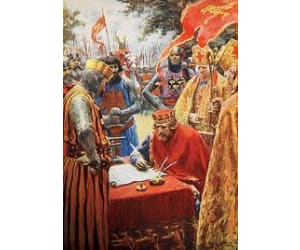
The Magna Carta - the Great Charter, a classroom play
Social Studies, Government, History, History: British, History: USA, Grade 6, 7, 8, 9, 10, 11, 12, Activities
Having my students involved in the learning process in my room is so much fun. Here is a 10-15 minute play to help bring alive history in your classroom! I use the Magna Carta play to help introduce the important topic of the Magna Carta. The overall theme, of course, is that no king (or government) is above the law. Three of the "rights" claimed by the unhappy barons are mentioned in the play, too. Currently, I am using this as part of an American History classroom. We are learning about the Roots of Representative Government. However, this resource can be used in many ways when learning about democracy, rights, the English Bill or Rights, the Declaration of Independence, and more. All have been influenced by Magna Carta. Students love being active while learning, and this gives them the chance. Every student can be involved if you choose. There are non-speaking parts like the "Knights of the King." Enjoy!
Author BCM Creations
Tags Readers Theater
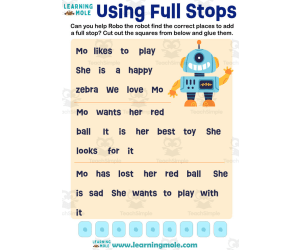
Using Full Stops Activity
Grammar, Language Development, ELA, Grade 2, 3, 4, 5, 6, 7, 8, 9, 10, 11, 12, Activities
Activity Introduction An amazing activity designed for the students to learn more about languages. Using Full Stops Do you enjoy learning English? Which topic do you like the most Grammar, writing, reading, spelling, comprehension, vocabulary or phonics? Have you ever tried to learn any other language? If yes, tell us more about it? How many languages are spoken in the world? What do you think the most interesting one? Can you say Hello in Spanish, French or even Japanese? You can give it a try! Can you name the countries that speaks Portuguese? How many countries speaks Dutch? What is the less spoken language in the whole world? Would you like to learn a new language someday? If yes, which language will you choose? Using Full Stops Activity The activity is perfect for encouraging the researching skills for the students, while learning more about world languages. Using Full Stops This friendly designed worksheet is suitable for students at school, homeschooling, and as a group activity. Instructions Can you help Robo the robot find the correct places to add a full stop? Cut out the squares from below and glue them. Format Available in a PDF format.
Author Educational Voice
Tags Using Full Stops Activity, Using Full Stops, Using Full Stops Facts, Using Full Stops Facts For Kids, Full Stops, Full Stops Facts, Full Stops Facts For Kids, Punctuation, Punctuation Activity

Potential Energy Experiment Activity
Science, Physics, Grade 4, 5, 6, 7, 8, 9, 10, Activities, Experiments
Activity Introduction An amazing activity designed for the students to learn more about STEM subjects. Potential Energy Experiment Do you like STEM subjects? what is your favorite one? Have you ever tried to plant a seed? If yes, tell us more about it. Or have you ever tried to invent something? If yes, tell us more about it. And how do you think it will help us? Have you ever seen a microorganism under a microscope? What was it? And how it looked like? Mathematics is a marvelous subject. Let' sharpen our brains and solve some equations. Do you like timetable tricks? What is your favorite one? Do you know how to code? Have you ever created an app or a game before? If yes, how was it like? Potential Energy Experiment Activity The activity is perfect for encouraging the researching skills for the students, while learning more about this topic. Potential Energy Experiment This friendly designed worksheet is suitable for students at school, homeschooling, and as a group activity. Instructions Do the following experiment to test the speed of various objects rolling down an inclined plane. Format Available in a PDF format.
Author Educational Voice
Tags Potential Energy Experiment Activity, Potential Energy Experiment, Potential Energy, Potential Energy Facts, Potential Energy Facts For Kids, STEM, Physics, Physics Facts, Physics Facts For Kids
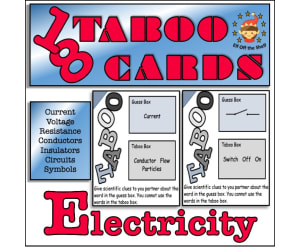
Current Electricity Taboo Cards 1
Science, Physics, Grade 5, 6, 7, 8, 9, Activities
Eighteen taboo cards on: -explaining current, voltage and resistance; -explaining and naming conductors and insulators; -circuits and symbols How to Use: -Work in pairs -Place cards in a pile face down -Student takes a card and gives scientific clues to their partner to help them guess the word in the guess box -The clue giver cannot use the words in the taboo box in the clues See more Elf Off the Shelf resources on this topic and many others
Author Elf off the Shelf Resources
Tags Taboo Cards, Current Electricity Printable, Electricity Taboo Cards, Phsyics Activity, Science

Middle School Math Stations or Centers: Factors, Multiples, Prime, Composite
Math, Fact Families, Multiplication and Division, Division, Numbers, Multiplication, Grade 4, 5, 6, 7, Centers, Activities
This ready-to-go set of 5 stations will supplement a unit about factors, multiples, prime and composite numbers. Math stations or centers are a great way to get students engaged as they move about the room and work collaboratively with their peers. Even when students are in middle school or the intermediate grades, they benefit from a variety of teaching strategies including the use of stations or centres! But they are a lot of work to prepare! Let me do the work for you! Station 1: Students solve 4 riddles/word problems involving factors and multiples. (optional: set out white boards for students to use) Station 2: Students play a game using 10-sided dice. (supplies needed: pairs of dice) Station 3: Students choose two numbers to investigate and learn about common factors and multiples. (optional: set out an anchor chart about factors vs multiples) Station 4: Students review prime and composite numbers and make prime factor trees. (optional: set out laptops or tablets for the online game extension) Station 5: Students apply what they have learned to a real-life problem, and practice writing and drawing about their mathematical thinking. (optional: set out counters for students to use) Ways to Use: You can break your class into 5 groups and have them rotate one at a time through the centres, giving them 10-20 minutes at each one. Or, start students at certain centres and then allow them to move around at their own pace as long as no one centre gets too full. I find these are a great resource as you are finishing your unit and preparing for the unit test. Grades to Use With: These stations work well in grades 4-7 classes or high school special education. Standards: CCSS4.OA.B.4 Find all factor pairs for a whole number in the range 1-100. Recognize that a whole number is a multiple of each of its factors. Determine whether a given whole number in the range 1-100 is a multiple of a given one-digit number. Determine whether a given whole number in the range 1-100 is prime or composite. CCSS6.NS.B.4 Find the greatest common factor of two whole numbers less than or equal to 100 and the least common multiple of two whole numbers less than or equal to 12. Use the distributive property to express a sum of two whole numbers 1–100 with a common factor as a multiple of a sum of two whole numbers with no common factor. For example, express 36 + 8 as 4 (9 + 2). If you like these math stations, check out the others in my store: 5 Stations for Adding/Subtracting Integers 5 Stations for Early Algebra Concepts 5 Stations for Area, Perimeter, and Volume
Author Grace Under Pressure
Tags Math Centers, Math Stations, Factors, Multiples, Word Problems, Prime , Composite, Middle School Math, Hands-on Math, Factor Trees, How To Teach Factors, How To Teach Factors And Multiples
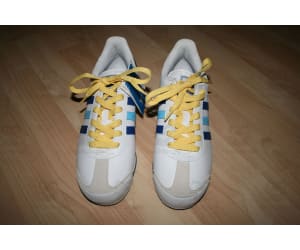
Foot Shoes Photoshop Activity
Science, Technology, Grade 7, 8, 9, 10, Activities
Students will work with digital tools in the Foot Shoes Photoshop Activity . Students will use pictures of their own feet to create a pair of foot shoes. Step by step directions are included.
Author OK Products
Tags Technology, Computer Science, Computer Lesson, Foot Shoes, Graphic Design, Photoshop, Mobile Applications, Art, Graphics
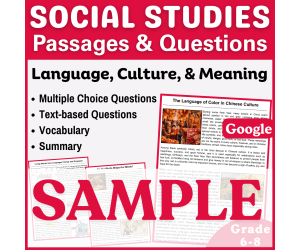
Social Studies SAMPLE Reading Passage: Language, Culture (Google)
ELA, Reading, Reading Comprehension, Strategies, Resources for Teachers, Social Studies, Geography, Sociology, Grade 6, 7, 8, 9, Writing Prompts, Worksheets & Printables, Centers, Activities, Teacher Tools, Assessments, Quizzes and Tests, Quizzes, Tests
This is a ONE PASSAGE SAMPLE. The following is the description of the FULL resource and the downloading links: Social Studies Reading Comprehension Passages: Language, Culture, Meaning (Google) This resource introduces a collection of Social Studies reading comprehension passages about Language, Culture, and Meaning. The passages are carefully designed to bridge the gap between social studies and literacy through strengthening reading comprehension and sparking knowledge curiosity in middle school students. Each passage blends English Language Arts skills with accurate social studies content. Ideal for interdisciplinary learning in ELA and Social Studies. Suitable for Grade 9 review, too! What Is Included in this Collection? There are three informational passages (with full answer keys): Living Words: How Languages Change and Disappear The Language of Color in Chinese Culture Do Our Words Shape Our Minds For Each Passage, students will have multiple tasks to complete as follow: 5 multiple-choice questions targeting main idea, key details, inference, vocabulary in context, and use of evidence 5 vocabulary matching items with clear, student-friendly definitions 5 text-based questions that require citing specific lines or facts 1 summary prompt that asks students to condense central ideas accurately Available Formats for this Resource Fillable PDF Word Docs Google Docs FULL CATALOG OF DOWNLOADING LINKS HERE For more Social Studies Reading Passages, check the following Links: Ancient Civilizations PDF Fillable PDF Word Docs Google Docs Early Empires and Trade Networks PDF Fillable PDF Word Docs Google Docs The Founding of the United States PDF Fillable PDF Word Docs Google Docs Language, Culture, and Meaning PDF Fillable PDF Word Docs Google Docs Psychology and Society PDF Fillable PDF Word Docs Google Docs Global Festivals and Traditions PDF Fillable PDF Word Docs Google Docs Extreme Environments and People PDF Fillable PDF Word Docs Google Docs Food, Culture, and Preservation PDF Fillable PDF Word Docs Google Docs Global Food Customs PDF Fillable PDF Word Docs Google Docs Media, Communication, and Popular Culture PDF Fillable PDF Word Docs Google Docs Human Impact on the Environment PDF Fillable PDF Word Docs Google Docs Civic Action and Social Change PDF Fillable PDF Word Docs Google Docs Fashion, Society, and Power PDF Fillable PDF Word Docs Google Docs People, Places, and Unusual Histories PDF Fillable PDF Word Docs Google Docs Product Details Length: 13 pages total Grades: 6–8, also suitable for Grade 9 review Use cases: close reading, stations, homework, intervention, test prep, and sub plans Why Teachers Choose This Set Authentic social studies content paired with rigorous literacy practice Consistent task structure across all passages for easier planning and smoother student routines Clear, age-appropriate writing that builds confidence without oversimplifying Use this set to reinforce ELA skills in social studies, to add literacy to your lessons, and to support independent work. The passages strengthen main idea, evidence use, vocabulary in context, inference, cause and effect, and summary writing. With ready-to-use assessments and complete answer keys, you can provide focused practice that is simple to run and fast to review.
Author Middle & High School - CORED Education
Rating
Tags Middle School, Reading Comprehension, Reading Strategies, ELA, Centers, Reading Passage, Assessments, Vocabulary, Social Studies
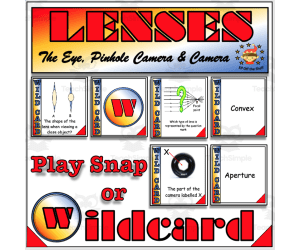
Light - Lenses, the Eye, the Pinhole camera and the Camera - Wildcard and Snap Card Games for Middle School
Science, Physics, Grade 5, 6, 7, 8, 9, Games, Activities
Light - Lenses, the Eye, the Pinhole camera and the Camera - Wildcard and Snap Card Games for Middle School: A Must-Have Educational Resource Designed for students in grades 5-9, this engaging teaching resource offers a unique approach to hands-on learning about optics. This comprehensive card deck covers topics that range from Lenses to Eye Anatomy, from Pinhole Cameras to Camera Technology. The pack includes: 66 Educative Playing Cards with scientific facts and diagrams related predominantly to physics. A systematic covering of facts around convex lenses used in various optical devices; how concave lenses work; visual perception through image formation by the eye lens; light regulation by iris-pupil dynamics etc.; this set is a versatile teaching aid. An exploration into interrelated topics such as how glasses correct sight abnormalities using various types of lenses based on individual need and ray diagrams ' working mechanism as it pertains specifically to distant & close object view recognition. The game set has been designed with a 'Wildcard' game apart from basic 'Snap' cards providing an interactive learning experience. The inclusion of an Animated PowerPoint that guides participants through game rules ensures smooth gameplay. Additionale Features: In-depth comparison between a camera’s functioning mechanism versus human vision enables learners to understand real-world applications. Suitable for cooperative education modules such as group activities as well is useful for individual self-study too! Homeschooling parents will find this multi-subject resource highly beneficial. In conclusion:, "Light - Lenses, the Eye, the Pinhole camera and the Camera" effectively makes abstract scientific theories tangible via gamified education while promoting holistic science learning.
Author Elf off the Shelf Resources
Tags Optics, Lenses, Eye Anatomy, Pinhole Camera, Camera Technology

Elect a President: Cooperative Work Activity
Social Studies, History, History: USA, Government, Grade 6, 7, 8, 9, Activities
Elect a President: Cooperative Work Activity An engaging teaching resource best suited for Grades 6-9, designed with a focus on Social Studies subjects, particularly History: USA and Government. The Concept This innovative activity introduces students to the fascinating world of elections. It creatively ties in aspects from WWII and leadership dynamics into an interactive learning session. Students work in pairs to assess potential presidential candidates based on defined attributes. Candidate Profiles Six anonymous presidential candidates' profiles are outlined – each presented with five positive attributes and one negative trait. These profiles are drawn from historical figures across different timelines, adding an additional layer of intrigue to the learning process. The Task Through a highly engaging exercise, students need to rank these figures according to who they believe would make ideal presidents based on the listed criteria. This module not only introduces them to election dynamics but also encourages critical thinking around leadership qualities and decision-making capabilities. Note: A simple click by tutors reveals each candidate's identity—an interesting twist that often surprises students about their primary or last-ranking choices. Potential Follow-Up Activities Discuss why certain candidates were selected over others; Analyze valuable traits according to student pairs; Delineate upon traits deemed insignificant; Etc... The Tools We Provide: Crafted using Microsoft PowerPoint making it easier for modification by educators as per their needs. *Can be used as part of whole class instruction, small group sessions or even individual homework assignments. Conclusion: The Elect a President: Cooperative Work Activity introduces a unique blend of history and government through interactive learning. It serves as an excellent introductory module for lessons on elections, WWII or leadership concepts.
Author EduPal Learning
Tags Elections, Cooperative Learning, Leadership, US History, Government

Research Organizer & Essay Assignment: J.K. Rowling
ELA, Literature, Writing, Grade 6, 7, 8, 9, 10, Activities, Projects, Worksheets & Printables, Worksheets
This resource provides your students with the opportunity to independently research and write about the life of the creator of Harry Potter, J.K. Rowling, with this engaging research planner and essay assignment. This carefully scaffolded and easy-to-assign-AND-assess resource has been designed to guide student learning from Rowling fact-collection to the careful development of a five-paragraph research essay. Teaching this resource could not be easier! Start by handing out the background research and note-taking worksheet (you could also ONLY hand this out if you want a shorter lesson!). Once students have found their facts and sources, provide them with the essay outline activity, which guides them step-by-step through the requirements of a short research essay. From there, drafting their essay, using the provided peer review checklist, and submitting their final draft will be no problem at all. And then you can assess their work with the provided Common Core rubric! Use this entire resource as a complete research lesson or just part of it as a short research activity or sub plan! This TeachSimple download includes: A J.K. Rowling essay writing assignment with directions, requirements, research essay writing tips, a peer review checklist, and Common Core-tied grading rubric An editable rubric, provided as a link, that lets you make adjustments to the grade values and guidelines. This link is provided as as Google Sheet specifically built for integration into Google Classroom, although you can also modify it for use in other Learning Management Systems (LMSs) A J.K. Rowling biography and note-taking worksheet that will guide your students through information gathering. This straightforward two-page handout includes instructions for background research, a fun drawing section, and an area to cite quality sources and organize conducted research A research essay outlining worksheet, so students build on their J.K. Rowling notes in a clear and simple manner as they build their work towards a draft and final paper All 6-pages of this lesson are provided in full-color and B&W versions Although this resource can be fitted for any secondary Language Arts classroom, it has been carefully designed to work best in grades 8 through 11. The included rubric is subtly but specifically tied to Common Core ELA Standards for Language (3) and Writing (2 and 7). This resource is provided as a print-ready, bookmarked, and adjustable PDF file. The rubric is also included as an editable Google Sheet. This resource contains 6 pages and 1 Google Sheet.
Author The Language of Educational Art, LLC
Tags Essay, Research, Rubric, Notetaking, Outlining
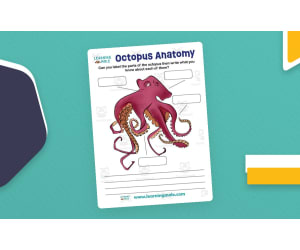
Octopus Activity
Science, Life Sciences, Biology, Animals, Grade 3, 4, 5, 6, 7, 8, 9, Activities
Activity Introduction An amazing activity designed for the students to learn more about famous places in different countries. The Octopus Do you like animals? what is your favorite one? Do you own a pet? If yes, tell us more about it, like what its name? And what do you like most about it? What are the animal kingdoms? Can you write down the characteristics of each animal class like mammals, birds, reptiles, amphibian, fish and mollusks. Do you know that some animals can sing, can you name any of them? What is the largest and the smallest mammal in the world? What is the largest and the smallest bird in the world? What is the largest and the smallest fish in the world? Octopus Activity The activity is perfect for encouraging the researching skills for the students, while learning more about this fantastic place. Octopus This friendly designed worksheet is suitable for students at school, homeschooling, and as a group activity. Instructions Can you label the parts of the octopus then write what you know about each of them? Format Available in a PDF format.
Author Educational Voice
Tags Octopus Activity, Octopus, Octopi , Octopus Facts, Octopus Facts For Kids, Animal, Animals, Animals Facts, Animals Facts For Kids

Frost Mittens Activity
Social Studies, Geography, Grade 3, 4, 5, 6, 7, 8, 9, Activities
Activity Introduction An amazing activity designed for the students to learn more about famous places in different countries. The Frost Mittens What do you know about this phenomenon? Where it happens? When it happens? What are the safety measures that we should take to be safe during this phenomenon? Are there any other places in the world that experienced this phenomenon? If yes, tell us more about them. Why do you think it happens? Do you like reading about Geography? What is your favorite country in the whole world? Frost Mittens Activity The activity is perfect for encouraging the researching skills for the students, while learning more about this fantastic phenomenon. Frost Mittens This friendly designed worksheet is suitable for students at school, homeschooling, and as a group activity. Instructions How does frost form? How can you create frost at home? What are different types of frost? Format Available in a PDF format.
Author Educational Voice
Tags Frost Mittens Activity, Frost , Frost Facts, Frost Facts For Kids, Weather , Weather Facts For Kids, Activities For Kids
Find, Analyze, & Share Poem Project
ELA, Literature, Poetry, Grade 7, 8, 9, 10, Activities, Projects
The Find, Analyze, & Share Poem Project - A Premier Education Resource The Find, Analyze, & Share Poem Project stands as an indispensable educational tool for teachers predominantly focusing on the disciplines of poetry analysis and public speaking. This zero-preparation product promises to sow the seeds of fundamental poetic insights in students whilst concurrently polishing their literary analyses capabilities and public speaking dexterity. Innovative By Design A true hallmark of innovation,this project crafts an autonomous learning journey enabling persistent exploration in unraveling literary treasures - a truly empowering experience that significantly nurtures critical thinking abilities. Dual Facet Advantages Every student using this wonderful tool will not only grasp essential poetic concepts but also traverse through intricate verse with a newly found analytical fervor. Following this journey lies the treasure of communicated eloquence; being able to present findings confidently before an audience - a skill paramount in today's education frameworks. Comprehensive Teaching Resources: Find, Analyze & Share Poem Project could seamlessly blend within group studies or operate as effective standalone homework assignments etc; This resource is supplemented by enlightening instructional presentation material spread across 27 slides fed with 8 poem variants and 10 easy-to-understand literary concepts; Symbiotic assessment capabilities including multiple rubrics built on Common Core ELA standards make tracking progress easier. The added flexibility comes via editable rubriks that are modifiable suiting individual instructor's grading philosophy aiding easy integration into Learning Management Systems like Google Classroom among others; Cross-Grade Compatibility An alluring advantage resides within its versatility across grades (from seventh through tenth grade) making it a perfect fit for multiple classrooms. Moreover, due to the incorporation of modern technology, no preparation is needed as its content can be directly linked via EASEL. The Find, Analyze & Share Poem Project - More Than A Class Tool More than a simple instructional mechanism, this extensively equipped tool fosters all-round development and learning exercising classroom discussions,presentation activities,critical thinking projects,and peer-review initiatives.With such rich features offered it's apt in calling it a harbringer of comprehensive learning.
Author The Language of Educational Art, LLC
Tags Teaching Resource, Poetry Analysis, Public Speaking, Independent Learning, Rubrics