



3,969 products added recently
Page 3 - 3rd Grade Assessments
Ensure your third-grade students are mastering essential skills with assessments designed for their level. This collection includes vocabulary quizzes, math concept evaluations, and science understanding checks. By integrating these assessments, you can inform your teaching strategies and support student achievement.

 Show filters

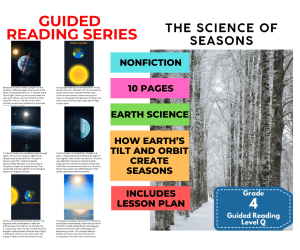
Guided Reading Level Q - Science of Seasons (with Lesson Plan)
ELA, Resources for Teachers, Reading Comprehension, Reading, Life Sciences, Science, Earth and Environmental Sciences, Geography, Social Studies, Space, Grade 3, 4, 5, Worksheets & Printables, Worksheets, Teacher Tools, Centers, Activities, Literacy Readers, Quizzes, Quizzes and Tests, Assessments
This Guided Reading Book - Science of Seasons (Level Q) with lesson plan includes: Guided Reading Color Label (front cover x1) This is a quick way to match the book’s demands to what students can generally handle.. The overall goal is to use the level/color to pick books for several smaller groups. To qualify for a certain level, a student is expected to read a book from that level with about 90–94% accuracy. If a student is consistently accurate and understands, move up a level. If the student is struggling at that level, drop down and add more support. Each student will improve at completely different rates, but it is generally one of the best ways to check progress across the class. DOWNLOAD THE CATALOG TO VIEW ALL GUIDED READING BOOKS AVAILABLE (SORTED LEVELS A-Z) Pre-Reading Question (x1) Teacher asks the prompt aloud, can be while showing the cover or first page. Students share what they already know, or make educated guesses from the cover. Prompt them to use the target vocabulary. Write some of their responses on the board to look back at during the reading. Vocabulary Words (x5) Introduce the five words, best doing it one at a time. Start by saying it, while students repeat and then see if anyone knows what it means before reading further. Read through the meaning and try to briefly connect each word to a picture or gesture so it’s meaningful. Ask students to flip through the book pages and point to where they see each of the vocabulary words. While reading the book pause upon coming across one of the vocab words or read the sentence twice to make sure students understand the word has appeared. Optional: Ask students to raise hands whenever they see/hear one of the new words. Guided Reading Pages (x10) Check the book snapshot (below) for: primary topic - do you need to prep extra reading or intro materials on this? what is taught best - decide on 1-2 bullets to focus on, use the prompt or words provided here for best results. learning goals - what you are checking for students to be able to do after the session, elicit answers using prompts or words provided. key vocabulary (see section above). questions overview - so you know what is coming up and if you need to prep extra materials to assist understanding. Run the lesson You may have already looked at a few of the pages together, but you can show them some of the pictures again first to set meaning. Depending on how much time you have and how familiar your students are with guided reading class, you may want to read the book aloud first with the group first. Students whisper or partner read, while you listen in. If time, do it as a group, one student reading a page each. Use the guided page’s prompts to coach: “Check the picture / does it make sense?” “Point under the words / try the first sound” “Reread the sentence smoothly”. Try to focus more on one student per session (rotating every time), so you can work out if they are ready to move up or need to move down a level. Comprehension Questions (back cover x3) This is your way to check that students didn’t just say the words, but actually understood the text. First, let students answer by pointing to the page/picture and saying a short sentence. After any answer, follow with: “Show me where you found that in the text.” In bigger groups, have partners answer first (10–20 seconds), then call on 2–3 students to share. Differentiation tips: Emerging speakers/struggling readers: oral + pointing On-level: oral in a full sentence Higher: one written sentence or draw + label Book Snapshot Title: The Science of Seasons Genre: Nonfiction (informational text) Subject: Earth & Space Science / Reading (Informational Text) Primary Topic: How Earth’s tilt and orbit create seasons Estimated Guided Reading Level (A–Z): Q What This Book Teaches Best Cause-and-effect in Earth science: The text explains how Earth’s orbit and its 23.5° axial tilt lead to changing seasons. Sunlight angle and temperature: Readers learn how direct, concentrated sunlight warms more than slanted rays that spread out and provide less heat. Key seasonal markers: The vernal equinox, summer solstice, autumnal equinox, and winter solstice are described with what happens to daylight and seasons. Hemispheres and opposite seasons: The book states seasons are opposite in the Northern and Southern Hemispheres because of Earth’s tilt. How living things respond to seasons: It describes animals migrating or hibernating when weather turns cold and food becomes scarce. Learning Goals Students will describe Earth’s orbit and explain that one trip takes approximately 365 days. Students will explain how Earth’s axial tilt affects the angles of sunlight hitting Earth. Students will compare direct rays and slanted rays using the text’s heat descriptions. Students will identify what happens during an equinox and during a solstice, based on the text. Students will explain why seasons are opposite in the Northern and Southern Hemispheres. Students will describe two ways animals survive seasonal change: migrating and hibernating. Key Vocabulary From the Text orbit — the path Earth travels around the Sun. axial — related to the line an object spins around. hemisphere — half of Earth. equinox — when day and night are nearly equal. migrate — move to a new place for better conditions. Discussion Prompts Pre-reading question: What do you think makes Earth have different seasons during the year? Comprehension questions: According to the text, how do Earth’s orbit and axial tilt help create the seasons? Comprehension questions: What happens to daylight and darkness during the vernal or autumnal equinox? Comprehension questions: What are two ways animals survive when the weather turns cold and food becomes scarce? Printing Tips 1. Best Printing Method (Recommended) “Booklet” Printing (Best if Available) If your printer or PDF viewer supports Booklet Printing , use this. Settings to use: Print mode: Booklet Paper size: Letter or A4 (either works) Orientation: Landscape Print on both sides: Yes Flip on: Short edge Scaling: Fit to printable area Booklet subset: First test: Front sides only Then: Back sides only This will automatically: Pair pages correctly Put the cover on the outside Align everything for folding After printing, fold in half and staple along the spine . 2. If “Booklet” Printing Is NOT Available You can still print this correctly with manual duplex printing . Step-by-step: Open the PDF. Choose Print . Set: Orientation: Landscape Pages per sheet: 1 Print on both sides: Yes Flip on: Short edge Print all pages . Because each PDF page already contains two facing book pages, the result will still fold cleanly into a book. Thousands of Cored Education products are included with your TeachSimple membership. Download links and encyclopedia index available here.
Author Cored Education
Rating
Tags Reading Comprehension, Reading Passages, Reading, Guided Reading, Guided Reading Lesson Plan, Guided Reading Activity, Pre-reading, Science Lesson Plans, Geography, Space

Candy Reading Comprehension Passages and Questions Google Slides
ELA, Language Development, Resources for Teachers, Vocabulary, Spelling, Reading Comprehension, Reading, Common Core, Grade 2, 3, 4, 5, Teacher Tools, Centers, Activities, Assessments, Tests, Quizzes and Tests, Presentations, Quizzes
Themed Reading Comprehension Passages Series - Candy This reading comprehension series is built for grades 2 to 5 and keeps things simple, clear, and easy to use. Every title follows a fun, kid-friendly theme and comes with two passage levels, one written for grades 2 to 3 and a more challenging version for grades 4 to 5. Students then work through a mix of follow-up pages that check understanding in different ways: multiple-choice questions, short written responses, scrambled words, a quick summary, and a theme-based word problem. Answer keys are included, so prep stays minimal. Each resource also comes in nine classroom-friendly formats, so you can choose what fits your setup: print or digital, editable or ready to go, and even self-grading options. Because the layout stays consistent, it is easy to plug into whole-class lessons, small groups, literacy centers, morning work, fast finisher tubs, sub plans, or home learning. It is a straightforward way to build comprehension, practice reading skills in context, and strengthen written responses without adding extra steps for you. Candy Lesson List Note: This product has titles different to those in the rest of the themed series. 1. Candy Types 2. Candy Flavors 3. Candy Shapes and Colors 4. Candy Ingredients 5. Candy Fun Facts GOOGLE SLIDES VERSION The same editable layout as PPT, but in the cloud for easy sharing, student access, and instant updates. Other versions are available in the links list below or in the full catalog. How to Use These Lessons Perfect for: Morning work or early-finisher bins Guided reading blocks or comprehension warmups Literacy centers or small-group rotations Holiday/seasonal review lessons Independent stations, sub plans, or take-home enrichment More Candy Themed Products CROSSWORDS WORDSEARCHES MAZES FULL CATALOG OF DOWNLOAD LINKS HERE Themed Reading Links Addition Animals Around the Home Birthday FORMATS: -FORMAL ASSESSMENT VERSION -PRESENTABLE PDF -PPT -SLIDES - PDF -FILLABLE PDF -WORD -FORMS -DOCS SUPPLEMENTARY MATERIALS (COMING SOON): -VISUAL READING PASSAGE VIDEO -GUIDED LEARNING VIDEO -LESSON PLANS Candy FORMATS: -FORMAL ASSESSMENT VERSION -PRESENTABLE PDF -PPT -SLIDES -PDF -FILLABLE PDF -WORD -FORMS -DOCS SUPPLEMENTARY MATERIALS (COMING SOON): -VISUAL READING PASSAGE VIDEO -GUIDED LEARNING VIDEO -LESSON PLANS Christmas Cinco de Mayo Clothes Colors Days and Months Division Earth Day Easter Easy Mazes Fall Father's Day Food Geography (Set 1) Geography (Set 2) Geography (Set 3) Graduation Health History (Set 1) History (Set 2) History (Set 3) Human Body Kindness Life Skills Mother's Day Multiplication Science (Set 1) Science (Set 2) Science (Set 3) Shapes Social Skills Spring Sports St. Patrick's Day Subtraction Summer Thanksgiving Transport Valentine's Day Winter Free One Lesson Themes Chinese New Year Lunar New Year Halloween Pink Shirt Day Independence Day Juneteenth President's Day Groundhog Day Readings in Depth Structure Each resource is built around a focused sub-theme within the broader topic. Students read two leveled passages (Grades 2–3 and Grades 4–5), then move through a short, consistent sequence of activities that checks understanding and keeps momentum: multiple-choice, brief written responses, a scrambled-words review, a compact summary task, and a light theme-linked word problem. The flow is predictable for students, but varied enough to feel fresh across topics. Each completed resource includes: Two differentiated reading passages (lower and upper level) A multiple-choice comprehension page Short written-response questions A scrambled-words or quick vocabulary check A brief summary activity A simple, theme-connected word problem Answer keys for fast marking and easy self-checking Nine classroom-friendly formats, including print, editable, digital, and self-grading options Themes Included These readings span a wide range of age-appropriate, high-interest topics, such as: Seasons and celebrations Real-world science and nature Community, character, and life skills Everyday high-frequency themes students already enjoy Each title connects to familiar experiences while strengthening comprehension, vocabulary in context, and clear written expression. Easy extensions (optional): Read twice: first for gist, second to highlight key details Write two “right there” questions and swap with a partner Create a 3-bullet fact list or mini mind map Turn the summary into a 3-sentence retell using sequence words Add one extra math question connected to the topic Compare the two levels: what details appear in both? Differentiation tips: Pre-teach 2–3 key words with quick examples Offer sentence starters for written responses Use partner reading: one reads aloud, one tracks evidence Allow highlighting or underlining before answering questions Provide a shorter chunking option for students who need breaks Encourage confident readers to justify answers with a quoted detail For similar downloads and other frees, do check out Cored Group on TeachSimple.
Author Cored Education
Rating
Tags Vocabulary, Spelling, Candy, Candy Activities, Writing Prompts, Word Problems, Reading Comprehension, Candy Reading, Candy Passages, Reading Passages

Reading Comprehension Passages Nonfiction Set 2 - Nutrition (Fillable)
ELA, Reading, Reading Comprehension, Common Core, ESL, Language Development, Spelling, Vocabulary, Writing, Resources for Teachers, Grade 2, 3, Worksheets & Printables, Worksheets, Assessments, Teacher Tools, Tests, Quizzes and Tests, Centers, Activities
Reading Comprehension Passages Nonfiction Set 2 Snapshot Genre: Nonfiction (informational articles + comprehension practice) Subject: Reading (Informational Text) / Health Primary Topic: What proteins are and why bodies need them Estimated Guided Reading Level (A–Z): N What This Teaches Best Understanding what proteins do in the body (tissues, muscles, organs; blood, skin, nails, hair). Learning how scientific terms connect (proteins → amino acids; essential amino acids; macronutrient). Distinguishing categories using definitions and examples (complete vs. incomplete protein sources). Reading for specific facts and quantities (e.g., “40 grams of protein,” “20 amino acids,” “nine essential”). Learning Goals Students will explain what proteins are and name body parts they support using the text. Students will describe what amino acids are and how they relate to proteins. Students will explain the difference between complete and incomplete proteins with examples from the text. Students will identify key numbers and facts stated in the article. Students will summarize the article using key ideas and vocabulary. Key Vocabulary From the Text proteins — nutrients that build and support body systems. amino acids — small parts that make up proteins. essential — needed and cannot be made by the body. macronutrient — a food type needed in large amounts. incomplete — missing some needed amino acids. Passages Include 1.Proteins: After water, protein makes up most of the weight in our bodies. 2.Carbohydrates: Carbohydrates are the principal source of energy for the body. 3.Fats: What are trans fats? Learn all about them in this lesson. 4.Milk: There are many kinds of milk, each has its own advantages. 5.Potatoes: Did you know potatoes originate from South America? 6.Composting: Read how to make your very own compost heap in this article. Additional File: Milk: Nutritional Values Printable FILLABLE PDF VERSION Worksheet-style pages, but with type-in answer boxes so students can complete and save their work digitally. Other versions are available in the links list below or in the full catalog. FULL CATALOG OF DOWNLOAD LINKS HERE For similar downloads and other frees, do check out Cored Group on TeachSimple.
Author Cored Education
Rating
Tags Elementary, Reading, Comprehension, Vocabulary, Answers, Spelling, Writing, Passages, Reading Centers, Reading Comprehension Assessment

Conjunctions Practice Questions - Grade 3-4 Grammar (PPT)
ELA, Language Development, ESL, Grammar, Common Core, Resources for Teachers, Grade 3, 4, Quizzes and Tests, Teacher Tools, Tests, Assessments, Presentations, Activities
Conjunctions Grammar Practice MCQS ELA MCQS Overview: In this series of lessons, students will embark on an engaging journey to explore the grammar skills that make our language vibrant and expressive. These lessons are crafted to help students identify, comprehend, and effectively apply language arts skills in both writing and speech. Accompanied by free supplementary materials available for all topics, each lesson builds on the previous one, offering a balanced mix of direct instruction, interactive group activities, and independent practice. Through fun and creative tasks, students will learn to recognize grammar within sentences, understand their function, and use them to enrich their own writing and speech. Conjunctions Overview: Includes: Correlative Conjunctions Coordinating Conjunctions Subordinating Conjunctions Mistake Finding PPT Version This is the PPT editable and interactive version. There is a fillable answer sheet at the end. This download is available in GOOGLE Docs, GOOGLE Forms, GOOGLE Slides. PDF, PPT, WORD, check the links below for more details. FULL CATALOG OF DOWNLOAD LINKS HERE Grade 3/4 Links: Adjectives Google Docs Google Forms Google Slides PDF PPT Word Free Supplementary Materials Pack Adverbs Google Docs Google Forms Google Slides PDF PPT Word Free Supplementary Materials Pack Conjunctions Google Docs Google Forms Google Slides PDF PPT Word Free Supplementary Materials Pack Nouns Google Docs Google Forms Google Slides PDF PPT Word Free Supplementary Materials Pack Pronouns Google Docs Google Forms Google Slides PDF PPT Word Free Supplementary Materials Pack Verbs Google Docs Google Forms Google Slides PDF PPT Word Free Supplementary Materials Pack Sentence Structure Google Docs Google Forms Google Slides PDF PPT Word Free Supplementary Materials Pack Present Tense Google Docs Google Forms Google Slides PDF PPT Word Free Supplementary Materials Pack Past Tense Google Docs Google Forms Google Slides PDF PPT Word Free Supplementary Materials Pack Future Tense Google Docs Google Forms Google Slides PDF PPT Word Free Supplementary Materials Pack Context Clues Google Docs Google Forms Google Slides PDF PPT Word Free Supplementary Materials Pack Defining Words Google Docs Google Forms Google Slides PDF PPT Word Free Supplementary Materials Pack Fill the Blanks Google Docs Google Forms Google Slides PDF PPT Word Free Supplementary Materials Pack Homophones Google Docs Google Forms Google Slides PDF PPT Word Free Supplementary Materials Pack Synonyms Google Docs Google Forms Google Slides PDF PPT Word Free Supplementary Materials Pack ELA Review Questions Overview Questions have three answer choices. There are a handful of pictures on each test for aesthetic purposes, as well as a review sheet covering most of the topics covered in the product. Introduction or Example Sheet Each topic will include an introduction or example sheet to go through first with your students. Full Answer Keys Full answer keys and sample responses are provided so no matter how busy you are, you know you're covered! In the Supplementary Pack Interactive Ice Breakers: Fun, hands-on activities that get students thinking about adjectives right from the start. Guided Practice: Teacher-led exercises that reinforce the day’s lesson, ensuring students can confidently identify and use adjectives. Group and Partner Tasks: Collaborative activities that allow students to work together to solve problems, categorize adjectives, and create descriptive sentences. Independent Worksheets: Structured worksheets that provide individual practice and help solidify understanding of key concepts. Exit Tasks: Quick, reflective activities at the end of each lesson that assess understanding and encourage students to apply what they’ve learned. For similar downloads and other frees, do check out Cored Group on TeachSimple.
Author Cored Education
Tags Elementary, Answers, Ccss, Common Core, Grammar, Tests, Test Prep, Assessment, Grade 3, Grade 4
Candy Reading Comprehension 1 Lesson Sample Word
ELA, Language Development, Resources for Teachers, Vocabulary, Spelling, Reading Comprehension, Reading, Early Math, Math, Common Core, Grade 2, 3, 4, 5, Worksheets & Printables, Worksheets, Teacher Tools, Centers, Activities, Assessments, Tests, Quizzes and Tests, Word Problems, Writing Prompts
THIS IS A ONE LESSON FREE SAMPLE OF THE FOLLOWING PRODUCT: Themed Reading Comprehension Passages Series - Candy This reading comprehension series is built for grades 2 to 5 and keeps things simple, clear, and easy to use. Every title follows a fun, kid-friendly theme and comes with two passage levels, one written for grades 2 to 3 and a more challenging version for grades 4 to 5. Students then work through a mix of follow-up pages that check understanding in different ways: multiple-choice questions, short written responses, scrambled words, a quick summary, and a theme-based word problem. Answer keys are included, so prep stays minimal. Each resource also comes in nine classroom-friendly formats, so you can choose what fits your setup: print or digital, editable or ready to go, and even self-grading options. Because the layout stays consistent, it is easy to plug into whole-class lessons, small groups, literacy centers, morning work, fast finisher tubs, sub plans, or home learning. It is a straightforward way to build comprehension, practice reading skills in context, and strengthen written responses without adding extra steps for you. Candy Lesson List Note: This product has titles different to those in the rest of the themed series. 1. Candy Types 2. Candy Flavors 3. Candy Shapes and Colors 4. Candy Ingredients 5. Candy Fun Facts WORD VERSION Fully editable worksheet-style pages, so you can tweak text, add instructions, and adapt for your class. Other versions are available in the links list below or in the full catalog. How to Use These Lessons Perfect for: Morning work or early-finisher bins Guided reading blocks or comprehension warmups Literacy centers or small-group rotations Holiday/seasonal review lessons Independent stations, sub plans, or take-home enrichment More Candy Themed Products CROSSWORDS WORDSEARCHES MAZES FULL CATALOG OF DOWNLOAD LINKS HERE Themed Reading Links Addition Animals Around the Home Birthday FORMATS: -FORMAL ASSESSMENT VERSION -PRESENTABLE PDF -PPT -SLIDES - PDF -FILLABLE PDF -WORD -FORMS -DOCS SUPPLEMENTARY MATERIALS (COMING SOON): -VISUAL READING PASSAGE VIDEO -GUIDED LEARNING VIDEO -LESSON PLANS Candy FORMATS: -FORMAL ASSESSMENT VERSION -PRESENTABLE PDF -PPT -SLIDES -PDF -FILLABLE PDF -WORD -FORMS -DOCS SUPPLEMENTARY MATERIALS (COMING SOON): -VISUAL READING PASSAGE VIDEO -GUIDED LEARNING VIDEO -LESSON PLANS Christmas Cinco de Mayo Clothes Colors Days and Months Division Earth Day Easter Easy Mazes Fall Father's Day Food Geography (Set 1) Geography (Set 2) Geography (Set 3) Graduation Health History (Set 1) History (Set 2) History (Set 3) Human Body Kindness Life Skills Mother's Day Multiplication Science (Set 1) Science (Set 2) Science (Set 3) Shapes Social Skills Spring Sports St. Patrick's Day Subtraction Summer Thanksgiving Transport Valentine's Day Winter Free One Lesson Themes Chinese New Year Lunar New Year Halloween Pink Shirt Day Independence Day Juneteenth President's Day Groundhog Day Readings in Depth Structure Each resource is built around a focused sub-theme within the broader topic. Students read two leveled passages (Grades 2–3 and Grades 4–5), then move through a short, consistent sequence of activities that checks understanding and keeps momentum: multiple-choice, brief written responses, a scrambled-words review, a compact summary task, and a light theme-linked word problem. The flow is predictable for students, but varied enough to feel fresh across topics. Each completed resource includes: Two differentiated reading passages (lower and upper level) A multiple-choice comprehension page Short written-response questions A scrambled-words or quick vocabulary check A brief summary activity A simple, theme-connected word problem Answer keys for fast marking and easy self-checking Nine classroom-friendly formats, including print, editable, digital, and self-grading options Themes Included These readings span a wide range of age-appropriate, high-interest topics, such as: Seasons and celebrations Real-world science and nature Community, character, and life skills Everyday high-frequency themes students already enjoy Each title connects to familiar experiences while strengthening comprehension, vocabulary in context, and clear written expression. Easy extensions (optional): Read twice: first for gist, second to highlight key details Write two “right there” questions and swap with a partner Create a 3-bullet fact list or mini mind map Turn the summary into a 3-sentence retell using sequence words Add one extra math question connected to the topic Compare the two levels: what details appear in both? Differentiation tips: Pre-teach 2–3 key words with quick examples Offer sentence starters for written responses Use partner reading: one reads aloud, one tracks evidence Allow highlighting or underlining before answering questions Provide a shorter chunking option for students who need breaks Encourage confident readers to justify answers with a quoted detail For similar downloads and other frees, do check out Cored Group on TeachSimple.
Author Cored Education
Rating
Tags Vocabulary, Spelling, Candy, Candy Activities, Writing Prompts, Word Problems, Reading Comprehension, Candy Reading, Candy Passages, Reading Passages

Hands-On STEM Challenges – Simple Machine Building Worksheets
STEM, Science, Basic Science, Inventors, Theories, Technology, Engineering, Special Resources, Social Emotional Learning (SEL), Special Education Needs (SEN), Homeschool Curriculum, Homeschool Templates, Grade 3, 4, 5, 6, 7, Worksheets & Printables, Workbooks, Worksheets, Word Searches, Teacher Tools, Lesson Plans, Quizzes and Tests, Quizzes, Tests, Assessments
Incorporate Real World Engineering & Discovery into Your Science Classroom with a Comprehensive Simple Machines STEM Unit. Tired of trying to teach students about abstract concepts like force, work, and mechanical advantage in physics without providing a tangible and exciting way to understand them? This complete 5-Week STEM Unit is the all-in-one solution that you've been searching for! It includes everything you need to take your 3rd, 4th & 5th grade students from the theory of physics to creating their very own projects! This product is NOT just a bunch of worksheets, it is an entire educational experience! The resource contains 3 parts: a theoretical guide for teachers, an interactive student workbook & a complete teacher resource pack. The unit provides students with hands-on experiences as they explore 6 classical simple machines (levers, pulleys, inclined planes, wedges, wheels and axles, screws) by examining real-world case studies such as the pyramids of Giza through modern skyscrapers, & then participating in a series of hands-on, challenging activities. Constructivist approaches promote "productive struggle" within the context of providing students with a true understanding of the concepts in this unit, using low-cost, readily available, recycled materials. No more expensive kits, use real-world, authentic inquiry-based learning that develops a true engineering mindset! What This 38-Page Resource Includes: In-depth explanation of Simple Machines: Each of the 6 Simple Machines is explained to teachers in easy-to-understand language. Helpful historical case studies and concept reinforcement questions are included to aid understanding. Worksheets: 10 challenging worksheets designed for students, allow students to demonstrate an understanding of Simple Machines in real-world contexts. These worksheets include activities such as identifying simple machines in everyday objects, analyzing compound machines, calculating mechanical advantage, and working on a design project similar to a Rube Goldberg. Visuals & Helpful Teacher Tools: Three High Contrast Anchor Charts: Vector illustrations of the 6 Simple Machines, a Class 1 Lever (Mechanical Advantage) and the Engineering Design Cycle (STEM). For use in display and projection. Detailed Answer Key: Complete answer key for all 10 worksheets. Complete Teacher Implementation Guide: The Ultimate Resource Guide - Contains teaching reasoning, recommended 5 week pacing guide, list of readily available recycled materials for use in the "Maker Station" and how to facilitate hands on activities and productive struggles in the classroom, as written by seasoned pros. Simple machines, STEM activities, processes used in the design of mechanical systems (engineering design), the learning of physics, the learning of physics from the perspective of children, third grade, fourth grade, fifth-grade science, hands-on learning, project-based learning (PBL), the use of levers and pulleys, worksheets, STEM units or courses together with lesson plans requiring little or no preparation and low-cost preparation; utilizing mechanical advantages using acceleration. The Reasons Parents/Schools Value: Comprehensive & Ready to Use: This isn't just one thing to do; it is a full 5-week unit plan which includes theory, worksheets, visuals, and a detailed teacher's guide. This prepares the teacher for doing the lesson in dozens of hours less than would normally be required. Cost Effective & Easily Accessible: This unit plan was designed to be completed with items that are readily available to you such as cardboard, bottle caps, or string. There is no need to purchase expensive robotic kits that are specialized. Provides Deeper Conceptual Understanding: When students work through building challenges (e.g., utilizing force) they have a hands-on experience they will remember long after the activity is completed. Encourages Developing an Engineering Mindset: In addition to using the Engineering Design Cycle and creating "productive struggle", there is an emphasis on teaching students how to think like an engineer and to use real-world skills to solve problems, be resilient, implement multiple iterations of their solution, and critically think. Target group analysis : The text has an explicit statement of the target audience ("For students in grades 3-5"), so it's clear that the cognitive level of this audience is in the appropriate range. Because of these two factors, we have identified: 1. Primary audience Members consisting of 3rd through 5th Grade Teachers (from public, private and charter schools). 2. Secondary audience members of Homeschooling Families looking for a complete, structured STEM Curriculum. 3. Tertiary audience members will be STEM/STEAM Coordinators, After School Program Directors and Science Club Leaders or Facilitators. Copyright and Terms of Use : Syed Hammad Rizvi is the copyright holder of this resource. This resource is intended for personal and single classroom use only. You cannot modify, distribute or sell this resource. In other words, you cannot post on the Internet for the public to access and download. If you wish to share this resource with other teachers, please consider purchasing a separate license through Teachsimple. Thank you for understanding and following these terms of use. This product has been developed in partnership with Syed Hammad Rizvi
Author Creative Book Store
Rating
Tags SimpleMachines, STEM, STEMeducation, HandsOnLearning, ProjectBasedLearning, ScienceTeacher, TeachersOfInstagram, ITeachScience, ITeachSTEM, EngineeringForKids

Earphones Reading Comprehension Passage - Cored Ed Encyclopedia
ELA, Language Development, Resources for Teachers, Reading Comprehension, Reading, Pre-Reading, Writing, Science, Physics, Strategies, Grade 2, 3, 4, 5, Worksheets & Printables, Worksheets, Teacher Tools, Centers, Activities, Writing Prompts, Assessments, Tests, Quizzes and Tests, Quizzes
This earphones reading comprehension contains the following: Pre-Reading Trivia Students will write down one thing they already know about the subject and then read five more facts and discuss. These facts are fun, and the students will enjoy learning about the subject before reading more. Reading Passage The text is a high-interest reading passage with set paragraphs, roughly three to four paragraphs long. It contains a variety of themes about the topic, anywhere from history to technology. The passage is between 250 and 350 words in length. Mixed Questions The first question page contains four multiple-choice questions, each with a choice of four answers, and three written response questions that require a sentence or two from the student. Creative Writing In this question, the student will be required to write a five to eight sentence paragraph on a question related to the topic. Extension Activities This page is optional for fast finishers. If there are five to ten minutes left at the end of the lesson, the student can choose one of three activities, each one requiring a different skill. Answer Key There are answers for the multiple-choice questions and three written response questions have sample answers. FULL CATALOG OF DOWNLOAD LINKS AND ENCYCLOPEDIA INDEX HERE Cored Ed Encyclopedia Overview The Cored Ed Encyclopedia is a weekly series of lessons that you can pick up and use right away. These short readings fit into whatever time you have available. Each one includes a warm-up, a reading, and a set of questions, but it’s flexible — you can do just the reading, the full lesson, or skip the writing section if you need to. Each lesson focuses on a single topic so students don’t get lost. The writing is clear but never childish, making it perfect for grades two through five. Topics range from animals and science to history, inventions, and everyday things. No matter the level of the student, everyone should take away at least one new idea or fact from each lesson. The materials are easy to print, easy to explain, and require no setup. They work well for whole-class teaching, partner work, or independent study.
Author Cored Education
Rating
Tags Vocabulary, Spelling, Reading Comprehension, Reading Passages, Cored Encyclopedia, Facts, Reading, Creative Writing, Earphones, Physcial Science

Simple Eco-Hero Stories & Green Habit Coloring Worksheets
Science, Earth and Environmental Sciences, Life Sciences, Earth Sciences, Environmental Science, Geology, Space, Nature & Plants, Human Body, STEM, Homeschool Curriculum, Homeschool Templates, Grade 1, 2, 3, 4, 5, Worksheets & Printables, Drawing Templates & Outlines, Workbooks, Worksheets, Coloring Pages, Word Searches, Teacher Tools, Assessments, Lesson Plans, Quizzes and Tests
You can use this all-inclusive, research-supported curriculum on environmental education to change your students from being eco-anxious to being empowered and confident eco-heros! This isn't just an assortment of worksheets. It's an entire framework designed to help students develop all of the daily habits associated with protecting the environment based on an understanding of environmental concepts transformed into narrative-kinesthetic activities. This can be used for Earth Day; as part of a year-long science curriculum; as a supplement for character education; etc. The combination of engaging stories about Eco-Heroes and hands-on literacy and visual arts activities will help students realize they too can protect the planet! What's Included in This 47-Page Resource? 1. Comprehensive Teacher's Guide: (10 Pages) An explanation of the educational philosophy by providing research-based rationale and examples from real-world scenarios to assure you of how to teach environmental principles effectively from a positive perspective. 2. Student Workbook: (21 Pages) Contains activities for students. Includes: 9 colorable images representing an eco-friendly habit (e.g., "The Water Champion," "The Carbon Tracker Team"), plus 10 age-appropriate worksheets (e.g., water conservation; energy; recycling; composting; plastic pollution) that require the use of fill-in-the-blank responses. 3. Certificate: Certifies the completion of a student’s commitment to becoming an eco-hero. Printable/collaborative format. 4. Complete Teacher Material: (16 Pages). In support of implementing the resources effectively and efficiently. Components are: - Pedagogical diagrams that help the Educator understand the principles. - Answer keys to all 10 worksheets. - A comprehensive guide showing the Educator how to use the materials with examples of differentiated instructional strategies for Grade Levels 1, 2, and 3. Important Topics In Environmental Education: Water & Energy Conserving Recycling, Upcycling & Waste Sorting Composting & Biodegrading Plastic Pollution & Reusables Alternatives Carbon Footprints & Alternative Transport Reforestation, Habitats & Photosynthesis Sustainable Agriculture & Locally Grown Food This resource requires no preparation; it can be printed out immediately and includes worksheets suitable for children of all ages. This resource will help teachers, parents, and club leaders to encourage children to become thoughtful, responsible global beings. Key Words: Earth Day, Environmental Science, Conservation, Recycling, Climate Change, Coloring Pages, Worksheets, 1st 2nd 3rd Grades, 1st, 2nd, 3rd Grade, Printable & Activites for Homeschooling. Things Parents/Teachers Like : Empowerment versus Fear: Helps to empower the child rather than leave them feeling overwhelmed by all the environmental issues around us (eco-anxiety), resulting in a child-to-hero relationship while focusing on positive actions that the child can do. Educational Not Just Boredom: Utilizes a “Narrative Kinesthetic” approach validated by educational psychology to teach habits through storytelling and action (coloring), resulting in a lasting behavioral change. Cross Curricula/All-in-one Unit: This resource is a unit containing integrated science, literacy (reading/writing), art and character education to provide teachers with time-saving resources. No-preparation Teacher Friendly: There is an implementation guide, visual supports and answer keys to help teachers immediately and confidently use the resource after posting on their site. Establishes Real-World Habits: Offers tools and ideas to replicate and create long-term positive programs that exist outside the classroom (e.g., conducting a "Home Waste Audit" as a follow up to an assignment). Audience Overview : - The text in this document identifies the target audience directly from key terms used, such as Grades 1-3 and primary aged learners. The level of difficulty of the student activities also provides direction for who this resource is written for. Primary Target - teachers for first, second, and third grade. The differentiated instructions at the end of this guide make it a very valuable resource for teachers that teach multiple grades or at least have multiple grade levels within their classroom(s). Secondary Target - Parents who are homeschooling their children, age 6-9 years old. Elementary Science Coordinators. After-school program coordinators (e.g., environmental club, boy/girl scout leaders). Parents looking for meaningful learning experiences that are centered around Earth Day. Copyright Notice/Terms of Use: The copyright for this book is owned by Syed Hammad Rizvi. This material is intended for personal and one classroom use only; it cannot be copied or altered in any way. In addition, it cannot be posted online where someone could possibly find it and download it. If you wish to use this product with other staff/professionals in different situations, please purchase an additional license(s) from Teachsimple. Thank you for your support of these terms of use. This product has been provided by Syed Hammad Rizvi.
Author Creative Book Store
Rating
Tags EnvironmentalScience, EnvironmentalEducation, SustainabilityForKids, Conservation, RecyclingActivities, CompostingForKids, WaterConservation, ClimateEducation, GreenHabits, EcoFriendlyKids
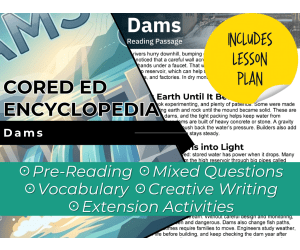
Dams Reading Comprehension Passage - Cored Ed Encyclopedia
ELA, Language Development, Reading Comprehension, Reading, Pre-Reading, Science, Technology, Physics, Earth and Environmental Sciences, Life Sciences, Grade 2, 3, 4, 5, Worksheets & Printables, Worksheets, Teacher Tools, Centers, Activities, Writing Prompts, Assessments, Quizzes and Tests, Quizzes, Lesson Plans
This dams reading comprehension with lesson plan includes: Visualization (on the front cover) Start your lesson by taking a minute to think and share something about the topic. Read the script aloud (slowly), perhaps prepare some music or sound effects. Student close their eyes and let their imaginations wander. Students open their eyes, read the question aloud and give them a few minutes to complete. Ask a few students to share or keep answers until the end to compare with what they learn in the passage. Quick pause—thousands of Cored Education products are included with your TeachSimple membership. Download links and encyclopedia index available here. Pre-Reading Trivia Students will write down one thing they already know about the subject and then read five more facts and discuss. These facts are fun, and the students will enjoy learning about the subject before reading more. Give 1 minute for students to write what they already know (no pressure—best guess is fine). Read the five facts together. After each fact, do ask a student for their opinion, was it surprising? Set a purpose by asking students to highlight/underline one fact they want to learn more about during the reading. Reading Passage The text is a high-interest reading passage with set paragraphs, roughly three to four paragraphs long. It contains a variety of themes about the topic, anywhere from history to technology. The passage is between 250 and 350 words in length. First, ask students to look at the headings and see what they’ll learn about today. What do they know about the topic/heading? First read options: Teacher read-aloud (best for support). Partner reading (paragraph by paragraph). While reading, students underline important details, and vocabulary words they think may come up in the questions section. Mixed Questions The first question page contains four multiple-choice questions, each with a choice of four answers, and three written response questions that require a sentence or two from the student. Students complete the mcqs first independently, then review quickly as a class. For the 3 written responses, try to get students giving the answer with some form of evidence: “I think ___ because the text says ___.” If students get stuck, send them back to check the passage. Vocabulary Questions Practice seven key words from the text in this section across two activities. First section is scrambled words where students will unscramble three words given a clue for each. The second section is a word to meaning matching activity. Before starting, have some students read out words they underlined in the passage. Ask students to say the word and read aloud the sentence(s) around each word. Ask students to do scrambled words and the matching exercise in pairs then go through answers as a class. For the scrambled spelling task, get four pairs to come up to the board and write the words for extra practice with the other student reading out the clue. For the matching task, prompt students to give full sentences: “I matched ___ with ___ because ___.” Creative Writing In this question, the student will be required to write a five to eight sentence paragraph on a question related to the topic. Before starting, ask students write down 3 key ideas they are going to include in their piece. Ask students for ideas to share around the class to help those struggling. Pro writing expectations: 5–8 sentences At least 2 facts or details from the passage At least 2 vocabulary words from the previous page Students read their paragraphs while classmates listen for facts and vocabulary words. Extension Activities This page is optional for fast finishers or to take home. There are several activities, each one requiring a different skill. Do some, do none, do all, completely optional - but you will feel reassured knowing every possibility is planned for. Includes summary writting question and additional facts. Answer Key There are answers for the multiple-choice questions, written response questions have sample answers, vocabulary answers and if there is a summary question then a sample summary will be provided as well. Lesson Plan Included Customized lesson plan for this lesson is included. Lesson Snapshot Title: Dams Genre: Nonfiction (informational text with headings) Subject: Science (Engineering) / Reading (Informational Text) Primary Topic: How dams store water, make electricity, and release water safely Estimated Guided Reading Level (A–Z): P What This Lesson Teaches Best Explains what a dam does by describing how a wall can hold back river water into a deep reservoir. Teaches types of dams and how they stay strong (embankment dams packed tight; gravity dams using weight; layers and drains for stability). Shows how stored water can generate electricity using penstocks, turbines, and generators. Highlights safety and trade-offs, including controlled release through a spillway, the danger of failure, and impacts on fish paths and river mud. Uses headings to organize information into clear sections (building, electricity, and safe water release). Learning Goals Students will explain how a dam changes a river’s flow and creates a reservoir. Students will describe how embankment dams are built and why tight packing matters. Students will identify the role of penstocks, turbines, and generators in making electricity. Students will explain why spillways are needed and how they help release extra water safely. Students will describe at least one cost or concern the passage connects to dams. Key Vocabulary From the Text reservoir — deep stored water behind a dam. embankment — packed earth-and-rock mound used to build a dam. penstocks — big pipes that send water down from a reservoir. turbines — spinning machines turned by rushing water. spillway — safe path for extra water to leave a reservoir. FULL CATALOG OF DOWNLOAD LINKS AND ENCYCLOPEDIA INDEX HERE
Author Cored Education
Rating
Tags Vocabulary, Reading Comprehension, Reading Passages, Lesson Plans, Ela Lesson Plans, Reading Comprehension Lesson Plans, Pre-reading, Science Lesson Plans, Physics, Technology

Guided Reading Level N - Manchester (with Lesson Plan)
ELA, Resources for Teachers, Reading Comprehension, Reading, Social Studies, Geography, Earth and Environmental Sciences, Science, History, Economics, Grade 2, 3, 4, Worksheets & Printables, Worksheets, Teacher Tools, Centers, Activities, Literacy Readers, Quizzes, Quizzes and Tests, Assessments, Lesson Plans
This Guided Reading Book - Manchester (Level N) with lesson plan includes: Guided Reading Color Label (front cover x1) This is a quick way to match the book’s demands to what students can generally handle.. The overall goal is to use the level/color to pick books for several smaller groups. To qualify for a certain level, a student is expected to read a book from that level with about 90–94% accuracy. If a student is consistently accurate and understands, move up a level. If the student is struggling at that level, drop down and add more support. Each student will improve at completely different rates, but it is generally one of the best ways to check progress across the class. DOWNLOAD THE CATALOG TO VIEW ALL GUIDED READING BOOKS AVAILABLE (SORTED LEVELS A-Z) Pre-Reading Question (x1) Teacher asks the prompt aloud, can be while showing the cover or first page. Students share what they already know, or make educated guesses from the cover. Prompt them to use the target vocabulary. Write some of their responses on the board to look back at during the reading. Vocabulary Words (x5) Introduce the five words, best doing it one at a time. Start by saying it, while students repeat and then see if anyone knows what it means before reading further. Read through the meaning and try to briefly connect each word to a picture or gesture so it’s meaningful. Ask students to flip through the book pages and point to where they see each of the vocabulary words. While reading the book pause upon coming across one of the vocab words or read the sentence twice to make sure students understand the word has appeared. Optional: Ask students to raise hands whenever they see/hear one of the new words. Guided Reading Pages (x10) Check the book snapshot (below) for: primary topic - do you need to prep extra reading or intro materials on this? what is taught best - decide on 1-2 bullets to focus on, use the prompt or words provided here for best results. learning goals - what you are checking for students to be able to do after the session, elicit answers using prompts or words provided. key vocabulary (see section above). questions overview - so you know what is coming up and if you need to prep extra materials to assist understanding. Run the lesson You may have already looked at a few of the pages together, but you can show them some of the pictures again first to set meaning. Depending on how much time you have and how familiar your students are with guided reading class, you may want to read the book aloud first with the group first. Students whisper or partner read, while you listen in. If time, do it as a group, one student reading a page each. Use the guided page’s prompts to coach: “Check the picture / does it make sense?” “Point under the words / try the first sound” “Reread the sentence smoothly”. Try to focus more on one student per session (rotating every time), so you can work out if they are ready to move up or need to move down a level. Comprehension Questions (back cover x3) This is your way to check that students didn’t just say the words, but actually understood the text. First, let students answer by pointing to the page/picture and saying a short sentence. After any answer, follow with: “Show me where you found that in the text.” In bigger groups, have partners answer first (10–20 seconds), then call on 2–3 students to share. Differentiation tips: Emerging speakers/struggling readers: oral + pointing On-level: oral in a full sentence Higher: one written sentence or draw + label Book Snapshot Title: World Cities: Manchester Genre: Nonfiction (informational text) Subject: Social Studies (Geography) Primary Topic: Manchester’s location, waterways, climate, and growth Estimated Guided Reading Level (A–Z): N What This Book Teaches Best How Manchester’s location and landform (a bowl-shaped plain) help describe where the city sits and what surrounds it. How waterways shape a city’s geography, including the River Irwell as a border and nearby rivers that join it. How people changed transportation and trade by building the Manchester Ship Canal to connect the inland city to the Irish Sea. How weather and climate connect to land features, including nearby hills trapping clouds and creating frequent grey skies and light rain. How Manchester has changed over time, from textile mills in the 1800s to a skyline with new skyscrapers in recent years. Learning Goals Students will identify where Manchester is located in England using details from the text. Students will describe how Manchester’s rivers and waterways affect the city’s geography. Students will explain why the Manchester Ship Canal was built and what it connects to. Students will describe Manchester’s temperate maritime climate using evidence from the text. Students will explain how damp air influenced textile mills in the 1800s, according to the text. Students will describe one way Manchester’s city center or skyline has changed, using text details. Key Vocabulary From the Text waterways — rivers or channels that water flows through. terrain — what the land is like. maritime — connected to the sea or ocean. municipal — belonging to a city or town. skyscrapers — very tall buildings with many floors. Discussion Prompts Pre-reading question: How might rivers, hills, and weather shape what a city becomes like? Comprehension questions: Where does the text say Manchester is located in England? Comprehension questions: What did the Manchester Ship Canal connect Manchester to? Comprehension questions: According to the text, how did damp air help cotton threads in the 1800s? Printing Tips 1. Best Printing Method (Recommended) “Booklet” Printing (Best if Available) If your printer or PDF viewer supports Booklet Printing , use this. Settings to use: Print mode: Booklet Paper size: Letter or A4 (either works) Orientation: Landscape Print on both sides: Yes Flip on: Short edge Scaling: Fit to printable area Booklet subset: First test: Front sides only Then: Back sides only This will automatically: Pair pages correctly Put the cover on the outside Align everything for folding After printing, fold in half and staple along the spine . 2. If “Booklet” Printing Is NOT Available You can still print this correctly with manual duplex printing . Step-by-step: Open the PDF. Choose Print . Set: Orientation: Landscape Pages per sheet: 1 Print on both sides: Yes Flip on: Short edge Print all pages . Because each PDF page already contains two facing book pages, the result will still fold cleanly into a book. Thousands of Cored Education products are included with your TeachSimple membership. Download links and encyclopedia index available here.
Author Cored Education
Rating
Tags Reading Comprehension, Reading Passages, Reading, Guided Reading, Guided Reading Lesson Plan, Guided Reading Activity, Pre-reading, Geography, Social Studies Lesson Plans, History
Candy Reading Comprehension Passages and Questions Word
ELA, Language Development, Resources for Teachers, Vocabulary, Spelling, Reading Comprehension, Reading, Early Math, Math, Common Core, Grade 2, 3, 4, 5, Worksheets & Printables, Worksheets, Teacher Tools, Centers, Activities, Assessments, Tests, Quizzes and Tests, Word Problems, Writing Prompts
Themed Reading Comprehension Passages Series - Candy This reading comprehension series is built for grades 2 to 5 and keeps things simple, clear, and easy to use. Every title follows a fun, kid-friendly theme and comes with two passage levels, one written for grades 2 to 3 and a more challenging version for grades 4 to 5. Students then work through a mix of follow-up pages that check understanding in different ways: multiple-choice questions, short written responses, scrambled words, a quick summary, and a theme-based word problem. Answer keys are included, so prep stays minimal. Each resource also comes in nine classroom-friendly formats, so you can choose what fits your setup: print or digital, editable or ready to go, and even self-grading options. Because the layout stays consistent, it is easy to plug into whole-class lessons, small groups, literacy centers, morning work, fast finisher tubs, sub plans, or home learning. It is a straightforward way to build comprehension, practice reading skills in context, and strengthen written responses without adding extra steps for you. Candy Lesson List Note: This product has titles different to those in the rest of the themed series. 1. Candy Types 2. Candy Flavors 3. Candy Shapes and Colors 4. Candy Ingredients 5. Candy Fun Facts WORD VERSION Fully editable worksheet-style pages, so you can tweak text, add instructions, and adapt for your class. Other versions are available in the links list below or in the full catalog. How to Use These Lessons Perfect for: Morning work or early-finisher bins Guided reading blocks or comprehension warmups Literacy centers or small-group rotations Holiday/seasonal review lessons Independent stations, sub plans, or take-home enrichment More Candy Themed Products CROSSWORDS WORDSEARCHES MAZES FULL CATALOG OF DOWNLOAD LINKS HERE Themed Reading Links Addition Animals Around the Home Birthday FORMATS: -FORMAL ASSESSMENT VERSION -PRESENTABLE PDF -PPT -SLIDES - PDF -FILLABLE PDF -WORD -FORMS -DOCS SUPPLEMENTARY MATERIALS (COMING SOON): -VISUAL READING PASSAGE VIDEO -GUIDED LEARNING VIDEO -LESSON PLANS Candy FORMATS: -FORMAL ASSESSMENT VERSION -PRESENTABLE PDF -PPT -SLIDES -PDF -FILLABLE PDF -WORD -FORMS -DOCS SUPPLEMENTARY MATERIALS (COMING SOON): -VISUAL READING PASSAGE VIDEO -GUIDED LEARNING VIDEO -LESSON PLANS Christmas Cinco de Mayo Clothes Colors Days and Months Division Earth Day Easter Easy Mazes Fall Father's Day Food Geography (Set 1) Geography (Set 2) Geography (Set 3) Graduation Health History (Set 1) History (Set 2) History (Set 3) Human Body Kindness Life Skills Mother's Day Multiplication Science (Set 1) Science (Set 2) Science (Set 3) Shapes Social Skills Spring Sports St. Patrick's Day Subtraction Summer Thanksgiving Transport Valentine's Day Winter Free One Lesson Themes Chinese New Year Lunar New Year Halloween Pink Shirt Day Independence Day Juneteenth President's Day Groundhog Day Readings in Depth Structure Each resource is built around a focused sub-theme within the broader topic. Students read two leveled passages (Grades 2–3 and Grades 4–5), then move through a short, consistent sequence of activities that checks understanding and keeps momentum: multiple-choice, brief written responses, a scrambled-words review, a compact summary task, and a light theme-linked word problem. The flow is predictable for students, but varied enough to feel fresh across topics. Each completed resource includes: Two differentiated reading passages (lower and upper level) A multiple-choice comprehension page Short written-response questions A scrambled-words or quick vocabulary check A brief summary activity A simple, theme-connected word problem Answer keys for fast marking and easy self-checking Nine classroom-friendly formats, including print, editable, digital, and self-grading options Themes Included These readings span a wide range of age-appropriate, high-interest topics, such as: Seasons and celebrations Real-world science and nature Community, character, and life skills Everyday high-frequency themes students already enjoy Each title connects to familiar experiences while strengthening comprehension, vocabulary in context, and clear written expression. Easy extensions (optional): Read twice: first for gist, second to highlight key details Write two “right there” questions and swap with a partner Create a 3-bullet fact list or mini mind map Turn the summary into a 3-sentence retell using sequence words Add one extra math question connected to the topic Compare the two levels: what details appear in both? Differentiation tips: Pre-teach 2–3 key words with quick examples Offer sentence starters for written responses Use partner reading: one reads aloud, one tracks evidence Allow highlighting or underlining before answering questions Provide a shorter chunking option for students who need breaks Encourage confident readers to justify answers with a quoted detail For similar downloads and other frees, do check out Cored Group on TeachSimple.
Author Cored Education
Rating
Tags Vocabulary, Spelling, Candy, Candy Activities, Writing Prompts, Word Problems, Reading Comprehension, Candy Reading, Candy Passages, Reading Passages
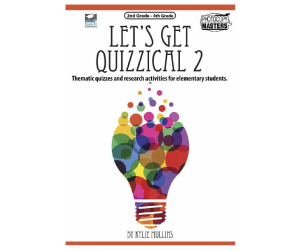
Let's Get Quizzical Book 2
, Grade 2, 3, 4, Teacher Tools, Assessments
This is a 36-page download filled with thematic quizzes and research activities on a wide range of topics. From the human body to wild animals, students will get to test their knowledge and learn even more with these quizzes . Answer key included.
Author Ready-Ed Publications
Tags Transportation Quiz, Thematic Quizzes, Research Activity, The World Around Us, Occupations
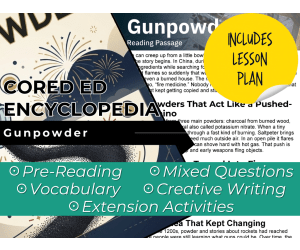
Gunpowder Reading Comprehension Passage - Cored Ed Encyclopedia
ELA, Reading Comprehension, Reading, Science, Technology, Pre-Reading, Language Development, History, Social Studies, Physics, Grade 2, 3, 4, 5, Worksheets & Printables, Worksheets, Teacher Tools, Centers, Activities, Writing Prompts, Assessments, Quizzes and Tests, Quizzes, Lesson Plans
This gunpowder reading comprehension with lesson plan includes: Visualization (on the front cover) Start your lesson by taking a minute to think and share something about the topic. Read the script aloud (slowly), perhaps prepare some music or sound effects. Student close their eyes and let their imaginations wander. Students open their eyes, read the question aloud and give them a few minutes to complete. Ask a few students to share or keep answers until the end to compare with what they learn in the passage. Quick pause—thousands of Cored Education products are included with your TeachSimple membership. Download links and encyclopedia index available here. Pre-Reading Trivia Students will write down one thing they already know about the subject and then read five more facts and discuss. These facts are fun, and the students will enjoy learning about the subject before reading more. Give 1 minute for students to write what they already know (no pressure—best guess is fine). Read the five facts together. After each fact, do ask a student for their opinion, was it surprising? Set a purpose by asking students to highlight/underline one fact they want to learn more about during the reading. Reading Passage The text is a high-interest reading passage with set paragraphs, roughly three to four paragraphs long. It contains a variety of themes about the topic, anywhere from history to technology. The passage is between 250 and 350 words in length. First, ask students to look at the headings and see what they’ll learn about today. What do they know about the topic/heading? First read options: Teacher read-aloud (best for support). Partner reading (paragraph by paragraph). While reading, students underline important details, and vocabulary words they think may come up in the questions section. Mixed Questions The first question page contains four multiple-choice questions, each with a choice of four answers, and three written response questions that require a sentence or two from the student. Students complete the mcqs first independently, then review quickly as a class. For the 3 written responses, try to get students giving the answer with some form of evidence: “I think ___ because the text says ___.” If students get stuck, send them back to check the passage. Vocabulary Questions Practice seven key words from the text in this section across two activities. First section is scrambled words where students will unscramble three words given a clue for each. The second section is a word to meaning matching activity. Before starting, have some students read out words they underlined in the passage. Ask students to say the word and read aloud the sentence(s) around each word. Ask students to do scrambled words and the matching exercise in pairs then go through answers as a class. For the scrambled spelling task, get four pairs to come up to the board and write the words for extra practice with the other student reading out the clue. For the matching task, prompt students to give full sentences: “I matched ___ with ___ because ___.” Creative Writing In this question, the student will be required to write a five to eight sentence paragraph on a question related to the topic. Before starting, ask students write down 3 key ideas they are going to include in their piece. Ask students for ideas to share around the class to help those struggling. Pro writing expectations: 5–8 sentences At least 2 facts or details from the passage At least 2 vocabulary words from the previous page Students read their paragraphs while classmates listen for facts and vocabulary words. Extension Activities This page is optional for fast finishers or to take home. There are several activities, each one requiring a different skill. Do some, do none, do all, completely optional - but you will feel reassured knowing every possibility is planned for. Includes summary writting question and additional facts. Answer Key There are answers for the multiple-choice questions, written response questions have sample answers, vocabulary answers and if there is a summary question then a sample summary will be provided as well. Lesson Plan Included Customized lesson plan for this lesson is included. Lesson Snapshot Title: Gunpowder Genre: Nonfiction (informational text) Subject: Science Primary Topic: How gunpowder was discovered and used over time Estimated Guided Reading Level (A–Z): Q What This Lesson Teaches Best Explains how gunpowder began in China during the Tang dynasty when alchemists mixed ingredients while searching for a life-lasting “elixir.” Identifies the three main powders in gunpowder—charcoal, sulfur, and saltpeter (also called potassium nitrate)—and describes what saltpeter adds to help burning. Describes how gunpowder behaves differently in an open pile versus a tight tube, leading to a strong push of hot gas. Traces how “fire medicine” was used first for celebrations and signals, then developed into fire arrows, bombs, fire lances, and hand cannons by the late 1200s. Shows how ideas travel as gunpowder and stories about rockets reached Europe, and how uses expanded to quarrying rock and digging tunnels, not only fighting. Learning Goals Students will describe how the text says gunpowder was discovered during the Tang dynasty in China. Students will identify the three main powders in gunpowder and explain what saltpeter adds to the burning process. Students will compare what happens when gunpowder burns in an open pile versus in a tight tube. Students will explain how “fire medicine” changed from signals and celebrations to fire arrows and later weapons over time. Students will describe two non-celebration uses of the powder mentioned in the text (quarrying rock and digging tunnels). Students will explain what the author means by “Ideas travel,” using the example of gunpowder reaching Europe. Key Vocabulary From the Text alchemists — people who mixed ingredients while searching for an “elixir.” elixir — a life-lasting drink they searched for. charcoal — powder from burned wood. sulfur — one of the three main powders. saltpeter — a mineral also called potassium nitrate. Discussion Prompts Pre-reading question: What do you think might happen if a powder burns very fast? Comprehension questions: How did the mixture get the name huoyao, or “fire medicine”? Comprehension questions: What role does saltpeter play when a tiny grain is lit? Comprehension questions: How did the uses of “fire medicine” change from celebrations to later tools or weapons? FULL CATALOG OF DOWNLOAD LINKS AND ENCYCLOPEDIA INDEX HERE
Author Cored Education
Rating
Tags Vocabulary, Reading Comprehension, Reading Passages, Lesson Plans, Ela Lesson Plans, Reading Comprehension Lesson Plans, Pre-reading, Science Lesson Plans, Social Studies Lesson Plans, History
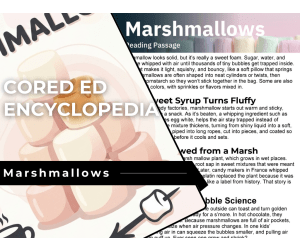
Marshmallows Reading Comprehension Passage - Cored Ed Encyclopedia
ELA, Language Development, Resources for Teachers, Reading Comprehension, Reading, Pre-Reading, Writing, Strategies, Physics, Science, Grade 2, 3, 4, 5, Worksheets & Printables, Worksheets, Teacher Tools, Centers, Activities, Writing Prompts, Assessments, Tests, Quizzes and Tests, Quizzes
This marshmallows reading comprehension contains the following: Visualize on the Cover (Teacher Read Aloud Script) Start your lesson by taking a few moments to visualize the topic and share thoughts or feelings about it. Pre-Reading Trivia Students will write down one thing they already know about the subject and then read five more facts and discuss. These facts are fun, and the students will enjoy learning about the subject before reading more. Reading Passage The text is a high-interest reading passage with set paragraphs, roughly three to four paragraphs long. It contains a variety of themes about the topic, anywhere from history to technology. The passage is between 250 and 350 words in length. Mixed Questions The first question page contains four multiple-choice questions, each with a choice of four answers, and three written response questions that require a sentence or two from the student. Vocabulary Questions Practice seven key words from the text in this section across two activities. First section is scrambled words where students will unscramble three words given a clue for each. The second section is a word to meaning matching activity. Creative Writing In this question, the student will be required to write a five to eight sentence paragraph on a question related to the topic. Extension Activities This page is optional for fast finishers or to take home. There are several activities, each one requiring a different skill. Do some, do none, do all, completely optional - but you will feel reassured knowing every possibility is planned for. Includes summary writting question. Answer Key There are answers for the multiple-choice questions, written response questions have sample answers, vocabulary answers and if there is a summary question then a sample summary will be provided as well. FULL CATALOG OF DOWNLOAD LINKS AND ENCYCLOPEDIA INDEX HERE Lesson Snapshot Title: Marshmallows Genre: Nonfiction Subject: Science (informational reading) Primary Topic: How marshmallows become foam; heat and pressure Estimated Guided Reading Level (A–Z): N What This Lesson Teaches Best Explains what a marshmallow is (a sweet foam) and how tiny air bubbles get trapped inside. Describes the process of making marshmallow mixture turn “fluffy” as it is beaten and thickens. Builds word knowledge through the origin of the name “marshmallow” from the marsh mallow plant and its “root sap.” Connects cause-and-effect in simple “food science”: heat toasts the outside and melts the inside; air pressure can make marshmallows puff up or shrink. Provides aligned support pages (trivia, questions, vocabulary tasks, writing, and extensions) that reuse the passage’s key ideas and terms. Learning Goals Explain why a marshmallow is called a “foam” using details from the text. Describe how air gets trapped in marshmallow ingredients while they are whipped or beaten. Tell why marshmallows are dusted with cornstarch. Explain where the word “marshmallow” comes from, based on the passage. Describe what heat does to a marshmallow over a fire or in hot chocolate. Describe how changes in air pressure can make marshmallows change size. Key Vocabulary From the Text Gelatin — ingredient that helps mixture set and hold bubbles. Cornstarch — powder dusted on marshmallows so they don’t stick. Cylinders — tube shapes, like short, round rolls. Sap — sticky liquid from a plant’s root. Pressure — force of air that can make bubbles shrink or grow. Cored Ed Encyclopedia Overview The Cored Ed Encyclopedia is a weekly series of lessons that you can pick up and use right away. These short readings fit into whatever time you have available. Each one includes a warm-up, a reading, and a set of questions, but it’s flexible — you can do just the reading, the full lesson, or skip the writing section if you need to. Each lesson focuses on a single topic so students don’t get lost. The writing is clear but never childish, making it perfect for grades two through five. Topics range from animals and science to history, inventions, and everyday things. No matter the level of the student, everyone should take away at least one new idea or fact from each lesson. The materials are easy to print, easy to explain, and require no setup. They work well for whole-class teaching, partner work, or independent study.
Author Cored Education
Rating
Tags Vocabulary, Spelling, Reading Comprehension, Reading Passages, Reading, Creative Writing, Reading Strategies, Writing Prompts, Physics, Marshmallows

Science Reading Comprehension: Life Cycles of Organisms (Google Drive)
ELA, Science, Life Sciences, Biology, Common Core, Animals, Insects, Nature & Plants, Grade 2, 3, 4, Centers, Activities, Assessments, Teacher Tools, Presentations, Tests, Quizzes and Tests, Worksheets, Worksheets & Printables, Diagrams
Science Reading Comprehension on Life Cycles of Organisms for Life Science (Biology) Life Cycles of Organisms: Reading Passages Life Science (Biology): Whether you're aiming to introduce your students to the world of science or simply seeking an uncomplicated reading resource, this no-prep package is a perfect fit. With its colorful design, user-friendly format, and a diverse range of questions and topics, this science reading worksheet set offers a hassle-free and engaging educational experience. Give it a try today to enrich your curriculum effortlessly! What's inside? Part 2 - Life Cycles of Organisms Reading Passage 1: The Life Cycle of Plants Reading Passage 2: The Life Cycle of Animals Reading Passage 3: Heredity Product Info: 17 PAGES (Docs Version: US English with Answers) & 3 FORMS (Self-Grading) 87 SLIDES Teaching Duration: 2 Weeks Science Reading Comprehension Outline: Targeted for students in 3rd and 4th grades, these reading passages are enhanced with illustrations and graphs to elucidate critical points. Each lesson aligns with the Common Core State Standards, allowing you to integrate science reading practice effortlessly, knowing that minimal preparation is needed on your part. Each passage comes with a variety of questions in different formats, including multiple-choice formats, data analysis, and fill-in-the-blanks. The topics covered strike a balance between engaging content and core curriculum-based science subjects. Versatile in application, these lessons are suitable for a variety of settings such as whole-class instruction, morning activities, independent desk work, small group discussions, contingency plans for substitute teachers, homework assignments, or even special holiday-themed tasks. FULL CATALOG OF DOWNLOAD LINKS HERE Grade 3/4 Links: Physical Science Part 1 - Properties of Objects and Materials Google Docs/Slides/Forms PDF PPT Word Free Supplementary Pack Accompanying Videos Physical Science Part 2 - Position and Motion of Objects Google Docs/Slides/Forms PDF PPT Word Free Supplementary Pack Accompanying Videos Physical Science Part 3 - Light, Heat, Electricity, Magnetism Google Docs/Slides/Forms PDF PPT Word Free Supplementary Pack Accompanying Videos Life Science Part 1 - Characteristics of Organisms Google Docs/Slides/Forms PDF PPT Word Free Supplementary Pack Accompanying Videos Life Science Part 2 - Life Cycles of Organisms Google Docs/Slides/Forms PDF PPT Word Free Supplementary Pack Accompanying Videos Life Science Part 3 - Organisms and Environments Google Docs/Slides/Forms PDF PPT Word Free Supplementary Pack Accompanying Videos Earth Science Part 1 - Properties of Earth Materials Google Docs/Slides/Forms PDF PPT Word Free Supplementary Pack Accompanying Videos Earth Science Part 2 - Changes in the Earth and Sky Google Docs/Slides/Forms PDF PPT Word Free Supplementary Pack Accompanying Videos Earth Science Part 3 - Objects in the Sky Google Docs/Slides/Forms PDF PPT Word Free Supplementary Pack Accompanying Videos For similar products and other frees, do check out Cored Group on TeachSimple .
Author Cored Education
Rating
Tags Science, Elementary, Reading, Comprehension, Life Science, Biology, Science Assessments, Reading Comprehension Assessments, Vocabulary Assessments, Self Assessment

Grade 3 Beginning of Year Social Studies Assessment Diagnostic
Social Studies, Grade 3, Assessments, Teacher Tools, Lesson Plans, Worksheets & Printables
Start the year with confidence using this 3rd Grade Beginning of Year Social Studies Assessment and complete targeted intervention system! This comprehensive Grade 3 Social Studies Diagnostic goes beyond a simple pretest by helping you assess student understanding, analyze skill gaps, create flexible small groups, assign targeted practice, and provide meaningful enrichment—all with one easy-to-use, no-prep resource. Designed as a complete Assess → Identify → Group → Practice → Reassess system, this resource helps teachers collect meaningful data and immediately turn assessment results into instructional action. With a 40-question diagnostic , skill analysis tools, 21 targeted practice pages , extension activities, and complete answer keys, you'll have everything you need to begin the school year with confidence. What's Included This 3rd Grade Beginning of Year Social Studies Assessment Bundle includes: ✅ Teacher Guide & Implementation Overview ✅ 40-question Beginning-of-Year Social Studies Diagnostic ✅ Printable Student Answer Sheet ✅ Skill Analysis & Grouping Tools ✅ Item-to-Skill Mapping Guide ✅ Class Skill Grid ✅ Individual Student Profiles ✅ Grouping Planner ✅ Reassessment Tracker ✅ 21 Targeted Follow-Up Practice Worksheets ✅ Extension Activities for students demonstrating mastery ✅ Choice Board for enrichment ✅ Complete Answer Key ✅ Scoring Guide ✅ Claim-Evidence-Reasoning (CER) Rubric ✅ Printable PDF format ✅ No-prep, print-and-go resource Students are assessed across five essential social studies strands : 🌎 Geography Cardinal directions Map keys & symbols Scale & distance Continents & oceans Physical features 📜 History Skills Past, present & future Timelines Chronological order Then & now Historical sources Cause & effect 🏛 Civics Rules & laws Community roles Rights & responsibilities Local government 💰 Economics Needs vs. wants Goods & services Producers & consumers Saving & spending 📊 Data Skills Reading tables Interpreting bar graphs Drawing conclusions Claim-Evidence-Reasoning (CER) writing The Teacher Guide explains that the complete bundle includes approximately 85 printable pages across seven coordinated resources , all using the same skill codes so every component works together seamlessly. How It Works in the Classroom This 3rd Grade Social Studies Beginning of Year Assessment makes back-to-school planning simple with an organized five-step instructional system. Step 1 — Assess Students complete the 40-question diagnostic using the separate Student Answer Sheet. Step 2 — Identify Skill Gaps Score assessments with the included Answer Key and record results using the Class Skill Grid. Step 3 — Group Students Use the Grouping Planner to build flexible intervention groups based on shared skill needs. Step 4 — Assign Targeted Practice Students receive only the follow-up worksheets that match their assessment results. Step 5 — Reassess Monitor student growth using the Reassessment Tracker and adjust instructional groups as needed. The Teacher Guide recommends administering the assessment during the first week of school in one 45-minute session or dividing it into shorter sections over several days. Questions may be read aloud so the assessment measures social studies knowledge rather than reading ability. Perfect for: Beginning of Year Assessment Social Studies Pretest Back to School Activities Diagnostic Assessment RTI MTSS Intervention Small Groups Progress Monitoring Data Meetings Review Before State Testing Flexible Grouping Standards & Learning Goals This 3rd Grade Social Studies Diagnostic Assessment reviews the foundational skills students should know at the beginning of third grade. Students demonstrate understanding of: Geography Cardinal directions Compass roses Reading maps Map keys Map symbols Scale Continents Oceans Physical features Landforms History Past, present & future Timeline sequencing Chronological thinking Historical sources Comparing life then and now Cause and effect Civics Rules Laws Rights Responsibilities Community helpers Local government Citizenship Economics Needs vs. wants Goods Services Producers Consumers Saving Spending Data Literacy Reading tables Interpreting graphs Comparing data Drawing conclusions Supporting claims with evidence Students complete a variety of engaging assessment formats including: Multiple-choice questions Maps Compass roses Timelines Tables Bar graphs Written responses CER writing The Teacher Guide identifies 21 beginning-of-year skills that are consistently coded throughout the assessment, analysis tools, follow-up practice, and answer key, making targeted instruction easy to implement. Why Teachers Love It ✨ More than a beginning-of-year test—it is a complete instructional system. ✨ Saves 10+ hours of planning by combining assessment, data analysis, intervention, enrichment, and reassessment into one coordinated resource. ✨ Every assessment question aligns directly to a specific social studies skill. ✨ Easily identify exactly what students know and where additional instruction is needed. ✨ Create flexible intervention groups using built-in planning tools. ✨ Includes 21 targeted follow-up practice worksheets that reteach each skill using a student-friendly "Remember" mini-lesson before students practice with fresh examples. ✨ Differentiate instruction with ease. Students who need additional support receive targeted skill practice while students demonstrating mastery move into engaging enrichment challenges and a choice board. ✨ Extension Activities promote higher-level thinking through projects such as: Designing maps Creating timelines Community helper reports Budget planning Data investigations Choice board challenges These activities extend learning through creativity, research, communication, and real-world application rather than repetitive worksheets. ✨ Skill Analysis Tools simplify data-driven instruction. Teachers receive: Item-to-Skill Map Class Skill Grid Student Profiles Grouping Planner Reassessment Tracker Each diagnostic question connects directly to a matching follow-up practice page, making it easy to assign only the skills each student needs. ✨ Includes complete scoring guidance. The Answer Key provides: Correct answers Skill codes Answer explanations Skill mastery bands CER scoring rubric Teachers can quickly identify whether students are Approaching , On Track , or Strong in each content area and immediately plan instruction. ✨ Encourages meaningful data conversations while keeping assessment easy to administer and simple to score. Start your school year with meaningful assessment data and a clear instructional plan using this 3rd Grade Beginning of Year Social Studies Assessment . Whether you're looking for a 3rd Grade Social Studies Diagnostic , Beginning of Year Pretest , Back to School Assessment , RTI Intervention Resource , Social Studies Skill Review , Progress Monitoring Tool , or Small Group Instruction Resource , this complete assessment system provides everything you need to assess, analyze, group, reteach, enrich, and monitor student growth throughout the year.
Author Bright Classroom Ideas Marketplace
Rating
Tags Social Studies, Assessment, Diagnostic, Back To School, Wotksheet
Proprioceptive Power-Ups: A Gamified Physical Therapy & Sensory
Research, Resources for Teachers, Classroom Management, Community Building, Special Resources, Life Skills, Social Emotional Learning (SEL), Social Skills, Special Education Needs (SEN), Speech Therapy, Grade 1, 2, 3, 4, 5, 6, 7, 8, Worksheets & Printables, Workbooks, Worksheets, Word Searches, Teacher Tools, Assessments, Graphic Organizers, Lesson Plans, Presentations, Outlines
With Proprioceptive Power-Ups, you can turn dysregulated classrooms into focused learners. This complete, evidence-based, gamified sensory regulation program takes ‘heavy work’ and transforms it into new fun, student-led Power-Ups. The 27-page digital PDF resource is designed to provide occupational therapy, physical therapy, and real-world classroom viability for students in kindergarten through eighth grade. Using Sensory Integration Theory, Self-Determination Theory (SDT), and micro-learning protocols, Proprioceptive Power-Ups provide sensory seekers with 3-5 minute ‘bursts’ of proprioceptive and vestibular input that calm those under-responding to sensations at the same time dramatically improving attention, motor planning skills, emotional regulation, and other important areas of development. The following features are provided within Proprioceptive Power-Ups: Comprehensive theoretical underpinning (neurobiology of proprioception, tripartite circuit architecture, integration within an MTSS Tier 1-3 model) 10 student workbook worksheets with fill-in-the-blank self-reflection and data tracking to complete before beginning a new series of Power-Ups. Age-divided choice board usages for example K-2 use an imagination engine; 3-5 uses a mission protocol; 6-8 uses biometric optimization. Full-color diagrams, schematics include but are not limited to: Neurological Processing Pathway; 3-Phase Sensory Circuit; Gamification Mechanics Matrix. Examples of IEP goals, tools for collecting data, and case studies demonstrating an overall reduction of 60-78% in both elopement and disruption of classroom activities as compared to pre-Proprioceptive Power-Ups implementation. Instant digital download of entire resource, no preparation required! Proprioceptive Power-Ups are ideal for teachers, occupational therapy specialists (OT), physical therapy specialists (PT), special education teachers/special instructors, and parents who are serving students with or without ADHD, developmental coordination disorder (DCD), autism spectrum disorder (ASD), or other classroom sensory processing disorder(s). Why Schools & Parents Are So Happy About It 1. Effectively Calms & Focuses Students: With instant self-regulation through 3–5 minutes of gamified “heavy work” activities, elopement, meltdown, and verbal disruptions have been reduced by as much as 78% in real case study examples. 2. Zero Lesson Prep but Maximum Engagement for the Students: Therapy is turned into play, through Choice Boards and avatar style Power-Ups - giving students choice and control, and saving teachers time while providing maximum engagement for the students in busy classroom settings and for kids on their IEP. 3. Evidence Based and Measured Progress: Easy access to the “whole brain” theory of neuroscience with pre/post data tracking tools and IEP goal templates providing easy documentation of progress to parents and administrators. 4. Age Appropriate From K to 8th Grade: There are differentiated stations and language to keep even the youngest kids excited about (and the oldest kids “cool” about) participating in activities in the same room without being segregated by age. 5. Proven Return On Investment: High impact proprioceptive input (replacing ineffective fidgety tools) will continue to improve time on task, enhance writing skills, and improve working/executive function without the need to sacrifice time during instruction. Target Students and Grade Levels: The resource is geared toward kindergarten through 8th grade (K-8) students. The children that will benefit from this program demonstrate an under-stimulated or dysregulated proprioceptive and vestibular system, including: Sensory Seekers (i.e., crashing, chewing, and pressing too hard); Sensory Under-Responders (i.e., lethargic, floppy, and having low muscle tone); Students with Attention-Deficit/Hyperactivity Disorder (ADHD) - Combined Type; Autism Spectrum Disorder (ASD); Developmental Coordination Disorder (DCD); Dyspraxia .A general education classroom using a Multi-Tiered System of Support (MTSS) Tier 1 (i.e., universal brain breaks), Tier 2 (i.e., targeted small groups), and Tier 3 (i.e., Individualized Education Plan-specific on Circuit) will also utilize the program as needed. There is built-in scaffolding provided within the program through the following: narrative/imaginative play for grades K-2; challenge-based missions for grades 3-5; and more mature "biometric optimization" language for middle school (grades 6-8) to assist in securing the dignity of the adolescent population. Copyright / Terms of Use This Book is copyright protected by Syed Hammad Rizvi. You may only use this resource for your own personal use and for use by one class within your own classroom. You may not change this resource or redistribute or sell any part of the resource. In other words, you may not post this resource on the internet where it would be easily accessible and/or downloadable by others. If you would like to share this resource with other teachers, kindly purchase additional licenses to use this resource from Teachsimple. Thank you for complying with the terms of use for this resource. Thank you from all of us at Syed Hammad Rizvi for purchasing this product!
Author Creative Book Store
Rating
Tags ProprioceptiveInput, HeavyWorkActivities, HeavyWork, JointCompression, DeepPressure, SensoryCircuit, SensoryIntegration, SensoryProcessingDisorder, SensoryProcessing, SensoryDiet

Ovens Reading Comprehension Passage - Cored Ed Encyclopedia
ELA, Language Development, Resources for Teachers, Reading Comprehension, Reading, Pre-Reading, Writing, Science, Physics, Strategies, Grade 2, 3, 4, 5, Worksheets & Printables, Worksheets, Teacher Tools, Centers, Activities, Writing Prompts, Assessments, Tests, Quizzes and Tests, Quizzes
This ovens reading comprehension contains the following: Visualize on the Cover (Teacher Read Aloud Script) Start your lesson by taking a few moments to visualize the topic and share thoughts or feelings about it. Pre-Reading Trivia Students will write down one thing they already know about the subject and then read five more facts and discuss. These facts are fun, and the students will enjoy learning about the subject before reading more. Reading Passage The text is a high-interest reading passage with set paragraphs, roughly three to four paragraphs long. It contains a variety of themes about the topic, anywhere from history to technology. The passage is between 250 and 350 words in length. Mixed Questions The first question page contains four multiple-choice questions, each with a choice of four answers, and three written response questions that require a sentence or two from the student. Vocabulary Questions Practice seven key words from the text in this section across two activities. First section is scrambled words where students will unscramble three words given a clue for each. The second section is a word to meaning matching activity. Creative Writing In this question, the student will be required to write a five to eight sentence paragraph on a question related to the topic. Extension Activities This page is optional for fast finishers or to take home. There are several activities, each one requiring a different skill. Do some, do none, do all, completely optional - but you will feel reassured knowing every possibility is planned for. Includes summary writting question. Answer Key There are answers for the multiple-choice questions, written response questions have sample answers, vocabulary answers and if there is a summary question then a sample summary will be provided as well. FULL CATALOG OF DOWNLOAD LINKS AND ENCYCLOPEDIA INDEX HERE Lesson Snapshot Title: Ovens Genre: Nonfiction (informational text) Subject: Science & Technology / Reading Informational Text Primary Topic: How ovens work and changed over time Estimated Guided Reading Level (A–Z): R What This Lesson Teaches Best How early ovens began as cooking pits with hot coals underneath and food covered to cook slowly. How clay ovens with thick walls held heat and were used for baking, including flatbread pressed onto the inner wall. How modern ovens can use different heat sources and methods, including gas/electric heat , broiling , and convection (a fan moving hot air). How the first microwave oven grew from an accident involving radar equipment and how microwaves heat food by moving water molecules . How headings organize information in an informational passage (history → features → invention story). Learning Goals Students will describe how some of the earliest ovens cooked food using hot coals and covered pits. Students will explain how clay ovens held heat and how bread could bake on the inner wall. Students will compare ways ovens heat food (baking, broiling, and convection) using details from the text. Students will explain what accident helped lead to the first microwave oven. Students will describe how microwaves heat food quickly based on the passage. Key Vocabulary From the Text insulated — kept heat in, like a protected box. convection — a fan circulates hot air for even heating. microwaves — waves that heat food fast without a fire. molecules — tiny pieces of matter that can move. radar — equipment mentioned that led to a discovery. Cored Ed Encyclopedia Overview The Cored Ed Encyclopedia is a weekly series of lessons that you can pick up and use right away. These short readings fit into whatever time you have available. Each one includes a warm-up, a reading, and a set of questions, but it’s flexible — you can do just the reading, the full lesson, or skip the writing section if you need to. Each lesson focuses on a single topic so students don’t get lost. The writing is clear but never childish, making it perfect for grades two through five. Topics range from animals and science to history, inventions, and everyday things. No matter the level of the student, everyone should take away at least one new idea or fact from each lesson. The materials are easy to print, easy to explain, and require no setup. They work well for whole-class teaching, partner work, or independent study.
Author Cored Education
Rating
Tags Vocabulary, Spelling, Reading Comprehension, Reading Passages, Reading, Creative Writing, Reading Strategies, Writing Prompts, Ovens, Physics
Back to School ELA Review for 3rd Grade | 20 Daily Lessons
ELA, Grade 3, Assessments, Teacher Tools, Lesson Plans, Worksheets & Printables
Make the first month of school smoother with this 3rd grade back to school ELA review designed to revisit essential Grade 2 reading, grammar, vocabulary, word study, and writing skills. With 20 structured daily lessons plus 16 print-and-play literacy games, this resource helps third graders rebuild confidence, establish routines, and prepare for Grade 3 learning. Each lesson follows a predictable four-part rhythm— Read & Think, Language & Grammar, Word Work, and Write About It —so students can review multiple ELA strands in manageable daily practice. The Teacher Guide recommends approximately 15–25 minutes per full lesson, with skills spiraling from lighter review into combined practice. What’s Included This 3rd grade ELA review includes a complete beginning-of-year literacy package: ✅ 20 daily ELA review lessons ✅ 40 pages of daily student lessons ✅ Short fiction, nonfiction, and fable passages ✅ Reading comprehension questions ✅ Text evidence practice ✅ Grammar and language review ✅ Phonics and word study ✅ Vocabulary practice ✅ Daily writing prompts ✅ 16 print-and-play literacy games and activities ✅ Partner and small-group games ✅ Literacy center activities ✅ Complete answer key for all 20 days ✅ Teacher guide ✅ 20-day pacing overview ✅ Four-week planning guide ✅ Differentiation ideas ✅ Game preparation directions ✅ Game-to-skill quick-reference map ✅ Class progress record sheet ✅ Family letter for home-school connection ✅ Student reflection ✅ Reading Star Award The Student Workbook contains 20 daily lessons plus 16 print-and-play games , covering reading, grammar, word work, vocabulary, and writing across 62 pages. The complete Answer Key provides answers for all 20 days, organized by section for efficient checking, with reasonable student wording accepted for open writing and reflection tasks. How It Works in the Classroom Use this 3rd grade back to school ELA review as a first-month literacy routine, morning work option, whole-group warm-up, independent review, intervention support, homework practice, or beginning-of-year skills check. Each day follows the same student-friendly structure: 📖 Read & Think — Students read a short fiction, nonfiction, or fable passage and answer comprehension questions, including text-based thinking ✏️ Language & Grammar — Students review a focused Grade 2 language skill 🔤 Word Work — Students practice phonics, vocabulary, morphology, and word relationships 📝 Write About It — Students complete a short writing task connected to the day’s reading or skill focus A full lesson is designed to take about 15–25 minutes . The predictable routine supports independence, while the spiraled sequence gradually combines reading, language, vocabulary, and writing skills. Use the resource for: ⭐ Back-to-school ELA review ⭐ Third grade morning work ⭐ Grade 2 skills review ⭐ Beginning-of-year literacy practice ⭐ Reading comprehension review ⭐ Grammar warm-ups ⭐ Vocabulary practice ⭐ Word study ⭐ Literacy centers ⭐ Partner practice ⭐ Small groups ⭐ Early finishers ⭐ Intervention and reteaching ⭐ Formative assessment ⭐ Homework or home practice The 20-Day Pacing at a Glance chart on page 6 of the Teacher Guide visually maps each day’s reading, language, and word-work focus. Students move from main idea and details, character traits, setting, sequence, and theme into inference, cause and effect, compare and contrast, author’s purpose, point of view, text features, fact and opinion, text evidence, context clues, summarizing, making connections, editing, and mixed review. For a four-week routine, the Teacher Guide suggests using daily workbook practice Monday through Thursday and reserving Friday for a game, center rotation, or catch-up. Standards & Learning Goals This third grade literacy review revisits essential Grade 2 learning across five major ELA strands: 📚 Reading Comprehension — main idea and details, character traits, setting, sequence and plot, theme or central message, inference, cause and effect, compare and contrast, author’s purpose, point of view, text features, fact and opinion, text evidence, context clues, making connections, and summarizing ✏️ Grammar & Language — complete sentences and fragments, subject and predicate, common and proper nouns, verb tense, adjectives and adverbs, pronouns, subject-verb agreement, possessive nouns, capitalization, commas in a series and dates, quotation marks, conjunctions, compound sentences, contractions, irregular plural nouns, irregular past-tense verbs, combining sentences, and editing 🔤 Phonics & Word Study — r-controlled vowels, diphthongs, prefixes, suffixes, root words, long vowel teams, compound words, and syllables 💬 Vocabulary — synonyms, antonyms, context clues, multiple-meaning words, homophones, shades of meaning, word relationships, comparatives, similes, and academic vocabulary 📝 Writing — sentence and paragraph writing, opinion writing with reasons, informative writing, sequencing, comparison writing, text-based responses, summarizing, personal connections, dialogue, descriptive writing, and reflection The workbook provides targeted daily practice that moves from foundational review into more complex application. For example, students practice character traits with subject and predicate on Day 2, sequence and plot with verb tense on Day 4, compare and contrast with possessive nouns on Day 8, point of view with commas on Day 10, text evidence with contractions on Day 14, and summarizing with editing on Day 17. Why Teachers Love It ✨ One predictable routine every day. The consistent four-part structure helps students know what to expect while building independence. ✨ Review multiple ELA skills without overwhelming students. Reading, grammar, word work, vocabulary, and writing are divided into manageable daily practice. ✨ Get 20 days of ready-to-use review. The pacing is already mapped for a smooth first month of third grade. ✨ Build deeper reading comprehension. Students practice main idea, character traits, setting, theme, inference, cause and effect, compare and contrast, author’s purpose, point of view, text features, fact and opinion, text evidence, context clues, and summarizing. ✨ Strengthen grammar and sentence skills. Practice includes sentences and fragments, subjects and predicates, verb tense, adjectives and adverbs, pronouns, possessives, capitalization, commas, quotation marks, conjunctions, compound sentences, contractions, irregular plurals, irregular past-tense verbs, and editing. ✨ Expand vocabulary and word knowledge. Students work with synonyms, antonyms, prefixes, suffixes, context clues, compound words, multiple-meaning words, homophones, root words, shades of meaning, word relationships, similes, and academic vocabulary. ✨ Add hands-on practice with 16 literacy games. Activities include: Parts of Speech Sort Contraction Match Synonym Match Roll-an-R-Controlled Word Tricky Word BINGO Tricky Word Roll & Read Vowel Team Sort Same & Opposite Match Reading Road Race Main Idea Baskets Fact or Opinion Sort Sentence Building Tiles Fix-It Cards Sequence Cards Homophone Match Syllable Sort The Game → Skill Quick Map on page 9 of the Teacher Guide clearly pairs each game with its target skill, including parts of speech, contractions, synonyms, r-controlled vowels, Grade 3 high-frequency words, word fluency, long vowel teams, antonyms, mixed reading and language, main idea and details, fact versus opinion, compound and expanded sentences, editing, sequencing, homophones, and syllables. ✨ Prep once and reuse the games. Print game pages on cardstock, laminate boards and cards, cut reusable pieces apart, and store activities in labeled bags for repeated center use. ✨ Differentiate for varied learning needs. The Teacher Guide includes practical adjustments for below-level readers, on-level learners, above-level students, and multilingual learners. ✨ Support stronger written responses. Daily writing tasks include opinion with reasons, sensory description, sequencing, comparing, dialogue, text-based responses, summaries, personal connections, similes, and reflection. ✨ Monitor progress without adding another formal assessment. The short daily pages can serve as low-stakes formative checks. The Class Record Sheet shown on page 10 of the Teacher Guide provides columns for Weeks 1–4 plus notes, making it easy to track students who are on target and identify skills to revisit. ✨ Save time checking work. The included answer key provides organized responses for all 20 daily lessons. ✨ Support home-school connection. A ready-to-send family letter explains the daily ELA review routine and suggests simple ways caregivers can support literacy at home. Give your students a confident, structured start to third grade with this 3rd grade back to school ELA review . Download it to review second grade skills, establish a predictable literacy routine, strengthen reading and writing confidence, and keep students engaged with 20 daily lessons plus 16 print-and-play games. Perfect for teachers searching for third grade morning work , second grade skills review, beginning of year ELA activities, 3rd grade literacy centers, reading comprehension practice, grammar review, vocabulary activities, word study, first month of school activities, formative assessment, or a complete back-to-school literacy review.
Author Bright Classroom Ideas Marketplace
Rating
Tags Daily, Assessment, Lesson, Ela, Reading, Writing, Grammar, Back To School

Defining Words Practice Questions - Vocabulary Grade 3-4 (Docs)
ELA, Language Development, ESL, Common Core, Resources for Teachers, Vocabulary, Grade 3, 4, Worksheets & Printables, Worksheets, Quizzes and Tests, Teacher Tools, Tests, Assessments, Centers, Activities
Defining Words Vocabulary Practice MCQS ELA MCQS Overview: In this series of lessons, students will embark on an engaging journey to explore the grammar skills that make our language vibrant and expressive. These lessons are crafted to help students identify, comprehend, and effectively apply language arts skills in both writing and speech. Accompanied by free supplementary materials available for all topics, each lesson builds on the previous one, offering a balanced mix of direct instruction, interactive group activities, and independent practice. Through fun and creative tasks, students will learn to recognize grammar within sentences, understand their function, and use them to enrich their own writing and speech. Defining Words Overview: Includes: Match Words to Definition Match Definition to Words Accurately Define Meanings Defining Word Practice Docs Version This is the Docs editable and fillable version. This download is available in GOOGLE Docs, GOOGLE Forms, GOOGLE Slides. PDF, PPT, WORD, check the links below for more details. FULL CATALOG OF DOWNLOAD LINKS HERE Grade 3/4 Links: Adjectives Google Docs Google Forms Google Slides PDF PPT Word Free Supplementary Materials Pack Adverbs Google Docs Google Forms Google Slides PDF PPT Word Free Supplementary Materials Pack Conjunctions Google Docs Google Forms Google Slides PDF PPT Word Free Supplementary Materials Pack Nouns Google Docs Google Forms Google Slides PDF PPT Word Free Supplementary Materials Pack Pronouns Google Docs Google Forms Google Slides PDF PPT Word Free Supplementary Materials Pack Verbs Google Docs Google Forms Google Slides PDF PPT Word Free Supplementary Materials Pack Sentence Structure Google Docs Google Forms Google Slides PDF PPT Word Free Supplementary Materials Pack Present Tense Google Docs Google Forms Google Slides PDF PPT Word Free Supplementary Materials Pack Past Tense Google Docs Google Forms Google Slides PDF PPT Word Free Supplementary Materials Pack Future Tense Google Docs Google Forms Google Slides PDF PPT Word Free Supplementary Materials Pack Context Clues Google Docs Google Forms Google Slides PDF PPT Word Free Supplementary Materials Pack Defining Words Google Docs Google Forms Google Slides PDF PPT Word Free Supplementary Materials Pack Fill the Blanks Google Docs Google Forms Google Slides PDF PPT Word Free Supplementary Materials Pack Homophones Google Docs Google Forms Google Slides PDF PPT Word Free Supplementary Materials Pack Synonyms Google Docs Google Forms Google Slides PDF PPT Word Free Supplementary Materials Pack ELA Review Questions Overview Questions have three answer choices. There are a handful of pictures on each test for aesthetic purposes, as well as a review sheet covering most of the topics covered in the product. Introduction or Example Sheet Each topic will include an introduction or example sheet to go through first with your students. Full Answer Keys Full answer keys and sample responses are provided so no matter how busy you are, you know you're covered! In the Supplementary Pack Interactive Ice Breakers: Fun, hands-on activities that get students thinking about adjectives right from the start. Guided Practice: Teacher-led exercises that reinforce the day’s lesson, ensuring students can confidently identify and use adjectives. Group and Partner Tasks: Collaborative activities that allow students to work together to solve problems, categorize adjectives, and create descriptive sentences. Independent Worksheets: Structured worksheets that provide individual practice and help solidify understanding of key concepts. Exit Tasks: Quick, reflective activities at the end of each lesson that assess understanding and encourage students to apply what they’ve learned. For similar downloads and other frees, do check out Cored Group on TeachSimple.
Author Cored Education
Tags Elementary, Answers, Ccss, Common Core, Tests, Test Prep, Grade 3, Grade 4, Vocabulary, Digital Centers

Inclusive Classroom: Special ED Integration Manual
Career, Life Studies, Coaching, Leadership, Classroom Management, Resources for Teachers, Community Building, Special Resources, Social Emotional Learning (SEL), Special Education Needs (SEN), Grade 1, 2, 3, 4, 5, 10, 11, 12, Teacher Tools, Anchor Charts, Assessments, Charts, Diagrams, Graphic Organizers, Lesson Plans, Literacy Readers, Outlines, Presentations
The Special Education Teacher Professional Manual: Special Education Classroom Integration Guide has been the best K-12 Special Education resource available to General and Special Education teachers for nearly 20 years. Get the most from your inclusive classroom strategies with 49 modules to walk you through Inclusive Classrooms, Individualized Education Plans (IEPs), Section 504 Plans, Universal Design for Learning (UDL), Differentiated Instruction, Positive Behavioral Interventions & Supports (PBIS), Sensory-Friendly Classroom, Assistive Technology, Co-Teaching Models, and Inclusive Assessment and Grading. Additionally, the manual includes Parent Partnerships, Peer Mentoring, and excellent ready-to-use tools including Charts, Rubrics, Diagrams, Checklists, and Examples of how to implement every module. Transform your classroom into a Neuro-Affirming, Equitable, and Compliant with IDEA classrooms that produce positive outcomes for students with Autism, Attention Deficit Hyperactivity Disorder (ADHD), Learning Disabilities, and many more! This guide is the perfect tool for Inclusion, Co-Teaching, and Special Education Classroom Integration! Download instantly as a PDF to begin your implementation today! Keywords: inclusive classroom manual, special education teacher guide, IEP 504 UDL PBIS, differentiated instruction K-12, sensory classroom, assistive technology tools, co-teaching models. What Parents and Schools Think About It: Provides true and genuine equal opportunities for all students to excel in school and make friends with other people and is supported by proven research; increases academic success for every student while increasing appreciation for all types of learners. Provides a way for teachers to quickly access support and utilize plug-and-play tools, like strategies, rubrics, charts, and legal compliance so they can reduce their stress level and comply with IEP/504 requirements. Provides evidence-based strategies that increase academic success for both typical and neurodiverse students, including universal design for learning (UDL), positive behavioral intervention and supports (PBIS), and co-teaching. Provides tools for parents to establish and enhance home-school partnerships, including communication resources and advocacy tools, that lead to better outcomes for their children. Transform poor-performing classrooms into calm, enjoyable, sensory-safe environments where both parents and administrators have reported visible improvements in student behavior and classroom engagement. The following are classes/grade levels of students the manual is intended for: The manual is designed for K-12 teachers working with students ages 3–21 (as defined by IDEA/IEPs). It is appropriate for: Elementary (Grades K-5): The main focus is on supportive features of the environment, peer mentoring, and basic IEPs. Middle (Grades 6-8): The main focus is on co-teaching, PBIS for behavior management, and inclusion of students both socially and students with disabilities. High (Grades 9-12): The main focus is on assistive technology, developing inclusive grading systems, assisting students with transition, and facilitating advocacy for students with disabilities from the parents of students. Additionally, this manual should be appropriate in general education classrooms, as well as in self-contained special education classrooms, resource rooms, and co-taught settings across all academic subjects (but not limited to just academic subjects). Copyrights/Terms of Use: This book is copyrighted by Syed Hammad Rizvi. This resource can only be used by an individual for personal use and the use of just one classroom. It cannot be changed, re-distributed or sold in any part. In other words, it cannot be put on the internet to be accessed by the public and used or downloaded. If you would like to share this resource with others, please purchase another license from Teachsimple for your coworkers. Thank you for respecting the terms of use of this resource. This product is proudly produced by Syed Hammad Rizvi.
Author Creative Book Store
Rating
Tags InclusiveEducation, SpecialEducationTeacher, IEPGoals, Section504, UniversalDesignForLearning, BehaviorManagement, SensoryClassroom, SensoryFriendly, NeurodivergentClassroom, AutismInTheClassroom
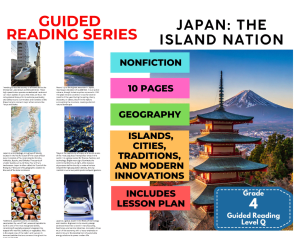
Japan The Island Nation: Guided Reading Level Q with Lesson Plan
ELA, Resources for Teachers, Reading Comprehension, Reading, Science, Geography, Social Studies, History, Earth and Environmental Sciences, Technology, Grade 3, 4, 5, Worksheets & Printables, Worksheets, Teacher Tools, Centers, Activities, Literacy Readers, Quizzes, Quizzes and Tests, Assessments, Lesson Plans
This Japan: The Island Nation (level q) guided reading book with lesson plan includes: Guided Reading Color Label (front cover x1) This is a quick way to match the book’s demands to what students can generally handle.. The overall goal is to use the level/color to pick books for several smaller groups. To qualify for a certain level, a student is expected to read a book from that level with about 90–94% accuracy. If a student is consistently accurate and understands, move up a level. If the student is struggling at that level, drop down and add more support. Each student will improve at completely different rates, but it is generally one of the best ways to check progress across the class. DOWNLOAD THE CATALOG TO VIEW ALL GUIDED READING BOOKS AVAILABLE (SORTED LEVELS A-Z) Pre-Reading Question (x1) Teacher asks the prompt aloud, can be while showing the cover or first page. Students share what they already know, or make educated guesses from the cover. Prompt them to use the target vocabulary. Write some of their responses on the board to look back at during the reading. Vocabulary Words (x5) Introduce the five words, best doing it one at a time. Start by saying it, while students repeat and then see if anyone knows what it means before reading further. Read through the meaning and try to briefly connect each word to a picture or gesture so it’s meaningful. Ask students to flip through the book pages and point to where they see each of the vocabulary words. While reading the book pause upon coming across one of the vocab words or read the sentence twice to make sure students understand the word has appeared. Optional: Ask students to raise hands whenever they see/hear one of the new words. Guided Reading Pages (x10) Check the book snapshot (below) for: primary topic - do you need to prep extra reading or intro materials on this? what is taught best - decide on 1-2 bullets to focus on, use the prompt or words provided here for best results. learning goals - what you are checking for students to be able to do after the session, elicit answers using prompts or words provided. key vocabulary (see section above). questions overview - so you know what is coming up and if you need to prep extra materials to assist understanding. Run the lesson You may have already looked at a few of the pages together, but you can show them some of the pictures again first to set meaning. Depending on how much time you have and how familiar your students are with guided reading class, you may want to read the book aloud first with the group first. Students whisper or partner read, while you listen in. If time, do it as a group, one student reading a page each. Use the guided page’s prompts to coach: “Check the picture / does it make sense?” “Point under the words / try the first sound” “Reread the sentence smoothly”. Try to focus more on one student per session (rotating every time), so you can work out if they are ready to move up or need to move down a level. Comprehension Questions (back cover x3) This is your way to check that students didn’t just say the words, but actually understood the text. First, let students answer by pointing to the page/picture and saying a short sentence. After any answer, follow with: “Show me where you found that in the text.” In bigger groups, have partners answer first (10–20 seconds), then call on 2–3 students to share. Differentiation tips: Emerging speakers/struggling readers: oral + pointing On-level: oral in a full sentence Higher: one written sentence or draw + label Book Snapshot Title: Japan: The Island Nation Genre: Nonfiction Subject: Social Studies (Geography/Culture) Primary Topic: Japan’s islands, cities, traditions, and modern innovations Estimated Guided Reading Level (A–Z): Q What This Book Teaches Best Explains Japan’s geography as an archipelago , naming the four main islands and describing its location off East Asia. Highlights Tokyo as a major metropolitan area , describing its role and features of city life. Describes transportation and technology through the Shinkansen (bullet train), including its speed, safety, and punctuality. Connects landforms and natural features to Japan’s identity by describing Mount Fuji, snow cover, and spring sakura blossoms. Builds understanding of culture and history through Shinto and Buddhism, matsuri festivals, and the Edo period (shoguns, samurai, and castles like Himeji). Learning Goals Students will explain what an archipelago is and name Japan’s four main islands. Students will describe Tokyo’s importance and identify details the text gives about the city. Students will explain how the Shinkansen helps people travel and identify key features the text highlights (such as speed or punctuality). Students will describe Mount Fuji using details from the text, including its height and volcanic history. Students will identify key ideas about Japanese traditions from the text (religions, shrines/torii, cuisine, or festivals). Students will explain how Japan’s climate varies and describe the text’s example of the “snow monkey” in winter. Key Vocabulary From the Text archipelago — a group of islands. metropolitan — related to a very large city area. punctuality — being on time. terraced — built in step-like levels on a hillside. geothermal — heat that comes from inside the Earth. Discussion Prompts Pre-reading question: What places, traditions, or inventions do you expect to learn about in Japan? Comprehension questions: What four main islands does the text name as part of Japan? Comprehension questions: What does the text say the Shinkansen is known for? Comprehension questions: How does the text say the “snow monkey” adapts to cold winters? Printing Tips 1. Best Printing Method (Recommended) “Booklet” Printing (Best if Available) If your printer or PDF viewer supports Booklet Printing , use this. Settings to use: Print mode: Booklet Paper size: Letter or A4 (either works) Orientation: Landscape Print on both sides: Yes Flip on: Short edge Scaling: Fit to printable area Booklet subset: First test: Front sides only Then: Back sides only This will automatically: Pair pages correctly Put the cover on the outside Align everything for folding After printing, fold in half and staple along the spine . 2. If “Booklet” Printing Is NOT Available You can still print this correctly with manual duplex printing . Step-by-step: Open the PDF. Choose Print . Set: Orientation: Landscape Pages per sheet: 1 Print on both sides: Yes Flip on: Short edge Print all pages . Because each PDF page already contains two facing book pages, the result will still fold cleanly into a book. Thousands of Cored Education products are included with your TeachSimple membership. Download links and encyclopedia index available here.
Author Cored Education
Rating
Tags Reading Comprehension, Reading Passages, Reading, Guided Reading, Guided Reading Lesson Plan, Guided Reading Activity, Pre-reading, Social Studies, Geography, History

Present Tense Supplementary Materials Grades 3-4 (PDF)
ELA, Language Development, ESL, Grammar, Common Core, Resources for Teachers, Grade 3, 4, Worksheets & Printables, Worksheets, Quizzes and Tests, Teacher Tools, Tests, Assessments, Activities, Lesson Plans
Present Tense Supplementary Materials Note: This download DOES NOT include the tests themselves. You can still make use of these materials without them but they are recommended. Download in a format of your choice in the "Links" section below. Outline Ice Breaker (5-10 minutes) Engaging, interactive activity to introduce the lesson’s theme. Examples: Matching games, sentence races, charades, or storytelling challenges. Guided Practice (10-15 minutes) Teacher-led exercises to reinforce the concept. Examples: Sorting sentences by tense, sentence transformations, or fill-in-the-gap exercises. Group or Partner Task (15 minutes) Collaborative activity to practice the lesson’s focus in a fun and engaging way. Examples: Role-play, storytelling, sentence-building games, or small-group discussions. Independent Worksheet (15 minutes) Individual written activity to solidify understanding. Examples: Sentence corrections, verb conjugation drills, or tense identification exercises. Exit Task (5 minutes) Quick reflective activity to assess understanding before students leave. Examples: Writing a sentence using the target concept, identifying a tense, or explaining a rule. Links: Includes: Present Simple Present Continuous Present Perfect Mistake Finding Google Docs Google Forms Google Slides PDF PPT Word FULL CATALOG OF DOWNLOAD LINKS HERE Grade 3/4 Links: Adjectives Google Docs Google Forms Google Slides PDF PPT Word Free Supplementary Materials Pack Adverbs Google Docs Google Forms Google Slides PDF PPT Word Free Supplementary Materials Pack Conjunctions Google Docs Google Forms Google Slides PDF PPT Word Free Supplementary Materials Pack Nouns Google Docs Google Forms Google Slides PDF PPT Word Free Supplementary Materials Pack Pronouns Google Docs Google Forms Google Slides PDF PPT Word Free Supplementary Materials Pack Verbs Google Docs Google Forms Google Slides PDF PPT Word Free Supplementary Materials Pack Sentence Structure Google Docs Google Forms Google Slides PDF PPT Word Free Supplementary Materials Pack Present Tense Google Docs Google Forms Google Slides PDF PPT Word Free Supplementary Materials Pack Past Tense Google Docs Google Forms Google Slides PDF PPT Word Free Supplementary Materials Pack Future Tense Google Docs Google Forms Google Slides PDF PPT Word Free Supplementary Materials Pack Context Clues Google Docs Google Forms Google Slides PDF PPT Word Free Supplementary Materials Pack Defining Words Google Docs Google Forms Google Slides PDF PPT Word Free Supplementary Materials Pack Fill the Blanks Google Docs Google Forms Google Slides PDF PPT Word Free Supplementary Materials Pack Homophones Google Docs Google Forms Google Slides PDF PPT Word Free Supplementary Materials Pack Synonyms Google Docs Google Forms Google Slides PDF PPT Word Free Supplementary Materials Pack ELA Review Questions Overview Questions have three answer choices. There are a handful of pictures on each test for aesthetic purposes, as well as a review sheet covering most of the topics covered in the product. Introduction or Example Sheet Each topic will include an introduction or example sheet to go through first with your students. Full Answer Keys Full answer keys and sample responses are provided so no matter how busy you are, you know you're covered! In the Supplementary Pack Interactive Ice Breakers: Fun, hands-on activities that get students thinking about adjectives right from the start. Guided Practice: Teacher-led exercises that reinforce the day’s lesson, ensuring students can confidently identify and use adjectives. Group and Partner Tasks: Collaborative activities that allow students to work together to solve problems, categorize adjectives, and create descriptive sentences. Independent Worksheets: Structured worksheets that provide individual practice and help solidify understanding of key concepts. Exit Tasks: Quick, reflective activities at the end of each lesson that assess understanding and encourage students to apply what they’ve learned. For similar downloads and other frees, do check out Cored Group on TeachSimple.
Author Cored Education
Tags Elementary, Answers, Ccss, Common Core, Grammar, Tests, Test Prep, Grade 3, Grade 4, Lesson Plan

Candy Reading Comprehension Passages and Questions Fillable PDF
ELA, Language Development, Resources for Teachers, Vocabulary, Spelling, Reading Comprehension, Reading, Early Math, Math, Common Core, Grade 2, 3, 4, 5, Worksheets & Printables, Worksheets, Teacher Tools, Centers, Activities, Assessments, Tests, Quizzes and Tests, Word Problems, Writing Prompts
Themed Reading Comprehension Passages Series - Candy This reading comprehension series is built for grades 2 to 5 and keeps things simple, clear, and easy to use. Every title follows a fun, kid-friendly theme and comes with two passage levels, one written for grades 2 to 3 and a more challenging version for grades 4 to 5. Students then work through a mix of follow-up pages that check understanding in different ways: multiple-choice questions, short written responses, scrambled words, a quick summary, and a theme-based word problem. Answer keys are included, so prep stays minimal. Each resource also comes in nine classroom-friendly formats, so you can choose what fits your setup: print or digital, editable or ready to go, and even self-grading options. Because the layout stays consistent, it is easy to plug into whole-class lessons, small groups, literacy centers, morning work, fast finisher tubs, sub plans, or home learning. It is a straightforward way to build comprehension, practice reading skills in context, and strengthen written responses without adding extra steps for you. Candy Lesson List Note: This product has titles different to those in the rest of the themed series. 1. Candy Types 2. Candy Flavors 3. Candy Shapes and Colors 4. Candy Ingredients 5. Candy Fun Facts FILLABLE PDF VERSION Worksheet-style pages, but with type-in answer boxes so students can complete and save their work digitally. Other versions are available in the links list below or in the full catalog. How to Use These Lessons Perfect for: Morning work or early-finisher bins Guided reading blocks or comprehension warmups Literacy centers or small-group rotations Holiday/seasonal review lessons Independent stations, sub plans, or take-home enrichment More Candy Themed Products CROSSWORDS WORDSEARCHES MAZES FULL CATALOG OF DOWNLOAD LINKS HERE Themed Reading Links Addition Animals Around the Home Birthday FORMATS: -FORMAL ASSESSMENT VERSION -PRESENTABLE PDF -PPT -SLIDES - PDF -FILLABLE PDF -WORD -FORMS -DOCS SUPPLEMENTARY MATERIALS (COMING SOON): -VISUAL READING PASSAGE VIDEO -GUIDED LEARNING VIDEO -LESSON PLANS Candy FORMATS: -FORMAL ASSESSMENT VERSION -PRESENTABLE PDF -PPT -SLIDES -PDF -FILLABLE PDF -WORD -FORMS -DOCS SUPPLEMENTARY MATERIALS (COMING SOON): -VISUAL READING PASSAGE VIDEO -GUIDED LEARNING VIDEO -LESSON PLANS Christmas Cinco de Mayo Clothes Colors Days and Months Division Earth Day Easter Easy Mazes Fall Father's Day Food Geography (Set 1) Geography (Set 2) Geography (Set 3) Graduation Health History (Set 1) History (Set 2) History (Set 3) Human Body Kindness Life Skills Mother's Day Multiplication Science (Set 1) Science (Set 2) Science (Set 3) Shapes Social Skills Spring Sports St. Patrick's Day Subtraction Summer Thanksgiving Transport Valentine's Day Winter Free One Lesson Themes Chinese New Year Lunar New Year Halloween Pink Shirt Day Independence Day Juneteenth President's Day Groundhog Day Readings in Depth Structure Each resource is built around a focused sub-theme within the broader topic. Students read two leveled passages (Grades 2–3 and Grades 4–5), then move through a short, consistent sequence of activities that checks understanding and keeps momentum: multiple-choice, brief written responses, a scrambled-words review, a compact summary task, and a light theme-linked word problem. The flow is predictable for students, but varied enough to feel fresh across topics. Each completed resource includes: Two differentiated reading passages (lower and upper level) A multiple-choice comprehension page Short written-response questions A scrambled-words or quick vocabulary check A brief summary activity A simple, theme-connected word problem Answer keys for fast marking and easy self-checking Nine classroom-friendly formats, including print, editable, digital, and self-grading options Themes Included These readings span a wide range of age-appropriate, high-interest topics, such as: Seasons and celebrations Real-world science and nature Community, character, and life skills Everyday high-frequency themes students already enjoy Each title connects to familiar experiences while strengthening comprehension, vocabulary in context, and clear written expression. Easy extensions (optional): Read twice: first for gist, second to highlight key details Write two “right there” questions and swap with a partner Create a 3-bullet fact list or mini mind map Turn the summary into a 3-sentence retell using sequence words Add one extra math question connected to the topic Compare the two levels: what details appear in both? Differentiation tips: Pre-teach 2–3 key words with quick examples Offer sentence starters for written responses Use partner reading: one reads aloud, one tracks evidence Allow highlighting or underlining before answering questions Provide a shorter chunking option for students who need breaks Encourage confident readers to justify answers with a quoted detail For similar downloads and other frees, do check out Cored Group on TeachSimple.
Author Cored Education
Rating
Tags Vocabulary, Spelling, Candy, Candy Activities, Writing Prompts, Word Problems, Reading Comprehension, Candy Reading, Candy Passages, Reading Passages