



3,953 products added recently
Page 2 - 5th Grade Assessments
Support your fifth-grade students as they prepare for the next stage of their education with assessments that cover advanced concepts. This collection includes comprehensive tests in math, language arts, and science. By utilizing these tools, you can address learning gaps and reinforce strengths.

 Show filters


Candy Reading Comprehension 1 Lesson Sample Google Forms
ELA, Language Development, Resources for Teachers, Vocabulary, Spelling, Reading Comprehension, Reading, Common Core, Grade 2, 3, 4, 5, Teacher Tools, Centers, Activities, Assessments, Tests, Quizzes and Tests, Quizzes, Word Problems, Worksheets & Printables, Writing Prompts
THIS IS A ONE LESSON FREE SAMPLE OF THE FOLLOWING PRODUCT: Themed Reading Comprehension Passages Series - Candy This reading comprehension series is built for grades 2 to 5 and keeps things simple, clear, and easy to use. Every title follows a fun, kid-friendly theme and comes with two passage levels, one written for grades 2 to 3 and a more challenging version for grades 4 to 5. Students then work through a mix of follow-up pages that check understanding in different ways: multiple-choice questions, short written responses, scrambled words, a quick summary, and a theme-based word problem. Answer keys are included, so prep stays minimal. Each resource also comes in nine classroom-friendly formats, so you can choose what fits your setup: print or digital, editable or ready to go, and even self-grading options. Because the layout stays consistent, it is easy to plug into whole-class lessons, small groups, literacy centers, morning work, fast finisher tubs, sub plans, or home learning. It is a straightforward way to build comprehension, practice reading skills in context, and strengthen written responses without adding extra steps for you. Candy Lesson List Note: This product has titles different to those in the rest of the themed series. 1. Candy Types 2. Candy Flavors 3. Candy Shapes and Colors 4. Candy Ingredients 5. Candy Fun Facts GOOGLE FORMS VERSION Mostly self-grading quizzes with built-in answer keys and sample responses, so you can collect scores and feedback in minutes. Non-self grading questions have a star before them, primarily the further questions writing section (4 questions), creative writing prompt and the summary. Sample answers are given for all but the creative writing. Other versions are available in the links list below or in the full catalog. How to Use These Lessons Perfect for: Morning work or early-finisher bins Guided reading blocks or comprehension warmups Literacy centers or small-group rotations Holiday/seasonal review lessons Independent stations, sub plans, or take-home enrichment More Candy Themed Products CROSSWORDS WORDSEARCHES MAZES FULL CATALOG OF DOWNLOAD LINKS HERE Themed Reading Links Addition Animals Around the Home Birthday FORMATS: -FORMAL ASSESSMENT VERSION -PRESENTABLE PDF -PPT -SLIDES - PDF -FILLABLE PDF -WORD -FORMS -DOCS SUPPLEMENTARY MATERIALS (COMING SOON): -VISUAL READING PASSAGE VIDEO -GUIDED LEARNING VIDEO -LESSON PLANS Candy FORMATS: -FORMAL ASSESSMENT VERSION -PRESENTABLE PDF -PPT -SLIDES -PDF -FILLABLE PDF -WORD -FORMS -DOCS SUPPLEMENTARY MATERIALS (COMING SOON): -VISUAL READING PASSAGE VIDEO -GUIDED LEARNING VIDEO -LESSON PLANS Christmas Cinco de Mayo Clothes Colors Days and Months Division Earth Day Easter Easy Mazes Fall Father's Day Food Geography (Set 1) Geography (Set 2) Geography (Set 3) Graduation Health History (Set 1) History (Set 2) History (Set 3) Human Body Kindness Life Skills Mother's Day Multiplication Science (Set 1) Science (Set 2) Science (Set 3) Shapes Social Skills Spring Sports St. Patrick's Day Subtraction Summer Thanksgiving Transport Valentine's Day Winter Free One Lesson Themes Chinese New Year Lunar New Year Halloween Pink Shirt Day Independence Day Juneteenth President's Day Groundhog Day Readings in Depth Structure Each resource is built around a focused sub-theme within the broader topic. Students read two leveled passages (Grades 2–3 and Grades 4–5), then move through a short, consistent sequence of activities that checks understanding and keeps momentum: multiple-choice, brief written responses, a scrambled-words review, a compact summary task, and a light theme-linked word problem. The flow is predictable for students, but varied enough to feel fresh across topics. Each completed resource includes: Two differentiated reading passages (lower and upper level) A multiple-choice comprehension page Short written-response questions A scrambled-words or quick vocabulary check A brief summary activity A simple, theme-connected word problem Answer keys for fast marking and easy self-checking Nine classroom-friendly formats, including print, editable, digital, and self-grading options Themes Included These readings span a wide range of age-appropriate, high-interest topics, such as: Seasons and celebrations Real-world science and nature Community, character, and life skills Everyday high-frequency themes students already enjoy Each title connects to familiar experiences while strengthening comprehension, vocabulary in context, and clear written expression. Easy extensions (optional): Read twice: first for gist, second to highlight key details Write two “right there” questions and swap with a partner Create a 3-bullet fact list or mini mind map Turn the summary into a 3-sentence retell using sequence words Add one extra math question connected to the topic Compare the two levels: what details appear in both? Differentiation tips: Pre-teach 2–3 key words with quick examples Offer sentence starters for written responses Use partner reading: one reads aloud, one tracks evidence Allow highlighting or underlining before answering questions Provide a shorter chunking option for students who need breaks Encourage confident readers to justify answers with a quoted detail For similar downloads and other frees, do check out Cored Group on TeachSimple.
Author Cored Education
Rating
Tags Vocabulary, Spelling, Candy, Candy Activities, Writing Prompts, Word Problems, Reading Comprehension, Candy Reading, Candy Passages, Reading Passages
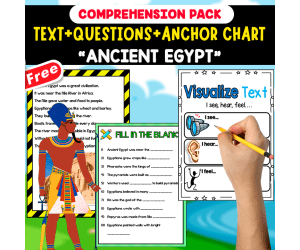
READING-COMPREHENSION PACK | ANCIENT EGYPT | 20 FREE PAGES
Reading, ELA, Writing, History, Social Studies, History: Ancient, History: World, Adult Education, Elementary, High School, Middle School, Homeschool Resources, Not Grade Specific, Anchor Charts, Teacher Tools, Assessments, Quizzes and Tests, Literacy Readers
READING-COMPREHENSION PACK | ANCIENT EGYPT | 20 FREE PAGES SUMMARY OF THIS PRODUCT: What is the name of the document?:READING-COMPREHENSION PACK | ANCIENT EGYPT How many pages does it include?: 20 In what format is it available (PDF, Word, PPT)?: PDF A4 Is it in color or black and white?: COLOR ABOUT THE AUTHOR: Hi there! We are EDITORIAL ARENAS EDUCATIVAS 🎓✨. We love designing educational materials that make children’s learning joyful, dynamic, and motivating. I invite you to visit my educational store, explore the variety of resources available, and find the perfect one for your students. MAIN DESCRIPTION OF THIS PRODUCT: What is the name of your product and what makes it special? This beautiful product is called “READING-COMPREHENSION PACK | ANCIENT EGYPT ”, and it is very special because it was carefully designed or compiled. With this educational resource, we want students to learn with enthusiasm and fun, because we believe learning is fun. How many pages are included in this resource? This fabulous document contains the following number of pages: 20 What size is it designed in (A4, letter, etc.)? This resource is designed in A4 format and compiled as a PDF. This makes downloading and printing simple and convenient, and PDFs are also easy to store and carry anywhere. PDF A4 Is the material in color or black and white? This pedagogical document comes in both black and white and color. This makes it more attractive for your learning sessions, but you have the freedom to choose how to print it. COLOR SECONDARY AND COMPLEMENTARY INFORMATION: What learning objectives does it achieve? This document fulfills a playful objective—it’s meant to be attractive and engaging for children. At the same time, it ensures that students learn or reinforce their knowledge. Who can use it best (teachers, parents, students, therapists, homeschoolers)? We are all part of education. Whether you are a teacher, parent, student, or therapist, this document can adapt perfectly to your learning goals, depending on your creativity. What additional materials are recommended (printer, scissors, markers, etc.)? The more immersed students are in learning, the greater their results. That’s why it’s ideal to complement this resource with pencils, crayons, markers, and even other art tools. What outcome, benefit, or transformation can the user expect? With this fabulous resource, students will first understand that learning is easy and fun, and second, they will strengthen their knowledge and skills.
Author EDITORIAL LAURA EDUCA
Rating
Tags FREE, FREE RESOURCES, READING, READING AND COMPREHENSION, COMPREHENSION, ANCIENT EGYPT, EGYPT, ANCHOR CHART
Sentence Structure Sample: Grammar Grades 3-4 (PPT)
ELA, Language Development, ESL, Grammar, Common Core, Grade 3, 4, Quizzes and Tests, Teacher Tools, Tests, Assessments, Presentations
Sentence Structure Sample Lesson ELA MCQS Overview: In this series of lessons, students will embark on an engaging journey to explore the grammar skills that make our language vibrant and expressive. These lessons are crafted to help students identify, comprehend, and effectively apply language arts skills in both writing and speech. Accompanied by free supplementary materials available for all topics, each lesson builds on the previous one, offering a balanced mix of direct instruction, interactive group activities, and independent practice. Through fun and creative tasks, students will learn to recognize grammar within sentences, understand their function, and use them to enrich their own writing and speech. Sentence Structure Overview: Includes: Declarative Sentences lnterroative Sentences Exclamatory Sentences Imperative Sentences Sentence Fragments End Punctuation PPT Version This is the PPT editable and interactive version. There is a fillable answer sheet at the end. This download is available in GOOGLE Docs, GOOGLE Forms, GOOGLE Slides. PDF, PPT, WORD, check the links below for more details. FULL CATALOG OF DOWNLOAD LINKS HERE Grade 3/4 Links: Adjectives Google Docs Google Forms Google Slides PDF PPT Word Free Supplementary Materials Pack Adverbs Google Docs Google Forms Google Slides PDF PPT Word Free Supplementary Materials Pack Conjunctions Google Docs Google Forms Google Slides PDF PPT Word Free Supplementary Materials Pack Nouns Google Docs Google Forms Google Slides PDF PPT Word Free Supplementary Materials Pack Pronouns Google Docs Google Forms Google Slides PDF PPT Word Free Supplementary Materials Pack Verbs Google Docs Google Forms Google Slides PDF PPT Word Free Supplementary Materials Pack Sentence Structure Google Docs Google Forms Google Slides PDF PPT Word Free Supplementary Materials Pack Present Tense Google Docs Google Forms Google Slides PDF PPT Word Free Supplementary Materials Pack Past Tense Google Docs Google Forms Google Slides PDF PPT Word Free Supplementary Materials Pack Future Tense Google Docs Google Forms Google Slides PDF PPT Word Free Supplementary Materials Pack Context Clues Google Docs Google Forms Google Slides PDF PPT Word Free Supplementary Materials Pack Defining Words Google Docs Google Forms Google Slides PDF PPT Word Free Supplementary Materials Pack Fill the Blanks Google Docs Google Forms Google Slides PDF PPT Word Free Supplementary Materials Pack Homophones Google Docs Google Forms Google Slides PDF PPT Word Free Supplementary Materials Pack Synonyms Google Docs Google Forms Google Slides PDF PPT Word Free Supplementary Materials Pack ELA Review Questions Overview Questions have three answer choices. There are a handful of pictures on each test for aesthetic purposes, as well as a review sheet covering most of the topics covered in the product. Introduction or Example Sheet Each topic will include an introduction or example sheet to go through first with your students. Full Answer Keys Full answer keys and sample responses are provided so no matter how busy you are, you know you're covered! In the Supplementary Pack Interactive Ice Breakers: Fun, hands-on activities that get students thinking about adjectives right from the start. Guided Practice: Teacher-led exercises that reinforce the day’s lesson, ensuring students can confidently identify and use adjectives. Group and Partner Tasks: Collaborative activities that allow students to work together to solve problems, categorize adjectives, and create descriptive sentences. Independent Worksheets: Structured worksheets that provide individual practice and help solidify understanding of key concepts. Exit Tasks: Quick, reflective activities at the end of each lesson that assess understanding and encourage students to apply what they’ve learned. For similar downloads and other frees, do check out Cored Group on TeachSimple.
Author Cored Education
Tags Elementary, Answers, Ccss, Common Core, Grammar, Tests, Test Prep, Assessment, Grade 3, Grade 4

Subject-Verb Agreement Supplementary Materials Grade 5-6 (PDF)
ELA, Language Development, ESL, Grammar, Common Core, Resources for Teachers, Grade 5, 6, 7, Worksheets & Printables, Worksheets, Quizzes and Tests, Teacher Tools, Tests, Assessments, Lesson Plans
Subject-Verb Agreement Supplementary Materials Note: This download DOES NOT include the tests themselves. You can still make use of these materials without them but they are recommended. Download in a format of your choice in the "Links" section below. In the Supplementary Pack Interactive Ice Breakers: Engaging warm-up activities that introduce students to key ELA concepts, such as quick capitalization corrections and punctuation challenges. Guided Practice: Structured teacher-led exercises that reinforce grammar and punctuation rules, helping students identify and apply them correctly in sentences. Group and Partner Tasks: Collaborative activities where students work together to edit sentences, correct capitalization, and improve punctuation through peer discussion and teamwork. Independent Worksheets: Carefully designed worksheets that provide focused practice, allowing students to apply learned concepts and refine their skills independently. Exit Tasks: Quick assessments at the end of each lesson, prompting students to reflect on what they’ve learned and apply their knowledge in writing and editing tasks. Links Major Subject-Verb Practice Wish Sentences Request Sentences Contrary to Fact Sentences Google Docs Google Forms Google Slides PDF PPT Word FULL CATALOG OF DOWNLOAD LINKS HERE Grade 5/6 Links: Capitalization & Punctuation Google Docs Google Forms Google Slides PDF PPT Word Free Supplementary Materials Pack Adjectives Google Docs Google Forms Google Slides PDF PPT Word Free Supplementary Materials Pack Nouns Google Docs Google Forms Google Slides PDF PPT Word Free Supplementary Materials Pack Pronouns Google Docs Google Forms Google Slides PDF PPT Word Free Supplementary Materials Pack Verbs Google Docs Google Forms Google Slides PDF PPT Word Free Supplementary Materials Pack Prefixes & Suffixes Google Docs Google Forms Google Slides PDF PPT Word Free Supplementary Materials Pack Sentence Structure Google Docs Google Forms Google Slides PDF PPT Word Free Supplementary Materials Pack Subject Verb Agreement Google Docs Google Forms Google Slides PDF PPT Word Free Supplementary Materials Pack Tenses Google Docs Google Forms Google Slides PDF PPT Word Free Supplementary Materials Pack Context Clues Google Docs Google Forms Google Slides PDF PPT Word Free Supplementary Materials Pack Defining Words Google Docs Google Forms Google Slides PDF PPT Word Free Supplementary Materials Pack Fill in the Blanks Google Docs Google Forms Google Slides PDF PPT Word Free Supplementary Materials Pack Homophones Google Docs Google Forms Google Slides PDF PPT Word Free Supplementary Materials Pack Synonyms Google Docs Google Forms Google Slides PDF PPT Word Free Supplementary Materials Pack ELA Review Questions Overview Questions have three answer choices. There are a handful of pictures on each test for aesthetic purposes, as well as a review sheet covering most of the topics covered in the product. Introduction or Example Sheet Each topic will include an introduction or example sheet to go through first with your students. Full Answer Keys Full answer keys and sample responses are provided so no matter how busy you are, you know you're covered! For More Like This For similar downloads and other frees, do check out Cored Group on TeachSimple.
Author Cored Education
Tags Elementary, Answers, Ccss, Common Core, Grammar, Tests, Test Prep, Assessment, Grade 5, Grade 6
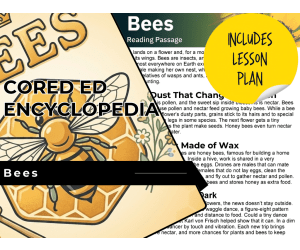
Bees Reading Comprehension Passage - Cored Ed Encyclopedia
ELA, Language Development, Reading Comprehension, Reading, Writing, Pre-Reading, Science, Insects, Life Sciences, Vocabulary, Grade 2, 3, 4, 5, Worksheets & Printables, Worksheets, Teacher Tools, Centers, Activities, Writing Prompts, Assessments, Quizzes and Tests, Quizzes, Lesson Plans
This bees reading comprehension with lesson plan includes: Visualization (on the front cover) Start your lesson by taking a minute to think and share something about the topic. Read the script aloud (slowly), perhaps prepare some music or sound effects. Student close their eyes and let their imaginations wander. Students open their eyes, read the question aloud and give them a few minutes to complete. Ask a few students to share or keep answers until the end to compare with what they learn in the passage. Quick pause—thousands of Cored Education products are included with your TeachSimple membership. Download links and encyclopedia index available here. Pre-Reading Trivia Students will write down one thing they already know about the subject and then read five more facts and discuss. These facts are fun, and the students will enjoy learning about the subject before reading more. Give 1 minute for students to write what they already know (no pressure—best guess is fine). Read the five facts together. After each fact, do ask a student for their opinion, was it surprising? Set a purpose by asking students to highlight/underline one fact they want to learn more about during the reading. Reading Passage The text is a high-interest reading passage with set paragraphs, roughly three to four paragraphs long. It contains a variety of themes about the topic, anywhere from history to technology. The passage is between 250 and 350 words in length. First, ask students to look at the headings and see what they’ll learn about today. What do they know about the topic/heading? First read options: Teacher read-aloud (best for support). Partner reading (paragraph by paragraph). While reading, students underline important details, and vocabulary words they think may come up in the questions section. Mixed Questions The first question page contains four multiple-choice questions, each with a choice of four answers, and three written response questions that require a sentence or two from the student. Students complete the mcqs first independently, then review quickly as a class. For the 3 written responses, try to get students giving the answer with some form of evidence: “I think ___ because the text says ___.” If students get stuck, send them back to check the passage. Vocabulary Questions Practice seven key words from the text in this section across two activities. First section is scrambled words where students will unscramble three words given a clue for each. The second section is a word to meaning matching activity. Before starting, have some students read out words they underlined in the passage. Ask students to say the word and read aloud the sentence(s) around each word. Ask students to do scrambled words and the matching exercise in pairs then go through answers as a class. For the scrambled spelling task, get four pairs to come up to the board and write the words for extra practice with the other student reading out the clue. For the matching task, prompt students to give full sentences: “I matched ___ with ___ because ___.” Creative Writing In this question, the student will be required to write a five to eight sentence paragraph on a question related to the topic. Before starting, ask students write down 3 key ideas they are going to include in their piece. Ask students for ideas to share around the class to help those struggling. Pro writing expectations: 5–8 sentences At least 2 facts or details from the passage At least 2 vocabulary words from the previous page Students read their paragraphs while classmates listen for facts and vocabulary words. Extension Activities This page is optional for fast finishers or to take home. There are several activities, each one requiring a different skill. Do some, do none, do all, completely optional - but you will feel reassured knowing every possibility is planned for. Includes summary writting question and additional facts. Answer Key There are answers for the multiple-choice questions, written response questions have sample answers, vocabulary answers and if there is a summary question then a sample summary will be provided as well. Lesson Plan Included Customized lesson plan for this lesson is included. Lesson Snapshot Title: Bees Genre: Nonfiction (informational passage) Subject: Life Science Primary Topic: Pollination, hive roles, and waggle-dance communication Estimated Guided Reading Level (A–Z): S What This Lesson Teaches Best Bees as insects with many kinds (more than 20,000) living almost everywhere on Earth except **Antarctica. How bees help plants make seeds by moving pollen from flower to flower while gathering nectar and pollen for baby bees. How honey bees live in organized hives with shared jobs (queen, drones, and worker bees doing specific tasks). How honey bees turn nectar into honey and store it for later as extra food. How the waggle dance can share direction and distance to food, supported by the work of Karl von Frisch. Learning Goals Describe where bees live and how many kinds the passage says there are. Explain how pollen gets from one flower to another in the passage. Identify what pollen and nectar do for growing baby bees. Describe how jobs are shared in a honey bee hive, including the queen, drones, and workers. Explain what the waggle dance communicates and how other bees follow it in a dim hive. Describe how honey is made and stored, using details from the passage. Key Vocabulary From the Text pollen — yellow dust that helps plants make seeds. nectar — sweet liquid inside blossoms. colony — a group of bees living together. larvae — baby insects before they become adults. vibration — shaking that can be felt as movement. FULL CATALOG OF DOWNLOAD LINKS AND ENCYCLOPEDIA INDEX HERE
Author Cored Education
Rating
Tags Vocabulary, Reading Comprehension, Reading Passages, Lesson Plans, Ela Lesson Plans, Reading Comprehension Lesson Plans, Pre-reading, Science Lesson Plans, Life Science, Insects
Task Initiation & Micro-Step Breakdown
Life Studies, Career, Leadership, Physical Education, P.E. & Health, Mental Health, Mindfulness, Resources for Teachers, Science, Classroom Management, Grade 6, 7, 8, 9, 10, 11, 12, Teacher Tools, Worksheets & Printables, Workbooks, Worksheets, Word Searches, Assessments, Lesson Plans, Quizzes and Tests, Quizzes, Tests
Are your students or kids stuck with a blank page due to a large assignment? Do they know how to do the assignment but can’t figure out the best way to jump into it? This is not because of laziness—this is an example of a breakdown in Task Initiation, which is one of the key executive functions of the brain. Support your students to move from being passive and procrastinating to becoming active creators of their success with our comprehensive neuroscience-based curriculum. This 42-page instructional manual and workbook supports creating a step-by-step strategy to overcome your student's brain's resistance to getting started with completing tasks. By applying the principles of cognitive offloading and granular sequencing, this manual and workbook will provide you with the ultimate guide to how to accomplish your goals. This resource is designed for teachers, parents, school counselors, and executive function coaches to support helping to create lifelong habits, build confidence in school, and decrease the anxiety and stress associated with homework. Contents of this 42-page document. The Neuroscience Guide (Part 1) (The “Why”) The neuroscience of procrastination. Easy-to-understand explanations for the science of procrastination (brain science) include energy, limbic friction, activation energy, time blindness, etc. Real-life examples of the science from students and short quizzes to test knowledge and understanding. The Student Workbook (Part 2) (The “How”) 10 in-depth printed worksheets provide a complete scaffolded framework for developing executive function. Actionable Steps: Deconstruct larger projects into small tasks, identify and eliminate friction, create a five-minute launchpad, master micro steps, create an executive execution ladder, eliminate distractions, and create empathy for your future self. Capstone Project: A master blueprint for a major project using taught strategies. Part Three: Visual & Teacher/Parent Resources (The “Tools”) Three Strong Visual Supports: Printables and classroom appropriate anchor charts will give students' cognitive relief through visual representation of how to use their brain there are three charts to choose from (The Anatomy of Task Paralysis, The Micro-Step Bridge, The Task Activation Loop). Complete Answer Key: An answer key for all ten student worksheets so that teachers can provide students with a comprehensive answer key. Teacher Implementation Guide: A detailed scripted guide on how to introduce these concepts and protocols such as the “Body Double” technique. Differentiation for Neurodivergent Learners: A separate section for specific, powerful strategies for students with ADHD, ASD, and Dyslexia. Not only is this a study skills printable, but it is a powerful cognitive resource that helps students understand themselves so that they may use the resources available to them to work more efficiently with their brain, rather than against it. Keywords: Executive Functioning, Study Skills, Procrastination, Task Initiation, ADHD Support, Neurodiversity, SEL, Middle School, High School, Printable Workbook, Digital Download, Homework Help, Time Management, Metacognition, Growth Mindset, Resources for Teachers, Resources for School Counselors, Parent Guide. What Makes It Busy and Maternal/School Parent-Friendly : Based on Neuroscience (not-created based off "Shame"): It regards procrastination as a normal neurological event, not an individual's defect nor character flaw. This removes guilt associated with procrastination by providing students with a "hacker" mindset to achieve the best outcome for their situation based on the wiring of their brains. Has Actionable, Step-By-Step Tools: Instead of vague and subjective statements like “just break it down,” this curriculum focuses on rigorous, rigorous sequencing (providing valuable resource worksheets/checklists) and concrete ways that a student can apply the information immediately. Targets Neurodivergent Learners: The section on differentiation for ADHD, ASD and Dyslexia students is a must-have addition to any inclusive classroom and will meet needs of all parents with children needing specific support; therefore, it is an extremely "valuable" and "highly-valuable" resource. Develops Lifelong Skills (beyond a one-time project): In addition to a single project, skills presented include metacognition, self-regulation, and planning—all important life-skills needed to continue and succeed throughout high school, college and after. The primary target audience is middle school students (6th-8th grade). The multiple case studies included (6th, 8th grade), the reorganization of the prefrontal cortex and task characteristics align directly with this group. The second target audience is upper elementary (4th-5th Grade) and high school (9th-12th Grade). As stated in the "Visuals & Teacher Keys" section: "(Grade 4-8)". The concepts provided are foundational and lend themselves readily to alteration, both upwards and downwards. High school students with executive functioning issues, especially those diagnosed with ADHD, would see tremendous benefit from this resource. Copyright Notice: This book was copyrighted by Syed Hammad Rizvi. This resource is available for personal use in a single-classroom setting only and cannot be changed (modifications), No part of this book can be shared, sold, or posted on the Internet to be found or downloaded by the public. Please note that if you wish to share this resource with others (teachers), you must buy additional licenses (a fee) from Teachsimple. Thank you for your cooperation in following these terms of usage. This product has been brought to you with pride by Syed Hammad Rizvi.
Author Creative Book Store
Rating
Tags Procrastination, Motivation, StudySkills, TimeManagement, Organization, Neuroscience, ADHD, GrowthMindset, ExecutiveFunctioning, TaskInitiation

Reading Passage: Minerals (Google Slides)
ELA, Reading, Reading Comprehension, Science, Earth and Environmental Sciences, Earth Sciences, Common Core, ESL, Language Development, Resources for Teachers, Grade 2, 3, 4, Presentations, Teacher Tools, Activities, Tests, Quizzes and Tests, Assessments
Free Reading Passage on Minerals for Earth Science What's inside this free product? Science Reading Comprehension Passage31 : Minerals Independent Google Slides Version: This is the independent Google Slides version containingone lesson with full answer keys. Product Info: 28 SLIDES (US English with Answers) Google Slides Version Teaching Duration: 90 Minutes Science Reading Comprehension Outline: Targeted for students in 3rd and 4th grades, these reading passages are enhanced with illustrations and graphs to elucidate critical points. Each lesson aligns with the Common Core State Standards, allowing you to integrate science reading practice effortlessly, knowing that minimal preparation is needed on your part. Each passage comes with a variety of questions in different formats, including multiple-choice formats, data analysis, and fill-in-the-blanks. The topics covered strike a balance between engaging content and core curriculum-based science subjects. Versatile in application, these lessons are suitable for a variety of settings such as whole-class instruction, morning activities, independent desk work, small group discussions, contingency plans for substitute teachers, homework assignments, or even special holiday-themed tasks. FULL CATALOG OF DOWNLOAD LINKS HERE Grade 3/4 Links: Physical Science Part 1 - Properties of Objects and Materials Google Docs/Slides/Forms PDF PPT Word Free Supplementary Pack Accompanying Videos Physical Science Part 2 - Position and Motion of Objects Google Docs/Slides/Forms PDF PPT Word Free Supplementary Pack Accompanying Videos Physical Science Part 3 - Light, Heat, Electricity, Magnetism Google Docs/Slides/Forms PDF PPT Word Free Supplementary Pack Accompanying Videos Life Science Part 1 - Characteristics of Organisms Google Docs/Slides/Forms PDF PPT Word Free Supplementary Pack Accompanying Videos Life Science Part 2 - Life Cycles of Organisms Google Docs/Slides/Forms PDF PPT Word Free Supplementary Pack Accompanying Videos Life Science Part 3 - Organisms and Environments Google Docs/Slides/Forms PDF PPT Word Free Supplementary Pack Accompanying Videos Earth Science Part 1 - Properties of Earth Materials Google Docs/Slides/Forms PDF PPT Word Free Supplementary Pack Accompanying Videos Earth Science Part 2 - Changes in the Earth and Sky Google Docs/Slides/Forms PDF PPT Word Free Supplementary Pack Accompanying Videos Earth Science Part 3 - Objects in the Sky Google Docs/Slides/Forms PDF PPT Word Free Supplementary Pack Accompanying Videos For similar products and other frees, do check out Cored Group on TeachSimple .
Author Cored Education
Tags Science, Elementary, Reading, Comprehension, Vocabulary, Answers, Physics, Physical Science, Ccss, Common Core

Science Reading Passage. Stars of Many Sizes (Fillable PDF)
Science, ELA, Reading, Reading Comprehension, Strategies, Resources for Teachers, Space, Earth and Environmental Sciences, Grade 6, 7, 8, 9, Writing Prompts, Worksheets & Printables, Centers, Activities, Teacher Tools, Assessments, Quizzes and Tests, Quizzes, Tests
Science Reading Comprehension Passages and Questions: Stars of Many Sizes (Fillable PDF) This very engaging science reading passage about Stars of Many Sizes is designed to bridge the gap between science and literacy through strengthening reading comprehension and sparking scientific curiosity in middle school students. The passage blends English Language Arts skills with accurate science content that supports NGSS classroom practice. Ideal for interdisciplinary learning in ELA and Science. Suitable for Grade 9 review, too! These worksheets are designed as fillable PDFs , which means students can type their answers directly into the document on any computer or tablet . Each page includes highlighted text fields that show them exactly where to type! Student Tasks for The Passage: 5 multiple-choice questions targeting main idea, key details, inference, vocabulary in context, and use of evidence 5 vocabulary matching items with clear, student-friendly definitions 5 text-based questions that require citing specific lines or facts 1 summary prompt that asks students to condense central ideas accurately Full answer key for every section Available Formats for this Resource PDF Word Docs Google Docs FULL CATALOG OF DOWNLOADING LINKS HERE Product Details Length: 4 pages total Grades: 6–8, also suitable for Grade 9 review Use cases: close reading, stations, homework, intervention, test prep, and sub plans Standards support: reinforces informational-text skills and supports NGSS-style sense making through observation, modeling, and clear use of claim, evidence, and reasoning Why Teachers Choose This Set Authentic science content paired with rigorous literacy practice Consistent task structure across all passages for easier planning and smoother student routines Clear, age-appropriate writing that builds confidence without oversimplifying Other Science Reading Collections you May find in the store: 1. Astronomy & Space Science 2. Volcanoes, Rocks, & Mountains 3. Rock Cycle, Soil, & Sinkholes 4. Mars, Glaciers, & Antarctica 5. Water Cycle, Acid Rain, & Wastewater 6. Insects, Animals, & Ecosystems 7. Bioluminescence & Insects 8. Animal Skin, Cats, & T. Rex 9. Human Body and Senses 10. Health & Applied Bioscience 11. Waves, Light, & Imaging 12. Electricity & Energy 13. Motion & Materials 14. Chemistry and Materials Science Use this set to reinforce ELA skills in science, to add literacy to your lessons, and to support independent work. The passages strengthen main idea, evidence use, vocabulary in context, inference, cause and effect, and summary writing. With ready-to-use assessments and complete answer keys, you can provide focused practice that is simple to run and fast to review.
Author Middle & High School - CORED Education
Rating
Tags Middle School, Reading Comprehension, Reading Strategies, ELA, Centers, Reading Passage, Assessments, Vocabulary, Environmental Science, Space

Cosmic Quest A Middle Schooler's Journey into Space Exploration, Alien
Life Skills, Special Resources, Social Emotional Learning (SEL), Science, Research, Space, Earth and Environmental Sciences, Environmental Science, Earth Sciences, Geology, Grade 6, 7, 8, 9, 10, 11, 12, Lesson Plans, Teacher Tools, Assessments, Experiments, Activities, Labs
Embark on an extraordinary travel through the cosmos with `` Cosmic Quest, '' the ultimate middle school guide to space geographic expedition, alien living search, and the universe 's deepest mysteries. Written specifically for class 6-9 ( ages 11-15 ), this thorough 338-page resource transforms composite astronomical concepts into engaging, accessible knowledge. Usually, from our solar system 's fiery planets to distant galaxies, from the Big Bang to the hunting for extraterrestrial life, `` Cosmic Quest '' covers everything a Young space enthusiast needs to know. Frankly, with 90 meticulously organized chapters, students will explore planetary science, astrobiology, NASA 's Artemis program, Mars rover discoveries, exoplanet research, and future space technologies. Perfect for classroom use, homeschool curricula, or independent study, this volume aligns with Next Generation skill Standards ( NGSS ) while sparking genuine curiosity about STEM fields. Now, here's where it gets good: each chapter includes clear explanations, stunning cosmic phenomena, and real-world connections to current infinite mission happening right now. Whether your student dreams of becoming an astronaut, astronomer, or simply gazes at the stars with wonder, `` Cosmic Quest '' provides the foundational noesis and inspiration for their scientific journey. The volume also includes essential career guidance for space-related professions, making it both educational and aspirational. Why Parents/Schools Love It: • detailed & Curriculum-Aligned: Covers 90 essential infinite science topics matching center schoolhouse standards, saving teachers planning time while ensuring complete coverage • Future-Focused & stream: Includes NASA missions ( Artemis, Mars exploration ), James Webb Telescope discoveries, and private space industry developments • Career-Inspiring: Dedicated chapters on space careers ( astronauts, engineers, scientists ) connect learning to real-world opportunities • Accessible Yet Rigorous: Makes complex concepts like dark matter, exoplanet detection, and exobiology understandable without `` dumbing down '' the science • Multi-Platform Ready: Perfect for classroom instruction, independent assess, homeschool curricula, and science fair project brainchild mark Audience Analysis: Primary Target: Grades 6-9 ( Ages 11-15 ) centre school science classrooms Homeschool students Gifted and talented programs for grades 5-7 Science club resources Library collections for young adults Secondary Target: Advanced elementary students ( grades 4-5 ) with strong reading skills High schoolhouse student ( grades 9-10 ) postulate foundational astronomy review Parents seeking educational enrichment materials instructor needing supplemental infinite skill resource Copyright/Terms of Use: This Book was copyrighted by Syed Hammad Rizvi. Often, this resource is for personal and single classroom use only. You may not alter, redistribute, or sell any part of this resource. In other words, you may not put it on, kind of, the Internet where it could be publicly found and downloaded. Also, if you want to share this resource with colleagues, please purchase additional licenses from Teachsimple. Thank you for respecting these terms of use. This product is happily brought to you by Syed Hammad Rizvi
Author Creative Book Store
Rating
Tags CosmicQuest, SpaceScienceBook, MiddleSchoolSTEM, AstronomyForKids, ScienceEducation, HomeschoolResources, NGSS, SpaceExploration, AlienLifeSearch, STEMBooks

Rice Reading Comprehension Passage - Cored Ed Encyclopedia
ELA, Language Development, Reading Comprehension, Reading, Pre-Reading, Science, Writing, Strategies, Life Sciences, Nature & Plants, Grade 2, 3, 4, 5, Worksheets & Printables, Worksheets, Teacher Tools, Centers, Activities, Writing Prompts, Assessments, Quizzes and Tests, Quizzes, Lesson Plans
This rice reading comprehension includes: Visualization (on the front cover) Start your lesson by taking a minute to think and share something about the topic. Read the script aloud (slowly), perhaps prepare some music or sound effects. Student close their eyes and let their imaginations wander. Students open their eyes, read the question aloud and give them a few minutes to complete. Ask a few students to share or keep answers until the end to compare with what they learn in the passage. Quick pause—thousands of Cored Education products are included with your TeachSimple membership. Download links and encyclopedia index available here. Pre-Reading Trivia Students will write down one thing they already know about the subject and then read five more facts and discuss. These facts are fun, and the students will enjoy learning about the subject before reading more. Give 1 minute for students to write what they already know (no pressure—best guess is fine). Read the five facts together. After each fact, do ask a student for their opinion, was it surprising? Set a purpose by asking students to highlight/underline one fact they want to learn more about during the reading. Reading Passage The text is a high-interest reading passage with set paragraphs, roughly three to four paragraphs long. It contains a variety of themes about the topic, anywhere from history to technology. The passage is between 250 and 350 words in length. First, ask students to look at the headings and see what they’ll learn about today. What do they know about the topic/heading? First read options: Teacher read-aloud (best for support). Partner reading (paragraph by paragraph). While reading, students underline important details, and vocabulary words they think may come up in the questions section. Mixed Questions The first question page contains four multiple-choice questions, each with a choice of four answers, and three written response questions that require a sentence or two from the student. Students complete the mcqs first independently, then review quickly as a class. For the 3 written responses, try to get students giving the answer with some form of evidence: “I think ___ because the text says ___.” If students get stuck, send them back to check the passage. Vocabulary Questions Practice seven key words from the text in this section across two activities. First section is scrambled words where students will unscramble three words given a clue for each. The second section is a word to meaning matching activity. Before starting, have some students read out words they underlined in the passage. Ask students to say the word and read aloud the sentence(s) around each word. Ask students to do scrambled words and the matching exercise in pairs then go through answers as a class. For the scrambled spelling task, get four pairs to come up to the board and write the words for extra practice with the other student reading out the clue. For the matching task, prompt students to give full sentences: “I matched ___ with ___ because ___.” Creative Writing In this question, the student will be required to write a five to eight sentence paragraph on a question related to the topic. Before starting, ask students write down 3 key ideas they are going to include in their piece. Ask students for ideas to share around the class to help those struggling. Pro writing expectations: 5–8 sentences At least 2 facts or details from the passage At least 2 vocabulary words from the previous page Students read their paragraphs while classmates listen for facts and vocabulary words. Extension Activities This page is optional for fast finishers or to take home. There are several activities, each one requiring a different skill. Do some, do none, do all, completely optional - but you will feel reassured knowing every possibility is planned for. Includes summary writting question. Answer Key There are answers for the multiple-choice questions, written response questions have sample answers, vocabulary answers and if there is a summary question then a sample summary will be provided as well. Lesson Plan Included Customized lesson plan for this lesson is included. Lesson Snapshot Title: Rice Genre: Nonfiction (informational text) Subject: Science (Life Science/Agriculture) Primary Topic: How rice was grown and spread Estimated Guided Reading Level (A–Z): R What This Lesson Teaches Best How rice changed from a wild grass into a crop as people “saved the best” seeds and planted them over many seasons. How rice paddies work: shallow flooded fields that help rice grow and can slow weeds while protecting tender plants. How rice spread to new places as traders and travelers carried it along rivers and coasts, with rice learning to fit different climates. How rice has different types (including indica and japonica) and how rice continues changing as farmers and scientists work on challenges like floods, droughts, and plant diseases. Using evidence from the passage to check understanding (some support-page answer choices/answer key items do not match the passage exactly). Learning Goals Explain how people changed rice over time by saving and planting the best seeds each season. Describe what a rice paddy is and how shallow flooding helps rice plants. Identify how rice traveled from Asia to other regions through traders and travelers. Compare indica and japonica using details stated in the text. Describe ways rice continues to change because meals depend on it and it must handle floods, droughts, and diseases. Key Vocabulary From the Text wetlands — watery land where plants grow near rivers. shattering — breaking apart and scattering away. paddies — muddy fields with low banks holding shallow water. indica — a group of long-grained rice types. droughts — long times with very little rain. Discussion Prompts Pre-reading question: What do you already know or wonder about rice and how it grows? Comprehension questions: How did saving the best seeds change rice over many seasons? Comprehension questions: What is a rice paddy, and how does shallow water help rice plants? Comprehension questions: According to the passage, how did rice travel far from home to new places? FULL CATALOG OF DOWNLOAD LINKS AND ENCYCLOPEDIA INDEX HERE
Author Cored Education
Rating
Tags Vocabulary, Reading Comprehension, Reading Passages, Reading, Creative Writing, Reading Strategies, Writing Prompts, Lesson Plans, Life Science, Rice
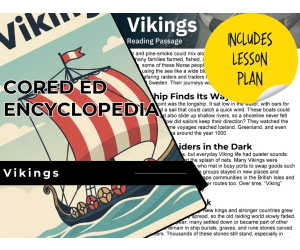
Vikings Reading Comprehension Passage - Cored Ed Encyclopedia
ELA, Language Development, Reading Comprehension, Reading, Pre-Reading, History, Social Studies, History: Europe, History: British, Vocabulary, Grade 2, 3, 4, 5, Worksheets & Printables, Worksheets, Teacher Tools, Centers, Activities, Writing Prompts, Assessments, Quizzes and Tests, Quizzes, Lesson Plans
This Vikings reading comprehension with lesson plan includes: Visualization (on the front cover) Start your lesson by taking a minute to think and share something about the topic. Read the script aloud (slowly), perhaps prepare some music or sound effects. Student close their eyes and let their imaginations wander. Students open their eyes, read the question aloud and give them a few minutes to complete. Ask a few students to share or keep answers until the end to compare with what they learn in the passage. Quick pause—thousands of Cored Education products are included with your TeachSimple membership. Download links and encyclopedia index available here. Pre-Reading Trivia Students will write down one thing they already know about the subject and then read five more facts and discuss. These facts are fun, and the students will enjoy learning about the subject before reading more. Give 1 minute for students to write what they already know (no pressure—best guess is fine). Read the five facts together. After each fact, do ask a student for their opinion, was it surprising? Set a purpose by asking students to highlight/underline one fact they want to learn more about during the reading. Reading Passage The text is a high-interest reading passage with set paragraphs, roughly three to four paragraphs long. It contains a variety of themes about the topic, anywhere from history to technology. The passage is between 250 and 350 words in length. First, ask students to look at the headings and see what they’ll learn about today. What do they know about the topic/heading? First read options: Teacher read-aloud (best for support). Partner reading (paragraph by paragraph). While reading, students underline important details, and vocabulary words they think may come up in the questions section. Mixed Questions The first question page contains four multiple-choice questions, each with a choice of four answers, and three written response questions that require a sentence or two from the student. Students complete the mcqs first independently, then review quickly as a class. For the 3 written responses, try to get students giving the answer with some form of evidence: “I think ___ because the text says ___.” If students get stuck, send them back to check the passage. Vocabulary Questions Practice seven key words from the text in this section across two activities. First section is scrambled words where students will unscramble three words given a clue for each. The second section is a word to meaning matching activity. Before starting, have some students read out words they underlined in the passage. Ask students to say the word and read aloud the sentence(s) around each word. Ask students to do scrambled words and the matching exercise in pairs then go through answers as a class. For the scrambled spelling task, get four pairs to come up to the board and write the words for extra practice with the other student reading out the clue. For the matching task, prompt students to give full sentences: “I matched ___ with ___ because ___.” Creative Writing In this question, the student will be required to write a five to eight sentence paragraph on a question related to the topic. Before starting, ask students write down 3 key ideas they are going to include in their piece. Ask students for ideas to share around the class to help those struggling. Pro writing expectations: 5–8 sentences At least 2 facts or details from the passage At least 2 vocabulary words from the previous page Students read their paragraphs while classmates listen for facts and vocabulary words. Extension Activities This page is optional for fast finishers or to take home. There are several activities, each one requiring a different skill. Do some, do none, do all, completely optional - but you will feel reassured knowing every possibility is planned for. Includes summary writting question. Answer Key There are answers for the multiple-choice questions, written response questions have sample answers, vocabulary answers and if there is a summary question then a sample summary will be provided as well. Lesson Plan Included Customized lesson plan for this lesson is included. Lesson Snapshot Title: Vikings Genre: Nonfiction (Informational text) Subject: Social Studies (History/Culture) Primary Topic: Viking travel, daily life, and lasting clues Estimated Guided Reading Level (A–Z): Q Support pages included: Visualization prompt, pre-reading trivia, mixed questions, vocabulary activities, creative writing, extension activities, and an answer key. QA check on support pages: The questions/vocabulary generally match the passage; the visualization prompt includes extra sensory details (e.g., “carved dragons,” a “small market”) that are not stated in the reading passage. What This Lesson Teaches Best Geography and origins of Viking-age people: Describes rocky coasts of Scandinavia and connects Vikings to places now Denmark, Norway, and Sweden. Why longships mattered for travel: Explains how longships used oars and a sail, crossed open seas, and moved up shallow rivers. Navigation using nature: States that sailors watched the Sun and stars to keep direction. A fuller view of Viking life: Notes that Vikings farmed, crafted, and traded goods (furs, metalwork, silver), and some blended with local people and helped shape communities. How history leaves evidence: Identifies lasting clues such as ship burials, graves, rune stones, and written sagas. Learning Goals Students will describe where Vikings lived and what the passage says the coasts were like. Students will explain how the longship’s design helped Vikings travel to many places. Students will identify how Viking sailors kept direction while traveling. Students will summarize everyday Viking jobs and trade goods named in the text. Students will list evidence the passage says still helps us learn about Vikings today. Key Vocabulary From the Text Scandinavia — a northern European region where many Vikings lived. Norse — people from Scandinavia in the passage. longship — a Viking boat with oars and a sail. Christianity — a religion that spread as times changed. sagas — stories written down from spoken memories. Discussion Prompts Pre-reading question: What details in the passage describe the coasts of Scandinavia? Comprehension questions: When did some Norse people begin traveling farther than neighbors expected? Comprehension questions: How did the longship help Vikings cross seas and travel up rivers? Comprehension questions: What clues does the passage say still remain today to help us learn about Vikings? FULL CATALOG OF DOWNLOAD LINKS AND ENCYCLOPEDIA INDEX HERE
Author Cored Education
Rating
Tags Vocabulary, Reading Comprehension, Reading Passages, Lesson Plans, Ela Lesson Plans, Reading Comprehension Lesson Plans, Pre-reading, History Lesson Plans, European History, British History

The Snow Queen Lapbook Project Reading & Writing Grades 3 4 5 ELA
Language Development, ELA, ESL, Children’s Literature, Literature, Literary Devices, Reading Comprehension, Reading, Strategies, Grade 3, 4, 5, Centers, Activities, Crafts, Projects, Assessments, Teacher Tools, Graphic Organizers, Templates
Experience the captivating tale of The Snow Queenthrough this The Snow QueenLapbook Project designed for Grades 3, 4, and 5 students, homeschoolers and EFL/ESL learners. This meaningful resource is created for reading classes, reading centers, fairy tale units, reading comprehension projects, and so much more! Contents: •3 The Snow QueenLapbook Differentiated Reading Passages (Easy, Average, Hard) •6 The Snow QueenLapbook Unique Cover Options •2 The Snow QueenLapbook Name Page Versions (for individual or group projects) •1 The Snow QueenLapbook Lapbook Center Flap •3 The Snow QueenLapbook Story Summary Pages •2 The Snow QueenLapbook Theme & Lesson Pages •2 The Snow QueenLapbook Sequence Pockets •6 The Snow QueenLapbook Visual Event Cards •3 The Snow QueenLapbook Sequencing Sets (Easy, Medium, Hard – 6 cards each) •6 The Snow QueenLapbook Retell Cards •1 The Snow QueenLapbook Character Analysis Fold •1 The Snow QueenLapbook Setting Foldable •1 The Snow QueenLapbook Elements of Story Fold •1 The Snow QueenLapbook Story Reflection Page •1 The Snow QueenLapbook Personal Connection Fold
Author It's Teacher L
Rating
Tags The Snow Queen, Fairy Tale, Reading Centers, Reading Comprehension, ELA Projects
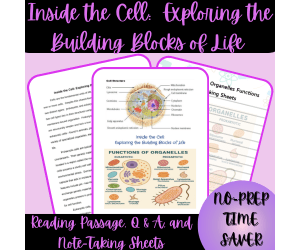
HIgh School Cell Structure & Organelles Functions Reading Passage
ELA, Reading, Writing, Research, Resources for Teachers, Science, Life Sciences, Biology, High School, Homeschool Resources, Teacher Tools, Lesson Plans, Assessments, Quizzes and Tests, Worksheets & Printables, Writing Prompts
This Inside the Cell: Exploring the Building Blocks of Life Reading Passage, Q & A, and Note-Taking Sheets resource is a thoughtfully designed resource created to help students/homeschoolers truly understand the fascinating world of cells. As a homeschool mom guiding my own ninth grader, I know how challenging it can be to find materials that are both engaging and thorough. This Inside the Cell: Exploring the Building Blocks of Life Reading Passage, Q & A, and Note-Taking Sheets resource brings together a detailed reading passage, critical thinking Q & A, and five versatile note-taking sheets to support deep comprehension. Whether you are teaching in a classroom or around the kitchen table, this set will help your learners grasp the essential differences between eukaryotic and prokaryotic cells and the remarkable functions of their organelles. INCLUDED IN THIS RESOURCE: Comprehensive reading passage on cell structure and organelle function 20 higher-order, research-based Q & A prompts Guided answer key for all questions Five note-taking sheets TOPICS COVERED: Differences between prokaryotic and eukaryotic cells Structure and function of major cell organelles Specialized features of plant and animal cells Cellular adaptations and ecological roles This Inside the Cell: Exploring the Building Blocks of Life Reading Passage, Q & A, and Note-Taking Sheets resource is a complete package for teaching and learning about the building blocks of life. It is designed to inspire curiosity, build confidence, and equip students/homeschoolers with the knowledge and skills they need to succeed in biology. As a mom and homeschool educator, I believe this resource will make your science lessons more meaningful and enjoyable for everyone involved. If you and your students/homeschoolers enjoyed this resource, please leave a review. Thank you for your support! Tina - Big Easy Homeschooling Mom
Author Homeschool with Big Easy Homeschooling Mom
Rating
Tags Cell Structure And Function Reading Passage, Eukaryotic And Prokaryotic Cell Comparison, Homeschool Cell Biology Resource, Homeschool Biology, High School Biology, Comprehensive Cell Biology Lesson, Cell Structure And Organelle Teaching Materials, Homeschool Science, High School Science, Eukaryotic And Prokaryotic Cells

READING-COMPREHENSION PACK | Artificial Intelligence | 20 PAGES
Reading, ELA, Writing, Technology, Science, Early Learning, Adult Education, High School, Homeschool Resources, Middle School, Not Grade Specific, Anchor Charts, Teacher Tools, Assessments, Charts, Quizzes and Tests
READING-COMPREHENSION PACK | Artificial Intelligence | 20 PAGES SUMMARY OF THIS PRODUCT: What is the name of the document?: READING-COMPREHENSION PACK | Artificial Intelligence How many pages does it include?: 20 In what format is it available (PDF, Word, PPT)?: PDF Is it in color or black and white?: COLOR ABOUT THE AUTHOR: At EDITORIAL ARENAS EDUCATIVAS, we believe that learning should be as fun as playing. That’s why we create educational materials that spark children’s curiosity and creativity. I invite you to check out my educational store and discover the wide range of resources that can transform your classes. MAIN DESCRIPTION: What is the name of the product? Hello! Thank you so much for being interested in this beautiful and fabulous product that you can use with your children, both at school and at home. The name of this fabulous product is: READING-COMPREHENSION PACK | Artificial Intelligence How many pages does it include? This educational document, carefully created and in some cases compiled, has the following number of pages: 20 What format is it in (A4, letter, digital, printable)? This educational resource is designed in A4 format and PDF, so you will have no difficulties printing it and it will also stay well-protected. PDF A4 Is it in black and white or in color? This document is available in black and white as well as in color. Actually, it combines both, making it more attractive for your students. COLOR SECONDARY AND COMPLEMENTARY INFORMATION: For what age, grade, or school level is it ideal? I usually create resources for early grades (children ages 3–5), but I also design for primary students (ages 7–12). My priority is to make children’s learning creative. What learning area does it focus on? This and all my resources focus on children’s essential learning, such as math and literacy. Occasionally, I also create resources for Spanish. What will students learn or practice with it? With this educational resource, children will be able to practice basic skills in math and literacy. Teachers can also adapt it to other learning areas, since learning is multidisciplinary. Who will benefit the most from this resource (teachers, families, students, therapists)? I strongly believe education involves many people—teachers, parents, and even therapists. That’s why this resource is open to anyone involved in the learning process.
Author EDITORIAL LAURA EDUCA
Rating
Tags FREE, FREE RESOURCES, READING, TECHONOLGY, ARTIFICIAL INTELLIGENCE, READING AND COMPREHENSION, COMPREHENSION

Yoga Reading Comprehension Passage - Cored Ed Encyclopedia
ELA, Language Development, Reading Comprehension, Reading, History, Social Studies, Pre-Reading, P.E. & Health, Yoga, Geography, Grade 2, 3, 4, 5, Worksheets & Printables, Worksheets, Teacher Tools, Centers, Activities, Writing Prompts, Assessments, Quizzes and Tests, Quizzes, Lesson Plans
This yoga reading comprehension with lesson plan includes: Visualization (on the front cover) Start your lesson by taking a minute to think and share something about the topic. Read the script aloud (slowly), perhaps prepare some music or sound effects. Student close their eyes and let their imaginations wander. Students open their eyes, read the question aloud and give them a few minutes to complete. Ask a few students to share or keep answers until the end to compare with what they learn in the passage. Quick pause—thousands of Cored Education products are included with your TeachSimple membership. Download links and encyclopedia index available here. Pre-Reading Trivia Students will write down one thing they already know about the subject and then read five more facts and discuss. These facts are fun, and the students will enjoy learning about the subject before reading more. Give 1 minute for students to write what they already know (no pressure—best guess is fine). Read the five facts together. After each fact, do ask a student for their opinion, was it surprising? Set a purpose by asking students to highlight/underline one fact they want to learn more about during the reading. Reading Passage The text is a high-interest reading passage with set paragraphs, roughly three to four paragraphs long. It contains a variety of themes about the topic, anywhere from history to technology. The passage is between 250 and 350 words in length. First, ask students to look at the headings and see what they’ll learn about today. What do they know about the topic/heading? First read options: Teacher read-aloud (best for support). Partner reading (paragraph by paragraph). While reading, students underline important details, and vocabulary words they think may come up in the questions section. Mixed Questions The first question page contains four multiple-choice questions, each with a choice of four answers, and three written response questions that require a sentence or two from the student. Students complete the mcqs first independently, then review quickly as a class. For the 3 written responses, try to get students giving the answer with some form of evidence: “I think ___ because the text says ___.” If students get stuck, send them back to check the passage. Vocabulary Questions Practice seven key words from the text in this section across two activities. First section is scrambled words where students will unscramble three words given a clue for each. The second section is a word to meaning matching activity. Before starting, have some students read out words they underlined in the passage. Ask students to say the word and read aloud the sentence(s) around each word. Ask students to do scrambled words and the matching exercise in pairs then go through answers as a class. For the scrambled spelling task, get four pairs to come up to the board and write the words for extra practice with the other student reading out the clue. For the matching task, prompt students to give full sentences: “I matched ___ with ___ because ___.” Creative Writing In this question, the student will be required to write a five to eight sentence paragraph on a question related to the topic. Before starting, ask students write down 3 key ideas they are going to include in their piece. Ask students for ideas to share around the class to help those struggling. Pro writing expectations: 5–8 sentences At least 2 facts or details from the passage At least 2 vocabulary words from the previous page Students read their paragraphs while classmates listen for facts and vocabulary words. Extension Activities This page is optional for fast finishers or to take home. There are several activities, each one requiring a different skill. Do some, do none, do all, completely optional - but you will feel reassured knowing every possibility is planned for. Includes summary writting question. Answer Key There are answers for the multiple-choice questions, written response questions have sample answers, vocabulary answers and if there is a summary question then a sample summary will be provided as well. Lesson Plan Included Customized lesson plan for this lesson is included. Lesson Snapshot Title: Yoga Genre: Nonfiction (informational text) Subject: Social Studies & Health/SEL (culture and well-being) / Informational Reading Primary Topic: Yoga’s origins, key ideas, and modern practice Estimated Guided Reading Level (A–Z): Q Support pages present: pre-reading trivia, mixed questions, vocabulary activities, creative writing, extension activities, and an answer key. What This Lesson Teaches Best Explains yoga as an old practice that began in India and grew over time. Defines what the word “yoga” can mean in the passage (“yoke” or “union,” like two things working as one). Describes key tools in yoga: body positions, steady breathing, and quiet attention (and how breathing can steady the mind). Introduces “sutras” and explains that Patanjali gathered yoga ideas into short lines meant to be remembered, including a description of yoga as a path with eight “limbs.” Traces how yoga changed in the 1900s, noting that teachers such as Tirumalai Krishnamacharya helped create modern postural yoga with flowing sequences taught in classes. Learning Goals Students will describe what the passage says the word “yoga” can mean. Students will identify tools the passage says yoga uses (body positions, steady breathing, quiet attention). Students will explain why careful breathing matters in some yoga traditions, using details from the text. Students will describe what sutras are and why they were written, according to the passage. Students will summarize how yoga changed in the 1900s based on the passage’s timeline. Key Vocabulary From the Text Sanskrit — a very old language from India. traditions — ways people practice and pass ideas over time. sutras — short lines of teaching meant to be remembered. meditation — a quiet practice to help the mind rest. asana — a steady seat for meditation, not a gym pose. FULL CATALOG OF DOWNLOAD LINKS AND ENCYCLOPEDIA INDEX HERE
Author Cored Education
Rating
Tags Vocabulary, Reading Comprehension, Reading Passages, Lesson Plans, Ela Lesson Plans, Reading Comprehension Lesson Plans, Pre-reading, Social Studies Lesson Plans, Yoga, History
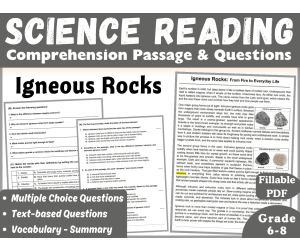
Earth Science Reading Passage: Igneous Rocks (Fillable PDF)
Science, ELA, Reading, Reading Comprehension, Strategies, Resources for Teachers, Earth and Environmental Sciences, Earth Sciences, Grade 6, 7, 8, 9, Writing Prompts, Worksheets & Printables, Centers, Activities, Teacher Tools, Assessments, Quizzes and Tests, Quizzes, Tests
Science Reading Comprehension Passages and Questions: Igneous Rocks (Fillable PDF) This very engaging earth science reading passage about Igneous Rocks is designed to bridge the gap between science and literacy through strengthening reading comprehension and sparking scientific curiosity in middle school students. The passage blends English Language Arts skills with accurate science content that supports NGSS classroom practice. Ideal for interdisciplinary learning in ELA and Science. Suitable for Grade 9 review, too! These worksheets are designed as fillable PDFs , which means students can type their answers directly into the document on any computer or tablet . Each page includes highlighted text fields that show them exactly where to type! Student Tasks for The Passage: 5 multiple-choice questions targeting main idea, key details, inference, vocabulary in context, and use of evidence 5 vocabulary matching items with clear, student-friendly definitions 5 text-based questions that require citing specific lines or facts 1 summary prompt that asks students to condense central ideas accurately Full answer key for every section Available Formats for this Resource PDF Word Docs Google Docs FULL CATALOG OF DOWNLOADING LINKS HERE Product Details Length: 4 pages total Grades: 6–8, also suitable for Grade 9 review Use cases: close reading, stations, homework, intervention, test prep, and sub plans Standards support: reinforces informational-text skills and supports NGSS-style sense making through observation, modeling, and clear use of claim, evidence, and reasoning Why Teachers Choose This Set Authentic science content paired with rigorous literacy practice Consistent task structure across all passages for easier planning and smoother student routines Clear, age-appropriate writing that builds confidence without oversimplifying Other Science Reading Collections you May find in the store: 1. Astronomy & Space Science 2. Volcanoes, Rocks, & Mountains 3. Rock Cycle, Soil, & Sinkholes 4. Mars, Glaciers, & Antarctica 5. Water Cycle, Acid Rain, & Wastewater 6. Insects, Animals, & Ecosystems 7. Bioluminescence & Insects 8. Animal Skin, Cats, & T. Rex 9. Human Body and Senses 10. Health & Applied Bioscience 11. Waves, Light, & Imaging 12. Electricity & Energy 13. Motion & Materials 14. Chemistry and Materials Science Use this set to reinforce ELA skills in science, to add literacy to your lessons, and to support independent work. The passages strengthen main idea, evidence use, vocabulary in context, inference, cause and effect, and summary writing. With ready-to-use assessments and complete answer keys, you can provide focused practice that is simple to run and fast to review.
Author Middle & High School - CORED Education
Rating
Tags Middle School, Reading Comprehension, Reading Strategies, ELA, Centers, Reading Passage, Assessments, Vocabulary, Environmental Science, Earth Science
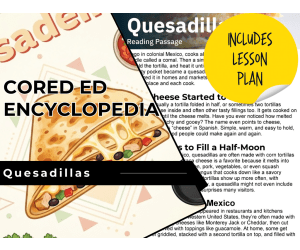
Quesadillas Reading Comprehension Passage - Cored Ed Encyclopedia
ELA, Language Development, Reading Comprehension, Reading, Pre-Reading, Social Studies, Writing, Strategies, Geography, Vocabulary, Grade 2, 3, 4, 5, Worksheets & Printables, Worksheets, Teacher Tools, Centers, Activities, Writing Prompts, Assessments, Quizzes and Tests, Quizzes, Lesson Plans
This quesadillas reading comprehension includes: Visualization (on the front cover) Start your lesson by taking a minute to think and share something about the topic. Read the script aloud (slowly), perhaps prepare some music or sound effects. Student close their eyes and let their imaginations wander. Students open their eyes, read the question aloud and give them a few minutes to complete. Ask a few students to share or keep answers until the end to compare with what they learn in the passage. Quick pause—thousands of Cored Education products are included with your TeachSimple membership. Download links and encyclopedia index available here. Pre-Reading Trivia Students will write down one thing they already know about the subject and then read five more facts and discuss. These facts are fun, and the students will enjoy learning about the subject before reading more. Give 1 minute for students to write what they already know (no pressure—best guess is fine). Read the five facts together. After each fact, do ask a student for their opinion, was it surprising? Set a purpose by asking students to highlight/underline one fact they want to learn more about during the reading. Reading Passage The text is a high-interest reading passage with set paragraphs, roughly three to four paragraphs long. It contains a variety of themes about the topic, anywhere from history to technology. The passage is between 250 and 350 words in length. First, ask students to look at the headings and see what they’ll learn about today. What do they know about the topic/heading? First read options: Teacher read-aloud (best for support). Partner reading (paragraph by paragraph). While reading, students underline important details, and vocabulary words they think may come up in the questions section. Mixed Questions The first question page contains four multiple-choice questions, each with a choice of four answers, and three written response questions that require a sentence or two from the student. Students complete the mcqs first independently, then review quickly as a class. For the 3 written responses, try to get students giving the answer with some form of evidence: “I think ___ because the text says ___.” If students get stuck, send them back to check the passage. Vocabulary Questions Practice seven key words from the text in this section across two activities. First section is scrambled words where students will unscramble three words given a clue for each. The second section is a word to meaning matching activity. Before starting, have some students read out words they underlined in the passage. Ask students to say the word and read aloud the sentence(s) around each word. Ask students to do scrambled words and the matching exercise in pairs then go through answers as a class. For the scrambled spelling task, get four pairs to come up to the board and write the words for extra practice with the other student reading out the clue. For the matching task, prompt students to give full sentences: “I matched ___ with ___ because ___.” Creative Writing In this question, the student will be required to write a five to eight sentence paragraph on a question related to the topic. Before starting, ask students write down 3 key ideas they are going to include in their piece. Ask students for ideas to share around the class to help those struggling. Pro writing expectations: 5–8 sentences At least 2 facts or details from the passage At least 2 vocabulary words from the previous page Students read their paragraphs while classmates listen for facts and vocabulary words. Extension Activities This page is optional for fast finishers or to take home. There are several activities, each one requiring a different skill. Do some, do none, do all, completely optional - but you will feel reassured knowing every possibility is planned for. Includes summary writting question. Answer Key There are answers for the multiple-choice questions, written response questions have sample answers, vocabulary answers and if there is a summary question then a sample summary will be provided as well. Lesson Plan Included Customized lesson plan for this lesson is included. Lesson Snapshot Title: Quesadillas Genre: Nonfiction (informational passage with support pages) Subject: Reading (Informational Text) / Social Studies (Culture & Food Traditions) Primary Topic: How quesadillas began and changed by place Estimated Guided Reading Level (A–Z): Q What This Lesson Teaches Best How foods and traditions change as people share them in different places (homes, markets, restaurants, and around the world). Comparing regional variations (corn vs. flour tortillas; different cheeses and fillings in different parts of Mexico and the U.S.). Building vocabulary and background knowledge about cooking tools and ingredients (comal, Oaxaca cheese, huitlacoche, guacamole). Identifying main ideas and key details across sections with headings (history/origin, filling choices, spreading beyond Mexico). Learning Goals Students can explain how the passage says a quesadilla is made (tortilla, filling, folded, heated). Students can describe how quesadillas changed in different places using details from the text. Students can compare quesadillas in different regions mentioned (central/southern Mexico, northern Mexico, Mexico City, Southwestern United States). Students can identify the main idea of each section heading and support it with one detail. Students can use key vocabulary from the passage when discussing the topic. Key Vocabulary From the Text colonial — from the time when a country was ruled by another comal — a flat griddle for heating and cooking tortillas Oaxaca — a place in Mexico named in the passage huitlacoche — a corn fungus used as a savory filling guacamole — a topping served with some quesadillas Discussion Prompts Pre-reading question: What foods have you seen change in different places or families? Comprehension questions: According to the passage, what is a quesadilla and how is it cooked? Comprehension questions: What are two different fillings or cheeses the passage says people use? Comprehension questions: How does the passage explain quesadillas changing as they spread beyond Mexico? FULL CATALOG OF DOWNLOAD LINKS AND ENCYCLOPEDIA INDEX HERE
Author Cored Education
Rating
Tags Vocabulary, Reading Comprehension, Reading Passages, Reading, Creative Writing, Reading Strategies, Writing Prompts, Lesson Plans, Quesadillas, Social Studies

6th Grade Math Assessment | Beginning of Year Diagnostic
Math, Grade 6, Assessments, Teacher Tools, Worksheets & Printables
Start sixth grade with clearer data and a focused instructional plan using this Grade 6 beginning of year math assessment . This visual sixth grade math diagnostic helps identify strengths, skill gaps, and readiness across 13 essential math strands—then connects results directly to targeted follow-up practice. With 45 questions , teacher scoring and analysis tools, and skill-specific reteaching pages, this resource creates a practical assess → analyze → group → reteach system for the beginning of the school year. What’s Included This sixth grade math assessment bundle provides a complete beginning-of-year diagnostic system: ✅ 45-question Student Math Assessment ✅ 13 essential math skill strands ✅ Clear, visual student-friendly layout ✅ Complete answer key for all 45 questions ✅ Teacher “what to look for” notes ✅ Common-error and misconception guidance ✅ 45-point scoring system ✅ Secure, Developing, and Emerging score bands ✅ One-page quick-grading answer grid ✅ Step-by-step administration guide ✅ Individual student scoring sheet ✅ Whole-class tracking grid ✅ Small-group planning guidance ✅ Standards alignment ✅ Reteaching roadmap ✅ 13 targeted follow-up practice pages ✅ Fresh practice problems different from assessment items ✅ Teacher answer strip for every practice page The answer key includes correct responses plus short teacher notes that help explain common errors and turn student responses into useful instructional information. How It Works in the Classroom Use this Grade 6 beginning of year math assessment during the first week or two of school to see which foundational skills students bring into sixth grade. There is no time limit, and the assessment can be split into two shorter sittings. A suggested break point comes after Decimal Operations, Question 21, so students can return with fresh attention for volume, coordinate plane, measurement, data, geometry, patterns, and multi-step problems. Use this resource for: ⭐ Beginning-of-year math assessment ⭐ Back-to-school math diagnostic ⭐ Sixth grade math pre-assessment ⭐ Fifth-grade skills review ⭐ Middle school math readiness ⭐ Small-group planning ⭐ Math intervention ⭐ Skill-based differentiation ⭐ Targeted reteaching ⭐ Independent follow-up practice After scoring, transfer results to the individual student scoring sheet and whole-class tracking grid. The whole-class chart on page 4 visually displays all 13 strands side by side, making class-wide strengths, shared gaps, and potential small groups easier to identify at a glance. Then print only the follow-up practice pages each student or group needs. Part 4 includes one focused worksheet for every assessed strand, with fresh problems that differ from the original assessment items. Standards & Learning Goals This sixth grade math diagnostic assessment checks readiness across 13 essential strands: 🔢 Place value and decimals ✖️➗ Multi-digit operations 🧮 Numerical expressions and exponents 🍕 Fractions ✖️➗ Fraction operations 🔟 Decimal operations 🧊 Volume 📍 Coordinate plane 📏 Measurement conversions 📊 Data and statistics 📐 Geometry 🔁 Patterns and function tables 🧠 Multi-step problem solving Students work with decimal place value to the thousandths, expanded form, rounding and comparing decimals, multi-digit multiplication and division, order of operations, exponents, variables, algebraic expressions, simplifying and ordering fractions, fraction-decimal conversions, multiplying and dividing fractions, decimal operations, rectangular prism volume, ordered pairs, quadrants, coordinate distance, metric and customary conversions, mean, median, mode, range, dot plots, triangle and parallelogram area, patterns, function tables, and multi-step reasoning. The included standards and reteaching map connects strands to illustrative Common Core references, including: 5.NBT.A.3 6.NS.A.1 6.NS.B.2–3 6.NS.C.6 6.NS.C.8 6.EE.A.1–2 6.EE.B 6.EE.C.9 6.RP.A.3 6.RP.A.3d 6.G.A.1–2 6.SP.B.5 5.NF.A 5.MD.A.1 5.MD.C.5 5.OA.B.3 The standards map also points each assessed strand to its matching Part 4 practice page, helping teachers move directly from assessment results to targeted reteaching. Why Teachers Love It ✨ See more than a total score. Results are broken down by skill strand for clearer instructional decisions. ✨ Save valuable planning time. The answer key, quick-grading grid, individual scoring sheet, and class tracker streamline the assessment process. ✨ Build purposeful small groups. Group students by shared skill needs instead of relying only on overall scores. ✨ Spot important misconceptions. Teacher notes help identify decimal place-value confusion, dropped zeros in division quotients, base-times-exponent errors, reversed “less than” expressions, misplaced decimal points, and coordinate-order mistakes. ✨ Preview algebra readiness. Students evaluate powers, use order of operations, substitute values into expressions, and translate verbal phrases into algebraic expressions. ✨ Check fraction and decimal operation readiness. Students simplify, compare, convert, multiply, and divide fractions while also adding, subtracting, multiplying, and dividing decimals. ✨ Assess coordinate plane understanding. Students name ordered pairs, identify quadrants, plot points, and determine distances along horizontal and vertical lines. ✨ Differentiate without searching for extra worksheets. Print only the specific follow-up page each student or group needs. ✨ Turn assessment data into flexible groups. The teacher tools recommend grouping by shared strand need rather than total score and rechecking skills after targeted practice. ✨ Move directly from assessment to reteaching. Practice pages cover decimals, multi-digit operations, expressions and exponents, fractions, fraction operations, decimal operations, volume, coordinate plane, measurement, statistics, geometry, patterns, function tables, and multi-step problems. Start the year knowing what your students understand and what they need next. Download this Grade 6 beginning of year math assessment to assess readiness, identify learning gaps, form targeted small groups, and provide focused follow-up practice from one coordinated resource. Perfect for teachers searching for a sixth grade math pre-assessment , back-to-school math diagnostic, Grade 6 readiness assessment, fifth-grade skills review, middle school math diagnostic, math intervention tool, or beginning-of-year math assessment with built-in scoring and reteaching support.
Author Bright Classroom Ideas Marketplace
Rating
Tags Math, Practice, Assessment, Diagnostic, Back-to-school

Science Reading Passages on Plant Parts and Ecosystems (PPT)
Science, Life Sciences, Biology, Common Core, ELA, Reading Comprehension, Reading, Animals, Human Body, Grade 5, 6, 7, Teacher Tools, Presentations, Assessments, Quizzes, Quizzes and Tests
Reading Passages on Plant Parts & Ecosystems for Life Science Make science come alive with this engaging collection of reading passages focused on plant parts, ecosystems, and the world of life science! Each passage is written to spark curiosity while helping students build a deeper understanding of how living things grow, survive, and interact with their environment. Whether you're prepping for assessments or just looking to weave more science into your literacy block, this resource has you covered. Aligned with CCSS, it's a time-saver for teachers and a confidence booster for students—turning science lessons into meaningful learning moments. What's inside? Plant Parts & Ecosystems Reading Passage1: Classification of Organisms Reading Passage2: Function of Plant Parts Reading Passage3: Reproduction in Plants Reading Passage4: Invertebrates Reading Passage 5: Vertebrates Reading Passage6: Earth's Biomes Reading Passage7: Ecosystems PPT Version: This is the PPT version. It includes editable slides, boxes are fillable (when not in full screen mode). If you are looking for fillable resources, it may be better to look at the Google Drive version of this product. 268 Slides Science Reading Comprehension Outline: Introducing a comprehensive resource tailored for 5th and 6th graders, this product offers enriching reading passages supplemented with illustrative pictures and graphs to clarify key concepts. Aligned with the Common Core State Standards (CCSS), it offers a hassle-free approach to teaching, given that the bulk of the preparation is already done for you. The passages present a diverse set of questions – from multiple choice to data analysis and fill-in-the-blanks. This ensures a rich blend of high-interest content and fundamental curriculum-based science themes. With its versatility, you can seamlessly integrate these lessons into various classroom settings, whether it's whole class discussions, morning exercises, independent desk tasks, small group engagements, contingency plans for substitute teachers, regular homework assignments, or even themed activities for holidays. FULL CATALOG OF DOWNLOAD LINKS HERE Grade 5/6 Links: Physical Science Part 1 - Physical and Chemical Properties Google Docs/Slides/Forms PDF PPT Word Free Supplementary Pack Accompanying Videos Physical Science Part 2 - Motion and Energy Google Docs/Slides/Forms PDF PPT Word Free Supplementary Pack Accompanying Videos Physical Science Part 3 - Electricity and Magnets Google Docs/Slides/Forms PDF PPT Word Free Supplementary Pack Accompanying Videos Life Science Part 1 - Cells, Reproduction and Genetics Google Docs/Slides/Forms PDF PPT Word Free Supplementary Pack Accompanying Videos Life Science Part 2 - Human Body Systems Google Docs/Slides/Forms PDF PPT Word Free Supplementary Pack Accompanying Videos Life Science Part 3 - Plant Parts and Ecosystems Google Docs/Slides/Forms PDF PPT Word Free Supplementary Pack Accompanying Videos Earth Science Part 1 - Plate Tectonics and Rock Cycle Google Docs/Slides/Forms PDF PPT Word Free Supplementary Pack Accompanying Videos Earth Science Part 2 - Ocean Exploration and Natural Resources Google Docs/Slides/Forms PDF PPT Word Free Supplementary Pack Accompanying Videos Earth Science Part 3 - Weather and Solar System Google Docs/Slides/Forms PDF PPT Word Free Supplementary Pack Accompanying Videos For similar products and other frees, do check out Cored Group on TeachSimple .
Author Cored Education
Rating
Tags Science, Elementary, Reading, Comprehension, Vocabulary, Answers, Reading Comprehension Presentations, Biology, Life Science, Biology Presentations

7th Grade Science Diagnostic Assessment & Review System
Science, Grade 7, Assessments, Teacher Tools, Lesson Plans, Worksheets & Printables
Start the year with a clear picture of student readiness using this 7th grade beginning of year science assessment and targeted skills system. With a 50-question diagnostic worth 114 points , scoring and analysis tools, instructional grouping support, 11 targeted follow-up practice pages , scientific reading passages, CER tasks, and complete explained answer keys, this resource helps teachers move from assessment results to focused instruction. Designed as a complete Assess → Analyze → Group → Review → Reteach system, this Grade 7 science resource measures both content knowledge and students’ ability to reason with evidence . Students analyze scientific models, data tables, multi-series graphs, short science texts, experimental scenarios, and Claim-Evidence-Reasoning tasks across Life Science, Physical Science, Earth Science, and Scientific Practices & Reading . What’s Included This 7th grade science assessment and review system includes: ✅ 50-question beginning-of-year science diagnostic ✅ 114 total assessment points ✅ Life Science questions ✅ Physical Science questions ✅ Earth Science questions ✅ Scientific Practices & Reading questions ✅ Multiple-choice questions ✅ Short-answer questions ✅ Labeling activities ✅ Matching questions ✅ Diagram and model interpretation ✅ Data tables ✅ Graph reading ✅ Multi-series graph analysis ✅ Scientific scenarios ✅ Vocabulary-in-context questions ✅ Claim-Evidence-Reasoning (CER) tasks ✅ 2 short scientific reading passages ✅ 5 evidence-based reading questions ✅ Photosynthesis model ✅ Cellular respiration model ✅ DNA and gene hierarchy ✅ Punnett square practice ✅ Genetics and heredity analysis ✅ Ecosystem data interpretation ✅ Chemical reaction model ✅ Conservation of mass ✅ Heat transfer diagrams ✅ Velocity-time graph analysis ✅ Earth systems and natural resources ✅ Experimental design and variables ✅ Mean and repeated-trial analysis ✅ Answer recording sheet ✅ Quick-reference answer key ✅ Skill-by-skill scoring chart ✅ Strand analysis tool ✅ Secure, Developing, and Needs Support performance bands ✅ Individual Student Performance Profile ✅ Whole-class data tracker ✅ Suggested instructional groups ✅ Group planning sheet ✅ 11 targeted follow-up science practice pages ✅ “Key Concept” refresher on every follow-up page ✅ “Extension” task for students who are Secure ✅ All-new follow-up practice with no repeated assessment questions ✅ Reading-for-evidence follow-up practice ✅ CER writing follow-up practice ✅ Complete answer keys ✅ Suggested short-answer responses ✅ Suggested reading-response answers ✅ Completed visual and diagram answers ✅ Sample CER responses ✅ Short “why” explanation for every assessment item ✅ Partial-credit guidance ✅ CER scoring guidance Part 1 contains 50 mixed-format questions worth 114 total points . The Teacher Guide recommends two 45-minute sessions and explains that the diagnostic measures both retained science knowledge and students’ ability to reason with evidence. The At-a-Glance chart on page 2 identifies four reporting areas: Life Science, Physical Science, Earth Science, and Scientific Practices & Reading . Part 2 turns student responses into actionable data with an answer recording sheet, quick-reference key, skill-by-skill scoring chart, strand analysis, performance bands, student profiles, a class data tracker, suggested instructional groups, and group planning support. Part 3 includes 11 ready-to-assign targeted follow-up pages with all-new practice. Every page includes a concise Key Concept refresher and an Extension task, and the set includes dedicated pages for both Reading Science for Evidence and CER Writing . Part 4 provides correct answers for all 50 questions, explanations of why answers are correct, suggested responses for short-answer and reading items, completed diagrams, sample CER responses, and partial-credit guidance. How It Works in the Classroom Use this 7th grade beginning of year science assessment during the first weeks of school to identify what students retained from earlier science learning, how well they interpret scientific information, and where instruction should begin. The resource follows a practical five-step system: 🔎 Assess — Students complete the 50-item mixed-format science diagnostic 📊 Analyze — Score by skill and strand to identify patterns and gaps 👥 Group — Form targeted instructional groups based on shared needs 📝 Review — Assign focused follow-up practice by strand or skill 🎯 Reteach — Use complete explanations, worked visuals, and model CER responses to support next steps The Assess → Reteach System chart on page 2 of Part 1 directly connects each stage to the matching component of the four-part resource. The same page shows the broad format range, strand organization, two scientific reading passages, and suggested two-session administration plan. Use this resource for: ⭐ Beginning-of-year science assessment ⭐ 7th grade science diagnostic ⭐ Middle school science pre-assessment ⭐ Back-to-school science review ⭐ Science readiness check ⭐ Formative assessment ⭐ Small-group planning ⭐ Science intervention ⭐ Targeted reteaching ⭐ Data-driven instruction ⭐ Skill-based grouping ⭐ Independent follow-up practice ⭐ Science stations ⭐ CER practice ⭐ Reading in science ⭐ Text-evidence practice ⭐ Graph and data interpretation ⭐ Middle school science reasoning The Scoring at a Glance chart on page 2 of Part 2 breaks the assessment into four totals: Life Science /41, Physical Science /31, Earth Science /20, and Scientific Practices /22 , for 114 total points . It also defines three performance bands: Secure (80%–100%) , Developing (50%–79%) , and Needs Support (below 50%) . The Student Performance Profile on page 15 of Part 2 provides a one-page strand snapshot with space for strengths, focus areas, assigned Part 3 practice pages, and group placement. The Class Data Tracker on page 16 gives teachers a whole-class view of strand percentages, while the Suggested Instructional Groups on page 17 connect shared student needs to specific follow-up practice. Standards & Learning Goals This seventh grade science diagnostic assessment reviews foundational science concepts, evidence-based reading, and scientific reasoning across four major areas: 🌱 Life Science — cell structure and function, photosynthesis, cellular respiration, matter cycling, traits, DNA and gene hierarchy, Punnett squares, dominant and recessive alleles, probability of traits, sexual reproduction, genetic ratios, ecosystem energy flow, organism roles, limiting factors, population data, and ecosystem CER reasoning ⚛️ Physical Science — atoms and elements, chemical reactions, conservation of mass, signs of chemical reactions, heat transfer, conduction, convection, radiation, thermal energy flow, forces and motion, velocity-time graphs, acceleration, force and mass relationships, and chemical-reaction CER reasoning 🌎 Earth Science — Earth’s four interacting systems, system components, system interactions, renewable and nonrenewable resources, energy-source graphs, human impact, sustainability, and resource-use CER reasoning 🔬 Scientific Practices & Reading — experimental design, independent and dependent variables, controlled variables, inference, repeated trials, averages, graph analysis, reading scientific texts for evidence, citing text details, interpreting passage data, drawing conclusions, and reading-based CER Students demonstrate understanding through varied science tasks rather than one question type. The assessment includes a photosynthesis diagram , cellular respiration diagram , DNA hierarchy , Bb × Bb Punnett square , genetics data, ecosystem population data, a chemical reaction model, sealed-container mass data, heat-transfer scenes, a velocity-time graph, Earth-system interactions, an energy-source graph, experimental variables, repeated-trial averages, and a two-series plant-growth graph. The Skill-by-Skill Scoring Chart on pages 11–13 of Part 2 helps teachers pinpoint specific gaps rather than relying only on one overall score. Skills include photosynthesis, respiration, DNA and genes, Punnett squares, heredity, ecosystem energy, chemical reactions, conservation of mass, heat transfer, forces, acceleration, Earth systems, natural resources, experimental design, variables, averages, graph analysis, reading for evidence, text evidence, passage-data interpretation, and reading-based CER. A particularly valuable feature is the integration of science literacy . Part 1 includes two short scientific texts— “The Hand-Washing Study” and “Coral Reefs and Warming Oceans” —followed by evidence-based questions that ask students to identify variables, cite controlled-test details, explain relationships, interpret numerical trends, and construct a CER response from text evidence. Why Teachers Love It ✨ Move beyond a single test score. Results can be analyzed by strand and individual skill, helping teachers see exactly where students are secure and where review is needed. ✨ Measure both science knowledge and evidence-based reasoning. The diagnostic checks content while also asking students to interpret models, analyze data, read scientific texts, cite evidence, and explain reasoning. ✨ Turn assessment data into an instructional plan. The scoring tools connect results to performance bands, student profiles, instructional groups, and targeted follow-up practice instead of leaving teachers with a stack of completed tests. ✨ Integrate science and reading skills. Two short scientific passages are followed by five evidence-based questions, giving teachers insight into how well students extract and use information from science texts. ✨ Use authentic scientific topics for reading practice. Students analyze a hand-washing investigation and a passage about coral reefs and warming oceans, then answer questions using specific evidence from the texts. ✨ Build genetics readiness. Students work with traits, DNA and gene hierarchy, dominant and recessive alleles, Punnett squares, predicted ratios, and observed offspring data. ✨ Connect photosynthesis and cellular respiration. Students interpret both processes through diagrams, equations, inputs, outputs, organelles, energy relationships, and matter cycling. ✨ Assess chemical reactions through models and evidence. Students analyze atom rearrangement, conservation of mass, reaction signs, sealed-container data, and CER evidence from temperature change and gas formation. ✨ Strengthen graph and data analysis. Students interpret ecosystem tables, genetic ratios, reaction mass data, velocity-time graphs, energy-source graphs, repeated trials, multi-series plant-growth graphs, and numerical trends in scientific passages. ✨ Support data-driven small groups. The Suggested Instructional Groups on page 17 of Part 2 organize students around shared gaps in Life Science, Physical Science, Earth Science, or Scientific Practices and connect those groups to matching Part 3 pages. ✨ Differentiate with clear performance bands. Use Secure, Developing, and Needs Support ranges to guide enrichment, targeted practice, or foundational small-group reteaching. ✨ Assign only the review students need. The 11 targeted follow-up pages include: Cells & Energy Review Genetics & Heredity Review Ecosystems Review Chemical Reactions & Matter Review Heat Transfer Review Forces & Motion Review Earth’s Systems Review Natural Resources Review Experimental Design & Data Review Reading Science for Evidence Review CER Writing Review The Practice Page Menu on page 2 of Part 3 directly matches common student difficulties to specific follow-up pages, making targeted assignment faster. ✨ Refresh key concepts before practice. Every targeted page includes a concise Key Concept section. Students review essential ideas before completing fresh practice, reducing the need to create separate reteaching notes. ✨ Extend learning for students who are already secure. Every follow-up page includes an Extension task that pushes students into explanation, application, prediction, argument, or investigation design. ✨ Use fresh follow-up practice instead of repeating the diagnostic. Part 3 explicitly provides all-new practice so students can demonstrate understanding with new examples and situations. ✨ Teach students how to read science for evidence. The dedicated Reading Science for Evidence Review page includes a new earthworm investigation passage and asks students to cite evidence, explain repeated trials, connect biological information to results, and generate a testable follow-up question. ✨ Build stronger Claim-Evidence-Reasoning responses. CER appears throughout the diagnostic and also receives its own targeted follow-up page. Students practice distinguishing claim, evidence, and reasoning and constructing a complete response from data. ✨ Make grading more manageable. Part 4 provides correct answers, short explanations of why, suggested responses for open-ended and reading items, completed diagrams, sample CER responses, and partial-credit guidance. ✨ Use completed diagrams for faster checking. The Completed Diagrams Quick View on page 2 of Part 4 points teachers to fully worked versions of photosynthesis, cellular respiration, DNA hierarchy, the Punnett square, the chemical reaction model, and heat-transfer scenes. ✨ Score open-ended work more consistently. Part 4 explains that multi-part items can receive point-by-point partial credit and that CER and reading items should be evaluated for a reasonable claim, specific evidence, and reasoning that connects them. ✨ Keep the instructional loop connected. Assessment, analysis, grouping, targeted review, science literacy practice, reteaching, and answer support are designed as one coordinated system rather than disconnected activities. Start the year knowing what students understand, how well they reason with evidence, and what they need next with this 7th grade beginning of year science assessment . Download this complete middle school science diagnostic and targeted review system to assess readiness, analyze results by strand and skill, create focused instructional groups, assign specific follow-up practice, strengthen science reading and CER writing, and support reteaching with complete explained answer keys. Perfect for teachers searching for a 7th grade science diagnostic assessment , beginning-of-year science review, middle school science pre-assessment, back-to-school science assessment, seventh grade science review, Life Science review, Physical Science review, Earth Science review, Scientific Practices assessment, photosynthesis and cellular respiration, genetics and heredity, Punnett squares, ecosystems, chemical reactions, conservation of mass, heat transfer, forces and motion, Earth systems, natural resources, experimental design, variables, graph analysis, reading science for evidence, CER practice, science intervention, small-group science planning, data-driven instruction, or targeted science reteaching.
Author Bright Classroom Ideas Marketplace
Rating
Tags Science, Worksheet, Back To School, Assessment, Lesson, Review

Ocean Plastic Pollution – Data Analysis & Advocacy Sheets
Science, Earth and Environmental Sciences, Earth Sciences, Environmental Science, Geology, Space, Life Sciences, Nature & Plants, STEM, Human Body, Grade 6, 7, 8, 9, 10, 11, 12, Worksheets & Printables, Workbooks, Worksheets, Word Searches, Teacher Tools, Assessments, Lesson Plans, Quizzes and Tests, Quizzes, Tests
This 55-page comprehensive, interdisciplinary curriculum will allow you to turn your classroom into an environmental action lab focused on ocean plastic pollution. Designed to bridge cutting-edge marine science with civic advocacy, it provides students with opportunities to move beyond passive learning and into actual environmental action based on evidence. The curriculum consists of three phases that take students through a complete educational process. In Phase 1, Theoretical Framework gives students all of the background knowledge necessary for them as citizens to become advocates for change through evidence-based advocacy strategies (i.e., the Coriolis Effect; chemical properties of polymers; biodegradability; accumulation and magnification of toxins in food webs; marine ecosystems) designed using science and basic tenets of physics & chemistry that are used in designing marine policies. In Phase 2, Application Phase, students have the opportunity to apply what they have learned through 10 worksheets that require analytical thinking skills (i.e., interpreting data sets; calculating numbers; ecological reasoning; evaluating corporations' environmental claims) in the creation of project proposals, respectively, regarding greenwashing, greenhouse gas emission reductions. In Phase 3, Instructional Materials, teacher support is provided (i.e., graphic organizers; rubric; answer keys with rational explanations; pacing guide; differentiation strategies, etc.) for successful implementation of the curriculum across disciplines. Students will have the opportunity to analyze real-world examples of ocean plastic pollution facts, including: the Great Pacific Garbage Patch, Henderson Island, Midway Atoll; develop a quantitative analysis of the rate of time it takes for PVC plastic to decompose; create maps showing the locations of the locations of plastic and non-plastic debris along ocean currents; analyze data related to the successful clean up of beaches and oceans and use such information in forming international legislation that seeks to eliminate as much plastic pollution as possible through public awareness campaigns such as "I Love My Ocean" public service announcements etc. Students compose policy memos formally addressed to elected representatives. The materials will help students build skills and competencies in the areas of data literacy, systems thinking, scientific writing, persuasive communication and authentic political agency through a pressing global issue — marine plastic pollution. Topics Covered: Environmental Science, Earth Science, Marine Biology, Chemistry (Polymer Science), Economics, Civics/Government, ELA (Persuasive Writing, Research), Mathematics (Data Analysis, Percent Calculations, Unit Conversions). You will get: Theoretical Resource: Four Chapters (Pgs. 1 - 10); Structured Worksheets for Students (10 Worksheets with 100+ Questions) (Pgs. 11 - 22); Three High Contrast Pedagogical Visual Diagrams (Lifecycle Flowchart, Bar Chart, Advocacy Framework); Complete Comprehensive Answer Keys for Each Question with Model Response; Graded Rubric (100 Point) for Final Policy Memo Project; Flexible Pacing Guide (20 days of Instruction in a 4 week period); Strategies for Differentiation for 3 Learner Profiles; Cross Curricular Activity Connection (Science, ELA, Math, C.S.S., Art); Teacher's Resource List (documentaries, interactive tools, essential readings); Final Note to Educators with Pedagogy Philosophy. Keywords: ocean plastic pollution, microplastics worksheet, marine debris, environmental science curriculum, ocean gyres lesson, bioaccumulation, biomagnification, greenwashing, single use plastics, Extended Producer Responsibility, policy memo project, STEM environmental education, data analysis science, middle school science, high school environmental science, science resources, civic advocacy project, ocean conservation, sustainability education, plastic pollution unit. PARENTS/TEACHERS ENJOY THIS CURRICULUM VERSION: Interdisciplinary - Covers Several Subjects with One Resource. This PDF Combines Science, Math Writing (ELA), Economics, Social Studies, & Civics into a Single Resource - Teachers Save Time By Not Having to Create Multiple Lesson Plans. Provides Cross-Curricular Value - Administrators/Parents Can Easily See Cross-Curricular Value of Lesson. Teaches Real-World Skills, Not Just Testing. Students Learn to Analyze Data Sets, Recognize Corporate Greenwashing, Develop Legislation &Write Policy Memos to Real See Elected Officials Using Many of the Same Skills That Will Benefit Them as They Enter College/Career &Participate In A Democratic Society. Ready for Implementation- Complete Answer Keys with Detailed Model Responses; Grading Rubric (100 Points), Pacing Guide (4 weeks); Differentiation Strategies for 3 Different Learner Profiles; Cross-Curricular Connections for This Curriculum Make Implementation Possible Immediately After Prep Work is Finished. Addresses An Urgent, Student-Motivating Issue. Ocean plastic pollution is one of the most obvious environmental crises our kids face; this curriculum connects with the concern they currently have & creates meaningful, engaging learning through rigorous science & civic engagement vs passive acknowledgment of a problem. Sufficiently Rigor for Advanced Students While Use Infrastructure to Support Struggling Learners - There Are Strategies for Supporting Struggling Readers, Advanced Learners Please Readers, English Language Learners Located In The Resource. TARGET STUDENT GRADE LEVELS : This PDF is appropriate for the following grade levels based on an in-depth study of various types of complexity factors: vocabulary (CPV), level of math (CPSM), level of writing (CPW), and level of conceptual depth (CPD). Primary Target Grades 7-10 Core Worksheets for Grades 7-8: Worksheets are intended for core subject teachers scaffolding; fill-in-the-blank and short answer sections of worksheets allow for guided reading. Independent Engagement for Grades 9-10: Students will have the ability to fully engage in all theoretical materials, perform calculations, write policy memorandums, and create advocacy campaigns. Secondary Target Grades 11-12 (AP Environmental Science/AP Language) Advanced students in all areas of study will benefit from the economic analysis, sections on international law, critique of greenwashing, and sections on writing policy briefs at college preparatory level. Also Appropriate for: Gifted/Advanced Programs (grades 6 and up) Environmental Clubs/Extracurricular Programs (all ages) College Level Environmental Science 101 (Community College Level) Adult Education/Homeschool (Middle School & High School Level) Copyright/Usage Terms : Despite being created by Syed Hammad Rizvi, this book belongs solely to him, and it may not be modified or sold without his consent. You are allowed to make copies for your use; however, you may not post or upload copies on-line or anywhere else that they would be available to the general public. If you wish to share this book with other educators, you can purchase additional copies of the same license from Teachsimple. By following these rules, you uphold the terms of use. This product has been lovingly produced with the help of Syed Hammad Rizvi
Author Creative Book Store
Rating
Tags OceanPlasticPollution, PlasticPollution, Microplastics, MarineDebris, EnvironmentalScience, MiddleSchoolScience, HighSchoolScience, ScienceTeacher, DigitalDownload, HomeschoolScience
READING-COMPREHENSION TEXT | 3D PRINTING | 20 FREE PAGES
ELA, Reading, Writing, Language Development, Technology, Science, Adult Education, Elementary, High School, Homeschool Resources, Middle School, Not Grade Specific, Assessments, Teacher Tools, Anchor Charts, Charts, Quizzes and Tests
READING-COMPREHENSION TEXT | 3D PRINTING | 20 FREE PAGES SUMMARY OF THIS PRODUCT: What is the name of the document?: READING-COMPREHENSION TEXT | 3D PRINTING How many pages does it include?: 20 In what format is it available (PDF, Word, PPT)?: PDF Is it in color or black and white?: COLOR ABOUT THE AUTHOR: Hi there! We are EDITORIAL ARENAS EDUCATIVAS 🎓✨. We love designing educational materials that make children’s learning joyful, dynamic, and motivating. I invite you to visit my educational store, explore the variety of resources available, and find the perfect one for your students. MAIN DESCRIPTION OF THIS PACK: What is the full title of the product? This fabulous educational resource is titled: READING-COMPREHENSION TEXT | 3D PRINTING How many pages or items does it include in total? This educational compilation contains the following number of pages: 20 What format is it in (digital, printable, PDF, A4, letter)? This fun and engaging resource is designed in A4 format and has been converted to PDF, making it easy to use and carry anywhere. PDF Is the design in full color, black and white, or mixed? This document includes both black and white and color versions, making it more creative and appealing. You also have the freedom to print it in whichever style you prefer. COLOR THANK YOU SO MUCH FOR PREFERRING MY PRODUCTS! SECONDARY AND COMPLEMENTARY INFORMATION: What subject or area does it cover? This educational document covers basic knowledge areas all students should have, such as math and literacy. What skills or competencies does it develop? Thanks to this fabulous resource, students will first be able to develop their knowledge, attention, and concentration. Who can use it (teachers, parents, therapists, students)? This document can be adapted according to the person using it. If you’re a teacher, you can use it; if you do homeschooling, you can also use it. Therapists can use it for students with learning difficulties, and even self-learners will find it very useful.
Author EDITORIAL LAURA EDUCA
Rating
Tags FREE, FREE RESOURCES, 3D PRINTING, TECHNOLOGY, READING, READING AND COMPREHENSION, COMPREHENSION, ELA

Reading Passages on Light Heat Electricity Magnetism (Google Drive)
Science, Physics, Common Core, ESL, Language Development, ELA, Vocabulary, Grade 2, 3, 4, Assessments, Teacher Tools, Tests, Quizzes and Tests, Centers, Activities, Presentations, Diagrams, Worksheets, Worksheets & Printables
Reading Passages on Light Heat Electricity Magnetism for Physical Science Light Heat Electricity Magnetism: Reading Passages Physical Science is a versatile package of science reading lessons offering an engaging way to practice and learn science concepts. Each passage is followed by a set of questions that demand a variety of skills, ensuring that every reader is challenged and engaged. With topics covering light, heat, and electrical circuits, the lessons provide a comprehensive and enjoyable approach to mastering these essential scientific principles. What's inside? Part 3 - Light, Heat, Electricity & Magnetism. Reading Passage 1: Characteristics of Light: Reflection and Refraction Reading Passage 2: Heat, Sources of Heat, and Heat Conduction Reading Passage 3: Electricity, Electrical Circuits, and Energy Reading Passage 4: Symbols and Electric Circuits Reading Passage 5: Magnets Magnetism and Electromagnetism This resource comes in 27 PAGES (Docs Version: US English with Answers) & 5 FORMS (Self-Grading) 143 SLIDES The average teaching duration using this resource is 2 Weeks Science Reading Comprehension Outline: Targeted for students in 3rd and 4th grades, these reading passages are enhanced with illustrations and graphs to elucidate critical points. Each lesson aligns with the Common Core State Standards, allowing you to integrate science reading practice effortlessly, knowing that minimal preparation is needed on your part. Each passage comes with a variety of questions in different formats, including multiple-choice formats, data analysis, and fill-in-the-blanks. The topics covered strike a balance between engaging content and core curriculum-based science subjects. Versatile in application, these lessons are suitable for a variety of settings such as whole-class instruction, morning activities, independent desk work, small group discussions, contingency plans for substitute teachers, homework assignments, or even special holiday-themed tasks. FULL CATALOG OF DOWNLOAD LINKS HERE Grade 3/4 Links: Physical Science Part 1 - Properties of Objects and Materials Google Docs/Slides/Forms PDF PPT Word Free Supplementary Pack Accompanying Videos Physical Science Part 2 - Position and Motion of Objects Google Docs/Slides/Forms PDF PPT Word Free Supplementary Pack Accompanying Videos Physical Science Part 3 - Light, Heat, Electricity, Magnetism Google Docs/Slides/Forms PDF PPT Word Free Supplementary Pack Accompanying Videos Life Science Part 1 - Characteristics of Organisms Google Docs/Slides/Forms PDF PPT Word Free Supplementary Pack Accompanying Videos Life Science Part 2 - Life Cycles of Organisms Google Docs/Slides/Forms PDF PPT Word Free Supplementary Pack Accompanying Videos Life Science Part 3 - Organisms and Environments Google Docs/Slides/Forms PDF PPT Word Free Supplementary Pack Accompanying Videos Earth Science Part 1 - Properties of Earth Materials Google Docs/Slides/Forms PDF PPT Word Free Supplementary Pack Accompanying Videos Earth Science Part 2 - Changes in the Earth and Sky Google Docs/Slides/Forms PDF PPT Word Free Supplementary Pack Accompanying Videos Earth Science Part 3 - Objects in the Sky Google Docs/Slides/Forms PDF PPT Word Free Supplementary Pack Accompanying Videos For similar products and other frees, do check out Cored Group on TeachSimple .
Author Cored Education
Rating
Tags Science, Elementary, Reading, Comprehension, Vocabulary, Physics, Physical Science, Reading Comprehension Assessments, Science Assessments, Vocabulary Assessments
Reading Comprehension on Changes in the Earth and Sky (PPT)
ELA, Reading, Reading Comprehension, Science, Earth and Environmental Sciences, Earth Sciences, Common Core, ESL, Language Development, Space, Grade 2, 3, 4, Teacher Tools, Presentations, Diagrams, Tests, Quizzes and Tests, Assessments
Reading Passages on Changes in the Earth and Sky for Earth Science Changes in the Earth and Sky: Reading Passages Earth Science: Elevate your classroom experience with this captivating science reading pack, designed to infuse the joy of science into your lessons. While the pack provides an entertaining approach, it also serves as an effective tool to gauge your students' comprehension of informational texts. Adorned with vibrant colors and themes, and aligned with the Common Core State Standards (CCSS), it covers intriguing topics such as the atmosphere, weather, and air pressure, ensuring both learning and enjoyment go hand in hand. What's inside? Part 2 - Changes in the Earth and Sky Reading Passage 1: Slow Changes to the Earth's Surface Reading Passage 2: Fast Changes to the Earth's Surface Reading Passage 3: The Atmosphere and Weather Reading Passage 4: Measuring Temperature, Air Pressure, and Humidity Reading Passage 5: The Motion of Objects in the Universe Product Info: 148 SLIDES Teaching Duration: 2 Weeks Science Reading Comprehension Outline: Targeted for students in 3rd and 4th grades, these reading passages are enhanced with illustrations and graphs to elucidate critical points. Each lesson aligns with the Common Core State Standards, allowing you to integrate science reading practice effortlessly, knowing that minimal preparation is needed on your part. Each passage comes with a variety of questions in different formats, including multiple-choice formats, data analysis, and fill-in-the-blanks. The topics covered strike a balance between engaging content and core curriculum-based science subjects. Versatile in application, these lessons are suitable for a variety of settings such as whole-class instruction, morning activities, independent desk work, small group discussions, contingency plans for substitute teachers, homework assignments, or even special holiday-themed tasks. FULL CATALOG OF DOWNLOAD LINKS HERE Grade 3/4 Links: Physical Science Part 1 - Properties of Objects and Materials Google Docs/Slides/Forms PDF PPT Word Free Supplementary Pack Accompanying Videos Physical Science Part 2 - Position and Motion of Objects Google Docs/Slides/Forms PDF PPT Word Free Supplementary Pack Accompanying Videos Physical Science Part 3 - Light, Heat, Electricity, Magnetism Google Docs/Slides/Forms PDF PPT Word Free Supplementary Pack Accompanying Videos Life Science Part 1 - Characteristics of Organisms Google Docs/Slides/Forms PDF PPT Word Free Supplementary Pack Accompanying Videos Life Science Part 2 - Life Cycles of Organisms Google Docs/Slides/Forms PDF PPT Word Free Supplementary Pack Accompanying Videos Life Science Part 3 - Organisms and Environments Google Docs/Slides/Forms PDF PPT Word Free Supplementary Pack Accompanying Videos Earth Science Part 1 - Properties of Earth Materials Google Docs/Slides/Forms PDF PPT Word Free Supplementary Pack Accompanying Videos Earth Science Part 2 - Changes in the Earth and Sky Google Docs/Slides/Forms PDF PPT Word Free Supplementary Pack Accompanying Videos Earth Science Part 3 - Objects in the Sky Google Docs/Slides/Forms PDF PPT Word Free Supplementary Pack Accompanying Videos For similar products and other frees, do check out Cored Group on TeachSimple .
Author Cored Education
Rating
Tags Science, Elementary, Reading, Comprehension, Vocabulary, Answers, Earth Science, Science Presentations, Earth Science Presentations