



3,887 products added recently
Page 6 - Elementary Assessments
Provide your elementary students with assessments that monitor their development across all subject areas. This collection includes grade-appropriate tools that help you track progress and tailor instruction. Ensure your students build a strong academic foundation by regularly evaluating their understanding.

 Show filters


Subject-Verb Agreement Practice Questions - Grades 1-2 Grammar(Slides)
ELA, Language Development, ESL, Grammar, Common Core, Resources for Teachers, Grade 1, 2, Presentations, Teacher Tools, Tests, Quizzes and Tests, Assessments, Activities
Subject-Verb Agreement Grammar Practice MCQS: 8 lessons, 120 MCQS, 280 slides ELA MCQS Overview: In this series of lessons, students will embark on an engaging exploration of the grammar skills that bring our language to life. These lessons are designed to help students identify, understand, and effectively use language arts skills in their writing and speech. Used with the free supplementary materials available for all topics, each lesson builds on the last, offering a mix of direct instruction, interactive group activities, and independent practice. Through fun and creative tasks, students will learn how to recognize grammar in sentences, understand their role in sentences and use them to enhance their own writing and speech. Subject-Verb Agreement Overview: Includes: Intro to Subject-Verb Agreement Match Subject to Verb Match Verb to Subject Additional Practice Slides Version This is the Slides editable and interactive version. There is a fillable answer sheet at the end. This download is available in GOOGLE Docs, GOOGLE Forms, GOOGLE Slides. PDF, PPT, WORD, check the links below for more details. FULL CATALOG OF DOWNLOAD LINKS HERE Grade 1/2 Links: Capitalization and Punctuation Google Docs Google Forms Google Slides PDF PPT Word Free Supplementary Materials Pack Adjectives Google Docs Google Forms Google Slides PDF PPT Word Free Supplementary Materials Pack Nouns Google Docs Google Forms Google Slides PDF PPT Word Free Supplementary Materials Pack Pronouns Google Docs Google Forms Google Slides PDF PPT Word Free Supplementary Materials Pack Verbs Google Docs Google Forms Google Slides PDF PPT Word Free Supplementary Materials Pack Prefixes & Suffixes Google Docs Google Forms Google Slides PDF PPT Word Free Supplementary Materials Pack Sentence Structure Google Docs Google Forms Google Slides PDF PPT Word Free Supplementary Materials Pack Subject-Verb Agreement Google Docs Google Forms Google Slides PDF PPT Word Free Supplementary Materials Pack ELA Review Questions Overview Questions have three answer choices. There are a handful of pictures on each test for aesthetic purposes, as well as a review sheet covering most of the topics covered in the product. Introduction or Example Sheet Each topic will include an introduction or example sheet to go through first with your students. Full Answer Keys Full answer keys and sample responses are provided so no matter how busy you are, you know you're covered! In the Supplementary Pack Interactive Ice Breakers: Fun, hands-on activities that get students thinking about adjectives right from the start. Guided Practice: Teacher-led exercises that reinforce the day’s lesson, ensuring students can confidently identify and use adjectives. Group and Partner Tasks: Collaborative activities that allow students to work together to solve problems, categorize adjectives, and create descriptive sentences. Independent Worksheets: Structured worksheets that provide individual practice and help solidify understanding of key concepts. Exit Tasks: Quick, reflective activities at the end of each lesson that assess understanding and encourage students to apply what they’ve learned. For similar downloads and other frees, do check out Cored Group on TeachSimple.
Author Cored Education
Tags Elementary, Reading, Comprehension, Vocabulary, Answers, Ccss, Common Core, Spelling, Writing, Passages

UK/Aus Spelling Pronouns Grammar Practice MCQs Year 2-3 (Docs)
ELA, Language Development, ESL, Grammar, Common Core, Resources for Teachers, Grade 1, 2, Worksheets & Printables, Worksheets, Assessments, Teacher Tools, Tests, Quizzes and Tests, Centers, Activities
THIS IS THE UK/AUS ENGLISH SPELLING VERSION. CHECK THE CATALOG FOR THE ORIGINAL AMERICAN ENGLISH VERSION. Pronouns Grammar Practice MCQs | 6 Lessons, 90 Questions ELA MCQs Overview Help students strengthen their grammar knowledge with a structured series of six pronoun lessons featuring 90 multiple-choice questions across 27 pages . Students will explore the grammar skills that bring language to life while learning to identify, understand, and use pronouns effectively in their writing and speech. Each lesson builds on previous learning and provides clear examples, focused review questions, and opportunities for independent practice. Pronouns Overview This resource covers: Personal Pronouns Possessive Pronouns Indefinite Pronouns Additional Pronoun Practice Editable Google Docs Version This is the editable and fillable Google Docs version , making it easy for students to complete the activities digitally and for teachers to adapt the material to suit their classroom needs. ELA Review Questions Each multiple-choice question includes three answer choices . A selection of illustrations adds visual interest, while the included review sheet revisits many of the pronoun skills covered throughout the resource. Browse the Complete Cored Catalog — 2,000+ Resources Included Introduction and Example Sheets Each topic includes an introduction or example sheet that can be reviewed with students before they begin the questions. These pages provide clear guidance and help prepare learners for independent practice. Full Answer Keys Complete answer keys and sample responses are included, helping teachers review student work quickly and confidently. Supplementary Learning Activities Free supplementary materials are available to support the lessons with additional classroom activities, including: Interactive Icebreakers: Engaging activities that introduce pronouns and activate prior knowledge. Guided Practice: Teacher-led exercises that reinforce each lesson’s key skills. Group and Partner Tasks: Collaborative activities that encourage students to identify and use pronouns together. Independent Worksheets: Structured activities that provide focused individual practice. Exit Tasks: Quick end-of-lesson activities that check understanding and encourage students to apply what they have learned. This pronouns grammar resource is ideal for lesson review, independent practice, homework, assessment preparation, or digital learning. The uploaded PDF is a Google Drive access document rather than the instructional product itself, so the listing details are based on the product information supplied above.
Author Cored Education
Rating
Tags Elementary, Reading, Comprehension, Vocabulary, Answers, Ccss, Common Core, Spelling, Writing, Digital Centers
U-Boats Reading Comprehension Passage - Cored Ed Encyclopedia
ELA, Language Development, Reading Comprehension, Reading, Science, Technology, Engineering, History, Social Studies, Physics, Grade 2, 3, 4, 5, Worksheets & Printables, Worksheets, Teacher Tools, Centers, Activities, Writing Prompts, Assessments, Quizzes and Tests, Quizzes, Lesson Plans
This U-boats reading comprehension with lesson plan includes: Visualization (on the front cover) Start your lesson by taking a minute to think and share something about the topic. Read the script aloud (slowly), perhaps prepare some music or sound effects. Student close their eyes and let their imaginations wander. Students open their eyes, read the question aloud and give them a few minutes to complete. Ask a few students to share or keep answers until the end to compare with what they learn in the passage. Quick pause—thousands of Cored Education products are included with your TeachSimple membership. Download links and encyclopedia index available here. Pre-Reading Trivia Students will write down one thing they already know about the subject and then read five more facts and discuss. These facts are fun, and the students will enjoy learning about the subject before reading more. Give 1 minute for students to write what they already know (no pressure—best guess is fine). Read the five facts together. After each fact, do ask a student for their opinion, was it surprising? Set a purpose by asking students to highlight/underline one fact they want to learn more about during the reading. Reading Passage The text is a high-interest reading passage with set paragraphs, roughly three to four paragraphs long. It contains a variety of themes about the topic, anywhere from history to technology. The passage is between 250 and 350 words in length. First, ask students to look at the headings and see what they’ll learn about today. What do they know about the topic/heading? First read options: Teacher read-aloud (best for support). Partner reading (paragraph by paragraph). While reading, students underline important details, and vocabulary words they think may come up in the questions section. Mixed Questions The first question page contains four multiple-choice questions, each with a choice of four answers, and three written response questions that require a sentence or two from the student. Students complete the mcqs first independently, then review quickly as a class. For the 3 written responses, try to get students giving the answer with some form of evidence: “I think ___ because the text says ___.” If students get stuck, send them back to check the passage. Vocabulary Questions Practice seven key words from the text in this section across two activities. First section is scrambled words where students will unscramble three words given a clue for each. The second section is a word to meaning matching activity. Before starting, have some students read out words they underlined in the passage. Ask students to say the word and read aloud the sentence(s) around each word. Ask students to do scrambled words and the matching exercise in pairs then go through answers as a class. For the scrambled spelling task, get four pairs to come up to the board and write the words for extra practice with the other student reading out the clue. For the matching task, prompt students to give full sentences: “I matched ___ with ___ because ___.” Creative Writing In this question, the student will be required to write a five to eight sentence paragraph on a question related to the topic. Before starting, ask students write down 3 key ideas they are going to include in their piece. Ask students for ideas to share around the class to help those struggling. Pro writing expectations: 5–8 sentences At least 2 facts or details from the passage At least 2 vocabulary words from the previous page Students read their paragraphs while classmates listen for facts and vocabulary words. Extension Activities This page is optional for fast finishers or to take home. There are several activities, each one requiring a different skill. Do some, do none, do all, completely optional - but you will feel reassured knowing every possibility is planned for. Includes summary writting question. Answer Key There are answers for the multiple-choice questions, written response questions have sample answers, vocabulary answers and if there is a summary question then a sample summary will be provided as well. Lesson Plan Included Customized lesson plan for this lesson is included. Lesson Snapshot Title: U-Boats Genre: Nonfiction (informational text) Subject: Social Studies (World History) Primary Topic: U-boats, convoys, and the Battle of the Atlantic Estimated Guided Reading Level (A–Z): R What This Lesson Teaches Best Explains what “U-boat” means and where the name comes from (German U-Boot , short for Unterseeboot , meaning “undersea boat”). Shows how underwater attacks shifted World War I fighting toward supply ships , and why food and materials crossing the Atlantic mattered. Teaches how convoys (merchant ships traveling together under protection) helped weaken the U-boat threat. Highlights how defenders used tools like sonar and radar to listen and search better during the Battle of the Atlantic, and how the balance began to swing by 1943. Describes the snorkel as a solution for getting air to submarine engines while staying mostly submerged, including testing in 1943 and wider use in 1944. Learning Goals Students will explain what the term “U-boat” means and where the name comes from using details from the text. Students will describe why supply ships crossing the Atlantic became so important in both World War I and World War II. Students will identify how convoys worked and explain how they helped weaken the U-boat threat. Students will explain how sonar and radar helped defenders find and track U-boats better. Students will describe what problem the snorkel solved for submarines and how it worked. Key Vocabulary From the Text convoys — groups of ships traveling together with protection. unrestricted — not limited by rules or limits. sonar — a tool that uses sound to find underwater objects. radar — a tool that helps detect objects by radio waves. snorkel — a tube that brings air while mostly underwater. FULL CATALOG OF DOWNLOAD LINKS AND ENCYCLOPEDIA INDEX HERE
Author Cored Education
Rating
Tags Vocabulary, Reading Comprehension, Reading Passages, Lesson Plans, Ela Lesson Plans, Reading Comprehension Lesson Plans, Pre-reading, History, History Lesson Plans, Physics

Reading Comprehension Fiction Set 7: Ian's Friday Nights (PPT)
ELA, Reading, Writing, Common Core, Reading Comprehension, ESL, Language Development, Vocabulary, Children’s Literature, Literature, Grade 2, 3, Teacher Tools, Presentations, Tests, Quizzes and Tests, Assessments, Activities
Reading Comprehension Passages Fiction Set 7 Sample Overview Fascinating reading comprehension passages, each with an array of activities included. Stories are written for the modern classroom and topics are designed to promote enthusiasm from each student. Each lesson contains a mixed questions section to check understanding, a vocabulary or spelling activity to help remember key language introduced, and a writing exercise. Full answer keys are provided. For a more detailed overview, check the section under the links at the bottom of this description. Passage Included 3.Ian's Friday Nights: Ian wants to be anywhere but the bleachers on Friday nights. PPT Version This is the PPT editable and fillable (when not in presentation mode) version. This download is available in GOOGLE Docs, GOOGLE Forms, GOOGLE Slides. PDF, PPT, WORD. FULL CATALOG OF DOWNLOAD LINKS HERE Grade 2/3 Links Fiction Set 1 - Nature Google Docs Google Forms Google Slides PDF PPT Word Guided Reading Materials Fiction Set 2 - Animals Google Docs Google Forms Google Slides PDF PPT Word Guided Reading Materials Fiction Set 3 - Food Google Docs Google Forms Google Slides PDF PPT Word Guided Reading Materials Fiction Set 4 - School Google Docs Google Forms Google Slides PDF PPT Word Guided Reading Materials Fiction Set 5 - Friends Google Docs Google Forms Google Slides PDF PPT Word Guided Reading Materials Fiction Set 6 - Family Google Docs Google Forms Google Slides PDF PPT Word Guided Reading Materials Fiction Set 7 - Sports Google Docs Google Forms Google Slides PDF PPT Word Guided Reading Materials Nonfiction Set 1 - Technology Google Docs Google Forms Google Slides PDF PPT Word Guided Reading Materials Nonfiction Set 2 - Nutrition Google Docs Google Forms Google Slides PDF PPT Word Guided Reading Materials Nonfiction Set 3 - Animals Google Docs Google Forms Google Slides PDF PPT Word Guided Reading Materials Reading Passages Overview Each passage is especially written for Grade 2-3 students, including key vocabulary required for this age group. Topics are varied and are accompanied by colorful graphics. Topics are meant to educate, yet entertain the modern student. These passages are perfect for the modern classroom. Whereas textbooks can become outdated in no time, any changes to technology or the world will result in updates to this product. Mixed Questions The mixed questions section of each lesson includes a variation of fivecomprehension, vocabulary and math questions. In addition, key reading strategies are frequently covered including cause & effect, summarizing, compare & contrast and making conclusions. Three of the questions will be MCQs and two will require a written response of some kind. Full answers and example responses appear at the end of the lesson. Spelling & Vocab Each reading passage contains a variety of words and phrases designed for Grade 2-3 students. Spelling and vocab activities provide the opportunity to build fluency with these words. As it can become quite mundane doing the same activities over and over, each lesson in a set will contain a different spelling and vocab activity . Writing Prompts Writing prompts are designed to continue the theme or lessons learned in the story. Students are persuaded to write in a variety of ways and each prompt includes several cues to help. As with the spelling/vocab section, writing prompts will vary. This includes research pieces, reading responses, poetry and creative writing prompts. Full Answer Keys Full answer keys and sample responses are provided so no matter how busy you are, you know you're covered! Mixed question answers provide evidence from the text, math questions contain the relevant workings. Answers are designed for use by the teacher, but also suitable as a handout to the student. Additional File One lesson will have an additional file. This is something fun to extend the lesson with. For similar downloads and other frees, do check out Cored Group on TeachSimple.
Author Cored Education
Tags Elementary, Reading, Comprehension, Vocabulary, Answers, Ccss, Common Core, Spelling, Writing, Passages
Jelly Beans Reading Comprehension Passage - Cored Ed Encyclopedia
ELA, Language Development, Resources for Teachers, Reading Comprehension, Reading, Pre-Reading, Writing, Science, Strategies, Physics, Grade 2, 3, 4, 5, Worksheets & Printables, Worksheets, Teacher Tools, Centers, Activities, Writing Prompts, Assessments, Tests, Quizzes and Tests, Quizzes
This jelly beans reading comprehension contains the following: Visualize on the Cover Start your lesson by taking a few moments to visualize the topic and share thoughts or feelings about it. Pre-Reading Trivia Students will write down one thing they already know about the subject and then read five more facts and discuss. These facts are fun, and the students will enjoy learning about the subject before reading more. Reading Passage The text is a high-interest reading passage with set paragraphs, roughly three to four paragraphs long. It contains a variety of themes about the topic, anywhere from history to technology. The passage is between 250 and 350 words in length. Mixed Questions The first question page contains four multiple-choice questions, each with a choice of four answers, and three written response questions that require a sentence or two from the student. Vocabulary Questions Practice seven key words from the text in this section across two activities. First section is scrambled words where students will unscramble three words given a clue for each. The second section is a word to meaning matching activity. Creative Writing In this question, the student will be required to write a five to eight sentence paragraph on a question related to the topic. Extension Activities This page is optional for fast finishers or to take home. There are several activities, each one requiring a different skill. Do some, do none, do all, completely optional - but you will feel reassured knowing every possibility is planned for. Answer Key There are answers for the multiple-choice questions, written response questions have sample answers, vocabulary answers and if there is a summary question then a sample summary will be provided as well. FULL CATALOG OF DOWNLOAD LINKS AND ENCYCLOPEDIA INDEX HERE Lesson Snapshot Title: Jelly Beans Genre: Nonfiction (Informational Text) Subject: Reading (Informational Text) Primary Topic: How jelly beans look, are made, and enjoyed Estimated Guided Reading Level (A–Z): P What This Lesson Teaches Best Explains what jelly beans are like (a chewy center with a thin candy shell and bright colors). Describes a step-by-step process for how the hard shell is built by adding warm sugar syrup in layers. Shares history clues about jelly beans (possible early story, late 1800s testing, and a 1930s Easter connection in the United States). Teaches how senses affect flavor (smell helps the tongue recognize what’s being eaten, and color can be misleading). Uses headings to organize information in an informational passage (making, history, flavors). Learning Goals Identify the main idea of the passage and support it with details. Describe what jelly beans look like and what is inside them. Explain how warm sugar syrup is added in layers to build a smooth shell. Describe at least one clue from the text about jelly beans’ history in the United States. Explain how smell can change how someone guesses a jelly bean flavor. Use the headings to locate information about making, history, and flavors. Key Vocabulary From the Text syrup — sweet, sticky liquid used to build layers. glaze — a coating that can make candy shiny. pectin — a thickener used to help candy set. thickeners — ingredients that help a mixture become thicker. invented — made for the first time; created. Cored Ed Encyclopedia Overview The Cored Ed Encyclopedia is a weekly series of lessons that you can pick up and use right away. These short readings fit into whatever time you have available. Each one includes a warm-up, a reading, and a set of questions, but it’s flexible — you can do just the reading, the full lesson, or skip the writing section if you need to. Each lesson focuses on a single topic so students don’t get lost. The writing is clear but never childish, making it perfect for grades two through five. Topics range from animals and science to history, inventions, and everyday things. No matter the level of the student, everyone should take away at least one new idea or fact from each lesson. The materials are easy to print, easy to explain, and require no setup. They work well for whole-class teaching, partner work, or independent study.
Author Cored Education
Rating
Tags Vocabulary, Spelling, Reading Comprehension, Reading Passages, Reading, Creative Writing, Reading Strategies, Writing Prompts, Jelly Beans, Physics

Reading Comprehension Passages Fiction Set 1 - Animals (Fillable PDF)
ELA, Reading, Reading Comprehension, Common Core, ESL, Language Development, Spelling, Vocabulary, Children’s Literature, Literature, Grade 4, 5, Worksheets & Printables, Worksheets, Writing Prompts, Assessments, Teacher Tools, Tests, Quizzes and Tests, Centers, Activities
Reading Comprehension Passages Fiction Set 1 Snapshot Title: Reading Comprehension: Fiction Grade 4–5 Animals Genre: Fiction anthology (short animal-themed stories, plus a few informational-style passages) Subject: Reading (ELA) Primary Topic: Animal-themed short texts and comprehension practice Estimated Guided Reading Level (A–Z): Q What This Teaches Best Reading comprehension across multiple short texts (students answer “Mixed Questions” on plot details, vocabulary-in-context, and reasoning tied to each passage). Character feelings and traits from evidence (e.g., fear, relief, helpfulness, responsibility, truthfulness, and teasing/bullying moments are shown through dialogue and actions). Sequencing and cause/effect (several lessons ask students to put events in order, matching what happened first/next/last in the story). Vocabulary development in authentic context (words like cautiously, evaporate, tournament, responsibility, and endangered appear in the reading passages and are reused in skill pages). Cross-curricular knowledge through reading (animal care/adoption, zoo habitats/endangered species, and Chinese New Year traditions are explained within the texts). Learning Goals Identify key events in a short story and explain how they connect in order. Describe a character’s feelings or traits using specific details from the text. Determine the meaning of unfamiliar words and phrases using context clues. Explain a problem and solution in a passage using text evidence. Compare how different passages present animal-related situations (pets, wildlife, zoo animals, or traditions). Passages Include 1.Donny's Glasses: Donny is being chased by a monster. Or so he thinks! 2.Hare & Bear: Hare & Bear have a cup of tea together in the warmth. 3.Maggie's Turtle: Maggie is desperate to win the fishing competition. 4.New Pup: Hugh finds out a new puppy isn't as fun as he hoped. 5.Naughty Cat: Lizzie can't find any of her stuff. Read this story to find outwhere it is. 6.Ella's Baseball Bat: Ella's dad is scared of bats, and now there is one in the house! 7.Ola the Rabbit: Read about Darla's newest pet in this lesson. 8.Ethan and the Puppies: Ethan gets ready for the puppies to arrive. 9.Endangered Animals: Sam learns all about endangered animals in this passage. 10.Chinese New Year: Jessie and Sally talk about the upcoming Chinese New Year. FILLABLE PDF VERSION Worksheet-style pages, but with type-in answer boxes so students can complete and save their work digitally. Other versions are available in the links list below or in the full catalog. FULL CATALOG OF DOWNLOAD LINKS HERE For similar downloads and other frees, do check out Cored Group on TeachSimple.
Author Cored Education
Rating
Tags Elementary, Reading, Comprehension, Vocabulary, Answers, Spelling, Writing, Passages, Reading Centers, Reading Comprehension Assessments
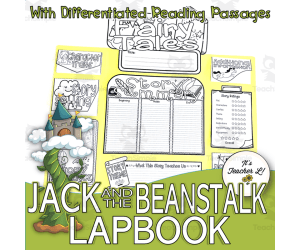
Jack and the Beanstalk Lapbook Project Reading & Writing Grade 3 4 5
Language Development, ELA, Children’s Literature, Literature, Literary Devices, Reading Comprehension, Reading, Grade 3, 4, 5, Activities, Centers, Crafts, Projects, Teacher Tools, Graphic Organizers, Assessments
Trek the trail of Jack in this fantastic Jack and the Beanstalk Lapbook Project designed for Grades 3, 4, 5, homeschool classrooms, and EFL/ESL learners. This perfect resource set is made for reading classes, reading centers, fairy tale units, sub plans, as well as a supplemental assessment tool for your reading comprehension activities. Contents: •3 Jack and the Beanstalk Lapbook Differentiated Reading Passages (Easy, Average, Hard) •6 Jack and the Beanstalk Lapbook Themed Lapbook Covers •2 Jack and the Beanstalk Lapbook Name Pages •1 Jack and the Beanstalk Lapbook Inner Overlap Page •3 Jack and the Beanstalk Lapbook Story Summary Page Options •2 Jack and the Beanstalk Lapbook Story Message Pages •2 Jack and the Beanstalk Lapbook Story Sequence Pockets •6 Jack and the Beanstalk Lapbook Story Sequence Photocards •3 Jack and the Beanstalk Lapbook Story Sequence Sets (6 cards each: Easy, Average, Hard) •6 Jack and the Beanstalk Lapbook Story Retell Cards •1 Jack and the Beanstalk Lapbook Character Traits Fold •1 Jack and the Beanstalk Lapbook Story Setting Fold •1 Jack and the Beanstalk Lapbook Additional Elements Fold •1 Jack and the Beanstalk Lapbook Story Ratings Page •1 Jack and the Beanstalk Lapbook Personal Reflection Fold
Author It's Teacher L
Rating
Tags Jack And The Beanstalk, Fairy Tale, Reading Comprehension, ELA Project
Guided Reading Level N - The Long Journey of Comets (with Lesson Plan)
ELA, Resources for Teachers, Reading Comprehension, Reading, Language Development, Science, Pre-Reading, Space, Earth and Environmental Sciences, Physics, Grade 2, 3, 4, Worksheets & Printables, Worksheets, Teacher Tools, Centers, Activities, Literacy Readers, Quizzes, Quizzes and Tests, Assessments
This Guided Reading Book - The Long Journey of a Comet (Level N) with lesson plan includes: Guided Reading Color Label (front cover x1) This is a quick way to match the book’s demands to what students can generally handle.. The overall goal is to use the level/color to pick books for several smaller groups. To qualify for a certain level, a student is expected to read a book from that level with about 90–94% accuracy. If a student is consistently accurate and understands, move up a level. If the student is struggling at that level, drop down and add more support. Each student will improve at completely different rates, but it is generally one of the best ways to check progress across the class. DOWNLOAD THE CATALOG TO VIEW ALL GUIDED READING BOOKS AVAILABLE (SORTED LEVELS A-Z) Pre-Reading Question (x1) Teacher asks the prompt aloud, can be while showing the cover or first page. Students share what they already know, or make educated guesses from the cover. Prompt them to use the target vocabulary. Write some of their responses on the board to look back at during the reading. Vocabulary Words (x5) Introduce the five words, best doing it one at a time. Start by saying it, while students repeat and then see if anyone knows what it means before reading further. Read through the meaning and try to briefly connect each word to a picture or gesture so it’s meaningful. Ask students to flip through the book pages and point to where they see each of the vocabulary words. While reading the book pause upon coming across one of the vocab words or read the sentence twice to make sure students understand the word has appeared. Optional: Ask students to raise hands whenever they see/hear one of the new words. Guided Reading Pages (x10) Check the book snapshot (below) for: primary topic - do you need to prep extra reading or intro materials on this? what is taught best - decide on 1-2 bullets to focus on, use the prompt or words provided here for best results. learning goals - what you are checking for students to be able to do after the session, elicit answers using prompts or words provided. key vocabulary (see section above). questions overview - so you know what is coming up and if you need to prep extra materials to assist understanding. Run the lesson You may have already looked at a few of the pages together, but you can show them some of the pictures again first to set meaning. Depending on how much time you have and how familiar your students are with guided reading class, you may want to read the book aloud first with the group first. Students whisper or partner read, while you listen in. If time, do it as a group, one student reading a page each. Use the guided page’s prompts to coach: “Check the picture / does it make sense?” “Point under the words / try the first sound” “Reread the sentence smoothly”. Try to focus more on one student per session (rotating every time), so you can work out if they are ready to move up or need to move down a level. Comprehension Questions (back cover x3) This is your way to check that students didn’t just say the words, but actually understood the text. First, let students answer by pointing to the page/picture and saying a short sentence. After any answer, follow with: “Show me where you found that in the text.” In bigger groups, have partners answer first (10–20 seconds), then call on 2–3 students to share. Differentiation tips: Emerging speakers/struggling readers: oral + pointing On-level: oral in a full sentence Higher: one written sentence or draw + label Book Snapshot Title: The Long Journey of a Comet Genre: Nonfiction (informational) Subject: Earth & Space Science Primary Topic: Comets: composition, orbit, coma, and tails Estimated Guided Reading Level (A–Z): N What This Book Teaches Best What comets are and what they’re made of (a “dirty snowball” mixture of ice, dust, and rock). How comets travel through the solar system, including long, oval-shaped orbits and time spent in the Kuiper Belt. What changes when a comet nears the Sun, including sublimation and the formation of a glowing coma. How solar wind and radiation create two tails that point away from the Sun, and how dust and ion tails differ. Why comets matter to scientists, described as “time capsules” that help scientists learn about the universe’s history. Learning Goals Students can describe what a comet is and identify materials the text says it contains. Students can explain what the nucleus is using details from the book. Students can describe what happens as a comet moves closer to the Sun, including sublimation and coma formation. Students can explain why a comet’s tails form and why they point away from the Sun. Students can compare the dust tail and the ion tail using text details. Students can explain what scientists can learn by studying comets, according to the text. Key Vocabulary From the Text mixture — different things combined together. nucleus — the solid center part of a comet. sublimation — when ice turns directly into gas. radiation — energy that travels out from the Sun. distinct — clearly different from something else. Discussion Prompts Pre-reading question: What do you think happens to a comet as it travels closer to the Sun? Comprehension questions: What does the text say a comet is made of? According to the text, what causes a comet to form a coma? What does the text say scientists can learn by studying comets? Printing Tips 1. Best Printing Method (Recommended) “Booklet” Printing (Best if Available) If your printer or PDF viewer supports Booklet Printing , use this. Settings to use: Print mode: Booklet Paper size: Letter or A4 (either works) Orientation: Landscape Print on both sides: Yes Flip on: Short edge Scaling: Fit to printable area Booklet subset: First test: Front sides only Then: Back sides only This will automatically: Pair pages correctly Put the cover on the outside Align everything for folding After printing, fold in half and staple along the spine . 2. If “Booklet” Printing Is NOT Available You can still print this correctly with manual duplex printing . Step-by-step: Open the PDF. Choose Print . Set: Orientation: Landscape Pages per sheet: 1 Print on both sides: Yes Flip on: Short edge Print all pages . Because each PDF page already contains two facing book pages, the result will still fold cleanly into a book. Thousands of Cored Education products are included with your TeachSimple membership. Download links and encyclopedia index available here.
Author Cored Education
Rating
Tags Reading Comprehension, Reading Passages, Reading, Guided Reading, Guided Reading Lesson Plan, Guided Reading Activity, Pre-reading, Vocabulary, Science Lesson Plans, Space

Defining Words Practice Questions - Vocabulary Grade 5-6 (Docs)
ELA, Language Development, ESL, Common Core, Resources for Teachers, Vocabulary, Grade 5, 6, 7, Worksheets & Printables, Worksheets, Quizzes and Tests, Teacher Tools, Tests, Assessments, Centers, Activities
Defining Words Grammar Practice MCQS ELA MCQS Overview: In this series of lessons, students will embark on an engaging journey to master the language arts skills that make communication effective and expressive. These lessons are designed to help students recognize, understand, and apply key grammar, vocabulary, and writing conventions in both their writing and speech. Each lesson builds upon the previous one, providing a structured blend of direct instruction, interactive group activities, and independent practice. With engaging tasks and thought-provoking questions, students will explore sentence structure, word choice, punctuation, and grammar rules to strengthen their understanding of English language conventions. Accompanied by free supplementary materials covering all topics, this series ensures a well-rounded and enjoyable learning experience. Through practice and exploration, students will develop the skills needed to analyze language, construct clear sentences, and express themselves with confidence. Defining Words Overview: Matching Words to Definition Matching Definition to Words Accurately Defining Meanings More Defining Word Practice Docs Version This is the Docs editable and fillable version. This download is available in GOOGLE Docs, GOOGLE Forms, GOOGLE Slides. PDF, PPT, WORD, check the links below for more details. FULL CATALOG OF DOWNLOAD LINKS HERE Grade 5/6 Links: Capitalization & Punctuation Google Docs Google Forms Google Slides PDF PPT Word Free Supplementary Materials Pack Adjectives Google Docs Google Forms Google Slides PDF PPT Word Free Supplementary Materials Pack Nouns Google Docs Google Forms Google Slides PDF PPT Word Free Supplementary Materials Pack Pronouns Google Docs Google Forms Google Slides PDF PPT Word Free Supplementary Materials Pack Verbs Google Docs Google Forms Google Slides PDF PPT Word Free Supplementary Materials Pack Prefixes & Suffixes Google Docs Google Forms Google Slides PDF PPT Word Free Supplementary Materials Pack Sentence Structure Google Docs Google Forms Google Slides PDF PPT Word Free Supplementary Materials Pack Subject Verb Agreement Google Docs Google Forms Google Slides PDF PPT Word Free Supplementary Materials Pack Tenses Google Docs Google Forms Google Slides PDF PPT Word Free Supplementary Materials Pack Context Clues Google Docs Google Forms Google Slides PDF PPT Word Free Supplementary Materials Pack Defining Words Google Docs Google Forms Google Slides PDF PPT Word Free Supplementary Materials Pack Fill in the Blanks Google Docs Google Forms Google Slides PDF PPT Word Free Supplementary Materials Pack Homophones Google Docs Google Forms Google Slides PDF PPT Word Free Supplementary Materials Pack Synonyms Google Docs Google Forms Google Slides PDF PPT Word Free Supplementary Materials Pack ELA Review Questions Overview Questions have three answer choices. There are a handful of pictures on each test for aesthetic purposes, as well as a review sheet covering most of the topics covered in the product. Introduction or Example Sheet Each topic will include an introduction or example sheet to go through first with your students. Full Answer Keys Full answer keys and sample responses are provided so no matter how busy you are, you know you're covered! In the Supplementary Pack Interactive Ice Breakers: Engaging warm-up activities that introduce students to key ELA concepts, such as quick capitalization corrections and punctuation challenges. Guided Practice: Structured teacher-led exercises that reinforce grammar and punctuation rules, helping students identify and apply them correctly in sentences. Group and Partner Tasks: Collaborative activities where students work together to edit sentences, correct capitalization, and improve punctuation through peer discussion and teamwork. Independent Worksheets: Carefully designed worksheets that provide focused practice, allowing students to apply learned concepts and refine their skills independently. Exit Tasks: Quick assessments at the end of each lesson, prompting students to reflect on what they’ve learned and apply their knowledge in writing and editing tasks. For More Like This For similar downloads and other frees, do check out Cored Group on TeachSimple.
Author Cored Education
Tags Elementary, Answers, Ccss, Common Core, Tests, Test Prep, Assessment, Grade 5, Grade 6, Vocabulary

Adaptive Sensory-Friendly Fitness Routines
Science, Life Sciences, Human Body, P.E. & Health, Health, Physical Education, Sports, Yoga, Mental Health, Mindfulness, Homeschool Curriculum, Homeschool Templates, Grade 9, 10, 11, 12, Teacher Tools, Quizzes and Tests, Quizzes, Tests, Worksheets & Printables, Assessments, Workbooks, Worksheets, Word Searches, Lesson Plans
Transform your approach to fitness and somatic care for adults with profound physical and neurological barriers. This comprehensive, 40-page digital curriculum, "Adaptive Sensory-Friendly Fitness Routines," is a groundbreaking resource designed for special education teachers, transition specialists, occupational therapists (OT), physical therapists (PT), and direct support professionals. Frustrated with traditional fitness models that are inaccessible or dysregulating? This evidence-based program is built on the Low-Arousal Adaptive Somatic Framework (LAASF) , which shifts the focus from impossible standards to dignity, comfort, and neurological safety. It redefines "fitness" for individuals with conditions such as severe cerebral palsy, traumatic brain injury (TBI), advanced multiple sclerosis, cortical visual impairment (CVI), and profound neurodevelopmental differences. This is more than just a set of exercises; it's a complete pedagogical system. WHAT'S INCLUDED: Part 1: In-Depth Clinical Guide (Pages 1-12): A professional deep dive into the neurobiology of sensory-friendly movement. Understand the science behind sensory gating, proprioceptive deficits, CVI adaptations, and low-stimulation design. Features two detailed case studies. Part 2: The Data-Driven Workbook (Pages 13-28): Ten meticulously designed, printable worksheets to guide your practice and document progress. These logs are the core of the program and include: Environmental Sensory Baseline (Pre-Workout Assessment) Somatic Readiness & Pain Scale Range of Motion (ROM) Micro-Movements Log Breath Control and Pacing Tracker Isometric Engagement & Release Log Assisted Mobility & Proprioceptive Input Logs Post-Exertion Decompression & Transition Protocols Weekly Neurological Fatigue Mapping Part 3: Visuals & Teacher Resources (Pages 29-40): Everything you need for successful implementation. Clear visual diagrams explaining the sensory ecosystem. A "Neurological Barrier Adaptation Matrix" for specific student profiles. A comprehensive Answer Key and Assessment for facilitator training. A sample "Exemplar Key" showing how to fill out the logs for a hypothetical case. A step-by-step Teacher Implementation Guide. This curriculum champions an age-appropriate, non-infantilizing approach, using high-contrast, minimalist visuals to reduce cognitive load and promote autonomy. Empower your students and clients to engage with their bodies in a safe, consensual, and meaningful way. Perfect for: Special Education Transition Programs (18+) Occupational Therapy & Physical Therapy Sessions Adult Day Programs & Supported Living Facilities Adapted Physical Education (APE) Caregiver and Paraprofessional Training Download today and unlock a world of intentional, accessible movement for the individuals you support. Keywords: Adaptive PE, Special Education, Life Skills, Adult Day Program, Transition Program, Occupational Therapy, Physical Therapy, Cerebral Palsy, TBI, CVI, Non-Verbal, Sensory-Friendly, Low Stimulation, Visual Supports, Workout Log, Data Tracking, IEP Goals, Somatic, Neurodiversity. Why Parents/Schools Love It: Dignity-Centered & Age-Appropriate: It rejects the infantilizing cartoons and primary colors common in special education, treating adults with the respect they deserve through mature, minimalist design. Inclusively Designed for the Most Profound Needs: This isn't a one-size-fits-all program. It's one of the few resources specifically engineered for individuals with the most significant physical, neurological, and sensory barriers, providing a path to engagement where none existed before. Data-Driven and Goal-Oriented: The 10-part workbook provides a clear, professional way to track subtle but critical progress—from breathing patterns to neurological fatigue. This is invaluable for IEPs, therapy goals, and demonstrating program efficacy. Empowers Staff & Ensures Safety: The comprehensive guide and implementation keys act as a powerful training tool, equipping staff with the knowledge to create a neurologically safe environment, prevent sensory overload, and facilitate movement consensually and effectively. Target Audience : This PDF is highly specialized. target the professionals and caregivers who will be implementing the program, not the end-users themselves. Primary Target Audience: Special Education Teachers (specifically those working in high school transition programs, ages 18-22). Occupational Therapists (OTs) and Physical Therapists (PTs) who work with adults with severe disabilities. Adapted Physical Education (APE) Teachers . Directors and Lead Staff at adult day programs, group homes, and supported living facilities. Case Managers and Transition Specialists for adults with disabilities. Parents and Guardians who are actively involved in directing the care of their adult children with profound needs. The content is written at a very high clinical level, so it reflect that professionalism. This is a tool for trained professionals to enhance their practice. Copyright/Terms of Use: This Book was copyrighted by Syed Hammad Rizvi. This resource is for personal and single classroom use only. You may not alter, redistribute, or sell any part of this resource. In other words, you may not put it on the Internet where it could be publicly found and downloaded. If you want to share this resource with colleagues, please purchase additional licenses from Teachsimple. Thank you for respecting these terms of use. This product is happily brought to you by Syed Hammad Rizvi
Author Creative Book Store
Rating
Tags AdaptiveFitness, SensoryFriendly, LowStimulation, SomaticCare, VisualSupports, SensoryRegulation, ProprioceptiveInput, AdaptedWorkout, SomaticAwareness, NeurologicalSupport
Reading Comprehension Fiction Set 5 Sample: Baseball Boy (Slides)
ELA, Reading, Language Development, Common Core, ESL, Reading Comprehension, Creative Writing, Writing, Resources for Teachers, Grade 4, 5, Teacher Tools, Presentations, Tests, Quizzes and Tests, Assessments, Activities
Reading Comprehension Passages Fiction Set 5 Sample Overview No prep reading comprehension lessons, with enjoyable stories and topics. Each lesson has a blend of post-reading activities. Mixed questions to check overall understanding. Vocabulary activities, plus a writing section. Lessons also contain a bonus extension exercise at the end. Some you may like, some you may not, either way they are there if you wish to use them. Full answer keys are provided. Passage Included 5.Baseball Boy: Mitch goes to watch the Chicago Hitters. Read about his day. Slides Version This is the Slides editable and fillable version. This download is available in GOOGLE Docs, GOOGLE Forms, GOOGLE Slides. PDF, PPT, WORD. FULL CATALOG OF DOWNLOAD LINKS HERE Grade 4/5 Links Fiction Set 1 - Animals Google Docs Google Forms Google Slides PDF PPT Word Guided Reading Materials Fiction Set 2 - Family Google Docs Google Forms Google Slides PDF PPT Word Guided Reading Materials Fiction Set 3 - Friends Google Docs Google Forms Google Slides PDF PPT Word Guided Reading Materials Fiction Set 4 - School Google Docs Google Forms Google Slides PDF PPT Word Guided Reading Materials Fiction Set 5 - Sports Google Docs Google Forms Google Slides PDF PPT Word Guided Reading Materials Nonfiction Set 1 - Birds Google Docs Google Forms Google Slides PDF PPT Word Guided Reading Materials Nonfiction Set 2 - Insects Google Docs Google Forms Google Slides PDF PPT Word Guided Reading Materials Nonfiction Set 3 - Mammals Google Docs Google Forms Google Slides PDF PPT Word Guided Reading Materials Nonfiction Set 4 - Nature Google Docs Google Forms Google Slides PDF PPT Word Guided Reading Materials Nonfiction Set 5 - Sea Animals Google Docs Google Forms Google Slides PDF PPT Word Guided Reading Materials Reading Passages Overview Each passage is especially written for Grade 4-5 students, including key vocabulary required for this age group. Topics are varied and are accompanied by colorful graphics. Topics are meant to educate, yet entertain the modern student. These passages are perfect for the modern classroom. Whereas textbooks can become outdated in no time, any changes to technology or the world will result in updates to this product. Mixed Questions The mixed questions section of each lesson includes a variation of five comprehension, vocabulary and math questions. In addition, key reading strategies are frequently covered including cause & effect, summarizing, compare & contrast and making conclusions. Two or three of the questions will be MCQs and other questions will require a written response of some kind. Full answers and example responses appear at the end of the lesson. Spelling & Vocab Each reading passage contains a variety of words and phrases designed for Grade 4-5 students. Spelling and vocab activities provide the opportunity to build fluency with these words. As it can become quite mundane doing the same activities over and over, each lesson in a set will contain a different spelling and vocab activity . Activities include: spelling games, sentence match-ups, mixed-up text and decoding words from the lesson. Writing Prompts Writing prompts are designed to continue the theme or lessons learned in the story. Students are persuaded to write in a variety of ways and each prompt includes several cues to help. As with the spelling/vocab section, writing prompts will vary. This includes research pieces, reading responses, poetry and creative writing prompts. Full Answer Keys Full answer keys and sample responses are provided so no matter how busy you are, you know you're covered! Mixed question answers provide evidence from the text, math questions contain the relevant workings. Answers are designed for use by the teacher, but also suitable as a handout to the student. Just for Fun Each lesson will have a bonus extension exercise. This is something fun to extend the lesson with. You can find these at the end of each lesson, titled Just for Fun. Just for Funs are optional. Some you may like, some you may not. Either way, they are there to do with as you wish. For similar downloads and other frees, do check out Cored Group on TeachSimple.
Author Cored Education
Tags Elementary, Reading, Comprehension, Vocabulary, Answers, Ccss, Common Core, Spelling, Writing, Passages
Science Reading Passage 7: Force and Motion (Google Slides)
Science, Physics, Common Core, ESL, Language Development, ELA, Reading Comprehension, Reading, Resources for Teachers, Grade 5, 6, 7, Presentations, Teacher Tools, Activities, Tests, Quizzes and Tests, Assessments
Free Reading Passage on Force & Motion for Physical Science What's inside this free product? Science Reading Comprehension Passage: Force & Motion Independent Google Slides Version: This is the independent Google Slides version containingone lesson. Product Info: 32 SLIDES (US English with Answers) Google Slides Version Teaching Duration: 90 Minutes Science Reading Comprehension Outline: Introducing a comprehensive resource tailored for 5th and 6th graders, this product offers enriching reading passages supplemented with illustrative pictures and graphs to clarify key concepts. Aligned with the Common Core State Standards (CCSS), it offers a hassle-free approach to teaching, given that the bulk of the preparation is already done for you. The passages present a diverse set of questions – from multiple choice to data analysis and fill-in-the-blanks. This ensures a rich blend of high-interest content and fundamental curriculum-based science themes. With its versatility, you can seamlessly integrate these lessons into various classroom settings, whether it's whole class discussions, morning exercises, independent desk tasks, small group engagements, contingency plans for substitute teachers, regular homework assignments, or even themed activities for holidays. FULL CATALOG OF DOWNLOAD LINKS HERE Grade 5/6 Links: Physical Science Part 1 - Physical and Chemical Properties Google Docs/Slides/Forms PDF PPT Word Free Supplementary Pack Accompanying Videos Physical Science Part 2 - Motion and Energy Google Docs/Slides/Forms PDF PPT Word Free Supplementary Pack Accompanying Videos Physical Science Part 3 - Electricity and Magnets Google Docs/Slides/Forms PDF PPT Word Free Supplementary Pack Accompanying Videos Life Science Part 1 - Cells, Reproduction and Genetics Google Docs/Slides/Forms PDF PPT Word Free Supplementary Pack Accompanying Videos Life Science Part 2 - Human Body Systems Google Docs/Slides/Forms PDF PPT Word Free Supplementary Pack Accompanying Videos Life Science Part 3 - Plant Parts and Ecosystems Google Docs/Slides/Forms PDF PPT Word Free Supplementary Pack Accompanying Videos Earth Science Part 1 - Plate Tectonics and Rock Cycle Google Docs/Slides/Forms PDF PPT Word Free Supplementary Pack Accompanying Videos Earth Science Part 2 - Ocean Exploration and Natural Resources Google Docs/Slides/Forms PDF PPT Word Free Supplementary Pack Accompanying Videos Earth Science Part 3 - Weather and Solar System Google Docs/Slides/Forms PDF PPT Word Free Supplementary Pack Accompanying Videos For similar products and other frees, do check out Cored Group on TeachSimple .
Author Cored Education
Tags Science, Elementary, Reading, Comprehension, Vocabulary, Answers, Physics, Physical Science, Ccss, Common Core

Guided Reading Level H - Reading Labels and Names
ELA, Resources for Teachers, Reading Comprehension, Reading, Health, P.E. & Health, Special Resources, Life Skills, Language Development, Vocabulary, Kindergarten, Grade 1, 2, Worksheets & Printables, Worksheets, Teacher Tools, Centers, Activities, Literacy Readers, Quizzes, Quizzes and Tests, Assessments
This Guided Reading Book - Reading Labels and Names (Level H) includes: Guided Reading Color Label (front cover x1) This is a quick way to match the book’s demands to what students can generally handle.. The overall goal is to use the level/color to pick books for several smaller groups. To qualify for a certain level, a student is expected to read a book from that level with about 90–94% accuracy. If a student is consistently accurate and understands, move up a level. If the student is struggling at that level, drop down and add more support. Each student will improve at completely different rates, but it is generally one of the best ways to check progress across the class. DOWNLOAD THE CATALOG TO VIEW ALL GUIDED READING BOOKS AVAILABLE (SORTED LEVELS A-Z) Pre-Reading Question (x1) Teacher asks the prompt aloud, can be while showing the cover or first page. Students share what they already know, or make educated guesses from the cover. Prompt them to use the target vocabulary. Write some of their responses on the board to look back at during the reading. Vocabulary Words (x5) Introduce the five words, best doing it one at a time. Start by saying it, while students repeat and then see if anyone knows what it means before reading further. Read through the meaning and try to briefly connect each word to a picture or gesture so it’s meaningful. Ask students to flip through the book pages and point to where they see each of the vocabulary words. While reading the book pause upon coming across one of the vocab words or read the sentence twice to make sure students understand the word has appeared. Optional: Ask students to raise hands whenever they see/hear one of the new words. Guided Reading Pages (x10) Check the book snapshot (below) for: primary topic - do you need to prep extra reading or intro materials on this? what is taught best - decide on 1-2 bullets to focus on, use the prompt or words provided here for best results. learning goals - what you are checking for students to be able to do after the session, elicit answers using prompts or words provided. key vocabulary (see section above). questions overview - so you know what is coming up and if you need to prep extra materials to assist understanding. Run the lesson You may have already looked at a few of the pages together, but you can show them some of the pictures again first to set meaning. Depending on how much time you have and how familiar your students are with guided reading class, you may want to read the book aloud first with the group first. Students whisper or partner read, while you listen in. If time, do it as a group, one student reading a page each. Use the guided page’s prompts to coach: “Check the picture / does it make sense?” “Point under the words / try the first sound” “Reread the sentence smoothly”. Try to focus more on one student per session (rotating every time), so you can work out if they are ready to move up or need to move down a level. Comprehension Questions (back cover x3) This is your way to check that students didn’t just say the words, but actually understood the text. First, let students answer by pointing to the page/picture and saying a short sentence. After any answer, follow with: “Show me where you found that in the text.” In bigger groups, have partners answer first (10–20 seconds), then call on 2–3 students to share. Differentiation tips: Emerging speakers/struggling readers: oral + pointing On-level: oral in a full sentence Higher: one written sentence or draw + label Book Snapshot Title: Reading Labels and Names Genre: Nonfiction (informational) Subject: Reading / Life Skills Primary Topic: Labels give facts and clues in daily life Estimated Guided Reading Level (A–Z): H What This Book Teaches Best Labels are “like a clue” that give “important information” and “facts about an object.” Labels tell what is inside or what something is (e.g., a box labeled “Orange,” a jar labeled “strawberry jam”). Labels and names help people stay organized and find the right item (a bin labeled “Toys,” a library label that says “Fiction.”). Labels can keep people safe and help them make careful choices (a sign that says “Wet Floor.”). Reading labels helps every day because labels “give facts and solve mysteries.” Learning Goals Students will explain what the book says a label is like and what it gives (clues, information, facts). Students will describe how a label tells what is inside an object using an example from the text. Students will identify how labels help keep spaces organized and clean using details from the text. Students will explain how a label can help keep people safe, using the “Wet Floor” sign example. Students will describe how names on items (like an envelope) help people know who something is for. Key Vocabulary From the Text clue — something that helps you figure something out. information — facts that help you know something. object — a thing you can see or touch. envelope — paper cover that holds a letter. mysteries — things you are trying to figure out. Discussion Prompts Pre-reading question: What labels do you notice that give you important information? Comprehension questions: What does the book say a label is like? Which label in the book helps keep the room clean? According to the book, how do labels help every day? Printing Tips 1. Best Printing Method (Recommended) “Booklet” Printing (Best if Available) If your printer or PDF viewer supports Booklet Printing , use this. Settings to use: Print mode: Booklet Paper size: Letter or A4 (either works) Orientation: Landscape Print on both sides: Yes Flip on: Short edge Scaling: Fit to printable area Booklet subset: First test: Front sides only Then: Back sides only This will automatically: Pair pages correctly Put the cover on the outside Align everything for folding After printing, fold in half and staple along the spine . 2. If “Booklet” Printing Is NOT Available You can still print this correctly with manual duplex printing . Step-by-step: Open the PDF. Choose Print . Set: Orientation: Landscape Pages per sheet: 1 Print on both sides: Yes Flip on: Short edge Print all pages . Because each PDF page already contains two facing book pages, the result will still fold cleanly into a book. Thousands of Cored Education products are included with your TeachSimple membership. Download links and encyclopedia index available here.
Author Cored Education
Rating
Tags Vocabulary, Reading Comprehension, Reading Passages, Leveled Reading, Nonfiction, Reading, Guided Reading, Health, Life Skills, Labels
Sentence Structure Practice Questions - Grade 3-4 Grammar (Google Doc)
ELA, Language Development, ESL, Grammar, Common Core, Resources for Teachers, Grade 3, 4, Worksheets & Printables, Worksheets, Quizzes and Tests, Teacher Tools, Tests, Assessments, Centers, Activities
Sentence Structure Grammar Practice MCQS ELA MCQS Overview: In this series of lessons, students will embark on an engaging journey to explore the grammar skills that make our language vibrant and expressive. These lessons are crafted to help students identify, comprehend, and effectively apply language arts skills in both writing and speech. Accompanied by free supplementary materials available for all topics, each lesson builds on the previous one, offering a balanced mix of direct instruction, interactive group activities, and independent practice. Through fun and creative tasks, students will learn to recognize grammar within sentences, understand their function, and use them to enrich their own writing and speech. Sentence Structure Overview: Includes: Declarative Sentences lnterroative Sentences Exclamatory Sentences Imperative Sentences Sentence Fragments End Punctuation Docs Version This is the Docs editable and fillable version. This download is available in GOOGLE Docs, GOOGLE Forms, GOOGLE Slides. PDF, PPT, WORD, check the links below for more details. FULL CATALOG OF DOWNLOAD LINKS HERE Grade 3/4 Links: Adjectives Google Docs Google Forms Google Slides PDF PPT Word Free Supplementary Materials Pack Adverbs Google Docs Google Forms Google Slides PDF PPT Word Free Supplementary Materials Pack Conjunctions Google Docs Google Forms Google Slides PDF PPT Word Free Supplementary Materials Pack Nouns Google Docs Google Forms Google Slides PDF PPT Word Free Supplementary Materials Pack Pronouns Google Docs Google Forms Google Slides PDF PPT Word Free Supplementary Materials Pack Verbs Google Docs Google Forms Google Slides PDF PPT Word Free Supplementary Materials Pack Sentence Structure Google Docs Google Forms Google Slides PDF PPT Word Free Supplementary Materials Pack Present Tense Google Docs Google Forms Google Slides PDF PPT Word Free Supplementary Materials Pack Past Tense Google Docs Google Forms Google Slides PDF PPT Word Free Supplementary Materials Pack Future Tense Google Docs Google Forms Google Slides PDF PPT Word Free Supplementary Materials Pack Context Clues Google Docs Google Forms Google Slides PDF PPT Word Free Supplementary Materials Pack Defining Words Google Docs Google Forms Google Slides PDF PPT Word Free Supplementary Materials Pack Fill the Blanks Google Docs Google Forms Google Slides PDF PPT Word Free Supplementary Materials Pack Homophones Google Docs Google Forms Google Slides PDF PPT Word Free Supplementary Materials Pack Synonyms Google Docs Google Forms Google Slides PDF PPT Word Free Supplementary Materials Pack ELA Review Questions Overview Questions have three answer choices. There are a handful of pictures on each test for aesthetic purposes, as well as a review sheet covering most of the topics covered in the product. Introduction or Example Sheet Each topic will include an introduction or example sheet to go through first with your students. Full Answer Keys Full answer keys and sample responses are provided so no matter how busy you are, you know you're covered! In the Supplementary Pack Interactive Ice Breakers: Fun, hands-on activities that get students thinking about adjectives right from the start. Guided Practice: Teacher-led exercises that reinforce the day’s lesson, ensuring students can confidently identify and use adjectives. Group and Partner Tasks: Collaborative activities that allow students to work together to solve problems, categorize adjectives, and create descriptive sentences. Independent Worksheets: Structured worksheets that provide individual practice and help solidify understanding of key concepts. Exit Tasks: Quick, reflective activities at the end of each lesson that assess understanding and encourage students to apply what they’ve learned. For similar downloads and other frees, do check out Cored Group on TeachSimple.
Author Cored Education
Tags Elementary, Answers, Ccss, Common Core, Grammar, Tests, Test Prep, Grade 3, Grade 4, Digital Centers
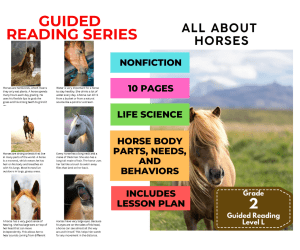
Guided Reading Level L - All About Horses (with Lesson Plan)
ELA, Resources for Teachers, Reading Comprehension, Reading, Science, Language Development, Life Sciences, Animals, Pre-Reading, Vocabulary, Grade 2, 3, 4, Worksheets & Printables, Worksheets, Teacher Tools, Centers, Activities, Literacy Readers, Quizzes, Quizzes and Tests, Assessments, Lesson Plans
This Guided Reading Book - All About Horses (Level L) with lesson plan includes: Guided Reading Color Label (front cover x1) This is a quick way to match the book’s demands to what students can generally handle.. The overall goal is to use the level/color to pick books for several smaller groups. To qualify for a certain level, a student is expected to read a book from that level with about 90–94% accuracy. If a student is consistently accurate and understands, move up a level. If the student is struggling at that level, drop down and add more support. Each student will improve at completely different rates, but it is generally one of the best ways to check progress across the class. DOWNLOAD THE CATALOG TO VIEW ALL GUIDED READING BOOKS AVAILABLE (SORTED LEVELS A-Z) Pre-Reading Question (x1) Teacher asks the prompt aloud, can be while showing the cover or first page. Students share what they already know, or make educated guesses from the cover. Prompt them to use the target vocabulary. Write some of their responses on the board to look back at during the reading. Vocabulary Words (x5) Introduce the five words, best doing it one at a time. Start by saying it, while students repeat and then see if anyone knows what it means before reading further. Read through the meaning and try to briefly connect each word to a picture or gesture so it’s meaningful. Ask students to flip through the book pages and point to where they see each of the vocabulary words. While reading the book pause upon coming across one of the vocab words or read the sentence twice to make sure students understand the word has appeared. Optional: Ask students to raise hands whenever they see/hear one of the new words. Guided Reading Pages (x10) Check the book snapshot (below) for: primary topic - do you need to prep extra reading or intro materials on this? what is taught best - decide on 1-2 bullets to focus on, use the prompt or words provided here for best results. learning goals - what you are checking for students to be able to do after the session, elicit answers using prompts or words provided. key vocabulary (see section above). questions overview - so you know what is coming up and if you need to prep extra materials to assist understanding. Run the lesson You may have already looked at a few of the pages together, but you can show them some of the pictures again first to set meaning. Depending on how much time you have and how familiar your students are with guided reading class, you may want to read the book aloud first with the group first. Students whisper or partner read, while you listen in. If time, do it as a group, one student reading a page each. Use the guided page’s prompts to coach: “Check the picture / does it make sense?” “Point under the words / try the first sound” “Reread the sentence smoothly”. Try to focus more on one student per session (rotating every time), so you can work out if they are ready to move up or need to move down a level. Comprehension Questions (back cover x3) This is your way to check that students didn’t just say the words, but actually understood the text. First, let students answer by pointing to the page/picture and saying a short sentence. After any answer, follow with: “Show me where you found that in the text.” In bigger groups, have partners answer first (10–20 seconds), then call on 2–3 students to share. Differentiation tips: Emerging speakers/struggling readers: oral + pointing On-level: oral in a full sentence Higher: one written sentence or draw + label Book Snapshot Title: All About Horses Genre: Nonfiction (informational) Subject: Life Science / Reading (Informational Text) Primary Topic: Horse body parts, needs, and behaviors Estimated Guided Reading Level (A–Z): L What This Book Teaches Best Key animal facts about horses (they are strong animals, mammals, and live outdoors in grassy areas). How horse body parts help them (mane and tail; tail swishes away flies). What horses need to stay healthy (they eat plants and drink a lot of water). How horses move (trot with “diagonal pairs,” and gallop as the fastest way to move with hooves off the ground). Special horse behaviors and life stages (sleeping while standing; a baby horse is a foal). Learning Goals Students will identify key facts about horses (habitat, body traits, and needs) from the text. Students will explain how a horse uses its tail based on details in the book. Students will describe what horses eat and how they graze using evidence from the text. Students will compare two horse movements (trot and gallop) using information from the book. Students will explain how a horse can sleep while standing without falling over. Students will describe what a foal is and what it can do soon after being born. Key Vocabulary From the Text mammal — an animal that breathes air with lungs. herbivores — animals that eat only plants. grazing — eating grass little by little over time. diagonal — slanted, from one corner to the opposite corner. hooves — the hard feet of a horse. Discussion Prompts Pre-reading question: What do you think a horse needs to stay healthy outdoors? Comprehension questions: What does the text say a horse uses its tail for? How does the text describe a trot? What is a foal, and what can it do within an hour of being born? Printing Tips 1. Best Printing Method (Recommended) “Booklet” Printing (Best if Available) If your printer or PDF viewer supports Booklet Printing , use this. Settings to use: Print mode: Booklet Paper size: Letter or A4 (either works) Orientation: Landscape Print on both sides: Yes Flip on: Short edge Scaling: Fit to printable area Booklet subset: First test: Front sides only Then: Back sides only This will automatically: Pair pages correctly Put the cover on the outside Align everything for folding After printing, fold in half and staple along the spine . 2. If “Booklet” Printing Is NOT Available You can still print this correctly with manual duplex printing . Step-by-step: Open the PDF. Choose Print . Set: Orientation: Landscape Pages per sheet: 1 Print on both sides: Yes Flip on: Short edge Print all pages . Because each PDF page already contains two facing book pages, the result will still fold cleanly into a book. Thousands of Cored Education products are included with your TeachSimple membership. Download links and encyclopedia index available here.
Author Cored Education
Rating
Tags Reading Comprehension, Reading Passages, Reading, Guided Reading, Guided Reading Lesson Plan, Guided Reading Activity, Pre-reading, Science Lesson Plans, Life Science, Animals
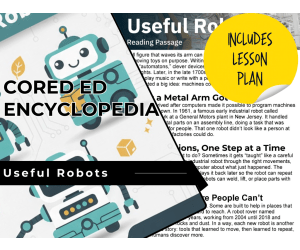
Useful Robots Reading Comprehension Passage - Cored Ed Encyclopedia
ELA, Language Development, Reading Comprehension, Reading, Pre-Reading, History, Social Studies, Technology, Science, Earth and Environmental Sciences, Grade 2, 3, 4, 5, Worksheets & Printables, Worksheets, Teacher Tools, Centers, Activities, Writing Prompts, Assessments, Quizzes and Tests, Quizzes, Lesson Plans
This useful robots reading comprehension with lesson plan includes: Visualization (on the front cover) Start your lesson by taking a minute to think and share something about the topic. Read the script aloud (slowly), perhaps prepare some music or sound effects. Student close their eyes and let their imaginations wander. Students open their eyes, read the question aloud and give them a few minutes to complete. Ask a few students to share or keep answers until the end to compare with what they learn in the passage. Quick pause—thousands of Cored Education products are included with your TeachSimple membership. Download links and encyclopedia index available here. Pre-Reading Trivia Students will write down one thing they already know about the subject and then read five more facts and discuss. These facts are fun, and the students will enjoy learning about the subject before reading more. Give 1 minute for students to write what they already know (no pressure—best guess is fine). Read the five facts together. After each fact, do ask a student for their opinion, was it surprising? Set a purpose by asking students to highlight/underline one fact they want to learn more about during the reading. Reading Passage The text is a high-interest reading passage with set paragraphs, roughly three to four paragraphs long. It contains a variety of themes about the topic, anywhere from history to technology. The passage is between 250 and 350 words in length. First, ask students to look at the headings and see what they’ll learn about today. What do they know about the topic/heading? First read options: Teacher read-aloud (best for support). Partner reading (paragraph by paragraph). While reading, students underline important details, and vocabulary words they think may come up in the questions section. Mixed Questions The first question page contains four multiple-choice questions, each with a choice of four answers, and three written response questions that require a sentence or two from the student. Students complete the mcqs first independently, then review quickly as a class. For the 3 written responses, try to get students giving the answer with some form of evidence: “I think ___ because the text says ___.” If students get stuck, send them back to check the passage. Vocabulary Questions Practice seven key words from the text in this section across two activities. First section is scrambled words where students will unscramble three words given a clue for each. The second section is a word to meaning matching activity. Before starting, have some students read out words they underlined in the passage. Ask students to say the word and read aloud the sentence(s) around each word. Ask students to do scrambled words and the matching exercise in pairs then go through answers as a class. For the scrambled spelling task, get four pairs to come up to the board and write the words for extra practice with the other student reading out the clue. For the matching task, prompt students to give full sentences: “I matched ___ with ___ because ___.” Creative Writing In this question, the student will be required to write a five to eight sentence paragraph on a question related to the topic. Before starting, ask students write down 3 key ideas they are going to include in their piece. Ask students for ideas to share around the class to help those struggling. Pro writing expectations: 5–8 sentences At least 2 facts or details from the passage At least 2 vocabulary words from the previous page Students read their paragraphs while classmates listen for facts and vocabulary words. Extension Activities This page is optional for fast finishers or to take home. There are several activities, each one requiring a different skill. Do some, do none, do all, completely optional - but you will feel reassured knowing every possibility is planned for. Includes summary writting question. Answer Key There are answers for the multiple-choice questions, written response questions have sample answers, vocabulary answers and if there is a summary question then a sample summary will be provided as well. Lesson Plan Included Customized lesson plan for this lesson is included. Lesson Snapshot Title: Useful Robots Genre: Nonfiction (Informational passage) Subject: Science & Technology (Engineering/Robotics) Primary Topic: How robots developed and help people Estimated Guided Reading Level (A–Z): P Support pages included: Pre-reading trivia, mixed questions, vocabulary activities, creative writing prompt, extension activities, and an answer key. QA notes on support pages: Support content generally matches the passage; however, the support pages use “automaton” (singular) while the passage uses “automata” (plural), and an extension prompt suggests “hills,” which is not stated in the passage (the passage names rocks and dust). What This Lesson Teaches Best Robots have a history: Explains that long ago people created “automata” that moved using steam, air, water, or falling weights. Modern robots and factory work: Describes an early industrial robot, Unimate, working in 1961 at a General Motors plant handling hot metal parts that were tough and dangerous for people. How robots learn repeatable motions: Shows how a person can guide a robot’s movements while sensors send signals to a computer that stores a pattern to repeat the job. Robots go where people can’t: Highlights the rover Opportunity exploring Mars for years (2004–2018) and sending back clues from rocks and dust. Big idea across time: Connects early moving devices to today’s robots as tools that learned to move, repeat, and help humans discover more. Learning Goals Students will explain what “automata” were and what powered them. Students will describe why Unimate’s factory job mattered for people. Students will identify how a robot can be “taught” motions and then repeat them. Students will summarize how robots can help in places that are risky, far away, or hard to reach. Students will use details from the text to tell what Opportunity did on Mars and what it sent back. Key Vocabulary From the Text automata — moving devices from long ago; not thinking machines. program — give a machine instructions to do a job. industrial — related to factories and making things. sensors — parts that notice and send signals to a computer. rover — a robot vehicle that travels to explore places. FULL CATALOG OF DOWNLOAD LINKS AND ENCYCLOPEDIA INDEX HERE
Author Cored Education
Rating
Tags Vocabulary, Reading Comprehension, Reading Passages, Lesson Plans, Ela Lesson Plans, Reading Comprehension Lesson Plans, Pre-reading, Science Lesson Plans, Technology, History

Reading Passages on Properties of Objects and Materials (Fillable PDF)
ELA, Reading, Reading Comprehension, Science, Physics, Common Core, ESL, Language Development, Vocabulary, Chemistry, Grade 2, 3, 4, Tests, Quizzes and Tests, Teacher Tools, Assessments, Worksheets, Worksheets & Printables, Centers, Activities
Reading Passages on Properties of Objects and Materials for Physical Science Snapshot Genre: Nonfiction Subject: Physical Science Primary Topic: Physical properties, matter, and changes of phase Estimated Guided Reading Level (A–Z): M What This Book Teaches Best It teaches how physical properties such as color, hardness, texture, size, shape, smell, melting point, and boiling point help identify substances. It explains how tools measure physical properties, including temperature, weight, length, and volume. It introduces classification by grouping matter into solids, liquids, gases, metals, and nonmetals. It explains states of matter and how atoms move differently in solids, liquids, and gases. It describes phase changes including melting, freezing, vaporization, and condensation. Learning Goals Students will identify observable physical properties used to describe materials. Students will explain how scientists use tools to measure temperature, length, weight, and volume. Students will classify examples of matter by state and by material type. Students will describe how atoms behave in solids, liquids, and gases. Students will explain how heat can cause melting, freezing, vaporization, and condensation. What's inside? Passage 1: Observable Physical Properties of Objects & Materials Passage 2: Measuring Physical Properties Passage 3: Classification of Matter Passage 4: States of Matter Passage 5: Change of Phase FILLABLE PDF VERSION Worksheet-style pages, but with type-in answer boxes so students can complete and save their work digitally. Other versions are available in the links list below or in the full catalog. FULL CATALOG OF DOWNLOAD LINKS HERE Grade 3/4 Links: Physical Science Part 1 - Properties of Objects and Materials Google Docs/Slides/Forms PDF PPT Word Free Supplementary Pack Accompanying Videos Physical Science Part 2 - Position and Motion of Objects Google Docs/Slides/Forms PDF PPT Word Free Supplementary Pack Accompanying Videos Physical Science Part 3 - Light, Heat, Electricity, Magnetism Google Docs/Slides/Forms PDF PPT Word Free Supplementary Pack Accompanying Videos Life Science Part 1 - Characteristics of Organisms Google Docs/Slides/Forms PDF PPT Word Free Supplementary Pack Accompanying Videos Life Science Part 2 - Life Cycles of Organisms Google Docs/Slides/Forms PDF PPT Word Free Supplementary Pack Accompanying Videos Life Science Part 3 - Organisms and Environments Google Docs/Slides/Forms PDF PPT Word Free Supplementary Pack Accompanying Videos Earth Science Part 1 - Properties of Earth Materials Google Docs/Slides/Forms PDF PPT Word Free Supplementary Pack Accompanying Videos Earth Science Part 2 - Changes in the Earth and Sky Google Docs/Slides/Forms PDF PPT Word Free Supplementary Pack Accompanying Videos Earth Science Part 3 - Objects in the Sky Google Docs/Slides/Forms PDF PPT Word Free Supplementary Pack Accompanying Videos For similar products and other frees, do check out Cored Group on TeachSimple .
Author Cored Education
Rating
Tags Science, Elementary, Reading, Comprehension, Physics, Physical Science, Reading Centers, Reading Comprehension Assessments, Science Assessments, Vocabulary Assessments

Prefixes and Suffixes Sample - Grades 1-2 Grammar (Slides)
ELA, Language Development, ESL, Grammar, Common Core, Resources for Teachers, Grade 1, 2, Presentations, Teacher Tools, Quizzes and Tests, Assessments, Activities
Prefixes and Suffixes - 1 Sample Lesson ELA MCQS Overview: In this series of lessons, students will embark on an engaging exploration of the grammar skills that bring our language to life. These lessons are designed to help students identify, understand, and effectively use language arts skills in their writing and speech. Used with the free supplementary materials available for all topics, each lesson builds on the last, offering a mix of direct instruction, interactive group activities, and independent practice. Through fun and creative tasks, students will learn how to recognize grammar in sentences, understand their role in sentences and use them to enhance their own writing and speech. Prefixes and Suffixes Overview: Includes: Intro to Prefixes Intro to Suffixes Forming Suffixes Determining Affix Word Meaning Slides Version This is the Slides editable and interactive version. There is a fillable answer sheet at the end. This download is available in GOOGLE Docs, GOOGLE Forms, GOOGLE Slides. PDF, PPT, WORD, check the links below for more details. FULL CATALOG OF DOWNLOAD LINKS HERE Grade 1/2 Links: Capitalization and Punctuation Google Docs Google Forms Google Slides PDF PPT Word Free Supplementary Materials Pack Adjectives Google Docs Google Forms Google Slides PDF PPT Word Free Supplementary Materials Pack Nouns Google Docs Google Forms Google Slides PDF PPT Word Free Supplementary Materials Pack Pronouns Google Docs Google Forms Google Slides PDF PPT Word Free Supplementary Materials Pack Verbs Google Docs Google Forms Google Slides PDF PPT Word Free Supplementary Materials Pack Prefixes & Suffixes Google Docs Google Forms Google Slides PDF PPT Word Free Supplementary Materials Pack Sentence Structure Google Docs Google Forms Google Slides PDF PPT Word Free Supplementary Materials Pack Subject-Verb Agreement Google Docs Google Forms Google Slides PDF PPT Word Free Supplementary Materials Pack ELA Review Questions Overview Questions have three answer choices. There are a handful of pictures on each test for aesthetic purposes, as well as a review sheet covering most of the topics covered in the product. Introduction or Example Sheet Each topic will include an introduction or example sheet to go through first with your students. Full Answer Keys Full answer keys and sample responses are provided so no matter how busy you are, you know you're covered! In the Supplementary Pack Interactive Ice Breakers: Fun, hands-on activities that get students thinking about adjectives right from the start. Guided Practice: Teacher-led exercises that reinforce the day’s lesson, ensuring students can confidently identify and use adjectives. Group and Partner Tasks: Collaborative activities that allow students to work together to solve problems, categorize adjectives, and create descriptive sentences. Independent Worksheets: Structured worksheets that provide individual practice and help solidify understanding of key concepts. Exit Tasks: Quick, reflective activities at the end of each lesson that assess understanding and encourage students to apply what they’ve learned. For similar downloads and other frees, do check out Cored Group on TeachSimple.
Author Cored Education
Tags Elementary, Reading, Comprehension, Vocabulary, Answers, Ccss, Common Core, Spelling, Writing, Passages

Science Reading Passages on Electricity and Magnets (Fillable PDF)
Science, Physics, Common Core, Reading Comprehension, Reading, ELA, ESL, Language Development, Vocabulary, Grade 5, 6, 7, Worksheets & Printables, Worksheets, Assessments, Teacher Tools, Tests, Quizzes and Tests
Reading Passages on Electricity and Magnets for Physical Science What's inside? Reading Passage 1: Static Electricity Reading Passage 2: Circuits Reading Passage 3: Electromagnets Reading Passage 4: Electric Energy Reading Passage 5: Energy Sources & Conversion FILLABLE PDF VERSION Worksheet-style pages, but with type-in answer boxes so students can complete and save their work digitally. Other versions are available in the links list below or in the full catalog. Snapshot Title: Title not stated Genre: Nonfiction Subject: Science / Physical Science Primary Topic: Electricity, circuits, electromagnets, and energy conversion. Estimated Guided Reading Level (A–Z): V What This Teaches Best Explains static electricity through atoms, charges, conductors, insulators, and lightning. Teaches how simple, series, and parallel circuits work and how current, resistance, and voltage are measured. Shows how electromagnets are made, how their strength changes, and how they are used in devices and motors. Compares batteries and generators and introduces direct current and alternating current. Helps students trace how energy changes form in tools such as flashlights, solar panels, and electric devices. Learning Goals Students will describe how static electricity forms when charges build up. Students will explain how a complete circuit allows electric current to flow. Students will compare series circuits and parallel circuits. Students will describe how an electromagnet can be turned on, off, or made stronger. Students will explain the difference between direct current and alternating current. Students will identify examples of energy conversion in electrical systems. FULL CATALOG OF DOWNLOAD LINKS HERE Grade 5/6 Links: Physical Science Part 1 - Physical and Chemical Properties Google Docs/Slides/Forms PDF PPT Word Free Supplementary Pack Accompanying Videos Physical Science Part 2 - Motion and Energy Google Docs/Slides/Forms PDF PPT Word Free Supplementary Pack Accompanying Videos Physical Science Part 3 - Electricity and Magnets Google Docs/Slides/Forms PDF PPT Word Free Supplementary Pack Accompanying Videos Life Science Part 1 - Cells, Reproduction and Genetics Google Docs/Slides/Forms PDF PPT Word Free Supplementary Pack Accompanying Videos Life Science Part 2 - Human Body Systems Google Docs/Slides/Forms PDF PPT Word Free Supplementary Pack Accompanying Videos Life Science Part 3 - Plant Parts and Ecosystems Google Docs/Slides/Forms PDF PPT Word Free Supplementary Pack Accompanying Videos Earth Science Part 1 - Plate Tectonics and Rock Cycle Google Docs/Slides/Forms PDF PPT Word Free Supplementary Pack Accompanying Videos Earth Science Part 2 - Ocean Exploration and Natural Resources Google Docs/Slides/Forms PDF PPT Word Free Supplementary Pack Accompanying Videos Earth Science Part 3 - Weather and Solar System Google Docs/Slides/Forms PDF PPT Word Free Supplementary Pack Accompanying Videos For similar products and other frees, do check out Cored Group on TeachSimple .
Author Cored Education
Rating
Tags Science, Elementary, Reading, Comprehension, Vocabulary, Physics, Physical Science, Common Core, Worksheets, Printable
Reading Comprehension and Questions Fiction Set 4 - School (Forms)
ELA, Reading, Language Development, Vocabulary, Common Core, Spelling, ESL, Reading Comprehension, Creative Writing, Writing, Grade 4, 5, Assessments, Teacher Tools, Tests, Quizzes and Tests, Activities, Centers
Reading Comprehension Passages Fiction Set 4 Overview No prep reading comprehension lessons, with enjoyable stories and topics. Each lesson has a blend of post-reading activities. Mixed questions to check overall understanding. Vocabulary activities, plus a writing section. Lessons also contain a bonus extension exercise at the end. Some you may like, some you may not, either way they are there if you wish to use them. Full answer keys are provided. Passages Include 1.The Principal: Kaitlin and Diann have to see the principal. Who's fault was it? 2.Fear: Tyson tries to look fearless. However, he has a lot on his mind lately. 3.Warm Welcome: Read about Juliet's first day at Westside Elementary. 4.Funny Photos: Darlene and her class have a good idea for their funny photos. 5.Gold Star: Amber's class has a new competition. The winner gets a goldstar. 6.Sub Teacher: Ed isn't excited to meet the sub teacher - Mr. Strict! 7.President Lina: Lina is too shy to run for school president. But after some persuasion... 8.Devon's Science Project: Devon helps save the world in this fun passage. 9.On the Stage: Tera and her class build a stage for their school out of adobe. 10.Eve's Amazing Day: Eve had a great day at school. Read all about it in this lesson. Forms Version This is the Forms editable and fillable/self grading version. This download is available in GOOGLE Docs, GOOGLE Forms, GOOGLE Slides. PDF, PPT, WORD. Browse the Complete Cored Catalog — 2,000+ Resources Included Reading Passages Each reading passage has been written specifically for students in Grades 4–5, using vocabulary and language that match their age and ability level. The collection covers a wide range of engaging topics, supported by colorful visuals that help bring the content to life. Every lesson is designed to build knowledge while keeping students interested and motivated to read. These resources are also designed with flexibility in mind. Unlike traditional textbooks that can quickly become outdated, lessons can be updated over time to reflect changes in technology, discoveries, and the world around us. Mixed Questions Every lesson includes a variety of questions that help students think more deeply about what they have read. The question section combines reading comprehension, vocabulary, and math skills, while also regularly reinforcing important reading strategies such as cause and effect, summarizing, compare and contrast, and drawing conclusions. Most lessons include a mix of multiple-choice and written-response questions, giving students opportunities to explain their thinking as well as select answers. Complete answer keys and sample responses are provided at the end of each lesson for quick and easy reference. Spelling & Vocabulary Each passage introduces students to useful words and phrases appropriate for Grades 4–5. To help build confidence and word knowledge, every lesson includes a spelling or vocabulary activity. Rather than repeating the same task throughout the collection, activities vary from lesson to lesson to keep practice fresh and engaging. Activities may include spelling challenges, sentence matching, decoding activities, mixed-up text exercises, and other vocabulary-building tasks connected directly to the reading. Writing Prompts Each lesson includes a writing activity that extends the ideas, themes, or topics explored in the passage. Students are encouraged to write in a variety of formats, with prompts providing helpful guidance and ideas to get them started. Writing tasks vary throughout the collection and may include creative writing, research activities, personal responses, poetry, opinion writing, and other engaging assignments. Full Answer Keys Complete answer keys and sample responses are included with every lesson, making planning and marking quicker and easier. Reading comprehension answers include evidence and support from the text, while math-based questions show the relevant working where appropriate. The answer keys are designed primarily for teachers but can also be shared with students when needed. Just for Fun Each lesson finishes with an optional extension activity called Just for Fun . These bonus activities provide an enjoyable way to extend learning beyond the main lesson and often encourage creativity, discussion, or independent thinking. They are completely optional, giving you the flexibility to use the activities that best suit your students and classroom needs. For similar downloads and other frees, do check out Cored Group on TeachSimple.
Author Cored Education
Rating
Tags Elementary, Reading, Comprehension, Vocabulary, Ccss, Common Core, Spelling, Writing, Passages, Self Assessment

Supplementary Materials for Weather and Solar System (PDF)
ELA, Reading, Reading Comprehension, Science, Earth and Environmental Sciences, Earth Sciences, Common Core, Grade 5, 6, 7, Assessments, Teacher Tools, Tests, Quizzes and Tests, Quizzes, Worksheets & Printables
Supplementary Materials for Weather and Solar System Each classroom is different and with that in mind, this free supplementary pack of questions gives teachers the opportunity to give early finishers some extra questions, or can be used for homework/holiday work. Each question is based on the topic of the reading lesson already covered, however, not all answers can be found in the text. What's inside? Questions for Part 3 - Weather & Solar System Reading Passage 1: Earth Moon and Sun Reading Passage 2: Weather Measurement Causes and Changes Reading Passage 3: Classification of the Sun and Other Stars Reading Passage 4: Inner and Outer Solar System Product Info: 12 PAGES (PDF Version: US English with Answers) Teaching Duration: 2 Weeks Science Reading Comprehension Outline: Introducing a comprehensive resource tailored for 5th and 6th graders, this product offers enriching reading passages supplemented with illustrative pictures and graphs to clarify key concepts. Aligned with the Common Core State Standards (CCSS), it offers a hassle-free approach to teaching, given that the bulk of the preparation is already done for you. The passages present a diverse set of questions – from multiple choice to data analysis and fill-in-the-blanks. This ensures a rich blend of high-interest content and fundamental curriculum-based science themes. With its versatility, you can seamlessly integrate these lessons into various classroom settings, whether it's whole class discussions, morning exercises, independent desk tasks, small group engagements, contingency plans for substitute teachers, regular homework assignments, or even themed activities for holidays. FULL CATALOG OF DOWNLOAD LINKS HERE Grade 5/6 Links: Physical Science Part 1 - Physical and Chemical Properties Google Docs/Slides/Forms PDF PPT Word Free Supplementary Pack Accompanying Videos Physical Science Part 2 - Motion and Energy Google Docs/Slides/Forms PDF PPT Word Free Supplementary Pack Accompanying Videos Physical Science Part 3 - Electricity and Magnets Google Docs/Slides/Forms PDF PPT Word Free Supplementary Pack Accompanying Videos Life Science Part 1 - Cells, Reproduction and Genetics Google Docs/Slides/Forms PDF PPT Word Free Supplementary Pack Accompanying Videos Life Science Part 2 - Human Body Systems Google Docs/Slides/Forms PDF PPT Word Free Supplementary Pack Accompanying Videos Life Science Part 3 - Plant Parts and Ecosystems Google Docs/Slides/Forms PDF PPT Word Free Supplementary Pack Accompanying Videos Earth Science Part 1 - Plate Tectonics and Rock Cycle Google Docs/Slides/Forms PDF PPT Word Free Supplementary Pack Accompanying Videos Earth Science Part 2 - Ocean Exploration and Natural Resources Google Docs/Slides/Forms PDF PPT Word Free Supplementary Pack Accompanying Videos Earth Science Part 3 - Weather and Solar System Google Docs/Slides/Forms PDF PPT Word Free Supplementary Pack Accompanying Videos For similar products and other frees, do check out Cored Group on TeachSimple .
Author Cored Education
Rating
Tags Science, Elementary, Reading, Comprehension, Vocabulary, Answers, Ccss, Common Core, Earth Science

California CAASPP Reading Practice Test for Grade 3
Reading, ELA, Grade 3, Tests, Quizzes and Tests, Teacher Tools, Assessments, Worksheets & Printables
California CAASPP Reading Practice Test for Grade 3 Looking for a 3rd Grade CAASPP Reading Practice Test that builds confidence and test readiness? This ELA practice test with answer key and teacher guide helps students master standards while giving you everything you need for easy prep and grading. What’s Included 📄 Full-length Grade 3 Reading Practice Test (30 questions) ✅ Complete Answer Key with explanations 📘 Detailed Teacher’s Guide with standards & teaching tips ✏️ 25 multiple-choice + 5 written-response questions 📊 Built-in scoring system (35 total points) 📚 4 engaging passages (fiction, nonfiction, and poetry) How It Works in the Classroom This CAASPP reading practice test is designed for flexible use: 🧠 Test prep before state assessments 📊 Benchmark or formative assessment 📝 Independent practice or homework 👩🏫 Whole-group test simulation 📂 Easy sub plans (print-and-go!) Students read passages and answer standards-aligned questions, including written responses that require text evidence and critical thinking . Standards & Learning Goals Aligned to 3rd Grade Common Core ELA standards , including: RL.3.1, RL.3.2, RL.3.3, RL.3.4, RL.3.5, RL.3.6, RL.3.9 RI.3.1, RI.3.2, RI.3.3, RI.3.4, RI.3.5, RI.3.7, RI.3.8, RI.3.9 Students will: Identify main idea and key details Use text evidence to support answers Analyze characters, themes, and structure Compare texts and interpret informational passages Why Teachers Love It ⭐ Zero prep – just print and go ⭐ Standards-aligned to CAASPP expectations ⭐ Built-in differentiation with multiple question types ⭐ Clear answer explanations for easy grading and reteaching ⭐ Strong test prep that mirrors real assessment structure Teachers love that this resource includes everything in one place —no extra planning required! Ready to boost your students’ reading skills and test confidence? Grab this 3rd Grade CAASPP Reading Practice Test today and make test prep simple and effective!
Author Bright Classroom Ideas Marketplace
Rating
Tags California, State Test, Reading, Caaspp

Science Reading Comprehension: Life Cycles of Organisms (Google Drive)
ELA, Science, Life Sciences, Biology, Common Core, Animals, Insects, Nature & Plants, Grade 2, 3, 4, Centers, Activities, Assessments, Teacher Tools, Presentations, Tests, Quizzes and Tests, Worksheets, Worksheets & Printables, Diagrams
Science Reading Comprehension on Life Cycles of Organisms for Life Science (Biology) Life Cycles of Organisms: Reading Passages Life Science (Biology): Whether you're aiming to introduce your students to the world of science or simply seeking an uncomplicated reading resource, this no-prep package is a perfect fit. With its colorful design, user-friendly format, and a diverse range of questions and topics, this science reading worksheet set offers a hassle-free and engaging educational experience. Give it a try today to enrich your curriculum effortlessly! What's inside? Part 2 - Life Cycles of Organisms Reading Passage 1: The Life Cycle of Plants Reading Passage 2: The Life Cycle of Animals Reading Passage 3: Heredity Product Info: 17 PAGES (Docs Version: US English with Answers) & 3 FORMS (Self-Grading) 87 SLIDES Teaching Duration: 2 Weeks Science Reading Comprehension Outline: Targeted for students in 3rd and 4th grades, these reading passages are enhanced with illustrations and graphs to elucidate critical points. Each lesson aligns with the Common Core State Standards, allowing you to integrate science reading practice effortlessly, knowing that minimal preparation is needed on your part. Each passage comes with a variety of questions in different formats, including multiple-choice formats, data analysis, and fill-in-the-blanks. The topics covered strike a balance between engaging content and core curriculum-based science subjects. Versatile in application, these lessons are suitable for a variety of settings such as whole-class instruction, morning activities, independent desk work, small group discussions, contingency plans for substitute teachers, homework assignments, or even special holiday-themed tasks. FULL CATALOG OF DOWNLOAD LINKS HERE Grade 3/4 Links: Physical Science Part 1 - Properties of Objects and Materials Google Docs/Slides/Forms PDF PPT Word Free Supplementary Pack Accompanying Videos Physical Science Part 2 - Position and Motion of Objects Google Docs/Slides/Forms PDF PPT Word Free Supplementary Pack Accompanying Videos Physical Science Part 3 - Light, Heat, Electricity, Magnetism Google Docs/Slides/Forms PDF PPT Word Free Supplementary Pack Accompanying Videos Life Science Part 1 - Characteristics of Organisms Google Docs/Slides/Forms PDF PPT Word Free Supplementary Pack Accompanying Videos Life Science Part 2 - Life Cycles of Organisms Google Docs/Slides/Forms PDF PPT Word Free Supplementary Pack Accompanying Videos Life Science Part 3 - Organisms and Environments Google Docs/Slides/Forms PDF PPT Word Free Supplementary Pack Accompanying Videos Earth Science Part 1 - Properties of Earth Materials Google Docs/Slides/Forms PDF PPT Word Free Supplementary Pack Accompanying Videos Earth Science Part 2 - Changes in the Earth and Sky Google Docs/Slides/Forms PDF PPT Word Free Supplementary Pack Accompanying Videos Earth Science Part 3 - Objects in the Sky Google Docs/Slides/Forms PDF PPT Word Free Supplementary Pack Accompanying Videos For similar products and other frees, do check out Cored Group on TeachSimple .
Author Cored Education
Rating
Tags Science, Elementary, Reading, Comprehension, Life Science, Biology, Science Assessments, Reading Comprehension Assessments, Vocabulary Assessments, Self Assessment
Reading Comprehension on Position and Motion of Objects (Google Drive)
ELA, Reading, Reading Comprehension, Common Core, ESL, Language Development, Vocabulary, Physics, Science, Grade 2, 3, 4, Worksheets, Worksheets & Printables, Assessments, Teacher Tools, Tests, Quizzes and Tests
Reading Passages on Position and Motion of Objects for Physical Science Position and Motion of Objects: Reading Passages Physical Science incorporates science literacy seamlessly into your teaching plans. The pack not only facilitates learning in crucial scientific domains but also offers an engaging variety of questions to reinforce comprehension. Focused on essential topics like motion, forces, and sound, these passages serve as a dual-purpose educational tool. By integrating this resource, you'll be able to tackle key scientific concepts while also honing your students' reading skills. The diverse set of questions that follow each passage—spanning multiple-choice, analytical, and more—provide a comprehensive approach to understanding both the text and the scientific principles it covers. What's inside? Part 2 - Position & Motion of Objects. Reading Passage 1: Position, Distance, and Motion Reading Passage 2: Pushing and Pulling Forces Reading Passage 3: Sound, Hearing, and Force Reading Passage 4: Characteristics of Sound Product Info: 23 PAGES (Docs Version: US English with Answer) & 4 FORMS (Self-Grading) 112 SLIDES Teaching Duration: 2 Weeks Science Reading Comprehension Outline: Targeted for students in 3rd and 4th grades, these reading passages are enhanced with illustrations and graphs to elucidate critical points. Each lesson aligns with the Common Core State Standards, allowing you to integrate science reading practice effortlessly, knowing that minimal preparation is needed on your part. Each passage comes with a variety of questions in different formats, including multiple-choice formats, data analysis, and fill-in-the-blanks. The topics covered strike a balance between engaging content and core curriculum-based science subjects. Versatile in application, these lessons are suitable for a variety of settings such as whole-class instruction, morning activities, independent desk work, small group discussions, contingency plans for substitute teachers, homework assignments, or even special holiday-themed tasks. FULL CATALOG OF DOWNLOAD LINKS HERE Grade 3/4 Links: Physical Science Part 1 - Properties of Objects and Materials Google Docs/Slides/Forms PDF PPT Word Free Supplementary Pack Accompanying Videos Physical Science Part 2 - Position and Motion of Objects Google Docs/Slides/Forms PDF PPT Word Free Supplementary Pack Accompanying Videos Physical Science Part 3 - Light, Heat, Electricity, Magnetism Google Docs/Slides/Forms PDF PPT Word Free Supplementary Pack Accompanying Videos Life Science Part 1 - Characteristics of Organisms Google Docs/Slides/Forms PDF PPT Word Free Supplementary Pack Accompanying Videos Life Science Part 2 - Life Cycles of Organisms Google Docs/Slides/Forms PDF PPT Word Free Supplementary Pack Accompanying Videos Life Science Part 3 - Organisms and Environments Google Docs/Slides/Forms PDF PPT Word Free Supplementary Pack Accompanying Videos Earth Science Part 1 - Properties of Earth Materials Google Docs/Slides/Forms PDF PPT Word Free Supplementary Pack Accompanying Videos Earth Science Part 2 - Changes in the Earth and Sky Google Docs/Slides/Forms PDF PPT Word Free Supplementary Pack Accompanying Videos Earth Science Part 3 - Objects in the Sky Google Docs/Slides/Forms PDF PPT Word Free Supplementary Pack Accompanying Videos For similar products and other frees, do check out Cored Group on TeachSimple .
Author Cored Education
Rating
Tags Science, Elementary, Reading, Comprehension, Vocabulary, Physics, Physical Science, Reading Comprehension Assessments, Science Assessments, Vocabulary Assessments