



3,911 products added recently
Page 6 - Science Assessments
Provide comprehensive science assessments covering biology, chemistry, physics, and Earth science. This collection includes lab reports, concept checks, and experimental evaluations. Foster a deeper understanding of scientific principles by using targeted assessments.

 Show filters


Science Reading Comprehension Passage: Chemical Bonding (Docs)
Science, ELA, Reading, Reading Comprehension, Strategies, Resources for Teachers, Chemistry, Grade 6, 7, 8, 9, 10, Writing Prompts, Worksheets & Printables, Centers, Activities, Teacher Tools, Assessments, Quizzes and Tests, Quizzes, Tests
Science Reading Comprehension Passage and Questions: Chemical Bonding (Google Docs) This very engaging science reading passage is about chemical bonding and how atoms connect to form the materials people use every day . It explains how outer electrons influence bonding and introduces three major bond types: ionic bonds, covalent bonds, and metallic bonds. Students explore examples such as sodium chloride, water, copper wire, aluminum foil, and iron beams while learning how bonding affects properties such as conductivity, strength, flexibility, and reactivity. This passage is designed to bridge the gap between science and literacy by strengthening reading comprehension while sparking scientific curiosity in middle school students. It blends English Language Arts skills with accurate science content, helping students build background knowledge, understand key concepts, use evidence from the text, and explain scientific ideas clearly. This resource supports science classroom practice while also reinforcing important literacy skills such as main idea, vocabulary, comprehension, and summarizing. Ideal for interdisciplinary learning in ELA and Science. Suitable for Grade 9 review, too! Student Tasks for The Passage: 10 multiple-choice questions targeting main idea, key details, science concepts, comparison, and real-world applications 10 True/False statements to check understanding and address common misconceptions 5 text-based short-answer questions that require students to explain important ideas from the passage 5 vocabulary matching items with clear, student-friendly definitions 1 summary prompt that asks students to condense the central ideas accurately Full answer key for every section Available Formats for this Resource PDF Fillable PDF Word Docs FULL CATALOG OF DOWNLOADING LINKS HERE Product Details Length: 7 pages total Grades: 6–8, also suitable for Grade 9 review Use cases: close reading, stations, homework, intervention, test prep, and sub plans Standards support: Reinforces informational-text skills and supports NGSS-style sense-making by helping students read scientific explanations, connect evidence to key concepts, interpret real-world examples, and explain cause-and-effect relationships in science. Why Teachers Choose This Set Authentic science content paired with rigorous literacy practice Consistent task structure across all passages for easier planning and smoother student routines Clear, age-appropriate writing that builds confidence without oversimplifying Other Science Reading Collections and Topics You May Find in the Store: 1. Astronomy & Space Science 2. Volcanoes, Rocks, & Mountains 3. Rock Cycle, Soil, & Sinkholes 4. Mars, Glaciers, & Antarctica 5. Water Cycle, Acid Rain, & Wastewater 6. Insects, Animals, & Ecosystems 7. Bioluminescence & Insects 8. Animal Skin, Cats, & T. Rex 9. Human Body and Senses 10. Health & Applied Bioscience 11. Waves, Light, & Imaging 12. Electricity & Energy 13. Motion & Materials 14. Chemistry and Materials Science 15. Electromagnetism 16. Acids and Bases 17. Gas Laws 18. Biotechnology 19. Periodic Trends 20. Protists and Fungi 21. Microevolution 22. Blood 23. Chemical Bonding 24. Magnets 25. Muscles 26. Nuclear Chemistry 27. Electromagnetic Devices 28. Epigenetics 29. The Law of Conservation of Mass 30. Atomic Models 31. Isotopes and Ions 32. Light 33. Human-Environment Interaction 34. Theory of Evolution 35. Photosynthesis 36. Origins of Life and Early Earth 37. Gene Expression and Regulation 38. Thermochemistry 39. Allergies 40. Coevolution 41. Birth to Adulthood 42. Cells 43. Entropy and Free Energy 44. The Human Brain 45. Mixtures and Solutions 46. Invertebrates 47. Zoo Animals 48. Biochemistry 49. Animal Behavior 50. Population Ecology ...and many more engaging science reading passages that cover intriguing and important topics designed to spark curiosity and support student learning. Use this passage to reinforce ELA skills in science, to add literacy to your lessons, and to support independent work. The passages strengthen main idea, evidence use, vocabulary in context, inference, cause and effect, and summary writing. With ready-to-use assessments and complete answer keys, you can provide focused practice that is simple to run and fast to review.
Author Middle & High School - CORED Education
Rating
Tags Middle School, Reading Comprehension, Reading Strategies, ELA, Centers, Reading Passage, Assessments, Vocabulary, Chemistry, Atomic Structure
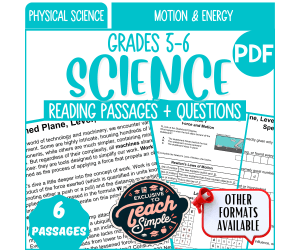
Reading Comprehension on Motion and Energy (PDF)
ELA, Reading, Reading Comprehension, Common Core, ESL, Language Development, Vocabulary, Physics, Science, Grade 5, 6, 7, Worksheets & Printables, Worksheets, Assessments, Teacher Tools, Tests, Quizzes and Tests, Centers, Activities
Reading Comprehension on Motion and Energy for Physical Science Motion and Energy: Reading Passages Physical Science Optimized for Grades 5-6, this science reading bundle offers a streamlined approach to assigning, evaluating, and reviewing reading assignments. Complete with detailed answer keys, abundant illustrations to clarify complex subjects, and engaging topics, it provides a comprehensive yet enjoyable learning experience. Don't miss out on this science reading comprehension toolkit – explore its potential in your classroom today! What's inside this Motion and Energy product? Part 2 - Motion & Energy Reading Passage 1: Kinetic & Potential Energy Reading Passage 2: Force & Motion Reading Passage 3: Simple Machines Reading Passage 4: Simple Machines 2 Reading Passage 5: Thermal Energy Reading Passage 6: Sound & Light Energy Product Info: 37 PAGES Teaching Duration: 2 Weeks Science Reading Comprehension Outline: Introducing a comprehensive resource tailored for 5th and 6th graders, this product offers enriching reading passages supplemented with illustrative pictures and graphs to clarify key concepts. Aligned with the Common Core State Standards (CCSS), it offers a hassle-free approach to teaching, given that the bulk of the preparation is already done for you. The passages present a diverse set of questions – from multiple choice to data analysis and fill-in-the-blanks. This ensures a rich blend of high-interest content and fundamental curriculum -based science themes. With its versatility, you can seamlessly integrate these lessons into various classroom settings, whether it's whole class discussions, morning exercises, independent desk tasks, small group engagements, contingency plans for substitute teachers, regular homework assignments, or even themed activities for holidays. FULL CATALOG OF DOWNLOAD LINKS HERE Grade 5/6 Links: Physical Science Part 1 - Physical and Chemical Properties Google Docs/Slides/Forms PDF PPT Word Free Supplementary Pack Accompanying Videos Physical Science Part 2 - Motion and Energy Google Docs/Slides/Forms PDF PPT Word Free Supplementary Pack Accompanying Videos Physical Science Part 3 - Electricity and Magnets Google Docs/Slides/Forms PDF PPT Word Free Supplementary Pack Accompanying Videos Life Science Part 1 - Cells, Reproduction and Genetics Google Docs/Slides/Forms PDF PPT Word Free Supplementary Pack Accompanying Videos Life Science Part 2 - Human Body Systems Google Docs/Slides/Forms PDF PPT Word Free Supplementary Pack Accompanying Videos Life Science Part 3 - Plant Parts and Ecosystems Google Docs/Slides/Forms PDF PPT Word Free Supplementary Pack Accompanying Videos Earth Science Part 1 - Plate Tectonics and Rock Cycle Google Docs/Slides/Forms PDF PPT Word Free Supplementary Pack Accompanying Videos Earth Science Part 2 - Ocean Exploration and Natural Resources Google Docs/Slides/Forms PDF PPT Word Free Supplementary Pack Accompanying Videos Earth Science Part 3 - Weather and Solar System Google Docs/Slides/Forms PDF PPT Word Free Supplementary Pack Accompanying Videos For similar products and other frees, do check out Cored Group on TeachSimple .
Author Cored Education
Rating
Tags Science, Elementary, Reading, Comprehension, Vocabulary, Physics, Physical Science, Worksheets, Printables, Reading Passages
Texas STAAR Pack of 3 Science Practice Tests for Grade 8
Science, Grade 8, Assessments, Teacher Tools, Tests, Quizzes and Tests, Worksheets & Printables
Texas STAAR Pack of 3 Science Practice Tests for Grade 8 Looking for a rigorous, STAAR Grade 8 Science practice test bundle that truly prepares students for the real exam? This resource includes 3 full-length, TEKS-aligned practice tests designed to build stamina, confidence, and mastery across all reporting categories. What’s Included 3 full-length STAAR-style science practice tests (35 questions each) 105 total multiple-choice questions covering all 4 reporting categories Detailed answer key with student-friendly rationales for every question TEKS alignment for all items (Grades 6–8 standards) Answer-at-a-glance scoring grids for quick grading Teacher’s Guide with pacing, administration tips, and differentiation strategies Class data tracker to monitor student growth and identify gaps How It Works in the Classroom This STAAR Grade 8 Science test prep resource is perfect for year-long or targeted review: Test 1: Beginning-of-year diagnostic Test 2: Mid-year progress check Test 3: Final STAAR simulation or review Use it for: Whole group STAAR prep Independent testing practice Small group reteach based on data Sub plans or test review days Each test mirrors STAAR timing (60–75 minutes) and includes graphs, diagrams, and data analysis just like the real test. Standards & Learning Goals Aligned to Texas TEKS Grade 8 Science , including vertical alignment from Grades 6–8: Matter and Energy Force, Motion, and Energy Earth and Space Organisms and Environments Students will: Practice interpreting scientific data and visuals Apply multi-step problem-solving skills Build confidence with STAAR-style questioning Why Teachers Love It ⭐ No-prep, print-and-go test prep solution ⭐ Easy grading with quick-reference answer grids ⭐ Built-in reteach support with detailed rationales ⭐ Differentiation strategies for diverse learners included ⭐ Data-driven instruction with reporting category breakdowns Take the stress out of STAAR prep with this complete Grade 8 Science practice test bundle . Everything you need is included—just print, assign, and watch your students grow in confidence and performance!
Author Bright Classroom Ideas Marketplace
Rating
Tags Texas, Staar, Science, State Test

TikTok Algorithm & Content Calendar Mapping
Technology, Science, Computer Science, Engineering, Business, Life Studies, Career, Leadership, Research, Finance, Homeschool Curriculum, Grade 7, 8, 9, 10, 11, 12, Worksheets & Printables, Workbooks, Worksheets, Word Searches, Teacher Tools, Assessments, Lesson Plans, Quizzes and Tests, Quizzes, Tests
Are your students spending hours scrolling TikTok? It's time to transform their passive consumption into a powerful, career-building skill! This comprehensive, 43-page project-based learning unit demystifies the TikTok algorithm and empowers students to think like professional digital strategists. Move beyond random posting and teach the data-driven science behind viral content. This isn't just a worksheet packet; it's a complete, academically rigorous curriculum designed for high school students. It treats TikTok as a serious case study in modern marketing, audience psychology, and behavioral economics. Students will transition from being casual creators to strategic digital architects, capable of planning, executing, and analyzing a 30-day content campaign. What's Included in This 43-Page All-in-One Unit: Part 1: Core Theory & Case Studies (10 Pages): In-depth chapters covering the architecture of the TikTok algorithm, the 4 phases of audio lifecycles (Inception, Acceleration, Apex, Decay), strategic content pillars, the 70/20/10 risk model, and real-world case studies. Part 2: The Student Workbook (21 Pages): Ten detailed worksheets guide students through practical application. They will analyze trending audio, calculate velocity, identify algorithmic triggers, define their niche, establish content pillars, build a 30-day posting calendar, and learn to iterate based on performance data. Part 3: Teacher Resources & Visuals (12 Pages): High-Contrast Diagrams: Perfect for classroom projection, breaking down the audio lifecycle, content matrix, and distribution feedback loop. Comprehensive Answer Key: Detailed, expected answers for every worksheet to make grading clear and objective. Teacher Implementation Guide: A step-by-step guide with pre-teaching strategies, classroom activities, discussion prompts, and advice for overcoming common student roadblocks. This resource is perfect for project-based learning and ready to print or use digitally. Equip your students with the 21st-century media literacy and marketing skills they need to succeed in the digital economy. Perfect for: High School Marketing & Business Classes Media Literacy & Digital Citizenship Units Career and Technical Education (CTE) Courses Journalism & Communications Entrepreneurship Programs Keywords: TikTok Marketing, Social Media Strategy, Digital Literacy, Algorithm, Content Calendar, Project-Based Learning (PBL), High School Business, CTE, Media Studies, 21st Century Skills, Content Creation, Viral Trends, Marketing Curriculum. Why Parents/Schools Love It: Turns Screen Time into Skill Time: It transforms a platform students already use for entertainment into a rigorous academic exercise, teaching critical thinking and analytical skills. Teaches In-Demand 21st-Century Skills: Students learn the fundamentals of digital marketing, data analysis, strategic planning, and content creation—skills that are highly valuable in college and future careers. 100% Turnkey & No-Prep: This is a complete, ready-to-go unit. With a teacher's guide, answer keys, and student worksheets, educators can implement it immediately without hours of prep work. Highly Engaging & Relevant: By using TikTok, a platform students are passionate about, this curriculum guarantees high student engagement and makes abstract concepts (like data analysis) tangible and exciting. Promotes Digital Citizenship: The unit encourages students to think ethically and critically about the content they create and consume, fostering responsible behavior in the digital world. Target Student Audience : Based on the academic language ("sociological study," "algorithmic architecture") and the direct mention on page 1, target: Grades: 9th to 12th Grade . While designed with 9th graders in mind, the complexity of the strategic concepts makes it perfectly suitable and challenging for students up to grade 12, especially in advanced marketing or business courses. Classes: Marketing, Business, Media Studies, Digital Literacy, Communications, Entrepreneurship, and Career & Technical Education (CTE) electives. Copyright/Terms of Use: This Book was copyrighted by Syed Hammad Rizvi. This resource is for personal and single classroom use only. You may not alter, redistribute, or sell any part of this resource. In other words, you may not put it on the Internet where it could be publicly found and downloaded. If you want to share this resource with colleagues, please purchase additional licenses from TpT. Thank you for respecting these terms of use. This product is happily brought to you by Syed Hammad Rizvi Are your students spending hours scrolling TikTok? It's time to transform their passive consumption into a powerful, career-building skill! This comprehensive, 43-page project-based learning unit demystifies the TikTok algorithm and empowers students to think like professional digital strategists. Move beyond random posting and teach the data-driven science behind viral content. This isn't just a worksheet packet; it's a complete, academically rigorous curriculum designed for high school students. It treats TikTok as a serious case study in modern marketing, audience psychology, and behavioral economics. Students will transition from being casual creators to strategic digital architects, capable of planning, executing, and analyzing a 30-day content campaign. What's Included in This 43-Page All-in-One Unit: Part 1: Core Theory & Case Studies (10 Pages): In-depth chapters covering the architecture of the TikTok algorithm, the 4 phases of audio lifecycles (Inception, Acceleration, Apex, Decay), strategic content pillars, the 70/20/10 risk model, and real-world case studies. Part 2: The Student Workbook (21 Pages): Ten detailed worksheets guide students through practical application. They will analyze trending audio, calculate velocity, identify algorithmic triggers, define their niche, establish content pillars, build a 30-day posting calendar, and learn to iterate based on performance data. Part 3: Teacher Resources & Visuals (12 Pages): High-Contrast Diagrams: Perfect for classroom projection, breaking down the audio lifecycle, content matrix, and distribution feedback loop. Comprehensive Answer Key: Detailed, expected answers for every worksheet to make grading clear and objective. Teacher Implementation Guide: A step-by-step guide with pre-teaching strategies, classroom activities, discussion prompts, and advice for overcoming common student roadblocks. This resource is perfect for project-based learning and ready to print or use digitally. Equip your students with the 21st-century media literacy and marketing skills they need to succeed in the digital economy. Perfect for: High School Marketing & Business Classes Media Literacy & Digital Citizenship Units Career and Technical Education (CTE) Courses Journalism & Communications Entrepreneurship Programs Keywords: TikTok Marketing, Social Media Strategy, Digital Literacy, Algorithm, Content Calendar, Project-Based Learning (PBL), High School Business, CTE, Media Studies, 21st Century Skills, Content Creation, Viral Trends, Marketing Curriculum. Why Parents/Schools Love It: Turns Screen Time into Skill Time: It transforms a platform students already use for entertainment into a rigorous academic exercise, teaching critical thinking and analytical skills. Teaches In-Demand 21st-Century Skills: Students learn the fundamentals of digital marketing, data analysis, strategic planning, and content creation—skills that are highly valuable in college and future careers. 100% Turnkey & No-Prep: This is a complete, ready-to-go unit. With a teacher's guide, answer keys, and student worksheets, educators can implement it immediately without hours of prep work. Highly Engaging & Relevant: By using TikTok, a platform students are passionate about, this curriculum guarantees high student engagement and makes abstract concepts (like data analysis) tangible and exciting. Promotes Digital Citizenship: The unit encourages students to think ethically and critically about the content they create and consume, fostering responsible behavior in the digital world. Target Student Audience : Based on the academic language ("sociological study," "algorithmic architecture") and the direct mention on page 1, target: Grades: 9th to 12th Grade . While designed with 9th graders in mind, the complexity of the strategic concepts makes it perfectly suitable and challenging for students up to grade 12, especially in advanced marketing or business courses. Classes: Marketing, Business, Media Studies, Digital Literacy, Communications, Entrepreneurship, and Career & Technical Education (CTE) electives. Copyright/Terms of Use: This Book was copyrighted by Syed Hammad Rizvi. This resource is for personal and single classroom use only. You may not alter, redistribute, or sell any part of this resource. In other words, you may not put it on the Internet where it could be publicly found and downloaded. If you want to share this resource with colleagues, please purchase additional licenses from Teachsimple. Thank you for respecting these terms of use. This product is happily brought to you by Syed Hammad Rizvi
Author Creative Book Store
Rating
Tags TikTokAlgorithm, TikTokMarketing, ContentStrategy, SocialMediaMarketing, DigitalMarketing, ContentCalendar, ViralMarketing, TrendingAudio, SocialMediaStrategy, BusinessTeacher
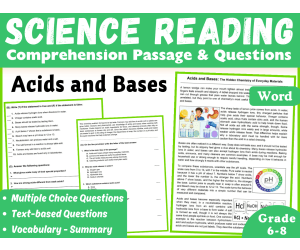
Physical Science Reading Comprehension Passage: Acids and Bases (Word)
Science, ELA, Reading, Reading Comprehension, Strategies, Resources for Teachers, Chemistry, Grade 6, 7, 8, 9, Writing Prompts, Worksheets & Printables, Centers, Activities, Teacher Tools, Assessments, Quizzes and Tests, Quizzes, Tests
Physical Science Reading Comprehension Passage and Questions: Acids and Bases (Word) This very engaging science reading passage is about acids and bases and how they appear in everyday materials. It explains that acids release hydrogen ions in water and are found in substances such as lemon juice, vinegar, citrus fruits, and stomach acid. It also describes bases, including soap, baking soda, ammonia, and cleaners, and explains how scientists use the pH scale to compare how acidic or basic a substance is. The passage introduces neutralization reactions , showing how acids and bases can react to form water and a salt, and connects the topic to real-life uses in farming, medicine, cooking, and cleaning. This passage is designed to bridge the gap between science and literacy by strengthening reading comprehension while sparking scientific curiosity in middle school students. It blends English Language Arts skills with accurate science content, helping students build background knowledge, understand key concepts, use evidence from the text, and explain scientific ideas clearly. This resource supports science classroom practice while also reinforcing important literacy skills such as main idea, vocabulary, comprehension, and summarizing. Ideal for interdisciplinary learning in ELA and Science. Suitable for Grade 9 review, too! Student Tasks for The Passage: 10 multiple-choice questions targeting main idea, key details, science concepts, comparison, and real-world applications 10 True/False statements to check understanding and address common misconceptions 5 text-based short-answer questions that require students to explain important ideas from the passage 5 vocabulary matching items with clear, student-friendly definitions 1 summary prompt that asks students to condense the central ideas accurately Full answer key for every section Available Formats for this Resource PDF Fillable PDF Google Docs FULL CATALOG OF DOWNLOADING LINKS HERE Product Details Length: 6 pages total Grades: 6–8, also suitable for Grade 9 review Use cases: close reading, stations, homework, intervention, test prep, and sub plans Standards support: Reinforces informational-text skills and supports NGSS-style sense-making by helping students read scientific explanations, connect evidence to key concepts, interpret real-world examples, and explain cause-and-effect relationships in science. Why Teachers Choose This Set Authentic science content paired with rigorous literacy practice Consistent task structure across all passages for easier planning and smoother student routines Clear, age-appropriate writing that builds confidence without oversimplifying Other Science Reading Collections and Topics You May Find in the Store: 1. Astronomy & Space Science 2. Volcanoes, Rocks, & Mountains 3. Rock Cycle, Soil, & Sinkholes 4. Mars, Glaciers, & Antarctica 5. Water Cycle, Acid Rain, & Wastewater 6. Insects, Animals, & Ecosystems 7. Bioluminescence & Insects 8. Animal Skin, Cats, & T. Rex 9. Human Body and Senses 10. Health & Applied Bioscience 11. Waves, Light, & Imaging 12. Electricity & Energy 13. Motion & Materials 14. Chemistry and Materials Science 15. Electromagnetism 16. Acids and Bases 17. Gas Laws 18. Biotechnology 19. Periodic Trends 20. Protists and Fungi 21. Microevolution 22. Blood 23. Chemical Bonding 24. Magnets 25. Muscles 26. Nuclear Chemistry 27. Electromagnetic Devices 28. Epigenetics 29. The Law of Conservation of Mass 30. Atomic Models 31. Isotopes and Ions 32. Light 33. Human-Environment Interaction 34. Theory of Evolution 35. Photosynthesis 36. Origins of Life and Early Earth 37. Gene Expression and Regulation 38. Thermochemistry 39. Allergies 40. Coevolution 41. Birth to Adulthood 42. Cells 43. Entropy and Free Energy 44. The Human Brain 45. Mixtures and Solutions 46. Invertebrates 47. Zoo Animals 48. Biochemistry 49. Animal Behavior 50. Population Ecology ...and many more engaging science reading passages that cover intriguing and important topics designed to spark curiosity and support student learning. Use this passage to reinforce ELA skills in science, to add literacy to your lessons, and to support independent work. The passages strengthen main idea, evidence use, vocabulary in context, inference, cause and effect, and summary writing. With ready-to-use assessments and complete answer keys, you can provide focused practice that is simple to run and fast to review.
Author Middle & High School - CORED Education
Rating
Tags Middle School, Reading Comprehension, Reading Strategies, ELA, Centers, Reading Passage, Assessments, Vocabulary, Chemistry, Physical Science
Chat.G.p.T. Guide for Small Business Owners Book
Technology, Science, Computer Science, Engineering, Special Education Needs (SEN), Special Resources, Resources for Teachers, Career, Life Studies, Business, Grade 6, 7, 8, 9, 10, 11, 12, Teacher Tools, Lesson Plans, Assessments, Presentations, Worksheets & Printables, Workbooks, Worksheets, Word Searches, Activities, Projects
The ultimate playbook for unlocking explosive growth; the Chat.G.P.T Playbook for Small Business Owners from Syed Hammad Rizvi, is the most comprehensive & practical AI resource available to entrepreneurs, solopreneurs, and gig economy founders. This 419-page behemoth includes 136 step-by-step chapters with concrete strategies for mastering prompt engineering (and creating prompt templates) content marketing, SEO-Optimized blogs, social media captions on Instagram, LinkedIn, Facebook, TikTok, email sequences, sales funnels, customer service automation, Google Ads copy & Social campaign ads, website copy, product descriptions, competitor analysis, lead generation, upselling & much more. No matter if you're an entrepreneur managing every role yourself or are a small business owner that needs to scale without a team; this book will show you how to incorporate Chat.G.P.T into every workflow you'll go through from brainstorming and drafting proposals to creating loyalty programs, SOPs, and investor summaries. Tips include information related to keyboard shortcuts, custom instructions, awareness of Chat.G.P.T.'s limitations, ethical uses of AI, and real case studies from early users who were able to save hours while generating additional revenue. Great for small business entrepreneurs, freelancers, eCommerce sellers, and service providers that want to work smart, not hard; you won't need a tech background to use this book; it gives you practical examples of prompts and templates you can use immediately to generate results. Reasons why parents and schools like this program. It Provides Future Entrepreneurs With Innovative .A.I. Skills They Will Need for Career Success And The Ability To Transform Their Skills To Become Successful. It Provides Teachers With Ready-To-Use, Current Examples And Templates That Can Help Improve The Learning Experience For Their Students And Make Entrepreneurship And Digital Marketing Classes More Relevant. Parents Can Provide Their College-Bound Or Business-Minded Teenagers With A Professional Development Resource That Will Help Build Their Teenager’s Confidence And Actual Revenue-Generating Skills. Schools Will Appreciate The Ethical Guidance In The Ethical .A.I. Section And Brand Consistency In The Brand Consistency Section That Are Aligned With The Principles Of Digital Citizenship And Responsible Technology Education. Provides Quantifiable Outcomes - Students Are Able To Apply The Information They Learned About “P.rompt.s” To Their Class Project, Internship Or Side Hustle, And Turn Theories Into Tangible Results. Audience (Target) / Classifications: This is a higher-level book that is a very suitable fit for higher-education and vocational business courses and programs. The groups you are targeting are: College and Universitystudents who are taking any of the following courses:entrepreneurship 101 or 201, small business management, digital marketing, business administration, ecommerce, or marketing strategy. Graduate students (MBA or postgraduate) who are takinga course that focuses on artifici.a.l intelligence in the business setting, operations, or sales. High school students taking advanced business classes and coursework in entrepreneurship, career and technical education, or who are members of DECA or FBLA.Platform:For High School; community college vocational tracks; online business boot camps; continuing education programs; and others. Teachers and Professors seeking real-life case studies of artific.i.a.l intelligence in businesses and prom.p.t templates to use in the class (ideal for as Prepared to Use Business Lessons Resources). Copyright/Terms of Use: Syed Hammad Rizvi created this Book. The Book is for personal use and for single classroom use. You cannot modify, redistribute, or sell this Book in any form or way. That is to say, you cannot share this Book with anyone else via the Internet and allow them access to it. If you would like to share this resource with teachers or colleagues, you can purchase additional licenses from Teachsimple. Thank you for adhering to these copyright/terms of use. This product is proudly provided Syed Hammad Rizvi
Author Creative Book Store
Rating
Tags ChatGPT, ChatGPTTips, AIForBusiness, SmallBusinessAI, EntrepreneurAI, SolopreneurTools, AIPromptEngineering, ChatGPTMarketing, AIContentCreation, SEOWithAI

Smart Home Ergonomics & Tech Neck Correction
P.E. & Health, Health, Mental Health, Mindfulness, Physical Education, Sports, Yoga, Science, Life Sciences, Human Body, Homeschool Curriculum, Grade 7, 8, 9, 10, 11, 12, Worksheets & Printables, Workbooks, Worksheets, Word Searches, Teacher Tools, Lesson Plans, Quizzes and Tests, Quizzes, Tests, Assessments
Are your students constantly hunched over their phones and laptops? Tackle the #1 health issue of the digital generation with this comprehensive, no-prep unit on "Tech Neck" and Digital Ergonomics! This is not just another lecture on "sitting up straight." This is a rigorous, science-based curriculum designed for high school Physical Education, Health, Anatomy, and Biology classes. It empowers students with a deep understanding of the biomechanics behind poor posture and gives them actionable strategies for lifelong spinal health. This complete resource pack turns a complex topic into an engaging, visual, and interactive learning experience. It's the perfect, relevant lesson for today's digitally-native teens. What's Included in this 44-Page Unit: PART 1: In-Depth Informational Text (11 pages): A detailed guide that serves as the "textbook" for the unit. Chapters cover: The Biomechanics of Forward Head Posture (The Physics of "Tech Neck") Visual Diagnostics: How to Identify Postural Problems The Muscular Domino Effect (Upper Crossed Syndrome) Real-World Case Studies & Corrective Ergonomics PART 2: Student Workbook (10 Differentiated Worksheets): Ready-to-print worksheets that reinforce concepts from the text. Topics include: Craniovertebral Anatomy The Physics of Cranial Load Sagittal Plane Diagnostics Muscular Imbalance Mapping Smart Home Ergonomic Traps Symptom Localization & Corrective Exercises Long-Term Degenerative Effects PART 3: High-Quality Visuals & Diagrams: Three professional, clean vector diagrams perfect for classroom display or inclusion in presentations. Includes: Weight Load Chart (The Physics of Forward Head Posture) Anatomy of Upper Cross Syndrome Mind Map Smartphone Posture Identification Diagram (Correct vs. Incorrect) PART 4: Comprehensive Teacher Answer Key (8 pages): A complete, detailed answer key for all 10 worksheets, making grading fast and easy. This unit is perfect for a multi-day lesson, a health project, an emergency sub plan, or as a vital component of your anatomy or physical education curriculum. Equip your students with the knowledge to protect their bodies in the digital age! Keywords: Tech Neck, Posture, Digital Citizenship, Health, Physical Education, Anatomy, Kinesiology, Biomechanics, Ergonomics, Worksheets, Printable PDF, High School, Middle School, Grades 9-12, No Prep, Sub Plan, Forward Head Posture, Student Workbook, Answer Key, Skeletal System, Muscular System. Why Parents/Schools Love It: Extremely Relevant: Addresses a universal, modern-day health crisis ("Tech Neck") that directly impacts students' daily lives, making learning instantly applicable. Scientifically Rigorous: Goes far beyond "sit up straight," teaching real anatomy, physics, and biomechanics. It provides a legitimate STEM-based approach to wellness. Comprehensive & No-Prep: This is a complete, turnkey unit. It includes informational text, worksheets, visuals, and a full answer key, saving teachers valuable preparation time. Promotes Lifelong Health: Empowers students with critical knowledge and actionable strategies to prevent chronic pain and long-term skeletal damage, promoting a lifetime of better health habits. Engaging & Interactive: The use of visual diagnostics, case studies, and practical worksheets makes students active participants in analyzing and solving real-world ergonomic problems. Target Student Audience : Based on a complete analysis of the vocabulary, concepts, and explicit mention in the text: Primary Target: Grade 9 Physical Education . The document specifically mentions this on page 1. Secondary (and equally strong) Targets: Grades 10-12 in subjects like Health, Anatomy & Physiology, Biology (human body unit), or Kinesiology . The level of detail (e.g., Upper Crossed Syndrome, C7-T1 junction, Wolff's Law) is advanced and perfectly suited for upper-level high school science courses. Copyright/Terms of Use: This Book was copyrighted by Syed Hammad Rizvi. This resource is for personal and single classroom use only. You may not alter, redistribute, or sell any part of this resource. In other words, you may not put it on the Internet where it could be publicly found and downloaded. If you want to share this resource with colleagues, please purchase additional licenses from Teachsimple. Thank you for respecting these terms of use. This product is happily brought to you by Syed Hammad Rizvi
Author Creative Book Store
Rating
Tags TechNeck, PostureCorrection, Ergonomics, Biomechanics, Anatomy, Kinesiology, SpinalHealth, ForwardHeadPosture, UpperCrossedSyndrome, StudentHealth

Volcanoes, Rocks, & Mountains: Reading Comprehension Passages (Docs)
Science, Earth and Environmental Sciences, ELA, Reading, Reading Comprehension, Strategies, Resources for Teachers, Geology, Earth Sciences, Grade 6, 7, 8, 9, Writing Prompts, Worksheets & Printables, Centers, Activities, Teacher Tools, Assessments, Quizzes and Tests, Quizzes, Tests
Volcanoes, Rocks, & Mountains: Reading Comprehension Passages (Docs) This engaging collection of earth science reading passages about Mountains, Volcanoes, and Igneous Rocks is designed to bridge the gap between science and literacy through strengthening reading comprehension and sparking scientific curiosity in middle school students. Each passage blends English Language Arts skills with accurate science content that supports NGSS classroom practice. Ideal for interdisciplinary learning in ELA and Science. Suitable for Grade 9 review, too! What Is Included? There are (3) informational passages: Mountains: From Plates to Peaks See how plate collisions fold rock, faults lift blocks, and volcanism builds peaks. Learn how rivers, glaciers, and gravity continue to reshape ranges over time. How Volcanoes Shape Our World Examine hazards such as ash, gases, lahars, and pyroclastic flows, along with benefits like fertile soils, mineral resources, geothermal energy, and new land. Learn how monitoring and planning reduce risk. Igneous Rocks: From Fire to Everyday Life Compare intrusive and extrusive rocks, link cooling rates to crystal size and texture, and connect granite, basalt, pumice, and obsidian to everyday uses in buildings, roads, tools, and art. Student Tasks for Each Passage: 5 multiple-choice questions targeting main idea, key details, inference, vocabulary in context, and use of evidence 5 vocabulary matching items with clear, student-friendly definitions 5 text-based questions that require citing specific lines or facts 1 summary prompt that asks students to condense central ideas accurately Full answer key for every section Available Formats for this Resource PDF Word Docs FULL CATALOG OF DOWNLOADING LINKS HERE Other Science Reading Collections you May find in the store: 1. Astronomy & Space Science 2. Volcanoes, Rocks, & Mountains 3. Rock Cycle, Soil, & Sinkholes 4. Mars, Glaciers, & Antarctica 5. Water Cycle, Acid Rain, & Wastewater 6. Insects, Animals, & Ecosystems 7. Bioluminescence & Insects 8. Animal Skin, Cats, & T. Rex 9. Human Body and Senses 10. Health & Applied Bioscience 11. Waves, Light, & Imaging 12. Electricity & Energy 13. Motion & Materials 14. Chemistry and Materials Science Product Details Length: 13 pages total Grades: 6–8, also suitable for Grade 9 review Use cases: close reading, stations, homework, intervention, test prep, and sub plans Standards support: reinforces informational-text skills and supports NGSS-style sense making through observation, modeling, and clear use of claim, evidence, and reasoning Why Teachers Choose This Set Authentic science content paired with rigorous literacy practice Consistent task structure across all passages for easier planning and smoother student routines Clear, age-appropriate writing that builds confidence without oversimplifying Use this set to reinforce ELA skills in science, to add literacy to your lessons, or to support independent work. The passages strengthen main idea, evidence use, vocabulary in context, inference, cause and effect, and summary writing. With ready-to-use assessments and complete answer keys, you can provide focused practice that is simple to run and fast to review.
Author Middle & High School - CORED Education
Rating
Tags Middle School, Reading Comprehension, Reading Strategies, Reading Passages, ELA, Centers, Reading Passage, Assessments, Vocabulary, Earth Science

DNA: Guided Reading Level N with Lesson Plan
ELA, Resources for Teachers, Reading Comprehension, Reading, Science, Life Sciences, Language Development, Technology, Pre-Reading, Vocabulary, Grade 2, 3, 4, Worksheets & Printables, Worksheets, Teacher Tools, Centers, Activities, Literacy Readers, Quizzes, Quizzes and Tests, Assessments, Lesson Plans
This DNA (level n) guided reading book with lesson plan includes: Guided Reading Color Label (front cover x1) This is a quick way to match the book’s demands to what students can generally handle.. The overall goal is to use the level/color to pick books for several smaller groups. To qualify for a certain level, a student is expected to read a book from that level with about 90–94% accuracy. If a student is consistently accurate and understands, move up a level. If the student is struggling at that level, drop down and add more support. Each student will improve at completely different rates, but it is generally one of the best ways to check progress across the class. DOWNLOAD THE CATALOG TO VIEW ALL GUIDED READING BOOKS AVAILABLE (SORTED LEVELS A-Z) Pre-Reading Question (x1) Teacher asks the prompt aloud, can be while showing the cover or first page. Students share what they already know, or make educated guesses from the cover. Prompt them to use the target vocabulary. Write some of their responses on the board to look back at during the reading. Vocabulary Words (x5) Introduce the five words, best doing it one at a time. Start by saying it, while students repeat and then see if anyone knows what it means before reading further. Read through the meaning and try to briefly connect each word to a picture or gesture so it’s meaningful. Ask students to flip through the book pages and point to where they see each of the vocabulary words. While reading the book pause upon coming across one of the vocab words or read the sentence twice to make sure students understand the word has appeared. Optional: Ask students to raise hands whenever they see/hear one of the new words. Guided Reading Pages (x10) Check the book snapshot (below) for: primary topic - do you need to prep extra reading or intro materials on this? what is taught best - decide on 1-2 bullets to focus on, use the prompt or words provided here for best results. learning goals - what you are checking for students to be able to do after the session, elicit answers using prompts or words provided. key vocabulary (see section above). questions overview - so you know what is coming up and if you need to prep extra materials to assist understanding. Run the lesson You may have already looked at a few of the pages together, but you can show them some of the pictures again first to set meaning. Depending on how much time you have and how familiar your students are with guided reading class, you may want to read the book aloud first with the group first. Students whisper or partner read, while you listen in. If time, do it as a group, one student reading a page each. Use the guided page’s prompts to coach: “Check the picture / does it make sense?” “Point under the words / try the first sound” “Reread the sentence smoothly”. Try to focus more on one student per session (rotating every time), so you can work out if they are ready to move up or need to move down a level. Comprehension Questions (back cover x3) This is your way to check that students didn’t just say the words, but actually understood the text. First, let students answer by pointing to the page/picture and saying a short sentence. After any answer, follow with: “Show me where you found that in the text.” In bigger groups, have partners answer first (10–20 seconds), then call on 2–3 students to share. Differentiation tips: Emerging speakers/struggling readers: oral + pointing On-level: oral in a full sentence Higher: one written sentence or draw + label Book Snapshot Title: DNA Genre: Nonfiction (informational science text) Subject: Life Science Primary Topic: DNA as genetic instructions in living things Estimated Guided Reading Level (A–Z): N What This Book Teaches Best Explains DNA as a “secret code” that gives living things instructions to grow and function. Teaches where DNA is kept : DNA is in cells, and a nucleus holds DNA safely inside almost every cell. Describes DNA’s shape as a long, twisted ladder called a double helix , and connects the shape to holding genetic information. Introduces the idea of a genetic code made of four special chemicals whose order works like letters forming sentences the body can “read.” Builds understanding of similarities and differences in living things , including shared DNA across animals and small DNA differences that make individuals unique. Learning Goals Students can explain what the book says DNA does for living things (instructions to grow and function). Students can describe where DNA is found in the body (in cells, held in the nucleus). Students can describe the shape of DNA using details from the text (a long, twisted ladder/double helix). Students can explain how the book describes the genetic code (four chemicals acting like letters in an alphabet). Students can describe ways DNA relates to traits and differences (physical traits, unique codes, identical twins). Students can explain why DNA makes a copy before a cell divides (so new cells have the same instructions). Key Vocabulary From the Text molecule — a tiny thing that carries important information. microscope — a tool to see things too small to see. nucleus — a cell’s control center that holds DNA safely. helix — a twisted shape like a ladder. genetic — related to the body’s DNA code and information. Discussion Prompts Pre-reading question: What do you think a “secret code” inside living things might help them do? Comprehension questions: Where does the book say DNA is kept inside almost every cell? Comprehension questions: What does the book compare the shape of DNA to, and what do scientists call that shape? Comprehension questions: Why does the book say DNA makes an exact copy of itself before a cell divides? Printing Tips 1. Best Printing Method (Recommended) “Booklet” Printing (Best if Available) If your printer or PDF viewer supports Booklet Printing , use this. Settings to use: Print mode: Booklet Paper size: Letter or A4 (either works) Orientation: Landscape Print on both sides: Yes Flip on: Short edge Scaling: Fit to printable area Booklet subset: First test: Front sides only Then: Back sides only This will automatically: Pair pages correctly Put the cover on the outside Align everything for folding After printing, fold in half and staple along the spine . 2. If “Booklet” Printing Is NOT Available You can still print this correctly with manual duplex printing . Step-by-step: Open the PDF. Choose Print . Set: Orientation: Landscape Pages per sheet: 1 Print on both sides: Yes Flip on: Short edge Print all pages . Because each PDF page already contains two facing book pages, the result will still fold cleanly into a book. Thousands of Cored Education products are included with your TeachSimple membership. Download links and encyclopedia index available here.
Author Cored Education
Rating
Tags Reading Comprehension, Reading Passages, Reading, Guided Reading, Guided Reading Lesson Plan, Guided Reading Activity, Pre-reading, Science Lesson Plans, Life Science, Technology
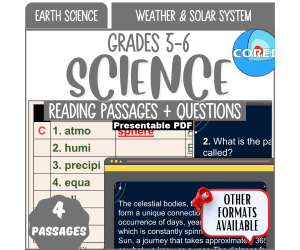
Reading Passages on Weather and Solar System Presentable PDF
ELA, Reading, Reading Comprehension, Science, Earth and Environmental Sciences, Earth Sciences, Common Core, ESL, Language Development, Space, Grade 5, 6, 7, Worksheets, Worksheets & Printables, Assessments, Teacher Tools, Tests, Quizzes and Tests, Diagrams, Centers, Activities
Reading Passages on Weather and Solar System for Earth Science Part 3 - Weather & Solar System Reading Passage 1: Earth Moon and Sun Reading Passage 2: Weather Measurement Causes and Changes Reading Passage 3: Classification of the Sun and Other Stars Reading Passage 4: Inner and Outer Solar System PRESENTABLE PDF VERSION Run it like a slide show straight from a PDF, with no PowerPoint or extra software needed, just open, project, and teach. Other versions are available in the links list below or in the full catalog. Snapshot Genre: Nonfiction. Subject: Science / Earth and Space Science. Primary Topic: Earth-space relationships, weather, stars, and planets. Estimated Guided Reading Level (A–Z): V. What This Teaches Best It explains how Earth’s rotation and revolution relate to day, night, years, seasons, and time zones. It shows how the Moon’s orbit connects to phases, tides, and eclipses. It teaches how weather forms through solar heating, air movement, air pressure, humidity, condensation, precipitation, and the water cycle. It introduces the Sun as a star and compares stars by brightness, color, temperature, and constellations. It compares inner terrestrial planets with outer Jovian planets and highlights notable traits of each planet. Learning Goals Students will explain how Earth’s movements cause day and night and support the calendar year. Students will describe how the Moon affects phases, tides, and eclipses. Students will explain how the sun drives weather and how water moves through the atmosphere. Students will describe how stars are classified by brightness and color. Students will compare the inner and outer planets using details from the text. FULL CATALOG OF DOWNLOAD LINKS HERE Grade 5/6 Links: Physical Science Part 1 - Physical and Chemical Properties Google Docs/Slides/Forms PDF PPT Word Free Supplementary Pack Accompanying Videos Physical Science Part 2 - Motion and Energy Google Docs/Slides/Forms PDF PPT Word Free Supplementary Pack Accompanying Videos Physical Science Part 3 - Electricity and Magnets Google Docs/Slides/Forms PDF PPT Word Free Supplementary Pack Accompanying Videos Life Science Part 1 - Cells, Reproduction and Genetics Google Docs/Slides/Forms PDF PPT Word Free Supplementary Pack Accompanying Videos Life Science Part 2 - Human Body Systems Google Docs/Slides/Forms PDF PPT Word Free Supplementary Pack Accompanying Videos Life Science Part 3 - Plant Parts and Ecosystems Google Docs/Slides/Forms PDF PPT Word Free Supplementary Pack Accompanying Videos Earth Science Part 1 - Plate Tectonics and Rock Cycle Google Docs/Slides/Forms PDF PPT Word Free Supplementary Pack Accompanying Videos Earth Science Part 2 - Ocean Exploration and Natural Resources Google Docs/Slides/Forms PDF PPT Word Free Supplementary Pack Accompanying Videos Earth Science Part 3 - Weather and Solar System Google Docs/Slides/Forms PDF PPT Word Free Supplementary Pack Accompanying Videos For similar products and other frees, do check out Cored Group on TeachSimple .
Author Cored Education
Rating
Tags Science, Elementary, Reading, Comprehension, Vocabulary, Reading Centers, Science Assessments, Reading Comprehension Assessments, Vocabulary Assessments, Earth Science

READING-COMPREHENSION PACK | 3D PRINTING | 20 FREE PAGES FOR KIDS
Reading, ELA, Writing, Technology, Science, Adult Education, Elementary, High School, Homeschool Resources, Middle School, Not Grade Specific, Anchor Charts, Teacher Tools, Assessments, Quizzes and Tests, Literacy Readers
READING-COMPREHENSION PACK | 3D PRINTING | 20 FREE PAGES FOR KIDS SUMMARY OF THIS PRODUCT: What is the name of the document?: READING-COMPREHENSION PACK | 3D PRINTING How many pages does it include?: 20 In what format is it available (PDF, Word, PPT)?: PDF Is it in color or black and white?: COLOR ABOUT THE AUTHOR: At EDITORIAL ARENAS EDUCATIVAS, we specialize in designing high-quality educational materials. We want every child to discover that learning can be both entertaining and creative. I invite you to explore my educational store and discover the wide collection of resources available for your classroom or home. MAIN DESCRIPTION OF THIS PRODUCT: What is the name of your product and what makes it special? This beautiful product is called “READING-COMPREHENSION PACK | 3D PRINTING”, and it is very special because it was carefully designed or compiled. With this educational resource, we want students to learn with enthusiasm and fun, because we believe learning is fun. How many pages are included in this resource? This fabulous document contains the following number of pages: 20 What size is it designed in (A4, letter, etc.)? This resource is designed in A4 format and compiled as a PDF. This makes downloading and printing simple and convenient, and PDFs are also easy to store and carry anywhere. PDF A4 SECONDARY AND COMPLEMENTARY INFORMATION: What subject or area does it cover? This educational document covers basic knowledge areas all students should have, such as math and literacy. What skills or competencies does it develop? Thanks to this fabulous resource, students will first be able to develop their knowledge, attention, and concentration. Who can use it (teachers, parents, therapists, students)? This document can be adapted according to the person using it. If you’re a teacher, you can use it; if you do homeschooling, you can also use it. Therapists can use it for students with learning difficulties, and even self-learners will find it very useful.
Author EDITORIAL LAURA EDUCA
Rating
Tags FREE, FREE RESOURCES, WRITING, READING, COMPREHENSION, ANCHOR CHART, 3D PRINTING
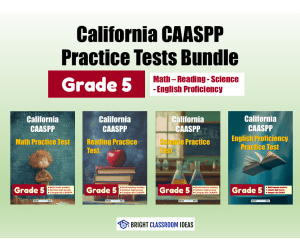
California CAASPP Practice Tests Bundle for Grade 5
ELA, Math, Science, Grade 5, Assessments, Teacher Tools, Tests, Quizzes and Tests, Worksheets & Printables
Prepare your students for success with this Grade 5 CAASPP Practice Tests Bundle . This complete resource includes Math, Reading, Science, and English Proficiency practice tests. It helps students build confidence and get familiar with real test-style questions across all subjects. It is clear, structured, and easy to use. The bundle includes four full practice tests that mirror CAASPP format and expectations. Students practice math problem solving, reading comprehension, scientific thinking, and language skills. The questions support critical thinking and real test readiness. Each test includes an answer key for quick and easy grading. All materials are printable and ready for classroom use. This bundle can be used by teachers for independent work, small group instruction, review sessions, and test preparation. Additionally, it is effective for subplans, evaluation days, and homework. Students learn how to confidently approach various question styles while developing skills in a variety of disciplines. Simply print and utilize. This Grade 5 CAASPP bundle helps students feel confident and prepared for success while simplifying exam preparation.
Author Bright Classroom Ideas Marketplace
Rating
Tags California, Caaspp, State Test, Math, Reading, Science, English Proficiency
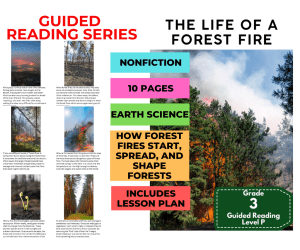
The Life of a Forest Fire: Guided Reading Level P with Lesson Plan
ELA, Resources for Teachers, Reading Comprehension, Reading, Science, Language Development, Life Sciences, Earth and Environmental Sciences, Physics, Technology, Grade 2, 3, 4, Worksheets & Printables, Worksheets, Teacher Tools, Centers, Activities, Literacy Readers, Quizzes, Quizzes and Tests, Assessments, Lesson Plans
This The Life of a Forest Fire (level p) guided reading book with lesson plan includes: Guided Reading Color Label (front cover x1) This is a quick way to match the book’s demands to what students can generally handle.. The overall goal is to use the level/color to pick books for several smaller groups. To qualify for a certain level, a student is expected to read a book from that level with about 90–94% accuracy. If a student is consistently accurate and understands, move up a level. If the student is struggling at that level, drop down and add more support. Each student will improve at completely different rates, but it is generally one of the best ways to check progress across the class. DOWNLOAD THE CATALOG TO VIEW ALL GUIDED READING BOOKS AVAILABLE (SORTED LEVELS A-Z) Pre-Reading Question (x1) Teacher asks the prompt aloud, can be while showing the cover or first page. Students share what they already know, or make educated guesses from the cover. Prompt them to use the target vocabulary. Write some of their responses on the board to look back at during the reading. Vocabulary Words (x5) Introduce the five words, best doing it one at a time. Start by saying it, while students repeat and then see if anyone knows what it means before reading further. Read through the meaning and try to briefly connect each word to a picture or gesture so it’s meaningful. Ask students to flip through the book pages and point to where they see each of the vocabulary words. While reading the book pause upon coming across one of the vocab words or read the sentence twice to make sure students understand the word has appeared. Optional: Ask students to raise hands whenever they see/hear one of the new words. Guided Reading Pages (x10) Check the book snapshot (below) for: primary topic - do you need to prep extra reading or intro materials on this? what is taught best - decide on 1-2 bullets to focus on, use the prompt or words provided here for best results. learning goals - what you are checking for students to be able to do after the session, elicit answers using prompts or words provided. key vocabulary (see section above). questions overview - so you know what is coming up and if you need to prep extra materials to assist understanding. Run the lesson You may have already looked at a few of the pages together, but you can show them some of the pictures again first to set meaning. Depending on how much time you have and how familiar your students are with guided reading class, you may want to read the book aloud first with the group first. Students whisper or partner read, while you listen in. If time, do it as a group, one student reading a page each. Use the guided page’s prompts to coach: “Check the picture / does it make sense?” “Point under the words / try the first sound” “Reread the sentence smoothly”. Try to focus more on one student per session (rotating every time), so you can work out if they are ready to move up or need to move down a level. Comprehension Questions (back cover x3) This is your way to check that students didn’t just say the words, but actually understood the text. First, let students answer by pointing to the page/picture and saying a short sentence. After any answer, follow with: “Show me where you found that in the text.” In bigger groups, have partners answer first (10–20 seconds), then call on 2–3 students to share. Differentiation tips: Emerging speakers/struggling readers: oral + pointing On-level: oral in a full sentence Higher: one written sentence or draw + label Book Snapshot Title: The Life of a Forest Fire Genre: Nonfiction (informational) Subject: Earth & Environmental Science Primary Topic: How forest fires start, spread, and shape forests Estimated Guided Reading Level (A–Z): P What This Book Teaches Best Explains common natural causes of forest fires , including how lightning can ignite dry wood and start a blaze. Teaches the Fire Triangle (heat, fuel, oxygen) and applies it to forest conditions like pine needles, branches, and grass as fuel. Compares types of forest fires (surface fires vs. crown fires) using clear, text-based differences in location, intensity, and damage. Shows how wind affects fire behavior , including carrying embers ahead of the fire and starting new fires through “spotting.” Describes fire’s ecological role and forest recovery , including nutrients returning to soil, new plant growth, and succession over time. Learning Goals Students can explain how a forest fire can begin in nature using details from the text (spark/lightning/heat on dry wood). Students can identify and describe the three parts of the Fire Triangle and explain why each is needed for a fire to keep burning. Students can compare a surface fire and a crown fire by describing where each burns and what the text says it can damage. Students can describe how wind changes a fire’s spread, including what “spotting” means in the text. Students can explain ways fire can help a forest over time (clearing debris, returning nutrients, creating open spaces for sunlight). Students can describe what happens after a fire during succession, using the sequence of changes described in the book. Key Vocabulary From the Text ecosystems — places where living things and land work together. ignite — to start burning. oxygen — a gas in air that fire needs. embers — small burning pieces carried ahead of a fire. succession — how a forest grows back after a fire. Discussion Prompts Pre-reading question: What are some natural ways a forest fire might start? Comprehension questions: What three elements does the text say a fire needs to exist? Comprehension questions: How does the text describe a surface fire as different from a crown fire? Comprehension questions: According to the text, what happens to the forest after a fire during succession? Printing Tips 1. Best Printing Method (Recommended) “Booklet” Printing (Best if Available) If your printer or PDF viewer supports Booklet Printing , use this. Settings to use: Print mode: Booklet Paper size: Letter or A4 (either works) Orientation: Landscape Print on both sides: Yes Flip on: Short edge Scaling: Fit to printable area Booklet subset: First test: Front sides only Then: Back sides only This will automatically: Pair pages correctly Put the cover on the outside Align everything for folding After printing, fold in half and staple along the spine . 2. If “Booklet” Printing Is NOT Available You can still print this correctly with manual duplex printing . Step-by-step: Open the PDF. Choose Print . Set: Orientation: Landscape Pages per sheet: 1 Print on both sides: Yes Flip on: Short edge Print all pages . Because each PDF page already contains two facing book pages, the result will still fold cleanly into a book. Thousands of Cored Education products are included with your TeachSimple membership. Download links and encyclopedia index available here.
Author Cored Education
Rating
Tags Reading Comprehension, Reading Passages, Reading, Guided Reading, Guided Reading Lesson Plan, Guided Reading Activity, Pre-reading, Science Lesson Plans, Earth Science, Physics
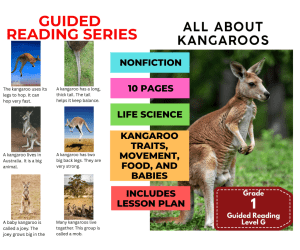
All About Kangaroos: Guided Reading Level G with Lesson Plan
ELA, Resources for Teachers, Reading Comprehension, Reading, Science, Language Development, Vocabulary, Life Sciences, Geography, Social Studies, Kindergarten, Grade 1, 2, Worksheets & Printables, Worksheets, Teacher Tools, Centers, Activities, Literacy Readers, Quizzes, Quizzes and Tests, Assessments, Lesson Plans
This All About Kangaroos (level g) guided reading book with lesson plan includes: Guided Reading Color Label (front cover x1) This is a quick way to match the book’s demands to what students can generally handle.. The overall goal is to use the level/color to pick books for several smaller groups. To qualify for a certain level, a student is expected to read a book from that level with about 90–94% accuracy. If a student is consistently accurate and understands, move up a level. If the student is struggling at that level, drop down and add more support. Each student will improve at completely different rates, but it is generally one of the best ways to check progress across the class. DOWNLOAD THE CATALOG TO VIEW ALL GUIDED READING BOOKS AVAILABLE (SORTED LEVELS A-Z) Pre-Reading Question (x1) Teacher asks the prompt aloud, can be while showing the cover or first page. Students share what they already know, or make educated guesses from the cover. Prompt them to use the target vocabulary. Write some of their responses on the board to look back at during the reading. Vocabulary Words (x5) Introduce the five words, best doing it one at a time. Start by saying it, while students repeat and then see if anyone knows what it means before reading further. Read through the meaning and try to briefly connect each word to a picture or gesture so it’s meaningful. Ask students to flip through the book pages and point to where they see each of the vocabulary words. While reading the book pause upon coming across one of the vocab words or read the sentence twice to make sure students understand the word has appeared. Optional: Ask students to raise hands whenever they see/hear one of the new words. Guided Reading Pages (x10) Check the book snapshot (below) for: primary topic - do you need to prep extra reading or intro materials on this? what is taught best - decide on 1-2 bullets to focus on, use the prompt or words provided here for best results. learning goals - what you are checking for students to be able to do after the session, elicit answers using prompts or words provided. key vocabulary (see section above). questions overview - so you know what is coming up and if you need to prep extra materials to assist understanding. Run the lesson You may have already looked at a few of the pages together, but you can show them some of the pictures again first to set meaning. Depending on how much time you have and how familiar your students are with guided reading class, you may want to read the book aloud first with the group first. Students whisper or partner read, while you listen in. If time, do it as a group, one student reading a page each. Use the guided page’s prompts to coach: “Check the picture / does it make sense?” “Point under the words / try the first sound” “Reread the sentence smoothly”. Try to focus more on one student per session (rotating every time), so you can work out if they are ready to move up or need to move down a level. Comprehension Questions (back cover x3) This is your way to check that students didn’t just say the words, but actually understood the text. First, let students answer by pointing to the page/picture and saying a short sentence. After any answer, follow with: “Show me where you found that in the text.” In bigger groups, have partners answer first (10–20 seconds), then call on 2–3 students to share. Differentiation tips: Emerging speakers/struggling readers: oral + pointing On-level: oral in a full sentence Higher: one written sentence or draw + label Book Snapshot Title: All About Kangaroos Genre: Nonfiction (informational) Subject: Science (Life Science) Primary Topic: Kangaroo traits, movement, food, and babies Estimated Guided Reading Level (A–Z): G What This Book Teaches Best Identifies a kangaroo’s habitat by stating it lives in Australia . Describes how kangaroos move: they have two big back legs , and they hop very fast. Explains how a kangaroo’s tail helps it by keeping balance . Shares what kangaroos eat by stating they like green grass and find food on the ground. Teaches family/group terms: a baby is a joey that grows in the pouch , and a group is a mob . Learning Goals Students will identify where a kangaroo lives using details from the text. Students will describe how kangaroos move, using the book’s words and examples. Students will explain how a kangaroo’s tail helps it keep balance. Students will describe what kangaroos eat and where they find food. Students will name what a baby kangaroo is called and where it grows. Students will identify what a group of kangaroos is called. Key Vocabulary From the Text Australia — a country where kangaroos live. balance — staying steady and not falling over. pouch — a pocket where a mother carries her baby. joey — a baby kangaroo. mob — a group of kangaroos that live together. Discussion Prompts Pre-reading question: What do you already know about kangaroos? Comprehension questions: Where does the book say a kangaroo lives? Comprehension questions: How does a kangaroo move in this book? Comprehension questions: What is a group of kangaroos called? Printing Tips 1. Best Printing Method (Recommended) “Booklet” Printing (Best if Available) If your printer or PDF viewer supports Booklet Printing , use this. Settings to use: Print mode: Booklet Paper size: Letter or A4 (either works) Orientation: Landscape Print on both sides: Yes Flip on: Short edge Scaling: Fit to printable area Booklet subset: First test: Front sides only Then: Back sides only This will automatically: Pair pages correctly Put the cover on the outside Align everything for folding After printing, fold in half and staple along the spine . 2. If “Booklet” Printing Is NOT Available You can still print this correctly with manual duplex printing . Step-by-step: Open the PDF. Choose Print . Set: Orientation: Landscape Pages per sheet: 1 Print on both sides: Yes Flip on: Short edge Print all pages . Because each PDF page already contains two facing book pages, the result will still fold cleanly into a book. Thousands of Cored Education products are included with your TeachSimple membership. Download links and encyclopedia index available here.
Author Cored Education
Rating
Tags Reading Comprehension, Reading Passages, Reading, Guided Reading, Guided Reading Lesson Plan, Guided Reading Activity, Pre-reading, Science Lesson Plans, Life Science, Geography

Earth Science Reading Comprehension Passage: The Water Cycle (PDF)
Science, ELA, Reading, Reading Comprehension, Strategies, Resources for Teachers, Earth and Environmental Sciences, Earth Sciences, Environmental Science, Grade 6, 7, 8, 9, Writing Prompts, Worksheets & Printables, Centers, Activities, Teacher Tools, Assessments, Quizzes and Tests, Quizzes, Tests
Science Reading Comprehension Passages and Questions: The Water Cycle (PDF) This very engaging earth science reading passage about the Water Cycle . It is designed to bridge the gap between science and literacy through strengthening reading comprehension and sparking scientific curiosity in middle school students. The passage blends English Language Arts skills with accurate science content that supports NGSS classroom practice. Ideal for interdisciplinary learning in ELA and Science. Suitable for Grade 9 review, too! Student Tasks for The Passage: 5 multiple-choice questions targeting main idea, key details, inference, vocabulary in context, and use of evidence 5 vocabulary matching items with clear, student-friendly definitions 5 text-based questions that require citing specific lines or facts 1 summary prompt that asks students to condense central ideas accurately Full answer key for every section Available Formats for this Resource Fillable PDF Word Docs Google Docs FULL CATALOG OF DOWNLOADING LINKS HERE Product Details Length: 5 pages total Grades: 6–8, also suitable for Grade 9 review Use cases: close reading, stations, homework, intervention, test prep, and sub plans Standards support: reinforces informational-text skills and supports NGSS-style sense making through observation, modeling, and clear use of claim, evidence, and reasoning Why Teachers Choose This Set Authentic science content paired with rigorous literacy practice Consistent task structure across all passages for easier planning and smoother student routines Clear, age-appropriate writing that builds confidence without oversimplifying Other Science Reading Collections you May find in the store: 1. Astronomy & Space Science 2. Volcanoes, Rocks, & Mountains 3. Rock Cycle, Soil, & Sinkholes 4. Mars, Glaciers, & Antarctica 5. Water Cycle, Acid Rain, & Wastewater 6. Insects, Animals, & Ecosystems 7. Bioluminescence & Insects 8. Animal Skin, Cats, & T. Rex 9. Human Body and Senses 10. Health & Applied Bioscience 11. Waves, Light, & Imaging 12. Electricity & Energy 13. Motion & Materials 14. Chemistry and Materials Science Use this set to reinforce ELA skills in science, to add literacy to your lessons, and to support independent work. The passages strengthen main idea, evidence use, vocabulary in context, inference, cause and effect, and summary writing. With ready-to-use assessments and complete answer keys, you can provide focused practice that is simple to run and fast to review.
Author Middle & High School - CORED Education
Rating
Tags Middle School, Reading Comprehension, Reading Strategies, ELA, Centers, Reading Passage, Assessments, Vocabulary, Environmental Science, Water Cycle

Science Reading Comprehension Physical & Chemical Properties Fillable
Science, Physics, Common Core, Reading Comprehension, Reading, ELA, Resources for Teachers, ESL, Language Development, Vocabulary, Grade 5, 6, 7, Worksheets & Printables, Worksheets, Centers, Activities, Tests, Quizzes and Tests, Teacher Tools, Quizzes, Assessments
Reading Comprehension Passages on Physical and Chemical Properties for Physical Science Physical & Chemical Properties Reading Passage1: Measuring Matter: Mass, Volume, and Density Reading Passage2: Physical and Chemical Properties of Matter Reading Passage 3: Physical and Chemical Changes in Matter Reading Passage4: Atoms, Elements, and Compounds Reading Passage5: Chemicals: Helpful and Harmful FILLABLE PDF VERSION Worksheet-style pages, but with type-in answer boxes so students can complete and save their work digitally. Other versions are available in the links list below or in the full catalog. Snapshot Genre: Nonfiction Subject: Physical Science Primary Topic: properties, changes, and structure of matter Estimated Guided Reading Level (A–Z): W What This Teaches Best Shows how to measure matter using mass, volume, and density, including formulas, cubic centimeters, milliliters, and a graduated cylinder. Teaches students to distinguish physical properties from chemical properties using examples such as buoyancy, conductivity, solubility, and flammability. Explains physical and chemical changes in matter, including melting, boiling, evaporation, condensation, mixtures, solutions, suspensions, and combustion. Builds foundational chemistry knowledge about atoms, elements, compounds, subatomic particles, and how the periodic table is organized. Connects chemistry to everyday safety by explaining acids, bases, neutral substances, pH testing, and safe handling of chemicals. Learning Goals Students will describe matter as anything that has weight and takes up space. Students will measure or calculate mass, volume, and density using the units and formulas given in the text. Students will identify and compare physical properties and chemical properties of matter using examples from the text. Students will explain the difference between physical changes and chemical changes using evidence from the lesson examples. Students will identify the parts of an atom and explain how elements and compounds are related. Students will classify substances as acidic, basic, or neutral and describe why some chemicals must be handled carefully. FULL CATALOG OF DOWNLOAD LINKS HERE Grade 5/6 Links: Physical Science Part 1 - Physical and Chemical Properties Google Docs/Slides/Forms PDF PPT Word Free Supplementary Pack Accompanying Videos Physical Science Part 2 - Motion and Energy Google Docs/Slides/Forms PDF PPT Word Free Supplementary Pack Accompanying Videos Physical Science Part 3 - Electricity and Magnets Google Docs/Slides/Forms PDF PPT Word Free Supplementary Pack Accompanying Videos Life Science Part 1 - Cells, Reproduction and Genetics Google Docs/Slides/Forms PDF PPT Word Free Supplementary Pack Accompanying Videos Life Science Part 2 - Human Body Systems Google Docs/Slides/Forms PDF PPT Word Free Supplementary Pack Accompanying Videos Life Science Part 3 - Plant Parts and Ecosystems Google Docs/Slides/Forms PDF PPT Word Free Supplementary Pack Accompanying Videos Earth Science Part 1 - Plate Tectonics and Rock Cycle Google Docs/Slides/Forms PDF PPT Word Free Supplementary Pack Accompanying Videos Earth Science Part 2 - Ocean Exploration and Natural Resources Google Docs/Slides/Forms PDF PPT Word Free Supplementary Pack Accompanying Videos Earth Science Part 3 - Weather and Solar System Google Docs/Slides/Forms PDF PPT Word Free Supplementary Pack Accompanying Videos For similar products and other frees, do check out Cored Group on TeachSimple .
Author Cored Education
Rating
Tags Science, Elementary, Reading, Comprehension, Vocabulary, Physics, Physical Science, Printables, Worksheets, Reading Passages

Physical Science Reading Comprehension Passage: Magnets (Word)
Science, ELA, Reading, Reading Comprehension, Strategies, Resources for Teachers, Physics, Grade 6, 7, 8, 9, 10, Writing Prompts, Worksheets & Printables, Centers, Activities, Teacher Tools, Assessments, Quizzes and Tests, Quizzes, Tests
Physical Science Reading Comprehension Passage and Questions: Magnets (Word Document) This very engaging science reading passage is about magnetism and the invisible forces magnets exert on certain materials . It explains magnetic fields, north and south poles, attraction and repulsion, and why materials such as iron, nickel, and cobalt respond strongly to magnets. Students also compare permanent magnets with electromagnets and explore how magnets are used in compasses, speakers, scrapyard cranes, MRI machines, and other everyday technologies. This passage is designed to bridge the gap between science and literacy by strengthening reading comprehension while sparking scientific curiosity in middle school students. It blends English Language Arts skills with accurate science content, helping students build background knowledge, understand key concepts, use evidence from the text, and explain scientific ideas clearly. This resource supports science classroom practice while also reinforcing important literacy skills such as main idea, vocabulary, comprehension, and summarizing. Ideal for interdisciplinary learning in ELA and Science. Suitable for Grade 9 review, too! Student Tasks for The Passage: 10 multiple-choice questions targeting main idea, key details, science concepts, comparison, and real-world applications 10 True/False statements to check understanding and address common misconceptions 5 text-based short-answer questions that require students to explain important ideas from the passage 5 vocabulary matching items with clear, student-friendly definitions 1 summary prompt that asks students to condense the central ideas accurately Full answer key for every section Available Formats for this Resource PDF Fillable PDF Google Docs FULL CATALOG OF DOWNLOADING LINKS HERE Product Details Length: 7 pages total Grades: 6–8, also suitable for Grade 9 review Use cases: close reading, stations, homework, intervention, test prep, and sub plans Standards support: Reinforces informational-text skills and supports NGSS-style sense-making by helping students read scientific explanations, connect evidence to key concepts, interpret real-world examples, and explain cause-and-effect relationships in science. Why Teachers Choose This Set Authentic science content paired with rigorous literacy practice Consistent task structure across all passages for easier planning and smoother student routines Clear, age-appropriate writing that builds confidence without oversimplifying Other Science Reading Collections and Topics You May Find in the Store: 1. Astronomy & Space Science 2. Volcanoes, Rocks, & Mountains 3. Rock Cycle, Soil, & Sinkholes 4. Mars, Glaciers, & Antarctica 5. Water Cycle, Acid Rain, & Wastewater 6. Insects, Animals, & Ecosystems 7. Bioluminescence & Insects 8. Animal Skin, Cats, & T. Rex 9. Human Body and Senses 10. Health & Applied Bioscience 11. Waves, Light, & Imaging 12. Electricity & Energy 13. Motion & Materials 14. Chemistry and Materials Science 15. Electromagnetism 16. Acids and Bases 17. Gas Laws 18. Biotechnology 19. Periodic Trends 20. Protists and Fungi 21. Microevolution 22. Blood 23. Chemical Bonding 24. Magnets 25. Muscles 26. Nuclear Chemistry 27. Electromagnetic Devices 28. Epigenetics 29. The Law of Conservation of Mass 30. Atomic Models 31. Isotopes and Ions 32. Light 33. Human-Environment Interaction 34. Theory of Evolution 35. Photosynthesis 36. Origins of Life and Early Earth 37. Gene Expression and Regulation 38. Thermochemistry 39. Allergies 40. Coevolution 41. Birth to Adulthood 42. Cells 43. Entropy and Free Energy 44. The Human Brain 45. Mixtures and Solutions 46. Invertebrates 47. Zoo Animals 48. Biochemistry 49. Animal Behavior 50. Population Ecology ...and many more engaging science reading passages that cover intriguing and important topics designed to spark curiosity and support student learning. Use this passage to reinforce ELA skills in science, to add literacy to your lessons, and to support independent work. The passages strengthen main idea, evidence use, vocabulary in context, inference, cause and effect, and summary writing. With ready-to-use assessments and complete answer keys, you can provide focused practice that is simple to run and fast to review.
Author Middle & High School - CORED Education
Rating
Tags Middle School, Reading Comprehension, Reading Strategies, ELA, Centers, Reading Passage, Assessments, Vocabulary, Physical Science, Magnets

Science Reading Passages on Light Heat Electricity Magnetism (PDF)
Science, Physics, Common Core, ESL, Language Development, ELA, Vocabulary, Reading Comprehension, Reading, Grade 2, 3, 4, Worksheets & Printables, Worksheets, Assessments, Teacher Tools, Tests, Quizzes and Tests
Reading Passages on Light Heat Electricity Magnetism for Physical Science Light Heat Electricity Magnetism: Reading Passages Physical Science is a versatile package of science reading lessons offering an engaging way to practice and learn science concepts. Each passage is followed by a set of questions that demand a variety of skills, ensuring that every reader is challenged and engaged. With topics covering light, heat, and electrical circuits, the lessons provide a comprehensive and enjoyable approach to mastering these essential scientific principles. What's inside? Part 3 - Light, Heat, Electricity & Magnetism. Reading Passage 1: Characteristics of Light: Reflection and Refraction Reading Passage 2: Heat, Sources of Heat, and Heat Conduction Reading Passage 3: Electricity, Electrical Circuits, and Energy Reading Passage 4: Symbols and Electric Circuits Reading Passage 5: Magnets Magnetism and Electromagnetism Product Info: 27 pages Teaching Duration: 2 Weeks Science Reading Comprehension Outline: Targeted for students in 3rd and 4th grades, these reading passages are enhanced with illustrations and graphs to elucidate critical points. Each lesson aligns with the Common Core State Standards, allowing you to integrate science reading practice effortlessly, knowing that minimal preparation is needed on your part. Each passage comes with a variety of questions in different formats, including multiple-choice formats, data analysis, and fill-in-the-blanks. The topics covered strike a balance between engaging content and core curriculum-based science subjects. Versatile in application, these lessons are suitable for a variety of settings such as whole-class instruction, morning activities, independent desk work, small group discussions, contingency plans for substitute teachers, homework assignments, or even special holiday-themed tasks. FULL CATALOG OF DOWNLOAD LINKS HERE Grade 3/4 Links: Physical Science Part 1 - Properties of Objects and Materials Google Docs/Slides/Forms PDF PPT Word Free Supplementary Pack Accompanying Videos Physical Science Part 2 - Position and Motion of Objects Google Docs/Slides/Forms PDF PPT Word Free Supplementary Pack Accompanying Videos Physical Science Part 3 - Light, Heat, Electricity, Magnetism Google Docs/Slides/Forms PDF PPT Word Free Supplementary Pack Accompanying Videos Life Science Part 1 - Characteristics of Organisms Google Docs/Slides/Forms PDF PPT Word Free Supplementary Pack Accompanying Videos Life Science Part 2 - Life Cycles of Organisms Google Docs/Slides/Forms PDF PPT Word Free Supplementary Pack Accompanying Videos Life Science Part 3 - Organisms and Environments Google Docs/Slides/Forms PDF PPT Word Free Supplementary Pack Accompanying Videos Earth Science Part 1 - Properties of Earth Materials Google Docs/Slides/Forms PDF PPT Word Free Supplementary Pack Accompanying Videos Earth Science Part 2 - Changes in the Earth and Sky Google Docs/Slides/Forms PDF PPT Word Free Supplementary Pack Accompanying Videos Earth Science Part 3 - Objects in the Sky Google Docs/Slides/Forms PDF PPT Word Free Supplementary Pack Accompanying Videos For similar products and other frees, do check out Cored Group on TeachSimple .
Author Cored Education
Rating
Tags Science, Elementary, Reading, Comprehension, Vocabulary, Physics, Physical Science, Reading Comprehension Assessments, Science Assessments, Vocabulary Assessments

Life Science Reading Comprehension Passage: Muscular System (Word)
Science, ELA, Reading, Reading Comprehension, Strategies, Resources for Teachers, Life Sciences, Biology, Human Body, Grade 6, 7, 8, 9, 10, Writing Prompts, Worksheets & Printables, Centers, Activities, Teacher Tools, Assessments, Quizzes and Tests, Quizzes, Tests
Life Science Reading Comprehension Passage and Questions: Muscular System (Word) This very engaging science reading passage is about the muscular system and how different types of muscles help the body move and function . It explains how skeletal muscles move bones, how smooth muscles work automatically inside organs and blood vessels, and how cardiac muscle pumps blood through the body. Students also learn how muscles work in pairs, how the nervous system sends signals that control contraction, and why exercise, protein, and rest are important for muscle strength and recovery. This passage is designed to bridge the gap between science and literacy by strengthening reading comprehension while sparking scientific curiosity in middle school students. It blends English Language Arts skills with accurate science content, helping students build background knowledge, understand key concepts, use evidence from the text, and explain scientific ideas clearly. This resource supports science classroom practice while also reinforcing important literacy skills such as main idea, vocabulary, comprehension, and summarizing. Ideal for interdisciplinary learning in ELA and Science. Suitable for Grade 9 review, too! Student Tasks for The Passage: 10 multiple-choice questions targeting main idea, key details, science concepts, comparison, and real-world applications 10 True/False statements to check understanding and address common misconceptions 5 text-based short-answer questions that require students to explain important ideas from the passage 5 vocabulary matching items with clear, student-friendly definitions 1 summary prompt that asks students to condense the central ideas accurately Full answer key for every section Available Formats for this Resource PDF Fillable PDF Google Docs FULL CATALOG OF DOWNLOADING LINKS HERE Product Details Length: 7 pages total Grades: 6–8, also suitable for Grade 9 review Use cases: close reading, stations, homework, intervention, test prep, and sub plans Standards support: Reinforces informational-text skills and supports NGSS-style sense-making by helping students read scientific explanations, connect evidence to key concepts, interpret real-world examples, and explain cause-and-effect relationships in science. Why Teachers Choose This Set Authentic science content paired with rigorous literacy practice Consistent task structure across all passages for easier planning and smoother student routines Clear, age-appropriate writing that builds confidence without oversimplifying Other Science Reading Collections and Topics You May Find in the Store: 1. Astronomy & Space Science 2. Volcanoes, Rocks, & Mountains 3. Rock Cycle, Soil, & Sinkholes 4. Mars, Glaciers, & Antarctica 5. Water Cycle, Acid Rain, & Wastewater 6. Insects, Animals, & Ecosystems 7. Bioluminescence & Insects 8. Animal Skin, Cats, & T. Rex 9. Human Body and Senses 10. Health & Applied Bioscience 11. Waves, Light, & Imaging 12. Electricity & Energy 13. Motion & Materials 14. Chemistry and Materials Science 15. Electromagnetism 16. Acids and Bases 17. Gas Laws 18. Biotechnology 19. Periodic Trends 20. Protists and Fungi 21. Microevolution 22. Blood 23. Chemical Bonding 24. Magnets 25. Muscles 26. Nuclear Chemistry 27. Electromagnetic Devices 28. Epigenetics 29. The Law of Conservation of Mass 30. Atomic Models 31. Isotopes and Ions 32. Light 33. Human-Environment Interaction 34. Theory of Evolution 35. Photosynthesis 36. Origins of Life and Early Earth 37. Gene Expression and Regulation 38. Thermochemistry 39. Allergies 40. Coevolution 41. Birth to Adulthood 42. Cells 43. Entropy and Free Energy 44. The Human Brain 45. Mixtures and Solutions 46. Invertebrates 47. Zoo Animals 48. Biochemistry 49. Animal Behavior 50. Population Ecology ...and many more engaging science reading passages that cover intriguing and important topics designed to spark curiosity and support student learning. Use this passage to reinforce ELA skills in science, to add literacy to your lessons, and to support independent work. The passages strengthen main idea, evidence use, vocabulary in context, inference, cause and effect, and summary writing. With ready-to-use assessments and complete answer keys, you can provide focused practice that is simple to run and fast to review.
Author Middle & High School - CORED Education
Rating
Tags Middle School, Reading Comprehension, Reading Strategies, ELA, Centers, Reading Passage, Assessments, Vocabulary, Muscular System, Life Science

Video Editing Storyboard & B-Roll Worksheets
Resources for Teachers, Classroom Management, Community Building, Technology, Science, Computer Science, Engineering, Special Resources, Special Education Needs (SEN), Social Emotional Learning (SEL), Grade 6, 7, 8, 9, 10, 11, 12, Worksheets & Printables, Workbooks, Worksheets, Word Searches, Teacher Tools, Lesson Plans, Quizzes and Tests, Quizzes, Tests, Assessments
Transform Your Students from "Point-and-Shoot" Amateurs to "Architects of Cinema" with this Comprehensive Video Editing Pre-Production Unit! Are your students' video projects plagued by shaky footage, jarring cuts, and a lack of a clear story? Do they jump straight to filming without a plan, leaving them with hours of unusable footage and a messy, confusing final product? It's time to teach them the most crucial part of filmmaking: pre-production. This complete, no-prep Video Editing & Filmmaking Unit is a 42-page curriculum designed to teach middle and high school students the art and science of planning a video before the camera ever rolls. Rooted in the pedagogy of pre-visualization, this resource shifts the cognitive load from the stressful editing room to the structured, creative space of the storyboard. Students will learn the professional workflow that powers every great film, documentary, and YouTube video. What’s Included in this 2-Week Unit: Part 1: Instructional Text (10 Pages): Four in-depth chapters covering the core concepts of professional video editing theory, including: The Architecture of the Edit (Storyboards & the 180-Degree Rule) Mastering the Jump-Cut and Temporal Compression Transitional Theory (Match Cuts, Whip-Pans) Supplementary Footage (B-Roll) as Narrative Scaffolding Part 2: Student Workbook (18 Pages): Ten engaging, scaffolded worksheets that turn theory into practice. Students will plan, brainstorm, and problem-solve sequences for jump-cuts, transitions, B-roll, continuity, and more. Part 3: Teacher Resources & Visuals (14 Pages): Everything you need to teach with confidence, even with no film background! Visual Anchor Charts: Clear diagrams explaining Jump-Cut Mitigation, the Narrative Transition Matrix, and Pre-Visualizing the Edit Timeline. Perfect for projecting or printing. Comprehensive Teacher Answer Key: Detailed answers and sample responses for all 10 worksheets. 2-Week Implementation & Pacing Guide: A day-by-day plan (10 days) to effortlessly guide your class through the entire unit, from introducing concepts to a final, summative project blueprint. By the end of this unit, your students will not just create better videos; they will be more intentional storytellers, critical thinkers, and effective communicators in a digital world. Perfect for Media Arts, Digital Storytelling, Journalism, English Language Arts (ELA) project-based learning, Film Studies, and any class that involves video creation! Keywords: Video Editing, Filmmaking Unit, Storyboard Worksheet, B-Roll Planning, Jump Cuts, Media Arts Curriculum, Digital Storytelling, Project-Based Learning, Middle School Media, High School Film, Pre-Production, Visual Organizers, No-Prep Lesson, CTE, Technology, ELA. Why Parents/Schools Love It: Develops Critical Thinking, Not Just Tech Skills: This unit teaches students essential 21st-century skills like planning, problem-solving, sequencing, and foresight. It moves beyond just using an app and forces them to think like architects and authors. Builds Real-World, Professional Habits: It bridges the gap between casual social media video (TikToks) and the deliberate, structured workflow used in professional media careers, giving students a tangible advantage. Increases Engagement Through Relevance: It takes a subject students are already passionate about—creating videos—and injects academic rigor, making learning both fun and deeply meaningful. Comprehensive & Teacher-Friendly: It’s a complete, "print-and-go" curriculum. The included pacing guide, visual aids, and detailed answer key empower any teacher, regardless of their film experience, to deliver a high-quality, expert-level unit with confidence. Target Student Audience : Based on the language ("eighth-grade media scholars"), concepts, and structure, target: Primary Target: Grades 7-10 . This is the sweet spot. It's advanced enough for gifted 7th graders, perfect for 8th and 9th-grade media or tech classes, and a fantastic foundational unit for 10th-grade introductory film or journalism courses. Secondary Target: Grades 11-12 . This can serve as a powerful remediation or review unit for older students who lack foundational pre-production skills. It's also excellent for any ELA or Social Studies teacher doing a video project who needs a structured way to teach the technical planning aspect. Copyright/Terms of Use: This Book was copyrighted by Syed Hammad Rizvi. This resource is for personal and single classroom use only. You may not alter, redistribute, or sell any part of this resource. In other words, you may not put it on the Internet where it could be publicly found and downloaded. If you want to share this resource with colleagues, please purchase additional licenses from Teachsimple. Thank you for respecting these terms of use. This product is happily brought to you by Syed Hammad Rizvi
Author Creative Book Store
Rating
Tags VideoEditing, Filmmaking, DigitalStorytelling, MediaArts, ProjectBasedLearning, PBL, TeacherResources, LessonPlans, Storyboard, VideoProduction

Reading Comprehension on Cells, Reproduction and Genetics (PDF)
ELA, Reading, Reading Comprehension, Language Development, Common Core, ESL, Biology, Life Sciences, Science, Nature & Plants, Grade 5, 6, 7, Worksheets, Worksheets & Printables, Assessments, Teacher Tools, Tests, Quizzes and Tests, Diagrams, Centers, Activities
Reading Passages on Cells, Reproduction and Genetics for Life Science (Biology) Cells, Reproduction and Genetics: Reading Passages Life Science - Enhance your assessment process with this ready-to-use science reading passage pack. Featuring enjoyable topics and themes, it's tailored to ensure students not only practice but also deepen their scientific understanding in preparation for tests. With questions meticulously aligned to the Common Core State Standards (CCSS), the pack dives into intriguing subjects such as circuits, electricity, and energy sources. It's a must-have resource for educators aiming to make learning both fun and fruitful. What's inside? Part 1 - Cells, Reproduction, Genetics Reading Passage 1: Cells Reading Passage 2: Cell Parts & Functions Reading Passage 3: Reproduction & Growth of Cells Reading Passage 4: Genetics Reading Passage 5: DNA Reading Passage 6: Uses of Genetics Product Info: 48 PAGES (PDF Version: US English with Answers) Teaching Duration: 2 Weeks Science Reading Comprehension Outline: Introducing a comprehensive resource tailored for 5th and 6th graders, this product offers enriching reading passages supplemented with illustrative pictures and graphs to clarify key concepts. Aligned with the Common Core State Standards (CCSS), it offers a hassle-free approach to teaching, given that the bulk of the preparation is already done for you. The passages present a diverse set of questions – from multiple choice to data analysis and fill-in-the-blanks. This ensures a rich blend of high-interest content and fundamental curriculum-based science themes. With its versatility, you can seamlessly integrate these lessons into various classroom settings, whether it's whole class discussions, morning exercises, independent desk tasks, small group engagements, contingency plans for substitute teachers, regular homework assignments, or even themed activities for holidays. FULL CATALOG OF DOWNLOAD LINKS HERE Grade 5/6 Links: Physical Science Part 1 - Physical and Chemical Properties Google Docs/Slides/Forms PDF PPT Word Free Supplementary Pack Accompanying Videos Physical Science Part 2 - Motion and Energy Google Docs/Slides/Forms PDF PPT Word Free Supplementary Pack Accompanying Videos Physical Science Part 3 - Electricity and Magnets Google Docs/Slides/Forms PDF PPT Word Free Supplementary Pack Accompanying Videos Life Science Part 1 - Cells, Reproduction and Genetics Google Docs/Slides/Forms PDF PPT Word Free Supplementary Pack Accompanying Videos Life Science Part 2 - Human Body Systems Google Docs/Slides/Forms PDF PPT Word Free Supplementary Pack Accompanying Videos Life Science Part 3 - Plant Parts and Ecosystems Google Docs/Slides/Forms PDF PPT Word Free Supplementary Pack Accompanying Videos Earth Science Part 1 - Plate Tectonics and Rock Cycle Google Docs/Slides/Forms PDF PPT Word Free Supplementary Pack Accompanying Videos Earth Science Part 2 - Ocean Exploration and Natural Resources Google Docs/Slides/Forms PDF PPT Word Free Supplementary Pack Accompanying Videos Earth Science Part 3 - Weather and Solar System Google Docs/Slides/Forms PDF PPT Word Free Supplementary Pack Accompanying Videos For similar products and other frees, do check out Cored Group on TeachSimple .
Author Cored Education
Rating
Tags Science, Elementary, Reading, Comprehension, Vocabulary, Answers, Physics, Physical Science, Common Core, Reading Passages

Science Reading Passage. Stars of Many Sizes (Fillable PDF)
Science, ELA, Reading, Reading Comprehension, Strategies, Resources for Teachers, Space, Earth and Environmental Sciences, Grade 6, 7, 8, 9, Writing Prompts, Worksheets & Printables, Centers, Activities, Teacher Tools, Assessments, Quizzes and Tests, Quizzes, Tests
Science Reading Comprehension Passages and Questions: Stars of Many Sizes (Fillable PDF) This very engaging science reading passage about Stars of Many Sizes is designed to bridge the gap between science and literacy through strengthening reading comprehension and sparking scientific curiosity in middle school students. The passage blends English Language Arts skills with accurate science content that supports NGSS classroom practice. Ideal for interdisciplinary learning in ELA and Science. Suitable for Grade 9 review, too! These worksheets are designed as fillable PDFs , which means students can type their answers directly into the document on any computer or tablet . Each page includes highlighted text fields that show them exactly where to type! Student Tasks for The Passage: 5 multiple-choice questions targeting main idea, key details, inference, vocabulary in context, and use of evidence 5 vocabulary matching items with clear, student-friendly definitions 5 text-based questions that require citing specific lines or facts 1 summary prompt that asks students to condense central ideas accurately Full answer key for every section Available Formats for this Resource PDF Word Docs Google Docs FULL CATALOG OF DOWNLOADING LINKS HERE Product Details Length: 4 pages total Grades: 6–8, also suitable for Grade 9 review Use cases: close reading, stations, homework, intervention, test prep, and sub plans Standards support: reinforces informational-text skills and supports NGSS-style sense making through observation, modeling, and clear use of claim, evidence, and reasoning Why Teachers Choose This Set Authentic science content paired with rigorous literacy practice Consistent task structure across all passages for easier planning and smoother student routines Clear, age-appropriate writing that builds confidence without oversimplifying Other Science Reading Collections you May find in the store: 1. Astronomy & Space Science 2. Volcanoes, Rocks, & Mountains 3. Rock Cycle, Soil, & Sinkholes 4. Mars, Glaciers, & Antarctica 5. Water Cycle, Acid Rain, & Wastewater 6. Insects, Animals, & Ecosystems 7. Bioluminescence & Insects 8. Animal Skin, Cats, & T. Rex 9. Human Body and Senses 10. Health & Applied Bioscience 11. Waves, Light, & Imaging 12. Electricity & Energy 13. Motion & Materials 14. Chemistry and Materials Science Use this set to reinforce ELA skills in science, to add literacy to your lessons, and to support independent work. The passages strengthen main idea, evidence use, vocabulary in context, inference, cause and effect, and summary writing. With ready-to-use assessments and complete answer keys, you can provide focused practice that is simple to run and fast to review.
Author Middle & High School - CORED Education
Rating
Tags Middle School, Reading Comprehension, Reading Strategies, ELA, Centers, Reading Passage, Assessments, Vocabulary, Environmental Science, Space

Physical Science Reading Comprehension Passage: Magnets (Docs)
Science, ELA, Reading, Reading Comprehension, Strategies, Resources for Teachers, Physics, Grade 6, 7, 8, 9, 10, Writing Prompts, Worksheets & Printables, Centers, Activities, Teacher Tools, Assessments, Quizzes and Tests, Quizzes, Tests
Physical Science Reading Comprehension Passage and Questions: Magnets (Google Docs) This very engaging science reading passage is about magnetism and the invisible forces magnets exert on certain materials . It explains magnetic fields, north and south poles, attraction and repulsion, and why materials such as iron, nickel, and cobalt respond strongly to magnets. Students also compare permanent magnets with electromagnets and explore how magnets are used in compasses, speakers, scrapyard cranes, MRI machines, and other everyday technologies. This passage is designed to bridge the gap between science and literacy by strengthening reading comprehension while sparking scientific curiosity in middle school students. It blends English Language Arts skills with accurate science content, helping students build background knowledge, understand key concepts, use evidence from the text, and explain scientific ideas clearly. This resource supports science classroom practice while also reinforcing important literacy skills such as main idea, vocabulary, comprehension, and summarizing. Ideal for interdisciplinary learning in ELA and Science. Suitable for Grade 9 review, too! Student Tasks for The Passage: 10 multiple-choice questions targeting main idea, key details, science concepts, comparison, and real-world applications 10 True/False statements to check understanding and address common misconceptions 5 text-based short-answer questions that require students to explain important ideas from the passage 5 vocabulary matching items with clear, student-friendly definitions 1 summary prompt that asks students to condense the central ideas accurately Full answer key for every section Available Formats for this Resource PDF Fillable PDF Word Docs FULL CATALOG OF DOWNLOADING LINKS HERE Product Details Length: 7 pages total Grades: 6–8, also suitable for Grade 9 review Use cases: close reading, stations, homework, intervention, test prep, and sub plans Standards support: Reinforces informational-text skills and supports NGSS-style sense-making by helping students read scientific explanations, connect evidence to key concepts, interpret real-world examples, and explain cause-and-effect relationships in science. Why Teachers Choose This Set Authentic science content paired with rigorous literacy practice Consistent task structure across all passages for easier planning and smoother student routines Clear, age-appropriate writing that builds confidence without oversimplifying Other Science Reading Collections and Topics You May Find in the Store: 1. Astronomy & Space Science 2. Volcanoes, Rocks, & Mountains 3. Rock Cycle, Soil, & Sinkholes 4. Mars, Glaciers, & Antarctica 5. Water Cycle, Acid Rain, & Wastewater 6. Insects, Animals, & Ecosystems 7. Bioluminescence & Insects 8. Animal Skin, Cats, & T. Rex 9. Human Body and Senses 10. Health & Applied Bioscience 11. Waves, Light, & Imaging 12. Electricity & Energy 13. Motion & Materials 14. Chemistry and Materials Science 15. Electromagnetism 16. Acids and Bases 17. Gas Laws 18. Biotechnology 19. Periodic Trends 20. Protists and Fungi 21. Microevolution 22. Blood 23. Chemical Bonding 24. Magnets 25. Muscles 26. Nuclear Chemistry 27. Electromagnetic Devices 28. Epigenetics 29. The Law of Conservation of Mass 30. Atomic Models 31. Isotopes and Ions 32. Light 33. Human-Environment Interaction 34. Theory of Evolution 35. Photosynthesis 36. Origins of Life and Early Earth 37. Gene Expression and Regulation 38. Thermochemistry 39. Allergies 40. Coevolution 41. Birth to Adulthood 42. Cells 43. Entropy and Free Energy 44. The Human Brain 45. Mixtures and Solutions 46. Invertebrates 47. Zoo Animals 48. Biochemistry 49. Animal Behavior 50. Population Ecology ...and many more engaging science reading passages that cover intriguing and important topics designed to spark curiosity and support student learning. Use this passage to reinforce ELA skills in science, to add literacy to your lessons, and to support independent work. The passages strengthen main idea, evidence use, vocabulary in context, inference, cause and effect, and summary writing. With ready-to-use assessments and complete answer keys, you can provide focused practice that is simple to run and fast to review.
Author Middle & High School - CORED Education
Rating
Tags Middle School, Reading Comprehension, Reading Strategies, ELA, Centers, Reading Passage, Assessments, Vocabulary, Physical Science, Magnets

Physical Science Reading Comprehension Passage: Magnets (Fillable PDF)
Science, ELA, Reading, Reading Comprehension, Strategies, Resources for Teachers, Physics, Grade 6, 7, 8, 9, 10, Writing Prompts, Worksheets & Printables, Centers, Activities, Teacher Tools, Assessments, Quizzes and Tests, Quizzes, Tests
Physical Science Reading Comprehension Passage and Questions: Magnets (Fillable PDF) This very engaging science reading passage is about magnetism and the invisible forces magnets exert on certain materials . It explains magnetic fields, north and south poles, attraction and repulsion, and why materials such as iron, nickel, and cobalt respond strongly to magnets. Students also compare permanent magnets with electromagnets and explore how magnets are used in compasses, speakers, scrapyard cranes, MRI machines, and other everyday technologies. This passage is designed to bridge the gap between science and literacy by strengthening reading comprehension while sparking scientific curiosity in middle school students. It blends English Language Arts skills with accurate science content, helping students build background knowledge, understand key concepts, use evidence from the text, and explain scientific ideas clearly. This resource supports science classroom practice while also reinforcing important literacy skills such as main idea, vocabulary, comprehension, and summarizing. Ideal for interdisciplinary learning in ELA and Science. Suitable for Grade 9 review, too! Student Tasks for The Passage: 10 multiple-choice questions targeting main idea, key details, science concepts, comparison, and real-world applications 10 True/False statements to check understanding and address common misconceptions 5 text-based short-answer questions that require students to explain important ideas from the passage 5 vocabulary matching items with clear, student-friendly definitions 1 summary prompt that asks students to condense the central ideas accurately Full answer key for every section This passage is designed as a fillable PDF , which means students can type their answers directly into the document on any computer or tablet . Each page includes highlighted text fields that show them exactly where to type! Available Formats for this Resource PDF Word Docs Google Docs FULL CATALOG OF DOWNLOADING LINKS HERE Product Details Length: 7 pages total Grades: 6–8, also suitable for Grade 9 review Use cases: close reading, stations, homework, intervention, test prep, and sub plans Standards support: Reinforces informational-text skills and supports NGSS-style sense-making by helping students read scientific explanations, connect evidence to key concepts, interpret real-world examples, and explain cause-and-effect relationships in science. Why Teachers Choose This Set Authentic science content paired with rigorous literacy practice Consistent task structure across all passages for easier planning and smoother student routines Clear, age-appropriate writing that builds confidence without oversimplifying Other Science Reading Collections and Topics You May Find in the Store: 1. Astronomy & Space Science 2. Volcanoes, Rocks, & Mountains 3. Rock Cycle, Soil, & Sinkholes 4. Mars, Glaciers, & Antarctica 5. Water Cycle, Acid Rain, & Wastewater 6. Insects, Animals, & Ecosystems 7. Bioluminescence & Insects 8. Animal Skin, Cats, & T. Rex 9. Human Body and Senses 10. Health & Applied Bioscience 11. Waves, Light, & Imaging 12. Electricity & Energy 13. Motion & Materials 14. Chemistry and Materials Science 15. Electromagnetism 16. Acids and Bases 17. Gas Laws 18. Biotechnology 19. Periodic Trends 20. Protists and Fungi 21. Microevolution 22. Blood 23. Chemical Bonding 24. Magnets 25. Muscles 26. Nuclear Chemistry 27. Electromagnetic Devices 28. Epigenetics 29. The Law of Conservation of Mass 30. Atomic Models 31. Isotopes and Ions 32. Light 33. Human-Environment Interaction 34. Theory of Evolution 35. Photosynthesis 36. Origins of Life and Early Earth 37. Gene Expression and Regulation 38. Thermochemistry 39. Allergies 40. Coevolution 41. Birth to Adulthood 42. Cells 43. Entropy and Free Energy 44. The Human Brain 45. Mixtures and Solutions 46. Invertebrates 47. Zoo Animals 48. Biochemistry 49. Animal Behavior 50. Population Ecology ...and many more engaging science reading passages that cover intriguing and important topics designed to spark curiosity and support student learning. Use this passage to reinforce ELA skills in science, to add literacy to your lessons, and to support independent work. The passages strengthen main idea, evidence use, vocabulary in context, inference, cause and effect, and summary writing. With ready-to-use assessments and complete answer keys, you can provide focused practice that is simple to run and fast to review.
Author Middle & High School - CORED Education
Rating
Tags Middle School, Reading Comprehension, Reading Strategies, ELA, Centers, Reading Passage, Assessments, Vocabulary, Physical Science, Magnets