



3,890 products added recently
Page 11 - 3rd Grade Lesson Plans
Support your third graders' expanding abilities with lesson plans that encourage exploration and deeper understanding. Covering a range of subjects, these resources offer hands-on activities and discussions. Use them to create a vibrant learning atmosphere that fosters enthusiasm.

 Show filters

I WONDER - How Did Ancient Romans Wash Their Clothes | Animated Video
History: Europe, History, Social Studies, History: Ancient, Grade 3, 4, 5, 6, 7, 8, 9, Lesson Plans, Teacher Tools
Video Introduction An amazing video designed for the students to learn more about history. I WONDER - How Did Ancient Romans Wash Their Clothes | Animated Video Lesson Let's use our time machine and trave though time till we get to the ancient world where life began! Have you ever thought about how did ancient Greeks, Romans, Egyptians and even the Viking and Celts use to shower? And how did these amazing civilizations build iconic buildings and invented things that we still use till today like toothpaste? Do you know who was the first king and queen in the world? Which countries they ruled? Who is the most fascinating person lived on Earth? Tell us more about him/her. I WONDER - How Did Ancient Romans Wash Their Clothes | Animated Video Lesson The video is perfect for encouraging the researching skills for the students, while learning more about history. I WONDER - How Did Ancient Romans Wash Their Clothes | Animated Video Lesson This friendly designed video is suitable for students at school, homeschooling, and as a group activity. Format Available in MP4 format.
Author Educational Voice
Rating
Tags How Did Ancient Romans Wash Their Clothes, Ancient Romans, Ancient Romans Video, Ancient Romans Facts, Ancient Romans Facts For Kids, Ancient Romans Video For Kids, Roman Clothes, Roman Clothes Facts

Baseball Reading Comprehension Passage - Cored Ed Encyclopedia
ELA, Language Development, Reading Comprehension, Reading, Social Studies, Writing, Vocabulary, History, Geography, Pre-Reading, Grade 2, 3, 4, 5, Worksheets & Printables, Worksheets, Teacher Tools, Centers, Activities, Writing Prompts, Assessments, Quizzes and Tests, Quizzes, Lesson Plans
This baseball reading comprehension with lesson plan includes: Visualization (on the front cover) Start your lesson by taking a minute to think and share something about the topic. Read the script aloud (slowly), perhaps prepare some music or sound effects. Student close their eyes and let their imaginations wander. Students open their eyes, read the question aloud and give them a few minutes to complete. Ask a few students to share or keep answers until the end to compare with what they learn in the passage. COMPANION VIDEO NOW AVAILABLE (EMBEDDED AFTER PREVIEW PICTURES IN PRODUCT DESCRIPTION) Quick pause—thousands of Cored Education products are included with your TeachSimple membership. Download links and encyclopedia index available here. Pre-Reading Trivia Students will write down one thing they already know about the subject and then read five more facts and discuss. These facts are fun, and the students will enjoy learning about the subject before reading more. Give 1 minute for students to write what they already know (no pressure—best guess is fine). Read the five facts together. After each fact, do ask a student for their opinion, was it surprising? Set a purpose by asking students to highlight/underline one fact they want to learn more about during the reading. Reading Passage The text is a high-interest reading passage with set paragraphs, roughly three to four paragraphs long. It contains a variety of themes about the topic, anywhere from history to technology. The passage is between 250 and 350 words in length. First, ask students to look at the headings and see what they’ll learn about today. What do they know about the topic/heading? First read options: Teacher read-aloud (best for support). Partner reading (paragraph by paragraph). While reading, students underline important details, and vocabulary words they think may come up in the questions section. Mixed Questions The first question page contains four multiple-choice questions, each with a choice of four answers, and three written response questions that require a sentence or two from the student. Students complete the mcqs first independently, then review quickly as a class. For the 3 written responses, try to get students giving the answer with some form of evidence: “I think ___ because the text says ___.” If students get stuck, send them back to check the passage. Vocabulary Questions Practice seven key words from the text in this section across two activities. First section is scrambled words where students will unscramble three words given a clue for each. The second section is a word to meaning matching activity. Before starting, have some students read out words they underlined in the passage. Ask students to say the word and read aloud the sentence(s) around each word. Ask students to do scrambled words and the matching exercise in pairs then go through answers as a class. For the scrambled spelling task, get four pairs to come up to the board and write the words for extra practice with the other student reading out the clue. For the matching task, prompt students to give full sentences: “I matched ___ with ___ because ___.” Creative Writing In this question, the student will be required to write a five to eight sentence paragraph on a question related to the topic. Before starting, ask students write down 3 key ideas they are going to include in their piece. Ask students for ideas to share around the class to help those struggling. Pro writing expectations: 5–8 sentences At least 2 facts or details from the passage At least 2 vocabulary words from the previous page Students read their paragraphs while classmates listen for facts and vocabulary words. Extension Activities This page is optional for fast finishers or to take home. There are several activities, each one requiring a different skill. Do some, do none, do all, completely optional - but you will feel reassured knowing every possibility is planned for. Includes summary writting question and additional facts. Answer Key There are answers for the multiple-choice questions, written response questions have sample answers, vocabulary answers and if there is a summary question then a sample summary will be provided as well. Lesson Plan Included Customized lesson plan for this lesson is included. Lesson Snapshot Title: Baseball Genre: Nonfiction (informational passage) Subject: Physical Education / Social Studies (Sports history) / Reading (Informational Text) Primary Topic: How baseball works and how it spread Estimated Guided Reading Level (A–Z): S What This Lesson Teaches Best Clear explanation of how a baseball game works (bases in a diamond, two teams, innings, outs, extra innings). How shared written rules helped organize the modern game (clubs writing rules; later standards like nine innings and a 90-foot base path). A brief timeline of key turning points using dates and evidence (1845 rules, 1869 first all-professional team, 1903 World Series, 1872 introduction in Japan). How baseball changed as it grew (teams traveling, paid players, big leagues forming, some leagues using timing rules). How baseball spread beyond its early American home (popularity across parts of the Americas and East Asia). Learning Goals Identify key parts of a baseball game described in the passage (bases, teams, innings, outs, extra innings). Explain how keeping shared rules helped baseball become more organized. Describe the “safer idea” included in the 1845 rules. Describe what it meant for baseball to turn “professional,” using details from the text. Retell the passage’s key dates in order and explain what happened at each date. Describe how the passage shows baseball spreading to new places and continuing to change. Key Vocabulary From the Text inning — part of the game when teams take turns playing. outs — times when a player is put out. standards — agreed-upon rules that many people follow. professional — paid to play as a job. leagues — organized groups of teams that play each other. FULL CATALOG OF DOWNLOAD LINKS AND ENCYCLOPEDIA INDEX HERE
Author Cored Education
Rating
Tags Vocabulary, Reading Comprehension, Reading Passages, Lesson Plans, Ela Lesson Plans, Reading Comprehension Lesson Plans, Pre-reading, History, History Lesson Plans, Social Studies Lesson Plans

Global Warming: Effects - Digital Lesson Plan Gr. 5-8 | MAC Software
Science, Earth and Environmental Sciences, Environmental Science, Grade 3, 4, 5, 6, 7, 8, Teacher Tools, Lesson Plans
Global Warming: Effects - Digital Lesson Plan for Grades 5-8 This MAC Software product is a premium teaching resource for educators in both public and home-school settings. It enhances the learning experience with its interactive nature and superbly crafted content. The digital plan provides an 80 screen-page array of innovative features focused on educating students about global warming, its effects on our environment and the role human societies have played in affecting the climate. Key Features: A comprehensive study of global warming including significant aspects like rising sea levels, glacier retreats, changes in agricultural trends. Region-specific studies that cover extreme weather events and their impact on human & wildlife health and economy. An array of pre-read and post-read interactive activities to foster participation Inclusion of test preparations, crosswords, word searches along with a range of multimedia elements such as videos & audio clips The educational content aligns with your State Standards ensuring uniformity across subjects taught thus easing out the integration process within curriculums. Last but not least; all content adheres to Bloom's Taxonomy framework focusing greatly on developing critical thinking skills among learners—a well-proven approach that resonates effectively with modern teaching methodologies. This single downloadable zip file (MAC software) simplifies environmental science education by encapsulating complex scientific phenomena related to global warming into stimulating lessons. This results in intrigued students who are driven by curiosity rather than rote learning methods! Bottom Line:This unique digital lesson plan makes it easy to impart intricate environmental science elements within your classroom or homeschool— fostering an improved understanding of today's world.
Author Classroom Complete Press
Tags Digital Science Lesson, Global Warming Lesson, Global Warming Effects, Digital Lesson Plan, Environment

SPIDERS ARE ARACHNIDS Gr. 3-4
Science, Life Sciences, Animals, Grade 3, 4, Teacher Tools, Lesson Plans
Spiders Are Arachnids This is a grade 3 to 4 teaching resource that provides an in-depth look at the world of arachnids, with a specific focus on spiders. Explore the intricate details of these small wonders in nature and educate your students about their fascinating characteristics, how they spin their webs, reproduce or find food, and who their predators are. The unit of study targets different spider species including Trapdoor, Fisher, Wolf, Jumping Crab, Tarantula and Black Widow. The diverse selection makes this resource suitable for a wide range of lesson planning for these grades. Imagine facilitating an interactive session where students come together to create charts titled: "Things We Know About Spiders" "Things We'd Like to Find Out About Spiders" As the unit progresses and as knowledge expands on this topic among students, these charts can be updated or modified. Taking Learning Outside the Classroom Don't confine learning within four walls! Utilize this curriculum tool to organize nature walks around your school premises or neighborhood. Students could sketch spiders they encounter and make records of their observations about them and their webs. This hands-on experience in collecting data cultivates an authentic interest towards arachnids among young learners. Skill-Building Exercises Included! The teaching aid is designed with additional exercises which primarily target enhancement of research skills, fostering creativity,and expanding word knowledge. These activities ensure holistic development beyond just textbook learning. 'Spiders are Arachnids' package comes as a single PDF file loaded with 58 pages ready-to-print making it convenient for all educators - be it public school teachers or parents who homeschool. These pages contain outlined lesson plans for Grade 3 or Grade 4 Science classes focusing on Zoology sessions. You can now provide dynamic education and foster love for science amongst learners in a snap! In conclusion: This resource is extremely helpful, practical and versatile - no matter if you're running whole group lessons; taking small groups; working on individual exercises; or even assigning extra work for out-of-school hours. Spiders Are Arachnids Gr. 3-4 can help make learning about these amazing creatures effective, engaging, and thoroughly enjoyable for all.
Author Classroom Complete Press
Tags Science Worksheets, Science Articles, Spiders, Arachnids, Word Knowledge
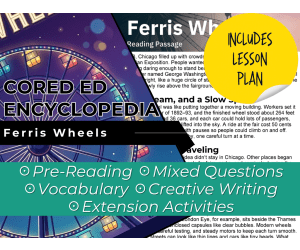
Ferris Wheels Reading Comprehension Passage - Cored Ed Encyclopedia
ELA, Reading Comprehension, Reading, Science, Technology, Language Development, Social Studies, History, Pre-Reading, Writing, Grade 2, 3, 4, 5, Worksheets & Printables, Worksheets, Teacher Tools, Centers, Activities, Writing Prompts, Assessments, Quizzes and Tests, Quizzes, Lesson Plans
This Ferris wheels reading comprehension with lesson plan includes: Visualization (on the front cover) Start your lesson by taking a minute to think and share something about the topic. Read the script aloud (slowly), perhaps prepare some music or sound effects. Student close their eyes and let their imaginations wander. Students open their eyes, read the question aloud and give them a few minutes to complete. Ask a few students to share or keep answers until the end to compare with what they learn in the passage. Quick pause—thousands of Cored Education products are included with your TeachSimple membership. Download links and encyclopedia index available here. Pre-Reading Trivia Students will write down one thing they already know about the subject and then read five more facts and discuss. These facts are fun, and the students will enjoy learning about the subject before reading more. Give 1 minute for students to write what they already know (no pressure—best guess is fine). Read the five facts together. After each fact, do ask a student for their opinion, was it surprising? Set a purpose by asking students to highlight/underline one fact they want to learn more about during the reading. Reading Passage The text is a high-interest reading passage with set paragraphs, roughly three to four paragraphs long. It contains a variety of themes about the topic, anywhere from history to technology. The passage is between 250 and 350 words in length. First, ask students to look at the headings and see what they’ll learn about today. What do they know about the topic/heading? First read options: Teacher read-aloud (best for support). Partner reading (paragraph by paragraph). While reading, students underline important details, and vocabulary words they think may come up in the questions section. Mixed Questions The first question page contains four multiple-choice questions, each with a choice of four answers, and three written response questions that require a sentence or two from the student. Students complete the mcqs first independently, then review quickly as a class. For the 3 written responses, try to get students giving the answer with some form of evidence: “I think ___ because the text says ___.” If students get stuck, send them back to check the passage. Vocabulary Questions Practice seven key words from the text in this section across two activities. First section is scrambled words where students will unscramble three words given a clue for each. The second section is a word to meaning matching activity. Before starting, have some students read out words they underlined in the passage. Ask students to say the word and read aloud the sentence(s) around each word. Ask students to do scrambled words and the matching exercise in pairs then go through answers as a class. For the scrambled spelling task, get four pairs to come up to the board and write the words for extra practice with the other student reading out the clue. For the matching task, prompt students to give full sentences: “I matched ___ with ___ because ___.” Creative Writing In this question, the student will be required to write a five to eight sentence paragraph on a question related to the topic. Before starting, ask students write down 3 key ideas they are going to include in their piece. Ask students for ideas to share around the class to help those struggling. Pro writing expectations: 5–8 sentences At least 2 facts or details from the passage At least 2 vocabulary words from the previous page Students read their paragraphs while classmates listen for facts and vocabulary words. Extension Activities This page is optional for fast finishers or to take home. There are several activities, each one requiring a different skill. Do some, do none, do all, completely optional - but you will feel reassured knowing every possibility is planned for. Includes summary writting question and additional facts. Answer Key There are answers for the multiple-choice questions, written response questions have sample answers, vocabulary answers and if there is a summary question then a sample summary will be provided as well. Lesson Plan Included Customized lesson plan for this lesson is included. Lesson Snapshot Title: Ferris Wheels Genre: Nonfiction (Informational Text) Subject: Social Studies (History) / Science & Technology / Reading (Informational Text) Primary Topic: Origins, design, and purpose of Ferris wheels Estimated Guided Reading Level (A–Z): P What This Lesson Teaches Best Explains the origin story of the first Ferris wheel at the 1893 Chicago world’s fair and why people wanted a daring new attraction. Uses clear facts and measurements (about 264 feet/80 meters , 36 cars , ride cost and time) to build informational reading skills. Shows how Ferris wheels spread to new places and why they’re also called “observation wheels” (because looking is part of the fun). Compares past and present Ferris wheels, including modern wheels built for slow sightseeing like the London Eye with enclosed capsules. Highlights how modern wheels rely on strong steel, careful testing, and steady motors for smooth turns. Learning Goals Students will describe why the 1893 world’s fair crowd wanted something “brand-new” to see. Students will identify key details about the first Ferris wheel (height, number of cars, ride time, and cost). Students will explain why Ferris wheels are also called “observation wheels” using evidence from the text. Students will describe how Ferris wheels spread to other places after Chicago, including the example in Vienna. Students will compare how some Ferris wheels are designed for thrills versus slow sightseeing today. Key Vocabulary From the Text Exposition — a huge fair where inventions and exhibits are shown. engineer — a person who designs and builds things. fairgrounds — the area where a fair is held. capsules — closed pods that carry riders on a wheel. skyline — the outline of a city’s buildings against the sky. FULL CATALOG OF DOWNLOAD LINKS AND ENCYCLOPEDIA INDEX HERE
Author Cored Education
Rating
Tags Vocabulary, Reading Comprehension, Reading Passages, Lesson Plans, Ela Lesson Plans, Reading Comprehension Lesson Plans, Pre-reading, Science Lesson Plans, Social Studies Lesson Plans, History

I WONDER - What Desserts Did Ancient Greeks Eat | Animated Video
History: Ancient, History, Social Studies, History: Europe, Grade 3, 4, 5, 6, 7, 8, 9, Lesson Plans, Teacher Tools
Video Introduction An amazing video designed for the students to learn more about history. I WONDER - What Desserts Did Ancient Greeks Eat | Animated Video Lesson Do you like history? Which topic do you really enjoy about history? Have you ever read an interesting fact about the Vikings? If yes, can you mention them? What do you like most about the Victorian era? Can you name all the Tudors? Have you ever wondered how people used to live in ancient Japan and ancient China? Do you know any interesting facts about ancient Egyptians and the Pharaohs? Have you ever visited South America? What do you know about Incas and Aztecs? Celtic culture was really one of a kind, can you name any of the places that Celts used to live in? Imagine yourself living during the ancient Roman empire, how your life will look like? Ancient Greece was an amazing place to live in. What do you know about ancient Greek life? I WONDER - What Desserts Did Ancient Greeks Eat | Animated Video Lesson The video is perfect for encouraging the researching skills for the students, while learning more about history. I WONDER - What Desserts Did Ancient Greeks Eat | Animated Video Lesson This friendly designed video is suitable for students at school, homeschooling, and as a group activity. Format Available in MP4 format.
Author Educational Voice
Tags What Desserts Did Ancient Greeks Eat, What Desserts Did Ancient Greeks Eat Video, Ancient Greek Desserts, Ancient Greek Desserts Facts, Ancient Greek Desserts Video, Ancient Greek Desserts Video For Kids
I WONDER - Do Gorillas Have Fingerprints | Animated Video Lesson
STEM, Biology, Life Sciences, Science, Animals, Grade 1, 2, 3, 4, 5, 6, 7, 8, Lesson Plans, Teacher Tools
Video Introduction Animal kingdoms are full of fascinating wonders to learn. This video is designed for the students to learn more about animals in different countries. I WONDER - Do Gorillas Have Fingerprints | Animated Video Lesson Do you like animals? what is your favorite one? Do you own a pet? If yes, tell us more about it, like what its name? And what do you like most about it? What are the animal kingdoms? Can you write down the characteristics of each animal class like mammals, birds, reptiles, amphibian, fish and mollusks. Do you know that some animals can sing, can you name any of them? What is the largest and the smallest mammal in the world? What is the largest and the smallest bird in the world? What is the largest and the smallest fish in the world? I WONDER - Do Gorillas Have Fingerprints | Animated Video Lesson The video is perfect for encouraging the researching skills for the students, while learning more about these fantastic animals. I WONDER - Do Gorillas Have Fingerprints | Animated Video Lesson This friendly designed video is suitable for students at school, homeschooling, and as a group activity. Format Available in MP4 format.
Author Educational Voice
Tags Do Gorillas Have Fingerprints, Do Gorillas Have Fingerprints Video, Gorillas Fingerprints, Gorillas Fingerprints Facts, Gorillas Fingerprints Facts For Kids, Gorillas Fingerprints Video, Gorillas Fingerprints Video For Kids

Civics and Government 4th Grade (15 Day) Unit
Social Studies, ELA, Government, Reading, Writing, Common Core, Grade 3, Lesson Plans, Teacher Tools
Are you introducing 4th graders to the concept of government and its role in our states? Through engaging activities, students will explore the differences among national, state, and local and state governments, understand the importance of laws and justice, and learn how governments function to serve the people. This 15 day unit includes day by day planning with suggested activities for differentiation. Typically used in a high ability classroom, it is appropriate for all students. Teaching methods used: Simulation, foldables, Nonfiction research, graphic organizers, group work, individual work, (suggested) guest speakers, and traditional assessment Unit includes: Alignment page showing 4th grade social studies state standards, Common Core Reading and Writing standards, and National Council of Social Studies Themes 15 day lesson plan broken into standard, reading/information source, and activities Vocabulary journal + answer key Foldable activity for three branches of government Individual Rights in Action choice project Mock election simulation Sequencing activity for election process 6 nonfiction reading passages (+ answer keys) How a Bill Becomes a Law Simulation (all three branches of government represented, based off of picture book Click, Clack, Moo by Doreen Cronin) Rubrics for all projects and answer keys where applicable Traditional vocabulary quiz List of possible guest speakers Government focus: Since fourth grade is more state based, the content and projects focus mainly on state government. The branches of government and responsibilities of important people within the government include national organizations and expectations (i.e.: President, Congress, and Supreme Court). If it is an election year, the election activity can easily be adjusted to "Elect a President" instead of making a decision about what to vote about within their school. I also recommend extending this simulation, instead of passing a bill into a law. You will want to look up a kid/student friendly version of your state's constitution to help you in some activities, or transition to U.S. Constitution Bill of Rights. Tags: government, elections, legislative, executive, judicial, state and local government, citizen, how a bill becomes a law, national government, governor File Type: PDF (not editable) Number of Pages: 65 (including curriculum plan and answer keys) Grade: 4 - depending on state standards, may overlap with second or fourth grade government content
Author Kel's Klass
Tags Government, Elections, Legislative, Executive, Judicial, State And Local Government, Citizen, How A Bill Becomes A Law, National Government, Governor
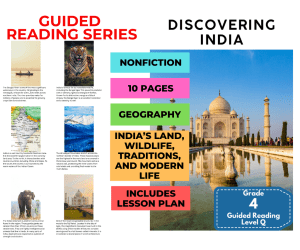
Discovering India: Guided Reading Level Q with Lesson Plan
ELA, Resources for Teachers, Reading Comprehension, Reading, Science, Geography, Social Studies, Technology, History, Life Sciences, Grade 3, 4, 5, Worksheets & Printables, Worksheets, Teacher Tools, Centers, Activities, Literacy Readers, Quizzes, Quizzes and Tests, Assessments, Lesson Plans
This Discovering India (level q) guided reading book with lesson plan includes: Guided Reading Color Label (front cover x1) This is a quick way to match the book’s demands to what students can generally handle.. The overall goal is to use the level/color to pick books for several smaller groups. To qualify for a certain level, a student is expected to read a book from that level with about 90–94% accuracy. If a student is consistently accurate and understands, move up a level. If the student is struggling at that level, drop down and add more support. Each student will improve at completely different rates, but it is generally one of the best ways to check progress across the class. DOWNLOAD THE CATALOG TO VIEW ALL GUIDED READING BOOKS AVAILABLE (SORTED LEVELS A-Z) Pre-Reading Question (x1) Teacher asks the prompt aloud, can be while showing the cover or first page. Students share what they already know, or make educated guesses from the cover. Prompt them to use the target vocabulary. Write some of their responses on the board to look back at during the reading. Vocabulary Words (x5) Introduce the five words, best doing it one at a time. Start by saying it, while students repeat and then see if anyone knows what it means before reading further. Read through the meaning and try to briefly connect each word to a picture or gesture so it’s meaningful. Ask students to flip through the book pages and point to where they see each of the vocabulary words. While reading the book pause upon coming across one of the vocab words or read the sentence twice to make sure students understand the word has appeared. Optional: Ask students to raise hands whenever they see/hear one of the new words. Guided Reading Pages (x10) Check the book snapshot (below) for: primary topic - do you need to prep extra reading or intro materials on this? what is taught best - decide on 1-2 bullets to focus on, use the prompt or words provided here for best results. learning goals - what you are checking for students to be able to do after the session, elicit answers using prompts or words provided. key vocabulary (see section above). questions overview - so you know what is coming up and if you need to prep extra materials to assist understanding. Run the lesson You may have already looked at a few of the pages together, but you can show them some of the pictures again first to set meaning. Depending on how much time you have and how familiar your students are with guided reading class, you may want to read the book aloud first with the group first. Students whisper or partner read, while you listen in. If time, do it as a group, one student reading a page each. Use the guided page’s prompts to coach: “Check the picture / does it make sense?” “Point under the words / try the first sound” “Reread the sentence smoothly”. Try to focus more on one student per session (rotating every time), so you can work out if they are ready to move up or need to move down a level. Comprehension Questions (back cover x3) This is your way to check that students didn’t just say the words, but actually understood the text. First, let students answer by pointing to the page/picture and saying a short sentence. After any answer, follow with: “Show me where you found that in the text.” In bigger groups, have partners answer first (10–20 seconds), then call on 2–3 students to share. Differentiation tips: Emerging speakers/struggling readers: oral + pointing On-level: oral in a full sentence Higher: one written sentence or draw + label Book Snapshot Title: Discovering India Genre: Nonfiction Subject: Social Studies (Geography/Culture) Primary Topic: India’s land, wildlife, traditions, and modern life Estimated Guided Reading Level (A–Z): Q What This Book Teaches Best Key geography facts about India’s location in Southern Asia, nearby borders, and surrounding waters. How landforms shape life in India, including the Himalayan Mountains and the Ganges River. Notable wildlife of India through examples like the Bengal tiger and the Indian elephant. Cultural traditions and everyday life, including spices used in meals and the celebration of Diwali. Modern India today, including transportation (auto-rickshaws) and major cities connected to technology and innovation. Learning Goals Students will describe where India is located and name details about its borders and southern waters. Students will explain how the Himalayan Mountains are described as protecting the inner plains. Students will explain why the Ganges River is important to people and farming in northern India. Students will describe key traits of the Bengal tiger and the Indian elephant using details from the text. Students will identify facts about the Taj Mahal, including where it is and features described in the book. Students will describe examples of Indian culture and modern life mentioned in the text (foods/spices, Diwali, transportation, cities). Key Vocabulary From the Text vast — very large in size. significant — very important. distinctive — easy to notice because it looks different. minarets — tall towers on a monument. diyas — small clay lamps used during Diwali. Discussion Prompts Pre-reading question: What are you hoping to learn about India as you read? Comprehension questions: What warm waters does the text say surround India to the south? Comprehension questions: According to the text, why is the Ganges River essential? Comprehension questions: What does the text say diyas symbolize during Diwali? Printing Tips 1. Best Printing Method (Recommended) “Booklet” Printing (Best if Available) If your printer or PDF viewer supports Booklet Printing , use this. Settings to use: Print mode: Booklet Paper size: Letter or A4 (either works) Orientation: Landscape Print on both sides: Yes Flip on: Short edge Scaling: Fit to printable area Booklet subset: First test: Front sides only Then: Back sides only This will automatically: Pair pages correctly Put the cover on the outside Align everything for folding After printing, fold in half and staple along the spine . 2. If “Booklet” Printing Is NOT Available You can still print this correctly with manual duplex printing . Step-by-step: Open the PDF. Choose Print . Set: Orientation: Landscape Pages per sheet: 1 Print on both sides: Yes Flip on: Short edge Print all pages . Because each PDF page already contains two facing book pages, the result will still fold cleanly into a book. Thousands of Cored Education products are included with your TeachSimple membership. Download links and encyclopedia index available here.
Author Cored Education
Rating
Tags Reading Comprehension, Reading Passages, Reading, Guided Reading, Guided Reading Lesson Plan, Guided Reading Activity, Pre-reading, Social Studies, Geography, History

I WONDER - What Jobs Do Rabbits Ears Do | Animated Video Lesson
STEM, Life Sciences, Science, Biology, Animals, Grade 1, 2, 3, 4, 5, 6, 7, 8, Lesson Plans, Teacher Tools
Video Introduction Animal kingdoms are full of fascinating wonders to learn. This video is designed for the students to learn more about animals in different countries. I WONDER - What Jobs Do Rabbits Ears Do | Animated Video Lesson Do you like animals? what is your favorite one? Do you own a pet? If yes, tell us more about it, like what its name? And what do you like most about it? What are the animal kingdoms? Can you write down the characteristics of each animal class like mammals, birds, reptiles, amphibian, fish and mollusks. Do you know that some animals can sing, can you name any of them? What is the largest and the smallest mammal in the world? What is the largest and the smallest bird in the world? What is the largest and the smallest fish in the world? I WONDER - What Jobs Do Rabbits Ears Do | Animated Video Lesson The video is perfect for encouraging the researching skills for the students, while learning more about these fantastic animals. I WONDER - What Jobs Do Rabbits Ears Do | Animated Video Lesson This friendly designed video is suitable for students at school, homeschooling, and as a group activity. Format Available in MP4 format.
Author Educational Voice
Tags What Jobs Do Rabbits Ears Do, What Jobs Do Rabbits Ears Do Video, Rabbits Ears, Rabbits Ears Facts, Rabbits Ears Facts For Kids, Rabbits Ears Video, Rabbits Ears Video For Kids, Rabbits, Rabbit
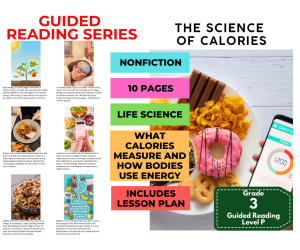
The Science of Calories: Guided Reading Level P with Lesson Plan
ELA, Resources for Teachers, Reading Comprehension, Reading, Science, Life Sciences, Health, P.E. & Health, Physics, Language Development, Grade 2, 3, 4, Worksheets & Printables, Worksheets, Teacher Tools, Centers, Activities, Literacy Readers, Quizzes, Quizzes and Tests, Assessments, Lesson Plans
This The Science of Calories (level p) guided reading book with lesson plan includes: Guided Reading Color Label (front cover x1) This is a quick way to match the book’s demands to what students can generally handle.. The overall goal is to use the level/color to pick books for several smaller groups. To qualify for a certain level, a student is expected to read a book from that level with about 90–94% accuracy. If a student is consistently accurate and understands, move up a level. If the student is struggling at that level, drop down and add more support. Each student will improve at completely different rates, but it is generally one of the best ways to check progress across the class. DOWNLOAD THE CATALOG TO VIEW ALL GUIDED READING BOOKS AVAILABLE (SORTED LEVELS A-Z) Pre-Reading Question (x1) Teacher asks the prompt aloud, can be while showing the cover or first page. Students share what they already know, or make educated guesses from the cover. Prompt them to use the target vocabulary. Write some of their responses on the board to look back at during the reading. Vocabulary Words (x5) Introduce the five words, best doing it one at a time. Start by saying it, while students repeat and then see if anyone knows what it means before reading further. Read through the meaning and try to briefly connect each word to a picture or gesture so it’s meaningful. Ask students to flip through the book pages and point to where they see each of the vocabulary words. While reading the book pause upon coming across one of the vocab words or read the sentence twice to make sure students understand the word has appeared. Optional: Ask students to raise hands whenever they see/hear one of the new words. Guided Reading Pages (x10) Check the book snapshot (below) for: primary topic - do you need to prep extra reading or intro materials on this? what is taught best - decide on 1-2 bullets to focus on, use the prompt or words provided here for best results. learning goals - what you are checking for students to be able to do after the session, elicit answers using prompts or words provided. key vocabulary (see section above). questions overview - so you know what is coming up and if you need to prep extra materials to assist understanding. Run the lesson You may have already looked at a few of the pages together, but you can show them some of the pictures again first to set meaning. Depending on how much time you have and how familiar your students are with guided reading class, you may want to read the book aloud first with the group first. Students whisper or partner read, while you listen in. If time, do it as a group, one student reading a page each. Use the guided page’s prompts to coach: “Check the picture / does it make sense?” “Point under the words / try the first sound” “Reread the sentence smoothly”. Try to focus more on one student per session (rotating every time), so you can work out if they are ready to move up or need to move down a level. Comprehension Questions (back cover x3) This is your way to check that students didn’t just say the words, but actually understood the text. First, let students answer by pointing to the page/picture and saying a short sentence. After any answer, follow with: “Show me where you found that in the text.” In bigger groups, have partners answer first (10–20 seconds), then call on 2–3 students to share. Differentiation tips: Emerging speakers/struggling readers: oral + pointing On-level: oral in a full sentence Higher: one written sentence or draw + label Book Snapshot Title: The Science of Calories Genre: Nonfiction (informational science text) Subject: Science (Nutrition/Human Body) Primary Topic: What calories measure and how bodies use energy Estimated Guided Reading Level (A–Z): P What This Book Teaches Best Defines energy as what living things need to survive and function, and connects energy to everyday examples like cars and lamps. Explains that a calorie measures energy in food (not weight or size) and describes it as a scientific unit of measurement. Shows how most energy starts with the sun , and how plants use photosynthesis to turn light into chemical energy stored in plant parts. Describes how the human body uses energy all the time (even during rest or sleep) to power the heart, lungs, and brain. Explains how food energy is released through digestion , how activity increases energy demand, and how extra calories may be stored as body fat. Learning Goals Explain what energy is and why living things need it. Describe what a calorie measures according to the text. Explain how plants get energy from the sun and where that energy is stored in a plant. Describe how digestion helps the body unlock energy from food. Describe how physical activity changes the body’s need for calories. Explain what happens when more calories are consumed than the body needs for daily activities. Key Vocabulary From the Text measurement — finding out how much of something there is. photosynthesis — plants use sunlight to make chemical energy. digestion — the process that unlocks energy in food. intestines — long tubes that help finish breaking down food. converted — changed from one form into another. Discussion Prompts Pre-reading question: What do you think calories tell us about the food we eat? Comprehension questions: What does the book say a calorie measures? Comprehension questions: How does the book explain that plants capture and store energy from the sun? Comprehension questions: What does the book say happens when a person consumes more calories than needed for daily activities? Printing Tips 1. Best Printing Method (Recommended) “Booklet” Printing (Best if Available) If your printer or PDF viewer supports Booklet Printing , use this. Settings to use: Print mode: Booklet Paper size: Letter or A4 (either works) Orientation: Landscape Print on both sides: Yes Flip on: Short edge Scaling: Fit to printable area Booklet subset: First test: Front sides only Then: Back sides only This will automatically: Pair pages correctly Put the cover on the outside Align everything for folding After printing, fold in half and staple along the spine . 2. If “Booklet” Printing Is NOT Available You can still print this correctly with manual duplex printing . Step-by-step: Open the PDF. Choose Print . Set: Orientation: Landscape Pages per sheet: 1 Print on both sides: Yes Flip on: Short edge Print all pages . Because each PDF page already contains two facing book pages, the result will still fold cleanly into a book. Thousands of Cored Education products are included with your TeachSimple membership. Download links and encyclopedia index available here.
Author Cored Education
Rating
Tags Reading Comprehension, Reading Passages, Reading, Guided Reading, Guided Reading Lesson Plan, Guided Reading Activity, Pre-reading, Science Lesson Plans, Life Science, Health

I WONDER - What Is Special About A Mantis Shrimp | Animated Video
STEM, Animals, Life Sciences, Science, Biology, Grade 1, 2, 3, 4, 5, 6, 7, 8, Lesson Plans, Teacher Tools
Video Introduction Animal kingdoms are full of fascinating wonders to learn. This video is designed for the students to learn more about animals in different countries. I WONDER - What Is Special About A Mantis Shrimp | Animated Video Lesson Do you like animals? what is your favorite one? Do you own a pet? If yes, tell us more about it, like what its name? And what do you like most about it? What are the animal kingdoms? Can you write down the characteristics of each animal class like mammals, birds, reptiles, amphibian, fish and mollusks. Do you know that some animals can sing, can you name any of them? What is the largest and the smallest mammal in the world? What is the largest and the smallest bird in the world? What is the largest and the smallest fish in the world? I WONDER - What Is Special About A Mantis Shrimp | Animated Video Lesson The video is perfect for encouraging the researching skills for the students, while learning more about these fantastic animals. I WONDER - What Is Special About A Mantis Shrimp | Animated Video Lesson This friendly designed video is suitable for students at school, homeschooling, and as a group activity. Format Available in MP4 format.
Author Educational Voice
Tags What Is Special About A Mantis Shrimp, What Is Special About A Mantis Shrimp Video, Mantis Shrimp, Mantis Shrimp Facts, Mantis Shrimp Facts For Kids, Mantis Shrimp Video, Mantis Shrimp Video For Kids

I WONDER - How Do Humans Breathe | Animated Video Lesson
Human Body, Life Sciences, Science, Biology, STEM, Grade 3, 4, 5, 6, 7, 8, 9, Lesson Plans, Teacher Tools
Video Overview The human body is full of fascinating wonders to learn. This video is created to help the students recognize the anatomy and the job of the human body. I WONDER - How Do Humans Breathe | Animated Video Lesson Every part and organ in our human body is vital so let's see how important they are. Have you ever imagined how we look like if we didn't have a skeleton? Did you know that because we have our amazing muscles we can stand! Do you know how many teeth do we have? Have you ever wondered about the food journey inside our body? Can you name all the glands in our body? Why do we have skin? Our nervous system is really good at sending signals. Can you tell us more about it? Are you really good at Mathematics, painting, or any other thing? You should really thank your brain about it! The famous five senses are really doing a great work? Can you explain how every sense works? I WONDER - How Do Humans Breathe | Animated Video Lesson The video is perfect for encouraging the researching skills for the students, while learning more about our fantastic human body. I WONDER - How Do Humans Breathe | Animated Video Lesson This friendly designed video is suitable for students at school, homeschooling, and as a group activity. Format Available in MP4 format.
Author Educational Voice
Tags How Do Humans Breathe, How Do Humans Breathe Video, Breathing, Breathing Facts, Breathing Facts For Kids, Breathing Video, Breathing Video For Kids, Human Body, Human Body Facts
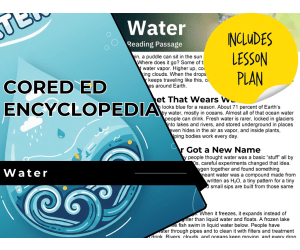
Water Reading Comprehension Passage - Cored Ed Encyclopedia
ELA, Language Development, Reading Comprehension, Reading, Pre-Reading, Science, Technology, Physics, Earth and Environmental Sciences, Earth Sciences, Grade 2, 3, 4, 5, Worksheets & Printables, Worksheets, Teacher Tools, Centers, Activities, Writing Prompts, Assessments, Quizzes and Tests, Quizzes, Lesson Plans
This water reading comprehension with lesson plan includes: Visualization (on the front cover) Start your lesson by taking a minute to think and share something about the topic. Read the script aloud (slowly), perhaps prepare some music or sound effects. Student close their eyes and let their imaginations wander. Students open their eyes, read the question aloud and give them a few minutes to complete. Ask a few students to share or keep answers until the end to compare with what they learn in the passage. Quick pause—thousands of Cored Education products are included with your TeachSimple membership. Download links and encyclopedia index available here. Pre-Reading Trivia Students will write down one thing they already know about the subject and then read five more facts and discuss. These facts are fun, and the students will enjoy learning about the subject before reading more. Give 1 minute for students to write what they already know (no pressure—best guess is fine). Read the five facts together. After each fact, do ask a student for their opinion, was it surprising? Set a purpose by asking students to highlight/underline one fact they want to learn more about during the reading. Reading Passage The text is a high-interest reading passage with set paragraphs, roughly three to four paragraphs long. It contains a variety of themes about the topic, anywhere from history to technology. The passage is between 250 and 350 words in length. First, ask students to look at the headings and see what they’ll learn about today. What do they know about the topic/heading? First read options: Teacher read-aloud (best for support). Partner reading (paragraph by paragraph). While reading, students underline important details, and vocabulary words they think may come up in the questions section. Mixed Questions The first question page contains four multiple-choice questions, each with a choice of four answers, and three written response questions that require a sentence or two from the student. Students complete the mcqs first independently, then review quickly as a class. For the 3 written responses, try to get students giving the answer with some form of evidence: “I think ___ because the text says ___.” If students get stuck, send them back to check the passage. Vocabulary Questions Practice seven key words from the text in this section across two activities. First section is scrambled words where students will unscramble three words given a clue for each. The second section is a word to meaning matching activity. Before starting, have some students read out words they underlined in the passage. Ask students to say the word and read aloud the sentence(s) around each word. Ask students to do scrambled words and the matching exercise in pairs then go through answers as a class. For the scrambled spelling task, get four pairs to come up to the board and write the words for extra practice with the other student reading out the clue. For the matching task, prompt students to give full sentences: “I matched ___ with ___ because ___.” Creative Writing In this question, the student will be required to write a five to eight sentence paragraph on a question related to the topic. Before starting, ask students write down 3 key ideas they are going to include in their piece. Ask students for ideas to share around the class to help those struggling. Pro writing expectations: 5–8 sentences At least 2 facts or details from the passage At least 2 vocabulary words from the previous page Students read their paragraphs while classmates listen for facts and vocabulary words. Extension Activities This page is optional for fast finishers or to take home. There are several activities, each one requiring a different skill. Do some, do none, do all, completely optional - but you will feel reassured knowing every possibility is planned for. Includes summary writting question. Answer Key There are answers for the multiple-choice questions, written response questions have sample answers, vocabulary answers and if there is a summary question then a sample summary will be provided as well. Lesson Plan Included Customized lesson plan for this lesson is included. Lesson Snapshot Title: Water Genre: Nonfiction (informational text) Subject: Science (Earth & Physical Science) / Informational Reading Primary Topic: Water cycle, where water is found, and H₂O Estimated Guided Reading Level (A–Z): R What This Lesson Teaches Best Explains how water changes state and moves around Earth (puddle → vapor → clouds → rain/snow). Builds background knowledge about where Earth’s water is found (oceans, glaciers/ice caps, lakes/rivers, underground aquifers, air as vapor). Introduces key science ideas about what water is made of (hydrogen + oxygen; water as a compound; H₂O; molecule). Highlights an important property of water: when it freezes, it expands and floats , allowing fish to swim below lake ice. Connects science to real life by describing how people move and clean water (pipes, filters, treatment) and why keeping water clean matters. Learning Goals Students will explain what happens to some puddle water when it shrinks in the sun. Students will describe at least three places water is found on Earth or in living things, using details from the text. Students will identify what scientists learned in the late 1700s about what water is made from. Students will explain why ice can float on liquid water, based on the passage. Students will describe one way people make water safer to drink that is stated in the text. Key Vocabulary From the Text vapor — water as an invisible gas in the air. glaciers — large masses of ice that store fresh water. aquifers — underground places where water is stored. compound — something made from two different gases joined together. molecule — a tiny particle that makes up water (H₂O). FULL CATALOG OF DOWNLOAD LINKS AND ENCYCLOPEDIA INDEX HERE
Author Cored Education
Rating
Tags Vocabulary, Reading Comprehension, Reading Passages, Lesson Plans, Ela Lesson Plans, Reading Comprehension Lesson Plans, Pre-reading, Science Lesson Plans, Technology, Earth Science
I WONDER - What Kind Of Angles Are In A Cube | Animated Video Lesson
Shapes, Early Math, Math, Geometry, Grade 3, 4, 5, 6, 7, 8, 9, Lesson Plans, Teacher Tools
Video Introduction An amazing video designed for the students to learn more about STEM. I WONDER - What Kind Of Angles Are In A Cube | Animated Video Lesson Shapes are all around us. What are your favourite ones? And can you give us some real life examples? Can you name the difference between the 2D shapes and 3D shapes? Have you ever tried to calculate the surface area of the square? If yes can you write the equation down? What is the perimeter of the rectangle? And can you tell the difference between radius and diameter of a circle? Can you mention what is the difference between the right angle and the acute angle? Have you ever heard about the obtuse angle? I WONDER - What Kind Of Angles Are In A Cube | Animated Video Lesson The video is perfect for encouraging the researching skills for the students, while learning more about this fantastic topic. I WONDER - What Kind Of Angles Are In A Cube | Animated Video Lesson This friendly designed video is suitable for students at school, homeschooling, and as a group activity. Format Available in MP4 format.
Author Educational Voice
Rating
Tags What Kind Of Angles Are In A Cube, Cube, Cube Facts, Facts About Cube , Angles Of Cube, Angles Of Cube Explained To Kids, Angles Of Cube Facts, Angles Of Cube Facts For Kids, Angles Of Cube Video For Kids

I WONDER - Why Do Rhinos Love Mud | Animated Video Lesson
STEM, Animals, Life Sciences, Science, Biology, Grade 1, 2, 3, 4, 5, 6, 7, 8, Lesson Plans, Teacher Tools
Video Introduction Animal kingdoms are full of fascinating wonders to learn. This video is designed for the students to learn more about animals in different countries. I WONDER - Why Do Rhinos Love Mud | Animated Video Lesson Do you like animals? what is your favorite one? Do you own a pet? If yes, tell us more about it, like what its name? And what do you like most about it? What are the animal kingdoms? Can you write down the characteristics of each animal class like mammals, birds, reptiles, amphibian, fish and mollusks. Do you know that some animals can sing, can you name any of them? What is the largest and the smallest mammal in the world? What is the largest and the smallest bird in the world? What is the largest and the smallest fish in the world? I WONDER - Why Do Rhinos Love Mud | Animated Video Lesson The video is perfect for encouraging the researching skills for the students, while learning more about these fantastic animals. I WONDER - Why Do Rhinos Love Mud | Animated Video Lesson This friendly designed video is suitable for students at school, homeschooling, and as a group activity. Format Available in MP4 format.
Author Educational Voice
Tags Why Do Rhinos Love Mud, Why Do Rhinos Love Mud Video, Rhinos Love Mud, Rhinos Love Mud Facts, Rhinos Love Mud Facts For Kids, Rhinos Love Mud Video, Rhinos Love Mud Video For Kids, Rhino

I WONDER - Are There Glaciers In Alaska | Animated Video Lesson
Geography, Social Studies, Grade 3, 4, 5, 6, 7, 8, 9, Lesson Plans, Teacher Tools
Video Introduction An amazing video designed for the students to learn more about famous places in different countries. I WONDER - Are There Glaciers In Alaska | Animated Video Lesson What do you know about this place? Do you know in which part of the world it is? Have you ever visited this place? If yes, can you tell us more about your adventure, and what do you like the most about this place? Do you like reading about Geography? What is your favorite country in the whole world? If you are going on a trip where it will be? Which country? What you are going to see there? Does this country has a famous place to visit? I WONDER - Are There Glaciers In Alaska | Animated Video Lesson The activity is perfect for encouraging the researching skills for the students, while learning more about this fantastic place. I WONDER - Are There Glaciers In Alaska | Animated Video Lesson This friendly designed video is suitable for students at school, homeschooling, and as a group activity. Format Available in MP4 format.
Author Educational Voice
Tags Are There Glaciers In Alaska, Are There Glaciers In Alaska Video, Glaciers In Alaska, Glaciers In Alaska Facts, Glaciers In Alaska Facts For Kids, Glaciers In Alaska Video, Glaciers In Alaska Video For Kids
I WONDER Why Do Table Tennis Rackets Have Two Different Coloured Sides
Sports, P.E. & Health, Grade 2, 3, 4, 5, 6, 7, 8, Lesson Plans, Teacher Tools
Video Introduction An amazing video designed for the students to learn more about sports in different countries. I WONDER - Why Do Table Tennis Rackets Have Two Different Coloured Sides | Animated Video Lesson What is your favorite sport? Tell us more about it. Who is your favorite athlete? Or what is your favorite team? Do you know who invented basketball? When basketball has been invented? Can you tell us where is the first time it has been played? Have you ever played soccer or football? If yes, tell us what was your position: A goal keeper, midfield player, or a defender? Do you like watching golf? If yes who is your favorite player? Can you name the differences between tennis and ping pong? Have you ever played volleyball on the beach? When it has been officially recognized by the Olympics? Do you like watching Formula 1 races? If yes, who is your favorite team or driver? Have you ever tried to play handball? If yes tell us more. Do you like watching people skiing or surfing? I WONDER - Why Do Table Tennis Rackets Have Two Different Coloured Sides | Animated Video Lesson The video is perfect for encouraging the researching skills for the students, while learning more about this sport. I WONDER - Why Do Table Tennis Rackets Have Two Different Coloured Sides | Animated Video Lesson This friendly designed video is suitable for students at school, homeschooling, and as a group activity. Format Available in MP4 format.
Author Educational Voice
Rating
Tags Why Do Table Tennis Rackets Have Two Different Coloured Sides, Why Do Table Tennis Rackets Have Two Different Coloured Sides Video, Table Tennis Rackets, Table Tennis Rackets Video, Table Tennis Rackets Facts
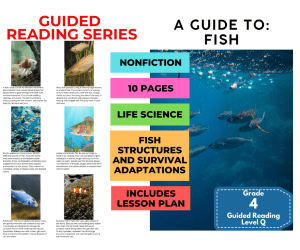
A Guide to Fish: Guided Reading Level Q with Lesson Plan
ELA, Resources for Teachers, Reading Comprehension, Reading, Science, Language Development, Life Sciences, Earth and Environmental Sciences, Pre-Reading, Vocabulary, Grade 3, 4, 5, Worksheets & Printables, Worksheets, Teacher Tools, Centers, Activities, Literacy Readers, Quizzes, Quizzes and Tests, Assessments, Lesson Plans
This A Guide to Fish (level q) guided reading book with lesson plan includes: Guided Reading Color Label (front cover x1) This is a quick way to match the book’s demands to what students can generally handle.. The overall goal is to use the level/color to pick books for several smaller groups. To qualify for a certain level, a student is expected to read a book from that level with about 90–94% accuracy. If a student is consistently accurate and understands, move up a level. If the student is struggling at that level, drop down and add more support. Each student will improve at completely different rates, but it is generally one of the best ways to check progress across the class. DOWNLOAD THE CATALOG TO VIEW ALL GUIDED READING BOOKS AVAILABLE (SORTED LEVELS A-Z) Pre-Reading Question (x1) Teacher asks the prompt aloud, can be while showing the cover or first page. Students share what they already know, or make educated guesses from the cover. Prompt them to use the target vocabulary. Write some of their responses on the board to look back at during the reading. Vocabulary Words (x5) Introduce the five words, best doing it one at a time. Start by saying it, while students repeat and then see if anyone knows what it means before reading further. Read through the meaning and try to briefly connect each word to a picture or gesture so it’s meaningful. Ask students to flip through the book pages and point to where they see each of the vocabulary words. While reading the book pause upon coming across one of the vocab words or read the sentence twice to make sure students understand the word has appeared. Optional: Ask students to raise hands whenever they see/hear one of the new words. Guided Reading Pages (x10) Check the book snapshot (below) for: primary topic - do you need to prep extra reading or intro materials on this? what is taught best - decide on 1-2 bullets to focus on, use the prompt or words provided here for best results. learning goals - what you are checking for students to be able to do after the session, elicit answers using prompts or words provided. key vocabulary (see section above). questions overview - so you know what is coming up and if you need to prep extra materials to assist understanding. Run the lesson You may have already looked at a few of the pages together, but you can show them some of the pictures again first to set meaning. Depending on how much time you have and how familiar your students are with guided reading class, you may want to read the book aloud first with the group first. Students whisper or partner read, while you listen in. If time, do it as a group, one student reading a page each. Use the guided page’s prompts to coach: “Check the picture / does it make sense?” “Point under the words / try the first sound” “Reread the sentence smoothly”. Try to focus more on one student per session (rotating every time), so you can work out if they are ready to move up or need to move down a level. Comprehension Questions (back cover x3) This is your way to check that students didn’t just say the words, but actually understood the text. First, let students answer by pointing to the page/picture and saying a short sentence. After any answer, follow with: “Show me where you found that in the text.” In bigger groups, have partners answer first (10–20 seconds), then call on 2–3 students to share. Differentiation tips: Emerging speakers/struggling readers: oral + pointing On-level: oral in a full sentence Higher: one written sentence or draw + label Book Snapshot Title: A Guide to: Fish Genre: Nonfiction (informational) Subject: Life Science Primary Topic: Fish structures and survival adaptations Estimated Guided Reading Level (A–Z): Q What This Book Teaches Best Explains how gills help fish breathe by extracting oxygen from water and releasing carbon dioxide. Describes how a fish’s streamlined shape and fins support efficient movement, stability, steering, and turning. Introduces the lateral line as a sensory system that detects vibrations and pressure changes to help fish navigate and find prey. Compares freshwater and saltwater habitats and explains how fish maintain the right internal balance of salt and water. Shows multiple survival strategies such as bioluminescence, camouflage, cartilaginous skeletons, and schooling (“safety in numbers”). Learning Goals Explain how fish breathe using gills and what happens as water passes over gill filaments. Describe how fins and a streamlined body shape help fish move, steer, and turn in water. Identify what the lateral line does and how it helps fish survive (navigation and finding prey). Compare how freshwater fish and saltwater fish manage water and salt in their bodies. Explain at least two survival adaptations described in the text (camouflage, bioluminescence, schooling). Describe what “cartilaginous fish” are and what the text says cartilage allows them to do. Key Vocabulary From the Text vertebrates — animals that have a backbone. specialized — made for a specific job or purpose. filaments — thin, threadlike parts of the gills. bioluminescence — the ability to make your own light. cartilaginous — having a skeleton made of cartilage, not hard bone. Discussion Prompts Pre-reading question: What body parts or behaviors might help fish survive in different kinds of water? Comprehension questions: What does the text explain that gills do for a fish? Comprehension questions: How does the lateral line help fish, according to the text? Comprehension questions: Why does the text say swimming in a school can help fish survive? Printing Tips 1. Best Printing Method (Recommended) “Booklet” Printing (Best if Available) If your printer or PDF viewer supports Booklet Printing , use this. Settings to use: Print mode: Booklet Paper size: Letter or A4 (either works) Orientation: Landscape Print on both sides: Yes Flip on: Short edge Scaling: Fit to printable area Booklet subset: First test: Front sides only Then: Back sides only This will automatically: Pair pages correctly Put the cover on the outside Align everything for folding After printing, fold in half and staple along the spine . 2. If “Booklet” Printing Is NOT Available You can still print this correctly with manual duplex printing . Step-by-step: Open the PDF. Choose Print . Set: Orientation: Landscape Pages per sheet: 1 Print on both sides: Yes Flip on: Short edge Print all pages . Because each PDF page already contains two facing book pages, the result will still fold cleanly into a book. Thousands of Cored Education products are included with your TeachSimple membership. Download links and encyclopedia index available here.
Author Cored Education
Rating
Tags Reading Comprehension, Reading Passages, Reading, Guided Reading, Guided Reading Lesson Plan, Guided Reading Activity, Pre-reading, Science Lesson Plans, Life Science, Earth Science

Measurement - Digital Lesson Plan Gr. 3-5 | MAC Software
Math, Measurements, Grade 3, 4, 5, Teacher Tools, Lesson Plans
The Measurement - Digital Lesson Plan Gr. 3-5 | MAC Software This inclusive educational tool is perfect for teachers and homeschoolers who want a complete and interactive approach to teaching measurement. Designed specifically for grades 3 to 5, the software offers: More than 230 individual activities across over 80 attention-grabbing interactive screens. Mastery of all expectations outlined by the National Council of Teachers of Mathematics (NCTM) and your State Curriculum Math Strand of Measurement. A balance between task-based learning and drill activities with more than 150 practice drills. Inclusivity & Diversity in Learning Built-in English and Spanish text-to-speech options , as well as diverse math tools such as imperial and metric units tools are included, fostering accessibility regardless of language or measurement system preference. Learning Strategies Offered? This resource uses multiple strategies to ensure student involvement, including: Printables, Interactive lessons, Test preparation exercises, Li >A memory match game, Li >Various other games like a board game or spinner game. Ol hr h4 Unique features: Applicability in Diverse Settings? / h4 p This software fits seamlessly into various settings: whole group instruction in classroom time, individual tasks at home, or even asynchronous remote instruction. / P Hr H4 Assessment Quizzes / h4 P Quote periodic comprehension testing through assessment quizzes after each chapter. / P Hr H4 Ease-of-Use / h4 p The product is compiled in one downloadable zip file, MAC compatible. / P>
Author Classroom Complete Press
Tags Digital Math Lesson, Measurement Lesson, Math Lesson Plan, Measuring Tools, Digital Math

I WONDER - What Is A Melody | Animated Video Lesson
Music, Creative Arts, Grade 2, 3, 4, 5, 6, 7, 8, Lesson Plans, Teacher Tools
Video Introduction An amazing video designed for the students to learn more about music. I WONDER - What Is A Melody | Animated Video Lesson A melody is a series of musical notes played one after the other, creating a tune or main theme in a piece of music. It is often the most recognizable part of a song and can be played by a single instrument or sung by a voice. Melodies can be simple or complex and are usually created using a combination of steps (moving to the next note in the scale) and leaps (skipping one or more notes in the scale). A well-crafted melody will often have a balance of both steps and leaps, creating an interesting and memorable tune. I WONDER - What Is A Melody | Animated Video Lesson The video is perfect for encouraging the artistic skills for the students, while learning more about this fantastic topic. I WONDER - What Is A Melody | Animated Video Lesson This friendly designed video is suitable for students at school, homeschooling, and as a group activity. Format Available in MP4 format.
Author Educational Voice
Rating
Tags What Is A Melody, What Is A Melody Video, Melody, Melody Facts, Melody Video, Melody Facts For Kids, Melody Video For Kids, Music, Music Facts, Music Video

I WONDER - What Is A Regular Polygon | Animated Video Lesson
STEM, Geometry, Math, Grade 2, 3, 4, 5, 6, 7, 8, Lesson Plans, Teacher Tools
Video Introduction An amazing video designed for the students to learn more about STEM. I WONDER - What Is A Regular Polygon | Animated Video Lesson Do you like STEM subjects? what is your favorite one? Have you ever tried to plant a seed? If yes, tell us more about it. Or have you ever tried to invent something? If yes, tell us more about it. And how do you think it will help us? Have you ever seen a microorganism under a microscope? What was it? And how it looked like? Mathematics is a marvelous subject. Let' sharpen our brains and solve some equations. Do you like timetable tricks? What is your favorite one? Do you know how to code? Have you ever created an app or a game before? If yes, how was it like? I WONDER - What Is A Regular Polygon | Animated Video Lesson The video is perfect for encouraging the researching skills for the students, while learning more about this fantastic topic. I WONDER - What Is A Regular Polygon | Animated Video Lesson This friendly designed video is suitable for students at school, homeschooling, and as a group activity. Format Available in MP4 format.
Author Educational Voice
Tags What Is A Regular Polygon, What Is A Regular Polygon Video, Regular Polygon, Regular Polygon Facts, Regular Polygon Facts For Kids, Regular Polygon Video, Regular Polygon Video For Kids, Polygon
I WONDER - What Is A Circle | Animated Video Lesson
STEM, Geometry, Math, Kindergarten, Preschool, Grade 1, 2, 3, 4, 5, Lesson Plans, Teacher Tools
Video Introduction An amazing video designed for the students to learn more about STEM. I WONDER - What Is A Circle | Animated Video Lesson Do you like STEM subjects? what is your favorite one? Have you ever tried to plant a seed? If yes, tell us more about it. Or have you ever tried to invent something? If yes, tell us more about it. And how do you think it will help us? Have you ever seen a microorganism under a microscope? What was it? And how it looked like? Mathematics is a marvelous subject. Let' sharpen our brains and solve some equations. Do you like timetable tricks? What is your favorite one? Do you know how to code? Have you ever created an app or a game before? If yes, how was it like? I WONDER - What Is A Circle | Animated Video Lesson The video is perfect for encouraging the researching skills for the students, while learning more about this fantastic topic. I WONDER - What Is A Circle | Animated Video Lesson This friendly designed video is suitable for students at school, homeschooling, and as a group activity. Format Available in MP4 format.
Author Educational Voice
Tags What Is A Circle, What Is A Circle Video, Circle, Circle Facts, Circle Facts For Kids, Circle Video, Circle Video For Kids, Shapes, Shapes Video For Kids, Shapes Video

All About Lake Baikal | Geographical Wonders Video Lesson
Social Studies, Geography, Grade 3, 4, 5, 6, 7, Lesson Plans, Teacher Tools
This animated geography video lesson is all about Lake Baikal. Students will love this engaging and interactive video as they learn more about geographical wonders and landforms. This video serves as a great introduction or review video for your learners. This is a 10-minute geography video lesson.
Author Educational Voice
Tags Geography Lesson, Social Studies Video, Landforms, Landmarks, Lake Baikal