



3,931 products added recently
Page 26 - Reading Lesson Plans
Inspire your students with reading lesson plans that incorporate a variety of genres and interactive activities. These resources aim to improve fluency, vocabulary, and comprehension. Use these plans to create an engaging reading environment where students develop a lifelong love for literature.

 Show filters

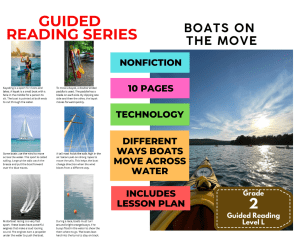
Guided Reading Level L - Boats on the Move (with Lesson Plan)
ELA, Resources for Teachers, Reading Comprehension, Reading, Science, Engineering, Technology, Physics, Sports, P.E. & Health, Grade 2, 3, 4, Worksheets & Printables, Worksheets, Teacher Tools, Centers, Activities, Literacy Readers, Quizzes, Quizzes and Tests, Assessments, Lesson Plans
This Guided Reading Book - Boats on the Move (Level L) with lesson plan includes: Guided Reading Color Label (front cover x1) This is a quick way to match the book’s demands to what students can generally handle.. The overall goal is to use the level/color to pick books for several smaller groups. To qualify for a certain level, a student is expected to read a book from that level with about 90–94% accuracy. If a student is consistently accurate and understands, move up a level. If the student is struggling at that level, drop down and add more support. Each student will improve at completely different rates, but it is generally one of the best ways to check progress across the class. DOWNLOAD THE CATALOG TO VIEW ALL GUIDED READING BOOKS AVAILABLE (SORTED LEVELS A-Z) Pre-Reading Question (x1) Teacher asks the prompt aloud, can be while showing the cover or first page. Students share what they already know, or make educated guesses from the cover. Prompt them to use the target vocabulary. Write some of their responses on the board to look back at during the reading. Vocabulary Words (x5) Introduce the five words, best doing it one at a time. Start by saying it, while students repeat and then see if anyone knows what it means before reading further. Read through the meaning and try to briefly connect each word to a picture or gesture so it’s meaningful. Ask students to flip through the book pages and point to where they see each of the vocabulary words. While reading the book pause upon coming across one of the vocab words or read the sentence twice to make sure students understand the word has appeared. Optional: Ask students to raise hands whenever they see/hear one of the new words. Guided Reading Pages (x10) Check the book snapshot (below) for: primary topic - do you need to prep extra reading or intro materials on this? what is taught best - decide on 1-2 bullets to focus on, use the prompt or words provided here for best results. learning goals - what you are checking for students to be able to do after the session, elicit answers using prompts or words provided. key vocabulary (see section above). questions overview - so you know what is coming up and if you need to prep extra materials to assist understanding. Run the lesson You may have already looked at a few of the pages together, but you can show them some of the pictures again first to set meaning. Depending on how much time you have and how familiar your students are with guided reading class, you may want to read the book aloud first with the group first. Students whisper or partner read, while you listen in. If time, do it as a group, one student reading a page each. Use the guided page’s prompts to coach: “Check the picture / does it make sense?” “Point under the words / try the first sound” “Reread the sentence smoothly”. Try to focus more on one student per session (rotating every time), so you can work out if they are ready to move up or need to move down a level. Comprehension Questions (back cover x3) This is your way to check that students didn’t just say the words, but actually understood the text. First, let students answer by pointing to the page/picture and saying a short sentence. After any answer, follow with: “Show me where you found that in the text.” In bigger groups, have partners answer first (10–20 seconds), then call on 2–3 students to share. Differentiation tips: Emerging speakers/struggling readers: oral + pointing On-level: oral in a full sentence Higher: one written sentence or draw + label Book Snapshot Title: Boats on the Move Genre: Nonfiction (informational) Subject: Science (Forces & Motion) / Reading (Informational Text) Primary Topic: Different ways boats move across water Estimated Guided Reading Level (A–Z): L What This Book Teaches Best Different ways boats move on water (wind, oars, paddles, engines). How specific boat parts help movement (sails, mast, ropes, propeller). How coordinated actions affect motion (oars dipping “at the same time” to go straight). How markers guide movement during a race (boats turn around bright orange buoys to stay on track). Comparing speed and movement styles (quiet glide vs fast roar; forward motion by alternating paddle sides). Learning Goals Students will identify several ways boats move across the water using details from the text. Students will explain how sails and wind help pull a boat forward. Students will describe how rowers use oars together to move a boat straight ahead. Students will describe how a double-ended paddle helps a kayak move forward quickly. Students will explain how an engine and propeller help push a motorboat through the water. Students will describe why boats turn around buoys during a race, based on the text. Key Vocabulary From the Text mast — a tall pole that holds sails up. rhythm — a steady pattern of movement. double-ended — having an end on both sides. propeller — a spinning part that helps push a boat. buoys — floating markers that show where to go. Discussion Prompts Pre-reading question: What are some different ways a boat could move across the water? Comprehension questions: How do large white sails help a boat move forward? What do rowers do “at the same time,” and what does that help the boat do? Why must boats turn around bright orange buoys during a race? Printing Tips 1. Best Printing Method (Recommended) “Booklet” Printing (Best if Available) If your printer or PDF viewer supports Booklet Printing , use this. Settings to use: Print mode: Booklet Paper size: Letter or A4 (either works) Orientation: Landscape Print on both sides: Yes Flip on: Short edge Scaling: Fit to printable area Booklet subset: First test: Front sides only Then: Back sides only This will automatically: Pair pages correctly Put the cover on the outside Align everything for folding After printing, fold in half and staple along the spine . 2. If “Booklet” Printing Is NOT Available You can still print this correctly with manual duplex printing . Step-by-step: Open the PDF. Choose Print . Set: Orientation: Landscape Pages per sheet: 1 Print on both sides: Yes Flip on: Short edge Print all pages . Because each PDF page already contains two facing book pages, the result will still fold cleanly into a book. Thousands of Cored Education products are included with your TeachSimple membership. Download links and encyclopedia index available here.
Author Cored Education
Rating
Tags Reading Comprehension, Reading Passages, Reading, Guided Reading, Guided Reading Lesson Plan, Guided Reading Activity, Pre-reading, Science Lesson Plans, Physics, Technology

Warriors in Winter (Magic Tree House #31 Lesson Plan, Videos, Activities)
ELA, Social Studies, Reading, Reading Comprehension, Grammar, Literature, Language Development, Spelling, Vocabulary, Writing, Geography, Grade 1, 2, 3, Lesson Plans, Teacher Tools
Product Title: Warriors in Winter (Magic Tree House #31 Lesson Plan, Videos, Activities) This comprehensive, five-day novel study of the Magic Tree House book 'Warriors in Winter' provides plentiful resources to foster students' love for literature. A No PREP book companion , it offers a wealth of materials that can be tailored to the needs and abilities of individual students. Key Features: 5-Day Lesson Plan: Organised daily plan with detailed activities including comprehension questions and vocabulary practice. Versatile Activities: Engaging pre-reading, during reading and post-reading activities involving drawing/coloring/crafts related to various curriculum areas. Social Studies Context: The creative use of mapping exercises linking directly with the novel’s plotline enhances research skills and geographical understanding. Diverse Notebook Pieces: Six unique interactive notebook options that work alongside the main reading experience allowing children to explore adventures creatively. KWL Charts : In-depth analysis charts noting what do they already Know(K), what do they Wish(W) to learn more about as well as discuss what has been Learnt(L). The Pack Also Includes: In addition, learners are challenged through engaging character analysis exercises while reinforcing their understanding with writing craftivity built into reading sessions. The pack is created primarily for grades 1 -3 covering language arts and social studies but can be easily customized per student’s age group or skill level. Teachers have full control over how they want to utilize this resource strengthening both teaching effectiveness and student learning outcome! Ranging from guiding a whole group, managing small discussions or assigning homework; this flexible, 112-page PDF companion enhances teaching convenience and student learning process. Transform your classroom into the enchanting world of Jack and Annie with 'Warriors in Winter (Magic Tree House #31 Lesson Plan, Videos, Activities)'.
Author Heather Huhman
Tags Novel Study, Comprehension Questions, Vocabulary Practice, Interactive Notebook, Character Analysis
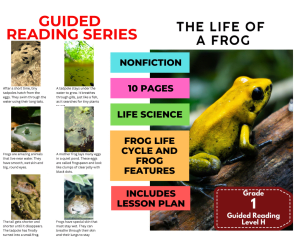
Guided Reading Level H - The Life of a Frog (with Lesson Plan)
ELA, Resources for Teachers, Reading Comprehension, Reading, Science, Animals, Life Sciences, Pre-Reading, Language Development, Vocabulary, Grade 1, 2, 3, Worksheets & Printables, Worksheets, Teacher Tools, Centers, Activities, Literacy Readers, Quizzes, Quizzes and Tests, Assessments, Lesson Plans
This Guided Reading Book - The Life of a Frog (Level H) with lesson plan includes: Guided Reading Color Label (front cover x1) This is a quick way to match the book’s demands to what students can generally handle.. The overall goal is to use the level/color to pick books for several smaller groups. To qualify for a certain level, a student is expected to read a book from that level with about 90–94% accuracy. If a student is consistently accurate and understands, move up a level. If the student is struggling at that level, drop down and add more support. Each student will improve at completely different rates, but it is generally one of the best ways to check progress across the class. DOWNLOAD THE CATALOG TO VIEW ALL GUIDED READING BOOKS AVAILABLE (SORTED LEVELS A-Z) Pre-Reading Question (x1) Teacher asks the prompt aloud, can be while showing the cover or first page. Students share what they already know, or make educated guesses from the cover. Prompt them to use the target vocabulary. Write some of their responses on the board to look back at during the reading. Vocabulary Words (x5) Introduce the five words, best doing it one at a time. Start by saying it, while students repeat and then see if anyone knows what it means before reading further. Read through the meaning and try to briefly connect each word to a picture or gesture so it’s meaningful. Ask students to flip through the book pages and point to where they see each of the vocabulary words. While reading the book pause upon coming across one of the vocab words or read the sentence twice to make sure students understand the word has appeared. Optional: Ask students to raise hands whenever they see/hear one of the new words. Guided Reading Pages (x10) Check the book snapshot (below) for: primary topic - do you need to prep extra reading or intro materials on this? what is taught best - decide on 1-2 bullets to focus on, use the prompt or words provided here for best results. learning goals - what you are checking for students to be able to do after the session, elicit answers using prompts or words provided. key vocabulary (see section above). questions overview - so you know what is coming up and if you need to prep extra materials to assist understanding. Run the lesson You may have already looked at a few of the pages together, but you can show them some of the pictures again first to set meaning. Depending on how much time you have and how familiar your students are with guided reading class, you may want to read the book aloud first with the group first. Students whisper or partner read, while you listen in. If time, do it as a group, one student reading a page each. Use the guided page’s prompts to coach: “Check the picture / does it make sense?” “Point under the words / try the first sound” “Reread the sentence smoothly”. Try to focus more on one student per session (rotating every time), so you can work out if they are ready to move up or need to move down a level. Comprehension Questions (back cover x3) This is your way to check that students didn’t just say the words, but actually understood the text. First, let students answer by pointing to the page/picture and saying a short sentence. After any answer, follow with: “Show me where you found that in the text.” In bigger groups, have partners answer first (10–20 seconds), then call on 2–3 students to share. Differentiation tips: Emerging speakers/struggling readers: oral + pointing On-level: oral in a full sentence Higher: one written sentence or draw + label Book Snapshot Title: The Life of a Frog Genre: Nonfiction (informational life cycle) Subject: Life Science + Reading (Informational Text) Primary Topic: Frog life cycle and frog features Estimated Guided Reading Level (A–Z): H What This Book Teaches Best Explains where frogs live and describes basic frog traits (smooth, wet skin; big, round eyes; living near water). Teaches the frog life cycle in clear steps: eggs (frogspawn) → tadpoles → legs grow → tail disappears → small frog. Shows how a tadpole lives and grows in water, including breathing through gills and eating tiny plants. Describes how frogs breathe (through skin and lungs) and how they get food (long, sticky tongue catching insects). Connects body parts to movement (strong back legs help frogs hop and jump high). Learning Goals Students will describe where frogs live and name physical traits the text mentions. Students will explain what frog eggs are called and describe what they look like. Students will retell the main stages of a frog’s life from eggs to a small frog. Students will describe how tadpoles move, breathe, and find food in the water. Students will explain how the frog’s body changes as legs grow and the tail disappears. Students will use text details to describe how a frog hunts and how it jumps. Key Vocabulary From the Text frogspawn — frog eggs that look like jelly. tadpoles — baby frogs that live in water and have tails. gills — body parts that help an animal breathe underwater. lungs — body parts used for breathing air. insects — small animals a frog can catch and eat. Discussion Prompts Pre-reading question: What changes do you think happen as a tadpole grows into a frog? Comprehension questions: Where does a mother frog lay many eggs, according to the text? Comprehension questions: What do tiny tadpoles use to swim through the water? Comprehension questions: What happens to the tadpole’s tail as it turns into a small frog? Printing Tips 1. Best Printing Method (Recommended) “Booklet” Printing (Best if Available) If your printer or PDF viewer supports Booklet Printing , use this. Settings to use: Print mode: Booklet Paper size: Letter or A4 (either works) Orientation: Landscape Print on both sides: Yes Flip on: Short edge Scaling: Fit to printable area Booklet subset: First test: Front sides only Then: Back sides only This will automatically: Pair pages correctly Put the cover on the outside Align everything for folding After printing, fold in half and staple along the spine . 2. If “Booklet” Printing Is NOT Available You can still print this correctly with manual duplex printing . Step-by-step: Open the PDF. Choose Print . Set: Orientation: Landscape Pages per sheet: 1 Print on both sides: Yes Flip on: Short edge Print all pages . Because each PDF page already contains two facing book pages, the result will still fold cleanly into a book. Thousands of Cored Education products are included with your TeachSimple membership. Download links and encyclopedia index available here.
Author Cored Education
Rating
Tags Reading Comprehension, Reading Passages, Reading, Guided Reading, Guided Reading Lesson Plan, Guided Reading Activity, Pre-reading, Science Lesson Plans, Animals, Frog Life Cycle

The Boat Trip Short Story | Pre-Intermediate Lesson Plan
ELA, Reading, Grade 10, 11, 12, Teacher Tools, Lesson Plans
The Boat Trip Short Story | Pre-Intermediate Lesson Plan This pre-intermediate English lesson plan helps students improve their reading comprehension and grammar skills. Educators can use this resource to teach the short story "The Boat Trip" to upper elementary or middle school students. The lesson plan includes the full text of the story along with pre-reading questions, vocabulary exercises, and post-reading discussion prompts. It incorporates elements like prediction, summarizing, and making inferences to build critical thinking. Teachers may utilize this resource for whole-group instruction, small reading groups, or as an independent reading assignment. With multiple ways to implement this short story lesson, it engages students meaningfully. The accompanying answer key also makes it easy for teachers to assess student progress. Providing rich literary content, this resource helps cultivate stronger readers. Includes an answer key Makes it easier than ever for educators to evaluate student responses accurately Eases manual workload on teachers when assessing responses delivered using traditional or conventional methods. The package consists of three PDFs with four ready-to-print pages along with one digital access file. With its emphasis on boat trips and gruesome discoveries, it injects a dose of fun into everyday schooling while imparting valuable educational content. In terms of implementation, there's room for flexibility depending on class size or individual learner preferences: whole group setting inclusion, where all learners navigate through collectively; small-sized subsection utilization, allowing more intimate discussion amongst peers; traditional homework assignments that encourage independence in learning.
Author TEAM TEFL
Tags Boats, Short Story, Language Arts, Reading Passage, Comprehension
By the Skin of My Teeth | Figurative Language Activity | Micro-Learning Deck
ELA, Reading, Reading Comprehension, Grade 4, 5, 6, 7, Teacher Tools, Lesson Plans
This resource allows students to explore figurative learning in a fun way. The figurative language term for this learning deck is "By the Skin of My Teeth." Through close reading and a reading passage with audio, your students will better comprehend figurative language! Included: -Video lesson on language concept -Reading passage w/ audio Comprehension -Quick write
Author Teach Me This
Tags Figurative Language, Language Activity, Comprehension, Learning Deck, Digital Lesson
Keep One's Eyes Peeled | Figurative Language Activity | Micro-Learning Deck
ELA, Reading, Reading Comprehension, Grade 4, 5, 6, 7, Teacher Tools, Lesson Plans
Keep One's Eyes Peeled | Figurative Language Activity | Micro-Learning Deck This is a comprehensive educational resource designed to help educators amplify their students’ comprehension of figurative language. As an interactive teaching tool, this Micro-Learning Deck uses the phrase 'Keep One's Eyes Peeled' as a unique approach to exploring the use of figurative language in daily conversations. Usability The activity deck can be used in whole-group sessions or small group interactions. Alternatively, it could serve as an engaging homework assignment that stimulates independent exploration. Inclusions 13 ready-to-display PowerPoint slides - Vividly animate student engagement with the subject matter in an intuitive manner. A video lesson on 'Keep One's Eyes Peeled' Reading passage with accompanying audio 'Quick Write' exercise- A potent tool drawing out insights from students on how well they have grasped the concept . Suitable For: The Keep One's Eye Peeled | Figurative Language Activity | Micro-Learning Deck was meticulously developed for learners within grades four through seven. Moreover, it fits snugly into any structured Language Arts curriculum primarily those focused on comprehension lessons. Note: This learning deck carries not just quality but immense quantity value-wise evident in its merit as reusable content over time regardless of class size or learning environment modulation(loss/change). Teachers can confidently dwell into subsequent cycles knowing they wield an efficient resource fostering retention and propelling academic growth over time across every student demograph reached.
Author Teach Me This
Tags Figurative Language, Micro-learning, Interactive Teaching, Comprehension Activities, Language Arts Curriculum

Put Something on Hold | Figurative Language Activity | Micro-Learning Deck
ELA, Reading, Reading Comprehension, Grade 4, 5, 6, 7, Teacher Tools, Lesson Plans
Micro-Learning Deck for Figurative Language: “Put Something On Hold” This teaching resource explores the figurative language term “put something on hold” in a fun, engaging way for students. Through close reading of a passage with accompanying audio, students will strengthen comprehension of figurative language. The deck includes a short video lesson explaining the language concept that can be shown to the whole class or small groups. Next, students read or listen to a passage containing examples of “put something on hold.” Finally, a quick write activity lets students reflect on their learning. This activity allows flexible implementation for individual, small group or whole class learning. The passage audio and quick writes provide differentiation for multiple learning styles. Overall, this resource builds familiarity with non-literal language in an easy micro-lesson format for 4th-7th grade ELA .
Author Teach Me This
Tags Figurative, Language, Comprehension Lesson, Reading Activity, Digital Learning

Lifestyles ESL TEFL Upper Intermediate Lesson Plan
ELA, Language Development, ESL, Vocabulary, Reading, Writing, Resources for Teachers, Not Grade Specific, Middle School, Adult Education, High School, Homeschool Resources, Teacher Tools, Lesson Plans, Worksheets & Printables
Lifestyles ESL TEFL ELL ELA Upper Intermediate ESL Lesson Plan This upper intermediate English lesson plan helps students learn about different lifestyles through informative texts and engaging exercises. Educators can implement it in various settings like whole class instruction, small groups, or as a homework assignment. Students will read texts on topics like culture, health, and leisure activities. Afterwards, they will demonstrate comprehension via fill-in-the-blanks, multiple choice questions, discussions, and an audio exercise. This versatile ESL ELA resource works for in-person or remote teaching. The answer key allows teachers to quickly assess student understanding. Overviewing unique lifestyles builds intercultural awareness while practicing reading, writing, listening, and speaking skills. The ESL lesson plan includes flashcards, a warmer, grammar rules, exercises, role-play, conversation, writing drill, activity, answers and an extra study that would be good to set as homework. There are 30+ pages and there are teachers notes to guide the teacher.
Author TEAM TEFL
Tags Lifestyles, ESL, Language Arts, Audio, Comprehension
Wild Goose Chase! | Figurative Language Activity | Micro-Learning Deck
ELA, Reading, Reading Comprehension, Grade 4, 5, 6, 7, Teacher Tools, Lesson Plans
Wild Goose Chase! Figurative Language Learning Activity helps students explore figurative language in an engaging way. Through close reading of a passage with audio support, 4th-7th graders will better comprehend the figurative language term "wild goose chase." This teaching resource includes a short video lesson explaining the language concept, a reading passage with audio recording, reading comprehension questions, and a quick write activity. Educators can implement this versatile learning activity in various settings - whole group instruction, small group lesson, independent practice, or even as a homework assignment.
Author Teach Me This
Tags Wild Goose Chase, Figurative, Language, Comprehension, Quick Write

Tonight on the Titanic (Magic Tree House #17 Lesson Plan, Videos, Activities)
ELA, Reading, Grade 1, 2, 3, Lesson Plans, Teacher Tools
A 5-day NO PREP novel study of Tonight on the Titanic (Magic Tree House #17). This comprehensive book companion includes a lesson plan, chapter comprehension questions, vocabulary practice, and many other activities. Perfect for first grade, second grade, and third grade classrooms, homeschool families, and cooperatives. You can easily customize lessons based on student age, reading and comprehension level, interests, and learning style! Additionally, all worksheets can be completed in an interactive notebook or simply discussed aloud if you desire to reduce the number of pages you print. THIS RESOURCE COVERS: Art (drawing, coloring, arts & crafts) Comprehension English language arts Geography Grammar History Reading Research Social studies Spelling Writing
Author Heather Huhman
Tags Magic Tree House, Tonight On The Titanic, Book Companion, Novel Study, Titanic

Goober Peas: Peanuts: Emergency Lesson Plan
ELA, Reading, Grade 5, 6, Teacher Tools, Lesson Plans
Goober Peas: Peanuts: Emergency Lesson Plan This dynamic and ready-to-use resource is designed for Grade 5 and Grade 6 educators with a focus on engaging students in cross-curricular learning within the Language Arts domain. It stimulates young minds through vibrant Reading modules. Resource Overview: Nonfiction Article: A compelling article exploring the rich history and uses of peanuts across different cultures. Worksheets: Customized worksheets, perfectly aligning with the article content, aiding in understanding and reinforcement of key knowledge. Extension Activities: Group discussions or individual assignments for extended learning. Emerges as brainstorming sessions or homework based on classroom discourse themes related to peanuts. The power of this resource lies in its quick application during challenging situations when regular teaching becomes problematic due to unexpected circumstances such as inclement weather conditions or sudden time gaps before school events. It comes off as a handy tool with seamless deployment amidst crisis moments with its easily navigable PDF format containing eight print-ready pages. In sum, Goober Peas: Peanuts: Emergency Lesson Plan optimally blends academic instruction with real-world exposure, capturing the historical-cultural essence of peanuts via an intriguing lens. Its grit shines through its readiness to serve instantly amidst overwhelming teaching instances without sacrificing meaningful learning opportunities tailored for grade 5 & grade 6 learners.
Author Classroom Complete Press
Tags History Worksheet, Reading Passage, Language Arts Activity, Vocabulary Lesson, Peanuts, Goober Peas Peanuts

Reading Comprehension: Main Idea
ELA, Reading, Reading Comprehension, Common Core, Grade 5, 6, 7, 8, Teacher Tools, Lesson Plans
Reading Comprehension: Main Idea - An Essential Teaching Resource Reading Comprehension: Main Idea is an essential teaching resource designed to enhance the reading and comprehension skills of students in grades 5 through to 8. Reading, a fundamental communication tool, is vital for success both within and beyond school. Focusing on "Main Idea" This resource specifically zooms in on "Main Idea," a key chapter slice from the full "Reading Comprehension" lesson plan. The ability to understand main ideas within texts enables students to grasp overall themes or concepts, thereby enriching their comprehension ability. An Effective and Structured Learning Tool The instructional material adopts Bloom's Taxonomy of Learning objectives, emphasizing its educational appropriateness. It emphasizes key reading acquisition elements such as: Understanding inference Leveraging context clues. The structure suits various implementation strategies—it can be used for whole group instruction or small group work. Considering each student’s learning style, it can also serve as individual assignments or extra homework tasks. A Compact Yet Informative Resource This teaching tool is compact yet informative and comes across 24 print-ready pages in PDF format. This convenience serves teachers working with diverse classroom environments well. Language Arts teachers will appreciate that this resource aligns closely with Common Core State Standards; thereby assuring curriculum-compliant lessons while instilling confidence that they are equipped with effective materials for stimulating their students' comprehension abilities.</p
Author Classroom Complete Press
Tags Reading, Comprehension, Word Search, Main Idea, Literacy

Hammy the Pig: Emergency Lesson Plan
ELA, Reading, Grade 1, 2, Teacher Tools, Lesson Plans
Hammy the Pig: Emergency Lesson Plan - An Overview This fantastic educational tool is primed for first and second grade students, presenting dynamic learning opportunities that span a variety of subjects. About the Unit A curiously captivating text about pigs lays at the heart of this cross-curricular unit. Its primary objective is fostering comprehensive growth in learners by improving their: Comprehension Skills: Asking questions related to the text and requiring insightful responses. Critical Thinking Abilities: Provoking thoughts through complex queries. Creativity and Writing Proficiency: Offering incentives to draft own stories based on pre-existing elements in the text. Mathematical Prowess: Featuring age-appropriate math problems integral to Hammy's tale, making number-crunching fun! Problem-solving Skills:: Incorporating a labyrinth where students guide Hammy towards his path, inculcating lateral thought structures. The Convenience Factor - A Teacher's Best Friend! Easing out load from educator's schedule necessitating minimal prep time- with eight ready-to-print pages delivered through PDF files, guaranteeing swift lesson delivery even when time is against you! Versatility - Changing Lanes Made Easy! Adept at adapting as per classroom dynamics- be it whole group instructions or smaller clusters, delegate as homework or serve as independent study material for self-learning sessions; morph your lesson plan to meet your needs seamlessly! In Conclusion... "All Set for Unexpected Hurdles - Presenting Hammy the Pig: Emergency Lesson Plan!" Glide through your 'can't teach right now' instances like a breeze!
Author Classroom Complete Press
Tags Language Arts, Reading Passage, Fill In The Blank, Story Writing, Reading Activity
Get a Grip | Figurative Language Activity | Micro-Learning Deck
ELA, Reading, Reading Comprehension, Grade 4, 5, 6, 7, Teacher Tools, Lesson Plans
Get a Grip | Figurative Language Activity for Upper Elementary Students This informative PowerPoint resource allows upper elementary students to explore figurative language concepts in an engaging way. Specifically, students will comprehend the term "get a grip" as a figurative language technique. Through close reading of a passage with accompanying audio, students strengthen figurative language skills. Educators can implement this resource in various settings such as whole group instruction, small reading groups, or as a homework supplement. The deck includes: a video lesson explaining "get a grip"; a reading passage with audio for modeling fluent reading; reading comprehension questions; and a quick write activity to assess understanding. This concise learning activity is designed to boost students' comprehension and appreciation of figurative language.
Author Teach Me This
Tags Get A Grip, Figurative, Language, Reading, Comprehension

Piece of Cake | Figurative Language Activity | Micro-Learning Deck
ELA, Reading, Reading Comprehension, Grade 4, 5, 6, 7, Teacher Tools, Lesson Plans
The Piece of Cake | Figurative Language Activity | Micro-Learning Deck This educational resource is perfect for educators wanting an engaging and comprehensive approach to teaching figurative language to students from grades 4 through 7. Main Features of the Micro-Learning Deck: Based around the phrase Piece of Cake as its main linguistic example, making learning playful yet insightful. A compilation of close reading exercises paired with an audio-enabled reading passage that encourages active learning and enhances auditory comprehension skills. An incorporated video lesson explaining vocabulary concepts, making understanding straightforward and retention easier. A quick write function for immediate student self- assessment providing real-time feedback on learning progress. Comes in a readily accessible Microsoft PowerPoint format comprised within 13 slides for easy display during lessons or virtual classes. Stored in a professional layout which decreases prep time significantly. Versatility: The deck can cater to various teaching styles. This includes whole group briefing sessions, divided amongst small groups enabling peer interaction while ensuring individual attention on each student. It could also be used as homework assignments providing one-on-one focused practice at home. In Conclusion If you seek well-structured educational resources promoting active participation where traditionally dense topics such as figurative language become easily graspable, then this Micro-learning Deck is perfect for you!
Author Teach Me This
Tags Figurative Language, Close Reading, Interactive Learning, Auditory Comprehension, Video Lesson

Henry and Mudge and the Funny Lunch | Literacy Unit
ELA, Reading, Grade 2, 3, 4, Lesson Plans, Teacher Tools
This resource is a Henry and Mudge and the Funny Lunch | Literacy Unit. Students will enjoy the engaging activities that go along with reading this book. Included: - Vocabulary chart - Making predictions - Comprehension fill in the blank - Comprehension writing - 9 question cards - Comprehension question worksheet w/ answer key - Writing a recipe - Compound words worksheet - Compound words game
Author Literacy Life
Tags Vocabulary, Henry And Mudge, Reading Chart, Making Predictions, Comprehension
Pig Out | Figurative Language Activity | Micro-Learning Deck
ELA, Reading, Reading Comprehension, Grade 4, 5, 6, 7, Teacher Tools, Lesson Plans
Pig Out | Figurative Language Activity for Grades 4-7 Pig Out is a micro-learning deck that allows students to explore figurative language in an engaging way. Through a short video lesson, reading passage with audio, and comprehension activity, students will better understand the figurative term "pig out" and how it is used in writing. This versatile resource can be used in whole group, small group, or individual settings to reinforce figurative language concepts. The deck includes a close reading passage to analyze use of figurative language, followed by a quick write activity for students to apply their learning. This concise, focused lesson allows flexible implementation for various learning needs. Students will enjoy learning about figurative language with this hands-on, literacy-focused resource.
Author Teach Me This
Tags Learning Deck, Pig Out, Figurative, Language, Comprehension Lesson
Learn to Read: Lesson 7: OO
Special Resources, ELA, Special Education Needs (SEN), Language Development, Phonics, Reading, Spelling, Vocabulary, Writing, Grade 1, 2, 3, Lesson Plans, Teacher Tools
About This Product This is a pack of 49 Phonic OO worksheets to teach the OO, specially designed for those with special needs, including those with dyslexia or who may be suspected of being dyslexic, but will work equally well with young learners in Kindergarten/EYFS/Y1. These sheets are LETRS/Science of Reading and UK GOV requirements aligned. These worksheets also align with the most popular phonic programmes, including RWI and Letters and Sounds. Who are these worksheets for? I have written them for pupils who struggle with processing information - especially sounds. This includes children who are DYSLEXIC or have ANY other kind of processing disorder. Such children may have failed with other methods of teaching phonics. Such pupils need activities that: ·are highly structured - one tiny step at a time building on the one before using only a limited number of words to start with and only using words that the child has already learnt to sound out, with no nasty surprises. ·Have only a little on each pageas these pupils tire easily. What makes these worksheets special? I have a powerful three-step process which I use with my special needs pupils, which is worked out throughout the worksheets: 1. See it!where we focus on becoming aware of the new sound in words. This involves first hearing the new sound in words and then seeing it in words (tracking). 2. Sound-it-out!Having learnt to see the new sound in words, we learn to sound out these words to read and write them. We begin by usingsound-it-out boxesfor reading and spelling which help the child to segment the word before blending the sounds. Once the child can read and write individual words, we work on fluency by building familiarity with the common words in the new sound family. Once the child can sound the words out to read and spell confidently, we move on to recognising them/using them in longer reading and dictation passages, as soon as the child is able. I provide 2 reading passages with comprehension exercises and one dictation passage, with a page in the workbook dedicated to it, with room for a picture, which again cements understanding. 3. Write it! Incorporated into the above two steps, we constantly write the new sound. This adds a multi-sensory dimension to our work - we see with our eyes, we sound it with our mouth parts and voice, and then we move by writing. All three steps work together to help the child feel in control of his/her learning and to become a successful, confident learner. We finish each sound with a dictation which culminates our work before we move on to the next sound. I try to give this a week after we finish the book, to act as revision. The dictation: Read this passage to your pupil, who should write it. Have the child read his/her work and check for errors. Make sure the writing is completely accurate before saying the child has finished, including full stops and capital letters correctly used. Flashcards are included. What is included in the pack: 46 Activities 2 Games Flashcards Please note: This pack is in a series: Find the bundle here: https://teachsimple.com/product/phonic-worksheets-for-special-needs-bundle-highly-structured I do hope others find these Special Needs Phonic worksheets helpful for their pupils with ordering and processing difficulties!
Author Lilibette's Resources
Tags Special Needs Phonics, Dyslexia Phonic Worksheets, Phonic Worksheets For Dyslexics, Home Education, Reading Intervention, OO WORKSHEETS, OO Phonic Worksheets, Home-school
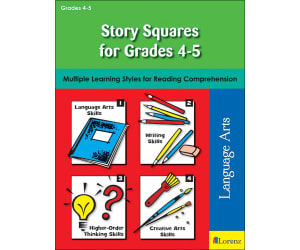
Story Squares for Grades 4-5: Multiple Learning Styles for Reading Comprehension
ELA, Reading, Reading Comprehension, Grade 4, 5, Teacher Tools, Lesson Plans
Story Squares for Grades 4-5: Multiple Learning Styles for Reading Comprehension This resourceful teaching guide is designed to enrich and diversify reading comprehension exercises in the classroom. It not only promotes students' love for reading but also nurtures a broad spectrum of skills. The tool caters to various learning styles, encompassing Language Arts, Writing, Higher-Order Thinking, and Creative Arts. The Versatility of Story Squares The potency of this tool lies in its unique flexibility - integrating into various educational setups such as whole-class discussions, small-group workshops or even homework assignments. In-depth Coverage on Children's Classics Matilda Missing May The Trumpet Swan School Story Each book is accompanied by a concise summary helping students grasp the central theme comfortably. Diverse Activity Options Per Book: Craftily formulated are 20 distinctive activity options per book . These activities stimulate comprehension abilities whilst fostering creative thinking. Educator Support: Tips for effective utilization of the resource in achieving desired student engagement results. ... Simplification tools include a glossary for graded books aiding understanding of complex vocabulary terms.. Applicable across learners transitioning from simpler texts or those newly initiated into studying English..
Author Classroom Complete Press
Tags Rubric, Reading Activity, Matilda, Comprehension Lesson, Creative Arts

Up The Creek Without a Paddle | Figurative Language Activity | Micro-Learning Deck
ELA, Reading, Reading Comprehension, Grade 4, 5, 6, 7, Teacher Tools, Lesson Plans
Up The Creek Without a Paddle Figurative Language Learning Activity helps students explore figurative language in an engaging way. This concise yet informative resource allows educators to teach the common idiom "up the creek without a paddle" which refers to being in a difficult situation without any means of resolving it. Through close reading of a passage with accompanying audio, students will comprehend the meaning of this colorful phrase. The deck includes a video lesson explaining the idiom, a reading passage about a boy who finds himself up the creek without a paddle, comprehension questions, and a quick write activity for students to apply their understanding. This versatile resource can be used for whole group instruction, small group work, or independent practice on figurative language.
Author Teach Me This
Tags Figurative Language, Learning Deck, Comprehension, Quick Write, Digital Lesson, Up The Creek Without A Paddle, Up A Creek Without A Paddle, Up Creek Without A Paddle, Without A Paddle Download
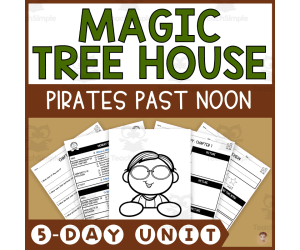
Pirates Past Noon (Magic Tree House #4 Lesson Plan, Videos, Activities)
ELA, Reading, Grade 1, 2, 3, Lesson Plans, Teacher Tools
A 5-day NO PREP novel study of Pirates Past Noon (Magic Tree House #4). This comprehensive book companion includes a lesson plan, chapter comprehension questions, vocabulary practice, and many other activities. Perfect for first grade, second grade, and third grade classrooms, homeschool families, and cooperatives. You can easily customize lessons based on student age, reading and comprehension level, interests, and learning style! Additionally, all worksheets can be completed in an interactive notebook or simply discussed aloud if you desire to reduce the number of pages you print. THIS RESOURCE COVERS: Art (drawing, coloring, arts & crafts) Comprehension English language arts Geography Grammar History Reading Research Social studies Spelling Writing
Author Heather Huhman
Tags Pirates Past Noon, Magic Tree House, Book Companion, Novel Study, Pirates, Magic Tree House Book 4, Magic Tree House Videos, Magictreehouse Videos

PIZZA PIZZAZZ Gr. 2-5
ELA, Reading, Grade 2, 3, Teacher Tools, Lesson Plans
PIZZA PIZZAZZ Gr. 2-5 Comprehensive Teaching Aid A unique and engaging teaching resource developed for those educators seeking to offer lessons in a dynamically interesting manner. 'Pizza Pizzazz,’ cleverly includes the concept of pizza into various educational subjects like: Word study Language arts Reading Math Art. This thematic variety serves to enthrall and engage students effectively! About Pizza Pizzazz: This product includes a set of 53 printable PDF pages laden with varied fun and informative activities, specially crafted for grade levels 2 through 5. This versatile tool can be integrated seamlessly into their existing language programs for maximum learning impact. Versatility in Learning Environments: Pizza Pizzazz materials can cater to differing teaching environments, right from whole group teachings or small group engagements, even serving as individual homework assignments. Fostering Collaboration: A highlight is that each activity is structured favorably toward facilitating cooperative learning strategies which foster teamwork among students. Activities range from language art exercises strengthening creative writing skills, thereby enhancing linguistic aptitude subtly yet firmly wrapped in an enjoyable format! Creative Adaptability Across Grades: This resource extends its reach beyond just being a lesson plan -- it serves across multiple grade levels starting from grade 2 all the way up through grade 5! Subjects spanned include Language Art with special emphasis on Reading, Math problems revolving around themes of everyone's favorite fast food, and even fostering artistic creativity with pizza-themed art activities! A Modern Approach to Education: 'Pizza Pizzazz Gr.2-5 truly encapsulates what modern education strives to accomplish — seamlessly merging conventional subjects with fun, contemporary themes engaging children effectively in each learning session. Indeed, classroom teaching has never felt this appealing or indeed appetizing! An enjoyable plunge into learning was never this deliciously straightforward!
Author Classroom Complete Press
Tags Language Arts, Word Study, Creative Writing, Cut And Paste, Word Search

The Love Story Short Story Intermediate Lesson Plan
ELA, Reading, Grade 5, 6, 7, 8, 9, 10, 11, 12, Teacher Tools, Lesson Plans
This is an intermediate lesson plan worksheet set for The Love Story short story. Discover "The Love Story," a captivating short story beginner lesson plan designed to enhance your students' reading comprehension and grammar skills. This carefully crafted worksheet set takes your learners on a gripping adventure through the 3-page passage while reinforcing vital language concepts. Our versatile product offers dual-access options - available via Google Apps or in downloadable ready-to-print PDFs, with three files included. To save time and simplify lesson delivery, an Answer Key is provided for quick reference! Featuring five pages of diverse activities, this resource delves into various dimensions of learning. It encourages readers to deeply analyze the text by engaging them in thought-provoking exercises tailored to different learning styles. Conversation questions are included to enable a class discussion about the story and your students' own love stories. This resource can also be accessed through Google Apps. Answer key included .3 PDFs with 5 ready to print pages and one digital access file
Author TEAM TEFL
Tags Short Story, Reading Lesson, Grammar Lesson, Vocabulary Words, Comprehension

Edith Cavell Biography and Comprehension Questions
ELA, Reading, Reading Comprehension, Grade 3, 4, 5, 6, 7, Teacher Tools, Lesson Plans
Edith Cavell Biography and Comprehension Questions: An Educational Resource Edith Cavell, a nurse who lived between 1865-1915, risked her life to help Allied soldiers escape German rule in Belgium. This product enables students to explore this inspirational story while honing their comprehension skills. What's Included? A detailed biography of Edith Cavell across 21 pages. Comprehension questions that encourage students to identify key details and explain vocabulary from the text. Inference activities asking learners to predict answers using evidence within the context - a crucial skill for language arts and many study areas. An answer section makes it easy for educators— whether they're teaching a whole class or individual instruction at home—to validate student understanding. It's also perfect as a Women's History resource or for International Women’s Day celebrations! Suitable For Grades 3 through 7 This resource is useful in Language Arts curriculum. Use it as lecture material for group instruction, supplemental activity in small groups, or as homework reinforcing historical facts along with reading comprehension. "Remember that behind each fact your scholar discovers exists an opportunity not only to learn but also garner wisdom from those who came before us." All content can be accessed using any standard PDF reader, So why wait? Bring history alive through learning experiences that engage student curiosities and enhance their comprehension skills!
Author Guinea Pig Education
Tags Edith Cavell, Biography, Comprehension Questions, Women's History, Inspiration