3,949 products added recently
Page 2 - 6th Grade Word Problems
Support sixth graders with word problems involving ratios, proportions, and introductory algebra. These worksheets promote higher-level thinking and real-world application. Incorporate them to strengthen mathematical reasoning.
Ratios, Rates, Percentages Worksheets: Applied Math Housing Math
Special Resources, Life Skills, Life Studies, Home Economics, Finance, Math, Percentages, Fractions, Grade 6, 7, 8, 9, Worksheets & Printables, Word Problems, Worksheets
Would you like to show your middle grades students in grades 6-9 how the ratio and rate math skills (percentages, fractions, ratios, and rates) that they have been learning in the classroom can be helpful in their real lives? Would you like to incorporate more useful life skills in your math class? Then, show your students all the ways math can be used in buying and/or renting homes! This makes math meaningful and helps engage reluctant learners! What's Included: 6 pages of worksheets that are ready to print and use (great to make a booklet or mini-unit) A Complete Answer Key is Included 1) Design Your Floorplan: Students will design a simple one-storey house that includes five rooms and hallways. They will calculate what percent of the home each room occupies. 2) Down Payments: Students will calculate the down payment & mortgage loan amount for different scenarios using whole-number percents or fractions. 3) Mortgage Payments: Students will use ratios, fractions, or percentages to help calculate how much of their monthly mortgage payment will go to interest & how much will go to paying down the loan/principal. 4) Interest Rates: Students will calculate a monthly interest payment using a variety of past interest rates. They will multiply the mortgage amount owing by the percent (written as a decimal) and then divide by 12. 5) Square Foot per Person: Students will practice calculating a simple real-world rate: square feet of living space for each person in a home. This can vary a lot in different cities and with different family situations. 6) Cost per Square Foot: Students will calculate another common rate: cost per square foot. They will compare four price points for buying and four more options for renting and determine the best deal for each situation.
Author Grace Under Pressure
Tags Ratio Worksheets, Rate Worksheets, Percent Worksheets, Percentage Worksheets, Ratios And Rates, Percent, Housing Math, Life Skills, Applied Math, Buy A House
6th Grade Math: Statistics and Probability Bundle: 4 Activities
Math, Statistics, Graphing, Money, Common Core, Grade 5, 6, 7, Worksheets & Printables, Word Problems, Activities
Do you need some new ideas for your 6th grade math unit to meet the Common Core State Standards for Statistics and Probability? Here is a ready-to-go bundle with four fun real-life activities to incorporate into your unit plan. 1) Statistical Questions: Students are taught what a statistical question is: a question that has numerical answers that vary.. 8 questions are included. Students need to identify if they are statistical questions or not. If they are, students think of how the data might be collected. If they are not, students explain what aspects of a statistical question are missing. Finally, students write 4 questions of their own (one should not be a statistical question) and they trade with a friend to see if they can identify the odd one out. 2) Dot Plots and Histograms: Students will collect numerical data through a survey and create their own dot plots and histograms to display their findings! This gives them a sense of ownership over their learning, and it is a great way to assess their skills! Discussion questions and self- assessment are included. 3) Math Stations: Statistics and Probability: Station 3 in particular has students create a dot plot and calculate the mean, median and mode of provided data. They can also do the probability stations if you want to address those skills. 4) Mean, Median and Interquartile Range of Hourly Wages: From a cashier to a taxi driver to an account to a CEO, students are given 10 realistic hourly wages. First, they create a histogram to display the data. Next, they write the wages in order from smallest to largest. They use this information to calculate the mean, the median, and the interquartile range. After that, they eliminate the outlier (the CEO wage) and recalculate the same statistics. Discussion questions are included. Grades to Use With: This bundle is designed for students in Grade 6, but can be used for Grade 5 enrichment, Grade 7 or 8 review, or high school special education classes. What's Included: 20 Page PDF with 4 Activities
Author Grace Under Pressure
Tags 6th Grade Math, Statistics , Probability, Dot Plots, Histograms, Mean, Median, Interquartile Range, Statistical Questions, Financial Literacy
Real-Life Integers: Working with Integers & Number Lines Grade 6 Math
Math, Number Lines, Addition and Subtraction, Addition, Subtraction, Numbers, Grade 5, 6, 7, Worksheets & Printables, Word Problems, Activities, Worksheets
Integers are everywhere in our lives! Get your students excited about learning about integers including using number lines and finding the difference between integers in a variety of real-life situations. This is perfect for students in grade six who are first learning about rational numbers. Social Media: Up Votes and Down Votes: You will read each statement one at a time to your class. Then ask for upvotes (and count the hands) and ask for downvotes (and count the hands). Remind students they can abstain from voting on a statement if they are ambivalent. If you think it will help your class, have students vote anonymously by putting their heads down. Record the upvotes and downvotes for each of the 10 statements. Students complete the math (which is really adding integers) to get each statement’s final score. (Extension: This activity can lead to a mini-lesson on facts vs. opinions.) Cities: Temperatures and Elevations: Students will need internet access for this activity. They will explore two cities: one with a positive temperature in degrees Celsius and one with a negative temperature in degrees Celsius. Using a number line, they will compare these two temperatures. Then, they must find the elevation (in meters) of six cities around the world to complete three math questions. Sports: Golf and Football: Students will apply adding and subtracting integers to a golf game to calculate the player’s score above or below par. Then, they use integers to calculate if a football team scores a touchdown. (Extension: Students can create their own football scenario. They can choose a starting point, make up 5 plays, and trade with a friend. ) Financial Literacy: Bank Account: Students add and subtract integers to keep a running bank balance in an account with an overdraft. They see how purchases reduce your balance and deposits increase your balance. I have included two versions, one with decimals and one with whole numbers only.
Author Grace Under Pressure
Tags Integers, Adding Integers, Grade Six Math, Sixth Grade Math, Subtracting Integers, Word Problems, Real-life Math
20 Logic Puzzles for Grades 5-8
STEM, Math, Science, Grade 5, 6, 7, 8, Games, Activities, Quizzes and Tests, Teacher Tools, Quizzes, Word Problems, Worksheets & Printables
Unlocking Logic: 20 Engaging Puzzles for Grades 5–8 is an entertaining and difficult set of brainteasers created to help middle school students improve their reasoning, critical thinking, and problem-solving abilities. There are 20 different puzzles in this ebook, such as logic grids, magic squares, numerical patterns, riddles, code-breaking, spatial thinking, and more. Every puzzle is designed to pique students' interest and promote original thought, which makes it ideal for early finishers, homework, enrichment, and classroom use. In order to engage a diverse variety of learners and facilitate flexible use across grades 5–8, the puzzles vary in difficulty and style. Pupils are urged to work alone or in groups, experiment with different approaches, and develop resilience by tackling problems carefully. To facilitate guided conversation and self-checking, a complete answer key is supplied. Whether you're a teacher looking to inspire your class or a parent wanting to support logical thinking at home, this ebook is the perfect companion for building sharp minds—one puzzle at a time!
Author Bright Classroom Ideas Marketplace
Rating
Tags Riddle, Logic, Puzzle, Quiz, Grade 5
Math Practice Simplified I - Money & Measurement
Math, Money, Measurements, Grade 5, 6, 7, 8, Worksheets & Printables, Word Problems, Worksheets
This mathematics-based resource is designed for grades 5-8. It’s imperative for students to have a strong foundation in basic math skills. This resource provides activities to help students understand everyday math basics through money and measurement. Students will add currency in the form of coins and determine how much change they will get back. Students will then move on to more advanced concepts, like budgeting, saving and borrowing money. This resource is perfect to prepare students to succeed on standardized tests . An answer key is included. Aligned to National Council of Teachers of Mathematics (NCTM) Standards.
Author Classroom Complete Press
Tags Math, Mathematics, Money, Measurement, Time, Temperature, Percentages, Decimals, Middle, Answer Key
Critical Thinking: Math in Media- Real World Middle School Math Task
Social Studies, History, Psychology, Math, Statistics, Place Value, Grade 6, 7, 8, 9, Worksheets & Printables, Word Problems, Activities
Critical Thinking: Math in the Media: Finding Errors Witness your students transform into math detectives with this fun educational tool! Students can practice both math skills and media literacy at the same time as they read real headlines and try to decide if they make sense mathematically. This unique teaching resource uses real headlines and quotes taken directly from various media sources. It presents learners with an opportunity to scrutinize these bits of information for mathematical inaccuracies. How to Use: Teachers can project these pages on an interactive whiteboard or print them out as worksheets—providing flexibility to adapt the delivery according to classroom needs or personal preferences. Allow students to work together in small groups or pairs to look at the headlines and decide if there are any math errors. Students need to explain what the error is if they find one. Topics covered include large numbers, percentages, and large number multiplication (in the millions). Come back together as a class to discuss and share ideas. You could have individual students come up to the board to explain their thought process and strategies. You could use several headlines in one lesson, or use them one at a time as a warm-up or hook for your math class. An extension is provided for students to find (or create) their own headlines. You could have each student do this and present one each day for several weeks. Grades to Use With: These are designed to be used in middle school classrooms in grades 6-9 to enhance media literacy, critical thinking skills, and application of math skills. Math skills used include percentages, large numbers, and decimal millions. What's Included: A total of 10 pages: Title Page Instruction Page 6 Headlines (one per page): 4 have errors and 2 do not Extension Page: Find your own headline! Answer Key
Author Grace Under Pressure
Rating
Tags Critical Thinking, Percentage, Large Numbers, Word Problems, Math, Media, Media Literacy, Applied Math, Real World Math, Math Prompt
50 Math Puzzles for Grade 6
Math, Algebra, Fractions, Decimals, Geometry, Percentages, Order Of Operations, Graphing, Statistics, Grade 6, Worksheets & Printables, Word Problems
The curriculum for math in grade six combines several disciplines into one. Larger numbers, their multiples, factors, decimals, percentages, geometry, and other topics are all included. In addition to these, algebra and ratio and proportion are two new courses being offered this year. The foundation for the subjects in higher grades is laid by these subjects. At this point, the Grade 6 Math curriculum aims to assist pupils strengthen their fundamental knowledge and ideas while also starting to employ increasingly sophisticated reasoning. Students study a range of foundational arithmetic skills that lay the groundwork for future success. As they study interesting topics like ratios, percentages, and fractions, they will focus on developing their critical thinking and problem-solving abilities. Ten major themes are covered throughout the year, including coordinate geometry, volume, perimeter and area, decimals, and number systems. Additionally, using concepts like Mean, Median, Mode, Range, and Interquartile Range, students will learn how to interpret data. They are prepared for increasingly complex mathematics in middle school and beyond by the challenges each topic offers. This printable worksheet contains 50 arithmetic problems and their answers covering each of these topics.
Author Bright Classroom Ideas Marketplace
Rating
Tags Math, Puzzle, Grade 6
5th Grade Summer Review or Practice Math Workbook
Math, Fractions, Graphing, Multiplication and Division, Order Of Operations, Addition and Subtraction, Algebra, Grade 4, 5, 6, Worksheets & Printables, Workbooks, Word Problems, Worksheets
Keep your students engaged and confident in math all summer long with this 5th Grade Summer Math Review Packet ! Designed to prevent the summer slide , this resource provides targeted practice on 20 essential 5th grade Common Core math skills —all identified as challenging concepts that lay the foundation for 6th-grade success . What’s Included? ✅ Teaching or note sheets for each skill ✅ Practice worksheets for reinforcement ✅ Detailed answer keys with step-by-step solutions ✅ Pre-review pages for select skills to refresh prior knowledge ✅ Teaching & tutoring tips for parents and educators Math Skills Covered: Multiply 2-digit numbers by 3-digit numbers Divide 4-digit numbers by 2-digit numbers Add, subtract, multiply, and divide whole numbers: word problems Evaluate numerical expressions with parentheses Convert decimals between standard and expanded form using fractions Compare decimal numbers (Ordering decimals included) Add and subtract decimals: word problems Multiply a decimal by a power of ten Multiply money amounts: multi-step word problems Divide by decimals Understand fractions as division: word problems Add and subtract fractions with unlike denominators: word problems Multiply two fractions Divide unit fractions and whole numbers: word problems Add, subtract, multiply, and divide mixed numbers Graph points from a table Multi-step problems with customary unit conversions Describe relationships among quadrilaterals Volume of compound figures Create and interpret line plots with fractions This packet is easily formatted to print and bind for a summer workbook or could be used individually in tutoring sessions or summer school lessons, as review worksheets. Practice could also help those that are skipping a grade in math, to ensure understanding of concepts that may be missed in the transition. Tags: 5th grade math review, summer math packet, prevent summer slide, 5th to 6th grade math transition, common core math worksheets, math tutoring resources, printable math workbook, summer school math activities, fractions and decimals practice, multiplication and division word problems
Author Kel's Klass
Tags 5th Grade Math Review, 5th Grade Summer Math Packet, Prevent Summer Slide, 5th To 6th Grade Math Transition, Common Core Math Worksheets, Math Tutoring Worksheets, Summer School Math Workbook, Adding And Subtracting Fractions, Multiplication And Division Practice
Real-World Ratio Worksheets: Rising Cost of Living Financial Literacy
Finance, Life Studies, Home Economics, Percentages, Math, Fractions, Money, Grade 6, 7, 8, 9, 10, 11, 12, Worksheets & Printables, Worksheets, Word Problems
Here’s a middle or high school applied math or consumer math activity to help your students practice the ratio math skills they have learned in a real-world situation: the rising cost of living . The three-page worksheet includes real statistics (from the United States) with accurate median family income, median house price, and average private college costs from 1965, 1995, and 2025. Students can use simple ratios to compare this data and see if housing and university really are more expensive compared to wages than they used to be. Although this lesson uses US data, it demonstrates trends that are occurring in other countries (like Canada) too! How to Use: Print 3 pages of worksheets for each student. Go over the table on page one together. It shows the median family income, median house price, and average cost of one year of college in 1965, 1995, and 2025 (in dollars for each of those years). Ask students what they notice. Model how to use the chart to write a ratio and simplify it by rounding. Use the included example of 1965 income to 1965 house price, which simplifies to 1:3 Let students work in pairs or small groups on the rest of the ratio questions. They will complete research for question 8: to find the average prices of a different category (medical insurance, food, cars, etc.) for 1965, 1995, and 2025. These can be shared later in a class discussion. Students can also share their ideas from question 9 in the discussion: how can people get ahead when housing and college cost so much more compared to wages than they used to? Finally, students can create their own meme to share a real-world proportional relationship about the rising cost of living with others. A sample is included in the answer key. A complete answer key is included so there is no guess-work with this lesson! Grades to Use With: This lesson is designed for middle school students in 6th, 7th or 8th grade to apply and practice ratio, rate, and proportional relationship skills. It could also be used in high school consumer math classes to help students understand current economic events. What's Included: 5-Page PDF: Ready to Print and Use! Complete Teacher Instructions Worksheet: Real Historical Data from the US: income, house prices, college costs in 1965, 1995, 2025 Worksheet: Ratio Math Questions Worksheet: Reflect & Create a Meme Complete Answer Key
Author Grace Under Pressure
Rating
Tags Rising Cost Of Living, Ratio Worksheets, Ratio And Rate, Real World Math, Financial Literacy, High School Financial Literacy, Middle School Financial Literacy, Budget, Ratio Word Problems
Probability Word Problems: Compare Games of Chance 4th 5th Grade
Math, Statistics, Fractions, Decimals, Percentages, Grade 4, 5, 6, Worksheets & Printables, Word Problems, Worksheets
In this 4th, 5th or 6th grade single outcome probability lesson with worksheets, you will find lots of great ideas that will help your elementary students begin to understand the ways to compare probabilities of single outcome events in a variety of games of chance. Your students will also learn about writing probabilities in fraction and decimal form. How to Use: Print 3 pages of worksheets for each of your students. They can work independently on these tasks or in small groups. Students will determine the theoretical probability for a game of chance using a spinner. Students will determine the theoretical probability for a different game of chance using a 10-sided die. Students will compare these 2 games and pick which game they would like to play. They can use their math calculations to help justify their choice. Have your students share their choices in a class discussion for the wrap-up! Using fractions (one half, tenths and quarters), equivalent fractions (with denominators of 100), and decimals to the hundredths, your students will calculate the three outcomes involved in each of these games of chance. They will notice that all 3 outcomes in a single game will always add up to 1.00. They can compare the 2 games more easily if they use a common denominator (/100). Grades to Use With: This probability math lesson (with worksheets) is designed for students in 4th, 5th, and 6th grades. It is a great addition to a probability unit when your students are learning about a variety of probability concepts including single outcome probability and how to use fractions and decimals to make fair comparisons between probability events. This lesson could also be used in some middle school special education classrooms. What's Included: 5-Page PDF- Ready to Print and Use! Complete Teacher Instructions 3-Page Worksheet: 2 Games of Chance & a Written Reflection Complete Answer Key If you enjoy this math activity, check out other probability lessons in my store! Middle School Math Stations for Probability and Statistics Theoretical & Experimental Probability Experiment: Hands-On Math
Author Grace Under Pressure
Rating
Tags Probability Word Problems, Probability Worksheet, Probability, Fractions, Decimals, Single Outcome Probability, Probability Games, Games Of Chance, 5th Grade Probability
Theoretical vs Experimental Probability – 2-Page Task
Math, Percentages, Fractions, Statistics, Grade 4, 5, 6, 7, Worksheets & Printables, Word Problems, Activities
Theoretical and Experimental Probability: A Hands-On Math Exercise (with Fractions and Percentages) This is a ready-to-use, engaging, two-page math activity designed for intermediate students in grade levels 4 through 7. The product lets your students easily conduct a simple probability experiment that will help them grasp the concepts of theoretical and experimental probabilities. They will also tie this learning into other math topics by converting fraction results into percentages. Items Needed: Paper bags filled with items that are red, yellow blue, and green. Ideal items can be Legos, blocks or counters. Bags should contain amounts of items that will easily convert from fractions to percentages- so 5 items, 10 items, 20 items, or 25 items are ideal. Features: Fits seamlessly into any probability or percentage unit Serves as excellent practice for reinforcing equivalent fraction and percentage concepts How to Use: Split students into small groups. Give each group a bag of items and a worksheet (double-sided) for each member. Students will explore their bag: count the total number of items, count how many there are of each colour, write each colour as a fraction, and convert that to a percentage. This is the theoretical probability of each event. Then they perform the experiment: pulling one item from the bag and replacing it twenty times. They will use a tally chart to record the colours pulled. They will turn their results (fractions out of 20) into percentages. This is the experimental probability. Finally, students reflect on if the theoretical and experimental probabilities matched or did not and why that could be. Grades to Use With: This activity is designed for students in grades 4-7 who are learning about equivalent fractions, percentages, and probability experiments. What's Included: 3 page PDF: Title Page and 2-page handout. Copy double sided and you are ready to go!
Author Grace Under Pressure
Rating
Tags Probability Experiment, Theoretical Probability, Experimental Probability, Fractions, Percentages, Math Experiment, Hands-on Math, Probability, Math Activity, 7th Grade Math
Life Skills: Nutrition Facts Math Percentages, Ratios, Rates
Special Resources, Life Skills, Home Economics, Life Studies, Math, Percentages, Multiplication and Division, Grade 5, 6, 7, 8, Worksheets & Printables, Worksheets, Word Problems
Healthy eating is a key life skill! Do you want to teach your class how to accurately read a nutrition facts label and determine the healthy and less healthy aspects of the food choices they make? Do you want to find a way to apply the math skills you have been teaching in your middle school classroom (percentages, rates, ratios) to a real-life engaging situation? This is the lesson for you! This ready-to-print lesson for students in 5th to 8th grades includes an eye-catching one-page handout to teach students the basic vocabulary and terms included on nutrition facts labels: - absolute amount in grams or mg or mcg & percent of Recommended Daily Intake (RDI) - suggested serving size (grams) - calories - fat, protein, carbohydrates - sodium - vitamins and minerals There are three different worksheets to allow students practice the following life skills: • Determining the number of servings in a package (you mean I'm not supposed to eat the whole tub of ice cream in one sitting!?). • Calculating the amount of nutrients and calories they would get if they ate several servings (which we often do!). • Comparing sugars that are naturally occurring vs. added. • Using simple percent calculations to determine the Recommended Daily Intake of vitamins. • Comparing two similar foods (frozen yogurt vs ice cream) to see which is a healthier choice and why. And more! What's Included: 6 Page PDF Ready to Print and Use! - Title Page and Teacher Instructions - Student Handout: The Basics of Nutrition Facts Labels - Potato Chip Nutrition Facts Label (with Math Questions) - Dried Apricots Nutrition Facts Label (with Math Questions) - Ice Cream vs. Frozen Yogurt Nutrition Facts Labels (with Math Questions) - Complete Answer Key If you like this lesson, check out other grocery lessons in my store: Grocery Shopping Price Comparisons Grocery Shopping on a Budget Grocery Game
Author Grace Under Pressure
Tags Word Problems, Life Skills, Real World Math, Nutrition Facts, Nutrition, Nutrition Facts Label, Percentage Word Problems, Rate Word Problems, Grocery Shopping, Family Consumer Sciences
Math Practice Simplified L - Pre-Algebra
Math, Algebra, Grade 6, 7, 8, Worksheets & Printables, Word Problems, Worksheets
This mathematics-based resource is designed for grades 6-8. It’s imperative for students to have a strong foundation in basic math skills. This resource provides real-world activities to help students practice with signed numbers, expressions with exponents, square numbers and roots. Use this resource as a building block to higher mathematics. The first part of this resource focuses on integers. Rational and irrational numbers follow. This resource is perfect to prepare students to succeed on standardized tests . An answer key is included. Aligned to National Council of Teachers of Mathematics (NCTM) Standards.
Author Classroom Complete Press
Tags Math, Mathematics, Integers, Word Problems, Rational Numbers, Exponents, Square Root, Middle, Drills, Answer Key
Create Your Dream Store – Decimal Math Project
Life Studies, Math, Addition and Subtraction, Addition, Decimals, Money, Finance, Business, Career, Grade 5, 6, 7, 8, Worksheets & Printables, Word Problems, Activities, Projects
This is an engaging math project that lets students apply math skills to a realistic situation: opening their own store! Grades to Use With: This project is perfect to use with your middle grades students in grades 5-8. It could also be a great addition to a high school life skills class studying finance, business, or careers. How to Use: Each of your students has won $2,000,000 in the lottery, and they are going to use it to open their very own store! They create a budget for a new business venture by considering the costs to rent a commercial storefront in your area, pay employees, and buy all of the supplies and stock they will need. They can do research on the internet to find out the prices of rental properties and the supplies they will need. They can do decimal calculations by hand or with a calculator. This will include adding decimals and multiplying decimals. Extension: Students who finish early can create an advertisement to attract customers to their new store. You could even have a day where each student presents their unique store idea to the class. What's Included: A total of 5 pages: Title Page and 4 page PDF assignment Standards: CCSS5.NBT.B.7 Add, subtract, multiply, and divide decimals to hundredths, using concrete models or drawings and strategies based on place value, properties of operations, and/or the relationship between addition and subtraction; relate the strategy to a written method and explain the reasoning used. CCSS7.NS.A.3 Solve real-world and mathematical problems involving the four operations with rational numbers. If you enjoy this math project, check out some other options in my store: Math in the Real World: Personal Math Research Project for STEM, Enrichment, or Early Finishers Financial Literacy: Household Budget Project: Taxes, Insurance, Loans, Rent, Groceries and More!
Author Grace Under Pressure
Rating
Tags Math Project, Store Design, Budget, Decimal Calculations, Group Work, Financial Literacy, Applied Math, Money, Business, Project
Savings Goals: Middle School Financial Literacy, Graphing, Patterns
Finance, Life Studies, Home Economics, Math, Algebra, Graphing, Money, Life Skills, Special Resources, Grade 6, 7, 8, Worksheets & Printables, Word Problems, Worksheets
Teach your middle grades students in 6th, 7th, and 8th grade all about saving up money for large purchases and help them practice a variety of intermediate math skills: using ratio tables, graphing, completing operations with large numbers, using percentages , and more! This middle school financial literacy & budgeting lesson has six ready-to-use worksheets to teach your class how to develop savings goals and save their money for life's big-ticket items. How to Use: Print 5 or 6 worksheets for each student. Go through the information on the first page and give your students time to complete the vocabulary definitions (budget, credit card, loan, and interest). Students will then research an item of their choice (between $200 to $300). They will practice calculating the sales tax for it. On the second page, students will complete a simple ratio table and the included graph to calculate how many hours of work will be required to pay for their item. They will calculate how many weeks of work this will take based on how much they work each week. On the third and fourth pages, students will complete similar activities for even larger savings goals: a new car and a down payment for a home. Your students get a choice for how they will consolidate their learning: they can either create a cartoon or write a paragraph reflection to share what they learned about savings goals. Grades to Use With: This lesson is specifically designed for your middle grades students who are learning about ratios, graphs, tables, and financial literacy in math class. It's a great way to incorporate real-world math and budgeting into your 6th, 7th or 8th grade classroom! It could also be used in high school special education classes where appropriate. What's Included: 8-Page PDF: Ready to Print and Use! Teacher Instructions 4 Pages of Worksheets 2 Pages of Student Reflection Choices Complete Answer Key If you enjoy this financial literacy activity, check out others in my store! Grace Under Pressure
Author Grace Under Pressure
Rating
Tags Middle School Financial Literacy, Financial Literacy, Budget, Budgeting, Saving Money, Savings Goals, Patterns Tables, Graphs, Graphing, Tables Of Value
Ratio Word Problems Digital Self-Checking Activity
Math, Algebra, Grade 6, 7, Worksheets & Printables, Word Problems, Activities
Introduction to Ratio Word Problems Digital Self-Checking Activity Ratio Word Problems Digital Self-Checking Activity is an ingenious teaching tool designed to make math lessons a fun-filled experience. This digital resource provides a practical, hands-on approach for educators aiming to clarify the concept of working with ratios while being easily accessible for public school teachers and homeschoolers alike. Suitable Grade Levels and Utility This resource fits perfectly in the curriculum of Grade 6 and Grade 7, particularly focusing on Algebra. While it excellently handles word problems related to ratios, this activity can also be molded for an array of other mathematical concepts. Description of the Activity The learning experience gets amplified with this engaging activity featuring a 12-question challenge. As students correctly solve each question on Google Sheets, a hidden image cleverly reveals itself bit by bit, creating an interactive sense of progress. Moreover, color-coded answers add another layer of interactivity: correct responses turn bright green, while incorrect ones appear red. Tailor-made for Different Settings: Implement it during morning tasks or homework; Utilize as bell-ringer tasks or exit tickets; Use it during warm-ups or review sessions—flexibility being its key highlight! Paperless Consistency: The promise is kept simple and adaptive—it requires no time-consuming prep from your end but can be assigned instantly via Google Classroom after adding it to your Google Drive! A Mix of Procedural Knowledge and Conceptual Understanding: The objective here isn't merely about understanding procedures but gaining complete command over conceptual clarity—methodical tools get seamlessly married with fundamental comprehension in this activity. Inclusions Inside: A pack of twelve Ratio Word Problems waits on Google Sheets! There's also a Student Recording Sheet attached to keep track of progress and a Teacher Answer Key to streamline the correction process. The Bottom Line: In conclusion, Ratio Word Problems Digital Self Checking Activity is an undeniably enriching educational asset for all educators advocating holistic learning!
Author Digitally Yours Shop
Tags Ratio Word Problems, Digital Activity, Self-checking, Math Education, Hands-on Learning
My Budget Project – Financial Literacy Grades 3–6
Special Resources, Life Studies, Life Skills, Finance, Home Economics, Math, Money, Addition and Subtraction, Addition, Multiplication and Division, Division, Subtraction, Grade 3, 4, 5, 6, Worksheets & Printables, Word Problems, Activities, Projects
Here’s a realistic and engaging way to teach upper elementary pupils in grades 3-6 about budgeting while introducing some basic financial literacy too! How to Use: 1) Each student will be assigned a monthly budget (from $1,700 all the way to $5,000). 2) They select one of three options (low, medium, pricey) for each spending category: housing, eating, transportation, technology, & clothing. They might find that they have to change their choices as they move through the process. Making sacrifices is part of budgeting in real life too! 3) Students add up the amounts they spend and calculate how much they can save per month (and throughout the entire year). 4) They pick what luxury option they would save for over time: a car, a video game system, a vacation, or a house. This lesson is full of fun and bright visuals and charts that are well-organized to ensure that this math learning is accessible to all the students in your class! Math skills needed: Addition - up to 1,000 Subtraction - 4-digit numbers Multiplication - 4-digit numbers by 12 Grades to Use With: This lessons is designed to be accessible to younger students in the elementary years (grades 3-6) because it uses simple math skills and bright and engaging visuals. It could also be an excellent resource for a high school special education classroom! What's Included: A total of 10 pages: Title Page Different Student Budgets to Assign Student Title Page Budget Spreadsheet 5 pages of options (housing, eating, transportation, technology, and clothing) Savings Spreadsheet If you enjoy this project, please check out other math and financial literacy activities in my store: Grace Under Pressure ! I strive to help students see how the math skills they learn in the classroom are super helpful in everyday life! Back to School Budget Activity Halloween Budget Activity My Party Budget: Decimals and Percentages Practice
Author Grace Under Pressure
Rating
Tags Financial Literacy, Budget Project, Spending, Saving, Budget, Rent, Groceries, Shopping, Transportation, Banking
Statistics Word Problems: Compare Two Data Sets of Annual Salaries
Math, Graphing, Measurements, Statistics, Grade 6, 7, 8, Worksheets & Printables, Worksheets, Word Problems
This middle school math lesson allows your students in grades 6-8 to apply the statistical skills they have been learning in class to a real-world financial literacy scenario: the annual salaries of workers who have a college degree compared to those who do not have one. It is a real world math activity that includes five worksheets all ready to go! Your students will: - Make two dot plots to display two data sets (that are included with the lesson): wages for people with a college degree and those without - Share observations about the distribution of data in each set - Calculate the mean, median and interquartile range for each data set - Draw inferences about whether there is an effect of a college education on someone's annual salary - Consider if the sample that was used is representative This lesson was designed to specifically address 7th Grade Common Core Math Standards for the Statistics and Probability strand: 7.SP.A.1 7.SP.B.3 7.SP.B.4 What's Included: 7 Page PDF- Ready to Print and Use! - Title Page with Teacher Instructions - Student Handout that has Two Data Sets (with 20 items each) - Dot Plot Worksheet (for students to graph and compare two dot plots) - 2-Page Measures of Central Tendency and Variation Worksheet - Reflection Worksheet - Answer Key If you enjoy this statistics lesson, check out other fun options in my store: Middle School Math Stations or Centers for Statistics and Probability: 5 Math Centers that are a great way to prepare for a unit test! Create Dot Plots and Histograms: 6th Grade Statistics and Graphing Practice: Students create and carry out their own survey and then graph it two ways! Identifying and Writing Statistical Questions for 6th Grade Math: Help your students learn ways to collect data and try it out!
Author Grace Under Pressure
Tags Statistics, Compare Data Sets, Financial Literacy, Dot Plots, Statistics Word Problems, Compare Data Distributions, Mean, Median, Interquartile Range, Graphing Data
Term 2 Critical Thinking: Morning Work Warm-Ups: 60 More Days!
Social Studies, Resources for Teachers, Math, ELA, Science, Grade 5, 6, 7, 8, Worksheets & Printables, Word Problems, Activities
Do you need some new activities for your middle school homeroom class with 5th, 6th, 7th or 8th grade students? Do you want a consistent routine to start your day on a good note of learning and fun? I have the full-term morning work powerpoint presentation just for you! THIS IS THE TERM 2 SLIDESHOW This presentation is a helpful tool to use as your morning routine with any middle school students! Students can use a special notebook for this task or they could use whiteboards, or whatever routine is best for your group. This editable powerpoint presentation has activities for each weekday with enough slides for one whole term (60 days of school). The slides are completely editable, so you can use them as a template and make more for future semesters. You can also ask students (especially early finishers) to help make extra slides. What are the Daily Categories? Math Monday: Mondays are for math! Students can review tons of intermediate math skills with fun word problems and puzzles that cover topics like ratios, money, area, and more! Trivia Tuesday; Tuesdays are for Trivia! Students will be asked questions about science, social studies, financial literacy and more! These will be great discussion starters too! Would You Rather Wednesday: This is a great way to practice speaking and listening skills. Students will be given two options and have to share their choice and their reasons and justifications. Thesaurus Thursday: Thursdays are for expanding vocabulary as students think of synonyms for boring words. Focus Friday: Fridays are for puzzles as students solve brain teasers and logic puzzles! Grades to Use With: These morning work slides are designed for students in 5th, 6th, 7th, or 8th grade. What's Included: An editable PowerPoint with 63 slides Title Page 12 Math Monday 12 Trivia Tuesday 12 Would You Rather Wednesday 12 Thesaurus Thursday 12 Focus Friday 2 Page Answer Key If you want another term (60 days) of this routine, check it out here!
Author Grace Under Pressure
Rating
Tags Critical Thinking, Morning Work, Warm-ups, Vocabulary, Math, Homeroom, Classroom Routine, Middle School, Middle School Homeroom, Homeroom Activities
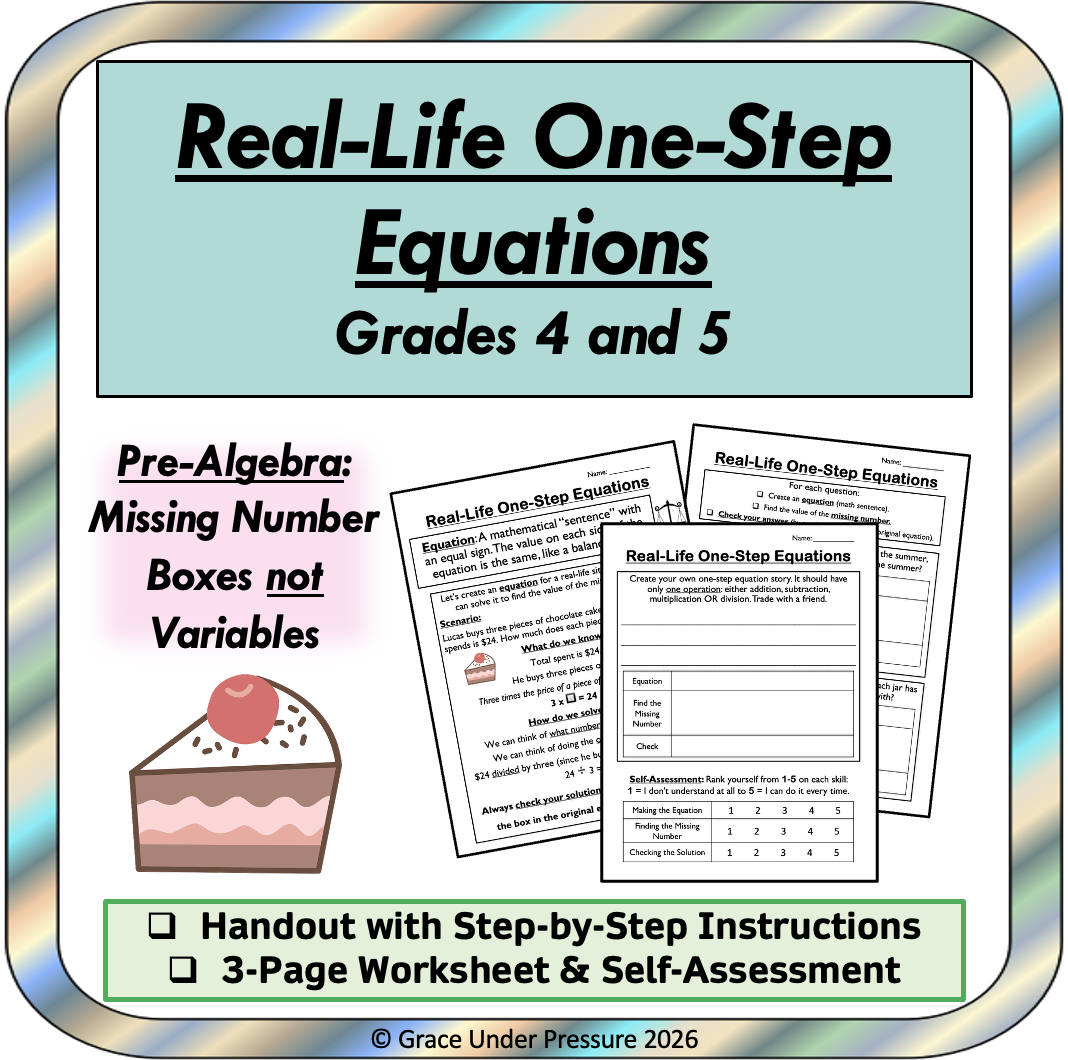
Two Step Equations Worksheet: Writing & Solving Real-Life Equations
Math, Algebra, Grade 6, 7, 8, Worksheets & Printables, Word Problems, Worksheets
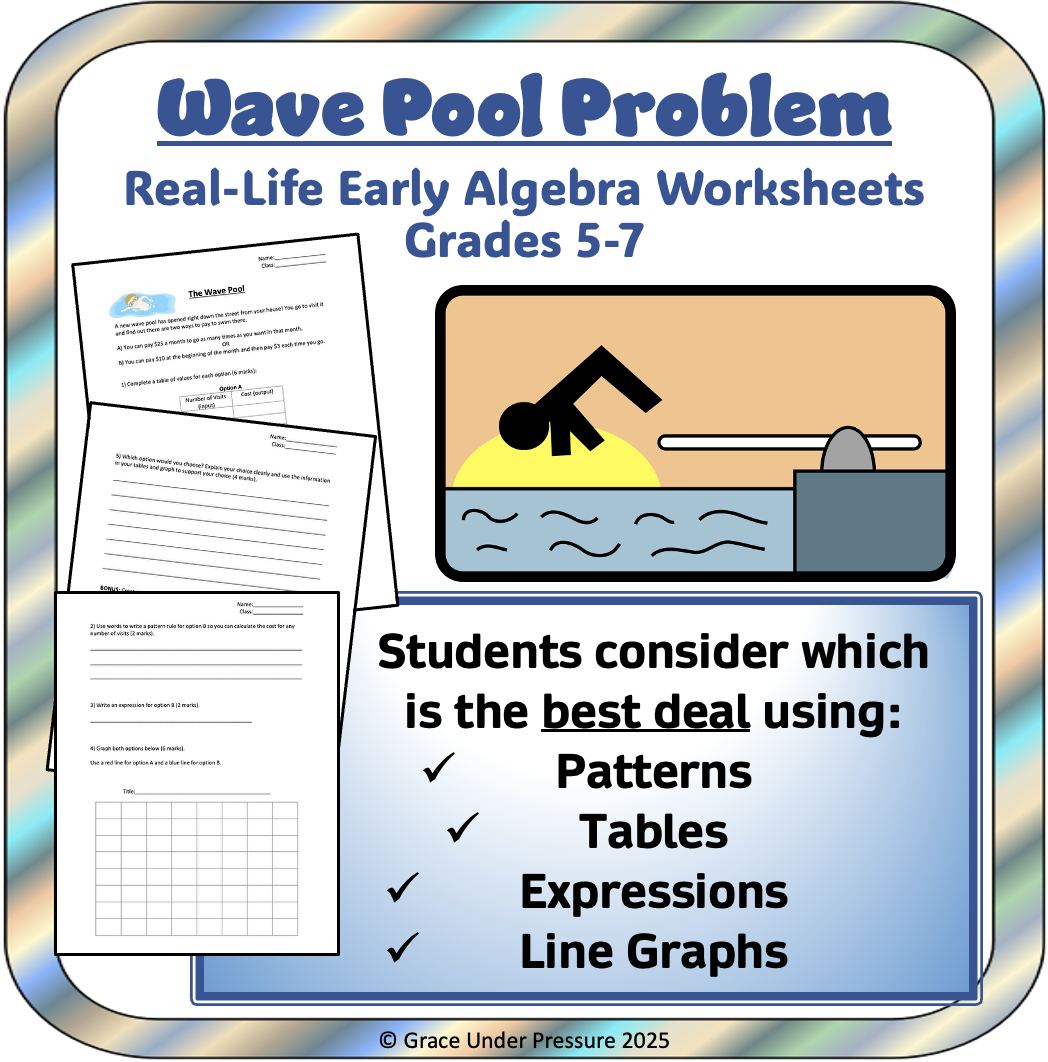
When teaching your students key algebra skills, it can often seem detached from the real world. Use this ready-to-go set of worksheets to help your students see how simple algebra can help solve real life problems that occur in everyday living. This product addresses simple two-step equations and the basics of algebra: doing the same thing to each side of an equation. How to Use: With this resource, learners get to see firsthand how two-step equations become useful tools in everyday situations. The package begins by presenting them with a sample scenario, presented in an easy-to-use handout, which will serve as both guide and template for subsequent activities. Then students put theory into practice by writing two-step equations representing simple real-life scenarios – distance, money, cooking and more! For each situation, students write an equation, solve the equation, and then check their solution by putting it back into the equation: an important final step. Grades to Use With: This lesson is designed for students in grades 6-8 who are learning the basics of algebra: writing equations, using variables, solving two-step equations, and checking their solution. It could also be used in high school special education classes as it is designed to be learner-friendly and includes step-by-step instructions and graphic organizers. What's Included: 7 Page PDF including: Title Page Sample Scenario Handout Three pages of realistic Practice Questions- with graphic organizers to keep students organized and focused A page with an extension activity (create your own problem) and an important Self-Assessment so students can see where they may need extra practice A complete answer key If you enjoy this algebra activity , check out other real world activities in my store: The Wave Pool Problem: Patterns, Expressions and Graphing Independent and Dependent Variables in Grade 6 Math: Hockey Math Solving Systems of Equations Using Substitution Inequality Matching Game Exponent Board Game
Author Grace Under Pressure
Tags Algebra, Two Step Equations, Equations, Word Problems, Real World Math, Middle School Math, Variables, Writing Two Step Equations, Two Step Equations Worksheet, Two Step Equations Worksheets
Math Journal: Experimental Probability with Two Independent Events
ELA, Math, Percentages, Fractions, Statistics, Writing, Grade 5, 6, 7, 8, 9, Worksheets & Printables, Word Problems, Activities
Math Journal: Experimental Probability with Two Independent Events This resource serves as a helpful teaching tool for educators focusing on the concepts of experimental probability and theoretical probability of two independent events in middle school mathematics. It offers an engaging math journal entry exercise that allows students to explain their mathematical thinking in pictures, numbers, diagrams, and words. How to Use: Students are given the following question: You have a six-sided die and a penny. If you roll the die twice and flip the penny twice, which is more likely: to get two sixes on the die or two heads from the penny? Explain your thinking using pictures, numbers, and words. Can you figure out the percentage chance of each event happening? Give students dice, coins, and mini whiteboards to work with so they can start to test out their ideas and theories. Encourage students to tackle the penny first as there are fewer results when flipping two coins. Suggest that students work together in pairs or small groups and use a table or chart to record the experimental options that could occur. You may want to start by teaching a mini-lesson about the probability of two independent events: that one multiplies the probability of each event to determine the probability of BOTH events. Grades to Use With This resource is ideal for use with students in grades 5-9 but can also be used as special education material or enrichment content for gifted children aged between grades 4-6. Finally, it could be used in a high school special education classroom. What's Included: This two page PDF is ready to print and go! If you enjoy this math journal entry, check out my bundle of 20 Middle School Math Journal Entries or my Math Journal Rubric for easy marking. Or, explore other probability items in my store.
Author Grace Under Pressure
Tags Math Journal, Experimental Probability, Two Independent Events, Middle School, Probability, Dice , Coins, Chance, Middle School Math, Fractions
Relationship Between Area and Perimeter: Math Inquiry Prompt
Math, Geometry, Measurements, Grade 3, 4, 5, 6, Worksheets & Printables, Word Problems, Activities, Worksheets
Here’s a ready-to-go math inquiry activity for your geometry unit. Students are tasked with drawing all the rectangles they can create with a specific area (24 units squared). Then, they calculate the perimeter of each rectangle. Finally, a prompt helps them notice the relationship between area and perimeter. Shapes that are longer and thinner will have a larger perimeter than other shapes with the same area. How to Use: Use this activity once your students have already had some practice calculating area and perimeter of rectangles. You could do a quick mini lesson about finding factors before handing out this activity , as your students need to determine the factors of 24 to complete this task (1x24, 2x12, 3x8 4x6). I let students work in pairs or small groups to complete this task as I want them talking about their math ideas! Grades to Use With: This math project is designed for students in grades 3-6 who are learning about area and perimeter of right-angle shapes (rectangles). In the USA, this is in Common Core Standards in the third grade and in British Columbia, Canada, it is addressed in Grade 5. What's Included: 2 Page PDF: Student worksheet and Complete Answer Key If you enjoy this math project, check out others in my store! I love to design engaging math activities that show students how the skills they learn in the classroom are actually extremely helpful in their everyday lives. Math is everywhere! Math Project: Create Your Dream Store: Decimal Calculations and Budgeting Financial Literacy: Vacation Math Project: Budgeting, Percentages, Time Zones and More! Math Project: Circle Graphs and Pie Charts Financial Literacy: My Party Budget: Decimals and Percentages Application Math in the Real World: Personal Math Research Project for STEM Education Geometry Project: Park Design with Area, Perimeter, and Volume Canadian Cities: Place Value to Millions Activity
Author Grace Under Pressure
Tags Geometry, Math, Area, Perimeter, Math Journal, Math Inquiry, Measurement, Inquiry, Grade 5 Math, 3rd Grade Math
6th Grade Math: Ratio & Proportional Relationship Bundle: 6 Activities
Math, Money, Percentages, Fractions, Common Core, Grade 5, 6, 7, Worksheets & Printables, Word Problems, Activities
Do you need some new ideas for your 6th grade math unit to meet the Common Core State Standards for Ratios and Proportional Relationships? Here is a ready-to-go bundle with six fun real-life activities to incorporate into your unit plan. 1) Ratio Exit Slip: Here is a quick assessment to check your students' understanding midway through a ratio unit. It assesses part to part and part to whole ratios and uses visuals. 2) Math Stations: Ratios and Proportional Relationships: These 5 stations are filled with problem solving, equivalent ratios, visual tasks, finding the ratios on road trips and more! 3) Income Inequality: Use a real world (and simple!) ratio called the Palma Ratio to talk about income inequality around the world and what kind of society your students want to live in. 4) Saving Up With a Part Time Job: Fill in ratio tables and graph them as well as your students choose an item to save up for, determine the tax, figure out how many hours they would have to work at two different hourly wages, and determine how many weeks it would take to save for their item. 5) Grocery Shopping Price Comparisons: Students use ratio and rates to figure out the best deal when sale prices are written in different a confusing ways. 6) Calculating Taxes, Tips, and Sale Prices: Students are taught three methods for calculating percentages: using benchmarks, using fractions, or using decimals. Then they apply these strategies to six real world examples. Grades to Use With: This bundle is designed for students in Grade 6, but can be used for Grade 5 enrichment, Grade 7 or 8 review, or high school special education classes. What's Included: 22 Page PDF with 6 Activities If you like this product, check out my 6th Grade Math Statistics and Probability Bundle as well!
Author Grace Under Pressure
Tags 6th Grade Math, Financial Literacy, Ratios, Proportional Relationships, Rates, Ratios And Rates, Percent, Ratio Tables, Grade 6 Math
Winter Unit Rates Word Problems Digital Escape Room
Math, Fractions, Winter, Seasons, Holiday & Seasonal, Grade 5, 6, 7, Escape Room, Activities, Worksheets & Printables, Word Problems, Worksheets
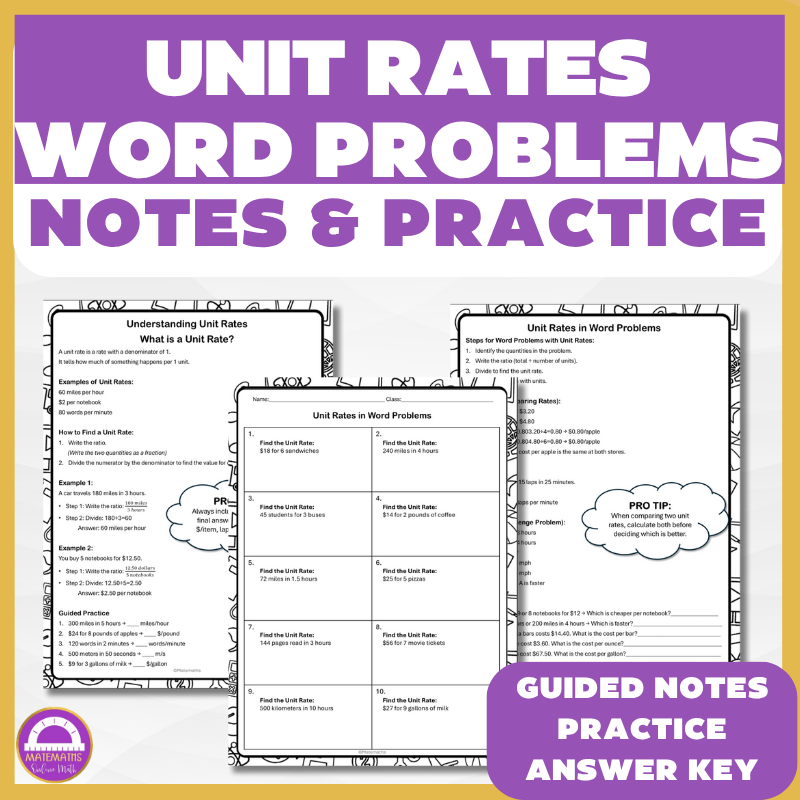
If your students struggle with unit rates, this Winter Digital Escape Room will give them the practice they need without the struggle. Rather than slog through another page of word problems, students are placed into a scenario where unit rate problems are a necessary part of bringing back the Frostbite Festival. This allows enough purpose to be added to avoid taking away from the math. Students work through twenty actual-unit-rate word problems set in four escape room winter scenes: The Snack Shack, Skating Trail, Yeti Workshop, and Penguin Performance. Students work with word problems related to cost, distance, time, and quantity from the everyday experience they realize from using unit rates. In order to progress, students must compute the correct answer and type it into the escape room. The escape room is a completely self-contained activity, which means students will not be able to progress with an incorrect answer, making this activity perfect for independent practice. One of the most beneficial aspects of this resource is the low level of work that it generates. There is no prep work that is necessary. You don’t have to set up anything, including logins and passwords and lock screens. You can just send out the link via Google Classroom, Canvas, Schoology, Microsoft Teams, or whatever tool that you are using. They just click and start. This autosave functionality comes in very handy during longer class times or interruptions. So long as students have had the chance to log back into the same computer and browser, they will pick up exactly where they left off. To make it more flexible, a printable version is also included. You will get a worksheet featuring all twenty unit rate problems, a matching version task card set, and finally, a full answer key. This is perfect for math center activities, small-scale intervention groups, or homework. Both the student and teacher instructions are provided and WrittenClearly, so there’s no misunderstanding or guestimation of how to do things. Students know just how to input their answers, and teachers know how to assign and use the autosave function. The skills which will be developed here include the understanding of the interpretation of unit rates, calculating a unit rate from a ratio, and using the rate in practical applications of money, time, distance, and measure problems. A winter unit rate resource that is engaging, organized, and actually easy to implement is not easy to find, but this escape room resource certainly delivers all of these things. Such a resource keeps students on task and provides a reliable no-prep resource for you to implement repeatedly.
Author Matemaths
Rating
Tags Mtemaths, Winter, Word Problems, Task Cards, Worksheet, Digital, Printable, Unit Rates, Escape Room