3,949 products added recently
Page 3 - 6th Grade Word Problems
Support sixth graders with word problems involving ratios, proportions, and introductory algebra. These worksheets promote higher-level thinking and real-world application. Incorporate them to strengthen mathematical reasoning.
5th grade 6th grade Christmas Math Activity: Digital and Print
Common Core, Math, Addition and Subtraction, Decimals, Fractions, Graphing, Measurements, Money, Multiplication and Division, Grade 5, 6, Word Problems, Worksheets & Printables, Centers, Activities, Escape Room, Games
The time before the holidays can get a little crazy in the classroom. Students are ready for a break and teachers are too! Keep your class engaged with EIGHT Days of math review! The ACTIVITIES are suitable for 5th grade and 6th grade. They are great for easy and fast sub plans. I use them as an 'end of the day carrot' that my students look forward to. They can't leave for the day without getting a step closer to finding Santa so it helps them to stay focused throughout the day so that we have time for the fun activity at the end of the day. One of the best parts: NO PREP required! This is not only great for distance learning but also great if you have run out of copies for the month and need a digital version fast... or if you just forget to make your copies for the week. (It's happened to me! - too. many things to keep track of) The pages do print beautiful in color and black and white if you have the time, but don't fret if you don't. Just assign it on Google Classroom - directions included. If you haven't taught the topic yet, it is a great mini lesson and if you have taught it, it can act as a review. (There are also some fun logic puzzles sprinkled in.) dividing decimals multiplying decimals dividing whole numbers multiplying whole numbers adding decimals subtracting decimals deducing information measurement conversions practicing with money problem solving graphing predicting and having fun! Each task builds off the next. Students will get clues as to where Santa might be hiding AFTER they correctly solve each math task. And don't worry, there is an ANSWER KEY. This resource lends itself to independent work but students can also work in groups of pairs to solve. Don't forget about the other holidays! There is a themed math activity in my store for each of the following: St. Patrick's Day: Find the Leprechaun Easter: Find the Easter Bunny Cinco de Mayo: Find the Piñata
Author Big Apple Teaching
Tags Math Challenge, Find Santa, Decimals, Division, Multiplication, Word Problems, Logic Puzzle, Graphing, Money
Volume Word Problems: Sprinkle Factory Grade 5 & 6 Conversions, Ratios
Math, Measurements, Multiplication and Division, Geometry, Grade 5, 6, Worksheets & Printables, Word Problems
Here’s an engaging 5th grade or 6th grade differentiated problem solving worksheet that includes several real-world math skills: o Conversions of standard measurements: millimetres to centimetres and centimetres to metres (5th Grade Measurement) o Calculating the volume of a rectangular prism that has whole number side lengths (5th Grade Measurement) o Multiplying & dividing by powers of ten (5th Grade Numbers in Base Ten) o Simple financial literacy (comparing prices) o Ratios and Rates (6th Grade Ratios and Proportional Relationships) Students will work on a realistic scenario: measuring boxes of sprinkles made at the sprinkle factory. Some are small for home use, and some are much larger for bakery and industrial applications. They will complete the following tasks for each box: Sketch the sprinkle box shape in 3-D with labelled measurements Complete simple and guided unit conversions on the measurements Calculate the exact volume of each box in centimetres cubed Determine the prices of each box using simple rates. This activity included three levels of difficulty: you can assign differing amounts to easily differentiate for your students, or complete the whole activity as a class, step-by-step. Level 1) Involves converting millimetres to centimetres and calculating the price and volume of the small box of sprinkles. Level 2) Has students convert metres to centimetres and calculate the volume and price of the larger box of sprinkles. Level 3) Students will compare the prices of the different boxes to find out which is a better deal using simple rates. This is an open-ended question, and there are lots of ways for students to solve it. You can have different students share their personal strategies with the rest of the class for further learning. What's Included: A 5-Page PDF that is ready for you to print Teacher instructions 3 Differentiated Student Worksheets A Complete Answer Key
Author Grace Under Pressure
Tags Word Problems, Volume Of Cubes, Ratios, Unit Conversions, Grade 6 Word Problems, Grade 5 Word Problems, 6th Grade Word Problems, 5th Grade Word Problems, Real World Math
Multiplication 101: Skill Testing Questions and Word Problems
Math, Multiplication and Division, Division, Grade 4, 5, 6, Word Problems, Worksheets & Printables
Multiplication 101: Skill Testing Questions and Word Problems This invaluable teaching resource is perfect for all types of educators, including public school teachers and homeschoolers. It is designed around the concept of multiplication as taught in Grade 4 to Grade 6, taking a step further with introduction of word problems to develop multiplicative thinking. Multiplication Tables Drill Sheets Included in the package are multiplication tables (1-13) drill sheets. These user-friendly sheets provide ample practice for students in reinforcing their knowledge about multiplication facts systematically. Each sheet focuses on a specific times table and can also serve dual-purpose as both practice and assessment tool. Real-World Problem Questions The package offers questions designed to encourage critical thinking among learners by applying multiplicative logic in daily real-life scenarios. Sample word problems feature situations such as Maria at McGregor's Pet Store filling baggies with fish or Mrs.Clarkson handing out homework pages; demonstrating practical application which helps students correlate mathematical theories to real-world circumstances. 'Think Pair Share' activity In addition, this educational resource introduces 'Think Pair Share,' an activity that fosters: Cooperative learning through brainstorming concepts related to multiplication and division; Better understanding of math foundations through collaborative work; accommodating whole group or small group settings alike. The versatility extends further as it can double up as comprehensive homework assignments once the concepts are understood inside the classroom setting, making it all-encompassing in nature. About Multiplication 101: Multiplication 101: Skill Testing Questions and Word Problems embodies both practicality and convenience for educators worldwide. It represents an effective medium that not only addresses individual academic needs but also nurtures proactive learning while reducing preparation time significantly. This groundbreaking resource perfectly strikes a balance between teaching efficiency and learner enrichment.
Author Easy As ABC
Tags Multiplication Drills, Word Problems, Critical Thinking, Cooperative Learning, Practical Application
Mth: Division of two digits
Math, Multiplication and Division, Multiplication, Grade 4, 5, 6, Worksheets & Printables, Word Problems, Activities, Worksheets
Mth: Division of Two Digits - An Inclusive Teaching Resource Mth: Division of two digits is a comprehensive learning resource designed purposefully to help students in grades 4-6 fortify their understanding of dealing with two-digit divisors. This well-thought-out teaching asset offers an engaging method for students to get recurring practice and, in turn, boost their confidence levels while dividing with double-digit divisors. Main Features: The advanced utilization of different activities that cater to various learning styles and needs among the students. Activities include a two-digit divisor division scavenger hunt, coloring pages, cutting, pasting and sorting exercises, worksheets with and without remainders division problems. A unique 'room quest' concept aimed at stimulating interest among the learners. This product aims not only to address student difficulties but also stimulate interest through a unique 'room quest' concept. The colorful activity allows children to search for problems hidden around the room in an interactive manner which adds an exciting dimension within classwork. In addition to its utility for 5th graders who can use it as part of their regular curriculum,Mth: Division of Two digits is equally beneficial for both ambitious 4th graders looking for advanced challenges as well as grade 6 teachers wanting material revision or reinforcement tool when teaching division involving two-digit divisors. Suitable Across Various Teaching Frameworks: No matter your lesson structure–whole group instruction or small groups session or even homework assignments – Mth: Division of Two digits satisfies all these modes effectively making it beneficial across various teaching frameworks. Persistent exposure through repetition ensures thorough comprehension thus fostering lasting mathematical competencies among young scholars.
Author Big Apple Teaching
Tags Division, Two-digit Divisors, Interactive Learning, Scavenger Hunt, Problem-solving
Back to School Math Review Task Cards for 6th Grade
Math, Grade 5, 6, Task Cards, Worksheets & Printables, Word Problems
Back to School Math Review Task Cards for 6th Grade is a set of 28 task cards reviewing essential math skills for students entering grade 6. This teaching resource focuses on skills like division, word problems , expressions, and more to reinforce learning from the previous year. The 26 PDF pages contain 4 task cards per page. A recording sheet and answer key are also included. Educators can utilize these cards versatilely for small group instruction, math centers, SCOOT games, bell-ringers, and more to fit varying learning needs. Whether for whole class review, reteaching struggling students, or a homework supplement, the broad sampling strengthens skills needed for success in 6th grade math. The variety keeps students engaged while checking for understanding.
Author AlwaysLearning
Tags Back To School, Math Review, SCOOT Game, Task Cards, August, Math, Word Problems, Fairy Tales
Math Journals: 20 Intermediate and Middle School Math and Critical Thinking Prompts: Geometry, Percentages, Pre-Algebra, Probability, Place Value and More!
Math, Percentages, Patterns, Decimals, Fractions, Geometry, Measurements, Place Value, Grade 4, 5, 6, 7, 8, Worksheets & Printables, Word Problems
Encourage your middle school/intermediate math students to clearly explain their ideas about concepts (like ratio, area, and algebra) in complete sentences using appropriate vocabulary and relevant diagrams . These open-ended questions require students to explain how they figured out their answers or to judge options using their mathematic understanding. They are a great review of math concepts learned earlier in the year or in previous grades, and they allow students to practice critical thinking skills too. This bundle includes 20 journal entry topics so you can use two a month for the entire school year. You and your students can track their progress and development. The journals are not numbered, so you can use them in whatever order works best for your class. This could be a fantastic addition to your math program for the new school year! A rubric for easy marking is also included. Students are assessed on their process, vocabulary, completeness, and visuals. This allows you to easily see student progress if you assess one or two journals per term. You could also use them as artifacts for parent-teacher conferences. Topics covered: - fractions and percent: equivalent fractions, fraction and decimal relationships, division of fractions, fractions to percent, percent discounts - probability and data collection: flipping coins, surveys, experiments - geometry: area and perimeter, triangles, rotations, - pre-algebra: one-step equations, membership rates - place value: large numbers, decimals to thousandths - factors and ratios For each topic, students are encouraged to write in complete sentences and explain all of their thinking clearly and explicitly. Don't assume the teacher knows what you are thinking! They should also draw some diagrams to support their thinking. This could include area and perimeter models, fraction models, t-charts and tables, and more.
Author Grace Under Pressure
Tags Journal, Math Journal, Intermediate Math, Word Problems, Pre-algebra, Middle School Math, Grade Six Math, Critical Thinking, Math, Percent
Order of Operations – 5 Real-Life BEDMAS Scenarios
Math, Order Of Operations, Grade 5, 6, 7, Worksheets & Printables, Word Problems, Worksheets
Order of Operations in Action: 5 Real-life Scenarios that use BEDMAS This teaching resource blends everyday real world situations with math knowledge, allowing students to solve word problems using simple mathematical equations and order of operations. It strives to show basic situations when we instinctively use order of operations to solve a multiple-step math problem: from making pancakes for a crowd to splitting the cost of pizzas with some friends. NOTE: Exponents are not used in this product. How to Use: Go through the sample problem with your class. Talk about how to turn the word problem into a simple equation. Then have your students solve the equation without order of operations and with order of operations. They should start to see why using order of operations helps get the correct answer. Then, allow students to work in pairs or small groups on the remaining four problems. For each one, students have to write their own equation and solve it with and without BEDMAS. Finally, early finishers can try to write their own sample problem to trade with a friend. What's included: A three-page PDF file containing two worksheets and an answer key: all visually-appealing and ready to print! Grades to Use With: This lesson is designed to be used in grades 5-7: when first introducing order of operations to your students, or as a real-world review of this important concept. Educational Goals: The primary objective is enriching students' comprehension and mastery surrounding the BEDMAS order of operations, minus exponents. The worksheets align well with key mathematical standards like CCSS5.OA.A.1 and CCSS5.OA.A.2. If you enjoy this real world math activity, check out others in my store: Financial Literacy: Saving Up From a Part Time Job Using Ratio Tables Vacation Math Project: Budgeting, Percentages, Time Zones and More! Plotting Polygons on 4 Quadrant Grids to Make a Logo
Author Grace Under Pressure
Rating
Tags Order Of Operations, Word Problems, Problem Solving, Real World Math, Applied Math, BEDMAS, Grade 5 Math, Grade 6 Math, Real Life Math, Worksheets
Measurements: Word Problems
Math, Measurements, Grade 4, 5, 6, 7, Word Problems, Worksheets & Printables
Measurements: Word Problems Measurements: Word Problems is an educational resource designed to assist in the understanding of measurement conversions, a critical aspect of mathematics education. This tool emphasizes practice through exercises and word problems. This resource targets students in grades 4 to 7, focusing on the area of measurements within mathematics. The compact, 4-page booklet format provides a rich array of measurement and conversion problems, making it suitable for diverse learning formats such as: Classroom Instruction Small Group Discussions Individual Homework Assignments User-Friendly Design The worksheets are designed with enough space for students' calculations. The clear instructions allow learners to follow easily and make the exercises both enjoyable and challenging. An Effective Learning Tool The inclusion of an answer page facilitates easy correction for educators or even self-assessment sessions if used as independent study material at home or during tutoring hours! Fully Editable Resource A standout feature is that the entire content can be customized based on varying competency levels - addressing individual nuances within diverse classrooms setup. In Conclusion Measurement: Word Problems does more than just provide engaging materials; it fosters steady progress while covering essential concepts around measurements and conversions during elementary school maths education!
Author Elementary Resources 4 U
Tags Measurement Conversions, Word Problems, Mathematics Education, Practice Exercises, Customizable
Absolute Value Worksheets: Real World 6th Grade Math 6.NS.C.7.C
Math, Number Lines, Numbers, Algebra, Grade 5, 6, 7, 8, Worksheets & Printables, Word Problems, Worksheets
Absolute Value can be a tricky topic to teach. It seems so easy and simple, but students actually need a strong, conceptual understanding of it for later years in middle school and high school math, so it definitely can't be skipped or glossed over! Here's a ready-to-go lesson all about absolute value for students in 6th grade. It is designed to meet standard CCSS 6.NS.C.7.c This lesson could also be a great review for students in grades 7 or 8 or could even be used in high school special education classrooms. First, there is a simple handout that explains what absolute value is using an easy, visual analogy: a dart board. Then, there are two pages of real-world questions for students to approach using an understanding of absolute value. From bank accounts, to elevation, to temperatures, to golf games, we actually use absolute value regularly in our number system without even noticing it! These questions require students to use number lines, integers, and absolute value proficiently. Students will notice how depending on the question, you may need to use an integer or an absolute value. They will start to see how absolute value can be helpful when calculating the difference between two numbers on a number line. A complete answer key is also included! If you enjoy this product, check out other grade 6 math number system lessons in my store: Middle School Math Stations or Centers: Fraction Operations: Add, Subtract, Multiply, Divide Multiplication and Division: Real Life Word Problems for Grades 4-6 Decimal Operations Assessment: Add, Subtract, Multiply, and Divide Middle School Math Stations or Centers: Factors, Multiples, Prime and Composite Integers and Plotting to Make Pictures in 4 Quadrant Cartesian Planes Combinations of Transformations in 4 Quadrants: Translation, Rotation, Reflection Real-Life Integers: Working with Integers and Number Lines Grade 6 Math
Author Grace Under Pressure
Rating
Tags Absolute Value, 6th Grade Math, Grade 6 Math, 7th Grade Math, Grade 7 Math, Number System, Number Lines, Real World Math, Word Problems, Absolute Value Worksheets
Coordinate Plane Worksheets: 5th Grade Patterns, Tables, Graphing
Math, Algebra, Graphing, Grade 5, 6, Worksheets & Printables, Worksheets, Word Problems
This engaging math project for students in grades 5 and 6 has several components, and it will help your students see how the math skills they learn in the classroom can be used in real-life situations! It is a great lesson to incorporate some simple financial literacy into your math curriculum too! How to Use: 1) Students will start by plotting ordered pairs on a coordinate plane to create the designs of two students who are making items for a craft sale. If graphed correctly, they will make a rectangle and an octagon. 2) Next, they will complete a worksheet that includes a table of values to show the profits of one of the craft sale participants. They will graph this data. 3) Then, students complete the same tasks (finishing a table of values and graphing the information) for the second seller. 4) Finally, students will compare the total sales of the two sellers to determine who made more money. There are a variety of ways students can find the final answer from multiplying with decimal amounts to using their tables or graphs. COMPLETE ANSWER KEY INCLUDED This lesson was created to target two specific 5th Grade Math Common Core Learning Standards: Geometry A.2: Represent real world and mathematical problems by graphing points in the first quadrant of the coordinate plane. Operations and Algebraic Thinking B.3: Generate two numerical patterns using two given rules. Form ordered pairs from the two patterns and graph the ordered pairs on a coordinate plane It could also be implemented in a 6th grade classroom during a Ratio and Proportional Relations unit or in a middle school special education classroom. What's Included: 7 Page PDF Ready to Print and Use! - Teacher instructions - Coordinate plane worksheet for students to plot shapes on - 2 pages of tables of values and graphs for students to complete - 3 page Answer Key
Author Grace Under Pressure
Tags 5th Grade Algebra, Patterns, Coordinate Plane Worksheet, Algebra Worksheet, Patterns And Tables, Graphing Workseheets, Real World Math, Financial Literacy, Math Project, Table Of Values
Canada Day or 4th of July Math Word Problems: Budget, Rate, Factors
Life Studies, Home Economics, Math, Money, Multiplication and Division, Division, Decimals, Grade 4, 5, 6, 7, Worksheets & Printables, Word Problems, Worksheets
Canada Day or 4th of July Math Word Problems: Budget, Rate, Factors, Multiples, Financial Literacy, Decimal Operations Here are three challenging, multi-step word problems for your middle school or intermediate students in grades 4-7. Each problem requires students to use their knowledge of factors and multiples, unit prices, and decimal operations. This is a great way to incorporate some simple financial literacy and budgeting into your math program. Two versions are provided: 4th of July and Canada Day: each version has a ready-to-print 3 page worksheet! Questions Included: Students need to figure out how to buy ingredients for 80 hamburgers at the best price. They will need to determine ways to make 80 using packs of 8, 12, 20, and 25. They will need to calculate the better unit prices. They think of ways a teacher could spend $20 to get some treats for her class with 24 students. There are inexpensive items like lollypops and pricier options like pop-its. Students should choose two different combinations of items. Finally, they determine how much a town would need to spend on fireworks and flags for their celebration. COMPLETE ANSWER KEY INCLUDED Grades to Use With: These activities could be used in grades 4-7 or in high school special education classrooms. In grades 4 and 5, you might do one problem together as a class, and then allow students to work in small groups to solve the other two. In grade 6 and 7, students should be able to complete these in a more independent way. If you enjoy this seasonal math activity , check out others in my store: Grocery Game: Winter Holidays Grocery Game: Spring Edition Halloween Budget Back To School Budget Christmas or Winter Holidays Budget Gingerbread Math: Fractions, Decimals, Percent Valentine's Day Shopping Lucky Leprechauns Multiplication Math Game
Author Grace Under Pressure
Tags 4th Of July, July 4th, Canada Day, Problem Solving, Word Problems, Financial Literacy, Budget, Decimals, Factors, Multiples
Financial Literacy: Saving Up From a Part-Time Job Using Ratio Tables
Life Studies, Finance, Home Economics, Math, Graphing, Money, Fractions, Grade 5, 6, 7, 8, Worksheets & Printables, Word Problems, Worksheets
Here's an integrated lesson that teaches key financial literacy skills while also allowing students to practice using ratio tables and graphing them. Students get to choose an item they want to save up for that costs between $200-$300. They research the exact price and where they can buy it. Then, they use a ratio table to help calculate the sales tax on that item in their area. Next students complete two ratio tables based on hourly wages they could get for a part-time job. They graph the data from the 2 tables to see that when you are making more money per hour, you can save up for an item faster. This is good practice for plotting ordered pairs on a coordinate plane. After that, students create a new ratio table to see how many weeks they will have to work to save up for their item. Finally, they reflect on what they have learned about ratio tables, graphing, saving up, getting a part-time job, or hourly wages. A complete answer key is included! Grades to Use With: This lesson is designed to target the Common Core State Standards 6.RP.A.3.A and 6.RP.A.3.C It is perfect for a grade 6 classroom, or could be used as review and/or to teach financial literacy in a grade 7 or 8 classroom. It could be used for enrichment in a grade 5 classroom. Finally. it could be used in high school special education classes. What's Included: 5 Page PDF: Title Page, 3 Pages of Worksheets with Ratio Tables and Graphs included, Complete Answer Key If you enjoy this financial literacy activity, check out others in my store: My Budget Project for Elementary: Grades 3-6 Back to School Budget Activity Halloween Budget Activity My Party Budget: Decimals and Percentages Practice Financial Literacy: Financial Tradeoffs
Author Grace Under Pressure
Tags Ratio Tables, Ratios, Financial Literacy, Money Math, Real World Math, Saving Money, Part Time Job, Proportional Relationships, Money, Finance
US State Capitals: Place Value to Millions Activity
Social Studies, Geography, Math, Numbers, Place Value, Grade 4, 5, 6, Worksheets & Printables, Word Problems, Activities, Worksheets
With this US State Capitals: Place Value to Millions Activity your upper elementary or intermediate students will be able to apply their place value knowledge (to the millions position). Students will find the populations of 11 US State Capitals (Sacramento, Springfield, Jefferson City, Augusta, Montpelier, Phoenix, Boise, Austin, Santa Fe, Honolulu, Frankfort) round each one to the nearest ten thousand work with the numbers: ordering, comparing, identifying specific place value spots, and writing in expanded form Grades to Use With: This lesson is designed for students in grades 4-6 who are learning or reviewing place value concepts (it can be used by American students, of course, but also by students in other countries too!). It could be a great beginning of the year activity as you ease into your math curriculum. It could also be used in high school special education classrooms. How to Use: This activity could be used as an in-class assessment during a place value unit. There is an answer key to easily mark the first two pages out of 50. There are also four extension challenges for early finishers. You can let students work on those independently or in small groups. What's Included: 6 Page PDF: Title Page Chart for 11 US State Capitals Worksheet with 8 Questions Extension sheet with 4 Challenges Answer Key If you enjoy this math application activity, check out others in my store. I am always striving to show students how the math they learn in class is helpful in real life! Pre-Algebra Problem: The Wave Pool: Expressions, Tables, and Graphs Math Project: Create Your Dream Store: Decimal Calculations and Budgeting Geometry Project: Park Design with Area, Perimeter, and Volume (and Budgeting!) Order of Operations in Action: 5 Real-Life Scenarios that Use BEDMAS Volume of Cylinders: Soup Can Savings Winter Holidays: Gingerbread Math: Fractions, Decimals, and Percents Using Tenths
Author Grace Under Pressure
Tags Place Value, Expanded Form, Millions, Population, 4th Grade Math, 5th Grade Math, Rounding, State Capitals, US Geography, Applied Math
Fractions Word Problems: Using Fractions for Taxes, Tips, Sales
Math, Fractions, Money, Life Skills, Special Resources, Grade 4, 5, 6, Worksheets & Printables, Word Problems
Here’s a fun, engaging, and visual personal finance lesson for middle grades students in the fourth through six grades. They can use the math they have been learning in the classroom applied to a real-life scenario: learning how to calculate taxes, tips, and sale discounts. Math Skills Used Equivalent Fractions (especially using a denominator of 100) Percentages Division (for example, to find a 20% discount, divide by 5) Money Decimals Addition and Subtraction This guided math lesson includes a clear and concise one-page handout that provides visuals to teach your students how to use fractions to help calculate sale prices, sales taxes, and tips. Next, the lesson includes three worksheets for your students. These are created to be of increasing levels of challenge. Assign one, two, or all three! Differentiate for your students' specific needs. First students calculate sale prices using fractions by applying simple division. Next they can calculate sale prices using percentages that are easily converted to fractions. Finally, they can practice calculating tips and taxes using simple percentages as well! A complete answer key is also included. Grades to Use With: This lesson is designed for students in grades 4-6 who are learning about fractions, equivalent fractions, simple percentages, ratios, and decimal operations. It could also be appropriate for middle or high school special education classrooms depending on your students' needs. What's Included: 6-Page that is ready to print and use! Teacher Instructions Student Handout 3-Page Worksheet Answer Key If you find this personal finance lesson useful, check out others in my store: My Budget Project for Grades 3-6: This lesson shows your students how to budget for housing, food, transportation and more! Valentine's Day Math Activity: Budgeting and Financial Literacy: This fun math lesson lets your students "shop" for Valentine's gifts for their friends while sticking to a budget. G rocery Shopping Price Comparisons: This is a great way to practice percentage and rate math: finding the best grocery deal.
Author Grace Under Pressure
Tags Fractions, Taxes, Tips, Sales, Financial Literacy, Math Word Problems, Fraction Word Problems, Applied Math, Tax, Tip
Financial Literacy
Math, Money, Grade 4, 5, 6, Worksheets & Printables, Word Problems, Worksheets
With this Financial Literacy resource, students will have understanding of the most common financial terms they probably hear on a daily basis. By introducing the terms including in this resource, students will become more financially aware and be able to think about the ways in which they handle their money. Financial terms students will learn are: income, spending, saving, credit, refund, charitable giving, tip, gratuity, and profit. Students will read scenarios and decide which financial term applies to each particular situation. Includes spending vs. investing worksheets in which students will know the difference between the two and create their own scenario in which they can make their own decisions in spending and investing. Through repetition students will remember the financial vocabulary words. The posters come in color and can be used to in the classroom to reinforce the lesson. Can be used as a stand alone lesson or to supplement any lesson pertaining to financial literacy. Includes: 8 full page posters for vocabulary word wall 2 page handouts with vocabulary terms 5 different activities related to newly acquired vocabulary answer key Check out the thumbnails to get an idea of what the resource will look like! Thanks!
Author Soumara Siddiqui
Tags Financial Literacy, Refund, Credit, Tip, Profit
Circumference and Area of Circles (with First Peoples' Principles)
Social Studies, First Peoples (Native), Math, Geometry, Measurements, Grade 6, 7, 8, Worksheets & Printables, Word Problems, Worksheets
Circumference and Area of Circles with First Peoples' Principles is a teaching resource that combines math education with a basic introduction to two cultural traditions from indigenous groups. It is suitable for middle grades students in 6th to 8th grades. This lesson provides a practical application of geometry by instructing students on how to calculate the areas of rectangles as well as the area and circumference of circles. The lesson plan blends hands-on activities with relevant mathematics concepts, helping students to understand math theory through real-life tasks. 1) Students learn what a button blanket is and its cultural significance. They measure the area of a "blanket" and calculate the area of the "buttons." Then, they cut out the buttons and glue them on the blanket in a design. Finally, they calculate the area of the blanket that is not covered by the buttons. 2) Students learn what a drum is and its cultural significance. They calculate the circumference of the "drum." Then they determine the area and circumference of a piece of rawhide that would be needed to overhang and cover the drum. This flexible lesson can be used in whole-class sessions to guide every student step by step. It may also serve as a resource for small group work or homework assignments, promoting independent problem-solving skills outside school hours. Grades to Use With: This product is specifically designed to align with the British Columbia Mathematics 7 curriculum requirements, but it can fit into any learning environment studying circle areas & perimeters - ranging from middle school math classes, high school social studies lessons, or high school special education. The worksheets also help meet CCSSMP1 standards. What's included: An easy-to-follow four-page PDF including two student worksheets. An answer key for teachers to accurately assess student progress through each exercise. If you enjoy this math activity , check out many others in my store: Grace Under Pressure
Author Grace Under Pressure
Tags Circles, Geometry, Indigenous Culture, Area, Circumference, Radius, Diameter, Button Blanket, Drum, Area Of Circle
Adding Decimals Word Problems – Practice Worksheet
Math, Addition and Subtraction, Addition, Decimals, Place Value, Grade 4, 5, 6, Worksheets & Printables, Word Problems, Worksheets
This worksheet is a great way for students to practice adding decimals. The word problems on this worksheet involve adding two decimals (up to hundredths) to find the sum. This is a great resource for teachers who are looking for extra practice for their students.
Author Have Fun Teaching
Rating
Tags Decimal Addition Word Problems, Word Problems With Decimals Worksheets, Decimal Word Problems Grade 5, Decimal Equations Worksheet, Decimal Word Problems Grade 6
Algebra Real World Math Problem: 5th 6th 7th Gr Patterns & Expressions
Math, Algebra, Graphing, Grade 5, 6, 7, Worksheets & Printables, Word Problems, Worksheets
This lesson is an excellent addition to a pre-algebra unit in grades 6 or 7 to help show students a real-world application of using expressions, tables of values, and graphing to solve a simple, everyday financial literacy decision. Students are tasked with deciding how to pay to visit a new wave pool in the neighbourhood. They can pay a flat monthly fee or pay a smaller fee and then pay a small amount each time they go. The trick will be determining how often they are likely to go each month. Students get to: Analyze a realistic scenario Complete two tables of values Write a pattern rule in words and turn it into an expression with a variable Create a simple line graph to compare the two options visually Explain their decision in words using evidence from their mathematical work This lesson can be used in various ways: it can be used during full-class instruction or smaller group activities. It could be regular classwork, a homework assignment, or even a summative assessment. I liked to have students complete it near the end of our algebra unit to assess skills before the unit test and to have as an artifact for parent-teacher conferences. An extension challenge is offered that is specifically designed for early finishers. A complete answer key is also included for easy marking out of twenty points. Grades to Use With: This lesson is designed for upper elementary or middle school students in grades 5-7. It could also be used in high school special education classrooms. What's Included: 7 Page PDF with three page student assignment, title page, and complete answer key. If you enjoy this algebra activity , check out others in my store: Modelling Equations: Visual Balance Scales Independent and Dependent Variables in Grade 6 Math: Hockey Math Solving Systems of Equations Using Substitution Inequality Matching Game Exponent Board Game Writing and Solving Two-Step Equations
Author Grace Under Pressure
Rating
Tags Pre-algebra, Expressions, Tables Of Values, Graphing, Graphs, Algebra, Variables, Real World Math, Word Problems, 6th Grade Algebra
Volume of Cylinders: Middle School Geometry Word Problem: Soup Cans
Math, Geometry, Measurements, Grade 6, 7, 8, 9, Worksheets & Printables, Word Problems, Worksheets
Here's a real world applied math example for your middle school geometry unit! It will have students calculating the area of circles, volume of cylinders, percentage reductions, and dimensions of labels (nets). Students are tasked to become a valued member of a soup company's management team. They have to determine the current volume of their soup cans, and whether an equivalent proportional reduction in height or diameter of the can will have a larger impact on the volume of soup inside. How to Use: This 3 page worksheet walks students through the process step-by-step. They sketch the current can and calculate its volume. They calculate a 10% reduction in height OR a 10% reduction in diameter of the can to see which one has a larger impact on the volume of soup inside. As an extension, they can measure out the reduced can's actual label size and design an appealing logo and image. All of the instructions are included, with space for sketches, explanations and formulae. A complete answer key is also included to eliminate any guesswork when marking! Grades to Use With: This lesson is designed for middle grades students in grades 6-9 who are learning about key geometry concepts: volume of 3D shapes, area of circles, ratios and proportional relationships, and creating nets from 3D shapes. It could also be used in adult education classes or some high school special education settings. What's Included: 5 Page PDF: Title Page, 2 Page Student Worksheet, Extension, Complete Answer Key If you enjoy this geometry activity, check out others in my store: Middle School Math Stations or Centers: Triangles, Area, Angles Middle School Math Stations or Centers for Area, Perimeter, and Volume Area of Triangles, Parallelograms, and Trapezoids: Jigsaw Journal Activity Relationship Between Area and Perimeter: Math Inquiry Prompt Park Design Project with Area, Perimeter, Volume, and Budgeting
Author Grace Under Pressure
Tags Geometry, Word Problems, Measurements, Volume Of Cylinders, Volume, Real World Math, Applied Math, Area Of Circle, Percent, Nets
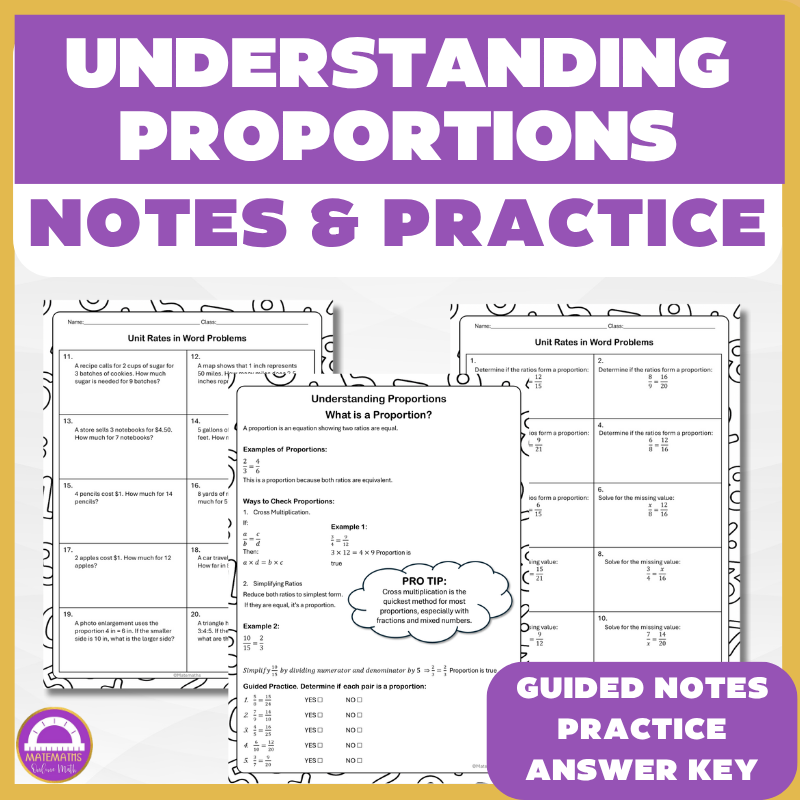
Proportions Word Problems Digital Self-Checking Digital Activity
Math, Fractions, Grade 6, 7, Worksheets & Printables, Word Problems, Activities
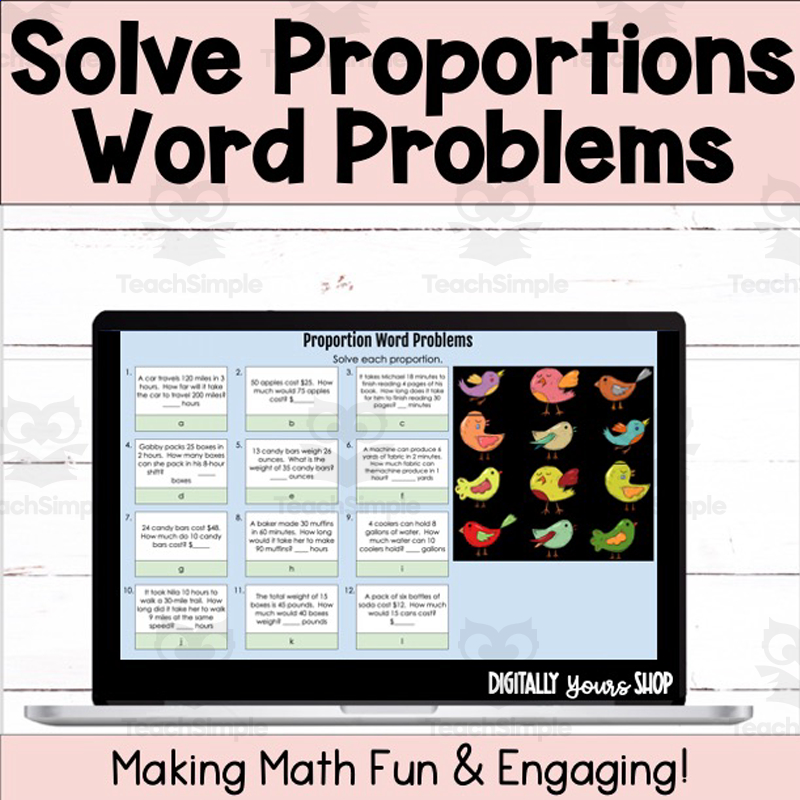
Engage middle school students in solving proportions with this self-checking digital math activity. The Proportions Word Problems Digital Self-Checking Digital Activity is a mystery picture reveal created using Google Sheets. As students correctly solve proportion word problems on a whiteboard or scratch paper, they type answers into the sheet. Correct answers turn green and reveal part of a fun mystery picture, providing instant feedback. Incorrect answers appear red, prompting students to try again. This no-prep resource aligns to 6.RP.A and 7.RP.A standards for finding and solving proportions. Use it for morning work, exit tickets, test prep, lesson follow-up, or homework. The self-checking feature allows this activity to be assigned digitally through Google Classroom or another learning management system. It's perfect for middle school classrooms and home schools seeking an engaging way for students to master solving proportions.
Author Digitally Yours Shop
Tags Proportions, Solving Proportions, Solve Proportions, Proportions Word Problems, Proportions Activity, Self-checking, Pixel Art, Google Sheets, Proportions Problems
Buying a Home: Financial Literacy Lesson- Mortgages and More for Grades 4-6 or Special Education
Special Resources, Life Studies, Life Skills, Math, Percentages, Addition and Subtraction, Addition, Subtraction, Multiplication and Division, Division, Money, Multiplication, Home Economics, Grade 4, 5, 6, Worksheets & Printables, Word Problems, Worksheets
Buying a Home: Financial Literacy Lesson- Mortgages and More for Grades 4-6 or Special Education Engage your elementary students in an exciting journey of learning about being homeowners with this interactive financial literacy lesson. This versatile resource is developed for students from grades 4 to 6 or high school special education pupils acquiring life skills. Students learn real-world home buying terminology such as down payment, mortgage, interest, principal, property taxes, and insurance. Learning complicated financial jargon makes navigating adult responsibilities less daunting in future years. What's Included: A comprehensive six-page PDF document includes: Title Page and Teacher Instructions A handout explaining home buying vocabulary and sample calculations for beginners. A series of practice problems for students to apply their learning and use intermediate math skills (addition & subtraction of numbers up to the hundred thousands, multiplying and dividing by 12 to work with monthly and yearly expenses, and calculating 1% of a number using decimals or division). An accompanying cut-and-paste vocabulary matching activity to reinforce learning. A complete answer key to make marking a breeze. How to Use: Go over the first page handout as a class or with small groups of students. Then, let students work together in pairs or small groups to complete the math questions during class time so questions can be addressed. Finally, I would assign the vocabulary matching as a quick homework task to reinforce the day's learning. Grades to Use With: This lesson is designed to be accessible to upper elementary students with the basic math skills of addition, subtraction, multiplication, and division with large numbers and an initial understanding of percentages. It could also be easily used in high school special education classes that are focusing on learning key life skills. If you enjoy this financial literacy math task, check out others in my store: Back to School Budget Activity Halloween Budget Activity My Party Budget: Decimals and Percentages Practice Financial Literacy: My Budget Project for Grades 3-6
Author Grace Under Pressure
Tags Financial Literacy, Home Buying, Mortgages, Vocabulary, Math, Down Payment, Life Skills, Interest, Budget, Money
Understanding Integers: Graphing Integers on a Number Line
Math, Number Lines, Early Math, Algebra, Grade 5, 6, 7, Worksheets & Printables, Word Problems, Worksheets
What is an integer? On what side of the number line will they be? This resource is perfect practice for students who are being introduced to integers. Students will know the difference between a negative number and positive number. Each worksheet contains a number line for visual aid and representation. Students are to graph each integer shown and by doing so, students will have more understanding of where the number is located on a number line. These integers may be in a set or individual. Students will also read real world examples of negative and positive numbers and decide where to graph each on a number line. Additional practice is included for students to tell the value of a letter shown on the number line. With the 5 different activities included in this set, it is a great introduction to integers and to set the foundation for future problems regarding integers. Includes: 5 practice pages answer key Check out the thumbnails to get an idea of what the pages will look like. Thanks! Understanding Integers: Graphing Integers on a Number Line Understanding Integers: Graphing Integers on a Number Line Understanding Integers: Graphing Integers on a Number Line Understanding Integers: Graphing Integers on a Number Line Understanding Integers: Graphing Integers on a Number Line Understanding Integers: Graphing Integers on a Number Line Understanding Integers: Graphing Integers on a Number Line
Author Soumara Siddiqui
Tags Integers, Integers On A Number Line, Graphing Integers
Independent & Dependent Variables – Hockey Math Lesson
Math, Algebra, Graphing, Grade 6, 7, 8, Worksheets & Printables, Word Problems, Worksheets
Here's a ready-to-go lesson to help show your students how learning about independent and dependent variables in grade 6 math can be helpful in the real world! This lesson is all about a hockey game and the mathematical relationships that can be found there. Students are given 4 scenarios about making ice, letting in fans, collecting money for 50/50 tickets, and the profits the arena makes. For each situation, they have to complete a table of values with missing entries, graph the relationship on the provided graph (labels and scales are already filled in), create an equation with the two provided variables, and answer one or two questions. The questions increase in difficulty throughout the assignment. You could use this lesson in several ways. After teaching your students the basic vocabulary and concepts from your math program, you could cut the four scenarios up and use them as task cards or stations. Or, you could assign one problem each to small groups. Or, you could give each student the entire double-sided worksheet. This could even be used as an assessment ! What's included: 4 Page PDF: Title and Instruction Page 2 Pages of Student Questions Complete Answer Key Grades to Use With: This lesson is designed for students in 6th Grade who are mastering the standard 6EE.C.9. However, it could also be a great review for students in 7th or 8th grades or it could be used in high school special education classes. If you enjoy this product, check out other 6th grade algebra activities in my store: Pre-Algebra Problem: The Wave Pool with Expressions, Tables, and Graphs Algebra: Modelling Equations: Visual Balance Scale Worksheet Exponent Board Game Or if you want more math games, check out some others in my store: Credit Score Board Game: Credit Cards, Loans, Mortgages and More: Personal Financial Literacy Bank Account Board Game: A Fun Financial Literacy Lesson for Addition, Subtraction or Integer Practice
Author Grace Under Pressure
Rating
Tags Independent Variable, Dependent Variable, Systems Of Equations, Graphing, Algebra, Equations, Variables, Tables, Linear Relationships, Real World Math
Canadian Cities: Place Value to Millions Activity
Math, Numbers, Place Value, Grade 4, 5, 6, Worksheets & Printables, Word Problems, Activities, Worksheets
With this Canadian Cities: Place Value to Millions Activity your upper elementary or intermediate students will be able to apply their place value knowledge (to the millions position). Students will find the populations of 11 Canadian cities (Charlottetown, Halifax, Montreal, Ottawa, Toronto, Winnipeg, Regina, Calgary, Vancouver, Whitehorse, and Yellowknife) round each one to the nearest ten thousand work with the numbers: ordering, comparing, identifying specific place value spots, and writing in expanded form This Canadian Cities: Place Value to Millions Activity includes a population chart for 11 Canadian cities a worksheet with 8 questions an extension sheet with 4 challenges an answer key to easily mark the assignment out of 40 Grades to Use With: This lesson is designed for students in grades 4-6 who are learning or reviewing place value concepts (it can be used by Canadian students, of course, but also by students in other countries too!). It could be a great beginning of the year activity as you ease into your math curriculum. It could also be used in high school special education classrooms. How to Use: This activity could be used as an in-class assessment during a place value unit. There is an answer key to easily mark the first two pages out of 40. There are also four extension challenges for early finishers. You can let students work on those independently or in small groups. If you enjoy this math application activity, check out others in my store. I am always striving to show students how the math they learn in class is helpful in real life! Math Project: Create Your Dream Store: Decimal Calculations and Budgeting Geometry Project: Park Design with Area, Perimeter, and Volume (and Budgeting!) Order of Operations in Action: 5 Real-Life Scenarios that Use BEDMAS Volume of Cylinders: Soup Can Savings Pre-Algebra Problem: The Wave Pool: Expressions, Tables, and Graphs Winter Holidays: Gingerbread Math: Fractions, Decimals, and Percents Using Tenths
Author Grace Under Pressure
Tags Place Value, Expanded Form, Millions, Population, Canada, Grade 4 Math, Grade 5 Math, 4th Grade Math, 5th Grade Math, Rounding