



3,985 products added recently
Page 17 - High School
Provide your high school students with activities that promote critical thinking, creativity, and autonomy. These resources encompass advanced topics and encourage in-depth analysis and discussion. Use them to enrich your curriculum and prepare students for future academic and career endeavors.

 Show filters


World History: Life in the Middle Ages | Feudalism | Document Based Activity
Social Studies, History, History: British, History: Europe, History: World, Grade 7, 8, 9, 10, 11, Activities
This resource is a World History: Life in the Middle Ages | Feudalism | Document Based Activity . You are purchasing a Document Based Activity (GOOGLE and Traditional versions provided) that uses the Inquiry Approach Lesson Strategy. This activity is on the topic of Life in the Middle Ages, specifically focusing on the question: How did the growth of towns, and an economy based upon trade and commerce, impact daily life during the Middle Ages? What was daily life like for people that lived during this time period? In the Inquiry Based (or Mystery Strategy) approach students are confronted with a historical puzzle or FOCUS question to consider and they are also given historical evidence (excerpts from primary sources, photographs, charts, graphs etc.) that they use to solve the puzzle or answer the FOCUS question. Students start by expressing their own curiosity about the topic, then they explore, ask questions, and investigate for answers. While working with the “clues” that you give them, students build their knowledge, continue to ask questions and search for answers, until they are able to draw conclusions about the puzzle or topic presented. In this activity , your students will: 1) Read a short Warm-up Reading and label a creative foldable on the unique Social Structure of the Middle Ages. 2) Work in small groups or pairs to analyze 7 pictures of Medieval Life. Guiding Questions are provided. (or individually for distance learning) 3) Investigate life in the Middle Ages using the clues (short primary/secondary source excerpts) provided. As they read each excerpt they will take notes and address the Comprehension questions provided on a GROUP GRAPHIC ORGANIZER. 4) Complete a creative assessment/Exit Card “Sensory” activity to gauge their understanding of the topic. All materials, sources, worksheets and handouts are provided! Your students will LOVE this activity ! About: Learning is a Passion Store - I have taught 6th-12th grade during my 20 year teaching career. I prefer to use lessons in my teaching practice that allow my students to become facilitators and active participants in their own learning rather than merely an audience of "my show". I love to create hands- on, interactive activities that really engage my students in the learning process.
Author Learning is a Passion
Tags World History, Middle Ages, Picture Analysis, Guiding Questions, Graphic Organizers, Feudalism World History
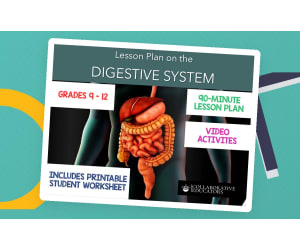
Lesson Plan on the Digestive System
Biology, Life Sciences, Science, Human Body, Grade 9, 10, 11, 12, Activities, Worksheets & Printables, Lesson Plans, Teacher Tools
Using the video “How the Digestive System Works”, this captivating 90-minute biology lesson presents the human digestive system to students in Grades 9–12. Students start with a stimulating discussion to activate prior knowledge, then engage in a focused video viewing while taking notes. The teacher subsequently clarifies the function of each organ in digestion, employing diagrams and analogies that are easy to relate to in order to enhance understanding. Students collaborate in pairs to identify parts of the digestive system and trace the path of a sandwich through the body. Single activities strengthen important vocabulary, the order of digestion, nutrient absorption, and frequent digestive problems. Pupils contemplate amusing trivia, including the reasons for stool odor and the workings of stomach acid. The lesson ends with a class review of answers and an exit ticket for personal reflection. This lesson combines visual, collaborative, and critical thinking strategies to ensure that students understand the digestion process and appreciate how their dietary habits affect their health. It is a practical, enlightening, and unforgettable investigation of an essential bodily system.
Author Bright Classroom Ideas Marketplace
Rating
Tags Human, Body, Biology, Digestive, System, Lesson, Plan

Science Revision for Grade 9
Science, Grade 9, Activities, Worksheets & Printables, Assessments, Teacher Tools
This Grade 9 Science worksheet ebook is perfect for busy teachers. It includes 30 ready-to-use activities that cover Biology, Chemistry, Physics, and Earth Science. All tasks can be completed on the page—no lab tools or extra materials needed. Students match, label, sort, calculate, and more. Each activity is designed to boost understanding and recall. The questions follow a clear, simple format. Answers are included at the end for quick checking. Teachers can use this ebook in class, for homework, or for revision. The mix of activities helps all types of learners stay engaged. It saves prep time and adds variety to your lessons. The worksheet fits any Grade 9 science curriculum. This is a great resource for review, test prep, or early finishers. Just print and go! Make your science lessons easier, more fun, and more effective. Download this worksheet today and give your students a smart, stress-free way to learn science. Your classroom will love it—and you will too!
Author Bright Classroom Ideas Marketplace
Rating
Tags Science, Revision, Grade 9

FIND 7 DIFFERENCES | 8 FREE EXERCISES FOR KIDS
Special Resources, Early Learning, Elementary, Homeschool Resources, High School, Adult Education, Not Grade Specific, Middle School, Pre-K, Games, Activities, Worksheets, Worksheets & Printables
FIND 7 DIFFERENCES | 8 FREE EXERCISES FOR KIDS ABOUT THE AUTHOR: Hi there! We are EDITORIAL LAURA EDUCA 🎓✨. We love designing educational materials that make children’s learning joyful, dynamic, and motivating. I invite you to visit my educational store, explore the variety of resources available, and find the perfect one for your students. SUMMARY OF THIS PRODUCT: What is the name of the document?: FIND 7 DIFFERENCES | 8 FREE EXERCISES FOR KIDS How many pages does it include?: 8 In what format is it available (PDF, Word, PPT)?: PDF Is it in color or black and white?: BLACK AND WHITE MAIN DESCRIPTION OF THIS RESOURCE: What is the name of your product and what makes it special? This beautiful product is called “FIND 7 DIFFERENCES | 8 FREE EXERCISES FOR KIDS”, and it is very special because it was carefully designed or compiled. With this educational resource, we want students to learn with enthusiasm and fun, because we believe learning is fun. How many pages are included in this resource? This fabulous document contains the following number of pages: 8 What size is it designed in (A4, letter, etc.)? This resource is designed in A4 format and compiled as a PDF. This makes downloading and printing simple and convenient, and PDFs are also easy to store and carry anywhere. PDF A4 Is the material in color or black and white? This pedagogical document comes in both black and white and color. This makes it more attractive for your learning sessions, but you have the freedom to choose how to print it. BLACK AND WHITE SECONDARY AND COMPLEMENTARY INFORMATION: What subject, skill, or topic does it cover? This resource is designed to cover essential learning areas for children, generally literacy and math. What learning objectives does it achieve? This document fulfills a playful objective—it’s meant to be attractive and engaging for children. At the same time, it ensures that students learn or reinforce their knowledge. Who can use it best (teachers, parents, students, therapists, homeschoolers)? We are all part of education. Whether you are a teacher, parent, student, or therapist, this document can adapt perfectly to your learning goals, depending on your creativity.
Author EDITORIAL LAURA EDUCA
Rating
Tags FREE, FERE RESOURCES, DIFFERENCES, FIND DIFFERENCES, GAMES, WORKSHEETS, BRAIN GAMES, SUDOKU
Summer 7th Grade Math Review | Digital Escape Room
Math, Algebra, Fractions, Geometry, Grade 7, 8, 9, Escape Room, Activities
Do you want to make your seventh graders review some math concepts in a fun and engaging way? Then this summer-themed digital escape room is perfect for you! Your students will help Turt find his missing friends by solving math problems involving decimals, fractions, percents, coordinate plane and quadrilaterals. They will enjoy this interactive and challenging activity that will keep them motivated and focused! The Summer 7th Grade Math Review | Digital Escape Room consists of 50 problems divided into five categories: • Operations with Integers: 10 problems • Operations with Fractions: 10 problems • One Step Equations: 10 problems • Area and Circumference of Circles: 10 problems • Two Step Equations: 10 problems Each category in this Summer 7th Grade Math Review | Digital Escape Room has a different game that students have to complete to reach another location where they will find another game. They will continue this process until they find all of Turt's friends and escape! This activity is designed to work on any device that has internet access, such as laptops, tablets, or smartphones. This means that your students can access it from anywhere and anytime they want! If your students cannot finish the Summer 7th Grade Math Review | Digital Escape Room in one session, they don't have to worry. They can simply save the URL at the top of the page and resume the activity later from where they left off. This Summer 7th Grade Math Review | Digital Escape Room is online and interactive, so you don't have to do any preparation or setup. You just have to copy the student answer sheet, share the link with your students, and let them have fun! No Google Classroom or Microsoft Teams accounts are required. For similar or other engaging resources, visit my store here! PDF with the link to the activity
Author Matemaths
Tags Matemaths, Escape Room, End Of Year, Summer, Back To School, Review

Poetry Activities for Blank Verse w/ William Shakespeare
ELA, Literature, Poetry, Grade 9, 10, 11, 12, Activities
This comprehensive resource on poetry explores the timeless charm of William Shakespeare's "Shall I Compare Thee to a Summer's Day?" (Sonnet 18), focusing on the intriguing poetic form of blank verse. This multifaceted tool engages students in guided annotation, literary analysis through short answer and essay tasks, and an enriching creative poetry-writing activity , providing a thorough examination of blank verse in poetry. With the ability to be smoothly broken down into separate elements, this resource serves as an excellent source for bell ringers, brief writing tasks, or substitute teacher lesson plans. Alternatively, teachers can effortlessly unify the three provided activities to craft a step-by-step lesson lasting 1-2 weeks, dedicating attention to the adept use of blank verse in poetry. Teaching this resource is simple! Start by presenting and discussing the poem with the poem analysis activity , which makes an excellent bell ringer. Then, give students time to complete the guided annotation activity and answer the analysis question that accompany the lesson (answer key included!). Next, students have the opportunity to write their own poem using the poetic concept analyzed earlier. Finally, you can assess students understanding of the poem and its poetic concepts with a literary analysis essay. That essay assignment comes with a prompt, writing tips, peer review, and Common Core-aligned rubric! Your TeachSimple download includes: A POEM ANALYSIS ACTIVITY : Give students the opportunity to read William Shakespeare's "Shall I Compare Thee to a Summer's Day?” (text included) and analyze the poem via an annotation activity and accompanying analysis questions (answer key included). Ideal for a bell ringer! A CREATIVE WRITING ASSIGNMENT: Provide students the opportunity to further develop their understanding of blank verse with a creative poem writing assignment (tied to one Common Core Writing Standard). Ideal for sub plans! A LITERARY ANALYSIS ESSAY: This essay assignment builds on students' understanding of blank verse and Shakespeare's "Shall I Compare Thee to a Summer's Day?” The assignment handout includes essay guidelines, analysis prompt, literary analysis writing tips, and a peer review checklist. The included rubric is tied to 4 Common Core ELA Standards and includes a link to an editable rubric that allows for grading customization and seamless integration into Google Classroom and many other Learning Management Systems (LMS's) Although this resource can be fitted for any secondary Language Arts classroom, it has been carefully designed to work best in grades 9 through 12. The included rubric is subtly but specifically tied to Common Core ELA Standards for Language (1 and 2) and Writing (2 and 4). This resource is provided in print-ready, bookmarked, and adjustable PDF files and PowerPoint Show files. This resource contains 5 pages and 1 Google Sheet.
Author The Language of Educational Art, LLC
Tags Literature, Creative Writing, Literary Analysis, Poetry, Summer

Science Reading Passage. Stars of Many Sizes (Fillable PDF)
Science, ELA, Reading, Reading Comprehension, Strategies, Resources for Teachers, Space, Earth and Environmental Sciences, Grade 6, 7, 8, 9, Writing Prompts, Worksheets & Printables, Centers, Activities, Teacher Tools, Assessments, Quizzes and Tests, Quizzes, Tests
Science Reading Comprehension Passages and Questions: Stars of Many Sizes (Fillable PDF) This very engaging science reading passage about Stars of Many Sizes is designed to bridge the gap between science and literacy through strengthening reading comprehension and sparking scientific curiosity in middle school students. The passage blends English Language Arts skills with accurate science content that supports NGSS classroom practice. Ideal for interdisciplinary learning in ELA and Science. Suitable for Grade 9 review, too! These worksheets are designed as fillable PDFs , which means students can type their answers directly into the document on any computer or tablet . Each page includes highlighted text fields that show them exactly where to type! Student Tasks for The Passage: 5 multiple-choice questions targeting main idea, key details, inference, vocabulary in context, and use of evidence 5 vocabulary matching items with clear, student-friendly definitions 5 text-based questions that require citing specific lines or facts 1 summary prompt that asks students to condense central ideas accurately Full answer key for every section Available Formats for this Resource PDF Word Docs Google Docs FULL CATALOG OF DOWNLOADING LINKS HERE Product Details Length: 4 pages total Grades: 6–8, also suitable for Grade 9 review Use cases: close reading, stations, homework, intervention, test prep, and sub plans Standards support: reinforces informational-text skills and supports NGSS-style sense making through observation, modeling, and clear use of claim, evidence, and reasoning Why Teachers Choose This Set Authentic science content paired with rigorous literacy practice Consistent task structure across all passages for easier planning and smoother student routines Clear, age-appropriate writing that builds confidence without oversimplifying Other Science Reading Collections you May find in the store: 1. Astronomy & Space Science 2. Volcanoes, Rocks, & Mountains 3. Rock Cycle, Soil, & Sinkholes 4. Mars, Glaciers, & Antarctica 5. Water Cycle, Acid Rain, & Wastewater 6. Insects, Animals, & Ecosystems 7. Bioluminescence & Insects 8. Animal Skin, Cats, & T. Rex 9. Human Body and Senses 10. Health & Applied Bioscience 11. Waves, Light, & Imaging 12. Electricity & Energy 13. Motion & Materials 14. Chemistry and Materials Science Use this set to reinforce ELA skills in science, to add literacy to your lessons, and to support independent work. The passages strengthen main idea, evidence use, vocabulary in context, inference, cause and effect, and summary writing. With ready-to-use assessments and complete answer keys, you can provide focused practice that is simple to run and fast to review.
Author Middle & High School - CORED Education
Rating
Tags Middle School, Reading Comprehension, Reading Strategies, ELA, Centers, Reading Passage, Assessments, Vocabulary, Environmental Science, Space
Atomic Model, Structure and Notation – Lab Station Activity
Science, Chemistry, Grade 7, 8, 9, 10, Labs, Experiments, Activities
Atomic Model, Structure and Notation Lab Station Activity Engage students in learning atomic model, structure, and notation through this customizable lab station activity . Students move through various stations testing their knowledge about topics like atomic theory history, the Bohr-Rutherford atomic model, subatomic particles, calculating atomic mass/numbers, and more. Activities include drawing models, researching questions, writing explanations, watching videos, answering test questions, and even formulating their own questions. Recording sheets provided for students to document their work. Use this as an introductory or review lab activity in individual, small group, or whole class settings to bring interactive chemistry learning to life. Modifiable with answer keys. 7th-10th grade. Chemistry.
Author Teach With Fergy
Tags Atomic, Model, Structure, Notation, Lab Station, Simple Atomic Model

Life Science Reading Comprehension Passage: Biotechnology (Docs)
Science, ELA, Reading, Reading Comprehension, Strategies, Resources for Teachers, Life Sciences, Biology, Grade 6, 7, 8, 9, 10, Writing Prompts, Worksheets & Printables, Centers, Activities, Teacher Tools, Assessments, Quizzes and Tests, Quizzes, Tests
Life Science Reading Comprehension Passage and Questions: Biotechnology (Docs) This very engaging science reading passage is about biotechnology and how living things can be used as tools to solve real-world problems . It explains how people use cells, bacteria, genes, plants, and other biological processes to create useful products and improve everyday life. The passage connects biotechnology to familiar examples such as bread, yogurt, vaccines, insulin, genetically modified crops, bioremediation, lab-grown meat, and biofuels. It also shows students how biotechnology can support medicine, agriculture, environmental cleanup, and a more sustainable future. This passage is designed to bridge the gap between science and literacy by strengthening reading comprehension while sparking scientific curiosity in middle school students. It blends English Language Arts skills with accurate science content, helping students build background knowledge, understand key concepts, use evidence from the text, and explain scientific ideas clearly. This resource supports science classroom practice while also reinforcing important literacy skills such as main idea, vocabulary, comprehension, and summarizing. Ideal for interdisciplinary learning in ELA and Science. Suitable for Grade 9 review, too! Student Tasks for The Passage: 10 multiple-choice questions targeting main idea, key details, science concepts, comparison, and real-world applications 10 True/False statements to check understanding and address common misconceptions 5 text-based short-answer questions that require students to explain important ideas from the passage 5 vocabulary matching items with clear, student-friendly definitions 1 summary prompt that asks students to condense the central ideas accurately Full answer key for every section Available Formats for this Resource PDF Fillable PDF Word Docs FULL CATALOG OF DOWNLOADING LINKS HERE Product Details Length: 7 pages total Grades: 6–8, also suitable for Grade 9 review Use cases: close reading, stations, homework, intervention, test prep, and sub plans Standards support: Reinforces informational-text skills and supports NGSS-style sense-making by helping students read scientific explanations, connect evidence to key concepts, interpret real-world examples, and explain cause-and-effect relationships in science. Why Teachers Choose This Set Authentic science content paired with rigorous literacy practice Consistent task structure across all passages for easier planning and smoother student routines Clear, age-appropriate writing that builds confidence without oversimplifying Other Science Reading Collections and Topics You May Find in the Store: 1. Astronomy & Space Science 2. Volcanoes, Rocks, & Mountains 3. Rock Cycle, Soil, & Sinkholes 4. Mars, Glaciers, & Antarctica 5. Water Cycle, Acid Rain, & Wastewater 6. Insects, Animals, & Ecosystems 7. Bioluminescence & Insects 8. Animal Skin, Cats, & T. Rex 9. Human Body and Senses 10. Health & Applied Bioscience 11. Waves, Light, & Imaging 12. Electricity & Energy 13. Motion & Materials 14. Chemistry and Materials Science 15. Electromagnetism 16. Acids and Bases 17. Gas Laws 18. Biotechnology 19. Periodic Trends 20. Protists and Fungi 21. Microevolution 22. Blood 23. Chemical Bonding 24. Magnets 25. Muscles 26. Nuclear Chemistry 27. Electromagnetic Devices 28. Epigenetics 29. The Law of Conservation of Mass 30. Atomic Models 31. Isotopes and Ions 32. Light 33. Human-Environment Interaction 34. Theory of Evolution 35. Photosynthesis 36. Origins of Life and Early Earth 37. Gene Expression and Regulation 38. Thermochemistry 39. Allergies 40. Coevolution 41. Birth to Adulthood 42. Cells 43. Entropy and Free Energy 44. The Human Brain 45. Mixtures and Solutions 46. Invertebrates 47. Zoo Animals 48. Biochemistry 49. Animal Behavior 50. Population Ecology ...and many more engaging science reading passages that cover intriguing and important topics designed to spark curiosity and support student learning. Use this passage to reinforce ELA skills in science, to add literacy to your lessons, and to support independent work. The passages strengthen main idea, evidence use, vocabulary in context, inference, cause and effect, and summary writing. With ready-to-use assessments and complete answer keys, you can provide focused practice that is simple to run and fast to review.
Author Middle & High School - CORED Education
Rating
Tags Middle School, Reading Comprehension, Reading Strategies, ELA, Centers, Reading Passage, Assessments, Vocabulary, Biology, Life Science
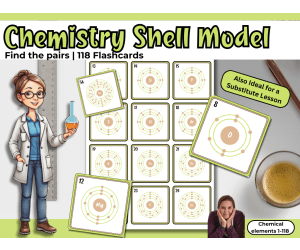
Shell Model – Chemistry Flashcards Without Element Names
STEM, Science, Chemistry, Physics, Life Sciences, Grade 7, 8, 9, 10, 11, 12, Activities, Games, Worksheets & Printables, Task Cards, Quizzes and Tests, Teacher Tools, Word Problems, Flashcards, Escape Room, Experiments
Shell Model – Chemistry Flashcards Without Element Names 118 cards for learning the periodic table Visual practice with atomic structure and electron configurations 🧪🔬 This printable flashcard set gives students a hands-on way to practice atomic structure and the shell model – without revealing the element names. Each of the 118 cards shows the atomic number, the chemical symbol, and a diagram of the electron distribution across shells. This encourages students to actively recall element names and deepen their understanding of how atomic structure relates to the periodic table. I’ve used these cards mainly for review and partner quizzes. Students really have to think: “What element has 11 electrons and that shell pattern?” or “Which group might this symbol belong to?” It shifts the focus from just memorizing the periodic table to actually understanding the structure behind it. What’s included: 118 printable flashcards (PDF) Each card includes: atomic number, symbol, and shell model (no element names) High-resolution layout, easy to print and cut Suggestions for classroom use included Classroom ideas: Use the cards as a “Find the Pairs” game: Print two sets and let students match identical cards or group elements by patterns. Use them for sorting tasks: metals vs. non-metals, main groups vs. transition metals, increasing number of shells, etc. Create mini-quiz stations: One student shows a card, the other has to guess the element name or describe properties based on the shell model. Let students use the cards to quiz themselves or work in pairs for peer learning. The fact that the element name is missing makes the activity more cognitively demanding – great for more advanced learners or as a follow-up to a unit on atomic structure. Students are more engaged when they can “figure things out” rather than just read off answers. The resource is ready to print. For repeated use, laminating is recommended. 📍 Best wishes, Heike from @Lernfitness Did You Know? I teach with a certified therapy dog, and together we create a positive and welcoming learning environment. 🐶
Author Lernfitness
Rating
Tags Educational Card Games, Chemistry, Physics, STEM Science Matching Game, Chemical Elements, Periodic Table Matching Game, Flashcards Chemical Elements, Shell Model, Game, Electron Configuration
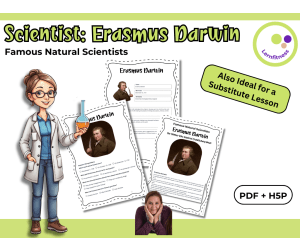
Scientist Erasmus Darwin Fact Sheet, Quiz + Exercises | PDF + H5P
Life Sciences, Science, Biology, STEM, History: World, History, Social Studies, Nature & Plants, Animals, Biographies, Grade 7, 8, 9, 10, Worksheets, Worksheets & Printables, Quizzes, Quizzes and Tests, Teacher Tools, Projects, Activities
Discover Erasmus Darwin – The Thinker Who Inspired Evolutionary Ideas Did you know that Erasmus Darwin, the grandfather of Charles Darwin, was a brilliant scientist, physician, and poet? He was one of the first to suggest that living things change and adapt over time – ideas that later influenced the theory of evolution. Erasmus Darwin’s work combined science and imagination, making him a true pioneer of his time. This teaching resource introduces your grades 7–10 students to the fascinating life and contributions of Erasmus Darwin. Designed for a 45-minute lesson, it includes engaging content and creative tasks to make his revolutionary ideas come alive in the classroom. What’s Included: Concise Informational Text: A clear and engaging overview of Erasmus Darwin’s role in science. Fact Sheet Activity: Encourages students to organize knowledge and work creatively. Quiz with Solutions: Promotes fun, interactive learning and self-assessment. Additional Exercises: Students can create their own questions and collaborate in pairs to deepen their understanding. Flexible Formats: Includes a color and black-and-white printable PDF, as well as interactive H5P tasks for digital learning. Why You’ll Love This Resource: Time-Saving: Perfect for teachers who need a ready-to-go, well-structured lesson. Versatile Use: Ideal for biology, history of science, or cross-curricular lessons in English and science classes. Promotes Independence: Solutions are included, allowing students to check their work and explore the topic at their own pace. Interactive and Engaging: Tasks are designed to keep students actively involved while learning about Erasmus Darwin’s legacy. Whether you use it for a regular lesson, substitute teaching, or as part of a digital learning activity, this resource will make Erasmus Darwin’s contributions come alive for your students. Bring Erasmus Darwin’s fascinating world of science into your classroom and inspire your students to see history and science in a whole new light! Have fun exploring the world of science with your students! Warmly, Lernfitness Did You Know? I teach with a certified therapy dog, and together we focus on creating a positive and inspiring learning environment.
Author Lernfitness
Tags Science, Biology, Famous Scientists Lesson, H5P, Interactive Science Exercises, STEM, History, Scientists, Evolution, Darwin
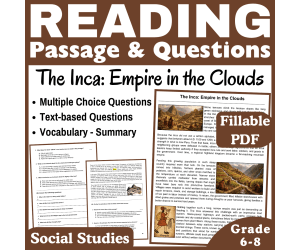
The Inca: Social Studies Reading Comprehension Passage. Fillable PDF
ELA, Reading, Reading Comprehension, Strategies, Resources for Teachers, Social Studies, History: Ancient, History, Geography, Grade 6, 7, 8, 9, Writing Prompts, Worksheets & Printables, Centers, Activities, Teacher Tools, Assessments, Quizzes and Tests, Quizzes, Tests
The Inca: Social Studies Reading Comprehension Passage (Fillable PDF) This resource introduces a unique Social Studies reading comprehension passage with questions about The Inca: Empire in the Clouds. The passage is carefully designed to bridge the gap between social studies and literacy through strengthening reading comprehension and sparking knowledge curiosity in middle school students. Each passage blends English Language Arts skills with accurate social studies content . Ideal for interdisciplinary learning in ELA and Social Studies. Suitable for Grade 9 review, too! This resource is designed as a fillable PDF , which means students can type their answers directly into the document on any computer or tablet . Each page includes highlighted text fields that show them exactly where to type! Student Tasks throughout the passage: 5 multiple-choice questions targeting the following skills: main idea, key details, inference, vocabulary in context, and use of evidence 5 vocabulary matching items with clear, student-friendly definitions 5 text-based questions that require citing specific lines or facts 1 summary prompt that asks students to condense central ideas accurately Full answer key for every section Available Formats for this Resource: PDF Word Docs Google Docs FULL CATALOG OF DOWNLOADING LINKS HERE Social Studies Reading Comprehension Collection Links: 1. Ancient Civilizations PDF Fillable PDF Word Docs Google Docs 2. Early Empires and Trade Networks PDF Fillable PDF Word Docs Google Docs 3. The Founding of the United States PDF Fillable PDF Word Docs Google Docs 4. Language, Culture, and Meaning PDF Fillable PDF Word Docs Google Docs 5. Psychology and Society PDF Fillable PDF Word Docs Google Docs 6. Global Festivals and Traditions PDF Fillable PDF Word Docs Google Docs 7. Extreme Environments and People PDF Fillable PDF Word Docs Google Docs 8. Food, Culture, and Preservation PDF Fillable PDF Word Docs Google Docs 9. Global Food Customs PDF Fillable PDF Word Docs Google Docs 10. Media, Communication, and Popular Culture PDF Fillable PDF Word Docs Google Docs 11. Human Impact on the Environment PDF Fillable PDF Word Docs Google Docs 12. Civic Action and Social Change PDF Fillable PDF Word Docs Google Docs 13. Fashion, Society, and Power PDF Fillable PDF Word Docs Google Docs 14. People, Places, and Unusual Histories PDF Fillable PDF Word Docs Google Docs Product Details: Length: 5 pages Grades: 6–8, also suitable for Grade 9 review Use cases: close reading, stations, homework, intervention, test prep, and sub plans Why Teachers Choose This Passage: Authentic social studies content paired with rigorous literacy practice Consistent task structure for easier planning and smoother student routines Clear, age-appropriate writing that builds confidence without oversimplifying Use this passage to reinforce ELA skills in social studies, to add literacy to your lessons, and to support independent work. The passage strengthens main idea, evidence use, vocabulary in context, inference, cause and effect, and summary writing. With ready-to-use assessments and complete answer keys, you can provide focused practice that is simple to run and fast to review.
Author Middle & High School - CORED Education
Rating
Tags Middle School, Reading Comprehension, Reading Strategies, ELA, Centers, Reading Passage, Assessments, Vocabulary, Social Studies, Ancient Civilization
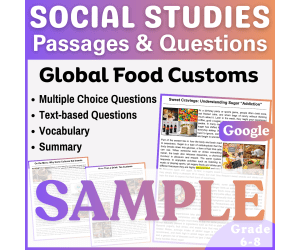
Reading Comprehension Passage: Sugar Addiction (Docs SAMPLE)
ELA, Reading, Reading Comprehension, Strategies, Resources for Teachers, Social Studies, Sociology, Grade 6, 7, 8, 9, Writing Prompts, Worksheets & Printables, Centers, Activities, Teacher Tools, Assessments, Quizzes and Tests, Quizzes, Tests
This is a ONE PASSAGE SAMPLE. The following is the description of the FULL resource and the downloading links: Social Studies Reading Comprehension Passages and Questions: Global Food Customs (Docs) This resource introduces a collection of Social Studies reading comprehension passages with questions about Global Food Customs. The passages are carefully designed to bridge the gap between social studies and literacy through strengthening reading comprehension and sparking knowledge curiosity in middle school students. Each passage blends English Language Arts skills with accurate social studies content . Ideal for interdisciplinary learning in ELA and Social Studies. Suitable for Grade 9 review, too! What Is Included in this Collection? There are three informational passages (with full answer keys): On the Menu: Why Some Cultures Eat Insects More Than a Drink: Tea Customs Sweet Cravings: Understanding Sugar “Addiction” For Each Passage, students will have multiple tasks to complete as follow: 5 multiple-choice questions targeting main idea, key details, inference, vocabulary in context, and use of evidence 5 vocabulary matching items with clear, student-friendly definitions 5 text-based questions that require citing specific lines or facts 1 summary prompt that asks students to condense central ideas accurately Available Formats for this Resource PDF Fillable PDF Word Docs FULL CATALOG OF DOWNLOADING LINKS HERE For more Social Studies Reading Passages, check the following Links: Ancient Civilizations PDF Fillable PDF Word Docs Google Docs Early Empires and Trade Networks PDF Fillable PDF Word Docs Google Docs The Founding of the United States PDF Fillable PDF Word Docs Google Docs Language, Culture, and Meaning PDF Fillable PDF Word Docs Google Docs Psychology and Society PDF Fillable PDF Word Docs Google Docs Global Festivals and Traditions PDF Fillable PDF Word Docs Google Docs Extreme Environments and People PDF Fillable PDF Word Docs Google Docs Food, Culture, and Preservation PDF Fillable PDF Word Docs Google Docs Global Food Customs PDF Fillable PDF Word Docs Google Docs Media, Communication, and Popular Culture PDF Fillable PDF Word Docs Google Docs Human Impact on the Environment PDF Fillable PDF Word Docs Google Docs Civic Action and Social Change PDF Fillable PDF Word Docs Google Docs Fashion, Society, and Power PDF Fillable PDF Word Docs Google Docs People, Places, and Unusual Histories PDF Fillable PDF Word Docs Google Docs Product Details Length: 14 pages total Grades: 6–8, also suitable for Grade 9 review Use cases: close reading, stations, homework, intervention, test prep, and sub plans Why Teachers Choose This Set Authentic social studies content paired with rigorous literacy practice Consistent task structure across all passages for easier planning and smoother student routines Clear, age-appropriate writing that builds confidence without oversimplifying Use this set to reinforce ELA skills in social studies, to add literacy to your lessons, and to support independent work. The passages strengthen main idea, evidence use, vocabulary in context, inference, cause and effect, and summary writing. With ready-to-use assessments and complete answer keys, you can provide focused practice that is simple to run and fast to review.
Author Middle & High School - CORED Education
Rating
Tags Middle School, Reading Comprehension, Reading Strategies, ELA, Centers, Reading Passage, Assessments, Vocabulary, Social Studies, Food And Culture

Nervous System – Lab Station Activity
Science, Life Sciences, Biology, Grade 8, 9, 10, 11, 12, Labs, Experiments, Activities
This fully editable Lab Station on The Nervous System is meant to get your students out of their seats and engaged in the content. Each station not only offers a unique opportunity to test your students knowledge (offer an opinion, answer questions based on a video or reading, draw, etc.), but also provides a fantastic learning opportunity where your kids are learning through assessment. Each station comes with a description card while some also contain more detailed instructions, a reading, questions to answer, etc. Students are equipped with a recording sheet (passport) to write their answers. There is almost no prep for you. Simply print the cards, lay them out around the room and you're all set. An answer key is also provided where applicable. This lab activity covers: - Structure, Parts and Functions of the Nervous System - Structure, Types and Functions of the Neuron - Reflex Arc - Nerve Signal Transmission and Action Potential - The Schwann Cell and Action Potential - Sodium-Potassium Pump - Neurotransmitters and its Functions ---------------------------------------------- Bonus Activities: To ensure your students don’t have any downtime between stations, your lab also includes a 10-word word scramble and word search, both with an answer key. You can use them as part of their mark, as a bonus so it’s not mandatory, etc. However you choose to use it, it will ensure that your students are always busy and never idle. Note: For stronger classes, I give the word scramble and for weaker ones, the word search. ----------------------------------------------- How do the Lab Stations work? Each station is specially designed to be a unique complement to the material while at the same time, provide a valuable learning experience. Below is an overview of how each station works. In your activity , each will be tailored to the specific content. Station 1: Get Hands-On – using their creative skills, students are required to draw or build. Station 2: Research – using a classroom computer or their own device, students must research a specific question/issue surrounding the topic. Station 3: Explain yourself – students write down an opinion to a question in paragraph form. Station 4: Rest Station - students can use this time to catch up on work they didn't have time to complete at a previous station or prepare themselves for an upcoming one. Station 5 - Applicability reading – students read a short passage from an article, website, etc. which directly connects the classroom content to a real life application. Station 6: Test your knowledge – students answer 5 multiple choice questions then provide a written explanation for how/why they came to their conclusion. Station 7: Learn from the expert – using a classroom computer or their own device, students must watch a short video clip and answer the associated questions. They may stop, rewind and restart as often as they like during the time frame. Station 8 - Rest Station. Station 9: Become the question master – Students must create 2 multiple-choice questions, 2 true/false questions and 1 short answer question. Students must also supply the answers. ------------------------------- You might also be interested in my other lab station activities Biology: • Cell and the Cell Theory • The Human Digestive System • The Circulatory System • The Human Respiratory System • Mitosis and the Cell Cycle • Cellular Respiration and Photosynthesis • Photosynthesis • Cancer: Cell Division Gone Wrong - Volume I • Cancer: Cell Division Gone Wrong - Volume II • Cell Membrane and Transport • Hearing and the Human Ear • The Human Eye • Genetic Material: DNA and RNA • The Nervous System • Energy Flow In Ecosystems Ecology and the Environment: • Ecosystems • The Classification of Living Things • Biodiversity and Invasive Species • The Carbon and Water Cycle • Climate Change • Photosynthesis • Cellular Respiration and Photosynthesis • Ecological Succession • Plant Sexual and Asexual Reproduction • Earth's Seasons • Interactions Within Ecosystems Physics: • Newton's Three Laws of Motion • Kinetic and Gravitational Potential Energy • Current Electricity and Circuit Diagrams • Static Electricity • Light Optics and the Production of Light • Sound, Sound Energy and Speed • One and Two-Dimensional Motion • Uniform Acceleration • How Planes Fly • Refraction • Friction • Energy and Its Forms • Density and Buoyancy Space Science: • The Life and Death of Stars • The Moon and its Phases • Life In Space • Our Solar System • Solar and Lunar Eclipse • Earth's Seasons • Asteroids, Comets and Meteors Chemistry: • Atomic Model, Notation and Atoms • Chemical Reactions and Balancing Equations • Molecular and Ionic Compounds • Physical and Chemical Properties & Changes • Acids, Bases, and Neutralization Reactions • The Periodic Table • Single and Double Displacement Reactions • Balancing Chemical Equations • Synthesis, Decomposition and Combustion Reactions • Atomic Theory, Atomic Structure and Isotopes • Types of Bonds and Intermolecular Forces • The Mole/Avogadro's Number • Density and Buoyancy These station cards are meant to be used as a lab activity but can also be utilized in a review task before a test or a quiz. Used either way, your students will love it! I know mine do and I'm telling you from first-hand experience as I've used this activity in my own class. Thank you for your interest in my products. If you have any questions, please send me an email - devon@teachwithfergy.com
Author Teach With Fergy
Tags Nervous, System, Neurons, Disorders, Lab Station, Nervous System Activity, Nervous System Lab, Nervous System Activities, Nervous System Activities Middle School

Magnets and Electromagnets 42 Question Board Game
Science, Physics, Grade 5, 6, 7, 8, 9, Activities, Games
With 42 question cards on permanent magnets and electromagnets this is an enjoyable and challenging board game for up to six players per set. It is suitable for all abilities. It can be played at the end of a module on electricity and electromagnets but is also a very useful test prep tool. This game is so much fun, pupils will forget they are learning! What You Get Game board (color and black and white) 42 question cards with questions of varying degrees of difficulty Answer sheet Instruction sheet. Rules for Play The player who throws the highest score starts and play proceeds in a clockwise direction. Students take turns and work their way around the board following the instructions in the squares. Some squares tell the student totake a question card from the face down pile. If correct they move on 2 spaces. If a player thinks an answer given by an opponent is incorrect they can challenge. If the challenge is correct the challenger moves forward 2 spaces. If the challenge is wrong the challenger moves back two spaces. In the event of a challenge, pupils are encouraged to consult their books but the teacher has a quick-check answer sheet. Prior Knowledge Required Composition of Magnets: Magnets are constructed using magnetic materials. Common materials include Iron, Cobalt, Nickel, and their corresponding alloys. Pole Interactions: Magnets have two types of poles - North and South. When two like poles (e.g., North and North) come close to each other, they repel. Conversely, when opposite poles (e.g., North and South) are brought together, they attract each other. Magnetic Fields: Surrounding every magnet is an invisible force field known as the magnetic field. This field can be visualized through field lines. Field Line Density: The density of these field lines determines the strength of the magnetic field. A region with closely spaced field lines indicates a stronger magnetic field than a region where they're spread out. Visualization of Field Lines: It's essential to understand and recognize the pattern of field lines around two bar magnets, especially when they have the same or opposite poles facing each other. Field Strength at Poles: The magnetic field is strongest at the poles of a magnet due to a higher concentration of field lines. Distance and Field Strength: The strength of the magnetic field diminishes as one moves farther from the magnet. Direction of Field Lines: Field lines emanate outward from the magnet's south pole and point inward toward the north pole. Magnetization Process: When a non-magnetized magnetic material becomes a magnet, the tiny regions within it called domains, which were initially oriented in random directions, align themselves to point uniformly in the same direction. Earth's Magnetic Properties: The Earth behaves like a large magnet. Interestingly, there appears to be a south-type magnetic pole near the Earth's geographic North Pole and a north-type magnetic pole near the Earth's geographic South Pole. Application in Devices: It would be beneficial to have a basic understanding of how magnets and magnetic fields operate within certain devices. Familiarize yourself with the structure and functioning of electric bells, relays, and circuit breakers, as they use these principles. See more Elf Off the Shelf resources on this topic and many others. Revisit attraction and repulsion with this magnetic poles investigation .
Author Elf off the Shelf Resources
Tags Magnets, Electromagnets, Magnetic Materials, Magnetic Fields, Earths Magnetism , Electric Bell, Electric Relay, North And South Poles, Magnetic Fileld Lines, Magnetism Game

Research Organizer & Essay Assignment: Elizabeth Barrett Browning
ELA, Literature, Poetry, Writing, Grade 8, 9, 10, 11, 12, Activities, Projects, Worksheets & Printables, Worksheets
This resource provides your students with the opportunity to independently explore and write about the life of poet Elizabeth Barrett Browning, the writer of "How Do I Love Thee?" and many other iconic poems, with this engaging research planner and essay assignment. This carefully scaffolded and easy-to-assign-AND-assess resource has been designed to guide student learning from Elizabeth Barrett Browning fact-collection to the careful development of a five-paragraph research essay. Teaching this resource could not be easier! Start by handing out the background research and note-taking worksheet (you could also ONLY hand this out if you want a shorter lesson!). Once students have found their facts and sources, provide them with the essay outline activity, which guides them step-by-step through the requirements of a short research essay. From there, drafting their essay, using the provided peer review checklist, and submitting their final draft will be no problem at all. And then you can assess their work with the provided Common Core rubric! Use this entire resource as a complete research lesson or just part of it as a short research activity or sub plan! This TeachSimple download includes: - An Elizabeth Barrett Browning essay writing assignment with directions, requirements, research essay writing tips, a peer review checklist, and Common Core-tied grading rubric - An editable rubric, provided as a link, that lets you make adjustments to the grade values and guidelines. This link is provided as as Google Sheet specifically built for integration into Google Classroom, although you can also modify it for use in other Learning Management Systems (LMSs) - An Elizabeth Barrett Browning biography and note-taking worksheet that will guide your students through information gathering. This straightforward two-page handout includes instructions for background research, a fun drawing section, and an area to cite quality sources and organize conducted research - A research essay outlining worksheet, so students build on their Elizabeth Barrett Browning notes in a clear and simple manner as they build their work towards a draft and final paper - All 6-pages of this lesson are provided in full-color and B&W versions Although this resource can be fitted for any secondary Language Arts classroom, it has been carefully designed to work best in grades 8 through 11. The included rubric is subtly but specifically tied to Common Core ELA Standards for Language (3) and Writing (2 and 7). This resource is provided as a print-ready, bookmarked, and adjustable PDF file. The rubric is also included as an editable Google Sheet. This resource contains 6 pages and 1 Google Sheet.
Author The Language of Educational Art, LLC
Tags Research, Essay, Rubric, Notetaking, Outlining

Money Superstitions: Social Studies Reading Passage. (Word)
ELA, Reading, Reading Comprehension, Strategies, Resources for Teachers, Social Studies, Sociology, Grade 6, 7, 8, 9, Writing Prompts, Worksheets & Printables, Centers, Activities, Teacher Tools, Assessments, Quizzes and Tests, Quizzes, Tests
Money Superstitions : Social Studies Reading Comprehension Passage (Word) This resource introduces a unique Social Studies reading comprehension passage with questions about Lucky Cash: What Money Superstitions Tell Us. The passage is carefully designed to bridge the gap between social studies and literacy through strengthening reading comprehension and sparking knowledge curiosity in middle school students. Each passage blends English Language Arts skills with accurate social studies content . Ideal for interdisciplinary learning in ELA and Social Studies. Suitable for Grade 9 review, too! Student Tasks throughout the passage: 5 multiple-choice questions targeting the following skills: main idea, key details, inference, vocabulary in context, and use of evidence 5 vocabulary matching items with clear, student-friendly definitions 5 text-based questions that require citing specific lines or facts 1 summary prompt that asks students to condense central ideas accurately Full answer key for every section Available Formats for this Resource: PDF Fillable PDF Google Docs FULL CATALOG OF DOWNLOADING LINKS HERE Social Studies Reading Comprehension Collection Links: 1. Ancient Civilizations PDF Fillable PDF Word Docs Google Docs 2. Early Empires and Trade Networks PDF Fillable PDF Word Docs Google Docs 3. The Founding of the United States PDF Fillable PDF Word Docs Google Docs 4. Language, Culture, and Meaning PDF Fillable PDF Word Docs Google Docs 5. Psychology and Society PDF Fillable PDF Word Docs Google Docs 6. Global Festivals and Traditions PDF Fillable PDF Word Docs Google Docs 7. Extreme Environments and People PDF Fillable PDF Word Docs Google Docs 8. Food, Culture, and Preservation PDF Fillable PDF Word Docs Google Docs 9. Global Food Customs PDF Fillable PDF Word Docs Google Docs 10. Media, Communication, and Popular Culture PDF Fillable PDF Word Docs Google Docs 11. Human Impact on the Environment PDF Fillable PDF Word Docs Google Docs 12. Civic Action and Social Change PDF Fillable PDF Word Docs Google Docs 13. Fashion, Society, and Power PDF Fillable PDF Word Docs Google Docs 14. People, Places, and Unusual Histories PDF Fillable PDF Word Docs Google Docs Product Details: Length: 4 pages Grades: 6–8, also suitable for Grade 9 review Use cases: close reading, stations, homework, intervention, test prep, and sub plans Why Teachers Choose This Passage: Authentic social studies content paired with rigorous literacy practice Consistent task structure for easier planning and smoother student routines Clear, age-appropriate writing that builds confidence without oversimplifying Use this passage to reinforce ELA skills in social studies, to add literacy to your lessons, and to support independent work. The passage strengthens main idea, evidence use, vocabulary in context, inference, cause and effect, and summary writing. With ready-to-use assessments and complete answer keys, you can provide focused practice that is simple to run and fast to review.
Author Middle & High School - CORED Education
Rating
Tags Middle School, Reading Comprehension, Reading Strategies, ELA, Centers, Reading Passage, Assessments, Vocabulary, Social Studies, Sociology

Vocational Skills Activity: How to Prepare for a Job Interview
Special Resources, Creative Arts, Art, Special Education Needs (SEN), Life Skills, Grade 10, 11, 12, Activities, Worksheets & Printables, Worksheets
Vocational Skills Activity : How to Prepare for a Job Interview The Vocational Skills Activity : How to Prepare for a Job Interview is an important resource designed with the primary goal of helping high school students acquire the essential skills needed for job interview preparation. This tool presents tailored activities to accommodate the specific needs of high school students while focusing on critical life skills. Both teenagers and adults will find this tool beneficial as it covers key vocational areas such as potential employer research, understanding job roles, preparing for probable interview questions, and formulating appropriate answers. These are facilitated through practical exercises and role-play scenarios offering hands-on interview experience. Features Dressing Correctly: Providing tips on appropriate attire along with maintaining excellent personal hygiene for interviews. Presentation Skills: Emphasizing one's unique qualities while staying relevant to the applied job positions - boosting confidence before prospective employers. Inclusivity: Offering assistance in developing essential life skills, making it suitable even for people with disabilities. Versatility: Comprised of numerous comprehension questions usable across different teaching environments like classrooms (large or small groups), special education classes or during one-to-one sessions. This activity will assist high school students in developing the necessary life skills to become more independent at school, at home, and in their communities. A great place to use this handout is in special education classes or in one-to-one settings, such as ABA therapy, speech therapy, occupational therapy, and Registered Behavior Technician (RBT) sessions. High school students who are working on independent living would benefit significantly from this activity for defining, setting, and measuring IEP goals. In addition to interactive instruction, this resource is ideal for hands-on and community-based learning. Engage your special education class with this highly interactive High School Vocational Skills Activity ! This activity contains step-by-step instructions, questions, and answers that reinforce learning, age-appropriate graphics, real-world examples, and ideas for implementation. This is the perfect special education activity for grade 10, grade 11, grade 12, and autism life skill centers. This special education life skills handout was designed to assist teens and adults with difficulties developing independent living skills. It's a printable, easy-to-use activity ready to hand out! Related Products for Developing Independent Living Skills How to Schedule an Appointment How to Fill Out a Job Application How to Create an Emergency Exit Plan How to Create a Strong Password A PDF with 42 unique pages. Color and black-and-white versions of each page are available for this pdf resource.
Author Adulting Life Skills Resources
Tags Job Interview Preparation, Vocational Skills, High School Students, Life Skills, Inclusive Resource

Natural Disasters: Weather and Climate Reading Article - Grade 8 and Up
Science, Earth and Environmental Sciences, Environmental Science, Grade 8, 9, 10, 11, Activities
Natural Disasters: Weather and Climate. This resource is suitable for high school students as well as strong middle school students. Tackle literacy and science by having your students read and answer questions from a scientific article. Questions include knowledge (direct from the paper), thinking, connecting, application, and open-ended varieties. No prep, no formatting, no issues. Simply download, print (or upload to your class site), and you're all set To give you an accurate idea of what this resource includes, I've included the complete versions of two other readings as the SAMPLE FILE - The Common Cold and Climate Change. You can also see exactly what the reading looks like in the preview images. This resource is fully editable for your convenience This resource covers the following topics: 1) What is a natural disaster? 2) Kinds of natural disasters 3) Meteorological natural disasters • Lightning • Tornadoes • Hurricanes • Tropical Storms • Blizzards • Hail 4) Climatological natural disasters • Drought • Extreme Heat • Wildfires 5) Summary The Problem You Face - Not having the time to properly teach scientific literacy (disciplinary literacy) or improve your students reading comprehension and analysis skills. The Solution This fully editable, NO PREP reading comprehension article is composed of relevant, applicable and engaging reading activities which can be used to: • introduce your topic • improve your students reading comprehension and scientific literacy skills • improve your students' analysis skills • provide an extension activity to students who move at a faster pace • provide extra credit to students in need • measure your students literacy skills Furthermore, this resource works very well as an emergency substitute plan as it will keep your students on task and focused while you are away. This resource will take your students between 50-75 minutes to complete and includes some open-ended questions. An answer key is also included for your reference. ----------------------------------------------- You might also be interested in the following individual reading comprehension articles: Earth and Space: • The Northern and Southern Lights • The Limitations of Space Travel • Why is the Sky Blue? An application of light waves • Stars - The Element Factories of the Universe • Solar and Lunar Eclipses • The Different Types of Clouds • How Weather Works • Natural Disasters • Natural Disasters: Weather and Climate Physics: • Magnets and Electromagnets • Roller Coasters - History, Design, and Function • How Do Boats Float? • Optical Phenomena • The Effects of Everyday Forces • Hydraulics Chemistry: • The Chemistry of Explosions • Plastics: A Marvel Of Innovation • The Chemistry of Paint • Water Softeners and Hard Water • Cleaning up Acid Spills • The Accumulation of Plastic in the Ocean • Chemistry of Cooking • Chemistry of Cosmetics • Blood Analysis and Forensics • Radioactivity • Desalination for Drinking Water Energy: • Fossil Fuels • Nuclear Energy: Fission and Fusion • Hydroelectric Energy Production • Solar Energy Production • Wind Energy Production • Renewable Energy Production • Hydraulic Fracturing - Fracking • Biofuels - Food or Fuel? Biology: • Fermentation and Food • DNA Paternity Tests • Laser Eye Surgery • Physical Adaptations • Muscle Growth • Genetically Modified Organisms • Mosquitoes And The Diseases They Spread • Twins • GERD and Acid Reflux - A Digestive System Disease • Bats – Misconceptions, Importance, and Facts • Superbugs - The Super Villains of Modern Medicine • Heart Attack and Stroke • Why Leaves Change Color In The Fall Health: • The Common Cold • The Flu • Exercise and its Importance for Health • Stem Cell Therapy: The Future of Medicine? • Concussions • Poliomyelitis - Polio • Smallpox • The Measles • Genetics and Gene Therapy • Heart Diseases • Cancer • The Effects of Caffeine • Down syndrome • HIV/AIDS - Informing the Public and Dispelling the Misconceptions • The Effect of Stress on the Brain • The Effect of Sugar on the Body • Whooping Cough • Asthma and Asthma Attacks • The Immune System • Farming: Organic vs. Conventional • The Dangers of Smoking • Parkinson’s Disease • Protective Equipment - Keeping you safe • Fats • Tinnitus – Ringing in the Ears • Cystic Fibrosis • The Effects Of Binge Drinking On Teenagers • Multiple Sclerosis • Painkillers • Diabetes • Radioactivity Ecology and the Environment: • Invasive Species • Ecosystems • Pesticides • The Importance of Bees • Coral Reef Ecosystems and their Future • Climate Change • Hydraulic Fracturing - Fracking • Farming: Organic vs. Conventional • Oil Spills and Their Consequences • Bioaccumulation and Biomagnification • RuBisCO - Earth's Most Important Protein • Symbiotic relationships between plants and insects • Smog - Its Causes and Dangers • Ocean Acidification • Pollution Control Devices • Tap vs Bottled Water • Predator Prey Relationships • Greenhouse Effect Natural Disasters: • Volcanoes: The Benefits and Devastation • Earthquakes • Tsunamis • How the Dinosaurs Died -------------------------------------------------- Each summary is rich with age appropriate content (grades 8 and up) and is 2.5-3 pages long (13-font). Following each is a list of 8-13 questions along with the answer key, which will help guide your students understanding. How this product will help your students: - Improve their scientific and disciplinary literacy skills - Improve their reading comprehension and scientific knowledge - Give them insights into important scientific concepts - Provide an extension activity for your faster moving/more gifted students How this product will help you: - Allow you to meet the NGSS, TEKS and Common Core Standards - Provide you with a concise introduction to your topic - Provide you with an engaging and easy to leave substitute plan which will keep your students engaged and on task - Prove you a means of measuring your students' literacy skills We don't spend enough time teaching scientific literacy to our students. This is either because we don't have the resources to do so effectively or we don't have the time. However, teaching our students to become scientifically literate is vital if we want them to succeed in life. We need them to know about the world they live in and about the issues they face. Even issues as simple as the common cold are misunderstood and can lead to the misuse of antibacterial drugs eventually rendering them ineffective. It can be used as a tool in your teaching arsenal on a regular basis, an extension activity for your faster learners, left for a substitute in an emergency or planned absence or as an extra bit of information for a topic. Add to cart
Author Teach With Fergy
Tags Natural Disasters, Weather, Climate, Science Article
Word of the Day Bell Ringers w/ Tragedy Narrative Assignment
ELA, Language Development, Vocabulary, Grade 8, 9, 10, 11, 12, Activities
Assist your middle and high school students' vocabulary acquisition with this resource that requires students to learn and apply 35 unique and complex words (taken from past SAT Writing & Language tests) through bell ringer activities and a summative tragedy narrative writing assignment. Teaching this resource is simple! Start it by presenting a new word at the start of each class period with the included slideshow while students use note-paper or the accompanying Google Form to digitally submit their own sentence using the day's word. When you have exhausted the 35 words, hand out the Science Fiction writing assignment, which includes planning and drafting activities, a peer edit, and Common Core rubric! Designed to open a class period in the amount of time it might take to record attendance, your download includes: - A 35-slide PowerPoint presentation that includes for each word: the part of speech, definition, example sentence, language of origin, and prompt for students to record their own sentence in their digital “word journal” - A link to a copy of a Google Slide Word Journal that can be shared with students, allowing them to record the word of the day and their unique sentence in a secure place while also generating a repository of answers to make assessment a breeze! - An alternative, printable World Journal document with directions, weekly word entries, and "completion" rubric - A tragedy narrative essay summative assessment that asks students to incorporate their learned vocabulary words into an original piece of writing. The narrative assignment handout includes writing tips, peer edit checklist, and ELA Common Core aligned rubric (CCRA.W.3, CCRA.L.1, CCRA.L2, CCRA.L.4) SAT WORDS IN BOOK 3: equivocate, adroit, postulate, analogous, proclivity, hidebound, ensconce, marred, soothsayer, clandestine, digress, obdurate, nonentity, gregarious, hackneyed, nostalgia, jurisprudence, emaciated, consecrate, replete, nullify, indolence, prodigious, therapeutic, euphemism, harbinger, retention, myriad, impious, alacrity, poignant, impoverished, larceny, caucus, maelstrom Although this resource can be fitted for any secondary Language Arts classroom, it has been carefully designed to work best in grades 9, 10, 11, and 12. The included activities and rubric are subtly but specifically tied to Common Core ELA Standard for Language (1, 2, and 4) and Writing (3). This resource is provided in a print-ready, bookmarked, and adjustable PDFs, Google Form, and PowerPoint Show files. This resource contains: 5 pages; 36 slides; 1 Google Form.
Author The Language of Educational Art, LLC
Tags Bell Ringer, Rubric, Creative Writing, SAT, Vocabulary

The Alps: Social Studies SAMPLE Reading Comprehension Passage (Word)
ELA, Reading, Reading Comprehension, Strategies, Resources for Teachers, Social Studies, Geography, Grade 6, 7, 8, 9, Writing Prompts, Worksheets & Printables, Centers, Activities, Teacher Tools, Assessments, Quizzes and Tests, Quizzes, Tests
This is a ONE PASSAGE SAMPLE. The following is the description of the FULL resource and the downloading links: Social Studies Reading Comprehension Passages and Questions: Extreme Environment and People (Word) This resource introduces a collection of Social Studies reading comprehension passages with questions about Extreme Environment and People. The passages are carefully designed to bridge the gap between social studies and literacy through strengthening reading comprehension and sparking knowledge curiosity in middle school students. Each passage blends English Language Arts skills with accurate social studies content . Ideal for interdisciplinary learning in ELA and Social Studies. Suitable for Grade 9 review, too! What Is Included in this Collection? There are three informational passages (with full answer keys): Salar de Uyuni: Bolivia’s Shining Salt Flat Above the Alps: The Story of the Eiger’s North Face Sherpas: Guardians of the High Mountains For Each Passage, students will have multiple tasks to complete as follow: 5 multiple-choice questions targeting main idea, key details, inference, vocabulary in context, and use of evidence 5 vocabulary matching items with clear, student-friendly definitions 5 text-based questions that require citing specific lines or facts 1 summary prompt that asks students to condense central ideas accurately Available Formats for this Resource PDF Fillable PDF Google Docs FULL CATALOG OF DOWNLOADING LINKS HERE For more Social Studies Reading Passages, check the following Links: Ancient Civilizations PDF Fillable PDF Word Docs Google Docs Early Empires and Trade Networks PDF Fillable PDF Word Docs Google Docs The Founding of the United States PDF Fillable PDF Word Docs Google Docs Language, Culture, and Meaning PDF Fillable PDF Word Docs Google Docs Psychology and Society PDF Fillable PDF Word Docs Google Docs Global Festivals and Traditions PDF Fillable PDF Word Docs Google Docs Extreme Environments and People PDF Fillable PDF Word Docs Google Docs Food, Culture, and Preservation PDF Fillable PDF Word Docs Google Docs Global Food Customs PDF Fillable PDF Word Docs Google Docs Media, Communication, and Popular Culture PDF Fillable PDF Word Docs Google Docs Human Impact on the Environment PDF Fillable PDF Word Docs Google Docs Civic Action and Social Change PDF Fillable PDF Word Docs Google Docs Fashion, Society, and Power PDF Fillable PDF Word Docs Google Docs People, Places, and Unusual Histories PDF Fillable PDF Word Docs Google Docs Product Details Length: 14 pages total Grades: 6–8, also suitable for Grade 9 review Use cases: close reading, stations, homework, intervention, test prep, and sub plans Why Teachers Choose This Set Authentic social studies content paired with rigorous literacy practice Consistent task structure across all passages for easier planning and smoother student routines Clear, age-appropriate writing that builds confidence without oversimplifying Use this set to reinforce ELA skills in social studies, to add literacy to your lessons, and to support independent work. The passages strengthen main idea, evidence use, vocabulary in context, inference, cause and effect, and summary writing. With ready-to-use assessments and complete answer keys, you can provide focused practice that is simple to run and fast to review.
Author Middle & High School - CORED Education
Rating
Tags Middle School, Reading Comprehension, Reading Strategies, ELA, Centers, Reading Passage, Assessments, Vocabulary, Social Studies, Geography

Electricity Generation – Lab Station Activity
Science, Technology, Engineering, Grade 7, 8, 9, 10, Labs, Experiments, Activities
Educators seeking an engaging, hands-on resource to teach the principles of electricity generation will find the Electricity Generation - Lab Station Activity to be an invaluable teaching tool. This product is a fully editable lab station activity designed to actively engage students in learning about electricity production. This robust product offers seven distinct lab stations with unique and engaging activities. Students have opportunities at each station to test their understanding of different methods of electricity production—such as renewable and non-renewable sources, fossil fuels, nuclear power, wind energy, hydroelectric power and future technologies in interactive ways. The resource includes practically no-prep for educators - just print the cards and lay them out around the classroom! Bonus activities: An added advantage is bonus activities such as word scrambles and word searches related to the topic. These orchestrated interjections ensure there is no idle time between transitioning from one action-packed station activity to another! The toolkit can be used during laboratory sessions or serves well for review tasks prior tests or quizzes. This resource also promotes independent thinking skills by requiring students to research specific aspects relating to electricity generation on their own devices or a classroom computer at 'research' stations. It encourages expression as students write down opinions on questions surrounding how electricity gets produced. Designed for multi-modal learners from 7th-10th grade studying science with subtopics in engineering; this package can also be sent home as extensions/homework tasks after lessons end. Overall teachers will appreciate how effortlessly it blends learning assessment while ensuring student engagement! Note: An answer key is provided where applicable so educators can quickly and accurately grade student work and offer feedback on their learning progress. In summary, this unique collection of station activities facilitates a complete immersion into understanding electricity generation while ensuring students remain stimulated and engaged throughout their exploration. As they navigate through each station activity – either in small groups or individually – students strengthen their grasp over the subject matter.
Author Teach With Fergy
Tags Electricity Generation, Lab Station, Hands-on Learning, Renewable Energy, STEM Education

Chemistry & Materials Science: Reading Comprehension Passages (Word)
Science, ELA, Reading, Reading Comprehension, Strategies, Resources for Teachers, Chemistry, Grade 6, 7, 8, 9, Writing Prompts, Worksheets & Printables, Centers, Activities, Teacher Tools, Assessments, Quizzes and Tests, Quizzes, Tests
Chemistry and Materials Science: Reading Comprehension Passages (Word) This very engaging collection of physical science reading passages about chemistry and material science is designed to bridge the gap between science and literacy through strengthening reading comprehension and sparking scientific curiosity in middle school students. Each passage blends English Language Arts skills with accurate science content that supports NGSS classroom practice. Ideal for interdisciplinary learning in ELA and Science. Suitable for Grade 9 review, too! What Is Included? There are (3) informational passages: Salt: Tiny Crystals, Big Effects The Hidden Science of Clothing Fingerprints: Patterns That Solve Crimes Student Tasks for Each Passage: 5 multiple-choice questions targeting main idea, key details, inference, vocabulary in context, and use of evidence 5 vocabulary matching items with clear, student-friendly definitions 5 text-based questions that require citing specific lines or facts 1 summary prompt that asks students to condense central ideas accurately Full answer key for every section Available Formats for this Resource PDF Google Docs FULL CATALOG OF DOWNLOADING LINKS HERE Other Science Reading Collections you May find in the store: 1. Astronomy & Space Science 2. Volcanoes, Rocks, & Mountains 3. Rock Cycle, Soil, & Sinkholes 4. Mars, Glaciers, & Antarctica 5. Water Cycle, Acid Rain, & Wastewater 6. Insects, Animals, & Ecosystems 7. Bioluminescence & Insects 8. Animal Skin, Cats, & T. Rex 9. Human Body and Senses 10. Health & Applied Bioscience 11. Waves, Light, & Imaging 12. Electricity & Energy 13. Motion & Materials 14. Chemistry and Materials Science Product Details Length: 13 pages total Grades: 6–8, also suitable for Grade 9 review Use cases: close reading, stations, homework, intervention, test prep, and sub plans Standards support: reinforces informational-text skills and supports NGSS-style sense making through observation, modeling, and clear use of claim, evidence, and reasoning Why Teachers Choose This Set Authentic science content paired with rigorous literacy practice Consistent task structure across all passages for easier planning and smoother student routines Clear, age-appropriate writing that builds confidence without oversimplifying Use this set to reinforce ELA skills in science, to add literacy to your lessons, or to support independent work. The passages strengthen main idea, evidence use, vocabulary in context, inference, cause and effect, and summary writing. With ready-to-use assessments and complete answer keys, you can provide focused practice that is simple to run and fast to review.
Author Middle & High School - CORED Education
Rating
Tags Middle School, Reading Comprehension, Reading Strategies, ELA, Centers, Reading Passage, Assessments, Vocabulary, Physical Science, Chemistry

Single and Double Displacement Reactions - 7 Engaging Lab Station Activities
Science, Chemistry, Grade 7, 8, 9, 10, Activities
Single and Double Displacement Reactions - 7 Engaging Lab Station Activities The Single and Double Displacement Reactions - 7 Engaging Lab Station Activities is a resource designed for dynamic classroom learning through interactive activities. Suitable for learners who prefer hands-on experience, it breaks boundaries of typical desk-bound learning structures. This teaching tool features seven unique stations, covering various scientific topics related to the human ear's hearing functions. Each station also functions as an interactive assessment to gauge students' understanding while broadening their knowledge. The resource is adaptable to cater different learner types. Active Engagement Through Learning Stations: Hands-On Activity : Emphasizes on visual representation through drawing or crafting. Research Task: Involves usage of digital devices to conduct specific research tasks. Express Yourself: Space for students to form paragraphs expressing their opinions. 'Rest Stations': Acts as resting hubs allowing students catch-up time on unfinished tasks before advancing further. Closed with Video & Knowledge Test Stations: Brief browser-based video lessons accompanied by five multiple-choice questions honing critical conclusions. In addition, two exciting bonus activities keep the energy high during transitions; these include a challenging word scramble and an engaging word search puzzle! A Broad Range Of Topics Covered The array of information encapsulated ranges from narrower science subjects such as vertigo and hearing loss, extending up-to complex chemistry spheres including single and double displacement reactions. Making this tool valuable across curriculum covering Grades 7-10 Science classes. An Active Learning Resource That Fits Everywhere! ; Whether incorporated into primary lab activities, or used as supplementary revision aids paving the way to tests – this resource is designed to foster active learning. Proven successful across a diverse range of educational environments, including homeschooling setups and traditional classroom structures. For additional details or inquiries just drop an Email.
Author Teach With Fergy
Tags Interactive Learning, Hands-on Activities, Scientific Exploration, Single Displacement Reactions, Double Displacement Reactions