



3,942 products added recently
Page 16 - 2nd Grade Lesson Plans
Enhance your second-grade classroom with lesson plans that build on foundational skills and introduce new concepts. These activities promote critical thinking and creativity across subjects. Implement these plans to keep your students motivated and progressing confidently.

 Show filters

I WONDER - What Is Enamel | Animated Video Lesson
Human Body, Life Sciences, Science, Biology, Grade 2, 3, 4, 5, 6, 7, 8, Lesson Plans, Teacher Tools
Video Overview The human body is full of fascinating wonders to learn. This video is created to help the students recognize the anatomy and the job of the human body. I WONDER - What Is Enamel | Animated Video Lesson Every part and organ in our human body is vital so let's see how important they are. Have you ever imagined how we look like if we didn't have a skeleton? Did you know that because we have our amazing muscles we can stand! Do you know how many teeth do we have? Have you ever wondered about the food journey inside our body? Can you name all the glands in our body? Why do we have skin? Our nervous system is really good at sending signals. Can you tell us more about it? Are you really good at Mathematics, painting, or any other thing? You should really thank your brain about it! The famous five senses are really doing a great work? Can you explain how every sense works? I WONDER - What Is Enamel | Animated Video Lesson The video is perfect for encouraging the researching skills for the students, while learning more about our fantastic human body. I WONDER - What Is Enamel | Animated Video Lesson This friendly designed video is suitable for students at school, homeschooling, and as a group activity. Format Available in MP4 format.
Author Educational Voice
Tags What Is Enamel, What Is Enamel Video, Enamel, Enamel Facts, Enamel Facts For Kids, Enamel Video, Enamel Video For Kids, Teeth, Tooth, Teeth Facts
I WONDER - How Do Zebras Protect Themselves | Animated Video Lesson
STEM, Animals, Life Sciences, Science, Biology, Grade 1, 2, 3, 4, 5, 6, 7, 8, Lesson Plans, Teacher Tools
Video Introduction Animal kingdoms are full of fascinating wonders to learn. This video is designed for the students to learn more about animals in different countries. I WONDER - How Do Zebras Protect Themselves | Animated Video Lesson Do you like animals? what is your favorite one? Do you own a pet? If yes, tell us more about it, like what its name? And what do you like most about it? What are the animal kingdoms? Can you write down the characteristics of each animal class like mammals, birds, reptiles, amphibian, fish and mollusks. Do you know that some animals can sing, can you name any of them? What is the largest and the smallest mammal in the world? What is the largest and the smallest bird in the world? What is the largest and the smallest fish in the world? I WONDER - How Do Zebras Protect Themselves | Animated Video Lesson The video is perfect for encouraging the researching skills for the students, while learning more about these fantastic animals. I WONDER - How Do Zebras Protect Themselves | Animated Video Lesson This friendly designed video is suitable for students at school, homeschooling, and as a group activity. Format Available in MP4 format.
Author Educational Voice
Tags How Do Zebras Protect Themselves, How Do Zebras Protect Themselves Video, Zebras, Zebra, Zebras Facts, Zebras Facts For Kids, Zebras Video, Zebras Video For Kids, Zebra Facts, Zebra Video

Math Puzzle | Interactive Math Video Lesson
, Grade 1, 2, 3, 4, Lesson Plans, Teacher Tools
Math Puzzle | Interactive Math Video Lesson The Math Puzzle | Interactive Math Video Adventure is a dynamic mathematical resource for educators. It helps engage students in Grades 1 through 4 by focusing on the amusing and enriching world of math puzzles. This animated video lesson brings a new dimension to traditional teaching methods, securing the attention of young learners. This interactive product allows students to be active participants in their learning journey, making them more likely to retain knowledge—a crucial factor for successful learning. The video features an easy-to-understand format suitable even for Grade 1 students but also holds the interest of Grade 2 through Grade 4 classes. Coming to you as an MP4 file and only about a minute long, this interactive lesson can smoothly blend into any class setup—be it whole group instruction or small group engagement. Teachers have found this resource particularly useful as an introductory tool or revision activity near exams. Homeschooling parents have appreciated its straightforward explanation that transforms complex concepts into engaging visuals. Its short length and interesting content make it ideal for use as a warm-up exercise early in class or between lessons – not only does it adhere to set curriculums, but it also adds fun elements into daily learning! It can be easily included as part of homework tasks too wherein students can reinforce what they've learned in class at home and at their own pace. In summary: The Math Puzzle | Interactive Math Video Lesson is more than just another teaching aid—it's a creative approach aimed at making math enjoyable for all primary level learners while effectively building foundational numeracy skills!</p
Author Educational Voice
Tags Interactive Math, Video Lesson, Math Puzzle, Engaging Visuals, Numeracy Skills

2nd Grade Grammar Curriculum | Second Grade Year-Long Grammar Curricul
ELA, Grammar, Grade 2, Lesson Plans, Teacher Tools
This second-grade grammar program is ready to print and easy to use! It's a thorough, year-long resource designed to cover all key grammar concepts based on Common Core standards. Each week introduces a new grammar concept, complete with everything you need to teach and assess student progress. The teacher packet includes all the essential materials, and students receive a packet with five practice worksheets plus a quiz at the end of each week. We've added plenty of variety to keep things engaging throughout the year! At the end, there's a comprehensive test to review everything your students have learned. With over 350 pages of material, this resource covers 30 weeks of instruction. That breaks down to just about $1.00 per week! What's Included: Teacher Packet: (Cover sheet, concept map, example page, and answer keys) Student Packet: (5 practice worksheets and a weekly quiz) End-of-year cumulative test Grammar Concepts by Week: Week 1: Capitalizing holidays Week 2: Capitalizing product names Week 3: Capitalizing geographic names Week 4: End punctuation Week 5: Review Week 6: Declarative and imperative sentences Week 7: Interrogative and exclamatory sentences Week 8: Creating simple sentences Week 9: Collective nouns Week 10: Review Week 11: Irregular plural nouns Week 12: Reflexive pronouns Week 13: Irregular past tense verbs Week 14: Adjectives Week 15: Review Week 16: Adverbs Week 17: Adjectives vs. adverbs Week 19: Rearranging simple sentences Week 20: Review Week 21: Coordinating conjunctions Week 22: Creating compound sentences Week 23: Rearranging compound sentences Week 24: Expanding compound sentences Week 25: Review Week 26: Apostrophes in possessives Week 27: Apostrophes in contractions Week 28: Commas in greetings and closings Week 29: Formal vs. informal English Week 30: Review
Author Simply Schoolgirl
Tags Grammar, Grammar Curriculum, Second Grade Grammar, Second Grade ELA

I WONDER - Who Invented Nail Polish | Animated Video Lesson
History: Asian, History, Social Studies, History: Ancient, Grade 2, 3, 4, 5, 6, 7, 8, Lesson Plans, Teacher Tools
Video Introduction An amazing video designed for the students to learn more about history. I WONDER - Who Invented Nail Polish | Animated Video Lesson Do you like history? Which topic do you really enjoy about history? Have you ever read an interesting fact about the Vikings? If yes, can you mention them? What do you like most about the Victorian era? Can you name all the Tudors? Have you ever wondered how people used to live in ancient Japan and ancient China? Do you know any interesting facts about ancient Egyptians and the Pharaohs? Have you ever visited South America? What do you know about Incas and Aztecs? Celtic culture was really one of a kind, can you name any of the places that Celts used to live in? Imagine yourself living during the ancient Roman empire, how your life will look like? Ancient Greece was an amazing place to live in. What do you know about ancient Greek life? I WONDER - Who Invented Nail Polish | Animated Video Lesson The video is perfect for encouraging the researching skills for the students, while learning more about history. I WONDER - Who Invented Nail Polish | Animated Video Lesson This friendly designed video is suitable for students at school, homeschooling, and as a group activity. Format Available in MP4 format.
Author Educational Voice
Tags Who Invented Nail Polish, Who Invented Nail Polish Video, Nail Polish, Nail Polish History, Nail Polish Facts, Nail Polish Video, Nail Polish Facts For Kids, Nail Polish Video For Kids, Nail Polish History Video

I WONDER - What Do Pigs Eat | Animated Video Lesson
STEM, Animals, Life Sciences, Science, Biology, Grade 1, 2, 3, 4, 5, 6, 7, 8, Lesson Plans, Teacher Tools
Video Introduction Animal kingdoms are full of fascinating wonders to learn. This video is designed for the students to learn more about animals in different countries. I WONDER - What Do Pigs Eat | Animated Video Lesson Do you like animals? what is your favorite one? Do you own a pet? If yes, tell us more about it, like what its name? And what do you like most about it? What are the animal kingdoms? Can you write down the characteristics of each animal class like mammals, birds, reptiles, amphibian, fish and mollusks. Do you know that some animals can sing, can you name any of them? What is the largest and the smallest mammal in the world? What is the largest and the smallest bird in the world? What is the largest and the smallest fish in the world? I WONDER - What Do Pigs Eat | Animated Video Lesson The video is perfect for encouraging the researching skills for the students, while learning more about these fantastic animals. I WONDER - What Do Pigs Eat | Animated Video Lesson This friendly designed video is suitable for students at school, homeschooling, and as a group activity. Format Available in MP4 format.
Author Educational Voice
Tags What Do Pigs Eat, What Do Pigs Eat Video, Pigs, Pigs Facts, Pig, Pigs Facts For Kids, Pigs Video, Pigs Video For Kids, Pig Facts, Pig Video

Short Vowels Decodable Books + Video Lessons + Activity Packs
Special Resources, ELA, Special Education Needs (SEN), Language Development, Pre-Reading, Phonics, Spelling, Kindergarten, Preschool, Grade 1, 2, Literacy Readers, Teacher Tools, Presentations, Lesson Plans
This is a set of ten lessons for struggling readers to help them develop reading fluency. The lessons cover short vowel words with and without a consonant blend. It includes 10 lessons, 10 decodable Reading Books, 10 matching PowerPoint presentations of the books + 10 packs of worksheets - a pack to support each book. This 10-week curriculum focuses on short vowel sounds and is designed for struggling readers. It includes 10 decodable reading books, each with only 10 new words per book to prevent cognitive overload. This pack is designed for children who have already learned to blend words with a short vowel sound, with both three and four sounds, but have not yet attained reading fluency. We study the ten words in each vowel sound, five each week, and then practice by using the activity pack. The child becomes very familiar with these five words. The child can then be given the next reading book and, to his/her great surprise, can read the book quite fluently without having to decode nearly every word. This gives the child an enormous boost. The process seems, in my experience, to help the child learn what is needed, once they can sound out words _ it helps them to learn how to store the words in the long-term memory, and I find it gets easier and easier as we go through the programme. The worksheets provide multi-sensory activities to help the child develop: Flashcards of the relevant words for each sound Phonemic awareness Strengthen consonant blends, which these children often find hard Tracking skills, which are again poor for many of these children Word differentiation - we tackle confusion words head-on (e.g. big/pig) Comprehension - as reading becomes more fluent, we can now build comprehension Fun print and go games And much, much more! The systematic, repetitive nature of this program makes it suitable for students with special needs, including those with dyslexia, cerebral palsy, or general learning disabilities. Ideal for small groups or one-on-one instruction, it helps develop reading fluency, phonetic awareness, and early writing skills. Teachers praise the simple download-and-print format that allows students worldwide to benefit. After completing this introductory short vowels pack, students can progress to more advanced phonics. This pack is followed by our decodable readers and PowerPoints, which continue in the same way: https://teachsimple.com/product/phonic-readers-matching-worksheets-and-powerpoint-pack-1-ck
Author Lilibette's Resources
Rating
Tags Learn To Read Programme, Fluency, Struggling Readers, Dyslexia, Special Needs, Phonics, Decodable Reading Books, Reading Fluency, Short Vowels
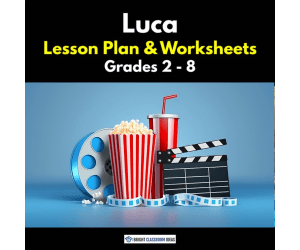
'Luca' Lesson Plan & Worksheets | Grades 2 - 8
ELA, Social Emotional Learning (SEL), Special Resources, Grade 2, 3, 4, 5, 6, 7, 8, Lesson Plans, Teacher Tools, Worksheets & Printables
'Luca' Lesson Plan & Worksheets | Grades 2 - 8 Take students on an unforgettable adventure to the Italian Riviera with this engaging Luca Movie Study ! Based on Pixar’s heartwarming film, this resource helps students explore themes of friendship, courage, acceptance, identity, and personal growth while strengthening reading comprehension, critical thinking, social-emotional learning, and cross-curricular skills. With 30 thoughtfully designed activities, students will connect deeply with Luca’s journey as he learns to embrace who he is and discover the world beyond his comfort zone. What's Included 30 student activities Printable student workbook Comprehensive teacher guide and lesson plan Complete answer key Reading comprehension questions Story sequencing activities Character analysis tasks Compare-and-contrast activities Story mountain graphic organizer Theme and symbolism exploration Social-emotional learning reflections Vocabulary development exercises Idioms and figurative language activities Opinion-writing prompts Geography activities about Italy Science habitat classification activities Math graphing and data-analysis tasks Italian language connections Creative writing projects Art and design extension activities Students will explore: Friendship and loyalty Courage and perseverance Accepting differences Being true to yourself Managing fear and anxiety Growth and independence Identity and belonging Curiosity and learning Cultural appreciation and global awareness How It Works in the Classroom This Luca movie guide is designed for flexible classroom use and can be used in: English Language Arts lessons Social-Emotional Learning (SEL) units Character education lessons Independent work Homeschool learning Substitute plans Small-group instruction Movie day enrichment Cross-curricular learning Summer-themed classroom activities Students complete activities before, during, and after viewing the film. Lessons include comprehension practice, vocabulary work, character studies, symbolism analysis, discussion prompts, graphing activities, science connections, geography exploration, and creative writing opportunities. The included teacher guide provides a complete 90-minute lesson plan with differentiation options for Grades 2–8. Standards & Learning Goals Students will: Recall and sequence major events from the story Analyze character traits, motivations, and growth Explore themes of friendship, courage, and acceptance Interpret symbolism and deeper meaning Practice inference and evidence-based thinking Strengthen vocabulary and language skills Examine story structure using a story mountain Interpret and create graphs using data Explore geography, culture, and language connections Reflect on personal growth and self-confidence Supports instruction in: English Language Arts Social-Emotional Learning (SEL) Character Education Science Mathematics Social Studies Geography Creative Writing Why Teachers Love It ✅ No-prep printable resource ✅ Includes teacher guide and complete answer key ✅ Integrates literacy, SEL, science, math, and geography ✅ Encourages meaningful conversations about acceptance and belonging ✅ Promotes growth mindset and self-confidence ✅ Includes engaging graphic organizers and creative activities ✅ Supports multiple learning styles and grade levels ✅ Encourages critical thinking and deeper analysis ✅ Flexible for classroom, homeschool, and enrichment settings ✅ Makes movie-based learning meaningful and memorable Teachers love how this resource transforms a favorite Pixar movie into a rich educational experience that encourages students to embrace their uniqueness, face challenges with courage, and celebrate friendship while building essential academic skills. The built-in SEL connections make it especially valuable for fostering empathy, resilience, and positive self-identity. Add this Luca Movie Study to your classroom today and help students explore courage, friendship, acceptance, and personal growth through engaging activities that turn movie day into a meaningful learning experience they'll remember long after the credits roll.
Author Bright Classroom Ideas Marketplace
Rating
Tags Luca, Film, Movie, Guide, Lesson, Plan, Worksheet
I WONDER - What Is A Trapezium | Animated Video Lesson
STEM, Geometry, Math, Grade 1, 2, 3, 4, 5, 6, 7, 8, Lesson Plans, Teacher Tools
Video Introduction An amazing video designed for the students to learn more about STEM. I WONDER - What Is A Trapezium | Animated Video Lesson Do you like STEM subjects? what is your favorite one? Have you ever tried to plant a seed? If yes, tell us more about it. Or have you ever tried to invent something? If yes, tell us more about it. And how do you think it will help us? Have you ever seen a microorganism under a microscope? What was it? And how it looked like? Mathematics is a marvelous subject. Let' sharpen our brains and solve some equations. Do you like timetable tricks? What is your favorite one? Do you know how to code? Have you ever created an app or a game before? If yes, how was it like? I WONDER - What Is A Trapezium | Animated Video Lesson The video is perfect for encouraging the researching skills for the students, while learning more about this fantastic topic. I WONDER - What Is A Trapezium | Animated Video Lesson This friendly designed video is suitable for students at school, homeschooling, and as a group activity. Format Available in MP4 format.
Author Educational Voice
Tags What Is A Trapezium, What Is A Trapezium Video, Trapezium, Trapezium Facts, Trapezium Facts For Kids, Trapezium Video, Trapezium Video For Kids, Trapezium Shape, Shapes Video, Shape
I WONDER - How Fast Can A Horse Run | Animated Video Lesson
STEM, Animals, Life Sciences, Science, Biology, Grade 1, 2, 3, 4, 5, 6, 7, 8, Lesson Plans, Teacher Tools
Video Introduction Animal kingdoms are full of fascinating wonders to learn. This video is designed for the students to learn more about animals in different countries. I WONDER - How Fast Can A Horse Run | Animated Video Lesson Do you like animals? what is your favorite one? Do you own a pet? If yes, tell us more about it, like what its name? And what do you like most about it? What are the animal kingdoms? Can you write down the characteristics of each animal class like mammals, birds, reptiles, amphibian, fish and mollusks. Do you know that some animals can sing, can you name any of them? What is the largest and the smallest mammal in the world? What is the largest and the smallest bird in the world? What is the largest and the smallest fish in the world? I WONDER - How Fast Can A Horse Run | Animated Video Lesson The video is perfect for encouraging the researching skills for the students, while learning more about these fantastic animals. I WONDER - How Fast Can A Horse Run | Animated Video Lesson This friendly designed video is suitable for students at school, homeschooling, and as a group activity. Format Available in MP4 format.
Author Educational Voice
Tags How Fast Can A Horse Run, How Fast Can A Horse Run Video, Horse, Horse Facts, Horse Facts For Kids, Horse Video, Horse Video For Kids, Horses, Horses Facts, Horses Video
I WONDER - Is Table Tennis An Olympic Sport | Animated Video Lesson
Sports, P.E. & Health, Grade 2, 3, 4, 5, 6, 7, 8, Lesson Plans, Teacher Tools
Video Introduction An amazing video designed for the students to learn more about sports in different countries. I WONDER - Is Table Tennis An Olympic Sport | Animated Video Lesson What is your favorite sport? Tell us more about it. Who is your favorite athlete? Or what is your favorite team? Do you know who invented basketball? When basketball has been invented? Can you tell us where is the first time it has been played? Have you ever played soccer or football? If yes, tell us what was your position: A goal keeper, midfield player, or a defender? Do you like watching golf? If yes who is your favorite player? Can you name the differences between tennis and ping pong? Have you ever played volleyball on the beach? When it has been officially recognized by the Olympics? Do you like watching Formula 1 races? If yes, who is your favorite team or driver? Have you ever tried to play handball? If yes tell us more. Do you like watching people skiing or surfing? I WONDER - Is Table Tennis An Olympic Sport | Animated Video Lesson The video is perfect for encouraging the researching skills for the students, while learning more about this sport. I WONDER - Is Table Tennis An Olympic Sport | Animated Video Lesson This friendly designed video is suitable for students at school, homeschooling, and as a group activity. Format Available in MP4 format.
Author Educational Voice
Rating
Tags Is Table Tennis An Olympic Sport, Is Table Tennis An Olympic Sport Video, Table Tennis, Table Tennis Facts, Table Tennis Video, Table Tennis Video For Kids, Table Tennis Facts For Kids, Olympic Sport
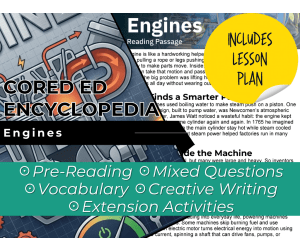
Engines Reading Comprehension Passage - Cored Ed Encyclopedia
ELA, Reading Comprehension, Reading, Science, Technology, Pre-Reading, Language Development, Physics, History, Social Studies, Grade 2, 3, 4, 5, Worksheets & Printables, Worksheets, Teacher Tools, Centers, Activities, Writing Prompts, Assessments, Quizzes and Tests, Quizzes, Lesson Plans
This engines reading comprehension with lesson plan includes: Visualization (on the front cover) Start your lesson by taking a minute to think and share something about the topic. Read the script aloud (slowly), perhaps prepare some music or sound effects. Student close their eyes and let their imaginations wander. Students open their eyes, read the question aloud and give them a few minutes to complete. Ask a few students to share or keep answers until the end to compare with what they learn in the passage. Quick pause—thousands of Cored Education products are included with your TeachSimple membership. Download links and encyclopedia index available here. Pre-Reading Trivia Students will write down one thing they already know about the subject and then read five more facts and discuss. These facts are fun, and the students will enjoy learning about the subject before reading more. Give 1 minute for students to write what they already know (no pressure—best guess is fine). Read the five facts together. After each fact, do ask a student for their opinion, was it surprising? Set a purpose by asking students to highlight/underline one fact they want to learn more about during the reading. Reading Passage The text is a high-interest reading passage with set paragraphs, roughly three to four paragraphs long. It contains a variety of themes about the topic, anywhere from history to technology. The passage is between 250 and 350 words in length. First, ask students to look at the headings and see what they’ll learn about today. What do they know about the topic/heading? First read options: Teacher read-aloud (best for support). Partner reading (paragraph by paragraph). While reading, students underline important details, and vocabulary words they think may come up in the questions section. Mixed Questions The first question page contains four multiple-choice questions, each with a choice of four answers, and three written response questions that require a sentence or two from the student. Students complete the mcqs first independently, then review quickly as a class. For the 3 written responses, try to get students giving the answer with some form of evidence: “I think ___ because the text says ___.” If students get stuck, send them back to check the passage. Vocabulary Questions Practice seven key words from the text in this section across two activities. First section is scrambled words where students will unscramble three words given a clue for each. The second section is a word to meaning matching activity. Before starting, have some students read out words they underlined in the passage. Ask students to say the word and read aloud the sentence(s) around each word. Ask students to do scrambled words and the matching exercise in pairs then go through answers as a class. For the scrambled spelling task, get four pairs to come up to the board and write the words for extra practice with the other student reading out the clue. For the matching task, prompt students to give full sentences: “I matched ___ with ___ because ___.” Creative Writing In this question, the student will be required to write a five to eight sentence paragraph on a question related to the topic. Before starting, ask students write down 3 key ideas they are going to include in their piece. Ask students for ideas to share around the class to help those struggling. Pro writing expectations: 5–8 sentences At least 2 facts or details from the passage At least 2 vocabulary words from the previous page Students read their paragraphs while classmates listen for facts and vocabulary words. Extension Activities This page is optional for fast finishers or to take home. There are several activities, each one requiring a different skill. Do some, do none, do all, completely optional - but you will feel reassured knowing every possibility is planned for. Includes summary writting question and additional facts. Answer Key There are answers for the multiple-choice questions, written response questions have sample answers, vocabulary answers and if there is a summary question then a sample summary will be provided as well. Lesson Plan Included Customized lesson plan for this lesson is included. Lesson Snapshot Title: Engines Genre: Nonfiction (Informational Text) Subject: Science (Physical Science/Technology) / Reading (Informational Text) Primary Topic: How engines turn energy into motion Estimated Guided Reading Level (A–Z): P What This Lesson Teaches Best Explains the core idea that an engine turns energy into motion , using heat, fuel, or electricity to make parts move. Builds understanding of how steam engines work (boiling water makes steam push a piston) and how designs became more efficient (Watt’s separate condenser idea). Describes internal combustion engines and the four-step cycle (take in, squeeze, burn/push, exhaust) that repeats. Connects parts and motion: pistons moving back-and-forth can turn a crankshaft to keep rotation going. Introduces electric motors as another way to change energy into motion using magnetism and current to spin a shaft. Learning Goals Students will explain how an engine changes energy into motion using heat, fuel, or electricity. Students will describe how steam can push a piston in an early steam engine. Students will explain why a separate condenser made a steam engine design more efficient. Students will identify how an internal combustion engine makes motion by burning fuel inside a chamber. Students will list the four repeated steps of a four-stroke engine as stated in the passage. Students will describe how an electric motor uses magnetism and current to spin a shaft. Key Vocabulary From the Text piston — a part pushed by steam or hot gases. condenser — a part that cools steam somewhere else. combustion — burning fuel to make hot gases. crankshaft — a part that keeps turning as pistons move. magnetism — a force used with current to make a shaft spin. FULL CATALOG OF DOWNLOAD LINKS AND ENCYCLOPEDIA INDEX HERE
Author Cored Education
Rating
Tags Vocabulary, Reading Comprehension, Reading Passages, Lesson Plans, Ela Lesson Plans, Reading Comprehension Lesson Plans, Pre-reading, Science Lesson Plans, Technology, Physics

Water Cycle Earth Science Activity
Earth and Environmental Sciences, Science, Earth Sciences, Environmental Science, Grade 2, 3, 4, Experiments, Activities, Diagrams, Teacher Tools, Lesson Plans, Templates
I created this water cycle science activity for young students who are beginning to learn how water moves through Earth’s systems. Each page focuses on a simple part of the water cycle, including evaporation, condensation, precipitation, and collection. The worksheets include clear diagrams, short explanations, and guided activities so students can understand the concept without feeling overwhelmed. This type of activity works well during science lessons, especially when students are being introduced to Earth science topics. It can be used as a whole-class activity, a science center, morning work, or extra practice after a lesson. I’ve used similar worksheets before, and students enjoy labeling diagrams and following the steps of the water cycle from start to finish. The pack is easy to print and works well in both color and black-and-white. It fits nicely into classroom routines and can also be used at home for review or reinforcement. What’s included: 11 printable water cycle worksheets Clear and simple water cycle diagrams Activities covering evaporation, condensation, precipitation, and collection Kid-friendly science illustrations Suitable for grades 1–3 Great for individual, partner, or small-group work
Author Bright Education
Rating
Tags Science, Water Cycle, Earth Science

I WONDER - How Do Our Feet Help Control Temperature | Animated Video
Biology, Life Sciences, Science, Human Body, STEM, Grade 2, 3, 4, 5, 6, 7, 8, Lesson Plans, Teacher Tools
Video Overview The human body is full of fascinating wonders to learn. This video is created to help the students recognize the anatomy and the job of the human body. I WONDER - How Do Our Feet Help Control Temperature | Animated Video Lesson Every part and organ in our human body is vital so let's see how important they are. Have you ever imagined how we look like if we didn't have a skeleton? Did you know that because we have our amazing muscles we can stand! Do you know how many teeth do we have? Have you ever wondered about the food journey inside our body? Can you name all the glands in our body? Why do we have skin? Our nervous system is really good at sending signals. Can you tell us more about it? Are you really good at Mathematics, painting, or any other thing? You should really thank your brain about it! The famous five senses are really doing a great work? Can you explain how every sense works? I WONDER - How Do Our Feet Help Control Temperature | Animated Video Lesson The video is perfect for encouraging the researching skills for the students, while learning more about our fantastic human body. I WONDER - How Do Our Feet Help Control Temperature | Animated Video Lesson This friendly designed video is suitable for students at school, homeschooling, and as a group activity. Format Available in MP4 format.
Author Educational Voice
Tags How Do Our Feet Help Control Temperature, How Do Our Feet Help Control Temperature Video, Feet Help Control Temperature, Feet Help Control Temperature Facts, Feet Help Control Temperature Facts For Kids

Personal and Objective Pronouns | Beginner Lesson Plan
ELA, Grammar, Grade 2, 3, 4, 5, Teacher Tools, Lesson Plans
Personal and Objective Pronouns Beginner Lesson Plan This 35-page beginner lesson plan helps students learn about personal and objective pronouns. It starts with flashcards to introduce key concepts. A warm-up activity activates prior knowledge. Then, the main lesson explores pronoun usage with examples. Students learn construction details, rules, and exceptions. Two closed exercises and one open exercise provide practice opportunities. Additional writing exercises, conversation topics, and a quiz activity conclude the lesson. Differentiated implementation ideas for whole group, small group, or individual instruction suit various classroom needs. Answer keys included. This standards-based pronoun resource develops grammar skills for grade 2-5 students. The engaging print and digital materials establish a solid language foundation.
Author TEAM TEFL
Tags Personal Pronouns, Objective Pronouns, Pronoun Worksheet, Language Arts Activity, Grammar Worksheet

I WONDER - Is A Skunk's Spray Dangerous | Animated Video Lesson
STEM, Animals, Life Sciences, Science, Biology, Grade 1, 2, 3, 4, 5, 6, 7, 8, Lesson Plans, Teacher Tools
Video Introduction Animal kingdoms are full of fascinating wonders to learn. This video is designed for the students to learn more about animals in different countries. I WONDER - Is A Skunk's Spray Dangerous | Animated Video Lesson Do you like animals? what is your favorite one? Do you own a pet? If yes, tell us more about it, like what its name? And what do you like most about it? What are the animal kingdoms? Can you write down the characteristics of each animal class like mammals, birds, reptiles, amphibian, fish and mollusks. Do you know that some animals can sing, can you name any of them? What is the largest and the smallest mammal in the world? What is the largest and the smallest bird in the world? What is the largest and the smallest fish in the world? I WONDER - Is A Skunk's Spray Dangerous | Animated Video Lesson The video is perfect for encouraging the researching skills for the students, while learning more about these fantastic animals. I WONDER - Is A Skunk's Spray Dangerous | Animated Video Lesson This friendly designed video is suitable for students at school, homeschooling, and as a group activity. Format Available in MP4 format.
Author Educational Voice
Tags Is A Skunk's Spray Dangerous, Is A Skunk's Spray Dangerous Video, Skunk's Spray, Skunk's Spray Facts, Skunk's Spray Facts For Kids, Skunk's Spray Video, Skunk's Spray Video For Kids, Skunk

Multiply by "Eight" Task Cards - 60 Task Cards
Math, Calculus, Early Math, Counting, Numbers, Basic Operations, Multiplication and Division, Multiplication, Grade 1, 2, 3, 4, 5, Assessments, Teacher Tools, Lesson Plans, Quizzes and Tests, Centers, Activities, Task Cards, Worksheets & Printables
Ready to multiply your students’ skills—and have a little fun along the way? These 60 multiplication task cards are all about conquering the 8-times tables (because 8 is the new cool, right?). With 60 cards and a variety of activities, you’ll have your students multiplying like math pros in no time. Ways to Use: Math Warm-Up: Begin your lesson with a few quick card challenges to get everyone’s brain in gear. Partner Practice: Students can quiz each other, helping each other out (and making math a team sport). Independent Practice: Let students work solo with the cards—quiet and focused. Interactive Games: Use the cards for math races, scavenger hunts, or timed drills to add some excitement. Quick Assessments: These cards double as a perfect way to check student progress in a flash. Advantages: Targeted Practice: Focusing on the 8-times tables, students build confidence with each card. Zero Prep: Simply print and use—no extra planning needed! Fun & Flexible: Keep students engaged with interactive learning. Versatile: Use them in pairs, individually, or with the whole class. Track Progress: Check where students need more practice and where they’re excelling. Get these task cards today—your students will thank you (and so will your sanity)!
Author Ponder Palette Plazza
Tags Multiplication, Multiplication Worksheets, Multiplication Task Cards, Multiplication Activities, Numbers, Task Cards, Math Task Cards, Mental Math
Geometry: Spatial Relationships - PC Software
Math, Geometry, Kindergarten, Preschool, Grade 1, 2, Teacher Tools, Lesson Plans
Geometry: Spatial Relationships - PC Software: An Essential Teaching Resource Geometry: Spatial Relationships - PC Software is an invaluable teaching resource, primarily for educators focused on mathematics for preschool, kindergarten, grade 1 and grade 2 levels. It finely concentrates on the subject of geometry and spatial relationships. An Interactive Learning Experience This software delivers a seamless integration of various fundamental learning tools such as: A pre- assessment measure to gauge students initial understanding of concepts. Detailed lesson plans to systematically educate learners. Intriguing word problems based on real-world scenarios which promotes critical thinking. Timed drill activities to foster quick recall skills in a lively environment. Innovative Educational Games Besides the primary teaching material, this software also offers interactive math tools that help turn complex mathematical ideas into enjoyable experiences. Notably included are fun yet educational spin-off games like the 'memory match game', 'board game', and 'spinner game'. These can easily be integrated into either group workshops or individual learning programs thereby encouraging joint problem-solving abilities amongst students. Linguistically Inclusive Learning Material . The Geometry: Spatial Relationships - PC Software extends its reach beyond English-speaking students as it includes Spanish versions for voice-overs and text content thus extending equal opportunity to acquire knowledge despite language boundaries often faced in multicultural classrooms or bilingual homeschooling setup. The Teacher Guide & Printable Resources . To assist teachers in delivering lessons effectively, this educational tool comes with a guide that provides beneficial tips on navigating through each lesson plan. It further arms educators with printable resources which can be used as supplementary material for homework assignments or additional practice tasks. User-friendly Access This efficient teaching resource is delivered in a simple zip file that is compatible with personal computers, thereby eliminating the often tedious installation processes associated with certain educational software solutions. In essence, Geometry: Spatial Relationships - PC Software serves as an innovative tool packed not only with curriculum-based content but also creative additional elements designed to shape confident young mathematicians who excel in understanding spatial relationships aspects of geometry while relishing the learning process.
Author Classroom Complete Press
Tags Spatial Relationships, Geometry, Math Lesson, Digital Math, Geometry Skills
Algebra: Addition & Subtraction - Learn the Skill - MAC Software
Math, Algebra, Common Core, Kindergarten, Preschool, Grade 1, 2, Teacher Tools, Lesson Plans
Algebra: Addition & Subtraction - Learn the Skill - MAC Software This is a carefully crafted teaching resource designed to facilitate a more comprehensive understanding of the addition and subtraction elements in Algebra. It's an excellent tool for public-school educators and homeschooling parents who want to introduce these vital mathematical concepts to learners from preschool age up to Grade 2. This software is not just any ordinary educational material. It's a mini chapter that provides curriculum-based content through real-world word problems, aiming to hone the mathematical skills while increasing real-life application awareness among students. Moreover, it incorporates various math tools into its system, allowing for interactive learning experiences like never before. Multilingual Support One noteworthy feature of this software is its multilingual support; it provides both English and Spanish voice overs along with text options, promoting bilingual education without losing focus on the primary subject matter – Mathematics. The content within this MAC software aligns tightly with Common Core State Standards(CCSS). Lends itself well to STEM initiatives. Sets standards by NCTM (National Council of Teachers of Mathematics). Teaching Methods Offer Flexibility You may incorporate it in whole group lectures or small group discussions , Possible transformation into exciting brain challenges, , Ideally this can even be part of your homework assignments providing constant reinforcement outside classroom walls. Please remember when you purchase, you'll receive 1 zip file containing all necessary software compatible exclusively with MAC devices. Train young academicians' minds using engaging resources backed up by stringent standards today! Get them ahead early on Algebra concepts they will undoubtedly encounter in future academic endeavors. Your investment today might just be their significant mathematical advantage tomorrow.
Author Classroom Complete Press
Tags Math Lesson Plan, Digital Math, Addition, Subtraction, Math Skills
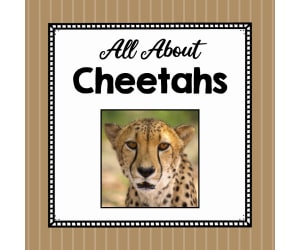
Animal Science Unit: Learning All About a Cheetah
Science, Life Sciences, Animals, Kindergarten, Preschool, Grade 1, 2, Lesson Plans, Teacher Tools
Animal Science Unit: Learning All About a Cheetah Dive deep into the world of cheetahs with this expansive collection of reading, activities, crafts and more designed to create an engaging animal science unit for PreK-2nd grade. Discover real photos, differentiated nonfiction reading, worksheets, posters and writing projects to match all levels. Gather round for rich discussions sparked by teacher resources like videos and guiding questions. Then bring concepts to life by creating articulated paper cheetahs, playing habitat games, acting out the life cycle and going on a photo scavenger hunt. This thoughtfully-designed unit aims to foster a meaningful understanding of cheetahs through immersive, multisensory learning. Students will walk away with in-depth knowledge of adaptations, habitats, anatomy, behaviors and more thanks to the comprehensive, high-quality materials provided.
Author Simply Schoolgirl
Tags Zooogy, Predators, Big Cats, Predator, Africa, African Animals, Asia, Asian Animals, Cheetah Crafts, Cheetah Printables

I WONDER - What Is A Pangolin | Animated Video Lesson
STEM, Biology, Life Sciences, Science, Animals, Grade 1, 2, 3, 4, 5, 6, 7, 8, Lesson Plans, Teacher Tools
Video Introduction Animal kingdoms are full of fascinating wonders to learn. This video is designed for the students to learn more about animals in different countries. I WONDER - What Is A Pangolin | Animated Video Lesson Do you like animals? what is your favorite one? Do you own a pet? If yes, tell us more about it, like what its name? And what do you like most about it? What are the animal kingdoms? Can you write down the characteristics of each animal class like mammals, birds, reptiles, amphibian, fish and mollusks. Do you know that some animals can sing, can you name any of them? What is the largest and the smallest mammal in the world? What is the largest and the smallest bird in the world? What is the largest and the smallest fish in the world? I WONDER - What Is A Pangolin | Animated Video Lesson The video is perfect for encouraging the researching skills for the students, while learning more about these fantastic animals. I WONDER - What Is A Pangolin | Animated Video Lesson This friendly designed video is suitable for students at school, homeschooling, and as a group activity. Format Available in MP4 format.
Author Educational Voice
Tags What Is A Pangolin, What Is A Pangolin Video, Pangolin, Pangolins, Pangolin Facts, Pangolin Facts For Kids, Pangolin Video, Pangolin Video For Kids, Pangolins Facts, Pangolins Video

Number & Operations: Fractions - FLASH-MAC
Math, Fractions, Grade 1, 2, Teacher Tools, Lesson Plans
Number & Operations: Fractions - FLASH-MAC This educational resource is a comprehensive teaching tool designed to simplify the concept of fractions in number and operations for first and second-grade students. This essential teaching aid comes packed with research-based, grade-appropriate content that supports math learning in an engaging manner. A Rounded Approach to Learning Employing an intricately rounded approach to learning, the resource encapsulates multiple facets including: a pre- assessment segment, rich lesson plan, practice exercises with real-world word problems, and time-constrained drill activities. Each segment aims at providing learners with a thorough understanding of critical mathematical concepts while fostering their problem-solving skills. Creative Inclusions & Diverse Needs catered too... Beyond just instruction-dependent resources, this package includes printable material for hands-on activities. Students will find enjoyment while reinforcing their knowledge through creative inclusions such as a memory match game, board game and spinner game. Additionally mindful of the diverse needs of today’s classrooms or homeschool environments; the product features options for English text along with voice over support not just in English but also Spanish. The Crowning Feature... The crowning feature of this resource is arguably its inclusion of SMART Response assessment tools which make it simpler than ever for educators to monitor student progress. Compatible with Mac operating systems; educators have unprecedented flexibility regarding how they implement this resource – be it relayed during whole groups sessions as part of instructed lessons or used by smaller groups working independently or even assigned as individual homework tasks to consolidate classroom teachings at home. In essence, Numer & Operations: Fractions - FLASH-MAC is not just another addition to your curriculum—it's more like adding streamlining power into your teaching repertoire. This blazes the trail for individualized, streamlined learning experiences that resonate soundly with diverse cohorts of first and second-grade students.
Author Classroom Complete Press
Tags Software (Mac)

Past Simple: To Be Verbs | Beginner Lesson Plan
ELA, Grammar, Grade 2, 3, 4, 5, 8, 9, 10, 11, 12, Teacher Tools, Lesson Plans
Past Simple: To Be Verbs | Beginner Lesson Plan The Past Simple: To Be Verbs | Beginner Lesson Plan is a high-quality ESL EFL ELL teaching resource that caters primarily to language arts students. Primarily focusing on enhancing grammar skills, this resource offers meticulous aid to grasp the 'Past Simple To Be' verbs. About the Resource: This engaging lesson plan comes in three PDF files containing 25 printable pages. The content of these pages are well-structured and aids teachers in careful planning and execution of lessons. It offers numerous exercises for students to test their comprehension abilities at their own pace. Educational and Interactive: Besides understanding past simple 'To be' verbs, it emphasizes on active implementation through fun exercises. This way, it not only boosts overall grammar skills but also encourages active participation from young learners. These features make it perfect for both group discussions as well as small group learning scenarios! Digital Access & Versatility: This tool supports digital access via Google Apps which promotes learning anytime, anywhere! To enhance its utility quotient, an answer key is added which provides hassle-free evaluation methods for teachers and serves as a clear reference point for those being homeschooled or self-taught. In conclusion, the 'Past Simple: To be Verbs | Beginner Lesson Plan' is undoubtedly a worthwhile acquisition that prioritizes shaping verbal prowess while maintaining high usability quotient! This TEFL lesson plan includes: Cover page Flash cards A warm-up activity Main use Construction details Rules, along with any exceptions Illustrative examples Two closed exercises One open exercise Revision exercise Writing exercises Chatterbox, a recurring feature in our course books encouraging conversation Activity, such as a game, quiz, puzzle, etc., to conclude the class
Author TEAM TEFL
Tags Language Arts, Grammar Skills, Past Simple Verbs, Beginner-level Students, Comprehension
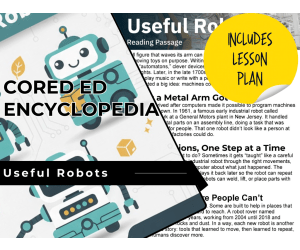
Useful Robots Reading Comprehension Passage - Cored Ed Encyclopedia
ELA, Language Development, Reading Comprehension, Reading, Pre-Reading, History, Social Studies, Technology, Science, Earth and Environmental Sciences, Grade 2, 3, 4, 5, Worksheets & Printables, Worksheets, Teacher Tools, Centers, Activities, Writing Prompts, Assessments, Quizzes and Tests, Quizzes, Lesson Plans
This useful robots reading comprehension with lesson plan includes: Visualization (on the front cover) Start your lesson by taking a minute to think and share something about the topic. Read the script aloud (slowly), perhaps prepare some music or sound effects. Student close their eyes and let their imaginations wander. Students open their eyes, read the question aloud and give them a few minutes to complete. Ask a few students to share or keep answers until the end to compare with what they learn in the passage. Quick pause—thousands of Cored Education products are included with your TeachSimple membership. Download links and encyclopedia index available here. Pre-Reading Trivia Students will write down one thing they already know about the subject and then read five more facts and discuss. These facts are fun, and the students will enjoy learning about the subject before reading more. Give 1 minute for students to write what they already know (no pressure—best guess is fine). Read the five facts together. After each fact, do ask a student for their opinion, was it surprising? Set a purpose by asking students to highlight/underline one fact they want to learn more about during the reading. Reading Passage The text is a high-interest reading passage with set paragraphs, roughly three to four paragraphs long. It contains a variety of themes about the topic, anywhere from history to technology. The passage is between 250 and 350 words in length. First, ask students to look at the headings and see what they’ll learn about today. What do they know about the topic/heading? First read options: Teacher read-aloud (best for support). Partner reading (paragraph by paragraph). While reading, students underline important details, and vocabulary words they think may come up in the questions section. Mixed Questions The first question page contains four multiple-choice questions, each with a choice of four answers, and three written response questions that require a sentence or two from the student. Students complete the mcqs first independently, then review quickly as a class. For the 3 written responses, try to get students giving the answer with some form of evidence: “I think ___ because the text says ___.” If students get stuck, send them back to check the passage. Vocabulary Questions Practice seven key words from the text in this section across two activities. First section is scrambled words where students will unscramble three words given a clue for each. The second section is a word to meaning matching activity. Before starting, have some students read out words they underlined in the passage. Ask students to say the word and read aloud the sentence(s) around each word. Ask students to do scrambled words and the matching exercise in pairs then go through answers as a class. For the scrambled spelling task, get four pairs to come up to the board and write the words for extra practice with the other student reading out the clue. For the matching task, prompt students to give full sentences: “I matched ___ with ___ because ___.” Creative Writing In this question, the student will be required to write a five to eight sentence paragraph on a question related to the topic. Before starting, ask students write down 3 key ideas they are going to include in their piece. Ask students for ideas to share around the class to help those struggling. Pro writing expectations: 5–8 sentences At least 2 facts or details from the passage At least 2 vocabulary words from the previous page Students read their paragraphs while classmates listen for facts and vocabulary words. Extension Activities This page is optional for fast finishers or to take home. There are several activities, each one requiring a different skill. Do some, do none, do all, completely optional - but you will feel reassured knowing every possibility is planned for. Includes summary writting question. Answer Key There are answers for the multiple-choice questions, written response questions have sample answers, vocabulary answers and if there is a summary question then a sample summary will be provided as well. Lesson Plan Included Customized lesson plan for this lesson is included. Lesson Snapshot Title: Useful Robots Genre: Nonfiction (Informational passage) Subject: Science & Technology (Engineering/Robotics) Primary Topic: How robots developed and help people Estimated Guided Reading Level (A–Z): P Support pages included: Pre-reading trivia, mixed questions, vocabulary activities, creative writing prompt, extension activities, and an answer key. QA notes on support pages: Support content generally matches the passage; however, the support pages use “automaton” (singular) while the passage uses “automata” (plural), and an extension prompt suggests “hills,” which is not stated in the passage (the passage names rocks and dust). What This Lesson Teaches Best Robots have a history: Explains that long ago people created “automata” that moved using steam, air, water, or falling weights. Modern robots and factory work: Describes an early industrial robot, Unimate, working in 1961 at a General Motors plant handling hot metal parts that were tough and dangerous for people. How robots learn repeatable motions: Shows how a person can guide a robot’s movements while sensors send signals to a computer that stores a pattern to repeat the job. Robots go where people can’t: Highlights the rover Opportunity exploring Mars for years (2004–2018) and sending back clues from rocks and dust. Big idea across time: Connects early moving devices to today’s robots as tools that learned to move, repeat, and help humans discover more. Learning Goals Students will explain what “automata” were and what powered them. Students will describe why Unimate’s factory job mattered for people. Students will identify how a robot can be “taught” motions and then repeat them. Students will summarize how robots can help in places that are risky, far away, or hard to reach. Students will use details from the text to tell what Opportunity did on Mars and what it sent back. Key Vocabulary From the Text automata — moving devices from long ago; not thinking machines. program — give a machine instructions to do a job. industrial — related to factories and making things. sensors — parts that notice and send signals to a computer. rover — a robot vehicle that travels to explore places. FULL CATALOG OF DOWNLOAD LINKS AND ENCYCLOPEDIA INDEX HERE
Author Cored Education
Rating
Tags Vocabulary, Reading Comprehension, Reading Passages, Lesson Plans, Ela Lesson Plans, Reading Comprehension Lesson Plans, Pre-reading, Science Lesson Plans, Technology, History