



3,948 products added recently
Page 33 - 2nd Grade Lesson Plans
Enhance your second-grade classroom with lesson plans that build on foundational skills and introduce new concepts. These activities promote critical thinking and creativity across subjects. Implement these plans to keep your students motivated and progressing confidently.

 Show filters


Measurement: Area & Volume - Learn the Skill - FLASH-PC
Math, Measurements, Common Core, Grade 1, 2, Teacher Tools, Lesson Plans
Measurement: Area & Volume - Learn the Skill - FLASH-PC This comprehensive teaching resource is perfect for educators working with Grade 1 and Grade 2 students. The resource offers curriculum-aligned content focused on mastering critical math concepts, such as area and volume measurements. Main Features This teaching tool presents real-world problems that help learners comprehend not only theoretical skills but also their practical applications. In addition to its engaging content, this resource provides vital math tools essential for understanding the subject matter. The resource also caters to a diverse classroom setting by offering both English and Spanish voice-over with text options. This makes it suitable for cross-cultural educational setups or bilingual programs. Major Advantage An essential aspect that sets this product apart is its alignment with Common Core State Standards and STEM initiatives under NCTM standards. This ensures teachers maintain commonly recognized educational guidelines while delivering instructions on area and volume measurements. Digital Nature of Resource Last but not least, due to its digital format, it perfectly fits into modern teaching environments that use software-based instructional materials It facilitates traditional classwork assignments or homework tasks promoting self-education regardless of group sizes involved whether for small study clusters or whole-class scenarios. In Summary: The product excels in versatility; it packs all necessary components within one file ensuring convenience during lesson presentation and practice sessions enhancing every learner's engagement alongside measurable progress assessment.
Author Classroom Complete Press
Tags Software (PC)
I WONDER - What is The Smallest Vertebrate In The World
STEM, Animals, Life Sciences, Science, Biology, Grade 1, 2, 3, 4, 5, 6, 7, 8, Lesson Plans, Teacher Tools
Video Introduction Animal kingdoms are full of fascinating wonders to learn. This video is designed for the students to learn more about animals in different countries. I WONDER - What is The Smallest Vertebrate In The World | Animated Video Lesson Do you like animals? what is your favorite one? Do you own a pet? If yes, tell us more about it, like what its name? And what do you like most about it? What are the animal kingdoms? Can you write down the characteristics of each animal class like mammals, birds, reptiles, amphibian, fish and mollusks. Do you know that some animals can sing, can you name any of them? What is the largest and the smallest mammal in the world? What is the largest and the smallest bird in the world? What is the largest and the smallest fish in the world? I WONDER - What is The Smallest Vertebrate In The World | Animated Video Lesson The video is perfect for encouraging the researching skills for the students, while learning more about these fantastic animals. I WONDER - What is The Smallest Vertebrate In The World | Animated Video Lesson This friendly designed video is suitable for students at school, homeschooling, and as a group activity. Format Available in MP4 format.
Author Educational Voice
Tags What Is The Smallest Vertebrate In The World, What Is The Smallest Vertebrate In The World Video, Smallest Vertebrate In The World, Smallest Vertebrate In The World Facts, Smallest Vertebrate In The World Video
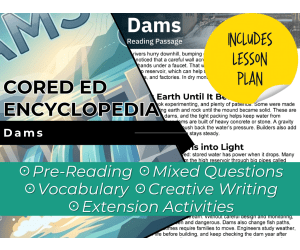
Dams Reading Comprehension Passage - Cored Ed Encyclopedia
ELA, Language Development, Reading Comprehension, Reading, Pre-Reading, Science, Technology, Physics, Earth and Environmental Sciences, Life Sciences, Grade 2, 3, 4, 5, Worksheets & Printables, Worksheets, Teacher Tools, Centers, Activities, Writing Prompts, Assessments, Quizzes and Tests, Quizzes, Lesson Plans
This dams reading comprehension with lesson plan includes: Visualization (on the front cover) Start your lesson by taking a minute to think and share something about the topic. Read the script aloud (slowly), perhaps prepare some music or sound effects. Student close their eyes and let their imaginations wander. Students open their eyes, read the question aloud and give them a few minutes to complete. Ask a few students to share or keep answers until the end to compare with what they learn in the passage. Quick pause—thousands of Cored Education products are included with your TeachSimple membership. Download links and encyclopedia index available here. Pre-Reading Trivia Students will write down one thing they already know about the subject and then read five more facts and discuss. These facts are fun, and the students will enjoy learning about the subject before reading more. Give 1 minute for students to write what they already know (no pressure—best guess is fine). Read the five facts together. After each fact, do ask a student for their opinion, was it surprising? Set a purpose by asking students to highlight/underline one fact they want to learn more about during the reading. Reading Passage The text is a high-interest reading passage with set paragraphs, roughly three to four paragraphs long. It contains a variety of themes about the topic, anywhere from history to technology. The passage is between 250 and 350 words in length. First, ask students to look at the headings and see what they’ll learn about today. What do they know about the topic/heading? First read options: Teacher read-aloud (best for support). Partner reading (paragraph by paragraph). While reading, students underline important details, and vocabulary words they think may come up in the questions section. Mixed Questions The first question page contains four multiple-choice questions, each with a choice of four answers, and three written response questions that require a sentence or two from the student. Students complete the mcqs first independently, then review quickly as a class. For the 3 written responses, try to get students giving the answer with some form of evidence: “I think ___ because the text says ___.” If students get stuck, send them back to check the passage. Vocabulary Questions Practice seven key words from the text in this section across two activities. First section is scrambled words where students will unscramble three words given a clue for each. The second section is a word to meaning matching activity. Before starting, have some students read out words they underlined in the passage. Ask students to say the word and read aloud the sentence(s) around each word. Ask students to do scrambled words and the matching exercise in pairs then go through answers as a class. For the scrambled spelling task, get four pairs to come up to the board and write the words for extra practice with the other student reading out the clue. For the matching task, prompt students to give full sentences: “I matched ___ with ___ because ___.” Creative Writing In this question, the student will be required to write a five to eight sentence paragraph on a question related to the topic. Before starting, ask students write down 3 key ideas they are going to include in their piece. Ask students for ideas to share around the class to help those struggling. Pro writing expectations: 5–8 sentences At least 2 facts or details from the passage At least 2 vocabulary words from the previous page Students read their paragraphs while classmates listen for facts and vocabulary words. Extension Activities This page is optional for fast finishers or to take home. There are several activities, each one requiring a different skill. Do some, do none, do all, completely optional - but you will feel reassured knowing every possibility is planned for. Includes summary writting question and additional facts. Answer Key There are answers for the multiple-choice questions, written response questions have sample answers, vocabulary answers and if there is a summary question then a sample summary will be provided as well. Lesson Plan Included Customized lesson plan for this lesson is included. Lesson Snapshot Title: Dams Genre: Nonfiction (informational text with headings) Subject: Science (Engineering) / Reading (Informational Text) Primary Topic: How dams store water, make electricity, and release water safely Estimated Guided Reading Level (A–Z): P What This Lesson Teaches Best Explains what a dam does by describing how a wall can hold back river water into a deep reservoir. Teaches types of dams and how they stay strong (embankment dams packed tight; gravity dams using weight; layers and drains for stability). Shows how stored water can generate electricity using penstocks, turbines, and generators. Highlights safety and trade-offs, including controlled release through a spillway, the danger of failure, and impacts on fish paths and river mud. Uses headings to organize information into clear sections (building, electricity, and safe water release). Learning Goals Students will explain how a dam changes a river’s flow and creates a reservoir. Students will describe how embankment dams are built and why tight packing matters. Students will identify the role of penstocks, turbines, and generators in making electricity. Students will explain why spillways are needed and how they help release extra water safely. Students will describe at least one cost or concern the passage connects to dams. Key Vocabulary From the Text reservoir — deep stored water behind a dam. embankment — packed earth-and-rock mound used to build a dam. penstocks — big pipes that send water down from a reservoir. turbines — spinning machines turned by rushing water. spillway — safe path for extra water to leave a reservoir. FULL CATALOG OF DOWNLOAD LINKS AND ENCYCLOPEDIA INDEX HERE
Author Cored Education
Rating
Tags Vocabulary, Reading Comprehension, Reading Passages, Lesson Plans, Ela Lesson Plans, Reading Comprehension Lesson Plans, Pre-reading, Science Lesson Plans, Physics, Technology

I WONDER - What Is A Cylinder | Animated Video Lesson
STEM, Geometry, Math, Grade 1, 2, 3, 4, 5, 6, 7, 8, Lesson Plans, Teacher Tools
Video Introduction An amazing video designed for the students to learn more about STEM. I WONDER - What Is A Cylinder | Animated Video Lesson Do you like STEM subjects? what is your favorite one? Have you ever tried to plant a seed? If yes, tell us more about it. Or have you ever tried to invent something? If yes, tell us more about it. And how do you think it will help us? Have you ever seen a microorganism under a microscope? What was it? And how it looked like? Mathematics is a marvelous subject. Let' sharpen our brains and solve some equations. Do you like timetable tricks? What is your favorite one? Do you know how to code? Have you ever created an app or a game before? If yes, how was it like? I WONDER - What Is A Cylinder | Animated Video Lesson The video is perfect for encouraging the researching skills for the students, while learning more about this fantastic topic. I WONDER - What Is A Cylinder | Animated Video Lesson This friendly designed video is suitable for students at school, homeschooling, and as a group activity. Format Available in MP4 format.
Author Educational Voice
Tags What Is A Cylinder, What Is A Cylinder Video, Cylinder, Cylinder Facts, Cylinder Facts For Kids, Cylinder Video, Cylinder Video For Kids, Cylinders, Cylinders Facts, Cylinders Video

I WONDER - What Is A Pentagon | Animated Video Lesson
STEM, Math, Geometry, Grade 1, 2, 3, 4, 5, 6, 7, 8, Lesson Plans, Teacher Tools
Video Introduction An amazing video designed for the students to learn more about STEM. I WONDER - What Is A Pentagon | Animated Video Lesson Do you like STEM subjects? what is your favorite one? Have you ever tried to plant a seed? If yes, tell us more about it. Or have you ever tried to invent something? If yes, tell us more about it. And how do you think it will help us? Have you ever seen a microorganism under a microscope? What was it? And how it looked like? Mathematics is a marvelous subject. Let' sharpen our brains and solve some equations. Do you like timetable tricks? What is your favorite one? Do you know how to code? Have you ever created an app or a game before? If yes, how was it like? I WONDER - What Is A Pentagon | Animated Video Lesson The video is perfect for encouraging the researching skills for the students, while learning more about this fantastic topic. I WONDER - What Is A Pentagon | Animated Video Lesson This friendly designed video is suitable for students at school, homeschooling, and as a group activity. Format Available in MP4 format.
Author Educational Voice
Tags What Is A Pentagon, What Is A Pentagon Video, Pentagon, Pentagon Facts, Pentagon Facts For Kids, Pentagon Video, Pentagon Video For Kids, Shape, Shapes, Shapes Video

Multiplication & Division 5 Day Small Group Remediation Plan (SOL 3.4)
Math, Multiplication and Division, Multiplication, Division, Grade 2, 3, 4, Activities, Teacher Tools, Lesson Plans
Title: Multiplication & Division 5 Day Small Group Remediation Plan (SOL 3.4) The Multiplication and Division 5 Day Small Group Remediation Plan is an excellent resource for educators looking to strengthen their student's proficiency in multiplication and division. This meticulously crafted resource has been designed to provide five days of focused review for small groups, helping students explore various concepts related to these arithmetical operations. Aimed at students in the 2nd to 4th grade, this plan has been planned meticulously to cover different topics on multiplication and division each day. The first four days consist of activity -based lesson plans focusing on a specific topic, such as equal groups or array multiplication, The activities are accompanied by guided practice sheets for hands-on experience. These are followed by independent practice sheets enabling learners to rehearse their newly gained skills autonomously. The fifth day serves as a review session comprising a concise nine-question exit ticket that evaluates the student's understanding after four days of remediation. There is also an accompanying digital slide show that instructors can employ while conducting whole group sessions or when using an interactive board during remedial lessons. The plan also comes with handy answer keys for all independent practice worksheets and the exit ticket, making grading swift and effortless. Moreover, it suits perfectly to Virginia standard SOL 3.4 but can be effortlessly applied for teaching multiplication and division concepts nationwide. This comprehensive resource packs an abundance of features into its easily navigable 24 pages - from double digit-by-single digit multiplication tasks undergirding skill consolidation right up until critical thinking based division problems facilitating real-world application All contributing towards incremental learning over five productive days. Teachers can implement this effective teaching aid not only in whole class instruction but also work wonders during one-to-one tutoring sessions or breakaway small group activities encouraging cooperation among peers —thus providing ample flexibility according to classroom dynamics or other pedagogical needs. Indeed the Multiplication & Division 5 Day Small Group Remediation Plan serves as a practical guide and tireless assistant in the educational journey, ensuring learning becomes not only productive but also enjoyable for every student.
Author SchoolingSara
Tags Multiplication, Division, Small Group, Remediation Plan, Virginia SOL, 3.4 Independent Practice
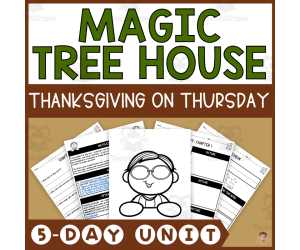
Thanksgiving on Thursday (Magic Tree House #27 Lesson Plan, Videos, Activities)
ELA, Reading, Grade 1, 2, 3, Lesson Plans, Teacher Tools
Bring history to life for students with this 5-day novel study on the Magic Tree House book Thanksgiving on Thursday. This reading comprehension resource covers the journey of Jack and Annie as they travel back in time to the first Thanksgiving. Through engaging printable activities, elementary students will strengthen literacy skills, learn about early American history and Native American culture, and make cross-curricular connections. Implementation ideas are provided to facilitate instruction for whole group, small group, or independent assignments. Customize this versatile Thanksgiving-themed language arts unit based on your students' grade level from 1st to 3rd, reading proficiency, and learning preferences. This easy no-prep book companion saves teachers preparation time while offering an interactive educational experience for public, private or homeschool settings.
Author Heather Huhman
Tags Thanksgiving On Thursday, Magic Tree House, Thanksgiving, Book Companion, Novel Study, Thanksgiving On Thursday Read Aloud
I WONDER - How Have Humans Influenced Zebras | Animated Video Lesson
STEM, Animals, Life Sciences, Science, Biology, Grade 1, 2, 3, 4, 5, 6, 7, 8, Lesson Plans, Teacher Tools
Video Introduction Animal kingdoms are full of fascinating wonders to learn. This video is designed for the students to learn more about animals in different countries. I WONDER - How Have Humans Influenced Zebras | Animated Video Lesson Do you like animals? what is your favorite one? Do you own a pet? If yes, tell us more about it, like what its name? And what do you like most about it? What are the animal kingdoms? Can you write down the characteristics of each animal class like mammals, birds, reptiles, amphibian, fish and mollusks. Do you know that some animals can sing, can you name any of them? What is the largest and the smallest mammal in the world? What is the largest and the smallest bird in the world? What is the largest and the smallest fish in the world? I WONDER - How Have Humans Influenced Zebras | Animated Video Lesson The video is perfect for encouraging the researching skills for the students, while learning more about these fantastic animals. I WONDER - How Have Humans Influenced Zebras | Animated Video Lesson This friendly designed video is suitable for students at school, homeschooling, and as a group activity. Format Available in MP4 format.
Author Educational Voice
Tags How Have Humans Influenced Zebras, How Have Humans Influenced Zebras Video, Zebras, Zebra, Zebras Facts, Zebras Facts For Kids, Zebras Video, Zebras Video For Kids, Zebra Facts

Weather Wise!
Science, Earth and Environmental Sciences, Environmental Science, Grade 1, 2, 3, 4, Teacher Tools, Lesson Plans
Weather Wise! This interactive educational resource delves into the captivating world of meteorology. Especially developed for students in grades 1-4, Weather Wise! offers a comprehensive guide through various weather phenomena. Main Features 10 distinct chapters each dedicated to a unique weather phenomenon A hands-on approach involving real-world experimentation and investigations Vibrant visuals accompanied by fun facts about aspects such as precipitation User-friendly PDF format with 160 pages of printable materials ready at your disposal Versatility & Ease of Use: The versatile nature of the curriculum means that it can be used across different classroom settings – group lessons, small discussions or individual assignments. It is just as appropriate for lively debates in discovery centers or for deep dives into individual learning objectives via extension projects. In Conclusion: Weather Wise! equips educators with an engaging tool to ignite budding learners' curiosity and foster a profound marvel towards Earth's atmospheric wonders. Invoke fascination for weather among young scientists today with this knowledge-rich resource uniquely positioned right at the intersection of science education and environmental consciousness.</p003E
Author Classroom Complete Press
Tags Science, Weather, Weather Lesson, Environment Activities, Snow And Cold

Algebra: Simple Patterns - Learn the Skill - FLASH-MAC
Math, Algebra, Common Core, Grade 1, 2, Teacher Tools, Lesson Plans
Algebra: Simple Patterns - Learn the Skill - FLASH-MAC This resource is specialized to assist educators in deciphering algebra intricacies via simple patterns. Aimed primarily at students in grade 1 and 2, it provides an enjoyable, comprehensible way to initiate understanding math. Unique Features Critical thinking: The FLASH-MAC software emphasizes on enhancing critical thinking abilities crucial for understanding the base principles of algebra. It achieves this through pattern recognition exercises presented as real-world word problems . Versatility: Teachers can use this tool in a variety of ways; be it as part of whole group sessions when introducing new concepts, or during small group tutoring for more targeted learning. It's also an excellent tool for homeschoolers promoting self-study. User-friendly: With multiple math tools embedded within a clean layout interface, even beginners will find this software easy to navigate and use. Bilingual support: Default language settings are English but options are available to switch over to Spanish— ensuring that language barrier does not hamper learning progress or comprehension levels of any child. Educational Standards Alignment The creators have designed the content based on rigorous academic benchmarks such as Common Core State Standards and STEM initiatives along with alignment towards NCTM guidelines. This offers reassurance about your lessons being accurate, up-to-date and achieving fundamental educational goals effectively. In Summary... The Algebra: Simple Patterns - Learn the Skill - FLASH-MAC teaching resource goes beyond just delivering lesson plans— it forms an exciting pathway leading children towards unraveling complex mathematical ideas competently right from elementary years and sets groundwork for higher-level mathematical exploration later in life.
Author Classroom Complete Press
Tags Software (Mac)
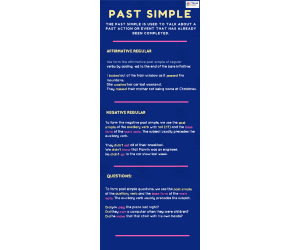
Past Simple | Beginner Lesson Plan
ELA, Grammar, Grade 2, 3, 4, 5, 8, 9, 10, 11, 12, Teacher Tools, Lesson Plans
Past Simple ESL and EFL lesson plan for A1 beginner English students. This TEFL resource is ready to go and comprises a range of teaching materials, such as flashcards, activities, conversation topics, and writing drills. Created to raise language proficiency for early English students, the lesson dives into the past simple in a variety of situations. Describing actions that are finished in the past, it empowers ESL students with the knowledge and confidence to use the present continuous accurately in every day conversation and writing. With the inclusion of activities, exercises, and real-life examples, this lesson plan strengthens language concepts and establishes a solid foundation in the basics of English grammar. This TEFL lesson plan includes: Cover page Flash cards A warm-up activity Main use Construction details Rules, along with any exceptions Illustrative examples Two closed exercises One open exercise Revision exercise Writing exercises Chatterbox, a recurring feature in our course books encouraging conversation Activity , such as a game, quiz, puzzle, etc., to conclude the class The lesson plan is available in PDF with 33 ready to print pages and one digital access file. A part of it is on Google Apps. The answer key is also included for reference.
Author TEAM TEFL
Tags Grammar Lesson Plan, Regular Verbs, Past Simple, Syllables, Past Participles

I WONDER - Can Mollusks Be Eaten | Animated Video Lesson
STEM, Animals, Life Sciences, Science, Biology, Grade 1, 2, 3, 4, 5, 6, 7, 8, Lesson Plans, Teacher Tools
Video Introduction Animal kingdoms are full of fascinating wonders to learn. This video is designed for the students to learn more about animals in different countries. I WONDER - Can Mollusks Be Eaten | Animated Video Lesson Do you like animals? what is your favorite one? Do you own a pet? If yes, tell us more about it, like what its name? And what do you like most about it? What are the animal kingdoms? Can you write down the characteristics of each animal class like mammals, birds, reptiles, amphibian, fish and mollusks. Do you know that some animals can sing, can you name any of them? What is the largest and the smallest mammal in the world? What is the largest and the smallest bird in the world? What is the largest and the smallest fish in the world? I WONDER - Can Mollusks Be Eaten | Animated Video Lesson The video is perfect for encouraging the researching skills for the students, while learning more about these fantastic animals. I WONDER - Can Mollusks Be Eaten | Animated Video Lesson This friendly designed video is suitable for students at school, homeschooling, and as a group activity. Format Available in MP4 format.
Author Educational Voice
Tags Can Mollusks Be Eaten, Can Mollusks Be Eaten Video, Mollusks, Mollusk, Mollusks Facts, Mollusks Facts Or Kids, Mollusks Video, Mollusks Video For Kids, Mollusk Facts, Mollusk Video

All About Number Patterns | Animated Math Video Lesson
Math, Percentages, Preschool, Grade 1, 2, Lesson Plans, Teacher Tools
All About Number Patterns | Animated Math Video Lesson This dynamic teaching tool serves as an excellent resource for educators keen on introducing mathematical concepts in a fun and engaging manner. It is specifically designed for Kindergarten, Grade 1, and Grade 2 students. Detailed Description: This video lesson captivates kids by presenting intriguing math riddles and pattern recognition problems. With accessible grade-level language, it ensures comprehension even among young learners who are just starting their numerical education journey. Promoting Critical Thinking: The goal of this 10-minute animated math video is to foster critical thinking by encouraging children to identify patterns in numbers themselves. A holistic learning atmosphere where the tool can serve as both an introductory concept revealer or a review reminder is promoted. Versatile Implementation: With its multimedia nature, this animated lesson offers plenty of opportunities for flexible implementation based on specific teaching needs such as: Whole-group presentations during core teaching time enabling direct interactions and group discussions around the content shown Integration into smaller study circles where individual engagement requirement is high. Serve as `homework assignments` allowing exploration at leisure without time pressure inhibiting comprehension. Delivered in MP4 file format to enhance digital adaptability while retaining theoretical richness pertinent to its subject matter - `Math Percentage Patterns` . This perfect fusion of traditional learning elements with modern-day techniques makes 'All About Number Patterns | Animated Math Video Lesson' not just another addition but brings mathematics off textbook pages fostering effective concept grasp.
Author Educational Voice
Tags Animated Math Lesson, Number Patterns, Hands-on Learning, Critical Thinking, Multimedia Education
High Frequency Picture Words: Match and Print - FLASH-MAC
ELA, Language Development, Vocabulary, Grade 1, 2, Teacher Tools, Lesson Plans
High Frequency Picture Words: Match and Print - FLASH-MAC This valuable teaching tool is a purposefully designed resource for Grade 1 and Grade 2 pupils focusing on the growth of their Vocabulary as part of the Language Arts Curriculum . It provides an engaging blend of recognition and application activities cultivating multi-modal learning. The core pieces lie within activities centered on recognizing high-frequency picture words, encompassing productive match-and-print exercises. Educators have the option to use this versatile tool during whole group instruction fostering collective learning or small group sessions focusing more on individual progress. Apart from being an effective instructional medium, this tool doubles as reinforcement or homework allowing learners to independently solidify their knowledge at home. In addition, it contains the following supplementary features: Tangible printables promoting student engagement while concurrently reinforcing learning objectives; Picturesque word flash cards facilitating swift retention through visual aids; Graphic organizers structuring information coherently for better assimilation; Interactive activities transforming everyday classroom teaching into immersive experiences. 'One fit-for-all': The utility includes one zip file containing MAC software making it compatible with your MAC device whether at your school or home, ultimately offering convenience by combining various elements under a single platform. In conclusion, High Frequency Picture Words: Match and Print - FLASH-MAC fills you up with unique tools to bolster your teachings leading to enriched experiences for our young learners. </p
Author Classroom Complete Press
Tags Matching, Picture Words, Vocabulary, Language Arts, High Frequency Words
I WONDER - What Is A Group Of Lions Called | Animated Video Lesson
STEM, Biology, Life Sciences, Science, Animals, Grade 1, 2, 3, 4, 5, 6, 7, 8, Lesson Plans, Teacher Tools
Video Introduction Animal kingdoms are full of fascinating wonders to learn. This video is designed for the students to learn more about animals in different countries. I WONDER - What Is A Group Of Lions Called | Animated Video Lesson Do you like animals? what is your favorite one? Do you own a pet? If yes, tell us more about it, like what its name? And what do you like most about it? What are the animal kingdoms? Can you write down the characteristics of each animal class like mammals, birds, reptiles, amphibian, fish and mollusks. Do you know that some animals can sing, can you name any of them? What is the largest and the smallest mammal in the world? What is the largest and the smallest bird in the world? What is the largest and the smallest fish in the world? I WONDER - What Is A Group Of Lions Called | Animated Video Lesson The video is perfect for encouraging the researching skills for the students, while learning more about these fantastic animals. I WONDER - What Is A Group Of Lions Called | Animated Video Lesson This friendly designed video is suitable for students at school, homeschooling, and as a group activity. Format Available in MP4 format.
Author Educational Voice
Tags What Is A Group Of Lions Called, What Is A Group Of Lions Called Video, Group Of Lions, Group Of Lions Facts, Group Of Lions Facts For Kids, Group Of Lions Video, Group Of Lions Video For Kids, Lions

The Plant Life Cycle Unit
ELA, Reading, Preschool, Grade 1, 2, Lesson Plans, Teacher Tools
The Plant Life Cycle Unit resource will give you everything your students need to apply their knowledge about plants and complete engaging activities. This unit includes: 1. What I Know Writing 2. What I'm Wondering Writing 3. Seed Observation Page 4. Seed Planting Page 5. What do seeds need to grow? 6. Our Seed is Growing Page 7. Label a Seed 8. Our Seeds Have Grown Page 9. Plants Need Cut and Paste 10. Plants Life Cycle Cut and Paste 11. Color the Life Cycle 12. Stem Experiment 13. Label the Flower 14. Make the Flower 15. What I Learned about Plants Writing
Author Kindergarten Cafe
Tags Plant Life Cycle, Life Cycle Journal, Plant Journal, Plant Life Cycle Unit, Growing Seeds

Michigan State Unit Study (Capital, Bird, Flower, Flag, Animal)
Social Studies, Geography, Grade 2, 3, 4, Lesson Plans, Teacher Tools
Product Description: Michigan State Unit Study (Capital, Bird, Flower, Flag, Animal) This comprehensive resource offers an immersive 5-day exploration of Michigan. It is well-suited for second to fourth-grade students and covers various subjects including geography, history, English language arts and science. Key Features: Educator-friendly: Comes with clear lesson plans and instructions for easy teaching. Videos: Engages visual learners with vivid portrayals of Michigan's key symbols. Daily Worksheets & Activities: Fosters interaction in varied ways with tasks usable as pair or group work or even as homeworks to link classroom lessons and home-based learning. Making this more engaging is the presence of an interactive notebook where learners keep their creative inputs. Attached are blank cards featuring six defining elements about Michigan - its statehood details along with its bird species; flower; flag; animal; capital city which can be utilized according to classroom needs! An inclusion of hands-on art components like coloring pages also adds a layer of fun learning for the young artists. Plus a special section devoted for those loving research tasks: mix-match research report pages! The resource - despite being full-packed makes it friendly-to-use whether you are a homeschooling parent or public school teacher given its simplified guidelines that can match unique learner demands! Our goal in designing this has been clear from the start: Learning should be fun informative suiting individual styles – we believe our product does just that and so much more!
Author Heather Huhman
Tags Michigan State, Unit Study, Capital City, Bird Species, Flower Symbol

A Social Story: Share the Words
, Preschool, Grade 1, 2, Teacher Tools, Lesson Plans
A Social Story: Share the Words, a Teaching Resource Designed for educators across various academic settings including public school teachers and homeschoolers, this unique tool harnesses the power of stories to instill in students the importance of sharing words and engaging in constructive dialogue. Format & Scope This teaching resource is constructed around a 21-slide Microsoft PowerPoint presentation. It doesn't restrict itself to any particular grade level. However, children in their formative years - Kindergarten till Grade 2 - stands to benefit the most from its use. The subject focus lies outside traditional academic disciplines, spotlighting instead on development of critical life skills via non-traditional learning methods. Versatility & Engagement Versatile: The format welcomes group-based activities as well as focused individual tasks. Engaging:The ingenious use of audio elements enables reading stories aloud hence creating an immersive learning atmosphere. The Objective: Cultivating Meaningful Dialogues In the wake of each story session are conversation bubbles fostering meaningful exchanges between learners and educators. These discussions serve as precursor towards implementing shared dialogues into day-to-day scenarios. Fundamental Concepts Taught: Active Listening: ; Caring Communication ; Beyond Formal Academics This resource prepares educators with dynamic teaching strategies, transcending beyond traditional textbooks thereby simplifying their effort towards nurturing thoughtful communicators out from their learners.
Author Teach Me This
Tags Social Skills, Dialogue, Communication, Active Listening, Storytelling

Non-Fiction Early Reader: Pine Trees Unit
ELA, Reading, Grade 1, 2, 3, 4, Lesson Plans, Teacher Tools
Non-Fiction Early Reader: Pine Trees Unit Engaging children in learning and enhancing their reading proficiency, the Non-Fiction Early Reader: Pine Trees Unit is an ideal teaching tool for educators who seek to build their students' competence in non-fiction text. Authentic photographs employed within the text lend realism and stir curiosity among new readers. The units are designed for young learners from grades 1 through 4, with a specific focus on language arts and reading skills. Educational Design & Supplementary Materials Designed thoughtfully by experienced educators, this product includes teacher guides loaded with themed words, comprehension queries, and vital reading tips. The package also brings additional support materials such as: Worksheets Posters Tracking sheets to assist in the learning process. Versatility & Resource Integration The Non-Fiction Early Reader: Pine Trees Unit takes into consideration different guided Reading Levels (J through S), Lexile Levels (450L-699L & 875L-925L), and DRA Levels (16-18 & 40-50). This extends its feasibility across various student aptitude levels ensuring no child is left behind! Pedagogical Applications & Parental Involvement This comprehensive resource pack allows for diverse ways of integration into your teaching plan - it can be used in whole class settings where everyone reads together or small groups that facilitate more specific guidance. Teachers may also consider using it as daily home assignments associated with a relevant section from the booklet. The ABC’s of Helping Your Child Read Non-Fiction,a parent handout included allows parents to contribute to their child's reading adventures! Learner Engagement & Progress Tracking To foster student engagement, the pack comprises of separate word strips with pictures and definitions for easy incorporation in classroom word walls. The inclusion of a reading chart motivating young readers, tracks the progress of students effectively. Expansion Beyond Classroom The Non-Fiction Early Reader: Pine Trees Unit, an ensemble resource aimed at fostering a love for learning and nurturing proficient readers right from their early education, is comprehensive yet manageable. With 85 pages full of instructive content in PDF format, , it creates an explorative space to decode non-fiction texts focused around Pine Trees - inviting children into a unique world of winter wonders!
Author Simply Schoolgirl
Tags Early Reader, Non-fiction, Pine Trees, Reading Proficiency, Teaching Resource
I WONDER - How Many Hairs Are On My Head | Animated Video Lesson
Biology, Life Sciences, Science, Human Body, STEM, Grade 2, 3, 4, 5, 6, 7, 8, Lesson Plans, Teacher Tools
Video Overview The human body is full of fascinating wonders to learn. This video is created to help the students recognize the anatomy and the job of the human body. I WONDER - How Many Hairs Are On My Head | Animated Video Lesson Every part and organ in our human body is vital so let's see how important they are. Have you ever imagined how we look like if we didn't have a skeleton? Did you know that because we have our amazing muscles we can stand! Do you know how many teeth do we have? Have you ever wondered about the food journey inside our body? Can you name all the glands in our body? Why do we have skin? Our nervous system is really good at sending signals. Can you tell us more about it? Are you really good at Mathematics, painting, or any other thing? You should really thank your brain about it! The famous five senses are really doing a great work? Can you explain how every sense works? I WONDER - How Many Hairs Are On My Head | Animated Video Lesson The video is perfect for encouraging the researching skills for the students, while learning more about our fantastic human body. I WONDER - How Many Hairs Are On My Head | Animated Video Lesson This friendly designed video is suitable for students at school, homeschooling, and as a group activity. Format Available in MP4 format.
Author Educational Voice
Tags How Many Hairs Are On My Head, How Many Hairs Are On My Head Video, Hair, Hair Facts, Hair Facts For Kids, Hair Video, Hair Video For Kids, Head, Head Facts, Head Facts For Kids

Joy and Heron Animated Writing Activity | Short Film
ELA, Writing, Grade 1, 2, 3, 4, Teacher Tools, Lesson Plans
Joy and Heron Animated Writing Activity | Short Film This animated short film "Joy and Heron" engages students in creative writing exercises. Students watch an 8-minute story about a young girl who befriends a great blue heron. After viewing, students sequence events, summarize the plot, identify the main idea and details, and respond to comprehension questions. Educators can facilitate whole-class discussion or assign the activities for small groups, partners, or independent work. This versatile resource builds critical thinking and writing skills for students in grades 1-4. With cross-curricular connections, the vivid visuals and charming story motivate young writers to use their imagination. Students will love analyzing this mini-movie through sequencing, summarizing, and responding to the narrative elements.
Author Teach Me This
Tags Joy And Heron, Creative Writing, Short Film, Animated Film, Story Events

Emotional Regulation & "Size of the Problem" Mapping
Special Resources, Life Skills, Social Emotional Learning (SEL), Social Skills, Special Education Needs (SEN), Speech Therapy, STEM, Resources for Teachers, Classroom Management, Community Building, Grade 1, 2, 3, 4, 5, 6, 7, 8, Teacher Tools, Assessments, Lesson Plans, Quizzes and Tests, Quizzes, Tests, Worksheets & Printables, Workbooks, Worksheets, Word Searches
Have you had enough of students throwing tantrums over minor issues? This COMPLETE set of materials will help you to promote emotional regulation in your classroom and/or counselling office. This complete print-and-go curriculum will teach students in grades 1 – 3 the important difference between a “glitch” and an “emergency.” Based upon the popular “Size of The Problem” concept, this toolkit goes far beyond simple worksheets by providing a comprehensive, neuroscience-based approach to building self-regulation skills. This is not just a bunch of activities; it is a comprehensive multi-week program that allows students to learn how their brain works, understand the size of their problems, and respond to those problems with appropriate emotional responses. This program can be used by any teacher, school counselor, special education teacher, or occupational therapist. WHAT IS IN THE PACKAGE - 43 Pages of High Value Content Part 1 – Theory and Clinical Guide (11 Pages) – A detailed educator guide to why the approach is used. This section will include an explanation of the neurobiology of an "amygdala hijack," a review of the principles of Cognitive Behavioural Therapy (CBT), and an explanation of the research supporting visual scales as an assessment tool for young learners. Part 2 – Engaging Student Workbook (20 Pages) – 10 Scaffolded Worksheets: Fun, relatable activities that allow the learners to develop their ability to identify problem sizes and their reaction to those problems. Topics Include: Problem Thermometer, Reaction Rulers, The Match Game, Shrink the Mismatch, What If? Lab, Body Signals, Perspective Taking, and a Personal Problem Map. Part 3 – Teacher Resources and Visuals (12 Pages) – 3 Visual Models for teachers: Classroom poster ("The Proportional Magnitude Scale"), an assessment matrix, and a cognitive mapping flowchart – all are perfect for use as anchor charts and for daily reference. Answer Keys for the student worksheets make it easy to assess your students. Detailed Implementation Guide for teachers: This guide contains a detailed week by week implementation plan for introducing conceptual information and providing reinforcement for long-lasting effects, including scripts and suggestions for implementation activities. Support your students as they develop a base of emotional awareness and skills to be able to deal with emotions throughout their life. Provide your students with the opportunity to not only deal with their emotional responses but to also develop the ability to know, evaluate and manage their emotional responses. CATEGORIES OF LEARNERS: Elementary Education, Social Emotional Learning; Copywriter; Emotion Regulator; Teacher; Student; Self-Regulator; Reference; Help With; Size Of The Problem; Coping Skills; Student Management; Meltdowns; Workbook; Worksheets; Visuals; Posters; Anchor Charts-School; Elementary Grades: 1st, 2nd, 3rd; School Counseling; Special Education; CBT. Reasons for Parents/Schools to Appreciate: Science Based Approach: Proven theories of neurobiology and cognitive behavioral therapy (CBT) provide a scientific basis for the works that are performed based on their use. Develops Lifelong Skills for Children: Children acquire a language and visual representations of their feelings, enabling them to have the tools they need to cope and manage their feelings as well develop independence and resiliency. Reduces Disruption in Classrooms: Students become more self-regulated and are less likely to act out over little things such as breaking a crayon or losing a game. Therefore, there is increased time for typical learning. A Complete Program: The online program is complete and provides all of the materials needed to teach the program to students. Teachers and counselors do not need to create or gather materials themselves; the time savings are significant! Target audience: According to the content, language, and examples of your product (for example, "first through third grades", 7-9 year-old case studies) the target is: Main Student Audience: 1st Grade to 3rd Grade students (6-9 years). Main Buyer Audience: Elementary school teachers, special education teachers, school counsellors, school psychologists, occupational therapists (OT's), child therapists, and the concerned parents of children who have difficulties regulating their emotions. Terms of Use and Copyright : Syed Hammad Rizvi is the owner of this copyrighted book; it is for individual and personal (one classroom) use only. You cannot modify, redistribute, or sell this item or any part of it anywhere else. You are not permitted to post it to the internet so that anyone can find it and download it. If you wish to share it with others, please purchase additional licenses from Teachsimple. Thanks for respecting these terms. Syed Hammad Rizvi (h) is honored to provide you with this resource!
Author Creative Book Store
Rating
Tags SocialEmotionalLearning, SEL, EmotionalRegulation, SelfRegulation, CopingSkills, MindfulnessForKids, EmotionalIntelligence, SocialSkills, Feelings, SizeOfTheProblem
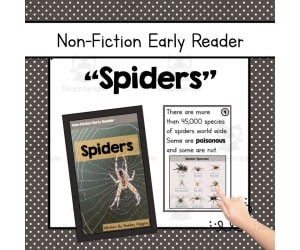
Non-Fiction Early Reader: Spiders Unit
ELA, Reading, Grade 1, 2, 3, 4, Lesson Plans, Teacher Tools
The Non-Fiction Early Reader: Spiders Unit An invaluable resource for educators looking to enhance their students' reading skills and nonfiction text comprehension. This 86-page PDF product effectively combines real-world imagery with comprehensive guides and versatile teaching materials to facilitate a dynamic learning approach. Tailored Learning Materials The unit features two sets of teacher and student booklets titled Spiders which are presented at two distinct reading levels. This aids teachers in crafting lesson plans tailored to the individual needs of their students. The package includes blank half-page student booklets that stimulate creativity as students are asked to write their versions. Versatile Usage This package can be used for both homework assignments or group activity material seamlessly incorporating elements such as: Fiction text feature posters: Displaying elements of an informative text, table of contents, subtopics & headings, illustrations & photos performance metrics like graphics glossary and index posters. A useful reading chart : Meant to keep new readers motivated through the provided Spiders units. Sounding out cards: For theme words plus word strips accompanied by pictures and definitions - ideal for enhancing language arts sessions and your class word wall. The ABC's of Helping Your Child Read Non-Fiction A great parent handout included in the set that reinforces home-to-school connections. It guides parents on how they can support children's learning progression outside classroom hours effectively. In Conclusion, " For Grade 1-Grade 4 educators focusing on Language Arts with a focus on Reading subsubjects this resource is worth adding into their repertoire. Its versatility makes differentiated instruction easy and fun in the classroom setting whether used one-on-one with early learners at home or in group-learning settings."
Author Simply Schoolgirl
Tags Spiders, Non-fiction, Early Reader, Reading Comprehension, Teaching Resources

Learn to Read and Spell Sight Words | Lesson 8 | Micro-Learning Deck
ELA, Language Development, Spelling, Preschool, Grade 1, 2, Teacher Tools, Lesson Plans
This download is Lesson 8 for Learn to Read and Spell Sight Words. This is a digital lesson with 30 slides to help teach sight words! The sight words for this lesson are: -get -go -had -has -have There are 6 different activities to teach the sight words for this lesson. Activities: -Write words -Letter tiles -Type words -Match the words -Close reading -Sentences
Author Teach Me This
Tags Learn To Read, Learn To Spell, Sight Words, Spelling Lesson, Letter Tiles