



3,945 products added recently
Page 8 - 2nd Grade Lesson Plans
Enhance your second-grade classroom with lesson plans that build on foundational skills and introduce new concepts. These activities promote critical thinking and creativity across subjects. Implement these plans to keep your students motivated and progressing confidently.

 Show filters

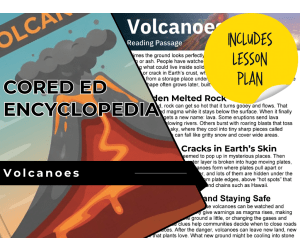
Volcanoes Reading Comprehension Passage - Cored Ed Encyclopedia
ELA, Language Development, Reading Comprehension, Reading, Pre-Reading, Earth Sciences, Earth and Environmental Sciences, Science, Geography, Social Studies, Grade 2, 3, 4, 5, Worksheets & Printables, Worksheets, Teacher Tools, Centers, Activities, Writing Prompts, Assessments, Quizzes and Tests, Quizzes, Lesson Plans
This volcanoes reading comprehension with lesson plan includes: Visualization (on the front cover) Start your lesson by taking a minute to think and share something about the topic. Read the script aloud (slowly), perhaps prepare some music or sound effects. Student close their eyes and let their imaginations wander. Students open their eyes, read the question aloud and give them a few minutes to complete. Ask a few students to share or keep answers until the end to compare with what they learn in the passage. Quick pause—thousands of Cored Education products are included with your TeachSimple membership. Download links and encyclopedia index available here. Pre-Reading Trivia Students will write down one thing they already know about the subject and then read five more facts and discuss. These facts are fun, and the students will enjoy learning about the subject before reading more. Give 1 minute for students to write what they already know (no pressure—best guess is fine). Read the five facts together. After each fact, do ask a student for their opinion, was it surprising? Set a purpose by asking students to highlight/underline one fact they want to learn more about during the reading. Reading Passage The text is a high-interest reading passage with set paragraphs, roughly three to four paragraphs long. It contains a variety of themes about the topic, anywhere from history to technology. The passage is between 250 and 350 words in length. First, ask students to look at the headings and see what they’ll learn about today. What do they know about the topic/heading? First read options: Teacher read-aloud (best for support). Partner reading (paragraph by paragraph). While reading, students underline important details, and vocabulary words they think may come up in the questions section. Mixed Questions The first question page contains four multiple-choice questions, each with a choice of four answers, and three written response questions that require a sentence or two from the student. Students complete the mcqs first independently, then review quickly as a class. For the 3 written responses, try to get students giving the answer with some form of evidence: “I think ___ because the text says ___.” If students get stuck, send them back to check the passage. Vocabulary Questions Practice seven key words from the text in this section across two activities. First section is scrambled words where students will unscramble three words given a clue for each. The second section is a word to meaning matching activity. Before starting, have some students read out words they underlined in the passage. Ask students to say the word and read aloud the sentence(s) around each word. Ask students to do scrambled words and the matching exercise in pairs then go through answers as a class. For the scrambled spelling task, get four pairs to come up to the board and write the words for extra practice with the other student reading out the clue. For the matching task, prompt students to give full sentences: “I matched ___ with ___ because ___.” Creative Writing In this question, the student will be required to write a five to eight sentence paragraph on a question related to the topic. Before starting, ask students write down 3 key ideas they are going to include in their piece. Ask students for ideas to share around the class to help those struggling. Pro writing expectations: 5–8 sentences At least 2 facts or details from the passage At least 2 vocabulary words from the previous page Students read their paragraphs while classmates listen for facts and vocabulary words. Extension Activities This page is optional for fast finishers or to take home. There are several activities, each one requiring a different skill. Do some, do none, do all, completely optional - but you will feel reassured knowing every possibility is planned for. Includes summary writting question. Answer Key There are answers for the multiple-choice questions, written response questions have sample answers, vocabulary answers and if there is a summary question then a sample summary will be provided as well. Lesson Plan Included Customized lesson plan for this lesson is included. Lesson Snapshot Title: Volcanoes Genre: Nonfiction (Informational text) Subject: Science (Earth Science) Primary Topic: What volcanoes are, how they form, and safety clues Estimated Guided Reading Level (A–Z): P What This Lesson Teaches Best What a volcano is (more than a “mountain”): Explains a volcano as an opening/vent or crack in Earth’s crust where hot melted rock, ash, and gases escape from an underground storage place called a magma chamber. Magma vs. lava: Defines melted rock as magma underground and lava once it reaches open air. How volcanic ash forms and spreads: Describes eruptions that toss bits of magma into the sky, cooling into tiny sharp pieces called volcanic ash that can fall like gritty snow and cover wide areas. Why volcanoes form where they do: Connects volcano locations to Earth’s outer layer being broken into huge moving plates (pulling apart or sliding under another), and also to “hot spots” that can form island chains such as Hawaii. Warning signs and community safety: Notes that rising magma can cause small earthquakes, ground swelling, or changes in gases and heat, and that these clues help communities decide when to close roads or move to safer places. Learning Goals Students will explain what the text says a volcano is and where the material comes from. Students will describe the difference between magma and lava using the passage’s definitions. Students will identify one way volcanic ash forms and describe what it is like when it falls. Students will describe how moving plates and hot spots help explain where volcanoes form. Students will list warning signs in the passage that may happen as magma rises. Students will explain how scientists’ observations can help communities stay safer. Key Vocabulary From the Text crust — Earth’s hard outer layer. magma — melted rock below Earth’s surface. lava — melted rock after it reaches open air. eruptions — times when a volcano sends material out. plates — huge moving pieces of Earth’s outer layer. FULL CATALOG OF DOWNLOAD LINKS AND ENCYCLOPEDIA INDEX HERE
Author Cored Education
Rating
Tags Vocabulary, Reading Comprehension, Reading Passages, Lesson Plans, Ela Lesson Plans, Reading Comprehension Lesson Plans, Pre-reading, Science Lesson Plans, Earth Science, Social Studies Lesson Plans

Math Phonics Addition: Quick Tips and Alternative Techniques for Math Mastery
Math, Addition and Subtraction, Addition, Grade 1, 2, 3, Teacher Tools, Lesson Plans
Math Phonics Addition: Quick Tips and Alternative Techniques for Math Mastery A reliable and innovative resource, this package is designed specifically for educators looking to simplify addition facts mastery from 0 through 10. Merging teaching techniques of language arts into mathematics facilitates easy understanding for students. Target Audience Suitable for first to third graders in public schools or homeschooling environments, this user-friendly product streamlines both the teaching and learning process. Lesson Plans The collection contains ten distinct lesson plans - Each one mirrors a perfect harmony of simplicity and usage effectiveness - All lesson plans come equipped with associated worksheets giving hands-on application of every rule/pattern learned during session- Included are customized pages carrying home assignments to help maintain consistent learning away from the classroom as well- The choice between utilizing it as part of whole group instruction or breaking it down into small group activities is yours—either way ensures fruitful results. Even assigning individual units intermittently per lesson plan fast-tracks mastering addition math facts from 0 through 10 substantially quicker than traditional methods might facilitate. No Extra Materials Required! This pack comes self-sufficient without demanding any additional materials. Everything required right from initiation till conclusion of this engaging program designed towards facilitating quick mastery over basic addition elements, is available within its PDF file. The materials use out-of-the-box techniques captivating students' interests while establishing sturdy foundations necessary not just in mathematics but across numerous other disciplines they will face throughout their academic journey. An Effective Yet Enjoyable Learning Experience! Above all, Math Phonics Addition: Quick Tips and Alternative Techniques for Math Mastery delivers on simplicity without trading off on effectiveness—an ideal response for beginners' classes needing a fun way into mathematics basics and senior grades seeking solidification of previously taught principles through unique teaching methodology.
Author Classroom Complete Press
Tags PDF
Curriculum Math Tools - Calculator Tool - FLASH-MAC
Math, Algebra, Grade 1, 2, 3, 4, 5, 6, 7, 8, Lesson Plans, Teacher Tools
Curriculum Math Tools - Calculator Tool - FLASH-MAC Take your math lessons to the next level with the Curriculum Math Tools - Calculator Tool-FLASH-MAC. This invaluable educational resource will streamline teaching and learning processes for every public school teacher, homeschooler and learner engaged in grades 1 through 8. The Calculator tool proves advantageous when maneuvering complex concepts across various math sub-subjects, such as algebra, geometry, measurement, data analysis, probability and more. Styled around the Five Strands of Math structure — Number & Operations, Algebra, Geometry, Measurement and Data Analysis & Probability — this tool stimulates comprehension by simplifying these integral subfields of academia. National Standard Alignment: Aligning with national standards including NCTM (National Council of Teachers of Mathematics), Common Core and STEM standards greatly expands its versatility. This ensures that your learners remain on par with curricula being taught in classrooms nationwide. Ease Of Installation: As a software suite packaged into a single zip file formatted for MAC systems it offers an easy installation process. Once installed educators can use it as part of whole group instruction to introduce or solidify concepts or assign it during small group work sessions to enhance hands-on practices smoothly establishing learning gaps while scaffolding subject mastery. The Value Of Practice: Increased understanding comes from practice which the Calculator tool promotes by offering an engaging platform students can navigate independently during homework assignments thus reinforcing class lessons at home. Versatility For Every Grade Level: Irrespective of grade level or skill set every public school teacher and homeschooler can use this teaching resource regularly making it an integral part in streamlining curriculum delivery methods for optimal teaching effectiveness and enhanced student comprehension experience. Equip your learners with Curriculum Math Tools – Calculator Tool-FLASH-MAC: where mathematics learning becomes simpler regardless whether you teach whole classrooms full time or homeschool smaller groups semi-formally yet need structured reliable resources that make students’ understanding better despite mathematical complexities well within national standardized norms.
Author Classroom Complete Press
Tags Math Curriculum, Math Tools, Math Assessment, Algebra, Geometry

Hands-On - Life Science: The Brain Gr. 1-5
Science, Life Sciences, Human Body, Grade 1, 2, 3, 4, 5, Teacher Tools, Lesson Plans
Hands-On - Life Science: The Brain Gr. 1-5 is a rich teaching resource designed to pique students' curiosity about the vast world of science, focusing specifically on life sciences. This section provides a deep dive into the human brain, vital for our existence and mind-bogglingly complex. About this Lesson Plan Embark on a unique journey into the mysteries of our brain with this enthralling lesson plan. Fun memory games present an opportunity for students to explore their own cognition while learning about the organ that makes it all possible. Activities measuring heart rate demonstrate how exercise impacts pulse and exercises logging dreams deepen understanding of sleep cycles and changes during rest periods. Holistic Learning Experience Hands-on experiments are paired with every concept, allowing students to gather empirical proof of theoretical knowledge thereby building stronger conceptual understanding. Comprehension activities are woven throughout the lessons ensuring knowledge embedding while nurturing critical thinking skills essential for academic success in any subject. Literacy Skills Development The resource includes reading passages teeming with fascinating information, not just about neuroscience—but beyond—thereby sharpening literacy skills across all subjects areas. 'Before you read' tasks ensure complete absorption during reading tasks, A number of strategically placed graphic organizers assist in structuring content efficiently, which assists memorization particularly favorably for visual learners. Assessment & Adaptability Built-in assessment activities periodically gauge student comprehension preventing lags or gaps in understanding—providing educators a chance to tailor future directives based on outcomes. Suitable for whole-classroom learning or small homeschooling groups, Easily adaptable for homework tasks, encouraging the consistent establishment of productive self-study habits crucial for long-term educational success. Technology Friendly In tune with modern technologies, this resource is delivered as a PDF file—compatible across various digital platforms. Step away from dull textbook methodologies instead opting for this lively Hands-on Life Science: The Brain Gr. 1-5 teaching resource which offers interactive scientific exploration while simultaneously reinforcing multiple academic skills.
Author Classroom Complete Press
Tags The Brain, Memory Games, Senses, Life Science, Experiments

Multiply by "Nine" Task Cards - 60 Task Cards
Math, Calculus, Early Math, Basic Operations, Counting, Numbers, Multiplication and Division, Multiplication, Grade 1, 2, 3, 4, 5, Worksheets & Printables, Task Cards, Teacher Tools, Assessments, Lesson Plans, Quizzes and Tests, Activities, Centers
Multiply your students’ success with these 60 task cards dedicated to mastering the 9-times tables! We know the 9s can be tricky, but with these fun and engaging task cards, your students will be multiplying like math pros in no time. These cards are your secret weapon for making multiplication less of a headache and more of a breeze. Ways to Use: Morning Kick-Off: Start the day with a few quick challenges to get the gears turning. Partner Practice: Pair students up to quiz each other for some friendly competition. Independent Work: Perfect for solo practice during quiet time or math centers. Group Games: Use in scavenger hunts, relay races, or timed drills for added excitement. Quick Assessments: Instant feedback to track progress without the extra effort. Advantages: Focused Learning: Master multiplication by 9 in no time with targeted practice. Prep-Free: Just print and go—no lesson planning required! Interactive Fun: Keeps students engaged with exciting activities and challenges. Versatile: Use them individually, in pairs, or with the whole class. Instant Feedback: Easy to track students’ progress and identify areas for improvement. With these task cards, you’ll have your students multiplying by 9 like they were born to do it!
Author Ponder Palette Plazza
Tags Multiplication, Multiplication Task Cards, Multiplication Worksheets, Multiplication Activities, Task Cards, Math Task Cards, Numbers, Mental Math

Animal Science Unit | All About Wolves | Learning about Animals | Wolf
Science, Life Sciences, Animals, Kindergarten, Preschool, Grade 1, 2, Lesson Plans, Teacher Tools
Dive into everything you need to know about wolves with this 200+ page learning adventure featuring beloved canines of the forest. Strategically designed for preK-2nd grade flexible implementation, vibrant games, stories and activities transform wolf discovery into reading, writing and STEM skill-building suited for all learners. Choose either comprehensive 30-day unit or mix/match thematic modules leveraging tactile math puzzles, charming illustrated fiction passages, and hands-on DIY habitat dioramas. Customize to complement core ELA curriculum through independent reading nooks, literacy circles showcasing student-created conservation PSAs and museum exhibits, or whole-class wolf pack modeling imaginative adventures. Six leveled early reader mini-books allow progression from basic vocabulary to nuanced concepts like ecosystem balance and extinction threats. Extensions encourage storytelling via role playing field journalists or designing engaging infographics profiling wildlife advocacy groups. Open-ended projects nurture confidence applying new wolf expertise through authentic writing tasks and student-directed research presentation. There are lighthearted games, charming visuals and multiple learning modes reinforcing retention in student-paced style. Supplement phonics instruction through inventing silly alliterative wolf pack names. Develop fine motor control designing mini plushies. Perform rhythm and movement exercises acting out hunting sequences. This forest friend-filled teaching kit spurs smiles while unfolding reading joy. What You Get: Teacher Resources: Discussion questions, project and activity ideas, book list, links to related videos...... Printables: Animal classification poster, type of eater poster, life cycle poster, animal species poster, collectible animal cards, vocabulary strips with definitions, map showing where the animal is native, and 12 high-quality photographs of animal habitats, behaviors, and physical characteristics. Worksheets: A ton of adorable and helpful worksheets to learn about animal adaptations, habitats, life cycles, vocabulary words, eating habits, and animal anatomy. Reading Material: Lots of reading resources including nonfiction article about this animal provided in two differentiated reading levels with comprehension questions. Also included is a fictional story about a child naturalist studying this animal provided in two reading levels. Several cute bookmarks featuring this animal. Writing Opportunities: You'll be blown away by the number of writing templates and options provided here including a full page blank booklet for young students, a half-page booklet with photos to add, nature journal covers, animal report planners provided in two levels, a few other writing prompts. You'll find something for every level of writing ability and skill. Crafts: Cute animal photo cut-outs, animal art outlines to support in depth art projects, jointed (articulated) paper craft, paper bag puppet, animal mask, animal footprint cut-outs, and coloring pages. Games: A macro-photo guessing game and a cute memory game to review this animal's behaviors, physical characteristics, and habitat.
Author Simply Schoolgirl
Tags Zoology, Pack, Mammals, Predator, Predators, Forest, Boreal, Arctic, Wolf Crafts, Wolf Lesson

Math Phonics Subtraction: Quick Tips and Alternative Techniques for Math Mastery
Math, Addition and Subtraction, Subtraction, Grade 1, 2, 3, Teacher Tools, Lesson Plans
Math Phonics Subtraction: Quick Tips and Alternative Techniques for Math Mastery An ideal tool for educators seeking engaging ways to teach subtraction skills to students in grades 1 through 3. This resource combines the structure of language arts with the fundamentals of math, allowing students to learn math facts in a unique and effective manner. The Phonics-Based Approach This innovative teaching resource uses a phonics-based approach, relying on rules, patterns, and memory tools often used in language arts education making it an excellent choice for introducing new concepts or offering alternative techniques. Versatility and Implementation The package includes one product file - a PDF format containing lesson plans centered on subtraction. Content is versatile and can be adapted according to various scenarios: Group discussions during class sessions, Potential small pod tasks within larger classrooms, Tutoring situations or homework assignments at homes. The Advantage for Educators Educators gain access not only to basic instruction materials but also inventive methods designed with consideration towards their typical challenges. The intriguing patterns inspired from language arts make learning an enjoyable yet immersive process. Aiding Tomorrow's Problem Solvers Today! Tackling the journey toward math mastery might sometimes seem like an uphill battle but when armed with this teaching tool designed specifically for beginners' ease mathematicians-in-making will enjoy each revelation across their learning experience. In summary, if you value effective instruction that integrates creativity into fundamental mathematical operations—subtraction—then Math Phonics Subtraction: Quick Tips and Alternative Techniques for Math Mastery should be your next pick.
Author Classroom Complete Press
Tags PDF
Geometry: Transformations & Symmetry - MAC Software
Math, Geometry, Kindergarten, Preschool, Grade 1, 2, Teacher Tools, Lesson Plans
Geometry: Transformations & Symmetry - MAC Software This software is particularly designed to furnish an extensive resource for teaching geometric transformations and symmetry. As a curriculum-based tool, it pours forth enlightening content geared towards preschool, kindergarten, Grade 1 & Grade 2 educators who desire to make learning geometry exciting and efficacious. Teaching Tools Lesson Plans: The package comes with various tools like structured lesson plans for group discussions ensuring optimal pace of learning with teachers' inputs for engagement. Real-World Problems: Practical exercises applying classroom knowledge in real-world scenarios serve as an efficient tool for independent or small-group tasks. Timed Drills: Mechanically-timed procedures provide scope for individual assessments while letting educators track student progress effectively. Inclusion of Interactive Math Tools The software provides visual aids and simplified explanations perfect for group demonstrations or independent use. It also includes printables which provides excellent accessibility both in and out of classrooms. "Fun"ctional Games Included: A Memory Match game stimulates recall vital in math education, A board game fosters strategic thinking relating to math concepts, A Spinner Game promotes mathematical reasoning from luck-based activities—all meticulously planned preserving foundational knowledge without sacrificing fun! . Linguistically Inclusive The product goes a step further by offering options for Spanish voice over and text to ensure language isn't a barrier in achieving educational goals. All these resources are conveniently bundled into a single ZIP file—making Geometry: Transformations & Symmetry - MAC Software a broad-ranging tool designed by seasoned educators conscious of everyday teaching challenges and diverse learner profiles.
Author Classroom Complete Press
Tags Geometry Lesson Plan, Math Lesson Plan, Digital Math, Symmetry, Transformations
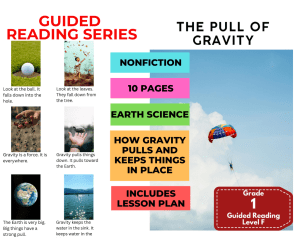
The Pull of Gravity: Guided Reading Level F with Lesson Plan
ELA, Resources for Teachers, Reading Comprehension, Reading, Science, Language Development, Vocabulary, Physics, Earth and Environmental Sciences, Pre-Reading, Kindergarten, Grade 1, 2, Worksheets & Printables, Worksheets, Teacher Tools, Centers, Activities, Literacy Readers, Quizzes, Quizzes and Tests, Assessments, Lesson Plans
This The Pull of Gravity (level f) guided reading book with lesson plan includes: Guided Reading Color Label (front cover x1) This is a quick way to match the book’s demands to what students can generally handle.. The overall goal is to use the level/color to pick books for several smaller groups. To qualify for a certain level, a student is expected to read a book from that level with about 90–94% accuracy. If a student is consistently accurate and understands, move up a level. If the student is struggling at that level, drop down and add more support. Each student will improve at completely different rates, but it is generally one of the best ways to check progress across the class. DOWNLOAD THE CATALOG TO VIEW ALL GUIDED READING BOOKS AVAILABLE (SORTED LEVELS A-Z) COMPANION VIDEO NOW AVAILABLE (EMBEDDED AFTER PREVIEW PICTURES IN PRODUCT DESCRIPTION) Pre-Reading Question (x1) The teacher says the question aloud, either while showing the cover or the first page. Students share what they already know or make sensible guesses based on the cover. Encourage them to use the target vocabulary where possible. Write a few of their ideas on the board so you can return to them during or after the reading. Vocabulary Words (x5) Introduce the five words one at a time. Say each word aloud, have students repeat it, and then ask if anyone already knows what it means. Read the meaning together and briefly connect each word to a picture, action, or gesture so it feels more memorable. Ask students to flip through the book and point to any pages where they spot the vocabulary words. While reading, pause when one of the words appears, or reread the sentence so students clearly notice and understand it in context. Optional: Ask students to raise their hands whenever they see or hear one of the new words. Guided Reading Pages (x10) Check the book snapshot below for: Primary topic — decide whether students need a quick introduction or extra background first. What this lesson teaches best — choose 1–2 key points to focus on during the session. Learning goals — keep in mind what students should be able to understand or say by the end. Key vocabulary — review and reinforce these throughout the lesson. Questions overview — look ahead so you know what students will be asked and whether any extra support is needed. Run the lesson You may already have looked at a few pages together, but it can help to revisit some of the pictures first to build meaning. Depending on your time and how confident the group is with guided reading, you may want to read the whole book aloud to them first. Students can then whisper-read or partner-read while you listen in. If time allows, you can also read as a group, with each student taking a page. Use the guided reading prompts to support them, such as: “Check the picture—does it make sense?” “Point under the words.” “Try the first sound.” “Reread the sentence smoothly.” It can be helpful to focus more closely on one student each session, rotating over time, so you can better judge whether they are ready to move up or may need more support at their current level. Comprehension Questions (back cover x3) This is where you check that students understood the text, not just the words on the page. Start by letting students answer by pointing to a page or picture and saying a short sentence. After they respond, follow up with: “Show me where you found that in the text.” In larger groups, let partners discuss their answer first for 10–20 seconds, then invite 2–3 students to share. Differentiation tips Emerging speakers / struggling readers: oral response + pointing On-level: oral response in a full sentence Higher: one written sentence or a drawing with labels Lesson Snapshot Title: The Pull of Gravity Genre: Nonfiction (informational) Subject: Science (Physical Science) Primary Topic: How gravity pulls things and helps keep them in place Estimated Guided Reading Level (A–Z): F What This Lesson Teaches Best Explains that gravity is a force and that it is all around us. Shows that gravity pulls things down and toward the Earth. Uses simple, everyday examples like a ball, leaves, water, rocks, sand, and air to show gravity in action. Helps students understand that larger objects, like Earth, have a stronger pull. Introduces the idea that gravity is also in space and helps pull the moon. Learning Goals Students will identify that gravity is a force found everywhere. Students will describe how gravity pulls things down and toward the Earth. Students will give examples from the text of things gravity pulls or keeps in place. Students will explain what the text says about Earth’s strong pull. Students will answer questions about gravity using details from the book. Key Vocabulary From the Text gravity — a pull that makes things go down force — a push or a pull toward — moving closer to something space — the place above Earth mountain — a very high hill of land Discussion Prompts Pre-reading question: What do you think makes things fall down to the ground? Comprehension question: What does the book say gravity is? Comprehension question: What does gravity pull things toward? Comprehension question: Name one thing the book says gravity keeps in place. 1. Best Printing Method (Recommended) Booklet printing is the best option if your printer or PDF viewer supports it. This method usually places the pages in the correct order automatically and makes folding much easier. Settings to use: Print mode: Booklet Paper size: Letter or A4 Orientation: Landscape Print on both sides: Yes Flip on: Short edge Scaling: Fit to printable area Booklet subset: First, print front sides only Then, print back sides only This will automatically: Pair the pages correctly Place the cover on the outside Help everything line up properly for folding After printing, fold the pages in half and staple along the spine. 2. If “Booklet” Printing Is Not Available You can still print the book correctly by using manual duplex printing . Step-by-step: Open the PDF. Click Print . Use these settings: Orientation: Landscape Pages per sheet: 1 Print on both sides: Yes Flip on: Short edge Print all pages. Since each PDF page already contains two facing book pages, the pages should still fold neatly into a book. Thousands of Cored Education products are included with your TeachSimple membership. Download links and encyclopedia index available here.
Author Cored Education
Rating
Tags Reading Comprehension, Reading Passages, Reading, Guided Reading, Guided Reading Lesson Plan, Guided Reading Activity, Pre-reading, Science Lesson Plans, Earth Science, Physics
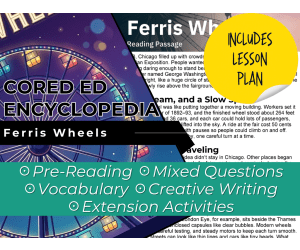
Ferris Wheels Reading Comprehension Passage - Cored Ed Encyclopedia
ELA, Reading Comprehension, Reading, Science, Technology, Language Development, Social Studies, History, Pre-Reading, Writing, Grade 2, 3, 4, 5, Worksheets & Printables, Worksheets, Teacher Tools, Centers, Activities, Writing Prompts, Assessments, Quizzes and Tests, Quizzes, Lesson Plans
This Ferris wheels reading comprehension with lesson plan includes: Visualization (on the front cover) Start your lesson by taking a minute to think and share something about the topic. Read the script aloud (slowly), perhaps prepare some music or sound effects. Student close their eyes and let their imaginations wander. Students open their eyes, read the question aloud and give them a few minutes to complete. Ask a few students to share or keep answers until the end to compare with what they learn in the passage. Quick pause—thousands of Cored Education products are included with your TeachSimple membership. Download links and encyclopedia index available here. Pre-Reading Trivia Students will write down one thing they already know about the subject and then read five more facts and discuss. These facts are fun, and the students will enjoy learning about the subject before reading more. Give 1 minute for students to write what they already know (no pressure—best guess is fine). Read the five facts together. After each fact, do ask a student for their opinion, was it surprising? Set a purpose by asking students to highlight/underline one fact they want to learn more about during the reading. Reading Passage The text is a high-interest reading passage with set paragraphs, roughly three to four paragraphs long. It contains a variety of themes about the topic, anywhere from history to technology. The passage is between 250 and 350 words in length. First, ask students to look at the headings and see what they’ll learn about today. What do they know about the topic/heading? First read options: Teacher read-aloud (best for support). Partner reading (paragraph by paragraph). While reading, students underline important details, and vocabulary words they think may come up in the questions section. Mixed Questions The first question page contains four multiple-choice questions, each with a choice of four answers, and three written response questions that require a sentence or two from the student. Students complete the mcqs first independently, then review quickly as a class. For the 3 written responses, try to get students giving the answer with some form of evidence: “I think ___ because the text says ___.” If students get stuck, send them back to check the passage. Vocabulary Questions Practice seven key words from the text in this section across two activities. First section is scrambled words where students will unscramble three words given a clue for each. The second section is a word to meaning matching activity. Before starting, have some students read out words they underlined in the passage. Ask students to say the word and read aloud the sentence(s) around each word. Ask students to do scrambled words and the matching exercise in pairs then go through answers as a class. For the scrambled spelling task, get four pairs to come up to the board and write the words for extra practice with the other student reading out the clue. For the matching task, prompt students to give full sentences: “I matched ___ with ___ because ___.” Creative Writing In this question, the student will be required to write a five to eight sentence paragraph on a question related to the topic. Before starting, ask students write down 3 key ideas they are going to include in their piece. Ask students for ideas to share around the class to help those struggling. Pro writing expectations: 5–8 sentences At least 2 facts or details from the passage At least 2 vocabulary words from the previous page Students read their paragraphs while classmates listen for facts and vocabulary words. Extension Activities This page is optional for fast finishers or to take home. There are several activities, each one requiring a different skill. Do some, do none, do all, completely optional - but you will feel reassured knowing every possibility is planned for. Includes summary writting question and additional facts. Answer Key There are answers for the multiple-choice questions, written response questions have sample answers, vocabulary answers and if there is a summary question then a sample summary will be provided as well. Lesson Plan Included Customized lesson plan for this lesson is included. Lesson Snapshot Title: Ferris Wheels Genre: Nonfiction (Informational Text) Subject: Social Studies (History) / Science & Technology / Reading (Informational Text) Primary Topic: Origins, design, and purpose of Ferris wheels Estimated Guided Reading Level (A–Z): P What This Lesson Teaches Best Explains the origin story of the first Ferris wheel at the 1893 Chicago world’s fair and why people wanted a daring new attraction. Uses clear facts and measurements (about 264 feet/80 meters , 36 cars , ride cost and time) to build informational reading skills. Shows how Ferris wheels spread to new places and why they’re also called “observation wheels” (because looking is part of the fun). Compares past and present Ferris wheels, including modern wheels built for slow sightseeing like the London Eye with enclosed capsules. Highlights how modern wheels rely on strong steel, careful testing, and steady motors for smooth turns. Learning Goals Students will describe why the 1893 world’s fair crowd wanted something “brand-new” to see. Students will identify key details about the first Ferris wheel (height, number of cars, ride time, and cost). Students will explain why Ferris wheels are also called “observation wheels” using evidence from the text. Students will describe how Ferris wheels spread to other places after Chicago, including the example in Vienna. Students will compare how some Ferris wheels are designed for thrills versus slow sightseeing today. Key Vocabulary From the Text Exposition — a huge fair where inventions and exhibits are shown. engineer — a person who designs and builds things. fairgrounds — the area where a fair is held. capsules — closed pods that carry riders on a wheel. skyline — the outline of a city’s buildings against the sky. FULL CATALOG OF DOWNLOAD LINKS AND ENCYCLOPEDIA INDEX HERE
Author Cored Education
Rating
Tags Vocabulary, Reading Comprehension, Reading Passages, Lesson Plans, Ela Lesson Plans, Reading Comprehension Lesson Plans, Pre-reading, Science Lesson Plans, Social Studies Lesson Plans, History

Let's Chat Conversation Cards | "Giving Feels Good"
Special Resources, Social Emotional Learning (SEL), Kindergarten, Preschool, Grade 1, 2, Teacher Tools, Lesson Plans
Let's Chat Conversation Cards for "Giving Feels Good" is a wonderful resource to build a positive mindset around compassion, perseverance, respect and responsibility. This packet includes printable conversation cards, a promise pledge, lesson plan aligned to standards, printable student award, and English/Spanish home connects. The conversation cards facilitate meaningful dialogue through which students can understand different perspectives and strengthen friendships. By reflecting on what it means to give back and how it makes us feel, students develop empathy and gratitude. Teachers can implement this versatile resource in whole group, small group, or as a homework assignment. With English and Spanish options, Let's Chat makes social-emotional learning accessible for more families.
Author Respectful Ways
Tags Spanish, SEL Lesson Plan, Respectful Ways, Conversation Cards, Giving
I WONDER - What Is The Difference Between A Crocodile And An Alligator
STEM, Biology, Life Sciences, Science, Animals, Grade 1, 2, 3, 4, 5, 6, 7, 8, Lesson Plans, Teacher Tools
Video Introduction Animal kingdoms are full of fascinating wonders to learn. This video is designed for the students to learn more about animals in different countries. I WONDER - What Is The Difference Between A Crocodile And An Alligator | Animated Video Lesson Do you like animals? what is your favorite one? Do you own a pet? If yes, tell us more about it, like what its name? And what do you like most about it? What are the animal kingdoms? Can you write down the characteristics of each animal class like mammals, birds, reptiles, amphibian, fish and mollusks. Do you know that some animals can sing, can you name any of them? What is the largest and the smallest mammal in the world? What is the largest and the smallest bird in the world? What is the largest and the smallest fish in the world? I WONDER - What Is The Difference Between A Crocodile And An Alligator | Animated Video Lesson The video is perfect for encouraging the researching skills for the students, while learning more about these fantastic animals. I WONDER - What Is The Difference Between A Crocodile And An Alligator | Animated Video Lesson This friendly designed video is suitable for students at school, homeschooling, and as a group activity. Format Available in MP4 format.
Author Educational Voice
Tags What Is The Difference Between A Crocodile And An Alligator, What Is The Difference Between A Crocodile And An Alligator Video, Crocodile, Crocodile Facts, Crocodile Video, Alligator, Alligator Facts

Skateboarding Reading Comprehension Passage - Cored Ed Encyclopedia
ELA, Language Development, Reading Comprehension, Reading, Pre-Reading, Writing, Sports, P.E. & Health, Technology, Science, Grade 2, 3, 4, 5, Worksheets & Printables, Worksheets, Teacher Tools, Centers, Activities, Writing Prompts, Assessments, Quizzes and Tests, Quizzes, Lesson Plans
This skateboarding reading comprehension includes: Visualization (on the front cover) Start your lesson by taking a minute to think and share something about the topic. Read the script aloud (slowly), perhaps prepare some music or sound effects. Student close their eyes and let their imaginations wander. Students open their eyes, read the question aloud and give them a few minutes to complete. Ask a few students to share or keep answers until the end to compare with what they learn in the passage. Quick pause—thousands of Cored Education products are included with your TeachSimple membership. Download links and encyclopedia index available here. Pre-Reading Trivia Students will write down one thing they already know about the subject and then read five more facts and discuss. These facts are fun, and the students will enjoy learning about the subject before reading more. Give 1 minute for students to write what they already know (no pressure—best guess is fine). Read the five facts together. After each fact, do ask a student for their opinion, was it surprising? Set a purpose by asking students to highlight/underline one fact they want to learn more about during the reading. Reading Passage The text is a high-interest reading passage with set paragraphs, roughly three to four paragraphs long. It contains a variety of themes about the topic, anywhere from history to technology. The passage is between 250 and 350 words in length. First, ask students to look at the headings and see what they’ll learn about today. What do they know about the topic/heading? First read options: Teacher read-aloud (best for support). Partner reading (paragraph by paragraph). While reading, students underline important details, and vocabulary words they think may come up in the questions section. Mixed Questions The first question page contains four multiple-choice questions, each with a choice of four answers, and three written response questions that require a sentence or two from the student. Students complete the mcqs first independently, then review quickly as a class. For the 3 written responses, try to get students giving the answer with some form of evidence: “I think ___ because the text says ___.” If students get stuck, send them back to check the passage. Vocabulary Questions Practice seven key words from the text in this section across two activities. First section is scrambled words where students will unscramble three words given a clue for each. The second section is a word to meaning matching activity. Before starting, have some students read out words they underlined in the passage. Ask students to say the word and read aloud the sentence(s) around each word. Ask students to do scrambled words and the matching exercise in pairs then go through answers as a class. For the scrambled spelling task, get four pairs to come up to the board and write the words for extra practice with the other student reading out the clue. For the matching task, prompt students to give full sentences: “I matched ___ with ___ because ___.” Creative Writing In this question, the student will be required to write a five to eight sentence paragraph on a question related to the topic. Before starting, ask students write down 3 key ideas they are going to include in their piece. Ask students for ideas to share around the class to help those struggling. Pro writing expectations: 5–8 sentences At least 2 facts or details from the passage At least 2 vocabulary words from the previous page Students read their paragraphs while classmates listen for facts and vocabulary words. Extension Activities This page is optional for fast finishers or to take home. There are several activities, each one requiring a different skill. Do some, do none, do all, completely optional - but you will feel reassured knowing every possibility is planned for. Includes summary writting question. Answer Key There are answers for the multiple-choice questions, written response questions have sample answers, vocabulary answers and if there is a summary question then a sample summary will be provided as well. Lesson Plan Included Customized lesson plan for this lesson is included. Lesson Snapshot Title: Skateboarding Genre: Nonfiction (informational text) Subject: Social Studies (history/culture) / Physical Education (sports) Primary Topic: How skateboarding began and evolved Estimated Guided Reading Level (A–Z): R What This Lesson Teaches Best How skateboarding started in California when surfers tried “sidewalk surfing” using boards and roller-skate wheels. How a problem (hard wheels and injury worries) led to a decline around 1966, and how a new solution helped the sport return. How new technology (polyurethane wheels that gripped and rolled smoothly) changed what riders could do and how safe it felt. How places to ride shaped new styles, from parks with banks/curves to pools, then street spots like curbs, stairs, and rails. How a timeline of key decades/years (1940s–50s, 1960s, 1970s, 1980s, 1995, Tokyo 2020/2021) shows the sport’s growth into major events. Learning Goals Describe why skateboarding began and what early riders used to make boards roll. Explain why skateboarding “nearly disappeared” around 1966 using details from the text. Identify how polyurethane wheels changed riding and why turns felt more controllable. Describe how skate parks and empty swimming pools helped create vertical skating and half-pipes. Explain how street-style skateboarding grew and name major events mentioned in the passage. Key Vocabulary From the Text polyurethane — a wheel material that grips and rolls smoothly. contests — competitions where people try to win. controllable — easy to control and not scary. vertical — going up steeply, like riding up walls. debut — first time something appears in an event. FULL CATALOG OF DOWNLOAD LINKS AND ENCYCLOPEDIA INDEX HERE
Author Cored Education
Rating
Tags Vocabulary, Reading Comprehension, Reading Passages, Reading, Creative Writing, Reading Strategies, Writing Prompts, Lesson Plans, Sports, Skateboarding

Aztecs Reading Comprehension Passage - Cored Ed Encyclopedia
ELA, Language Development, Reading Comprehension, Reading, Social Studies, Writing, Vocabulary, Geography, History, History: Ancient, Grade 2, 3, 4, 5, Worksheets & Printables, Worksheets, Teacher Tools, Centers, Activities, Writing Prompts, Assessments, Quizzes and Tests, Quizzes, Lesson Plans
This Aztecs reading comprehension with lesson plan includes: Visualization (on the front cover) Start your lesson by taking a minute to think and share something about the topic. Read the script aloud (slowly), perhaps prepare some music or sound effects. Student close their eyes and let their imaginations wander. Students open their eyes, read the question aloud and give them a few minutes to complete. Ask a few students to share or keep answers until the end to compare with what they learn in the passage. Quick pause—thousands of Cored Education products are included with your TeachSimple membership. Download links and encyclopedia index available here. Pre-Reading Trivia Students will write down one thing they already know about the subject and then read five more facts and discuss. These facts are fun, and the students will enjoy learning about the subject before reading more. Give 1 minute for students to write what they already know (no pressure—best guess is fine). Read the five facts together. After each fact, do ask a student for their opinion, was it surprising? Set a purpose by asking students to highlight/underline one fact they want to learn more about during the reading. Reading Passage The text is a high-interest reading passage with set paragraphs, roughly three to four paragraphs long. It contains a variety of themes about the topic, anywhere from history to technology. The passage is between 250 and 350 words in length. First, ask students to look at the headings and see what they’ll learn about today. What do they know about the topic/heading? First read options: Teacher read-aloud (best for support). Partner reading (paragraph by paragraph). While reading, students underline important details, and vocabulary words they think may come up in the questions section. Mixed Questions The first question page contains four multiple-choice questions, each with a choice of four answers, and three written response questions that require a sentence or two from the student. Students complete the mcqs first independently, then review quickly as a class. For the 3 written responses, try to get students giving the answer with some form of evidence: “I think ___ because the text says ___.” If students get stuck, send them back to check the passage. Vocabulary Questions Practice seven key words from the text in this section across two activities. First section is scrambled words where students will unscramble three words given a clue for each. The second section is a word to meaning matching activity. Before starting, have some students read out words they underlined in the passage. Ask students to say the word and read aloud the sentence(s) around each word. Ask students to do scrambled words and the matching exercise in pairs then go through answers as a class. For the scrambled spelling task, get four pairs to come up to the board and write the words for extra practice with the other student reading out the clue. For the matching task, prompt students to give full sentences: “I matched ___ with ___ because ___.” Creative Writing In this question, the student will be required to write a five to eight sentence paragraph on a question related to the topic. Before starting, ask students write down 3 key ideas they are going to include in their piece. Ask students for ideas to share around the class to help those struggling. Pro writing expectations: 5–8 sentences At least 2 facts or details from the passage At least 2 vocabulary words from the previous page Students read their paragraphs while classmates listen for facts and vocabulary words. Extension Activities This page is optional for fast finishers or to take home. There are several activities, each one requiring a different skill. Do some, do none, do all, completely optional - but you will feel reassured knowing every possibility is planned for. Includes summary writting question and additional facts. Answer Key There are answers for the multiple-choice questions, written response questions have sample answers, vocabulary answers and if there is a summary question then a sample summary will be provided as well. Lesson Plan Included Customized lesson plan for this lesson is included. Lesson Snapshot Title: Aztecs Genre: Nonfiction (informational passage) Subject: Social Studies (Ancient Civilizations) / Reading (Informational Text) Primary Topic: Building lake-city life and what happened later Estimated Guided Reading Level (A–Z): S What This Lesson Teaches Best How a wandering Nahua group (the Mexica) chose a home based on a sign and began building a city on a lake. How people adapted to living on water using chinampas , canals, and causeways to grow food and move around. How Triple Alliance (between Tenochtitlan , Texcoco , and Tlacopan ) helped the capital grow powerful through victories and tribute. Using headings to track a sequence: founding and growth, alliance and power, then conflict and destruction, and what remains today. Connecting past to present by noting how the eagle-and-cactus story lives on and how archaeologists still uncover remains beneath modern streets. Learning Goals Identify the sign the Mexica saw that helped them choose their home. Describe how builders expanded the island and how chinampas helped crops grow near home. Explain how canals and causeways helped the city get fresh water and connect to the shore. Describe how tribute (examples named in the text) helped the capital grow powerful. Describe what the passage says happened after Spanish explorers arrived, including the year the city fell. Explain what the passage says exists today where the city once stood. Key Vocabulary From the Text chinampas — raised garden beds packed with mud. causeways — broad raised roads that connect land and water. tribute — goods sent to rulers as payment. levees — walls or banks that help stop floods. archaeologists — people who uncover and study the past. FULL CATALOG OF DOWNLOAD LINKS AND ENCYCLOPEDIA INDEX HERE
Author Cored Education
Rating
Tags Vocabulary, Reading Comprehension, Reading Passages, Lesson Plans, Ela Lesson Plans, Reading Comprehension Lesson Plans, Pre-reading, History, History Lesson Plans, Geography

Curriculum Math Tools - Money Counter Tool - FLASH-MAC
Math, Algebra, Grade 1, 2, 3, 4, 5, 6, 7, 8, Lesson Plans, Teacher Tools
Curriculum Math Tools - Money Counter Tool - FLASH-MAC This is a teaching resource designed to enhance and simplify the understanding of core mathematical concepts. Suitable for all grades from Grade One through Grade Eight, it can be used effectively in homeschooling settings as well as public school classrooms. The tool's main focus is on bolstering foundational knowledge in mathematics, keeping in sync with respected educational standards such as: NCTM (National Council of Teachers of Mathematics) Common Core STEM guidelines This tool introduces a shift from traditional approaches to learning maths by offering an interactive engagement with five significant strands: Number & Operations for basic arithmetic, Algebra to aid understanding patterns and equations, Geometry that boosts visualization, Measurement for understanding dimensions and its variations, Data Analysis & Probability to initiate statistical thinking early on. The practical interface caters to different teaching dynamics. It fosters collaborative learning among small groups or large classrooms alike. Moreover, it can provide immediate visual support during homework assignments, making complex mathematical ideas easier to grasp. Note:The product includes one file which only operates with software compatible with Mac devices. Hence one should verify the compatibility criteria before attempting use. To Conclude... ; The "Curriculum Math Tools - Money Counter Tool – FLASH MAC", allows teachers an opportunity bring algebra alive while keeping up with advanced curricular standards — transforming students’ perception towards mathematics into a logical discourse worthy of exploration!
Author Classroom Complete Press
Tags Software (Mac)

Sentence Structure Supplementary Materials - Grammar Grades 1-2 (PDF)
ELA, Language Development, ESL, Grammar, Common Core, Resources for Teachers, Grade 1, 2, Teacher Tools, Lesson Plans, Outlines, Quizzes, Quizzes and Tests, Tests, Assessments, Worksheets & Printables, Worksheets
Sentence Structure Supplementary Materials Note: This download DOES NOT include the tests themselves. You can still make use of these materials without them but they are recommended. Download in a format of your choice in the "Links" section below. In the Supplementary Pack Interactive Ice Breakers: Fun, hands-on activities that get students thinking about adjectives right from the start. Guided Practice: Teacher-led exercises that reinforce the day’s lesson, ensuring students can confidently identify and use adjectives. Group and Partner Tasks: Collaborative activities that allow students to work together to solve problems, categorize adjectives, and create descriptive sentences. Independent Worksheets: Structured worksheets that provide individual practice and help solidify understanding of key concepts. Exit Tasks: Quick, reflective activities at the end of each lesson that assess understanding and encourage students to apply what they’ve learned. Links: Complete Sentences Sentence Fragments Subject of a Sentence Types of Sentence End Punctuation Google Docs Google Forms Google Slides PDF PPT Word Free Supplementary Materials Pack FULL CATALOG OF DOWNLOAD LINKS HERE Grade 1/2 Links: Capitalization and Punctuation Google Docs Google Forms Google Slides PDF PPT Word Free Supplementary Materials Pack Adjectives Google Docs Google Forms Google Slides PDF PPT Word Free Supplementary Materials Pack Nouns Google Docs Google Forms Google Slides PDF PPT Word Free Supplementary Materials Pack Pronouns Google Docs Google Forms Google Slides PDF PPT Word Free Supplementary Materials Pack Verbs Google Docs Google Forms Google Slides PDF PPT Word Free Supplementary Materials Pack Prefixes & Suffixes Google Docs Google Forms Google Slides PDF PPT Word Free Supplementary Materials Pack Sentence Structure Google Docs Google Forms Google Slides PDF PPT Word Free Supplementary Materials Pack Subject-Verb Agreement Google Docs Google Forms Google Slides PDF PPT Word Free Supplementary Materials Pack ELA Review Questions Overview Questions have three answer choices. There are a handful of pictures on each test for aesthetic purposes, as well as a review sheet covering most of the topics covered in the product. Introduction or Example Sheet Each topic will include an introduction or example sheet to go through first with your students. Full Answer Keys Full answer keys and sample responses are provided so no matter how busy you are, you know you're covered! In the Supplementary Pack Interactive Ice Breakers: Fun, hands-on activities that get students thinking about adjectives right from the start. Guided Practice: Teacher-led exercises that reinforce the day’s lesson, ensuring students can confidently identify and use adjectives. Group and Partner Tasks: Collaborative activities that allow students to work together to solve problems, categorize adjectives, and create descriptive sentences. Independent Worksheets: Structured worksheets that provide individual practice and help solidify understanding of key concepts. Exit Tasks: Quick, reflective activities at the end of each lesson that assess understanding and encourage students to apply what they’ve learned. For similar downloads and other frees, do check out Cored Group on TeachSimple.
Author Cored Education
Tags Elementary, Reading, Comprehension, Vocabulary, Answers, Ccss, Common Core, Spelling, Writing, Passages

Ocean Animal Research Writing Project on ORCAS for K-2nd Grade
Life Studies, ELA, Writing, Creative Writing, Reading, Science, Life Sciences, Animals, Research, Kindergarten, Grade 1, 2, Lesson Plans, Teacher Tools, Worksheets & Printables, Presentations, Worksheets, Writing Prompts
Animal Research Writing Project on Orcas for K-2nd Grade, Discover fascinating facts about magnificent orcas with this complete animal research project for young learners. Budding marine biologists in kindergarten through 2nd grade will love learning about the physical characteristics, habitats, behaviors, and lives of these intelligent creatures through engaging activities. The customizable 19-page learning packet guides students step-by-step through the research process with leveled reading passages, real-life photos, coloring pages, multiple graphic organizers to sort information, and differentiated writing templates to fit all ability levels. Extension ideas for incorporating the material into centers, whole class instruction, or independent work are included as well. Watch student creativity and confidence blossom as they synthesize their learnings into an illustrated informational booklet on a favorite sea mammal. This versatile cross-curricular resource builds key skills in reading, writing, science and more in an authentic way. Download this unique, Common Core-aligned unit today to set your young marine biologists on an exciting learning adventure! Here are even more informational resources on report writing for OCEAN ANIMALS. Click on the links below: Animal Research Writing Project on WHALES for K-2nd Grade Animal Research Writing Project on the OCTOPUS for K-2nd Grade Animal Research Writing Project on SEA TURTLES for K-2nd Grade Animal Research Writing Project on ORCAS for K-2nd Grade Animal Research Writing Project on the SHELLFISH for K-2nd Grade Animal Research Writing Project on DOLPHINS for K-2nd Grade Animal Research Writing Project on SEALS for K-2nd Grade Want to teach your students all about Zoo Animals? Check out all these interesting facts about these favorite zoo animals. With the same great photos, facts, habitat drawings, and more. It is a great way to help students to get interested in writing. For Zoo Animal reports, click on the following links below: Animal Research Writing Project on TIGERS for K-2nd Grade Animal Research Writing Project on MONKEYS for K-2nd Grade Animal Research Writing Project on PANDAS for K-2nd Grade Animal Research Writing Project on HIPPOS for K-2nd Grade Animal Research Writing Project on ELEPHANTS for K-2nd Grade Animal Research Writing Project on GIRAFFES for K-2nd Grade
Author K-5 Treasures
Tags Informational Writing, Writing Report, Report On Animals, 1st Grade Writing, 2nd Grade Writing, Ocean Animals, Orcas, Report On Orcas, Ocean Animal Research, Ocean Animal Report
Funky Phonics®: Learn to Read, vol. 4 Gr. 1-2
ELA, Language Development, Phonics, Grade 1, 2, Teacher Tools, Lesson Plans
Funky Phonics®: Learn to Read, vol. 4 Gr. 1-2 As a practical and efficient teaching resource designed for educators, this learning tool offers ready-to-use classroom activities, lessons, reproducible worksheets, and exercises optimal for first and second graded learners. Key Focus The anchor point of Funky Phonics®: Learn to Read series is bolstering children's grasp on phonics with enthralling content attracting their inherent inquisitiveness. Volume 4 specifically gears up for educating about r-controlled vowels, blends, and common word families entrenched in systematically designed essentials. Learing Area Supplementation Working as an enhancement within the Language Arts territory specifically focusing on Phonics sub-topic,this pedagogical tool support educators by alleviating the burdens of lesson planning with an added advantage of tailoring according to distinct student necessities. Differentiating Instruction: This program not only effectively addresses whole group learning scenarios but also adapts well to small groups or single assignments. Educational Flexibility: The learning tool adjusts readily into various educative contexts including public school classrooms as well as homeschooling frameworks thus proving itself an adaptable teaching amenity. User-Friendly Packaging: All these resources are comprehensively packaged into one PDF file enabling easy access and navigation during instruction periods. Making Learning Effective & Enjoyable! In each aspect integrating instruction harmoniously with learner participation—making literacy training effective yet fun. Funky Phonics®: Learn to Read vol. 4 establishes itself as an ideal addition right within the classroom spectrum facilitating Grades 1-2 level Language Arts teaching at its utmost potential.
Author Classroom Complete Press
Tags PDF
I WONDER - How Long Have People Been Building Snowmen | Animated Video
History: Ancient, History, Social Studies, History: World, Grade 2, 3, 4, 5, 6, 7, 8, Lesson Plans, Teacher Tools
Video Introduction An amazing video designed for the students to learn more about history. I WONDER - How Long Have People Been Building Snowmen | Animated Video Lesson Do you like history? Which topic do you really enjoy about history? Have you ever read an interesting fact about the Vikings? If yes, can you mention them? What do you like most about the Victorian era? Can you name all the Tudors? Have you ever wondered how people used to live in ancient Japan and ancient China? Do you know any interesting facts about ancient Egyptians and the Pharaohs? Have you ever visited South America? What do you know about Incas and Aztecs? Celtic culture was really one of a kind, can you name any of the places that Celts used to live in? Imagine yourself living during the ancient Roman empire, how your life will look like? Ancient Greece was an amazing place to live in. What do you know about ancient Greek life? I WONDER - How Long Have People Been Building Snowmen | Animated Video Lesson The video is perfect for encouraging the researching skills for the students, while learning more about history. I WONDER - How Long Have People Been Building Snowmen | Animated Video Lesson This friendly designed video is suitable for students at school, homeschooling, and as a group activity. Format Available in MP4 format.
Author Educational Voice
Tags How Long Have People Been Building Snowmen, How Long Have People Been Building Snowmen Video, Snowmen, Snowman, Snowman Facts, Snowman Facts For Kids, Snowman Video, Snowman Video For Kids
I WONDER - Why Do Kangaroos Have A Pouch | Animated Video Lesson
STEM, Biology, Life Sciences, Science, Animals, Grade 1, 2, 3, 4, 5, 6, 7, 8, Lesson Plans, Teacher Tools
Video Introduction Animal kingdoms are full of fascinating wonders to learn. This video is designed for the students to learn more about animals in different countries. I WONDER - Why Do Kangaroos Have A Pouch | Animated Video Lesson Do you like animals? what is your favorite one? Do you own a pet? If yes, tell us more about it, like what its name? And what do you like most about it? What are the animal kingdoms? Can you write down the characteristics of each animal class like mammals, birds, reptiles, amphibian, fish and mollusks. Do you know that some animals can sing, can you name any of them? What is the largest and the smallest mammal in the world? What is the largest and the smallest bird in the world? What is the largest and the smallest fish in the world? I WONDER - Why Do Kangaroos Have A Pouch | Animated Video Lesson The video is perfect for encouraging the researching skills for the students, while learning more about these fantastic animals. I WONDER - Why Do Kangaroos Have A Pouch | Animated Video Lesson This friendly designed video is suitable for students at school, homeschooling, and as a group activity. Format Available in MP4 format.
Author Educational Voice
Tags Why Do Kangaroos Have A Pouch, Why Do Kangaroos Have A Pouch Video, Kangaroos Pouch, Kangaroos Pouch Video, Kangaroos Pouch Facts, Kangaroos Pouch Facts For Kids, Kangaroos Pouch Video For Kids

Algebra - Digital Lesson Plan Gr. PK-2 | PC Software
Math, Algebra, Kindergarten, Preschool, Grade 1, 2, Teacher Tools, Lesson Plans
Algebra - Digital Lesson Plan for Grades PK-2 A PC software specially designed for the expressive needs of young learners venturing into the world of mathematics. This effective teaching resource aims to scaffold educators as they lay down foundations of algebra. Program Features: Over 150 individual activities distributed across more than 80 interactive screen pages. An exciting and highly dynamic arena for students to explore all aspects within the recognized NCTM and State Curriculum Algebra Strand. Carefully packaged pre- assessment tasks that aid both teachers in instructional planning and students in understanding their starting point. Incorporation of word problems connected to real-life experiences, fostering an innate interest towards math in students. Built-in reinforcements through 90 drill problems allowing practice of procedural proficiency skills & strengthening understanding, thereby building confidence. Add-On Features: Dual-language text-to-speech support (English and Spanish), printable resources, interactive lessons & test preparation materials along with engaging games whimsically packaged as memory match games along with board game stimulating active participation. Post-Instruction Phase: An assessment quiz is integrated within this software ecosystem contributing effectively towards guiding educators future instructional plans based on data-driven insights. Suitable usage adaptable based on various teaching scenarios i.e., whole group classroom instructions or smaller focused group sessions or during dedicated review sessions or homework assignments at home. Download this zip file containing PC software aptly categorized under Math-Algebra leading a path blending traditional learning methods fluidly into technological tools.
Author Classroom Complete Press
Tags Algebra Lesson, Algebra Digital Lesson, Digital Math Lesson Plan, Math Games, Algebra Games
I WONDER - Where Do Zebras Live | Animated Video Lesson
STEM, Biology, Life Sciences, Science, Animals, Grade 1, 2, 3, 4, 5, 6, 7, 8, Lesson Plans, Teacher Tools
Video Introduction Animal kingdoms are full of fascinating wonders to learn. This video is designed for the students to learn more about animals in different countries. I WONDER - Where Do Zebras Live | Animated Video Lesson Do you like animals? what is your favorite one? Do you own a pet? If yes, tell us more about it, like what its name? And what do you like most about it? What are the animal kingdoms? Can you write down the characteristics of each animal class like mammals, birds, reptiles, amphibian, fish and mollusks. Do you know that some animals can sing, can you name any of them? What is the largest and the smallest mammal in the world? What is the largest and the smallest bird in the world? What is the largest and the smallest fish in the world? I WONDER - Where Do Zebras Live | Animated Video Lesson The video is perfect for encouraging the researching skills for the students, while learning more about these fantastic animals. I WONDER - Where Do Zebras Live | Animated Video Lesson This friendly designed video is suitable for students at school, homeschooling, and as a group activity. Format Available in MP4 format.
Author Educational Voice
Tags Where Do Zebras Live, Where Do Zebras Live Video, Zebras, Zebra, Zebras Facts, Zebras Facts For Kids, Zebras Video, Zebras Video For Kids, Zebra Facts, Zebra Video

Curriculum Math Tools - Ruler Tool - FLASH-MAC
Math, Algebra, Grade 1, 2, 3, 4, 5, 6, 7, 8, Lesson Plans, Teacher Tools
Curriculum Math Tools - Ruler Tool - FLASH-MAC This is a practical teaching resource formulated for the benefit of educators teaching 1st to 8th grade students. Designed for easy compatibility with Mac systems, it simplifies complex mathematical concepts for improved understanding. The tool takes inspiration from known standards such as NCTM, Common Core, and STEM regulations, thereby ensuring comprehensive learning across the Five Strands of Mathematics: Number & Operations Algebra Geometry Measurement Data Analysis & Probability. The Advantages of Using this Math Tool Lorem ipsum dolor sit amet consectetur adipisicing elit. Included in regular classroom activities, whether it's whole-group learning or small-group sessions, the Curriculum Math Tools - Ruler Tool can quite efficiently render abstract mathematical ideas into tangible scenarios. Teachers can also utilize it as a supplementary material during homework assignments. The tool seeks to facilitate an enhanced understanding of various math concepts spread across different grades and complexity levels – from Grade 1 to Grade 8 Mathematics including Algebra topics. It can easily integrate into various teaching methods including traditional classroom-type studies or modern homeschooling setups. Diving Deep into Complex Concepts Packed with this ruler tool are interactive learning experiences set to captivate student curiosity while easing up their journey through mathematics lesson by lesson. User Experience Simplified The box contains: One product file Without any confusing add-ons No complicated elements on its way. Add this ruler tool to your math teaching repertoire and ensure the smooth sailing of learning without hinderances. The Final Wrap Adjusting to your needs in a jiffy on your MAC system, the Curriculum Math Tools - Ruler Tool packs essential nuances of mathematics into one neat and handy package awaiting at your fingertips!>.
Author Classroom Complete Press
Tags Software (Mac)

I WONDER - How Long Does It Take The Stomach To Empty | Animated Video
Human Body, Life Sciences, Science, Biology, STEM, Grade 1, 2, 3, 4, 5, 6, 7, 8, Lesson Plans, Teacher Tools
Video Overview The human body is full of fascinating wonders to learn. This video is created to help the students recognize the anatomy and the job of the human body. I WONDER - How Long Does It Take The Stomach To Empty | Animated Video Lesson Every part and organ in our human body is vital so let's see how important they are. Have you ever imagined how we look like if we didn't have a skeleton? Did you know that because we have our amazing muscles we can stand! Do you know how many teeth do we have? Have you ever wondered about the food journey inside our body? Can you name all the glands in our body? Why do we have skin? Our nervous system is really good at sending signals. Can you tell us more about it? Are you really good at Mathematics, painting, or any other thing? You should really thank your brain about it! The famous five senses are really doing a great work? Can you explain how every sense works? I WONDER - How Long Does It Take The Stomach To Empty | Animated Video Lesson The video is perfect for encouraging the researching skills for the students, while learning more about our fantastic human body. I WONDER - How Long Does It Take The Stomach To Empty | Animated Video Lesson This friendly designed video is suitable for students at school, homeschooling, and as a group activity. Format Available in MP4 format.
Author Educational Voice
Tags How Long Does It Take The Stomach To Empty, How Long Does It Take The Stomach To Empty Video, Stomach, Stomach Facts, Stomach Facts For Kids, Stomach Video, Stomach Video For Kids