



3,890 products added recently
Page 21 - 3rd Grade Lesson Plans
Support your third graders' expanding abilities with lesson plans that encourage exploration and deeper understanding. Covering a range of subjects, these resources offer hands-on activities and discussions. Use them to create a vibrant learning atmosphere that fosters enthusiasm.

 Show filters


For the Love of Books & Stories
ELA, Reading, Grade 3, 4, 5, 6, Teacher Tools, Lesson Plans
For the Love of Books & Stories Unlock the world of enchanting tales and narratives with 'For the Love of Books & Stories’. This meticulously designed teaching resource focuses on fostering a love for books in your students while advancing their literacy skills across grades 3 to 6. The core essence of this collection lies in its wide array of versatile activities, revolving around Language Arts and more specifically, Reading. Each activity draws upon a student's unique reading experiences, regardless of proficiency level. This approach enables learners to deeply relate to their regular reading habits and couple them with academic insights to enhance understanding. Versatile Settings & Homework Adaptability Designed expertly for both small and large group settings, the activities can be effortlessly adapted across various classroom situations. These activities make splendid additions to homework assignments as well - encouraging learners to groom their readership independently at home as well. Featuring full background information for each activity enlisted in this tool-kit helps teachers tread confidently while introducing or explaining tasks to students. In this manner, educators are also groomed into becoming each student's most effective literacy mentor - preparing themselves first before guiding young learners towards a love-filled journey into books. A Resource That Complements Lesson Plans Too! 'For The Love Of Books & Stories' is an incredible resource that complements Lesson Plans too. Incorporated within are lessons that aim at enhancing both reading capabilities and written expressions; thus covering overall Literacy learning objectives with precision. This product file comes as a PDF document ensuring easy downloadability and convenience when it comes making copies for appropriate use across diverse teaching scenarios encompassing classrooms or homeschooling setups alike. In summary, whether you're an educator looking for fresh resources or a homeschooler seeking out innovative ways by which you can instill love for stories in your child— For The Love Of Books & Stories serves as trusted companion bridging dreams with knowledge through books.
Author Classroom Complete Press
Tags PDF

I WONDER - What Is Air Pollution | Animated Video Lesson
Environmental Science, Earth and Environmental Sciences, Science, Grade 2, 3, 4, 5, 6, 7, 8, Lesson Plans, Teacher Tools
Video Introduction An amazing video designed for the students to learn more about STEM. I WONDER - What Is Air Pollution | Animated Video Lesson Do you like STEM subjects? what is your favorite one? Have you ever tried to plant a seed? If yes, tell us more about it. Or have you ever tried to invent something? If yes, tell us more about it. And how do you think it will help us? Have you ever seen a microorganism under a microscope? What was it? And how it looked like? Mathematics is a marvelous subject. Let' sharpen our brains and solve some equations. Do you like timetable tricks? What is your favorite one? Do you know how to code? Have you ever created an app or a game before? If yes, how was it like? I WONDER - What Is Air Pollution | Animated Video Lesson The video is perfect for encouraging the researching skills for the students, while learning more about this fantastic topic. I WONDER - What Is Air Pollution | Animated Video Lesson This friendly designed video is suitable for students at school, homeschooling, and as a group activity. Format Available in MP4 format.
Author Educational Voice
Tags What Is Air Pollution, What Is Air Pollution Video, Air Pollution, Air Pollution Facts, Air Pollution Facts For Kids, Air Pollution Video, Air Pollution Video For Kids, Pollution, Pollution Facts
Geometry: 2-D & 3-D Shapes - FLASH-PC
Math, Geometry, Grade 3, 4, 5, Teacher Tools, Lesson Plans
Geometry: 2-D & 3-D Shapes - FLASH-PC This is an advanced educational resource designed for third, fourth and fifth-grade educators that offers in-depth insights into the world of Geometry. The dynamic software aids understanding of both 2-dimensional and 3-dimensional shapes, thus providing a platform for practical application of geometric concepts. Title: Featured Resources: A zip file containing software compatible with PC. An initial assessment setup to gauge students' current knowledge. Carefully structured lesson plans covering all important geometric aspects. Routine tasks engagingly presented as timed drill activities making learning fun and interactive while aiding revisions and practice sessions. Title: Unique Features: The programme comes with a well-drafted teacher guide that gives step-by-step instructions to ensure ease of implementation in various teaching scenarios such as: Apart from conventional lessons, there are interactive educational games such as memory match game, board game, there also included which significantly reinforces the learning process making it more enjoyable than typical traditional methods." Title: Performance Tracking System: The integrated SMART Response assessment system can efficiently track progress offering real-time feedback on either individual student or overall class performance. This feature aids teachers in making immediate beneficial interventions when necessary. Geometry: 2-D & 3-D Shapes - FLASH-PC, thus sets itself apart as a distinctive fusion of technological innovation aimed not just for delivering streamlined mathematical lessons but also ensuring fun-filled learning experiences fostering active engagement among students. It constructs a successful bridge between traditional teaching methods and modern digital platforms with the clear aim – promote effective and enjoyable Geometry learning.
Author Classroom Complete Press
Tags Geometry, 2D Shapes, 3D Shapes, Math Worksheet, Geometry Activity

I WONDER - Why Are Proteins Important In Our Diet | Animated Video
Human Body, Life Sciences, Science, Biology, STEM, Grade 3, 4, 5, 6, 7, 8, Lesson Plans, Teacher Tools
Video Overview The human body is full of fascinating wonders to learn. This video is created to help the students recognize the anatomy and the job of the human body. I WONDER - Why Are Proteins Important In Our Diet | Animated Video Lesson Every part and organ in our human body is vital so let's see how important they are. Have you ever imagined how we look like if we didn't have a skeleton? Did you know that because we have our amazing muscles we can stand! Do you know how many teeth do we have? Have you ever wondered about the food journey inside our body? Can you name all the glands in our body? Why do we have skin? Our nervous system is really good at sending signals. Can you tell us more about it? Are you really good at Mathematics, painting, or any other thing? You should really thank your brain about it! The famous five senses are really doing a great work? Can you explain how every sense works? I WONDER - Why Are Proteins Important In Our Diet | Animated Video Lesson The video is perfect for encouraging the researching skills for the students, while learning more about our fantastic human body. I WONDER - Why Are Proteins Important In Our Diet | Animated Video Lesson This friendly designed video is suitable for students at school, homeschooling, and as a group activity. Format Available in MP4 format.
Author Educational Voice
Tags Why Are Proteins Important In Our Diet, Why Are Proteins Important In Our Diet Video, Proteins, Protein, Proteins Facts, Proteins Facts For Kids, Proteins Video, Proteins Video For Kids

I WONDER - How Old Are Icebergs | Animated Video Lesson
Geography, Social Studies, Grade 2, 3, 4, 5, 6, 7, 8, Lesson Plans, Teacher Tools
Video Introduction An amazing video designed for the students to learn more about famous places in different countries. I WONDER - How Old Are Icebergs | Animated Video Lesson What do you know about this place? Do you know in which part of the world it is? Have you ever visited this place? If yes, can you tell us more about your adventure, and what do you like the most about this place? Do you like reading about Geography? What is your favorite country in the whole world? If you are going on a trip where it will be? Which country? What you are going to see there? Does this country has a famous place to visit? I WONDER - How Old Are Icebergs | Animated Video Lesson The activity is perfect for encouraging the researching skills for the students, while learning more about this fantastic place. I WONDER - How Old Are Icebergs | Animated Video Lesson This friendly designed video is suitable for students at school, homeschooling, and as a group activity. Format Available in MP4 format.
Author Educational Voice
Tags How Old Are Icebergs, How Old Are Icebergs Video, Icebergs, Iceberg, Icebergs Facts, Icebergs Facts For Kids, Icebergs Video, Icebergs Video For Kids, Iceberg Facts, Iceberg Video
I WONDER - How Long Is The Yangtze River | Animated Video Lesson
Geography, Social Studies, Grade 3, 4, 5, 6, 7, 8, 9, Lesson Plans, Teacher Tools
Video Introduction An amazing video designed for the students to learn more about famous places in different countries. I WONDER - How Long Is The Yangtze River | Animated Video Lesson What do you know about this place? Do you know in which part of the world it is? Have you ever visited this place? If yes, can you tell us more about your adventure, and what do you like the most about this place? Do you like reading about Geography? What is your favorite country in the whole world? If you are going on a trip where it will be? Which country? What you are going to see there? Does this country has a famous place to visit? I WONDER - How Long Is The Yangtze River | Animated Video Lesson The activity is perfect for encouraging the researching skills for the students, while learning more about this fantastic place. I WONDER - How Long Is The Yangtze River | Animated Video Lesson This friendly designed video is suitable for students at school, homeschooling, and as a group activity. Format Available in MP4 format.
Author Educational Voice
Tags How Long Is The Yangtze River, How Long Is The Yangtze River Video, The Yangtze River, The Yangtze River Facts, The Yangtze River Facts For Kids, The Yangtze River Video, The Yangtze River Video For Kids

Oak tree Life Cycle diagram Fall science activities cut paste fun fact
Life Sciences, Science, Biology, Nature & Plants, Kindergarten, Preschool, Grade 1, 2, 3, Coloring Pages, Worksheets, Worksheets & Printables, Parts of and Anatomy of, Flashcards, Diagrams, Teacher Tools, Lesson Plans
Make learning about the life cycle of an oak tree fun and interactive with this printable fall science activity! Students will explore how an oak tree grows through different stages while learning about acorns, germination, growth, seasonal changes, and the importance of trees in nature. I like using this resource during fall science units, autumn classroom activities, tree studies, forest lessons, botany units, and seasonal learning. It's a low-prep activity that combines science, cut-and-paste practice, and interesting oak tree facts. What You Will Get This printable Oak Tree Life Cycle resource helps students identify and sequence the stages of an oak tree's growth while building plant science vocabulary and learning fascinating facts about oak trees. What's Included in this Resource? • Oak tree life cycle diagram activity • Cut-and-paste life cycle activity • Acorn and tree growth stages • Plant science vocabulary • Seasonal changes and tree facts • Fun facts about oak trees • Student-friendly printable pages • Easy-to-use classroom format This resource is perfect for: • Fall science lessons • Autumn classroom activities • Tree and forest studies • Plant life cycle units • Botany lessons • Science centers • Homeschool learning • Early finisher activities Why you will love this? • Easy to print and use • Connects plant science with a popular fall theme • Reinforces life cycle sequencing skills • Builds plant and tree vocabulary • Encourages observation and scientific thinking • Combines learning with hands-on cut-and-paste practice This Oak Tree Life Cycle activity is a fun way for students to discover how an oak tree grows from acorn to mature tree while exploring seasonal changes and fascinating facts about one of the most recognizable trees in North America.
Author Perfect_Printables
Rating
Tags Life Cycle, Fall Activities, Squash Life Cycle, Fall Science, Tree Life Cycle, Oak Tree Life Cycle, Oak Tree Activities, Fall Tree, Fall Science Worksheet, Acorn

I WONDER - How Are Waterfalls Formed | Animated Video Lesson
Geography, Social Studies, Grade 1, 2, 3, 4, 5, 6, 7, 8, Lesson Plans, Teacher Tools
Video Introduction An amazing video designed for the students to learn more about famous places in different countries. I WONDER - How Are Waterfalls Formed | Animated Video Lesson What do you know about this place? Do you know in which part of the world it is? Have you ever visited this place? If yes, can you tell us more about your adventure, and what do you like the most about this place? Do you like reading about Geography? What is your favorite country in the whole world? If you are going on a trip where it will be? Which country? What you are going to see there? Does this country has a famous place to visit? I WONDER - How Are Waterfalls Formed | Animated Video Lesson The activity is perfect for encouraging the researching skills for the students, while learning more about this fantastic place. I WONDER - How Are Waterfalls Formed | Animated Video Lesson This friendly designed video is suitable for students at school, homeschooling, and as a group activity. Format Available in MP4 format.
Author Educational Voice
Tags How Are Waterfalls Formed, How Are Waterfalls Formed Video, Waterfalls, Waterfall, Waterfalls Facts, Waterfalls Facts For Kids, Waterfalls Video, Waterfalls Video For Kids, Waterfall Video

All About Superlatives | Interactive Literacy Video Lesson
ELA, Grammar, Grade 1, 2, 3, Lesson Plans, Teacher Tools
This animated video is a literacy lesson all about superlatives. Students will love this engaging and interactive video. This video serves as a great introduction or review video for your learners. This is a 3-minute video lesson.
Author Educational Voice
Tags Grammar Video, Superlatives, Adjectives, Adverbs, Literacy Video

I WONDER - Can Animals Live In Polar Regions | Animated Video Lesson
STEM, Animals, Life Sciences, Science, Biology, Grade 1, 2, 3, 4, 5, 6, 7, 8, Lesson Plans, Teacher Tools
Video Introduction Animal kingdoms are full of fascinating wonders to learn. This video is designed for the students to learn more about animals in different countries. I WONDER - Can Animals Live In Polar Regions | Animated Video Lesson Do you like animals? what is your favorite one? Do you own a pet? If yes, tell us more about it, like what its name? And what do you like most about it? What are the animal kingdoms? Can you write down the characteristics of each animal class like mammals, birds, reptiles, amphibian, fish and mollusks. Do you know that some animals can sing, can you name any of them? What is the largest and the smallest mammal in the world? What is the largest and the smallest bird in the world? What is the largest and the smallest fish in the world? I WONDER - Can Animals Live In Polar Regions | Animated Video Lesson The video is perfect for encouraging the researching skills for the students, while learning more about these fantastic animals. I WONDER - Can Animals Live In Polar Regions | Animated Video Lesson This friendly designed video is suitable for students at school, homeschooling, and as a group activity. Format Available in MP4 format.
Author Educational Voice
Tags Can Animals Live In Polar Regions, Can Animals Live In Polar Regions Video, Animals That Live In Polar Regions, Animals That Live In Polar Regions Facts, Animals That Live In Polar Regions Video, Animals That Live In Polar Regions Facts For Kids

I WONDER - How Long Have People Been Living In Egypt | Animated Video
Geography, Social Studies, History: African, History, History: Ancient, Grade 3, 4, 5, 6, 7, 8, 9, Lesson Plans, Teacher Tools
Video Introduction An amazing video designed for the students to learn more about famous places in different countries. I WONDER - How Long Have People Been Living In Egypt | Animated Video Lesson Do you like geography?! Let's discover this amazing place and know more about its unique stories. Have you ever visited a unique place or a different country than yours? If yes, tell us about it! If no, tell us what kind of places you would like to visit in the future? Every country has it's own story tell us the story about your country: Where it is located? And when it has been established? I WONDER - How Long Have People Been Living In Egypt | Animated Video Lesson The activity is perfect for encouraging the researching skills for the students, while learning more about this fantastic place. I WONDER - How Long Have People Been Living In Egypt | Animated Video Lesson This friendly designed video is suitable for students at school, homeschooling, and as a group activity. Format Available in MP4 format.
Author Educational Voice
Rating
Tags How Long Have People Been Living In Egypt, Egypt, Egypt Facts, Egypt Video, Egypt Video For Kids, Egypt Facts For Kids, Egypt's History For Kids, Egypt's Geography For Kids, Geography

I WONDER - Where Do Amphibians Live | Animated Video Lesson
STEM, Animals, Life Sciences, Science, Biology, Grade 1, 2, 3, 4, 5, 6, 7, 8, Lesson Plans, Teacher Tools
Video Introduction Animal kingdoms are full of fascinating wonders to learn. This video is designed for the students to learn more about animals in different countries. I WONDER - Where Do Amphibians Live | Animated Video Lesson Do you like animals? what is your favorite one? Do you own a pet? If yes, tell us more about it, like what its name? And what do you like most about it? What are the animal kingdoms? Can you write down the characteristics of each animal class like mammals, birds, reptiles, amphibian, fish and mollusks. Do you know that some animals can sing, can you name any of them? What is the largest and the smallest mammal in the world? What is the largest and the smallest bird in the world? What is the largest and the smallest fish in the world? I WONDER - Where Do Amphibians Live | Animated Video Lesson The video is perfect for encouraging the researching skills for the students, while learning more about these fantastic animals. I WONDER - Where Do Amphibians Live | Animated Video Lesson This friendly designed video is suitable for students at school, homeschooling, and as a group activity. Format Available in MP4 format.
Author Educational Voice
Tags Where Do Amphibians Live, Where Do Amphibians Live Video, Amphibians, Amphibian, Amphibians Facts, Amphibians Facts For Kids, Amphibians Video, Amphibians Video For Kids, Amphibian Video

I WONDER - What Type Of Water Do Different Fish Live In
STEM, Biology, Life Sciences, Science, Animals, Grade 1, 2, 3, 4, 5, 6, 7, 8, Lesson Plans, Teacher Tools
Video Introduction Animal kingdoms are full of fascinating wonders to learn. This video is designed for the students to learn more about animals in different countries. I WONDER - What Type Of Water Do Different Fish Live In | Animated Video Lesson Do you like animals? what is your favorite one? Do you own a pet? If yes, tell us more about it, like what its name? And what do you like most about it? What are the animal kingdoms? Can you write down the characteristics of each animal class like mammals, birds, reptiles, amphibian, fish and mollusks. Do you know that some animals can sing, can you name any of them? What is the largest and the smallest mammal in the world? What is the largest and the smallest bird in the world? What is the largest and the smallest fish in the world? I WONDER - What Type Of Water Do Different Fish Live In | Animated Video Lesson The video is perfect for encouraging the researching skills for the students, while learning more about these fantastic animals. I WONDER - What Type Of Water Do Different Fish Live In | Animated Video Lesson This friendly designed video is suitable for students at school, homeschooling, and as a group activity. Format Available in MP4 format.
Author Educational Voice
Tags What Type Of Water Do Different Fish Live In, What Type Of Water Do Different Fish Live In Video, Different Fish, Different Fish Facts, Fish, Fish Facts, Fish Facts For Kids, Fish Video, Fish Video For Kids
I WONDER - What Was Childhood Like In A Castle | Animated Video Lesson
History: Ancient, History, Social Studies, History: British, History: Europe, History: World, Grade 3, 4, 5, 6, 7, 8, 9, Lesson Plans, Teacher Tools
Video Introduction An amazing video designed for the students to learn more about history. I WONDER - What Was Childhood Like In A Castle | Animated Video Lesson Do you like history? Which topic do you really enjoy about history? Have you ever read an interesting fact about the Vikings? If yes, can you mention them? What do you like most about the Victorian era? Can you name all the Tudors? Have you ever wondered how people used to live in ancient Japan and ancient China? Do you know any interesting facts about ancient Egyptians and the Pharaohs? Have you ever visited South America? What do you know about Incas and Aztecs? Celtic culture was really one of a kind, can you name any of the places that Celts used to live in? Imagine yourself living during the ancient Roman empire, how your life will look like? Ancient Greece was an amazing place to live in. What do you know about ancient Greek life? I WONDER - What Was Childhood Like In A Castle | Animated Video Lesson The video is perfect for encouraging the researching skills for the students, while learning more about history. I WONDER - What Was Childhood Like In A Castle | Animated Video Lesson This friendly designed video is suitable for students at school, homeschooling, and as a group activity. Format Available in MP4 format.
Author Educational Voice
Tags What Was Childhood Like In A Castle, What Was Childhood Like In A Castle Facts, Castle, Castle Facts, Castle Video, Castle Facts For Kids, Castle Video For Kids, Castles, Castles Facts, Castles Video
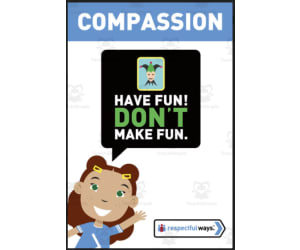
Let's Chat Conversation Cards | "Have Fun, Don't Make Fun"
Special Resources, Social Emotional Learning (SEL), Grade 2, 3, 4, 5, 6, Teacher Tools, Lesson Plans
Let's Chat Conversation Cards for "Have Fun, Don't Make Fun." The “Let’s Chat Conversation Cards is a wonderful resource to help students build a positive mindset. This resource is part of a whole program that works towards having students believe they can be compassionate, have perseverance, respect, and responsibility and through it all, achieve great things! Let’s Chat Conversation Cards allows for real conversations through which students may learn of different perspectives and strengthen friendships through truly understanding each other. This resource is a set of Let's Chat Conversation Cards for "Have Fun, Don't Make Fun." There are 57 other Let's Chat resources available, along with matching Respectful Signage listed under "graphics". The "Home Connects" for families is available in English and Spanish. Meridian MS Public Schools has been a partner district of Respectful Ways since October of 2020 and they shared this year’s Panorama Data with us. Meridian students who are utilizing Respectful Ways and PBIS showed great improvements in these 3 key areas: 12% higher GPAs 37% attendance improvements 93% less referrals Respectful Ways is a trauma-informed program: Assessment: Take our survey to assess your school climate. Targeted Results: Your survey identifies modules that meet your students' social and emotional needs. Our trauma-informed online curriculum has been vetted by the Attachment & Trauma Network. Custom Professional Development: We offer workshops with subject-matter experts who use your data to address student behavioral needs and educator wellness needs. Blended Education Interventions: Respectful Ways (RW) integrates seamlessly with different instructional frameworks such as PBIS and MTSS, using evidence and research-based practices. For more information email Pam@RespectfulWays.com or call 404-955-8882.
Author Respectful Ways
Tags Conversation Cards, Spanish, Respectful Ways, Don't Make Fun, Bullying, Compassion, Sel, Let's Chat, Character Education, Social Emotional Learning
Number & Operations: Base-Ten & Place Value - FLASH-MAC
Math, Statistics, Grade 3, 4, 5, Teacher Tools, Lesson Plans
The Number & Operations: Base-Ten & Place Value - FLASH-MAC An invaluable teaching resource designed for educators, focusing on base-ten system and place value comprehension. Intended primarily for third to fifth-grade students but versatile enough to be used with different age groups. Inclusions: Pre- assessment Tool: Assess students' understanding before introducing new topics. Faculty Guide: Ensures easy navigation and effective application of the resources within this package. Critical Thinking Exercises: Word problems that encourage the use of mathematical concepts in real-life scenarios. Includes timed drill activities to reinforce regular practice and time management skills. Educational Games: A variety of memory matches, board games, and spinner games promote active learning while reinforcing understanding of place-value concepts. Digital vs Printable Resources This product can be deployed digitally or as printable worksheets. Text in English comes with voice-over by default; however, Spanish voice-over and text transition are also available upon request — a valuable asset for bilingual classrooms or home schools catering to Spanish-speaking learners. Note: This teaching tool is fully compatible with Mac systems. In summation, take advantage of FLASH-MAC's dynamic resources that match innovation with curriculum-based content—offering a streamlined learning experience from both teachers’ standpoint while fostering deeper understanding among students when dealing with core aspects like numbers operation!
Author Classroom Complete Press
Tags Software (Mac)

I WONDER - How Smart Are Octopi | Animated Video Lesson
STEM, Biology, Life Sciences, Science, Animals, Grade 1, 2, 3, 4, 5, 6, 7, 8, Lesson Plans, Teacher Tools
Video Introduction Animal kingdoms are full of fascinating wonders to learn. This video is designed for the students to learn more about animals in different countries. I WONDER - How Smart Are Octopi | Animated Video Lesson Do you like animals? what is your favorite one? Do you own a pet? If yes, tell us more about it, like what its name? And what do you like most about it? What are the animal kingdoms? Can you write down the characteristics of each animal class like mammals, birds, reptiles, amphibian, fish and mollusks. Do you know that some animals can sing, can you name any of them? What is the largest and the smallest mammal in the world? What is the largest and the smallest bird in the world? What is the largest and the smallest fish in the world? I WONDER - How Smart Are Octopi | Animated Video Lesson The video is perfect for encouraging the researching skills for the students, while learning more about these fantastic animals. I WONDER - How Smart Are Octopi | Animated Video Lesson This friendly designed video is suitable for students at school, homeschooling, and as a group activity. Format Available in MP4 format.
Author Educational Voice
Tags How Smart Are Octopi, How Smart Are Octopi Video, Octopi, Octopi Facts, Octopi Facts For Kids, Octopi Video, Octopi Video For Kids, Smart Octopi, Smart Octopus, Smart Octopi Video

I WONDER - What Are The Most Endangered Animals | Animated Video
STEM, Animals, Life Sciences, Science, Biology, Grade 1, 2, 3, 4, 5, 6, 7, 8, Lesson Plans, Teacher Tools
Video Introduction Animal kingdoms are full of fascinating wonders to learn. This video is designed for the students to learn more about animals in different countries. I WONDER - What Are The Most Endangered Animals | Animated Video Lesson Do you like animals? what is your favorite one? Do you own a pet? If yes, tell us more about it, like what its name? And what do you like most about it? What are the animal kingdoms? Can you write down the characteristics of each animal class like mammals, birds, reptiles, amphibian, fish and mollusks. Do you know that some animals can sing, can you name any of them? What is the largest and the smallest mammal in the world? What is the largest and the smallest bird in the world? What is the largest and the smallest fish in the world? I WONDER - What Are The Most Endangered Animals | Animated Video Lesson The video is perfect for encouraging the researching skills for the students, while learning more about these fantastic animals. I WONDER - What Are The Most Endangered Animals | Animated Video Lesson This friendly designed video is suitable for students at school, homeschooling, and as a group activity. Format Available in MP4 format.
Author Educational Voice
Tags What Are The Most Endangered Animals, What Are The Most Endangered Animals Video, Most Endangered Animals, Most Endangered Animals Facts, Most Endangered Animals Video, Most Endangered Animals Video For Kids
Let's Chat Conversation Cards | "Enjoy the Journey"
Special Resources, Social Emotional Learning (SEL), Grade 2, 3, 4, 5, Teacher Tools, Lesson Plans
Let's Chat Conversation Cards for "Enjoy the Journey." The “Let’s Chat" Conversation Cards is a wonderful resource to help students build a positive mindset. This resource is part of an extended, trauma-informed program that helps students believe they can be compassionate, have perseverance, be respectful, and be responsible -- and through it all, achieve great things! Let’s Chat Conversation Cards allow for real give-and-take conversations -- which helps students learn different perspectives and strengthens friendships through understanding one another. This resource is one set of Let's Chat Conversation Cards for "Enjoy the Journey." There are 57 other Let's Chat resources available, along with matching Respectful Signage listed under "graphics". The "Home Connects" for families is available in English and Spanish. Meridian MS Public Schools has been a partner district of Respectful Ways since October of 2020 and they shared this year’s Panorama Data with us. Meridian students who are utilizing Respectful Ways and PBIS showed great improvements in these 3 key areas: 12% higher GPAs 37% attendance improvements 93% less referrals Respectful Ways is a trauma-informed program: Assessment: Take our survey to assess your school climate. Targeted Results: Your survey identifies modules that meet your students' social and emotional needs. Our trauma-informed online curriculum has been vetted by the Attachment & Trauma Network. Custom Professional Development: We offer workshops with subject-matter experts who use your data to address student behavioral needs and educator wellness needs. Blended Education Interventions: Respectful Ways (RW) integrates seamlessly with different instructional frameworks such as PBIS and MTSS, using evidence and research-based practices. For more information email Pam@RespectfulWays.com or call 404-955-8882.
Author Respectful Ways
Tags Conversation Cards, Spanish, Respectful Ways, Enjoy The Journey, Social Emotional Learning, SEL , Trauma-informed, Perseverance , Let's Chat, Character Education

I WONDER - What Is The Smallest Amphibian In The World
STEM, Animals, Life Sciences, Science, Biology, Grade 1, 2, 3, 4, 5, 6, 7, 8, Lesson Plans, Teacher Tools
Video Introduction Animal kingdoms are full of fascinating wonders to learn. This video is designed for the students to learn more about animals in different countries. I WONDER - What Is The Smallest Amphibian In The World | Animated Video Lesson Do you like animals? what is your favorite one? Do you own a pet? If yes, tell us more about it, like what its name? And what do you like most about it? What are the animal kingdoms? Can you write down the characteristics of each animal class like mammals, birds, reptiles, amphibian, fish and mollusks. Do you know that some animals can sing, can you name any of them? What is the largest and the smallest mammal in the world? What is the largest and the smallest bird in the world? What is the largest and the smallest fish in the world? I WONDER - What Is The Smallest Amphibian In The World | Animated Video Lesson The video is perfect for encouraging the researching skills for the students, while learning more about these fantastic animals. I WONDER - What Is The Smallest Amphibian In The World | Animated Video Lesson This friendly designed video is suitable for students at school, homeschooling, and as a group activity. Format Available in MP4 format.
Author Educational Voice
Tags What Is The Smallest Amphibian In The World, What Is The Smallest Amphibian In The World Video, Smallest Amphibian In The World, Smallest Amphibian In The World Video, Smallest Amphibian In The World Facts

Owls Gr. 2-6
Science, Life Sciences, Animals, Grade 2, 3, Teacher Tools, Lesson Plans
The Owls Gr. 2-6 Teaching Resource This Owls Gr. 2-6 teaching resource is a comprehensive study material focused on owls, it's tailored to fit students in grades 2 through 6 and is designed to enhance Science classes, more precisely Zoology subtopics. Unit Organization: Characteristics of an Owl Habitat Owls Love the Night Life Owl Babies Detailed Focus On their Food Pattern: Night Friends and Owl Enemies Next it pans out into broader behavioral aspects: Focusing on Multiple Dimensions In-depth study about different owl species: Different Kinds of Owls Endangered Owls Key culture references regarding owls: Owl Literature Owl Art Includes Specialized learning aids: Task Cards, Record Sheets & Information portals. Ace student engagement modules: Word Cards, Owl Quiz & Writing Page. This enriched content provokes students not merely build foundational "owl" knowledge but also raises awareness about shared environmental experiences with these nocturnal beings. The resource offers flexibility in terms of its usage—it can be employed across whole group lectures or small cooperative learning teams even as engrossing take-home assignments! Additional materials strengthening the curriculum plan come packaged with this educative tool. High-grade lesson planning materials comprising reading passages, activities, word cards along bustling with an evaluatory quiz ensures comprehensive lesson preparation. The Owls Gr. 2-6 teaching resource is a source of academic richness and it vouches to be the finest companion for educators aiming to impart knowledge about these intriguing creatures of the night sky adeptly.
Author Classroom Complete Press
Tags PDF
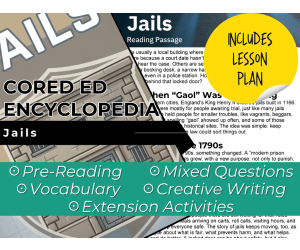
Jails Reading Comprehension Passage - Cored Ed Encyclopedia
ELA, Reading Comprehension, Reading, Pre-Reading, Language Development, Vocabulary, History, Social Studies, Law, Spelling, Grade 2, 3, 4, 5, Worksheets & Printables, Worksheets, Teacher Tools, Centers, Activities, Writing Prompts, Assessments, Quizzes and Tests, Quizzes, Lesson Plans
This Jails reading comprehension with lesson plan includes: Visualization (on the front cover) Start your lesson by taking a minute to think and share something about the topic. Read the script aloud (slowly), perhaps prepare some music or sound effects. Student close their eyes and let their imaginations wander. Students open their eyes, read the question aloud and give them a few minutes to complete. Ask a few students to share or keep answers until the end to compare with what they learn in the passage. Quick pause—thousands of Cored Education products are included with your TeachSimple membership. Download links and encyclopedia index available here. Pre-Reading Trivia Students will write down one thing they already know about the subject and then read five more facts and discuss. These facts are fun, and the students will enjoy learning about the subject before reading more. Give 1 minute for students to write what they already know (no pressure—best guess is fine). Read the five facts together. After each fact, do ask a student for their opinion, was it surprising? Set a purpose by asking students to highlight/underline one fact they want to learn more about during the reading. Reading Passage The text is a high-interest reading passage with set paragraphs, roughly three to four paragraphs long. It contains a variety of themes about the topic, anywhere from history to technology. The passage is between 250 and 350 words in length. First, ask students to look at the headings and see what they’ll learn about today. What do they know about the topic/heading? First read options: Teacher read-aloud (best for support). Partner reading (paragraph by paragraph). While reading, students underline important details, and vocabulary words they think may come up in the questions section. Mixed Questions The first question page contains four multiple-choice questions, each with a choice of four answers, and three written response questions that require a sentence or two from the student. Students complete the mcqs first independently, then review quickly as a class. For the 3 written responses, try to get students giving the answer with some form of evidence: “I think ___ because the text says ___.” If students get stuck, send them back to check the passage. Vocabulary Questions Practice seven key words from the text in this section across two activities. First section is scrambled words where students will unscramble three words given a clue for each. The second section is a word to meaning matching activity. Before starting, have some students read out words they underlined in the passage. Ask students to say the word and read aloud the sentence(s) around each word. Ask students to do scrambled words and the matching exercise in pairs then go through answers as a class. For the scrambled spelling task, get four pairs to come up to the board and write the words for extra practice with the other student reading out the clue. For the matching task, prompt students to give full sentences: “I matched ___ with ___ because ___.” Creative Writing In this question, the student will be required to write a five to eight sentence paragraph on a question related to the topic. Before starting, ask students write down 3 key ideas they are going to include in their piece. Ask students for ideas to share around the class to help those struggling. Pro writing expectations: 5–8 sentences At least 2 facts or details from the passage At least 2 vocabulary words from the previous page Students read their paragraphs while classmates listen for facts and vocabulary words. Extension Activities This page is optional for fast finishers or to take home. There are several activities, each one requiring a different skill. Do some, do none, do all, completely optional - but you will feel reassured knowing every possibility is planned for. Includes summary writting question and additional facts. Answer Key There are answers for the multiple-choice questions, written response questions have sample answers, vocabulary answers and if there is a summary question then a sample summary will be provided as well. Lesson Plan Included Customized lesson plan for this lesson is included. Lesson Snapshot Title: Jails Genre: Nonfiction (informational text) Subject: Social Studies (Civics) / Reading (Informational Text) Primary Topic: What jails are and how they differ from prisons Estimated Guided Reading Level (A–Z): S What This Lesson Teaches Best Explains what a jail is and why people may be there for a short time (waiting for a court date or serving short sentences). Uses history to show how jails were used long ago (England, 1166) and why the spelling “gaol” appeared. Clarifies the difference between “jail” and “prison” in formal American and Canadian English (pretrial custody/shorter sentences vs. longer sentences). Connects jails to community routines and civic values (rules, safety checks, fairness, harm prevention, justice). Builds understanding of how word choice and definitions matter when discussing systems and government roles (counties vs. state/federal). Learning Goals Describe what a jail is and give two reasons people may be held there. Explain how early jails in England were used and what “gaol” means in the passage. Explain what changed in the 1790s in the United States, according to the text. Compare a jail and a prison using details from the passage. Identify examples of routines and rules in jails and explain why they matter. Key Vocabulary From the Text booking — recording a new person in jail. cells — small rooms where people are held. trial — a court process to decide a case. convicted — found guilty of a crime. reform — help someone change for the better. FULL CATALOG OF DOWNLOAD LINKS AND ENCYCLOPEDIA INDEX HERE
Author Cored Education
Rating
Tags Vocabulary, Reading Comprehension, Reading Passages, Lesson Plans, Ela Lesson Plans, Reading Comprehension Lesson Plans, Pre-reading, Social Studies Lesson Plans, History, Jails
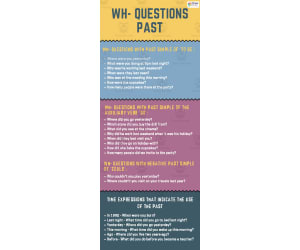
Wh- Questions Past Tense Pre Intermediate Lesson Plan
ELA, Grammar, Grade 3, 4, 5, Teacher Tools, Lesson Plans
This is a pre intermediate ESL ELA ELL lesson plan worksheet set for Wh- Questions - Past Tense. Students will learn more about these and then complete the exercises to follow, which will assess their comprehension and implement grammar skills. They will learn how to use the following wh-questions in the past; When did an action occur to discover a time or date. Where did something happen to indicate location. Who did something to find out which person did it. Why to indicate the reasons for an action happening. How many to quantify numbers. What happened to give an explanation of the events that occurred. With whom to ask who a person was with when an event took place. This lesson plan includes: Cover page Flash cards A warm-up activity Main use Construction details Rules, along with any exceptions Illustrative examples Two closed exercises One open exercise Revision exercise Writing exercises Chatterbox, a recurring feature in our course books encouraging conversation Activity, such as a game, quiz, puzzle, etc., to conclude the class The lesson plan is available in PDF with 27 ready to print pages and one digital access file. A part of it is on Google Apps. The answer key is also included for reference.
Author TEAM TEFL
Tags Wh Questions, Past Tense, Past Simple, Grammar Worksheet, Language Arts, Wh Questions Simple Past, Questions In Past Tense, Questions In The Past Tense, Plan In Past Tense
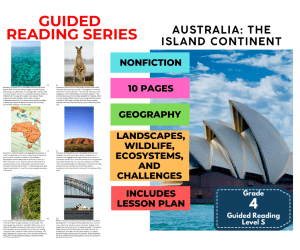
Australia - Island Continent: Guided Reading Level S with Lesson Plan
ELA, Resources for Teachers, Reading Comprehension, Reading, Science, Geography, Social Studies, History, Life Sciences, Earth and Environmental Sciences, Grade 3, 4, 5, Worksheets & Printables, Worksheets, Teacher Tools, Centers, Activities, Literacy Readers, Quizzes, Quizzes and Tests, Assessments, Lesson Plans
This Australia: The Island Continent (level s) guided reading book with lesson plan includes: Guided Reading Color Label (front cover x1) This is a quick way to match the book’s demands to what students can generally handle.. The overall goal is to use the level/color to pick books for several smaller groups. To qualify for a certain level, a student is expected to read a book from that level with about 90–94% accuracy. If a student is consistently accurate and understands, move up a level. If the student is struggling at that level, drop down and add more support. Each student will improve at completely different rates, but it is generally one of the best ways to check progress across the class. DOWNLOAD THE CATALOG TO VIEW ALL GUIDED READING BOOKS AVAILABLE (SORTED LEVELS A-Z) Pre-Reading Question (x1) Teacher asks the prompt aloud, can be while showing the cover or first page. Students share what they already know, or make educated guesses from the cover. Prompt them to use the target vocabulary. Write some of their responses on the board to look back at during the reading. Vocabulary Words (x5) Introduce the five words, best doing it one at a time. Start by saying it, while students repeat and then see if anyone knows what it means before reading further. Read through the meaning and try to briefly connect each word to a picture or gesture so it’s meaningful. Ask students to flip through the book pages and point to where they see each of the vocabulary words. While reading the book pause upon coming across one of the vocab words or read the sentence twice to make sure students understand the word has appeared. Optional: Ask students to raise hands whenever they see/hear one of the new words. Guided Reading Pages (x10) Check the book snapshot (below) for: primary topic - do you need to prep extra reading or intro materials on this? what is taught best - decide on 1-2 bullets to focus on, use the prompt or words provided here for best results. learning goals - what you are checking for students to be able to do after the session, elicit answers using prompts or words provided. key vocabulary (see section above). questions overview - so you know what is coming up and if you need to prep extra materials to assist understanding. Run the lesson You may have already looked at a few of the pages together, but you can show them some of the pictures again first to set meaning. Depending on how much time you have and how familiar your students are with guided reading class, you may want to read the book aloud first with the group first. Students whisper or partner read, while you listen in. If time, do it as a group, one student reading a page each. Use the guided page’s prompts to coach: “Check the picture / does it make sense?” “Point under the words / try the first sound” “Reread the sentence smoothly”. Try to focus more on one student per session (rotating every time), so you can work out if they are ready to move up or need to move down a level. Comprehension Questions (back cover x3) This is your way to check that students didn’t just say the words, but actually understood the text. First, let students answer by pointing to the page/picture and saying a short sentence. After any answer, follow with: “Show me where you found that in the text.” In bigger groups, have partners answer first (10–20 seconds), then call on 2–3 students to share. Differentiation tips: Emerging speakers/struggling readers: oral + pointing On-level: oral in a full sentence Higher: one written sentence or draw + label Book Snapshot Title: Australia: The Island Continent Genre: Nonfiction Subject: Social Studies (Geography/Culture) Primary Topic: Australia’s landscapes, wildlife, ecosystems, and challenges Estimated Guided Reading Level (A–Z): S What This Book Teaches Best Explains Australia’s unique identity as the only country that is also an entire continent, located in the Southern Hemisphere between the Indian and Pacific Oceans. Builds understanding of diverse landscapes, from the arid Outback (including Uluru) to the Great Barrier Reef and the Daintree Rainforest. Teaches how isolation supports unique wildlife, highlighting marsupials (kangaroos, koalas) and monotremes (platypus) with survival traits and behaviors. Connects place to people by describing Uluru’s importance to the Anangu and the long history of Aboriginal and Torres Strait Islander peoples, including “songlines” and rock art sites. Introduces modern Australia through coastal city life in Sydney and present-day environmental challenges like climate change, bushfires, drought, and conservation work. Learning Goals Students will explain why Australia is called the “island continent” using details from the text. Students will describe two Australian environments (such as the Outback, reef, or rainforest) with text evidence. Students will explain what the text says about Uluru, including what it is and why it is sacred to the Anangu people. Students will identify one animal from the text and describe a feature or behavior that helps it survive. Students will describe how the text presents Australia’s long human history through Aboriginal and Torres Strait Islander peoples, “songlines,” and rock art. Students will explain modern challenges Australia faces and summarize how scientists and conservationists respond. Key Vocabulary From the Text Hemisphere — half of the Earth. arid — very dry, with little rain. monolith — one huge rock that stands alone. marsupials — mammals that carry babies in a pouch. biodiversity — many different living things in one place. Discussion Prompts Pre-reading question: What places, animals, or environments do you expect to learn about in Australia? Comprehension questions: Where does the text say Australia is located, and what oceans are nearby? Comprehension questions: What does the text explain about the Great Barrier Reef and what lives there? Comprehension questions: What are two modern challenges Australia faces, according to the text? Printing Tips 1. Best Printing Method (Recommended) “Booklet” Printing (Best if Available) If your printer or PDF viewer supports Booklet Printing , use this. Settings to use: Print mode: Booklet Paper size: Letter or A4 (either works) Orientation: Landscape Print on both sides: Yes Flip on: Short edge Scaling: Fit to printable area Booklet subset: First test: Front sides only Then: Back sides only This will automatically: Pair pages correctly Put the cover on the outside Align everything for folding After printing, fold in half and staple along the spine . 2. If “Booklet” Printing Is NOT Available You can still print this correctly with manual duplex printing . Step-by-step: Open the PDF. Choose Print . Set: Orientation: Landscape Pages per sheet: 1 Print on both sides: Yes Flip on: Short edge Print all pages . Because each PDF page already contains two facing book pages, the result will still fold cleanly into a book. Thousands of Cored Education products are included with your TeachSimple membership. Download links and encyclopedia index available here.
Author Cored Education
Rating
Tags Reading Comprehension, Reading Passages, Reading, Guided Reading, Guided Reading Lesson Plan, Guided Reading Activity, Pre-reading, Social Studies, Geography, History