



3,890 products added recently
Page 22 - 3rd Grade Lesson Plans
Support your third graders' expanding abilities with lesson plans that encourage exploration and deeper understanding. Covering a range of subjects, these resources offer hands-on activities and discussions. Use them to create a vibrant learning atmosphere that fosters enthusiasm.

 Show filters


Whales Reading Comprehension Passage - Cored Ed Encyclopedia
ELA, Language Development, Reading Comprehension, Reading, Pre-Reading, Science, Animals, Life Sciences, Vocabulary, Writing, Grade 2, 3, 4, 5, Worksheets & Printables, Worksheets, Teacher Tools, Centers, Activities, Writing Prompts, Assessments, Quizzes and Tests, Quizzes, Lesson Plans
This whales reading comprehension with lesson plan includes: Visualization (on the front cover) Start your lesson by taking a minute to think and share something about the topic. Read the script aloud (slowly), perhaps prepare some music or sound effects. Student close their eyes and let their imaginations wander. Students open their eyes, read the question aloud and give them a few minutes to complete. Ask a few students to share or keep answers until the end to compare with what they learn in the passage. Quick pause—thousands of Cored Education products are included with your TeachSimple membership. Download links and encyclopedia index available here. Pre-Reading Trivia Students will write down one thing they already know about the subject and then read five more facts and discuss. These facts are fun, and the students will enjoy learning about the subject before reading more. Give 1 minute for students to write what they already know (no pressure—best guess is fine). Read the five facts together. After each fact, do ask a student for their opinion, was it surprising? Set a purpose by asking students to highlight/underline one fact they want to learn more about during the reading. Reading Passage The text is a high-interest reading passage with set paragraphs, roughly three to four paragraphs long. It contains a variety of themes about the topic, anywhere from history to technology. The passage is between 250 and 350 words in length. First, ask students to look at the headings and see what they’ll learn about today. What do they know about the topic/heading? First read options: Teacher read-aloud (best for support). Partner reading (paragraph by paragraph). While reading, students underline important details, and vocabulary words they think may come up in the questions section. Mixed Questions The first question page contains four multiple-choice questions, each with a choice of four answers, and three written response questions that require a sentence or two from the student. Students complete the mcqs first independently, then review quickly as a class. For the 3 written responses, try to get students giving the answer with some form of evidence: “I think ___ because the text says ___.” If students get stuck, send them back to check the passage. Vocabulary Questions Practice seven key words from the text in this section across two activities. First section is scrambled words where students will unscramble three words given a clue for each. The second section is a word to meaning matching activity. Before starting, have some students read out words they underlined in the passage. Ask students to say the word and read aloud the sentence(s) around each word. Ask students to do scrambled words and the matching exercise in pairs then go through answers as a class. For the scrambled spelling task, get four pairs to come up to the board and write the words for extra practice with the other student reading out the clue. For the matching task, prompt students to give full sentences: “I matched ___ with ___ because ___.” Creative Writing In this question, the student will be required to write a five to eight sentence paragraph on a question related to the topic. Before starting, ask students write down 3 key ideas they are going to include in their piece. Ask students for ideas to share around the class to help those struggling. Pro writing expectations: 5–8 sentences At least 2 facts or details from the passage At least 2 vocabulary words from the previous page Students read their paragraphs while classmates listen for facts and vocabulary words. Extension Activities This page is optional for fast finishers or to take home. There are several activities, each one requiring a different skill. Do some, do none, do all, completely optional - but you will feel reassured knowing every possibility is planned for. Includes summary writting question. Answer Key There are answers for the multiple-choice questions, written response questions have sample answers, vocabulary answers and if there is a summary question then a sample summary will be provided as well. Lesson Plan Included Customized lesson plan for this lesson is included. Lesson Snapshot Title: Whales Genre: Nonfiction (informational text) Subject: Life Science / Informational Reading Primary Topic: Whales as mammals, feeding types, fossils, human impacts Estimated Guided Reading Level (A–Z): Q What This Lesson Teaches Best Whales are mammals that breathe air with lungs through blowholes , so they must surface as part of everyday life. Whales can have two different feeding tools : baleen plates that strain food like krill, or sharp teeth used to grab fish or squid. Fossils provide evidence that early whale relatives were land mammals and changed over millions of years to live in the ocean. Human activity affects whales today (fishing gear tangles, ships strike, and loud noise can fill the water where whales communicate), and scientists use tracking tools to help protect them. Learning Goals Students will explain why whales rise to the surface using details about breathing and blowholes. Students will compare how baleen whales and toothed whales get food, using evidence from the text. Students will describe what fossils show about where whales came from long ago. Students will identify one modern problem that can make whale communication harder, based on the passage. Students will describe at least one way scientists track whales to protect them, using details from the text. Key Vocabulary From the Text blowholes — nostrils on top of a whale’s head. baleen — mouth plates that strain tiny food from water. krill — tiny sea creatures baleen whales hold onto. streamlined — shaped to move smoothly through water. fossils — old remains in rock that give clues. FULL CATALOG OF DOWNLOAD LINKS AND ENCYCLOPEDIA INDEX HERE
Author Cored Education
Rating
Tags Vocabulary, Reading Comprehension, Reading Passages, Lesson Plans, Ela Lesson Plans, Reading Comprehension Lesson Plans, Pre-reading, Science Lesson Plans, Life Science, Animals
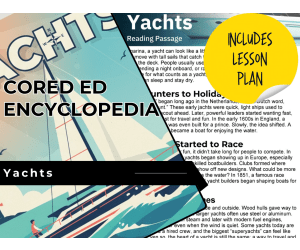
Yachts Reading Comprehension Passage - Cored Ed Encyclopedia
ELA, Language Development, Reading Comprehension, Reading, Science, History, Social Studies, Technology, Engineering, Pre-Reading, Grade 2, 3, 4, 5, Worksheets & Printables, Worksheets, Teacher Tools, Centers, Activities, Writing Prompts, Assessments, Quizzes and Tests, Quizzes, Lesson Plans
This yachts reading comprehension with lesson plan includes: Visualization (on the front cover) Start your lesson by taking a minute to think and share something about the topic. Read the script aloud (slowly), perhaps prepare some music or sound effects. Student close their eyes and let their imaginations wander. Students open their eyes, read the question aloud and give them a few minutes to complete. Ask a few students to share or keep answers until the end to compare with what they learn in the passage. Quick pause—thousands of Cored Education products are included with your TeachSimple membership. Download links and encyclopedia index available here. Pre-Reading Trivia Students will write down one thing they already know about the subject and then read five more facts and discuss. These facts are fun, and the students will enjoy learning about the subject before reading more. Give 1 minute for students to write what they already know (no pressure—best guess is fine). Read the five facts together. After each fact, do ask a student for their opinion, was it surprising? Set a purpose by asking students to highlight/underline one fact they want to learn more about during the reading. Reading Passage The text is a high-interest reading passage with set paragraphs, roughly three to four paragraphs long. It contains a variety of themes about the topic, anywhere from history to technology. The passage is between 250 and 350 words in length. First, ask students to look at the headings and see what they’ll learn about today. What do they know about the topic/heading? First read options: Teacher read-aloud (best for support). Partner reading (paragraph by paragraph). While reading, students underline important details, and vocabulary words they think may come up in the questions section. Mixed Questions The first question page contains four multiple-choice questions, each with a choice of four answers, and three written response questions that require a sentence or two from the student. Students complete the mcqs first independently, then review quickly as a class. For the 3 written responses, try to get students giving the answer with some form of evidence: “I think ___ because the text says ___.” If students get stuck, send them back to check the passage. Vocabulary Questions Practice seven key words from the text in this section across two activities. First section is scrambled words where students will unscramble three words given a clue for each. The second section is a word to meaning matching activity. Before starting, have some students read out words they underlined in the passage. Ask students to say the word and read aloud the sentence(s) around each word. Ask students to do scrambled words and the matching exercise in pairs then go through answers as a class. For the scrambled spelling task, get four pairs to come up to the board and write the words for extra practice with the other student reading out the clue. For the matching task, prompt students to give full sentences: “I matched ___ with ___ because ___.” Creative Writing In this question, the student will be required to write a five to eight sentence paragraph on a question related to the topic. Before starting, ask students write down 3 key ideas they are going to include in their piece. Ask students for ideas to share around the class to help those struggling. Pro writing expectations: 5–8 sentences At least 2 facts or details from the passage At least 2 vocabulary words from the previous page Students read their paragraphs while classmates listen for facts and vocabulary words. Extension Activities This page is optional for fast finishers or to take home. There are several activities, each one requiring a different skill. Do some, do none, do all, completely optional - but you will feel reassured knowing every possibility is planned for. Includes summary writting question. Answer Key There are answers for the multiple-choice questions, written response questions have sample answers, vocabulary answers and if there is a summary question then a sample summary will be provided as well. Lesson Plan Included Customized lesson plan for this lesson is included. Lesson Snapshot Title: Yachts Genre: Nonfiction (informational text) Subject: Social Studies (history of technology) / Informational Reading Primary Topic: What yachts are, their history, and how they changed Estimated Guided Reading Level (A–Z): Q What This Lesson Teaches Best Describes what a yacht can look and sound like at a marina, and explains that yachts may move by sails or by a motor beneath the deck. Explains how people use yachts for pleasure, such as cruising along a coast, spending a night onboard, or racing across open water, and notes that many yachts have a cabin where someone can sleep and stay dry. Traces how the word “yacht” began in Netherlands from a Dutch word meaning “hunt,” and how early yachts were quick ships used to chase pirates and scout ahead before becoming boats for travel and fun. Shows how yacht racing grew in Europe in the 1600s and how a race in 1851 helped launch the America’s Cup, influencing yacht designs for speed and handling. Explains how yachts changed over time (new materials like fiberglass, larger yachts using steel or aluminum, and engines arriving from steam to modern fuel engines), including very large “superyachts” that may need a hired crew. Learning Goals Students will identify two ways yachts can be powered using details from the text. Students will describe what the passage says people do on yachts for pleasure. Students will explain how the meaning and use of “yacht” changed over time in the passage. Students will describe how racing influenced yacht design, using the passage’s examples. Students will describe at least two changes in yacht materials or engines mentioned in the text. Key Vocabulary From the Text marina — a place where boats dock. cabin — a room where someone can sleep and stay dry. hulls — the outer bodies of boats. fiberglass — a newer material used instead of wood. crew — a hired group to run a yacht. FULL CATALOG OF DOWNLOAD LINKS AND ENCYCLOPEDIA INDEX HERE
Author Cored Education
Rating
Tags Vocabulary, Reading Comprehension, Reading Passages, Lesson Plans, Ela Lesson Plans, Reading Comprehension Lesson Plans, Pre-reading, History Lesson Plans, Science Lesson Plans, Engineering

I WONDER - Who Invented The Cat Flap | Animated Video Lesson
History: British, History, Social Studies, Grade 2, 3, 4, 5, 6, 7, 8, Lesson Plans, Teacher Tools
Video Introduction An amazing video designed for the students to learn more about history. I WONDER - Who Invented The Cat Flap | Animated Video Lesson Do you like history? Which topic do you really enjoy about history? Have you ever read an interesting fact about the Vikings? If yes, can you mention them? What do you like most about the Victorian era? Can you name all the Tudors? Have you ever wondered how people used to live in ancient Japan and ancient China? Do you know any interesting facts about ancient Egyptians and the Pharaohs? Have you ever visited South America? What do you know about Incas and Aztecs? Celtic culture was really one of a kind, can you name any of the places that Celts used to live in? Imagine yourself living during the ancient Roman empire, how your life will look like? Ancient Greece was an amazing place to live in. What do you know about ancient Greek life? I WONDER - Who Invented The Cat Flap | Animated Video Lesson The video is perfect for encouraging the researching skills for the students, while learning more about history. I WONDER - Who Invented The Cat Flap | Animated Video Lesson This friendly designed video is suitable for students at school, homeschooling, and as a group activity. Format Available in MP4 format.
Author Educational Voice
Tags Who Invented The Cat Flap, Who Invented The Cat Flap Video, The Cat Flap, The Cat Flap History, The Cat Flapfacts, The Cat Flap Facts For Kids, The Cat Flap Video, The Cat Flap Video For Kids
I WONDER - How Do Lions Hunt | Animated Video Lesson
STEM, Biology, Life Sciences, Science, Animals, Grade 1, 2, 3, 4, 5, 6, 7, 8, Lesson Plans, Teacher Tools
Video Introduction Animal kingdoms are full of fascinating wonders to learn. This video is designed for the students to learn more about animals in different countries. I WONDER - How Do Lions Hunt | Animated Video Lesson Do you like animals? what is your favorite one? Do you own a pet? If yes, tell us more about it, like what its name? And what do you like most about it? What are the animal kingdoms? Can you write down the characteristics of each animal class like mammals, birds, reptiles, amphibian, fish and mollusks. Do you know that some animals can sing, can you name any of them? What is the largest and the smallest mammal in the world? What is the largest and the smallest bird in the world? What is the largest and the smallest fish in the world? I WONDER - How Do Lions Hunt | Animated Video Lesson The video is perfect for encouraging the researching skills for the students, while learning more about these fantastic animals. I WONDER - How Do Lions Hunt | Animated Video Lesson This friendly designed video is suitable for students at school, homeschooling, and as a group activity. Format Available in MP4 format.
Author Educational Voice
Tags How Do Lions Hunt, How Do Lions Hunt Video, Lions, Lion, Lions Facts, Lions Facts For Kids, Lions Video, Lions Video For Kids, How Do Lions Hunt Facts, How Do Lions Hunt Facts For Kids
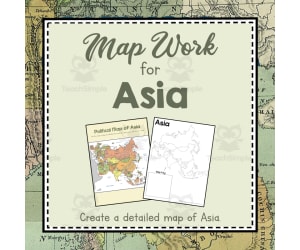
Map Work of Asia | Continent of Asia Unit Study | Geography Bundle
Social Studies, Geography, Grade 3, 4, 5, 6, 7, Lesson Plans, Teacher Tools
Map Work of Asia | Continent of Asia Unit Study | Geography Bundle This is a comprehensive resource designed for educators and homeschoolers teaching geography to Grade 3 to Grade 7 students. This unique tool offers activities and worksheets that engage learners in understanding the vast and diverse continent of Asia. Uses: Classroom integration in various setups such as whole group discussions or small group activities Suitable for homework assignments Ideal for after-school programs or summer camps Contents: A politically accurate map of Asia enriched with quick facts about the continent. An instructor's guide on how best to present these facts. Labeling activity of distinct Asian countries with an answer key. Mapped word searches exclusively centered around Asia. Note: As a bonus, there are flashcards aiding memory retention especially useful when dealing with identification and locational memorization of 13 diverse Asian countries! If your scope expands beyond geography or includes other continents, look out for additional brochures detailing specific nations across those continents as well as informational cards on local flora & fauna. Postcard sets showcasing famous landmarks can fire up curiosity among young learners too! The bundle comes in multiple file formats ensuring easy access across different platforms - insightful geographic knowledge just a click away! Taking geography from being just textbook content to becoming an engaging exploration tool, this bundle is truly dynamic and comprehensive!
Author Simply Schoolgirl
Rating 5
Tags Asia, Map Work, Continent Study, Geography Bundle, Countries

I WONDER - Can You Live With One Kidney | Animated Video Lesson
Science, Human Body, Life Sciences, Biology, Grade 3, 4, 5, 6, 7, 8, 9, Lesson Plans, Teacher Tools
Video Overview The human body is full of fascinating wonders to learn. This video is created to help the students recognize the anatomy and the job of the human body. I WONDER - Can You Live With One Kidney | Animated Video Lesson Every part and organ in our human body is vital so let's see how important they are. Have you ever imagined how we look like if we didn't have a skeleton? Did you know that because we have our amazing muscles we can stand! Do you know how many teeth do we have? Have you ever wondered about the food journey inside our body? Can you name all the glands in our body? Why do we have skin? Our nervous system is really good at sending signals. Can you tell us more about it? Are you really good at Mathematics, painting, or any other thing? You should really thank your brain about it! The famous five senses are really doing a great work? Can you explain how every sense works? I WONDER - Can You Live With One Kidney | Animated Video Lesson The video is perfect for encouraging the researching skills for the students, while learning more about our fantastic human body. I WONDER - Can You Live With One Kidney | Animated Video Lesson This friendly designed video is suitable for students at school, homeschooling, and as a group activity. Format Available in MP4 format.
Author Educational Voice
Tags Can You Live With One Kidney, Can You Live With One Kidney Video, Kidney, Kidneys, Kidney Facts, Kidney Facts For Kids, Kidney Video, Kidney Video For Kids, Human Body, Human Body Facts
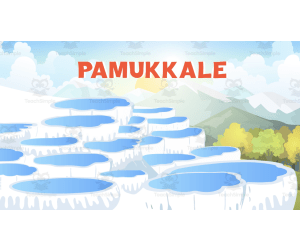
All About Pamukkale | Geographical Wonders Video Lesson
Social Studies, Geography, Grade 3, 4, 5, 6, 7, Lesson Plans, Teacher Tools
Are you an incredible educator seeking to captivate your students with engaging digital lessons? If so, our All About Pamukkale: Geographical Wonders Video Lesson is just for you! This animated journey transports viewers into the fascinating world of Pamukkale, a jaw-dropping gem found in Turkey. Known for its gleaming white travertine terraces and hot springs, it's a geographical wonder that simply must be seen to be believed! This concise 10-minute MP4 video captures learners' attention while filling their young minds with enticing information about landforms and unique geographical attractions. Vibrant visuals combined with interactive features ensure your students will remain riveted throughout the entire lesson. Perfect for both elementary and middle school teachers looking to spice up their geography units, this high-quality video lesson will motivate curious learners to further investigate and comprehend nature's awe-inspiring wonders on our planet. Investing in this readily accessible digital educational resource means you'll not only invigorate your classroom environment but also instill in young minds an appreciation for Earth's astonishing landscapes. Be prepared to watch as your students' learning experience is enriched like never before through discovery of these captivating natural phenomena!
Author Educational Voice
Tags Geography Lesson, Social Studies Video, Video Lesson, Pamukkale, Landmarks

I WONDER - How Big Are Rhinos | Animated Video Lesson
STEM, Animals, Life Sciences, Science, Biology, Grade 1, 2, 3, 4, 5, 6, 7, 8, Lesson Plans, Teacher Tools
Video Introduction Animal kingdoms are full of fascinating wonders to learn. This video is designed for the students to learn more about animals in different countries. I WONDER - How Big Are Rhinos | Animated Video Lesson Do you like animals? what is your favorite one? Do you own a pet? If yes, tell us more about it, like what its name? And what do you like most about it? What are the animal kingdoms? Can you write down the characteristics of each animal class like mammals, birds, reptiles, amphibian, fish and mollusks. Do you know that some animals can sing, can you name any of them? What is the largest and the smallest mammal in the world? What is the largest and the smallest bird in the world? What is the largest and the smallest fish in the world? I WONDER - How Big Are Rhinos | Animated Video Lesson The video is perfect for encouraging the researching skills for the students, while learning more about these fantastic animals. I WONDER - How Big Are Rhinos | Animated Video Lesson This friendly designed video is suitable for students at school, homeschooling, and as a group activity. Format Available in MP4 format.
Author Educational Voice
Tags How Big Are Rhinos, How Big Are Rhinos Video, Rhinos, Rhino, Rhinos Facts, Rhinos Facts For Kids, Rhinos Video, Rhinos Video For Kids, Rhino Facts, Rhino Video
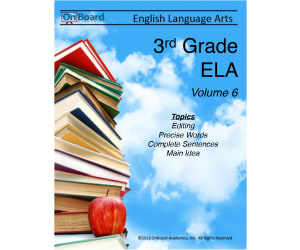
Grade 3 ELA Volume 6
ELA, Language Development, ESL, Grade 3, Teacher Tools, Lesson Plans
Grade 3 ELA Volume 6: Grade 3 ELA Volume 6 is a meticulously crafted workbook for Grade 3 students. This resource encourages them to practice and enhance their language arts skills with its engaging educational platform. A professionally packaged, ready-to-print PDF conventional material that includes 38 comprehensive pages . It offers differentiated exercises and hands-on learning opportunities enhancing student-centered learning environments for public school teachers and homeschoolers. Main Focus of the Material: The primary focus of this volume lies in establishing an all-rounded understanding and application of language arts concepts. A dedicated section on editing practices that help students identify text imperfections enhances their analytical abilities. Precision with words forms another key component enabling students to understand the function of distinct words better. The content also helps integrate complete sentences, which are essential constructs in English Language Arts ( ELA ). Students are trained to construct and use well-structured sentences effectively expressing their thoughts and ideas. It bravely delves into main concepts encouraging young learners to recognize central thoughts within a piece of writing. Despite being primarily designed for third graders' needs, it is equally effective for those assisting English as a Second Language (ESL) pupils due its intuitive approach towards mastering language arts. Type & Implementation Methods: This resource comes under Lesson Plans types aiding various implementation methods which include: Use during whole group activities or small group discussions that further enhance peer relationship skills among students. Educators can extensively use it during typical classroom sessions while homeschooling parents find them helpful during routine study periods or as homework assignments encouraging self-learning outside formal confines. Conclusion: In essence, Grade 3 ELA Volume 6 is a well-structured, versatile educational resource that significantly helps improve third grade students' skills in language arts. The workbook emphasizes standard-based education with an approachable and learner-friendly format suitable for both traditional and modern-day educators.
Author Classroom Complete Press
Tags Editing, Complete Sentences, Main Idea, Language Arts

Conjunctions Supplementary Materials Grades 3-4 (PDF)
ELA, Language Development, ESL, Grammar, Common Core, Resources for Teachers, Grade 3, 4, Worksheets & Printables, Worksheets, Quizzes and Tests, Teacher Tools, Tests, Assessments, Lesson Plans, Activities
Conjunctions Supplementary Materials Note: This download DOES NOT include the tests themselves. You can still make use of these materials without them but they are recommended. Download in a format of your choice in the "Links" section below. Outline Ice Breaker (5-10 minutes) Engaging, interactive activity to introduce the lesson’s theme. Examples: Matching games, sentence races, charades, or storytelling challenges. Guided Practice (10-15 minutes) Teacher-led exercises to reinforce the concept. Examples: Sorting sentences by tense, sentence transformations, or fill-in-the-gap exercises. Group or Partner Task (15 minutes) Collaborative activity to practice the lesson’s focus in a fun and engaging way. Examples: Role-play, storytelling, sentence-building games, or small-group discussions. Independent Worksheet (15 minutes) Individual written activity to solidify understanding. Examples: Sentence corrections, verb conjugation drills, or tense identification exercises. Exit Task (5 minutes) Quick reflective activity to assess understanding before students leave. Examples: Writing a sentence using the target concept, identifying a tense, or explaining a rule. Links: Includes: Correlative Conjunctions Coordinating Conjunctions Subordinating Conjunctions Mistake Finding Google Docs Google Forms Google Slides PDF PPT Word FULL CATALOG OF DOWNLOAD LINKS HERE Grade 3/4 Links: Adjectives Google Docs Google Forms Google Slides PDF PPT Word Free Supplementary Materials Pack Adverbs Google Docs Google Forms Google Slides PDF PPT Word Free Supplementary Materials Pack Conjunctions Google Docs Google Forms Google Slides PDF PPT Word Free Supplementary Materials Pack Nouns Google Docs Google Forms Google Slides PDF PPT Word Free Supplementary Materials Pack Pronouns Google Docs Google Forms Google Slides PDF PPT Word Free Supplementary Materials Pack Verbs Google Docs Google Forms Google Slides PDF PPT Word Free Supplementary Materials Pack Sentence Structure Google Docs Google Forms Google Slides PDF PPT Word Free Supplementary Materials Pack Present Tense Google Docs Google Forms Google Slides PDF PPT Word Free Supplementary Materials Pack Past Tense Google Docs Google Forms Google Slides PDF PPT Word Free Supplementary Materials Pack Future Tense Google Docs Google Forms Google Slides PDF PPT Word Free Supplementary Materials Pack Context Clues Google Docs Google Forms Google Slides PDF PPT Word Free Supplementary Materials Pack Defining Words Google Docs Google Forms Google Slides PDF PPT Word Free Supplementary Materials Pack Fill the Blanks Google Docs Google Forms Google Slides PDF PPT Word Free Supplementary Materials Pack Homophones Google Docs Google Forms Google Slides PDF PPT Word Free Supplementary Materials Pack Synonyms Google Docs Google Forms Google Slides PDF PPT Word Free Supplementary Materials Pack ELA Review Questions Overview Questions have three answer choices. There are a handful of pictures on each test for aesthetic purposes, as well as a review sheet covering most of the topics covered in the product. Introduction or Example Sheet Each topic will include an introduction or example sheet to go through first with your students. Full Answer Keys Full answer keys and sample responses are provided so no matter how busy you are, you know you're covered! In the Supplementary Pack Interactive Ice Breakers: Fun, hands-on activities that get students thinking about adjectives right from the start. Guided Practice: Teacher-led exercises that reinforce the day’s lesson, ensuring students can confidently identify and use adjectives. Group and Partner Tasks: Collaborative activities that allow students to work together to solve problems, categorize adjectives, and create descriptive sentences. Independent Worksheets: Structured worksheets that provide individual practice and help solidify understanding of key concepts. Exit Tasks: Quick, reflective activities at the end of each lesson that assess understanding and encourage students to apply what they’ve learned. For similar downloads and other frees, do check out Cored Group on TeachSimple.
Author Cored Education
Tags Elementary, Answers, Ccss, Common Core, Grammar, Tests, Test Prep, Grade 3, Grade 4, Lesson Plan
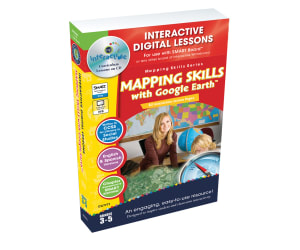
Mapping Skills with Google Earth - Digital Lesson Plan Gr. 3-5 | PC Software
Social Studies, Geography, Grade 3, 4, 5, Teacher Tools, Lesson Plans
Mapping Skills with Google Earth - Digital Lesson Plan Gr. 3-5 | PC Software A comprehensive teaching resource for grade 3 to 5 geography instruction, providing educators with an immersive, interactive platform. The digital lesson plan allows in-depth exploration of reading and creating maps over 80 engaging screen-pages. It offers vivid details about map elements such as: Lines of latitude Longitude Time zones Catering to various learning styles, it provides reading passages both before and after interactive lessons. This resource fosters understanding by introducing different types of maps like: Topographic Maps Choropleth Maps An overview of North American states and provinces will be given along with a world-view featuring different countries worldwide. A key feature is the built-in Google Earth™ component promoting active engagement in lessons. Promoting Interactivity: The software enhances interactivity through features such as: Interactive map activities AND (FOR FUN)(TO LEARN) Test prep materials Memory match game Crossword puzzles Word searches © Supports English and Spanish Text-to-Speech options To assess acquired knowledge, Comprehension Quizzes are available – aligning with state standards and following Bloom's Taxonomy questioning techniques. This product comes in one easy-to-install zip file containing PC software, ensuring geographical learning adventures are always at your fingertips! Summary Introducing Mapping Skills with Google Earth - Digital Lesson Plan Gr.3-5 | PC Software could significantly enrich your social studies curriculum, engaging students fully in their geographical journey. += / </ stamp
Author Classroom Complete Press
Tags Digital Mapping Skills, Google Earth Activity, Digital Lesson Plan, Social Studies Interactive Activity

I WONDER - How Much Food Can The Stomach Hold | Animated Video Lesson
Human Body, Life Sciences, Science, Biology, STEM, Grade 3, 4, 5, 6, 7, 8, 9, Lesson Plans, Teacher Tools
Video Overview The human body is full of fascinating wonders to learn. This video is created to help the students recognize the anatomy and the job of the human body. I WONDER - How Much Food Can The Stomach Hold | Animated Video Lesson Every part and organ in our human body is vital so let's see how important they are. Have you ever imagined how we look like if we didn't have a skeleton? Did you know that because we have our amazing muscles we can stand! Do you know how many teeth do we have? Have you ever wondered about the food journey inside our body? Can you name all the glands in our body? Why do we have skin? Our nervous system is really good at sending signals. Can you tell us more about it? Are you really good at Mathematics, painting, or any other thing? You should really thank your brain about it! The famous five senses are really doing a great work? Can you explain how every sense works? I WONDER - How Much Food Can The Stomach Hold | Animated Video Lesson The video is perfect for encouraging the researching skills for the students, while learning more about our fantastic human body. I WONDER - How Much Food Can The Stomach Hold | Animated Video Lesson This friendly designed video is suitable for students at school, homeschooling, and as a group activity. Format Available in MP4 format.
Author Educational Voice
Tags Stomach, How Much Food Can The Stomach Hold, How Much Food Can The Stomach Hold Video, Stomach Facts, Stomach Facts For Kids, Digestive System, Digestive System Facts, Stomach Video
'Slumberland' Lesson Plan, Worksheets & PowerPoint | Grades 3 - 9
ELA, Social Emotional Learning (SEL), Special Resources, Grade 3, 4, 5, 6, 7, 8, Lesson Plans, Teacher Tools, Worksheets & Printables
Slumberland Movie Study | Fantasy Adventure, ELA, Figurative Language, Critical Thinking & SEL Activities | Grades 3–9 Take students on a magical journey through dreams, imagination, and self-discovery with this engaging Slumberland Movie Study ! Based on the Netflix fantasy adventure, this resource helps students explore themes of courage, grief, hope, imagination, family, and personal growth while strengthening reading comprehension, vocabulary, figurative language, critical thinking, and creative writing skills. Through 30 thoughtfully designed activities, students dive into the dream world of Slumberland while making meaningful connections to the story and its powerful messages. What's Included 30 student activities Printable student workbook Comprehensive teacher guide Complete answer key Vocabulary and word-play activities Compound words, idioms, homophones, and affixes practice Character motivation and character analysis activities Story comprehension tasks Symbolism and theme exploration Figurative language lessons Metaphor and personification activities Map-reading and navigation challenges Probability and data-analysis tasks Number patterns and stem-and-leaf plot activities Creative writing projects Poetry writing activities Postcard and design projects Reflection and SEL activities Students will explore: Courage and resilience Imagination and creativity Hope and healing Letting go and moving forward Family relationships Friendship and trust Dreams and symbolism Personal growth and self-discovery Coping with loss in healthy ways How It Works in the Classroom This Slumberland movie guide is designed for flexible classroom use and works well for: English Language Arts lessons SEL and character education units Creative writing lessons Independent work Homeschool learning Substitute plans Small-group discussions Movie day enrichment Cross-curricular learning Figurative language instruction Students complete activities before, during, and after viewing the film. Lessons include vocabulary development, character analysis, symbolism studies, map-reading tasks, figurative language practice, discussion prompts, creative writing opportunities, and reflection activities. The included teacher guide provides a flexible 90-minute lesson plan, differentiation strategies, and extension ideas. Standards & Learning Goals Students will: Strengthen vocabulary and word-study skills Analyze character motivations and growth Explore symbolism and theme using evidence Identify and create figurative language Interpret setting and mood Develop critical-thinking and inferencing skills Read maps using keys, scales, and compass directions Analyze data and solve math problems Express ideas through poetry and creative writing Reflect on courage, hope, and personal growth Supports instruction in: English Language Arts Social-Emotional Learning (SEL) Critical Thinking Creative Writing Figurative Language Mathematics Geography & Map Skills Reading Comprehension Why Teachers Love It ✅ No-prep printable resource ✅ Includes teacher guide and complete answer key ✅ Rich focus on figurative language and literary analysis ✅ Encourages creativity and imagination ✅ Supports meaningful SEL discussions ✅ Integrates literacy, math, and critical thinking ✅ Includes engaging map and navigation activities ✅ Flexible for classroom, homeschool, and enrichment settings ✅ Encourages deeper reflection on hope, courage, and growth ✅ Appeals to a wide range of learners through creative and analytical activities Teachers love how this resource transforms a visually stunning fantasy film into a meaningful educational experience. Students strengthen literacy and critical-thinking skills while exploring important themes of resilience, imagination, loss, healing, and learning to move forward with hope. Add this Slumberland Movie Study to your classroom today and help students explore imagination, courage, hope, and personal growth through engaging activities that transform movie day into a meaningful learning adventure.
Author Bright Classroom Ideas Marketplace
Rating
Tags Slumberland, Movie, Film, Guide, Lesson, Plan, Worksheet, Ela, Sel
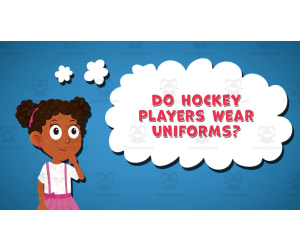
I WONDER - Do Hockey Players Wear Uniforms | Animated Video Lesson
Sports, P.E. & Health, Grade 1, 2, 3, 4, 5, 6, 7, 8, Lesson Plans, Teacher Tools
Video Introduction An amazing video designed for the students to learn more about sports in different countries. I WONDER - Do Hockey Players Wear Uniforms | Animated Video Lesson What is your favorite sport? Tell us more about it. Who is your favorite athlete? Or what is your favorite team? Do you know who invented basketball? When basketball has been invented? Can you tell us where is the first time it has been played? Have you ever played soccer or football? If yes, tell us what was your position: A goal keeper, midfield player, or a defender? Do you like watching golf? If yes who is your favorite player? Can you name the differences between tennis and ping pong? Have you ever played volleyball on the beach? When it has been officially recognized by the Olympics? Do you like watching Formula 1 races? If yes, who is your favorite team or driver? Have you ever tried to play handball? If yes tell us more. Do you like watching people skiing or surfing? I WONDER - Do Hockey Players Wear Uniforms | Animated Video Lesson The video is perfect for encouraging the researching skills for the students, while learning more about this sport. I WONDER - Do Hockey Players Wear Uniforms | Animated Video Lesson This friendly designed video is suitable for students at school, homeschooling, and as a group activity. Format Available in MP4 format.
Author Educational Voice
Rating
Tags Do Hockey Players Wear Uniforms, Do Hockey Players Wear Uniforms Video, Hockey Players, Hockey Players Facts, Hockey Players Video, Hockey Players Video For Kids, Hockey Players Facts For Kids
Measurement: Volume & Surface Area - Practice the Skill 3 - FLASH-MAC
Math, Measurements, Common Core, Grade 3, 4, 5, Teacher Tools, Lesson Plans
Measurement: Volume & Surface Area - Practice the Skill 3 – FLASH-MAC FLASH-MAC is an interactive digital resource that addresses the vital areas of volume and surface area in geometrical figures. This tool is designed especially for teachers and homeschooling parents to deliver fun, relevant, and effectual learning. Aligned with Core Standards The course content matches seamlessly with the Common Core State Standards, encompassing elements of STEM (Science, Technology, Engineering, Math) learning. It is developed in accordance to guidelines provided by NCTM (National Council of Teachers of Mathematics). Nuances like determining faces, edges or vertices made comprehensible. "Practice-the-skill" drills for repetitive practice on challenging math measures like volume calculation and surface area determination. This program offers English and Spanish language options—both through voiceovers and text rendering.. Apart from this a series of math tools accompanying the course serves as visual aid for effective comprehension among learners when dealing with intricate geometrical ideas! Digital Integration Simplified! All these resources are seamlessly integrated into one product file that can be accessed via Software (Mac), making it super simple for educators to incorporate this tool into existing classroom structures. Making Geometry Fun! Crafted by TeachSimple, Measurement: Volume & Surface Area - Practice the Skill 3 – FLASH-MAC" enables teachers to confidently teach geometry while nurturing their student's measurement skills. Get set to witness measurable improvement in your student’s understanding!
Author Classroom Complete Press
Tags Software (Mac)
I WONDER - Are All Stars Yellow | Animated Video Lesson
Space, Earth and Environmental Sciences, Science, Grade 1, 2, 3, 4, 5, 6, 7, 8, Lesson Plans, Teacher Tools
Video Introduction An amazing video designed for the students to learn more about space facts. I WONDER - Are All Stars Yellow | Animated Video Lesson Have you ever thought about travelling to space?! Join us with this amazing video about The Moon Ganymede. Can you name any three facts about The Moon Ganymede? How amazing is space! Let's discover some amazing facts about planets and moons! Do you know that we have two kinds of planets in our solar system? Can you name the planets based upon their core type? I WONDER - Are All Stars Yellow | Animated Video Lesson The video is perfect for encouraging the researching skills for the students, while learning more about the fantastic space. I WONDER - Are All Stars Yellow | Animated Video Lesson This friendly designed video is suitable for students at school, homeschooling, and as a group activity. Format Available in MP4 format.
Author Educational Voice
Rating
Tags Are All Stars Yellow, Stars, Stars Facts, Stars Video, Stars Facts For Kids, Stars Video For Kids, Star Facts, Star Video, Star, Star Facts For Kids
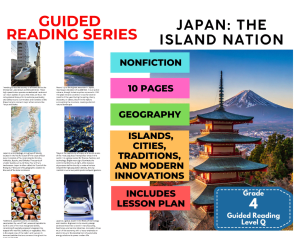
Japan The Island Nation: Guided Reading Level Q with Lesson Plan
ELA, Resources for Teachers, Reading Comprehension, Reading, Science, Geography, Social Studies, History, Earth and Environmental Sciences, Technology, Grade 3, 4, 5, Worksheets & Printables, Worksheets, Teacher Tools, Centers, Activities, Literacy Readers, Quizzes, Quizzes and Tests, Assessments, Lesson Plans
This Japan: The Island Nation (level q) guided reading book with lesson plan includes: Guided Reading Color Label (front cover x1) This is a quick way to match the book’s demands to what students can generally handle.. The overall goal is to use the level/color to pick books for several smaller groups. To qualify for a certain level, a student is expected to read a book from that level with about 90–94% accuracy. If a student is consistently accurate and understands, move up a level. If the student is struggling at that level, drop down and add more support. Each student will improve at completely different rates, but it is generally one of the best ways to check progress across the class. DOWNLOAD THE CATALOG TO VIEW ALL GUIDED READING BOOKS AVAILABLE (SORTED LEVELS A-Z) Pre-Reading Question (x1) Teacher asks the prompt aloud, can be while showing the cover or first page. Students share what they already know, or make educated guesses from the cover. Prompt them to use the target vocabulary. Write some of their responses on the board to look back at during the reading. Vocabulary Words (x5) Introduce the five words, best doing it one at a time. Start by saying it, while students repeat and then see if anyone knows what it means before reading further. Read through the meaning and try to briefly connect each word to a picture or gesture so it’s meaningful. Ask students to flip through the book pages and point to where they see each of the vocabulary words. While reading the book pause upon coming across one of the vocab words or read the sentence twice to make sure students understand the word has appeared. Optional: Ask students to raise hands whenever they see/hear one of the new words. Guided Reading Pages (x10) Check the book snapshot (below) for: primary topic - do you need to prep extra reading or intro materials on this? what is taught best - decide on 1-2 bullets to focus on, use the prompt or words provided here for best results. learning goals - what you are checking for students to be able to do after the session, elicit answers using prompts or words provided. key vocabulary (see section above). questions overview - so you know what is coming up and if you need to prep extra materials to assist understanding. Run the lesson You may have already looked at a few of the pages together, but you can show them some of the pictures again first to set meaning. Depending on how much time you have and how familiar your students are with guided reading class, you may want to read the book aloud first with the group first. Students whisper or partner read, while you listen in. If time, do it as a group, one student reading a page each. Use the guided page’s prompts to coach: “Check the picture / does it make sense?” “Point under the words / try the first sound” “Reread the sentence smoothly”. Try to focus more on one student per session (rotating every time), so you can work out if they are ready to move up or need to move down a level. Comprehension Questions (back cover x3) This is your way to check that students didn’t just say the words, but actually understood the text. First, let students answer by pointing to the page/picture and saying a short sentence. After any answer, follow with: “Show me where you found that in the text.” In bigger groups, have partners answer first (10–20 seconds), then call on 2–3 students to share. Differentiation tips: Emerging speakers/struggling readers: oral + pointing On-level: oral in a full sentence Higher: one written sentence or draw + label Book Snapshot Title: Japan: The Island Nation Genre: Nonfiction Subject: Social Studies (Geography/Culture) Primary Topic: Japan’s islands, cities, traditions, and modern innovations Estimated Guided Reading Level (A–Z): Q What This Book Teaches Best Explains Japan’s geography as an archipelago , naming the four main islands and describing its location off East Asia. Highlights Tokyo as a major metropolitan area , describing its role and features of city life. Describes transportation and technology through the Shinkansen (bullet train), including its speed, safety, and punctuality. Connects landforms and natural features to Japan’s identity by describing Mount Fuji, snow cover, and spring sakura blossoms. Builds understanding of culture and history through Shinto and Buddhism, matsuri festivals, and the Edo period (shoguns, samurai, and castles like Himeji). Learning Goals Students will explain what an archipelago is and name Japan’s four main islands. Students will describe Tokyo’s importance and identify details the text gives about the city. Students will explain how the Shinkansen helps people travel and identify key features the text highlights (such as speed or punctuality). Students will describe Mount Fuji using details from the text, including its height and volcanic history. Students will identify key ideas about Japanese traditions from the text (religions, shrines/torii, cuisine, or festivals). Students will explain how Japan’s climate varies and describe the text’s example of the “snow monkey” in winter. Key Vocabulary From the Text archipelago — a group of islands. metropolitan — related to a very large city area. punctuality — being on time. terraced — built in step-like levels on a hillside. geothermal — heat that comes from inside the Earth. Discussion Prompts Pre-reading question: What places, traditions, or inventions do you expect to learn about in Japan? Comprehension questions: What four main islands does the text name as part of Japan? Comprehension questions: What does the text say the Shinkansen is known for? Comprehension questions: How does the text say the “snow monkey” adapts to cold winters? Printing Tips 1. Best Printing Method (Recommended) “Booklet” Printing (Best if Available) If your printer or PDF viewer supports Booklet Printing , use this. Settings to use: Print mode: Booklet Paper size: Letter or A4 (either works) Orientation: Landscape Print on both sides: Yes Flip on: Short edge Scaling: Fit to printable area Booklet subset: First test: Front sides only Then: Back sides only This will automatically: Pair pages correctly Put the cover on the outside Align everything for folding After printing, fold in half and staple along the spine . 2. If “Booklet” Printing Is NOT Available You can still print this correctly with manual duplex printing . Step-by-step: Open the PDF. Choose Print . Set: Orientation: Landscape Pages per sheet: 1 Print on both sides: Yes Flip on: Short edge Print all pages . Because each PDF page already contains two facing book pages, the result will still fold cleanly into a book. Thousands of Cored Education products are included with your TeachSimple membership. Download links and encyclopedia index available here.
Author Cored Education
Rating
Tags Reading Comprehension, Reading Passages, Reading, Guided Reading, Guided Reading Lesson Plan, Guided Reading Activity, Pre-reading, Social Studies, Geography, History
Geometry: Transformations & Symmetry - Practice the Skill 3 - FLASH-MAC
Math, Geometry, Common Core, Grade 3, 4, 5, Teacher Tools, Lesson Plans
Geometry: Transformations & Symmetry - Practice the Skill 3 - FLASH-MAC Geometry: Transformations & Symmetry - Practice the Skill 3 - FLASH-MAC is a robust teaching tool designed to help students grasp the foundational concepts of transformations and symmetry in geometry. This comprehensive resource is specifically aimed at educators catering to grades 3, 4, or 5. Our interactive approach engages students with timed drill activities that focus on identifying line symmetry in different shapes. This exercises provide an effective way for constant practice and improved understanding of geometry transformations and symmetry. Ease Of Use & Accessibility We recognise the diverse needs of our learners which is why this product includes English and Spanish voice-overs, plus text options. It ensures seamless usability for children who use either language as their primary medium of communication. Educational Standards Compliance This tool aligns perfectly with Common Core State Standards (CCSS) Promotes STEM initiatives meticulously crafted around National Council of Teachers of Mathematics (NCTM) guidelines. Versatility & Application Settings The digital nature as Mac-compatible software offers versatile usage modes, offering adaptability to various instruction settings such as: In a group setting during whole-class instructions, In small groups during station activities or, Assigned as homework for individual student practice before exams or quizzes. Homeschooling Support . This educational tool can also act as support system for homeschoolers: its intuitive design promotes independent navigation by learners themselves, further facilitating self-driven learning. In summary, if you're an educator in a formal setting or manage homeschooling routines independently; and are seeking capable resources that focus on advancing understanding of Geometry sub-subjects – the Geometry: Transformations & Symmetry tool is a great choice!
Author Classroom Complete Press
Tags Software (Mac)

I WONDER - How Much Of Earth Is Covered In Water | Animated Video
Geography, Social Studies, Grade 2, 3, 4, 5, 6, 7, 8, Lesson Plans, Teacher Tools
Video Introduction An amazing video designed for the students to learn more about famous places in different countries. I WONDER - How Much Of Earth Is Covered In Water | Animated Video Lesson What do you know about this place? Do you know in which part of the world it is? Have you ever visited this place? If yes, can you tell us more about your adventure, and what do you like the most about this place? Do you like reading about Geography? What is your favorite country in the whole world? If you are going on a trip where it will be? Which country? What you are going to see there? Does this country has a famous place to visit? I WONDER - How Much Of Earth Is Covered In Water | Animated Video Lesson The activity is perfect for encouraging the researching skills for the students, while learning more about this fantastic place. I WONDER - How Much Of Earth Is Covered In Water | Animated Video Lesson This friendly designed video is suitable for students at school, homeschooling, and as a group activity. Format Available in MP4 format.
Author Educational Voice
Tags How Much Of Earth Is Covered In Water, How Much Of Earth Is Covered In Water Video, Earth, Earth Facts, Earthfacts For Kids, Earth Video, Earth Video For Kids, Water On Earth, Water On Earth Video

I WONDER - What Was Bronze Age Art Like | Animated Video Lesson
History: Asian, History, Social Studies, History: Ancient, History: African, History: Europe, History: World, Grade 3, 4, 5, 6, 7, 8, 9, Lesson Plans, Teacher Tools
Video Introduction An amazing video designed for the students to learn more about history. I WONDER - What Was Bronze Age Art Like | Animated Video Lesson Do you like history? Which topic do you really enjoy about history? Have you ever read an interesting fact about the Vikings? If yes, can you mention them? What do you like most about the Victorian era? Can you name all the Tudors? Have you ever wondered how people used to live in ancient Japan and ancient China? Do you know any interesting facts about ancient Egyptians and the Pharaohs? Have you ever visited South America? What do you know about Incas and Aztecs? Celtic culture was really one of a kind, can you name any of the places that Celts used to live in? Imagine yourself living during the ancient Roman empire, how your life will look like? Ancient Greece was an amazing place to live in. What do you know about ancient Greek life? I WONDER - What Was Bronze Age Art Like | Animated Video Lesson The video is perfect for encouraging the researching skills for the students, while learning more about history. I WONDER - What Was Bronze Age Art Like | Animated Video Lesson This friendly designed video is suitable for students at school, homeschooling, and as a group activity. Format Available in MP4 format.
Author Educational Voice
Tags What Was Bronze Age Art Like, What Was Bronze Age Art Like Video, Bronze Age, Bronze Age Facts, Bronze Age Video, Bronze Age Facts For Kids, Bronze Age Video For Kids, Bronze Age Art

100 More Little Reading Comprehension Lessons
ELA, Reading, Reading Comprehension, Grade 1, 2, 3, 4, Teacher Tools, Lesson Plans
The 100 More Little Reading Comprehension Lessons The 100 More Little Reading Comprehension Lessons is an enriching resource tailored to enhance the reading comprehension skills of students in grades one to four. This teaching aid comprises 100 unique short stories, poems, and informative articles covering a wide range of interesting topics. The variety of subjects captivates students' curiosity while honing their literacy abilities in both mainstream and homeschool environments. Key Language Arts Concepts: Apart from offering rich reading materials, this bundle provides essential practice in key language arts concepts like: Vocabulary development and assimilation. Fostering Critical Thinking: This educational resource fosters critical thinking. Every narrative or poem has comprehension questions that provoke thought and understanding reinforcement. It encourages knowledge application in new contexts too. Variety of Uses: The 100 More Little Reading Comprehension Lessons product offers great flexibility. It caters for whole classroom instruction, focus groups, or can be tailored into individual homework assignments. Ease of Use: Its lesson plan format makes this teaching tool easily accessible for educators ensuring time-efficient planning as no valuable class time is wasted on class preparation but rather actual execution these well-planned lessons. Note: This product adds fun to learning thus making it intellectually stimulating; promising long-term benefits for children's academic success story.
Author Classroom Complete Press
Tags PDF

I WONDER - What Are The Famous Spanish Landmarks | Animated Video
Geography, Social Studies, Grade 3, 4, 5, 6, 7, 8, 9, Lesson Plans, Teacher Tools
Video Introduction An amazing video designed for the students to learn more about famous places in different countries. I WONDER - What Are The Famous Spanish Landmarks | Animated Video Lesson What do you know about this place? Do you know in which part of the world it is? Have you ever visited this place? If yes, can you tell us more about your adventure, and what do you like the most about this place? Do you like reading about Geography? What is your favorite country in the whole world? If you are going on a trip where it will be? Which country? What you are going to see there? Does this country has a famous place to visit? I WONDER - What Are The Famous Spanish Landmarks | Animated Video Lesson The activity is perfect for encouraging the researching skills for the students, while learning more about this fantastic place. I WONDER - What Are The Famous Spanish Landmarks | Animated Video Lesson This friendly designed video is suitable for students at school, homeschooling, and as a group activity. Format Available in MP4 format.
Author Educational Voice
Tags What Are The Famous Spanish Landmarks, What Are The Famous Spanish Landmarks Video, Famous Spanish Landmarks, Famous Spanish Landmarks Facts, Famous Spanish Landmarks Video, Famous Spanish Landmarks Video For Kids

Geometry: Triangles & Pyramids - Practice the Skill 2 - FLASH-MAC
Math, Geometry, Common Core, Grade 3, 4, 5, Teacher Tools, Lesson Plans
Geometry: Triangles & Pyramids - Practice the Skill 2 - FLASH-MAC: A thorough study tool focusing on the fundamentals of Triangles and Pyramids. Created to support Grade 3, Grade 4, and Grade 5 math curriculum . Main Objectives: To empower students to recognize different types of triangles according to their angles. To aid in building problem-solving skills through timely drill activities that supplement learning. Versatility: This resource can be accommodated across various settings from entire class instructions, reduced group studies or even solitary homework tasks. Multilingual approach: Besides standard English text and audio, a Spanish substitute is also provided to amplify its reach among bilingual classrooms and ESL learners. Digital Enhancement: The teaching material incorporates tech utensils for an elevated scope of learning geometry. It extracts diverse math tools designed specially to help students excel in these drills. Pedagogic Alignment: Congruent with both Common Core State Standards and STEM initiatives within present-day teaching norms. The content is composed as per guidelines established by NCTM, guaranteeing comprehensive content that encourages quality education. Premium Accessibility: The product uses Mac software ensuring it remains easily navigable for educators managing virtual platforms today. In conclusion, Whether you're looking for a resource promoting mathematical acumen specifically concerning geometry's triangles and pyramids amongst your students— third graders through fifth graders —this product not only offers skill-building exercises but fosters a well-rounded grasp of the subject matter.
Author Classroom Complete Press
Tags Software (Mac)
I WONDER - How Long Are Orangutan's Arms | Animated Video Lesson
STEM, Biology, Life Sciences, Science, Animals, Grade 2, 3, 4, 5, 6, 7, 8, Lesson Plans, Teacher Tools
Video Introduction Animal kingdoms are full of fascinating wonders to learn. This video is designed for the students to learn more about animals in different countries. I WONDER - How Long Are Orangutan's Arms | Animated Video Lesson Do you like animals? what is your favorite one? Do you own a pet? If yes, tell us more about it, like what its name? And what do you like most about it? What are the animal kingdoms? Can you write down the characteristics of each animal class like mammals, birds, reptiles, amphibian, fish and mollusks. Do you know that some animals can sing, can you name any of them? What is the largest and the smallest mammal in the world? What is the largest and the smallest bird in the world? What is the largest and the smallest fish in the world? I WONDER - How Long Are Orangutan's Arms | Animated Video Lesson The video is perfect for encouraging the researching skills for the students, while learning more about these fantastic animals. I WONDER - How Long Are Orangutan's Arms | Animated Video Lesson This friendly designed video is suitable for students at school, homeschooling, and as a group activity. Format Available in MP4 format.
Author Educational Voice
Tags How Long Are Orangutan's Arms, How Long Are Orangutan's Arms Video, Orangutan's Arms, Orangutan's Arms Facts, Orangutan's Arms Facts For Kids, Orangutan's Arms Video, Orangutan's Arms Video For Kids