



3,970 products added recently
Page 18 - ELA Quizzes
English Language Arts (ELA) Quizzes are essential tools for measuring students' literacy skills. They cover areas such as reading comprehension, vocabulary, grammar, writing conventions, and literary analysis. Using ELA Quizzes allows you to identify strengths and weaknesses in students' language abilities, guiding your instruction to address specific needs. These quizzes support skill development that is crucial for academic success across all subjects.

 Show filters


Social Studies Reading Comprehension Passages: Food and Culture (Docs)
ELA, Reading, Reading Comprehension, Strategies, Resources for Teachers, Social Studies, Sociology, Grade 6, 7, 8, 9, Writing Prompts, Worksheets & Printables, Centers, Activities, Teacher Tools, Assessments, Quizzes and Tests, Quizzes, Tests
Social Studies Reading Comprehension Passages and Questions: Food and Culture (Docs) This resource introduces a collection of Social Studies reading comprehension passages with questions about Food, Culture, and Preservation. The passages are carefully designed to bridge the gap between social studies and literacy through strengthening reading comprehension and sparking knowledge curiosity in middle school students. Each passage blends English Language Arts skills with accurate social studies content . Ideal for interdisciplinary learning in ELA and Social Studies. Suitable for Grade 9 review, too! What Is Included in this Collection? There are three informational passages (with full answer keys): Homemade Cottage Cheese: Food, Family, and Local Trade Salty Traditions: How Salami and Kimchi Stay Safe to Eat From Grasslands to Grill: The Foods of South America For Each Passage, students will have multiple tasks to complete as follow: 5 multiple-choice questions targeting main idea, key details, inference, vocabulary in context, and use of evidence 5 vocabulary matching items with clear, student-friendly definitions 5 text-based questions that require citing specific lines or facts 1 summary prompt that asks students to condense central ideas accurately Available Formats for this Resource PDF Fillable PDF Word Docs FULL CATALOG OF DOWNLOADING LINKS HERE For more Social Studies Reading Passages, check the following Links: Ancient Civilizations PDF Fillable PDF Word Docs Google Docs Early Empires and Trade Networks PDF Fillable PDF Word Docs Google Docs The Founding of the United States PDF Fillable PDF Word Docs Google Docs Language, Culture, and Meaning PDF Fillable PDF Word Docs Google Docs Psychology and Society PDF Fillable PDF Word Docs Google Docs Global Festivals and Traditions PDF Fillable PDF Word Docs Google Docs Extreme Environments and People PDF Fillable PDF Word Docs Google Docs Food, Culture, and Preservation PDF Fillable PDF Word Docs Google Docs Global Food Customs PDF Fillable PDF Word Docs Google Docs Media, Communication, and Popular Culture PDF Fillable PDF Word Docs Google Docs Human Impact on the Environment PDF Fillable PDF Word Docs Google Docs Civic Action and Social Change PDF Fillable PDF Word Docs Google Docs Fashion, Society, and Power PDF Fillable PDF Word Docs Google Docs People, Places, and Unusual Histories PDF Fillable PDF Word Docs Google Docs Product Details Length: 14 pages total Grades: 6–8, also suitable for Grade 9 review Use cases: close reading, stations, homework, intervention, test prep, and sub plans Why Teachers Choose This Set Authentic social studies content paired with rigorous literacy practice Consistent task structure across all passages for easier planning and smoother student routines Clear, age-appropriate writing that builds confidence without oversimplifying Use this set to reinforce ELA skills in social studies, to add literacy to your lessons, and to support independent work. The passages strengthen main idea, evidence use, vocabulary in context, inference, cause and effect, and summary writing. With ready-to-use assessments and complete answer keys, you can provide focused practice that is simple to run and fast to review.
Author Middle & High School - CORED Education
Rating
Tags Middle School, Reading Comprehension, Reading Strategies, ELA, Centers, Reading Passage, Assessments, Vocabulary, Social Studies, Food And Culture
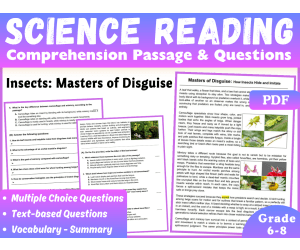
Life Science Reading Comprehension Passage: Insects' Disguises (PDF)
Science, ELA, Reading, Reading Comprehension, Strategies, Resources for Teachers, Life Sciences, Animals, Grade 6, 7, 8, 9, Writing Prompts, Worksheets & Printables, Centers, Activities, Teacher Tools, Assessments, Quizzes and Tests, Quizzes, Tests
Life Science Reading Comprehension Passage and Questions: Insects' Disguises (PDF) This very engaging life science reading passage about Insects' Disguises: how insects use camouflage and mimicry to survive . It explains the difference between the two strategies: Camouflage helps insects blend into their surroundings so predators do not notice them. Examples include stick insects, leaf insects, and katydids. Mimicry helps insects look like something else, either something dangerous or something tempting. Examples include hoverflies that look like bees or wasps, and mantises that imitate flowers or dead leaves. The passage also explains how these disguises work because predators make quick decisions based on color, shape, motion, and patterns. This passage is designed to bridge the gap between science and literacy through strengthening reading comprehension and sparking scientific curiosity in middle school students. The passage blends English Language Arts skills with accurate science content that supports NGSS classroom practice. Ideal for interdisciplinary learning in ELA and Science. Suitable for Grade 9 review, too! Student Tasks for The Passage: 5 multiple-choice questions targeting main idea, key details, inference, vocabulary in context, and use of evidence 5 vocabulary matching items with clear, student-friendly definitions 5 text-based questions that require citing specific lines or facts 1 summary prompt that asks students to condense central ideas accurately Full answer key for every section Available Formats for this Resource Fillable PDF Word Docs Google Docs FULL CATALOG OF DOWNLOADING LINKS HERE Product Details Length: 5 pages total Grades: 6–8, also suitable for Grade 9 review Use cases: close reading, stations, homework, intervention, test prep, and sub plans Standards support: reinforces informational-text skills and supports NGSS-style sense making through observation, modeling, and clear use of claim, evidence, and reasoning Why Teachers Choose This Set Authentic science content paired with rigorous literacy practice Consistent task structure across all passages for easier planning and smoother student routines Clear, age-appropriate writing that builds confidence without oversimplifying Other Science Reading Collections you May find in the store: 1. Astronomy & Space Science 2. Volcanoes, Rocks, & Mountains 3. Rock Cycle, Soil, & Sinkholes 4. Mars, Glaciers, & Antarctica 5. Water Cycle, Acid Rain, & Wastewater 6. Insects, Animals, & Ecosystems 7. Bioluminescence & Insects 8. Animal Skin, Cats, & T. Rex 9. Human Body and Senses 10. Health & Applied Bioscience 11. Waves, Light, & Imaging 12. Electricity & Energy 13. Motion & Materials 14. Chemistry and Materials Science Use this set to reinforce ELA skills in science, to add literacy to your lessons, and to support independent work. The passages strengthen main idea, evidence use, vocabulary in context, inference, cause and effect, and summary writing. With ready-to-use assessments and complete answer keys, you can provide focused practice that is simple to run and fast to review.
Author Middle & High School - CORED Education
Rating
Tags Middle School, Reading Comprehension, Reading Strategies, ELA, Centers, Reading Passage, Assessments, Vocabulary, Life Science, Insects

Life Science Reading Comprehension Passage: Goosebumps. SAMPLE
Science, ELA, Reading, Reading Comprehension, Strategies, Resources for Teachers, Life Sciences, Biology, Grade 6, 7, 8, 9, Writing Prompts, Worksheets & Printables, Centers, Activities, Teacher Tools, Assessments, Quizzes and Tests, Quizzes, Tests
This is a free passage sample from the complete resource. The full version includes everything needed for a complete reading comprehension activity: the passage, multiple-choice questions, short-answer questions, vocabulary matching, a summary-writing task, and a detailed answer key. Download the complete passage resource by clicking on the following links: PDF Fillable PDF Word Docs Google Docs Life Science Reading Comprehension Passage and Questions: Goosebumps (PDF) This very engaging life science reading passage about goosebumps and why humans still get them. It explains that goosebumps happen when tiny muscles attached to hair follicles tighten and pull hairs upright. In furry animals, this reaction helps trap heat and can make the animal look larger when threatened. In humans, the reflex is mostly vestigial , meaning it is a leftover from ancestors who had more body hair. The passage also explains how goosebumps connect to the sympathetic nervous system , adrenaline , strong emotions, music, fear, cold, and even scientific research on stress and feelings. This passage is designed to bridge the gap between science and literacy through strengthening reading comprehension and sparking scientific curiosity in middle school students. The passage blends English Language Arts skills with accurate science content that supports NGSS classroom practice. Ideal for interdisciplinary learning in ELA and Science. Suitable for Grade 9 review, too! Student Tasks for The Passage: 5 multiple-choice questions targeting main idea, key details, inference, vocabulary in context, and use of evidence 5 vocabulary matching items with clear, student-friendly definitions 5 text-based questions that require citing specific lines or facts 1 summary prompt that asks students to condense central ideas accurately Full answer key for every section FULL CATALOG OF DOWNLOADING LINKS HERE Product Details Length: 5 pages total Grades: 6–8, also suitable for Grade 9 review Use cases: close reading, stations, homework, intervention, test prep, and sub plans Standards support: reinforces informational-text skills and supports NGSS-style sense making through observation, modeling, and clear use of claim, evidence, and reasoning Why Teachers Choose This Set Authentic science content paired with rigorous literacy practice Consistent task structure across all passages for easier planning and smoother student routines Clear, age-appropriate writing that builds confidence without oversimplifying Other Science Reading Collections you May find in the store: 1. Astronomy & Space Science 2. Volcanoes, Rocks, & Mountains 3. Rock Cycle, Soil, & Sinkholes 4. Mars, Glaciers, & Antarctica 5. Water Cycle, Acid Rain, & Wastewater 6. Insects, Animals, & Ecosystems 7. Bioluminescence & Insects 8. Animal Skin, Cats, & T. Rex 9. Human Body and Senses 10. Health & Applied Bioscience 11. Waves, Light, & Imaging 12. Electricity & Energy 13. Motion & Materials 14. Chemistry and Materials Science Use this set to reinforce ELA skills in science, to add literacy to your lessons, and to support independent work. The passages strengthen main idea, evidence use, vocabulary in context, inference, cause and effect, and summary writing. With ready-to-use assessments and complete answer keys, you can provide focused practice that is simple to run and fast to review.
Author Middle & High School - CORED Education
Rating
Tags Middle School, Reading Comprehension, Reading Strategies, ELA, Centers, Reading Passage, Assessments, Vocabulary, Life Science, Biology
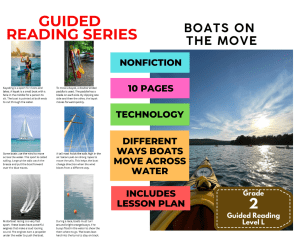
Guided Reading Level L - Boats on the Move (with Lesson Plan)
ELA, Resources for Teachers, Reading Comprehension, Reading, Science, Engineering, Technology, Physics, Sports, P.E. & Health, Grade 2, 3, 4, Worksheets & Printables, Worksheets, Teacher Tools, Centers, Activities, Literacy Readers, Quizzes, Quizzes and Tests, Assessments, Lesson Plans
This Guided Reading Book - Boats on the Move (Level L) with lesson plan includes: Guided Reading Color Label (front cover x1) This is a quick way to match the book’s demands to what students can generally handle.. The overall goal is to use the level/color to pick books for several smaller groups. To qualify for a certain level, a student is expected to read a book from that level with about 90–94% accuracy. If a student is consistently accurate and understands, move up a level. If the student is struggling at that level, drop down and add more support. Each student will improve at completely different rates, but it is generally one of the best ways to check progress across the class. DOWNLOAD THE CATALOG TO VIEW ALL GUIDED READING BOOKS AVAILABLE (SORTED LEVELS A-Z) Pre-Reading Question (x1) Teacher asks the prompt aloud, can be while showing the cover or first page. Students share what they already know, or make educated guesses from the cover. Prompt them to use the target vocabulary. Write some of their responses on the board to look back at during the reading. Vocabulary Words (x5) Introduce the five words, best doing it one at a time. Start by saying it, while students repeat and then see if anyone knows what it means before reading further. Read through the meaning and try to briefly connect each word to a picture or gesture so it’s meaningful. Ask students to flip through the book pages and point to where they see each of the vocabulary words. While reading the book pause upon coming across one of the vocab words or read the sentence twice to make sure students understand the word has appeared. Optional: Ask students to raise hands whenever they see/hear one of the new words. Guided Reading Pages (x10) Check the book snapshot (below) for: primary topic - do you need to prep extra reading or intro materials on this? what is taught best - decide on 1-2 bullets to focus on, use the prompt or words provided here for best results. learning goals - what you are checking for students to be able to do after the session, elicit answers using prompts or words provided. key vocabulary (see section above). questions overview - so you know what is coming up and if you need to prep extra materials to assist understanding. Run the lesson You may have already looked at a few of the pages together, but you can show them some of the pictures again first to set meaning. Depending on how much time you have and how familiar your students are with guided reading class, you may want to read the book aloud first with the group first. Students whisper or partner read, while you listen in. If time, do it as a group, one student reading a page each. Use the guided page’s prompts to coach: “Check the picture / does it make sense?” “Point under the words / try the first sound” “Reread the sentence smoothly”. Try to focus more on one student per session (rotating every time), so you can work out if they are ready to move up or need to move down a level. Comprehension Questions (back cover x3) This is your way to check that students didn’t just say the words, but actually understood the text. First, let students answer by pointing to the page/picture and saying a short sentence. After any answer, follow with: “Show me where you found that in the text.” In bigger groups, have partners answer first (10–20 seconds), then call on 2–3 students to share. Differentiation tips: Emerging speakers/struggling readers: oral + pointing On-level: oral in a full sentence Higher: one written sentence or draw + label Book Snapshot Title: Boats on the Move Genre: Nonfiction (informational) Subject: Science (Forces & Motion) / Reading (Informational Text) Primary Topic: Different ways boats move across water Estimated Guided Reading Level (A–Z): L What This Book Teaches Best Different ways boats move on water (wind, oars, paddles, engines). How specific boat parts help movement (sails, mast, ropes, propeller). How coordinated actions affect motion (oars dipping “at the same time” to go straight). How markers guide movement during a race (boats turn around bright orange buoys to stay on track). Comparing speed and movement styles (quiet glide vs fast roar; forward motion by alternating paddle sides). Learning Goals Students will identify several ways boats move across the water using details from the text. Students will explain how sails and wind help pull a boat forward. Students will describe how rowers use oars together to move a boat straight ahead. Students will describe how a double-ended paddle helps a kayak move forward quickly. Students will explain how an engine and propeller help push a motorboat through the water. Students will describe why boats turn around buoys during a race, based on the text. Key Vocabulary From the Text mast — a tall pole that holds sails up. rhythm — a steady pattern of movement. double-ended — having an end on both sides. propeller — a spinning part that helps push a boat. buoys — floating markers that show where to go. Discussion Prompts Pre-reading question: What are some different ways a boat could move across the water? Comprehension questions: How do large white sails help a boat move forward? What do rowers do “at the same time,” and what does that help the boat do? Why must boats turn around bright orange buoys during a race? Printing Tips 1. Best Printing Method (Recommended) “Booklet” Printing (Best if Available) If your printer or PDF viewer supports Booklet Printing , use this. Settings to use: Print mode: Booklet Paper size: Letter or A4 (either works) Orientation: Landscape Print on both sides: Yes Flip on: Short edge Scaling: Fit to printable area Booklet subset: First test: Front sides only Then: Back sides only This will automatically: Pair pages correctly Put the cover on the outside Align everything for folding After printing, fold in half and staple along the spine . 2. If “Booklet” Printing Is NOT Available You can still print this correctly with manual duplex printing . Step-by-step: Open the PDF. Choose Print . Set: Orientation: Landscape Pages per sheet: 1 Print on both sides: Yes Flip on: Short edge Print all pages . Because each PDF page already contains two facing book pages, the result will still fold cleanly into a book. Thousands of Cored Education products are included with your TeachSimple membership. Download links and encyclopedia index available here.
Author Cored Education
Rating
Tags Reading Comprehension, Reading Passages, Reading, Guided Reading, Guided Reading Lesson Plan, Guided Reading Activity, Pre-reading, Science Lesson Plans, Physics, Technology
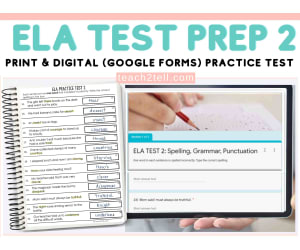
ELA Test Prep Worksheets Language Arts Review Print & Digital Activity
Common Core, Holiday & Seasonal, Language Development, ELA, Grammar, Spelling, Vocabulary, April, Months, Grade 3, 4, 5, 6, Activities, Assessments, Teacher Tools, Tests, Quizzes and Tests, Quizzes, Worksheets & Printables, Rubrics
Looking for ELA test prep worksheets that actually help your students review without feeling like another boring test? If your students tend to switch off during review time, you might find this resource a lot easier to manage. It’s designed to give you a solid language arts review while keeping things clear, structured, and purposeful—especially in the lead-up to testing. You can use this as a quick pre-assessment, a focused revision lesson, or even as a full practice test . I’ve used it in all three ways, depending on where my class is at. What’s included: 60-question ELA test prep worksheet (PDF) for print use Matching digital version (Google Forms) – self-checking Questions covering spelling, grammar, vocabulary, and punctuation A mix of multiple choice, checkbox, and short response Answer key for quick marking (or no marking at all with digital) Why this works What tends to happen with test prep is students either rush… or completely overthink it. This set helps balance that. The questions are varied enough to keep students thinking, but still familiar in format—so they’re building confidence as they go. You’ll also start to notice patterns in errors (especially with punctuation and sentence structure), which makes your follow-up teaching much more targeted. And honestly, the digital version saves a lot of time. The instant feedback alone is worth it. Ideal for Grades 3–5 (and useful for early Grade 6 review) End-of-term revision Standardized test preparation Homework or independent review How it can be used Whole-class test prep session Small group targeted revision Literacy centers Early finishers Independent practice before assessment Pre-test or post-test check-in Skills covered Spelling Grammar Punctuation Vocabulary Parts of speech Sentence structure Clause structure If you’re needing something straightforward that gives you a clear snapshot of where your students are at (without hours of prep), this tends to do the job really well.
Author Teach2Tell
Rating
Tags ELA Test Prep Worksheets, Language Arts Review, Grammar Worksheets Grade 4, ELA Practice Test, Print And Digital ELA, Upper Elementary ELA, Punctuation Practice Worksheets, Reading And Grammar Review, Standardized Test Prep ELA, Google Forms ELA Quiz
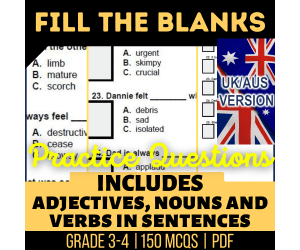
UK/Aus Spelling Fill in the Blanks Practice Questions - Year 4-5 (PDF)
ELA, Language Development, ESL, Common Core, Resources for Teachers, Vocabulary, Grade 3, 4, Worksheets & Printables, Worksheets, Quizzes and Tests, Teacher Tools, Tests, Assessments, Quizzes
THIS IS THE UK/AUS ENGLISH SPELLING VERSION. CHECK THE CATALOG FOR THE ORIGINAL AMERICAN ENGLISH VERSION. Fill in the Blanks Vocabulary Practice MCQS ELA MCQS Overview: In this series of lessons, students will embark on an engaging journey to explore the grammar skills that make our language vibrant and expressive. These lessons are crafted to help students identify, comprehend, and effectively apply language arts skills in both writing and speech. This UK/Aus English version is especially useful for schools, teachers, and families working with British-based spelling and language conventions. It is a helpful option for classrooms using UK curriculum expectations, international programmes influenced by British English, or any setting where learners need to practise the correct capitalisation and punctuation forms for that version of English. Fill in the Blanks Overview: Includes: Adjectives in Sentences Nouns in Sentences Verbs in Sentences Frequently Mistaken Words PDF Version This is the PDF uneditable version. This download is available in GOOGLE Docs, GOOGLE Forms, GOOGLE Slides. PDF, PPT, WORD, check the links below for more details. FULL CATALOG OF DOWNLOAD LINKS HERE ELA Review Questions Overview Each review test includes three answer choices for every question, which helps keep things simple and manageable for students. The layout is clear and easy to follow, so students can focus on the questions instead of figuring out what to do. A few pictures are included on each test to make the pages feel a little more inviting and less overwhelming. A review sheet is also included, giving students a chance to go back over many of the main skills covered in the resource. Introduction or Example Sheet Each topic comes with an introduction or example sheet to look at before students begin. This gives students a clear starting point and helps them feel more prepared. It also lets them see what to expect before moving into the main work. For many students, it is a helpful way to quickly refresh the key ideas before they start practicing on their own. Full Answer Keys Full answer keys are included to make marking and checking work faster and easier. Sample responses are also provided where needed, especially for open-ended tasks. This can be a real time-saver on busy days and makes the resource more practical to use. Everything is there to help make planning, teaching, and checking student work feel a little more straightforward. For similar downloads and other frees, do check out Cored Group on TeachSimple.
Author Cored Education
Rating
Tags Elementary, Answers, Ccss, Common Core, Tests, Test Prep, Assessment, Grade 3, Grade 4, Vocabulary

Jets Reading Comprehension Passage - Cored Ed Encyclopedia
ELA, Language Development, Resources for Teachers, Reading Comprehension, Reading, Pre-Reading, Science, Technology, Writing, Strategies, Grade 2, 3, 4, 5, Worksheets & Printables, Worksheets, Teacher Tools, Centers, Activities, Writing Prompts, Assessments, Tests, Quizzes and Tests, Quizzes
This jets reading comprehension contains the following: Visualize on the Cover (Teacher Read Aloud Script) Start your lesson by taking a few moments to visualize the topic and share thoughts or feelings about it. Pre-Reading Trivia Students will write down one thing they already know about the subject and then read five more facts and discuss. These facts are fun, and the students will enjoy learning about the subject before reading more. Reading Passage The text is a high-interest reading passage with set paragraphs, roughly three to four paragraphs long. It contains a variety of themes about the topic, anywhere from history to technology. The passage is between 250 and 350 words in length. Mixed Questions The first question page contains four multiple-choice questions, each with a choice of four answers, and three written response questions that require a sentence or two from the student. Vocabulary Questions Practice seven key words from the text in this section across two activities. First section is scrambled words where students will unscramble three words given a clue for each. The second section is a word to meaning matching activity. Creative Writing In this question, the student will be required to write a five to eight sentence paragraph on a question related to the topic. Extension Activities This page is optional for fast finishers or to take home. There are several activities, each one requiring a different skill. Do some, do none, do all, completely optional - but you will feel reassured knowing every possibility is planned for. Answer Key There are answers for the multiple-choice questions, written response questions have sample answers, vocabulary answers and if there is a summary question then a sample summary will be provided as well. FULL CATALOG OF DOWNLOAD LINKS AND ENCYCLOPEDIA INDEX HERE Lesson Snapshot Title: Jets Genre: Nonfiction (Informational Text) Subject: Science & Technology / Reading (Informational Text) Primary Topic: How jets move, engine parts, and high flight Estimated Guided Reading Level (A–Z): Q What This Lesson Teaches Best Explains the big idea behind jets using an action-and-reaction example (like a blown-up balloon zipping across a room). Describes how a jet engine makes thrust by pulling air in, squeezing it, heating it, and blasting it out the back. Builds technical understanding of engine parts and jobs (inlet, compressor, turbine, exhaust nozzle). Connects jet flight to conditions in the sky (air is thinner and smoother high above clouds; contrails can form when water vapour freezes). Adds brief history context about early jet-engine work and the first turbojet-powered flight date and plane name. Learning Goals Explain how a jet airplane is pushed forward when air or hot gas rushes out the back. Describe what happens inside a jet engine from the inlet to the exhaust nozzle. Identify the jobs of the compressor and turbine using details from the passage. Retell key history details about early jet designs and the first turbojet-powered flight mentioned. Describe what the air is like high above clouds and how that relates to jet travel. Explain how contrails can form according to the text. Key Vocabulary From the Text inlet — the front opening where air is pulled in. compressor — a part that squeezes air so it is packed tight. turbine — a wheel that takes energy from rushing gas. thrust — the push that moves an airplane forward. contrails — white lines that can form when water vapour freezes. Cored Ed Encyclopedia Overview The Cored Ed Encyclopedia is a weekly series of lessons that you can pick up and use right away. These short readings fit into whatever time you have available. Each one includes a warm-up, a reading, and a set of questions, but it’s flexible — you can do just the reading, the full lesson, or skip the writing section if you need to. Each lesson focuses on a single topic so students don’t get lost. The writing is clear but never childish, making it perfect for grades two through five. Topics range from animals and science to history, inventions, and everyday things. No matter the level of the student, everyone should take away at least one new idea or fact from each lesson. The materials are easy to print, easy to explain, and require no setup. They work well for whole-class teaching, partner work, or independent study.
Author Cored Education
Rating
Tags Vocabulary, Spelling, Reading Comprehension, Reading Passages, Reading, Creative Writing, Reading Strategies, Writing Prompts, Technology, Jets
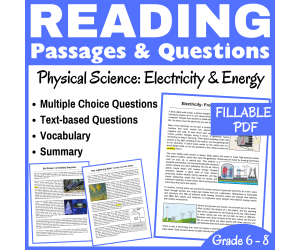
Physical Science Reading Passages: Electricity & Energy (FILLABLE PDF)
Science, ELA, Reading, Reading Comprehension, Strategies, Resources for Teachers, Physics, Grade 6, 7, 8, 9, Writing Prompts, Worksheets & Printables, Centers, Activities, Teacher Tools, Assessments, Quizzes and Tests, Quizzes, Tests
Electricity and Energy: Physical Science Reading Comprehension Passages and Questions (PDF) This very engaging and fillable collection of physical science reading passages about electricity and energy is designed to bridge the gap between science and literacy through strengthening reading comprehension and sparking scientific curiosity in middle school students. Each passage blends English Language Arts skills with accurate science content that supports NGSS classroom practice. Ideal for interdisciplinary learning in ELA and Science. Suitable for Grade 9 review, too! These worksheets are designed as fillable PDFs , which means students can type their answers directly into the document on any computer or tablet . Each page includes highlighted text fields that show them exactly where to type! What Is Included? There are (3) informational passages: The Lightning Rod: Turning Fear into Safety Eel Power: A Holiday Surprise Electricity: From Source to Socket Student Tasks for Each Passage: 5 multiple-choice questions targeting main idea, key details, inference, vocabulary in context, and use of evidence 5 vocabulary matching items with clear, student-friendly definitions 5 text-based questions that require citing specific lines or facts 1 summary prompt that asks students to condense central ideas accurately Full answer key for every section Available Formats for this Resource Word Docs Google Docs FULL CATALOG OF DOWNLOADING LINKS HERE Other Science Reading Collections and Topics You May Find in the Store: 1. Astronomy & Space Science 2. Volcanoes, Rocks, & Mountains 3. Rock Cycle, Soil, & Sinkholes 4. Mars, Glaciers, & Antarctica 5. Water Cycle, Acid Rain, & Wastewater 6. Insects, Animals, & Ecosystems 7. Bioluminescence & Insects 8. Animal Skin, Cats, & T. Rex 9. Human Body and Senses 10. Health & Applied Bioscience 11. Waves, Light, & Imaging 12. Electricity & Energy 13. Motion & Materials 14. Chemistry and Materials Science 15. Electromagnetism 16. Acids and Bases 17. Gas Laws 18. Biotechnology 19. Periodic Trends 20. Protists and Fungi 21. Microevolution 22. Blood 23. Chemical Bonding 24. Magnets 25. Muscles 26. Nuclear Chemistry 27. Electromagnetic Devices 28. Epigenetics 29. The Law of Conservation of Mass 30. Atomic Models 31. Isotopes and Ions 32. Light 33. Human-Environment Interaction 34. Theory of Evolution 35. Photosynthesis 36. Origins of Life and Early Earth 37. Gene Expression and Regulation 38. Thermochemistry 39. Allergies 40. Coevolution 41. Birth to Adulthood 42. Cells 43. Entropy and Free Energy 44. The Human Brain 45. Mixtures and Solutions 46. Invertebrates 47. Zoo Animals 48. Biochemistry 49. Animal Behavior 50. Population Ecology ...and many more engaging science reading passages that cover intriguing and important topics designed to spark curiosity and support student learning. How to Use These PDFs Click on the highlighted area to start typing your answer. Move to the next question by clicking in the next highlighted box. When you are finished, close the document and select SAVE so your answers stay recorded. If you want to keep a blank copy for later, choose Save As and give your completed version a new name. Product Details Length: 14 pages total Grades: 6–8, also suitable for Grade 9 review Use cases: close reading, stations, homework, intervention, test prep, and sub plans Standards support: reinforces informational-text skills and supports NGSS-style sense making through observation, modeling, and clear use of claim, evidence, and reasoning Why Teachers Choose This Set Authentic science content paired with rigorous literacy practice Consistent task structure across all passages for easier planning and smoother student routines Clear, age-appropriate writing that builds confidence without oversimplifying Use this set to reinforce ELA skills in science, to add literacy to your lessons, or to support independent work. The passages strengthen main idea, evidence use, vocabulary in context, inference, cause and effect, and summary writing. With ready-to-use assessments and complete answer keys, you can provide focused practice that is simple to run and fast to review.
Author Middle & High School - CORED Education
Rating
Tags Middle School, Reading Comprehension, Reading Strategies, ELA, Centers, Reading Passage, Assessments, Vocabulary, Physical Science, Physics

History of the Domestic Dog: Guided Reading Level R with Lesson Plan
ELA, Resources for Teachers, Reading Comprehension, Reading, Science, Language Development, Life Sciences, Vocabulary, History, Social Studies, Grade 3, 4, 5, Worksheets & Printables, Worksheets, Teacher Tools, Centers, Activities, Literacy Readers, Quizzes, Quizzes and Tests, Assessments, Lesson Plans
This History of the Domestic Dog (level r) guided reading book with lesson plan includes: Guided Reading Color Label (front cover x1) This is a quick way to match the book’s demands to what students can generally handle.. The overall goal is to use the level/color to pick books for several smaller groups. To qualify for a certain level, a student is expected to read a book from that level with about 90–94% accuracy. If a student is consistently accurate and understands, move up a level. If the student is struggling at that level, drop down and add more support. Each student will improve at completely different rates, but it is generally one of the best ways to check progress across the class. DOWNLOAD THE CATALOG TO VIEW ALL GUIDED READING BOOKS AVAILABLE (SORTED LEVELS A-Z) Pre-Reading Question (x1) Teacher asks the prompt aloud, can be while showing the cover or first page. Students share what they already know, or make educated guesses from the cover. Prompt them to use the target vocabulary. Write some of their responses on the board to look back at during the reading. Vocabulary Words (x5) Introduce the five words, best doing it one at a time. Start by saying it, while students repeat and then see if anyone knows what it means before reading further. Read through the meaning and try to briefly connect each word to a picture or gesture so it’s meaningful. Ask students to flip through the book pages and point to where they see each of the vocabulary words. While reading the book pause upon coming across one of the vocab words or read the sentence twice to make sure students understand the word has appeared. Optional: Ask students to raise hands whenever they see/hear one of the new words. Guided Reading Pages (x10) Check the book snapshot (below) for: primary topic - do you need to prep extra reading or intro materials on this? what is taught best - decide on 1-2 bullets to focus on, use the prompt or words provided here for best results. learning goals - what you are checking for students to be able to do after the session, elicit answers using prompts or words provided. key vocabulary (see section above). questions overview - so you know what is coming up and if you need to prep extra materials to assist understanding. Run the lesson You may have already looked at a few of the pages together, but you can show them some of the pictures again first to set meaning. Depending on how much time you have and how familiar your students are with guided reading class, you may want to read the book aloud first with the group first. Students whisper or partner read, while you listen in. If time, do it as a group, one student reading a page each. Use the guided page’s prompts to coach: “Check the picture / does it make sense?” “Point under the words / try the first sound” “Reread the sentence smoothly”. Try to focus more on one student per session (rotating every time), so you can work out if they are ready to move up or need to move down a level. Comprehension Questions (back cover x3) This is your way to check that students didn’t just say the words, but actually understood the text. First, let students answer by pointing to the page/picture and saying a short sentence. After any answer, follow with: “Show me where you found that in the text.” In bigger groups, have partners answer first (10–20 seconds), then call on 2–3 students to share. Differentiation tips: Emerging speakers/struggling readers: oral + pointing On-level: oral in a full sentence Higher: one written sentence or draw + label Book Snapshot Title: The Science and History of the Domestic Dog Genre: Nonfiction (informational) Subject: Life Science Primary Topic: Domestication, traits, and roles of dogs Estimated Guided Reading Level (A–Z): R What This Book Teaches Best Explains dogs’ biological connection to gray wolves , including shared DNA and instincts tied to social behavior and communication. Describes the history of domestication and how human artificial selection led to many distinct dog breeds. Uses specific evidence to show why dogs have exceptional smell and hearing (brain structures, scent receptors, and hearing frequencies). Shows how selective breeding creates specialists for different jobs (speed, herding, cold-weather survival, and service work). Teaches how to read dog communication signals (tail wag speed/height, ear position, facial muscles, back posture). Learning Goals Explain how the text connects domestic dogs to gray wolves using specific evidence (classification and DNA). Describe how domestication began and how humans’ breeding choices created many breeds over time. Identify details that show why dogs can smell better than humans (olfactory bulb and scent receptors). Identify details that show why dogs can hear better than humans (frequencies and ear muscles). Compare at least two breeds in the text by explaining how traits match their work or environment (speed, herding, cold climate, service). Describe what the text says people can look for to understand a dog’s emotional state. Key Vocabulary From the Text subspecies — a smaller group within a kind of animal. domestication — animals becoming used to living with people. olfactory — having to do with smell. frequencies — how high or low a sound is. resilient — able to handle hard conditions and keep going. Discussion Prompts Pre-reading question: What jobs or tasks have you seen dogs do for people? Comprehension questions: According to the text, how are domestic dogs connected to gray wolves? Comprehension questions: What evidence does the text give to show how powerful a dog’s sense of smell is? Comprehension questions: What signs does the text say people can look for to understand a dog’s emotional state? Printing Tips 1. Best Printing Method (Recommended) “Booklet” Printing (Best if Available) If your printer or PDF viewer supports Booklet Printing , use this. Settings to use: Print mode: Booklet Paper size: Letter or A4 (either works) Orientation: Landscape Print on both sides: Yes Flip on: Short edge Scaling: Fit to printable area Booklet subset: First test: Front sides only Then: Back sides only This will automatically: Pair pages correctly Put the cover on the outside Align everything for folding After printing, fold in half and staple along the spine . 2. If “Booklet” Printing Is NOT Available You can still print this correctly with manual duplex printing . Step-by-step: Open the PDF. Choose Print . Set: Orientation: Landscape Pages per sheet: 1 Print on both sides: Yes Flip on: Short edge Print all pages . Because each PDF page already contains two facing book pages, the result will still fold cleanly into a book. Thousands of Cored Education products are included with your TeachSimple membership. Download links and encyclopedia index available here.
Author Cored Education
Rating
Tags Reading Comprehension, Reading Passages, Reading, Guided Reading, Guided Reading Lesson Plan, Guided Reading Activity, Pre-reading, Science Lesson Plans, Life Science, History
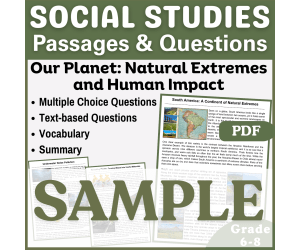
Reading Comprehension Passage: South America (SAMPLE PDF)
ELA, Reading, Reading Comprehension, Strategies, Resources for Teachers, Social Studies, Geography, Grade 6, 7, 8, 9, Writing Prompts, Worksheets & Printables, Centers, Activities, Teacher Tools, Assessments, Quizzes and Tests, Quizzes, Tests
This is a ONE PASSAGE SAMPLE. The following is the description of the FULL resource and the downloading links: Social Studies Reading Comprehension Passages and Questions: Our Planet: Natural Extremes and Human Impact (PDF) This resource introduces a collection of Social Studies reading comprehension passages with questions about Our Planet: Natural Extremes and Human Impact. The passages are carefully designed to bridge the gap between social studies and literacy through strengthening reading comprehension and sparking knowledge curiosity in middle school students. Each passage blends English Language Arts skills with accurate social studies content . Ideal for interdisciplinary learning in ELA and Social Studies. Suitable for Grade 9 review, too! What Is Included in this Collection? There are three informational passages (with full answer keys): Remaking Plastic: Turning Waste into Useful Materials Underwater Noise Pollution South America: A Continent of Natural Extremes For Each Passage, students will have multiple tasks to complete as follow: 5 multiple-choice questions targeting main idea, key details, inference, vocabulary in context, and use of evidence 5 vocabulary matching items with clear, student-friendly definitions 5 text-based questions that require citing specific lines or facts 1 summary prompt that asks students to condense central ideas accurately Available Formats for this Resource Fillable PDF Word Docs Google Docs FULL CATALOG OF DOWNLOADING LINKS HERE For more Social Studies Reading Passages, check the following Links: Ancient Civilizations PDF Fillable PDF Word Docs Google Docs Early Empires and Trade Networks PDF Fillable PDF Word Docs Google Docs The Founding of the United States PDF Fillable PDF Word Docs Google Docs Language, Culture, and Meaning PDF Fillable PDF Word Docs Google Docs Psychology and Society PDF Fillable PDF Word Docs Google Docs Global Festivals and Traditions PDF Fillable PDF Word Docs Google Docs Extreme Environments and People PDF Fillable PDF Word Docs Google Docs Food, Culture, and Preservation PDF Fillable PDF Word Docs Google Docs Global Food Customs PDF Fillable PDF Word Docs Google Docs Media, Communication, and Popular Culture PDF Fillable PDF Word Docs Google Docs Human Impact on the Environment PDF Fillable PDF Word Docs Google Docs Civic Action and Social Change PDF Fillable PDF Word Docs Google Docs Fashion, Society, and Power PDF Fillable PDF Word Docs Google Docs People, Places, and Unusual Histories PDF Fillable PDF Word Docs Google Docs Product Details Length: 15 pages total Grades: 6–8, also suitable for Grade 9 review Use cases: close reading, stations, homework, intervention, test prep, and sub plans Why Teachers Choose This Set Authentic social studies content paired with rigorous literacy practice Consistent task structure across all passages for easier planning and smoother student routines Clear, age-appropriate writing that builds confidence without oversimplifying Use this set to reinforce ELA skills in social studies, to add literacy to your lessons, and to support independent work. The passages strengthen main idea, evidence use, vocabulary in context, inference, cause and effect, and summary writing. With ready-to-use assessments and complete answer keys, you can provide focused practice that is simple to run and fast to review.
Author Middle & High School - CORED Education
Rating
Tags Middle School, Reading Comprehension, Reading Strategies, ELA, Centers, Reading Passage, Assessments, Vocabulary, Social Studies, Geography
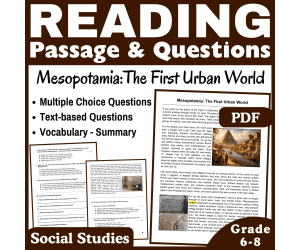
Mesopotamia: Social Studies Reading Comprehension Passage (PDF)
ELA, Reading, Reading Comprehension, Strategies, Resources for Teachers, Social Studies, History: Ancient, History, Geography, Grade 6, 7, 8, 9, Writing Prompts, Worksheets & Printables, Centers, Activities, Teacher Tools, Assessments, Quizzes and Tests, Quizzes, Tests
Mesopotamia: Social Studies Reading Comprehension Passage (PDF) This resource contains an engaging Social Studies reading comprehension passage about Mesopotamia: The First Urban World. The passage is carefully written and designed to bridge the gap between social studies and literacy through strengthening comprehension skills and sparking knowledge curiosity in middle school students. The passage blends English Language Arts skills with accurate social studies content. Ideal for interdisciplinary learning in ELA and Social Studies. Suitable for Grade 9 review, too! Student Tasks throughout the passage: 5 multiple-choice questions targeting the following skills: main idea, key details, inference, vocabulary in context, and use of evidence 5 vocabulary matching items with clear, student-friendly definitions 5 text-based questions that require citing specific lines or facts 1 summary prompt that asks students to condense central ideas accurately Full answer key for every section Available Formats for this Resource: Fillable PDF Word Docs Google Docs FULL CATALOG OF DOWNLOADING LINKS HERE Social Studies Reading Comprehension Collection Links: 1. Ancient Civilizations PDF Fillable PDF Word Docs Google Docs 2. Early Empires and Trade Networks PDF Fillable PDF Word Docs Google Docs 3. The Founding of the United States PDF Fillable PDF Word Docs Google Docs 4. Language, Culture, and Meaning PDF Fillable PDF Word Docs Google Docs 5. Psychology and Society PDF Fillable PDF Word Docs Google Docs 6. Global Festivals and Traditions PDF Fillable PDF Word Docs Google Docs 7. Extreme Environments and People PDF Fillable PDF Word Docs Google Docs 8. Food, Culture, and Preservation PDF Fillable PDF Word Docs Google Docs 9. Global Food Customs PDF Fillable PDF Word Docs Google Docs 10. Media, Communication, and Popular Culture PDF Fillable PDF Word Docs Google Docs 11. Human Impact on the Environment PDF Fillable PDF Word Docs Google Docs 12. Civic Action and Social Change PDF Fillable PDF Word Docs Google Docs 13. Fashion, Society, and Power PDF Fillable PDF Word Docs Google Docs 14. People, Places, and Unusual Histories PDF Fillable PDF Word Docs Google Docs Product Details: Length: 5 pages Grades: 6–8, also suitable for Grade 9 review Use cases: close reading, stations, homework, intervention, test prep, and sub plans Why Teachers Choose This Passage: Authentic social studies content paired with rigorous literacy practice Consistent task structure for easier planning and smoother student routines Clear, age-appropriate writing that builds confidence without oversimplifying Use this passage to reinforce ELA skills in social studies, to add literacy to your lessons, and to support independent work. The passage strengthens main idea, evidence use, vocabulary in context, inference, cause and effect, and summary writing. With ready-to-use assessments and complete answer keys, you can provide focused practice that is simple to run and fast to review.
Author Middle & High School - CORED Education
Rating
Tags Middle School, Reading Comprehension, Reading Strategies, ELA, Centers, Reading Passage, Assessments, Vocabulary, Social Studies, Ancient Civilization
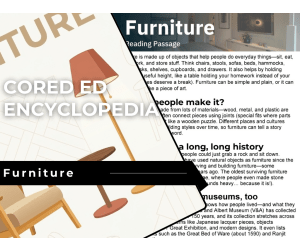
Furniture Reading Comprehension Passage - Cored Ed Encyclopedia
ELA, Language Development, Resources for Teachers, Reading Comprehension, Reading, Pre-Reading, Writing, Science, Technology, Strategies, Grade 2, 3, 4, 5, Worksheets & Printables, Worksheets, Teacher Tools, Centers, Activities, Writing Prompts, Assessments, Tests, Quizzes and Tests, Quizzes
This furniture reading comprehension contains the following: Pre-Reading Trivia Students will write down one thing they already know about the subject and then read five more facts and discuss. These facts are fun, and the students will enjoy learning about the subject before reading more. Reading Passage The text is a high-interest reading passage with set paragraphs, roughly three to four paragraphs long. It contains a variety of themes about the topic, anywhere from history to technology. The passage is between 250 and 350 words in length. Mixed Questions The first question page contains four multiple-choice questions, each with a choice of four answers, and three written response questions that require a sentence or two from the student. Creative Writing In this question, the student will be required to write a five to eight sentence paragraph on a question related to the topic. Extension Activities This page is optional for fast finishers. If there are five to ten minutes left at the end of the lesson, the student can choose one of three activities, each one requiring a different skill. Answer Key There are answers for the multiple-choice questions and three written response questions have sample answers. FULL CATALOG OF DOWNLOAD LINKS AND ENCYCLOPEDIA INDEX HERE Snapshot Genre: Nonfiction (informational text) Subject: Reading Primary Topic: What furniture is, how it’s made, and history Estimated Guided Reading Level (A–Z): Q What This Lesson Teaches Best Defines furniture by what it helps people do (sit, eat, sleep, work, store things) and gives examples of common items. Explains how furniture is made , including common materials and how makers connect parts using joints . Builds background knowledge about furniture across time , from using natural objects to evidence of built furniture long ago and stone furniture at Skara Brae. Shows how museums use objects as evidence of how people lived, including examples from the Victoria and Albert Museum (V&A) collection. Learning Goals Students will be able to explain what furniture is and list everyday tasks it helps people do. Students will be able to identify examples of furniture named in the passage and describe what each might be used for. Students will be able to describe how furniture can be made, including common materials and how joints connect pieces. Students will be able to describe key points in the history of furniture mentioned in the text (natural objects, carving/building, Skara Brae stone furniture). Students will be able to explain why museums collect furniture and name at least one example of an item mentioned from the V&A collection. Key Vocabulary From the Text joints — special fits that lock furniture parts together. archaeologists — people who study the past using evidence. cupboards — furniture for storing things behind doors. centuries — periods of one hundred years. lacquer — a shiny coating used on some objects. Cored Ed Encyclopedia Overview The Cored Ed Encyclopedia is a weekly series of lessons that you can pick up and use right away. These short readings fit into whatever time you have available. Each one includes a warm-up, a reading, and a set of questions, but it’s flexible — you can do just the reading, the full lesson, or skip the writing section if you need to. Each lesson focuses on a single topic so students don’t get lost. The writing is clear but never childish, making it perfect for grades two through five. Topics range from animals and science to history, inventions, and everyday things. No matter the level of the student, everyone should take away at least one new idea or fact from each lesson. The materials are easy to print, easy to explain, and require no setup. They work well for whole-class teaching, partner work, or independent study.
Author Cored Education
Rating
Tags Vocabulary, Spelling, Reading Comprehension, Reading Passages, Reading, Creative Writing, Reading Strategies, Writing Prompts, Technology, Furniture
SAMPLE physical Science Reading Passage: Electric Cars (FILLABLE PDF)
Science, ELA, Reading, Reading Comprehension, Strategies, Resources for Teachers, Physics, Grade 6, 7, 8, 9, Writing Prompts, Worksheets & Printables, Centers, Activities, Teacher Tools, Assessments, Quizzes and Tests, Quizzes, Tests
This is a ONE PASSAGE SAMPLE. The following is the description of the FULL resource and the downloading links: Electricity and Energy: Physical Science Reading Comprehension Passages and Questions (FILLABLE PDF) This engaging and fillable collection of physical science reading passages about electricity and energy is designed to bridge the gap between science and literacy through strengthening reading comprehension and sparking scientific curiosity in middle school students. Each passage blends English Language Arts skills with accurate science content that supports NGSS classroom practice. Ideal for interdisciplinary learning in ELA and Science. Suitable for Grade 9 review, too! These worksheets are designed as fillable PDFs , which means students can type their answers directly into the document on any computer or tablet . Each page includes highlighted text fields that show them exactly where to type! What Is Included? There are (3) informational passages: Sweet Science: How Heat Shapes Candy Baseball Science: From Bat to Ball Electric vs. Gasoline Cars: The Road Ahead Student Tasks for Each Passage: 5 multiple-choice questions targeting main idea, key details, inference, vocabulary in context, and use of evidence 5 vocabulary matching items with clear, student-friendly definitions 5 text-based questions that require citing specific lines or facts 1 summary prompt that asks students to condense central ideas accurately Full answer key for every section Available Formats for this Resource Word Docs Google Docs FULL CATALOG OF DOWNLOADING LINKS HERE Other Science Reading Collections and Topics You May Find in the Store: 1. Astronomy & Space Science 2. Volcanoes, Rocks, & Mountains 3. Rock Cycle, Soil, & Sinkholes 4. Mars, Glaciers, & Antarctica 5. Water Cycle, Acid Rain, & Wastewater 6. Insects, Animals, & Ecosystems 7. Bioluminescence & Insects 8. Animal Skin, Cats, & T. Rex 9. Human Body and Senses 10. Health & Applied Bioscience 11. Waves, Light, & Imaging 12. Electricity & Energy 13. Motion & Materials 14. Chemistry and Materials Science 15. Electromagnetism 16. Acids and Bases 17. Gas Laws 18. Biotechnology 19. Periodic Trends 20. Protists and Fungi 21. Microevolution 22. Blood 23. Chemical Bonding 24. Magnets 25. Muscles 26. Nuclear Chemistry 27. Electromagnetic Devices 28. Epigenetics 29. The Law of Conservation of Mass 30. Atomic Models 31. Isotopes and Ions 32. Light 33. Human-Environment Interaction 34. Theory of Evolution 35. Photosynthesis 36. Origins of Life and Early Earth 37. Gene Expression and Regulation 38. Thermochemistry 39. Allergies 40. Coevolution 41. Birth to Adulthood 42. Cells 43. Entropy and Free Energy 44. The Human Brain 45. Mixtures and Solutions 46. Invertebrates 47. Zoo Animals 48. Biochemistry 49. Animal Behavior 50. Population Ecology ...and many more engaging science reading passages that cover intriguing and important topics designed to spark curiosity and support student learning. How to Use These PDFs Click on the highlighted area to start typing your answer. Move to the next question by clicking in the next highlighted box. When you are finished, close the document and select SAVE so your answers stay recorded. If you want to keep a blank copy for later, choose Save As and give your completed version a new name. Product Details Length: 12 pages total Grades: 6–8, also suitable for Grade 9 review Use cases: close reading, stations, homework, intervention, test prep, and sub plans Standards support: reinforces informational-text skills and supports NGSS-style sense making through observation, modeling, and clear use of claim, evidence, and reasoning Why Teachers Choose This Set Authentic science content paired with rigorous literacy practice Consistent task structure across all passages for easier planning and smoother student routines Clear, age-appropriate writing that builds confidence without oversimplifying Use this set to reinforce ELA skills in science, to add literacy to your lessons, or to support independent work. The passages strengthen main idea, evidence use, vocabulary in context, inference, cause and effect, and summary writing. With ready-to-use assessments and complete answer keys, you can provide focused practice that is simple to run and fast to review.
Author Middle & High School - CORED Education
Rating 5
Tags Middle School, Reading Comprehension, Reading Strategies, ELA, Centers, Reading Passage, Assessments, Vocabulary, Physical Science, Physics

Motion & Materials: SAMPLE Physical Science Reading Passage (Word)
Science, ELA, Reading, Reading Comprehension, Strategies, Resources for Teachers, Physics, Grade 6, 7, 8, 9, Writing Prompts, Worksheets & Printables, Centers, Activities, Teacher Tools, Assessments, Quizzes and Tests, Quizzes, Tests
This is a ONE PASSAGE SAMPLE. The following is the description of the FULL resource and the downloading links: Electricity and Energy: Physical Science Reading Comprehension Passages and Questions (Word) This very engaging collection of physical science reading passages about electricity and energy is designed to bridge the gap between science and literacy through strengthening reading comprehension and sparking scientific curiosity in middle school students. Each passage blends English Language Arts skills with accurate science content that supports NGSS classroom practice. Ideal for interdisciplinary learning in ELA and Science. Suitable for Grade 9 review, too! What Is Included? There are (3) informational passages: Sweet Science: How Heat Shapes Candy Baseball Science: From Bat to Ball Electric vs. Gasoline Cars: The Road Ahead Student Tasks for Each Passage: 5 multiple-choice questions targeting main idea, key details, inference, vocabulary in context, and use of evidence 5 vocabulary matching items with clear, student-friendly definitions 5 text-based questions that require citing specific lines or facts 1 summary prompt that asks students to condense central ideas accurately Full answer key for every section Available Formats for this Resource PDF Google Docs FULL CATALOG OF DOWNLOADING LINKS HERE Other Science Reading Collections and Topics You May Find in the Store: 1. Astronomy & Space Science 2. Volcanoes, Rocks, & Mountains 3. Rock Cycle, Soil, & Sinkholes 4. Mars, Glaciers, & Antarctica 5. Water Cycle, Acid Rain, & Wastewater 6. Insects, Animals, & Ecosystems 7. Bioluminescence & Insects 8. Animal Skin, Cats, & T. Rex 9. Human Body and Senses 10. Health & Applied Bioscience 11. Waves, Light, & Imaging 12. Electricity & Energy 13. Motion & Materials 14. Chemistry and Materials Science 15. Electromagnetism 16. Acids and Bases 17. Gas Laws 18. Biotechnology 19. Periodic Trends 20. Protists and Fungi 21. Microevolution 22. Blood 23. Chemical Bonding 24. Magnets 25. Muscles 26. Nuclear Chemistry 27. Electromagnetic Devices 28. Epigenetics 29. The Law of Conservation of Mass 30. Atomic Models 31. Isotopes and Ions 32. Light 33. Human-Environment Interaction 34. Theory of Evolution 35. Photosynthesis 36. Origins of Life and Early Earth 37. Gene Expression and Regulation 38. Thermochemistry 39. Allergies 40. Coevolution 41. Birth to Adulthood 42. Cells 43. Entropy and Free Energy 44. The Human Brain 45. Mixtures and Solutions 46. Invertebrates 47. Zoo Animals 48. Biochemistry 49. Animal Behavior 50. Population Ecology ...and many more engaging science reading passages that cover intriguing and important topics designed to spark curiosity and support student learning. Product Details Length: 12 pages total Grades: 6–8, also suitable for Grade 9 review Use cases: close reading, stations, homework, intervention, test prep, and sub plans Standards support: reinforces informational-text skills and supports NGSS-style sense making through observation, modeling, and clear use of claim, evidence, and reasoning Why Teachers Choose This Set Authentic science content paired with rigorous literacy practice Consistent task structure across all passages for easier planning and smoother student routines Clear, age-appropriate writing that builds confidence without oversimplifying Use this set to reinforce ELA skills in science, to add literacy to your lessons, or to support independent work. The passages strengthen main idea, evidence use, vocabulary in context, inference, cause and effect, and summary writing. With ready-to-use assessments and complete answer keys, you can provide focused practice that is simple to run and fast to review.
Author Middle & High School - CORED Education
Rating
Tags Middle School, Reading Comprehension, Reading Strategies, ELA, Centers, Reading Passage, Assessments, Vocabulary, Physical Science, Physics
Water Cycle, Acid Rain, & Wastewater: Reading Comprehension (PDF)
Science, Earth and Environmental Sciences, ELA, Reading, Reading Comprehension, Strategies, Resources for Teachers, Environmental Science, Grade 6, 7, 8, 9, Writing Prompts, Worksheets & Printables, Centers, Activities, Teacher Tools, Assessments, Quizzes and Tests, Quizzes, Tests
Water Cycle, Acid Rain, & Wastewater: Reading Comprehension Passages (PDF) This very engaging collection of environmental science reading passages about Water Cycle, Acid Rain, & Wastewater is designed to bridge the gap between science and literacy through strengthening reading comprehension and sparking scientific curiosity in middle school students. Each passage blends English Language Arts skills with accurate science content that supports NGSS classroom practice. Ideal for interdisciplinary learning in ELA and Science. Suitable for Grade 9 review, too! What Is Included? There are (3) informational passages: Wastewater: From Drain to Clean Follow water from your sink to the treatment plant as screens pull out debris, grit settles, microbes break down leftovers, and disinfection makes the water safe to release or reuse. The Water Cycle: The Engine of Our Planet Watch water move through evaporation, condensation, precipitation, and runoff, with plants and soils helping store and move it. See how this cycle powers weather and refills rivers and aquifers. Acid Rain: Causes, Impacts, and Solutions Learn how certain air pollutants turn rain more acidic, what that means for lakes, forests, and buildings, and how cleaner energy and emission controls help damaged ecosystems recover. Student Tasks for Each Passage: 5 multiple-choice questions targeting main idea, key details, inference, vocabulary in context, and use of evidence 5 vocabulary matching items with clear, student-friendly definitions 5 text-based questions that require citing specific lines or facts 1 summary prompt that asks students to condense central ideas accurately Full answer key for every section Available Formats for this Resource Word Docs Google Docs FULL CATALOG OF DOWNLOADING LINKS HERE Other Science Reading Collections and Topics You May Find in the Store: 1. Astronomy & Space Science 2. Volcanoes, Rocks, & Mountains 3. Rock Cycle, Soil, & Sinkholes 4. Mars, Glaciers, & Antarctica 5. Water Cycle, Acid Rain, & Wastewater 6. Insects, Animals, & Ecosystems 7. Bioluminescence & Insects 8. Animal Skin, Cats, & T. Rex 9. Human Body and Senses 10. Health & Applied Bioscience 11. Waves, Light, & Imaging 12. Electricity & Energy 13. Motion & Materials 14. Chemistry and Materials Science 15. Electromagnetism 16. Acids and Bases 17. Gas Laws 18. Biotechnology 19. Periodic Trends 20. Protists and Fungi 21. Microevolution 22. Blood 23. Chemical Bonding 24. Magnets 25. Muscles 26. Nuclear Chemistry 27. Electromagnetic Devices 28. Epigenetics 29. The Law of Conservation of Mass 30. Atomic Models 31. Isotopes and Ions 32. Light 33. Human-Environment Interaction 34. Theory of Evolution 35. Photosynthesis 36. Origins of Life and Early Earth 37. Gene Expression and Regulation 38. Thermochemistry 39. Allergies 40. Coevolution 41. Birth to Adulthood 42. Cells 43. Entropy and Free Energy 44. The Human Brain 45. Mixtures and Solutions 46. Invertebrates 47. Zoo Animals 48. Biochemistry 49. Animal Behavior 50. Population Ecology ...and many more engaging science reading passages that cover intriguing and important topics designed to spark curiosity and support student learning. Product Details Length: 15 pages total Grades: 6–8, also suitable for Grade 9 review Use cases: close reading, stations, homework, intervention, test prep, and sub plans Standards support: reinforces informational-text skills and supports NGSS-style sense making through observation, modeling, and clear use of claim, evidence, and reasoning Why Teachers Choose This Set Authentic science content paired with rigorous literacy practice Consistent task structure across all passages for easier planning and smoother student routines Clear, age-appropriate writing that builds confidence without oversimplifying Use this set to reinforce ELA skills in science, to add literacy to your lessons, or to support independent work. The passages strengthen main idea, evidence use, vocabulary in context, inference, cause and effect, and summary writing. With ready-to-use assessments and complete answer keys, you can provide focused practice that is simple to run and fast to review.
Author Middle & High School - CORED Education
Rating
Tags Middle School, Reading Comprehension, Reading Strategies, Reading Passages, ELA, Centers, Reading Passage, Assessments, Vocabulary, Environmental Science
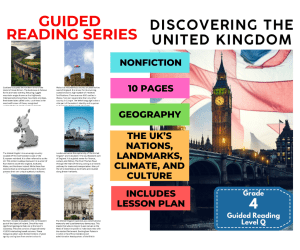
Discovering United Kingdom: Guided Reading Level Q with Lesson Plan
ELA, Resources for Teachers, Reading Comprehension, Reading, Science, Geography, Social Studies, History, Life Sciences, Earth and Environmental Sciences, Grade 3, 4, 5, Worksheets & Printables, Worksheets, Teacher Tools, Centers, Activities, Literacy Readers, Quizzes, Quizzes and Tests, Assessments, Lesson Plans
This Discovering the United Kingdom (level q) guided reading book with lesson plan includes: Guided Reading Color Label (front cover x1) This is a quick way to match the book’s demands to what students can generally handle.. The overall goal is to use the level/color to pick books for several smaller groups. To qualify for a certain level, a student is expected to read a book from that level with about 90–94% accuracy. If a student is consistently accurate and understands, move up a level. If the student is struggling at that level, drop down and add more support. Each student will improve at completely different rates, but it is generally one of the best ways to check progress across the class. DOWNLOAD THE CATALOG TO VIEW ALL GUIDED READING BOOKS AVAILABLE (SORTED LEVELS A-Z) Pre-Reading Question (x1) Teacher asks the prompt aloud, can be while showing the cover or first page. Students share what they already know, or make educated guesses from the cover. Prompt them to use the target vocabulary. Write some of their responses on the board to look back at during the reading. Vocabulary Words (x5) Introduce the five words, best doing it one at a time. Start by saying it, while students repeat and then see if anyone knows what it means before reading further. Read through the meaning and try to briefly connect each word to a picture or gesture so it’s meaningful. Ask students to flip through the book pages and point to where they see each of the vocabulary words. While reading the book pause upon coming across one of the vocab words or read the sentence twice to make sure students understand the word has appeared. Optional: Ask students to raise hands whenever they see/hear one of the new words. Guided Reading Pages (x10) Check the book snapshot (below) for: primary topic - do you need to prep extra reading or intro materials on this? what is taught best - decide on 1-2 bullets to focus on, use the prompt or words provided here for best results. learning goals - what you are checking for students to be able to do after the session, elicit answers using prompts or words provided. key vocabulary (see section above). questions overview - so you know what is coming up and if you need to prep extra materials to assist understanding. Run the lesson You may have already looked at a few of the pages together, but you can show them some of the pictures again first to set meaning. Depending on how much time you have and how familiar your students are with guided reading class, you may want to read the book aloud first with the group first. Students whisper or partner read, while you listen in. If time, do it as a group, one student reading a page each. Use the guided page’s prompts to coach: “Check the picture / does it make sense?” “Point under the words / try the first sound” “Reread the sentence smoothly”. Try to focus more on one student per session (rotating every time), so you can work out if they are ready to move up or need to move down a level. Comprehension Questions (back cover x3) This is your way to check that students didn’t just say the words, but actually understood the text. First, let students answer by pointing to the page/picture and saying a short sentence. After any answer, follow with: “Show me where you found that in the text.” In bigger groups, have partners answer first (10–20 seconds), then call on 2–3 students to share. Differentiation tips: Emerging speakers/struggling readers: oral + pointing On-level: oral in a full sentence Higher: one written sentence or draw + label Book Snapshot Title: Discovering the United Kingdom Genre: Nonfiction Subject: Social Studies (Geography, Government, Culture) Primary Topic: The UK’s nations, landmarks, climate, and culture Estimated Guided Reading Level (A–Z): Q What This Book Teaches Best Introduces the United Kingdom as a union of four countries and explains that each has its own traditions and landscapes. Builds geography knowledge by describing where the UK is located and by highlighting regional features in Scotland, Wales, and Northern Ireland. Teaches civics basics by explaining the UK’s constitutional monarchy and that the elected Parliament makes laws. Connects history and landmarks through examples like Stonehenge and major places in London along the River Thames. Explains how climate supports wildlife and gives an example of conservation connected to the red squirrel. Learning Goals Students will identify the four countries that make up the United Kingdom using details from the text. Students will describe why London is important in the United Kingdom and name one detail about the River Thames from the text. Students will describe key physical features of Scotland and explain what “lochs” are using the text’s description. Students will describe two details the text gives about Wales, such as its landscape, castles, or language. Students will explain how the text describes the UK’s government and who makes laws. Students will explain how the UK’s temperate climate is described and name one effect it has on wildlife. Key Vocabulary From the Text sovereign — able to govern itself. distinct — clearly different. interspersed — spread in between other things. constitutional — based on rules for how a country is run. prehistoric — from before written records. Discussion Prompts Pre-reading question: When you hear “United Kingdom,” what places or facts do you expect to learn about? Comprehension questions: What four countries does the text say make up the United Kingdom? Comprehension questions: What does the text say about who makes laws in the United Kingdom? Comprehension questions: What are two details the text gives about Scotland or Wales? Printing Tips 1. Best Printing Method (Recommended) “Booklet” Printing (Best if Available) If your printer or PDF viewer supports Booklet Printing , use this. Settings to use: Print mode: Booklet Paper size: Letter or A4 (either works) Orientation: Landscape Print on both sides: Yes Flip on: Short edge Scaling: Fit to printable area Booklet subset: First test: Front sides only Then: Back sides only This will automatically: Pair pages correctly Put the cover on the outside Align everything for folding After printing, fold in half and staple along the spine . 2. If “Booklet” Printing Is NOT Available You can still print this correctly with manual duplex printing . Step-by-step: Open the PDF. Choose Print . Set: Orientation: Landscape Pages per sheet: 1 Print on both sides: Yes Flip on: Short edge Print all pages . Because each PDF page already contains two facing book pages, the result will still fold cleanly into a book. Thousands of Cored Education products are included with your TeachSimple membership. Download links and encyclopedia index available here.
Author Cored Education
Rating
Tags Reading Comprehension, Reading Passages, Reading, Guided Reading, Guided Reading Lesson Plan, Guided Reading Activity, Pre-reading, Social Studies, Geography, History
Social Studies Reading Passage: Milk Carton Program (Fillable PDF)
ELA, Reading, Reading Comprehension, Strategies, Resources for Teachers, Social Studies, Sociology, Grade 6, 7, 8, 9, Writing Prompts, Worksheets & Printables, Centers, Activities, Teacher Tools, Assessments, Quizzes and Tests, Quizzes, Tests
Missing Children Milk Carton Program: Social Studies Reading Comprehension Passage (Fillable PDF) This resource introduces a unique Social Studies reading comprehension passage with questions about The Missing Children Milk Carton Program. The passage is carefully designed to bridge the gap between social studies and literacy through strengthening reading comprehension and sparking knowledge curiosity in middle school students. Each passage blends English Language Arts skills with accurate social studies content . Ideal for interdisciplinary learning in ELA and Social Studies. Suitable for Grade 9 review, too! These worksheets are designed as fillable PDFs , which means students can type their answers directly into the document on any computer or tablet . Each page includes highlighted text fields that show them exactly where to type! Student Tasks throughout the passage: 5 multiple-choice questions targeting the following skills: main idea, key details, inference, vocabulary in context, and use of evidence 5 vocabulary matching items with clear, student-friendly definitions 5 text-based questions that require citing specific lines or facts 1 summary prompt that asks students to condense central ideas accurately Full answer key for every section Available Formats for this Resource: PDF Word Docs Google Docs FULL CATALOG OF DOWNLOADING LINKS HERE Social Studies Reading Comprehension Collection Links: 1. Ancient Civilizations PDF Fillable PDF Word Docs Google Docs 2. Early Empires and Trade Networks PDF Fillable PDF Word Docs Google Docs 3. The Founding of the United States PDF Fillable PDF Word Docs Google Docs 4. Language, Culture, and Meaning PDF Fillable PDF Word Docs Google Docs 5. Psychology and Society PDF Fillable PDF Word Docs Google Docs 6. Global Festivals and Traditions PDF Fillable PDF Word Docs Google Docs 7. Extreme Environments and People PDF Fillable PDF Word Docs Google Docs 8. Food, Culture, and Preservation PDF Fillable PDF Word Docs Google Docs 9. Global Food Customs PDF Fillable PDF Word Docs Google Docs 10. Media, Communication, and Popular Culture PDF Fillable PDF Word Docs Google Docs 11. Human Impact on the Environment PDF Fillable PDF Word Docs Google Docs 12. Civic Action and Social Change PDF Fillable PDF Word Docs Google Docs 13. Fashion, Society, and Power PDF Fillable PDF Word Docs Google Docs 14. People, Places, and Unusual Histories PDF Fillable PDF Word Docs Google Docs Product Details: Length: 5 pages Grades: 6–8, also suitable for Grade 9 review Use cases: close reading, stations, homework, intervention, test prep, and sub plans Why Teachers Choose This Passage: Authentic social studies content paired with rigorous literacy practice Consistent task structure for easier planning and smoother student routines Clear, age-appropriate writing that builds confidence without oversimplifying Use this passage to reinforce ELA skills in social studies, to add literacy to your lessons, and to support independent work. The passage strengthens main idea, evidence use, vocabulary in context, inference, cause and effect, and summary writing. With ready-to-use assessments and complete answer keys, you can provide focused practice that is simple to run and fast to review.
Author Middle & High School - CORED Education
Rating
Tags Middle School, Reading Comprehension, Reading Strategies, ELA, Centers, Reading Passage, Assessments, Vocabulary, Social Studies, Sociology
Saving Electricity Campaign: Social Studies Reading Passage (PDF)
ELA, Reading, Reading Comprehension, Strategies, Resources for Teachers, Social Studies, Sociology, Grade 6, 7, 8, 9, Writing Prompts, Worksheets & Printables, Centers, Activities, Teacher Tools, Assessments, Quizzes and Tests, Quizzes, Tests
Saving Electricity Campaign: Social Studies Reading Comprehension Passage (PDF) This resource introduces a unique Social Studies reading comprehension passage with questions about Saving Electricity Campaign. The passage is carefully designed to bridge the gap between social studies and literacy through strengthening reading comprehension and sparking knowledge curiosity in middle school students. Each passage blends English Language Arts skills with accurate social studies content . Ideal for interdisciplinary learning in ELA and Social Studies. Suitable for Grade 9 review, too! Student Tasks throughout the passage: 5 multiple-choice questions targeting the following skills: main idea, key details, inference, vocabulary in context, and use of evidence 5 vocabulary matching items with clear, student-friendly definitions 5 text-based questions that require citing specific lines or facts 1 summary prompt that asks students to condense central ideas accurately Full answer key for every section Available Formats for this Resource: Fillable PDF Word Docs Google Docs FULL CATALOG OF DOWNLOADING LINKS HERE Social Studies Reading Comprehension Collection Links: 1. Ancient Civilizations PDF Fillable PDF Word Docs Google Docs 2. Early Empires and Trade Networks PDF Fillable PDF Word Docs Google Docs 3. The Founding of the United States PDF Fillable PDF Word Docs Google Docs 4. Language, Culture, and Meaning PDF Fillable PDF Word Docs Google Docs 5. Psychology and Society PDF Fillable PDF Word Docs Google Docs 6. Global Festivals and Traditions PDF Fillable PDF Word Docs Google Docs 7. Extreme Environments and People PDF Fillable PDF Word Docs Google Docs 8. Food, Culture, and Preservation PDF Fillable PDF Word Docs Google Docs 9. Global Food Customs PDF Fillable PDF Word Docs Google Docs 10. Media, Communication, and Popular Culture PDF Fillable PDF Word Docs Google Docs 11. Human Impact on the Environment PDF Fillable PDF Word Docs Google Docs 12. Civic Action and Social Change PDF Fillable PDF Word Docs Google Docs 13. Fashion, Society, and Power PDF Fillable PDF Word Docs Google Docs 14. People, Places, and Unusual Histories PDF Fillable PDF Word Docs Google Docs Product Details: Length: 5 pages Grades: 6–8, also suitable for Grade 9 review Use cases: close reading, stations, homework, intervention, test prep, and sub plans Why Teachers Choose This Passage: Authentic social studies content paired with rigorous literacy practice Consistent task structure for easier planning and smoother student routines Clear, age-appropriate writing that builds confidence without oversimplifying Use this passage to reinforce ELA skills in social studies, to add literacy to your lessons, and to support independent work. The passage strengthens main idea, evidence use, vocabulary in context, inference, cause and effect, and summary writing. With ready-to-use assessments and complete answer keys, you can provide focused practice that is simple to run and fast to review.
Author Middle & High School - CORED Education
Rating
Tags Middle School, Reading Comprehension, Reading Strategies, ELA, Centers, Reading Passage, Assessments, Vocabulary, Social Studies, Sociology
Mesopotamia: SAMPLE Social Studies Reading Comprehension Passage
ELA, Reading, Reading Comprehension, Strategies, Resources for Teachers, Social Studies, History: Ancient, History, Geography, Grade 6, 7, 8, 9, Writing Prompts, Worksheets & Printables, Centers, Activities, Teacher Tools, Assessments, Quizzes and Tests, Quizzes, Tests
This is a free passage sample from the complete resource. The full version includes everything needed for a complete reading comprehension activity: the passage, multiple-choice questions, short-answer questions, vocabulary matching, a summary-writing task, and a detailed answer key. Download the complete passage resource by clicking on the following links: PDF Fillable PDF Word Docs Google Docs Mesopotamia: Social Studies Reading Comprehension Passage This resource contains an engaging Social Studies reading comprehension passage about Mesopotamia: The First Urban World. The passage is carefully written and designed to bridge the gap between social studies and literacy through strengthening comprehension skills and sparking knowledge curiosity in middle school students. The passage blends English Language Arts skills with accurate social studies content. Ideal for interdisciplinary learning in ELA and Social Studies. Suitable for Grade 9 review, too! Student Tasks throughout the passage: 5 multiple-choice questions targeting the following skills: main idea, key details, inference, vocabulary in context, and use of evidence 5 vocabulary matching items with clear, student-friendly definitions 5 text-based questions that require citing specific lines or facts 1 summary prompt that asks students to condense central ideas accurately Full answer key for every section FULL CATALOG OF DOWNLOADING LINKS HERE Other Social Studies Reading Comprehension Collections You May Find in the Store: 1. Ancient Civilizations 2. Early Empires and Trade Networks 3. The Founding of the United States 4. Language, Culture, and Meaning 5. Psychology and Society 6. Global Festivals and Traditions 7. Extreme Environments and People 8. Food, Culture, and Preservation 9. Global Food Customs 10. Media, Communication, and Popular Culture 11. Human Impact on the Environment 12. Civic Action and Social Change 13. Fashion, Society, and Power 14. People, Places, and Unusual Histories Product Details: Length: 5 pages Grades: 6–8, also suitable for Grade 9 review Use cases: close reading, stations, homework, intervention, test prep, and sub plans Why Teachers Choose This Passage: Authentic social studies content paired with rigorous literacy practice Consistent task structure for easier planning and smoother student routines Clear, age-appropriate writing that builds confidence without oversimplifying Use this passage to reinforce ELA skills in social studies, to add literacy to your lessons, and to support independent work. The passage strengthens main idea, evidence use, vocabulary in context, inference, cause and effect, and summary writing. With ready-to-use assessments and complete answer keys, you can provide focused practice that is simple to run and fast to review.
Author Middle & High School - CORED Education
Rating
Tags Middle School, Reading Comprehension, Reading Strategies, ELA, Centers, Reading Passage, Assessments, Vocabulary, Social Studies, Ancient Civilization

Benjamin Franklin: Man of Ideas. SAMPLE Social Studies Reading Passage
ELA, Reading, Reading Comprehension, Strategies, Resources for Teachers, Social Studies, History, History: USA, Grade 6, 7, 8, 9, Writing Prompts, Worksheets & Printables, Centers, Activities, Teacher Tools, Assessments, Quizzes and Tests, Quizzes, Tests
This is a free passage sample from the complete resource. The full version includes everything needed for a complete reading comprehension activity: the passage, multiple-choice questions, short-answer questions, vocabulary matching, a summary-writing task, and a detailed answer key. Download the complete passage resource by clicking on the following links: PDF Fillable PDF Word Docs Google Docs Benjamin Franklin: Man of Ideas: Social Studies Reading Comprehension Passage This resource contains an engaging Social Studies reading comprehension passage about Benjamin Franklin: Man of Ideas. The passage is carefully written and designed to bridge the gap between social studies and literacy through strengthening comprehension skills and sparking knowledge curiosity in middle school students. The passage blends English Language Arts skills with accurate social studies content. Ideal for interdisciplinary learning in ELA and Social Studies. Suitable for Grade 9 review, too! Student Tasks throughout the passage: 5 multiple-choice questions targeting the following skills: main idea, key details, inference, vocabulary in context, and use of evidence 5 vocabulary matching items with clear, student-friendly definitions 5 text-based questions that require citing specific lines or facts 1 summary prompt that asks students to condense central ideas accurately Full answer key for every section FULL CATALOG OF DOWNLOADING LINKS HERE Other Social Studies Reading Comprehension Collections You May Find in the Store: 1. Ancient Civilizations 2. Early Empires and Trade Networks 3. The Founding of the United States 4. Language, Culture, and Meaning 5. Psychology and Society 6. Global Festivals and Traditions 7. Extreme Environments and People 8. Food, Culture, and Preservation 9. Global Food Customs 10. Media, Communication, and Popular Culture 11. Human Impact on the Environment 12. Civic Action and Social Change 13. Fashion, Society, and Power 14. People, Places, and Unusual Histories Product Details: Length: 5 pages Grades: 6–8, also suitable for Grade 9 review Use cases: close reading, stations, homework, intervention, test prep, and sub plans Why Teachers Choose This Passage: Authentic social studies content paired with rigorous literacy practice Consistent task structure for easier planning and smoother student routines Clear, age-appropriate writing that builds confidence without oversimplifying Use this passage to reinforce ELA skills in social studies, to add literacy to your lessons, and to support independent work. The passage strengthens main idea, evidence use, vocabulary in context, inference, cause and effect, and summary writing. With ready-to-use assessments and complete answer keys, you can provide focused practice that is simple to run and fast to review.
Author Middle & High School - CORED Education
Rating
Tags Middle School, Reading Comprehension, Reading Strategies, ELA, Centers, Reading Passage, Assessments, Vocabulary, Social Studies, US HISTORY
FREE Reading Comprehension: Human-Environment Interaction Fillable PDF
Science, ELA, Reading, Reading Comprehension, Strategies, Resources for Teachers, Common Core, Language Development, Earth and Environmental Sciences, Environmental Science, Grade 6, 7, 8, 9, 10, Writing Prompts, Worksheets & Printables, Centers, Activities, Teacher Tools, Assessments, Quizzes and Tests, Quizzes, Tests, Literacy Readers
Reading Comprehension Passage and Questions for Middle School: Human-Environment Interaction (Fillable PDF) This engaging middle school reading comprehension resource explores human-environment interaction and how people and places shape each other. Students learn how communities depend on natural resources, adapt to local environmental conditions, and modify the land to meet human needs. The passage examines real-world examples such as raised homes in flood-prone areas, farming, roads, cities, renewable and nonrenewable resources, deforestation, desertification, pollution, natural hazards, and climate change . It also introduces the idea of sustainability by showing how human needs can be balanced with protecting ecosystems and resources for the future. This passage is designed to bridge the gap between science and literacy by strengthening reading comprehension while sparking scientific curiosity in middle school students. It blends English Language Arts skills with accurate science content, helping students build background knowledge, understand key concepts, use evidence from the text, and explain scientific ideas clearly. This resource supports science classroom practice while also reinforcing important literacy skills such as main idea, vocabulary, comprehension, and summarizing. Ideal for interdisciplinary learning in ELA and Science. Suitable for Grade 9 review, too! Student Tasks for The Passage: 10 multiple-choice questions targeting main idea, key details, science concepts, comparison, and real-world applications 10 True/False statements to check understanding and address common misconceptions 5 text-based short-answer questions that require students to explain important ideas from the passage 5 vocabulary matching items with clear, student-friendly definitions 1 summary prompt that asks students to condense the central ideas accurately Full answer key for every section This passage is designed as a fillable PDF , which means students can type their answers directly into the document on any computer or tablet . Each page includes highlighted text fields that show them exactly where to type! Available Formats for this Resource PDF Word Docs Google Docs Product Details Length: 7 pages total Grades: 6–8, also suitable for Grade 9 review Use cases: close reading, stations, homework, intervention, test prep, and sub plans Standards support: Reinforces informational-text skills and supports NGSS-style sense-making by helping students read scientific explanations, connect evidence to key concepts, interpret real-world examples, and explain cause-and-effect relationships in science. FULL CATALOG OF DOWNLOADING LINKS HERE Other Science Reading Collections and Topics You May Find in the Store: 1. Astronomy & Space Science 2. Volcanoes, Rocks, & Mountains 3. Rock Cycle, Soil, & Sinkholes 4. Mars, Glaciers, & Antarctica 5. Water Cycle, Acid Rain, & Wastewater 6. Insects, Animals, & Ecosystems 7. Bioluminescence & Insects 8. Animal Skin, Cats, & T. Rex 9. Human Body and Senses 10. Health & Applied Bioscience 11. Waves, Light, & Imaging 12. Electricity & Energy 13. Motion & Materials 14. Chemistry and Materials Science 15. Electromagnetism 16. Acids and Bases 17. Gas Laws 18. Biotechnology 19. Periodic Trends 20. Protists and Fungi 21. Microevolution 22. Blood 23. Chemical Bonding 24. Magnets 25. Muscles 26. Nuclear Chemistry 27. Electromagnetic Devices 28. Epigenetics 29. The Law of Conservation of Mass 30. Atomic Models 31. Isotopes and Ions 32. Light 33. Human-Environment Interaction 34. Theory of Evolution 35. Photosynthesis 36. Origins of Life and Early Earth 37. Gene Expression and Regulation 38. Thermochemistry 39. Allergies 40. Coevolution 41. Birth to Adulthood 42. Cells 43. Entropy and Free Energy 44. The Human Brain 45. Mixtures and Solutions 46. Invertebrates 47. Zoo Animals 48. Biochemistry 49. Animal Behavior 50. Population Ecology ...and many more engaging science reading passages that cover intriguing and important topics designed to spark curiosity and support student learning. Use this passage to reinforce ELA skills in science, to add literacy to your lessons, and to support independent work. The passages strengthen main idea, evidence use, vocabulary in context, inference, cause and effect, and summary writing. With ready-to-use assessments and complete answer keys, you can provide focused practice that is simple to run and fast to review.
Author Middle & High School - CORED Education
Rating
Tags Reading Comprehension, Reading Strategies, ELA, Centers, Reading Passage, Assessments, Vocabulary, Environmental Science, Geography, CCSS

Life Science Reading Comprehension Passage: Bioluminescence (Word)
Science, ELA, Reading, Reading Comprehension, Strategies, Resources for Teachers, Life Sciences, Animals, Grade 6, 7, 8, 9, Writing Prompts, Worksheets & Printables, Centers, Activities, Teacher Tools, Assessments, Quizzes and Tests, Quizzes, Tests
Life Science Reading Comprehension Passage and Questions: Bioluminescence (Word) This very engaging life science reading passage about Bioluminescence: how living things produce light through chemical reactions . It explains how glowing organisms use light for survival , including communication, defense, camouflage, attracting prey, and escaping predators. Examples include glowing plankton, anglerfish, squid, jellyfish, fireflies, glow-worms, fungi, microbes, and marine bacteria . It also explains the science behind firefly light, especially luciferin, oxygen, and luciferase , and shows how scientists use bioluminescence in labs and possible technology. This passage is designed to bridge the gap between science and literacy through strengthening reading comprehension and sparking scientific curiosity in middle school students. The passage blends English Language Arts skills with accurate science content that supports NGSS classroom practice. Ideal for interdisciplinary learning in ELA and Science. Suitable for Grade 9 review, too! Student Tasks for The Passage: 5 multiple-choice questions targeting main idea, key details, inference, vocabulary in context, and use of evidence 5 vocabulary matching items with clear, student-friendly definitions 5 text-based questions that require citing specific lines or facts 1 summary prompt that asks students to condense central ideas accurately Full answer key for every section Available Formats for this Resource PDF Fillable PDF Google Docs FULL CATALOG OF DOWNLOADING LINKS HERE Product Details Length: 5 pages total Grades: 6–8, also suitable for Grade 9 review Use cases: close reading, stations, homework, intervention, test prep, and sub plans Standards support: reinforces informational-text skills and supports NGSS-style sense making through observation, modeling, and clear use of claim, evidence, and reasoning Why Teachers Choose This Set Authentic science content paired with rigorous literacy practice Consistent task structure across all passages for easier planning and smoother student routines Clear, age-appropriate writing that builds confidence without oversimplifying Other Science Reading Collections you May find in the store: 1. Astronomy & Space Science 2. Volcanoes, Rocks, & Mountains 3. Rock Cycle, Soil, & Sinkholes 4. Mars, Glaciers, & Antarctica 5. Water Cycle, Acid Rain, & Wastewater 6. Insects, Animals, & Ecosystems 7. Bioluminescence & Insects 8. Animal Skin, Cats, & T. Rex 9. Human Body and Senses 10. Health & Applied Bioscience 11. Waves, Light, & Imaging 12. Electricity & Energy 13. Motion & Materials 14. Chemistry and Materials Science Use this set to reinforce ELA skills in science, to add literacy to your lessons, and to support independent work. The passages strengthen main idea, evidence use, vocabulary in context, inference, cause and effect, and summary writing. With ready-to-use assessments and complete answer keys, you can provide focused practice that is simple to run and fast to review.
Author Middle & High School - CORED Education
Rating
Tags Middle School, Reading Comprehension, Reading Strategies, ELA, Centers, Reading Passage, Assessments, Vocabulary, Life Science, Bioluminescence

Science Reading Passages on Plant Parts and Ecosystems (PPT)
Science, Life Sciences, Biology, Common Core, ELA, Reading Comprehension, Reading, Animals, Human Body, Grade 5, 6, 7, Teacher Tools, Presentations, Assessments, Quizzes, Quizzes and Tests
Reading Passages on Plant Parts & Ecosystems for Life Science Make science come alive with this engaging collection of reading passages focused on plant parts, ecosystems, and the world of life science! Each passage is written to spark curiosity while helping students build a deeper understanding of how living things grow, survive, and interact with their environment. Whether you're prepping for assessments or just looking to weave more science into your literacy block, this resource has you covered. Aligned with CCSS, it's a time-saver for teachers and a confidence booster for students—turning science lessons into meaningful learning moments. What's inside? Plant Parts & Ecosystems Reading Passage1: Classification of Organisms Reading Passage2: Function of Plant Parts Reading Passage3: Reproduction in Plants Reading Passage4: Invertebrates Reading Passage 5: Vertebrates Reading Passage6: Earth's Biomes Reading Passage7: Ecosystems PPT Version: This is the PPT version. It includes editable slides, boxes are fillable (when not in full screen mode). If you are looking for fillable resources, it may be better to look at the Google Drive version of this product. 268 Slides Science Reading Comprehension Outline: Introducing a comprehensive resource tailored for 5th and 6th graders, this product offers enriching reading passages supplemented with illustrative pictures and graphs to clarify key concepts. Aligned with the Common Core State Standards (CCSS), it offers a hassle-free approach to teaching, given that the bulk of the preparation is already done for you. The passages present a diverse set of questions – from multiple choice to data analysis and fill-in-the-blanks. This ensures a rich blend of high-interest content and fundamental curriculum-based science themes. With its versatility, you can seamlessly integrate these lessons into various classroom settings, whether it's whole class discussions, morning exercises, independent desk tasks, small group engagements, contingency plans for substitute teachers, regular homework assignments, or even themed activities for holidays. FULL CATALOG OF DOWNLOAD LINKS HERE Grade 5/6 Links: Physical Science Part 1 - Physical and Chemical Properties Google Docs/Slides/Forms PDF PPT Word Free Supplementary Pack Accompanying Videos Physical Science Part 2 - Motion and Energy Google Docs/Slides/Forms PDF PPT Word Free Supplementary Pack Accompanying Videos Physical Science Part 3 - Electricity and Magnets Google Docs/Slides/Forms PDF PPT Word Free Supplementary Pack Accompanying Videos Life Science Part 1 - Cells, Reproduction and Genetics Google Docs/Slides/Forms PDF PPT Word Free Supplementary Pack Accompanying Videos Life Science Part 2 - Human Body Systems Google Docs/Slides/Forms PDF PPT Word Free Supplementary Pack Accompanying Videos Life Science Part 3 - Plant Parts and Ecosystems Google Docs/Slides/Forms PDF PPT Word Free Supplementary Pack Accompanying Videos Earth Science Part 1 - Plate Tectonics and Rock Cycle Google Docs/Slides/Forms PDF PPT Word Free Supplementary Pack Accompanying Videos Earth Science Part 2 - Ocean Exploration and Natural Resources Google Docs/Slides/Forms PDF PPT Word Free Supplementary Pack Accompanying Videos Earth Science Part 3 - Weather and Solar System Google Docs/Slides/Forms PDF PPT Word Free Supplementary Pack Accompanying Videos For similar products and other frees, do check out Cored Group on TeachSimple .
Author Cored Education
Rating
Tags Science, Elementary, Reading, Comprehension, Vocabulary, Answers, Reading Comprehension Presentations, Biology, Life Science, Biology Presentations

Social Studies SAMPLE Reading Passage: Food in South America (Docs)
ELA, Reading, Reading Comprehension, Strategies, Resources for Teachers, Social Studies, Sociology, Grade 6, 7, 8, 9, Writing Prompts, Worksheets & Printables, Centers, Activities, Teacher Tools, Assessments, Quizzes and Tests, Quizzes, Tests
This is a ONE PASSAGE SAMPLE. The following is the description of the FULL resource and the downloading links: Social Studies Reading Comprehension Passages and Questions: Food and Culture (Docs) This resource introduces a collection of Social Studies reading comprehension passages with questions about Food, Culture, and Preservation. The passages are carefully designed to bridge the gap between social studies and literacy through strengthening reading comprehension and sparking knowledge curiosity in middle school students. Each passage blends English Language Arts skills with accurate social studies content . Ideal for interdisciplinary learning in ELA and Social Studies. Suitable for Grade 9 review, too! What Is Included in this Collection? There are three informational passages (with full answer keys): Homemade Cottage Cheese: Food, Family, and Local Trade Salty Traditions: How Salami and Kimchi Stay Safe to Eat From Grasslands to Grill: The Foods of South America For Each Passage, students will have multiple tasks to complete as follow: 5 multiple-choice questions targeting main idea, key details, inference, vocabulary in context, and use of evidence 5 vocabulary matching items with clear, student-friendly definitions 5 text-based questions that require citing specific lines or facts 1 summary prompt that asks students to condense central ideas accurately Available Formats for this Resource PDF Fillable PDF Word Docs FULL CATALOG OF DOWNLOADING LINKS HERE For more Social Studies Reading Passages, check the following Links: Ancient Civilizations PDF Fillable PDF Word Docs Google Docs Early Empires and Trade Networks PDF Fillable PDF Word Docs Google Docs The Founding of the United States PDF Fillable PDF Word Docs Google Docs Language, Culture, and Meaning PDF Fillable PDF Word Docs Google Docs Psychology and Society PDF Fillable PDF Word Docs Google Docs Global Festivals and Traditions PDF Fillable PDF Word Docs Google Docs Extreme Environments and People PDF Fillable PDF Word Docs Google Docs Food, Culture, and Preservation PDF Fillable PDF Word Docs Google Docs Global Food Customs PDF Fillable PDF Word Docs Google Docs Media, Communication, and Popular Culture PDF Fillable PDF Word Docs Google Docs Human Impact on the Environment PDF Fillable PDF Word Docs Google Docs Civic Action and Social Change PDF Fillable PDF Word Docs Google Docs Fashion, Society, and Power PDF Fillable PDF Word Docs Google Docs People, Places, and Unusual Histories PDF Fillable PDF Word Docs Google Docs Product Details Length: 14 pages total Grades: 6–8, also suitable for Grade 9 review Use cases: close reading, stations, homework, intervention, test prep, and sub plans Why Teachers Choose This Set Authentic social studies content paired with rigorous literacy practice Consistent task structure across all passages for easier planning and smoother student routines Clear, age-appropriate writing that builds confidence without oversimplifying Use this set to reinforce ELA skills in social studies, to add literacy to your lessons, and to support independent work. The passages strengthen main idea, evidence use, vocabulary in context, inference, cause and effect, and summary writing. With ready-to-use assessments and complete answer keys, you can provide focused practice that is simple to run and fast to review.
Author Middle & High School - CORED Education
Rating
Tags Middle School, Reading Comprehension, Reading Strategies, ELA, Centers, Reading Passage, Assessments, Vocabulary, Social Studies, Food And Culture