



3,931 products added recently
Page 4 - Middle School Word Problems
Provide middle school students with word problems spanning various topics appropriate for their level. These worksheets solidify foundational skills and promote logical reasoning. Use them to support continued mathematical development.

 Show filters


Financial Literacy – Bank Statement & Credit Card Bill
Special Resources, Life Studies, Life Skills, Math, Percentages, Decimals, Money, Finance, Home Economics, Grade 7, 8, 9, 10, 11, 12, Worksheets & Printables, Word Problems, Activities
Financial Literacy: Bank Statement and Credit Card Bill Practice Activity A useful teaching resource, this activity is designed to arm students with necessary skills around reconciling bank accounts and managing monthly expenses. This hands-on lesson promotes the understanding of financial literacy through realistic practice with everyday financial documents - namely credit card bills and checking account statements. Grades to Use With: This lesson is suitable for students in grade 7 through grade 12, depending on your situation. It can be utilized in a variety of subjects such as Career and Personal Planning, Life Skills, Home Economics, and Math. The math skills required are adding and subtracting with money amounts up the the thousands of dollars. How to Use: Students are given a sample VISA bill with entries for one month's spending. They add up their total spending, reflect on if they should pay off the entire bill each month, add up their spending in specific categories (groceries, gas), and transfer their VISA spending to their checking account to pay off the bill. Next, students are given a sample checking account for one month of spending. They must complete a math operation for each entry. Sometimes that involves adding a deposit to the balance, subtracting a withdrawal from the balance, or figuring out a transaction amount based on a given balance. You can do several entries together as a class, and then assign the rest for your students to complete. Finally, students answer questions about the monthly spending as a whole, and they decide if this person has good financial health. A complete answer key is included. What's Included: A total of 7 pages: Title Page, 3 page assignment, 3 page answer key If you enjoy this real-wold financial literacy lesson, check out others in my store! Taxes, Tips, Sales: Using Percentages in Real Life Inflation: What is it and why does it matter? Financial Literacy: Interest Rates: Lending and Borrowing Money Renting vs Buying a Home: Real-Life Math Project Income Tax: Notes and Practice Calculations Household Budget Project
Author Grace Under Pressure
Rating
Tags Bank Statement, Financial Literacy, Money Management, Personal Finance, Credit Card, Budget, Money, Real World Math, Life Skills, High School Life Skills
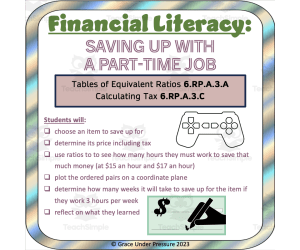
Financial Literacy: Saving Up From a Part-Time Job Using Ratio Tables
Life Studies, Finance, Home Economics, Math, Graphing, Money, Fractions, Grade 5, 6, 7, 8, Worksheets & Printables, Word Problems, Worksheets
Here's an integrated lesson that teaches key financial literacy skills while also allowing students to practice using ratio tables and graphing them. Students get to choose an item they want to save up for that costs between $200-$300. They research the exact price and where they can buy it. Then, they use a ratio table to help calculate the sales tax on that item in their area. Next students complete two ratio tables based on hourly wages they could get for a part-time job. They graph the data from the 2 tables to see that when you are making more money per hour, you can save up for an item faster. This is good practice for plotting ordered pairs on a coordinate plane. After that, students create a new ratio table to see how many weeks they will have to work to save up for their item. Finally, they reflect on what they have learned about ratio tables, graphing, saving up, getting a part-time job, or hourly wages. A complete answer key is included! Grades to Use With: This lesson is designed to target the Common Core State Standards 6.RP.A.3.A and 6.RP.A.3.C It is perfect for a grade 6 classroom, or could be used as review and/or to teach financial literacy in a grade 7 or 8 classroom. It could be used for enrichment in a grade 5 classroom. Finally. it could be used in high school special education classes. What's Included: 5 Page PDF: Title Page, 3 Pages of Worksheets with Ratio Tables and Graphs included, Complete Answer Key If you enjoy this financial literacy activity, check out others in my store: My Budget Project for Elementary: Grades 3-6 Back to School Budget Activity Halloween Budget Activity My Party Budget: Decimals and Percentages Practice Financial Literacy: Financial Tradeoffs
Author Grace Under Pressure
Tags Ratio Tables, Ratios, Financial Literacy, Money Math, Real World Math, Saving Money, Part Time Job, Proportional Relationships, Money, Finance

High School Financial Literacy: Net Worth = Assets - Liabilities
Special Resources, Life Studies, Life Skills, Math, Addition and Subtraction, Addition, Subtraction, Money, Finance, Home Economics, Grade 7, 8, 9, 10, 11, 12, Worksheets & Printables, Word Problems, Worksheets
This 6 Page Financial Literacy PDF teaches your students about assets, liabilities, and net worth (equity). It is an easy way to get your high school students interested in personal financial literacy and building their wealth. 3 case studies are included with calculations to complete and questions to respond to. Each person has some assets and some liabilities. Students must add each of these categories up and find the difference to see how much net worth each person has. Then they need to think about what changes each person could make to their financial habits. Perhaps one person has too much debt or someone else isn't investing much even with a high income. Students can start to see how high income does not always lead to high net worth if the person spends more than they make and has debt. On the other hand, someone with a lower income can have a high net worth if they live a frugal lifestyle and save money in investments or property equity. Just because someone "looks" rich, doesn't mean that they are! Grades to Use WIth: The actual math in this assignment is quite simple: adding and subtracting numbers to the hundred thousands. Students could do the work by hand or with a calculator. Because of this, this assignment is accessible to students in grades 7-12 in regular math classes, adult education students, and high school special education students. How to Use: Introduce the vocabulary: Assets, Liabilities, and Equity on the first page and fill in the blanks together. You could do one of the case studies together as a class and assign the other two for students to complete on their own. What's Included: 6 page PDF: Title Page Introduction Page 3 Case Studies Answer Key If you enjoy this product, check out some of the other personal finance lessons in my store: Grace Under Pressure .
Author Grace Under Pressure
Tags Financial Literacy, Net Worth, Wealth, Assets, Budget, Finance, Personal Financial Literacy Worksheets, High School Financial Literacy, Net Worth Worksheets, Personal Finance

Probability Word Problems: Compare Games of Chance 4th 5th Grade
Math, Statistics, Fractions, Decimals, Percentages, Grade 4, 5, 6, Worksheets & Printables, Word Problems, Worksheets
In this 4th, 5th or 6th grade single outcome probability lesson with worksheets, you will find lots of great ideas that will help your elementary students begin to understand the ways to compare probabilities of single outcome events in a variety of games of chance. Your students will also learn about writing probabilities in fraction and decimal form. How to Use: Print 3 pages of worksheets for each of your students. They can work independently on these tasks or in small groups. Students will determine the theoretical probability for a game of chance using a spinner. Students will determine the theoretical probability for a different game of chance using a 10-sided die. Students will compare these 2 games and pick which game they would like to play. They can use their math calculations to help justify their choice. Have your students share their choices in a class discussion for the wrap-up! Using fractions (one half, tenths and quarters), equivalent fractions (with denominators of 100), and decimals to the hundredths, your students will calculate the three outcomes involved in each of these games of chance. They will notice that all 3 outcomes in a single game will always add up to 1.00. They can compare the 2 games more easily if they use a common denominator (/100). Grades to Use With: This probability math lesson (with worksheets) is designed for students in 4th, 5th, and 6th grades. It is a great addition to a probability unit when your students are learning about a variety of probability concepts including single outcome probability and how to use fractions and decimals to make fair comparisons between probability events. This lesson could also be used in some middle school special education classrooms. What's Included: 5-Page PDF- Ready to Print and Use! Complete Teacher Instructions 3-Page Worksheet: 2 Games of Chance & a Written Reflection Complete Answer Key If you enjoy this math activity, check out other probability lessons in my store! Middle School Math Stations for Probability and Statistics Theoretical & Experimental Probability Experiment: Hands-On Math
Author Grace Under Pressure
Rating
Tags Probability Word Problems, Probability Worksheet, Probability, Fractions, Decimals, Single Outcome Probability, Probability Games, Games Of Chance, 5th Grade Probability

6th Grade Math: Statistics and Probability Bundle: 4 Activities
Math, Statistics, Graphing, Money, Common Core, Grade 5, 6, 7, Worksheets & Printables, Word Problems, Activities
Do you need some new ideas for your 6th grade math unit to meet the Common Core State Standards for Statistics and Probability? Here is a ready-to-go bundle with four fun real-life activities to incorporate into your unit plan. 1) Statistical Questions: Students are taught what a statistical question is: a question that has numerical answers that vary.. 8 questions are included. Students need to identify if they are statistical questions or not. If they are, students think of how the data might be collected. If they are not, students explain what aspects of a statistical question are missing. Finally, students write 4 questions of their own (one should not be a statistical question) and they trade with a friend to see if they can identify the odd one out. 2) Dot Plots and Histograms: Students will collect numerical data through a survey and create their own dot plots and histograms to display their findings! This gives them a sense of ownership over their learning, and it is a great way to assess their skills! Discussion questions and self- assessment are included. 3) Math Stations: Statistics and Probability: Station 3 in particular has students create a dot plot and calculate the mean, median and mode of provided data. They can also do the probability stations if you want to address those skills. 4) Mean, Median and Interquartile Range of Hourly Wages: From a cashier to a taxi driver to an account to a CEO, students are given 10 realistic hourly wages. First, they create a histogram to display the data. Next, they write the wages in order from smallest to largest. They use this information to calculate the mean, the median, and the interquartile range. After that, they eliminate the outlier (the CEO wage) and recalculate the same statistics. Discussion questions are included. Grades to Use With: This bundle is designed for students in Grade 6, but can be used for Grade 5 enrichment, Grade 7 or 8 review, or high school special education classes. What's Included: 20 Page PDF with 4 Activities
Author Grace Under Pressure
Tags 6th Grade Math, Statistics , Probability, Dot Plots, Histograms, Mean, Median, Interquartile Range, Statistical Questions, Financial Literacy
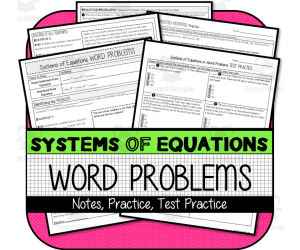
Systems of Equations: Word Problems NOTES & PRACTICE
Math, Algebra, Grade 8, Word Problems, Worksheets & Printables
Systems of Equations: Word Problems NOTES & PRACTICE A comprehensive teaching resource tool specifically designed for eighth-grade math educators. This resource material meets the common core mathematical standards defined by CCSS.MATH.CONTENT.8.EE.C.8 and CCSS.MATH.CONTENT.8.EE.C.8.C . Focused Content Coverage: Analyzing and solving pairs of simultaneous linear equations based in real-world or mathematical scenarios. Vital instruction on setting up equations in both Slope-Intercept & Standard Forms framed within mathematical word problems as well as real-world problems. Educational Engagement & Practice Activities: This product provides practice activities that can be utilized either during class sessions for whole or small group activities, or can be assigned as homework exercises. Included Test Preparation Resources: Multiple Choice + Constructed Response TEST PRACTICE preparation materials are available for equipping students to tackle assessment challenges. Inclusive Resources Available: Detailed notes on the subject matter Theoretical and applied practice exercises Review materials aimed for test preparation A comprehensive Answer Key A perfect blend of practicality and effectiveness, Systems of Equations: Word Problems NOTES & PRACTICE is dedicated to reinforcing algebraic principles in an eighth-grade classroom setting while adhering to standard statutory requirements.
Author The Math Cafe
Tags Systems Of Equations, Word Problems, Algebraic Equations, Linear Equations, Test Practice
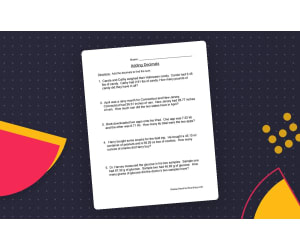
Adding Decimals Word Problems – Practice Worksheet
Math, Addition and Subtraction, Addition, Decimals, Place Value, Grade 4, 5, 6, Worksheets & Printables, Word Problems, Worksheets
This worksheet is a great way for students to practice adding decimals. The word problems on this worksheet involve adding two decimals (up to hundredths) to find the sum. This is a great resource for teachers who are looking for extra practice for their students.
Author Have Fun Teaching
Rating
Tags Decimal Addition Word Problems, Word Problems With Decimals Worksheets, Decimal Word Problems Grade 5, Decimal Equations Worksheet, Decimal Word Problems Grade 6
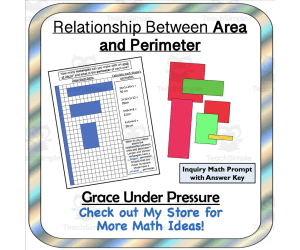
Relationship Between Area and Perimeter: Math Inquiry Prompt
Math, Geometry, Measurements, Grade 3, 4, 5, 6, Worksheets & Printables, Word Problems, Activities, Worksheets
Here’s a ready-to-go math inquiry activity for your geometry unit. Students are tasked with drawing all the rectangles they can create with a specific area (24 units squared). Then, they calculate the perimeter of each rectangle. Finally, a prompt helps them notice the relationship between area and perimeter. Shapes that are longer and thinner will have a larger perimeter than other shapes with the same area. How to Use: Use this activity once your students have already had some practice calculating area and perimeter of rectangles. You could do a quick mini lesson about finding factors before handing out this activity , as your students need to determine the factors of 24 to complete this task (1x24, 2x12, 3x8 4x6). I let students work in pairs or small groups to complete this task as I want them talking about their math ideas! Grades to Use With: This math project is designed for students in grades 3-6 who are learning about area and perimeter of right-angle shapes (rectangles). In the USA, this is in Common Core Standards in the third grade and in British Columbia, Canada, it is addressed in Grade 5. What's Included: 2 Page PDF: Student worksheet and Complete Answer Key If you enjoy this math project, check out others in my store! I love to design engaging math activities that show students how the skills they learn in the classroom are actually extremely helpful in their everyday lives. Math is everywhere! Math Project: Create Your Dream Store: Decimal Calculations and Budgeting Financial Literacy: Vacation Math Project: Budgeting, Percentages, Time Zones and More! Math Project: Circle Graphs and Pie Charts Financial Literacy: My Party Budget: Decimals and Percentages Application Math in the Real World: Personal Math Research Project for STEM Education Geometry Project: Park Design with Area, Perimeter, and Volume Canadian Cities: Place Value to Millions Activity
Author Grace Under Pressure
Tags Geometry, Math, Area, Perimeter, Math Journal, Math Inquiry, Measurement, Inquiry, Grade 5 Math, 3rd Grade Math

Financial Literacy: Mortgage Effects When Interest Rates Rise
Life Studies, Special Resources, Home Economics, Finance, Math, Percentages, Multiplication and Division, Division, Multiplication, Life Skills, Grade 8, 9, 10, 11, 12, Worksheets & Printables, Word Problems, Teacher Tools, Lesson Plans
Everyone is talking about rising interest rates these days. But why does it matter? Should our students learn about this? Yes! Here's a complete ready-to-go lesson for high school students in math class, life skills, home economics, or career and personal planning. It will teach them all about buying a home, getting a mortgage, and how mortgage payments are calculated using interest rates. 1) First, there is a handout explaining all the relevant home-buying vocabulary: from down payment and mortgage to interest and principal. There is a complete handout or a fill-in-the-blanks version: you choose what is best for your students! 2) Then, there is a second sheet with a sample scenario of what happens when interest rates rise and people have to renew their mortgage. This clearly shows, step by step, how mortgage payments can rise by hundreds or thousands of dollars even if you live in the exact same place. This handout also has completed or fill-in-the-blank versions for you to pick from. 3) Next, there is a matching worksheet where students match all the home buying words to their definitions. 4) Finally, there is a math worksheet for students to complete. It has 10 questions for students to calculate themselves about down payments, mortgage payments and rising interest rates. Math skills required are multiplying and dividing with numbers up to 6 digits and working with percents written as a decimal. For example calculating the interest payment on a $300,000 mortgage at 3% would be done: 300,000 x 0.03 All the questions are designed to have round numbers and simply calculations whenever possible. Grades to Use With: This lesson is designed for high school students in grades 8-12: from special education to regular home economics classes. What's Included: 8 Page PDF: Title Page, 2 Pages of Handout, 2 Pages of Sample Scenario, Vocabulary Matching, Math Questions, Complete Answer Key If you enjoy this product, check out my Financial Literacy Activities like Household Budget Debit Cards vs Credit Cards Bank Statement and Credit Card Bill Practice
Author Grace Under Pressure
Tags Financial Literacy, Life Skills, Mortgage, High School Financial Literacy, Down Payment, Interest Rates, Economy, Rising Interest Rates, Home Ownership
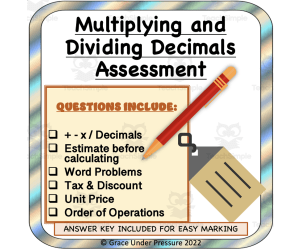
Decimal Operations Assessment: Add, Subtract, Multiply, Divide
Math, Addition and Subtraction, Addition, Decimals, Multiplication and Division, Multiplication, Division, Subtraction, Grade 5, 6, 7, 8, Worksheets & Printables, Word Problems, Teacher Tools, Assessments, Worksheets
Decimal Operations Assessment : Add, Subtract, Multiply, Divide (with answer key) Do you need a quick and valid assessment for your decimal operations unit? Do you want to encourage your students to estimate before they calculate? Here is the math quiz for you! This 2-page decimal operations math quiz assesses the following topics Addition of decimals Subtraction of decimals Multiplication of decimals Division of decimals How to Use: The first page requires students not only to complete computations, but also to estimate their solutions before starting out. Half of the marks are given for successful estimations. This encourages students to develop estimation skills which can greatly help in identifying potential calculation errors. The second page contains word problems (worth 10 marks) that increase in complexity. These cover real-world scenarios such as unit price computation, tax calculations, evaluating sale prices and dealing with multiple operations simultaneously. These word problems aim to assess deeper levels of comprehension and application of decimal operation skills. What's Included: 5 Page PDF ready to print! Teacher Instructions 2 page decimal operations quiz 2 page complete answer key for easy marking Grades to Use With: This math quiz is designed for students in grades 5-8 who are first learning about decimal operations or reviewing this skill. The word problems also tie in with grade 6 learning standards about unit rates. This activity could also be used in high school special education classes. If you enjoy this applied math activity, check out others in my store: Grocery Game: Estimating, Adding, Multiplying Decimals Grocery Shopping Price Comparisons: Financial Literacy and Money Math Wave Pool Problem: Pre-Algebra Skills: Expressions, Tables, and Graphs: Real-Life Application Butter Tart Recipe Activity: Multiplication and Addition of Mixed Numbers and Improper Fractions Gingerbread Math: Decimals, Fractions, and Percentages Using Tenths Equivalent Fractions Practice in a set of 5 Stations or Centers
Author Grace Under Pressure
Rating
Tags Decimal Operations, Assessment, Problem Solving, Estimating, Multiplying Decimals, Adding Decimals, Math Quiz, Decimal Quiz, Decimal Operations Quiz, Unit Rate
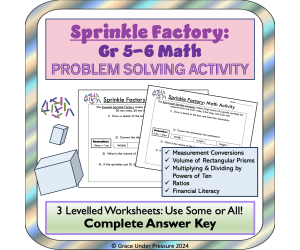
Volume Word Problems: Sprinkle Factory Grade 5 & 6 Conversions, Ratios
Math, Measurements, Multiplication and Division, Geometry, Grade 5, 6, Worksheets & Printables, Word Problems
Here’s an engaging 5th grade or 6th grade differentiated problem solving worksheet that includes several real-world math skills: o Conversions of standard measurements: millimetres to centimetres and centimetres to metres (5th Grade Measurement) o Calculating the volume of a rectangular prism that has whole number side lengths (5th Grade Measurement) o Multiplying & dividing by powers of ten (5th Grade Numbers in Base Ten) o Simple financial literacy (comparing prices) o Ratios and Rates (6th Grade Ratios and Proportional Relationships) Students will work on a realistic scenario: measuring boxes of sprinkles made at the sprinkle factory. Some are small for home use, and some are much larger for bakery and industrial applications. They will complete the following tasks for each box: Sketch the sprinkle box shape in 3-D with labelled measurements Complete simple and guided unit conversions on the measurements Calculate the exact volume of each box in centimetres cubed Determine the prices of each box using simple rates. This activity included three levels of difficulty: you can assign differing amounts to easily differentiate for your students, or complete the whole activity as a class, step-by-step. Level 1) Involves converting millimetres to centimetres and calculating the price and volume of the small box of sprinkles. Level 2) Has students convert metres to centimetres and calculate the volume and price of the larger box of sprinkles. Level 3) Students will compare the prices of the different boxes to find out which is a better deal using simple rates. This is an open-ended question, and there are lots of ways for students to solve it. You can have different students share their personal strategies with the rest of the class for further learning. What's Included: A 5-Page PDF that is ready for you to print Teacher instructions 3 Differentiated Student Worksheets A Complete Answer Key
Author Grace Under Pressure
Tags Word Problems, Volume Of Cubes, Ratios, Unit Conversions, Grade 6 Word Problems, Grade 5 Word Problems, 6th Grade Word Problems, 5th Grade Word Problems, Real World Math

Financial Literacy: Financial Trade-offs
Special Resources, Life Studies, Life Skills, Finance, Home Economics, Math, Money, Grade 7, 8, 9, 10, 11, 12, Worksheets & Printables, Word Problems, Activities
Financial Literacy: Financial Trade-offs Here’s a quick and simple way to include some easy financial literacy learning into your middle, high school, or special education class. These 8 prompts describe realistic financial scenarios about work, housing expenses, post-secondary education, cars, retirement planning, and wedding costs. Use them as debate topics, research prompts, or a simple whole class discussion (ideal for those extra few minutes you often end up with before the end of class). Only simple math skills and basic financial vocabulary are needed to understand these topics. How to Use: Start by explaining the basic premise to your students: Often people can feel stuck in their life due to a financial issue. However, by making a few financial trade-offs, there is usually a different way to deal with issues. Here are eight real life scenarios that many people deal with. Discuss them with your peers, have a debate, make a list of pros and cons! Realize that you always have more options if you can think critically and creatively. Main Goal: The main goal of these prompts is to drive home the importance of understanding trade-offs in goal setting and financial planning. Each topic presents itself as a relatable real-life scenario offering two distinctive choices involving critical thinking and decision-making. There is no "right" answer: just the right answer for your situation. Grades to Use With: These prompts could work in a middle or high school math class, a personal planning or career and education class, or a high school special education classroom. They could even be used in adult education scenarios. What's Included: A total of 10 pages in PDF: Title Page, Instruction Page and 8 trade-off situations If you enjoy this financial literacy product, please check out some of my other options in my store: FIRE: Financial Independence Retire Early Compound Interest: Hook Students on Financial Literacy Net Worth: Assets - Liabilities = Equity
Author Grace Under Pressure
Tags Financial Literacy, Trade-offs, Critical Thinking, Budget, Money, Life Skills, Real World Math, Finance, Planning, Personal Finance

Percent Word Problems
Math, Percentages, Grade 7, 8, 9, 10, Word Problems, Worksheets & Printables
This is a 1-page printable with Percent Word Problems for your middle and high school students. This makes a great homework assignment or assessment. Answer key included.
Author Mister G's Teacher Shop
Tags Percents, Math Worksheet, Homework, Independent Work, Math Assessment, Word Problems, Comprehension, Bell Ringer, Solving Percentages Word Problems, Percent Word Problems Worksheets For Grade 7, Percent Word Problems Pdf

Money Math Life Skills Worksheet: Reading Restaurant Menus Level 3
Special Resources, Creative Arts, Art, Life Studies, Social Emotional Learning (SEL), Special Education Needs (SEN), Life Skills, Math, Money, Grade 7, 8, 9, Worksheets & Printables, Word Problems, Activities, Worksheets
Money Math Life Skills Worksheet : Reading Restaurant Menus Level 3 This 192-question Special Education life skills activity teaches grade 7-9 students to calculate tips, apply sales tax, and determine total meal costs using six standard restaurant breakfast and lunch menus. Students will: - Calculate meal costs with 2, 3, and 4 menu items - Apply sales tax to meal costs - Calculate tips Use this printable worksheet one-on-one or in special education classes to develop essential real-world math and money management abilities. It includes step-by-step instructions, questions, answers, graphics, and ideas for implementation. Excellent for IEP goal setting and measuring progress in money math. Engage students with this highly interactive life skills activity!
Author Adulting Life Skills Resources
Tags Life Skills Money Math, Special Education Money Math, Independent Living Skills, IEP Goal-Oriented Skills, Community-Based Instruction, Adulting On The Spectrum, Social And Emotional Learning, Life Skills For Adults, Life Skills For Teens, Autism And Money Skills

Measurements: Word Problems
Math, Measurements, Grade 4, 5, 6, 7, Word Problems, Worksheets & Printables
Measurements: Word Problems Measurements: Word Problems is an educational resource designed to assist in the understanding of measurement conversions, a critical aspect of mathematics education. This tool emphasizes practice through exercises and word problems. This resource targets students in grades 4 to 7, focusing on the area of measurements within mathematics. The compact, 4-page booklet format provides a rich array of measurement and conversion problems, making it suitable for diverse learning formats such as: Classroom Instruction Small Group Discussions Individual Homework Assignments User-Friendly Design The worksheets are designed with enough space for students' calculations. The clear instructions allow learners to follow easily and make the exercises both enjoyable and challenging. An Effective Learning Tool The inclusion of an answer page facilitates easy correction for educators or even self-assessment sessions if used as independent study material at home or during tutoring hours! Fully Editable Resource A standout feature is that the entire content can be customized based on varying competency levels - addressing individual nuances within diverse classrooms setup. In Conclusion Measurement: Word Problems does more than just provide engaging materials; it fosters steady progress while covering essential concepts around measurements and conversions during elementary school maths education!
Author Elementary Resources 4 U
Tags Measurement Conversions, Word Problems, Mathematics Education, Practice Exercises, Customizable
Mth: Division of two digits
Math, Multiplication and Division, Multiplication, Grade 4, 5, 6, Worksheets & Printables, Word Problems, Activities, Worksheets
Mth: Division of Two Digits - An Inclusive Teaching Resource Mth: Division of two digits is a comprehensive learning resource designed purposefully to help students in grades 4-6 fortify their understanding of dealing with two-digit divisors. This well-thought-out teaching asset offers an engaging method for students to get recurring practice and, in turn, boost their confidence levels while dividing with double-digit divisors. Main Features: The advanced utilization of different activities that cater to various learning styles and needs among the students. Activities include a two-digit divisor division scavenger hunt, coloring pages, cutting, pasting and sorting exercises, worksheets with and without remainders division problems. A unique 'room quest' concept aimed at stimulating interest among the learners. This product aims not only to address student difficulties but also stimulate interest through a unique 'room quest' concept. The colorful activity allows children to search for problems hidden around the room in an interactive manner which adds an exciting dimension within classwork. In addition to its utility for 5th graders who can use it as part of their regular curriculum,Mth: Division of Two digits is equally beneficial for both ambitious 4th graders looking for advanced challenges as well as grade 6 teachers wanting material revision or reinforcement tool when teaching division involving two-digit divisors. Suitable Across Various Teaching Frameworks: No matter your lesson structure–whole group instruction or small groups session or even homework assignments – Mth: Division of Two digits satisfies all these modes effectively making it beneficial across various teaching frameworks. Persistent exposure through repetition ensures thorough comprehension thus fostering lasting mathematical competencies among young scholars.
Author Big Apple Teaching
Tags Division, Two-digit Divisors, Interactive Learning, Scavenger Hunt, Problem-solving

TWO STEP EQUATIONS | 20 WORD PROBLEMS
Math, Early Learning, Elementary, High School, Homeschool Resources, Middle School, Not Grade Specific, Word Problems, Worksheets & Printables
TWO STEP EQUATIONS | 20 WORD PROBLEMS ABOUT THE AUTHOR: Laura Educa Publishing specializes in developing and selecting impactful teaching resources for children. Our goal is to transform the learning process into an enjoyable and motivating adventure for every child. PLEASE VISIT MY STORE, BECAUSE I HAVE A LOT OF FREE RESOURCES FOR YOU: -PAINTING ANIMALS: https://teachsimple.com/product/coloring-animals-8-free-pages-for-kids -TRACING LINES: https://teachsimple.com/product/tracing-lines-and-strokes-4-free-pages -ANIMAL PUZZLES: https://teachsimple.com/product/6-free-animal-puzzles-for-cutting-and-pasting MAIN DESCRIPTION OF THIS RESOURCE: Title of the Resource: TWO STEP EQUATIONS | 20 WORD PROBLEMS Total Page Count: 10 File Format: PDF Available in Color or Grayscale: COLOR SECONDARY AND COMPLEMENTARY DESCRIPTION: -Write an engaging introduction for this product. First of all, at EDITORIAL LAURA EDUCA, we are deeply grateful that you have chosen to use one of our products in your learning or teaching process. -Highlight the main learning objective of this resource. Some of the objectives of using this resource could be said to be: -To motivate student learning. - To help students solidify specific knowledge. -Outline the structure and steps included in the activity. For student learning, it is necessary to follow a certain structure that involves the student learning process. Let's begin by mentioning motivation, moving on to the foundation of learning, and finally carrying out the metacognitive step. -Identify the target grade levels or age range. It all depends on the student. Most of my resources are suitable for use with young children, but there are also open resources for use by the general public. -Describe the format in which this resource is provided. I could also explain that most of my resources are designed in PDF format, but you will also find some presented in PPT. -Confirm if answer keys are included and their usefulness. Due to their nature, most of my resources do not include answer keys.
Author EDITORIAL LAURA EDUCA
Rating
Tags FREE, FREE RESOURCES, MATH, MATH RESOURCES, EQUATIONS, EQUATION, WORD PROBLEMS, PROBLEMS

Area, Surface Area, & Volume of Composite Figures REAL-WORLD SITUATIONS
Math, Geometry, Grade 7, Worksheets & Printables, Worksheets, Word Problems
Area, Surface Area, & Volume of Composite Figures- REAL-WORLD SITUATIONS Designed with educators in mind, the product 'Area, Surface Area & Volume of Composite Figures- REAL-WORLD SITUATIONS' delivers a powerful teaching resource for seventh-grade geometry. It shifts away from abstract mathematical problems to focus on real-life applications which makes learning more engaging and relatable. The product dovetails neatly into the 7th Grade Geometry Standard CCSS.MATH.CONTENT.7.G.B.6 which emphasizes problem-solving that pertains to area, volume and surface area of varied 2D and 3D objects such as triangles, quadrilaterals, polygons, cubes and right prisms. Main Features: Total of twelve well-crafted questions: Each question indicates what sort of computation is required for each practical situation presented. Versatile usage: Suitable as handouts or easily applied as an assignment using Google Forms. Innovative grading feature: Automatic grading with Google Forms integration simplifies the evaluation process (Note: This includes multiple choice format for questions one to six while seven through twelve are short answer types). Detailed Answer Key included:: Description comes complete with accurate ideally detailed Answer Key so teachers are never stuck searching for correct solutions! Please note that this resource doesn't include practice tasks dealing with composite figures incorporating circles rather sticking strictly standard requirements provided. Leverage This Resource In Various Ways: This reliable tool offers versatility breadth meet your pedagogical needs. Whether you’re catering a lively whole-class discussion or supervising independent small-group explorations, it can even be extended as a home task reinforcing concepts further. This is math made practical, an educational ally for any seventh-grade geometry classroom or homeschooling setup.
Author The Math Cafe
Tags Area, Surface Area, Volume, Composite Figures, Real-world Situations
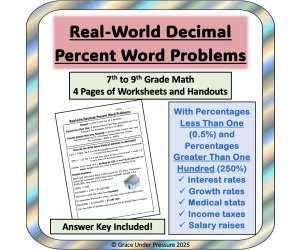
Percent Less Than One & More Than a Hundred: Decimal Percent Worksheet
Math, Addition and Subtraction, Multiplication and Division, Percentages, Decimals, Grade 7, 8, 9, Worksheets & Printables, Worksheets, Word Problems
Here are no-prep Real-World Decimal Percent word problem worksheets that show your students in 7th, 8th or 9th grade realistic scenarios that need the use of percentages less than one (for example, 0.5%) and percentages more than one hundred (for example, 250%) to solve. From measuring and comparing population growth to deciphering medical statistics to bookkeeping for small businesses- people use information about decimal percentages in our daily lives without even noticing it! Your Students Will: Learn from a sample scenario involving house price appreciation. Solve real-world decimal percent word problems involving interest rates, growth rates, medical statistics, salary raises, and more! Self-assess their skills with a simple self-assessment scale. How to Use: Print 4 pages of worksheets for each student Go through the sample problem together, ensuring students know how to convert percentages into decimals for easy calculations. Let students work in pairs or small groups on the word problems. Students self-assess their skills using a simple scale. Have students come up and share their solution methods when you review the questions as a class. A complete answer key is included. Math Skills Required: Converting percents less than one and more than one hundred into decimals. Completing calculations using the four operations, large numbers, and decimal percents. Using mental math and estimation skills to check the reasonableness of answers. Grades to Use With : These worksheets are perfect for students in 7th, 8th and 9th grade who are learning about (or reviewing) proportional relationships- specifically more complicated percents. They are a great way for students to practice solving real-world math word problems. The worksheets could also be used in high school special education classes where appropriate. What's Included: 6-Page PDF: Ready to Print and Use! Teacher Instructions Student Handout with Vocabulary and Sample Scenario 3 Pages of Student Worksheets with Word Problems and Self-Assessment Complete Answer Key
Author Grace Under Pressure
Rating
Tags Decimal Percent, Percent Less Than One, Percent More Than One Hundred, Percent Word Problems, 7th Grade Percent, 8th Grade Percent, Percentages, Real World Math, 9th Grade Percent
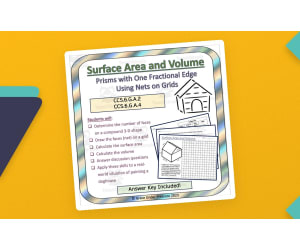
Surface Area + Volume – Real-Life Doghouse Math
Math, Geometry, Measurements, Common Core, Grade 6, Worksheets & Printables, Worksheets, Word Problems
Here's a fun and engaging lesson that helps students apply the geometry skills they are learning in the classroom to a real world mathematical situation: painting a doghouse. It is designed to address the Common Core State Standards 6.G.A.2 and 6.G.A.4: Finding volume and surface area and drawing nets. Students will: Determine how many faces there are on a compound three dimensional shape (including a rectangular prism & a triangular prism). Sketch the faces/create a net on the grid provided (one face includes a fractional length of ½ inch). Use a table to help calculate the surface area of all of the faces. Calculate the volume of this compound shape using a table to organize the information. Answer the provided discussion questions. These are provided to get students thinking about the concepts of geometry and include the questions: Explain why you didn’t calculate the area of the base of the doghouse. If each container of paint covers 200 inches², how many containers should you buy? Why would it be useful to know the volume of the doghouse? Students are also asked about the formulae for volume of a rectangular prism and triangular prism. Grades to Use With: This lesson is designed to target Common Core State Standards for 6th grade geometry. It could also be used for enrichment in 5th grade, review in 7th or 8th grades, or in a high school special education classroom. What's Included: 6 Page PDF Title Page Grid for Drawing Nets Extra Grid Paper Tables for Calculating Surface Area and Volume Discussion Questions Complete Answer Key If you enjoy this geometry activity, check out others in my store: Geometry Project: Park Design: Area, Perimeter, and Volume with Budgeting Middle School Math Stations or Centers: Triangles, Angles, Area Middle School Math Stations or Centers: Area, Perimeter, and Volume Relationship Between Area and Perimeter: Math Inquiry Prompt
Author Grace Under Pressure
Rating
Tags Surface Area, Volume, Geometry, 6th Grade Math, Grade 6 Math, Nets, Surface Area Worksheet, Volume Worksheet, Worksheets, Area

Absolute Value Worksheets: Real World 6th Grade Math 6.NS.C.7.C
Math, Number Lines, Numbers, Algebra, Grade 5, 6, 7, 8, Worksheets & Printables, Word Problems, Worksheets
Absolute Value can be a tricky topic to teach. It seems so easy and simple, but students actually need a strong, conceptual understanding of it for later years in middle school and high school math, so it definitely can't be skipped or glossed over! Here's a ready-to-go lesson all about absolute value for students in 6th grade. It is designed to meet standard CCSS 6.NS.C.7.c This lesson could also be a great review for students in grades 7 or 8 or could even be used in high school special education classrooms. First, there is a simple handout that explains what absolute value is using an easy, visual analogy: a dart board. Then, there are two pages of real-world questions for students to approach using an understanding of absolute value. From bank accounts, to elevation, to temperatures, to golf games, we actually use absolute value regularly in our number system without even noticing it! These questions require students to use number lines, integers, and absolute value proficiently. Students will notice how depending on the question, you may need to use an integer or an absolute value. They will start to see how absolute value can be helpful when calculating the difference between two numbers on a number line. A complete answer key is also included! If you enjoy this product, check out other grade 6 math number system lessons in my store: Middle School Math Stations or Centers: Fraction Operations: Add, Subtract, Multiply, Divide Multiplication and Division: Real Life Word Problems for Grades 4-6 Decimal Operations Assessment: Add, Subtract, Multiply, and Divide Middle School Math Stations or Centers: Factors, Multiples, Prime and Composite Integers and Plotting to Make Pictures in 4 Quadrant Cartesian Planes Combinations of Transformations in 4 Quadrants: Translation, Rotation, Reflection Real-Life Integers: Working with Integers and Number Lines Grade 6 Math
Author Grace Under Pressure
Rating
Tags Absolute Value, 6th Grade Math, Grade 6 Math, 7th Grade Math, Grade 7 Math, Number System, Number Lines, Real World Math, Word Problems, Absolute Value Worksheets
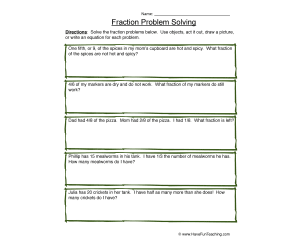
Fraction Word Problem Solving Worksheet
Math, Fractions, Grade 3, 4, 5, 6, Worksheets & Printables, Word Problems, Worksheets
Fraction Word Problem Solving Worksheet helps students solve five word problems relating to fractions using strategies of their choice. This is a great resource for teachers who want to help their students practice fraction word problems .
Author Have Fun Teaching
Tags

Canada Day or 4th of July Math Word Problems: Budget, Rate, Factors
Life Studies, Home Economics, Math, Money, Multiplication and Division, Division, Decimals, Grade 4, 5, 6, 7, Worksheets & Printables, Word Problems, Worksheets
Canada Day or 4th of July Math Word Problems: Budget, Rate, Factors, Multiples, Financial Literacy, Decimal Operations Here are three challenging, multi-step word problems for your middle school or intermediate students in grades 4-7. Each problem requires students to use their knowledge of factors and multiples, unit prices, and decimal operations. This is a great way to incorporate some simple financial literacy and budgeting into your math program. Two versions are provided: 4th of July and Canada Day: each version has a ready-to-print 3 page worksheet! Questions Included: Students need to figure out how to buy ingredients for 80 hamburgers at the best price. They will need to determine ways to make 80 using packs of 8, 12, 20, and 25. They will need to calculate the better unit prices. They think of ways a teacher could spend $20 to get some treats for her class with 24 students. There are inexpensive items like lollypops and pricier options like pop-its. Students should choose two different combinations of items. Finally, they determine how much a town would need to spend on fireworks and flags for their celebration. COMPLETE ANSWER KEY INCLUDED Grades to Use With: These activities could be used in grades 4-7 or in high school special education classrooms. In grades 4 and 5, you might do one problem together as a class, and then allow students to work in small groups to solve the other two. In grade 6 and 7, students should be able to complete these in a more independent way. If you enjoy this seasonal math activity , check out others in my store: Grocery Game: Winter Holidays Grocery Game: Spring Edition Halloween Budget Back To School Budget Christmas or Winter Holidays Budget Gingerbread Math: Fractions, Decimals, Percent Valentine's Day Shopping Lucky Leprechauns Multiplication Math Game
Author Grace Under Pressure
Tags 4th Of July, July 4th, Canada Day, Problem Solving, Word Problems, Financial Literacy, Budget, Decimals, Factors, Multiples
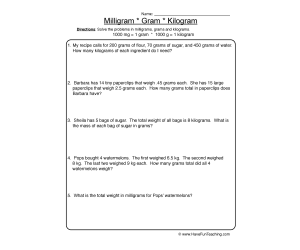
Metric Measurement Scenarios Worksheet
Math, Measurements, Grade 4, 5, 6, Worksheets & Printables, Word Problems, Worksheets
This Metric Measurement Scenarios Worksheet is a great way for students to convert grams and build their understanding of metric units. This product could help other teachers by providing a fun and interactive way for students to learn about metric measures.
Author Have Fun Teaching
Tags Weight