



3,984 products added recently
Page 2 - Social Emotional Learning Worksheets
Use SEL worksheets to help students navigate emotions, build resilience, and improve social interactions. Activities include scenarios, reflection prompts, and cooperative tasks. Incorporate them to strengthen community and foster a respectful learning environment.

 Show filters

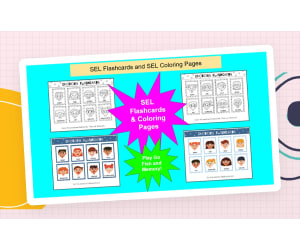
SEL Flashcards for Social Emotional Learning with SEL Coloring Pages
Special Resources, Life Skills, Social Emotional Learning (SEL), Social Skills, Special Education Needs (SEN), Speech Therapy, Preschool, Kindergarten, Grade 1, 2, 3, Activities, Centers, Games, Worksheets & Printables, Flashcards, Worksheets, Coloring Pages
In this SEL product, you will get SEL Flashcards for Social Emotional Learning. You will also get SEL coloring pages because there are two different pages of emotions/feelings. Both pages have a black and white version and a color version. The black and white version allows your students to color their own faces and images. The emotions listed are; happy, sad, silly, proud, shy confused, scared, excited, angry, tired, loving, sick, disgusted, cry, jealous, disappointed. These flashcards can be used for so many purposes. I have used these flashcards for Go Fish games where the students have to ask for a certain feeling. You will need to make two copies of the colored emotions poster to make this game work. If a student asks for "angry" and the student they asked has it, that student give the card to the one who asked and that student places the match down on the table and names a time they felt angry. I have also used this resource for memory games. You would, again, make two copies of each emotion. Then you would mix up the cards and place them face down (I would highly recommend cardstock) in a random order. Students then would choose two cards and reveal the emotion cards. If they are a match, then the student can share when they have felt that way. If it is not a match, they would place the cards face down again the the next student would take a turn. This is a fun and interactive game but also helps students discuss their feelings in a non-threatening way. This resource can be used as a whole class activity where students color their flashcards and then cut them out. They can randomly pick a card and name a time they felt that way. This can also be used as a center activity for Go Fish or Memory (as I described above). The ways to use these Emotion SEL Flashcards are endless!
Author Jennifer Moyer Taylor
Tags SEL Flashcards, SEL Coloring Pages, Games, Social Emotional Learning, School Counseling, SEL, Social Skills, Emotions, Feelings, Sel Activities

Working Memory & Sequential Recall Exercises
Life Skills, Special Resources, Social Emotional Learning (SEL), Social Skills, Special Education Needs (SEN), STEM, Resources for Teachers, Classroom Management, Community Building, Life Studies, Homeschool Curriculum, Grade 2, 3, 4, 5, 6, 7, Worksheets & Printables, Workbooks, Worksheets, Word Searches, Teacher Tools, Lesson Plans, Quizzes and Tests, Quizzes, Tests, Presentations
The Evidence-Based Working Memory & Sequential Recall Curriculum Will Help Unlock Your Students' Ultimate Learning Potential! As an Educator, Clinician, or Special Education Teacher do you have students struggling to complete multi-step directions, reading comprehension or complex math problems? Do you see them grasp a concept at one moment, and then lose it the next? More than likely, the root cause of this lack of learning is not due to the student not putting forth effort, but rather, it's simply a bottleneck in their working memory. This comprehensive 41-page digital curriculum is much more than a set of worksheets - it's an evidence-based intervention program specifically developed using the science of neuroplasticity and within Alan Baddeley's highly regarded cognitive theory to target, strengthen and developed the most important part of the cognitive engine of learning, which is working memory and sequential recall - so that teachers are able to go beyond rote memorization while at the same time, enabling the student to create robust, long-lasting executive function skills. Designed to meet the needs of 2nd, 3rd, and 4th grade Student as well as for support of older students who are in RTI/MTSS or Special Education, this curriculum is going to help support students bridging the gap from seeing the information to actually processing the information. HOW TO USE THIS 41-PAGE DOCUMENT This is a comprehensive 3-step program that is ready for you to implement right away: Step 1 - Core Content and Theory (A Guide for Educators) — An in-depth look at the cognitive science behind the exercises. Through clear definitions and supporting case studies, you’ll be able to accurately explain Phonological Loop, Visuospatial Sketchpad, Central Executive, and Episodic Buffer to yourself and to others so that you, as an educator, can become an expert in understanding what each of these components does. Step 2 - Student Workbook — Ten progressive, fun worksheets for students to accomplish as if they were on “missions” (i.e., Zoo Keeper’s Roster, Detective’s Missing Clue, Architect’s Blueprint, etc.). These worksheets each target unique aspects of working memory by having students perform: - Forward/Backward Sequential Recall - Procedural Recall/Recognizing Steps - Semantic Clustering/Categorizing - Dual-Task Process/Inhibiting Distractors - Pattern Recognition/Chronological Sequencing Visual Aid and Teacher Resources (Part 3): The essential support for successful teaching. Cognitive Architecture Visuals; Diagrams to support cognitive processing and visual representation of working memory. Teacher Implementation Guide; Framework for cognitive dose control of Load with 7-10 minute intervals. Differentiation; Explicitly designed order of operations enabling the use of scaffolding in strategies used for increasing to gifted levels. Comprehensive Answer Key; A tool for quick and effective evaluation of student achievement. You will be able to change your responses of, "I forgot," to, "I've got this!" once you have utilized your resources from above. Key Words: Working Memory, Executive Functions, Sequential Memory, Special Education, Speech Language Pathologist/ Speech Therapy, Response To Intervention, Multi-Tiered System Of Supports, Cognitive Skills, Following Multi-Step Directions, Reading Comprehension, Math Word Problems, Learning Disabilities, ADHD Support, 2nd Grade, 3rd Grade, 4th Grade, Digital Resource, Paper Forms, Cognitive Load. The reasons parents/schools value it: Targets Root Causes: This program helps children build the underlying cognitive skills themselves rather than just treating their symptoms (e.g., bad grades, lost assignments). These skills (working memory) allow students to do all of their academic work. Based on Scientific Evidence & No Prep Required: The exercises included in this program are not simple "busy work." They form part of a well-structured curriculum based on scientific principles of cognition. They are provided to the teacher in easy-to-print/implement formats, thus allowing the teachers to save preparation time. Differentiation Built-In: The teacher's guide includes specific strategies for the teacher to assist struggling learners and to challenge gifted learners, thus allowing all children to make significant (meaningful) progress. Increased Independence in Class: Students completing the exercises will demonstrate increased ability to follow multi-step instructions, complete complex tasks, and work independently with minimal redirection. Improved Achievement Across All Academic Areas: Students who have a strong working memory can better comprehend what they have read (because they can track characters and plot), can solve math problems more accurately (because they can hold the numbers and steps they are holding), and can write more clearly and accurately because they have better organization. Target Audience Analysis: On the basis of the content, the nature of the language, and the explicit references within the PDF: The primary audience are second to fourth graders (approximately ages 7-10). The document explicitly states this developmental window as its focus. Secondary audience: The resource is just as appropriate for older students (5th grade and up) with identified learning disabilities, ADHD, or who are in a support program through Special Education, Resource Rooms, Speech Therapy, RTI, or MTSS. These basic foundational skills are often the major barriers to learners. Primary audience: for professionals, and not the kids. Of course, other groups are: General Education Teachers (Grades 2-4) Special Education Teachers School Psychologists Speech-Language Pathologists (SLPs) Educational Diagnosticians Homeschooling Parents who are familiar with brain development. Copyright /Terms of Use: Copyrighted by Syed Hammad Rizvi. This resource is for individual use and classroom only. No part of this resource may be modified, sold, or shared in any other manner, including posting it on the Internet where anyone might download it. If you wish to provide this resource to other teachers, you must purchase additional licenses through Teachsimple. Thank you for your cooperation in this matter and for following the terms of use. This resource is proudly provided to you by Syed Hammad Rizvi.
Author Creative Book Store
Rating
Tags WorkingMemory, ExecutiveFunction, ExecutiveFunctioning, ExecutiveFunctionSkills, CognitiveSkills, BrainTraining, Neurodiversity, SequentialRecall, SequencingSkills, FollowingDirections
Trauma-Informed Coping Strategies & Burnout Prevention
Life Skills, Special Resources, Social Emotional Learning (SEL), Social Skills, Special Education Needs (SEN), Speech Therapy, STEM, Resources for Teachers, Classroom Management, Community Building, Grade 9, 10, 11, 12, Worksheets & Printables, Workbooks, Worksheets, Word Searches, Teacher Tools, Lesson Plans, Quizzes and Tests, Quizzes, Tests, Assessments
Do you have academically smart students who feel apathetic? Do you see signs of burnout: perfectionism, worry, sleepless nights, and lack of will to study any further? The current academic environment seems to be a very stressful place to be in. For students in advanced placement programs such as AP, IB, and other similar programs, the intense search for success often leads to chronic levels of stress, anxiety, and burnout. Traditional advice on time management and wellness simply does not work in this situation – since what they need is not effort but rather the functioning of their nervous systems in survival mode. The name of the program is Trauma-Informed Coping Strategies and Burnout Prevention: Self-Awareness Strategies for High School Students. This is not just another workbook. It is a well-developed curriculum based on neurobiological principles that helps the students deal with stress and avoid burnout. This guide helps the students stop looking at stress as a psychological phenomenon. What is Included in the 34-Page Material? Section One: The Structural Nature of Academic Resilience: This part of the paper presents concise information regarding the reason behind burnout. The section also teaches students about the neurobiology of stress such as the HPA Axis, Allostatic Load and Window of Tolerance which are important concepts in the educational field. It also features such significant ideas as Strategic Underachievement and Harm Reduction. Section Two: The Student Workbook (11 Self-Tests): This part be viewed as the basis of the whole curriculum and through the help of 11 intense self-tests the educators will be able to explain the nature of stress. Among the themes discussed are; the Burnout Proximity Scale, Nervous system and perfectionism tests, Assessment of Energy Expenditure and Time- Blindness, The External Forces and the Relational Boundaries, The Imposter and Academic Worth, Acute crisis and Grounding. Section Three: Visuals and Teacher/Counselor Resources: This section is important for the teachers and educators due to the fact it contains the following diagrams; the Academic Burnout Cascade, Trauma-Informed Coping Matrix and The Self-Auditing Cycle. Moreover, as far as the teacher can reach the information concerning students’ needs and problems. In that way, the person will be able to remain at the correct track. This tool is ideal for all kinds of professionals such as counselors, psychologists, teachers in health and wellness classes, and people working with the youth. With it, you will be able to help these students successfully survive high school along with creating essential skills they need during college years and in their lives. Keywords: social emotional learning, mental health, preventing burnout, stress management, skills of study, executive function skills, high school, AP, IB, college preparation, academic resilience, coping skills, trauma informed, workbook, anxiety, perfectionism, school counselor Reasons Why Parents/Schools Appreciate It: Evidence-Based Approach: The program doesn’t consist only of generic self-care tips, rather it provides students with an understanding of neurobiology behind stress. Promotes Self-Awareness in Students: The self-audit format allows students to put themselves in control of their situations and helps them to learn how to analyze their own states of well-being and develop useful skills. Presents a Well-defined, Actionable Approach: The program brings a unique mix of theory and practice, offering students all necessary tools to create their own management plan. Includes All Necessary Resources for Teachers: The comprehensive Teacher Guide, diagnostic rubrics and facilitation scripts turn this program into a plug-and-play solution for counselors and teachers. Develops Resilience: The skills developed will allow individuals to set personal boundaries, manage emotions, think differently, and separate self-esteem from success. Intended Target Audience: The targeted audiences would vary in the context of the subject matter discussed (AP, IB, highly competitive college admission procedures, neurobiology). Main Audience: Gifted students and high school students in grades 10–12. Among this group of students, there are many advanced courses (AP, IB, Dual Enrollment) students who experience problems relating to the college admission process. Minor Audience: School counselors this program can be used successfully in individual and group counseling. Health, wellness, and psychology teachers this program can be used as a multi-week unit in their classes. Advisory / homeroom teachers this program will serve as a useful resource for the school SEL curriculum. Proactive students and parents of gifted kids who need a practical instrument to cope with school stress. Copyright and Other Legal Issues Copyright on this Book rests with Syed Hammad Rizvi. This material is created for your own personal and one day classroom uses. You may not modify, market or sell any part of this resource. In other words, you must not place it on web for public access. If you wish to share this material with your colleagues, please purchase additional copies from Teachsimple.
Author Creative Book Store
Rating
Tags AcademicBurnout, StudentBurnout, StressManagement, AcademicStress, StudentAnxiety, TestAnxiety, Perfectionism, Procrastination, Overwhelm, StudentMentalHealth

Guided Reading Level H - Who Cooks for the Community
ELA, Resources for Teachers, Reading Comprehension, Reading, Social Emotional Learning (SEL), Special Resources, Career, Life Studies, Social Studies, Economics, Kindergarten, Grade 1, 2, Worksheets & Printables, Worksheets, Teacher Tools, Centers, Activities, Literacy Readers, Quizzes, Quizzes and Tests, Assessments
This Guided Reading Book - Who Cooks for the Community (Level H) includes: Guided Reading Color Label (front cover x1) This is a quick way to match the book’s demands to what students can generally handle.. The overall goal is to use the level/color to pick books for several smaller groups. To qualify for a certain level, a student is expected to read a book from that level with about 90–94% accuracy. If a student is consistently accurate and understands, move up a level. If the student is struggling at that level, drop down and add more support. Each student will improve at completely different rates, but it is generally one of the best ways to check progress across the class. DOWNLOAD THE CATALOG TO VIEW ALL GUIDED READING BOOKS AVAILABLE (SORTED LEVELS A-Z) Pre-Reading Question (x1) Teacher asks the prompt aloud, can be while showing the cover or first page. Students share what they already know, or make educated guesses from the cover. Prompt them to use the target vocabulary. Write some of their responses on the board to look back at during the reading. Vocabulary Words (x5) Introduce the five words, best doing it one at a time. Start by saying it, while students repeat and then see if anyone knows what it means before reading further. Read through the meaning and try to briefly connect each word to a picture or gesture so it’s meaningful. Ask students to flip through the book pages and point to where they see each of the vocabulary words. While reading the book pause upon coming across one of the vocab words or read the sentence twice to make sure students understand the word has appeared. Optional: Ask students to raise hands whenever they see/hear one of the new words. Guided Reading Pages (x10) Check the book snapshot (below) for: primary topic - do you need to prep extra reading or intro materials on this? what is taught best - decide on 1-2 bullets to focus on, use the prompt or words provided here for best results. learning goals - what you are checking for students to be able to do after the session, elicit answers using prompts or words provided. key vocabulary (see section above). questions overview - so you know what is coming up and if you need to prep extra materials to assist understanding. Run the lesson You may have already looked at a few of the pages together, but you can show them some of the pictures again first to set meaning. Depending on how much time you have and how familiar your students are with guided reading class, you may want to read the book aloud first with the group first. Students whisper or partner read, while you listen in. If time, do it as a group, one student reading a page each. Use the guided page’s prompts to coach: “Check the picture / does it make sense?” “Point under the words / try the first sound” “Reread the sentence smoothly”. Try to focus more on one student per session (rotating every time), so you can work out if they are ready to move up or need to move down a level. Comprehension Questions (back cover x3) This is your way to check that students didn’t just say the words, but actually understood the text. First, let students answer by pointing to the page/picture and saying a short sentence. After any answer, follow with: “Show me where you found that in the text.” In bigger groups, have partners answer first (10–20 seconds), then call on 2–3 students to share. Differentiation tips: Emerging speakers/struggling readers: oral + pointing On-level: oral in a full sentence Higher: one written sentence or draw + label Book Snapshot Title: Who Cooks for the Community? Genre: Nonfiction (informational) Subject: Social Studies / Reading Primary Topic: Kitchen jobs that feed the community Estimated Guided Reading Level (A–Z): H What This Book Teaches Best How many different workers in a kitchen help make food for others in the community (restaurants, schools, hospitals). The roles and responsibilities of kitchen jobs (head chef, sous chef, line cooks, prep cook, pastry chef, bakers, pizza makers, dishwasher). How teamwork in kitchens helps people stay healthy by providing nutritious meals. Using text to learn job-specific actions and tools (checking supplies, chopping ingredients, measuring, mixing dough, cleaning pots and pans). Learning Goals Students will describe how kitchens help the community using details from the book. Students will identify at least three kitchen jobs named in the text and tell what each job does. Students will explain what the head chef decides and why that role is important. Students will describe how the prep cook helps the other cooks work faster, using text evidence. Students will explain why a clean kitchen is important for preparing food, based on the dishwasher page. Key Vocabulary From the Text sous — a helper chef who is second in charge. ingredients — foods used to make a meal or recipe. responsible — in charge of an important job. specialize — focus on doing one kind of work well. nutritious — good for your body; helps you stay healthy. Discussion Prompts Pre-reading question: Who do you think works in a kitchen, and what might they do? Comprehension questions: Where does the book say people visit kitchens to get the food they need? What does the head chef decide in the kitchen? Why does the book say the dishwasher is an important part of the kitchen team? Printing Tips 1. Best Printing Method (Recommended) “Booklet” Printing (Best if Available) If your printer or PDF viewer supports Booklet Printing , use this. Settings to use: Print mode: Booklet Paper size: Letter or A4 (either works) Orientation: Landscape Print on both sides: Yes Flip on: Short edge Scaling: Fit to printable area Booklet subset: First test: Front sides only Then: Back sides only This will automatically: Pair pages correctly Put the cover on the outside Align everything for folding After printing, fold in half and staple along the spine . 2. If “Booklet” Printing Is NOT Available You can still print this correctly with manual duplex printing . Step-by-step: Open the PDF. Choose Print . Set: Orientation: Landscape Pages per sheet: 1 Print on both sides: Yes Flip on: Short edge Print all pages . Because each PDF page already contains two facing book pages, the result will still fold cleanly into a book. Thousands of Cored Education products are included with your TeachSimple membership. Download links and encyclopedia index available here.
Author Cored Education
Rating
Tags Vocabulary, Reading Comprehension, Reading Passages, Leveled Reading, Nonfiction, Reading, Guided Reading, Social Studies, Chef, Careers

Personal Brand Identity & Color Theory Grids
Science, Technology, Computer Science, Engineering, STEM, Special Resources, Life Skills, Social Emotional Learning (SEL), Special Education Needs (SEN), Social Studies, Homeschool Curriculum, Homeschool Templates, Grade 9, 10, 11, 12, Worksheets & Printables, Workbooks, Worksheets, Word Searches, Writing Prompts, Teacher Tools, Lesson Plans, Quizzes and Tests, Quizzes, Tests
Transform Your Students' Digital Portfolios from Generic to Unforgettable! Are your high school students preparing for college admissions, scholarships, or their first career steps? In today's digital world, a professional online portfolio is no longer a "nice-to-have"—it's an essential tool. But how do you guide them to create a portfolio that truly stands out and communicates their unique value in just a few seconds? This comprehensive curriculum is your answer. "Personal Brand Identity & Color Theory Grids" is a rigorous, project-based unit that bridges the gap between abstract personal traits and powerful, professional visual communication. It moves beyond "picking pretty colors" and teaches students the psychology behind design, empowering them to engineer a digital identity that captivates admissions officers and recruiters from the very first click. Students will embark on a journey from self-reflection to technical application, learning how to translate their core values—like "innovation," "reliability," or "creativity"—into specific, web-ready Hex color codes. They will learn to build a sophisticated 5-point color grid that ensures their portfolio is not only beautiful but also accessible, psychologically resonant, and strategically effective. ► Who is this for? High School Teachers (Grades 10-12, perfect for seniors) Subjects: Art, Graphic Design, Web Design, Computer Science, Career & Technical Education (CTE), Business, and Senior Capstone or College Prep courses. ► What's Included in this 42-Page PDF? Phase 1: In-Depth Theory (10 Pages): A detailed guide covering the cognitive psychology of color, professional archetypes (The Analyst, The Empath, etc.), the mathematics of Hex codes, and case studies. Phase 2: Student Workbook (13 Pages): Ten rigorous worksheets that guide students through every step of the process, from defining their core values to stress-testing their final color palette for accessibility (WCAG). Phase 3: Visuals & Teacher Resources (19 Pages): Pedagogical Visuals: High-resolution diagrams explaining key concepts. Comprehensive Answer Key: Detailed answers and exemplar responses for all student worksheets. Teacher Implementation Guide: Includes a pedagogical rationale, a suggested 10-day pacing guide, and instructions for facilitating a professional critique. Equip your students with the 21st-century digital literacy and personal branding skills they need to build a future they deserve. Download this turnkey curriculum today and watch their confidence and portfolios soar! Keywords: Personal Branding, Digital Portfolio, Color Theory, Color Psychology, Hex Codes, Graphic Design, Web Design, College Applications, Career Readiness, High School, Senior Project, Capstone, Visual Identity, UI/UX, Project-Based Learning, CTE, STEM, Art Curriculum. Why Parents/Schools Love It: Builds Real-World Career Readiness: This curriculum goes beyond theory and provides students with a tangible, high-impact skill. They learn to market themselves professionally, giving them a distinct advantage in college and job applications. Integrates Art, Psychology, and Technology (STEM): This is a powerful cross-curricular resource. It connects creative expression with the science of human perception and the technical language of web design (Hex codes), making it relevant for students in both arts and STEM fields. Promotes Deep Self-Reflection and Critical Thinking: Students aren't just following instructions; they are guided through a process of defining their personal values and professional goals, forcing them to think critically about how to present themselves to the world. Comprehensive & Turnkey for Teachers: This is not just a worksheet; it's a complete, 42-page unit. With a teacher guide, a 10-day pacing plan, student-facing theory, worksheets, and a full answer key, it saves educators dozens of hours of prep time. Target Student Audience : Based on the language ("post-secondary transition," "Grade 12 transition"), academic rigor, and professional focus, you should target: Primary Target: High School Seniors (Grade 12). The material is perfectly tailored for students building portfolios for college applications and job/internship searches. Secondary Target: High School Juniors (Grade 11): Excellent for advanced students in design, art, or tech programs. First-Year College/University Students: Ideal for introductory courses in graphic design, digital media, or professional development. Ideal Courses: Art & Graphic Design Web Design / Interactive Media Computer Science (as a design/UI module) Career & Technical Education (CTE) pathways Business & Marketing College Preparedness / Senior Seminar / Capstone Project classes Copyright/Terms of Use: This Book was copyrighted by Syed Hammad Rizvi. This resource is for personal and single classroom use only. You may not alter, redistribute, or sell any part of this resource. In other words, you may not put it on the Internet where it could be publicly found and downloaded. If you want to share this resource with colleagues, please purchase additional licenses from Teachsimple. Thank you for respecting these terms of use. This product is happily brought to you by Syed Hammad Rizvi
Author Creative Book Store
Rating
Tags PersonalBranding, ColorTheory, GraphicDesign, WebDesign, DigitalPortfolio, BrandIdentity, ArtEducation, DigitalLiteracy, ProjectBasedLearning, ColorPsychology
Impulse Control "Stop-and-Think" Scenarios
Special Resources, Life Skills, Social Emotional Learning (SEL), Social Skills, Special Education Needs (SEN), Speech Therapy, STEM, Resources for Teachers, Classroom Management, Community Building, Kindergarten, Homeschool Curriculum, Homeschool Templates, Grade 1, 2, 3, 4, Worksheets & Printables, Workbooks, Worksheets, Word Searches, Teacher Tools, Lesson Plans, Quizzes and Tests, Quizzes, Tests, Assessments
Are you having difficulty keeping your class from being disrupted by impulsive behaviors, such as yelling out of turn, grabbing objects off the desk, etc? Transform your classroom into an orderly, peaceful environment using this cutting edge, neuroscience-based curriculum for teaching impulse control skills! This is not a behavior chart. It is a complete, turn-key curriculum designed to provide K-3 students with a reason for their actions and give students the skill set necessary to “Stop and Think.” This curriculum is based upon cause and effect mapping. This curriculum also creates a visual, non-judgmental framework for developing and reinforcing lifelong self-control and executive functioning skills without relying upon punishment. The impulse control curriculum is a perfect teaching tool for general and special education teachers and school counselors because it directly addresses the neurodevelopmental needs of young children. Young students will finally develop a clear understanding of how to connect the impulse for an immediate action with the consequences of that action at a future time. Packages Include 46 Pages of Content That Covers: Phase 1: Educator’s Guide to the Impulsive Brain: A Simple, Easy-to-Follow Guide About the Neurobiology of the K-3 Brain So You Can Implement this Strategy in Your Classroom with Confidence. Phase 2: Student Workbook with 10 Scenarios: Homework Sheets That Help You With Everyday Classroom Challenges. Primarily Used For Teachers To Give Out, Also For Students To Complete On Their Own. Examples Include: Calling Out (The Interruption Ripple) Grabbing & Boundary Violations (The Space Invader) Hallway Safety (The Transition Tornado) Task Avoidance and Frustration (The Frustration Flash) Cutting in Line, Misusing Supplies, Indoor Voice and many other examples. Phase 3: Teacher Visuals and Resources: Conceptual Diagrams: Simple Visual Aids To Help Explain The ‘Stop and Think’ Cycle And The Domino Effect of Actions. Comprehensive Answer Key: Each Worksheet Has A Detailed Answer Key Including A Teacher Rationale And Guidance Prompts To Deepen Student Learning. Implementation Guide: A Step By Step Plan On How To Introduce, Practice, And Reinforce These Concepts In Your Classroom. Ideal for: Elementary School (K-3) Teachers Social Emotional Learning( (SEL) Programs Small group and .Individual Counseling/Interventions Students exhibiting attention challenges and difficulties with impulse control Classroom Behavior Management Support Support students in developing self-awareness and the ability to self-regulate through this easy-to-follow and complete program! Download now and create a more compassionate, calm, and productive classroom! Search Terms: Impulse control, self-regulation, social emotional learning (SEL), classroom behavior management, behavior Intervention, executive functioning, Cause and Effect, Stop and Think, K-3, Kindergarten, 1st grade, 2nd grade, 3rd grade, ADHD Support, Emotional regulation, print documents, behavior mapping, visuals to support learning. Reasons Why Parents and Schools Appreciate This System: The focus of this system is on skill building through the development of empathy & social awareness, rather than punishment. When discipline is replaced with proactive skill building, it empowers your child. This system is backed by neuroscientific research on how children develop. Many traditional methods do not function well because they do not work with how the brain develops, so this system is based on good science. Through the principle of the "ripple effect", children will develop a better understanding of how their behaviour affects not only themselves but also family & friends. This is not just a worksheet. This system includes the teacher's guide, activities for students, visual aids and an answer key, so you can spend more time teaching & less time preparing. The system will validate the feelings and impulses of a child ("Your body was telling you to grab") and provide the child with tangible tools to make a better choice, allowing him/her to become an active architect of his/her own success. Intended Audience: The target audience is educators and support personnel who work with children in grades K-3, as well as parents who want to support their child at home. The way that children in this age group typically learn and behave, make it difficult for them to develop effective self-regulation skills, therefore parents and professionals need additional support in teaching these skills. The explicit text indicates a K-3 focus (ages 5-9) and the type of behavioral problems addressed in this resource; behaviors classified as K-3 students in the general education classroom include: * K-3 General Education (all K-3 classes) * K-3 Special Education teachers who assist students with ADHD, ASD and/or other executive functioning deficits * School-based counselors, social workers and school psychologists providing small group and individual intervention * Behavior interventionists and BCBAs * Proactive parents wanting to implement strategies at home to help their child gain self-regulation skills Copyright and Terms of Use: The author, Syed Hammad Rizvi, has copyrighted this resource for your sole enjoyment in the classroom and at home. You may not copy, modify or distribute this resource in any way, including on the Internet, where it can be found and downloaded for free by anyone. If you would like to share this resource with your colleagues (and they would like their own copy), you can purchase additional licenses from Teachsimple! We greatly appreciate it when you follow the Terms of Use stated here. Sincerely, Syed Hammad Rizvi
Author Creative Book Store
Rating
Tags ImpulseControl, SelfRegulation, EmotionalRegulation, BehaviorManagement, ClassroomManagement, SocialEmotionalLearning, SEL, ExecutiveFunctioning, StopAndThink, CauseAndEffect
Conflict Resolution & Peer Mediation Prompts
Life Skills, Special Resources, Social Emotional Learning (SEL), Social Skills, Special Education Needs (SEN), Speech Therapy, STEM, Resources for Teachers, Classroom Management, Community Building, Homeschool Curriculum, Homeschool Templates, Grade 4, 5, 6, 7, 8, Worksheets & Printables, Workbooks, Worksheets, Word Searches, Teacher Tools, Lesson Plans, Presentations, Quizzes and Tests, Quizzes, Tests
Do you find that there are many complicated (and sometimes unseen) conflicts in your 4th, 5th, and 6th grade classroom? From conflicts on the playground to having miscommunication on group chat, pre-adolescents have a much more difficult time managing their social world than they ever did before. This curriculum on Conflict Resolution and Peer Mediation is a complete, research-supported program that will help you empower your students with the tools necessary for success in looking at conflict in a way that is positive and productive. This is not just another collection of worksheets; this is a complete Social Emotional Learning (SEL) toolkit that has been created for the modern student. Based on developmental psychology, this curriculum will address the two types of settings in which pre-adolescents experience conflict: the physical environment of the playground and the virtual environment of today's digital world (gaming, social media, texting). Using the use of "scripted roleplay scaffolding" methodology, this curriculum will enable a child to bypass the "fight or flight" response and give them the exact words and tools they need to de-escalate an argument, share their feelings in a healthy way, and resolve conflict. Additionally, by providing the student with a "lexical bridge," they will be able to articulate complex emotions (jealousy, exclusion, betrayal) in a manner that will promote empathy and understanding. What's Included in the 48 Page PDF File Section One - Guidelines for Teachers This section provides an in-depth overview of the theory and methodology used in the development of these scripts along with the reasons behind their creation. It covers issues such as social dynamics of pre-teens, the difference between intent versus impact, and the unique challenges of dealing with conflict in the digital world (Online Disinhibition Effect). Section Two - Eleven Worksheets for Students These are the main component of the curriculum and consist of eleven interactive worksheets that incorporate real-life scenarios faced by students on a daily basis. The worksheets cover a broad range of scenarios dealing with: Group Chat Misunderstanding (Roblox, text messaging) Disputes between Playground Rules (Four Square) Digital Exclusion (Multi Player Gaming, Minecraft) "I Was Only Playing" and Cyber Bullying Rumors, Gossip, and Broken Trust The Challenge of Inclusion (Cafeteria Seating) De-Escalation Strategies for Youth Valuing Digital Property and Creations Section Three - This teacher resource package includes all necessary materials needed to complete each portion of the curriculum. Visual Support: Printable, easy-to-read diagrams outlining the Peer Mediation Pathway, conflict escalation, and I-Statement structure. Complete Answer Key: Sample answers for all questions in the curriculum supporting main concepts of de-escalation and restorative language. Full Implementation Guide: Step-by-step directions for introducing your curriculum, implementing role-playing (including "Fishbowl" method), differentiating for all learning levels, and addressing and assisting with common challenges. Provide your students with a lifelong gift: confidence and ability to develop healthy friendships and resolve conflicts calmly and with compassion. This curriculum is for teachers, counselors, social workers and administrators. Keyword SEO: Conflict Resolution; Peer Mediation; Social Emotional Learning; Grammarly; Digital Citizenship; Cyberbullying; Anti-Bullying; Worksheets; 4th Grade; 5th Grade; 6th Grade; Middle School; School Counselor; Restorative Justice; I-Statements; Role Playing Scripts; Classroom Management; Friendship Skills. Why Parents Schools Appreciate It: Provides the Exact Words: Rather than telling children what to do, it gives them exactly how to express themselves in situations of high stress. This "lexical certainty" is a game changer for those children who become overwhelmed by a situation and don’t know what to say. Addresses Today’s Technological Conflicts of the New Millennium: This curriculum goes beyond teaching children outdated scenarios to dealing with real types of digital situations that they face today, such as gaming exclusion, misunderstandings with friends on a group text message, and dealing with the impact of a “seen” message. Therefore, it is extremely relevant and effective. Research-based & Developmentally Appropriate: The method used in this curriculum is based on solid principles of child psychology and understands the concrete scaffolding that pre-adolescents need to utilize when managing complex feelings. It provides a structured safe environment in which to practice empathy. Comprehensive No Preparation Resource: This is a complete 48-page curriculum, not a single worksheet, along with a teacher’s guide, visual aids, student workbook, and an answer key, therefore providing the educator and/or counselor an immediate implementation resource with a high level of confidence. Builds Lifelong Skills: This curriculum is a method of solving conflicts today, it also creates the building blocks for rewiring a child’s approach to conflict as they move into adulthood and creating the neurological pathways to become more mature, empathetic, and resilient in relationships as an adult. Target Audience Classes : After conducting a thorough review of their report, the authors (PDF) specifically identified the following groups as targets based on a potential audience needs analysis: Grades: Fourth grade through sixth grade Ages: Approximately 9 to 12 years The authors also have tailored to this developmental stage, as well as their own peer social groupings, such as on playgrounds, in-game chat rooms (Roblox, Minecraft), and with friends via group messenger/chat program. Thus, they provide great information directed towards students in early/middle school and also those working with them professionally (school counselor/social worker). Copyright Notice: This book is copyrighted by Syed Hammad Rizvi and only allowed for one person (you) and one classroom use of the book you have purchased. You may not make any alterations, distribute, sell or share (post on the internet) this book. For additional copies to distribute to colleagues please purchase a license from Teachsimple. Thank you for your support of our copyrights. This Product is proudly made by Syed Hammad Rizvi
Author Creative Book Store
Rating
Tags ConflictResolution, SocialEmotionalLearning, SEL, PeerMediation, DigitalCitizenship, ClassroomManagement, CharacterEducation, CommunicationSkills, RestorativeJustice, RestorativePractices
Proprioceptive Power-Ups: A Gamified Physical Therapy & Sensory
Research, Resources for Teachers, Classroom Management, Community Building, Special Resources, Life Skills, Social Emotional Learning (SEL), Social Skills, Special Education Needs (SEN), Speech Therapy, Grade 1, 2, 3, 4, 5, 6, 7, 8, Worksheets & Printables, Workbooks, Worksheets, Word Searches, Teacher Tools, Assessments, Graphic Organizers, Lesson Plans, Presentations, Outlines
With Proprioceptive Power-Ups, you can turn dysregulated classrooms into focused learners. This complete, evidence-based, gamified sensory regulation program takes ‘heavy work’ and transforms it into new fun, student-led Power-Ups. The 27-page digital PDF resource is designed to provide occupational therapy, physical therapy, and real-world classroom viability for students in kindergarten through eighth grade. Using Sensory Integration Theory, Self-Determination Theory (SDT), and micro-learning protocols, Proprioceptive Power-Ups provide sensory seekers with 3-5 minute ‘bursts’ of proprioceptive and vestibular input that calm those under-responding to sensations at the same time dramatically improving attention, motor planning skills, emotional regulation, and other important areas of development. The following features are provided within Proprioceptive Power-Ups: Comprehensive theoretical underpinning (neurobiology of proprioception, tripartite circuit architecture, integration within an MTSS Tier 1-3 model) 10 student workbook worksheets with fill-in-the-blank self-reflection and data tracking to complete before beginning a new series of Power-Ups. Age-divided choice board usages for example K-2 use an imagination engine; 3-5 uses a mission protocol; 6-8 uses biometric optimization. Full-color diagrams, schematics include but are not limited to: Neurological Processing Pathway; 3-Phase Sensory Circuit; Gamification Mechanics Matrix. Examples of IEP goals, tools for collecting data, and case studies demonstrating an overall reduction of 60-78% in both elopement and disruption of classroom activities as compared to pre-Proprioceptive Power-Ups implementation. Instant digital download of entire resource, no preparation required! Proprioceptive Power-Ups are ideal for teachers, occupational therapy specialists (OT), physical therapy specialists (PT), special education teachers/special instructors, and parents who are serving students with or without ADHD, developmental coordination disorder (DCD), autism spectrum disorder (ASD), or other classroom sensory processing disorder(s). Why Schools & Parents Are So Happy About It 1. Effectively Calms & Focuses Students: With instant self-regulation through 3–5 minutes of gamified “heavy work” activities, elopement, meltdown, and verbal disruptions have been reduced by as much as 78% in real case study examples. 2. Zero Lesson Prep but Maximum Engagement for the Students: Therapy is turned into play, through Choice Boards and avatar style Power-Ups - giving students choice and control, and saving teachers time while providing maximum engagement for the students in busy classroom settings and for kids on their IEP. 3. Evidence Based and Measured Progress: Easy access to the “whole brain” theory of neuroscience with pre/post data tracking tools and IEP goal templates providing easy documentation of progress to parents and administrators. 4. Age Appropriate From K to 8th Grade: There are differentiated stations and language to keep even the youngest kids excited about (and the oldest kids “cool” about) participating in activities in the same room without being segregated by age. 5. Proven Return On Investment: High impact proprioceptive input (replacing ineffective fidgety tools) will continue to improve time on task, enhance writing skills, and improve working/executive function without the need to sacrifice time during instruction. Target Students and Grade Levels: The resource is geared toward kindergarten through 8th grade (K-8) students. The children that will benefit from this program demonstrate an under-stimulated or dysregulated proprioceptive and vestibular system, including: Sensory Seekers (i.e., crashing, chewing, and pressing too hard); Sensory Under-Responders (i.e., lethargic, floppy, and having low muscle tone); Students with Attention-Deficit/Hyperactivity Disorder (ADHD) - Combined Type; Autism Spectrum Disorder (ASD); Developmental Coordination Disorder (DCD); Dyspraxia .A general education classroom using a Multi-Tiered System of Support (MTSS) Tier 1 (i.e., universal brain breaks), Tier 2 (i.e., targeted small groups), and Tier 3 (i.e., Individualized Education Plan-specific on Circuit) will also utilize the program as needed. There is built-in scaffolding provided within the program through the following: narrative/imaginative play for grades K-2; challenge-based missions for grades 3-5; and more mature "biometric optimization" language for middle school (grades 6-8) to assist in securing the dignity of the adolescent population. Copyright / Terms of Use This Book is copyright protected by Syed Hammad Rizvi. You may only use this resource for your own personal use and for use by one class within your own classroom. You may not change this resource or redistribute or sell any part of the resource. In other words, you may not post this resource on the internet where it would be easily accessible and/or downloadable by others. If you would like to share this resource with other teachers, kindly purchase additional licenses to use this resource from Teachsimple. Thank you for complying with the terms of use for this resource. Thank you from all of us at Syed Hammad Rizvi for purchasing this product!
Author Creative Book Store
Rating
Tags ProprioceptiveInput, HeavyWorkActivities, HeavyWork, JointCompression, DeepPressure, SensoryCircuit, SensoryIntegration, SensoryProcessingDisorder, SensoryProcessing, SensoryDiet

Money Math Life Skills Worksheet: Reading Restaurant Menus Level 4
Special Resources, Creative Arts, Art, Social Emotional Learning (SEL), Special Education Needs (SEN), Speech Therapy, Life Skills, Grade 7, 8, 9, Activities, Worksheets & Printables, Worksheets
Money Math Life Skills Worksheet : Reading Restaurant Menus Level 4 helps middle school students practice essential money management abilities. This interactive 192-question worksheet uses six sample breakfast and lunch menus to teach calculating meal costs with sales tax, tips, discounts, and multiple menu items. Students determine total costs for meals with two, three, and four menu items. The step-by-step questions reinforce computational skills and real-world application. Use this printable resource for special education, life skills instruction, speech therapy, ABA, or to set IEP goals. It engages students using relevant examples to build money math abilities for greater independence. Color and black-and-white versions are included. Related products help students practice money skills for grocery and clothes shopping.
Author Adulting Life Skills Resources
Tags Life Skills Money Math, Special Education Money Math, Independent Living Skills, IEP Goal-Oriented Skills, Autism Resource For Parent, Adulting On The Spectrum, Social And Emotional Learning, Life Skills For Teens, Life Skills For Adults, Autism And Money Skills

Experiential Learning – Community Problem-Solving Projects
Social Studies, Government, Sociology, History: USA, History, Resources for Teachers, Classroom Management, Community Building, Special Resources, Social Emotional Learning (SEL), Grade 5, 7, 8, 9, 10, 11, 12, Worksheets & Printables, Workbooks, Worksheets, Word Searches, Teacher Tools, Assessments, Lesson Plans, Quizzes and Tests, Quizzes, Tests
Utilizing the no-prep experiential learning unit on solving community issues will empower your students to be active learners and members of their community by providing them with a hands-on, project-based learning (PBL) experience that goes far beyond the traditional textbook. The complete curriculum guide and student workbook for this PBL unit will give you all the necessary information to create an engaging and effective PBL unit with your middle school students. The curriculum is built on the proven E.P.I.C framework (empathize, probe, innovate, commit), which will lead them through the entire civic action process, from identifying an authentic community issue, to conducting research about that issue, to designing a sustainable solution, to implementing their proposed solution. ● Learning Objectives For Participants: 1. Developing Systems Thinking through the use of tools like Iceberg Model and Five Whys, to identify underlying causes of issues rather than just surface level symptoms. 2. Supporting Empathetic Research by conducting interviews with Stakeholders and Mapping Community Assets through uses of Asset-Based Community Development. 3. Developing Data Analysis through differentiating and collecting data from both Qualitative and Quantitative sources in order to effectively communicate the case for change. 4. Supporting Design Thinking and Innovation by brainstorming and using a Feasibility/Impact Matrix to develop the best ideas. 5. Developing project management through Budgeting, Resources Allocation, Timelines with Milestones and Risk Mitigation. 6. Developing Persuasive Communication by learning how to "Pitch" using Ethos, Pathos and Logos to obtain Stakeholder Buy-In. 7. Developing Resilience and Reflection by gaining experience with real-world friction, by learning from successes and failures. Basic Content Summary. The following outlines the contents of the 39-page PDF document: - Part 1 is the Teacher's Theoretical Guide (approximately 11 pages in total) and provides a comprehensive overview of experiential learning's pedagogical background. The guide will give you the ability to facilitate, and confidence to use, experiential learning with your students. - Part 2 is the Student Workbook (about 16 pages total) and has worksheets that are scaffolded for each step of the project from community mapping through to summative reflection; includes 10 different worksheets. - Part 3 is comprised of Visuals & Teacher Resources (about 12 pages total). - Classroom Visuals: Contains anchor charts for The Experiential Learning Cycle, Root Cause Analysis (Fishbone Diagram), and the Strategic Intervention Matrix. - Comprehensive Answer Key & Rubrics: Contains exhibiting example rubrics at every stage (from Substandard to Advanced responses) so that grading is on the process of completion—this means your students know what to expect when working on this project! - Teacher Implementation Guide: Provides suggestions on becoming a guide on the side to your students, how to manage issues that may arise throughout the project, as well as how to create psychological safety for your students. Social Studies, Civics, Government, Leadership, Service-Learning, and Project-Based Learning (PBL) classrooms can benefit from using this resource to empower their students to positively impact the world around them. Download this resource today to begin developing the next generations of architects who will create social change! Projects Based Learning, (PBL), Experiential Learning, Civic, Social Studies, Middle School, Community Service, Servic eLearning, Problem Solving/ Critical Thinking/ Designthinking, Student Workbook (and Teacherguide). This resource also contains Rubrics, No Prep needed, Printable, Leadership and Civic engagement. What Makes It Good for Parents & Schools: Teaches 21st Century Skills Through Real-Life Scenarios: This learning experience is much more than hand memorizing; it teaches students real life skills that they will use throughout highschool, college, and their professional lives, such as budgeting, project management, public speaking, and analyzing data. Promotes Empathy and Civic Responsibility: Through class activities and community projects that are performed as a group and individulally, students will inherently develop a sense of empathy toward others and their community, realizing that they can and should take responsibility for helping bring about positive changes. Develops Resiliency & Growth Mindset: The curriculum helps students change the way they think about challenges (obstacles) and how they see their own failure (a way to collect information for growth). Students will learn to be resilient, open and flexible to the change of environment/challenges, as well as to be perseverant in overcoming obstacles into adulthood. Provides a Complete Package of A High-Quality, Cross-Curricular, and Academically Rigorou: The project consists of four major areas all integrated into one project: social studies, ie. civic mindedness; math, ie. development of budget(s); ELA, ie. persuasive writing skills; science, ie. collection of data. As a result, the project allows for multiplication of all of the classes learned as opposed to singularly focused learning. Provides Everything Needed in a Complete Turnkey Package: When teachers receive the project; it includes a teacher guide, student workbooks, and visual aids, as well as description of the method to assess the student's work is extremely organized, easy-to-understand as well as easy to implement and to grade both substantively and fairly. Intended Audience by Age Group: Age Breakdown Based on Content, Language and Express; Grades 6-8, (Middle School). Page 2 has an explicit mention of the "critical development window of grades 5-8". The task complexity (Budgeting, Stakeholder Analysis and System Thinking) fits perfectly within this age bracket particularly in 7-8 grade level. Secondary Audience: Advanced 5th grade or as part of Introductory 9th/10th grade course work. Material is substantial enough to be used as a High School Freshman/Sophomore Civics, Government or Leadership Elective Course- and, an awesome resource for Gifted and Talented (of which there are many!) in Middle School. Copyright & Terms Of Use: Syed Hammad Rizvi owns copyright on this book. The materials on this site may be used only by yourself or in your classroom (individually). You may not modify, share, or sell any part of it; therefore you are prohibited from placing it on the Internet so that someone else could download it. If you would like to share the resource with your Co-Workers, please purchase Multiple licenses through Teachsimple. Thank you for abiding by the Terms of Use. We thank you for your continued support of Syed Hammad Rizvi.
Author Creative Book Store
Rating
Tags ProjectBasedLearning, PBL, ExperientialLearning, ServiceLearning, CommunityProblemSolving, CivicEngagement, CivicAction, DesignThinking, SystemsThinking, InquiryBasedLearning
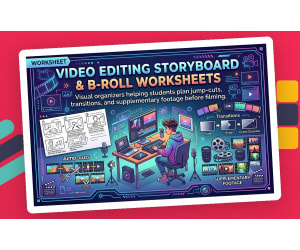
Video Editing Storyboard & B-Roll Worksheets
Resources for Teachers, Classroom Management, Community Building, Technology, Science, Computer Science, Engineering, Special Resources, Special Education Needs (SEN), Social Emotional Learning (SEL), Grade 6, 7, 8, 9, 10, 11, 12, Worksheets & Printables, Workbooks, Worksheets, Word Searches, Teacher Tools, Lesson Plans, Quizzes and Tests, Quizzes, Tests, Assessments
Transform Your Students from "Point-and-Shoot" Amateurs to "Architects of Cinema" with this Comprehensive Video Editing Pre-Production Unit! Are your students' video projects plagued by shaky footage, jarring cuts, and a lack of a clear story? Do they jump straight to filming without a plan, leaving them with hours of unusable footage and a messy, confusing final product? It's time to teach them the most crucial part of filmmaking: pre-production. This complete, no-prep Video Editing & Filmmaking Unit is a 42-page curriculum designed to teach middle and high school students the art and science of planning a video before the camera ever rolls. Rooted in the pedagogy of pre-visualization, this resource shifts the cognitive load from the stressful editing room to the structured, creative space of the storyboard. Students will learn the professional workflow that powers every great film, documentary, and YouTube video. What’s Included in this 2-Week Unit: Part 1: Instructional Text (10 Pages): Four in-depth chapters covering the core concepts of professional video editing theory, including: The Architecture of the Edit (Storyboards & the 180-Degree Rule) Mastering the Jump-Cut and Temporal Compression Transitional Theory (Match Cuts, Whip-Pans) Supplementary Footage (B-Roll) as Narrative Scaffolding Part 2: Student Workbook (18 Pages): Ten engaging, scaffolded worksheets that turn theory into practice. Students will plan, brainstorm, and problem-solve sequences for jump-cuts, transitions, B-roll, continuity, and more. Part 3: Teacher Resources & Visuals (14 Pages): Everything you need to teach with confidence, even with no film background! Visual Anchor Charts: Clear diagrams explaining Jump-Cut Mitigation, the Narrative Transition Matrix, and Pre-Visualizing the Edit Timeline. Perfect for projecting or printing. Comprehensive Teacher Answer Key: Detailed answers and sample responses for all 10 worksheets. 2-Week Implementation & Pacing Guide: A day-by-day plan (10 days) to effortlessly guide your class through the entire unit, from introducing concepts to a final, summative project blueprint. By the end of this unit, your students will not just create better videos; they will be more intentional storytellers, critical thinkers, and effective communicators in a digital world. Perfect for Media Arts, Digital Storytelling, Journalism, English Language Arts (ELA) project-based learning, Film Studies, and any class that involves video creation! Keywords: Video Editing, Filmmaking Unit, Storyboard Worksheet, B-Roll Planning, Jump Cuts, Media Arts Curriculum, Digital Storytelling, Project-Based Learning, Middle School Media, High School Film, Pre-Production, Visual Organizers, No-Prep Lesson, CTE, Technology, ELA. Why Parents/Schools Love It: Develops Critical Thinking, Not Just Tech Skills: This unit teaches students essential 21st-century skills like planning, problem-solving, sequencing, and foresight. It moves beyond just using an app and forces them to think like architects and authors. Builds Real-World, Professional Habits: It bridges the gap between casual social media video (TikToks) and the deliberate, structured workflow used in professional media careers, giving students a tangible advantage. Increases Engagement Through Relevance: It takes a subject students are already passionate about—creating videos—and injects academic rigor, making learning both fun and deeply meaningful. Comprehensive & Teacher-Friendly: It’s a complete, "print-and-go" curriculum. The included pacing guide, visual aids, and detailed answer key empower any teacher, regardless of their film experience, to deliver a high-quality, expert-level unit with confidence. Target Student Audience : Based on the language ("eighth-grade media scholars"), concepts, and structure, target: Primary Target: Grades 7-10 . This is the sweet spot. It's advanced enough for gifted 7th graders, perfect for 8th and 9th-grade media or tech classes, and a fantastic foundational unit for 10th-grade introductory film or journalism courses. Secondary Target: Grades 11-12 . This can serve as a powerful remediation or review unit for older students who lack foundational pre-production skills. It's also excellent for any ELA or Social Studies teacher doing a video project who needs a structured way to teach the technical planning aspect. Copyright/Terms of Use: This Book was copyrighted by Syed Hammad Rizvi. This resource is for personal and single classroom use only. You may not alter, redistribute, or sell any part of this resource. In other words, you may not put it on the Internet where it could be publicly found and downloaded. If you want to share this resource with colleagues, please purchase additional licenses from Teachsimple. Thank you for respecting these terms of use. This product is happily brought to you by Syed Hammad Rizvi
Author Creative Book Store
Rating
Tags VideoEditing, Filmmaking, DigitalStorytelling, MediaArts, ProjectBasedLearning, PBL, TeacherResources, LessonPlans, Storyboard, VideoProduction

Editable Parent Letter – Inform Families About Your School Dog
Social Emotional Learning (SEL), Special Resources, Social Skills, Special Education Needs (SEN), Life Skills, Animals, Life Sciences, Science, Classroom Management, Resources for Teachers, High School, Middle School, Elementary, Early Learning, Homeschool Resources, Not Grade Specific, Adult Education, Classroom Decor, Bulletin Boards, Projects, Activities, Door Decor, Presentations, Teacher Tools, Templates, Worksheets, Worksheets & Printables
Editable Parent Letter Inform Families About Your School Dog in a Clear & Supportive Way 🐶📄 Bringing a therapy dog into your school is an exciting step, but it’s important that parents feel informed, comfortable, and confident about how the dog will be integrated into school life. Whether your dog is in training or already a certified school therapy dog, this editable parent letter gives you a professional yet approachable way to communicate with families. Save time with a ready-to-use structure, while still being able to personalize details to fit your specific school dog program. This letter template helps explain the purpose, benefits, and guidelines of having a school dog while addressing common parent questions and concerns. 🐾 What Makes This Parent Letter So Helpful? ✔ Saves You Time – A clear, structured letter that you can edit to match your school and dog’s situation. ✔ Three Customizable Versions – Whether your dog is in training or fully certified, choose the letter that fits best. ✔ Reassures Parents – Provides families with transparent information about safety, learning benefits, and school policies. ✔ Professional Yet Friendly – A warm, engaging tone that helps build trust with parents. ✔ Completely Editable – Customize in PowerPoint or Keynote, or print the ready-to-use PDF version. 📌 What’s Included? 📥 Three Different Parent Letter Versions: 📝 Therapy Dog in Training – A welcoming letter introducing the school dog’s role during training. 📑 Therapy Dog in Training (Formal Version) – A more structured, professional-style letter. 📜 Certified Therapy Dog – A letter that presents the fully trained dog and highlights its impact. 🎨 Design Options: ✔ Each version comes in five colors + a black-and-white option. 📌 Formats Included: 📄 PDF – Ready to print and use as-is. 🎞 PowerPoint & Keynote – Fully editable, allowing you to personalize names, school details, and policies. 💡 How to Use This Parent Letter 📍 Step 1: Choose the version that best fits your therapy dog program. 📍 Step 2: Edit the content (if needed) to include specific school information. 📍 Step 3: Print or email the letter to parents before introducing the dog. 📍 Step 4: Use it for school board approvals or staff meetings as a formal introduction. 💡 Bonus Tip: Laminate the letter and keep a copy in your classroom or school office for reference! 🌟 Why Teachers & Therapy Dog Handlers Love This Resource ✔ “This saved me so much time! I just edited the details, and it was ready to send.” ✔ “Parents felt reassured because everything was clearly explained.” ✔ “The different versions were perfect—I could choose the one that fit our situation best.” 🐶 Make Parent Communication Easy & Stress-Free! Having a therapy dog in school is a wonderful opportunity—but keeping parents informed is key. This editable parent letter gives you the perfect way to explain everything professionally, warmly, and clearly. 📥 Download now and confidently introduce your school dog to families! 🐾✨ 📍 Best wishes, Heike from Lernfitness Did You Know? I teach with a certified therapy dog, and together we create a positive and inspiring learning environment. 🐶✨
Author Lernfitness
Tags Therapy Dog, Animal-assisted Learning, Inclusive Education Tools, Therapy Dog Rules, Classroom Pet Guidelines, Therapy Dog In School, Social-emotional Learning, SEL, Dog, Parent Letter
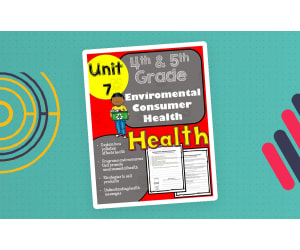
Environmental Consumer Health: 4th and 5th Grade Unit 7
P.E. & Health, Life Studies, Physical Education, Health, Life Skills, Special Resources, Social Emotional Learning (SEL), Social Skills, Grade 4, 5, Teacher Tools, Lesson Plans, Worksheets & Printables, Worksheets
Environmental Consumer Health: 4th and 5th Grade Unit 7 For 4th and 5th Grade Health, there are seven standards that students will practice and learn. Through using this Environmental Consumer Health: 4th and 5th Grade Health Unit 7 students will explore and learn to identify daily healthy habits. This Environmental Consumer Health Unit 7, is full of engaging worksheets to help students learn about their environment in an educational way as it pertains to their own health and the health of others. In this unit, students will be educated on the pollution that effects the land, water, and air in their neighborhood and community. They will also identify solutions to stop the pollution. Along with that, they will discover ways to help the environment by reducing, recycling, and reusing products. Advertisers use tricky ways to convince consumers that unhealthy food is beneficial to them. Kids will learn about these tricky strategies and the messages that advertisers use that convince the public to use these unhealthy products. In addition, students will have the opportunity to draw their own advertisement to help stop the spread of a disease outbreak in a community. Lastly, there is an assessment to check for understanding. This Environmental Consumer Health unit is the perfect way for teachers and parents to help their students understand the importance of health in a community and teaches students a way to develop healthy habits for life! Included in this Environmental Consumer Health: 4th and 5th Grade Unit 7 are the following: How the land, water, and air pollution affect persona health and our community health. A worksheet is provided on solutions to stop the pollution. Learn ways to help a community with reducing, recycling, and reusing products. Students will learn about tricky strategies advertisers use on consumers to coerce them to purchase unhealthy products and the messages these advertisers are sending to kids. Understand what environmental health messages mean to a community. Draw your own health advertisement to help stop a disease outbreak in a community. Lastly, there is an assessment to check for understanding. There is an answer key included. There are 16 pages included! This unit meets Common Core Standards. There are seven units that cover all the health requirements for 4th and 5th grade. Here are the links to other health units: Health | 4th and 5th Grade Unit 1: Personal Health Health | 4th and 5th Grade Unit 2: Growth and Development Health | 4th and 5th Grade Unit 3: Nutrition and Physical Activity Health | 4th and 5th Grade Unit 4: Substance Use and Abuse Health |4th and 5th Grade Unit 5: Injury and Violence Prevention Health | 4th and 5th Grade Unit 6: Prevention and Control of Disease Health |4th and 5th Grade Unit 7: Environmental Consumer Health
Author K-5 Treasures
Tags Health Unit, Personal Health, Healthy Goals, Health Activities, Physical Goals, Health Goals, Health And Wellness, 4th Grade Health, 5th Grade Heath, Heath Units

Gig Economy Taxes & 1099 Forms
Math, Money, Statistics, Resources for Teachers, Classroom Management, Community Building, STEM, Special Resources, Life Skills, Social Emotional Learning (SEL), Grade 6, 7, 8, 9, 10, 11, 12, Worksheets & Printables, Workbooks, Worksheets, Word Searches, Teacher Tools, Assessments, Lesson Plans, Quizzes and Tests, Quizzes, Tests
Are your students babysitting, driving for DoorDash, selling on Etsy, or freelancing online? They're not just earning money—they're running a business. Prepare them for the real world of independent work with this comprehensive, no-prep unit on Gig Economy Taxes and the 1099-NEC form. This resource is expertly designed to bridge the gap between abstract economic theory and the immediate financial realities facing today's teens. Move beyond basic budgeting and empower your students with the critical knowledge to avoid the dreaded "tax shock" that derails so many young entrepreneurs. This is a must-have for any Personal Finance, Economics, Business, Entrepreneurship, or Career & Technical Education (CTE) class. WHAT'S INCLUDED IN THIS 44-PAGE RESOURCE: Part 1: In-Depth Textbook (10 Pages): A clearly written guide that deconstructs complex topics into understandable concepts. Chapters Cover: The Anatomy of a 1099 Contractor, Demystifying the Self-Employment Tax, The Mechanics of Personal Withholding, and Strategic Deductions. Real-World Case Studies: Follow "Maya the Digital Freelancer" and "Leo the Neighborhood Landscaper" to see the concepts in action. Part 2: Student Workbook (10 Rigorous Worksheets): A complete set of independent practice worksheets that build from foundational knowledge to complex synthesis. Worksheets Cover: W-2 vs. 1099 Paradigm, Anatomy of the 1099-NEC Form, Calculating Self-Employment Tax, Estimated Quarterly Taxes, Strategic Deductions, Budgeting, The Penalty Trap, State Tax Variables, Record-Keeping, and a final Capstone Scenario synthesizing all skills. Part 3: Teacher & Visual Resources: Everything you need to teach with confidence. High-Contrast Visual Aids: Three professional diagrams perfect for classroom projection (Self-Employment Tax Breakdown, W-2 vs. 1099 Flowchart, Quarterly Tax Timeline). Comprehensive Answer Key: Detailed, step-by-step answers for all 10 worksheets, including calculation breakdowns for easy grading. Full Teacher Implementation Guide: A complete 4-day pacing guide, discussion prompts, student engagement strategies, and extension activities to bring the lessons to life. Empower your students to become financially savvy business owners. This isn't just a lesson on taxes; it's a lesson on survival and success in the modern workforce. Download today and equip your students for their financial future! Keywords: Financial Literacy, Gig Economy, Taxes, 1099, Self Employment Tax, Independent Contractor, Personal Finance, CTE, Economics, High School Math, Business, Entrepreneurship, Worksheets, Lesson Plan, No Prep, Project Based Learning, Real World Math. Why Parents/Schools Love It: Prepares Students for the Modern Workforce: This curriculum directly addresses the rise of freelance and gig work, providing essential, real-world skills that traditional textbooks often miss. Prevents Costly Future Mistakes: By teaching students how to manage their tax obligations now , it protects them from the shock of a huge, unexpected tax bill, penalties, and financial distress down the road. Completely Turnkey & No-Prep: It's a comprehensive, ready-to-teach unit. The detailed textbook, worksheets, visuals, and answer keys save teachers hours of research and preparation time. Fosters a CEO Mindset: The resource shifts students from a passive "employee" mentality to an active "business owner" mindset, promoting responsibility, discipline, and advanced financial planning. Builds Critical Thinking, Not Just Memorization: Through case studies, scenario analysis, and critical thinking prompts, students learn to apply complex rules to real-life situations. Target Audience (Student Classes) : Based on the content's complexity, language, and explicit examples (11th and 12th graders), target: High School (Grades 10-12) Early College (Freshman/Sophomore Level) This resource is a perfect fit for the following courses: Personal Finance Economics Business & Entrepreneurship Career & Technical Education (CTE) Life Skills / Career Readiness Applied Mathematics / Real-World Math Copyright/Terms of Use: This Book was copyrighted by Syed Hammad Rizvi. This resource is for personal and single classroom use only. You may not alter, redistribute, or sell any part of this resource. In other words, you may not put it on the Internet where it could be publicly found and downloaded. If you want to share this resource with colleagues, please purchase additional licenses from Teachsimple. Thank you for respecting these terms of use. This product is happily brought to you by Syed Hammad Rizvi
Author Creative Book Store
Rating
Tags GigEconomy, 1099, 1099NEC, SelfEmploymentTax, IndependentContractor, FreelanceTaxes, TaxLiteracy, TaxTipsForStudents, SideHustleTaxes, StudentEntrepreneur

Health 2nd Grade Unit 5: Injury / Violence Prevention and Safety
P.E. & Health, Health, Physical Education, Special Resources, Life Skills, Social Emotional Learning (SEL), Social Skills, Common Core, Grade 2, Lesson Plans, Teacher Tools, Worksheets & Printables, Worksheets
For 2nd Grade Health there are seven standards that need to be taught. Unit 1 Personal Health Unit 2 Growth and Development Unit 3 Nutrition and Physical Activity Unit 4 Substance Use and Abuse Unit 5 Injury/ Violence Prevention Control and Safety Unit 6 Prevention/Control of Disease Unit 7 Environmental Consumer Health These units can be taught out of order. They are only numbered for your convenience. At the end of each unit, there is an assessment to test students’ understanding. Through using this Health 2nd Grade Unit 5: Injury / Violence Prevention and Safety students will learn to identify personal information, safety in their environment, trusted adults in their community, and how to identify bullying and ways to report it and stop bullying. Students will also learn the following concepts: * Know their address and phone number as they practice writing it and reciting it. * Understand safety in your environment. * Students will be able to identify trusted adults in community. * Students will learn safety procedures in home. * Students will understand what is bullying. At the end of the unit, there is an assessment to check for understanding. A total of 12 pages for this 2nd Grade Health unit on Injury / Violence Prevention and Safety. There are seven units that cover all the health requirements for second grade. Here are the links to other health units: Health 2nd Grade Unit 1: Personal Health Health 2nd Grade Unit 2: Growth and Development Health 1st Grade Unit 3: Nutrition and Physical Activity Health 2nd Grade Unit 4: Substance Use and Abuse Health 2nd Grade Unit 5: Injury / Violence Prevention and Safety Health 2nd Grade Unit 6: Prevention / Control of Disease Health 2nd Grade Unit 7: Environmental / Consumer Health 2nd grade Coronavirus / Covid-19 Facts This unit meets Common Core Standards.
Author K-5 Treasures
Tags Health Unit, Injury, Violence Prevention, Safety, 2nd Grade Health, Second Grade Health, Community Workers, Bully Prevention, Health Activities, 2nd Grade Health Resources

Kindergarten Health: Unit 7
P.E. & Health, Life Studies, Physical Education, Health, Special Resources, Life Skills, Social Emotional Learning (SEL), Social Skills, Kindergarten, Teacher Tools, Lesson Plans, Worksheets & Printables, Worksheets
For Kindergarten Health there are seven standards that need to be taught to achieve healthy habits! Unit 1 Personal Health Unit 2 Growth and Development Unit 3 Nutrition and Physical Activity Unit 4 Substance Use and Abuse Unit 5 Injury/ Violence Prevention Control and Safety Unit 6 Prevention/Control of Disease Unit 7 Environmental Consumer Health These units can be taught out of order. They are only numbered for your convenience. Discover the comprehensive and engaging Kindergarten Health: Unit 7, a top-notch digital educational package designed to help you educate young minds about essential health concepts, habits, and practices. Focused on Environmental Consumer Health, this unit equips students with the knowledge to stay safe from sun exposure and appreciate the role healthcare workers play in their community. This fun-filled material offers interactive activities like cut-and-paste worksheets where children can learn about dressing appropriately for sun protection. They'll also get introduced to sunscreen usage for additional safety measures. With 12 insightful pages adhering to Common Core Standards, Kindergarten Health: Unit 7 is an indispensable resource for educators seeking high-quality content on environmental consumer health topics tailored towards kindergarten learners. Maximize your kindergarten instruction by exploring all seven units of the Kindergarten Health series by Teach Simple. Give your students a solid foundation in understanding personal wellbeing essentials while keeping them informed about current facts concerning Covid-19. Students will cut, paste, and decide how to best protect our bodies from the sun. They will also learn about health care workers in our community and how they keep us safe. There are a total of 12 pages included in this unit for Kindergarten Health. There are seven units that cover all the health requirements for Kindergarten. Here are the links to other health units: Kindergarten Health: Unit 1 Personal Health Kindergarten Health: Unit 2 Growth and Development Kindergarten Health: Unit 3 Nutrition and Physical Activity Kindergarten Health: Unit 4 Substance Use and Abuse Kindergarten Health: Unit 5 Injury / Violence Prevention Control and Safety Kindergarten Health: Unit 6 Prevention / Control of Disease Kindergarten Health: Unit 7 Enviromental Consumer Health You can also teach your students about keeping yourself safe by studying about the Coronavirus, where and when it started and facts that plagued our world with this virus. Kindergarten Health: Covid 19 / Coronavirus Facts This unit meets Common Core Standards.
Author K-5 Treasures
Tags Health Units, Health Worksheets, Worksheets On Health, Kindergarten Health, Personal Health, Healthy Habits, Healthy Foods, Healthy Kids, Elementary Health

Internet Safety Life Skills: How to Create a Secure Password
Special Resources, Creative Arts, Art, Life Studies, Social Emotional Learning (SEL), Special Education Needs (SEN), Life Skills, Coaching, Grade 10, 11, 12, Activities, Worksheets & Printables, Worksheets
"Creating a Strong Password" is an educational activity designed for high school students in special education. It helps them understand why having a secure password is important for safeguarding their money and personal information. The use of this Internet Safety Life Skills resource will allow students to engage in the following: • Understanding Why Usernames and Passwords Matter • Making Passwords with Descriptive Phrases • Learning How Strong Passwords Keep You Safe • Telling Apart Strong and Weak Passwords • Checking If a Password Is Strong or Weak There are 16 reading comprehension questions in this Internet Safety Life Skills resource! This activity aims to help high school students acquire essential life skills, enhancing their independence in school, at home, and in their communities. This handout is particularly suitable for use in special education classes or one-on-one settings like ABA therapy, speech therapy, occupational therapy, and Registered Behavior Technician (RBT) sessions. High school students focusing on independent living can greatly benefit from this activity, as it assists in defining, setting, and measuring IEP goals. Beyond interactive teaching, this resource is excellent for hands-on and community-based learning experiences. Engage your special education class with this highly interactive High School Internet Safety Life Skills Activity! This activity contains step-by-step instructions, questions, and answers that reinforce learning, age-appropriate graphics, real-world examples, and ideas for implementation. This is the perfect special education activity for grade 10, grade 11, grade 12, and autism life skill centers . This special education life skills handout was designed to assist teens and adults with difficulties developing independent living skills. It's a printable, easy-to-use activity ready to hand out! Related Products for Developing Independent Living Skills How to Read a Basic Pay Stub How to Schedule an Appointment How to Fill Out a Job Application How to Create an Emergency Exit Plan A PDF with seven unique pages. Color and black-and-white versions of each page are available for this pdf resource.
Author Adulting Life Skills Resources
Tags Interactive Safety Lessons, Autism Safety Resources, Internet Safety, Independent Living Skills, IEP Goal-Oriented Skills, Life Skills For Autistic Teens And Adults, Adulting On The Spectrum, Social And Emotional Learning, Life Skills For Teens, Life Skills For Adults
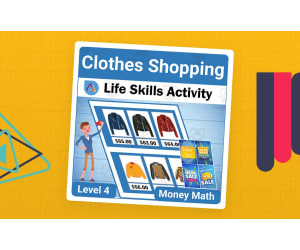
Money Math Life Skills Worksheet: Clothes Shopping Level 4
Special Resources, Life Studies, Creative Arts, Art, Social Emotional Learning (SEL), Special Education Needs (SEN), Life Skills, Grade 7, 8, 9, Worksheets & Printables, Word Problems, Activities, Worksheets
Money Math Life Skills Worksheet: Clothes Shopping Level 4 is a meticulously designed, no-preparation-needed tool for middle school students. This important resource helps learners in understanding various aspects of money management, such as calculating discounts and sales tax. Developed particularly for special education students, this worksheet dives into real-world situations adding greatly to its value. The activity incorporates a variety of clothing items creating an extensive range of price calculations involving: Pants Shirts Skirts Dresses shoes Accessories The questions are word problems with multiple correct answer options—an impressive 60 questions divided into six sets containing ten each for different clothing items providing comprehensive coverage that deepens student understanding. This worksheet is valuable in diverse scenarios from special education classes to ABA (Applied Behavior Analysis) therapy or RBT (Registered Behavior Technician) sessions. It fortifies independent living skills vital for effectively navigating within and outside the academic environment. This product is versatile in applying practical IEP goals among middle school students developing independence. The application possibilities range from interactive group exercises to hands-on community instruction events. Easily understood instructions facilitate effortless learning combined with immediate reinforcement through concise answers at the end of each section—a feature facilitating closely monitored progress tracking initiatives. Made with age-appropriate graphic illustrations and real-life examples—Money Math Life Skills Worksheet: Clothes Shopping Level 4 augments curriculum relevancy while introducing varied modalities promoting student engagement—making it an effective tool supporting Grade 7-9 learners especially those within autism life skill centers. There are two available versions (colored and black-and-white) of this 40-page PDF format resource: Smoothly integrates into existing teaching routines Provides much-needed instruction supporting objective-driven learning among students requiring specialized intervention. This resource works splendidly with other leveled activities like Grocery Shopping or Reading Menus Level 1-4 and supplements existing efforts towards developing practical money-math skills.
Author Adulting Life Skills Resources
Tags Money Management, Life Skills, Clothing, Discounts, Sales Tax

AI Image Creation Ethics & Creative Prompt Engineering Pack Worksheets
Research, Resources for Teachers, Classroom Management, Community Building, Science, Technology, Computer Science, Engineering, Special Resources, Social Emotional Learning (SEL), Homeschool Curriculum, Homeschool Templates, Grade 4, 5, 6, 7, 8, Worksheets & Printables, Worksheets, Workbooks, Word Searches, Writing Prompts, Teacher Tools, Graphic Organizers, Lesson Plans, Diagrams, Quizzes and Tests
Prepare your students for a creative and ethical future with a comprehensive (34-page) digital workbook designed specifically for grade level students that covers everything students need to know when creating and using Images created by Machines (AI). That means learning how to use AI ethically. This Creative Prompt Engineering Pack provides elementary teachers, homeschool parents, and digital literacy coaches with everything they need to teach students how to create image-based prompts through the use of the Four Pillars of Prompt Construction (Subject, Environment, Lighting and Aesthetic) while also covering such topics as (but not limited to) Intellectual Property Rights; Digital Consent; Misinformation; Combating Bias; and Full Disclosure. Components Included: *) 4 chapters of hands-on student worksheets (fill-in-the-blank; scenario analysis; prompt rewriting; ethical debates) *) Visual anchors and flowcharts *) 1 Lifecycle diagrams *) 1 complete answer key for educators with complete implementation guide *) No prep, print-and-go/digital Google Classroom compatible Ideal for STEM, Arts, ELA, Digital Citizenship and AI Literacy curricula. Support your students develop into ethical and creative "prompt engineers" who respect artists and tell the truth when creating images generated by AI. Keywords that are integrated naturally into this Creative Prompt Engineering Pack Include AI Prompt Engineering for Kids; AI Ethics Curriculum Grade 93; Text-to-Image AI Workbook; Responsible Digital Art Maker; Digital Literacy PDF; Creative Prompt Engineering Pack. Parents and Schools Appreciate This Product: Provides Students with TRUE 21st Century Skills - Demonstrated through students’ ability to write quality prompts, demonstrate ethical decision making, be good digital citizens and use critical thinking; exactly what was requested in new educational standards. No Preparation Required - Easy to use for the teacher. Includes full answer keys, visual aides, Madlib sheets; everything you need to have no preparation time. This is a time saver! (Additionally, Families can use them to home school.) Promotes Creativity and Responsibility - Ongoing excitement generated by kids learning to create art through AI while at the same time understanding why it is inappropriate to steal the style of an artist, spread false information and/or conceal their use of AI. Ideal for Diverse Learning Needs (Although all materials created/based on target grade level - Fourth Grade) - Case studies, fill in the blanks and pictures make it attainable to all grades 4 & 5 regardless of ability (includes exceptional education students). Future-Proofing Students with Digital Literacy - Equips students with at least an understanding of how to appropriately use technology (Artificial Intelligence), enabling parents and schools to feel good about the ethical use of technology by their children. The target audience : of the material is 4th and 5th graders (ages 9 - 11 years old). The teacher's guide on page 25 clearly indicates this is intended for "students in the 4th/5th grade" and uses "Grade 4-5 Student Pack" as reference. The vocabulary and activities, as well as case studies and visuals, are ideally suited for upper elementary and/or early middle school students. This resource could also be used with success in a homeschool setting, advanced gifted 3rd graders, and as a beginning unit in 6th grade technology/digital literacy/arts classes. Copyright and Usage Terms: This publication is owned by Syed Hammad Rizvi and is intended only for personal and classroom use. You may not sell, alter, or redistribute this publication in any way. In other words, you cannot place it on the World Wide Web for anyone to find and download. If you wish to share this publication with other teachers, please purchase another license from Teachsimple. Thank you for respecting the use of this publication. This publication was created with much joy by Syed Hammad Rizvi
Author Creative Book Store
Rating
Tags AIPromptEngineering, AIForKids, AIEthics, PromptEngineering, AIImageCreation, DigitalLiteracy, AIArtForKids, TextToImage, ResponsibleAI, EthicalAI

Health 1st Grade Unit 7: Environmental / Consumer Health
P.E. & Health, Special Resources, Health, Physical Education, Life Skills, Social Emotional Learning (SEL), Social Skills, Grade 1, Lesson Plans, Teacher Tools, Worksheets & Printables, Worksheets
For 1st Grade Health there are seven standards that need to be taught. Unit 1 Personal Health Unit 2 Growth and Development Unit 3 Nutrition and Physical Activity Unit 4 Substance Use and Abuse Unit 5 Injury/ Violence Prevention Control and Safety Unit 6 Prevention/Control of Disease Unit 7 Environmental Consumer Health These units can be taught out of order. They are only numbered for your convenience. At the end of each unit, there is an assessment to test students’ understanding. Through using this Health 1st Grade Unit 7: Environmental / Consumer Health includes the following concepts: * Students will learn about sun damage. * Students will learn how to protect themselves from sun rays. * Students will learn about community health workers. * Students will learn about slogans and safety slogans. At the end of the unit, there is an assessment to check for understanding. With this unit, your students are sure to be engaged and learn so much about their health! A total of 13 pages for Health 1st Grade Unit 7: Environmental / Consumer Health. There are seven units that cover all the health requirements for first grade. Here are the links to other health units: Health 1st Grade Unit 1: Personal Health Health 1st Grade Unit 2: Growth and Development Health 1st Grade Unit 3: Nutrition and Physical Activity Health 1st Grade Unit 4: Substance Use and Abuse Health 1st Grade Unit 5: Injury / Violence Prevention and Safety Health 1st Grade Unit 6: Prevention / Control of Disease Health 1st Grade Unit 7: Environmental / Consumer Health You can also teach your students about keeping yourself safe by studying about the Coronavirus, where and when it started and facts that plagued our world with this virus. 1st grade Coronavirus / Covid-19 Facts by Teach Simple This unit meets Common Core Standards.
Author K-5 Treasures
Tags Health Unit, Environment, Consumer Health, 1st Grade Health, First Grade Health, Healthy Habits, Environmental Health, Community Health, Health, 1st Grade Resources

Personal Health – 4th & 5th Grade Unit 1
P.E. & Health, Life Studies, Health, Life Skills, Social Emotional Learning (SEL), Social Skills, Grade 4, 5, Worksheets & Printables, Worksheets, Assessments
Personal Health: 4th and 5th Grade Unit 1 For 4th and 5th Grade Health, there are seven standards that students will practice and learn. Through using this 4th and 5th Grade Health Unit 1: Personal Health students will explore and learn to identify daily healthy habits. This unit is the perfect way to help 4th and 5th graders learn the importance of their personal health! This engaging unit is perfect to help your 4th and 5th grade students understand the four ways to be healthy which include: social, physical, mental, and emotional health. There are lessons that teach the steps to make good health decisions, plus there are lessons to help them to teach their family and friends with their health choices. Included in this unit are ways to help enhance their verbal and nonverbal communication skills, how to set reasonable goals to improve their eating habits, and students will set physical goals that will be beneficial to their health. All of these units meet Common Core Standards. Included at the end is an assessment to check for understanding with answer keys. This is a fun and engaging health unit that students are sure to enjoy. There are 22 pages included! Included in this 4th and 5th Grade Health Unit are the following: Students will learn all the ways to be healthy which include physical, mental, emotional, and social. Steps to help them make good health decisions. Students will practice those steps on their own with a given a scenario to solve. A guide is given to teach these steps to help family and friends to make good health choices. They will learn verbal and nonverbal communication skills and how to improve those skills. Students will set goals to improve their healthy eating habits. Setting physical goals to improve their health is also included. Lastly, there is an assessment to check for understanding. Answer keys are also provided. There are seven units that cover all the health requirements for 4th and 5th grade. Here are the links to other health units: Health | 4th and 5th Grade Unit 1: Personal Health Health | 4th and 5th Grade Unit 2: Growth and Development Health | 4th and 5th Grade Unit 3: Nutrition and Physical Activity Health | 4th and 5th Grade Unit 4: Substance Use and Abuse Health |4th and 5th Grade Unit 5: Injury and Violence Prevention Health | 4th and 5th Grade Unit 6: Prevention and Control of Disease Health |4th and 5th Grade Unit 7: Environmental Consumer Health
Author K-5 Treasures
Tags Health Unit, Personal Health, Healthy Goals, Physical Goals, Health Goals, Health And Wellness, 4th Grade Health, 5th Grade Heath, Health, Plan

Adaptive Executive Functioning Mastery: A K-Adult Scaffolding Frame
ELA, Resources for Teachers, Classroom Management, Community Building, Social Emotional Learning (SEL), Special Resources, Life Skills, Social Skills, Special Education Needs (SEN), Speech Therapy, Grade 1, 2, 3, 4, 5, 10, 11, Worksheets & Printables, Worksheets, Workbooks, Teacher Tools, Assessments, Diagrams, Lesson Plans, Presentations, Outlines, Literacy Readers
The Adaptive Executive Functioning Mastery: A K-Adult Scaffolding Framework contains everything needed for educators to implement effective executive functioning (working memory, inhibitory control, cognitive flexibility, task initiation, time blindness, metacognition, etc.) in all levels of education from kindergarten through adult. The workbook comprises: • In-depth theory chapters on cognitive load, dynamic scaffolding, and the function of the prefrontal cortex. • 10 fillable student worksheets with real life case studies. • Teacher/facilitator implementation guide with teacher supports such as fading protocols. • Printable visuals (Neuro-Developmental Continuum; Adaptive Scaffolding Matrix; Emotional Regulation Loop). • Answer Key for assessments. An essential part of this workbook is that it will help to reduce environmental friction and support the autonomous development of exobrains that fade into an internal mastery. It is suitable for use in special education, general education, homeschooling, college support programs, and/or in the coaching of adults. This digital download is immediately available via PDF format as well as in a format that may be accessed using Notion. No preparation required. Why Parents and Schools Are Fans : Evidence-based but usable immediately: Break down the latest neuroscience (prefrontal cortex, cognitive load theory, Vygotsky ZPD) into zero-prep, easy-to-use worksheets and visuals for teachers to use on Monday. Neuro-affirmative and compassionate: Replace "laziness" and "try harder" with practical scaffolding that respects how the brain is wired so that the number of meltdowns, anxiety, and learned helplessness decreases. Built-in fading and autonomy: The Bridge-and-Fade Protocol has 4 phases with clearly defined transitional points will reduce dependence on the scaffolding of adults for each student to develop independence and report the skill as internalized. Saves time in planning: Diagnostic answer keys, visual resources, and Notion/PDF hybrid options will save teachers hours of planning for busy IEPs, 504s, and RTI meetings. Versatile across the lifespan: One purchase will allow the entire school to utilize the tools (PreK-12 and adult transitions) or a family will be able to use the tools with their child from kindergarten through college and into their career. Target Audiences and Student Classifications : This Framework has been purposely created for life cycle growth from beginning of time with K-Adult. This Framework identifies all target audiences as follows: Early Childhood/Primary (ages 4-9): Pre-K-3 Special ed., and needs-based learning support. Elementary to Middle Schools (Ages 6-13): 4-8 Special Needs, RtI 2nd/3rd Tier (Academic Interventions) Classrooms, ADHD/Autism support classrooms. High Schools (Ages 14-18): 9-12 Intervention Support Classrooms, Study Skills classrooms, Transition to College programs. Adults & College Students (ages 19+) - Univesity Disability Services, Adult ADHD Coaches, Workplace Executive Skill Training, Homeschool High School/College Preparation. Cross-setting Users: Special Needs and General Education Teachers working with Neurodivergent Students, School Guidance Counselors, Occupational/Physical Therapists, Parents of Neurodivergent Students, Corporate Neurodiversity Trainers/Service Providers. Copyright / Terms of Use: Syed Hammad Rizvi holds copyrights to this book. This resource is for personal use only and may only be used in one classroom at a time. You may not modify, redistribute or sell any part of this resource. In other words, you cannot upload this resource to the Internet for others to find and download publicly. If you would like to share this resource with other educators, you must purchase additional licenses through Teachsimple. Thank you for being respectful of these terms of use. Syed Hammad Rizvi is excited to offer this product.
Author Creative Book Store
Rating
Tags ExecutiveFunctioning, ADHDResources, Neurodivergent, SpecialEducation, ExecutiveFunction, ADHDWorksheets, TeacherResources, IEPTools, 504Plan, Neurodiversity
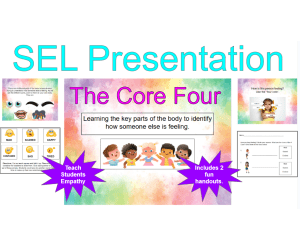
SEL Presentation-The Core Four
Special Resources, Social Emotional Learning (SEL), Social Skills, Special Education Needs (SEN), Life Skills, Kindergarten, Preschool, Grade 1, 2, Worksheets & Printables, Worksheets, Teacher Tools, Lesson Plans, Presentations
In this SEL presentation, students will learn about the "core four" as a way to figure out how someone else is feeling. This is the building block of empathy and understanding how someone is feeling. This product has a 12 slide Google Slides Presentation with the last 4 slides as handouts and activities for the lesson plan. Students will understand that the core four is looking at the key 4 body parts; the eyes, eyebrows, mouth and hands. They will analyze 4 pictures of real people and guess how they are feeling based on the core four. After they analyze the real children, they will play a game of charades with partners or in groups. There are 6 different emotions to act out-each have an emoji as well as the feeling word. No reading is required. Then there are 2 extension SEL worksheets. One is identifying what people are feeling in a picture, they will circle the feeling word and write down which part of the core four helped them figure it out. The next handout is a fun Find the 9 Differences in an emoji picture. The answer is on the following slide. This lesson is good for pre-k, kindergarten, first and second grades. If you are interested in more SEL products, please feel free to visit my SEL store here: https://teachsimple.com/contributor/jennifer-moyer-taylor For more products teaching students about feelings, emotions and SEL skills, check out these products: https://teachsimple.com/product/guess-the-emotion-sel-game (This is a fun lesson kind of like the game Cranium where students get to use play dough, writing, charades or talking to give clues about what feeling card they get.) https://teachsimple.com/product/betsy-the-top-banana-boom-cards-a-story-about-cliques-plus-task-cards-on-excluding-and-including-others-with-audio-plus-extension-activity (This is a combination Boom Cards activity as well as a fruit salad activity to discuss inclusivity with others.) https://teachsimple.com/product/sel-flashcards-for-social-emotional-learning-with-sel-coloring-pages (social emotional flashcards showcasing 16 different feelings. They are black and white as well as in color so students could color them in themselves. You can play memory, go Fish and other games with these flashcards.)
Author Jennifer Moyer Taylor
Tags SEL Presentation, Feelings, Emotions, Sel, Social Emotional Learning, School Counseling, Sen, Special Education Needs, Social Skills
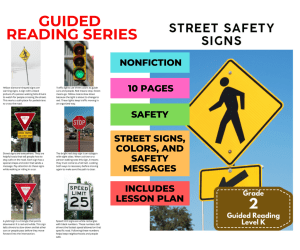
Guided Reading Level K - Street Safety Signs (with Lesson Plan)
ELA, Resources for Teachers, Reading Comprehension, Reading, Pre-Reading, Language Development, Health, P.E. & Health, Social Emotional Learning (SEL), Special Resources, Grade 1, 2, 3, Worksheets & Printables, Worksheets, Teacher Tools, Centers, Activities, Literacy Readers, Quizzes, Quizzes and Tests, Assessments
This Guided Reading Book - Street Safety Signs (Level K) with lesson plan includes: Guided Reading Color Label (front cover x1) This is a quick way to match the book’s demands to what students can generally handle.. The overall goal is to use the level/color to pick books for several smaller groups. To qualify for a certain level, a student is expected to read a book from that level with about 90–94% accuracy. If a student is consistently accurate and understands, move up a level. If the student is struggling at that level, drop down and add more support. Each student will improve at completely different rates, but it is generally one of the best ways to check progress across the class. DOWNLOAD THE CATALOG TO VIEW ALL GUIDED READING BOOKS AVAILABLE (SORTED LEVELS A-Z) Pre-Reading Question (x1) Teacher asks the prompt aloud, can be while showing the cover or first page. Students share what they already know, or make educated guesses from the cover. Prompt them to use the target vocabulary. Write some of their responses on the board to look back at during the reading. Vocabulary Words (x5) Introduce the five words, best doing it one at a time. Start by saying it, while students repeat and then see if anyone knows what it means before reading further. Read through the meaning and try to briefly connect each word to a picture or gesture so it’s meaningful. Ask students to flip through the book pages and point to where they see each of the vocabulary words. While reading the book pause upon coming across one of the vocab words or read the sentence twice to make sure students understand the word has appeared. Optional: Ask students to raise hands whenever they see/hear one of the new words. Guided Reading Pages (x10) Check the book snapshot (below) for: primary topic - do you need to prep extra reading or intro materials on this? what is taught best - decide on 1-2 bullets to focus on, use the prompt or words provided here for best results. learning goals - what you are checking for students to be able to do after the session, elicit answers using prompts or words provided. key vocabulary (see section above). questions overview - so you know what is coming up and if you need to prep extra materials to assist understanding. Run the lesson You may have already looked at a few of the pages together, but you can show them some of the pictures again first to set meaning. Depending on how much time you have and how familiar your students are with guided reading class, you may want to read the book aloud first with the group first. Students whisper or partner read, while you listen in. If time, do it as a group, one student reading a page each. Use the guided page’s prompts to coach: “Check the picture / does it make sense?” “Point under the words / try the first sound” “Reread the sentence smoothly”. Try to focus more on one student per session (rotating every time), so you can work out if they are ready to move up or need to move down a level. Comprehension Questions (back cover x3) This is your way to check that students didn’t just say the words, but actually understood the text. First, let students answer by pointing to the page/picture and saying a short sentence. After any answer, follow with: “Show me where you found that in the text.” In bigger groups, have partners answer first (10–20 seconds), then call on 2–3 students to share. Differentiation tips: Emerging speakers/struggling readers: oral + pointing On-level: oral in a full sentence Higher: one written sentence or draw + label Book Snapshot Title: Street Safety Signs Genre: Nonfiction (informational) Subject: Health & Safety / Reading (Informational Text) Primary Topic: Street signs, colors, and safety messages Estimated Guided Reading Level (A–Z): K What This Book Teaches Best How street signs help people stay safe: Street signs are “helpful tools” that tell people how to stay safe on the road. Using shapes and colors to understand meaning: Each sign has a special shape and color that sends a message. Key safety actions for walkers and drivers: The stop sign means come to a full halt and look both ways before moving again. Recognizing common road signals: The book explains warning signs, traffic lights, yield signs, speed limit signs, school signs, do not enter signs, and bike lane signs. Street-sign knowledge as a life skill: Paying attention to signs helps people “navigate the world safely.” Learning Goals Students will explain how street signs help people stay safe on roads. Students will identify what different sign colors and shapes communicate in this text. Students will describe what a stop sign tells people to do and why looking both ways matters. Students will explain what traffic light colors mean (red, green, yellow) based on the text. Students will connect specific signs (yield, speed limit, school, do not enter, bike lane) to their safety messages. Key Vocabulary From the Text octagon — a shape with eight sides. pedestrians — people who are walking. intersection — where two roads meet or cross. fluorescent — very bright and easy to see. navigate — find your way and move safely place to place. Discussion Prompts Pre-reading question: What street signs or signals have you seen that help people stay safe? Comprehension questions: What does the stop sign mean, and what should you do before moving again? What do yellow diamond-shaped warning signs tell drivers to watch for? Why do speed limit signs help keep neighborhoods and people safe? Printing Tips 1. Best Printing Method (Recommended) “Booklet” Printing (Best if Available) If your printer or PDF viewer supports Booklet Printing , use this. Settings to use: Print mode: Booklet Paper size: Letter or A4 (either works) Orientation: Landscape Print on both sides: Yes Flip on: Short edge Scaling: Fit to printable area Booklet subset: First test: Front sides only Then: Back sides only This will automatically: Pair pages correctly Put the cover on the outside Align everything for folding After printing, fold in half and staple along the spine . 2. If “Booklet” Printing Is NOT Available You can still print this correctly with manual duplex printing . Step-by-step: Open the PDF. Choose Print . Set: Orientation: Landscape Pages per sheet: 1 Print on both sides: Yes Flip on: Short edge Print all pages . Because each PDF page already contains two facing book pages, the result will still fold cleanly into a book. Thousands of Cored Education products are included with your TeachSimple membership. Download links and encyclopedia index available here.
Author Cored Education
Rating
Tags Reading Comprehension, Reading Passages, Reading, Guided Reading, Guided Reading Lesson Plan, Guided Reading Activity, Pre-reading, Vocabulary, Street Signs, Health