



3,984 products added recently
Page 9 - High School
Provide your high school students with activities that promote critical thinking, creativity, and autonomy. These resources encompass advanced topics and encourage in-depth analysis and discussion. Use them to enrich your curriculum and prepare students for future academic and career endeavors.

 Show filters

Science Reading Comprehension Passage: The Truth About Drinks. SAMPLE
Science, ELA, Reading, Reading Comprehension, Strategies, Resources for Teachers, Grade 6, 7, 8, 9, Writing Prompts, Worksheets & Printables, Centers, Activities, Teacher Tools, Assessments, Quizzes and Tests, Quizzes, Tests
This is a free passage sample from the complete resource. The full version includes everything needed for a complete reading comprehension activity: the passage, multiple-choice questions, short-answer questions, vocabulary matching, a summary-writing task, and a detailed answer key. Download the complete passage resource by clicking on the following links: PDF Fillable PDF Word Docs Google Docs Science Reading Comprehension Passage and Questions: The Truth About Drinks (PDF) This very engaging science reading passage about how common drinks affect health, focus, and sleep. It explains the differences between regular soda, diet soda, and energy drinks . The passage warns that regular soda often contains a lot of added sugar, diet soda uses artificial sweeteners that may affect taste habits, and energy drinks can contain high caffeine levels that may cause headaches, anxiety, racing heartbeat, and poor sleep in teenagers. It also teaches students how to read beverage labels by checking added sugar, caffeine, ingredients, and serving size . This passage is designed to bridge the gap between science and literacy through strengthening reading comprehension and sparking scientific curiosity in middle school students. The passage blends English Language Arts skills with accurate science content that supports NGSS classroom practice. Ideal for interdisciplinary learning in ELA and Science. Suitable for Grade 9 review, too! Student Tasks for The Passage: 5 multiple-choice questions targeting main idea, key details, inference, vocabulary in context, and use of evidence 5 vocabulary matching items with clear, student-friendly definitions 5 text-based questions that require citing specific lines or facts 1 summary prompt that asks students to condense central ideas accurately Full answer key for every section FULL CATALOG OF DOWNLOADING LINKS HERE Product Details Length: 5 pages total Grades: 6–8, also suitable for Grade 9 review Use cases: close reading, stations, homework, intervention, test prep, and sub plans Standards support: reinforces informational-text skills and supports NGSS-style sense making through observation, modeling, and clear use of claim, evidence, and reasoning Why Teachers Choose This Set Authentic science content paired with rigorous literacy practice Consistent task structure across all passages for easier planning and smoother student routines Clear, age-appropriate writing that builds confidence without oversimplifying Other Science Reading Collections you May find in the store: 1. Astronomy & Space Science 2. Volcanoes, Rocks, & Mountains 3. Rock Cycle, Soil, & Sinkholes 4. Mars, Glaciers, & Antarctica 5. Water Cycle, Acid Rain, & Wastewater 6. Insects, Animals, & Ecosystems 7. Bioluminescence & Insects 8. Animal Skin, Cats, & T. Rex 9. Human Body and Senses 10. Health & Applied Bioscience 11. Waves, Light, & Imaging 12. Electricity & Energy 13. Motion & Materials 14. Chemistry and Materials Science Use this set to reinforce ELA skills in science, to add literacy to your lessons, and to support independent work. The passages strengthen main idea, evidence use, vocabulary in context, inference, cause and effect, and summary writing. With ready-to-use assessments and complete answer keys, you can provide focused practice that is simple to run and fast to review.
Author Middle & High School - CORED Education
Rating
Tags Middle School, Reading Comprehension, Reading Strategies, ELA, Centers, Reading Passage, Assessments, Vocabulary, Bioscience

Sigmund Freud Research Organizer & Essay Assignment
Social Studies, ELA, Biographies, History, History: World, History: Ancient, Psychology, Sociology, Grade 7, 8, 9, 10, Activities, Projects, Worksheets & Printables, Worksheets
Sigmund Freud founded psychoanalysis and is probably the most widely studied psychiatrist all-time, and perhaps also the misunderstood. This resource provides your students with the opportunity to independently explore and write about the life of the controversial psychology figure with this engaging research planner and essay assignment. This carefully scaffolded and easy-to-assign-AND-assess resource has been designed to guide student learning from Sigmund Freud fact-collection to the careful development of a five-paragraph research essay. Teaching this resource could not be easier! Start by handing out the background research and note-taking worksheet (you could also ONLY hand this out if you want a shorter lesson!). Once students have found their facts and sources, provide them with the essay outline activity, which guides them step-by-step through the requirements of a short research essay. From there, drafting their essay, using the provided peer review checklist, and submitting their final draft will be no problem at all. And then you can assess their work with the provided Common Core rubric! Use this entire resource as a complete research lesson or just part of it as a short research activity or sub plan! This TeachSimple download includes: - A Sigmund Freud essay writing assignment with directions, requirements, research essay writing tips, a peer review checklist, and Common Core-tied grading rubric - An editable rubric, provided as a link, that lets you make adjustments to the grade values and guidelines. This link is provided as as Google Sheet specifically built for integration into Google Classroom, although you can also modify it for use in other Learning Management Systems (LMSs) - A Sigmund Freud biography and note-taking worksheet that will guide your students through information gathering. This straightforward two-page handout includes instructions for background research, a fun drawing section, and an area to cite quality sources and organize conducted research - A research essay outlining worksheet, so students build on their Sigmund Freud notes in a clear and simple manner as they build their work towards a draft and final paper - All 6-pages of this lesson are provided in full-color and B&W versions Although this resource can be fitted for any secondary Language Arts classroom, it has been carefully designed to work best in grades 8 through 11. The included rubric is subtly but specifically tied to Common Core ELA Standards for Language (3) and Writing (2 and 7). This resource is provided as a print-ready, bookmarked, and adjustable PDF file. The rubric is also included as an editable Google Sheet. This resource contains 6 pages and 1 Google Sheet.
Author The Language of Educational Art, LLC
Tags Essay, Rubric, Research, Notetaking, Outlining

Single vs Dual Income Budget: High School Financial Literacy Budgeting
Life Studies, Finance, Home Economics, Math, Addition and Subtraction, Money, Special Resources, Life Skills, Grade 9, 10, 11, 12, Worksheets & Printables, Word Problems, Worksheets, Projects, Activities
This high school financial literacy project lets your students tackle a real-world budgeting decision families make: should both parents work, or should one stay home to do childcare? Students will use critical-thinking and problem-solving skills as they work with these realistic budgets (single income budget vs dual income budget). This task can show your students in 9th, 10th, 11th, or 12th grade how financial literacy and math skills can be incredibly useful in everyday life! How to Use: Print five pages for each student. Go through the first page together and introduce the family in the simulation. Students use the income and income tax information to calculate the net income. Give students time to add up the monthly expenses in each budget (single-income vs dual-income). Discuss what expenses change when both parents work and if those seem reasonable or not. Have students complete the calculations to compare the two budgets on the fourth page. NOTE: In this simulation, there is almost no difference in money left over if both parents work since the extra income is used to pay for childcare, a second car, a cleaner, etc. That does not mean this is always the case! Use the prompts on the fifth page to have a class discussion about this topic. Then, students write their final opinion in a paragraph to sum up their learning. They may have ideas for how to change this budget or scenario to make having both parents work be more financially beneficial. I have included blank spreadsheets as well if you want your students to create their own budgets using salaries and expenses from your geographical area. What’s Included: 9-Page PDF: Ready to Print and Use! Teacher Instructions Introduction to Kat and Alex and their family Single-Income Budget Spreadsheet (with expenses included) Dual-Income Budget Spreadsheet (with expenses included) Comparison of the Budgets Worksheet Reflection (with discussion prompts) Two Blank Budget Spreadsheets (single and dual income) Complete Answer Key Grades to Use With: Grades 9-12 General Studies or Grades 11-12 Special Ed Family and Consumer Sciences/Family Studies Life Skills Applied Math or Consumer Math Career and Personal Planning Financial Literacy Math Skills Required: Only intermediate math skills are required to complete this project: Adding & subtracting money amounts to the hundred thousands (salaries) Dividing by 12 to find monthly amounts (with decimals) An understanding of integers
Author Grace Under Pressure
Rating
Tags Financial Literacy, High School Financial Literacy, Budget, Budgeting, Financial Literacy Project, High School Financial Literacy Project, Two Income, Single Income, Comparing Budgets

Science Revision for Grade 12
Science, Grade 12, Activities, Worksheets & Printables, Assessments, Teacher Tools
This Grade 12 Science Worksheet ebook is perfect for busy teachers. It includes 30 ready-to-use activities that cover key topics in biology, chemistry, and physics. Students can complete all tasks on the worksheet. No extra materials are needed. Each section helps students review and practice important science concepts. You’ll find labeling diagrams , multiple-choice questions , short answers , fill-in-the-blanks , matching , and calculation problems . The variety keeps students engaged and helps them learn in different ways. All answers are included at the end of the ebook, so you can save time when checking work. Use it for classwork, homework, revision , or test prep . It’s great for independent work or group activities. The language is clear. The layout is student-friendly. You don’t need to plan anything—just print and go! This ebook helps students build confidence and prepare for exams. It also supports curriculum goals. If you teach Grade 12 Science, this is a must-have resource. Keep your lessons simple, effective, and fun with this helpful tool!
Author Bright Classroom Ideas Marketplace
Rating
Tags Science, Grade 12, Revision

Engaging Business Case Study: Business Ethics
Life Studies, Social Studies, Finance, Business, Career, Economics, History, Psychology, Grade 8, 9, 10, 11, 12, Activities, Projects
Ethics happen in the little grey areas of life. This case study places your students in a perfect example of one of those grey areas. The ManuJet case follows a new manager trying to find early managerial success while navigating a difficult ethical situation. This case study is designed for high school business students to analyze competing priorities between low wage workers and an ethically questionable wage practice. This product includes a full case study packet, with a custom narrative specifically made to bring about great debate on ethics! It also comes with an instructor guide, class slides, and some basic financial information on ManuJet and its competitors. Overall, the case study includes: A case study narrative An overview of Manujet An overview of rival companies Analysis of the ethics dilemma An instructor's guide A class slideshow to review and discuss the facts of the case An overarching task for students: "The Board of Directors meet in 3 weeks to discuss your vision for the plant, any courses of action you feel are necessary, and to hear your goals for the plant this year. Prepare a presentation with this information, using the information from the case." If you are looking to get students out of their textbooks and into real world scenarios, case studies like these are perfect!
Author Ed Dynamic
Rating 5
Tags Ethics, Business, Case Study, Morality, Business Ethics, Morals, Leadership, Decision Making
Konrad Lorenz – Fact Sheet, Quiz & Interactive PDF incl. H5P
Life Sciences, Science, STEM, History, Social Studies, Biographies, Inventors, Basic Science, Physics, Biology, Grade 6, 7, 8, 9, 10, 11, 12, Worksheets, Worksheets & Printables, Quizzes, Quizzes and Tests, Teacher Tools, Projects, Activities
Scientist Konrad Lorenz - Fact Sheet, Quiz & Interactive Version (PDF & H5P) Konrad Lorenz – Animal Behavior and the Roots of Ethology Fact Sheet, Quiz & Interactive Exercises (PDF + H5P) 🦢🧠 This 45-minute resource introduces students in grades 7–10 to Konrad Lorenz – a key figure in the development of modern ethology, the study of animal behavior. Many students enjoy learning about animals, but the scientific side of behavior research ist oft weniger bekannt. Lorenz is especially known for his work on imprinting in geese – observing how young animals form strong attachments during a critical period after birth. His careful observations helped shape the way we think about instinct, learning, and behavior in both animals and humans. To make this topic approachable, I’ve put together a compact, ready-to-use lesson. It includes a short informational text, a fact sheet, quiz questions with answers, and a creative partner task. The materials are available in both color and black-and-white versions, plus there’s an H5P version for digital use. What’s included: A short, student-friendly text about Konrad Lorenz and his contributions to behavioral science A fact sheet to help students organize key ideas Quiz questions (with answer key) for review or self-check A partner task where students come up with their own questions and exchange them Formats: Printable/digital PDF and interactive H5P 💻 Answer key included ✅ I’ve used this material when introducing the basics of behavior in biology – especially to discuss how scientific observation works in practice. It also fits nicely into lessons on instinct vs. learning or historical perspectives on animal research. The flexible format works well for independent study, pair work, or short projects. 🚀 Download now and bring the legacy of Konrad Lorenz into your biology lessons today! 📍 Best wishes, Heike from Lernfitness Did You Know? I teach with a certified therapy dog, and together we create a positive and inspiring learning environment. 🐶✨
Author Lernfitness
Tags Science, Biology, Famous Scientists Lesson, H5P, Interactive Science Exercises, STEM, History, Scientists, Konrad Lorenz, Animal Behavior

Earth Science Reading Comprehension Passage: Soil Types. SAMPLE
Science, ELA, Reading, Reading Comprehension, Strategies, Resources for Teachers, Earth and Environmental Sciences, Earth Sciences, Geology, Grade 6, 7, 8, 9, Writing Prompts, Worksheets & Printables, Centers, Activities, Teacher Tools, Assessments, Quizzes and Tests, Quizzes, Tests
This is a free passage sample from the complete resource. The full version includes everything needed for a complete reading comprehension activity: the passage, multiple-choice questions, short-answer questions, vocabulary matching, a summary-writing task, and a detailed answer key. Download the complete passage resource by clicking on the following links: PDF Fillable PDF Word Docs Google Docs Science Reading Comprehension Passages and Questions: Soil Types (PDF) This very engaging earth science reading passage about Soil Types is designed to bridge the gap between science and literacy through strengthening reading comprehension and sparking scientific curiosity in middle school students. The passage blends English Language Arts skills with accurate science content that supports NGSS classroom practice. Ideal for interdisciplinary learning in ELA and Science. Suitable for Grade 9 review, too! Student Tasks for The Passage: 5 multiple-choice questions targeting main idea, key details, inference, vocabulary in context, and use of evidence 5 vocabulary matching items with clear, student-friendly definitions 5 text-based questions that require citing specific lines or facts 1 summary prompt that asks students to condense central ideas accurately Full answer key for every section FULL CATALOG OF DOWNLOADING LINKS HERE Product Details Length: 5 pages total Grades: 6–8, also suitable for Grade 9 review Use cases: close reading, stations, homework, intervention, test prep, and sub plans Standards support: reinforces informational-text skills and supports NGSS-style sense making through observation, modeling, and clear use of claim, evidence, and reasoning Why Teachers Choose This Set Authentic science content paired with rigorous literacy practice Consistent task structure across all passages for easier planning and smoother student routines Clear, age-appropriate writing that builds confidence without oversimplifying Other Science Reading Collections you May find in the store: 1. Astronomy & Space Science 2. Volcanoes, Rocks, & Mountains 3. Rock Cycle, Soil, & Sinkholes 4. Mars, Glaciers, & Antarctica 5. Water Cycle, Acid Rain, & Wastewater 6. Insects, Animals, & Ecosystems 7. Bioluminescence & Insects 8. Animal Skin, Cats, & T. Rex 9. Human Body and Senses 10. Health & Applied Bioscience 11. Waves, Light, & Imaging 12. Electricity & Energy 13. Motion & Materials 14. Chemistry and Materials Science Use this set to reinforce ELA skills in science, to add literacy to your lessons, and to support independent work. The passages strengthen main idea, evidence use, vocabulary in context, inference, cause and effect, and summary writing. With ready-to-use assessments and complete answer keys, you can provide focused practice that is simple to run and fast to review.
Author Middle & High School - CORED Education
Rating
Tags Middle School, Reading Comprehension, Reading Strategies, ELA, Centers, Reading Passage, Assessments, Vocabulary, Environmental Science, Earth Science

Lesson Plan on Climate Change
Earth Sciences, Earth and Environmental Sciences, Science, Environmental Science, Grade 9, 10, 11, 12, Lesson Plans, Teacher Tools, Worksheets & Printables, Activities
Looking for a clear, engaging lesson on climate change? This 90-minute class is just what you need. It uses a short YouTube video to explain global warming and climate change in a simple way your students will understand. The lesson includes real facts and figures, group discussions, and a worksheet that helps learners stay focused. Students will learn the difference between global warming and climate change. They will see how rising temperatures, melting ice, and extreme weather affect people around the world. The worksheet includes vocabulary, video questions, and a reflection activity. The lesson ends with a short quiz or exit ticket. It also encourages students to think about real ways they can take action. This resource is great for Grades 9–12. It’s ready to use in class or online. No prep needed. Just print the worksheet or share it digitally. If you want to teach climate change with impact and clarity, this lesson will help you do it. Simple. Effective. Powerful.
Author Bright Classroom Ideas Marketplace
Rating
Tags Climate, Change, Environment, Earth, Lesson, Plan

FREE ALPHABET MINIBOOK A - Z | WITH EXAMPLES OF VOCABULARY
ELA, Elementary, Adult Education, Early Learning, High School, Homeschool Resources, Middle School, Not Grade Specific, Pre-K, Activities, Worksheets & Printables, Classroom Decor, Teacher Tools
ABC MINIBOOK WITH EXAMPLES OF EACH LETTER INTRODUCTION: HELLO! WELCOME TO THE EDITORIAL ARENAS EDUCATIVAS RESOURCE STORE! This time we bring you these fantastic resource for you! Your children's afternoons will no longer be boring thanks to these fantastic resource. MAIN INFORMATION: 1. Brief introduction: Hello, thank you very much for being interested in this educational document. This document will help you a lot both in the classroom if you are a teacher, as well as if you homeschool and want to stimulate your children from home. 2. Title of the educational resource: This document is titled "Teaching material for children" 3. Topic to work on: Thanks to this educational document, we are going to work on a basic topic that every child and/or student should master. 4. Area of knowledge where it should be applied: Thanks to this document, we will address a topic and at the same time an important area of learning. 5. Number of pages it contains: This educational document contains the following number of pages available and ready to be used by you, you just have to download and print the document to start using it in your classroom. SECONDARY AND COMPLEMENTARY INFORMATION: 6. In what area of knowledge can it be applied? You can apply this set of educational sheets according to your criteria, in the corresponding area. 7. Should I apply it individually or as a group in my class? Also, according to your criteria, see if it is better for these sheets to be applied individually or as a group. 8. What size and format is this resource in? This set of teaching sheets has been published in A4 size, PDF format, so that it is much easier to use. 9. Do I need any extra elements to apply it? Yes, perhaps your students need pencils, colors, markers and even sometimes scissors and erasers. 10. Is it in color or black and white? This educational document has been designed mostly in color so that it is highly attractive to students.
Author EDITORIAL LAURA EDUCA
Tags ABC, ABECEDARY, ALPHABET, FREE, FREE RESOURCES, LITERACY, TOP RESOURCES
Teen Financial Literacy Workbook
Math, Money, Statistics, Finance, Life Studies, Career, Business, Research, Special Resources, Life Skills, Homeschool Curriculum, Grade 8, 9, 10, 11, 12, Projects, Activities, Teacher Tools, Assessments, Diagrams, Lesson Plans, Literacy Readers, Presentations, Workbooks, Worksheets & Printables
Have you ever dreamt of having a long-term source of wealth? The Teen Financial Literacy Workbook Professional Edition is an affiliate partner – with great resources and actual financial literacy PDF workbook systems for students, parents, schools, owners, businesses, and anyone else who desires or needs basic money management skills! This 41-page workbook features engaging activities surrounding money management with 10 separate segments (All representatives of teen financial success) containing: -Money Mindset and Abundance Mentality -Types of Earning Income (active income vs. passive income, paycheck income vs. side hustle income) -Introduction to Budgets ( Rule of 50/30/20, tracking budgets and how to re-balance them) -Smart Ways to Save Money (compound interest & how to build an emergency fund; short vs. long-term financial goals) -Banking 101 (types of bank accounts; what is a debit card? Ways to avoid bank fees) -Credit Education (what is a credit score and how to improve it; credit cards; establishing a credit history) -Debt Relief Options (student loans; car loans; snowball/investment; interest vs. avalanche methods) -Introduction to Investment (stocks; bonds; mutual funds; risk-reward analysis) -Online Shopping Safeguards and Scam Prevention -Basic Understanding of Taxes (income tax, sales tax, basics of filing taxes) The Teen Financial Literacy Workbook has been designed to take the abstract concepts surrounding financial literacy and provide the tools and resources to develop responsible behaviors and create lifelong habits! The workbook can be used for instructional purposes (e.g., classroom-based, homeschooling; family financial nights; or independent teen learning) and is an excellent resource for teaching financial literacy. The workbook is easily accessible as an Instant Digital Download (PDF format, device/tablet/phone f, etc.) to print after downloading. No preparation work is necessary! Suitable for all types of life skill, career and technical programs, economics, or personal finance courses. What Makes It So Popular With Parents and Schools : Relatable to real life - Topics that teens need to prepare for the "real world", including: how to manage a paycheck, learn about credit scores, avoid debt traps, and the importance of investing and being safe online - are not often covered thoroughly in school. Supported interaction with parents and teens - Each module contains mentoring tips to help parents guide their teens without lecturing them making money discussions a way to bond more closely. Professionally designed - Provides a clean, visually appealing layout, interesting graphics and plenty of practical examples to keep teenagers engaged without sounding like a stuffy textbook. Easy to use - Print 1 pdf file for use in the classroom, at home or with family; there is no teacher preparation time. Demonstrated long-term results - Instilling habits that help young adults avoid making expensive mistakes as an adult (i.e. high-interest debt, low credit scores, missed opportunities for compound growth). This workbook is specifically designed for students in high school (grades 9–12). Ideal for students who will be using this workbook are freshmen, sophomores, juniors, and seniors (ages 14–18) that are preparing for their first job(s), preparing for college/university, getting their first car, or preparing to live independently from their parents. It is also appropriate for advanced 8th graders attending middle school life skills sessions and/or pre-high school financial literacy programs; however, this workbook is not appropriate for elementary/middle school because much of the content assumes students in these grades can: - Receive a paycheck. - Get a credit card. - Make decisions about going to college or trade school. Copyright/Use: This book is the intellectual property of Syed Hammad Rizvi. This book is intended to be used for personal, noncommercial, single-student use. You are prohibited from changing, redistributing, or selling any part of this book on the internet or making it available for download by the public. If you want to share this book with colleagues, you must purchase additional licenses from Teachsimple. Thank you for your adherence to the copyrights of these resources. Syed Hammad Rizvi acknowledges and appreciates your support.
Author Creative Book Store
Rating
Tags FinancialLiteracy, TeenFinancialLiteracy, FinancialLiteracyForTeens, MoneyManagement, TeenFinance, HighSchoolFinance, BudgetingForTeens, FinancialFreedom, PersonalFinance, MoneySkills
Types of Chemical Reactions and Balancing Device-Based Scavenger Hunt Activity
Science, Chemistry, Grade 10, 11, 12, Activities
Types of Chemical Reactions and Balancing Device-Based Scavenger Hunt Activity This engaging scavenger hunt activity teaches students about different types of chemical reactions and how to balance equations. Students work in small groups, moving from station to station around the classroom and utilizing devices to complete unique tasks at each location. Tasks involve videos, simulations, quizzes, calculations, readings, and more to reinforce concepts like synthesis reactions, decomposition reactions, single and double displacement reactions, combustion, and incomplete combustion. The self-paced, game -like format promotes engaged learning, allows the teacher to assess student progress in real-time, and works well for whole class, small group, or independent practice. This versatile resource saves paper, comes in Word and PDF formats, and combines learning with fun.
Author Teach With Fergy
Tags Chemical Reactions, Balancing, Scavenger Hunt
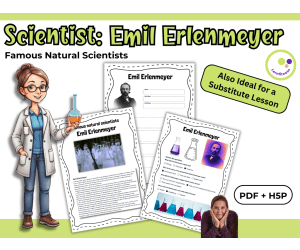
Emil Erlenmeyer – The Scientist Behind the Famous Flask
Life Sciences, Science, STEM, Social Studies, Biographies, Inventors, Basic Science, Physics, Chemistry, Technology, Grade 6, 7, 8, 9, 10, 11, Worksheets, Worksheets & Printables, Quizzes, Quizzes and Tests, Teacher Tools, Projects, Activities
Emil Erlenmeyer – The Scientist Behind the Famous Flask Comprehension Activities A short informational text and classroom task set for grades 7–10 🧪📘 (PDF + H5P) ⚗️📘 A printable and digital resource for grades 7–10 science and cross-curricular teaching 🧪🧠 This resource introduces students to Emil Erlenmeyer, a chemist best known for designing the Erlenmeyer flask – a piece of lab equipment still used every day in schools and laboratories around the world. Beyond the flask, he also made important contributions to the understanding of chemical structures and reactions. The text is written in clear, student-friendly language and offers a good opportunity to connect science content with the people behind the discoveries. I’ve used this kind of material in lessons where students are learning about lab equipment, scientific processes, or simply getting to know the history of chemistry. What’s included: A short informational text about Emil Erlenmeyer A printable student profile to summarize key facts Quiz questions based on the text (with answer key) Two extension tasks for extra practice or early finishers: – Students create their own questions – Exchange and answer partner questions Available formats: – PDF (print and digital use) – DOCX (editable text version) – H5P version for digital platforms (without images) How to use it in class: Students begin by reading the text – individually, in pairs, or as a group. They then complete the profile and quiz questions. The optional tasks work well in partner work or as a small extension activity. The structure is easy to follow and also works in substitute lessons, even when the substitute isn’t a science teacher. The H5P version can be used in digital classrooms or assigned as a self-paced homework activity with built-in feedback. No prep is needed – just print or upload and start. A simple way to connect everyday classroom science with the people who shaped it. Have fun exploring the world of science with your students! Warmly, Lernfitness Did You Know? I teach with a certified therapy dog, and together we focus on creating a positive and inspiring learning environment.
Author Lernfitness
Rating
Tags Science, Famous Scientists Lesson, H5P, Interactive Science Exercises, STEM, Scientists, Chemistry, Emil Erlenmeyer, Erlenmeyer Flask, Lab

Financial Literacy: Income Tax- Notes and Realistic Sample Practice
Life Studies, Special Resources, Finance, Home Economics, Math, Percentages, Money, Decimals, Life Skills, Grade 9, 10, 11, 12, Worksheets & Printables, Word Problems, Activities
Financial Literacy: Income Tax- Notes and Realistic Sample Practice This comprehensive financial literacy resource provides an introduction to all aspects of income tax for high school students in grades 9-12. How to Use: Note-Taking Sheet: Begin the learning process with a note-taking sheet that includes ten questions and answers, helping students become familiar with the basics of income taxes including their purpose, due dates, understanding progressive taxes, and more. Activity Section: The resource features a three-page income tax calculation activity. It simplifies elements of the income tax process like income assessment , deductions calculation, determining progressive tax amounts using percentages, as well as understanding credits. This section can be tackled using a calculator or done manually. Tax Profiles: Natasha Jones, Derek Lim and Maya Parker: The engaging profiles show unique individual tax situations through appealing visuals with basic bookkeeping exercises emulating real-life tax preparation. You could do the first profile as a whole class, allow students to work in pairs on the second profile, and use the final one for homework or assessment . A complete, colour-coded answer key is included to make marking a breeze! Grades to Use With: This lesson is designed for high school students (grades 9-12) in a variety of classes from career and personal planning, to finance or business, home economics, or applied math! Basic math skills required include calculating percentages using decimals and adding and subtracting numbers to the hundred thousands. What's Included: A total of 13 pages in ready-to-print PDF Format Title Page Instructions Income Tax: The Basics (background questions to be done as a class or by research) Answer Key 3 page Income Tax Forms 3 Profiles: Natasha Jones, Derek Lim, and Maya Parker 3 Page Answer Key If you enjoy this personal finance lesson, check out many others in my store: Financial Literacy: Household Budget Project: Taxes, Insurance, Loans, Rent, Groceries and More! Interest Rates Credit Score Board Game Debit vs Credit Cards Debt and Bankruptcy: Personal Financial Literacy Lesson
Author Grace Under Pressure
Tags Deductions, Progressive Tax, Income Tax, Taxes, Budget, Real World Math, Financial Literacy, Personal Finance, Finance, Life Skills
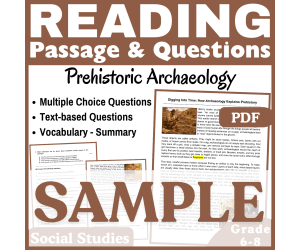
Prehistoric Archaeology: SAMPLE Social Studies Reading Passage
ELA, Reading, Reading Comprehension, Strategies, Resources for Teachers, Social Studies, History: Ancient, History, Geography, Grade 6, 7, 8, 9, Writing Prompts, Worksheets & Printables, Centers, Activities, Teacher Tools, Assessments, Quizzes and Tests, Quizzes, Tests
This is a free passage sample from the complete resource. The full version includes everything needed for a complete reading comprehension activity: the passage, multiple-choice questions, short-answer questions, vocabulary matching, a summary-writing task, and a detailed answer key. Download the complete passage resource by clicking on the following links: PDF Fillable PDF Word Docs Google Docs Prehistoric Archaeology: Social Studies Reading Comprehension Passage This resource contains an engaging Social Studies reading comprehension passage about Prehistoric Archaeology . The passage is carefully written and designed to bridge the gap between social studies and literacy through strengthening comprehension skills and sparking knowledge curiosity in middle school students. The passage blends English Language Arts skills with accurate social studies content. Ideal for interdisciplinary learning in ELA and Social Studies. Suitable for Grade 9 review, too! Student Tasks throughout the passage: 5 multiple-choice questions targeting the following skills: main idea, key details, inference, vocabulary in context, and use of evidence 5 vocabulary matching items with clear, student-friendly definitions 5 text-based questions that require citing specific lines or facts 1 summary prompt that asks students to condense central ideas accurately Full answer key for every section FULL CATALOG OF DOWNLOADING LINKS HERE Other Social Studies Reading Comprehension Collections You May Find in the Store: 1. Ancient Civilizations 2. Early Empires and Trade Networks 3. The Founding of the United States 4. Language, Culture, and Meaning 5. Psychology and Society 6. Global Festivals and Traditions 7. Extreme Environments and People 8. Food, Culture, and Preservation 9. Global Food Customs 10. Media, Communication, and Popular Culture 11. Human Impact on the Environment 12. Civic Action and Social Change 13. Fashion, Society, and Power 14. People, Places, and Unusual Histories Product Details: Length: 5 pages Grades: 6–8, also suitable for Grade 9 review Use cases: close reading, stations, homework, intervention, test prep, and sub plans Why Teachers Choose This Passage: Authentic social studies content paired with rigorous literacy practice Consistent task structure for easier planning and smoother student routines Clear, age-appropriate writing that builds confidence without oversimplifying Use this passage to reinforce ELA skills in social studies, to add literacy to your lessons, and to support independent work. The passage strengthens main idea, evidence use, vocabulary in context, inference, cause and effect, and summary writing. With ready-to-use assessments and complete answer keys, you can provide focused practice that is simple to run and fast to review.
Author Middle & High School - CORED Education
Rating
Tags Middle School, Reading Comprehension, Reading Strategies, ELA, Centers, Reading Passage, Assessments, Vocabulary, Social Studies, Prehistoric Archaeology
Desert Island Simulation Activity
Social Studies, Sociology, Grade 9, 10, 11, 12, Activities, Projects
Sociology in Practice: Island Simulation Teacher Guide Thank you so much for having purchased my simulation activity and materials. In my experience, simulations have been the best way to make content come to life in the classroom to create enduring learning. This specific simulation was designed to start my sociology course off. I reference it throughout the semester when discussing big ideas like power dynamics, social desirability, and social institutions. I think this simulation also works well at the end of the course. It can also be easily adapted by changing the questions up a little to work in a government class, a psychology class, or a leadership class. Ultimately, I’ve found simulations like this work best as a template of sorts– it is creativity in the classroom that really brings them to life! Have fun! Chronological Directions 1.As a first step, if possible, I like to arrange the room in a way that creates separation between the 4 groups (or however many groups you choose to have). The ideal group size I’ve found to be between 5 and 7. This allows for diversity of opinion and a talkative environment, but doesn’t result in as many students not participating. As always, balancing student personalities is often a good strategy if you know your students well already. 2.Day 1. First, take some time to overview the simulation. I recommend displaying slides 2-7 on opening day and take your time answering questions. Most questions can be answered on your own discretion. For example, “is there hope of rescue?” you can answer in any fashion. Or not answer! A common question you will likely be asked is “how did we get a map for an island we didn’t know existed”? To which I usually respond, “magic!”. 3.Next, give students (or assign on Google Classroom, if applicable) the Day 1 Worksheet. The worksheet will walk students through the tasks of the first day, which include naming their village, creating 10 rules for their new society, deciding how power will be wielded in the community (Pure democracy? Dictatorship? Oiligarchy?), and how they will explore the land. That, paired with discussion, should wrap up day 1 depending on the length of your periods. 4.In between Day 1 and 2 you will want to gather announcements. I like to get creative and respond to what students discussed yesterday. For example, what happened to the scouts they sent out? Did they simply disappear? How did the people respond to the newest 10 rules? Was there a mutiny? Were the scouts met by hostile locals? Did the scouts discover additional food or clean drinking water? Were they able to meet up with another group? If so, are there talks to combine the two villages? If so, who will retain power? The possibilities are quite literally limitless. 5.Day 2. Make sure to hand out the Day 2 Worksheet. Start by making the announcements you decided on based off of day 1. Additionally, announce that a few people are seriously hurt from the crash and some seem to have fallen ill. The medical area is over-run, and the leader(s) need to establish who gets priority for medical attention. Students can then decide what will happen to rule breakers, what the plan is for food and shelter, and if there is time, they can draw or create a layout of their simple village. 6.Again, in between Day 2 and 3 you will think of and possibly write down announcements. All the prior possibilities are in play and more! The mingling between groups tends to create the most fun classroom environments, I think. 7.Day 3. Make sure to hand out the Day 3 Worksheet. Presumably the simulation could go on longer, but this is the last day with provided materials. Make your written announcements, and also announce that a small child who speaks no English has entered their villages and pointed out “Hobbes Cave” on their maps. I named the cave after Thomas Hobbes, so I think it is fair game for bad things to happen to scouts sent to explore there. Totally up to you, however. Continue to press students on things like the structure of their society, power dynamics, and their interactions with other groups or lack thereof. 8.Day 4. I like to spend one day at the end as a reflection day. I start by announcing how the game ended and explaining how the game relates to content we will learn this year (or have already learned). I also assign the Day 4 Worksheet to collect reflections. 9.Make any adjustments or additions as needed, and feel free to provide me feedback on the project! I really enjoyed making it and hope you enjoy it too. With further questions, reach out to me at tristanjbernhard@gmail.com . Take A Look At More Of My Best Sellers: Language Development Slides & Guided Notes Crash Course Sociology Episode 15 Worksheet Gender Roles & Gender Socialization Slides & Guided Notes Enjoy More From My Store Here: Active Social Studies
Author Ed Dynamic
Tags Small Group, Google Classroom, Community, Sociology, Role Play, Critical Thinking

Animal Skin, Cats, & T. Rex: Reading Comprehension passages (PDF)
Science, ELA, Reading, Reading Comprehension, Strategies, Resources for Teachers, Life Sciences, Animals, Insects, Nature & Plants, Grade 6, 7, 8, 9, Writing Prompts, Worksheets & Printables, Centers, Activities, Teacher Tools, Assessments, Quizzes and Tests, Quizzes, Tests
Animal Skin, Cats, & T. Rex: Reading Comprehension Passages (PDF) This very engaging collection of life science reading passages about Animal Skin, Cats, & T. Rex is designed to bridge the gap between science and literacy through strengthening reading comprehension and sparking scientific curiosity in middle school students. Each passage blends English Language Arts skills with accurate science content that supports NGSS classroom practice. Ideal for interdisciplinary learning in ELA and Science. Suitable for Grade 9 review, too! What Is Included? There are (3) informational passages: Tyrannosaurus rex: The Tyrant Lizard King Step into the late Cretaceous and see T. rex up close, from its towering build and crushing bite to the clues fossils give about speed and feeding. CT scans, trackways, and healed injuries help scientists piece together how this predator lived. Cats and Sweetness: A Taste They Don’t Have A small change in a taste receptor means cats do not detect sugar. This trait fits a meat-first diet and helps explain why scent, texture, fats, and proteins matter more than sweetness. Animal Skin: A Tool for Survival Skin works as armor, thermostat, camouflage, warning, and display. Examples include the hippo’s natural sunscreen, zebra stripes that confuse attackers, and king snakes that copy coral snake colors to stay safe. Student Tasks for Each Passage: 5 multiple-choice questions targeting main idea, key details, inference, vocabulary in context, and use of evidence 5 vocabulary matching items with clear, student-friendly definitions 5 text-based questions that require citing specific lines or facts 1 summary prompt that asks students to condense central ideas accurately Full answer key for every section Available Formats for this Resource Word Docs Google Docs FULL CATALOG OF DOWNLOADING LINKS HERE Other Science Reading Collections and Topics You May Find in the Store: 1. Astronomy & Space Science 2. Volcanoes, Rocks, & Mountains 3. Rock Cycle, Soil, & Sinkholes 4. Mars, Glaciers, & Antarctica 5. Water Cycle, Acid Rain, & Wastewater 6. Insects, Animals, & Ecosystems 7. Bioluminescence & Insects 8. Animal Skin, Cats, & T. Rex 9. Human Body and Senses 10. Health & Applied Bioscience 11. Waves, Light, & Imaging 12. Electricity & Energy 13. Motion & Materials 14. Chemistry and Materials Science 15. Electromagnetism 16. Acids and Bases 17. Gas Laws 18. Biotechnology 19. Periodic Trends 20. Protists and Fungi 21. Microevolution 22. Blood 23. Chemical Bonding 24. Magnets 25. Muscles 26. Nuclear Chemistry 27. Electromagnetic Devices 28. Epigenetics 29. The Law of Conservation of Mass 30. Atomic Models 31. Isotopes and Ions 32. Light 33. Human-Environment Interaction 34. Theory of Evolution 35. Photosynthesis 36. Origins of Life and Early Earth 37. Gene Expression and Regulation 38. Thermochemistry 39. Allergies 40. Coevolution 41. Birth to Adulthood 42. Cells 43. Entropy and Free Energy 44. The Human Brain 45. Mixtures and Solutions 46. Invertebrates 47. Zoo Animals 48. Biochemistry 49. Animal Behavior 50. Population Ecology ...and many more engaging science reading passages that cover intriguing and important topics designed to spark curiosity and support student learning. Product Details Length: 1e pages total Grades: 6–8, also suitable for Grade 9 review Use cases: close reading, stations, homework, intervention, test prep, and sub plans Standards support: reinforces informational-text skills and supports NGSS-style sense making through observation, modeling, and clear use of claim, evidence, and reasoning Why Teachers Choose This Set Authentic science content paired with rigorous literacy practice Consistent task structure across all passages for easier planning and smoother student routines Clear, age-appropriate writing that builds confidence without oversimplifying Use this set to reinforce ELA skills in science, to add literacy to your lessons, or to support independent work. The passages strengthen main idea, evidence use, vocabulary in context, inference, cause and effect, and summary writing. With ready-to-use assessments and complete answer keys, you can provide focused practice that is simple to run and fast to review.
Author Middle & High School - CORED Education
Rating
Tags Middle School, Reading Comprehension, Reading Strategies, ELA, Centers, Reading Passage, Assessments, Vocabulary, Life Science, Dinosaurs

AI for Kids: Understanding Artificial Intelligence Book
Science, Technology, Computer Science, Engineering, Special Resources, Life Skills, Special Education Needs (SEN), STEM, Research, Resources for Teachers, Grade 6, 7, 8, 9, 10, 11, 12, Projects, Activities, Teacher Tools, Assessments, Lesson Plans, Presentations, Literacy Readers, Quizzes and Tests, Quizzes, Tests
Uncover the amazing world of Artificial Intelligence with AI for Kids by Syed Hammad Rizvi – the best easy to read and conceptual book about what AI is for kids! This 315 page long book has no coding requirement; instead, it presents many complicated ideas such as; machine learning, algorithms, deep learning, data patterns, ethical AI & bias, quantum computing, autonomous vehicles, robotics, and The Future of AI (including the singularity and AGI) in an interesting and fun way by using many familiar analogies that can be easily understood (i.e. Lego sorting, riding a bike, master cooks). AI for Kids is perfect for kids who want to learn how Siri, Netflix recommendations, facial recognition, and ChatGPT actually work without any programming or technical knowledge! There are 151 short chapters filled with real-life examples appropriate for children, and the information in these chapters empowers children. The book can be used as a tool to create interest in STEM subjects, or as an educational resource to be used at home, school, in after-school STEM clubs, or at night before bed to build AI literacy and inspire future generations of innovators, ethicists, and thinkers! Keywords: AI, kids, artificial intelligence, machine learning simply explained, neural networks beginners, ethical AI & the future of AI, no coding AI, STEM children 8-14. Here's what Parents & Schools find appealing about this Read: - No technical overwhelm – just follow AI concepts with relatable analogies to make it easy to understand & fun for kids. - Covers every aspect of AI within 151 bite-sized chapters (history, how AI learns, applications in health care, gaming & robotics, ethics, bias, jobs of the future) – this one book replaces the need for many resources. - Build early critical thinking skills and digital citizenship skills by getting children thinking critically about AI choices, identifying biased information, and preparing children for careers related to AI. - Very versatile for classroom/homeschooling use – short chapters, discussion prompts, & real-life examples are well-suited to be used as part of lessons/projects or for independent reading. - Future-proof & aspirational – encourages children to believe they can influence AI positively, while dreaming of careers such as “AI Ethicist" or "Human-AI Team Coordinator." Target Audience (Based on Complete Analysis of Book): The title and content are explicitly created for kids, with simple formats (analogies, short chapters), questions and real-life examples being used throughout all 151 chapters (from basics at Chapter 1 to complex concepts such as singularity, quantum AI, bias, ethics and future impact in the other chapters). The content continually uses easy-to-understand language to help engage kids, even through some of the most trying sections (example of AGI: like a true thinker who could write novels and create music; bias, using the analogy of a warped photograph; and food science using the analogy of a digital chef). While the book does not provide any required ages/grades, the depth of material (differentiating between narrow/general AI, explaining XAI, discussing the predictive policing debate, interdisciplinary teams, and impact on society) and no requirement of coding make it appropriate for children age 8-14 (grades 3-8 / upper elementary and middle school). Younger children (grades 3-5) will enjoy the fun stories and introduction of subject matter, while older children (grades 6-8) will understand the ethical aspects of these technologies and their potential future career opportunities as well as understand how these technologies apply to the real world and benefit society through further learning. This book would be a good resource for homeschoolers, teachers, gifted programs and any student who has an interest in technology. It will be too basic for high school students but will provide a solid foundation and valuable supplemental material. Copyright Terms: This book is protected by copyright as established by Syed Hammad Rizvi. This material is intended for individual use and for use in a single classroom. You cannot modify, distribute, or sell this material. In other words, you can’t post this material online where it has the potential of being found & downloaded by others. If you would like to share this material with teachers, please purchase an additional license from Teachsimple. Thank you for your cooperation with these copyright terms! This product is gratefully provided by Syed Hammad Rizvi.
Author Creative Book Store
Rating
Tags ArtificialIntelligence, STEM, STEMeducation, KidsSTEM, HomeschoolSTEM, TeacherResources, NeuralNetworksForKids, ChatGPTforKids, AIethicsForKids, FutureOfAI
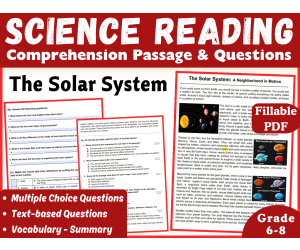
Science Reading Passage. The Solar System (Fillable PDF)
Science, ELA, Reading, Reading Comprehension, Strategies, Resources for Teachers, Space, Earth and Environmental Sciences, Grade 6, 7, 8, 9, Writing Prompts, Worksheets & Printables, Centers, Activities, Teacher Tools, Assessments, Quizzes and Tests, Quizzes, Tests
Science Reading Comprehension Passages and Questions: The Solar System (Fillable PDF) This very engaging science reading passage about The Solar System is designed to bridge the gap between science and literacy through strengthening reading comprehension and sparking scientific curiosity in middle school students. The passage blends English Language Arts skills with accurate science content that supports NGSS classroom practice. Ideal for interdisciplinary learning in ELA and Science. Suitable for Grade 9 review, too! These worksheets are designed as fillable PDFs , which means students can type their answers directly into the document on any computer or tablet . Each page includes highlighted text fields that show them exactly where to type! Student Tasks for The Passage: 5 multiple-choice questions targeting main idea, key details, inference, vocabulary in context, and use of evidence 5 vocabulary matching items with clear, student-friendly definitions 5 text-based questions that require citing specific lines or facts 1 summary prompt that asks students to condense central ideas accurately Full answer key for every section Available Formats for this Resource PDF Word Docs Google Docs FULL CATALOG OF DOWNLOADING LINKS HERE Product Details Length: 5 pages total Grades: 6–8, also suitable for Grade 9 review Use cases: close reading, stations, homework, intervention, test prep, and sub plans Standards support: reinforces informational-text skills and supports NGSS-style sense making through observation, modeling, and clear use of claim, evidence, and reasoning Why Teachers Choose This Set Authentic science content paired with rigorous literacy practice Consistent task structure across all passages for easier planning and smoother student routines Clear, age-appropriate writing that builds confidence without oversimplifying Other Science Reading Collections you May find in the store: 1. Astronomy & Space Science 2. Volcanoes, Rocks, & Mountains 3. Rock Cycle, Soil, & Sinkholes 4. Mars, Glaciers, & Antarctica 5. Water Cycle, Acid Rain, & Wastewater 6. Insects, Animals, & Ecosystems 7. Bioluminescence & Insects 8. Animal Skin, Cats, & T. Rex 9. Human Body and Senses 10. Health & Applied Bioscience 11. Waves, Light, & Imaging 12. Electricity & Energy 13. Motion & Materials 14. Chemistry and Materials Science Use this set to reinforce ELA skills in science, to add literacy to your lessons, and to support independent work. The passages strengthen main idea, evidence use, vocabulary in context, inference, cause and effect, and summary writing. With ready-to-use assessments and complete answer keys, you can provide focused practice that is simple to run and fast to review.
Author Middle & High School - CORED Education
Rating
Tags Middle School, Reading Comprehension, Reading Strategies, ELA, Centers, Reading Passage, Assessments, Vocabulary, Environmental Science, The Solar System

Chemical Reactions and Balancing Equations – Lab Station Activity
Science, Chemistry, Grade 9, 10, 11, 12, Labs, Experiments, Activities
Chemical Reactions and Balancing Equations Lab Station Activity This editable lab station activity covers describing chemical reactions, balancing chemical equations, and types of chemical reactions. Students rotate through 9 stations, including getting hands-on to draw models, researching topics, writing explanations, answering questions based on videos, and more. It is designed to engage students in the content in a fun and meaningful way. Use it to complement your chemistry curriculum as an in-class lab or review activity before tests. With minimal prep required and an answer key provided, implementing this activity into your chemistry lesson plans is seamless. Your students will love moving through the stations while solidifying their understanding of chemical reactions and balancing equations.
Author Teach With Fergy
Tags Ionic, Forces, Reactions, Chemical, Lab Stations, Balancing Equations, Describing Chemical Reactions Lab Answer Key

Father's Day Narrative Writing Guide!
ELA, Writing, Creative Writing, Grade 6, 7, 8, 9, 10, 11, 12, Activities, Projects
Honor your father by transforming him into a superhero in your very own action-adventure tale! Our collection of narrative writing guides aims to facilitate the journey from "conceptualization to completion" by allowing students' creativity to ignite their writing, instead of the other way around. Unlike many traditional creative writing tasks, our Father's Day guide initiates the process by encouraging students to make straightforward and enjoyable decisions about the fundamental aspects of their narrative even before they begin to jot down their ideas or start typing! You'll be amazed at how simply your students will be able to craft their own Father's Day narrative. Beginning with straightforward directions, examples, and tips, students will then be able to plan out their story using multiple choice characterization options, short answer plotting devices, and map-drawing activity. An outlining guidance completes the narrative planning process. By then, students will be excited to start drafting their story. A clear peer edit activity is included with this resource, as well as a Common Core-tied rubric. Perfect as an instant sub plan (just print and leave on your desk!) or as a foundation for a week-long writing project, your download provides: A storyboard template guiding students in choosing their plot's setting, protagonist, character development, antagonist, and conflict (little to no writing needed!) A research table to help students flesh out their narrative details A narrative structuring exercise allowing students to use their storyboard's guidelines to commence drafting their narrative A Father's Day narrative writing task sheet featuring descriptions of well-known family tales, a calendar for setting due dates, general tips for narrative writing, a checklist for peer editing of fantasy writing, and a grading rubric aligned with FOUR Common Core standards This 4-page lesson is offered in both full color and black & white versions Although this resource can be fitted for any secondary Language Arts classroom, it has been carefully designed to work best in grades 7, 8, 9, and 10. The included rubric is subtly but specifically tied to Common Core ELA Standards for Language (1 and 2), Reading Literature (2), and Writing (3, 4, and 5). This resource is provided in print-ready, bookmarked, and adjustable PDF files and PowerPoint Show files. This resource contains 4 pages.
Author The Language of Educational Art, LLC
Tags Creative, Essay, Rubric, Narrative
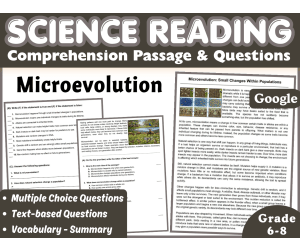
Life Science Reading Comprehension Passage: Microevolution (Docs)
Science, ELA, Reading, Reading Comprehension, Strategies, Resources for Teachers, Life Sciences, Biology, Grade 6, 7, 8, 9, 10, Writing Prompts, Worksheets & Printables, Centers, Activities, Teacher Tools, Assessments, Quizzes and Tests, Quizzes, Tests
Life Science Reading Comprehension Passage and Questions: Microevolution (Docs) This very engaging science reading passage is about microevolution and the small inherited changes that occur within populations over many generations . It explains how traits and alleles can become more or less common through natural selection, mutation, genetic drift, the bottleneck and founder effects, gene flow, and non-random mating. Students explore clear examples such as insect camouflage, antibiotic-resistant bacteria, changing bird beaks, animal movement, pollen transfer, and mate-attracting traits. This passage is designed to bridge the gap between science and literacy by strengthening reading comprehension while sparking scientific curiosity in middle school students. It blends English Language Arts skills with accurate science content, helping students build background knowledge, understand key concepts, use evidence from the text, and explain scientific ideas clearly. This resource supports science classroom practice while also reinforcing important literacy skills such as main idea, vocabulary, comprehension, and summarizing. Ideal for interdisciplinary learning in ELA and Science. Suitable for Grade 9 review, too! Student Tasks for The Passage: 10 multiple-choice questions targeting main idea, key details, science concepts, comparison, and real-world applications 10 True/False statements to check understanding and address common misconceptions 5 text-based short-answer questions that require students to explain important ideas from the passage 5 vocabulary matching items with clear, student-friendly definitions 1 summary prompt that asks students to condense the central ideas accurately Full answer key for every section Available Formats for this Resource PDF Fillable PDF Word Docs FULL CATALOG OF DOWNLOADING LINKS HERE Product Details Length: 7 pages total Grades: 6–8, also suitable for Grade 9 review Use cases: close reading, stations, homework, intervention, test prep, and sub plans Standards support: Reinforces informational-text skills and supports NGSS-style sense-making by helping students read scientific explanations, connect evidence to key concepts, interpret real-world examples, and explain cause-and-effect relationships in science. Why Teachers Choose This Set Authentic science content paired with rigorous literacy practice Consistent task structure across all passages for easier planning and smoother student routines Clear, age-appropriate writing that builds confidence without oversimplifying Other Science Reading Collections and Topics You May Find in the Store: 1. Astronomy & Space Science 2. Volcanoes, Rocks, & Mountains 3. Rock Cycle, Soil, & Sinkholes 4. Mars, Glaciers, & Antarctica 5. Water Cycle, Acid Rain, & Wastewater 6. Insects, Animals, & Ecosystems 7. Bioluminescence & Insects 8. Animal Skin, Cats, & T. Rex 9. Human Body and Senses 10. Health & Applied Bioscience 11. Waves, Light, & Imaging 12. Electricity & Energy 13. Motion & Materials 14. Chemistry and Materials Science 15. Electromagnetism 16. Acids and Bases 17. Gas Laws 18. Biotechnology 19. Periodic Trends 20. Protists and Fungi 21. Microevolution 22. Blood 23. Chemical Bonding 24. Magnets 25. Muscles 26. Nuclear Chemistry 27. Electromagnetic Devices 28. Epigenetics 29. The Law of Conservation of Mass 30. Atomic Models 31. Isotopes and Ions 32. Light 33. Human-Environment Interaction 34. Theory of Evolution 35. Photosynthesis 36. Origins of Life and Early Earth 37. Gene Expression and Regulation 38. Thermochemistry 39. Allergies 40. Coevolution 41. Birth to Adulthood 42. Cells 43. Entropy and Free Energy 44. The Human Brain 45. Mixtures and Solutions 46. Invertebrates 47. Zoo Animals 48. Biochemistry 49. Animal Behavior 50. Population Ecology ...and many more engaging science reading passages that cover intriguing and important topics designed to spark curiosity and support student learning. Use this passage to reinforce ELA skills in science, to add literacy to your lessons, and to support independent work. The passages strengthen main idea, evidence use, vocabulary in context, inference, cause and effect, and summary writing. With ready-to-use assessments and complete answer keys, you can provide focused practice that is simple to run and fast to review.
Author Middle & High School - CORED Education
Rating
Tags Middle School, Reading Comprehension, Reading Strategies, ELA, Centers, Reading Passage, Assessments, Vocabulary, Biology, Life Science
Asteroids, Comets and Meteors - 7 Lab Station Activities
Science, Earth and Environmental Sciences, Space, Grade 9, 10, 11, Activities
Asteroids, Comets and Meteors - 7 Lab Station Activities Introduction: A priceless teaching aid made specifically for science educators focusing on astronomy. Meant primarily for students of grades 9-11, this resource can be adapted to meet different needs. It contains seven lab station activities centered on asteroids, comets, and meteors designed to stimulate active learning with various assessment opportunities. Station Details: Station One: Sparks creativity by allowing students to draw or build related concepts. Station Two: Targeted independent inquiry into issues or questions linked to asteroids, comets, and meteors. Station Three: Written discourse where learners provide their view in paragraph format on a significant question. Stations Four/Eight: Rest spaces giving students the chance to make up for missed assignments or prepare for upcoming ones without pressure. Station Five:The application of learnings in practical settings through small reading sections directly relating classroom lessons with real-life scenarios. -Focus Areas- - Understanding asteroid locations and uses - Distinguishing between meteors/meteorites/meteoroids - Impacts from collisions between asteroids and Earth - Crater creation process - Using asteroids/comets as fuel resources >station Six: Validates understanding through multiple choice query followed by written explanations on reasoning behind chosen responses. >station Seven: Digital natives are catered for through video content coupled with related questions which compensate traditional print sources. These lab stations also include recording sheets for students to document their findings. In turn, this simplifies the grading process for teachers while teaching students about tracking coursework. The lab stations can be utilized in various settings such as group activities, individual assignments or even as homework tasks. In Conclusion Critical tool in promoting comprehensive acquisition and application of knowledge. A well-structured design of the product ensures student engagement during the learning process of complex scientific concepts ideally within a stress free space.
Author Teach With Fergy
Tags Astronomy Education, Asteroids, Comets, Meteors, Lab Activities

Social Studies SAMPLE Reading Passage: Food in South America (PDF)
ELA, Reading, Reading Comprehension, Strategies, Resources for Teachers, Social Studies, Sociology, Grade 6, 7, 8, 9, Writing Prompts, Worksheets & Printables, Centers, Activities, Teacher Tools, Assessments, Quizzes and Tests, Quizzes, Tests
This is a ONE PASSAGE SAMPLE. The following is the description of the FULL resource and the downloading links: Social Studies Reading Comprehension Passages and Questions: Food and Culture (PDF) This resource introduces a collection of Social Studies reading comprehension passages with questions about Food, Culture, and Preservation. The passages are carefully designed to bridge the gap between social studies and literacy through strengthening reading comprehension and sparking knowledge curiosity in middle school students. Each passage blends English Language Arts skills with accurate social studies content . Ideal for interdisciplinary learning in ELA and Social Studies. Suitable for Grade 9 review, too! What Is Included in this Collection? There are three informational passages (with full answer keys): Homemade Cottage Cheese: Food, Family, and Local Trade Salty Traditions: How Salami and Kimchi Stay Safe to Eat From Grasslands to Grill: The Foods of South America For Each Passage, students will have multiple tasks to complete as follow: 5 multiple-choice questions targeting main idea, key details, inference, vocabulary in context, and use of evidence 5 vocabulary matching items with clear, student-friendly definitions 5 text-based questions that require citing specific lines or facts 1 summary prompt that asks students to condense central ideas accurately Available Formats for this Resource Fillable PDF Word Docs Google Docs FULL CATALOG OF DOWNLOADING LINKS HERE For more Social Studies Reading Passages, check the following Links: Ancient Civilizations PDF Fillable PDF Word Docs Google Docs Early Empires and Trade Networks PDF Fillable PDF Word Docs Google Docs The Founding of the United States PDF Fillable PDF Word Docs Google Docs Language, Culture, and Meaning PDF Fillable PDF Word Docs Google Docs Psychology and Society PDF Fillable PDF Word Docs Google Docs Global Festivals and Traditions PDF Fillable PDF Word Docs Google Docs Extreme Environments and People PDF Fillable PDF Word Docs Google Docs Food, Culture, and Preservation PDF Fillable PDF Word Docs Google Docs Global Food Customs PDF Fillable PDF Word Docs Google Docs Media, Communication, and Popular Culture PDF Fillable PDF Word Docs Google Docs Human Impact on the Environment PDF Fillable PDF Word Docs Google Docs Civic Action and Social Change PDF Fillable PDF Word Docs Google Docs Fashion, Society, and Power PDF Fillable PDF Word Docs Google Docs People, Places, and Unusual Histories PDF Fillable PDF Word Docs Google Docs Product Details Length: 14 pages total Grades: 6–8, also suitable for Grade 9 review Use cases: close reading, stations, homework, intervention, test prep, and sub plans Why Teachers Choose This Set Authentic social studies content paired with rigorous literacy practice Consistent task structure across all passages for easier planning and smoother student routines Clear, age-appropriate writing that builds confidence without oversimplifying Use this set to reinforce ELA skills in social studies, to add literacy to your lessons, and to support independent work. The passages strengthen main idea, evidence use, vocabulary in context, inference, cause and effect, and summary writing. With ready-to-use assessments and complete answer keys, you can provide focused practice that is simple to run and fast to review.
Author Middle & High School - CORED Education
Rating
Tags Middle School, Reading Comprehension, Reading Strategies, ELA, Centers, Reading Passage, Assessments, Vocabulary, Social Studies, Food And Culture
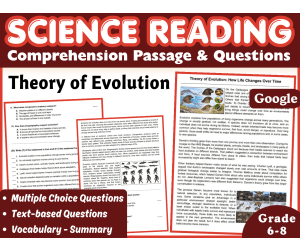
Reading Comprehension | Life Science | Biology | Evolution (Docs)
Science, ELA, Reading, Reading Comprehension, Strategies, Resources for Teachers, Common Core, Language Development, Life Sciences, Biology, Grade 6, 7, 8, 9, 10, Writing Prompts, Worksheets & Printables, Centers, Activities, Teacher Tools, Assessments, Quizzes and Tests, Quizzes, Tests, Literacy Readers
Life Science Reading Comprehension Passage and Questions for Middle School: Evolution (Google Document) This engaging middle school life science reading comprehension resource explores the theory of evolution, natural selection, and the evidence scientists use to understand how life changes over time . Students learn how Charles Darwin’s observations of Galápagos finches helped shape his thinking about adaptation and how inherited traits can become more common in populations across generations. The passage explains key concepts including variation, natural selection, adaptation, competition, survival and reproduction, common ancestry, fossils, transitional forms, comparative anatomy, and biogeography . Students also learn how geographic isolation can cause populations to change in different directions over time. This passage is designed to bridge the gap between science and literacy by strengthening reading comprehension while sparking scientific curiosity in middle school students. It blends English Language Arts skills with accurate science content, helping students build background knowledge, understand key concepts, use evidence from the text, and explain scientific ideas clearly. This resource supports science classroom practice while also reinforcing important literacy skills such as main idea, vocabulary, comprehension, and summarizing. Ideal for interdisciplinary learning in ELA and Science. Suitable for Grade 9 review, too! Student Tasks for The Passage: 10 multiple-choice questions targeting main idea, key details, science concepts, comparison, and real-world applications 10 True/False statements to check understanding and address common misconceptions 5 text-based short-answer questions that require students to explain important ideas from the passage 5 vocabulary matching items with clear, student-friendly definitions 1 summary prompt that asks students to condense the central ideas accurately Full answer key for every section Available Formats for this Resource PDF Fillable PDF Word Docs Product Details Length: 7 pages total Grades: 6–8, also suitable for Grade 9 review Use cases: close reading, stations, homework, intervention, test prep, and sub plans Standards support: Reinforces informational-text skills and supports NGSS-style sense-making by helping students read scientific explanations, connect evidence to key concepts, interpret real-world examples, and explain cause-and-effect relationships in science. FULL CATALOG OF DOWNLOADING LINKS HERE Other Science Reading Collections and Topics You May Find in the Store: 1. Astronomy & Space Science 2. Volcanoes, Rocks, & Mountains 3. Rock Cycle, Soil, & Sinkholes 4. Mars, Glaciers, & Antarctica 5. Water Cycle, Acid Rain, & Wastewater 6. Insects, Animals, & Ecosystems 7. Bioluminescence & Insects 8. Animal Skin, Cats, & T. Rex 9. Human Body and Senses 10. Health & Applied Bioscience 11. Waves, Light, & Imaging 12. Electricity & Energy 13. Motion & Materials 14. Chemistry and Materials Science 15. Electromagnetism 16. Acids and Bases 17. Gas Laws 18. Biotechnology 19. Periodic Trends 20. Protists and Fungi 21. Microevolution 22. Blood 23. Chemical Bonding 24. Magnets 25. Muscles 26. Nuclear Chemistry 27. Electromagnetic Devices 28. Epigenetics 29. The Law of Conservation of Mass 30. Atomic Models 31. Isotopes and Ions 32. Light 33. Human-Environment Interaction 34. Theory of Evolution 35. Photosynthesis 36. Origins of Life and Early Earth 37. Gene Expression and Regulation 38. Thermochemistry 39. Allergies 40. Coevolution 41. Birth to Adulthood 42. Cells 43. Entropy and Free Energy 44. The Human Brain 45. Mixtures and Solutions 46. Invertebrates 47. Zoo Animals 48. Biochemistry 49. Animal Behavior 50. Population Ecology ...and many more engaging science reading passages that cover intriguing and important topics designed to spark curiosity and support student learning. Use this passage to reinforce ELA skills in science, to add literacy to your lessons, and to support independent work. The passages strengthen main idea, evidence use, vocabulary in context, inference, cause and effect, and summary writing. With ready-to-use assessments and complete answer keys, you can provide focused practice that is simple to run and fast to review.
Author Middle & High School - CORED Education
Rating
Tags Middle School, Reading Comprehension, Reading Strategies, ELA, Centers, Reading Passage, Assessments, Vocabulary, Life Science, Biology