End of Year Math Review Task Cards for 6th Grade
Provide 28 Common Core-aligned math task cards for 6th grade students to review a full year's worth of math skills involving expressions, equations, ratios, and inequalities.
Classroom resources
Browse by lesson focus
Choose the topic or kind of practice you need.
Provide 28 Common Core-aligned math task cards for 6th grade students to review a full year's worth of math skills involving expressions, equations, ratios, and inequalities.
Give students practice identifying and describing the properties of rational and irrational numbers (framed around Georgia's 8th Grade Number System standard MGSE8.NS.1) through a 'Guess Who?'-style guessing-game card activity.
Keep 4th graders' math skills strong over the summer with a standards-aligned review workbook and games covering multi-digit operations, factors/multiples, fractions, decimals, and geometry, preparing for Grade 5.
Engage 5th/6th grade students in an 8-day Christmas-themed math mystery activity where daily math tasks (decimal division/multiplication, elapsed time, data lookups) each reveal a clue toward finding Santa's hiding spot.
Review Grade 5 math skills (standard form, volume, division, decimal operations, fraction operations) ahead of end-of-year testing through two 8-question bingo games.
Review a range of 6th grade math skills (ratios, unit rate, order of operations, percent, equations, inequalities, fraction/decimal operations, coordinate plane distance, GCF) through two slide-driven bingo review games.
A 10-minute daily spiral-review warm-up/escape-room activity ('Math Missions: Space Edition - Mission 2') reviewing ratios, unit rates, fraction simplification, decimal comparison, and order of operations for 6th grade.
A 10-minute daily spiral-review warm-up/escape-room activity ('Math Missions: Space Edition - Mission 3') reviewing ratios, unit rates, fraction simplification, decimal comparison, and order of operations for 6th grade.
A 10-minute daily spiral-review warm-up/escape-room activity ('Math Missions: Space Edition - Mission 4') reviewing ratios, unit rates, fraction simplification, decimal comparison, and order of operations for 6th grade.
A 10-minute daily spiral-review warm-up/escape-room activity ('Math Missions: Space Edition - Mission 5') reviewing ratios, unit rates, fraction simplification, decimal comparison, and order of operations for 6th grade.
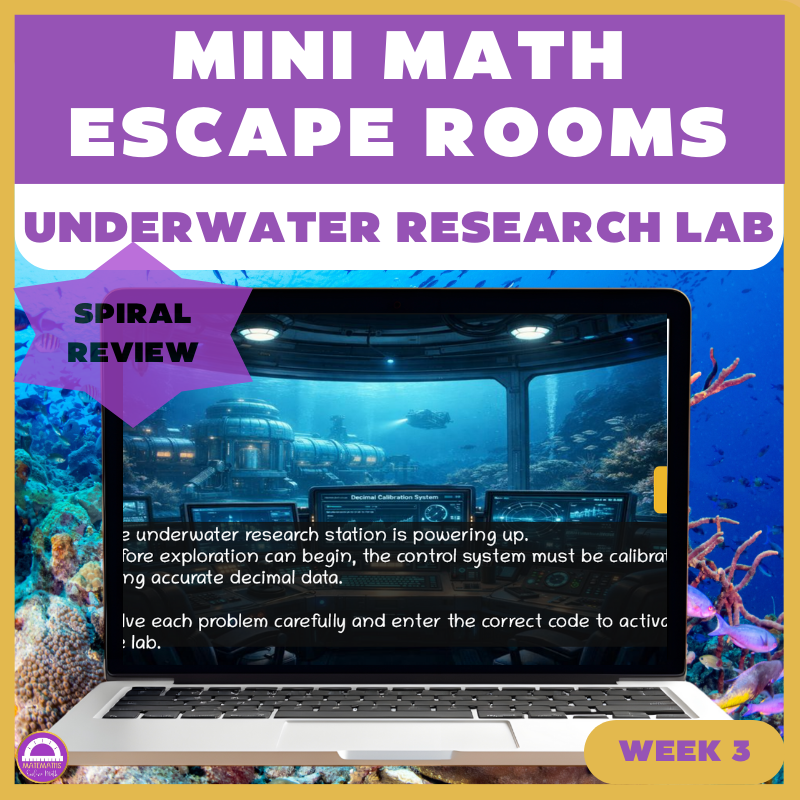
A full week (5 daily missions) of 8-10 minute spiral-review 'mini escape room' warm-ups for 6th grade math, themed as Underwater Research Lab.
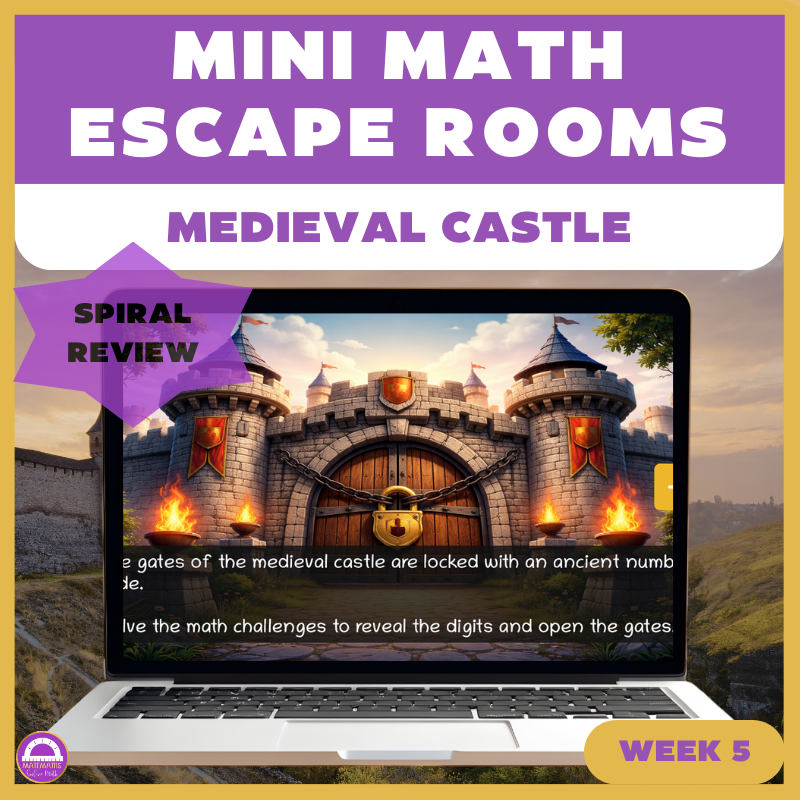
A full week (5 daily missions) of 8-10 minute spiral-review 'mini escape room' warm-ups for 6th grade math, themed as Medieval Castle.
A summer review workbook and games pack for rising/outgoing 6th graders, covering 62 standards-aligned math activities (ratios, rates, percent, algebra, coordinate plane, statistics, problem solving) organized by week, meant to prevent summer learning loss.
Review Grade 8 math skills (right-triangle side length via Pythagorean theorem/trig, coordinate-plane distance, parallel-line angle pairs, comparing numbers in radical/decimal/mixed form, rate-time-distance, unit cost, approximate position of a radical on a number line) through a teacher-led BINGO game format.
A digital, self-checking decimal addition/subtraction activity using a 'puzzle picture' reveal format, aimed at grades 4-5.
Adding & Subtracting Rational Numbers with Integer Rules Scavenger Hunts This unique education tool engages 7th-grade students in learning about the addition and subtraction of rational numbers.
Adding Decimals to the Tenths Scavenger Hunt Introduction This invaluable teaching resource provides a focus on adding decimals up to the tenths place in a captivating and stimulating way.
This exciting back-to-school themed digital escape room , is designed to provide a fun and engaging experience for your middle school students while reviewing essential grade six math skills. With its captivating storyline and diverse math problems, this escape room is the perfect tool to make learning interactive and enjoyable. Join…
Welcome to this exciting back-to-school themed digital escape room , specially designed to captivate and engage your middle school students while reviewing essential grade six math concepts. This immersive experience offers a fun and interactive way for students to reinforce their understanding of converting fractions, decimals, and…
One slide deck runs two back-to-back bingo rounds covering 16 total 7th-grade math problems, presented one or two at a time on a projected screen. Students first build their own 4x4 board and fill it with 16 given answers in random order, to vary board arrangements. Game 1 covers questions 1-8 (a rate word problem, evaluating an expression, upper quartile from a data set, solving for a variable, mean of a data set, an integer temperature-change problem, and spinner probability); students mark the corner of the matching square rather than crossing it out, since the same board carries over into Game 2, questions 9-16 (unit-rate cupcakes, probability of drawing a name, extrapolating a data trend, lower quartile and percent from a box-and-whisker plot, solving for a side in similar triangles, a ratio-to-percent conversion, and simplifying an expression). A full answer key for all 16 questions is included on the final slide, along with a note on the one answer value that gets reused (4.48 appears twice, so 3.36 is left as a spare on student boards).
Do you integrate daily Number Talks into your math lessons? In search of a dynamic, zero-prep way to refine your students' mental math prowess?
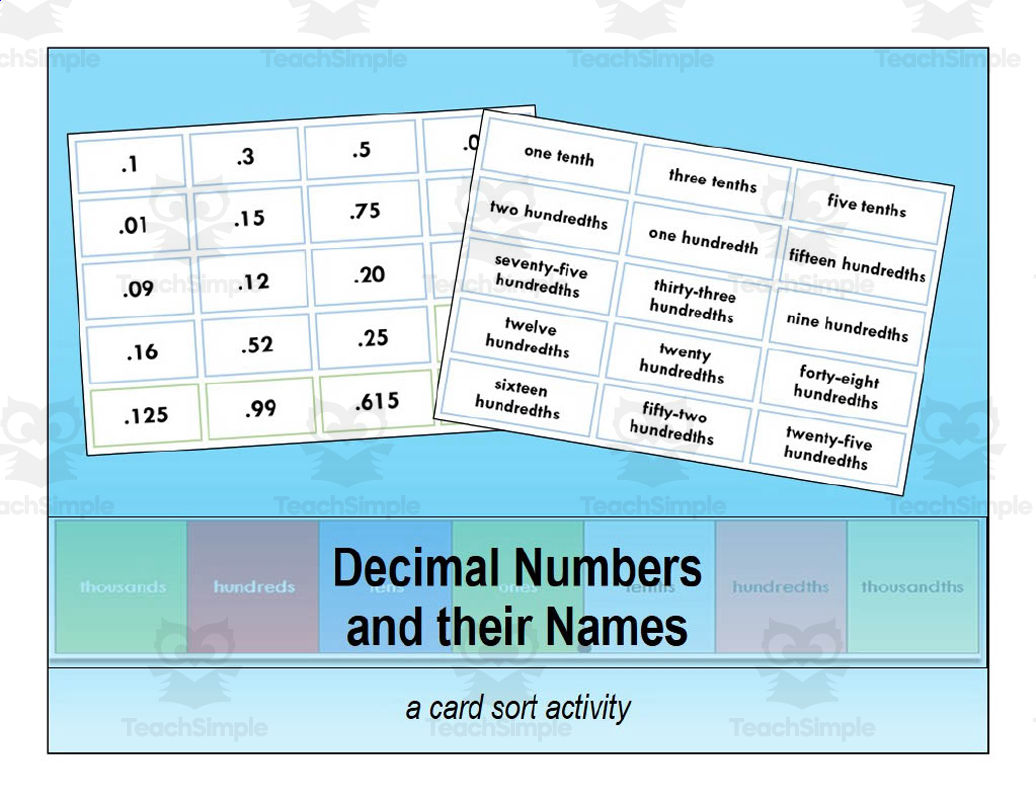
Teach students to say/read decimal numbers by their correct place-value names (e.g. '.5' as 'five tenths'), up to the thousandths place, via a card sort or memory game.
A whole-class decimal place-value game in which students try to build the largest or smallest possible decimal number as digits are randomly generated one at a time.
An interactive, teacher-locked PowerPoint game (playable in PowerPoint only, not Google Slides) for up to 4 players that gives students practice with decimal mental-math multiplication using the 'break a factor into addends' strategy, with a spinner for scoring.