



3,931 products added recently
Page 2 - History Lesson Plans
Transport your students through time with history lesson plans that vividly illustrate past events and societies. These resources include primary sources, discussions, and projects. Implement them to foster critical thinking and a deeper understanding of our world's history.

 Show filters


Pony Express: History - Hands On
Social Studies, History, History: USA, Grade 1, 2, 3, 4, Teacher Tools, Lesson Plans
Pony Express: History - Hands On A comprehensive teaching resource designed to engage students actively in learning about an exciting period of American history. Primarily developed for first to fourth graders. This educational tool encompasses subjects like: Social Studies with specific focus on U.S. History. What makes it special? The initiative seamlessly integrates various mediums and practices such as poems, music, games , discussions, arts and creative writing activities. It shifts from traditional passive learning techniques encouraging participation that enhances learning outcomes. Simulating the historical era: In this module focusing on the Pony Express era, students get involved in: - Creating their own petitions—a popular recourse in old times. - Participating in enactments involving Pony Rider puppets representing an actual Pony Express ride. - Involving themselves in a relay race—a tangible demonstration of real-life pony express team's challenges. Reinforcing through sharing: After processing these experiential lessons about history through fun-filled means like a museum exhibit for sharing with friends or family—this package bolsters knowledge retention. All-in-one PDF package includes: - total of 34 readily printable pages serving varying functions across different group sizes. Bolster your active and experiential learning journey using Pony Express: History - Hands On!.
Author Classroom Complete Press
Tags Social Studies, Pony Express, Puppets, American History, Poems
Television Reading Comprehension Passage - Cored Ed Encyclopedia
ELA, Language Development, Reading Comprehension, Reading, Pre-Reading, Science, Technology, Engineering, History, Social Studies, Grade 2, 3, 4, 5, Worksheets & Printables, Worksheets, Teacher Tools, Centers, Activities, Writing Prompts, Assessments, Quizzes and Tests, Quizzes, Lesson Plans
This television reading comprehension includes: Visualization (on the front cover) Start your lesson by taking a minute to think and share something about the topic. Read the script aloud (slowly), perhaps prepare some music or sound effects. Student close their eyes and let their imaginations wander. Students open their eyes, read the question aloud and give them a few minutes to complete. Ask a few students to share or keep answers until the end to compare with what they learn in the passage. Quick pause—thousands of Cored Education products are included with your TeachSimple membership. Download links and encyclopedia index available here. Pre-Reading Trivia Students will write down one thing they already know about the subject and then read five more facts and discuss. These facts are fun, and the students will enjoy learning about the subject before reading more. Give 1 minute for students to write what they already know (no pressure—best guess is fine). Read the five facts together. After each fact, do ask a student for their opinion, was it surprising? Set a purpose by asking students to highlight/underline one fact they want to learn more about during the reading. Reading Passage The text is a high-interest reading passage with set paragraphs, roughly three to four paragraphs long. It contains a variety of themes about the topic, anywhere from history to technology. The passage is between 250 and 350 words in length. First, ask students to look at the headings and see what they’ll learn about today. What do they know about the topic/heading? First read options: Teacher read-aloud (best for support). Partner reading (paragraph by paragraph). While reading, students underline important details, and vocabulary words they think may come up in the questions section. Mixed Questions The first question page contains four multiple-choice questions, each with a choice of four answers, and three written response questions that require a sentence or two from the student. Students complete the mcqs first independently, then review quickly as a class. For the 3 written responses, try to get students giving the answer with some form of evidence: “I think ___ because the text says ___.” If students get stuck, send them back to check the passage. Vocabulary Questions Practice seven key words from the text in this section across two activities. First section is scrambled words where students will unscramble three words given a clue for each. The second section is a word to meaning matching activity. Before starting, have some students read out words they underlined in the passage. Ask students to say the word and read aloud the sentence(s) around each word. Ask students to do scrambled words and the matching exercise in pairs then go through answers as a class. For the scrambled spelling task, get four pairs to come up to the board and write the words for extra practice with the other student reading out the clue. For the matching task, prompt students to give full sentences: “I matched ___ with ___ because ___.” Creative Writing In this question, the student will be required to write a five to eight sentence paragraph on a question related to the topic. Before starting, ask students write down 3 key ideas they are going to include in their piece. Ask students for ideas to share around the class to help those struggling. Pro writing expectations: 5–8 sentences At least 2 facts or details from the passage At least 2 vocabulary words from the previous page Students read their paragraphs while classmates listen for facts and vocabulary words. Extension Activities This page is optional for fast finishers or to take home. There are several activities, each one requiring a different skill. Do some, do none, do all, completely optional - but you will feel reassured knowing every possibility is planned for. Includes summary writting question. Answer Key There are answers for the multiple-choice questions, written response questions have sample answers, vocabulary answers and if there is a summary question then a sample summary will be provided as well. Lesson Plan Included Customized lesson plan for this lesson is included. Lesson Snapshot Title: Television Genre: Nonfiction (informational text) Subject: Science (Technology) Primary Topic: How television changed from mechanical to digital Estimated Guided Reading Level (A–Z): S What This Lesson Teaches Best How an invention changed over time, from a “spinning disk” experiment to modern screens and signals. Key milestones in television’s development (1925 Selfridges demo, 1927 Farnsworth, 1936 BBC service, late 2000s flat-panels). How pictures can be broken into lines/signals and sent by wire, radio, antenna, cable, or internet. The shift from black-and-white to color broadcasts and how viewers experienced that change over decades. Comparing analog and digital signals as two different ways information travels. Learning Goals Students will describe how early television used a spinning Nipkow disk to scan pictures into lines. Students will identify key people, places, and dates from the passage (Baird, Farnsworth, Selfridges, Alexandra Palace). Students will explain how television changed from mechanical parts to all-electronic systems that made clearer pictures. Students will summarize how TV viewing changed from bulky cathode-ray tubes to flat-panel screens and high-definition images. Students will compare analog and digital signals using details from the text. Key Vocabulary From the Text scan — break a picture into lines to send it. signals — messages that carry picture or sound information. broadcasting — sending TV so many people can receive it. analog — a smooth, continuous wave way of sending. digital — coded bits that travel more cleanly. FULL CATALOG OF DOWNLOAD LINKS AND ENCYCLOPEDIA INDEX HERE
Author Cored Education
Rating
Tags Vocabulary, Reading Comprehension, Reading Passages, Lesson Plans, Ela Lesson Plans, Reading Comprehension Lesson Plans, Pre-reading, History, Social Studies, Social Studies Lesson Plans

Horses Reading Comprehension Passage - Cored Ed Encyclopedia
ELA, Reading Comprehension, Reading, Pre-Reading, Language Development, History, Social Studies, Geography, Life Sciences, Science, Grade 2, 3, 4, 5, Worksheets & Printables, Worksheets, Teacher Tools, Centers, Activities, Writing Prompts, Assessments, Quizzes and Tests, Quizzes, Lesson Plans
This horses reading comprehension with lesson plan includes: Visualization (on the front cover) Start your lesson by taking a minute to think and share something about the topic. Read the script aloud (slowly), perhaps prepare some music or sound effects. Student close their eyes and let their imaginations wander. Students open their eyes, read the question aloud and give them a few minutes to complete. Ask a few students to share or keep answers until the end to compare with what they learn in the passage. Quick pause—thousands of Cored Education products are included with your TeachSimple membership. Download links and encyclopedia index available here. Pre-Reading Trivia Students will write down one thing they already know about the subject and then read five more facts and discuss. These facts are fun, and the students will enjoy learning about the subject before reading more. Give 1 minute for students to write what they already know (no pressure—best guess is fine). Read the five facts together. After each fact, do ask a student for their opinion, was it surprising? Set a purpose by asking students to highlight/underline one fact they want to learn more about during the reading. Reading Passage The text is a high-interest reading passage with set paragraphs, roughly three to four paragraphs long. It contains a variety of themes about the topic, anywhere from history to technology. The passage is between 250 and 350 words in length. First, ask students to look at the headings and see what they’ll learn about today. What do they know about the topic/heading? First read options: Teacher read-aloud (best for support). Partner reading (paragraph by paragraph). While reading, students underline important details, and vocabulary words they think may come up in the questions section. Mixed Questions The first question page contains four multiple-choice questions, each with a choice of four answers, and three written response questions that require a sentence or two from the student. Students complete the mcqs first independently, then review quickly as a class. For the 3 written responses, try to get students giving the answer with some form of evidence: “I think ___ because the text says ___.” If students get stuck, send them back to check the passage. Vocabulary Questions Practice seven key words from the text in this section across two activities. First section is scrambled words where students will unscramble three words given a clue for each. The second section is a word to meaning matching activity. Before starting, have some students read out words they underlined in the passage. Ask students to say the word and read aloud the sentence(s) around each word. Ask students to do scrambled words and the matching exercise in pairs then go through answers as a class. For the scrambled spelling task, get four pairs to come up to the board and write the words for extra practice with the other student reading out the clue. For the matching task, prompt students to give full sentences: “I matched ___ with ___ because ___.” Creative Writing In this question, the student will be required to write a five to eight sentence paragraph on a question related to the topic. Before starting, ask students write down 3 key ideas they are going to include in their piece. Ask students for ideas to share around the class to help those struggling. Pro writing expectations: 5–8 sentences At least 2 facts or details from the passage At least 2 vocabulary words from the previous page Students read their paragraphs while classmates listen for facts and vocabulary words. Extension Activities This page is optional for fast finishers or to take home. There are several activities, each one requiring a different skill. Do some, do none, do all, completely optional - but you will feel reassured knowing every possibility is planned for. Includes summary writting question and additional facts. Answer Key There are answers for the multiple-choice questions, written response questions have sample answers, vocabulary answers and if there is a summary question then a sample summary will be provided as well. Lesson Plan Included Customized lesson plan for this lesson is included. Lesson Snapshot Title: Horses Genre: Nonfiction (informational text) Subject: Life Science / Social Studies (human–animal history) Primary Topic: Horse features, domestication, and partnership with people Estimated Guided Reading Level (A–Z): R What This Lesson Teaches Best Describes horses as domesticated equines (Equus ferus caballus) with single hard hooves. Explains how horse ancestors changed over millions of years from many-toed to one-toed runners. Uses archaeology clues (tooth wear from a bit; Botai culture evidence) to explain early domestication. Shows how trained horses affected human travel and power, including chariots and the development of different breeds. Highlights horse social behavior and communication (ear turns, tail swishes, shifts of weight) as part of partnership. Learning Goals Identify key physical features of horses described in the passage (hoof, muscle, equine). Describe how horse ancestors changed over time, using details from the text. Explain what clues archaeologists found that suggest humans guided horses with a bit. Describe how horses helped people with travel and power long ago (such as chariots). Explain how people created different breeds by choosing traits like strength, speed, or calm temperaments. Describe how horses communicate and stay watchful using body signals mentioned in the passage. Key Vocabulary From the Text domesticated — tamed to live and work with people. equine — related to horses. ancestors — family members from long ago. archaeologists — scientists who study the past using evidence. temperaments — typical behaviors, like calmness or energy. FULL CATALOG OF DOWNLOAD LINKS AND ENCYCLOPEDIA INDEX HERE
Author Cored Education
Rating
Tags Vocabulary, Reading Comprehension, Reading Passages, Lesson Plans, Ela Lesson Plans, Reading Comprehension Lesson Plans, Pre-reading, Social Studies Lesson Plans, Life Science, Science Lesson Plans

Country Study Presentation - North Korea - Geography - East Asia
Social Studies, Economics, Geography, History: Asian, History, Middle School, High School, Adult Education, Teacher Tools, Presentations, Lesson Plans
Country Study Presentation - North Korea - Geogr aphy + Social Studies - East Asia Try this Digital Teaching Resource on North Korea ( Introductory Presentation Lesson ), designed for Geography, Asian History ( East Asia ), and Social Studies lessons. Perfect for Grades 7–12 ( Middle school and High School students ), this Introductory PDF Presentation offers a fun, informative, and ready-to-use lesson that requires little to no preparation. Students will explore North Korea ’s geography, history, culture, language and economy — making it perfect for classroom instruction, homeschooling, or online learning. 📘 Within this Social Studies and Geograhy Teaching resource, teachers and educators can find the following topics dealt: ✅ Greetings in Korean ✅ Geography of North Korea ( East Asia ) – Key facts, borders, and an interactive Google Maps link to its location. ✅ Quick Facts – Population, capital city, currency, flag, and other essential details. ✅ History Overview – A concise summary of North Korea ’s most significant historical events. ✅ Geography & Environment – Details about the country’s land area, regions, and climate zones. ✅ North Korea's Economy – Insight into North Korea industries, exports, and economic strengths. ✅ Pyongyang – Explore the capital city, its famous landmarks, and cultural highlights. ✅ Other Major Cities – A map showcasing additional important urban centers. ✅ North Korea's Culture & Traditions – A look at the customs and values that define the North Korea ( East Asia ) ✅ Farewell in Korean This Social Studies + Geography Country Study Presentation on North Korea ( East Asia ) PDF Digital Teaching Resource ( 15 slides ) can be ideal for Middle School and High School Students from 7th grade to 12th grade to introduce North Korea ( East Asia ) and its culture, language, society, history and economy. Learning with Alan is a Teaching Resource - Educational Material Store whose aim is to help Teachers, Educators and Tutors to achieve their teaching objectives while creating a fun and stimulating environment. Learning should always be fun. Never Forget! If you want to browse more of my Teaching Resources, click here Learning with Alan!
Author Learning with Alan
Rating
Tags Social Studies, Geography, Country Study, North Korea, Asia, East Asia, Presentation, Introduction, History, Communism
United Nations Reading Comprehension Passage - Cored Ed Encyclopedia
ELA, Language Development, Reading Comprehension, Reading, Pre-Reading, Vocabulary, History, Social Studies, Government, Writing, Grade 2, 3, 4, 5, Worksheets & Printables, Worksheets, Teacher Tools, Centers, Activities, Writing Prompts, Assessments, Quizzes and Tests, Quizzes, Lesson Plans
This United Nations reading comprehension with lesson plan includes: Visualization (on the front cover) Start your lesson by taking a minute to think and share something about the topic. Read the script aloud (slowly), perhaps prepare some music or sound effects. Student close their eyes and let their imaginations wander. Students open their eyes, read the question aloud and give them a few minutes to complete. Ask a few students to share or keep answers until the end to compare with what they learn in the passage. Quick pause—thousands of Cored Education products are included with your TeachSimple membership. Download links and encyclopedia index available here. Pre-Reading Trivia Students will write down one thing they already know about the subject and then read five more facts and discuss. These facts are fun, and the students will enjoy learning about the subject before reading more. Give 1 minute for students to write what they already know (no pressure—best guess is fine). Read the five facts together. After each fact, do ask a student for their opinion, was it surprising? Set a purpose by asking students to highlight/underline one fact they want to learn more about during the reading. Reading Passage The text is a high-interest reading passage with set paragraphs, roughly three to four paragraphs long. It contains a variety of themes about the topic, anywhere from history to technology. The passage is between 250 and 350 words in length. First, ask students to look at the headings and see what they’ll learn about today. What do they know about the topic/heading? First read options: Teacher read-aloud (best for support). Partner reading (paragraph by paragraph). While reading, students underline important details, and vocabulary words they think may come up in the questions section. Mixed Questions The first question page contains four multiple-choice questions, each with a choice of four answers, and three written response questions that require a sentence or two from the student. Students complete the mcqs first independently, then review quickly as a class. For the 3 written responses, try to get students giving the answer with some form of evidence: “I think ___ because the text says ___.” If students get stuck, send them back to check the passage. Vocabulary Questions Practice seven key words from the text in this section across two activities. First section is scrambled words where students will unscramble three words given a clue for each. The second section is a word to meaning matching activity. Before starting, have some students read out words they underlined in the passage. Ask students to say the word and read aloud the sentence(s) around each word. Ask students to do scrambled words and the matching exercise in pairs then go through answers as a class. For the scrambled spelling task, get four pairs to come up to the board and write the words for extra practice with the other student reading out the clue. For the matching task, prompt students to give full sentences: “I matched ___ with ___ because ___.” Creative Writing In this question, the student will be required to write a five to eight sentence paragraph on a question related to the topic. Before starting, ask students write down 3 key ideas they are going to include in their piece. Ask students for ideas to share around the class to help those struggling. Pro writing expectations: 5–8 sentences At least 2 facts or details from the passage At least 2 vocabulary words from the previous page Students read their paragraphs while classmates listen for facts and vocabulary words. Extension Activities This page is optional for fast finishers or to take home. There are several activities, each one requiring a different skill. Do some, do none, do all, completely optional - but you will feel reassured knowing every possibility is planned for. Includes summary writting question. Answer Key There are answers for the multiple-choice questions, written response questions have sample answers, vocabulary answers and if there is a summary question then a sample summary will be provided as well. Lesson Plan Included Customized lesson plan for this lesson is included. Lesson Snapshot Title: United Nations Genre: Nonfiction (Informational text) Subject: Social Studies (Civics/Global Studies) Primary Topic: How the UN began and works for peace Estimated Guided Reading Level (A–Z): P What This Lesson Teaches Best Origins and purpose of the UN: Explains that delegates from 50 countries met in San Francisco in 1945 and signed the United Nations Charter, leading to the UN officially beginning on October 24, 1945. How countries work together in the UN: Describes the UN headquarters in New York City and how member countries speak and vote in the General Assembly, while a smaller group (the Security Council) votes on steps meant to protect peace. Peacekeeping basics: Introduces UN peacekeeping observers (UNTSO) and explains that peacekeepers watch, report, and help keep ceasefires from breaking (and are not there to conquer). Communication across languages: Shows why interpreters matter by explaining that leaders use interpreters in six official languages so the same message can travel across the room. UN help beyond meetings: Notes that UN groups like UNICEF and the World Health Organization work on children’s needs, health, and bringing supplies after earthquakes, floods, or wars. Learning Goals Students will identify key dates and events that led to the UN officially beginning in 1945. Students will describe how the General Assembly and the Security Council are different, using details from the text. Students will explain what the United Nations Charter is and what it was meant to help countries do. Students will summarize what peacekeepers do and why peacekeeping can be hard when countries won’t cooperate. Students will use context clues to determine the meaning of key words such as interpreters and ceasefires . Key Vocabulary From the Text delegates — people chosen to represent a country at a meeting. Charter — a written promise that explains a group’s goals. headquarters — the main building where an organization works. interpreters — people who change speech into another language. ceasefires — times when fighting stops for a while. FULL CATALOG OF DOWNLOAD LINKS AND ENCYCLOPEDIA INDEX HERE
Author Cored Education
Rating
Tags Vocabulary, Reading Comprehension, Reading Passages, Lesson Plans, Ela Lesson Plans, Reading Comprehension Lesson Plans, Pre-reading, Social Studies Lesson Plans, Social Studies, Government

World War II Gr. 5-8
Social Studies, History, History: World, Grade 5, 6, 7, 8, Teacher Tools, Lesson Plans
World War II Gr. 5-8 Teaching Resource This exceptional teaching resource is custom-made for students in grade 5 to grade 8. Anchored on the theme of History: World, it provides deep insights into the events, alliances and nuances that defined World War II. The resource captures historical sentiments from1939-1945. It explores key questions about the war's significance. Vital pre-War events like the Treaty of Versailles are discussed. A close look at Adolf Hitler’s rise and motives is included. Detailed Analysis of Important Battles and Aftermath Repercussions The teaching material travels through history detailing significant battles such as Pearl Harbor, Midway, and Normandy alongside an analysis of advanced warfare machinery used during that era such as submarines & tanks. The aftermath of these battles along with reasons behind establishment of global institutions like 'United Nations' post-war are also studied in-depth to provide students with holistic perspective around world politics following World War II itself. Educator Flexibility & Student Engagement This tailor made resource is versatile in its usage ensuring higher engagement levels during lessons—be it whole group discussions or smaller personal interactions within classmates—adding more perspectives on historical interpretation; additionally serving as excellent home assignments. It aligns perfectly with State Standards—the content resonates with Bloom's Taxonomy standards providing equal opportunity to students across different learning capacities throughout class lessons. Making Learning Fun! To maintain student interest & make learning interactive—several fun elements have been incorporated including crosswords, word search games plus comprehension quizzes—with a handy answer key provided for teacher's convenience. With customization ensured towards different teaching setups—such as public schooling or homeschooling—this resource holds potential in transforming History lessons into lively interactive events! And to cap it all, the resource is available as an easy-to-use PDF file that can be downloaded, printed, or digitally used as required. The World War II Gr. 5-8 serves not just as lesson plan material—but a balanced mix of educative tool coupled with fun activity segments—adding life to World History Sessions!
Author Classroom Complete Press
Tags PDF

Sunglasses Reading Comprehension Passage - Cored Ed Encyclopedia
ELA, Language Development, Reading Comprehension, Reading, Pre-Reading, Writing, Science, Physics, History, Social Studies, Grade 2, 3, 4, 5, Worksheets & Printables, Worksheets, Teacher Tools, Centers, Activities, Writing Prompts, Assessments, Quizzes and Tests, Quizzes, Lesson Plans
This sunglasses reading comprehension includes: Visualization (on the front cover) Start your lesson by taking a minute to think and share something about the topic. Read the script aloud (slowly), perhaps prepare some music or sound effects. Student close their eyes and let their imaginations wander. Students open their eyes, read the question aloud and give them a few minutes to complete. Ask a few students to share or keep answers until the end to compare with what they learn in the passage. Quick pause—thousands of Cored Education products are included with your TeachSimple membership. Download links and encyclopedia index available here. Pre-Reading Trivia Students will write down one thing they already know about the subject and then read five more facts and discuss. These facts are fun, and the students will enjoy learning about the subject before reading more. Give 1 minute for students to write what they already know (no pressure—best guess is fine). Read the five facts together. After each fact, do ask a student for their opinion, was it surprising? Set a purpose by asking students to highlight/underline one fact they want to learn more about during the reading. Reading Passage The text is a high-interest reading passage with set paragraphs, roughly three to four paragraphs long. It contains a variety of themes about the topic, anywhere from history to technology. The passage is between 250 and 350 words in length. First, ask students to look at the headings and see what they’ll learn about today. What do they know about the topic/heading? First read options: Teacher read-aloud (best for support). Partner reading (paragraph by paragraph). While reading, students underline important details, and vocabulary words they think may come up in the questions section. Mixed Questions The first question page contains four multiple-choice questions, each with a choice of four answers, and three written response questions that require a sentence or two from the student. Students complete the mcqs first independently, then review quickly as a class. For the 3 written responses, try to get students giving the answer with some form of evidence: “I think ___ because the text says ___.” If students get stuck, send them back to check the passage. Vocabulary Questions Practice seven key words from the text in this section across two activities. First section is scrambled words where students will unscramble three words given a clue for each. The second section is a word to meaning matching activity. Before starting, have some students read out words they underlined in the passage. Ask students to say the word and read aloud the sentence(s) around each word. Ask students to do scrambled words and the matching exercise in pairs then go through answers as a class. For the scrambled spelling task, get four pairs to come up to the board and write the words for extra practice with the other student reading out the clue. For the matching task, prompt students to give full sentences: “I matched ___ with ___ because ___.” Creative Writing In this question, the student will be required to write a five to eight sentence paragraph on a question related to the topic. Before starting, ask students write down 3 key ideas they are going to include in their piece. Ask students for ideas to share around the class to help those struggling. Pro writing expectations: 5–8 sentences At least 2 facts or details from the passage At least 2 vocabulary words from the previous page Students read their paragraphs while classmates listen for facts and vocabulary words. Extension Activities This page is optional for fast finishers or to take home. There are several activities, each one requiring a different skill. Do some, do none, do all, completely optional - but you will feel reassured knowing every possibility is planned for. Includes summary writting question. Answer Key There are answers for the multiple-choice questions, written response questions have sample answers, vocabulary answers and if there is a summary question then a sample summary will be provided as well. Lesson Plan Included Customized lesson plan for this lesson is included. Lesson Snapshot Title: Sunglasses Genre: Nonfiction (informational text + support pages) Subject: Science (Light) / Health & Safety Primary Topic: Why sunglasses help and how they evolved Estimated Guided Reading Level (A–Z): Q What This Lesson Teaches Best What glare is and how tinted lenses can “calm down” sharp, shiny light bouncing off surfaces like water, sand, snow, or a car hood. A simple history of eye protection: smoky quartz lenses in 12th-century China and Inuit snow goggles with narrow slits to cut glare. How sunglasses became part of everyday life (experiments with tints; boardwalk sales in 1929; polarized lenses arriving in 1936). What UV light is (invisible but harmful over time) and what UV400 labeling means in the passage (filtering nearly all UVA/UVB up to 400 nanometers). How polarized lenses reduce reflected sparkle off flat surfaces like roads and water, making shapes easier to see. Learning Goals Define glare using details from the passage. Explain how tinted lenses help eyes feel more comfortable in bright sunlight. Describe two early ways people protected their eyes from harsh light. Explain how sunglasses became popular for everyday use using the dates and examples given. Describe what UV light is and what UV400 means in the passage. Explain how polarized lenses help with reflections off water and roads. Key Vocabulary From the Text glare — sharp, shiny light that bounces off surfaces. tinted — made darker, like a shaded window for eyes. quartz — a mineral used like simple dark lenses long ago. ultraviolet — invisible light that can harm eyes and skin over time. polarized — lens type that reduces reflections and sparkle. FULL CATALOG OF DOWNLOAD LINKS AND ENCYCLOPEDIA INDEX HERE
Author Cored Education
Rating
Tags Vocabulary, Reading Comprehension, Reading Passages, Lesson Plans, Ela Lesson Plans, Reading Comprehension Lesson Plans, Reading, Pre-reading, Physics, Sunglasses

45' Lesson on Memorial Day - Worksheet & Activities | Grade 2
History, Social Studies, Grade 2, Lesson Plans, Teacher Tools, Worksheets & Printables
45' Lesson on Memorial Day - Worksheet & Activities | Grade 2 Make Memorial Day meaningful and engaging with these Grade 2 Memorial Day Activities ! This no-prep, standards-aligned resource helps students understand the purpose of Memorial Day while building reading, writing, and vocabulary skills. What’s Included ✅ Memorial Day student worksheet packet with a variety of literacy and social studies activities ✅ Activities include: Word search and vocabulary building Reading comprehension (true/false, multiple choice) Writing prompts and sentence practice Matching, sorting, and sequencing Thank-you note writing Coloring and drawing activities ✅ Complete Answer Key : Quick-grade format Clear answers for all objective questions Guidance for grading open-ended responses ✅ Detailed 45-minute Lesson Plan : Step-by-step teaching instructions Vocabulary, objectives, and materials Memorial Day vs. Veterans Day comparison Differentiation strategies and assessment ideas How It Works in the Classroom This Grade 2 Memorial Day activity pack is flexible and easy to use: Use as a complete 45-minute lesson with built-in pacing and structure Assign worksheets during centers, independent work, or morning work Spread activities across multiple days for a Memorial Day mini-unit Pair with a read-aloud or class discussion about heroes and honoring others Use sequencing and vocabulary activities (see page 5) to reinforce comprehension skills Standards & Learning Goals Aligned to Grade 2 Social Studies and ELA standards Students will: Understand what Memorial Day is and when it is observed Identify important symbols (flag, poppy, parade, moment of silence) Learn the difference between Memorial Day and Veterans Day Build vocabulary: honor, brave, soldier, veteran, hero Strengthen reading comprehension and writing skills Practice sequencing, sorting, and critical thinking Demonstrate respect and gratitude through reflection and writing Why Teachers Love It ⭐ Perfect balance of social studies + literacy integration ⭐ Builds deeper understanding with reading, writing, and vocabulary tasks ⭐ Includes a complete, ready-to-teach lesson plan (zero prep!) ⭐ Great for whole group, centers, sub plans, or independent work ⭐ Supports all learners with differentiation strategies ⭐ Makes grading easy with a clear and thorough answer key ⭐ Encourages thoughtful reflection and meaningful classroom discussions Download these Grade 2 Memorial Day activities today to create an engaging, meaningful lesson that helps students understand, reflect, and show gratitude!
Author Bright Classroom Ideas Marketplace
Rating
Tags Memorial Day, Lesson, Plan, History, Worksheet
Tanks Reading Comprehension Passage - Cored Ed Encyclopedia
ELA, Language Development, Reading Comprehension, Reading, Pre-Reading, Science, Technology, Engineering, History, Social Studies, Grade 2, 3, 4, 5, Worksheets & Printables, Worksheets, Teacher Tools, Centers, Activities, Writing Prompts, Assessments, Quizzes and Tests, Quizzes, Lesson Plans
This tanks reading comprehension includes: Visualization (on the front cover) Start your lesson by taking a minute to think and share something about the topic. Read the script aloud (slowly), perhaps prepare some music or sound effects. Student close their eyes and let their imaginations wander. Students open their eyes, read the question aloud and give them a few minutes to complete. Ask a few students to share or keep answers until the end to compare with what they learn in the passage. Quick pause—thousands of Cored Education products are included with your TeachSimple membership. Download links and encyclopedia index available here. Pre-Reading Trivia Students will write down one thing they already know about the subject and then read five more facts and discuss. These facts are fun, and the students will enjoy learning about the subject before reading more. Give 1 minute for students to write what they already know (no pressure—best guess is fine). Read the five facts together. After each fact, do ask a student for their opinion, was it surprising? Set a purpose by asking students to highlight/underline one fact they want to learn more about during the reading. Reading Passage The text is a high-interest reading passage with set paragraphs, roughly three to four paragraphs long. It contains a variety of themes about the topic, anywhere from history to technology. The passage is between 250 and 350 words in length. First, ask students to look at the headings and see what they’ll learn about today. What do they know about the topic/heading? First read options: Teacher read-aloud (best for support). Partner reading (paragraph by paragraph). While reading, students underline important details, and vocabulary words they think may come up in the questions section. Mixed Questions The first question page contains four multiple-choice questions, each with a choice of four answers, and three written response questions that require a sentence or two from the student. Students complete the mcqs first independently, then review quickly as a class. For the 3 written responses, try to get students giving the answer with some form of evidence: “I think ___ because the text says ___.” If students get stuck, send them back to check the passage. Vocabulary Questions Practice seven key words from the text in this section across two activities. First section is scrambled words where students will unscramble three words given a clue for each. The second section is a word to meaning matching activity. Before starting, have some students read out words they underlined in the passage. Ask students to say the word and read aloud the sentence(s) around each word. Ask students to do scrambled words and the matching exercise in pairs then go through answers as a class. For the scrambled spelling task, get four pairs to come up to the board and write the words for extra practice with the other student reading out the clue. For the matching task, prompt students to give full sentences: “I matched ___ with ___ because ___.” Creative Writing In this question, the student will be required to write a five to eight sentence paragraph on a question related to the topic. Before starting, ask students write down 3 key ideas they are going to include in their piece. Ask students for ideas to share around the class to help those struggling. Pro writing expectations: 5–8 sentences At least 2 facts or details from the passage At least 2 vocabulary words from the previous page Students read their paragraphs while classmates listen for facts and vocabulary words. Extension Activities This page is optional for fast finishers or to take home. There are several activities, each one requiring a different skill. Do some, do none, do all, completely optional - but you will feel reassured knowing every possibility is planned for. Includes summary writting question. Answer Key There are answers for the multiple-choice questions, written response questions have sample answers, vocabulary answers and if there is a summary question then a sample summary will be provided as well. Lesson Plan Included Customized lesson plan for this lesson is included. Lesson Snapshot Title: Tanks Genre: Nonfiction (informational text) Subject: Social Studies (History & Technology) Primary Topic: Why tanks were created and how they changed Estimated Guided Reading Level (A–Z): R What This Lesson Teaches Best Explains a real-world problem from World War I (trenches, barbed wire, muddy ground) and why a new machine was needed. Describes how tracks work by spreading a tank’s heavy weight so it doesn’t sink as easily and can cross rough land and trenches. Introduces key tank parts and purposes, including armor plates for protection and a rotating turret that helps the tank aim. Shows how designs changed over time (stronger engines, tougher armor, radios, better sights) and how tanks became part of teams with special jobs. Reinforces the idea that inventions are problem-solving —how to protect people inside a moving machine and travel over hard-to-cross land. Learning Goals Students will identify the main problems soldiers faced on the Western Front that led to tanks being developed. Students will explain how tracks helped early tanks move over muddy ground and cross trenches. Students will describe what a rotating turret does and why it was an important design change. Students will summarize how tanks changed from World War I to the end of World War II using key details from the text. Students will use text evidence to explain how new tools (like radios) helped crews work together. Key Vocabulary From the Text trenches — long ditches where soldiers sheltered during war. barbed — having sharp points that make crossing dangerous. tracks — looped bands that help vehicles grip the ground. turret — a rotating top part that carries the main weapon. armored — protected with strong metal on the outside. FULL CATALOG OF DOWNLOAD LINKS AND ENCYCLOPEDIA INDEX HERE
Author Cored Education
Rating
Tags Vocabulary, Reading Comprehension, Reading Passages, Lesson Plans, Ela Lesson Plans, Reading Comprehension Lesson Plans, Pre-reading, History, Social Studies, Social Studies Lesson Plans

Korean War: Consequences and Aftermath of the War Gr. 5-8
Social Studies, History, History: USA, Grade 5, 6, 7, 8, Teacher Tools, Lesson Plans
Korean War: Consequences and Aftermath of the War Gr. 5-8 This is a specialized teaching resource designed for educators, both in public schools and home-schooling environments, targeting students from grades five to eight. The chapter is extrapolated from the full-length lesson plan addressing a unique historical event - The Korean War (1950-1953) during the Cold War period. Geographical Contexts: This resource equips educators to analyze and discuss geographical attributes associated with North and South Korea - facilitating understanding how geography molded key events. Burrowing into Historical Roots: Discuss historical landmarks leading up to these events. Analyze post World-War II tension between world superpowers' influence on such landmark events. Dive deep into profiles of key figures à la President Harry S. Truman, Joseph Stalin, Kim Il-sung crucial to war-narratives. Military Engagements & Activities: An immersive exploration of primary battlegrounds lending insights into U.S troops’ combat against North Korean army advancing at rapid strides. Educational Tools : Learning Through Fun Educators will find tools like: Crosswords Puzzles . Word Searches or Quizzes. The resources appeal to varied learning techniques among students — stimulating their intellectual growth while comprehending complex themes ranging from weapons used through aftermath left behind post-warfare operations cessation. Benefits for Teachers : Fosters strict adherence to state standards. Written following Bloom's Taxonomy principles making it suitable for alignment with various grade-based lesson plans focused on U.S.A history. Hands-on activities perfectly complement quizzes & answer keys encapsulated within a printable PDF file containing 27 readily available pages. In summary, this resource straddles the perfect balance between delivering intricate content about Korean War aftermath while also ensuring engaging and interactive student participation via diverse learning activities.
Author Classroom Complete Press
Tags Social Studies, Korean War, War, United Nations, Map Exercise
Quiz Shows Reading Comprehension Passage - Cored Ed Encyclopedia
ELA, Language Development, Reading Comprehension, Reading, Pre-Reading, Writing, Strategies, Vocabulary, History, Social Studies, Grade 2, 3, 4, 5, Worksheets & Printables, Worksheets, Teacher Tools, Centers, Activities, Writing Prompts, Assessments, Quizzes and Tests, Quizzes, Lesson Plans
This quiz shows reading comprehension includes: Visualization (on the front cover) Start your lesson by taking a minute to think and share something about the topic. Read the script aloud (slowly), perhaps prepare some music or sound effects. Student close their eyes and let their imaginations wander. Students open their eyes, read the question aloud and give them a few minutes to complete. Ask a few students to share or keep answers until the end to compare with what they learn in the passage. Quick pause—thousands of Cored Education products are included with your TeachSimple membership. Download links and encyclopedia index available here. Pre-Reading Trivia Students will write down one thing they already know about the subject and then read five more facts and discuss. These facts are fun, and the students will enjoy learning about the subject before reading more. Give 1 minute for students to write what they already know (no pressure—best guess is fine). Read the five facts together. After each fact, do ask a student for their opinion, was it surprising? Set a purpose by asking students to highlight/underline one fact they want to learn more about during the reading. Reading Passage The text is a high-interest reading passage with set paragraphs, roughly three to four paragraphs long. It contains a variety of themes about the topic, anywhere from history to technology. The passage is between 250 and 350 words in length. First, ask students to look at the headings and see what they’ll learn about today. What do they know about the topic/heading? First read options: Teacher read-aloud (best for support). Partner reading (paragraph by paragraph). While reading, students underline important details, and vocabulary words they think may come up in the questions section. Mixed Questions The first question page contains four multiple-choice questions, each with a choice of four answers, and three written response questions that require a sentence or two from the student. Students complete the mcqs first independently, then review quickly as a class. For the 3 written responses, try to get students giving the answer with some form of evidence: “I think ___ because the text says ___.” If students get stuck, send them back to check the passage. Vocabulary Questions Practice seven key words from the text in this section across two activities. First section is scrambled words where students will unscramble three words given a clue for each. The second section is a word to meaning matching activity. Before starting, have some students read out words they underlined in the passage. Ask students to say the word and read aloud the sentence(s) around each word. Ask students to do scrambled words and the matching exercise in pairs then go through answers as a class. For the scrambled spelling task, get four pairs to come up to the board and write the words for extra practice with the other student reading out the clue. For the matching task, prompt students to give full sentences: “I matched ___ with ___ because ___.” Creative Writing In this question, the student will be required to write a five to eight sentence paragraph on a question related to the topic. Before starting, ask students write down 3 key ideas they are going to include in their piece. Ask students for ideas to share around the class to help those struggling. Pro writing expectations: 5–8 sentences At least 2 facts or details from the passage At least 2 vocabulary words from the previous page Students read their paragraphs while classmates listen for facts and vocabulary words. Extension Activities This page is optional for fast finishers or to take home. There are several activities, each one requiring a different skill. Do some, do none, do all, completely optional - but you will feel reassured knowing every possibility is planned for. Includes summary writting question. Answer Key There are answers for the multiple-choice questions, written response questions have sample answers, vocabulary answers and if there is a summary question then a sample summary will be provided as well. Lesson Plan Included Customized lesson plan for this lesson is included. Lesson Snapshot Title: Quiz Shows Genre: Nonfiction (informational reading passage) Subject: Reading (Informational Text) / Social Studies (media history) Primary Topic: Quiz shows from radio to TV to podcasts Estimated Guided Reading Level (A–Z): R What This Lesson Teaches Best How quiz shows changed over time, from radio “question games” to television and modern podcasts. Key historical milestones and examples (late 1930s radio programs; 1938 BBC spelling quiz on TV; 1950s U.S. daytime quiz/game shows). Understanding fairness and trust in media (some shows were “rigged,” followed by investigations, hearings, and stronger rules). Text structure practice using section headings to track ideas (early radio → TV era → fairness tested → today). Strong built-in supports that match the passage (questions, vocabulary work, writing prompt, and extensions align to passage details). Learning Goals Students will describe how people participated in quiz shows before TVs were common, using details from the passage. Students will explain how television changed quiz shows, including what it was like for contestants under cameras and lights. Students will explain what “rigged” means in the passage and why quiz shows had to “rebuild trust.” Students will identify ways quiz shows appear today (board, screen at home, or podcast), based on the passage. Students will use the section headings to state the main idea of each section and support it with one detail. Key Vocabulary From the Text contestants — people who compete in a game rigged — secretly fixed so it is not fair producers — people who run and plan a show investigations — careful searches to find out what happened genre — a type or category of show FULL CATALOG OF DOWNLOAD LINKS AND ENCYCLOPEDIA INDEX HERE
Author Cored Education
Rating
Tags Vocabulary, Reading Comprehension, Reading Passages, Reading, Creative Writing, Reading Strategies, Writing Prompts, Lesson Plans, Quiz Shows, History
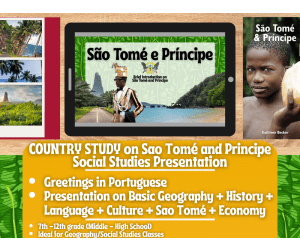
Country Study Presentation - São Tomé and Príncipe -Geography - Africa
Social Studies, Economics, Geography, History, History: African, Middle School, Not Grade Specific, High School, Adult Education, Teacher Tools, Presentations, Lesson Plans
Country Study Presentation - São Tomé and Príncipe - Geography + Social Studies - Central Africa Try this Teaching Resource on São Tomé and Príncipe (Introductory Presentation Lesson - PDF Printable), designed for Geography + African History (Central Africa) + Social Studies lessons. Suitable for Grades 7–12 (Middle school and High School students), this Introductory PDF Presentation offers a ready to use lesson that requires little to no preparation. Geography and Social Studies students will learn about São Tomé and Príncipe ’s geography, history, culture, language and economy — making it perfect for classroom instruction, homeschooling, or online learning. 📘 Teachers can find the following topics in this Social Studies and Geograhy Teaching resource ✅ Greetings in Portuguese ✅ Geography of São Tomé and Príncipe ( Central Africa ) – Key facts, borders, and an interactive Google Maps link to its location. ✅ Quick Facts – Population, capital city, currency and other essential details. ✅ Languages of São Tomé and Príncipe : Portuguese - introduction in the languages spoken + basic vocabuary ✅ History Overview – A concise summary of the most important events in the history of São Tomé and Príncipe ( Central Africa ) ✅ Geography & Environment – Details about the country’s land area, regions, and climate zones. ✅ São Tomé and Príncipe's Economy – paragraph on São Tomé and Príncipe ’s industries, exports, currency and economic strengths (Central Africa) ✅ São Tomé – Explore the capital city of São Tomé and Príncipe , its famous landmarks, and cultural highlights. ✅ Other Major Cities – A map showcasing additional important cities in São Tomé and Príncipe ( Central Africa ) ✅ São Tomé and Príncipe's Culture & Traditions – A look at the customs and values that define São Tomé and Príncipe ( Central Africa ) ✅ Farewell in Portuguese 🎯 This Geography and Social Studies Teaching Resource can be perfect for: Geography classes Social Studies lessons World cultures units Country study projects Substitute teacher toolbox Digital learning In-class or online teaching 📂 Resource Details Format: PDF Digital Presentation Grade Levels: 7th–12th Grade (Middle School and High School students) Learning with Alan is an educational resource store created to help teachers, educators, and tutors reach their teaching goals while building a fun, engaging, and stimulating learning environment . Because learning should always be meaningful—and fun! 🎓✨ If you want to browse more of my Teaching Resources, click here Learning with Alan!!
Author Learning with Alan
Rating
Tags Social Studies, Geography, Lesson, Introduction, São Tomé And Príncipe, Africa, Country Study, Presentation, History, Activity
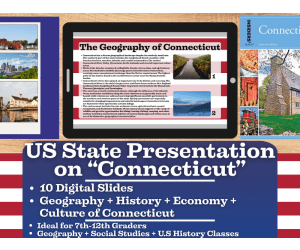
US State Presentation on Connecticut
Social Studies, Economics, Geography, History: USA, History, Not Grade Specific, Middle School, High School, Teacher Tools, Presentations, Lesson Plans
US State Presentation on Connecticut Bring the United States to life in your classroom with this engaging US State Presentation on Connecticut , a ready-to-use digital resource designed for Geography, Social Studies, and US History classes from 7th grade through 12th grade . This presentation provides students with a clear, structured introduction to one US state while combining essential geographical, historical, economic, and cultural information in an accessible format. This US State Presentation on Connecticut , includes: The resource begins with a general introduction to the state , helping students understand its location, identity, and importance within the United States. Students then explore the state's borders and neighboring states , making it easier to place it within the broader geography of the country. A general data section introduces key facts such as population, area, population density, capital city, and other essential statistics , providing a useful foundation for further study. A paragraph that explores the history of this US state , highlighting important events, periods, people, and developments that have shaped its identity. This section is particularly useful for US History lessons because it allows students to connect state-level history with major events and themes in American history. A Geography section examines the state's physical characteristics, including its territory, landscapes, natural features, environment, and climate. Students can discover how mountains, rivers, plains, forests, coastlines, deserts, or other geographical characteristics have influenced settlement and human activity. A presentation also introduces the state's economy , explaining its major economic sectors, industries, natural resources, agricultural activities, and other economic strengths. This provides an excellent opportunity to connect geography with economics and understand why particular industries have developed in different parts of the United States. A dedicated section focuses on the capital city , introducing its importance as a political and administrative center. Students can also learn about other important cities , discovering major urban centers and their roles in business, transportation, education, culture, tourism, or industry. A paragraoh that explores culture , giving students an opportunity to learn about traditions, food, music, celebrations, landmarks, historical heritage, and other characteristics that contribute to the state's unique identity. This digital US State Presentation on Connecticut is ideal for classroom instruction, student research, geography units, US History lessons, Social Studies activities, state studies, homework, review activities, and independent learning. Its organized structure makes it suitable for middle school and high school students , while its broad range of topics encourages students to view a state from multiple perspectives. Whether you are teaching a unit on the United States, American Geography, US History, state studies, or regional culture , this resource offers a convenient and engaging way to help students explore the diversity and complexity of the United States. Perfect for: Geography Classes, Social Studies Classes, US History Classes, Middle School, High School, Grades 7–12, State Studies, American Studies, Homeschooling, Student Research, and Digital Learning. Learning with Alan is an educational resource store created to help teachers, educators, and tutors reach their teaching goals while building a fun, engaging, and stimulating learning environment . Because learning should always be meaningful—and fun! 🎓✨ If you want to browse more of my Teaching Resources, click here Learning with Alan!!
Author Learning with Alan
Rating
Tags Social Studies, Geography, USA, United States Of America, Connecticut, Lesson, Presentation, Introduction, New England, US History
Confederation: The Building of a Nation Gr. 8-9
Social Studies, History, History: Canada, Grade 8, 9, Teacher Tools, Lesson Plans
Confederation: The Building of a Nation Gr. 8-9 Confederation: The Building of a Nation Gr. 8-9 is an educational resource specifically developed for teachers and homeschoolers focusing on Grade 8 and 9 students. This dedicated teaching resource elaborately traces the chronological evolution of Canada, from its nascent stage in the mid-1800's to its contemporary form. About the Ebook This ebook has been crafted carefully to generate an engaging educational experience for students, with the primary topics being Canadian history and social studies. Excellently structured with ten comprehensive lessons This guide unfolds the rich history of Canada in compelling reading passages that shed light on multiple key stages Fundamental to Canada's development. Each lesson singularly examines individual provinces and territories joining the Confederation; however, they also touch base on various supplementary topics integral to Canada's creation. Educational Activities This ebook integrates diverse activities meant not only to reinforce knowledge but also engage students interactively. Crosswords that challenge critical thinking skills Word searches igniting an interest in exploring new vocabulary terms related to Canadian history, among others. Evaluation Template: A quick reference point during instructions or corrections included as 'Answer Key' immensely helps educators irrespective of their teaching settings ranging from large classroom groups, one-on-one tutoring at home or administering homework assignments. Note: If you are instructing a large class group or tutoring one-on-one at home or administering homework assignments – Confederation: The Building of a Nation Gr. 8-9 holds versatility that adapts well across diverse teaching settings. Digital Product Accessibility This digital product comes in a single PDF file making it conveniently accessible across various digital devices.
Author Classroom Complete Press
Tags PDF
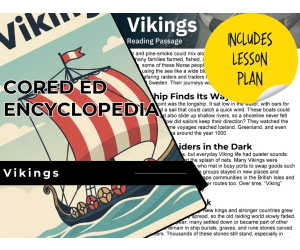
Vikings Reading Comprehension Passage - Cored Ed Encyclopedia
ELA, Language Development, Reading Comprehension, Reading, Pre-Reading, History, Social Studies, History: Europe, History: British, Vocabulary, Grade 2, 3, 4, 5, Worksheets & Printables, Worksheets, Teacher Tools, Centers, Activities, Writing Prompts, Assessments, Quizzes and Tests, Quizzes, Lesson Plans
This Vikings reading comprehension with lesson plan includes: Visualization (on the front cover) Start your lesson by taking a minute to think and share something about the topic. Read the script aloud (slowly), perhaps prepare some music or sound effects. Student close their eyes and let their imaginations wander. Students open their eyes, read the question aloud and give them a few minutes to complete. Ask a few students to share or keep answers until the end to compare with what they learn in the passage. Quick pause—thousands of Cored Education products are included with your TeachSimple membership. Download links and encyclopedia index available here. Pre-Reading Trivia Students will write down one thing they already know about the subject and then read five more facts and discuss. These facts are fun, and the students will enjoy learning about the subject before reading more. Give 1 minute for students to write what they already know (no pressure—best guess is fine). Read the five facts together. After each fact, do ask a student for their opinion, was it surprising? Set a purpose by asking students to highlight/underline one fact they want to learn more about during the reading. Reading Passage The text is a high-interest reading passage with set paragraphs, roughly three to four paragraphs long. It contains a variety of themes about the topic, anywhere from history to technology. The passage is between 250 and 350 words in length. First, ask students to look at the headings and see what they’ll learn about today. What do they know about the topic/heading? First read options: Teacher read-aloud (best for support). Partner reading (paragraph by paragraph). While reading, students underline important details, and vocabulary words they think may come up in the questions section. Mixed Questions The first question page contains four multiple-choice questions, each with a choice of four answers, and three written response questions that require a sentence or two from the student. Students complete the mcqs first independently, then review quickly as a class. For the 3 written responses, try to get students giving the answer with some form of evidence: “I think ___ because the text says ___.” If students get stuck, send them back to check the passage. Vocabulary Questions Practice seven key words from the text in this section across two activities. First section is scrambled words where students will unscramble three words given a clue for each. The second section is a word to meaning matching activity. Before starting, have some students read out words they underlined in the passage. Ask students to say the word and read aloud the sentence(s) around each word. Ask students to do scrambled words and the matching exercise in pairs then go through answers as a class. For the scrambled spelling task, get four pairs to come up to the board and write the words for extra practice with the other student reading out the clue. For the matching task, prompt students to give full sentences: “I matched ___ with ___ because ___.” Creative Writing In this question, the student will be required to write a five to eight sentence paragraph on a question related to the topic. Before starting, ask students write down 3 key ideas they are going to include in their piece. Ask students for ideas to share around the class to help those struggling. Pro writing expectations: 5–8 sentences At least 2 facts or details from the passage At least 2 vocabulary words from the previous page Students read their paragraphs while classmates listen for facts and vocabulary words. Extension Activities This page is optional for fast finishers or to take home. There are several activities, each one requiring a different skill. Do some, do none, do all, completely optional - but you will feel reassured knowing every possibility is planned for. Includes summary writting question. Answer Key There are answers for the multiple-choice questions, written response questions have sample answers, vocabulary answers and if there is a summary question then a sample summary will be provided as well. Lesson Plan Included Customized lesson plan for this lesson is included. Lesson Snapshot Title: Vikings Genre: Nonfiction (Informational text) Subject: Social Studies (History/Culture) Primary Topic: Viking travel, daily life, and lasting clues Estimated Guided Reading Level (A–Z): Q Support pages included: Visualization prompt, pre-reading trivia, mixed questions, vocabulary activities, creative writing, extension activities, and an answer key. QA check on support pages: The questions/vocabulary generally match the passage; the visualization prompt includes extra sensory details (e.g., “carved dragons,” a “small market”) that are not stated in the reading passage. What This Lesson Teaches Best Geography and origins of Viking-age people: Describes rocky coasts of Scandinavia and connects Vikings to places now Denmark, Norway, and Sweden. Why longships mattered for travel: Explains how longships used oars and a sail, crossed open seas, and moved up shallow rivers. Navigation using nature: States that sailors watched the Sun and stars to keep direction. A fuller view of Viking life: Notes that Vikings farmed, crafted, and traded goods (furs, metalwork, silver), and some blended with local people and helped shape communities. How history leaves evidence: Identifies lasting clues such as ship burials, graves, rune stones, and written sagas. Learning Goals Students will describe where Vikings lived and what the passage says the coasts were like. Students will explain how the longship’s design helped Vikings travel to many places. Students will identify how Viking sailors kept direction while traveling. Students will summarize everyday Viking jobs and trade goods named in the text. Students will list evidence the passage says still helps us learn about Vikings today. Key Vocabulary From the Text Scandinavia — a northern European region where many Vikings lived. Norse — people from Scandinavia in the passage. longship — a Viking boat with oars and a sail. Christianity — a religion that spread as times changed. sagas — stories written down from spoken memories. Discussion Prompts Pre-reading question: What details in the passage describe the coasts of Scandinavia? Comprehension questions: When did some Norse people begin traveling farther than neighbors expected? Comprehension questions: How did the longship help Vikings cross seas and travel up rivers? Comprehension questions: What clues does the passage say still remain today to help us learn about Vikings? FULL CATALOG OF DOWNLOAD LINKS AND ENCYCLOPEDIA INDEX HERE
Author Cored Education
Rating
Tags Vocabulary, Reading Comprehension, Reading Passages, Lesson Plans, Ela Lesson Plans, Reading Comprehension Lesson Plans, Pre-reading, History Lesson Plans, European History, British History
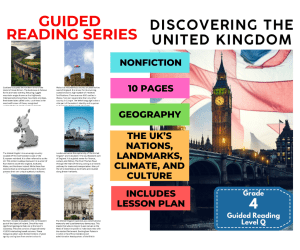
Discovering United Kingdom: Guided Reading Level Q with Lesson Plan
ELA, Resources for Teachers, Reading Comprehension, Reading, Science, Geography, Social Studies, History, Life Sciences, Earth and Environmental Sciences, Grade 3, 4, 5, Worksheets & Printables, Worksheets, Teacher Tools, Centers, Activities, Literacy Readers, Quizzes, Quizzes and Tests, Assessments, Lesson Plans
This Discovering the United Kingdom (level q) guided reading book with lesson plan includes: Guided Reading Color Label (front cover x1) This is a quick way to match the book’s demands to what students can generally handle.. The overall goal is to use the level/color to pick books for several smaller groups. To qualify for a certain level, a student is expected to read a book from that level with about 90–94% accuracy. If a student is consistently accurate and understands, move up a level. If the student is struggling at that level, drop down and add more support. Each student will improve at completely different rates, but it is generally one of the best ways to check progress across the class. DOWNLOAD THE CATALOG TO VIEW ALL GUIDED READING BOOKS AVAILABLE (SORTED LEVELS A-Z) Pre-Reading Question (x1) Teacher asks the prompt aloud, can be while showing the cover or first page. Students share what they already know, or make educated guesses from the cover. Prompt them to use the target vocabulary. Write some of their responses on the board to look back at during the reading. Vocabulary Words (x5) Introduce the five words, best doing it one at a time. Start by saying it, while students repeat and then see if anyone knows what it means before reading further. Read through the meaning and try to briefly connect each word to a picture or gesture so it’s meaningful. Ask students to flip through the book pages and point to where they see each of the vocabulary words. While reading the book pause upon coming across one of the vocab words or read the sentence twice to make sure students understand the word has appeared. Optional: Ask students to raise hands whenever they see/hear one of the new words. Guided Reading Pages (x10) Check the book snapshot (below) for: primary topic - do you need to prep extra reading or intro materials on this? what is taught best - decide on 1-2 bullets to focus on, use the prompt or words provided here for best results. learning goals - what you are checking for students to be able to do after the session, elicit answers using prompts or words provided. key vocabulary (see section above). questions overview - so you know what is coming up and if you need to prep extra materials to assist understanding. Run the lesson You may have already looked at a few of the pages together, but you can show them some of the pictures again first to set meaning. Depending on how much time you have and how familiar your students are with guided reading class, you may want to read the book aloud first with the group first. Students whisper or partner read, while you listen in. If time, do it as a group, one student reading a page each. Use the guided page’s prompts to coach: “Check the picture / does it make sense?” “Point under the words / try the first sound” “Reread the sentence smoothly”. Try to focus more on one student per session (rotating every time), so you can work out if they are ready to move up or need to move down a level. Comprehension Questions (back cover x3) This is your way to check that students didn’t just say the words, but actually understood the text. First, let students answer by pointing to the page/picture and saying a short sentence. After any answer, follow with: “Show me where you found that in the text.” In bigger groups, have partners answer first (10–20 seconds), then call on 2–3 students to share. Differentiation tips: Emerging speakers/struggling readers: oral + pointing On-level: oral in a full sentence Higher: one written sentence or draw + label Book Snapshot Title: Discovering the United Kingdom Genre: Nonfiction Subject: Social Studies (Geography, Government, Culture) Primary Topic: The UK’s nations, landmarks, climate, and culture Estimated Guided Reading Level (A–Z): Q What This Book Teaches Best Introduces the United Kingdom as a union of four countries and explains that each has its own traditions and landscapes. Builds geography knowledge by describing where the UK is located and by highlighting regional features in Scotland, Wales, and Northern Ireland. Teaches civics basics by explaining the UK’s constitutional monarchy and that the elected Parliament makes laws. Connects history and landmarks through examples like Stonehenge and major places in London along the River Thames. Explains how climate supports wildlife and gives an example of conservation connected to the red squirrel. Learning Goals Students will identify the four countries that make up the United Kingdom using details from the text. Students will describe why London is important in the United Kingdom and name one detail about the River Thames from the text. Students will describe key physical features of Scotland and explain what “lochs” are using the text’s description. Students will describe two details the text gives about Wales, such as its landscape, castles, or language. Students will explain how the text describes the UK’s government and who makes laws. Students will explain how the UK’s temperate climate is described and name one effect it has on wildlife. Key Vocabulary From the Text sovereign — able to govern itself. distinct — clearly different. interspersed — spread in between other things. constitutional — based on rules for how a country is run. prehistoric — from before written records. Discussion Prompts Pre-reading question: When you hear “United Kingdom,” what places or facts do you expect to learn about? Comprehension questions: What four countries does the text say make up the United Kingdom? Comprehension questions: What does the text say about who makes laws in the United Kingdom? Comprehension questions: What are two details the text gives about Scotland or Wales? Printing Tips 1. Best Printing Method (Recommended) “Booklet” Printing (Best if Available) If your printer or PDF viewer supports Booklet Printing , use this. Settings to use: Print mode: Booklet Paper size: Letter or A4 (either works) Orientation: Landscape Print on both sides: Yes Flip on: Short edge Scaling: Fit to printable area Booklet subset: First test: Front sides only Then: Back sides only This will automatically: Pair pages correctly Put the cover on the outside Align everything for folding After printing, fold in half and staple along the spine . 2. If “Booklet” Printing Is NOT Available You can still print this correctly with manual duplex printing . Step-by-step: Open the PDF. Choose Print . Set: Orientation: Landscape Pages per sheet: 1 Print on both sides: Yes Flip on: Short edge Print all pages . Because each PDF page already contains two facing book pages, the result will still fold cleanly into a book. Thousands of Cored Education products are included with your TeachSimple membership. Download links and encyclopedia index available here.
Author Cored Education
Rating
Tags Reading Comprehension, Reading Passages, Reading, Guided Reading, Guided Reading Lesson Plan, Guided Reading Activity, Pre-reading, Social Studies, Geography, History
Multicultural Canada Gr. 2-3
Social Studies, History, History: Canada, Grade 2, 3, Teacher Tools, Lesson Plans
Multicultural Canada Gr. 2-3: A Comprehensive Educational Resource Multicultural Canada Gr. 2-3 is a comprehensive educational resource that enriches the learning experiences of Grade 2 and Grade 3 students. It situates multiculturalism within a Canadian context, providing a dynamic foundation for social studies and Canadian history. A Deep Dive into The Multicultural Fabrics of Canadian Cities The resource explores the multicultural diversity of Canada's cities, delineating the multiple communities that contribute to these diverse hubs. The material acknowledges First Nations peoples' presence in Canada before European settlement, weaving this narrative into discussions delicately. Interactive Reading and Story-Telling An essential part of this teaching tool is focussed on reading and storytelling - suited for both large class instruction or small group setups. There's an engaging Big Book pattern activity , encouraging active student participation in creating stories around multicultural themes - which promotes creativity while reinforcing learning through practical application. The tool sets clear objectives like understanding Canada's diverse cultural fabric to appreciating First Nations people's historical significance predating European intervention. This functionality extends beyond classroom settings; it can be assigned as homework as well, promoting self-study and enabling reinforcement of learnt content at home. Additional Skills Beyond Curriculum Requirements Encouraged: The resource guides on preparing 'flannel boards' to convey included stories such as "Joseph from Ukraine" instilling skills beyond primary curriculum requirement; this includes engagement through physical storytelling methods! Diverse Reading Lists for Extended Learning: Included are Additional Reading lists within lesson plans; this gives educators added resources to urge student exploration beyond defined curriculum boundaries or cater enrichment activities for learners eager to know more about Canadian cultural diversity. PDF Format - Ideal For Digital Learning Landscapes In conclusion, this easy-to-use PDF formatted material ensures broad device accessibility. This comes in handy particularly in today's digital education environment where adaptability and inclusivity have paramount importance. To summarise: Multicultural Canada Gr. 2-3 is a flexible teaching resource that marries fascinating storytelling techniques with historical and socio-cultural insights - providing an enriched learning environment for educators to explore social studies and Canadian history deeply.
Author Classroom Complete Press
Tags PDF
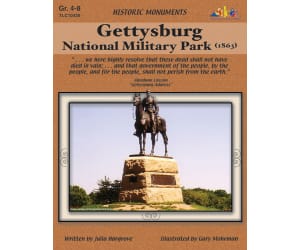
Gettysburg National Military Park (1863): Historic Monuments
Social Studies, History, History: USA, Grade 4, 5, 6, 7, 8, Teacher Tools, Lesson Plans
Gettysburg National Military Park (1863): Historic Monuments An interactive educational resource, meticulously designed to foster comprehensive understanding of the pivotal Gettysburg battle, a critical chapter in America's Civil War history. It serves as rich tactile window into the past, presenting fascinating narratives about key figures and events that shaped this historical battle. The PDF is stuffed with 50 pages of engaging content fits seamlessly for Grades 4-8. It fetches captivating anecdotes about Commanders Robert E. Lee and George G. Meade, their decisive strategic choices that moulded this conflict's outcome - making it an essential tool to impart the importance and impact of this historic combat. This teaching aid throws spotlight on Gettysburg's historic monuments - living symbols of our shared past: Takes students on a guided tour around President Abraham Lincoln's famous 'Gettysburg Address' delivered at park’s dedication ceremony. Presents thoughtfully crafted questions honing student understanding centred around Lincoln's epoch-defining speech. Versatility: A Noteworthy Feature The resource effortlessly incorporates within any USA History curriculum set within Social Studies instruction or Lesson Plans focusing monument conservation techniques - evoking meaningful classroom discussions about these entities' cultural value today. Educators can shape up their students' historical comprehension skills significantly, by bridging past events and key figures with lasting monumental commemorations housed within Gettysburg National Military Park (1863). A vital tool fostering a knowledgeable consciousness regarding our collective American heritage. Immerse your class with hands-on history sessions through intuitive lessons focusing real-time analytical capabilities for decoding past errors to craft better future pathways for all! Feel free to exercise the flexibility of this resource material. Incorporate it for group/solo instruction, activities, or assign as enriching homework - always on hand to transport your students back in time with enthralling tales from Gettysburg!
Author Classroom Complete Press
Tags Abraham Lincoln, Gettysburg, Civil War, History Lesson, Robert E. Lee
Engines Reading Comprehension Passage - Cored Ed Encyclopedia
ELA, Reading Comprehension, Reading, Science, Technology, Pre-Reading, Language Development, Physics, History, Social Studies, Grade 2, 3, 4, 5, Worksheets & Printables, Worksheets, Teacher Tools, Centers, Activities, Writing Prompts, Assessments, Quizzes and Tests, Quizzes, Lesson Plans
This engines reading comprehension with lesson plan includes: Visualization (on the front cover) Start your lesson by taking a minute to think and share something about the topic. Read the script aloud (slowly), perhaps prepare some music or sound effects. Student close their eyes and let their imaginations wander. Students open their eyes, read the question aloud and give them a few minutes to complete. Ask a few students to share or keep answers until the end to compare with what they learn in the passage. Quick pause—thousands of Cored Education products are included with your TeachSimple membership. Download links and encyclopedia index available here. Pre-Reading Trivia Students will write down one thing they already know about the subject and then read five more facts and discuss. These facts are fun, and the students will enjoy learning about the subject before reading more. Give 1 minute for students to write what they already know (no pressure—best guess is fine). Read the five facts together. After each fact, do ask a student for their opinion, was it surprising? Set a purpose by asking students to highlight/underline one fact they want to learn more about during the reading. Reading Passage The text is a high-interest reading passage with set paragraphs, roughly three to four paragraphs long. It contains a variety of themes about the topic, anywhere from history to technology. The passage is between 250 and 350 words in length. First, ask students to look at the headings and see what they’ll learn about today. What do they know about the topic/heading? First read options: Teacher read-aloud (best for support). Partner reading (paragraph by paragraph). While reading, students underline important details, and vocabulary words they think may come up in the questions section. Mixed Questions The first question page contains four multiple-choice questions, each with a choice of four answers, and three written response questions that require a sentence or two from the student. Students complete the mcqs first independently, then review quickly as a class. For the 3 written responses, try to get students giving the answer with some form of evidence: “I think ___ because the text says ___.” If students get stuck, send them back to check the passage. Vocabulary Questions Practice seven key words from the text in this section across two activities. First section is scrambled words where students will unscramble three words given a clue for each. The second section is a word to meaning matching activity. Before starting, have some students read out words they underlined in the passage. Ask students to say the word and read aloud the sentence(s) around each word. Ask students to do scrambled words and the matching exercise in pairs then go through answers as a class. For the scrambled spelling task, get four pairs to come up to the board and write the words for extra practice with the other student reading out the clue. For the matching task, prompt students to give full sentences: “I matched ___ with ___ because ___.” Creative Writing In this question, the student will be required to write a five to eight sentence paragraph on a question related to the topic. Before starting, ask students write down 3 key ideas they are going to include in their piece. Ask students for ideas to share around the class to help those struggling. Pro writing expectations: 5–8 sentences At least 2 facts or details from the passage At least 2 vocabulary words from the previous page Students read their paragraphs while classmates listen for facts and vocabulary words. Extension Activities This page is optional for fast finishers or to take home. There are several activities, each one requiring a different skill. Do some, do none, do all, completely optional - but you will feel reassured knowing every possibility is planned for. Includes summary writting question and additional facts. Answer Key There are answers for the multiple-choice questions, written response questions have sample answers, vocabulary answers and if there is a summary question then a sample summary will be provided as well. Lesson Plan Included Customized lesson plan for this lesson is included. Lesson Snapshot Title: Engines Genre: Nonfiction (Informational Text) Subject: Science (Physical Science/Technology) / Reading (Informational Text) Primary Topic: How engines turn energy into motion Estimated Guided Reading Level (A–Z): P What This Lesson Teaches Best Explains the core idea that an engine turns energy into motion , using heat, fuel, or electricity to make parts move. Builds understanding of how steam engines work (boiling water makes steam push a piston) and how designs became more efficient (Watt’s separate condenser idea). Describes internal combustion engines and the four-step cycle (take in, squeeze, burn/push, exhaust) that repeats. Connects parts and motion: pistons moving back-and-forth can turn a crankshaft to keep rotation going. Introduces electric motors as another way to change energy into motion using magnetism and current to spin a shaft. Learning Goals Students will explain how an engine changes energy into motion using heat, fuel, or electricity. Students will describe how steam can push a piston in an early steam engine. Students will explain why a separate condenser made a steam engine design more efficient. Students will identify how an internal combustion engine makes motion by burning fuel inside a chamber. Students will list the four repeated steps of a four-stroke engine as stated in the passage. Students will describe how an electric motor uses magnetism and current to spin a shaft. Key Vocabulary From the Text piston — a part pushed by steam or hot gases. condenser — a part that cools steam somewhere else. combustion — burning fuel to make hot gases. crankshaft — a part that keeps turning as pistons move. magnetism — a force used with current to make a shaft spin. FULL CATALOG OF DOWNLOAD LINKS AND ENCYCLOPEDIA INDEX HERE
Author Cored Education
Rating
Tags Vocabulary, Reading Comprehension, Reading Passages, Lesson Plans, Ela Lesson Plans, Reading Comprehension Lesson Plans, Pre-reading, Science Lesson Plans, Technology, Physics

The Russo-Ukrainian War: A Christian Call for Justice and Peace
ELA, Reading, Writing, Research, Resources for Teachers, Social Studies, History: World, History, High School, Homeschool Resources, Writing Prompts, Worksheets & Printables, Teacher Tools, Assessments, Lesson Plans, Quizzes and Tests
As a homeschool mom, guiding my own 9th-grade daughter through high school history has shown me firsthand just how crucial it is to find resources that do not just relay facts, but truly spark critical thinking through a biblical lens. That is why I'm so excited about the Russo-Ukrainian War: A Christian Call For Justice and Peace resource! It really tackles a current event that's deeply impacted our world, offering a unique chance for our high schoolers/homeschoolers to thoughtfully engage with challenging global issues from a distinctly Christian worldview. I truly designed this passage, Q&A, and those helpful note-taking sheets specifically to help your student/homeschooler understand the conflict's origins, its profound humanitarian impact, and the intricate ethical dilemmas it presents, all while grounding their learning in timeless Christian principles of justice, compassion, and peace. INCLUDED IN THIS RESOURCE: A detailed reading passage exploring the Russo-Ukrainian War from a Christian Worldview. 20 thought-provoking, complex passage questions designed for deep critical thinking. A detailed, guided answer key to facilitate understanding and for easy grading. 5 note-taking sheets to encourage students/homeschoolers to take notes. TOPICS COVERED: Historical Roots and Geopolitical Context of the Conflict. Christian Ethical Evaluation of War ( The Humanitarian Crisis and Christian Mandates for Compassion. The Intersection of Faith, Nationalism, and the Church's Prophetic Role. As a homeschool mom, I truly believe the Russo-Ukrainian War: A Christian Call For Justice and Peace resource is so much more than just a reading passage. Honestly, it is a meticulously crafted tool for both spiritual and intellectual growth, designed with your high schooler/homeschooler in mind. My goal was to equip them to navigate complex global events, not just with facts, but with true wisdom and heartfelt compassion. The rigorous questions, in-depth analysis, and practical note-taking aids are not just busywork; they are there to prepare your student/homeschooler not only for robust discussions right now in your homeschool but also for the critical thinking and nuanced understanding required for college-level studies in history, political science, and even theology. My heartfelt hope is that this resource helps you provide your student/homeschooler with the solid, faith-filled foundation they need to engage thoughtfully and faithfully with the world around them for years to come. If you and your students/homeschoolers enjoyed this resource, please leave a review. Thank you for your support! Tina - Big Easy Homeschooling Mom
Author Homeschool with Big Easy Homeschooling Mom
Rating
Tags Christian Perspective Ukraine War, Christian Homeschool History, High School World History Curriculum, Russo-Ukrainian Conflict Analysis, Christian Worldview Resources, Global Conflict, Christian Ethics, Faith And War, Peace And Justice, Christian Worldview
High School The History of the King Cake
ELA, Reading, Writing, Holiday & Seasonal, Research, Resources for Teachers, Social Studies, History, High School, Homeschool Resources, Teacher Tools, Quizzes and Tests, Lesson Plans, Worksheets & Printables, Writing Prompts
Hey mama! As I am right there in the trenches with you navigating the high school years with my own 9th grader, I know firsthand how tough it is to find those "unicorn" resources—the ones that are actually academically rigorous but don't bore our teens to tears. I poured my heart into creating this History of the King Cake unit because I wanted something for my daughter that moved past the basic Mardi Gras trivia and really pushed her to think about how cultures evolve and adapt. INCLUDED IN THIS RESOURCE: A detailed reading passage on King Cake history. 20 Complex prompts requiring paragraph-style answers. Detailed example responses for easy grading. Structured note-taking sheets for active reading and retention. TOPIC COVERED: Exploring the pagan roots of Saturnalia rituals. How Epiphany and the Magi shaped tradition. French and Spanish influences in early Louisiana. Deep dives into colors, shapes, and hidden babies. When it comes down to it, my heart’s desire is to put tools in your hands that make your homeschool days feel a little lighter and a lot more meaningful. This History of the King Cake really was a labor of love for me—I built it to meet the exact same high standards I hold for my own daughter’s 9th-grade year, and it is such a joy to finally share it with your family. It is honestly the perfect way to lean into the fun of the Carnival season without feeling like you are falling behind on those heavy-hitting high school English and History requirements. I have always found that when we give our teens something truly fascinating and culturally rich to sink their teeth into, that is when they actually start to love the process of learning. Thank you so much for supporting my work and letting me be a small part of your journey; I cannott wait to hear how this unit brings a little "Big Easy" magic to your high school lessons. If you and your students/homeschoolers enjoyed this resource, please leave a review. Thank you for your support! Tina - Big Easy Homeschooling Mom
Author Homeschool with Big Easy Homeschooling Mom
Rating
Tags Mardi Gras, King Cake, Louisiana History, Carnival Season, King Cake Historical Origins, Epiphany Lesson Plan, Mardi Gras Educational Resources, King Cake Traditions, Mardi Gras Colors, Cultural History Lessons
Pledge of Allegiance: History Speaks . . .
Social Studies, History, History: USA, Grade 4, 5, 6, 7, 8, Teacher Tools, Lesson Plans
The Pledge of Allegiance: History Speaks is an engaging lesson plan designed for students in grade 4 through grade 8, focusing on an integral piece of U.S. history. Key Features: Rigorous exploration of the backstory and present-day relevance of the Pledge, fostering critical thinking among young learners. Detailed activities based on two Supreme Court decisions for interactive learning about democracy and civil rights. A fresh perspective on the controversial aspects often not covered in traditional textbooks to ensure a comprehensive understanding. Reproductions of original editorial cartoons from as early as 1892 are included in this teaching resource to engage students visually and enhance their historical knowledge. This PDF lesson plan's adaptability makes it ideal for both big-group discussions and independent home assignments. It offers teachers a robust tool to inculcate love for social studies by presenting its significance beyond just a subject."The Pledge of Allegiance: History Speaks" transforms ordinary school periods into meaningful lessons where history plays an active role!
Author Classroom Complete Press
Tags PDF

Vietnam War: Remembering the War Gr. 5-8
Social Studies, History, History: USA, Grade 5, 6, 7, 8, Teacher Tools, Lesson Plans
Vietnam War: Remembering the War Gr. 5-8 is an engaging and informative teaching resource designed specifically for grades 5 through 8. This product encompasses a slice of the full lesson plan on the Vietnam War, focusing on how this far-reaching conflict was commemorated. Ideal for educators in both public school settings and homeschool environments, it presents an accessible way to delve into a significant chapter in American history. Detailed and comprehensive, this package guides students through an exploration of the Vietnam War—the longest military conflict in U.S. history—explaining its origins, key events, players' roles, and outcomes. Students will gain a thorough understanding of how developments following World War II triggered U.S involvement in Vietnam as part of their broader effort to curb communist expansion. The fascinating narratives surrounding Presidents John F. Kennedy, Lyndon B Johnson, and Richard M Nixon are each considered within this resource packet's pages. The package also spotlights technological advancements introduced during the war period such as helicopters that were instrumental during major battles. Educators can encourage students to empathize with soldiers' experiences by facilitating hands-on activities that simulate organizing protests at home — representative of civil opposition against warfare realities faced by veterans who returned home from Vietnam. Delving further into battlefield conditions that soldiers confronted like Southeast Asia's unique climate and terrain gives a rounded understanding about war-time scenarios while broadening geography-related comprehension skills too. This material is aligned with state standards and built according to Bloom's Taxonomy—ensuring comprehensive educational outcomes across critical cognitive domains including knowledge application abilities: analysis; synthesis; evaluation skills - all critical elements for successful academic growth trajectories in middle school learners particularly within social studies contexts. The statement fails to cover about extraordinary navy SEALS teams involved or an appreciation that post-war circumstances treated these personnel differently from those involved previously in similar capacities - all captured within these learning pages available upon purchase. With convenience prioritized alongside pedagogical robustness, the resource is presented in PDF format so it can be effortlessly integrated into any lesson plan, used with whole group class instruction, small group activities or as enriching homework assignments. The package includes 28 ready-to-print pages complete with additional hands-on activities such as crossword puzzles and comprehension quizzes as well as a word search and an answer key for easy tracking of students' grasp over the material.
Author Classroom Complete Press
Tags U.S. Navy, Social Studies, Assessment, Vietnam War, Informational Text
Country Study Presentation - Marshall Island - Geography - Oceania
Social Studies, Economics, First Peoples (Native), Geography, History, Grade 7, 8, 9, 10, 11, 12, Teacher Tools, Lesson Plans, Presentations
Country Study Presentation - Marshall Island - Geography + Social Studies - Oceania Try this Teaching Resource on Marshall Islands ( Introductory Presentation Lesson - PDF Printable ), designed for Geography + Oceanian History ( Oceania - Pacific Ocean ) + Social Studies lessons. Suitable for Grades 7–12 (Middle school and High School students), this Introductory PDF Presentation offers a ready to use lesson that requires little to no preparation. Geography and Social Studies students will learn about Marshall Islands ’s geography, history, culture, language and economy — making it perfect for classroom instruction, homeschooling, or online learning. 📘 Teachers can find the following topics in this Social Studies and Geograhy Teaching resource ✅ Greetings in English + Marshallese ✅ Geography of Marshall Islands ( Oceania - Pacific Ocean ) – Key facts, borders, and an interactive Google Maps link to its location. ✅ Quick Facts – Population, capital city, currency and other essential details ( Oceania - Pacific Ocean ) ✅ Languages of Marshall Islands : English + Marshallese - introduction in the languages spoken + basic vocabuary ✅ History Overview – A concise summary of the most important events in the history of Marshall Islands ( Oceania - Pacific Ocean ) ✅ Geography & Environment – Details about the country’s land area, regions, and climate zones ( Oceania - Pacific Ocean ) ✅ Marshall Islands's Economy – paragraph on Marshall Islands ’s industries, exports, currency and economic strengths ( Oceania - Pacific Ocean ) ✅ Majuro – Explore the capital city of Marshall Islands , its famous landmarks, and cultural highlights. ✅ Other Major Cities – A map showcasing additional important cities in Marshall Islands ( Oceania - Pacific Ocean ) ✅ Marshall Islands's Culture & Traditions – A look at the customs and values that define Marshall Islands ( Oceania - Pacific Ocean ) ✅ Farewell in English + Marshallese 🎯 This Geography and Social Studies Teaching Resource can be perfect for: Geography classes Social Studies lessons World cultures units Country study projects Substitute teacher toolbox Digital learning In-class or online teaching 📂 Resource Details Format: PDF Digital Presentation Grade Levels: 7th–12th Grade ( Middle School and High School students ) Learning with Alan is an educational resource store created to help teachers, educators, and tutors reach their teaching goals while building a fun, engaging, and stimulating learning environment . Because learning should always be meaningful—and fun! 🎓✨ If you want to browse more of my Teaching Resources, click here Learning with Alan!!
Author Learning with Alan
Rating
Tags Social Studies, Geography, Country Study, Oceania, Pacific Ocean, Marshall Islands, Lesson, Introduction, Presentation, Activity