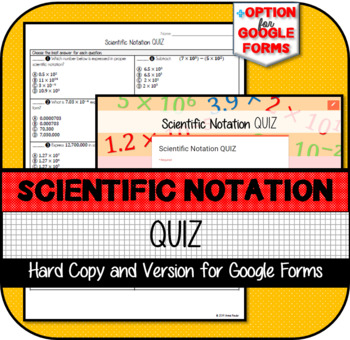
Scientific Notation QUIZ
A quick and concise way to assess your students' understanding of scientific notation and completing operations (add, subtract, multiply, divide) with numbers written in scientific notation.




637 resources
Explore sub-categories
13 sub-categories · 637 resources
A quick and concise way to assess your students' understanding of scientific notation and completing operations (add, subtract, multiply, divide) with numbers written in scientific notation.

This ten-question quiz combines operation choices, equation solving and two paired word problems about a rectangle and a phone plan. The three-page PDF contains a teacher letter with a Google Forms copy link, a student quiz and a letter-answer key. Item 2 requires two selections; provide scratch paper for calculations.
Provide four standards-based quiz versions (pre-test, test, and two retakes) assessing square root and cube root concepts under CCSS 8.EE.A.2, so teachers can pre-test, test, and re-test without reusing questions.
Get the Best Test Preparation Available with Calculation of Drug Dosages, 11th Edition (Ogden & Fluharty) – Ultimate Exam Preparation Test Bank for Your Consciousness Do you use the textbook Calculation of Drug Dosages, 11th Edition by…
Test Bank: Morris's Calculate with Confidence, Eighth Edition Use the definitive test bank for the eighth edition of Morris' "Calculate with Confidence" to master the crucial skill of medical dosage calculations and ace your exams.
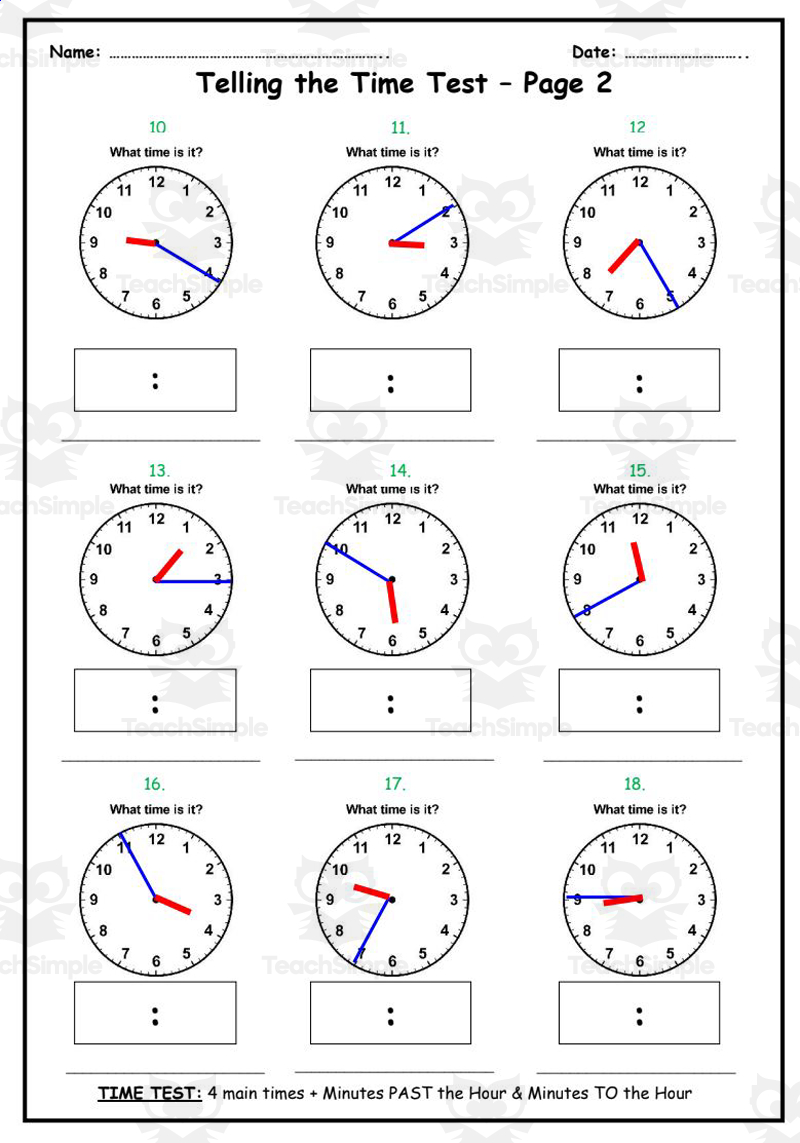
Test/assess students' ability to read the time on an analog clock face.
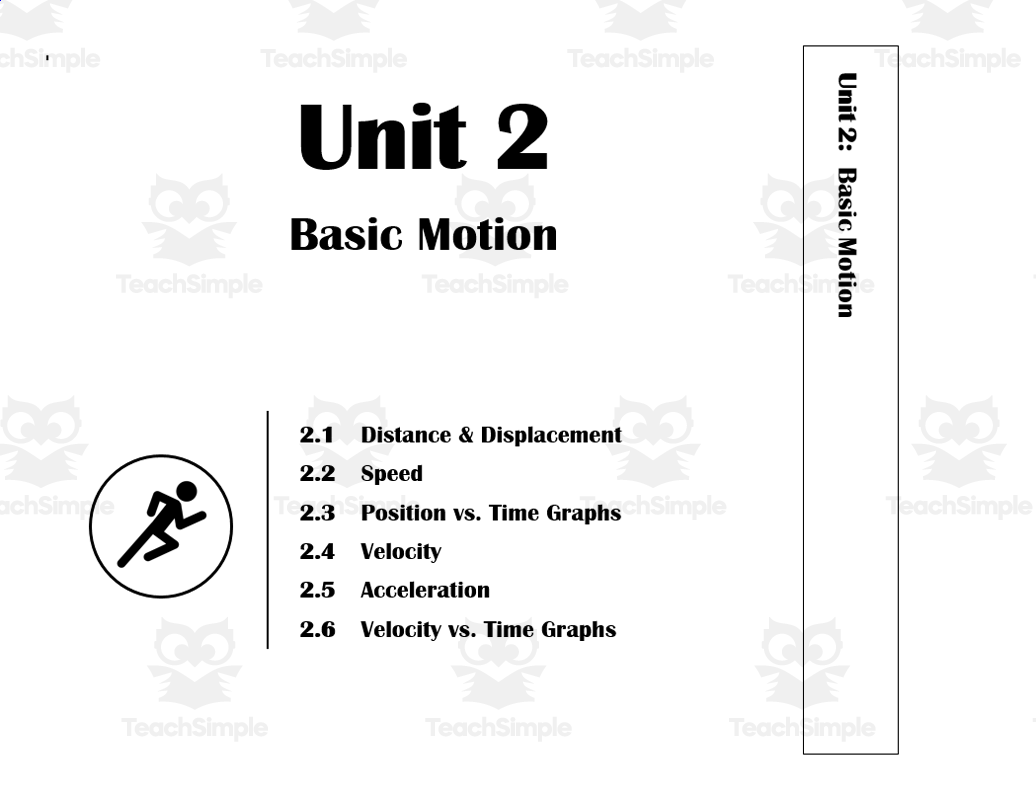
A middle/high school science unit package on Basic Motion (distance & displacement, speed, position vs. time graphs, velocity, acceleration, velocity vs. time graphs) providing a binder organization divider, a summative unit test, and a review 'recovery quiz' for students who need to make up missed work.
This 4.MD.1 Fourth Grade Common Core Lesson is great for helping students understand relative sizes of measurement units. This is an important skill for students to have as they progress in their education.
This 5.MD.4 Fifth Grade Common Core Lesson is great for teaching students how to measure volumes by counting unit cubes. This lesson uses cubic cm, cubic in, cubic ft, and improvised units, which makes it a great resource for teachers.
This Fifth Grade Common Core Lesson is perfect for helping students solve real world problems involving volume. With this lesson, teachers can help their students better understand and use volume in practical ways.
This lesson is designed to help fifth grade students compare the size of a product to the size of one factor to the other factor. By the end of the lesson, students will be able to use their knowledge of multiplication to compare the size of a product to the size of one factor to the other factor.
This lesson is great for helping students to understand numerical patterns and relationships between corresponding terms, in order to succeed in the 5.OA.3 Fifth Grade Common Core standard.
Algebra: Expressions - Multiplication & Division - Pre- Assessment & Teach the Skill - FLASH-MAC is a focused, curriculum-based resource designed for educators to convey multiplication and division concepts of algebraic expressions effectively. It is hinged not only on profound understanding but also interactive learning suitable for…
Algebra: Expressions - Multiplication & Division - Pre- Assessment & Teach the Skill - FLASH-PC This is a comprehensive teaching resource designed to enhance understanding of algebraic expressions, specifically multiplication and division, among grades 3 through 5 students. Key Features: Diverse approach: Goes beyond the traditional…
A single-topic reading-comprehension chapter slice on 'Divisions of Each Branch of Government' from a Classroom Complete Press American Government unit, for grades 5-8.
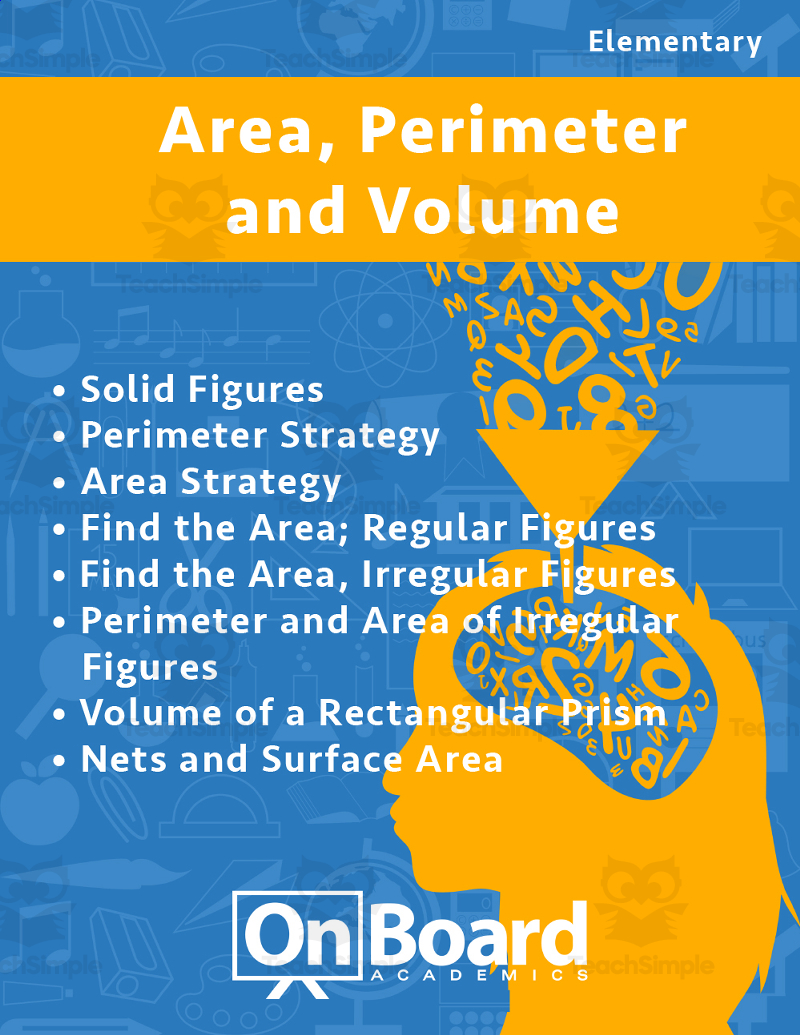
A 61-page grade 5 (with some grade 6 content) academic workbook teaching area, perimeter, and volume concepts, plus related percent and solid-figure topics, through vocabulary intros, guided practice, and quizzes.
Canadian Government: Divisions of Each Branch of Government This unique instruction kit serves educators across the spectrum including public school teachers to homeschoolers. Designed for students between grades 5 and 8, it imparts detailed knowledge about Canadian governance and electoral systems. Usage: Suitable for various teaching…
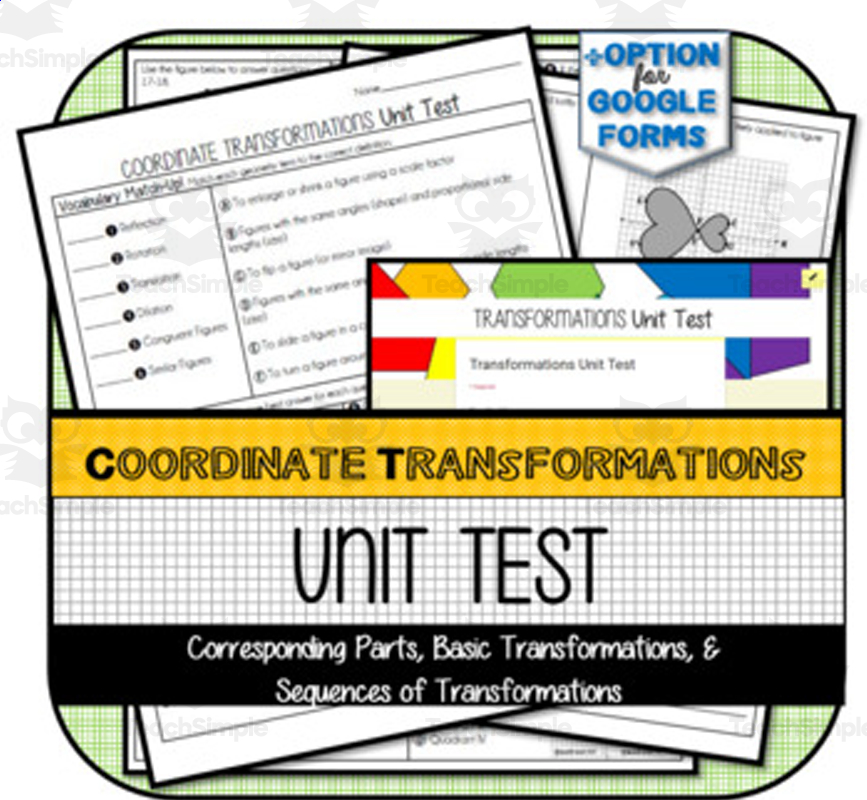
Assess student mastery of a full geometric-transformations unit (reflections, rotations, translations, dilations, congruence, and similarity), aligned to CCSS.MATH.CONTENT.8.G.A.1 through 8.G.A.4.
A math workbook teaching customary and metric units of measure, covering length, weight/mass, and capacity, with practice exercises, matching/ordering tasks, conversions, and quizzes.
A 52-page decimals workbook covering a progression of decimal skills -- from basic decimal/money notation through comparing/ordering, fraction-decimal-percent conversion, and multiplying/dividing decimals -- usable as a standalone unit or supplementary material.

A multi-section math workbook teaching students how to display and interpret data (bar graphs, stem-and-leaf plots, circle graphs) and how to calculate basic probability using tree diagrams.
A math workbook teaching students to display and interpret data using bar graphs, circle graphs, and stem-and-leaf plots, and to understand basic probability concepts including tree diagrams and sample space.
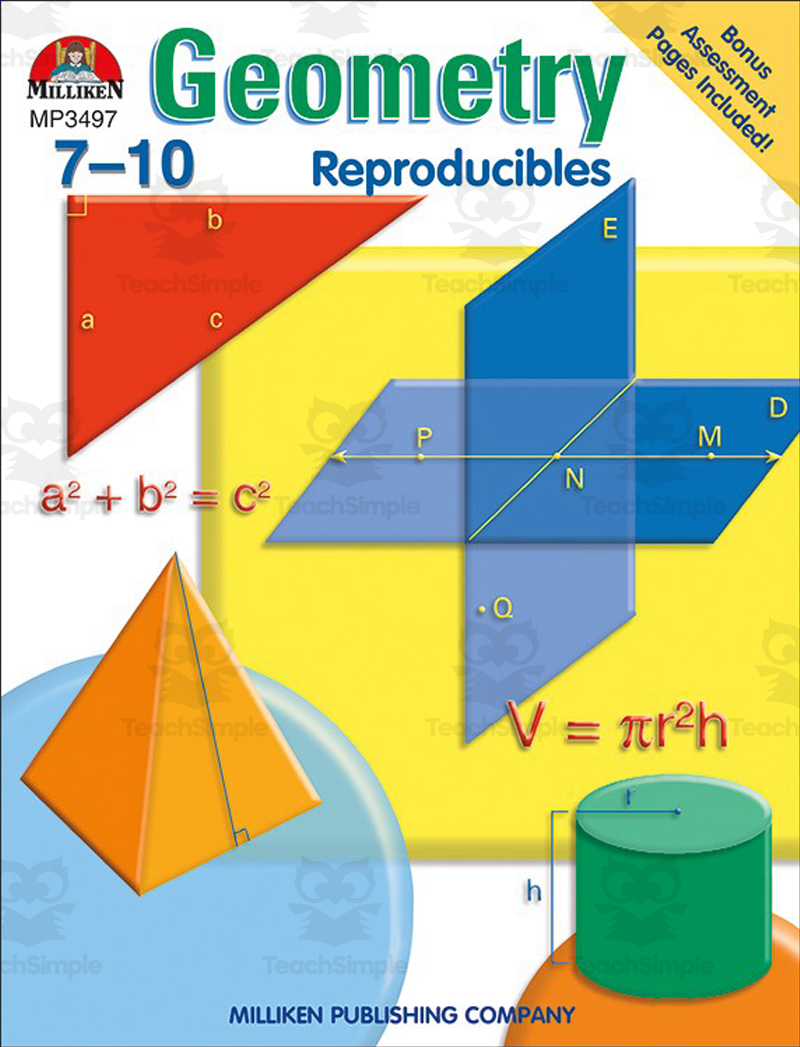
Provide a comprehensive geometry workbook of reproducible worksheets, puzzles, mazes, and games covering topics from geometry basics through circles and spheres, with an assessment section.
Teach 3rd-grade geometry fundamentals -- angles, line symmetry, flips/slides/turns (transformations), and lines/rays/angles -- through a sequence of instructional pages, practice activities, and unit quizzes.