resources by type
resources by grade
resources by subject
other resources

3,948 products added recently

Page 3 - 8th Grade Word Problems

Provide eighth graders with word problems that involve geometry, functions, and complex algebraic concepts. These worksheets bridge the gap to high school mathematics. Use them to ensure readiness and build confidence.

Relevant
alt down
Any Time
alt down
filter by
alt down
All File Types
alt down
filter nav Show filters
Sort by: Relevant
CLEAR
resources by type
Activities
down arrow
Classroom Decor
down arrow
Teacher Tools
down arrow
Worksheets & Printables
up arrow
Drawing Templates & Outlines
Flashcards
Novel Studies
Parts of and Anatomy of
Task Cards
Word Problems
Writing Prompts
Worksheets
down arrow
Workbooks
resources by grade
Early Learning
down arrow
Pre-K
down arrow
Elementary
down arrow
Middle School
up arrow
Grade 6
Grade 7
Grade 8
High School
down arrow
Adult Education
Not Grade Specific
resources by subject
Creative Arts
down arrow
ELA
down arrow
Holiday & Seasonal
down arrow
Life Studies
down arrow
Math
up arrow
Addition and Subtraction
down arrow
Algebra
down arrow
Calculus
down arrow
Trigonometry
Decimals
Early Math
down arrow
Fractions
Geometry
Graphing
Measurements
Money
Multiplication and Division
down arrow
Number Lines
Order of Operations
Percentages
Statistics
Time
P.E. & Health
down arrow
Social Studies
down arrow
Special Resources
down arrow
Science
down arrow
Foreign Languages
down arrow
Resources for Teachers
down arrow
other resources
Common Core
Homeschool Resources
down arrow
Montessori
Research
STEM
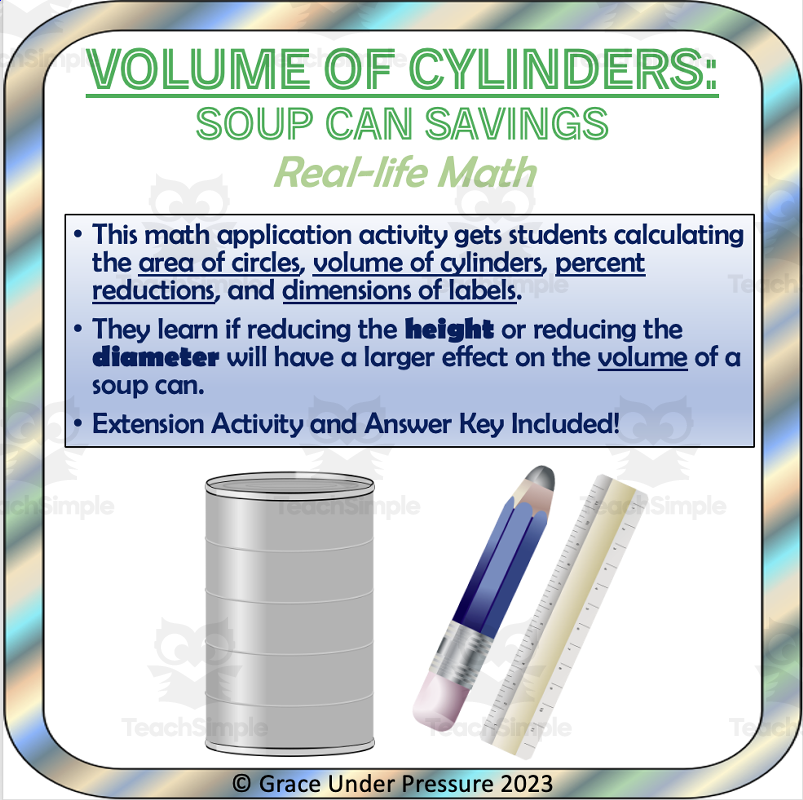
Volume of Cylinders: Middle School Geometry Word Problem: Soup Cans

Volume of Cylinders: Middle School Geometry Word Problem: Soup Cans
Math, Geometry, Measurements, Grade 6, 7, 8, 9, Worksheets & Printables, Word Problems, Worksheets

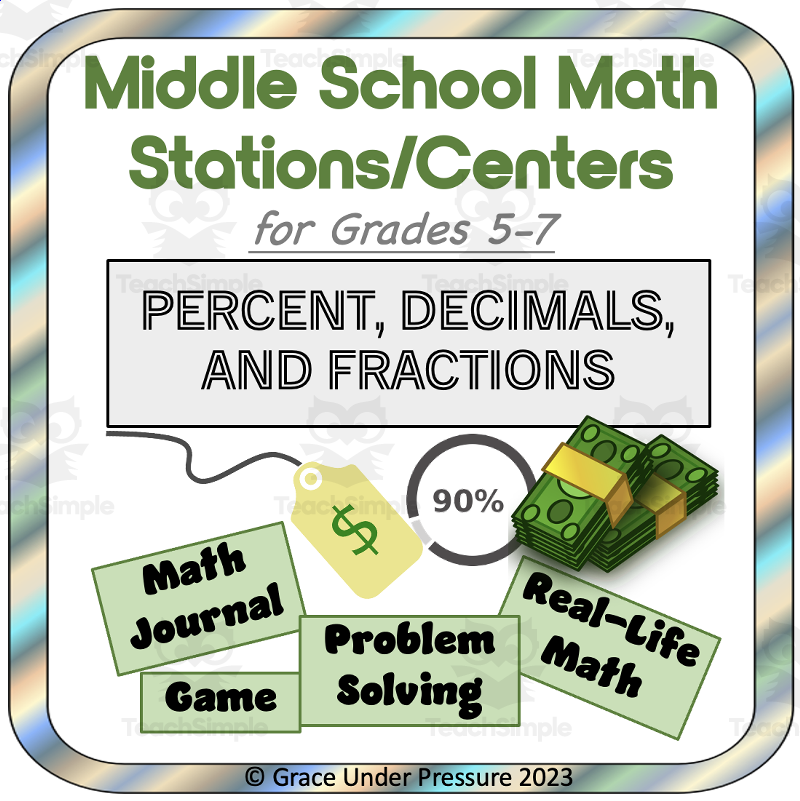
Here's a real world applied math example for your middle school geometry unit! It will have students calculating the area of circles, volume of cylinders, percentage reductions, and dimensions of labels (nets). Students are tasked to become a valued member of a soup company's management team. They have to determine the current volume of their soup cans, and whether an equivalent proportional reduction in height or diameter of the can will have a larger impact on the volume of soup inside. How to Use: This 3 page worksheet walks students through the process step-by-step. They sketch the current can and calculate its volume. They calculate a 10% reduction in height OR a 10% reduction in diameter of the can to see which one has a larger impact on the volume of soup inside. As an extension, they can measure out the reduced can's actual label size and design an appealing logo and image. All of the instructions are included, with space for sketches, explanations and formulae. A complete answer key is also included to eliminate any guesswork when marking! Grades to Use With: This lesson is designed for middle grades students in grades 6-9 who are learning about key geometry concepts: volume of 3D shapes, area of circles, ratios and proportional relationships, and creating nets from 3D shapes. It could also be used in adult education classes or some high school special education settings. What's Included: 5 Page PDF: Title Page, 2 Page Student Worksheet, Extension, Complete Answer Key If you enjoy this geometry activity, check out others in my store: Middle School Math Stations or Centers: Triangles, Area, Angles Middle School Math Stations or Centers for Area, Perimeter, and Volume Area of Triangles, Parallelograms, and Trapezoids: Jigsaw Journal Activity Relationship Between Area and Perimeter: Math Inquiry Prompt Park Design Project with Area, Perimeter, Volume, and Budgeting

Author Grace Under Pressure

Tags Geometry, Word Problems, Measurements, Volume Of Cylinders, Volume, Real World Math, Applied Math, Area Of Circle, Percent, Nets

Independent & Dependent Variables – Hockey Math Lesson

Independent & Dependent Variables – Hockey Math Lesson
Math, Algebra, Graphing, Grade 6, 7, 8, Worksheets & Printables, Word Problems, Worksheets

Here's a ready-to-go lesson to help show your students how learning about independent and dependent variables in grade 6 math can be helpful in the real world! This lesson is all about a hockey game and the mathematical relationships that can be found there. Students are given 4 scenarios about making ice, letting in fans, collecting money for 50/50 tickets, and the profits the arena makes. For each situation, they have to complete a table of values with missing entries, graph the relationship on the provided graph (labels and scales are already filled in), create an equation with the two provided variables, and answer one or two questions. The questions increase in difficulty throughout the assignment. You could use this lesson in several ways. After teaching your students the basic vocabulary and concepts from your math program, you could cut the four scenarios up and use them as task cards or stations. Or, you could assign one problem each to small groups. Or, you could give each student the entire double-sided worksheet. This could even be used as an assessment ! What's included: 4 Page PDF: Title and Instruction Page 2 Pages of Student Questions Complete Answer Key Grades to Use With: This lesson is designed for students in 6th Grade who are mastering the standard 6EE.C.9. However, it could also be a great review for students in 7th or 8th grades or it could be used in high school special education classes. If you enjoy this product, check out other 6th grade algebra activities in my store: Pre-Algebra Problem: The Wave Pool with Expressions, Tables, and Graphs Algebra: Modelling Equations: Visual Balance Scale Worksheet Exponent Board Game Or if you want more math games, check out some others in my store: Credit Score Board Game: Credit Cards, Loans, Mortgages and More: Personal Financial Literacy Bank Account Board Game: A Fun Financial Literacy Lesson for Addition, Subtraction or Integer Practice

Author Grace Under Pressure

Rating

Tags Independent Variable, Dependent Variable, Systems Of Equations, Graphing, Algebra, Equations, Variables, Tables, Linear Relationships, Real World Math

Human Rights: Access to Water (Canada) An Integrated Math and Social Studies Lesson

Human Rights: Access to Water (Canada) An Integrated Math and Social Studies Lesson
P.E. & Health, Social Studies, Health, Math, Percentages, First Peoples (Native), History, History: Canada, Grade 5, 6, 7, 8, Worksheets & Printables, Word Problems, Worksheets

Human Rights: Access to Water (Canada) - An Integrated Math and Social Studies Lesson This teaching resource is designed for middle grades students (5th-8th grades). It combines the subjects of math and social studies into one integrated lesson about water, human rights, and the kind of world we want to live in. The main focus: This lesson raises the question why all residents in Canada, especially in First Nations communities, don't have access to clean and drinkable water. While providing a basic understanding of human rights, it specifically examines water as a fundamental right. Tasks Involved Include: Defining human rights in their own words Looking at the UN Declaration of Human Rights and putting some rights into their own words Thinking about why clean water is a human right A case study on current water quality advisories in British Columbia (link provided) Determination of part-to-part & part-to-whole ratios and percentages using live data Reflecting on the fairness of the current situation Calculation of personal daily water usage Determining how long it would take to boil one's required amount of water pot by pot These tasks demonstrate the practical impact that math has on everyday life while shedding light on unfair access to clean drinking water. They require students to use critical thinking and applied math skills to tackle an important social issue. Grades to Use With: This lesson is designed for students in the middle grades (5-8) and can be used in math class when studying ratios and proportional relationships OR social studies class when studying indigenous issues and human rights. What's Included: 4 Page PDF: Title Page Brief Overview of Human Rights and Water as a Specific Human Right Case Study of Water Advisories in British Columbia, Canada Math Application: How long would it take to boil all the water you use each day?

Author Grace Under Pressure

Tags Human Rights, Access To Water, Canada, Math And Social Studies, Clean Water, Indigenous, Indigenous Rights, First Nations, Ratios, Percentages

Systems of Equations: Word Problems NOTES & PRACTICE

Systems of Equations: Word Problems NOTES & PRACTICE
Math, Algebra, Grade 8, Word Problems, Worksheets & Printables

Systems of Equations: Word Problems NOTES & PRACTICE A comprehensive teaching resource tool specifically designed for eighth-grade math educators. This resource material meets the common core mathematical standards defined by CCSS.MATH.CONTENT.8.EE.C.8 and CCSS.MATH.CONTENT.8.EE.C.8.C . Focused Content Coverage: Analyzing and solving pairs of simultaneous linear equations based in real-world or mathematical scenarios. Vital instruction on setting up equations in both Slope-Intercept & Standard Forms framed within mathematical word problems as well as real-world problems. Educational Engagement & Practice Activities: This product provides practice activities that can be utilized either during class sessions for whole or small group activities, or can be assigned as homework exercises. Included Test Preparation Resources: Multiple Choice + Constructed Response TEST PRACTICE preparation materials are available for equipping students to tackle assessment challenges. Inclusive Resources Available: Detailed notes on the subject matter Theoretical and applied practice exercises Review materials aimed for test preparation A comprehensive Answer Key A perfect blend of practicality and effectiveness, Systems of Equations: Word Problems NOTES & PRACTICE is dedicated to reinforcing algebraic principles in an eighth-grade classroom setting while adhering to standard statutory requirements.

Author The Math Cafe

Tags Systems Of Equations, Word Problems, Algebraic Equations, Linear Equations, Test Practice

Types of Investment Accounts in CANADA: Non-Registered, TFSA, RRSP

Types of Investment Accounts in CANADA: Non-Registered, TFSA, RRSP
Special Resources, Life Studies, Life Skills, Finance, Home Economics, Math, Money, Grade 8, 9, 10, 11, 12, Worksheets & Printables, Word Problems, Worksheets

Types of Investment Accounts in Canada: Non-Registered, TFSA, RRSP This financial literacy lesson teaches students in grades 8-12 about the different types of investment accounts in Canada. Each account has its own benefits and drawbacks, and if students understand these aspects, they will be able to make smart financial decisions in the future. Comprehension of these accounts will help equip learners with key knowledge about investments, tax saving strategies, and planning ahead for retirement. How to Use: This material can be used in different teaching environments including a whole class setting, small groups or pairs, or as individual seat work. The content starts with a graphic organizer with a completed version or a blank version. You can read through it with your class, have them takes notes as you project the completed version on an interactive whiteboard, or have them complete research to find the information themselves. This is followed by six practical scenarios encouraging thoughtful problem-solving; students must choose the best-suited account under given circumstances. They can refer back to their graphic organizer for this task. An answer key is also included for easy marking. What's Included: A 5 page PDF is included: Title Page Graphic Organizer (filled in and empty) Questions Answer Key Grades to Use With: This lesson is designed for high school students in finance, life skills, career and personal planning, or home economics classes in grades 8-12. If you enjoy this personal finance lesson, check out others in my store. I love to help students understand complex financial topics in an age-appropriate way! Financial Literacy: Household Budget Project: Taxes, Insurance, Loans, Rent, Groceries and More! Interest Rates: Notes and Sample Questions Credit Score Board Game: A fun way to learn about credit scores! Debit vs Credit Cards Handout Debt and Bankruptcy: Personal Financial Literacy Lesson Financial Literacy: Income Tax- Notes and Realistic Sample Practice

Author Grace Under Pressure

Tags Investment Accounts, TFSA, RRSP, Personal Finance, Financial Literacy, Saving Money, Retirement, Life Skills, Finance, Canadian Investment Accounts