



3,982 products added recently
Page 22 - 4th Grade Worksheets
Enhance your fourth-grade classroom with worksheets that cover a range of subjects and promote analytical thinking. These resources help students delve deeper into topics and develop critical skills. Incorporate them to enrich your teaching and support student achievement.

 Show filters


Multiplication Mystery Picture Puzzle | 3rd 4th Grade Math Worksheet
Math, Calculus, Addition and Subtraction, Subtraction, Addition, Multiplication and Division, Division, Multiplication, Resources for Teachers, Grade 3, 4, Activities, Teacher Tools, Worksheets & Printables, Workbooks, Worksheets, Centers
🪟 Engage your students in multiplication practice with the help of our Multiplication Puzzle Mystery Picture Worksheet! This worksheet will encourage children to master math facts by solving multiplication problems and completing problem-solving activities. Your kids will get lots of practice working on a math mystery picture that is to be uncovered. Engaging visual elements and interactive tasks will help children become more proficient in multiplying numbers by providing additional practice with math facts. Worksheet Contents: • Multiplication fact practice problems • A task of coloring by numbers to uncover a mystery picture • Word problems for practicing multiplication • True or False questions to check understanding of multiplication facts • Bonus multiplication problem for advanced students • A student-friendly format • Designed for US Letter Size Paper (8.5" x 11") Skills Developed: • Multiplication fact fluency • Mastering math facts • Problem-solving strategies • Developing number sense • Working independently • Assessing knowledge • Reviewing math facts Ideal for: 📚 Grade 3 Math 📚 Grade 4 Math 📚 Math Centers 📚 Morning Work 📚 Homework Assignments 📚 Fast Finishers 📚 Sub Plans 📚 Homeschool Learning 📚 Small Group Lessons Students will enjoy discovering multiplication facts as they solve the mystery picture in our Multiplication Puzzle Mystery Picture Worksheet!
Author BrightPrintsNY
Rating
Tags Multiplication Mystery Picture Worksheet, Math Puzzle Worksheets For 3rd Grade, Fun Multiplication Activities For Kids, Mystery Picture Math Worksheets Printable, 4th Grade Multiplication Practice Sheets, Multiplication Color By Code Puzzles, Printable Math Mystery Picture Activity, Multiplication Worksheets For Classroom Fun, Puzzle Math Worksheets For Elementary Students, Engaging Multiplication Practice For 3rd 4th Grade

Use Better Vocabulary In Your Writing: said (EFL Work Pack) 8+
ELA, Language Development, ESL, Grade 4, 5, 6, 7, 8, 9, 10, 11, 12, Worksheets & Printables, Worksheets
Use Better Vocabulary In Your Writing: said (EFL Work Pack) 8+ 'Use Better Vocabulary In Your Writing: said (EFL Work Pack) 8+' is a crucial resource conceived for aiding students aged 8 and above, who are not native English speakers. It delineates a path towards achieving an intermediary proficiency in written English. Fun Learning Approach The notable aspect of this work pack is the enthralling character 'the alien Zoggy'. This intriguing personality transforms a standard learning session into an engaging, interactive experience benefiting learners of all ages. Holistic Language Improvement The resource provides comprehensive assistance to surmount common challenges encountered by non-native speakers: Deducing idioms and colloquial phrases widely used by fluent speakers Determining correct preposition usage after verbs Composing formal letters in the standard English format Amply expanding vocabulary pool Additionally, each pack focuses on enhancing grammar—an essential facet of mastering any language. Our exhaustive range enriches writing skills and facilitates effective verbal communication. Incorporating This Resource Into Lesson Plans Teachers can seamlessly integrate this helpful tool into regular lessons, homework assignments or weekly supplementary classes—steering EFL students towards mastering written English vocabulary. Particularly training them to replace banal words with linguistically rich alternatives is rewarding progress. Availability & Suitability This tool comes as PDF downloadable software under the Category: Language Arts endorsing ESL education. While it's most appropriate for Grade 4 through Grade12 scholars, there are no rigid grade prerequisites making it equally effective across variable levels of ESL education.
Author Guinea Pig Education
Tags Vocabulary Improvement, Written English, Language Skills, EFL Students, Instructional Material
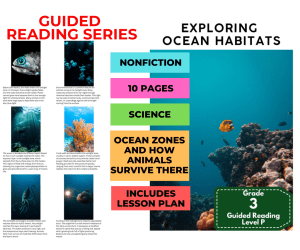
Guided Reading Level P - Exploring Ocean Habitats (with Lesson Plan)
ELA, Resources for Teachers, Reading Comprehension, Reading, Language Development, Physics, Science, Life Sciences, Earth and Environmental Sciences, Grade 2, 3, 4, Worksheets & Printables, Worksheets, Teacher Tools, Centers, Activities, Literacy Readers, Quizzes, Quizzes and Tests, Assessments
This Guided Reading Book - Exploring Ocean Habitats (Level P) with lesson plan includes: Guided Reading Color Label (front cover x1) This is a quick way to match the book’s demands to what students can generally handle.. The overall goal is to use the level/color to pick books for several smaller groups. To qualify for a certain level, a student is expected to read a book from that level with about 90–94% accuracy. If a student is consistently accurate and understands, move up a level. If the student is struggling at that level, drop down and add more support. Each student will improve at completely different rates, but it is generally one of the best ways to check progress across the class. DOWNLOAD THE CATALOG TO VIEW ALL GUIDED READING BOOKS AVAILABLE (SORTED LEVELS A-Z) Pre-Reading Question (x1) Teacher asks the prompt aloud, can be while showing the cover or first page. Students share what they already know, or make educated guesses from the cover. Prompt them to use the target vocabulary. Write some of their responses on the board to look back at during the reading. Vocabulary Words (x5) Introduce the five words, best doing it one at a time. Start by saying it, while students repeat and then see if anyone knows what it means before reading further. Read through the meaning and try to briefly connect each word to a picture or gesture so it’s meaningful. Ask students to flip through the book pages and point to where they see each of the vocabulary words. While reading the book pause upon coming across one of the vocab words or read the sentence twice to make sure students understand the word has appeared. Optional: Ask students to raise hands whenever they see/hear one of the new words. Guided Reading Pages (x10) Check the book snapshot (below) for: primary topic - do you need to prep extra reading or intro materials on this? what is taught best - decide on 1-2 bullets to focus on, use the prompt or words provided here for best results. learning goals - what you are checking for students to be able to do after the session, elicit answers using prompts or words provided. key vocabulary (see section above). questions overview - so you know what is coming up and if you need to prep extra materials to assist understanding. Run the lesson You may have already looked at a few of the pages together, but you can show them some of the pictures again first to set meaning. Depending on how much time you have and how familiar your students are with guided reading class, you may want to read the book aloud first with the group first. Students whisper or partner read, while you listen in. If time, do it as a group, one student reading a page each. Use the guided page’s prompts to coach: “Check the picture / does it make sense?” “Point under the words / try the first sound” “Reread the sentence smoothly”. Try to focus more on one student per session (rotating every time), so you can work out if they are ready to move up or need to move down a level. Comprehension Questions (back cover x3) This is your way to check that students didn’t just say the words, but actually understood the text. First, let students answer by pointing to the page/picture and saying a short sentence. After any answer, follow with: “Show me where you found that in the text.” In bigger groups, have partners answer first (10–20 seconds), then call on 2–3 students to share. Differentiation tips: Emerging speakers/struggling readers: oral + pointing On-level: oral in a full sentence Higher: one written sentence or draw + label Book Snapshot Title: Exploring Ocean Habitats Genre: Nonfiction (informational) Subject: Life Science / Earth Science (Ocean) / Reading Primary Topic: Ocean zones and how animals survive there Estimated Guided Reading Level (A–Z): P What This Book Teaches Best Ocean layers by sunlight: The ocean is divided into layers based on how much sunlight reaches the water (sunlight zone, twilight zone, midnight zone, abyssal plain, hadal zone). How living things get energy in different zones: Phytoplankton grow in the sunlight zone, plants can’t grow in the twilight zone due to limited light for photosynthesis, and deep-sea ecosystems near vents use chemosynthesis. Animal adaptations for dark habitats: Examples include large eyes in the twilight zone and bioluminescence used to attract prey, communicate, or camouflage. Survival challenges in the deep ocean: The text describes permanent darkness, high pressure, near-freezing temperatures, and how food can drift down from above (“marine snow”). Specialized predators and movement: The anglerfish uses a glowing lure to bring prey close, and the Dumbo octopus flaps ear-like fins and lacks an ink sac in total darkness. Learning Goals Students will explain how the ocean is divided into layers based on sunlight. Students will describe the sunlight zone and how deep it extends, using details from the text. Students will explain why plants cannot grow in the twilight zone, according to the book. Students will describe two survival adaptations from the text (such as bioluminescence, large eyes, or a glowing lure). Students will compare conditions in two deep-ocean habitats (midnight zone, abyssal plain, hadal zone) using text evidence. Students will explain how hydrothermal vent ecosystems can thrive without sunlight, based on the text. Key Vocabulary From the Text phytoplankton — tiny ocean organisms that grow using sunlight. photosynthesis — plants making food using light. bioluminescence — animals making their own light. cephalopods — ocean animals like octopuses and squids. chemosynthesis — making energy using chemicals, not sunlight. Discussion Prompts Pre-reading question: What might make it hard for ocean animals to live where there is very little light? Comprehension questions: What does the book say the sunlight zone is, and how deep does it go? Why does the book say plants cannot grow in the twilight zone? According to the text, what helps ecosystems thrive near hydrothermal vents? Printing Tips 1. Best Printing Method (Recommended) “Booklet” Printing (Best if Available) If your printer or PDF viewer supports Booklet Printing , use this. Settings to use: Print mode: Booklet Paper size: Letter or A4 (either works) Orientation: Landscape Print on both sides: Yes Flip on: Short edge Scaling: Fit to printable area Booklet subset: First test: Front sides only Then: Back sides only This will automatically: Pair pages correctly Put the cover on the outside Align everything for folding After printing, fold in half and staple along the spine . 2. If “Booklet” Printing Is NOT Available You can still print this correctly with manual duplex printing . Step-by-step: Open the PDF. Choose Print . Set: Orientation: Landscape Pages per sheet: 1 Print on both sides: Yes Flip on: Short edge Print all pages . Because each PDF page already contains two facing book pages, the result will still fold cleanly into a book. Thousands of Cored Education products are included with your TeachSimple membership. Download links and encyclopedia index available here.
Author Cored Education
Rating
Tags Reading Comprehension, Reading Passages, Reading, Guided Reading, Guided Reading Lesson Plan, Guided Reading Activity, Pre-reading, Vocabulary, Science Lesson Plans, Oceans
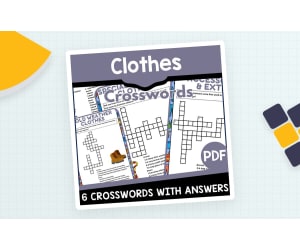
Clothes Crosswords (PDF)
ELA, Language Development, Resources for Teachers, Vocabulary, Spelling, ESL, Grade 2, 3, 4, 5, Worksheets & Printables, Worksheets, Crosswords Puzzles, Centers
Crossword Series This crossword series is designed for students in grades 2–5. Each set of crosswords is built around a clear vocabulary theme, allowing students to strengthen their word recognition, build subject-based knowledge, and reinforce early literacy and thinking skills. Each topic includes six crossword sets , and each set features the following consistent structure: 1. 8 vocabulary clues 2. Crossword puzzle 3. Answer key 4. 1 Did You Know fact related to the set These crosswords are designed to be student-friendly, classroom-ready, and easily integrated into thematic units, seasonal learning, morning work, or independent literacy stations. Clothes Crosswords Word List 1. Everyday Clothes Shirt, Pants, Socks, Shoes, Dress, Shorts, Jacket, Hat 2. Cold Weather Clothes Sweater, Coat, Mittens, Gloves, Scarf, Boots, Earmuffs, Hood 3. Warm Weather Clothes T-shirt, Sandals, Swimsuit, Sunglasses, Sunhat, Flip-flops, Tank top, Skirt 4. Special Occasion Clothes Suit, Tie, Blouse, Tuxedo, Gown, Bow tie, High heels, Vest 5. Sleepwear & Comfortable Clothes Pajamas, Slippers, Robe, Sweatpants, Hoodie, Leggings, Nightgown, Onesie 6. Accessories & Extras Belt, Backpack, Watch, Necklace, Bracelet, Ring, Zipper, Buttons PDF Version Other versions will appear here when available. Follow the store for the lastest on new products. How to Use This Crossword These crosswords are ideal for whole-class work, small groups, literacy centers, or take-home activities. Use one set per day, or spread them across a week or month depending on your curriculum needs. Each clue has been crafted to align with the reading level of grades 2–5, with support for both decoding and meaning. The Did You Know? facts offer additional extension opportunities for writing, drawing, or display work. Whether you're reinforcing vocabulary, exploring a seasonal topic, or adding variety to your literacy block, these crosswords provide a fun, flexible, and focused way to boost early literacy in an engaging format. More Clothes Themed Products Nothing yet, but follow for the latest on new products. FULL CATALOG OF DOWNLOAD LINKS HERE Themed Crossword Links Addition PDF Animals PDF Around the Home PDF Birthday PDF Candy PDF Christmas PDF Cinco de Mayo PDF Clothes PDF Colors PDF Days and Months PDF Division PDF Earth Day PDF Easter PDF Easy Crosswords PDF Fall PDF Father's Day PDF Food PDF Geography (Set 1) PDF Geography (Set 2) PDF Geography (Set 3) PDF Graduation PDF Health PDF History (Set 1) PDF History (Set 2) PDF History (Set 3) PDF Human Body PDF Kindness PDF Life Skills PDF Mother's Day PDF Multiplication PDF Science Crosswords (Set 1) PDF Science Crosswords (Set 2) PDF Science Crosswords (Set 3) PDF Shapes PDF Social Skills PDF Spring PDF Sports PDF St. Patrick's Day PDF Subtraction PDF Summer PDF Thanksgiving PDF Transport PDF Valentine's Day PDF Winter PDF Crosswords in Depth Structure Each crossword clue is written in simplified language to suit early readers, and follows a strict number-and-clue format (e.g., 1.A shape with four sides ). Students complete each puzzle using the themed vocabulary provided, helping to build both content knowledge and spelling confidence. Each completed set includes: A questions section with clearly formatted clues An answers section to support teacher checking or independent correction A Did You Know? fact tied to the topic (one per set) to add curiosity and cross-curricular value Themes Included The crosswords cover a wide variety of engaging, age-appropriate themes such as: Seasons & Holidays (e.g., Winter, Easter, Valentine’s Day) Math Concepts (e.g., Addition, Subtraction, Multiplication, Division) Everyday Topics (e.g., School, Colors, Animals, Weather) Special Units (e.g., Health, Earth Day, Sports, Graduation, Kindness) Each theme is carefully selected to reflect the experiences and interests of young learners, while reinforcing vocabulary and comprehension. For similar downloads and other frees, do check out Cored Group on TeachSimple.
Author Cored Education
Rating
Tags Vocabulary, Spelling, Crosswords, Ela Crosswords

Horace Visits The Roman Army (age 7-11 years)
ELA, Grammar, Grade 4, 5, 6, Worksheets & Printables, Worksheets
The Adventures of Horace the Cat The captivating adventures are brought to life by Horace, a cat with his innovative technology known as the I-collar. Through this tech-savvy feline's narrative, we explore exciting locations including: A Roman Villa A Roman Town Within the Roman Army Title: Horace Visits The Roman Army (age 7-11 years) This title offers an illuminating glimpse into what daily life was like during that era from our cat's unique perspective. Tailored For Teachers and Students Aged 7-11 Each book blends entertaining stories with grammar, punctuation, and spelling lessons. This combination makes it perfect for various teaching scenarios such as: Individual assignments during classwork or group projects . Home-based learning reinforcement using follow-up exercises. Note: This range of books also introduces new vocabulary words to fluent readers adding an extra layer to their language comprehension growth. Digital Delivery for Convenience The entire package is delivered in PDF format which allows teachers to create easy-to-use packets for students' usage. Purposeful Storytelling and Learning Resources Combined The workbooks serve a dual purpose - they make language arts sessions fun while also educating about history through immersive storytelling tied up with lessons crafted according to grade 4-6 syllabi requirements. They ensure a fine balance between edutainment and education making them well-suited for home or traditional classroom settings. These resources undoubtedly offer invaluable insights into society's norms and cultures. Our dear companion Horace's animated exploits across time allow us to weave together relevant knowledge about historical cultures with steady literacy skill development.
Author Guinea Pig Education
Tags Roman History, Educational Storytelling, Language Skills, Cat Character, Interactive Exercises

Internet Reading Comprehension Passage - Cored Ed Encyclopedia
ELA, Language Development, Resources for Teachers, Reading Comprehension, Reading, Pre-Reading, Writing, Science, Technology, Strategies, Grade 2, 3, 4, 5, Worksheets & Printables, Worksheets, Teacher Tools, Centers, Activities, Writing Prompts, Assessments, Tests, Quizzes and Tests, Quizzes
This Internet reading comprehension contains the following: Pre-Reading Trivia Students will write down one thing they already know about the subject and then read five more facts and discuss. These facts are fun, and the students will enjoy learning about the subject before reading more. Reading Passage The text is a high-interest reading passage with set paragraphs, roughly three to four paragraphs long. It contains a variety of themes about the topic, anywhere from history to technology. The passage is between 250 and 350 words in length. Mixed Questions The first question page contains four multiple-choice questions, each with a choice of four answers, and three written response questions that require a sentence or two from the student. Vocabulary Questions Practice seven key words from the text in this section across two activities. First section is scrambled words where students will unscramble three words given a clue for each. The second section is a word to meaning matching activity. Creative Writing In this question, the student will be required to write a five to eight sentence paragraph on a question related to the topic. Extension Activities This page is optional for fast finishers or to take home. There are several activities, each one requiring a different skill. Do some, do none, do all, completely optional - but you will feel reassured knowing every possibility is planned for. Answer Key There are answers for the multiple-choice questions, written response questions have sample answers, vocabulary answers and if there is a summary question then a sample summary will be provided as well. FULL CATALOG OF DOWNLOAD LINKS AND ENCYCLOPEDIA INDEX HERE Lesson Snapshot Title: Internet Genre: Nonfiction (informational text) Subject: Reading (Informational Text) / Technology Primary Topic: How the Internet works and how it began Estimated Guided Reading Level (A–Z): Q What This Lesson Teaches Best Defines the Internet as a worldwide system of connected computer networks that use shared rules (TCP/IP) to communicate. Explains how messages travel by being split into small chunks called packets that can take different routes and arrive out of order. Describes what routers do: forward packets between networks by choosing paths toward the right destination. Builds background knowledge about early Internet history (ARPANET, the 1969 “lo” message, and the 1983 switch to TCP/IP). Clarifies the difference between the Internet and the World Wide Web, introducing hypertext and using a browser to view linked pages. Learning Goals Students can explain what the Internet is using details from the passage. Students can describe how a message is broken into packets and why packets can arrive out of order. Students can identify what a router does when packets travel between networks. Students can summarize key early-history facts about ARPANET, including the 1969 message and the 1983 switch to TCP/IP. Students can describe one difference between the Internet and the World Wide Web based on the passage. Key Vocabulary From the Text TCP/IP — shared rules networks use to communicate. packets — small chunks of a message that travel separately. routers — devices that forward packets between networks. ARPANET — an early packet-switched network before today’s Internet. hypertext — linked pages you view with a browser. Cored Ed Encyclopedia Overview The Cored Ed Encyclopedia is a weekly series of lessons that you can pick up and use right away. These short readings fit into whatever time you have available. Each one includes a warm-up, a reading, and a set of questions, but it’s flexible — you can do just the reading, the full lesson, or skip the writing section if you need to. Each lesson focuses on a single topic so students don’t get lost. The writing is clear but never childish, making it perfect for grades two through five. Topics range from animals and science to history, inventions, and everyday things. No matter the level of the student, everyone should take away at least one new idea or fact from each lesson. The materials are easy to print, easy to explain, and require no setup. They work well for whole-class teaching, partner work, or independent study.
Author Cored Education
Rating
Tags Vocabulary, Spelling, Reading Comprehension, Reading Passages, Reading, Creative Writing, Reading Strategies, Writing Prompts, Internet, Technology

Animal adaptations
Science, Life Sciences, Animals, Grade 3, 4, 5, Worksheets & Printables, Worksheets
Understanding Animal Adaptations Understanding Animal Adaptations is a comprehensive, enriched teaching resource designed for educators aiming to make science, specifically zoology, engaging and straightforward for their Grade 3, 4 and 5 students. This expansive collection of worksheets focuses primarily on distinct adaptations animals have developed over time to survive in their respective environments. This well-organized PDF contains a generous mix of theoretical content enhanced by text with illustrations and practical exercises ranging from simpler tasks such as drawing activities to more complex ones like research assignments. Bats, sharks, penguins are some examples of animals included in this extensive unit with focus on their specific adaptation features followed by thought-stimulating questions and an answer key. An additional attractive feature is the creative inclusion of riddles which contribute to making learning fun. Furthermore, one can find hands-on activities using materials such as plasticine that foster kinesthetic learning. Topics move beyond individual species into broader topics intertwined with animal adaptation including camouflage, chemical defenses and other defense mechanisms along with detailing different habitats. There's also information about fascinating phenomena like migration patterns including those of the Arctic Terns or Monarch butterflies. Hibernation habits within the animal kingdom: A final section deals with intriguing topics such as hibernation habits within the animal kingdom adding an extra layer of knowledge acquisition opportunity for students. Educational Scenarios: 'Understanding Animal Adaptations' can be utilized during whole class instruction sessions 'Used in small group workspaces conducive to collaborative student interaction' 'Even assigned as independent homework tasks that promote personalized learning at home' These diverse educational contexts cater towards incorporating multiple teaching strategies thereby enhancing overall instructional effectiveness.
Author Learn it ANY way
Tags Animal Adaptations, Zoology, Worksheets, Hands-on Activities, Habitats
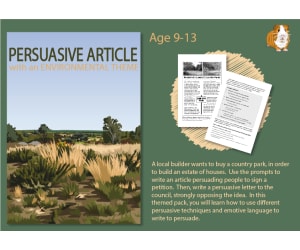
Write A Persuasive Article With An Environmental Theme (9-14 years)
ELA, Writing, Grade 4, 5, 6, 7, Worksheets & Printables, Worksheets
Write A Persuasive Article With An Environmental Theme (9-14 years) Students explore persuasive writing and improve literacy skills with this complete resource pack. Pack includes sample writings on environmental themes to inspire students' own persuasive articles, letters, brochures, and more. Lessons teach literary devices like emotive language, varied sentences, and good spelling, punctuation and grammar. With model student essays, practice questions to test skills, and tips to help students succeed on assignments. Useful for teachers or parents looking for a writing curriculum, supplemental practice, or homework help in grades 4-7 language arts. Can be used flexibly for whole-class, small group, or individual assignments. Engages students to build persuasive writing abilities.
Author Guinea Pig Education
Tags Persuasive Writing, Letter, Article, Persuasive Techniques, Emotive Language
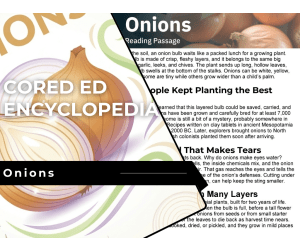
Onions Reading Comprehension Passage - Cored Ed Encyclopedia
ELA, Language Development, Resources for Teachers, Reading Comprehension, Reading, Pre-Reading, Writing, Life Sciences, Science, Nature & Plants, Grade 2, 3, 4, 5, Worksheets & Printables, Worksheets, Teacher Tools, Centers, Activities, Writing Prompts, Assessments, Tests, Quizzes and Tests, Quizzes
This onions reading comprehension contains the following: Visualize on the Cover (Teacher Read Aloud Script) Start your lesson by taking a few moments to visualize the topic and share thoughts or feelings about it. Pre-Reading Trivia Students will write down one thing they already know about the subject and then read five more facts and discuss. These facts are fun, and the students will enjoy learning about the subject before reading more. Reading Passage The text is a high-interest reading passage with set paragraphs, roughly three to four paragraphs long. It contains a variety of themes about the topic, anywhere from history to technology. The passage is between 250 and 350 words in length. Mixed Questions The first question page contains four multiple-choice questions, each with a choice of four answers, and three written response questions that require a sentence or two from the student. Vocabulary Questions Practice seven key words from the text in this section across two activities. First section is scrambled words where students will unscramble three words given a clue for each. The second section is a word to meaning matching activity. Creative Writing In this question, the student will be required to write a five to eight sentence paragraph on a question related to the topic. Extension Activities This page is optional for fast finishers or to take home. There are several activities, each one requiring a different skill. Do some, do none, do all, completely optional - but you will feel reassured knowing every possibility is planned for. Includes summary writting question. Answer Key There are answers for the multiple-choice questions, written response questions have sample answers, vocabulary answers and if there is a summary question then a sample summary will be provided as well. FULL CATALOG OF DOWNLOAD LINKS AND ENCYCLOPEDIA INDEX HERE Lesson Snapshot Title: Onions Genre: Nonfiction (informational text) Subject: Life Science (plants) / Reading Informational Text Primary Topic: Onion bulbs, history, tears, and growing Estimated Guided Reading Level (A–Z): Q What This Lesson Teaches Best How an onion bulb is made of layers and helps the plant grow. Key plant facts: onions send up hollow leaves , and the bulb swells at the bottom of the stalks. A clear cause-and-effect explanation for why cutting onions can make eyes water (chemicals mix → gas → tears). A brief history of onions, including early recipes on clay tablets in ancient Mesopotamia and later planting in North America. How onions are grown/harvested, including that onions are biennial plants and can be started from sets . Learning Goals Students will identify details that describe what an onion bulb is like and what it does for the plant. Students will explain why cutting an onion can make eyes water using information from the text. Students will describe one way people long ago saved and replanted onions. Students will describe how onions can be grown (from seeds or sets) and when they are often harvested. Students will use section headings to locate key information in the passage. Key Vocabulary From the Text biennial — a plant built for a two-year life cycle. chemicals — substances that can mix and cause changes. Mesopotamia — an ancient place where people wrote on clay tablets. colonists — people who settled in a new place long ago. sets — small starter onion bulbs used for planting. Cored Ed Encyclopedia Overview The Cored Ed Encyclopedia is a weekly series of lessons that you can pick up and use right away. These short readings fit into whatever time you have available. Each one includes a warm-up, a reading, and a set of questions, but it’s flexible — you can do just the reading, the full lesson, or skip the writing section if you need to. Each lesson focuses on a single topic so students don’t get lost. The writing is clear but never childish, making it perfect for grades two through five. Topics range from animals and science to history, inventions, and everyday things. No matter the level of the student, everyone should take away at least one new idea or fact from each lesson. The materials are easy to print, easy to explain, and require no setup. They work well for whole-class teaching, partner work, or independent study.
Author Cored Education
Rating
Tags Vocabulary, Spelling, Reading Comprehension, Reading Passages, Reading, Creative Writing, Reading Strategies, Writing Prompts, Onions, Life Science
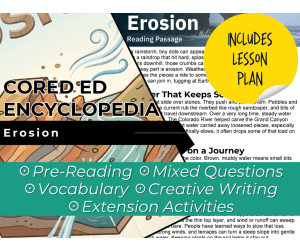
Erosion Reading Comprehension Passage - Cored Ed Encyclopedia
ELA, Reading Comprehension, Reading, Science, Technology, Language Development, Social Studies, Earth and Environmental Sciences, Geography, Life Sciences, Grade 2, 3, 4, 5, Worksheets & Printables, Worksheets, Teacher Tools, Centers, Activities, Writing Prompts, Assessments, Quizzes and Tests, Quizzes, Lesson Plans
This erosion reading comprehension with lesson plan includes: Visualization (on the front cover) Start your lesson by taking a minute to think and share something about the topic. Read the script aloud (slowly), perhaps prepare some music or sound effects. Student close their eyes and let their imaginations wander. Students open their eyes, read the question aloud and give them a few minutes to complete. Ask a few students to share or keep answers until the end to compare with what they learn in the passage. Quick pause—thousands of Cored Education products are included with your TeachSimple membership. Download links and encyclopedia index available here. Pre-Reading Trivia Students will write down one thing they already know about the subject and then read five more facts and discuss. These facts are fun, and the students will enjoy learning about the subject before reading more. Give 1 minute for students to write what they already know (no pressure—best guess is fine). Read the five facts together. After each fact, do ask a student for their opinion, was it surprising? Set a purpose by asking students to highlight/underline one fact they want to learn more about during the reading. Reading Passage The text is a high-interest reading passage with set paragraphs, roughly three to four paragraphs long. It contains a variety of themes about the topic, anywhere from history to technology. The passage is between 250 and 350 words in length. First, ask students to look at the headings and see what they’ll learn about today. What do they know about the topic/heading? First read options: Teacher read-aloud (best for support). Partner reading (paragraph by paragraph). While reading, students underline important details, and vocabulary words they think may come up in the questions section. Mixed Questions The first question page contains four multiple-choice questions, each with a choice of four answers, and three written response questions that require a sentence or two from the student. Students complete the mcqs first independently, then review quickly as a class. For the 3 written responses, try to get students giving the answer with some form of evidence: “I think ___ because the text says ___.” If students get stuck, send them back to check the passage. Vocabulary Questions Practice seven key words from the text in this section across two activities. First section is scrambled words where students will unscramble three words given a clue for each. The second section is a word to meaning matching activity. Before starting, have some students read out words they underlined in the passage. Ask students to say the word and read aloud the sentence(s) around each word. Ask students to do scrambled words and the matching exercise in pairs then go through answers as a class. For the scrambled spelling task, get four pairs to come up to the board and write the words for extra practice with the other student reading out the clue. For the matching task, prompt students to give full sentences: “I matched ___ with ___ because ___.” Creative Writing In this question, the student will be required to write a five to eight sentence paragraph on a question related to the topic. Before starting, ask students write down 3 key ideas they are going to include in their piece. Ask students for ideas to share around the class to help those struggling. Pro writing expectations: 5–8 sentences At least 2 facts or details from the passage At least 2 vocabulary words from the previous page Students read their paragraphs while classmates listen for facts and vocabulary words. Extension Activities This page is optional for fast finishers or to take home. There are several activities, each one requiring a different skill. Do some, do none, do all, completely optional - but you will feel reassured knowing every possibility is planned for. Includes summary writting question and additional facts. Answer Key There are answers for the multiple-choice questions, written response questions have sample answers, vocabulary answers and if there is a summary question then a sample summary will be provided as well. Lesson Plan Included Customized lesson plan for this lesson is included. Lesson Snapshot Title: Erosion Genre: Nonfiction (Informational Text) Subject: Science (Earth Science) / Reading (Informational Text) Primary Topic: How erosion moves Earth materials and changes land Estimated Guided Reading Level (A–Z): N What This Lesson Teaches Best Clearly distinguishes weathering (breaking rock apart in place) from erosion (moving pieces away). (Reading Passage, p. 3) Explains multiple forces that cause erosion— water, wind, waves, ice, and gravity —and what they do to Earth’s surface. (p. 3) Shows how rivers reshape land over time, including how moving water and sediment can help carve deep valleys (Colorado River/Grand Canyon example). (p. 3) Introduces sediment and connects erosion to deposition , explaining how new landforms can build up (beaches, river deltas). (p. 3) Connects science to real-world problem solving by describing ways people can slow soil loss (trees, terraces, keeping plants on soil). (p. 3) Learning Goals Students will explain how erosion is different from weathering using the text’s definitions. Students will identify forces that can cause erosion (water, wind, waves, ice, gravity). Students will describe how rivers move sediment and can change riverbeds and valleys over time. Students will explain what sediment is and how deposition happens when sediment settles. Students will describe at least two ways people can help soil “stay home,” based on the passage. Key Vocabulary From the Text weathering — breaking rock apart where it sits. erosion — moving soil and rock to a new place. sediment — tiny bits of soil and rock that travel. deposition — when sediment settles and builds up land. terraces — steps that slow water on a steep slope. FULL CATALOG OF DOWNLOAD LINKS AND ENCYCLOPEDIA INDEX HERE
Author Cored Education
Rating
Tags Vocabulary, Reading Comprehension, Reading Passages, Lesson Plans, Ela Lesson Plans, Reading Comprehension Lesson Plans, Pre-reading, Geography, Earth Science, Science Lesson Plans

The World of Dolphins: Guided Reading Level Q with Lesson Plan
ELA, Resources for Teachers, Reading Comprehension, Reading, Science, Language Development, Life Sciences, Earth and Environmental Sciences, Pre-Reading, Vocabulary, Grade 3, 4, 5, Worksheets & Printables, Worksheets, Teacher Tools, Centers, Activities, Literacy Readers, Quizzes, Quizzes and Tests, Assessments, Lesson Plans
This The World of Dolphins (level q) guided reading book with lesson plan includes: Guided Reading Color Label (front cover x1) This is a quick way to match the book’s demands to what students can generally handle.. The overall goal is to use the level/color to pick books for several smaller groups. To qualify for a certain level, a student is expected to read a book from that level with about 90–94% accuracy. If a student is consistently accurate and understands, move up a level. If the student is struggling at that level, drop down and add more support. Each student will improve at completely different rates, but it is generally one of the best ways to check progress across the class. DOWNLOAD THE CATALOG TO VIEW ALL GUIDED READING BOOKS AVAILABLE (SORTED LEVELS A-Z) Pre-Reading Question (x1) Teacher asks the prompt aloud, can be while showing the cover or first page. Students share what they already know, or make educated guesses from the cover. Prompt them to use the target vocabulary. Write some of their responses on the board to look back at during the reading. Vocabulary Words (x5) Introduce the five words, best doing it one at a time. Start by saying it, while students repeat and then see if anyone knows what it means before reading further. Read through the meaning and try to briefly connect each word to a picture or gesture so it’s meaningful. Ask students to flip through the book pages and point to where they see each of the vocabulary words. While reading the book pause upon coming across one of the vocab words or read the sentence twice to make sure students understand the word has appeared. Optional: Ask students to raise hands whenever they see/hear one of the new words. Guided Reading Pages (x10) Check the book snapshot (below) for: primary topic - do you need to prep extra reading or intro materials on this? what is taught best - decide on 1-2 bullets to focus on, use the prompt or words provided here for best results. learning goals - what you are checking for students to be able to do after the session, elicit answers using prompts or words provided. key vocabulary (see section above). questions overview - so you know what is coming up and if you need to prep extra materials to assist understanding. Run the lesson You may have already looked at a few of the pages together, but you can show them some of the pictures again first to set meaning. Depending on how much time you have and how familiar your students are with guided reading class, you may want to read the book aloud first with the group first. Students whisper or partner read, while you listen in. If time, do it as a group, one student reading a page each. Use the guided page’s prompts to coach: “Check the picture / does it make sense?” “Point under the words / try the first sound” “Reread the sentence smoothly”. Try to focus more on one student per session (rotating every time), so you can work out if they are ready to move up or need to move down a level. Comprehension Questions (back cover x3) This is your way to check that students didn’t just say the words, but actually understood the text. First, let students answer by pointing to the page/picture and saying a short sentence. After any answer, follow with: “Show me where you found that in the text.” In bigger groups, have partners answer first (10–20 seconds), then call on 2–3 students to share. Differentiation tips: Emerging speakers/struggling readers: oral + pointing On-level: oral in a full sentence Higher: one written sentence or draw + label Book Snapshot Title: The World of Dolphins Genre: Nonfiction (informational) Subject: Life Science Primary Topic: Dolphin traits, behavior, and survival Estimated Guided Reading Level (A–Z): Q What This Book Teaches Best Explains dolphins as marine mammals (warm-blooded, nurse young with milk) and notes they are related to whales. Teaches how dolphins breathe : they cannot breathe underwater, must surface for oxygen, and use a blowhole to exhale and inhale quickly. Highlights dolphin social life in pods , including working together for food, protection from predators, and saving energy by swimming as a team. Describes dolphin communication and sensing , including clicks/squeaks/whistles, a unique “signature whistle,” and echolocation to find objects in dark or murky water. Connects dolphin survival to human impact , naming pollution, habitat loss, and accidental capture in fishing nets as threats. Learning Goals Students will explain why dolphins must come to the ocean’s surface to breathe and how a blowhole helps them do it. Students will describe how dolphins live in pods and list ways pod members help each other find food and stay safe. Students will explain how echolocation works in the text and what information dolphins learn from returning echoes. Students will identify what dolphins eat in the book and describe one hunting strategy pods use with schools of fish. Students will describe how mother dolphins care for calves and what the mother teaches the calf over time. Students will name threats to dolphins mentioned in the text and explain why protecting the ocean matters for their survival. Key Vocabulary From the Text blowhole — opening on top of a dolphin’s head for breathing. echolocation — finding things using sounds and listening for echoes. carnivores — animals that eat other animals for food. crustaceans — sea animals with hard shells, like crabs and shrimp. breaching — jumping up out of the water. Discussion Prompts Pre-reading question: What do you think dolphins need in order to survive in the ocean? Comprehension questions: Why does the text say dolphins have to come to the surface of the ocean? Comprehension questions: How does the text explain that echolocation helps dolphins in dark or murky water? Comprehension questions: What does the text say dolphins do in pods that helps them find food or stay safe? Printing Tips 1. Best Printing Method (Recommended) “Booklet” Printing (Best if Available) If your printer or PDF viewer supports Booklet Printing , use this. Settings to use: Print mode: Booklet Paper size: Letter or A4 (either works) Orientation: Landscape Print on both sides: Yes Flip on: Short edge Scaling: Fit to printable area Booklet subset: First test: Front sides only Then: Back sides only This will automatically: Pair pages correctly Put the cover on the outside Align everything for folding After printing, fold in half and staple along the spine . 2. If “Booklet” Printing Is NOT Available You can still print this correctly with manual duplex printing . Step-by-step: Open the PDF. Choose Print . Set: Orientation: Landscape Pages per sheet: 1 Print on both sides: Yes Flip on: Short edge Print all pages . Because each PDF page already contains two facing book pages, the result will still fold cleanly into a book. Thousands of Cored Education products are included with your TeachSimple membership. Download links and encyclopedia index available here.
Author Cored Education
Rating
Tags Reading Comprehension, Reading Passages, Reading, Guided Reading, Guided Reading Lesson Plan, Guided Reading Activity, Pre-reading, Science Lesson Plans, Life Science, Earth Science
Guided Reading Activities and Lesson Plans Fiction Set 1 - Animals
ELA, Reading, Reading Comprehension, Common Core, ESL, Language Development, Pre-Reading, Vocabulary, Resources for Teachers, Grade 4, 5, Worksheets & Printables, Worksheets, Teacher Tools, Lesson Plans
Guided Reading Activities with Lesson Plans Fiction Set 1 Note: This download DOES NOT include the passages themselves. If you have not already done so, download in a format of your choice in the "reading links" section below. Overview The perfect companion materials for Cored Education reading comprehension downloads. This collection provides structured lessons designed to enhance students' reading, comprehension, vocabulary, and creative thinking. Each lesson follows a consistent format that includes pre-reading activities to engage students, vocabulary-building exercises, comprehension checks, creative writing prompts, and discussion topics that promote critical thinking. The lessons are designed to foster active participation, encourage reflection, and develop key literacy skills through interactive and immersive learning experiences. The series is ideal for guided reading sessions, providing teachers with a comprehensive toolkit to engage students in both individual and group activities, enhancing their understanding of text and expanding their language skills. Includes Guided Reading Materials For: 1.Donny's Glasses 2.Hare & Bear 3.Maggie's Turtle 4.New Pup 5.Naughty Cat 6.Ella's Baseball Bat 7.Ola the Rabbit 8.Ethan and the Puppies 9.Endangered Animals 10.Chinese New Year Reading Links: This is the guided reading materials version and DOES NOT include the passages themselves. The passages related to this download are available here in GOOGLE Docs, GOOGLE Forms, GOOGLE Slides. PDF, PPT, WORD. Google Docs Google Forms Google Slides PDF PPT Word Key Features: Engaging Lesson Structure: Each lesson follows a clear and predictable format, which includes pre-reading discussions, vocabulary exercises, reading activities, and creative tasks to maintain student engagement. Vocabulary Development: Focus on introducing and applying new vocabulary in context, helping students internalize new words and use them effectively. Comprehension and Reflection: The lessons include comprehension questions and reflective prompts that encourage students to think critically about the text and its themes. Creative Writing and Discussion: Opportunities for students to express themselves through writing and group discussions, reinforcing their understanding while fostering creativity. Interactive and Student-Centered: The activities are designed to be interactive, allowing students to engage directly with the content and each other, promoting active learning. Browse the Complete Cored Catalog — 2,000+ Resources Included Reading Passages Each reading passage has been written specifically for students in Grades 4–5, using vocabulary and language that match their age and ability level. The collection covers a wide range of engaging topics, supported by colorful visuals that help bring the content to life. Every lesson is designed to build knowledge while keeping students interested and motivated to read. These resources are also designed with flexibility in mind. Unlike traditional textbooks that can quickly become outdated, lessons can be updated over time to reflect changes in technology, discoveries, and the world around us. Mixed Questions Every lesson includes a variety of questions that help students think more deeply about what they have read. The question section combines reading comprehension, vocabulary, and math skills, while also regularly reinforcing important reading strategies such as cause and effect, summarizing, compare and contrast, and drawing conclusions. Most lessons include a mix of multiple-choice and written-response questions, giving students opportunities to explain their thinking as well as select answers. Complete answer keys and sample responses are provided at the end of each lesson for quick and easy reference. Spelling & Vocabulary Each passage introduces students to useful words and phrases appropriate for Grades 4–5. To help build confidence and word knowledge, every lesson includes a spelling or vocabulary activity. Rather than repeating the same task throughout the collection, activities vary from lesson to lesson to keep practice fresh and engaging. Activities may include spelling challenges, sentence matching, decoding activities, mixed-up text exercises, and other vocabulary-building tasks connected directly to the reading. Writing Prompts Each lesson includes a writing activity that extends the ideas, themes, or topics explored in the passage. Students are encouraged to write in a variety of formats, with prompts providing helpful guidance and ideas to get them started. Writing tasks vary throughout the collection and may include creative writing, research activities, personal responses, poetry, opinion writing, and other engaging assignments. Full Answer Keys Complete answer keys and sample responses are included with every lesson, making planning and marking quicker and easier. Reading comprehension answers include evidence and support from the text, while math-based questions show the relevant working where appropriate. The answer keys are designed primarily for teachers but can also be shared with students when needed. Just for Fun Each lesson finishes with an optional extension activity called Just for Fun . These bonus activities provide an enjoyable way to extend learning beyond the main lesson and often encourage creativity, discussion, or independent thinking. They are completely optional, giving you the flexibility to use the activities that best suit your students and classroom needs. For similar downloads and other frees, do check out Cored Group on TeachSimple.
Author Cored Education
Rating
Tags Elementary, Reading, Comprehension, Vocabulary, Answers, Ccss, Guided Reading, Guided Reading Activity, Guided Reading Lesson Plans, Guided Reading Lesson Plan

Homophones Practice Questions - Vocabulary Grade 3-4 (Docs)
ELA, Language Development, ESL, Common Core, Resources for Teachers, Vocabulary, Grade 3, 4, Worksheets & Printables, Worksheets, Quizzes and Tests, Teacher Tools, Tests, Assessments, Centers, Activities
Homophones Vocabulary Practice MCQS ELA MCQS Overview: In this series of lessons, students will embark on an engaging journey to explore the grammar skills that make our language vibrant and expressive. These lessons are crafted to help students identify, comprehend, and effectively apply language arts skills in both writing and speech. Accompanied by free supplementary materials available for all topics, each lesson builds on the previous one, offering a balanced mix of direct instruction, interactive group activities, and independent practice. Through fun and creative tasks, students will learn to recognize grammar within sentences, understand their function, and use them to enrich their own writing and speech. Homophones Overview: Homophones include: sent, scent, cent for, four, fore wear, where, were raise, rays, raze vane, vein, vain they're, their, there two, too, to, than, then, van Docs Version This is the Docs editable and fillable version. This download is available in GOOGLE Docs, GOOGLE Forms, GOOGLE Slides. PDF, PPT, WORD, check the links below for more details. FULL CATALOG OF DOWNLOAD LINKS HERE Grade 3/4 Links: Adjectives Google Docs Google Forms Google Slides PDF PPT Word Free Supplementary Materials Pack Adverbs Google Docs Google Forms Google Slides PDF PPT Word Free Supplementary Materials Pack Conjunctions Google Docs Google Forms Google Slides PDF PPT Word Free Supplementary Materials Pack Nouns Google Docs Google Forms Google Slides PDF PPT Word Free Supplementary Materials Pack Pronouns Google Docs Google Forms Google Slides PDF PPT Word Free Supplementary Materials Pack Verbs Google Docs Google Forms Google Slides PDF PPT Word Free Supplementary Materials Pack Sentence Structure Google Docs Google Forms Google Slides PDF PPT Word Free Supplementary Materials Pack Present Tense Google Docs Google Forms Google Slides PDF PPT Word Free Supplementary Materials Pack Past Tense Google Docs Google Forms Google Slides PDF PPT Word Free Supplementary Materials Pack Future Tense Google Docs Google Forms Google Slides PDF PPT Word Free Supplementary Materials Pack Context Clues Google Docs Google Forms Google Slides PDF PPT Word Free Supplementary Materials Pack Defining Words Google Docs Google Forms Google Slides PDF PPT Word Free Supplementary Materials Pack Fill the Blanks Google Docs Google Forms Google Slides PDF PPT Word Free Supplementary Materials Pack Homophones Google Docs Google Forms Google Slides PDF PPT Word Free Supplementary Materials Pack Synonyms Google Docs Google Forms Google Slides PDF PPT Word Free Supplementary Materials Pack ELA Review Questions Overview Questions have three answer choices. There are a handful of pictures on each test for aesthetic purposes, as well as a review sheet covering most of the topics covered in the product. Introduction or Example Sheet Each topic will include an introduction or example sheet to go through first with your students. Full Answer Keys Full answer keys and sample responses are provided so no matter how busy you are, you know you're covered! In the Supplementary Pack Interactive Ice Breakers: Fun, hands-on activities that get students thinking about adjectives right from the start. Guided Practice: Teacher-led exercises that reinforce the day’s lesson, ensuring students can confidently identify and use adjectives. Group and Partner Tasks: Collaborative activities that allow students to work together to solve problems, categorize adjectives, and create descriptive sentences. Independent Worksheets: Structured worksheets that provide individual practice and help solidify understanding of key concepts. Exit Tasks: Quick, reflective activities at the end of each lesson that assess understanding and encourage students to apply what they’ve learned. For similar downloads and other frees, do check out Cored Group on TeachSimple.
Author Cored Education
Tags Elementary, Answers, Ccss, Common Core, Tests, Test Prep, Grade 3, Grade 4, Vocabulary, Digital Centers
The Biophilic Blueprint A Gamified Technical Literacy & Engineering
Science, Life Sciences, Earth and Environmental Sciences, Earth Sciences, Environmental Science, Geology, Space, Basic Science, Human Body, Nature & Plants, Grade 2, 3, 4, 5, 6, 7, 8, Worksheets & Printables, Parts of and Anatomy of, Worksheets, Word Searches, Writing Prompts, Crosswords Puzzles, Dot To Dots, Mazes, Word Problems, Workbooks
Gamified STEM-based Reading Comprehension Activities for Valentine's & Groundhog Day Willeng Activity Packet Your elementary classroom will be transformed with our exciting new gamified reading comprehension activity pack that combines science, engineering and seasonal fun into a single resource! The Biophilic Blueprint is a total of 41 pages in a PDF format designed as both a complete teacher's guide and a student workbook. This packet utilizes biophilic design concepts to convert traditional Groundhog Day and Valentine's Day celebrations into a rigorous STEM based reading comprehension and education program. By using concepts such as how groundhogs build burrows, the science of hibernation, the shape of hearts, and how species in the environment coexist (symbiosis), students will develop skills such as identifying main ideas, finding supporting details/inferences/cause and effect relationships, vocabulary, sequencing, and text analysis. This educational resource packet provides a thorough theoretical framework for teachers (included in Chapters 1-4 and Appendix) along with items such as 10 fun and engaging student worksheets that incorporate real-world passages related to topics including groundhog engineering; the history of Valentine’s Day; folklore based on meteorology; and examples of how two different species can work together during winter months. There are also diagrams, answer keys, and procedures for implementing the activities. The activities focus on winter-themed concepts and are designed to promote higher-order thinking through the use of analogies (for example, “Taproot Main Idea” or “Burrow Blueprinting”) to help students connect abstract concepts in literacy to concrete knowledge. This packet is appropriate for use by home-schoolers, as a part of a classroom's learning centers, or as a holiday unit for teachers. It is a printable PDF with no preparation required prior to printing and will conform to Reading Informational Text-WO Common Core Standards for third and fourth grades (RI.3.1 and RI.4.2). Using these resources will also promote the love of bio-literacy among children. Groundhog Day Reading Comprehension Worksheets, Valentine’s Day Main Idea Worksheets, Winter STEM Activities for Kids, Resources for Biophilic Education, Elementary Engineering Simulation, 3rd Grade Literacy Packet, 4th Grade Inference Worksheet, Seasonal Holiday Printables, February-Themed Teacher Resources. Why Parents/Schools Appreciate It: - Involving the STEM Literacy Fusion: Exposure to STEM information from a fun angle, such as celebrating Groundhogs Day or Valentine's Day, makes reading lessons an interactive simulation, sparking students curiosity, engaging them in critical thinking, and not feeling as traditional drill type exercise. - No Additional Preparation, Differentiated Resources: Provides teachers with materials written in ready-to-print format, with answer keys, diagrams, and tiered instruction; saving them time while allowing both homeschool and classroom teachers to tailor these resources according to individual student needs (from struggling to gifted). - Facilitates Higher-Order Thinking: Structures reading as a form of "Narrative Engineering", which includes tapping into analogy resources, logic mapping, and building out main idea/s, inference/s, and synthesis, while providing Common Core compliant alignment; exposing students to a gamified assessment process for test preparation. - Biophilia and Thematic Connection: Utilizes nature-based thematic units (ex: burrow as blueprints, hearts as systems of circulation) to promote environmental awareness and emotional connection between students and the unit content, making the unit lessons memorable. - Proven Retention Strategies: Incorporates Kinesthetic exercises (ex. developing a tracing image of leaf's venous structure) and visualization techniques (ex. red/blue annotation) that support retention of comprehension from the information being presented, as will be supported by the research-based material as referenced in the PDF. Target Audience/Students: The target audience/students based on careful re-evaluation of the PDF (entire document), in terms of defined target audience, print complexity, differentiated method of instructing the content contained within, and activity level as follows: Primary Audience: Third and Fourth Grade Students – The PDF is specifically geared toward Third and Fourth Grade students. Both grades focus on "Technical Literacy Threshold," where students transition from "Learning to Read" to "Reading to Learn." Worksheets are designed to focus on extracting a main idea; use of inferences; determining vocabulary from context; mapping cause and effect; and synthesizing information, including examples of using biology from the hibernation of a groundhog to exploring the symbiosis of Valentine's Day To promote engagement with these activities in the above context utilizes graphic organizers, logic puzzles, and text related questions within the reading level of Third and Fourth Grade (Example: Non-fiction passages regarding burrows or honey bee hives.) Expanded Audience: Second Grade (Lower Level/On-Level Readers) and Fifth Grade (Higher Level/Gifted Students) – Use of a simplified "Tier 1" strategy with second graders in terms of visual anchor via diagrams and color codes. To utilize advanced applications with Fifth graders, such as "Compare/Contrast Winter Matrix" and "synthesis writing" (Example: Debate isolation vs. co-operation) in a survival situation. Overall targeted audience is Grades 2-5, however, the depth of content is most appropriate for level two elementary cohorts at classroom, home-schools or after school programs, related to STEM seasonal integration with Literacy. Copyright and Terms of Use Copyright is owned by Syed Hammad Rizvi. This material is for personal use and/or use in a single classroom only. You are not permitted to change, share or sell any parts of this material. This also includes uploading the material online so it is available to the general public for download. If you want to share this resource with others, you must purchase an additional license through Teachsimple. Thank you for your understanding of this copyright policy. This product is proudly provided by Syed Hammad Rizvi
Author Creative Book Store
Rating
Tags BiophilicBlueprint, GamifiedLearning, TechnicalLiteracy, EngineeringSimulation, ReadingComprehension, GroundhogDayActivities, ValentinesDayWorksheets, MainIdeaPassage, WinterActivityPacket, ElementarySTEM

Verbs #7
ELA, Grammar, Grade 3, 4, 5, Worksheets & Printables, Worksheets
Verbs #7 Resource Pack This resource focuses on verbs to build literacy skills for a variety of learners. Educators can implement it in whole group, small group, or individual settings. The 28-page pack contains vocabulary sheets, activity pages, games, writing prompts, comics, diagrams, and clip art focused on verbs. Learners will identify, analyze, apply, and create with verbs through activities like bingo, riddles, research, vocabulary practice, and more. The variety of verb-based games and open-ended creative prompts allow differentiation and engagement for students. This supplementary resource develops grammar and literacy in line with 3rd through 5th grade language arts standards.
Author Learn it ANY way
Tags Verbs, Grammar, Vocabulary, Writing, Reading

UK/Aus Spelling Present Tense Practice - Year 4-5 Grammar (PDF)
ELA, Language Development, ESL, Grammar, Common Core, Resources for Teachers, Grade 3, 4, Worksheets & Printables, Worksheets, Quizzes and Tests, Teacher Tools, Tests, Assessments
THIS IS THE UK/AUS ENGLISH SPELLING VERSION. CHECK THE CATALOG FOR THE ORIGINAL AMERICAN ENGLISH VERSION. Present Tense Grammar Practice MCQS ELA MCQS Overview: In this series of lessons, students will embark on an engaging journey to explore the grammar skills that make our language vibrant and expressive. These lessons are crafted to help students identify, comprehend, and effectively apply language arts skills in both writing and speech. This UK/Aus English version is especially useful for schools, teachers, and families working with British-based spelling and language conventions. It is a helpful option for classrooms using UK curriculum expectations, international programmes influenced by British English, or any setting where learners need to practise the correct capitalisation and punctuation forms for that version of English. Present Tense Overview: Includes: Present Simple Present Continuous Present Perfect Mistake Finding PDF Version This is the PDF uneditable version. This download is available in GOOGLE Docs, GOOGLE Forms, GOOGLE Slides. PDF, PPT, WORD, check the links below for more details. FULL CATALOG OF DOWNLOAD LINKS HERE ELA Review Questions Overview Each review test includes three answer choices for every question. The format is clear and easy for students to follow. A small number of pictures are included on each test to make the pages feel more welcoming and less plain. A review sheet is also included to help students go back over many of the main skills covered in the product. Introduction or Example Sheet Each topic includes an introduction or example sheet to look at before students begin. It gives them a clear starting point and helps them understand what to expect. It is also a helpful way to quickly review the main ideas before moving into the practice. Full Answer Keys Full answer keys are included to make checking work quick and easy. Sample responses are also provided where needed, especially for open-ended tasks. This helps save time and makes the resource simpler to use on busy days. For similar downloads and other frees, do check out Cored Group on TeachSimple.
Author Cored Education
Rating
Tags Elementary, Answers, Ccss, Common Core, Grammar, Tests, Test Prep, Assessment, Grade 3, Grade 4

Practise Writing To Explain And To Instruct (9-14 years)
ELA, Writing, Grade 4, 5, 6, 7, Worksheets & Printables, Worksheets
Practise Writing To Explain And To Instruct (9-14 years) A comprehensive teaching resource ideal for educators in public schools, homeschooling settings and private institutions. Primarily designed for students between the grades of 4 and 7 aged 9 to 14, it focuses on enhancing written communication skills that form the backbone of English assignments. Core Focus This resource pack is deeply rooted in Information Writing. It provides immense focus on aspects such as writing to: Advise Inform Explain Review The pack also provides tangible understanding by offering examples and model texts for generating various forms of writing like police reports, biographies, interviews or book reviews among others. The clear distinction between facts and opinions equals young learners to channel their thinking effectively. Additionality & Benefits This digital tool dives deeper than mere fluency improvement; it catalyses students' writing into being more engaging by targeting sentence variation, punctuation usage while retaining consistent grammar. The lessons organised within this resource foster interactive learning sessions stimulating creativity among learners. Widely helpful for those unfamiliar with expressing themselves creatively in written form or the ones combating writer's block. From a teacher's perspective these resources are timesavers while preparing lessons or homework tasks since they also contain structurally organized lesson plans against each specific topic. Digital Format (PDF) The Practise Writing To Explain And To Instruct (9-14 years) comes in an easy-to-disseminate digital format comprising varied worksheets that ensure active student participation. Ideally usable across whole class settings, small group activities or even individual assignments. Final Thoughts This resource pack is not just another set of worksheets; it nurtures children’s written prose by tracing every aspect of content creation right from the brainstorming stage to a final polished coherent paragraph. An invaluable tool for educators focusing on Language Arts or core writing skills.
Author Guinea Pig Education
Tags Writing Fluency, Information Writing, Interactive Lessons, Teaching Resource, Language Arts
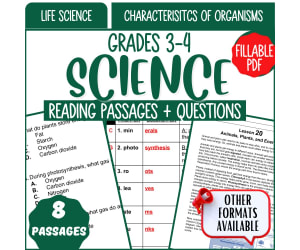
Reading Comprehension Passages: Characteristics of Organisms Fillable
ELA, Reading, Reading Comprehension, Science, Life Sciences, Biology, Common Core, Animals, Human Body, Grade 2, 3, 4, Worksheets & Printables, Worksheets, Assessments, Teacher Tools, Tests, Quizzes and Tests
Reading Comprehension Passages on Characteristics of Organisms for Life Science (Biology) Snapshot Genre: Nonfiction. Subject: Life Science. Primary Topic: Plant and animal survival, cells, energy, and senses. Estimated Guided Reading Level (A–Z): N. What This Book Teaches Best Explains what organisms need to live, including energy, food, water, air, sunlight, weather, and shelter, and shows that organisms cannot survive where those needs are not met. Builds understanding of environments and ecosystems by introducing ecosystem, community, and population and by using tables and charts to compare places like deserts, rainforests, grasslands, and tundras. Shows how survival depends on structures, instincts, learned behaviors, stimuli, responses, and reflexes. Teaches the parts and functions of plant and animal cells and connects plant parts such as roots, leaves, stems, and trunks to their jobs. Explains how plants and animals get and use energy through respiration and photosynthesis and how senses help animals gather information and avoid danger. Learning Goals Students will explain what plants and animals need from their environments in order to survive. Students will compare different ecosystems and describe how living and nonliving things interact within them. Students will describe how structures, instincts, learned behaviors, and reflexes help organisms survive. Students will identify major plant and animal cell parts and explain each part’s function. Students will explain how animals get energy from food and how plants get energy from sunlight. Students will describe how sense organs, nerves, and the brain help animals respond to danger. Part 1 - Characteristics of Organisms Reading Passage 1: Animal and Plant Needs and the Environment Reading Passage 2: Environments, Ecosystems, and Organisms Reading Passage 3: Instincts, Behavior, and Survival Reading Passage 4: Plant and Animal Cells Reading Passage 5: Plant Structure, Function, and Survival Reading Passage 6: Animals, Plants, and Energy Reading Passage 7: Animal Needs and Animal Behavior Reading Passage 8: The Five Senses and Survival FILLABLE PDF VERSION Worksheet-style pages, but with type-in answer boxes so students can complete and save their work digitally. Other versions are available in the links list below or in the full catalog. FULL CATALOG OF DOWNLOAD LINKS HERE Grade 3/4 Links: Physical Science Part 1 - Properties of Objects and Materials Google Docs/Slides/Forms PDF PPT Word Free Supplementary Pack Accompanying Videos Physical Science Part 2 - Position and Motion of Objects Google Docs/Slides/Forms PDF PPT Word Free Supplementary Pack Accompanying Videos Physical Science Part 3 - Light, Heat, Electricity, Magnetism Google Docs/Slides/Forms PDF PPT Word Free Supplementary Pack Accompanying Videos Life Science Part 1 - Characteristics of Organisms Google Docs/Slides/Forms PDF PPT Word Free Supplementary Pack Accompanying Videos Life Science Part 2 - Life Cycles of Organisms Google Docs/Slides/Forms PDF PPT Word Free Supplementary Pack Accompanying Videos Life Science Part 3 - Organisms and Environments Google Docs/Slides/Forms PDF PPT Word Free Supplementary Pack Accompanying Videos Earth Science Part 1 - Properties of Earth Materials Google Docs/Slides/Forms PDF PPT Word Free Supplementary Pack Accompanying Videos Earth Science Part 2 - Changes in the Earth and Sky Google Docs/Slides/Forms PDF PPT Word Free Supplementary Pack Accompanying Videos Earth Science Part 3 - Objects in the Sky Google Docs/Slides/Forms PDF PPT Word Free Supplementary Pack Accompanying Videos For similar products and other frees, do check out Cored Group on TeachSimple .
Author Cored Education
Rating
Tags Science, Elementary, Reading, Comprehension, Vocabulary, Reading Centers, Life Science, Biology, Science Assessments, Reading Comprehension Assessments

World Meteorological Day Word Search 2nd 3rd 4th 5th Grade Worksheet
Common Core, Earth Sciences, Earth and Environmental Sciences, Science, Social Studies, Grade 2, 3, 4, 5, Activities, Word Searches, Worksheets, Worksheets & Printables
Let us celebrate World Meteorological Day with a fun Word Search Worksheet Activity that's perfect for elementary students. This activity is a way to introduce students to words related to the weather, climate and meteorology in a way that is easy for them to understand. The Word Search Worksheet Activity is like a puzzle that makes learning fun and interactive. It helps students get better at spelling reading and recognizing words. We have two versions of this activity. One with colors and one without colors. This allows students to be creative and make learning fun. Using this Word Search Worksheet Activity helps students learn about things like temperature, precipitation, storms and the tools we use to measure the weather. It also helps students get better at reading and focusing. This activity is great for students in the 2nd to grade. It helps students become curious about the world around them in an positive way. Objective The main goal of this activity is to help students learn words and get better at reading and writing. The Word Search Worksheet Activity introduces students to words related to meteorology. Students also get better at paying attention to details solving problems and looking at things carefully as they search for words in the puzzle. This activity helps students think about how the weather and climate affect our lives. The World Meteorological Day Word Search Worksheet Activity is a way to learn about the weather and climate. Order, Outline and Steps First students look at the list of words related to the weather and climate. Then they search for each word in the puzzle. The words can be found horizontally vertically or diagonally in the grid. After they finish the puzzle students can color the black-and-white version to help them remember what they learned and to be creative. This way students can. Have fun at the same time. The World Meteorological Day Word Search Worksheet Activity is a way to learn about the weather and climate. Grades or Ages This activity is designed for students in the 3rd, 4th and 5th grade. The words and puzzle are suitable for students with reading and understanding levels. The World Meteorological Day Word Search Worksheet Activity is great for students of all levels. Implementation Format This activity is perfect for science classes lessons about the weather and climate reading centers, morning work, homework, special activities or plans for substitute teachers. It can also be used in classrooms or for remote learning. The World Meteorological Day Word Search Worksheet Activity is a way to learn about the weather and climate in a fun and interactive way. Answer Keys We have included a complete and easy-to-use answer key to make it simple and quick to check the students work. The answer key is clearly. Easy to understand. How to Use and Variations You can use this activity to introduce a lesson about the weather and climate. You can assign it to students to work on independently or in groups. You can also include it in science centers morning work or homework activities. The coloring page can be used to help students learn and be creative. The World Meteorological Day Word Search Worksheet Activity is a way to learn about the weather and climate. Standards This activity supports the English Language Arts standards for learning words, spelling and reading fluently. It also supports the science standards for learning about the weather, climate and meteorology. The World Meteorological Day Word Search Worksheet Activity meets all the standards for learning about the weather and climate. File Type This activity is available as a PDF file that you can print. Number of Pages This activity has 3 pages in total: • 1 colored Word Search Worksheet • 1 black-and-white coloring page • 1 answer key
Author Classsim
Rating
Tags World, Meteorological , Day , Word Search , 2nd 3rd 4th 5th Grade, Worksheet , Activity, World Meteorological Day , World Meteorological Day Word Search 2nd 3rd 4th 5th Grade , World Meteorological Day Word Search 2nd 3rd 4th 5th Grade Worksheet Activity

Wisconsin WebQuest Printable Book
Social Studies, Geography, Grade 4, 5, 6, 7, 8, Worksheets, Worksheets & Printables
Wisconsin WebQuest Printable Book Dive into the world of Wisconsin with the Wisconsin WebQuest Printable Book, a dedicated educational resource for 4th to 8th-grade students. It uniquely combines creative learning activities with online research tasks for an enjoyable exploration of fascinating state facts. The printable book is engaging, informative and seamlessly easy-to-use, fostering a delightful enhancement to students' knowledge about Wisconsin. Each mini book comprises: Ten pages filled with interactive exercises Investigation themes including the state's capital, most populated city, native flora and fauna The history of local indigenous tribes and key neighbouring states The popular nicknames associated with Wisconsin. In addition, open-ended spaces are provided within each section for additional interesting information that they uncover during their quest. This tool not only amplifies geographical proficiency but also underlines crucial research skills - from methodical online research tactics to choosing reliable sources of information - a must-have skillset in today's digital era. About the Layout: The layout ensures convenience and accessibility: An easy-to-print format: Two identical copies per printed page – just cut down the middle! A built-in map exercise: This enables learners to hone their understanding about city locations which can be conveniently cross-referenced within their project books. An available answer key: An optimum tool for efficient assessment or as a guidance tool during discussions. .. . Versatility: Incorporate this resource in group activities during Social Studies class hours or use it as exciting geography-based homework assignments. Even small study groups can utilise it: The usability extends far beyond traditional classroom confines and is a perfect fit for homeschoolers too! Set course towards discovery by integrating the Wisconsin WebQuest Printable Book into your learning schema today!
Author Soumara Siddiqui
Tags Wisconsin, WebQuest, Printable Book, Geography, Research
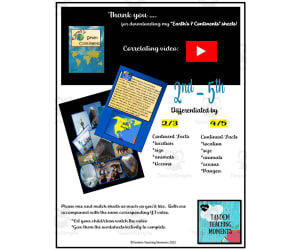
"Earth's 7 Continents" Worksheet Packet
Social Studies, Geography, Grade 2, 3, 4, 5, Worksheets & Printables, Worksheets
This is an "Earth's 7 Continents" Worksheet Packet. You will get a variety of differentiated worksheets for your little learners. There are 2 different versions - labeled with 2/3 and 4/5. Students will get to write, label maps and so much more. A correlating YouTube video is included for easy listening. Answer keys are included.
Author Tandem Teaching Moments
Tags Geography, Continents, Earth, Word Scramble, Writing
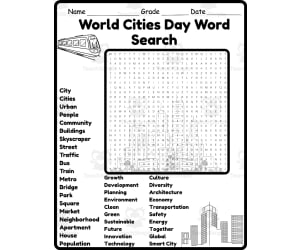
World Cities Day Word Search 2rd 3th 4th 5th Grade worksheet activity
Language Development, ELA, Vocabulary, Spelling, Geography, Social Studies, Grade 2, 3, 4, 5, Games, Activities, Word Searches, Worksheets, Worksheets & Printables
Make learning fun with a no-prep, printable vocabulary word search that builds vocabulary, reinforces literacy, and sparks curiosity! Students can explore the new vocabulary words while practicing spelling, scanning for letters, and identifying keywords. A word search can be a perfect and easy-to-use activity to liven up a lesson by combining learning with fun! It is an excellent way to reinforce concepts within a lesson and engage students' hands-on learning. Purpose: This activity allows students to learn new vocabulary words and contextualized vocabulary related to a topic ✏️, improve spelling, reading, and attention to detail 📚, increase awareness of concepts and knowledge about the world at large 🌍, and encourage curiosity and engagement about the topic 🐾. Word searches are a hands-on way to make learning memorable and fun for students - it engages them at all vocabulary levels! How to Do It: 1️⃣ Hand out the word search worksheet. 2️⃣ Introduce any important vocabulary or concepts that fit with the topic. 3️⃣ The students search for the words and circle or highlight each one. 4️⃣ Discuss the importance of the topic or the words that the student found. 5️⃣ Review the answers using the answer key that is included for each product ✅ Perfect For: Grades 2-5 🌟, independent practice, partner work, students who finish early, science or social studies centers, or for substitute plans 🤝 Way of Implementation: Great for independent practice early finishers, partner work, or substitute plans 🤝. Answer Keys: (these will be pencils under your three files: Given for simple checking and self-assessing. Fun Variations: Timed Challenge ⏳ - record how many words students can find in a set time. Partner Puzzle 🤝 - work together to find all of the words. Vocabulary Extension ✏️ - write sentences or a few short paragraphs using the words. Create-Your-Own Word Search 🧩 - have students make their own word search puzzles using the vocabulary. Standards Alignment: Supports CCSS/ELA vocabulary development, and can also connect to NGSS or other relevant standards, depending on the topic. File & Print Info: PDF includes both a color and black and white version, and is ink-friendly to make printing easy. Teacher Tip! Have students learn by being hands-on, engaged, and active while helping them build awareness, vocabulary, and literacy skills around any topic! 🌟
Author Classsim
Rating
Tags World , Cities, Day , Word Search, 2rd 3th 4th 5th Grade , Worksheet, Activity, World Cities Day Word Search, World Cities Day Word Search 2rd 3th 4th 5th Grade, World Cities Day Word Search 2rd 3th 4th 5th Grade Worksheet

Free Reading Passage: Plant Structure, Function, and Survival PDF
ELA, Reading, Reading Comprehension, Science, Life Sciences, Biology, Common Core, ESL, Language Development, Vocabulary, Grade 2, 3, 4, Worksheets & Printables, Worksheets, Assessments, Teacher Tools, Tests, Quizzes and Tests
Free Reading Passage on Plant Structure, Function, and Survival for Life Science What's inside this free product? Science Reading Comprehension Passage19 : Plant Structure, Function, and Survival Independent PDF Version: This is the independent PDF version containingone lesson with full answer keys. Product Info: 6 PAGES (US English with Answers) PDF Version Teaching Duration: 90 Minutes Science Reading Comprehension Outline: Targeted for students in 3rd and 4th grades, these reading passages are enhanced with illustrations and graphs to elucidate critical points. Each lesson aligns with the Common Core State Standards, allowing you to integrate science reading practice effortlessly, knowing that minimal preparation is needed on your part. Each passage comes with a variety of questions in different formats, including multiple-choice formats, data analysis, and fill-in-the-blanks. The topics covered strike a balance between engaging content and core curriculum-based science subjects. Versatile in application, these lessons are suitable for a variety of settings such as whole-class instruction, morning activities, independent desk work, small group discussions, contingency plans for substitute teachers, homework assignments, or even special holiday-themed tasks. FULL CATALOG OF DOWNLOAD LINKS HERE Grade 3/4 Links: Physical Science Part 1 - Properties of Objects and Materials Google Docs/Slides/Forms PDF PPT Word Free Supplementary Pack Accompanying Videos Physical Science Part 2 - Position and Motion of Objects Google Docs/Slides/Forms PDF PPT Word Free Supplementary Pack Accompanying Videos Physical Science Part 3 - Light, Heat, Electricity, Magnetism Google Docs/Slides/Forms PDF PPT Word Free Supplementary Pack Accompanying Videos Life Science Part 1 - Characteristics of Organisms Google Docs/Slides/Forms PDF PPT Word Free Supplementary Pack Accompanying Videos Life Science Part 2 - Life Cycles of Organisms Google Docs/Slides/Forms PDF PPT Word Free Supplementary Pack Accompanying Videos Life Science Part 3 - Organisms and Environments Google Docs/Slides/Forms PDF PPT Word Free Supplementary Pack Accompanying Videos Earth Science Part 1 - Properties of Earth Materials Google Docs/Slides/Forms PDF PPT Word Free Supplementary Pack Accompanying Videos Earth Science Part 2 - Changes in the Earth and Sky Google Docs/Slides/Forms PDF PPT Word Free Supplementary Pack Accompanying Videos Earth Science Part 3 - Objects in the Sky Google Docs/Slides/Forms PDF PPT Word Free Supplementary Pack Accompanying Videos For similar products and other frees, do check out Cored Group on TeachSimple .
Author Cored Education
Tags Science, Elementary, Reading, Comprehension, Vocabulary, Answers, Physics, Physical Science, Ccss, Common Core

Geography Mazes - Set 3: 1 Page Sample (PDF)
ELA, Language Development, Vocabulary, Spelling, ESL, Resources for Teachers, Geography, Social Studies, Grade 2, 3, 4, 5, Worksheets & Printables, Worksheets, Teacher Tools, Centers, Activities, Mazes
THIS IS A ONE PAGE SAMPLE OF A SIX PAGE MAZE DOWNLOAD FULL SIX MAZE DOWNLOAD INFORMATION: Maze Series This maze series is designed for students in grades 2–5. Each set features a clear, kid-friendly theme with scene-based mazes that students first navigate, then complete by drawing a few target words from a simple word list. Pages come in varied styles and graduated difficulty, with an optional “color it in” step—and some themes invite quick calculations to match the task. These mazes are student-friendly, classroom-ready, and perfect for literacy warmups, seasonal units, fast-finisher bins, centers, sub plans, or home learning extensions. The playful, structured format builds problem-solving, attention to detail, and fine-motor control while reinforcing themed content in a motivating way. Note: Unlike many themed products, not all word-list words appear on the maze pages. To support full vocabulary coverage, we’ve released a companion word list you can find in the links section. Geography Set 3 Word List 1. More Countries of the World United States, United Kingdom, Australia, India, Peru, Egypt, South Korea, Turkey 2. More Famous Cities Chicago, Toronto, Dubai, Venice, Shanghai, Bangkok, Lisbon, Marrakech 3. More Famous Landmarks Mount Fuji, Sydney Opera House, Chichen Itza, Victoria Falls, Neuschwanstein Castle, Angkor Wat, Red Square, The Parthenon 4. Landforms and Earth's Features Canyon, Plateau, Delta, Glacier, Hill, Bay, Strait, Isthmus 5. U.S. States and Capitals California, Texas, Florida, Alaska, Hawaii, Washington D.C., New York, Illinois 6. People and Cultures Around the World Language, Tradition, Festival, Temple, Market, Music, Clothing, Customs PDF Version Other versions will appear here when available. Follow the store for the lastest on new products. How to Use These Mazes Perfect for: Morning work or early-finisher bins Literacy or STEM centers Holiday/seasonal review lessons Independent stations, sub plans, or take-home enrichment More Geography Themed Products Geography Crosswords (Set 1) PDF Geography Crosswords (Set 2) PDF Geography Crosswords (Set 3) PDF Geography Word Searches (Set 1) PDF Geography Word Searches (Set 2) PDF Geography Word Searches (Set 3) PDF Geography Mazes (Set 1) PDF Geography Mazes (Set 2) PDF FULL CATALOG OF DOWNLOAD LINKS HERE Themed Mazes Links Addition PDF Animals PDF Around the Home PDF Birthday PDF Candy PDF Christmas PDF Cinco de Mayo PDF Clothes PDF Colors PDF Days and Months PDF Division PDF Earth Day PDF Easter PDF Easy Mazes PDF Fall PDF Father's Day PDF Food PDF Geography (Set 1) PDF Geography (Set 2) PDF Geography (Set 3) PDF Graduation PDF Health PDF History (Set 1) PDF History (Set 2) PDF History (Set 3) PDF Human Body PDF Kindness PDF Life Skills PDF Mother's Day PDF Multiplication PDF Science (Set 1) PDF Science (Set 2) PDF Science (Set 3) PDF Shapes PDF Social Skills PDF Spring PDF Sports PDF St. Patrick's Day PDF Subtraction PDF Summer PDF Thanksgiving PDF Transport PDF Valentine's Day PDF Winter PDF Mazes in Depth Structure Each maze is crafted around a focused sub-theme. Students navigate the maze, encountering branches and cul-de-sacs that build attention and planning. Most pages include a tiny follow-up box—students draw or label 2–3 target words from a small word box, add a quick count, or color in the scene—so the activity reinforces both content and skills in a highly engaging format. Each completed set includes: A themed maze page. A simple student instruction strip. An answer key showing the solved path for teacher support or self-checking Themes Included These mazes cover a wide range of fun, age-appropriate themes, including: Seasons & Holidays (e.g., Halloween, Easter, Valentine’s Day) Math-Lite Connections (e.g., quick counts, number words) Everyday Topics (e.g., Animals, Weather, School) Special Units (e.g., Health, Earth Day, Sports, Kindness) Each topic reflects students’ real-life experiences and interests while strengthening problem-solving, visual scanning, and fine-motor control in a playful, highly visual way. Easy extensions (optional): Time it: solve once in pencil, then try to beat the time in pen Retell the route using sequence words (first, next, then, finally) Count intersections or turns and graph the results Write a 1–2 sentence mini-story about the scene using the target words Design a tiny maze in the corner for a partner to solve Differentiation tips: Offer a finger-trace pass before pencils for emerging learners Highlight the borders of the correct region on first attempts Use thicker-line versions or simpler pages to build confidence Pair roles: “navigator” gives directions; “driver” traces the path For similar downloads and other frees, do check out Cored Group on TeachSimple.
Author Cored Education
Rating
Tags Vocabulary, Spelling, Geography, Countries Of The World, Famous Cities, Famous Landmarks, Landforms And Earth's Features, U.S. States And Capitals, Mazes, Geography Mazes