



3,991 products added recently
Page 23 - 4th Grade Worksheets
Enhance your fourth-grade classroom with worksheets that cover a range of subjects and promote analytical thinking. These resources help students delve deeper into topics and develop critical skills. Incorporate them to enrich your teaching and support student achievement.

 Show filters

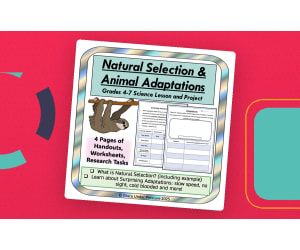
Natural Selection & Animal Adaptations Worksheets 4th 5th 6th 7th Gr
Science, Life Sciences, Animals, Grade 4, 5, 6, 7, Worksheets & Printables, Worksheets, Teacher Tools, Lesson Plans
This engaging and fun animal adaptations elementary or middle school science lesson with research project will help students in 4th, 5th, 6th, or 7th grade learn all about natural selection, surprising animal adaptations, and the foundational ideas of evolution at an age-appropriate level. It could be a useful addition to your animal adaptations unit or a biodiversity unit in an elementary or middle school science class! How to Use : Print 4 pages of worksheets for each student. First, teach using the Natural Selection Handout. This clearly explains an example of natural selection and defintes the key vocabulary: evolution, adaptations & natural selection. Next, you can either assign or allow your students to choose a plant, animal, or fungus to research. Students will draw a diagram of their choice and find and elaborate about five adaptations the organism has. They will use the Adaptations Worksheet for this. Then, teach your students about Surprising or Unique Animal Adaptations : slow speed, sharing food, small size, no sight & being cold-blooded instead of warm-blooded. For each surprising adaptation, they will find an example organism and explain how the surprising adaptation actually helps it survive. This can be completed in pairs or small groups. Suggested websites are provided so the research is done for you! Make sure to have a class discussion and highlight that many of the surprising or unique adaptations help animals as they require less food or energy to survive. Finally, each student will choose their favorite surprising animal adaptation they researched. They will complete the last worksheet: My Surprising Animal Adaptation . They will draw a picture & explain their surprising adaptation. These finished worksheets could make a wonderful bulletin board display. Grades to Use With: This science activity is designed for your students in 4th, 5th, 6th, or 7th grade when they are learning about biodiversity, natural selection, and animal adaptations. It is written using a simple reading level and it includes clear instructions. Your students will love researching to find unique organisms and explaining them to the rest of the class! What's Included: 5-Page PDF: Ready to Print and Use! Teacher Instructions with Website Links Natural Selection Handout Adaptations Research & Worksheet Surprising or Unique Animal Adaptations Research & Worksheet My Surprising Animal Adaptation Worksheet
Author Grace Under Pressure
Rating
Tags Natural Selection, Natural Selection Worksheets, Adaptations, Animal Adaptations, Animal Adaptations Worksheets, Elementary Science, Biodiversity, Organisms, 5th Grade Science

Canadian government
Social Studies, Government, Grade 3, 4, 5, Worksheets & Printables, Worksheets
Canadian Government Teaching Resource: A Comprehensive Overview This Canadian Government resource provides a thorough and comprehensive teaching unit about the Canadian government and its various components. Suitable for all types of learners, the resource features a wide range of engaging activities, enlightening texts, and in-depth coverage on topics such as basic government concepts, political parties, legislation processes, elections and roles within the governing body among other themes. Activities for Diverse educational settings Research tasks: Students delve into information gathering on different political parties. Voting Simulations: Interesting hands-on interaction sessions reflecting realistic election scenarios. Detailed Questions: Section-based queries inviting students to articulate intelligent responses around text content reviewed during lessons. A Way to Foster Creative Thinking & Critical Analysis Skills The Fox Teaching's Canadian Government Resource fosters thought-provoking critical analysis through questions centered around governmental themes while encouraging creative thinking with practical hands-on activities - including construction of timelines representing historical events within Canada's governmental history. This pedagogically sound product provides materials for diverse multidisciplinary tasks ranging from reading comprehension exercises to poster creation projects. There are even delightful text-based games intertwined with learning along with vocabulary enhancement Bingo games ensuring cultural exposure mixed with loads of engaging fun! A Guidebook plus Grading Enabler all rolled into one The package includes ready-made answer keys useful during grading sessions rendering them stress-free while enabling stimulating classroom deliberations courtesy direct feedback made possible straight off these ready reckoners! With options likely favoring PDF formats – sharing becomes hassle-free across multiple platforms should need arise! Mix Learning & Leisure Enjoyably! Educators will love comic sections interspersed within teaching contents - ensuring lighter moments of leisure while still enabling conscious engagement around the broader Canadian political theme. Covering Grade 3 right through to Grade 5 materials, this product adeptly integrates foundational civic education into primary level through intermediate elementary belts equally efficiently. The Key Takeaway In conclusion, the Fox Teaching's Canadian Government Resource provides educators and learners an engaging, comprehensive overview of Canada's governmental structure in a fun-filled yet insightful fashion. Here’s wishing you happy explorations into these captivating governmental study realms!
Author Learn it ANY way
Tags Canadian Government, Teaching Resource, Civic Education, Political Parties, Activity-based Learning

Nevada WebQuest Printable Book
Social Studies, Geography, Grade 4, 5, 6, 7, 8, Worksheets, Worksheets & Printables
The Nevada WebQuest Printable Book: A unique exploration tool tailored for educators and students in grades 4-8. This compact and portable mini-book, is perfect for field trips or nature walks. Its interactive design encourages active learning as students are prompted to research facts online about Nevada. The mini-book comprises of: 10 pages with engaging tasks that include identifying: Nevada's most populated city Capital city State symbol such as its bird and flower Historical content regarding native tribes that lived in Nevada. Geographical information regarding bordering states & natural resources in the area. In addition there are blank spaces intended for documenting captivating facts discovered during the research journey. Each print yields two identical pages – simply cut along the dotted lines and stack separately allowing each student to create their own travel booklet at ease. This resource can be used both collectively, leading to class-wide presentations or discussions and independently serving as an excellent practice tool to enhance research skills over time. Note: The design simplicity ensures even those new to online research can make use of this resource. The package includes an answer key providing immediate support when needed. The “Nevada WebQuest Printable Book” promises strengthened geography insights via virtual field trips right from your classroom's walls! It beautifully combines knowledge acquisition with adventure catering specifically to our young explorers' curiosity.
Author Soumara Siddiqui
Tags Nevada, WebQuest, Printable Book, Active Learning, Research Skills
Reading Response Forms: Creating Gr. 3-4
ELA, Reading, Common Core, Grade 3, 4, Worksheets & Printables, Worksheets
Reading Response Forms: Creating Gr. 3-4 Review Reading Response Forms: Creating Gr. 3-4 is a resource for educators teaching third and fourth grade students in both public schools and home-school settings, aimed at enhancing reading comprehension skills. About the Resource The product is based on the six levels of Bloom's Taxonomy, integrating a range of skill-based worksheets and hands-on activities. It focuses not only on reading but also covers knowledge, comprehension, application, analysis, synthesis, and evaluation. Versatile Application Fits alongside existing reading programs or as standalone student work. Promotes full-range thinking abilities to boost reading comprehension skills through various worksheet activities. Student Assessment Rubrics Included: The product comprises student assessment rubrics simplifying performance reviews with defined success criteria benchmarks for language arts competencies. Add-ons: Word Puzzles: Key terms and concepts are presented in puzzles making learning interactive while teaching important vocabulary. Color Graphic Organizers: These visuals help categorize information graphically based on story elements like characters or plot points. Inclusive Comprehension Quiz: A thorough quiz to measure students' understanding of material taught during lessons. New with this version - teacher implementation guide! - This guide helps educators effectively use these resources ensuring lively pupil engagement during lessons while maximising benefits from this resource. The content adheres closely to CSS (Common Core State Standards) , ensuring curriculum compatibility. Offered as an easily accessible PDF file, this resource is simple to incorporate into any curriculum, making it a valuable asset for any dedicated third and fourth-grade Language Arts educator.
Author Classroom Complete Press
Tags PDF

Hands-On STEM Challenges – Simple Machine Building Worksheets
STEM, Science, Basic Science, Inventors, Theories, Technology, Engineering, Special Resources, Social Emotional Learning (SEL), Special Education Needs (SEN), Homeschool Curriculum, Homeschool Templates, Grade 3, 4, 5, 6, 7, Worksheets & Printables, Workbooks, Worksheets, Word Searches, Teacher Tools, Lesson Plans, Quizzes and Tests, Quizzes, Tests, Assessments
Incorporate Real World Engineering & Discovery into Your Science Classroom with a Comprehensive Simple Machines STEM Unit. Tired of trying to teach students about abstract concepts like force, work, and mechanical advantage in physics without providing a tangible and exciting way to understand them? This complete 5-Week STEM Unit is the all-in-one solution that you've been searching for! It includes everything you need to take your 3rd, 4th & 5th grade students from the theory of physics to creating their very own projects! This product is NOT just a bunch of worksheets, it is an entire educational experience! The resource contains 3 parts: a theoretical guide for teachers, an interactive student workbook & a complete teacher resource pack. The unit provides students with hands-on experiences as they explore 6 classical simple machines (levers, pulleys, inclined planes, wedges, wheels and axles, screws) by examining real-world case studies such as the pyramids of Giza through modern skyscrapers, & then participating in a series of hands-on, challenging activities. Constructivist approaches promote "productive struggle" within the context of providing students with a true understanding of the concepts in this unit, using low-cost, readily available, recycled materials. No more expensive kits, use real-world, authentic inquiry-based learning that develops a true engineering mindset! What This 38-Page Resource Includes: In-depth explanation of Simple Machines: Each of the 6 Simple Machines is explained to teachers in easy-to-understand language. Helpful historical case studies and concept reinforcement questions are included to aid understanding. Worksheets: 10 challenging worksheets designed for students, allow students to demonstrate an understanding of Simple Machines in real-world contexts. These worksheets include activities such as identifying simple machines in everyday objects, analyzing compound machines, calculating mechanical advantage, and working on a design project similar to a Rube Goldberg. Visuals & Helpful Teacher Tools: Three High Contrast Anchor Charts: Vector illustrations of the 6 Simple Machines, a Class 1 Lever (Mechanical Advantage) and the Engineering Design Cycle (STEM). For use in display and projection. Detailed Answer Key: Complete answer key for all 10 worksheets. Complete Teacher Implementation Guide: The Ultimate Resource Guide - Contains teaching reasoning, recommended 5 week pacing guide, list of readily available recycled materials for use in the "Maker Station" and how to facilitate hands on activities and productive struggles in the classroom, as written by seasoned pros. Simple machines, STEM activities, processes used in the design of mechanical systems (engineering design), the learning of physics, the learning of physics from the perspective of children, third grade, fourth grade, fifth-grade science, hands-on learning, project-based learning (PBL), the use of levers and pulleys, worksheets, STEM units or courses together with lesson plans requiring little or no preparation and low-cost preparation; utilizing mechanical advantages using acceleration. The Reasons Parents/Schools Value: Comprehensive & Ready to Use: This isn't just one thing to do; it is a full 5-week unit plan which includes theory, worksheets, visuals, and a detailed teacher's guide. This prepares the teacher for doing the lesson in dozens of hours less than would normally be required. Cost Effective & Easily Accessible: This unit plan was designed to be completed with items that are readily available to you such as cardboard, bottle caps, or string. There is no need to purchase expensive robotic kits that are specialized. Provides Deeper Conceptual Understanding: When students work through building challenges (e.g., utilizing force) they have a hands-on experience they will remember long after the activity is completed. Encourages Developing an Engineering Mindset: In addition to using the Engineering Design Cycle and creating "productive struggle", there is an emphasis on teaching students how to think like an engineer and to use real-world skills to solve problems, be resilient, implement multiple iterations of their solution, and critically think. Target group analysis : The text has an explicit statement of the target audience ("For students in grades 3-5"), so it's clear that the cognitive level of this audience is in the appropriate range. Because of these two factors, we have identified: 1. Primary audience Members consisting of 3rd through 5th Grade Teachers (from public, private and charter schools). 2. Secondary audience members of Homeschooling Families looking for a complete, structured STEM Curriculum. 3. Tertiary audience members will be STEM/STEAM Coordinators, After School Program Directors and Science Club Leaders or Facilitators. Copyright and Terms of Use : Syed Hammad Rizvi is the copyright holder of this resource. This resource is intended for personal and single classroom use only. You cannot modify, distribute or sell this resource. In other words, you cannot post on the Internet for the public to access and download. If you wish to share this resource with other teachers, please consider purchasing a separate license through Teachsimple. Thank you for understanding and following these terms of use. This product has been developed in partnership with Syed Hammad Rizvi
Author Creative Book Store
Rating
Tags SimpleMachines, STEM, STEMeducation, HandsOnLearning, ProjectBasedLearning, ScienceTeacher, TeachersOfInstagram, ITeachScience, ITeachSTEM, EngineeringForKids

Geography Word Searches - Set 1 (PDF)
ELA, Language Development, Vocabulary, Spelling, ESL, Resources for Teachers, Geography, Social Studies, Grade 2, 3, 4, 5, Worksheets & Printables, Worksheets, Teacher Tools, Centers, Activities, Word Searches
Wordsearch Series This wordsearch series is designed for students in grades 2–5. Each set of wordsearches is built around a clear vocabulary theme, helping students develop word recognition, improve spelling, and boost topic-related understanding through engaging visual puzzles. Every wordsearch also includes a fun hidden shape for students to guess—adding an interactive twist to traditional vocabulary practice. These wordsearches are student-friendly, classroom-ready, and perfect for integrating into literacy warmups, seasonal units, fast-finisher tasks, or home learning extensions. Each puzzle reinforces themed vocabulary in a playful, structured format that keeps learners motivated. Geography Word Search Set 1 Word List 1. Countries of the World Canada, Brazil, China, India, Egypt, France, Japan, Mexico 2. Famous Cities New York, Paris, London, Tokyo, Sydney, Cairo, Rome, Rio 3. Famous Landmarks Eiffel Tower, Great Wall, Statue of Liberty, Colosseum, Taj Mahal, Mount Everest, Amazon River, Grand Canyon 4. Continents and Oceans Asia, Africa, Europe, Australia, Antarctica, Pacific, Atlantic, Indian 5. Natural Wonders Niagara Falls, Grand Canyon, Mount Everest, Amazon Rainforest, Sahara Desert, Great Barrier Reef, Victoria Falls, Northern Lights 6. Landforms and Geography Terms Mountain, River, Desert, Island, Peninsula, Volcano, Valley, Glacier PDF Version Other versions will appear here when available. Follow the store for the lastest on new products. How to Use These Wordsearches These wordsearches are ideal for: Morning work or early finisher bins Vocabulary centers or anchor activities Holiday or seasonal review lessons Independent literacy stations or take-home enrichment Each puzzle includes a themed word list and a shaped grid for students to complete. Word directions may vary (horizontal, vertical, diagonal), and answer keys are included for easy checking. Optional vocabulary challenges or writing tasks can be added to extend the learning experience. Whether you're reviewing key vocabulary, exploring a seasonal topic, or offering fun literacy practice, these wordsearches provide a flexible and engaging tool to support vocabulary growth in grades 2–5. More Geography Themed Products Geography Crosswords (Set 1) PDF Geography Crosswords (Set 2) PDF Geography Crosswords (Set 3) PDF Geography (Set 2) PDF Geography (Set 3) PDF FULL CATALOG OF DOWNLOAD LINKS HERE Themed Word Search Links Addition PDF Animals PDF Around the Home PDF Birthday PDF Candy PDF Christmas PDF Cinco de Mayo PDF Clothes PDF Colors PDF Days and Months PDF Division PDF Earth Day PDF Easter PDF Easy Word Searches PDF Fall PDF Father's Day PDF Food PDF Geography (Set 1) PDF Geography (Set 2) PDF Geography (Set 3) PDF Graduation PDF Health PDF History (Set 1) PDF History (Set 2) PDF History (Set 3) PDF Human Body PDF Kindness PDF Life Skills PDF Mother's Day PDF Multiplication PDF Science Word Searches (Set 1) PDF Science Word Searches (Set 2) PDF Science Word Searches (Set 3) PDF Shapes PDF Social Skills PDF Spring PDF Sports PDF St. Patrick's Day PDF Subtraction PDF Summer PDF Thanksgiving PDF Transport PDF Valentine's Day PDF Winter PDF Wordsearches in Depth Structure Each wordsearch is crafted around a focused sub-theme and includes a visual puzzle shaped like a related object (e.g., balloon, gift, snowman). Students complete each puzzle using the provided themed word list, strengthening both content knowledge and spelling skills in a highly engaging format. Each completed set includes: A shaped wordsearch puzzle with 10 vocabulary words A student instruction guide with search directions (horizontal, vertical, diagonal) An answer key for teacher support or student self-checking A Did You Know? fact connected to the theme for enrichment or discussion Themes Included The wordsearches cover a wide range of fun, age-appropriate themes, including: Seasons & Holidays (e.g., Halloween, Easter, Valentine’s Day) Math Concepts (e.g., Addition, Number Words) Everyday Topics (e.g., Animals, Weather, School) Special Units (e.g., Health, Earth Day, Sports, Kindness) Each topic is selected to reflect students’ real-life experiences and interests while reinforcing literacy skills and content understanding in a playful, visual way. For similar downloads and other frees, do check out Cored Group on TeachSimple.
Author Cored Education
Rating
Tags Vocabulary, Spelling, Geography, Countries Of The World, Famous Cities, Famous Landmarks, Natural Wonders, Continents And Oceans, Word Searches, Geography Word Searches

Algeria Map Geography Word Search 2rd 3th 4th 5th Grade worksheet
Vocabulary, Language Development, ELA, Spelling, Geography, Social Studies, Grade 2, 3, 4, 5, Games, Activities, Word Searches, Worksheets, Worksheets & Printables
Make learning fun with a no-prep, printable vocabulary word search that builds vocabulary, reinforces literacy, and sparks curiosity! Students can explore the new vocabulary words while practicing spelling, scanning for letters, and identifying keywords. A word search can be a perfect and easy-to-use activity to liven up a lesson by combining learning with fun! It is an excellent way to reinforce concepts within a lesson and engage students' hands-on learning. Purpose: This activity allows students to learn new vocabulary words and contextualized vocabulary related to a topic ✏️, improve spelling, reading, and attention to detail 📚, increase awareness of concepts and knowledge about the world at large 🌍, and encourage curiosity and engagement about the topic 🐾. Word searches are a hands-on way to make learning memorable and fun for students - it engages them at all vocabulary levels! How to Do It: 1️⃣ Hand out the word search worksheet. 2️⃣ Introduce any important vocabulary or concepts that fit with the topic. 3️⃣ The students search for the words and circle or highlight each one. 4️⃣ Discuss the importance of the topic or the words that the student found. 5️⃣ Review the answers using the answer key that is included for each product ✅ Perfect For: Grades 2-5 🌟, independent practice, partner work, students who finish early, science or social studies centers, or for substitute plans 🤝 Way of Implementation: Great for independent practice early finishers, partner work, or substitute plans 🤝. Answer Keys: (these will be pencils under your three files: Given for simple checking and self-assessing. Fun Variations: Timed Challenge ⏳ - record how many words students can find in a set time. Partner Puzzle 🤝 - work together to find all of the words. Vocabulary Extension ✏️ - write sentences or a few short paragraphs using the words. Create-Your-Own Word Search 🧩 - have students make their own word search puzzles using the vocabulary. Standards Alignment: Supports CCSS/ELA vocabulary development, and can also connect to NGSS or other relevant standards, depending on the topic. File & Print Info: PDF includes both a color and black and white version, and is ink-friendly to make printing easy. Teacher Tip! Have students learn by being hands-on, engaged, and active while helping them build awareness, vocabulary, and literacy skills around any topic! 🌟
Author Classsim
Rating
Tags Algeria , Map, Geography, Word Search , 2rd 3th 4th 5th Grade , Worksheet , Activity, Algeria Map Geography Word Search, Algeria Map Geography Word Search 2rd 3th 4th 5th Grade, Algeria Map Geography Word Search 2rd 3th 4th 5th Grade Worksheet Activity

Literacy worksheets: noise pollution
ELA, Language Development, Vocabulary, Science, Earth and Environmental Sciences, Environmental Science, Grade 3, 4, 5, Worksheets & Printables, Worksheets
Literacy Worksheets: Noise Pollution This literacy resource teaches students about the impacts of noise pollution on the environment and society. Students build vocabulary and reading skills through activities like creating word searches, writing riddles, completing comics strips, studying vocabulary terms, comparing concepts in Venn diagrams , and more. Teachers can use these 27 pages of independent literacy worksheets for whole class instruction, small group work, or at-home practice on this timely environmental science topic. With multiple ability levels built in, this resource helps students in grades 3-5 expand their knowledge of science vocabulary and improve their language arts abilities.
Author Learn it ANY way
Tags Noise Pollution, Noise, Environment, Reading, Writing, Grammar, Vocabulary

Year Round Cloze Paragraphs
ELA, Reading, Grade 2, 3, 4, Worksheets & Printables, Worksheets
This resource is a set of Year Round Cloze Paragraphs. There is 1 worksheet for each month from August to July. On each worksheet, there are 4 cloze paragraphs - related to a topic or holiday for that month. Students will read the paragraphs and circle the words that best complete the sentences. Answer keys are included. Instructions for accessing this as a digital resource is included.
Author Literacy Life
Tags Close Reading, Cloze Paragraphs, Vocabulary, November, Informational Text
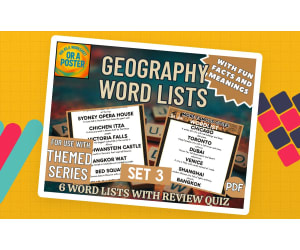
Geography Word List Posters - Set 3 (PDF)
ELA, Language Development, Vocabulary, Spelling, ESL, Resources for Teachers, Geography, Social Studies, Grade 2, 3, 4, 5, Worksheets & Printables, Worksheets, Teacher Tools, Centers, Activities, Posters, Classroom Decor
Word List Poster Series This word list poster series is designed for students in grades 2–5. Each printable focuses on a clear, kid-friendly theme and features 8 target vocabulary words with short, student-friendly meanings or fun facts. The clean layout works as both an anchor chart and a write-in sheet, giving students a quick, visual reference they can revisit during centers and independent work. These posters are student-friendly, classroom-ready, and perfect for warmups, vocabulary walls, sub plans, or take-home reference. Display a single poster to support the day’s lesson, or group several to build a themed wall across your unit. Note: Each poster is a companion piece to its matching themed product in the series—pair it with the corresponding maze, wordsearch, or activity pack for a consistent set of 8 focus words. Geography Set 3 Word List 1. More Countries of the World United States, United Kingdom, Australia, India, Peru, Egypt, South Korea, Turkey 2. More Famous Cities Chicago, Toronto, Dubai, Venice, Shanghai, Bangkok, Lisbon, Marrakech 3. More Famous Landmarks Mount Fuji, Sydney Opera House, Chichen Itza, Victoria Falls, Neuschwanstein Castle, Angkor Wat, Red Square, The Parthenon 4. Landforms and Earth's Features Canyon, Plateau, Delta, Glacier, Hill, Bay, Strait, Isthmus 5. U.S. States and Capitals California, Texas, Florida, Alaska, Hawaii, Washington D.C., New York, Illinois 6. People and Cultures Around the World Language, Tradition, Festival, Temple, Market, Music, Clothing, Customs PDF Version Other versions will appear here when available. Follow the store for the lastest on new products. How to Use These Word List Posters Perfect for: Morning work or early-finisher bins Vocabulary centers or anchor walls Holiday/seasonal review lessons Independent stations, sub plans, or take-home reference More Geography Themed Products Geography Crosswords (Set 1) PDF Geography Crosswords (Set 2) PDF Geography Crosswords (Set 3) PDF Geography Word Searches (Set 1) PDF Geography Word Searches (Set 2) PDF Geography Word Searches (Set 3) PDF Geography Mazes (Set 1) PDF Geography Mazes (Set 2) PDF Geography Mazes (Set 3) PDF FULL CATALOG OF DOWNLOAD LINKS HERE Themed Word List Posters Links Addition PDF Animals PDF Around the Home PDF Birthday PDF Candy PDF Christmas PDF Cinco de Mayo PDF Clothes PDF Colors PDF Days and Months PDF Division PDF Earth Day PDF Easter PDF Easy Word List Posters PDF Fall PDF Father's Day PDF Food PDF Geography (Set 1) PDF Geography (Set 2) PDF Geography (Set 3) PDF Graduation PDF Health PDF History (Set 1) PDF History (Set 2) PDF History (Set 3) PDF Human Body PDF Kindness PDF Life Skills PDF Mother's Day PDF Multiplication PDF Science (Set 1) PDF Science (Set 2) PDF Science (Set 3) PDF Shapes PDF Social Skills PDF Spring PDF Sports PDF St. Patrick's Day PDF Subtraction PDF Summer PDF Thanksgiving PDF Transport PDF Valentine's Day PDF Winter PDF Word List Posters in Depth Structure Each poster is built around a focused sub-theme and presents 8 target words with short, student-friendly meanings or fun facts. The clean A4 portrait layout works as an anchor chart on your board or as a student reference at desks. These posters are designed as companion pieces to the matching themed products (mazes, wordsearches, activity packs), so the same vocabulary stays visible across your unit. Each poster set includes: A themed word list poster with 8 words + brief meanings/facts A clean, high-contrast layout for easy printing and display Space that can double as write-in/draw-to-show-meaning during centers Themes Included Seasons & Holidays (e.g., Halloween, Easter, Valentine’s Day) Everyday Topics (e.g., Animals, Weather, School) Math & Science Connections (e.g., Number Words, Simple Machines) Special Units (e.g., Health, Earth Day, Sports, Kindness) Each topic reflects real-life experiences and interests while strengthening vocabulary recognition and content understanding in a clear, visual way. Easy extensions (optional) Sketch it: students draw a quick icon for each word Sort it: group words by category (e.g., actions, objects) Star it: highlight “I already know” vs. “I’m learning” words Match it: point to examples in a reading, video, or picture set Say it: brief oral definition or example sentence during share-out Differentiation tips Pre-teach 2–3 anchor words; add the rest later in the week Offer picture cues or gestures for emerging readers/ELLs Let students choose 4 of 8 to focus on first, then build up Color-code by part of speech or concept family for quick scanning For similar downloads and other frees, do check out Cored Group on TeachSimple.
Author Cored Education
Rating
Tags Vocabulary, Spelling, Geography, Countries Of The World, Famous Cities, Famous Landmarks, Landforms And Earth's Features, U.S. States And Capitals, Word Lists, Geography Word Lists

Animal Adaptations on the Savanna Activities and Worksheets
ELA, Grammar, Reading, Language Development, Spelling, Vocabulary, Writing, Science, Life Sciences, Biology, Earth and Environmental Sciences, Earth Sciences, Grade 3, 4, Worksheets & Printables, Worksheets
Animals Adaptations on the Savanna Activities and Worksheets Animal Adaptations on the Savanna Activities and Worksheets is a comprehensive teaching resource designed to support educators guiding their 3rd and 4th grade students through studies of the Savanna habitat. The main focus of this product is to strengthen learners' integration of reading, writing, science, and critical thinking skills while engaging them with interesting information about the unique adoptions of savanna animals. Resources Description: The resources provided span across an array of worksheets, handouts, task cards, card games and PowerPoint slides. All pages are available in both color and black & white options for convenience. Activities Include: Dictionery skills: testing learners' dictionary abilities with Savanna-specific vocabulary. Savannaa animal's detailed diagramming using organizers. Pupils create personalized word searches featuring specific learned terms form their lessons. Learners write descriptive pieces or opinion essays about their favorite animal among the ecosystem's inhabitants. Detailed Descriptions The packet includes informational handouts that provide in-depth explanations related to habitats or adaptions as well as descriptions about specific fauna found within this African grassland setting including natives like zebras, rhinoceroses along with exotic creatures like snowy owls or newts. PPTs & Task Cards Included task cards allow teachers further flexibility for both large group exploration or small group breakaways centered around questions formulated directly from information presented in aforementioned handouts. Gaming Component: Learning through Playing! Three different versions offer game -like learning focusing specifically on adaptations. Corresponding PowerPoint slides compile summarized details aimed at further enriching subject understanding. Summary In conclusion; Animal Adaptations on the Savanna Activities and Worksheets present an extensive instructional package highlighting upon aspects concerning not just biology but also language arts, consequently making it a very effective cross-curricular tool for educators.
Author Quail Trail Products
Tags Savanna Animals, Animal Adaptations, Habitats, Biodiversity, Science Literacy

Visualizing
ELA, Reading, Grade 3, 4, 5, Worksheets & Printables, Worksheets
Table of contents p.4 Book cover with assessment p.5 Listening for picture words with assessment p.6 Visualizing (4 senses) with assessment p.7 Visualizing with assessment p.8 Favourite scene with assessment p.9 Photo album with assessment p.10 Comic strip summary with assessment p.11 Setting with assessment p.12 Sketching a character with assessment p.13 Listening for picture words p.14 visualizing (4 senses) p.15 Visualizing p.16 Favourite scene p.17 Photo album p.18 Book jacket p.19 Comic strip summary p.20 Setting p.21 Sketching a character
Author Learn it ANY way
Tags Visualizing, Reading, Writing, Imagining, Vocabulary
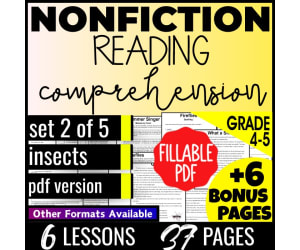
Reading Comprehension Nonfiction Set 2 - Insects (Fillable PDF)
ELA, Reading, Reading Comprehension, Common Core, ESL, Language Development, Spelling, Vocabulary, Creative Writing, Writing, Grade 4, 5, Worksheets & Printables, Worksheets, Assessments, Teacher Tools, Tests, Quizzes and Tests, Writing Prompts
Reading Comprehension Passages Nonfiction Set 2 Snapshot Title: Reading Comprehension: Nonfiction Grade 4–5 Insects Genre: Nonfiction (informational articles with practice pages) Subject: Reading (Informational Text) / Life Science Primary Topic: Insect and spider traits, behaviors, and survival Estimated Guided Reading Level (A–Z): S What This Teaches Best Comparing animal groups using key traits (e.g., spiders vs. insects: legs, eyes, antennae, exoskeleton). Animal defenses and survival behaviors (tarantula defenses; stink bug “stink blob”; ostrich-like comparisons are not present—this book stays on insects/spiders). Life cycles and roles in colonies (firefly stages; queen/worker/drone roles in ants and bees). Cause/effect and how parts help animals function (grasshoppers hearing through the tympanum; bees turning nectar into honey through evaporation and enzymes). Nonfiction comprehension routines (mixed questions, vocabulary tasks, sequencing/reordering text, and short written responses tied to each article). Learning Goals Explain how spiders and insects are different using details from the text. Describe how an insect or spider protects itself and why the defense helps. Identify the role of a queen, worker, and drone in a colony using text evidence. Describe stages in a life cycle (such as fireflies) using the article’s information. Determine the meaning of science words by using context clues in the passages. Passages Include 1.We Are Not Insects: Spiders ARE NOT insects! Read more in this article. 2.What a Smell: How does the stink bug protect its children? Find out in this lesson. 3.Queen: The ant queen. Sounds elegant. In fact, it isn't! It's a tough job. 4.Summer Singer: How do grasshoppers make noise and why? Read this passage to find out. 5.Fireflies: Why do fireflies flash? Read to learn about this, and more. 6.Bees: Worker bees, house bees. Collecting nectar, storing nectar. What exactly goes on in a bee hive? FULL CATALOG OF DOWNLOAD LINKS HERE FILLABLE PDF VERSION Worksheet-style pages, but with type-in answer boxes so students can complete and save their work digitally. Other versions are available in the links list below or in the full catalog. For similar downloads and other frees, do check out Cored Group on TeachSimple.
Author Cored Education
Rating
Tags Elementary, Reading, Comprehension, Vocabulary, Answers, Common Core, Spelling, Writing, Passages, Reading Comprehension Assessments

Idaho WebQuest Printable Book
Social Studies, Geography, Grade 4, 5, 6, 7, 8, Worksheets, Worksheets & Printables
Idaho WebQuest Printable Book Delve into the world of geography and social studies with the Idaho WebQuest Printable Book. This educational resource is designed for teachers and homeschoolers, offering an interactive way for students to learn in-depth about their state. It is ideal for grades 4 to 8, encompassing a broad range of learning levels. The Idaho WebQuest Printable Book guides students on their quest to know more about their state. It serves as a comprehensive portable guide that can be carried everywhere during field trips, nature walks, or leisure drives around Idaho. This tool focuses on empowering learners by guiding them through online research activities. Pupils will hone their internet search skills while familiarizing themselves with reliable sources of information - all recreating the process of individual investigation. Included Elements: Ten pages ready for data entry Identifying most populous city and capital city information Understanding local natural resources and state nicknames Recognizing bordering states Features like relevant historical influences such as native American tribes that resided within the region and symbolic representations like a state bird or flower. The seamless assembly of this booklet involves simple tasks such as "cutting along indicated lines", then stapling together – much like assembling a personalized mini handbook—all pertaining instructions found within product thumbnails. An inclusive answer key facilitates easy grading while confirming acquired knowledge's accuracy—the marginal frequency fields interspaced after inquiries denoting anticipated answers regarding geographic features under examination. Educational Applications: This interactive approach fosters student engagement when studying geography or social studies by: Opening up innovative ways for educators across different learning settings Partaking as a whole-class activity Utilized in smaller group discussions Employed as an individually assigned project for homework. The vibrant combination of independent research within a structured framework makes the Idaho WebQuest Printable Book an enjoyable stepping stone to imparting researching skills and instilling explorative curiosity among budding minds.
Author Soumara Siddiqui
Tags Idaho Geography, Idaho History, State Research, Social Studies, Web-based Learning
Discovering India: Guided Reading Level Q with Lesson Plan
ELA, Resources for Teachers, Reading Comprehension, Reading, Science, Geography, Social Studies, Technology, History, Life Sciences, Grade 3, 4, 5, Worksheets & Printables, Worksheets, Teacher Tools, Centers, Activities, Literacy Readers, Quizzes, Quizzes and Tests, Assessments, Lesson Plans
This Discovering India (level q) guided reading book with lesson plan includes: Guided Reading Color Label (front cover x1) This is a quick way to match the book’s demands to what students can generally handle.. The overall goal is to use the level/color to pick books for several smaller groups. To qualify for a certain level, a student is expected to read a book from that level with about 90–94% accuracy. If a student is consistently accurate and understands, move up a level. If the student is struggling at that level, drop down and add more support. Each student will improve at completely different rates, but it is generally one of the best ways to check progress across the class. DOWNLOAD THE CATALOG TO VIEW ALL GUIDED READING BOOKS AVAILABLE (SORTED LEVELS A-Z) Pre-Reading Question (x1) Teacher asks the prompt aloud, can be while showing the cover or first page. Students share what they already know, or make educated guesses from the cover. Prompt them to use the target vocabulary. Write some of their responses on the board to look back at during the reading. Vocabulary Words (x5) Introduce the five words, best doing it one at a time. Start by saying it, while students repeat and then see if anyone knows what it means before reading further. Read through the meaning and try to briefly connect each word to a picture or gesture so it’s meaningful. Ask students to flip through the book pages and point to where they see each of the vocabulary words. While reading the book pause upon coming across one of the vocab words or read the sentence twice to make sure students understand the word has appeared. Optional: Ask students to raise hands whenever they see/hear one of the new words. Guided Reading Pages (x10) Check the book snapshot (below) for: primary topic - do you need to prep extra reading or intro materials on this? what is taught best - decide on 1-2 bullets to focus on, use the prompt or words provided here for best results. learning goals - what you are checking for students to be able to do after the session, elicit answers using prompts or words provided. key vocabulary (see section above). questions overview - so you know what is coming up and if you need to prep extra materials to assist understanding. Run the lesson You may have already looked at a few of the pages together, but you can show them some of the pictures again first to set meaning. Depending on how much time you have and how familiar your students are with guided reading class, you may want to read the book aloud first with the group first. Students whisper or partner read, while you listen in. If time, do it as a group, one student reading a page each. Use the guided page’s prompts to coach: “Check the picture / does it make sense?” “Point under the words / try the first sound” “Reread the sentence smoothly”. Try to focus more on one student per session (rotating every time), so you can work out if they are ready to move up or need to move down a level. Comprehension Questions (back cover x3) This is your way to check that students didn’t just say the words, but actually understood the text. First, let students answer by pointing to the page/picture and saying a short sentence. After any answer, follow with: “Show me where you found that in the text.” In bigger groups, have partners answer first (10–20 seconds), then call on 2–3 students to share. Differentiation tips: Emerging speakers/struggling readers: oral + pointing On-level: oral in a full sentence Higher: one written sentence or draw + label Book Snapshot Title: Discovering India Genre: Nonfiction Subject: Social Studies (Geography/Culture) Primary Topic: India’s land, wildlife, traditions, and modern life Estimated Guided Reading Level (A–Z): Q What This Book Teaches Best Key geography facts about India’s location in Southern Asia, nearby borders, and surrounding waters. How landforms shape life in India, including the Himalayan Mountains and the Ganges River. Notable wildlife of India through examples like the Bengal tiger and the Indian elephant. Cultural traditions and everyday life, including spices used in meals and the celebration of Diwali. Modern India today, including transportation (auto-rickshaws) and major cities connected to technology and innovation. Learning Goals Students will describe where India is located and name details about its borders and southern waters. Students will explain how the Himalayan Mountains are described as protecting the inner plains. Students will explain why the Ganges River is important to people and farming in northern India. Students will describe key traits of the Bengal tiger and the Indian elephant using details from the text. Students will identify facts about the Taj Mahal, including where it is and features described in the book. Students will describe examples of Indian culture and modern life mentioned in the text (foods/spices, Diwali, transportation, cities). Key Vocabulary From the Text vast — very large in size. significant — very important. distinctive — easy to notice because it looks different. minarets — tall towers on a monument. diyas — small clay lamps used during Diwali. Discussion Prompts Pre-reading question: What are you hoping to learn about India as you read? Comprehension questions: What warm waters does the text say surround India to the south? Comprehension questions: According to the text, why is the Ganges River essential? Comprehension questions: What does the text say diyas symbolize during Diwali? Printing Tips 1. Best Printing Method (Recommended) “Booklet” Printing (Best if Available) If your printer or PDF viewer supports Booklet Printing , use this. Settings to use: Print mode: Booklet Paper size: Letter or A4 (either works) Orientation: Landscape Print on both sides: Yes Flip on: Short edge Scaling: Fit to printable area Booklet subset: First test: Front sides only Then: Back sides only This will automatically: Pair pages correctly Put the cover on the outside Align everything for folding After printing, fold in half and staple along the spine . 2. If “Booklet” Printing Is NOT Available You can still print this correctly with manual duplex printing . Step-by-step: Open the PDF. Choose Print . Set: Orientation: Landscape Pages per sheet: 1 Print on both sides: Yes Flip on: Short edge Print all pages . Because each PDF page already contains two facing book pages, the result will still fold cleanly into a book. Thousands of Cored Education products are included with your TeachSimple membership. Download links and encyclopedia index available here.
Author Cored Education
Rating
Tags Reading Comprehension, Reading Passages, Reading, Guided Reading, Guided Reading Lesson Plan, Guided Reading Activity, Pre-reading, Social Studies, Geography, History
Discovering United Kingdom: Guided Reading Level Q with Lesson Plan
ELA, Resources for Teachers, Reading Comprehension, Reading, Science, Geography, Social Studies, History, Life Sciences, Earth and Environmental Sciences, Grade 3, 4, 5, Worksheets & Printables, Worksheets, Teacher Tools, Centers, Activities, Literacy Readers, Quizzes, Quizzes and Tests, Assessments, Lesson Plans
This Discovering the United Kingdom (level q) guided reading book with lesson plan includes: Guided Reading Color Label (front cover x1) This is a quick way to match the book’s demands to what students can generally handle.. The overall goal is to use the level/color to pick books for several smaller groups. To qualify for a certain level, a student is expected to read a book from that level with about 90–94% accuracy. If a student is consistently accurate and understands, move up a level. If the student is struggling at that level, drop down and add more support. Each student will improve at completely different rates, but it is generally one of the best ways to check progress across the class. DOWNLOAD THE CATALOG TO VIEW ALL GUIDED READING BOOKS AVAILABLE (SORTED LEVELS A-Z) Pre-Reading Question (x1) Teacher asks the prompt aloud, can be while showing the cover or first page. Students share what they already know, or make educated guesses from the cover. Prompt them to use the target vocabulary. Write some of their responses on the board to look back at during the reading. Vocabulary Words (x5) Introduce the five words, best doing it one at a time. Start by saying it, while students repeat and then see if anyone knows what it means before reading further. Read through the meaning and try to briefly connect each word to a picture or gesture so it’s meaningful. Ask students to flip through the book pages and point to where they see each of the vocabulary words. While reading the book pause upon coming across one of the vocab words or read the sentence twice to make sure students understand the word has appeared. Optional: Ask students to raise hands whenever they see/hear one of the new words. Guided Reading Pages (x10) Check the book snapshot (below) for: primary topic - do you need to prep extra reading or intro materials on this? what is taught best - decide on 1-2 bullets to focus on, use the prompt or words provided here for best results. learning goals - what you are checking for students to be able to do after the session, elicit answers using prompts or words provided. key vocabulary (see section above). questions overview - so you know what is coming up and if you need to prep extra materials to assist understanding. Run the lesson You may have already looked at a few of the pages together, but you can show them some of the pictures again first to set meaning. Depending on how much time you have and how familiar your students are with guided reading class, you may want to read the book aloud first with the group first. Students whisper or partner read, while you listen in. If time, do it as a group, one student reading a page each. Use the guided page’s prompts to coach: “Check the picture / does it make sense?” “Point under the words / try the first sound” “Reread the sentence smoothly”. Try to focus more on one student per session (rotating every time), so you can work out if they are ready to move up or need to move down a level. Comprehension Questions (back cover x3) This is your way to check that students didn’t just say the words, but actually understood the text. First, let students answer by pointing to the page/picture and saying a short sentence. After any answer, follow with: “Show me where you found that in the text.” In bigger groups, have partners answer first (10–20 seconds), then call on 2–3 students to share. Differentiation tips: Emerging speakers/struggling readers: oral + pointing On-level: oral in a full sentence Higher: one written sentence or draw + label Book Snapshot Title: Discovering the United Kingdom Genre: Nonfiction Subject: Social Studies (Geography, Government, Culture) Primary Topic: The UK’s nations, landmarks, climate, and culture Estimated Guided Reading Level (A–Z): Q What This Book Teaches Best Introduces the United Kingdom as a union of four countries and explains that each has its own traditions and landscapes. Builds geography knowledge by describing where the UK is located and by highlighting regional features in Scotland, Wales, and Northern Ireland. Teaches civics basics by explaining the UK’s constitutional monarchy and that the elected Parliament makes laws. Connects history and landmarks through examples like Stonehenge and major places in London along the River Thames. Explains how climate supports wildlife and gives an example of conservation connected to the red squirrel. Learning Goals Students will identify the four countries that make up the United Kingdom using details from the text. Students will describe why London is important in the United Kingdom and name one detail about the River Thames from the text. Students will describe key physical features of Scotland and explain what “lochs” are using the text’s description. Students will describe two details the text gives about Wales, such as its landscape, castles, or language. Students will explain how the text describes the UK’s government and who makes laws. Students will explain how the UK’s temperate climate is described and name one effect it has on wildlife. Key Vocabulary From the Text sovereign — able to govern itself. distinct — clearly different. interspersed — spread in between other things. constitutional — based on rules for how a country is run. prehistoric — from before written records. Discussion Prompts Pre-reading question: When you hear “United Kingdom,” what places or facts do you expect to learn about? Comprehension questions: What four countries does the text say make up the United Kingdom? Comprehension questions: What does the text say about who makes laws in the United Kingdom? Comprehension questions: What are two details the text gives about Scotland or Wales? Printing Tips 1. Best Printing Method (Recommended) “Booklet” Printing (Best if Available) If your printer or PDF viewer supports Booklet Printing , use this. Settings to use: Print mode: Booklet Paper size: Letter or A4 (either works) Orientation: Landscape Print on both sides: Yes Flip on: Short edge Scaling: Fit to printable area Booklet subset: First test: Front sides only Then: Back sides only This will automatically: Pair pages correctly Put the cover on the outside Align everything for folding After printing, fold in half and staple along the spine . 2. If “Booklet” Printing Is NOT Available You can still print this correctly with manual duplex printing . Step-by-step: Open the PDF. Choose Print . Set: Orientation: Landscape Pages per sheet: 1 Print on both sides: Yes Flip on: Short edge Print all pages . Because each PDF page already contains two facing book pages, the result will still fold cleanly into a book. Thousands of Cored Education products are included with your TeachSimple membership. Download links and encyclopedia index available here.
Author Cored Education
Rating
Tags Reading Comprehension, Reading Passages, Reading, Guided Reading, Guided Reading Lesson Plan, Guided Reading Activity, Pre-reading, Social Studies, Geography, History

Guided Reading Level P - A Guide to Sharks (with Lesson Plan)
ELA, Resources for Teachers, Reading Comprehension, Reading, Pre-Reading, Language Development, Animals, Life Sciences, Science, Vocabulary, Grade 2, 3, 4, Worksheets & Printables, Worksheets, Teacher Tools, Centers, Activities, Literacy Readers, Quizzes, Quizzes and Tests, Assessments
This Guided Reading Book - A Guide to Sharks (Level P) with lesson plan includes: Guided Reading Color Label (front cover x1) This is a quick way to match the book’s demands to what students can generally handle.. The overall goal is to use the level/color to pick books for several smaller groups. To qualify for a certain level, a student is expected to read a book from that level with about 90–94% accuracy. If a student is consistently accurate and understands, move up a level. If the student is struggling at that level, drop down and add more support. Each student will improve at completely different rates, but it is generally one of the best ways to check progress across the class. DOWNLOAD THE CATALOG TO VIEW ALL GUIDED READING BOOKS AVAILABLE (SORTED LEVELS A-Z) Pre-Reading Question (x1) Teacher asks the prompt aloud, can be while showing the cover or first page. Students share what they already know, or make educated guesses from the cover. Prompt them to use the target vocabulary. Write some of their responses on the board to look back at during the reading. Vocabulary Words (x5) Introduce the five words, best doing it one at a time. Start by saying it, while students repeat and then see if anyone knows what it means before reading further. Read through the meaning and try to briefly connect each word to a picture or gesture so it’s meaningful. Ask students to flip through the book pages and point to where they see each of the vocabulary words. While reading the book pause upon coming across one of the vocab words or read the sentence twice to make sure students understand the word has appeared. Optional: Ask students to raise hands whenever they see/hear one of the new words. Guided Reading Pages (x10) Check the book snapshot (below) for: primary topic - do you need to prep extra reading or intro materials on this? what is taught best - decide on 1-2 bullets to focus on, use the prompt or words provided here for best results. learning goals - what you are checking for students to be able to do after the session, elicit answers using prompts or words provided. key vocabulary (see section above). questions overview - so you know what is coming up and if you need to prep extra materials to assist understanding. Run the lesson You may have already looked at a few of the pages together, but you can show them some of the pictures again first to set meaning. Depending on how much time you have and how familiar your students are with guided reading class, you may want to read the book aloud first with the group first. Students whisper or partner read, while you listen in. If time, do it as a group, one student reading a page each. Use the guided page’s prompts to coach: “Check the picture / does it make sense?” “Point under the words / try the first sound” “Reread the sentence smoothly”. Try to focus more on one student per session (rotating every time), so you can work out if they are ready to move up or need to move down a level. Comprehension Questions (back cover x3) This is your way to check that students didn’t just say the words, but actually understood the text. First, let students answer by pointing to the page/picture and saying a short sentence. After any answer, follow with: “Show me where you found that in the text.” In bigger groups, have partners answer first (10–20 seconds), then call on 2–3 students to share. Differentiation tips: Emerging speakers/struggling readers: oral + pointing On-level: oral in a full sentence Higher: one written sentence or draw + label Book Snapshot Title: A Guide to Sharks Genre: Nonfiction (informational text) Subject: Life Science / Reading (Informational Text) Primary Topic: Shark adaptations, senses, and ocean ecosystem roles Estimated Guided Reading Level (A–Z): P What This Book Teaches Best Food chains and ecosystem balance: Sharks are “apex predators” that help regulate marine animal populations, and the text explains what could happen “without sharks.” Body structure and movement: Sharks’ skeletons are made of cartilage, which helps them stay buoyant and turn quickly while swimming. How sharks breathe: The book explains gills, oxygen extraction, and why many sharks must keep swimming to breathe. Feeding and hunting adaptations: Sharks’ teeth work like a “conveyor belt,” replacing lost or broken teeth. Special senses and survival strategies: The text describes electroreception (Ampullae of Lorenzini), camouflage (Wobbegong shark), and different ways sharks reproduce. Learning Goals Students will describe what it means for sharks to be apex predators in an underwater food chain. Students will explain how cartilage helps sharks stay buoyant and move in water. Students will explain why many sharks must swim constantly in order to breathe. Students will describe how a shark’s teeth are replaced when one is lost or broken. Students will describe electroreception and how it helps sharks find prey hiding under sand. Students will explain one way sharks help keep ocean fish populations and the marine ecosystem healthy. Key Vocabulary From the Text apex — the very top or highest level. cartilage — flexible body material that is not bone. buoyant — able to float or stay up in water. electroreception — sensing tiny electrical signals in the water. ecosystem — living things and how they interact in a place. Discussion Prompts Pre-reading question: What body features might help a shark survive in the ocean? Comprehension questions: According to the text, why do many sharks need to keep swimming in order to breathe? Comprehension questions: What does the text say happens when a shark loses or breaks a tooth? Comprehension questions: How does the text explain that sharks help keep the ocean’s fish populations and ecosystem healthy? Printing Tips 1. Best Printing Method (Recommended) “Booklet” Printing (Best if Available) If your printer or PDF viewer supports Booklet Printing , use this. Settings to use: Print mode: Booklet Paper size: Letter or A4 (either works) Orientation: Landscape Print on both sides: Yes Flip on: Short edge Scaling: Fit to printable area Booklet subset: First test: Front sides only Then: Back sides only This will automatically: Pair pages correctly Put the cover on the outside Align everything for folding After printing, fold in half and staple along the spine . 2. If “Booklet” Printing Is NOT Available You can still print this correctly with manual duplex printing . Step-by-step: Open the PDF. Choose Print . Set: Orientation: Landscape Pages per sheet: 1 Print on both sides: Yes Flip on: Short edge Print all pages . Because each PDF page already contains two facing book pages, the result will still fold cleanly into a book. Thousands of Cored Education products are included with your TeachSimple membership. Download links and encyclopedia index available here.
Author Cored Education
Rating
Tags Reading Comprehension, Reading Passages, Reading, Guided Reading, Guided Reading Lesson Plan, Guided Reading Activity, Pre-reading, Science Lesson Plans, Life Science, Animals

French immigration to Canada (#1208)
Social Studies, History, History: Canada, Grade 4, 5, 6, Worksheets & Printables, Worksheets
French Immigration to Canada (#1208) - A Comprehensive Teaching Resource This fascinating examination into a crucial aspect of Canadian history is compiled into a 17-page PDF document suitable for Grade 4 to Grade 6 students. This comprehensive teaching resource comes complete with reading and comprehension tasks aligned with Social Studies curriculum , focusing on 'History: Canada'. Dive Into Interactive Learning Predict (Page 4) Recount Prior Knowledge (Page 5) Visual Aid and Reinforcement of Ideas(Pages 6 &7) Foster Analytical Skills through Reading Strategies component (Page Eight) The subsequent pages are loaded with questions intended to check comprehension levels whilst allowing for reflection. A convenient answer key ensures that it's simple enough for students' work to be reviewed or self-checked. Making Connections, Expressing Opinions, and Text Transformation Activities. An opportunity to establish connections(Page thirteen) . An arena for voicing personal opinions about the text(Page fourteen). . . Text transformation activities engage student creativity in yet another way (page sixteen). All worksheets are constructed in a manner that isn’t too wordy or puzzling; hence they cater comfortably towards learners within the grade four-six bracket.Finally, this comprehensive educational resource makes studying social studies simple but rewarding whether it's used in whole group activities at school or small group assignments at home.
Author Learn it ANY way
Tags French Immigration, Canadian History, Social Studies Curriculum, Reading Skills, Interactive Learning

Türkiye Map Geography Word Search 2rd 3th 4th 5th Grade worksheet
Vocabulary, Language Development, ELA, Spelling, Geography, Social Studies, Grade 2, 3, 4, 5, Games, Activities, Word Searches, Worksheets, Worksheets & Printables
Make learning fun with a no-prep, printable vocabulary word search that builds vocabulary, reinforces literacy, and sparks curiosity! Students can explore the new vocabulary words while practicing spelling, scanning for letters, and identifying keywords. A word search can be a perfect and easy-to-use activity to liven up a lesson by combining learning with fun! It is an excellent way to reinforce concepts within a lesson and engage students' hands-on learning. Purpose: This activity allows students to learn new vocabulary words and contextualized vocabulary related to a topic ✏️, improve spelling, reading, and attention to detail 📚, increase awareness of concepts and knowledge about the world at large 🌍, and encourage curiosity and engagement about the topic 🐾. Word searches are a hands-on way to make learning memorable and fun for students - it engages them at all vocabulary levels! How to Do It: 1️⃣ Hand out the word search worksheet. 2️⃣ Introduce any important vocabulary or concepts that fit with the topic. 3️⃣ The students search for the words and circle or highlight each one. 4️⃣ Discuss the importance of the topic or the words that the student found. 5️⃣ Review the answers using the answer key that is included for each product ✅ Perfect For: Grades 2-5 🌟, independent practice, partner work, students who finish early, science or social studies centers, or for substitute plans 🤝 Way of Implementation: Great for independent practice early finishers, partner work, or substitute plans 🤝. Answer Keys: (these will be pencils under your three files: Given for simple checking and self-assessing. Fun Variations: Timed Challenge ⏳ - record how many words students can find in a set time. Partner Puzzle 🤝 - work together to find all of the words. Vocabulary Extension ✏️ - write sentences or a few short paragraphs using the words. Create-Your-Own Word Search 🧩 - have students make their own word search puzzles using the vocabulary. Standards Alignment: Supports CCSS/ELA vocabulary development, and can also connect to NGSS or other relevant standards, depending on the topic. File & Print Info: PDF includes both a color and black and white version, and is ink-friendly to make printing easy. Teacher Tip! Have students learn by being hands-on, engaged, and active while helping them build awareness, vocabulary, and literacy skills around any topic! 🌟
Author Classsim
Rating
Tags Türkiye , Map , Geography , Word Search , 2rd 3th 4th 5th Grade , Worksheet , Activity, Türkiye Map Geography Word Search , Türkiye Map Geography Word Search 2rd 3th 4th 5th Grade, Türkiye Map Geography Word Search 2rd 3th 4th 5th Grade Worksheet Activity
Reading Comprehension Nonfiction Set 1 - Birds (PDF)
ELA, Reading, Reading Comprehension, Common Core, ESL, Language Development, Vocabulary, Spelling, Creative Writing, Writing, Grade 4, 5, Worksheets & Printables, Worksheets, Assessments, Teacher Tools, Tests, Quizzes and Tests, Writing Prompts, Centers, Activities
Reading Comprehension Passages Nonfiction Set 1 Overview No prep reading comprehension lessons, with enjoyable articles and topics. Each lesson has a blend of post-reading activities. Mixed questions to check overall understanding. Vocabulary activities, plus a writing section. Lessons also contain a bonus extension exercise at the end. Some you may like, some you may not, either way they are there if you wish to use them. Full answer keys are provided. Passages Include 1.No Fly Zone: An article on birds that cannot fly. 2.Ostrich: Ostrich eggs are big enough to be used as make shift cups! 3.Chickadees: A small, but interesting bird, common to Canada and Northern U.S.A 4.The Owl: What do you know about this mysterious creature? 5.Turkeys: A popular food at Thanksgiving and Christmas. How do Turkeys live? 6.Oil Spill: How did the Deepwater Horizon oil spill effect local birds? PDF Version This is the PDF uneditable version. This download is available in GOOGLE Docs, GOOGLE Forms, GOOGLE Slides. PDF, PPT, WORD. Browse the Complete Cored Catalog — 2,000+ Resources Included Reading Passages Each reading passage has been written specifically for students in Grades 4–5, using vocabulary and language that match their age and ability level. The collection covers a wide range of engaging topics, supported by colorful visuals that help bring the content to life. Every lesson is designed to build knowledge while keeping students interested and motivated to read. These resources are also designed with flexibility in mind. Unlike traditional textbooks that can quickly become outdated, lessons can be updated over time to reflect changes in technology, discoveries, and the world around us. Mixed Questions Every lesson includes a variety of questions that help students think more deeply about what they have read. The question section combines reading comprehension, vocabulary, and math skills, while also regularly reinforcing important reading strategies such as cause and effect, summarizing, compare and contrast, and drawing conclusions. Most lessons include a mix of multiple-choice and written-response questions, giving students opportunities to explain their thinking as well as select answers. Complete answer keys and sample responses are provided at the end of each lesson for quick and easy reference. Spelling & Vocabulary Each passage introduces students to useful words and phrases appropriate for Grades 4–5. To help build confidence and word knowledge, every lesson includes a spelling or vocabulary activity. Rather than repeating the same task throughout the collection, activities vary from lesson to lesson to keep practice fresh and engaging. Activities may include spelling challenges, sentence matching, decoding activities, mixed-up text exercises, and other vocabulary-building tasks connected directly to the reading. Writing Prompts Each lesson includes a writing activity that extends the ideas, themes, or topics explored in the passage. Students are encouraged to write in a variety of formats, with prompts providing helpful guidance and ideas to get them started. Writing tasks vary throughout the collection and may include creative writing, research activities, personal responses, poetry, opinion writing, and other engaging assignments. Full Answer Keys Complete answer keys and sample responses are included with every lesson, making planning and marking quicker and easier. Reading comprehension answers include evidence and support from the text, while math-based questions show the relevant working where appropriate. The answer keys are designed primarily for teachers but can also be shared with students when needed. Just for Fun Each lesson finishes with an optional extension activity called Just for Fun . These bonus activities provide an enjoyable way to extend learning beyond the main lesson and often encourage creativity, discussion, or independent thinking. They are completely optional, giving you the flexibility to use the activities that best suit your students and classroom needs. For similar downloads and other frees, do check out Cored Group on TeachSimple.
Author Cored Education
Rating
Tags Elementary, Reading, Comprehension, Vocabulary, Common Core, Spelling, Writing, Passages, Reading Centers, Reading Comprehension Assessments

Powered Neuro-Inclusive Micro-Learning Strategy Cards for Diverse
Science, Technology, Computer Science, Engineering, Special Resources, Social Emotional Learning (SEL), Special Education Needs (SEN), STEM, Life Skills, ELA, Grade 2, 3, 4, 5, 9, 10, 11, 12, Worksheets & Printables, Flashcards, Parts of and Anatomy of, Word Problems, Workbooks, Worksheets, Writing Prompts, Teacher Tools, Assessments, Lesson Plans
Unlocks the future of inclusive education with this 49-page ultimate resource: "AI-Powered Neuro-Inclusive Micro-Learning Strategy Cards for Diverse Classrooms (Ready!)" – an innovative and educator-recommended resource that disrupts and transforms K-12 educational strategies for the better. This downloadable pdf resource pushes the boundaries of neuro-inclusive education practices, micro-learning best practices, and responsible AI applications, covering all theoretical aspects of neuro-inclusive educational practices, micro-learning best practices, AI applications, and a lot more with its profound evidence-based resources on UDL, Cognitive Load Factors, and Constructivist concepts, with actual demonstration cases from elementary and high school levels, strategy card templates for creative development on worksheets and ethics of AI applications for educational environments, all crafted together for optimal cognitive engagement and minimizing educational barriers for effective personalized cognitive educational development. Perfect for special education resources, differentiated resources for personalized educational practices, and educational management tools, this SEO-optimized resource for educators helps and enables all educators for preparation of balanced cognitive educational morsels for enhanced cognitive engagements, motivation, and academic achievement for students across diverse K-12 educational environments. Keywords: Neuro-inclusive educational practices for classrooms, AI-based educational resources for classrooms, Micro-learning for neuro-diverse students, K-12 Neuro-inclusive educational practices, UDL resources for classrooms. Why Parents/Schools Love It: Personalized and Inclusive Strategy: Enables teachers to provide personalized education support for neurodiverse students, making them less frustrated and more confident using bite-sized and adjustable strategies such as tools for students with ADHD or autistic students. Time-Saving AI Integration: “Ethical AI capabilities offer real-time analytics, personalized content, and feedback loops that ease the instructor’s workload and help enhance outcomes in a K-12 classroom.” Results That Speak for Themselves: Proven on the evidence-based frameworks of UDL and Cognitive Load Theory, as well as illustrated cases of 20% or greater retention and engagement rates, there is no doubt that it helps students significantly. Versatile & Ready to Use: Comes with strategy cards, worksheets, & writing prompts that teachers can print out for instant use in their classrooms, thus being very useful in encouraging motivation, managing cognitive overload, & ensuring equitable education. Future-Proof Designs: equipped with ethical AI tools and frameworks that protect consumer and individual rights to privacy and mitigate biases, to ready and prepare learners for a technology-driven and worldwide environment while focusing on teaching and learning. Targeted Classes/Students : After thoroughly evaluating the entire 49-page PDF file, which contains information on foundational theory (Chapters 1-3), the design and execution of strategy cards (Chapter 4), worksheets for practice, ethical issues, case studies, and advanced topics, it is clear that the guide is designed for use in K-12 education environments. It applies to all grade levels, Kindergarten through 12th grade, with a focus on neurodiverse students. Specific suggestions are included for: Elementary School Students (Grades K-5): Underlying concepts may target fractions, reading comprehension, or social-emotional control, with examples such as Northwood Elementary focusing on ADHD, Dyslexia, and Autistic students during grades 3-5. Designed specifically for students who profit from visual supports and time-dosing assistance with their learning and attention. Middle School Students (6-8): Focuses on executive functioning assistance, multi-step task planning (ecosystems lesson for instance), AI-powered modifications for ESL, anxious, gifted students. Case examples, like Summit Ridge Middle School, discuss differentiating for students with learning disabilities. High School Students(9-12): Focuses on difficult topics in geometry proofs, formulas for volume, and abstract ideas, using micro-learning for dyscalculia, slow processing, and high-functioning autism. Examples include Emerald High School’s geometry in the 9th grade, which emphasize challenging concepts. Copyright/Terms of Use : This Book was copyrighted by Syed Hammad Rizvi. This document or textbook is exclusively for non-commercial personal and classroom use only. You are not allowed to copy, distribute, or sell any portion of this document or textbook through the Internet for public download. If you would like to share this resource with others in your workplace, please purchase additional licenses from Teachsimple. We appreciate your respect for these guidelines for use. This product is proudly brought to you by Syed Hammad Rizvi
Author Creative Book Store
Rating
Tags NeuroInclusiveEducation, AIPoweredLearning, MicroLearningStrategies, K12InclusivePedagogy, NeurodiversityInClassrooms, UDLPrinciples, CognitiveLoadTheory, EthicalAIInEducation, ADHDTeachingTools, DyslexiaSupportResources

Skateboarding Reading Comprehension Passage - Cored Ed Encyclopedia
ELA, Language Development, Reading Comprehension, Reading, Pre-Reading, Writing, Sports, P.E. & Health, Technology, Science, Grade 2, 3, 4, 5, Worksheets & Printables, Worksheets, Teacher Tools, Centers, Activities, Writing Prompts, Assessments, Quizzes and Tests, Quizzes, Lesson Plans
This skateboarding reading comprehension includes: Visualization (on the front cover) Start your lesson by taking a minute to think and share something about the topic. Read the script aloud (slowly), perhaps prepare some music or sound effects. Student close their eyes and let their imaginations wander. Students open their eyes, read the question aloud and give them a few minutes to complete. Ask a few students to share or keep answers until the end to compare with what they learn in the passage. Quick pause—thousands of Cored Education products are included with your TeachSimple membership. Download links and encyclopedia index available here. Pre-Reading Trivia Students will write down one thing they already know about the subject and then read five more facts and discuss. These facts are fun, and the students will enjoy learning about the subject before reading more. Give 1 minute for students to write what they already know (no pressure—best guess is fine). Read the five facts together. After each fact, do ask a student for their opinion, was it surprising? Set a purpose by asking students to highlight/underline one fact they want to learn more about during the reading. Reading Passage The text is a high-interest reading passage with set paragraphs, roughly three to four paragraphs long. It contains a variety of themes about the topic, anywhere from history to technology. The passage is between 250 and 350 words in length. First, ask students to look at the headings and see what they’ll learn about today. What do they know about the topic/heading? First read options: Teacher read-aloud (best for support). Partner reading (paragraph by paragraph). While reading, students underline important details, and vocabulary words they think may come up in the questions section. Mixed Questions The first question page contains four multiple-choice questions, each with a choice of four answers, and three written response questions that require a sentence or two from the student. Students complete the mcqs first independently, then review quickly as a class. For the 3 written responses, try to get students giving the answer with some form of evidence: “I think ___ because the text says ___.” If students get stuck, send them back to check the passage. Vocabulary Questions Practice seven key words from the text in this section across two activities. First section is scrambled words where students will unscramble three words given a clue for each. The second section is a word to meaning matching activity. Before starting, have some students read out words they underlined in the passage. Ask students to say the word and read aloud the sentence(s) around each word. Ask students to do scrambled words and the matching exercise in pairs then go through answers as a class. For the scrambled spelling task, get four pairs to come up to the board and write the words for extra practice with the other student reading out the clue. For the matching task, prompt students to give full sentences: “I matched ___ with ___ because ___.” Creative Writing In this question, the student will be required to write a five to eight sentence paragraph on a question related to the topic. Before starting, ask students write down 3 key ideas they are going to include in their piece. Ask students for ideas to share around the class to help those struggling. Pro writing expectations: 5–8 sentences At least 2 facts or details from the passage At least 2 vocabulary words from the previous page Students read their paragraphs while classmates listen for facts and vocabulary words. Extension Activities This page is optional for fast finishers or to take home. There are several activities, each one requiring a different skill. Do some, do none, do all, completely optional - but you will feel reassured knowing every possibility is planned for. Includes summary writting question. Answer Key There are answers for the multiple-choice questions, written response questions have sample answers, vocabulary answers and if there is a summary question then a sample summary will be provided as well. Lesson Plan Included Customized lesson plan for this lesson is included. Lesson Snapshot Title: Skateboarding Genre: Nonfiction (informational text) Subject: Social Studies (history/culture) / Physical Education (sports) Primary Topic: How skateboarding began and evolved Estimated Guided Reading Level (A–Z): R What This Lesson Teaches Best How skateboarding started in California when surfers tried “sidewalk surfing” using boards and roller-skate wheels. How a problem (hard wheels and injury worries) led to a decline around 1966, and how a new solution helped the sport return. How new technology (polyurethane wheels that gripped and rolled smoothly) changed what riders could do and how safe it felt. How places to ride shaped new styles, from parks with banks/curves to pools, then street spots like curbs, stairs, and rails. How a timeline of key decades/years (1940s–50s, 1960s, 1970s, 1980s, 1995, Tokyo 2020/2021) shows the sport’s growth into major events. Learning Goals Describe why skateboarding began and what early riders used to make boards roll. Explain why skateboarding “nearly disappeared” around 1966 using details from the text. Identify how polyurethane wheels changed riding and why turns felt more controllable. Describe how skate parks and empty swimming pools helped create vertical skating and half-pipes. Explain how street-style skateboarding grew and name major events mentioned in the passage. Key Vocabulary From the Text polyurethane — a wheel material that grips and rolls smoothly. contests — competitions where people try to win. controllable — easy to control and not scary. vertical — going up steeply, like riding up walls. debut — first time something appears in an event. FULL CATALOG OF DOWNLOAD LINKS AND ENCYCLOPEDIA INDEX HERE
Author Cored Education
Rating
Tags Vocabulary, Reading Comprehension, Reading Passages, Reading, Creative Writing, Reading Strategies, Writing Prompts, Lesson Plans, Sports, Skateboarding
Pollinators Reading Comprehension Passage for 2nd, 3rd, and 4th Grades
ELA, Reading, Reading Comprehension, Science, Nature & Plants, Life Sciences, Grade 2, 3, 4, Centers, Activities, Worksheets, Worksheets & Printables
Pollinators Reading Comprehension Passage for 2nd, 3rd, and 4th Grades (Science + ELA) | No Prep Make learning about pollination fun and easy with this engaging Science and ELA resource! Instead of teaching pollination as a difficult science topic, this reading comprehension set will help students learn about a few amazing animals that help plants grow. They will explore a variety of fascinating garden helpers from around the world, discovering that pollinators include much more than just bees and butterflies. This no-prep resource combines informational reading , comprehension practice, and interactive activities to keep students engaged while building science knowledge and reading skills at the same time. I created this resource to blend ELA with Science . What’s inside? Informational Reading Passage An engaging nonfiction passage that explains how pollination works and introduces students to a variety of pollinators, including bees, butterflies, beetles, flies, bats, hummingbirds, lemurs, and possums. Reading Comprehension Questions Text-dependent questions that help students practice comprehension , recall details , and build critical-thinking skills . Circle the Pollinators Activity Students will identify and circle the animals that help with pollination. Pollinator Coloring Activity A fun page where students will color only the pollinators while reinforcing science concepts. Fun Facts Extension Page High-interest pollinator facts page is included to keep early finishers engaged and curious. Answer Key The answer key is also in this set for easy grading and quick checking. Formats Included Colorful version + black-and-white version Grade Levels Perfect for: 2nd Grade 3rd Grade 4th Grade Why Teachers Love This Resource It combines Science and ELA in one easy to use activity It helps students practice reading comprehension using informational text It also introduces students to both common and unusual pollinators This resource also includes visual activities that support young learners and ESL students No prep resource - simply print and use It Is Great For Guided Reading Groups Science Lessons Literacy Centers Independent Work Homework Sub Plans Spring Units Earth Day Activities Homeschool Science Lessons Skills Covered Reading Informational Text Main Idea and Supporting Details Science Vocabulary Understanding Life Cycles and Pollination Critical Thinking Visual Recognition Skills Common Core Standards CCSS.ELA-LITERACY.RI.2.1 CCSS.ELA-LITERACY.RI.3.3 CCSS.ELA-LITERACY.RI.4.7 This pollinators reading comprehension pack makes science meaningful, interactive, and easy to understand while helping students strengthen important reading skills at the same time.
Author FlashKart
Rating
Tags ELA, Reading Comprehension, Language Arts, Pollinators, Garden Helpers, No Prep, Centers, Worksheets, Reading Skills, Science
Tennis Reading Comprehension Passage - Cored Ed Encyclopedia
ELA, Language Development, Reading Comprehension, Reading, Pre-Reading, Science, Technology, Engineering, History, Social Studies, Grade 2, 3, 4, 5, Worksheets & Printables, Worksheets, Teacher Tools, Centers, Activities, Writing Prompts, Assessments, Quizzes and Tests, Quizzes, Lesson Plans
This tennis reading comprehension includes: Visualization (on the front cover) Start your lesson by taking a minute to think and share something about the topic. Read the script aloud (slowly), perhaps prepare some music or sound effects. Student close their eyes and let their imaginations wander. Students open their eyes, read the question aloud and give them a few minutes to complete. Ask a few students to share or keep answers until the end to compare with what they learn in the passage. Quick pause—thousands of Cored Education products are included with your TeachSimple membership. Download links and encyclopedia index available here. Pre-Reading Trivia Students will write down one thing they already know about the subject and then read five more facts and discuss. These facts are fun, and the students will enjoy learning about the subject before reading more. Give 1 minute for students to write what they already know (no pressure—best guess is fine). Read the five facts together. After each fact, do ask a student for their opinion, was it surprising? Set a purpose by asking students to highlight/underline one fact they want to learn more about during the reading. Reading Passage The text is a high-interest reading passage with set paragraphs, roughly three to four paragraphs long. It contains a variety of themes about the topic, anywhere from history to technology. The passage is between 250 and 350 words in length. First, ask students to look at the headings and see what they’ll learn about today. What do they know about the topic/heading? First read options: Teacher read-aloud (best for support). Partner reading (paragraph by paragraph). While reading, students underline important details, and vocabulary words they think may come up in the questions section. Mixed Questions The first question page contains four multiple-choice questions, each with a choice of four answers, and three written response questions that require a sentence or two from the student. Students complete the mcqs first independently, then review quickly as a class. For the 3 written responses, try to get students giving the answer with some form of evidence: “I think ___ because the text says ___.” If students get stuck, send them back to check the passage. Vocabulary Questions Practice seven key words from the text in this section across two activities. First section is scrambled words where students will unscramble three words given a clue for each. The second section is a word to meaning matching activity. Before starting, have some students read out words they underlined in the passage. Ask students to say the word and read aloud the sentence(s) around each word. Ask students to do scrambled words and the matching exercise in pairs then go through answers as a class. For the scrambled spelling task, get four pairs to come up to the board and write the words for extra practice with the other student reading out the clue. For the matching task, prompt students to give full sentences: “I matched ___ with ___ because ___.” Creative Writing In this question, the student will be required to write a five to eight sentence paragraph on a question related to the topic. Before starting, ask students write down 3 key ideas they are going to include in their piece. Ask students for ideas to share around the class to help those struggling. Pro writing expectations: 5–8 sentences At least 2 facts or details from the passage At least 2 vocabulary words from the previous page Students read their paragraphs while classmates listen for facts and vocabulary words. Extension Activities This page is optional for fast finishers or to take home. There are several activities, each one requiring a different skill. Do some, do none, do all, completely optional - but you will feel reassured knowing every possibility is planned for. Includes summary writting question. Answer Key There are answers for the multiple-choice questions, written response questions have sample answers, vocabulary answers and if there is a summary question then a sample summary will be provided as well. Lesson Plan Included Customized lesson plan for this lesson is included. Lesson Snapshot Title: Tennis Genre: Nonfiction (informational text) Subject: Social Studies (History of Sports) Primary Topic: How tennis changed over time Estimated Guided Reading Level (A–Z): Q What This Lesson Teaches Best How tennis began as jeu de paume (“game of the palm”) and shifted from hands to gloves and then rackets. How indoor courts with hard walls and slanted roofs changed play by creating surprising angles. How tennis moved outdoors in the 1800s when rubber balls bounced well outside and lawns made smooth courts. Key moments that helped standardize and spread the sport (1873 rules book, 1877 Wimbledon). How tournaments changed when the Open Era began in 1968, allowing professionals and amateurs to compete together. Learning Goals Students will explain why the early game was called jeu de paume using details from the text. Students will describe how playing spaces changed from courtyards to enclosed indoor courts. Students will identify how walls and slanted roofs affected play in real tennis. Students will summarize two changes in the 1800s that helped tennis move outdoors. Students will describe why the 1873 rulebook and the 1877 Wimbledon championship mattered for tennis. Students will explain what changed in 1968 when the Open Era began. Key Vocabulary From the Text monastery — a place where monks live and work. cloisters — covered walkways around a courtyard. boundary — a line that shows where play must stay. enclosed — closed in by walls; not open outside. amateurs — people who play for fun, not as paid work. FULL CATALOG OF DOWNLOAD LINKS AND ENCYCLOPEDIA INDEX HERE
Author Cored Education
Rating
Tags Vocabulary, Reading Comprehension, Reading Passages, Lesson Plans, Ela Lesson Plans, Reading Comprehension Lesson Plans, Pre-reading, History, History Lesson Plans, Sports