



3,885 products added recently
Page 4 - High School Games
Bring interactive learning to your high school classroom with games that support advanced concepts. This collection includes simulations, debates, and problem-solving challenges across subjects like science, math, and social studies. By integrating these games into your lessons, you can enhance engagement and deepen understanding.

 Show filters


Biochemistry - Macromolecules – Device-Based Scavenger Hunt Activity
Science, Life Sciences, Biology, Grade 7, 8, 9, 10, 11, Activities, Games
Biochemistry - Macromolecules - Device-Based Scavenger Hunt Activity. This activity is the coolest thing I've created and your kids are going to love it, mine do. Think of a scavenger hunt, then add devices (Smartphones, Chromebooks, Laptops, or Tablets), engaged students, and learning through assessment and you have this resource. Quick Disclaimer. In order to use this activity, your classroom must have at least 1 device per 3 students. Smartphones, Chromebooks, Laptops, and Tablets will all work perfectly. The Content Includes: • Carbohydrates • Lipids • Proteins and Enzymes • Nucleic Acids • Cell Membrane • Saturated vs. Unsaturated fats ****************************************************** Here's how you implement them: • Print the QR codes and place them around the room • Place your students into groups • Let them loose! They move from Location to Location as they complete their tasks. Each Task is assigned by scanning the QR code and there are 5 Tasks per Scavenger Hunt Activity. • Have them submit their answers directly to your email via a form on my website. ********************************************************************** I've created a video that walks you through the entire activity. I did it using screen capture software on my phone so you can see exactly what your students will see. CLICK HERE to have a look . ********************************************************************** This activity: • Lets your students utilize their devices • Cuts down on wasted paper • Combines learning with assessment • Is a lot of fun • Comes in both Word and PDF formats Each Hunt is different and offers a unique way for your students to explore the topic. From Hunt-to-Hunt, possible tasks your students will face include: • Video analysis • Simulations • Fully automated and marked Quiz • Finish the story • Start the story • Calculations • News article • Opinion • Word scramble • Short answer • Web research --------------------------------------------------------------------------------------------- There are other Hunts as well and I'm continually adding more. Currently, the Hunts I have available include: Biology: • Cell Organelles • The Digestive System • The Circulatory System • Biochemistry - Macromolecules • Photosynthesis and Cellular Respiration • Mitosis and Cell Division • Cells and the Cell Theory – A Device-Based Scavenger Hunt Activity Ecology: • Energy Flow in Ecosystems • Invasive Species • Photosynthesis and Cellular Respiration • Cycling of Matter in Ecosystems • Ecosystems and Ecological Succession Space and Earth Science: • The Seasons • Our Solar System • The Moon • The International Space Station - Meeting Our Needs • Climate Change Electricity: • Static Electricity • Electricity Generation Chemistry: • Atoms: Atomic Theory and Structure • Physical and Chemical Changes • Elements and the Periodic Table • Chemical Reactions • Types of Chemical Reactions and Balancing • Acids, Bases and pH Physics: • Friction • Energy Transfer --------------------------------------------------------------------------------------------- Also, please visit my website Teach With Fergy for my thoughts on teaching, learning and everything in between.
Author Teach With Fergy
Tags Biochemistry Printable, Macromolecules Game, Macromolecules Printable, Science Activity, Scavenger Hunt, Macromolecules Word Search, Biochemistry Macromolecules, Macromolecules Activity Biology, Macromolecule Activities
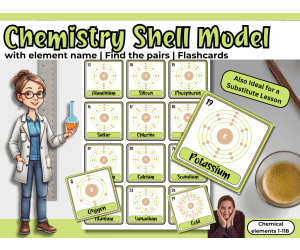
Shell Model – Chemical Elements Flashcards - Element names
STEM, Science, Chemistry, Physics, Life Sciences, Grade 7, 8, 9, 10, 11, 12, Activities, Games, Worksheets & Printables, Task Cards, Quizzes and Tests, Teacher Tools, Word Problems, Word Searches, Worksheets, Flashcards
Shell Model – Chemical Elements Flashcards 118 cards for learning the periodic table Learn atomic structure and the periodic table through play and visual learning 🧪🧠 These flashcards are designed to help students explore the structure of atoms using the shell model. Covering all 118 elements of the periodic table, each card includes the atomic number, element name, symbol, and a visual representation of the electron arrangement in shells. It’s a simple but effective tool for bringing abstract chemistry content into a more visual and interactive format. I’ve used this set in grades 7–10, both in introductory lessons and for revision. What worked especially well was printing the cards twice and using them as a memory game (“Find the Pairs”). Students match element names with their shell models or symbols – and along the way, they start to notice patterns: which elements belong to the same group, how many electrons fit in each shell, and what the outer shells can tell us about chemical reactivity. What’s included: 118 printable flashcards (PDF) – one for each element Each card features: atomic number, element name, chemical symbol, and shell model Suggestions for classroom use (games, sorting tasks, self-study) The cards can be used in a variety of ways: – As a memory game (matching name and shell model) – For group sorting activities (by group, period, metal/non-metal, etc.) – As quick quizzes in pair work – Or as visual aids when introducing atomic theory They’re suitable for different levels of difficulty. Beginners can focus on names and symbols, while more advanced students work with the shell diagrams and explain electron configurations. It’s also a helpful tool for differentiation – everyone works at their own pace, but with the same visual material. This resource comes as a PDF and is easy to print and prepare. Laminating the cards is a good idea if you plan to use them more than once. 📍 Best wishes, Heike from @Lernfitness Did You Know? I teach with a certified therapy dog, and together we create a positive and welcoming learning environment. 🐶
Author Lernfitness
Rating
Tags Educational Card Games, Chemistry, Physics, STEM Science Matching Game, Chemical Elements, Periodic Table Matching Game, Flashcards Chemical Elements, Element Names, Shell Model, Game

Country Study on Japan - Snakes and Ladders Board Game PDF
Social Studies, Geography, Grade 7, 8, 9, 10, 11, 12, Activities, Games
Country Study on Japan - Snakes and Ladders Board Game PDF This Teaching Resource is a PDF Board game (Snakes and Ladders; 3 slides) on Japan (Asia). This Printable Resource can be great for Geography and Social Studies Classes. Suitable Learners for this kind of lesson are students from 7th Grade to 12th Grade. This Geography + Social Studies game on Japan (Asia Country Study) aims to test learners on their knowledge on Japan and Japanese Culture (naming Japanese cities, telling about history events, telling about your pawn's character, telling about Famous Japanese People or telling what you would like to visit in Japan). Some preparation on Japan (East Asia) can be useful for this Social Studies Activity. Within this amazing Country Study on Japan (East Asia Country Study) board game (snakes and ladders; 3 PDF Printable slides) it is offered: 1 board with questions and Speaking Prompts (ex. naming Cities in Japan or telling about Japanese history events, Naming Japanese Cuisine's dishes, telling where you would like to go if you had to go to Japan etc) 1 Printable Craft Die with numbers written 1 Printable Craft cone to make Game Pawns to play 5 Famous People from Japan (Hayao Miyazaki, Yoko Ono, Naruhito, Meiji etc.) to stick on the printable craft cone This amazing Social Studies + Geography Country Study on Japan (East Asia) PDF Digital Teaching Resource (3 PDF Printable Slides) can be great for learners from 7th grade to 12th grade to test Japan and its Culture. Learning with Alan is a Brand New Teaching Resource, Educational Material Store whose aim is to help Teachers, Educators and Tutors to achieve their teaching objectives while creating a fun and stimulating environment. Never Forget! If you want to browse more of my Teaching Resources, click here Learning with Alan
Author Learning with Alan
Tags Asia, Japan, Japanes, Country Study, Social Studies, Geography, Snakes And Ladders, Game, Printable, Culture

Rational Numbers Safari Escape Room – Interactive Math Adventure
Math, Order Of Operations, Decimals, Fractions, Grade 7, 8, 9, Escape Room, Activities, Games, Quizzes, Quizzes and Tests, Teacher Tools, Worksheets & Printables, Worksheets
Embark on a global math safari with this exciting digital escape room for rational numbers! From Africa to Asia, South America to Australia, students complete engaging problems on fractions, decimals, negatives, and mixed operations in their quest to locate four exotic animals. With 40 problem-interactives and self-checking design, this activity is an excellent means of making rational number operations practice meaningful and fun. How It Works Students begin at the first destination and will have to solve a series of rational number problems in order to move on their quest. Once they have completed each challenge, they will be able to unlock the next destination and meet a new animal. They will have practiced all the key skills with rational numbers once they have reached the final destination. They will visit and trace: Elephant (Africa) Tiger (Asia) Macaw (South America) Kangaroo (Australia) What's Included 40 Rational Number Problems (4 sets of 10) covering: Adding & subtracting rational numbers Multiplying rational numbers Dividing rational numbers Multi-step mixed operations Self-Checking Digital Format – drag-and-drop format for instant response Printable Worksheet Version – ideal for additional practice or students without access to devices Printable Answer Key – makes grading or review easy Special Feature – Autosave & Resume Students can come and go! A "Continue" button with the same device and browser lets them pick up where they left off, perfect for multi-day projects or those who finish early. Skills Taught: Adding & subtracting rational numbers (fractions, decimals, integers) Multiplying and dividing rational numbers Solving multi-step, mixed rational number problems Building fluency and confidence with operations with rational numbers Aligned to CCSS 7.NS.A.1–3 Ideal For: 7th Grade Math – Rational Numbers Unit Math stations or centers Digital days of learning Spiral review or test preparation Sub plans or enrichment Turn rational number practice into a global safari adventure! Students will love going on new adventures while overcoming math obstacles, and teachers will enjoy the no-prep, ready-to-go resources. Add to your cart today and make rational numbers practice enjoyable and efficient!
Author Matemaths
Rating
Tags Matemaths, Escape Room, Safari, Math, Middle School, Rational Numbers

Plant Anatomy and Photosynthesis - Find the Pair Game - Middle School Science
Science, Life Sciences, Biology, Nature & Plants, Grade 6, 7, 8, 9, Activities, Games, Worksheets
This is an engaging and enjoyable memory game on plant parts and photosynthesis. Pupils work in teams of three or four. Each team lays out their 42 cards face down in a square and take it in turn to turn over two cards. If the cards are a question and its correct answer, the pupil keeps the pair. If they are not a match they are turned face down and the next pupil gets a turn. This process continues until all cards are matched and the winner is the pupil with the most pairs. If a team member thinks that the selectors pair is not a correct match, they can challenge. Pupils are encouraged to check their books for the correct answer but the teacher also has a quick-check answer sheet. If the challenge is correct, the challenger keeps the pair. Included in this Pack. 42 question and answer cards Teacher’s answer sheet. Instruction sheet Preparation · Use double-sided printing to copy 1 set per group of 4 pupils. · Sheets could be laminated to enable year-on-year use. · Cut sheets into cards. Prior Knowledge Required · Root, stem and leaves are organs and the flower an organ system. · Functions of the root, stem, leaf and flower. · The terms transpiration, guard cells, stomata, xylem, phloem, chlorophyll, chloroplast and photosynthesis. · Parts of the flower; · The ovule and pollen grain as the female and male reproductive cells. · Role of played by xylem, phloem, guard cells, stomata and chloroplasts in photosynthesis. · Word equations for photosynthesis and respiration. · Comparison of photosynthesis and respiration. · Glucose converted to insoluble starch for storage on root. See more Elf Off the Shelf resources on this topic and many others
Author Elf off the Shelf Resources
Tags Plant Anatomy, Plant Photosynthesis, Photosynthesis Game, Find The Pair Game, Biology Game

Abandon Ship! Titanic Social Stratification Game
Social Studies, History, Psychology, Grade 7, 8, 9, 10, 11, 12, Games, Activities
Abandon Ship! Titanic Social Stratification Game is an immersive role-playing activity where students decide which passengers get a spot in the limited lifeboats as the Titanic sinks. Students are split into groups and assigned character sheets with information about fictional passengers' identities and backgrounds. Each group must collaborate and decide which 5 of the 8 characters to "save" based on the limited information they are given about each person. This activity sparks thoughtful discussions around social stratification, privilege, discrimination, and more while also working on teamwork and decision-making skills. Most importantly, students find this activity highly engaging as they take on the roles of Titanic passengers fighting for survival. This versatile 25+ page teaching resource can be used as a standalone activity or supplement lessons on the Titanic, social stratification, ethics, discrimination, psychology and more for grades 7-12.
Author Ed Dynamic
Tags Social Stratification, Privilege, Ethics, Teamwork
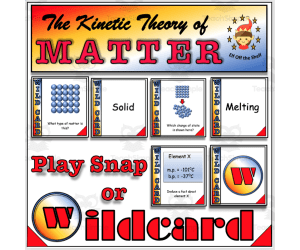
Kinetic Theory of Matter, Staes of Matter, Change of State - Wilcard and Snap Card Games for Middle School
Science, Physics, Grade 5, 6, 7, 8, 9, Activities, Games
Kinetic Theory of Matter, States of Matter, Change of State - Wildcard and Snap Card Games for Middle School An engaging teaching resource designed to help students reinforce their knowledge about the three states of matter - solid, liquid and gas. This science-focused game pack aids learners in understanding essential principles such as the arrangement of particles in different matter states, properties relating to particle arrangement, changes including sublimation and gas pressure dynamics. Designed primarily for middle school pupils - grades 5 through 9. These card games are highly versatile. They can be introduced during whole-class sessions for an interactive group project or during smaller learning pod activities to stimulate communication and team-solving skills. The set comprises two distinct games: wildcard and snap. Accompanied by a lively PowerPoint animation providing clear instructions to facilitate smooth game sessions. A refreshing break from typical textbook-based lessons without compromising on academic objectives. Homeschooling Tool: This teaching material marries education with recreation forming an ideal tool for homeschoolers seeking practical resources that nurture children's enthusiasm towards science while refining critical thinking abilities along joyful paths! To Summarise: Included is a comprehensive set boasting 102 playing cards packed into a single user-friendly Zip file ensuring convenience for busy educators who don’t wish to compromise on quality instruction techniques or subject variety within their curriculum . An energy-filling wild card & snap card games focusing on kinetic theory which is a great way toward vibrant classrooms reflecting engaged learners!
Author Elf off the Shelf Resources
Tags Kinetic Theory, States Of Matter, Change Of State, Particle Arrangement, Interactive Learning

Plant Anatomy and Photosynthesis Dominoes Game - Middle School Science
Science, Life Sciences, Biology, Nature & Plants, Grade 6, 7, 8, 9, Activities, Games, Worksheets
Plant Anatomy and Photosynthesis Dominoes Game for Middle School Science Navigating the world of plants becomes fun, educative, and interactive with the Plant Anatomy and Photosynthesis Dominoes Game. Ideal for public school teachers or homeschooling parents, this game serves as a comprehensive teaching tool for students in Grades 6 through 9. About the game This resource blends learning with play effectively by incorporating plant anatomy and photosynthesis into a dominoes game. It consists of 90 dominoes, each carrying either a word related to plant functions or questions/answers about them. Coverage of Topics The different parts of plants such as roots, stems, leaves and flowers Concepts like transpiration, guard cells stomata xylem phloem chlorophyll chloroplasts The process of photosynthesis. In addition to this, basic functions like glucose conversion into insoluble starch for storage in roots are covered along with more complex topics such as comparison between respiration and photosynthesis Interactive Nature A unique feature is an animation-enhanced PowerPoint that explains how to play the game. This resource encourages interaction making it ideal both individually or group settings. The competitive nature promotes peer-to-peer learning boosting their independent research skills. Focusing on Real-Life Scientific Processes An important aspect about this product is its emphasis on real-life scientific processes such as photosynthesis respiration comparative analysis between two Among educational games available market Plant Anatomy serves not only educational tool but also innovative way keep classroom engrossed science subject matter . It strikes balance between being educational entertaining at same time. Conclusion This game promises not only a learning experience but also a fun, interactive approach to mastering essential topics within the school curriculum. Whether used as a whole-class instruction tool, for small-group collaboration, or even as homework assignment – it supports a diverse range of digital platforms providing an easy to use application.
Author Elf off the Shelf Resources
Rating
Tags Plant Anatomy, Photosynthesis, Middle School Science, Educational Game, Interactive Learning
Scratch: Walking, Running, Jumping and Ground (Game Mechanics #2)
Science, Technology, Computer Science, Grade 3, 4, 5, 6, 7, 8, 9, 10, Games, Activities
Scratch: Walking, Running, Jumping and Ground (Game Mechanics #2) This educational resource is primarily designed for educators seeking to instruct their students about the fundamentals of sprite movement in game development. Teachers can delve into the realms of computer science by demonstrating how to animate characters that can walk, run and jump realistically within a digital environment. The guide acquaints learners with not only movement but also showcases how they can implement a basic 'ground' guide ensuring that any jumps made by a character are met with a tangible surface governed by gravitational principles. Note that it's crucial for students to familiarize themselves with Scratch before diving into this product. This ensures maximum benefit from these comprehensive lesson plans while successfully expanding their knowledge base about Scratch game mechanics. Ideal Teaching Tool This product serves as an ideal teaching tool for both public school teachers and homeschoolers alike. It could be integrated within: Whole group sessions Sessions within smaller classroom clusters focused on more individualized learning Homework assignments About The Product: 'Scratch: Walking, Running, Jumping & Ground – Game Mechanics #2' is packed full of useful insights guaranteed to captivate young technophiles engaging in Computer Science studies. It shines due its diverse applicability across multiple education settings making it a remarkable addition to any modern-day educator's toolkit.
Author Roombop
Tags Sprite Movement, Game Mechanics, Animation, Computer Science, Educational Resource

Magnets and Electromagnets 42 Question Board Game
Science, Physics, Grade 5, 6, 7, 8, 9, Activities, Games
With 42 question cards on permanent magnets and electromagnets this is an enjoyable and challenging board game for up to six players per set. It is suitable for all abilities. It can be played at the end of a module on electricity and electromagnets but is also a very useful test prep tool. This game is so much fun, pupils will forget they are learning! What You Get Game board (color and black and white) 42 question cards with questions of varying degrees of difficulty Answer sheet Instruction sheet. Rules for Play The player who throws the highest score starts and play proceeds in a clockwise direction. Students take turns and work their way around the board following the instructions in the squares. Some squares tell the student totake a question card from the face down pile. If correct they move on 2 spaces. If a player thinks an answer given by an opponent is incorrect they can challenge. If the challenge is correct the challenger moves forward 2 spaces. If the challenge is wrong the challenger moves back two spaces. In the event of a challenge, pupils are encouraged to consult their books but the teacher has a quick-check answer sheet. Prior Knowledge Required Composition of Magnets: Magnets are constructed using magnetic materials. Common materials include Iron, Cobalt, Nickel, and their corresponding alloys. Pole Interactions: Magnets have two types of poles - North and South. When two like poles (e.g., North and North) come close to each other, they repel. Conversely, when opposite poles (e.g., North and South) are brought together, they attract each other. Magnetic Fields: Surrounding every magnet is an invisible force field known as the magnetic field. This field can be visualized through field lines. Field Line Density: The density of these field lines determines the strength of the magnetic field. A region with closely spaced field lines indicates a stronger magnetic field than a region where they're spread out. Visualization of Field Lines: It's essential to understand and recognize the pattern of field lines around two bar magnets, especially when they have the same or opposite poles facing each other. Field Strength at Poles: The magnetic field is strongest at the poles of a magnet due to a higher concentration of field lines. Distance and Field Strength: The strength of the magnetic field diminishes as one moves farther from the magnet. Direction of Field Lines: Field lines emanate outward from the magnet's south pole and point inward toward the north pole. Magnetization Process: When a non-magnetized magnetic material becomes a magnet, the tiny regions within it called domains, which were initially oriented in random directions, align themselves to point uniformly in the same direction. Earth's Magnetic Properties: The Earth behaves like a large magnet. Interestingly, there appears to be a south-type magnetic pole near the Earth's geographic North Pole and a north-type magnetic pole near the Earth's geographic South Pole. Application in Devices: It would be beneficial to have a basic understanding of how magnets and magnetic fields operate within certain devices. Familiarize yourself with the structure and functioning of electric bells, relays, and circuit breakers, as they use these principles. See more Elf Off the Shelf resources on this topic and many others.
Author Elf off the Shelf Resources
Tags Magnets, Electromagnets, Magnetic Materials, Magnetic Fields, Earths Magnetism , Electric Bell, Electric Relay, North And South Poles, Magnetic Fileld Lines, Magnetism Game

English Numbers 0-10, Colors, and Patterns Vocabulary Game
Life Studies, ELA, Language Development, Pre-Reading, ESL, Reading, Vocabulary, Kindergarten, Preschool, Grade 1, 2, 3, 4, 5, 6, 7, 8, 9, 10, 11, 12, Teacher Tools, Presentations, Activities, Games
Vocabulary practice made fun! This English #vocabulary #game practices 24 high-frequency #number #color and #pattern words. Editable pages make it easy to add in extra words your learners are working on. Learners will practice reading the sentence and question, "I have____. Who has?" Then classmates will search their cards to see if they have the number, color, or pattern in question! Repeated exposure is necessary for vocabulary retention. In addition, a QR code has been provided in the instructions. Simply point your phone or computer camera at the code to open a link to the Google Slides presentation. Pull up the corresponding photo for each vocabulary word to expose learners to 2+ photos of the object in question. It's common knowledge that while tangible objects are best, realistic photos are next-best when teaching vocabulary. No more clip art or cartoons here! Use the realia presentation to introduce the vocabulary words as well as to support learners during the game. Play multiple rounds, and shuffle well to give extended practice! With a minimum of 2 players, this game is perfect for pairs, small group, or whole-class practice with up to 24 players! Words included in this pack are: one, two, three, four, five, six, seven, eight, nine, ten, red, orange, yellow, green, blue, purple, pink, brown, black, white, dots, stripes, and zig zags. This PDF download includes game instructions, the easy to use QR code link to the realia presentation, three pages to print, as well as a blank page for you to add in additional vocabulary words and drawings! Be sure to check out additional "I Have, Who Has" vocabulary games in English, French, and Spanish: School and Classroom, Calendar: Days, Months, & Seasons, Food & Drink, Numbers 1-10, Colors, and Patterns, Weather & Landforms! Got questions or a request? Let me know! Get in touch on socials at @melissaisteaching.
Author Melissa Is Teaching
Tags Vocabulary, Colors, Numbers, Patterns, English Vocabulary, ELL Vocabulary, Esl Vocabulary

Who Has the Lab Equipment? – Interactive Science + Chemistry Game
STEM, Science, Chemistry, Physics, Life Sciences, Special Education Needs (SEN), Special Resources, Research, Biology, Homeschool Templates, Grade 6, 7, 8, 9, 10, 11, Activities, Games, Worksheets & Printables, Task Cards, Quizzes and Tests, Teacher Tools, Quizzes, Word Problems, Word Searches, Worksheets
Who Has the Lab Equipment? – A Fun & Engaging Science Game for the Classroom 🔬 Turn Science Learning into an Interactive Adventure! Helping students learn laboratory equipment doesn’t have to be tedious. With "Who Has the Lab Equipment?", you can bring hands-on engagement and excitement into your chemistry, physics, or biology classroom! This fast-paced call-and-response game is perfect for reinforcing lab tools and key scientific terminology while encouraging active participation and teamwork. 🎯 Why Teachers Love This Game ✅ Boosts Student Engagement – Keeps students actively involved instead of passively memorizing vocabulary. ✅ Encourages Collaboration – Supports teamwork, communication, and critical thinking. ✅ Differentiated Learning – Includes three levels to accommodate students of all abilities. ✅ Perfect for Science Lessons – A great addition to chemistry, physics, and biology classes. ✅ Low-Prep & Classroom-Friendly – Just print, cut, and play! 🧪 What’s Included? 🃏 90 Total Cards – 3 differentiated sets of 30 cards each: ✔ Level 1: Terms with visual aids – perfect for beginners. ✔ Level 2: A mix of terms and images – great for building recognition. ✔ Level 3: Visuals only – students must recall and name the equipment independently. 📌 How to Play 1️⃣ Distribute the Cards – Each student gets one or more cards. 2️⃣ Start the Game – The student with the first card reads aloud: "I have the test tube. Who has the test tube rack?" 3️⃣ Find the Answer – The student with the correct response answers and then reads the next prompt. 4️⃣ Keep Going! – Play continues until all cards have been matched. 💡 Bonus Challenge: Encourage students to use complete sentences when responding to reinforce scientific communication skills. 🌟 Why This Game is a Must-Have for Science Teachers ✔ Versatile Use – Works as a lesson starter, review activity, or quick filler for substitute plans. ✔ Supports Multiple Learning Styles – Helps visual, auditory, and kinesthetic learners grasp key concepts. ✔ Perfect for Science Centers – Ideal for small groups or whole-class activities. ✔ Durable & Reusable – Laminate the cards for long-lasting classroom use. 🔬 Make Science Learning Engaging and Memorable! If you're looking for a fun, effective, and interactive way to teach students about laboratory equipment, this game is the perfect resource for your science classroom. 🚀 Download now and bring interactive learning into your chemistry, physics, or biology lessons! 📍 Best wishes, Heike from Lernfitness Did You Know? I teach with a certified therapy dog, and together we create a positive and inspiring learning environment. 🐶✨
Author Lernfitness
Tags Game, Educational Card Games, Chemistry, Lab, Biology, Laboratory Equipment, Lab Tools, Physics, STEM Science Matching Game, Who Has It?

Presidential Election Process Vocabulary Game
Social Studies, Government, Grade 4, 5, 6, 7, 8, 9, 10, 11, 12, Activities, Games
Presidential Election Process Vocabulary Game : An Exhilarating Educational Resource This exciting teaching tool is catered towards students from Grade 4 to Grade 12 studying Social Studies. Pillars of The Game : Furthers the understanding of the presidential election process. Incorporates engaging key terms related to governance (Example: President, Democrat, Republican, etc.). 15-page long detailed instruction and game in PDF format. Versatile enough for a Games Notebook setup or as an independent activity. Set-Up Instruction: All you need to ready this game is a simple print-out of the pdf file followed by preparation based on outlined instructions in it. Versatility In Execution: This game is designed keeping individual pedagogical requirements in mind and thus facilitates execution through whole classroom engagements or small group-centric interactions. Additionally, it can be assigned as homework for more practice outside school surroundings. Beyond Just A ' Game ': The Presidential Election Process Vocabulary Game presents learning through stimulative engagement unlike traditional methods. Due its collaborative nature, it promotes interaction amongst peers making education a fun-filled experience while imbibing values beyond textbooks thereby culminating into holistic development.
Author Knowledge Box Central
Tags Presidential Election, Vocabulary Game, Social Studies, Government Education, Democracy
Free Construction Hangman Game to Practice Vocabulary
Special Resources, Grade 7, 8, 9, 10, 11, 12, Games, Activities
Construction Vocabulary Words to Review and Reinforce Definitions of the CTE curriculum . Students will learn and practice Construction terms through definitions and characteristics. The engaging activity promotes collaboration and class discussion as students review terms of Construction tools, machinery, and more with multiple visuals and learning formats like multiple choice questions, memory games, hang-man, and others. This versatile resource can be used for whole-group instruction, small-group practice, or independent work, just practice the words and then review them by choosing the correct letters, it will self-correct you until you choose the correct ones. Students will learn important terms related to the construction industry while having fun playing hangman. The game reviews 17 key vocabulary words through slides and an end-of-presentation game. To play, students guess letters to try to reveal the mystery word. If they guess incorrectly, part of the "hangman" is drawn. Guess all the letters correctly before the hangman is fully drawn to win! This supplemental resource helps build pronunciation, spelling skills, concentration, and construction industry knowledge. Practice Construction Vocabulary with this Free Interactive Game Introduce young learners to a variety of tools and machinery with this entertaining digital game. Students will see the names and images of different tools; exercising visual memory and concentration. This self-checking activity can be played independently or as a whole class game projected on a smartboard. The vibrant slideshow stimulates engagement while building construction classification skills. students will build their knowledge of important terms and definitions while having fun playing games. This activity stimulates intelligence, builds concentration, reinforces letter recognition, improves spelling and pronunciation, and engagingly expands vocabulary. It's a perfect supplement for any Construction lesson. Check our shop, material, and products for more interactive construction vocabulary reviews covering other topics like human microbiome, metabolism, and more grade levels in science and Spanish language arts. Download this versatile 17-slide PowerPoint today!
Author ShapeUp-N-Matematicas y Lenguaje
Tags Construction, Construction Equipment, Construction Tools And Instruments, Construction Machinery, Construction Material, Construction Workers, Construction Safety Gear

Country Study on Jaoan - Guess Who Game on famous Japanese People
Social Studies, Geography, History, History: Asian, Grade 6, 7, 8, 9, 10, 11, 12, Activities, Games
Country Study on Jaoan - Guess Who Game on famous Japanese People This Teaching Resource is a fun Guess Who Game PDF (1 slide, 15 cards) on Famous Japanese People. This Printable Resource can be great for Geography, Asian History and Social Studies Classes. Suitable Learners for this kind of lesson are students from 6th Grade to 12th Grade. This Geography + Social Studies Guess Who Game on Famous People from Japan (Country Study) aims to introduce learners to Japan (Asia) and its most famous Japanese People (leaders, writers, inventors, film makers, emperors etc.). Little Preparation is needed for this Social Studies + Geography Activity. Some of the Japanese People selected for this Geography + Social Studies Country Study on Japan are: Haruki Murakami (Writer) Hayao Miyazaki (Academy Award film maker and animator) Banana Yoshimoto (Writer) Naruhito (Emperor) Yoko Ono (artist) Naomi Osaka (Tennis Player) Yuko Shimizu (Hello Kitty Creator) Shigeru Miyamoto (Super Mario creator) Michio Suzuki (Inventor, industrialist and businessman) and many more! A very fun and engaging way to play this "Guess Who on Famous People from Japan" (country study on Japan) game can be the following: all Learners sit on the floor in a circle every Learner has a Flash Card on their face every Learner/player asks a question about their Flash Card 's famous Japanese person This Social Studies + Geography Country Study on Japan PDF Printable Teaching Resource (1 slide, 15 cards for 15 Famous People from Japan) can be great for learners from 6th grade to 12th grade to introduce Japan and its Culture through its most important and celebrated people. Learning with Alan is a Brand New Teaching Resource/Educational Material Store whose aim is to help Teachers, Educators and Tutors to achieve their teaching objectives while creating a fun and stimulating environment. Never Forget! If you want to browse more of my Teaching Resources, click here Learning with Alan!
Author Learning with Alan
Tags Asia, Asian, Japan, Japanese, Country Study, Social Studies, Geography, Asian History, Guess Who, Game
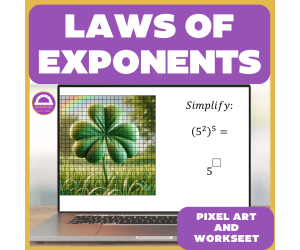
Exponent Rules - Laws of Exponents Pixel Art
Math, Geometry, Algebra, Grade 7, 8, 9, Activities, Games, Worksheets & Printables, Task Cards
Need a brief and interactive method to reinforce the exponent laws? This self-assessment digital pixel art activity and printable worksheet turn exponent practice into an interactive, low-prep, and fun experience! With only 10 clearly written questions, this resource is mapped to guide students to become proficient with exponent rules without getting overwhelmed. It's an ideal warm-up, exit ticket, or fast review task—maintaining meaningfulness and efficiency in learning while guaranteeing that students receive the practice they require. What's Included? ✔️ Self-Checking Digital Pixel Art Activity (Google Sheets) Students input their answers, and the correct ones uncover a surprise pixel art image. Instant feedback keeps students engaged and encourages independent learning. ✔️ Printable Worksheet (PDF) Same 10 exponent rules questions, but printable—ideal for classwork, homework, or added practice. Ideal for math stations, spiral review, or quick assessments. ✔️ Answer Key Saves your time grading! Exponent Rules Addressed Product of Powers Quotient of Powers Power of a Power Why You'll Love This Resource No-Prep & Time-Saving Just distribute the digital version or print the worksheet—no extra prep required! The digital pixel art activity is self-grading, so students get immediate feedback, and you don't have to manually grade every response. Engaging & Motivating Children love watching the pixel image come alive as they solve each problem correctly. The gamification built in makes practice a game, not tedium! Adjustable & Adaptable Use this resource for: ✅ Warm-ups – A quick, engaging means of starting class. ✅ Exit tickets – Assure understanding within minutes. ✅ Spiral review – Brush up on exponent rules without overwhelming students. ✅ Independent practice – Perfect for independent learning. ✅ Home practice or extra credit – Give students a fun way to practice at home. Perfect For: ✔️ 8th Grade Math, Pre-Algebra, & Algebra 1 ✔️ Teachers of interesting, no-prep resources ✔️ Students who need more practice with exponent rules ✔️ Math centers, stations, or quick assessments Make Exponents Fun & Easy! With this downloadable worksheet and fun pixel art activity, students can easily learn exponent rules while experiencing a stress-free learning process. For a fast review, independent practice, or math warm-up fun, this content is designed to save you time and build student confidence.
Author Matemaths
Tags Pixel Art, Interactive Activity, Digital Learning, Matemaths, Task Cards, Printable, Digital, Algebra, Geometry, Pythagorean Theorem
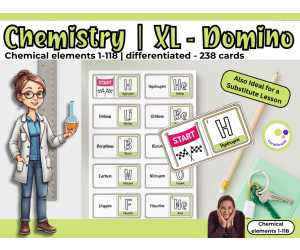
XL Domino – Chemical Elements 1–118 | exploring element names + symbol
STEM, Science, Chemistry, Physics, Life Sciences, Montessori, Basic Science, Grade 7, 8, 9, 10, 11, 12, Activities, Games, Worksheets & Printables, Task Cards, Quizzes and Tests, Teacher Tools, Word Problems, Flashcards, Escape Room, Experiments
XL Domino – Chemical Elements 1–118 An interactive domino game for exploring element names and symbols 🧪🎲 This printable XL domino game offers a fun and flexible way for students to practice the names and symbols of all 118 chemical elements. Designed for use in grades 7–10, this resource supports both introductory lessons and ongoing review in chemistry class. Whether used in small groups, as a full-class activity, or even spread out along the hallway floor, it encourages active learning and collaboration. Each card features either the name or the symbol of a chemical element. By matching these correctly, students build a long domino chain – all while reinforcing their knowledge of atomic numbers, symbols, and the layout of the periodic table. What’s included: 238 printable domino cards (PDF format) Two complete versions of the game (119 cards each): – Beginner version: element names on both sides – Advanced version: name on one side, symbol on the other Covers all elements from hydrogen (1) to oganesson (118) Tips for setup and gameplay included How I’ve used it: This game works well before introducing the periodic table in depth. It gives students time to get comfortable with element names and symbols in a low-pressure setting. The larger card format makes it ideal for group work or movement-based activities, such as arranging the cards on the floor or in the hallway. Why it works: The visual repetition and active gameplay help students internalize key facts more effectively than passive memorization. Group dynamics also support peer learning – students naturally help each other recall unfamiliar elements. And because it feels like a game, students stay engaged longer and show more willingness to participate. The material is easy to prepare: print, laminate if you like, and cut out the cards. From there, you can adapt it for differentiated learning levels or turn it into a competitive classroom challenge. This is not just a game – it’s a versatile teaching tool that brings the periodic table to life. 📍 Best wishes, Heike from @Lernfitness Did You Know? I teach with a certified therapy dog, and together we create a positive and welcoming learning environment. 🐶
Author Lernfitness
Rating
Tags Educational Card Games, Chemistry, Physics, STEM Science Matching Game, Chemical Elements, Periodic Table Matching Game, Game, Domino, Differentiation

The Road to Revolution Diplomacy Game: Round #4 - The Coercive Intolerable Acts
Social Studies, History, History: USA, Grade 9, 10, 11, 12, Activities, Games
Sure, here it is: The Road to Revolution Diplomacy Game: Round #4 – The Coercive Intolerable Acts A valuable teaching resource that helps students experience the tumultuous era between the French and Indian War and the American Revolution. This activity provides an authentic learning experience for 9th-12th grade Social Studies students , more specifically those studying USA History. Game Objectives This game has value either as an individual lesson or as part of a four-part lesson series called the Road to Revolution Diplomacy Game. Participants assume leadership roles representing either colonial assemblies, British parliament or potentially even as the king. These roles are instrumental in exploring significant events from 1773 and 1774. The Boston Tea Party Introduction of Coercive Acts also known as 'Intolerable Acts' Students will then develop innovative solutions and strategies specific to their sides' objectives. Fostering Critical Thinking The focus is how political leaders made critical decisions during this era in history. Replicating these experiences in a classroom setting encourages active learning about historical events like Massachusetts's reaction to Great Britain's punitive measures & formation of First Continental Congress.. Students can solidify their understanding by creating official documents, letters, acts such crafting way forward, meditating on this time frame sparking critical thinking about present-day governance issues and diplomatic solutions making it apt both for group activities or homework assignments ensuring knowledge retention. Digital Integration & Materials Provided: With downloadable Word docs and PDF files included with purchase. ∟Technological integration makes distribution via digital classrooms easier. ∟Printable versions are provided for traditional forms of schooling. ∟Seamlessly converges historical studies with today’s technology-centric education methods. Overall The Road to Revolution Diplomacy Game: Round #4 – The Coercive Intolerable Acts offers an interactive learning encounter, enabling students to not just study history but immerse them in the thought processes and diplomatic discussions that shaped an epoch, molding future leaders.
Author BCM Creations
Tags Revolution, Diplomacy, Coercive Acts, American Revolution, Historical Learning

Zombie Government! (An engaging government simulation on the role of government)
Social Studies, History, History: USA, Government, Grade 7, 8, 9, 10, 11, 12, Activities, Games
Zombie Government! is an engaging government simulation that puts students in charge of a quarantine zone (QZ) facing a zombie apocalypse. Students must make difficult decisions about how to govern the QZ, keep citizens safe, and distribute limited resources. This interactive game allows students to explore the roles and responsibilities of government through simulated scenarios involving potential rebellions, food shortages, corruption, and more. The simulation encourages collaboration, critical thinking, and problem solving as students navigate complex situations. This bundle from experienced educators includes detailed teacher guides, slides, and both digital and printable student workbooks to support implementation. Zombie Government helps students gain firsthand experience with the real-world challenges of leadership and governance.
Author Ed Dynamic
Tags Government Simulation, Social Studies Games, Leadership Activities, Critical Thinking
The Road to Revolution Diplomacy Game: Round #3 - The Incident on King Street
Social Studies, History, History: USA, Grade 9, 10, 11, 12, Activities, Games
The Road to Revolution Diplomacy Game: Round #3 - The Incident on King Street This an engaging teaching resource that draws students right into the heart of American history. It transports them back to the pivotal night of March 5th, 1770—'The Incident on King Street' or as it was referred to by the colonists, 'a massacre'. Gameplay and Educational Highlights Role-play: Students can take on roles as historical figures from both colonial assemblies and British Parliament. Real-world Scenario: They will respond and react to actual events from history. Creativity encouraged: Learners can create official documents, formulate Acts that align with their respective teams' strategies. They also get the chance to develop news articles or other forms of communication that serve their cause. This interactive game not only serves as a dynamic approach towards teaching US History but also instills valuable skills such as leadership and collaboration among students. Educational Suitability This gaming resource is aptly tailored for secondary school learners studying in grade 9 through grade 12. It's especially recommended for those who prefer active participation rather than passive textbook learning. Add-on Benefits An integral part of a four-part series—the 'Road To Revolution Diplomacy Game' Included are three Word docs and one PDF which provide useful guides throughout this historical journey. Fostering initiative driven leadership skills through decision-making process under pressure . In conclusion, The Road to Revolution Diplomacy Game: Round #3 - The Incident on King Street is the perfect blend of factual, knowledge-based learning and friendly competition that will surely engage students' interests.
Author BCM Creations
Tags Road To Revolution, US History, Diplomacy Game, Interactive Learning, Colonial Assemblies

Create A Candidate (Engaging Local Election Simulation)
Social Studies, History, History: USA, Government, Grade 7, 8, 9, 10, 11, 12, Activities, Games
Create A Candidate is an engaging civics simulation where students run for local office in the fictional town of Genericburg. Students review background information and statistics about issues facing the town. Then they create a candidate profile, choosing their background and political positions. Students decide what policies and changes their candidate will campaign on to address Genericburg's problems. They strategize how their candidate will appeal to voters and budget fundraising and spending. Create A Candidate builds critical thinking as students identify effective solutions for the town's issues. This activity covers key civics and government content in an interactive way. The resource includes a slideshow explaining the simulation, teacher's guide, and student workbook with print and digital versions. Create A Candidate transforms a civics lesson into an exciting political campaign where students roleplay candidates aiming to win an election and improve a community.
Author Ed Dynamic
Tags Civics, Government, Campaign, Election, Roleplay
Atoms: Atomic Theory and Structure - Device-Based Scavenger Hunt Activity
Science, Chemistry, Grade 7, 8, 9, 10, 11, Activities, Games
Atoms: Atomic Theory and Structure - Device-Based Scavenger Hunt Activity. This activity is the coolest thing I've created and your kids are going to love it, mine do. Think of a scavenger hunt, then add devices (Smartphones, Chromebooks, Laptops, or Tablets), engaged students, and learning through assessment and you have this resource. ********************* Quick Disclaimer. In order to use this activity, your classroom must have at least 1 device per 3 students. Smartphones, Chromebooks, Laptops, and Tablets will all work perfectly. The Content Includes: • Atomic Theory --> Contributing scientists --> Historical theories • Atomic Structure --> Protons --> Neutrons --> Electrons --> Particle location and charge • Atoms visualization and application Here's how you implement them: • Print the QR codes and place them around the room • Place your students into groups • Let them loose! They move from Location to Location as they complete their tasks. Each Task is assigned by scanning the QR code and there are 5 Tasks per Scavenger Hunt Activity. • Have them submit their answers directly to your email via a form on my website. ********************************************************************** I've created a video that walks you through the entire activity. I did it using screen capture software on my phone so you can see exactly what your students will see. CLICK HERE to have a look . ********************************************************************** This activity: • Lets your students utilize their devices • Cuts down on wasted paper • Combines learning with assessment • Is a lot of fun • Comes in both Word and PDF formats Each Hunt is different and offers a unique way for your students to explore the topic. From Hunt-to-Hunt, possible tasks your students will face include: • Video analysis • Simulations • Fully automated and marked Quiz • Finish the story • Start the story • Calculations • News article • Opinion • Word scramble • Short answer • Web research Buyer Comment: "Really fun activity for high school being all students have a phone" --------------------------------------------------------------------------------------------- There are other Hunts as well and I'm continually adding more. Currently, the Hunts I have available include: Biology: • Cell Organelles • The Digestive System • The Circulatory System • Biochemistry - Macromolecules • Photosynthesis and Cellular Respiration • Mitosis and Cell Division • Cells and the Cell Theory – A Device-Based Scavenger Hunt Activity Ecology: • Energy Flow in Ecosystems • Invasive Species • Photosynthesis and Cellular Respiration • Cycling of Matter in Ecosystems • Ecosystems and Ecological Succession Space and Earth Science: • The Seasons • Our Solar System • The Moon • The International Space Station - Meeting Our Needs • Climate Change Electricity: • Static Electricity • Electricity Generation Chemistry: • Atoms: Atomic Theory and Structure • Physical and Chemical Changes • Elements and the Periodic Table • Chemical Reactions • Types of Chemical Reactions and Balancing • Acids, Bases and pH Physics: • Friction • Energy Transfer --------------------------------------------------------------------------------------------- Also, please visit my website Teach With Fergy for my thoughts on teaching, learning and everything in between.
Author Teach With Fergy
Tags Atomic Theory Assessment, Atoms Printable, Chemistry Scavenger Hunt, Digital Scavenger Hunt, Science Games, Atomic Theory Activity

Video Game Design Planner
Creative Arts, Art, Graphic Arts, Grade 7, 8, 9, 10, Games, Activities
As you introduce and review new topics with your art students, you may want to ensure that you have quality resources that will allow them to express their understanding of the concept. Art can be concrete and abstract simultaneously! Because of this, we want to assess mastery in the best ways we know how. We can do this when we present hands-on and engaging lessons and instruction to our students. This is aVideo Game Design Planner – Planning Your Video Game Code.Itis an editable presentation that can be accessed through Microsoft or Google. It consists of 4 slides. The objective is for students to be able to successfully plan the code for their own video game. The presentation breakdown is as follows: Slide 2 – Fully editable planning calendar for students to change the dates and type in text boxes. Slide 3 – Fully editable planning calendar for students to change the dates and type in text boxes. Slide 4 – Coding Rubric. Slide 5 – Design Rubric. Each rubric will score 4 different things. Coding Rubric: --Algorithms & Control Structures --Thinking & Creativity --Communication & Clarity --Program Development Design Rubric: --Animation & Design --Thinking & Creativity --Communication & Function --Principles, Elements & Style This can be used with middle and high school art students. I hope you enjoy! Take A Look at My Best Sellers: Book Club, but with a twist! Elements of Art Lesson Coding Video Games Animal Dominoes Game Coloring Lesson for Middle School Digital Portraits Lesson You can find more resources at my storefront here: https://teachsimple.com/contributor/resource-garden
Author Resource Garden
Tags Video Games, Graphic Arts, Coding Lesson, Coding Activities, Video Game Design, Graphic Organizer, Design Planner, Video Game Coding
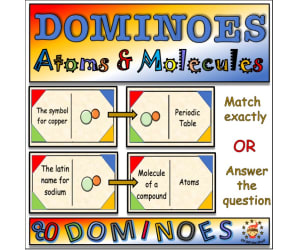
Chemistry - Atoms and Molecules Dominoes
Science, Chemistry, Grade 6, 7, 8, 9, Activities, Games
A dominoes game with questions and statements on forces and weight and mass instead of answers. Prior Knowledge Atoms are the building blocks of elements. All the atoms of one element are the same but are different to the atoms of other elements. Atoms combine to form molecules. If combining atoms are from the same element, a molecule of an element is formed but if they are from different elements, a molecule of a compound is formed. An element contains only one type of atom. A compound contains two or more different types of atom combined together chemically. Elements are listed in the periodic table. Each element has its own symbol. Some symbols are the capitalized first letter of the name of the element . Some symbols have two letters from the name with only the first capitalized. Some symbols are taken from the Latin name of the element. What You Get 80 dominos Animated PowerPoint explaining the rules and how to play. Rules of the Game Each player selects seven dominos from the top of the face-down pile and holds them in their hand like playing cards. The player whose surname begins with a letter closest to the letter A starts and play proceed in a clockwise direction. Dominos can be matched exactly, or a name can be matched with a symbol or descriptions, sketches and circuit diagrams can be matched. If a player thinks a match is wrong, they can challenge. If the challenger is correct, they give a card from their own hand to the challenged player. If the challenged player is correct, they give a card from their hand to the challenger. Pupils are encouraged to check their books for the correct answer and consult their teacher if a consensus is not reached. If a player cannot play a domino, they pick up from the face down pile and can play if possible or add it to their hand. See more Elf Off the Shelf resources on this topic and many others
Author Elf off the Shelf Resources
Tags Chemistry Game, Chemistry Dominos, Atoms Handout, Molecules Game, Science Dominoes