
Reading & language
More Tape Diagram Problems
A tape-diagram ratio word-problem worksheet (CCSS 6.RP.3) for review, assessment, or small-group intervention, using fairy-tale/nursery-rhyme characters.
Answers included




Classroom resources
Browse by lesson focus
Choose the topic or kind of practice you need.
Showing 313–336 of 2703 resources

 Show filters
 A tape-diagram ratio word-problem worksheet (CCSS 6.RP.3) for review, assessment, or small-group intervention, using fairy-tale/nursery-rhyme characters.
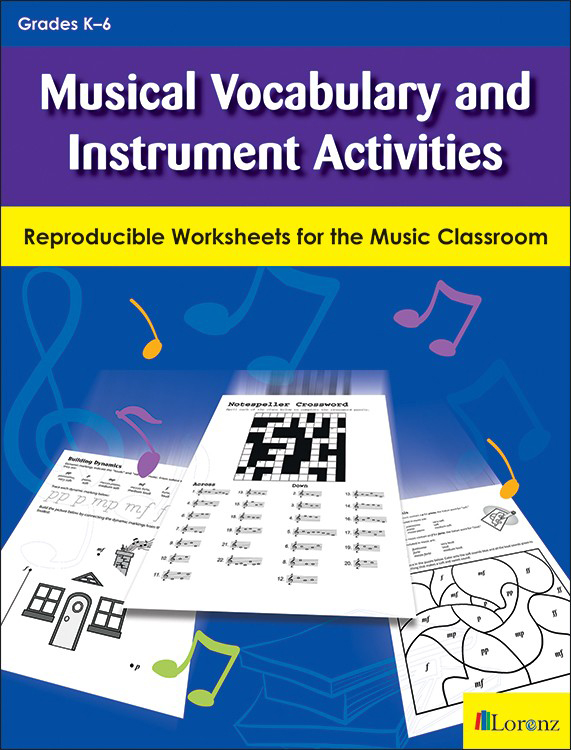
Solve a letter-scramble word puzzle to build music vocabulary; find hidden music terms and other words in a letter-grid word search; unscramble instrument names and locate them in a word search; color pictured instruments by family (brass, percussion, string, woodwind); and complete a maze that alternates wind and…
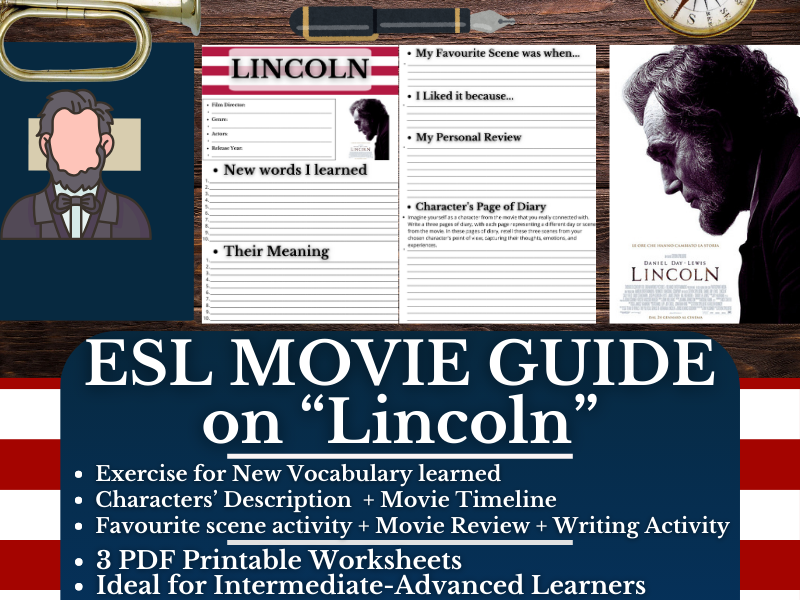
A post-viewing ESL/EFL movie-guide worksheet for the film "Lincoln", used to build vocabulary, character recall, and written reflection after students watch the film.

An 8th-grade math worksheet giving practice calculating with scientific notation, aligned to Common Core standard 8.EE.A.4.
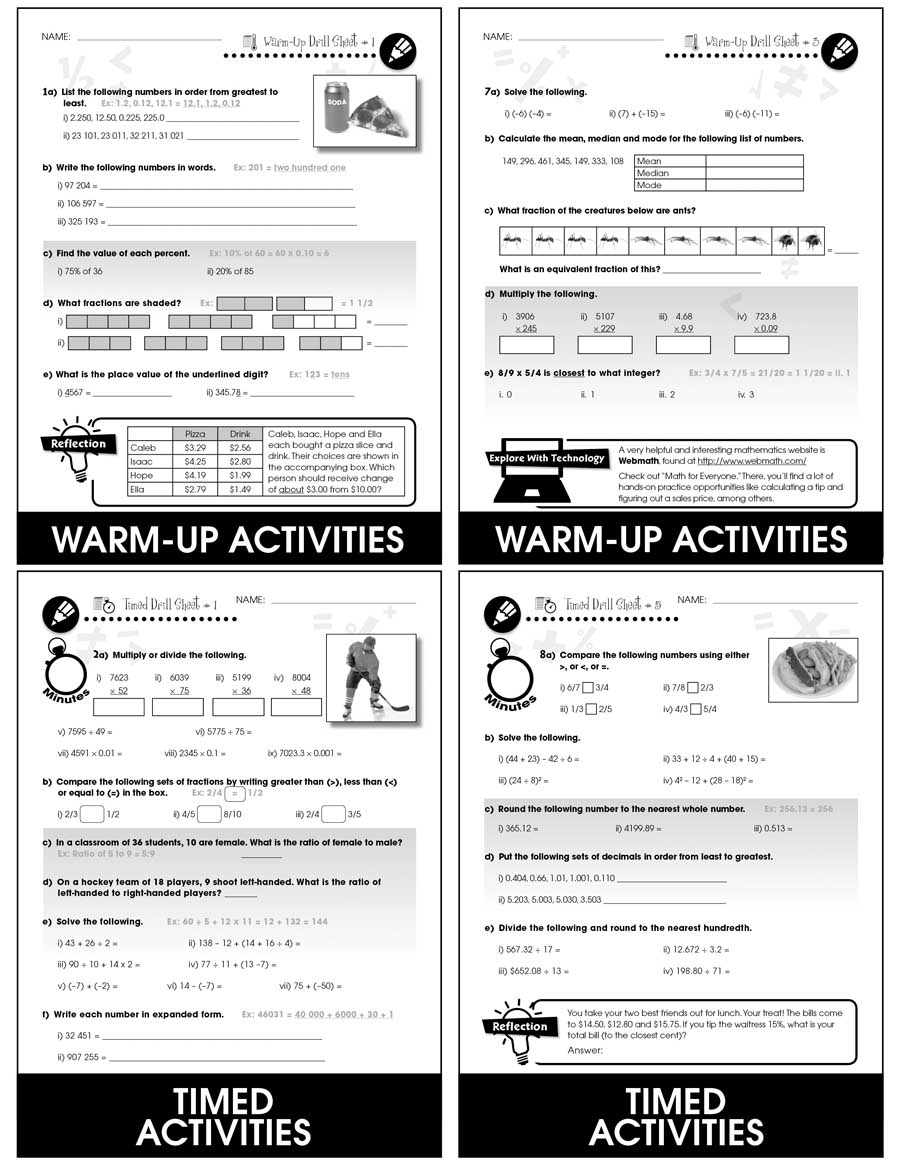
A full-book math skills-practice resource for Number & Operations (Grades 6-8) from Classroom Complete Press's "Principles & Standards of Math Series," built around the NCTM Principles & Standards for School Mathematics process goals (problem solving, reasoning & proof, communication, connections, representation)…
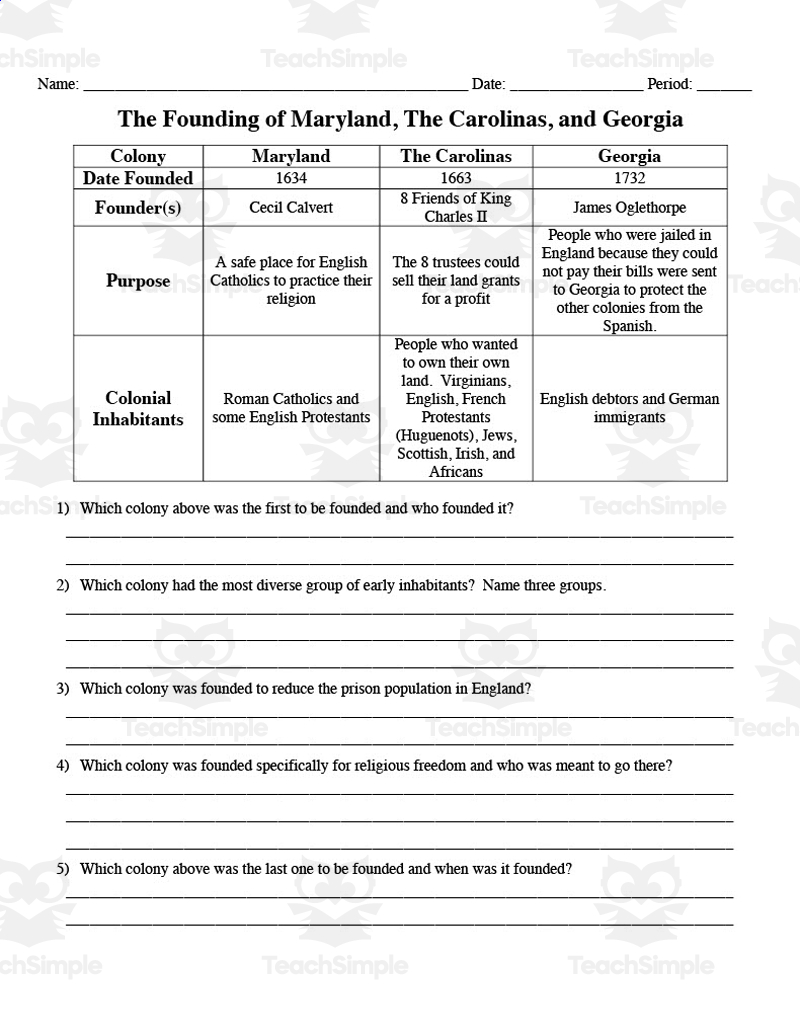
A comprehension worksheet that uses a comparison chart of three American colonies (Maryland, the Carolinas, Georgia) to build analytical reading and historical comparison skills.

Students write the factors of given multiplication equations, circle whether numbers are prime or composite, and complete factor trees to find prime factorizations.

Four student pages guide learners from perfect squares and simplified radicals to side-length patterns in 45–45–90 and 30–60–90 triangles. Students apply the Pythagorean theorem, label diagrams, bisect an equilateral triangle and explain the resulting shortcuts. Printed summary boxes state the relationships, and three embedded handwritten answer pages follow. The seven-page Word file combines editable student content with image-based answers.
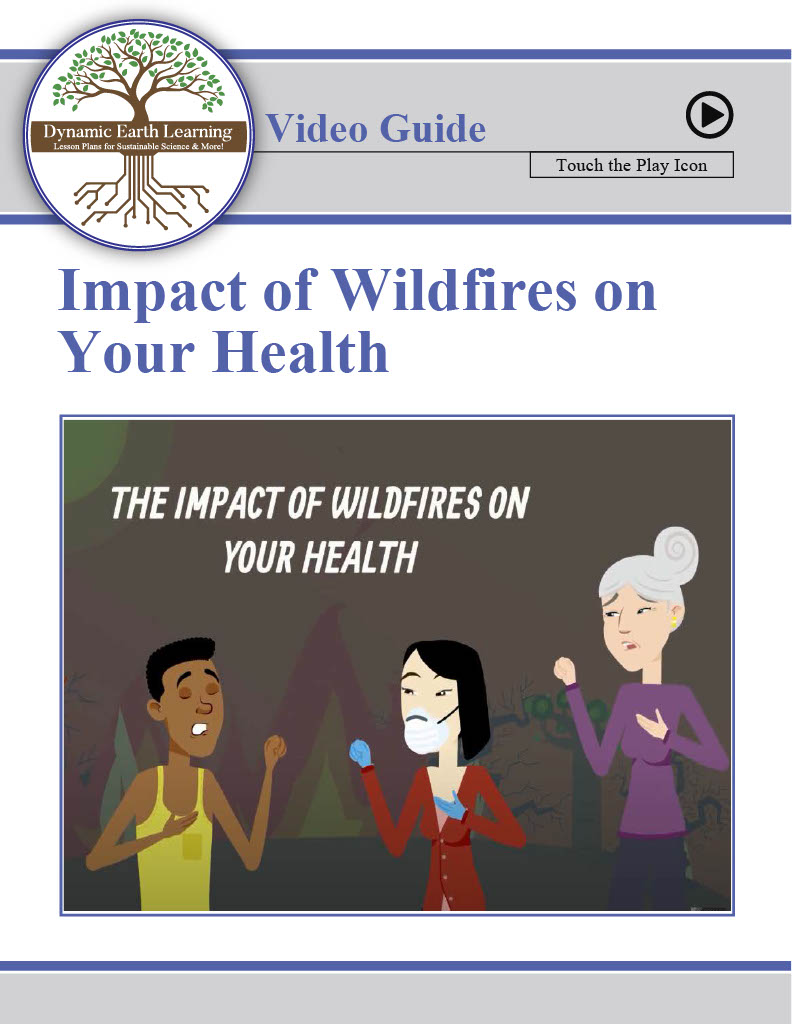
Answer prior-knowledge questions about wildfires, watch a referenced video ('The Impact of Wildfires on Your Health') and complete a guided worksheet with short-answer and multiple-choice questions about health effects of wildfire smoke and protective actions, then answer a reflection question.
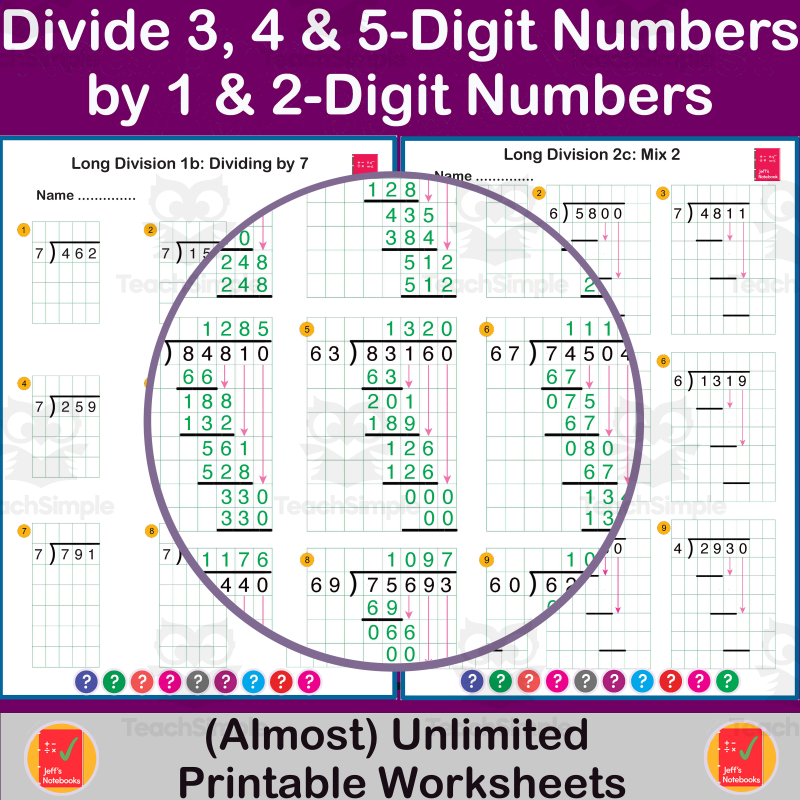
Provide a large, differentiated bank of long-division practice worksheets (3, 4, and 5-digit dividends divided by 1- and 2-digit divisors) using the standard algorithm, with and without remainders.
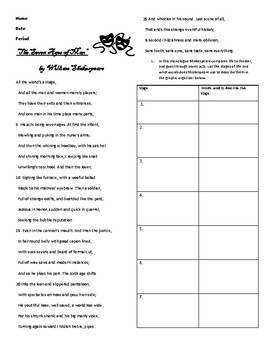
A literature worksheet that has students analyze Shakespeare's well-known life-stages monologue from As You Like It.

Give students practice identifying and plotting ordered pairs/coordinates on the Cartesian (coordinate) plane, including finding missing vertices and applying transformations (translation, rotation, enlargement).

A worksheet set teaching Roman numeral recognition and conversion between Arabic and Roman numerals, plus joke-decoding puzzles using a numeral-to-letter cipher.
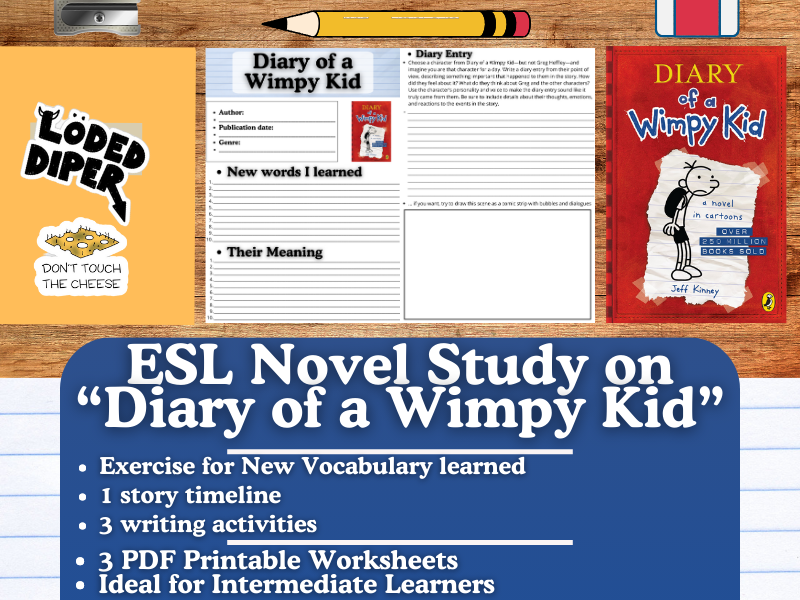
Fill in blanks for author, publication date, and genre; complete two 10-item blank list sections; write a letter to the character Greg Heffley offering advice or asking questions about his choices; write a diary entry from the point of view of a different named character in the book.

A collection of 68 incremental math word-problem worksheets across 19 problem types, designed as a supplement (not a standalone curriculum) that starts each topic with simple questions and gradually increases complexity, training students to read word problems carefully.
 Free download
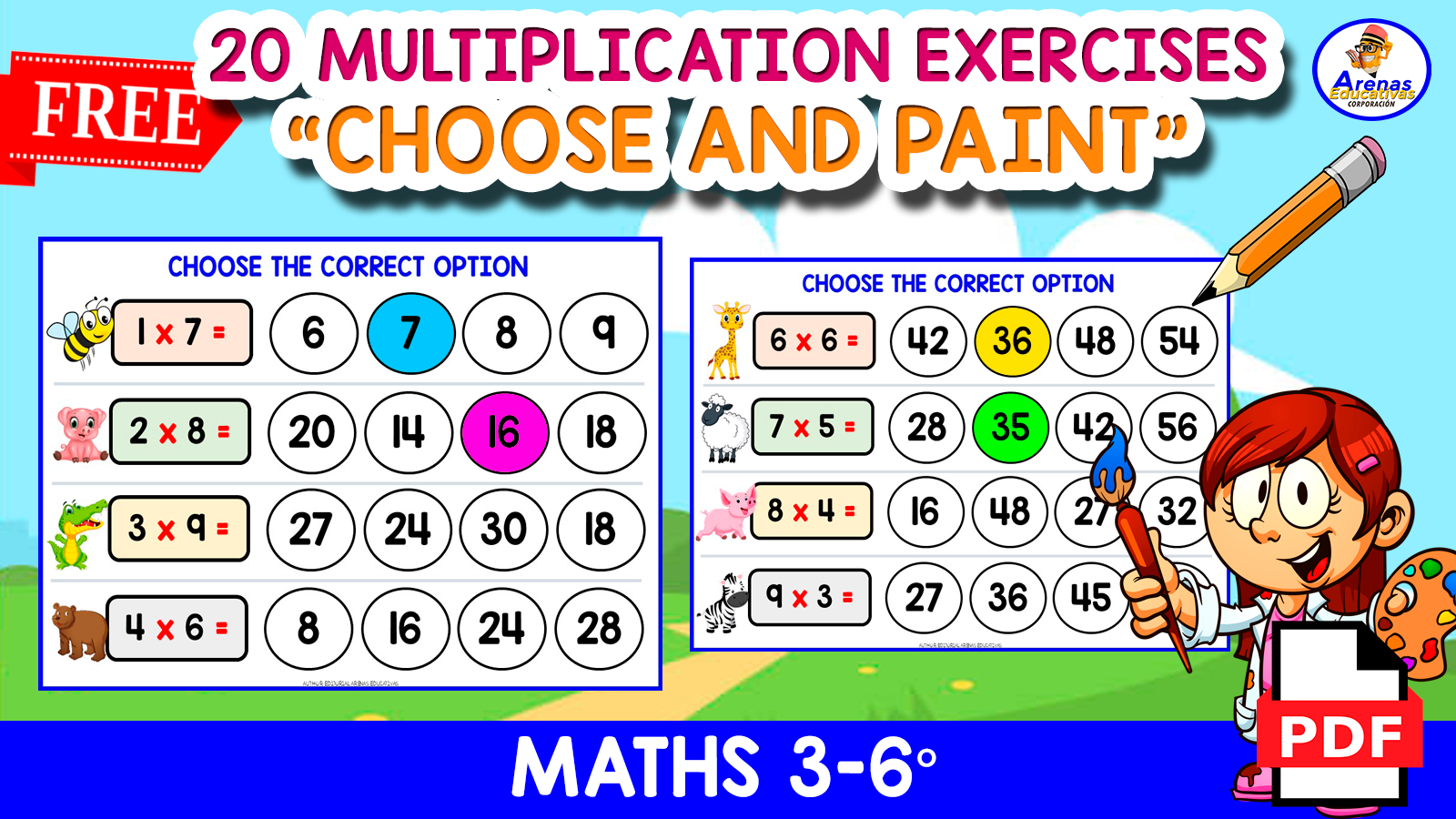
 A multiple-choice multiplication worksheet ('MULTIPLICATION EXERCISES / 20 EXERCISES') where students select the correct product from four options and color/paint it in, per the seller's stated 'choose and paint' method.
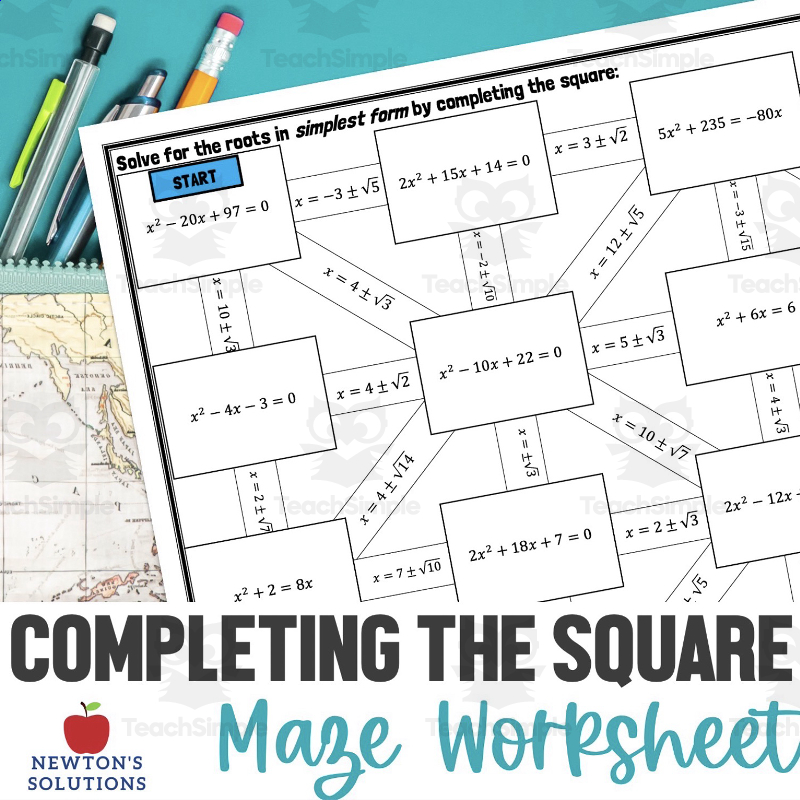
A maze-format algebra worksheet where students solve quadratic equations by completing the square to navigate from start to finish.
 Free download
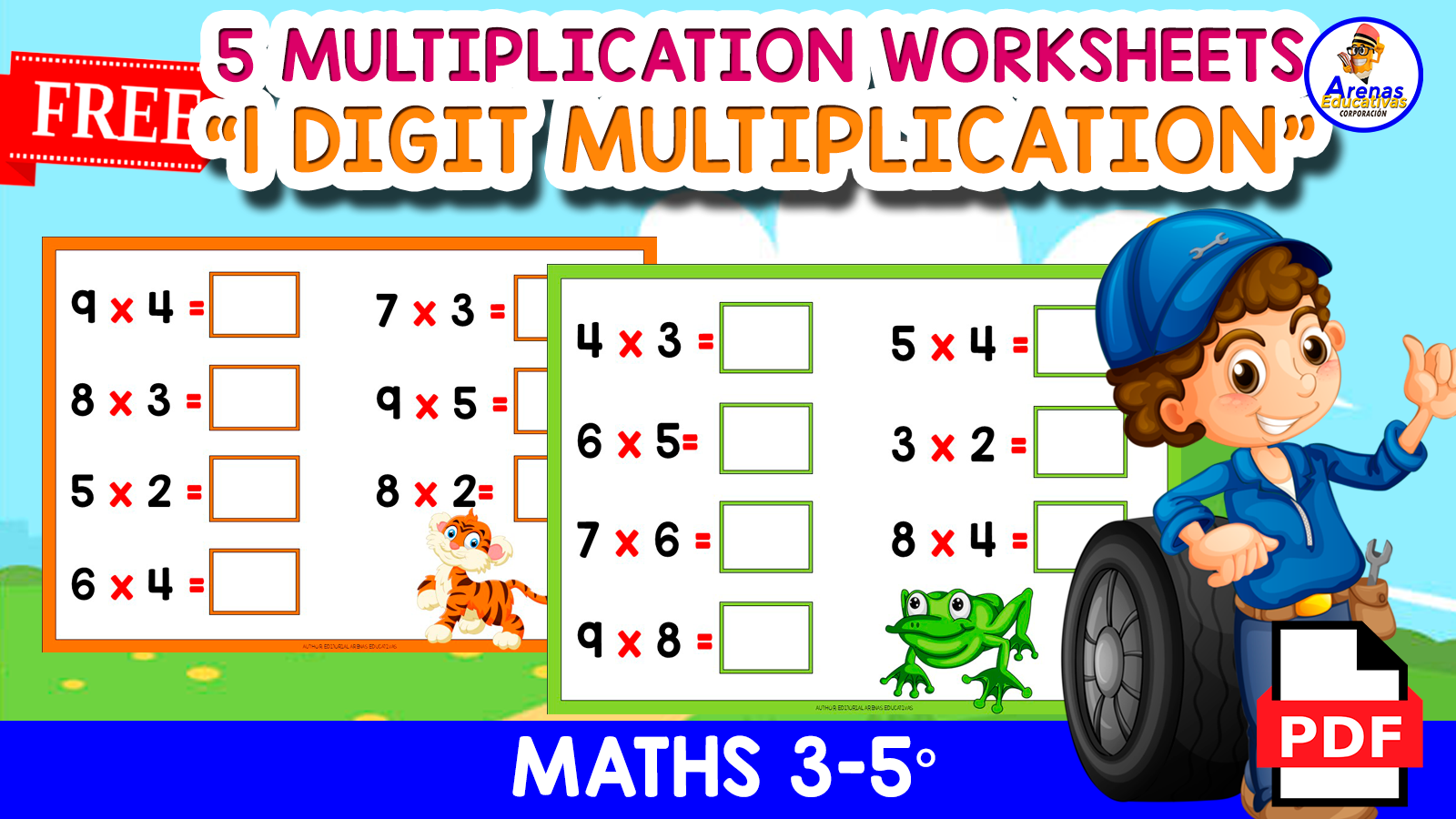
 5 FREE MULTIPLICATION WORKSHEETS | Free Resource
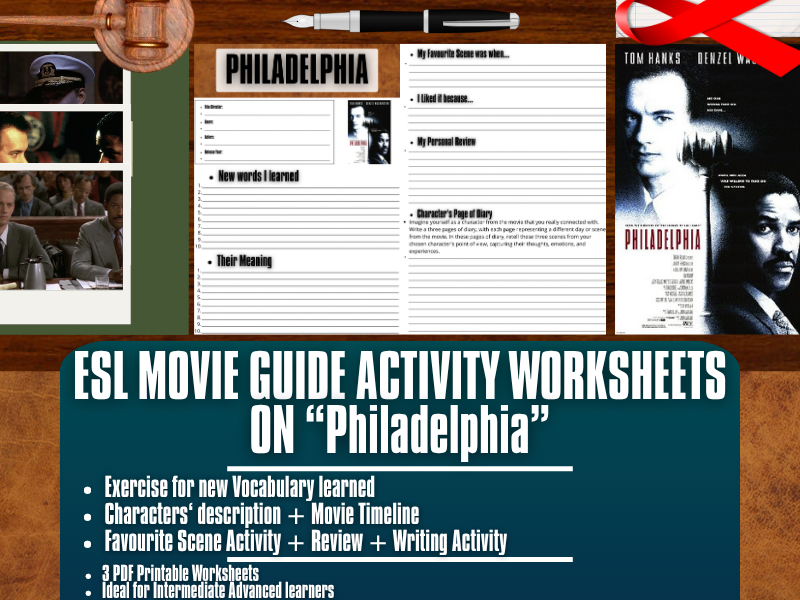
A post-viewing ESL/EFL movie-guide worksheet for the film "Philadelphia", used to build vocabulary, character recall, and written reflection after students watch the film.

Twenty labeled triangle-pair diagrams ask students to decide whether each pair is provably congruent and, if so, to name the correct reasoning — SSS, SAS, ASA, HL, or SAA — and complete the congruence statement, with several pairs lacking enough information to prove congruence so students must recognize when a proof cannot be made. A second section has students sketch hexagons under four different conditions (plain, equilateral, equiangular, and regular) and bisect a segment at a labeled point, then a third section mixes in unrelated algebra and coordinate-geometry problems: solving for angle measures inside a multi-triangle figure, graphing vertical and horizontal lines, and finding the equation of a line perpendicular to a given one. The worksheet closes with two open two-column proof problems where students must supply their own statements and reasons for a given pair of triangles. A complete answer key follows every section, filling in the correct congruence reasoning for all twenty pairs, the coordinate-geometry answers, and a worked two-column proof for both closing problems. Students who need to review which side lengths can even form a triangle before judging congruence can start with Triangle Inequality Theorem practice .

A guided-discovery geometry worksheet that leads students through measuring figures to derive properties of trapezoids, isosceles trapezoids, kites, and trapezoid midsegments.
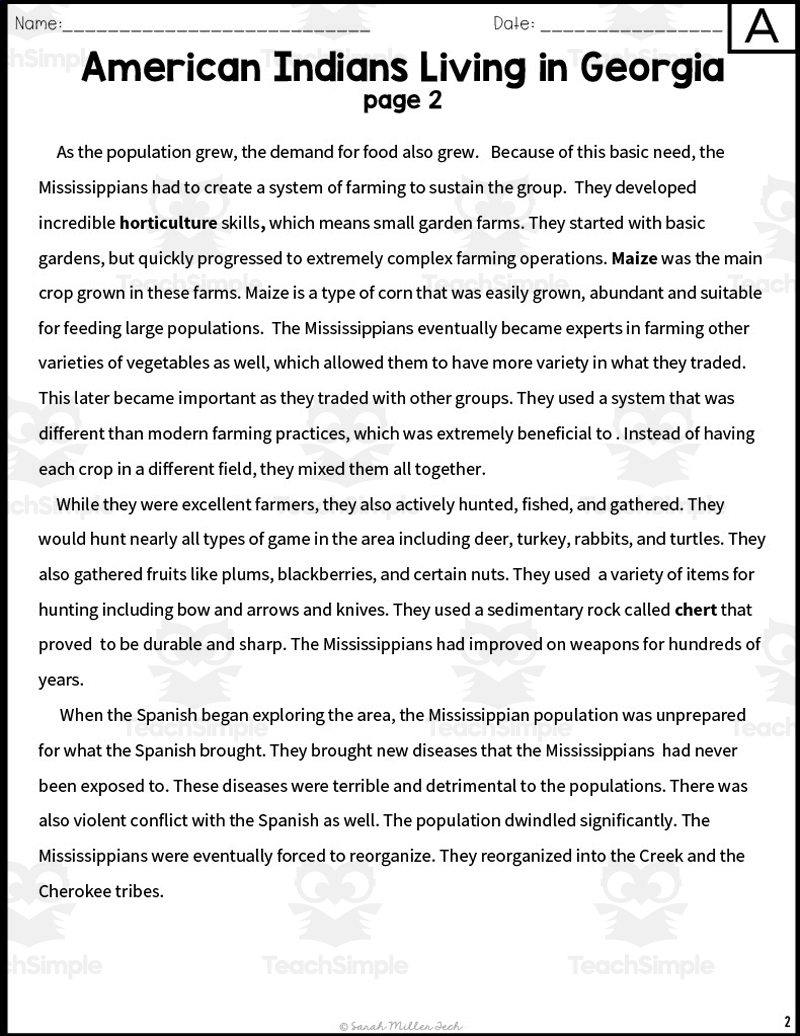
Students read an informational passage (in two differentiated reading-level versions, A and B), fill in vocabulary terms, underline main ideas, circle text features, complete a graphic organizer, match vocabulary to definitions, answer multiple-choice comprehension questions, and write a short-answer response.
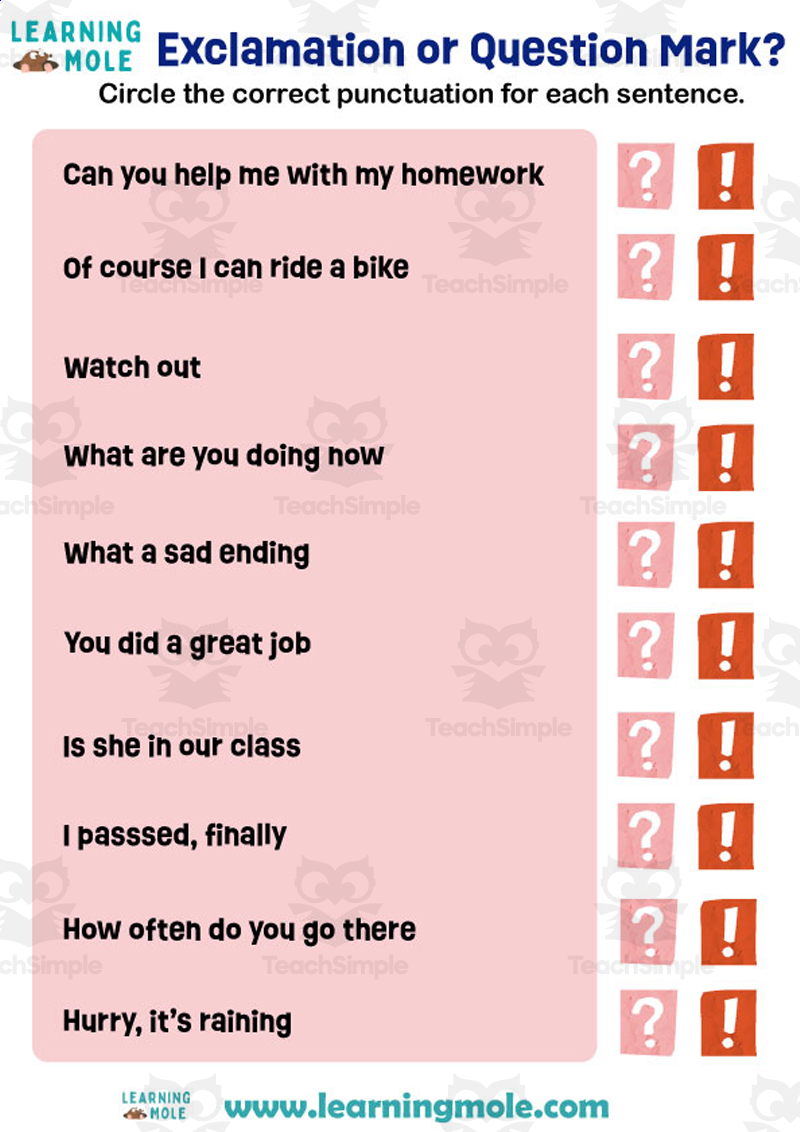
Students circle the correct punctuation mark (exclamation point or question mark) for each of nine given sentences.
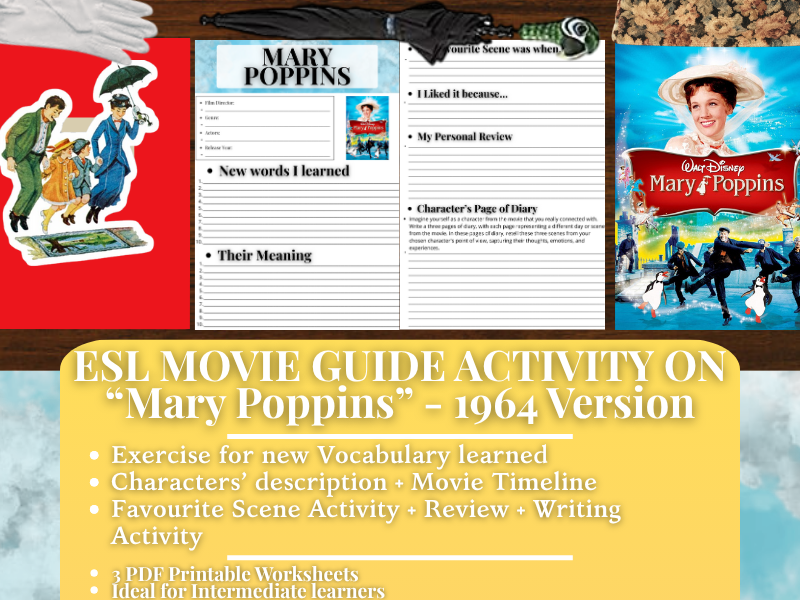
A post-viewing ESL/EFL movie-guide worksheet for the film "Mary Poppins" (1964 film), used to build vocabulary, character recall, and written reflection after students watch the film.