



3,978 products added recently
Page 15 - Middle School Games
Support your middle school students with games that make learning dynamic and enjoyable. This collection includes interdisciplinary challenges, team-building exercises, and subject-specific games. By integrating these games into your lessons, you can motivate students and reinforce key concepts.

 Show filters

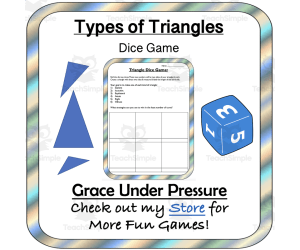
Triangle Dice Game: Isosceles, Scalene, Equilateral, Right, Acute, Obtuse
Math, Geometry, Measurements, Grade 4, 5, 6, 7, Activities, Games
Here's a deceptively simple dice game to practice identifying and creating six kinds of triangles. Three are classified by their angles: acute, right, and obtuse. Three are classified by their side lengths: scalene, equilateral, and isosceles. Use this game to reinforce the definitions of each of these six triangles in a geometry/measurement unit. Students work independently or in small groups. Each player needs two dice. They roll them and use the two numbers as side lengths in centimetres for a triangle. They draw the triangle in one of the boxes on their paper and measure and label the third side length. Here's where the strategy and critical thinking come in. Can students make six kinds of triangles in less than six turns? Maybe! If they get some lucky rolls! For example, if a student gets a roll with two of the same numbers, they should make an isosceles or equilateral triangle (depending on what angles they draw). But this triangle will also be an acute triangle (or an isosceles right triangle). Clever students (with lucky rolls) should be able to complete the task in less than six turns. Standards: CCSS 4.G.A.2 Classify two-dimensional figures based on the presence or absence of parallel or perpendicular lines, or the presence or absence of angles of a specified size. Recognize right triangles as a category, and identify right triangles. CCSS 7.G.A.2 Draw (freehand, with ruler and protractor, and with technology) geometric shapes with given conditions. Focus on constructing triangles from three measures of angles or sides, noticing when the conditions determine a unique triangle, more than one triangle, or no triangle. Grades: This game works well in classes from grades 4-7. Ideally students know how to use a ruler and a protractor. If you enjoy this product, check out the other math games in my store Grace Under Pressure
Author Grace Under Pressure
Tags Triangles, Geometry, Isosceles, Obtuse, Acute, Right Triangle, Scalene, Math Game, Dice Game, Hands-on Math, Triangle Scalene Isosceles Equilateral, Isosceles Scalene And Equilateral Triangles, Scalene Isosceles And Equilateral Triangles, Scalene Isosceles Equilateral, Isosceles Scalene, Obtuse Isoceles, Equilateral Acute, Acute Equilateral, Isoceles Obtuse, Isosceles Scalene Equilateral, Classify Triangles Game, Obtuse Equilateral

Classifying Living Things Jeopardy Game
Science, Life Sciences, Animals, Grade 4, 5, 6, Activities, Games
This resource is a Classifying Living Things Jeopardy Game. This Powerpoint/Slides Download is 100% Ready To use for classifying. All the slides are fully editable, so that you are able to insert your own content answers and questions. The Lightning Bolt is the Navigation tool on each question page, and will take you to the answer slide. This makes a great science review.
Author Hey Teacher Shoppe
Tags Whole Group, Classifying, Animals, Science Games, Jeopardy

Integer Card Games
Math, Numbers, Grade 7, Activities, Games
Particularly, with the topic of integers, students REALLY need to be fast and fluent with their facts. Quizzing & drilling constantly is one way to achieve that… however, these games will help break up the monotony and build the solid foundation they will need to be able to keep a good pace with problem solving later on. 1) There are several games to choose from, each a different difficulty & pace. 2) Prepare to take time to explain the rules in detail to make sure students understand how to play. 3) Once students know the rules well, these will be very quick and easy activities any time they need review (constantly), or you need a time filler. Just save/laminate your decks of cards and pull them out when needed! Most games are geared towards fluency in find the sum of two integers, but some can be played by also finding the product of two integers.
Author The Math Cafe
Tags Integers, Card Games, Integer Classroom Games, Integer Games For 7th Grade

Create A Candidate (Engaging Local Election Simulation)
Social Studies, History, History: USA, Government, Grade 7, 8, 9, 10, 11, 12, Activities, Games
Create A Candidate is an engaging civics simulation where students run for local office in the fictional town of Genericburg. Students review background information and statistics about issues facing the town. Then they create a candidate profile, choosing their background and political positions. Students decide what policies and changes their candidate will campaign on to address Genericburg's problems. They strategize how their candidate will appeal to voters and budget fundraising and spending. Create A Candidate builds critical thinking as students identify effective solutions for the town's issues. This activity covers key civics and government content in an interactive way. The resource includes a slideshow explaining the simulation, teacher's guide, and student workbook with print and digital versions. Create A Candidate transforms a civics lesson into an exciting political campaign where students roleplay candidates aiming to win an election and improve a community.
Author Ed Dynamic
Tags Civics, Government, Campaign, Election, Roleplay

Kinetic Theory, Mixtures, Separating Mixtures - Smart Board Bingo for Middle School
Science, Chemistry, Grade 5, 6, 7, 8, 9, Activities, Games
Kinetic Theory, Mixtures, Separating Mixtures - Smart Board Bingo for Middle School This interactive teaching resources offers a refreshing approach to instruct middle school students on key chemistry concepts, such as the kinetic theory of matter and mixtures properties and compositions. Core Concepts Covered: Kinetic theory of matter Properties and composition of mixtures Methods of separating mixtures This resource reinforces understanding in: Particle arrangement in various states of matter (solids, liquids, gases) Dynamics associated with state changes In-depth topics include: - Solubility definitions - Factors affecting solubility (e.g. temperature or stirring effects) - Characteristics & behaviours of suspensions & saturated solutions - Methods for isolating components (evaporation to dryness or distillation types) - Distinctions between compounds vs elements relative to mixture purity The primary teaching tool is presented through an engaging interactive bingo game accessed on a smart board. Fifty questions are generated randomly by software. If the number called out aligns with their bingo card number, students must not only cross off that number but also provide written answers on their card. This promotes active engagement and makes learning fun! Note: This package contains an answer PowerPoint and answer sheets that can be used for verification after games. Listed amongst included resources are: An Answer Powerpoint A set accommodating up-to-48 bingo cards ensuring every student's inclusion regardless of class size Breakaway sheets for the verification of student responses and topic discussions A variety of supportive supplementary materials to bolster revision at a student’s personal pace may it be as homework task or collaboratively in classroom setting In conclusion: The Kinetic Theory, Mixtures, Separating Mixtures - Smart Board Bingo for Middle School teaching resource changes the landscape of standard lessons into dynamic, interactive learning sessions. It seamlessly combines theories with fun activities that make students grasp and remember these essential chemistry concepts effectively while alluringly building their problem-solving skills. An absolutely joyous learning journey inviting middle schoolers towards charming world encapsulated within molecules leading them to have strong foundation prepping up for higher-grade studies.
Author Elf off the Shelf Resources
Tags Kinetic Theory, Mixtures, Separating Mixtures, Smart Board Bingo, Middle School

VR Game Design Activity
Science, Technology, Grade 3, 4, 5, 6, 7, 8, 9, Games, Activities
Activity Introduction An amazing activity designed for the students to learn more about STEM. VR Game Design Do you like STEM subjects? what is your favorite one? Have you ever tried to plant a seed? If yes, tell us more about it. Or have you ever tried to invent something? If yes, tell us more about it. And how do you think it will help us? Have you ever seen a microorganism under a microscope? What was it? And how it looked like? Mathematics is a marvelous subject. Let' sharpen our brains and solve some equations. Do you like timetable tricks? What is your favorite one? Do you know how to code? Have you ever created an app or a game before? If yes, how was it like? VR Game Design Activity The activity is perfect for encouraging the researching skills for the students, while learning more about this fantastic topic. VR Game Design This friendly designed worksheet is suitable for students at school, homeschooling, and as a group activity. Instructions Design an interactive VR game , then add some labels for the player. Next, describe how it works, the equipment or controls you use to play, the goal of your game , and who your game is designed for. Format Available in a PDF format.
Author Educational Voice
Tags VR Game Design Activity, VR Facts, VR Facts For Kids, VR Game Design, Game Design, Game Design Facts, Game Design Facts For Kids, Technology, Technology Facts, Technology Facts For Kids

Economic Systems Game (Engaging and Memorable Rock, Paper, Scissors Game)
Social Studies, Economics, Grade 7, 8, 9, 10, 11, 12, Activities, Games
The Economic Systems Game is an engaging rock, paper, scissors activity that creates a classroom economy using provided "class bucks". Students attempt to "get rich" by playing against classmates. This memorable simulation demonstrates in a simplistic way how different economic systems operate and affect human behavior.\n\nThe game introduces and provides context about capitalism, socialism, and communism. Common critiques of each system are included as well. The non-partisan game and slides do not show preference towards any one type of system. \n\nThis routine highlight of the school year comes with class slides, printable "class bucks", and a teacher guide. It is designed to spark thorough discussions about how economic systems can impact government, politics, culture, and more.
Author Ed Dynamic
Tags Economics, Systems, Classroom, Activity, Discussion
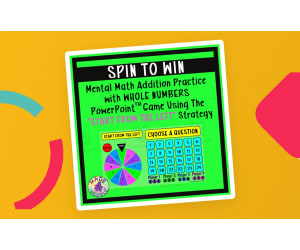
Spin To Win Start From The Left Whole Number Addition Mental Math Game
Math, Addition and Subtraction, Addition, Grade 3, 4, 5, 6, 7, Activities, Games
Spin To Win Start From The Left Whole Number Addition Mental Math Game Searching for dynamic and interactive methods to enhance your students' mental math capabilities with zero setup on your end? Offer your students more opportunities to master the 'Start From The Left' Mental Math Addition Strategy through this interactive game. This PowerPoint game facilitates group play for up to four players on a single device, or can be projected for the entire class using a teacher's computer. With 25 diverse questions, students can hone their skills using the 'Start From The Left' method. The game encourages teamwork, allowing students to collaborate and assist one another. Moreover, a sprinkle of unpredictability is thrown into the mix as players spin to ascertain their score for correct answers, ensuring the outcome is always in suspense! HOW TO PLAY: Students choose their question then solve it mentally. When done, they say the answer out loud, then check it by clicking the “check answer” button. If their answer is correct they then get to spin the wheel to be awarded their points! Some questions actually give a reward or a punishment! Where are they hidden? Who know!? Winner is the player with the most points when your time is up! More Addition Strategies with Whole Number SPIN TO WIN Games : · Round & Adjust · Take & Give · Start From the Left · Break One Addend Apart · Add Up
Author Made 4 The Middle
Tags Math, Mental Math, Basic Skills, Number Talks, Engaging, Games, Digital, Centers, Self-checking , No Prep
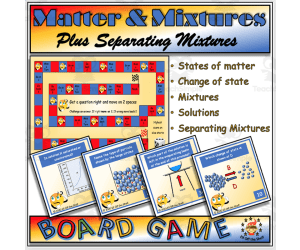
Kinetic Theory of Matter, Mixtures, Separating Mixtures Board Game for Middle School
Science, Physics, Grade 5, 6, 7, 8, 9, Activities, Games
Kinetic Theory of Matter, Mixtures, Separating Mixtures Board Game for Middle School This teaching resource combines fun and education to provide an effective way of reinforcing curriculum on the kinetic theory of matter. It consists of 54 question cards tackling various levels of difficulty that probe topics like: Particle Arrangements in Solids, Liquids, Gases Changes in States including Sublimation Differences in Pressure among Gases Diffusion Process Pure Substances vs. Mixtures: A Detailed Examination into Elements and Compounds. This interactive board game benefits both large classes and smaller study groups by promoting proactive learning through challenging comprehension tests on subject matters. Additionally, it can serve as an alternative homework assignment encouraging practical applications. Quick Preparation Time & Easy Setup: To prepare the game, photocopy the provided game board onto A3 paper or card - color and greyscale versions are included! Photocopy question sheets onto another set of paper then cut them into cards. The process is very straightforward which makes this learning resource even more appealing from a teacher’s perspective. The Game Play Process: The game allows students to put their knowledge to test on matter topics as they roll dice moving along the board following square instructions(challenge phase). During this phase, if a student thinks their opponent made a mistake with an answer during their turn, the challenge resolution phase kicks in where books may be consulted for fact-checking . A Quick-Check Answer Sheet is supplied for teachers looking over these activities ensuring proper order while boosting learning potential. In order to maximise the benefits of this resource, students from Grade 5 up through Grade 9 should already have some background knowledge about properties of matter. Suitable for Any Learning Environment Whether you’re teaching in a public school or homeschooling, The Kinetic Theory of Matter Board Game presents an excellent approach towards reinforcing important scientific concepts while cultivating problem-solving skills - making lessons both educational and enjoyable. This game is specifically designed to benefit students learning Physics.
Author Elf off the Shelf Resources
Tags Kinetic Theory, Matter, Mixtures, Separating Mixtures, Board Game
The Tragedy of the Commons Simulation (Slides, Worksheet, Instructions)
Social Studies, History, Psychology, Grade 7, 8, 9, 10, 11, 12, Activities, Games
The Tragedy of the Commons Simulation introduces students to the economic concept of the "tragedy of the commons" through an engaging in-class game . Students compete in rounds to collect the most slips of paper, learning firsthand how self-interest can lead to overuse and depletion of shared resources. Accompanying slides explain the concept and connect it to real-world examples. This complete lesson includes teacher instructions outlining the lively simulation, student worksheets for reflection and discussion, printable slips for the game , and presentation slides summarizing key learnings. Applicable for middle and high school economics, social studies, or psychology, this hands-on group activity sparks critical thought on cooperation vs. competition and responsible use of shared resources.
Author Ed Dynamic
Tags Economics, Social Studies, Psychology, Cooperation, Competition

Analogies Space Adventure Digital Escape Game
Special Resources, ELA, Speech Therapy, Language Development, ESL, Strategies, Vocabulary, Grade 4, 5, 6, 7, Activities, Games
🚀 Analogies Space Adventure Digital Escape Game - Ignite Cognitive Exploration! 🌌 Embark on an educational odyssey with our Analogies Space Adventure Digital Escape Game – a thrilling blend of learning and fun that challenges young minds to master the art of analogical reasoning. Perfect for middle school students, this interactive escape game is meticulously designed to captivate and educate simultaneously. Objective: Guided by a cosmic narrative, students delve into a series of engaging puzzles where they decipher analogies, decode connections, and unlock the mysteries of language relationships. 🗣️This immersive experience fosters critical thinking, language skills, and problem-solving prowess.🧠 Order, Outline, and Steps: Students are provided with directions and examples of analogy types. Your students will navigate through four distinct challenges, each unlocking a new dimension of analogical understanding. As they progress, they'll unveil clues, solve analogies, and ultimately crack the code to escape from the cosmic adventure.🚀 When they complete each challenge, they are given one of four numbers used to solve the challenge. Implementation Format: Delivered as a digital escape game , this resource offers hassle-free implementation. No physical materials are required – simply access the game online and watch your students' enthusiasm soar! No need for Microsoft or Google to use this. No log on is required. Answers are self-correcting.🎯 How to Use and Variations: Our escape game can be utilized in various ways. Use it as an exciting group activity, an individual challenge, or even as a rewarding assignment for early finishers. You can use for homework assignments as well. Unlock a Universe of Learning: With the Analogies Space Adventure Digital Escape Game , you're not just teaching analogies – you're guiding your students on a celestial journey of cognitive growth and linguistic mastery. 🧠Engage, educate, and elevate with this captivating resource that brings critical thinking to new heights! 🌟🗺️
Author Ivybee Speech
Tags Analogies, Speech And Language Therapy, Critical Thinking, Word Relationships, Vocabulary, Problem Solving, Conceptual Awareness, Logical Reasoning, Cognitive Skills, Creative Thinking

Current Electricity 54 Question Board Game - Middle School Science
Science, Physics, Grade 6, 7, 8, 9, Activities, Games
This is a challenging, engaging and enjoyable boardgame, for up to six pupils per set, with 54 question cards on the basics of current electricity including: · understanding the terms current, voltage and resistance; · conductors and insulators; · circuit symbol; · circuits diagrams ; · units and measurement of current and voltage; · current and voltage in series and parallel circuits; · lamps in series and parallel. · Current and voltage vary with number of batteries. · Relationship between resistance and current. Included in this Pack. · Game board · 54 Question cards with questions of varying difficulty · Teacher answer sheet · Instruction sheet. Preparation · Photocopy Board onto A3 paper or card (Colour and greyscale versions included). · Photocopy question sheets onto paper or card (Colour and greyscale versions included) and cut into question cards. How to Play. · Highest score of dice starts · Pupils take turns and work their way around the board following the instructions in the squares. · A symbol on the board indicates that the pupil takes a question card from the face down pile. If correct they move on 2 spaces. · If a player thinks an answer given by an opponent is incorrect they can challenge. If the challenge is correct the challenger moves forward 2 spaces. If the challenge is wrong the challenger moves back two spaces. · In the event of a challenge, pupils are encouraged to consult their books but the teacher has a quick-check answer sheet. Prior Knowledge Required · The symbols for switch, resistor, battery, voltmeter, ammeter, motor, buzzer and able to recognise series and parallel circuits. · Metals and non-metals as conductors and insulators. · Current is a flow of electrons and metal ions cause resistance. · Batteries contain chemicals and provide the push or voltage to current. · Voltage is the difference in energy level between two points in a circuit. · Comparative resistance of long/short, thin/thick wires. · Know that insulators have high resistances and the resistance of all conductors is comparatively lower. · Comparative brightness of identical lamps in series and parallel and the effect of removing a lamp. · Ammeters are placed in series and voltmeters in parallel. · Current is measured in amps and voltage in volts. · Current in series and parallel circuits. · Voltage in series and parallel circuits. · Current and voltage vary with number of batteries. · Metal ions causing high and low resistance conductors. · Relationship between resistance and current. These learning outcomes, and others, are contained in fully resourced packs from Elf Off the Shelf. Each pack contains two PowerPoints and fourteen original and engaging pupil resources. They are also available as a substantially discounted bundles. Please follow the links below if you are interested in these resources. See more Elf Off the Shelf resources on this topic and many others
Author Elf off the Shelf Resources
Tags Science Board Game, Electricity Board Game, Physics Game, Science Printable, Electricity Team Game, Conductors And Insulators Game, Series And Parallel Circuit Games, Middle School Science Game

Country Study on Chile - Snakes and Ladders Board game PDF
Social Studies, Geography, Grade 7, 8, 9, 10, 11, 12, Activities, Games
Country Study on Chile - Snakes and Ladders Board game PDF This Teaching Resource is a PDF Board game (Snakes and Ladders; 3 slides) on Chile (South America). This Printable Resource can be great for Geography and Social Studies Classes. Suitable Learners for this kind of lesson are students from 7th Grade to 12th Grade. This Geography + Social Studies game on Chile (country Study, South America) aims to test learners on their knowledge on Chile and Its Culture (naming Chilean cities, telling about history events, telling about your pawn's character, telling about Famous Chilean or telling what you would like to visit, telling about the economy). Some preparation on Chile (South America) can be useful for this Social Studies Activity. Within this amazing Country Study on Chile (South America) board game (snakes and ladders; 3 PDF Printable slides) it is offered: 1 board with questions and Speaking Prompts (ex. naming Cities in Chile or telling about Chile's history events, telling where you would like to go, telling about the Chilean Peso and Chile's Economy etc) 1 Printable Craft Die with numbers written 1 Printable Craft cone to make Game Pawns to play 5 Famous People from Chile (Isabel Allende, Pablo Neruda, Bernardo O'Higgins, Gabriela Mistral, Violeta Parra etc.) to stick on the printable craft cone This amazing Social Studies + Geography Country Study on Chile (South America) PDF Digital Teaching Resource (3 PDF Printable Slides) can be great for learners from 7th grade to 12th grade to test Chile and Chilean Culture Learning with Alan is a Brand New Teaching Resource, Educational Material Store whose aim is to help Teachers, Educators and Tutors to achieve their teaching objectives while creating a fun and stimulating environment. Never Forget! If you want to browse more of my Teaching Resources, click here Learning with Alan
Author Learning with Alan
Tags Chile, South America, Snakes And Ladders, Game, Printable, Teaching Resource, Culture, Geography, Social Studies

Presidents Time-Line Game
Social Studies, Government, Grade 5, 6, 7, Games, Activities
The Presidents' Time-Line Game is a 17-page download that is jam-packed with everything your students will need to engage in this activity and show what they know about presidents! The idea of the game is for a player to get 8 cards in chronological order in their personal timeline on the table in front of them. The game is over when the first player has 8 cards placed correctly in their timeline. Printable cards starting at 1778 are included for the game .
Author Creative Learning Connection
Tags Presidents Game, US Presidents, Timeline Activity, Timeline Game, Presidents Timeline
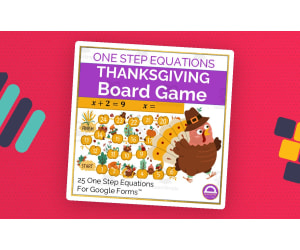
Board Game | Thanksgiving One Step Equations Activity Google Form
Math, Algebra, Grade 6, 7, 8, Games, Activities
Many middle schoolers need additional practice in solving one step equations! This engaging, no prep and self-checking Thanksgiving themed activity that incorporates 25 one step equations in a Google Form will help them practice their skills. As they correctly answer the questions, the turkey will advance on the board. If the answer is wrong, students will get the message: "think again" and won't be allowed to move to the next question.
Author Matemaths
Tags Math, Algebra, Equations, Thanksgiving, Game

Scratch Christmas: Snowball Game
Science, Technology, Computer Science, Grade 3, 4, 5, 6, 7, 8, 9, 10, Games, Activities
Scratch Christmas Snowball Game teaches students in grades 3-10 how to create a computer game using Scratch. Students will code an interactive game where the objective is to throw as many snowballs as possible within the time limit. The step-by-step tutorial guides learners of all skill levels through the process of animating sprite movements, keeping score, and adding fun holiday flair. Educators can implement this resource in computer lab sessions for individual or collaborative coding projects. Students enjoy the creative freedom to customize their games by changing the scenery, characters, sounds and more after completing the tutorial. This Scratch coding project promotes problem-solving, critical thinking, and computational skills across the STEM curriculum in an engaging way.
Author Roombop
Tags Scratch, Scratch Programming, Coding, Winter, Snowball Fight Flash Games, Snowball Game Classroom

Free Science Interactive Hangman Game / Magnetic Field Vocabulary
Science, Basic Science, Earth and Environmental Sciences, Earth Sciences, Physics, Grade 8, Games, Activities
Magnetic Field Vocabulary Hangman Game for 8th Grade Science Practice, learn, and review 8th grade science vocabulary related to magnetic fields with this interactive hangman game. Students will build knowledge of key terms and definitions related to characteristics and the importance of magnetic fields. This game aims to enhance student learning in a fun and engaging way. It challenges students to guess hidden vocabulary words correctly before the hangman is fully drawn on the screen. With each incorrect guess, another body part is added. Use this 16-slide PPT game for whole-class or small group vocabulary review. It includes visual aids to introduce new terms first. Then students take turns guessing letters. If correct, the letter drops into place. If not, another body part is added to the hangman. Keep playing until students guess the full word or phrase. Check our shop for more Spanish language games to reinforce science, math, reading, and more!
Author ShapeUp-N-Matematicas y Lenguaje
Tags Magnetic Field, Poles, Magnets, Interactive Activity, Games, Small Or Whole Group, Compass, Motion, Types Of Energy, Energy
Functions - Vocabulary Grab Bag Game
Math, Algebra, Grade 8, 9, 10, Activities, Games
Vocab Grab Bag is an interactive learning and review activity that focuses on academic vocabulary. This math activity can be a part of your sheltered instruction toolbox and is great for both ELLs and native English speakers. Sheltered language strategies are teaching strategies that focus on teaching academic vocabulary at the same time as academic content. These types of strategies have been researched and shown to improve student learning, especially for ELLs. This Vocab Grab Bag game combines both academic vocabulary building and student interaction. When students participate in this activity, they are explicitly required to interact with both academic language and content at the same time. This Vocab Grab Bag resource contains -Vocabulary Cards; you will need one set of cards per group. -”How to play vocab grab bag” text Instructions to project -Cheat Sheet: Words and definitions -Job cards for groups of 3, 4, or 5; you will need one set of job cards per group -(Optional) Alphabetizing Mat; if you use this additional activity, print one mat per group. -Answer Key for Alphabetizing Mat You will need to supply your own bag, envelope, or container for the word cards. How to play Vocab Grab Bag 1.Cut out the vocab cards and place one set of cards in each bag, envelope or container that you are using. 2.Organize students into groups of 3, 4, or 5. I have found that groups of 4 seem to be optimal. 3.Give each student one Job Card. 4.Students go in order, starting with Job 1 until they have completed one round. Do not return the used words to the container. 5. After each round, students rotate jobs, passing the Job Cards in the order you designate. 6. Continue until the teacher stops the game . 7. Alternate option #1: When all word cards have been used, transition to putting the words in alphabetical order, using the Alphabetizing Mat. 8. Alternate option #2: If all word cards have been used, return all the cards to the container and start over again. Teacher tips •Do not skip the praise step, it is important and surprisingly fun! •If you have a student in the very early stages of learning English, consider letting them keep Job 1 or Job 2 for the entire game . •Project the instructions at the front of the room for students to refer to while playing.
Author Sheltered Language Resources
Tags Functions Printable, Functions Game, Algebra Games, Math Vocabulary Game, Grab Bag Game, Grab Bag Games, Grab Bag Rules, Functions Vocabulary

Construction Hangman Game to Practice Vocabulary
Special Resources, Grade 7, 8, 9, 10, 11, 12, Games, Activities
Construction Vocabulary Words to Review and Reinforce Definitions of the CTE curriculum . Students will learn and practice Construction terms through definitions and characteristics. The engaging activity promotes collaboration and class discussion as students review terms of Construction tools, machinery, and more with multiple visuals and learning formats like multiple choice questions, memory games, hang-man, and others. This versatile resource can be used for whole-group instruction, small-group practice, or independent work, just practice the words and then review them by choosing the correct letters, it will self-correct you until you choose the correct ones. Students will learn important terms related to the construction industry while having fun playing hangman. The game reviews 17 key vocabulary words through slides and an end-of-presentation game. To play, students guess letters to try to reveal the mystery word. If they guess incorrectly, part of the "hangman" is drawn. Guess all the letters correctly before the hangman is fully drawn to win! This supplemental resource helps build pronunciation, spelling skills, concentration, and construction industry knowledge. Practice Construction Vocabulary with this Free Interactive Game Introduce young learners to a variety of tools and machinery with this entertaining digital game. Students will see the names and images of different tools; exercising visual memory and concentration. This self-checking activity can be played independently or as a whole class game projected on a smartboard. The vibrant slideshow stimulates engagement while building construction classification skills. students will build their knowledge of important terms and definitions while having fun playing games. This activity stimulates intelligence, builds concentration, reinforces letter recognition, improves spelling and pronunciation, and engagingly expands vocabulary. It's a perfect supplement for any Construction lesson. Check our shop, material, and products for more interactive construction vocabulary reviews covering other topics like human microbiome, metabolism, and more grade levels in science and Spanish language arts. Download this versatile 17-slide PowerPoint today!
Author ShapeUp-N-Matematicas y Lenguaje
Tags Construction, Construction Equipment, Construction Tools And Instruments, Construction Machinery, Construction Material, Construction Workers, Construction Safety Gear

Magnetism Dominoes Game for Middle School
Science, Physics, Grade 5, 6, 7, 8, Activities, Games
No numbers on these dominoes, just questions and answers. The game is suitable for all abilities as it can be played by matching two of the same question or a question with its answer. An animated PowerPoint explains how the game is played. This game is so much fun, pupils will forget they are learning! Prior Knowledge Composition of Magnets: Magnets are constructed using magnetic materials. Common materials include Iron, Cobalt, Nickel, and their corresponding alloys. Pole Interactions: Magnets have two types of poles - North and South. When two like poles (e.g., North and North) come close to each other, they repel. Conversely, when opposite poles (e.g., North and South) are brought together, they attract each other. Magnetic Fields: Surrounding every magnet is an invisible force field known as the magnetic field. This field can be visualized through field lines. Field Line Density: The density of these field lines determines the strength of the magnetic field. A region with closely spaced field lines indicates a stronger magnetic field than a region where they're spread out. Visualization of Field Lines: It's essential to understand and recognize the pattern of field lines around two bar magnets, especially when they have the same or opposite poles facing each other. Field Strength at Poles: The magnetic field is strongest at the poles of a magnet due to a higher concentration of field lines. Distance and Field Strength: The strength of the magnetic field diminishes as one moves farther from the magnet. Direction of Field Lines: Field lines emanate outward from the magnet's south pole and point inward toward the north pole. Magnetization Process: When a non-magnetized magnetic material becomes a magnet, the tiny regions within it called domains, which were initially oriented in random directions, align themselves to point uniformly in the same direction. Earth's Magnetic Properties: The Earth behaves like a large magnet. Interestingly, there appears to be a south-type magnetic pole near the Earth's geographic North Pole and a north-type magnetic pole near the Earth's geographic South Pole. Application in Devices: It would be beneficial to have a basic understanding of how magnets and magnetic fields operate within certain devices. Familiarize yourself with the structure and functioning of electric bells, relays, and circuit breakers, as they use these principles. What You Get 90 dominos Animated PowerPoint explaining the rules and how to play. How to Play Each player chooses seven dominos from the top of the face-down pile and holds them in their hand like playing cards. The player who has the longest full name starts and play proceed in a clockwise direction. Players match a question exactly or a question with its answer with the answer. A player can challenge a match if they think it is wrong. Pupils are encouraged to check their books for the correct answer and consult their teacher if a consensus is not reached. If the challenge is correct, the challenger gives one of their cards to the other player. If the challenge is wrong, the challenged player gives one of their cards to the challenger. If a player cannot play a domino, they pick up from the face down pile and can play if possible or add it to their hand. See more Elf Off the Shelf resources on this topic and many others. Explore the ideas hands-on with this magnetic poles and fields activity .
Author Elf off the Shelf Resources
Tags Magnets, Electromagnets, Magnetic Materials, Magnetic Fields, Earths Magnetism, Electricbell, Electric Relay, Circuit Breakers, North And South Poles, Magnetic Field Lines
8th Grade Math Bingo Review #1
, Grade 8, Activities, Games
This PowerPoint Presentation contains 2 bingo games of 8 questions each. The topics covered are: find the missing side of a right triangle, find the distance between two points in the coordinate plane, solve for angle pairs formed by 2 parallel lines cut by a transversal, compare numerals in different forms (radical, decimal, mixed) rate-time-distance problems, find unit cost, find the approximate position on the number line for a radical •Directions for BINGO. •Have students to make a 4 x 4 game board. They will fill in the answers in random order. This way everyone has a different board but all of the answers. Put up the first 2 questions. When all students finish #1, you can change to the second page, which still has #2 but also #3 for those that have also finished #2. This allows some students to work ahead when ready. When everyone has finished #2, move to the next screen, which has #3 and #4 as some students will be ready for #4. Continue in this way. Students should put a mark in the corner of the square---Don’t have them completely mark out their answers in the first game because they will use this same board in the second game. •Students MUST show their work on paper to get credit for a BINGO. For the problems that don’t have work to show, they must explain their answer on paper. •The first game uses questions #1-8. In a regular size class there should be 5-6 bingos after this many questions. You can start the second game #9-10 or save that for another class time. Just make sure students save their board because both games use the same board. •I like to give a piece of candy (like jolly rancher) for BINGOs. I always help students with their problems since I used BINGO as practice not as an assessment.
Author Math Resources With Rigor
Tags 8th Grade Math Review, End Of Year Review, Review Bingo Game

The Road to Revolution Diplomacy Game - Round #2 Stamp Act
Social Studies, History, History: USA, Grade 8, 9, 10, 11, Activities, Games
The Road to Revolution Diplomacy Game - Round #2 Stamp Act: An Engaging Classroom Resource "The Road to Revolution Diplomacy Game - Round #2 Stamp Act" is a combinatory tool of game-play and learning designed for high school level teaching. Detailing the period between the French and Indian War and American Revolution, it can be employed as a stand-alone teaching resource or part of a four-lesson series. Primarily designed for U.S history curriculum within Grades 8 through 11, it actively involves students in understanding key historical events. An Adaptable Tool for Varied Learning Environments This tool flexibly adapts to both large group instruction and small group activities, even suitable as an engaging homework task encouraging at-home participation. Its aim is simple yet powerful: ignite students' interest in history by allowing them firsthand experience of influential roles during America's foundational years. A Carefully Crafted Historical Role-Play Experience In the gameplay, students find themselves role-playing characters from colonial assemblies or British Parliament, with options to represent key figures like the king! This unique lesson on 'Road to Revolution' enables them to experience how parliamentary decisions influenced key events such as The Sugar Act (1764), Parliament 1763's Proclamation, and most notably 'The Stamp Act' (1765). The engaging activity encourages active learning as they forge political alliances echoing real-life decisions by historical figures. It also allows them collaborative problem-solving via creating solutions in various forms like official documents & media broadcasts aiming at their side's progression. Enriching Historical Knowledge and Engagement The resources for this lesson are provided in easily accessible formats: three Word docs along with one PDF file. Active use of these resources facilitates significant knowledge about important events like Virginia Resolves (1765), Repeal of Stamp Act (1776), The Townshend Acts (677), among others, making it directly applicable through reenactment - stimulating a more profound engagement with history. An Insightful Blend Of History and Strategy As students navigate the high-voltage sequence of "The Road to Revolution Diplomacy Game - Round #2 Stamp Act", they gain inspiring insight into not just history but also political negotiation and strategic thought. This resource drums up great potential for learning that is both fun-filled and enriching!
Author BCM Creations
Tags Interactive Learning, American Revolution, Role-playing, Parliamentary Decisions, Historical Events, Proclamation Of 1763 Clipart

Smart Cookie Game-Part 2 (2022 Version)
Special Resources, Social Skills, Grade 4, 5, 6, 7, 8, 9, 10, 11, 12, Activities, Games
In this Smart Cookie game (2022 version), students try and race each other to be the first one to guess the answer based on one at a time clues after one at a time clicks via Presentation mode on Google Slides. This is based on the wildly popular game Smart A** but more applicable and relevant to elementary-high schoolers. I have included many references to popular t.v. shows and famous people the students born after 2001 would know. This is a trivial pursuit-like game but more fun and students feel more successful. It is just for fun and perfect for Zoom, an ice breaker or indoor recess but they might even learn something! There are 3 categories; Who Am I?, Where Am I?, and What Am I? There are 42 slides for each category. Use in Presentation mode for your class. There are answer sheets at the end for each card so the Game Leader can reference quickly and keep track of the cards used. This is in PowerPoint so the completed cards will turn black after being used for easy game play. In this new 2022 version there are all new cards for each category!
Author Jennifer Moyer Taylor
Tags Games, Brain Breaks, Fun Stuff, All Subjects, Trivia, Smart Cookie Trivia, Smart Cookie Math

Who Said It: Shakespeare or...? Classroom Card Game
ELA, Literature, Grade 8, 9, 10, 11, 12, Activities, Games
Who Said It: Shakespeare or...? Classroom Card Game This innovative teaching resource is specially designed for educators who wish to immerse students in the fascinating world of language arts. Primarily focusing on the enduring words of English playwright, William Shakespeare, it offers an exciting method to study literature. Crafted for Grades 8 through 12, this classroom card game bridges classical and contemporary communication. The primary objective? Sparking pupils’ interest in Shakespeare's unique use of language while drawing direct comparisons with modern pop culture references. An Engaging Learning Resource A Fun Educational Tool : Use the game to enrich your language arts curriculum or as a point of discussion. Play-based Learning : Group activities significantly enhance learning outcomes and foster critical thinking. Informed Choices : Move from guesswork based on intuition towards informed answers backed by knowledge indicating active learning. A Twist to Routine Assignments Perfect for small study groups & homework assignments that focus on engagement over humdrum drilling techniques. Think bite-sized trivia loaded with vital lessons! Dare we say this is more than a quick filler exercise—it offers hours loaded with linguistic explorations. The Gameplay Process Your task starts by presenting 'Who said it: Shakespeare or...?', followed by a quote which needs correct attribution. Students then deduce if they think William Shakespeare himself, or famous individuals like Batman, Justin Bieber,Tupac Shakur, Taylor Swift among others, made the remark; thus linking Bard’s England with today’s global milieu. Note: This tool’s digital PDF format ensures it's easily printed and always game ready. Growth in appreciation for how words transcend the centuries is an expected outcome! Shakespeare or...? It's up to them to decide!
Author Fairways and Chalkboards
Tags Language Arts, Shakespeare, Classroom Game, Literature Study, Critical Thinking