
Math practice
Power Rule with Fractions – Laws of Exponents Lesson
Guided-notes lesson (Lesson 5 of a Laws of Exponents video series) teaching the power rule applied to fractions/quotients raised to a power.


Classroom resources
Browse by lesson focus
Choose the topic or kind of practice you need.
Showing 1249–1272 of 2235 resources

 Show filters
Guided-notes lesson (Lesson 5 of a Laws of Exponents video series) teaching the power rule applied to fractions/quotients raised to a power.
Word-problem practice setting up and solving systems of equations, usable as task cards, small-group work, or a whole-class game.

A set of 36 task cards that has students determine whether the result of an addition or subtraction problem involving integers will be positive or negative, without calculating the actual sum or difference.

Simplify Expressions Combining Like Terms - Digital Task Cards These digital task cards are a unique and engaging way for middle school students to enhance their math skills. Specifically designed for the Google Classroom, they offer an easy-to-use, paperless resource that can be incorporated into any teaching method. Product Features…

Gives ESL/EFL teen and adult learners a reading-comprehension and essay-writing practice activity built around a biographical passage on Eleanor Roosevelt and her human-rights advocacy.

Notes-and-practice packet teaching students to draw inferences about a population from random sample data, aligned to CCSS.MATH.CONTENT.7.SP.A.2.

Provide multiple game-based review formats (task cards, Jeopardy-style PowerPoint, Google Slides version) to build reading comprehension and higher-order-thinking vocabulary around the novel Hatchet by Gary Paulsen.

Introduction to Solving for Y - Digital Task Cards Google Classroom educators, the Solving for Y - Digital Task Cards offer a powerful tool for enhancing students' abilities to understand and solve linear equations. Specifically designed for middle-school learners, it's appropriate for 8th and 9th graders taking Algebra. As a digitally…

Teach and assess compound probability (sample space, tree diagrams) aligned to the CCSS.MATH.CONTENT.7.SP.C.8 standard.

Gives ESL/EFL teen learners a reading-comprehension and essay-writing practice activity built around a biographical passage on Freddie Mercury and the band Queen.
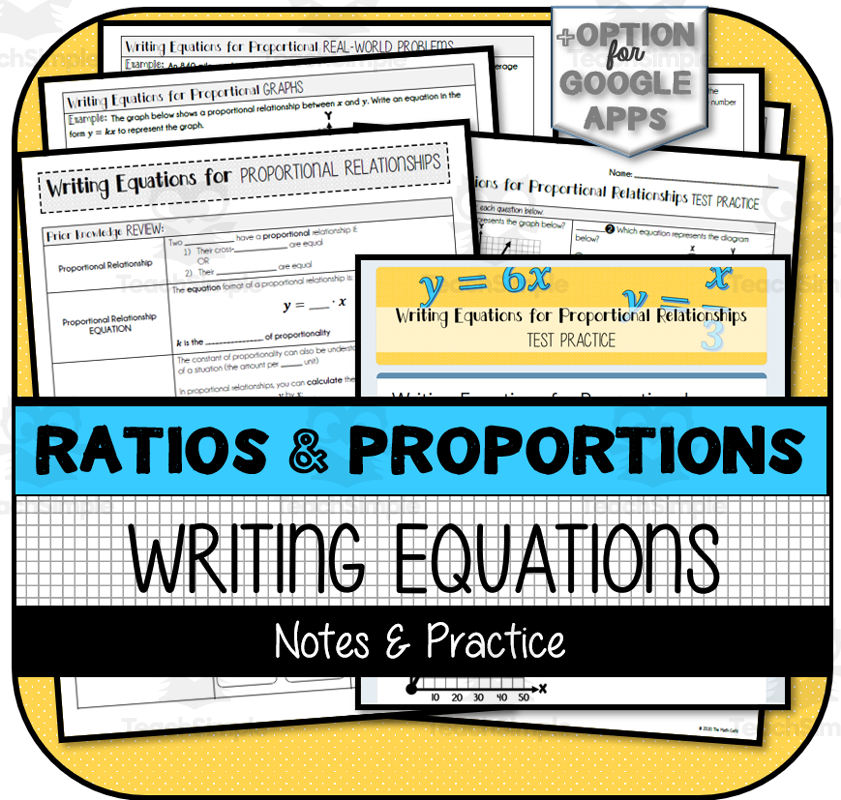
Notes and practice resource teaching students to write equations (y = kx) representing proportional relationships shown in tables, diagrams, graphs, and real-world descriptions, aligned to CCSS.MATH.CONTENT.7.RP.A.2.

Cross-curricular inductive-reasoning math task cards set within Native American (Iroquois-inspired 'Three Sisters' companion planting) history content.

Give 8th-grade students a self-checking, classroom scavenger-hunt review of Functions Part 2 topics (linear vs. nonlinear relationships, proportional relationships, similar triangles & slope, and distance/time graphs).

Give 8th-grade students a self-checking, classroom scavenger-hunt review of Functions standards (relations & functions, inputs & outputs, slope-intercept form, comparing & interpreting functions), aligned to CCSS.MATH.CONTENT.8.F.A.1, 8.F.A.2, and 8.F.B.4.

Gives ESL/EFL teen learners a reading-comprehension and essay-writing practice activity built around a biographical passage on Benjamin Franklin.

Teach long and synthetic (short) polynomial division through scaffolded notes, classwork, and homework.

A 7th-grade math notes-and-practice resource on percent applications and proportional relationships, aligned to CCSS.MATH.CONTENT.7.RP.A.3.

Guided/scaffolded fill-in-the-blank notes teaching the concept of linear parent functions and the general transformation form f(x)=af(b(x-c))+d, building from number lines and coordinate systems up to graphing transformed linear functions.

Scaffolded notes that teach students to distinguish non-functions, functions, and one-to-one (injective) functions using input/output diagrams, graphs (horizontal and vertical line test), and algebraic methods.

Gives ESL/EFL teen learners a reading-comprehension and essay-writing practice activity built around an informational passage on the rock-hewn churches of Lalibela, Ethiopia.

Three connected note-and-practice sets teach the Triangle Inequality Theorem , Angle Sum Theorem, and how to classify whether a set of given side lengths or angle measures produces one unique triangle, many triangles, or no triangle at all. Each set opens with guided fill-in-the-blank notes explaining the rule (e.g., 'the sum of the two shorter sides must be greater than the longest side'), works through a labeled example, and then provides 6-12 practice problems, some multiple choice and some requiring students to show their work. A ten-question 'Triangles Test Practice' section follows, along with a Google Forms link for a self-grading digital version of the same test. A complete answer key is provided for every notes page and the test practice section, including worked-out numeric substitutions.

Provide scaffolded (fill-in-the-blank) guided notes teaching the Perpendicular Bisector Theorem and Angle Bisector Theorem (and their converses) for high school geometry.
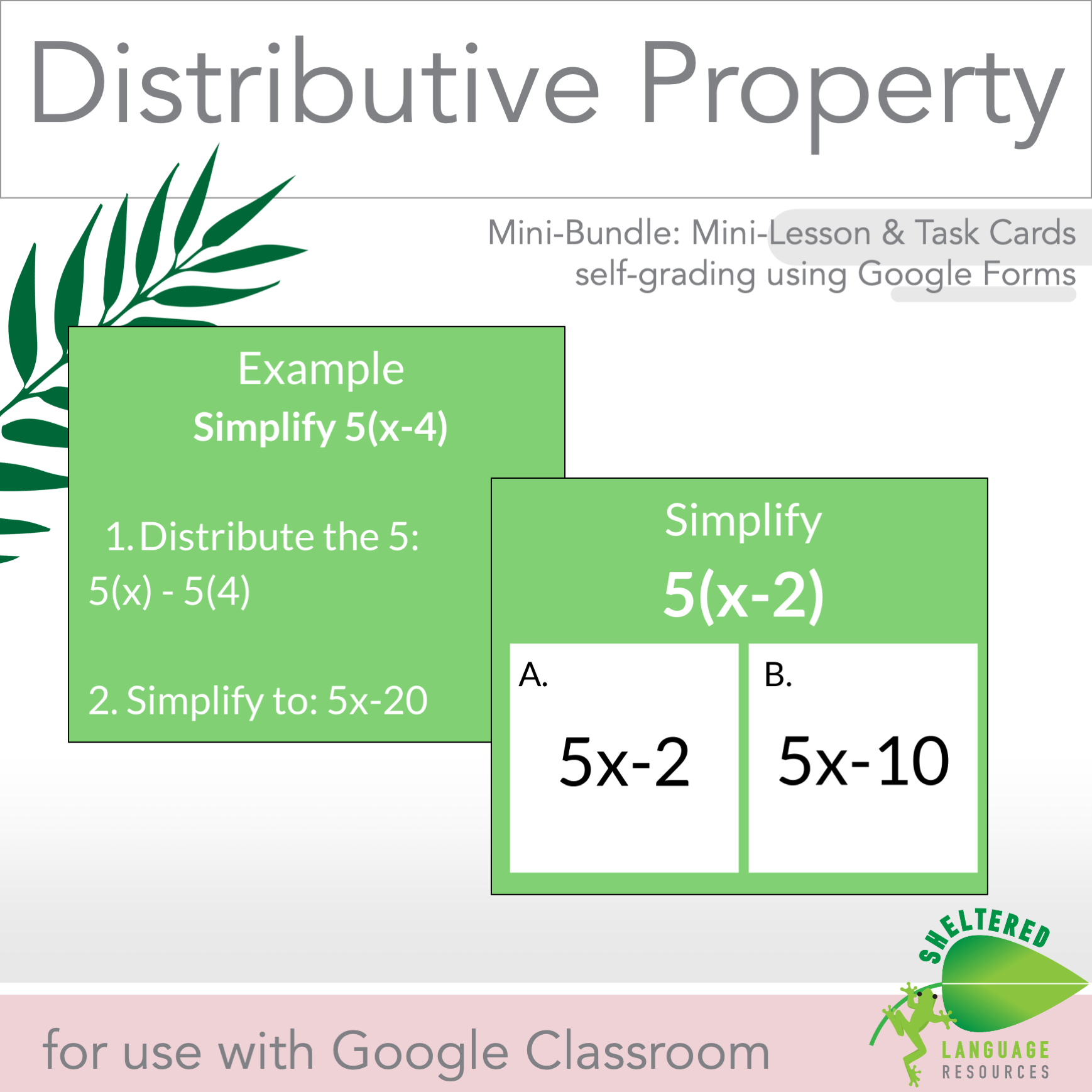
This self graded, digital math practice activity about the distributive property is perfect for your digital middle school math classroom. What makes this a Mini-Lesson & Practice Activity? There is a series of slides that leads students through the basics of how the distributive property works. Students can give feedback as they go…
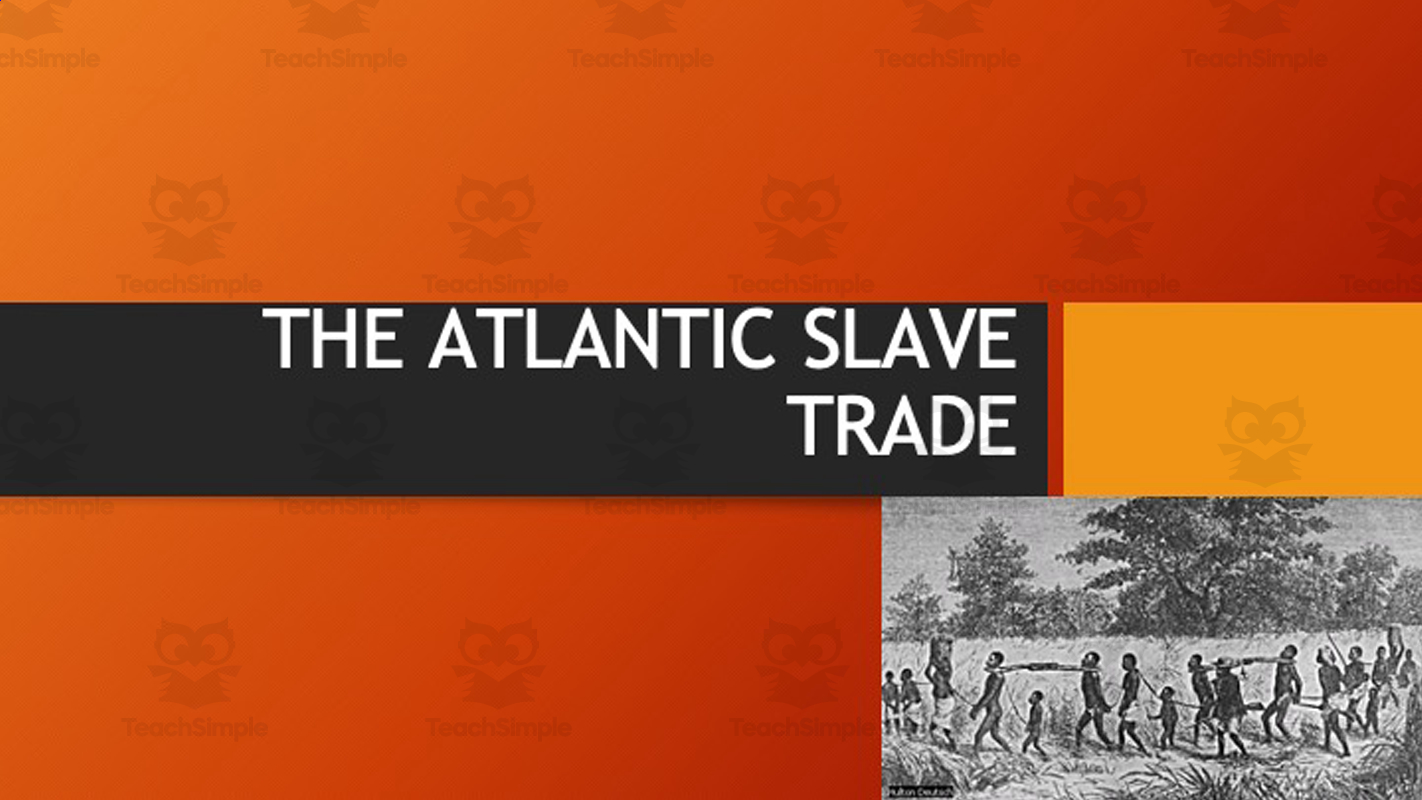
A 23-slide PowerPoint presentation with an accompanying fill-in-the-blank skeleton outline notes packet teaching high school students the history of the Atlantic Slave Trade.