



3,984 products added recently
Page 58 - Science Activities
Ignite your students' interest in science with activities that make learning interactive and exciting. This collection offers experiments, demonstrations, and inquiry-based projects covering various scientific fields. By integrating these science activities into your lessons, you can encourage critical thinking, foster curiosity, and deepen understanding of scientific concepts.

 Show filters

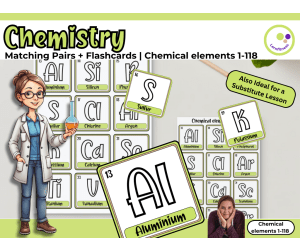
Chemical Elements – Matching Pairs Game & Flashcards (1–118)
STEM, Science, Chemistry, Physics, Life Sciences, Montessori, Basic Science, Grade 7, 8, 9, 10, 11, 12, Activities, Games, Worksheets & Printables, Task Cards, Teacher Tools, Flashcards, Classroom Decor, Door Decor, Bulletin Boards, Posters
Chemical Elements – Matching Pairs Game & Flashcards (1–118) 118 cards for learning the periodic table A visual and interactive way to explore the periodic table 🧪🧠 This printable card set includes all 118 chemical elements and can be used either as a classic memory game or as flashcards for independent practice. Each card features the element’s symbol, atomic number, and name – providing a clear and accessible entry point into the world of chemistry. The cards are designed to be used flexibly. You can print them twice to play Matching Pairs (also known as Memory®), where students turn over cards and try to find identical pairs. This helps improve concentration and recall while reinforcing students’ familiarity with element symbols and atomic numbers. What’s included: 118 cards (PDF format) – one for each chemical element Each card includes: element symbol, name, and atomic number Use them as a memory game (print twice) or flashcards for review Black-and-white format allows for optional color coding (e.g. element groups or states of matter) In my classroom: I’ve used this resource with grades 7–10, both during our unit on the periodic table and as a review activity. Some groups like to sort the cards by group or period before playing. Others enjoy using them competitively, seeing who can name the most elements based on symbol alone. There’s also room for differentiation: stronger students can work without a periodic table for support, while others use it alongside. The black-and-white version is copy-friendly and works well if you want students to color-code elements (e.g. metals vs. non-metals). You can also adapt the game for faster learners by having them group elements or research additional properties. This is a low-prep activity you can use again and again – whether as a center activity, partner task, or quick review before a test. Just print, cut, and play. 📍 Best wishes, Heike from @Lernfitness Did You Know? I teach with a certified therapy dog, and together we create a positive and welcoming learning environment. 🐶
Author Lernfitness
Rating
Tags Educational Card Games, Chemistry, Physics, STEM Science Matching Game, Chemical Elements, Periodic Table Matching Game, Game, Memory, Matching Pairs, Flashcards

Science Revision Bundle for Grades 1-12
Science, Elementary, High School, Middle School, Activities, Worksheets & Printables, Assessments, Teacher Tools
This 12-book Science Worksheet Bundle is a complete resource for teachers of Grades 1 to 12. Each ebook includes 30 engaging activities that students can do directly on the page. You don’t need extra materials—just print and use. The bundle covers all key science topics for every grade level. It includes activities in biology, chemistry, physics , and general science , all carefully designed for each age group. Students will label diagrams, answer questions, match terms, solve problems, and more. All answers are provided at the end of each book to make your job easier. Use the worksheets for classwork, revision, homework , or test prep . The language is clear and the layout is easy to follow. This bundle saves you hours of planning. You get a full year of science worksheets for every grade in one place. It’s perfect for schools, tutors, and homeschoolers. Help your students learn science step by step, from beginner to advanced. Get this bundle today and make teaching science simple, fun, and effective!
Author Bright Classroom Ideas Marketplace
Rating
Tags Science, Revision

Endangered Species Categories
Science, Life Sciences, Animals, Grade 2, 3, 4, Activities
This science activity focuses on Endangered Species Categories. Students will: 1. Cut apart each box. 2. Think about how each color, face, and description ranges in level of severity. 3. Sort them into the correct order on the blank page
Author ELA Resources
Tags Animals, Endangered Species, Graphic Organizers, Small Group, Science

Pixel Pics Spreadsheet Activity: Summer Edition
Holiday & Seasonal, Seasons, Summer, Science, Technology, Computer Science, Not Grade Specific, Activities
Pixel Pics Spreadsheet Activity: Summer Edition is a colorful pixel art project for students to complete using Google Sheets. This summer-themed activity includes 5 tabs with different images to recreate: pineapple, sunglasses, turtle, flamingos, and shark. Students follow the color coding in each tab to fill the pixels and reveal the summer artwork. They can complete all 5 images or choose specific tabs based on their interest. This activity develops computer skills as students practice using spreadsheets. It can be implemented as individual practice, partner work, or in small groups. With bright artwork and approachable instructions, Pixel Pics allows students to showcase their tech abilities while having summer fun. Differentiate by adjusting the number of tabs assigned or allowing free choice. The included completed example helps guide students of all levels to success.
Author Lab LLama - Computer Skills Resources
Tags Computer Skills, Microsoft Activity, Computer Lesson, Digital Learning, Pixel Pics, Lab Llama, Spreadsheet Activity, Summer Coloring, Summer
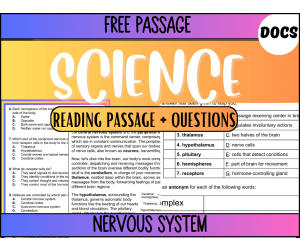
Reading Passage 25: Nervous System (Google Docs)
ELA, Reading, Reading Comprehension, Science, Life Sciences, Biology, Common Core, ESL, Language Development, Vocabulary, Grade 5, 6, 7, Centers, Activities, Assessments, Teacher Tools, Tests, Quizzes and Tests
Free Reading Passage on Nervous System for Life Science What's inside this free product? Science Reading Comprehension Passage: Nervous System Independent Google Docs Version: This is the independent Google Docs version containingone lesson. Product Info: 8 PAGES (US English with Answers) Google Docs Version Teaching Duration: 90 Minutes Science Reading Comprehension Outline: Introducing a comprehensive resource tailored for 5th and 6th graders, this product offers enriching reading passages supplemented with illustrative pictures and graphs to clarify key concepts. Aligned with the Common Core State Standards (CCSS), it offers a hassle-free approach to teaching, given that the bulk of the preparation is already done for you. The passages present a diverse set of questions – from multiple choice to data analysis and fill-in-the-blanks. This ensures a rich blend of high-interest content and fundamental curriculum-based science themes. With its versatility, you can seamlessly integrate these lessons into various classroom settings, whether it's whole class discussions, morning exercises, independent desk tasks, small group engagements, contingency plans for substitute teachers, regular homework assignments, or even themed activities for holidays. FULL CATALOG OF DOWNLOAD LINKS HERE Grade 5/6 Links: Physical Science Part 1 - Physical and Chemical Properties Google Docs/Slides/Forms PDF PPT Word Free Supplementary Pack Accompanying Videos Physical Science Part 2 - Motion and Energy Google Docs/Slides/Forms PDF PPT Word Free Supplementary Pack Accompanying Videos Physical Science Part 3 - Electricity and Magnets Google Docs/Slides/Forms PDF PPT Word Free Supplementary Pack Accompanying Videos Life Science Part 1 - Cells, Reproduction and Genetics Google Docs/Slides/Forms PDF PPT Word Free Supplementary Pack Accompanying Videos Life Science Part 2 - Human Body Systems Google Docs/Slides/Forms PDF PPT Word Free Supplementary Pack Accompanying Videos Life Science Part 3 - Plant Parts and Ecosystems Google Docs/Slides/Forms PDF PPT Word Free Supplementary Pack Accompanying Videos Earth Science Part 1 - Plate Tectonics and Rock Cycle Google Docs/Slides/Forms PDF PPT Word Free Supplementary Pack Accompanying Videos Earth Science Part 2 - Ocean Exploration and Natural Resources Google Docs/Slides/Forms PDF PPT Word Free Supplementary Pack Accompanying Videos Earth Science Part 3 - Weather and Solar System Google Docs/Slides/Forms PDF PPT Word Free Supplementary Pack Accompanying Videos For similar products and other frees, do check out Cored Group on TeachSimple .
Author Cored Education
Tags Science, Elementary, Reading, Comprehension, Vocabulary, Answers, Physics, Physical Science, Ccss, Digital Centers

Current Electricity Taboo Cards 3
Science, Physics, Grade 6, 7, 8, 9, Activities
Current Electricity Taboo Cards 3 is a top-tier teaching resource targeted at educators who wish to invigorate the scientific understanding of their students, notably in grades 6 through 9. It focuses on vital subjects like batteries, voltage, current, resistance and Ohm's Law—which form an integral part of middle school physics . The package comprises of twelve thought-provoking taboo cards that ensure student involvement and interaction. These cards aim at creating an atmosphere of inquiry while providing tough yet gratifying educational experiences. Each student has a chance to explore fascinating scientific information, leading to enhanced understanding and recall. "How do these cards function?", you might ask. The cards are laid face down on a surface; each learner draws one randomly and begins giving clues for their partner to decipher the word written on the card. But there's no room for complacency - each card contains a 'Taboo Box'; any words contained within cannot be used as hints! This added layer increases engagement levels of students eager for more demanding study tools. Cluster teaching isn't left out either - these resources are equally efficient when employed in larger groups resulting in wide-ranging debates enveloping multiple educational dimensions simultaneously. Digital files available across varied formats stored conveniently inside zip files without compromising file quality. Useful beyond traditional classrooms as well! Potential role in homework assignments thus further strengthening bonds between guardians & wards while making learning fun. In Conclusion, Current Electricity Taboo Cards 3 unlocks extraordinary educational possibilities whether it's group activities or individual assignments; distant or public education; homeschooling or private coaching centres alike relish its potential. This interactive tool aids in conveying scientific principles in an entertaining yet intellectually stimulating way.
Author Elf off the Shelf Resources
Tags Electricity, Taboo Cards, Science Education, Collaborative Learning, Interactive Teaching, Black Taboo Cards
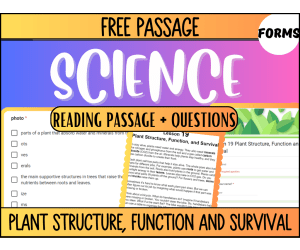
Free Reading Passage: Plant Structure, Function, and Survival (Forms)
ELA, Reading, Reading Comprehension, Science, Life Sciences, Biology, Common Core, ESL, Language Development, Vocabulary, Grade 2, 3, 4, Centers, Activities, Assessments, Teacher Tools, Quizzes and Tests, Tests
Free Reading Passage on Plant Structure, Function, and Survival for Life Science What's inside this free product? Science Reading Comprehension Passage19 : Plant Structure, Function, and Survival Independent Google Forms Version: This is the independent Google Forms version containingone lesson with full answer keys. Product Info: 1 form (US English with Answers) Google Forms Version Teaching Duration: 90 Minutes Science Reading Comprehension Outline: Targeted for students in 3rd and 4th grades, these reading passages are enhanced with illustrations and graphs to elucidate critical points. Each lesson aligns with the Common Core State Standards, allowing you to integrate science reading practice effortlessly, knowing that minimal preparation is needed on your part. Each passage comes with a variety of questions in different formats, including multiple-choice formats, data analysis, and fill-in-the-blanks. The topics covered strike a balance between engaging content and core curriculum-based science subjects. Versatile in application, these lessons are suitable for a variety of settings such as whole-class instruction, morning activities, independent desk work, small group discussions, contingency plans for substitute teachers, homework assignments, or even special holiday-themed tasks. FULL CATALOG OF DOWNLOAD LINKS HERE Grade 3/4 Links: Physical Science Part 1 - Properties of Objects and Materials Google Docs/Slides/Forms PDF PPT Word Free Supplementary Pack Accompanying Videos Physical Science Part 2 - Position and Motion of Objects Google Docs/Slides/Forms PDF PPT Word Free Supplementary Pack Accompanying Videos Physical Science Part 3 - Light, Heat, Electricity, Magnetism Google Docs/Slides/Forms PDF PPT Word Free Supplementary Pack Accompanying Videos Life Science Part 1 - Characteristics of Organisms Google Docs/Slides/Forms PDF PPT Word Free Supplementary Pack Accompanying Videos Life Science Part 2 - Life Cycles of Organisms Google Docs/Slides/Forms PDF PPT Word Free Supplementary Pack Accompanying Videos Life Science Part 3 - Organisms and Environments Google Docs/Slides/Forms PDF PPT Word Free Supplementary Pack Accompanying Videos Earth Science Part 1 - Properties of Earth Materials Google Docs/Slides/Forms PDF PPT Word Free Supplementary Pack Accompanying Videos Earth Science Part 2 - Changes in the Earth and Sky Google Docs/Slides/Forms PDF PPT Word Free Supplementary Pack Accompanying Videos Earth Science Part 3 - Objects in the Sky Google Docs/Slides/Forms PDF PPT Word Free Supplementary Pack Accompanying Videos For similar products and other frees, do check out Cored Group on TeachSimple .
Author Cored Education
Tags Science, Elementary, Reading, Comprehension, Vocabulary, Answers, Physics, Physical Science, Ccss, Digital Centers

Guided Reading Level F - Planets in Our Solar System
ELA, Resources for Teachers, Reading Comprehension, Reading, Language Development, Pre-Reading, Vocabulary, Science, Earth and Environmental Sciences, Space, Kindergarten, Grade 1, 2, Worksheets & Printables, Worksheets, Teacher Tools, Centers, Activities, Literacy Readers, Quizzes, Quizzes and Tests, Assessments
This Guided Reading Book - Planets in Our Solar System (Level F) includes: Guided Reading Color Label (front cover x1) This is a quick way to match the book’s demands to what students can generally handle.. The overall goal is to use the level/color to pick books for several smaller groups. To qualify for a certain level, a student is expected to read a book from that level with about 90–94% accuracy. If a student is consistently accurate and understands, move up a level. If the student is struggling at that level, drop down and add more support. Each student will improve at completely different rates, but it is generally one of the best ways to check progress across the class. DOWNLOAD THE CATALOG TO VIEW ALL GUIDED READING BOOKS AVAILABLE (SORTED LEVELS A-Z) COMPANION VIDEO NOW AVAILABLE (EMBEDDED AFTER PREVIEW PICTURES IN PRODUCT DESCRIPTION) Pre-Reading Question (x1) The teacher says the question aloud, either while showing the cover or the first page. Students share what they already know or make sensible guesses based on the cover. Encourage them to use the target vocabulary where possible. Write a few of their ideas on the board so you can return to them during or after the reading. Vocabulary Words (x5) Introduce the five words one at a time. Say each word aloud, have students repeat it, and then ask if anyone already knows what it means. Read the meaning together and briefly connect each word to a picture, action, or gesture so it feels more memorable. Ask students to flip through the book and point to any pages where they spot the vocabulary words. While reading, pause when one of the words appears, or reread the sentence so students clearly notice and understand it in context. Optional: Ask students to raise their hands whenever they see or hear one of the new words. Guided Reading Pages (x10) Check the book snapshot below for: Primary topic — decide whether students need a quick introduction or extra background first. What this lesson teaches best — choose 1–2 key points to focus on during the session. Learning goals — keep in mind what students should be able to understand or say by the end. Key vocabulary — review and reinforce these throughout the lesson. Questions overview — look ahead so you know what students will be asked and whether any extra support is needed. Run the lesson You may already have looked at a few pages together, but it can help to revisit some of the pictures first to build meaning. Depending on your time and how confident the group is with guided reading, you may want to read the whole book aloud to them first. Students can then whisper-read or partner-read while you listen in. If time allows, you can also read as a group, with each student taking a page. Use the guided reading prompts to support them, such as: “Check the picture—does it make sense?” “Point under the words.” “Try the first sound.” “Reread the sentence smoothly.” It can be helpful to focus more closely on one student each session, rotating over time, so you can better judge whether they are ready to move up or may need more support at their current level. Comprehension Questions (back cover x3) This is where you check that students understood the text, not just the words on the page. Start by letting students answer by pointing to a page or picture and saying a short sentence. After they respond, follow up with: “Show me where you found that in the text.” In larger groups, let partners discuss their answer first for 10–20 seconds, then invite 2–3 students to share. Differentiation tips Emerging speakers / struggling readers: oral response + pointing On-level: oral response in a full sentence Higher: one written sentence or a drawing with labels Book Snapshot Title: Planets in Our Solar System Genre: Nonfiction (informational) Subject: Science Primary Topic: Basic facts about the Sun, the planets, and the Moon Estimated Guided Reading Level (A–Z): F What This Book Teaches Best Introduces the Sun as a star at the center of the solar system that gives light and heat to the planets. Teaches the order of the planets, from Mercury to Neptune, with one main fact about each one. Builds science vocabulary naturally through the text, including words like craters , surface , giant , unique , and reflects . Helps students compare planets using simple details such as color, temperature, rings, winds, and clouds. Learning Goals Students will identify the Sun’s job in the solar system using details from the text. Students will name the planets in order from Mercury to Neptune as shown in the book. Students will describe at least three planets using facts from the text. Students will explain what makes one planet “unique” in the book. Students will tell what the Moon does at night, according to the text. Key Vocabulary From the Text craters — deep holes in the ground surface — the outside layer of something giant — very, very big unique — special and different from others reflects — bounces light back Discussion Prompts Pre-reading question: What do you already know about the Sun, the Moon, and the planets? Comprehension question: Which planet does the book say is the smallest? Comprehension question: What is Saturn famous for? Comprehension question: What does the Moon reflect at night? 1. Best Printing Method (Recommended) Booklet printing is the best option if your printer or PDF viewer supports it. This method usually places the pages in the correct order automatically and makes folding much easier. Settings to use: Print mode: Booklet Paper size: Letter or A4 Orientation: Landscape Print on both sides: Yes Flip on: Short edge Scaling: Fit to printable area Booklet subset: First, print front sides only Then, print back sides only This will automatically: Pair the pages correctly Place the cover on the outside Help everything line up properly for folding After printing, fold the pages in half and staple along the spine. 2. If “Booklet” Printing Is Not Available You can still print the book correctly by using manual duplex printing . Step-by-step: Open the PDF. Click Print . Use these settings: Orientation: Landscape Pages per sheet: 1 Print on both sides: Yes Flip on: Short edge Print all pages. Since each PDF page already contains two facing book pages, the pages should still fold neatly into a book. Thousands of Cored Education products are included with your TeachSimple membership. Download links and encyclopedia index available here.
Author Cored Education
Rating
Tags Vocabulary, Reading Comprehension, Reading Passages, Leveled Reading, Nonfiction, Reading, Guided Reading, Earth Science, Space, Planets

Mars, Glaciers, & Antarctica: Reading Comprehension Passages (Docs)
Science, Space, Earth and Environmental Sciences, ELA, Reading, Reading Comprehension, Strategies, Resources for Teachers, Environmental Science, Grade 6, 7, 8, 9, Writing Prompts, Worksheets & Printables, Centers, Activities, Teacher Tools, Assessments, Quizzes and Tests, Quizzes, Tests
Mars, Glaciers, and Antarctica: Reading Comprehension Passages (Docs) This engaging collection of science reading passages about Mars, Glaciers, and Antarctica (Earth and Space Environments) is designed to bridge the gap between science and literacy through strengthening reading comprehension and sparking scientific curiosity in middle school students. Each passage blends English Language Arts skills with accurate science content that supports NGSS classroom practice. Ideal for interdisciplinary learning in ELA and Science. Suitable for Grade 9 review, too! What Is Included? There are (3) informational passages: Antarctica: Science at the End of the Earth Explore a protected polar laboratory where clear air, ancient ice, and unique wildlife let scientists study climate change, ocean circulation, and even space signals with high precision. From Earth to Mars: What Life Would Require Contrast Earth and Mars, then outline what settlers would need: breathable air, liquid water, radiation shielding, steady energy, food production, and closed-loop systems for waste and resources. Ice Age Leftovers: From Glaciers to Sea Ice Differentiate glaciers, ice shelves, sea ice, and icebergs, and see how they shape coasts, reflect sunlight, steer ocean temperatures, and preserve clues to past climates. Student Tasks for Each Passage: 5 multiple-choice questions targeting main idea, key details, inference, vocabulary in context, and use of evidence 5 vocabulary matching items with clear, student-friendly definitions 5 text-based questions that require citing specific lines or facts 1 summary prompt that asks students to condense central ideas accurately Full answer key for every section Available Formats for this Resource PDF Word Docs FULL CATALOG OF DOWNLOADING LINKS HERE Other Science Reading Collections you May find in the store: 1. Astronomy & Space Science 2. Volcanoes, Rocks, & Mountains 3. Rock Cycle, Soil, & Sinkholes 4. Mars, Glaciers, & Antarctica 5. Water Cycle, Acid Rain, & Wastewater 6. Insects, Animals, & Ecosystems 7. Bioluminescence & Insects 8. Animal Skin, Cats, & T. Rex 9. Human Body and Senses 10. Health & Applied Bioscience 11. Waves, Light, & Imaging 12. Electricity & Energy 13. Motion & Materials 14. Chemistry and Materials Science Product Details Length: 15 pages total Grades: 6–8, also suitable for Grade 9 review Use cases: close reading, stations, homework, intervention, test prep, and sub plans Standards support: reinforces informational-text skills and supports NGSS-style sense making through observation, modeling, and clear use of claim, evidence, and reasoning Why Teachers Choose This Set Authentic science content paired with rigorous literacy practice Consistent task structure across all passages for easier planning and smoother student routines Clear, age-appropriate writing that builds confidence without oversimplifying Use this set to reinforce ELA skills in science, to add literacy to your lessons, or to support independent work. The passages strengthen main idea, evidence use, vocabulary in context, inference, cause and effect, and summary writing. With ready-to-use assessments and complete answer keys, you can provide focused practice that is simple to run and fast to review.
Author Middle & High School - CORED Education
Rating
Tags Middle School, Reading Comprehension, Reading Strategies, Reading Passages, ELA, Centers, Reading Passage, Assessments, Vocabulary, Earth Science

The Wind Powered Car: Cross Curricular STEM Project (Grades 3-5)
Science, Earth and Environmental Sciences, Environmental Science, STEM, Grade 3, 4, 5, Activities
The Wind Powered Car is an engaging cross-curricular STEM project for grades 3-5 that spans several days. Students will read about alternative energy, design and construct a prototype of a wind-powered car, collect and analyze data, create line plot graphs, and write an informational "how-to" piece. This project integrates reading, writing, math, and science standards with hands-on learning. Detailed lesson plans are included covering key concepts like asking questions, measurement, data collection, and engineering design. Students will be actively engaged as they learn about wind power, build and test their car designs, record performance data, and document the process. This project can flexibly fit a 2-day mini-unit or extended for a full week. It's a dynamic way to launch the school year or celebrate Earth Day while embedding mathematical practices and inspiring a love of STEM.
Author Beyond Traditional Math
Tags Wind Power, STEM Project, Cross-curricular, Hands-on, Earth Day

STEM Challenges and STEM Activities for Winter
Science, Technology, Engineering, STEM, Preschool, Activities
STEM Challenges and STEM Activities for Winter This comprehensive teaching resource is tailored specifically for kindergarten educators. It promotes active learning through structured STEM activities, comprising of 4 individual challenges that align with various winter themes or special occasions. These activities cater to all learners, ranging from beginners to adept problem-solvers. The pack comprises everything an educator would require to implement these exciting tasks – design planning sheets, detailed lesson plans, and engaging STEAM design process posters. With minimal prep work required, these materials have been designed considering what most teachers would already have in their classrooms. Main Strengths Promotes critical thinking and problem-solving skills. Fosters collaboration among students in subjects like Science and Engineering. Versatile enough for large group work, small groups, solo tasks or pairing up with older buddies - making it a suitable choice for multiple pedagogical techniques. The challenges included are per month and comes with both color & B/W challenge cards as well as suggested material lists of two difficulty levels (Level 1 & Level 2). Each activity comes with differentiated planning sheets beautifully crafted approach these engaging tasks. An insightful section about Early Years STEAM is also included to boost the understanding further. BONUS: Expect bonus content incorporating maker space material lists aimed at aiding educators organize! This robust package sums up into a lightweight 50-page PDF ideal suitable both printed and digital usage. Suitable For: Educators, Homeschoolers, or anyone looking for kindergarten-specific STEM activities during the chilly winter months.
Author Creativity Powered Kindergarten
Tags STEM Challenges, Winter STEM Activities, Kindergarten STEM, Science Engineering, Critical Thinking
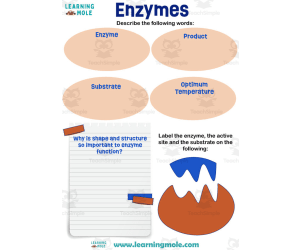
Enzymes Activity
Science, Life Sciences, Biology, Human Body, Grade 2, 3, 4, 5, 6, 7, 8, 9, Activities
Activity Overview The human body is full of fascinating wonders to learn. This activity is created to help the students recognize the anatomy and the job of the human body. Enzymes Every part and organ in our human body is vital so let's see how important they are. Have you ever imagined how we look like if we didn't have a skeleton? Did you know that because we have our amazing muscles we can stand! Do you know how many teeth do we have? Have you ever wondered about the food journey inside our body? Can you name all the glands in our body? Why do we have skin? Our nervous system is really good at sending signals. Can you tell us more about it? Are you really good at Mathematics, painting, or any other thing? You should really thank your brain about it! The famous five senses are really doing a great work? Can you explain how every sense works? Enzymes Activity The activity is perfect for encouraging the researching skills for the students, while learning more about our fantastic human body. Enzymes This friendly designed worksheet is suitable for students at school, homeschooling, and as a group activity. Instruction Describe the following words: Enzyme Product Substrate Optimum temperature Format Available in a PDF format.
Author Educational Voice
Tags Enzymes, Enzymes Activity, Enzyme, Enzymes Facts, Enzymes Facts For Kids, Human Body, Human Body Facts, Human Body Facts For Kids, STEM, Science
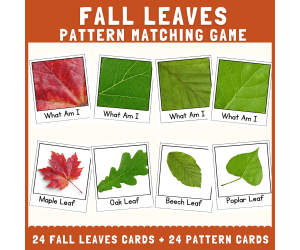
Fall tree leaves shape pattern matching cut & match science activity
Life Sciences, Science, Environmental Science, Earth and Environmental Sciences, Winter, Seasons, Holiday & Seasonal, Nature & Plants, Pre-K, Elementary, Games, Activities, Centers
Make learning about fall tree leaves fun and interactive with this Fall Tree Leaves Shape & Pattern Matching Activity! Students will identify and match different leaf shapes and patterns while building observation, classification, and early plant science skills. I like using this resource during fall science units, autumn nature studies, tree and plant lessons, seasonal learning centers, and homeschool activities. It’s a hands-on cut-and-match activity that gives students an engaging way to observe the similarities and differences between fall leaves. What You Will Get This printable Fall Tree Leaves Matching resource helps students recognize and match different leaf shapes and patterns through hands-on science practice. What’s Included in this Resource? • Fall tree leaf picture cards • Leaf shape and pattern matching cards • Cut-and-match activities • Leaf recognition practice • Shape and pattern matching activities • Student-friendly printable pages • Easy-to-use science center format This resource is perfect for: • Fall science units • Autumn nature studies • Tree and plant studies • Leaf science activities • Seasonal science centers • Preschool and elementary science • Hands-on matching activities • Homeschool learning Why you will love this? • Easy to print and use • Builds observation and matching skills • Introduces different leaf shapes and patterns • Encourages visual discrimination and classification • Connects plant science with a seasonal fall theme • Great for science centers and independent learning This Fall Tree Leaves Shape & Pattern Matching Activity is a fun way for students to observe different fall leaves, identify their unique shapes and patterns, and strengthen early science and classification skills through hands-on cut-and-match activities.
Author Perfect_Printables
Rating
Tags Plant Science, Fall Leaves , Leaf Activities, Nature Activities, Science Centers, Leaf Matching, Leaf Shape Matching, Leaf Pattern Activity, Autumn Science, Cut And Match Activity

Research Organizer & Essay Assignment: Henry Ford
Social Studies, History, History: USA, Science, Technology, Grade 7, 8, 9, 10, 11, 12, Activities, Projects, Worksheets & Printables, Worksheets
It's hard to imagine a more significant businessman to the twentieth century than Henry Ford. This resource provides your students with the opportunity to independently learn about and explain the life of the Ford Motor Company founder with this engaging research planner and essay assignment. This carefully scaffolded and easy-to-assign-AND-assess resource has been designed to guide student learning from Henry Ford fact-collection to the careful development of a five-paragraph research essay. Teaching this resource could not be easier! Start by handing out the background research and note-taking worksheet (you could also ONLY hand this out if you want a shorter lesson!). Once students have found their facts and sources, provide them with the essay outline activity, which guides them step-by-step through the requirements of a short research essay. From there, drafting their essay, using the provided peer review checklist, and submitting their final draft will be no problem at all. And then you can assess their work with the provided Common Core rubric! Use this entire resource as a complete research lesson or just part of it as a short research activity or sub plan! This TeachSimple download includes: - A Henry Ford essay writing assignment with directions, requirements, research essay writing tips, a peer review checklist, and Common Core-tied grading rubric - An editable rubric, provided as a link, that lets you make adjustments to the grade values and guidelines. This link is provided as as Google Sheet specifically built for integration into Google Classroom, although you can also modify it for use in other Learning Management Systems (LMSs) - A Henry Ford biography and note-taking worksheet that will guide your students through information gathering. This straightforward two-page handout includes instructions for background research, a fun drawing section, and an area to cite quality sources and organize conducted research - A research essay outlining worksheet, so students build on their Henry Ford notes in a clear and simple manner as they build their work towards a draft and final paper - All 6-pages of this lesson are provided in full-color and B&W versions Although this resource can be fitted for any secondary Language Arts classroom, it has been carefully designed to work best in grades 8 through 11. The included rubric is subtly but specifically tied to Common Core ELA Standards for Language (3) and Writing (2 and 7). This resource is provided as a print-ready, bookmarked, and adjustable PDF file. The rubric is also included as an editable Google Sheet. This resource contains 6 pages and 1 Google Sheet.
Author The Language of Educational Art, LLC
Tags Essay, Rubric, Research, Notetaking, Outlining, Henry Ford

Motion & Materials: Physical Science Reading Comprehension (Google)
Science, ELA, Reading, Reading Comprehension, Strategies, Resources for Teachers, Physics, Grade 6, 7, 8, 9, Writing Prompts, Worksheets & Printables, Centers, Activities, Teacher Tools, Assessments, Quizzes and Tests, Quizzes, Tests
Electricity and Energy: Physical Science Reading Comprehension Passages and Questions (Google) This very engaging collection of physical science reading passages about electricity and energy is designed to bridge the gap between science and literacy through strengthening reading comprehension and sparking scientific curiosity in middle school students. Each passage blends English Language Arts skills with accurate science content that supports NGSS classroom practice. Ideal for interdisciplinary learning in ELA and Science. Suitable for Grade 9 review, too! What Is Included? There are (3) informational passages: Sweet Science: How Heat Shapes Candy Baseball Science: From Bat to Ball Electric vs. Gasoline Cars: The Road Ahead Student Tasks for Each Passage: 5 multiple-choice questions targeting main idea, key details, inference, vocabulary in context, and use of evidence 5 vocabulary matching items with clear, student-friendly definitions 5 text-based questions that require citing specific lines or facts 1 summary prompt that asks students to condense central ideas accurately Full answer key for every section Available Formats for this Resource PDF Word Docs FULL CATALOG OF DOWNLOADING LINKS HERE Other Science Reading Collections you May find in the store: 1. Astronomy & Space Science 2. Volcanoes, Rocks, & Mountains 3. Rock Cycle, Soil, & Sinkholes 4. Mars, Glaciers, & Antarctica 5. Water Cycle, Acid Rain, & Wastewater 6. Insects, Animals, & Ecosystems 7. Bioluminescence & Insects 8. Animal Skin, Cats, & T. Rex 9. Human Body and Senses 10. Health & Applied Bioscience 11. Waves, Light, & Imaging 12. Electricity & Energy 13. Motion & Materials 14. Chemistry and Materials Science Product Details Length: 12 pages total Grades: 6–8, also suitable for Grade 9 review Use cases: close reading, stations, homework, intervention, test prep, and sub plans Standards support: reinforces informational-text skills and supports NGSS-style sense making through observation, modeling, and clear use of claim, evidence, and reasoning Why Teachers Choose This Set Authentic science content paired with rigorous literacy practice Consistent task structure across all passages for easier planning and smoother student routines Clear, age-appropriate writing that builds confidence without oversimplifying Use this set to reinforce ELA skills in science, to add literacy to your lessons, or to support independent work. The passages strengthen main idea, evidence use, vocabulary in context, inference, cause and effect, and summary writing. With ready-to-use assessments and complete answer keys, you can provide focused practice that is simple to run and fast to review.
Author Middle & High School - CORED Education
Rating
Tags Middle School, Reading Comprehension, Reading Strategies, ELA, Centers, Reading Passage, Assessments, Vocabulary, Physical Science, Physics

Independent, Dependent & Controlled Variables Lesson
Science, Basic Science, Grade 4, 5, 6, 7, 8, Activities, Experiments
This fun science lesson is a great introduction for a science fair unit or a beginning of the year scientific method unit when you need to teach your students how to carry out a true experiment . It teaches students about independent, dependent and controlled variables using humour and real-life situations. The first page has fill-in-the blank notes about a pretend experiment I completed that had some mistakes in the design. Students should stay engaged and focused throughout the lesson component as they have to fill in the blanks. They should start to think about why controlling variables matters, and they learn the relevant vocabulary. The second page gives students a chance to start brainstorming some basic experimental design ideas on their own or in pairs. They are given three situations and need to think of independent variables they could alter, what dependent variable that would affect, and all of the other variables they would need to carefully control. At the end, there is a quick review to reinforce the relevant vocabulary. Grades to Use With: This lesson can easily work in a variety of grades in the middle years, from grades 4-8 and possibly beyond! Standards: NGSS3-5-ETS1-3 Plan and carry out fair tests in which variables are controlled and failure points are considered to identify aspects of a model or prototype that can be improved. If you enjoy this science activity, check out some other options in my store: Personal Carbon Emissions /Footprint: Integrated Math and Earth Sciences Lesson: Ways to Slow Climate Change Periodic Table: Element Baseball Cards STEM Project: Extreme Environment Technology Design and "Shark Tank" Presentation STEM Project: Climate Change Solutions 8 Low-Prep STEM Tasks for Elementary and Middle School Students: Simple Handouts for Each Experiment
Author Grace Under Pressure
Rating
Tags Science Experiments, Independent Variable, Dependent Variable, Science Fair, Scientific Method, Control Variable, Experiment, STEM, Science, Elementary Science, Variables In Science Experiments, Independent And Controlled Variables, Controlled Scientific Experiment, Examples Of Independent Dependent And Controlled Variables, Controlled Variables In Science, Independent Dependent And Control Variables, What Are Independent Dependent And Controlled Variables, Science Experiment Control, Variables For Science Projects, Worksheet, Lesson, Science Worksheet, Science Lesson

Light - Reflection Find the Pair Game for - Middle School
Science, Physics, Grade 5, 6, 7, 8, 9, Activities, Games
The Light - Reflection Find the Pair Game for Middle School A captivating educational tool designed to facilitate understanding of light reflection in plane mirrors. This resource utilizes a memory game format, fostering active participation among students from grades 5 to 9. Participation and Format: Students engage in small groups of three or four. The interactive nature of the Middle School Light Reflection game provides a way to encourage teamwork and independent critical thinking skills. Each group works together to match 42 question-and-answer cards. Individuals take turns at revealing and pairing the cards. Challenging Element: This unique teaching resource features a challenging element that further encourages learning — if one team member believes that the selected pair does not match correctly, they can raise a challenge. Pupils may refer back to their study materials during these instances. An included quick-check answer sheet is available for teachers' guidance. If correct in their challenge, participants have the opportunity to earn points for their group. Simplicity In Use: Edge educators: Just print sets double-sided (potentially laminating them for increased durability) and distribute among groups fledge easy task generation set-ups. This reflective game addresses several key concepts about light transmission including: Tags: Images seen through periscope usage Luminous/non-luminous objects; , Opaque/transparent/translucent materials; Labeling incident rays and reflected rays; The normal point implementation. Potential Usage Spots: Classes handling science subjects like physics or during homeschooling sessions focusing broad-based scientific education around middle school level grades like grade 5 up till grade 9 constitute prime usage spots. Versatility In Use: The Light - Reflection Find the Pair Game doesn't restrict learning just within classroom boundaries and can also be implemented as an engaging homework assignment, thus offering versatility and ample opportunities for meaningful learning outside school walls.
Author Elf off the Shelf Resources
Tags Light Reflection, Plane Mirrors, Memory Game, Educational Tool, Science Education
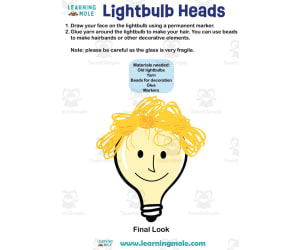
Lightbulb Heads Activity
Science, Basic Science, Physics, Grade 3, 4, 5, 6, 7, 8, 9, Activities
Activity Introduction An amazing activity designed for the students to learn more about famous places in different countries. The Lightbulb Heads Do you like STEM subjects? what is your favorite one? Have you ever tried to plant a seed? If yes, tell us more about it. Or have you ever tried to invent something? If yes, tell us more about it. And how do you think it will help us? Have you ever seen a microorganism under a microscope? What was it? And how it looked like? Mathematics is a marvelous subject. Let' sharpen our brains and solve some equations. Do you like timetable tricks? What is your favorite one? Do you know how to code? Have you ever created an app or a game before? If yes, how was it like? Lightbulb Heads Activity The activity is perfect for encouraging the researching skills for the students, while learning more about this fantastic place. Lightbulb Heads This friendly designed worksheet is suitable for students at school, homeschooling, and as a group activity. Instructions Draw your face on the lightbulb using a permanent marker. Glue yarn around the lightbulb to make your hair. You can use beads to make hairbands or other decorative elements. Note: Please be careful as the glass is very fragile. Materials Needed Old lightbulbs Yarn Beads for decoration Glue Markers Format Available in a PDF format.
Author Educational Voice
Tags Lightbulb Heads Activity, Lightbulb Heads, Lightbulb, Lightbulbs, Lightbulb Facts, Lightbulb Activity For Kids, Lightbulb Facts For Kids
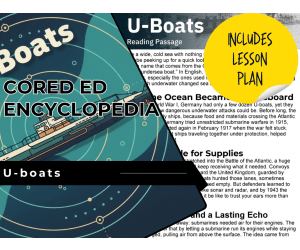
U-Boats Reading Comprehension Passage - Cored Ed Encyclopedia
ELA, Language Development, Reading Comprehension, Reading, Science, Technology, Engineering, History, Social Studies, Physics, Grade 2, 3, 4, 5, Worksheets & Printables, Worksheets, Teacher Tools, Centers, Activities, Writing Prompts, Assessments, Quizzes and Tests, Quizzes, Lesson Plans
This U-boats reading comprehension with lesson plan includes: Visualization (on the front cover) Start your lesson by taking a minute to think and share something about the topic. Read the script aloud (slowly), perhaps prepare some music or sound effects. Student close their eyes and let their imaginations wander. Students open their eyes, read the question aloud and give them a few minutes to complete. Ask a few students to share or keep answers until the end to compare with what they learn in the passage. Quick pause—thousands of Cored Education products are included with your TeachSimple membership. Download links and encyclopedia index available here. Pre-Reading Trivia Students will write down one thing they already know about the subject and then read five more facts and discuss. These facts are fun, and the students will enjoy learning about the subject before reading more. Give 1 minute for students to write what they already know (no pressure—best guess is fine). Read the five facts together. After each fact, do ask a student for their opinion, was it surprising? Set a purpose by asking students to highlight/underline one fact they want to learn more about during the reading. Reading Passage The text is a high-interest reading passage with set paragraphs, roughly three to four paragraphs long. It contains a variety of themes about the topic, anywhere from history to technology. The passage is between 250 and 350 words in length. First, ask students to look at the headings and see what they’ll learn about today. What do they know about the topic/heading? First read options: Teacher read-aloud (best for support). Partner reading (paragraph by paragraph). While reading, students underline important details, and vocabulary words they think may come up in the questions section. Mixed Questions The first question page contains four multiple-choice questions, each with a choice of four answers, and three written response questions that require a sentence or two from the student. Students complete the mcqs first independently, then review quickly as a class. For the 3 written responses, try to get students giving the answer with some form of evidence: “I think ___ because the text says ___.” If students get stuck, send them back to check the passage. Vocabulary Questions Practice seven key words from the text in this section across two activities. First section is scrambled words where students will unscramble three words given a clue for each. The second section is a word to meaning matching activity. Before starting, have some students read out words they underlined in the passage. Ask students to say the word and read aloud the sentence(s) around each word. Ask students to do scrambled words and the matching exercise in pairs then go through answers as a class. For the scrambled spelling task, get four pairs to come up to the board and write the words for extra practice with the other student reading out the clue. For the matching task, prompt students to give full sentences: “I matched ___ with ___ because ___.” Creative Writing In this question, the student will be required to write a five to eight sentence paragraph on a question related to the topic. Before starting, ask students write down 3 key ideas they are going to include in their piece. Ask students for ideas to share around the class to help those struggling. Pro writing expectations: 5–8 sentences At least 2 facts or details from the passage At least 2 vocabulary words from the previous page Students read their paragraphs while classmates listen for facts and vocabulary words. Extension Activities This page is optional for fast finishers or to take home. There are several activities, each one requiring a different skill. Do some, do none, do all, completely optional - but you will feel reassured knowing every possibility is planned for. Includes summary writting question. Answer Key There are answers for the multiple-choice questions, written response questions have sample answers, vocabulary answers and if there is a summary question then a sample summary will be provided as well. Lesson Plan Included Customized lesson plan for this lesson is included. Lesson Snapshot Title: U-Boats Genre: Nonfiction (informational text) Subject: Social Studies (World History) Primary Topic: U-boats, convoys, and the Battle of the Atlantic Estimated Guided Reading Level (A–Z): R What This Lesson Teaches Best Explains what “U-boat” means and where the name comes from (German U-Boot , short for Unterseeboot , meaning “undersea boat”). Shows how underwater attacks shifted World War I fighting toward supply ships , and why food and materials crossing the Atlantic mattered. Teaches how convoys (merchant ships traveling together under protection) helped weaken the U-boat threat. Highlights how defenders used tools like sonar and radar to listen and search better during the Battle of the Atlantic, and how the balance began to swing by 1943. Describes the snorkel as a solution for getting air to submarine engines while staying mostly submerged, including testing in 1943 and wider use in 1944. Learning Goals Students will explain what the term “U-boat” means and where the name comes from using details from the text. Students will describe why supply ships crossing the Atlantic became so important in both World War I and World War II. Students will identify how convoys worked and explain how they helped weaken the U-boat threat. Students will explain how sonar and radar helped defenders find and track U-boats better. Students will describe what problem the snorkel solved for submarines and how it worked. Key Vocabulary From the Text convoys — groups of ships traveling together with protection. unrestricted — not limited by rules or limits. sonar — a tool that uses sound to find underwater objects. radar — a tool that helps detect objects by radio waves. snorkel — a tube that brings air while mostly underwater. FULL CATALOG OF DOWNLOAD LINKS AND ENCYCLOPEDIA INDEX HERE
Author Cored Education
Rating
Tags Vocabulary, Reading Comprehension, Reading Passages, Lesson Plans, Ela Lesson Plans, Reading Comprehension Lesson Plans, Pre-reading, History, History Lesson Plans, Physics

Saving Water Activity
Environmental Science, Earth and Environmental Sciences, Science, Earth Sciences, Grade 2, 3, 4, 5, 6, 7, 8, 9, 10, Activities
Activity Introduction An amazing activity designed for the students to learn more about STEM. Saving Water Do you like STEM subjects? what is your favorite one? Have you ever tried to plant a seed? If yes, tell us more about it. Or have you ever tried to invent something? If yes, tell us more about it. And how do you think it will help us? Have you ever seen a microorganism under a microscope? What was it? And how it looked like? Mathematics is a marvelous subject. Let' sharpen our brains and solve some equations. Do you like timetable tricks? What is your favorite one? Do you know how to code? Have you ever created an app or a game before? If yes, how was it like? Saving Water Activity The activity is perfect for encouraging the researching skills for the students, while learning more about this fantastic topic. Saving Water This friendly designed worksheet is suitable for students at school, homeschooling, and as a group activity. Instructions Can you think of ways to save water? What could you do? Format Available in a PDF format.
Author Educational Voice
Tags Saving Water Activity, Saving Water, Saving Water Facts, Water Activity, Saving Water Facts For Kids, Water Facts, Water Facts For Kids, Water Cycle, Earth, Earth Facts

Science Word Searches - Set 3 (PDF)
ELA, Language Development, Vocabulary, Spelling, ESL, Resources for Teachers, Science, Physics, Earth and Environmental Sciences, Life Sciences, Grade 2, 3, 4, 5, Worksheets & Printables, Worksheets, Teacher Tools, Centers, Activities, Word Searches
Wordsearch Series This wordsearch series is designed for students in grades 2–5. Each set of wordsearches is built around a clear vocabulary theme, helping students develop word recognition, improve spelling, and boost topic-related understanding through engaging visual puzzles. Every wordsearch also includes a fun hidden shape for students to guess—adding an interactive twist to traditional vocabulary practice. These wordsearches are student-friendly, classroom-ready, and perfect for integrating into literacy warmups, seasonal units, fast-finisher tasks, or home learning extensions. Each puzzle reinforces themed vocabulary in a playful, structured format that keeps learners motivated. Science Word Search Set 3 Word List 1. Human Body Systems Brain, Heart, Lungs, Muscles, Bones, Veins, Digest, Nerves 2. Ecosystems and Food Chains Ecosystem, Habitat, Producer, Consumer, Decomposer, Food Chain, Predator, Prey 3. States of Matter Matter, Solid, Liquid, Gas, Melt, Freeze, Evaporate, Condense 4. Space and the Universe Galaxy, Milky Way, Orbit, Gravity, Black Hole, Meteor, Astronomer, Telescope 5. Plants and Photosynthesis Roots, Stem, Leaf, Flower, Seed, Sunlight, Oxygen, Chlorophyll 6. Simple Machines and Engineering Lever, Pulley, Ramp, Wheel, Axle, Screw, Gears, Invent PDF Version Other versions will appear here when available. Follow the store for the lastest on new products. How to Use These Wordsearches These wordsearches are ideal for: Morning work or early finisher bins Vocabulary centers or anchor activities Holiday or seasonal review lessons Independent literacy stations or take-home enrichment Each puzzle includes a themed word list and a shaped grid for students to complete. Word directions may vary (horizontal, vertical, diagonal), and answer keys are included for easy checking. Optional vocabulary challenges or writing tasks can be added to extend the learning experience. Whether you're reviewing key vocabulary, exploring a seasonal topic, or offering fun literacy practice, these wordsearches provide a flexible and engaging tool to support vocabulary growth in grades 2–5. More Science Themed Products Science Crosswords (Set 1) PDF Science Crosswords (Set 2) PDF Science Crosswords (Set 3) PDF Science Word Searches (Set 1) PDF Science Word Searches (Set 2) PDF FULL CATALOG OF DOWNLOAD LINKS HERE Themed Word Search Links Addition PDF Animals PDF Around the Home PDF Birthday PDF Candy PDF Christmas PDF Cinco de Mayo PDF Clothes PDF Colors PDF Days and Months PDF Division PDF Earth Day PDF Easter PDF Easy Word Searches PDF Fall PDF Father's Day PDF Food PDF Geography (Set 1) PDF Geography (Set 2) PDF Geography (Set 3) PDF Graduation PDF Health PDF History (Set 1) PDF History (Set 2) PDF History (Set 3) PDF Human Body PDF Kindness PDF Life Skills PDF Mother's Day PDF Multiplication PDF Science Word Searches (Set 1) PDF Science Word Searches (Set 2) PDF Science Word Searches (Set 3) PDF Shapes PDF Social Skills PDF Spring PDF Sports PDF St. Patrick's Day PDF Subtraction PDF Summer PDF Thanksgiving PDF Transport PDF Valentine's Day PDF Winter PDF Wordsearches in Depth Structure Each wordsearch is crafted around a focused sub-theme and includes a visual puzzle shaped like a related object (e.g., balloon, gift, snowman). Students complete each puzzle using the provided themed word list, strengthening both content knowledge and spelling skills in a highly engaging format. Each completed set includes: A shaped wordsearch puzzle with 10 vocabulary words A student instruction guide with search directions (horizontal, vertical, diagonal) An answer key for teacher support or student self-checking A Did You Know? fact connected to the theme for enrichment or discussion Themes Included The wordsearches cover a wide range of fun, age-appropriate themes, including: Seasons & Holidays (e.g., Halloween, Easter, Valentine’s Day) Math Concepts (e.g., Addition, Number Words) Everyday Topics (e.g., Animals, Weather, School) Special Units (e.g., Health, Earth Day, Sports, Kindness) Each topic is selected to reflect students’ real-life experiences and interests while reinforcing literacy skills and content understanding in a playful, visual way. For similar downloads and other frees, do check out Cored Group on TeachSimple.
Author Cored Education
Rating
Tags Vocabulary, Spelling, Science, Human Body Systems, Ecosystems, Food Chains, States Of Matter, Plants And Photosynthesis, Science Word Searches, Word Searches
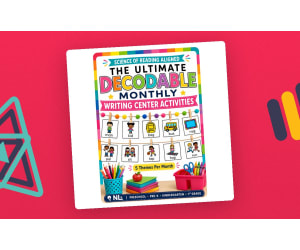
Themed Phonics Writing Center Activities Preschool Pre-K Kindergarten
Science, Holiday & Seasonal, Kindergarten, Preschool, Grade 1, 2, Worksheets & Printables, Activities
Looking for a Science of Reading aligned literacy resource that combines phonics, writing, decoding, and hands-on learning? This Ultimate Decodable Monthly Writing Center Activities pack is designed to help preschool, Pre-K, kindergarten, and first-grade students develop foundational reading skills through engaging center-based activities. Perfect for literacy stations, morning work, intervention groups, small-group instruction, homeschool learning, and independent practice. What's Included 30 printable activity pages Beginning sounds activities CVC word practice Decodable sentence building Rhyming activities Word family practice Sound boxes Vowel sorting Matching activities Cut-and-paste centers Scissor skill activities Reading fluency pages Mini-book assembly Monthly progress tracker Full-color cover page Full-color thank you page Skills Developed Students will strengthen: Phonemic awareness Decoding skills Letter-sound correspondence CVC word reading Vocabulary development Writing readiness Fine motor skills Reading fluency Sentence construction Independent literacy practice Why This Product Sells Teachers love resources that are easy to prep, highly engaging, and aligned with current reading research. These activities support Science of Reading instruction while providing meaningful hands-on practice that students enjoy. The variety of activity types keeps learners engaged and supports multiple learning styles. Perfect For Literacy Centers Writing Centers Small Groups RTI Intervention Homeschool Programs Morning Work Early Finishers Reading Practice Independent Learning Classroom Rotations
Author petterbooka
Rating
Tags Printables, Centers, Back To School, Science Of Reading, Writing, Phonics & Phonological Awareness

World Wildlife Day Word Search 2nd 3rd 4th 5th Grade Worksheet
Common Core, Nature & Plants, Life Sciences, Science, Life Studies, Grade 2, 3, 4, 5, Activities, Word Searches, Worksheets, Worksheets & Printables
Introduction This World Wildlife Day Word Search Worksheet Activity inspires students to explore animals, habitats, conservation, and environmental awareness in an exciting and engaging manner. The word search activity sparks curiosity while developing academic skills in reading and vocabulary. Objective Students will engage in word recognition, spelling, and concentration while exploring significant vocabulary related to animals and environmental conservation. This activity promotes awareness of nature and conservation in an appropriate and suitable manner for students. Order, Outline, and Steps Students search for words in a systematically designed grid. Words are hidden in various directions, making it more interesting and intellectually stimulating. Once the search is over, students can color the black-and-white version. Grades or Ages Designed for 2nd through 5th grade classrooms. Implementation Format Ideal for science classes, Earth awareness activities, centers, homework, or early finisher activities. How to Use and Variations Can be used in conjunction with lessons on animals, habitats, or conservation efforts. Standards Meets science vocabulary and English language arts standards. File Type Printable PDF Number of Pages 3 pages total • 1 colored worksheet • 1 coloring worksheet • 1 answer key
Author Classsim
Rating
Tags World , Wildlife , Day , Word Search, 2nd 3rd 4th 5th Grade, Worksheet, Activity, World Wildlife Day, World Wildlife Day Word Search , World Wildlife Day Word Search 2nd 3rd 4th 5th Grade Worksheet Activity

Science Natural Selection Case Study: The Battle Against Bollworms
Science, Life Sciences, Biology, Grade 6, 7, Activities
This is a Science Natural Selection Case Study. Students will read the case study called "The Battle Against Bollworms" and then complete the activities . The case study will allow them to re-cap, use data to fill a graph, and answer conclusion questions. Answer key included.
Author Sarah Miller Tech
Tags Natural Selection, Case Study, Science Activities, Data, Cross-curricular