
Reading & writing
Beginning Sounds G, T, B Worksheet
Practice identifying the beginning consonant sounds g, t, and b using picture-based CVC words.




Classroom resources
Browse by lesson focus
Choose the topic or kind of practice you need.
Showing 2929–2952 of 3528 resources

 Show filters
 Practice identifying the beginning consonant sounds g, t, and b using picture-based CVC words.

A phonics worksheet for distinguishing the beginning sounds of the letters K and C.

Practice distinguishing the hard c and k spellings of the /k/ sound by sorting words.

A one-page phonics worksheet for practicing the beginning consonants F, G, and H by building new words.

For each letter, students circle objects that start with the target sound, name pictures and trace the letter/word, write missing letters to complete or form rhyming words, draw lines connecting a character to matching objects, solve a maze, circle the correct word to match a picture, and complete review pages…

Students trace and write PH words, match word halves and pictures to words, read a short poem about a new phone, distinguish PH from F beginning sounds, write a short story about using a phone using a word bank, fill in sentence blanks, write words for pictures, complete an ABC-order list, solve a crossword and word…

Students read an anchor chart of CH spelling rules, trace and write CH words, match word halves and pictures to words, distinguish CH from C beginning sounds, fill in sentence blanks, write words for pictures, complete an ABC-order list, solve a crossword and word search, score words with Scrabble letter values, use…

Students read an anchor chart of SH spelling rules, trace and write SH words, match word halves and pictures to words, distinguish SH from S beginning sounds, write a short story about finding shells using a word bank, fill in sentence blanks, write words for pictures, complete an ABC-order list, solve a crossword and…

Students read an anchor chart of WH spelling rules, trace and write WH words, match word halves and pictures to words, distinguish WH from W beginning sounds, write a short story about seeing a whale using a word bank, fill in sentence blanks, write words for pictures, complete an ABC-order list, solve a crossword and…

Students read an anchor chart of TH spelling rules, trace and write TH words, match word halves and pictures to words, distinguish TH from T beginning sounds, write a short story about a kid thinking about something using a word bank, fill in sentence blanks, write words for pictures, complete an ABC-order list, solve…
 Free download
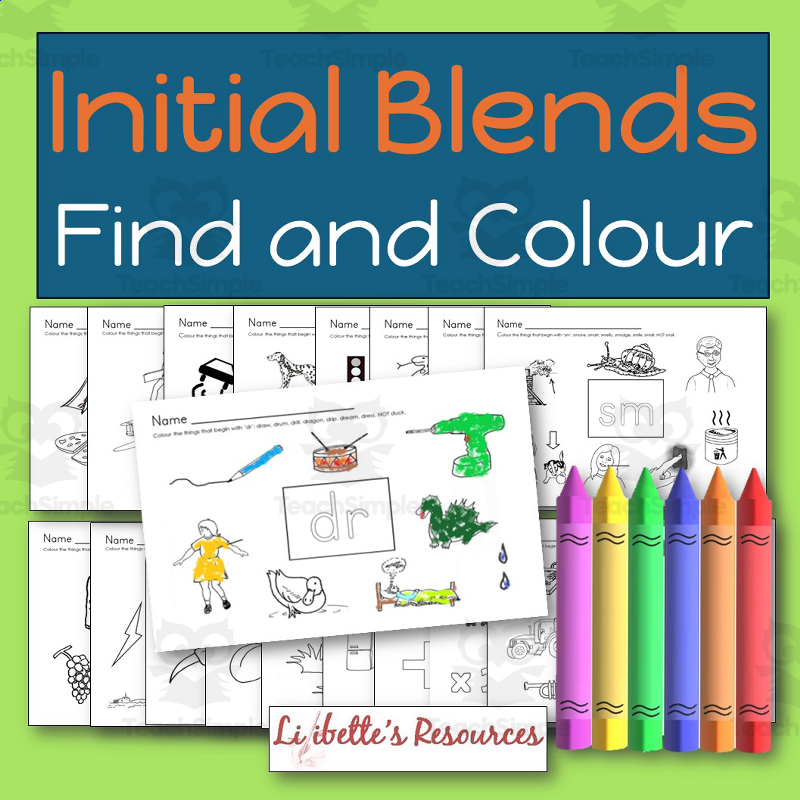
 Find-and-color worksheets that acquaint children with initial consonant blends for phonemic awareness.
Teach upper-elementary/middle-school students to identify and analyze characterization in literature using graphic organizers, as one chapter/skill section of a larger published 'Literary Devices' workbook.
Teach upper-elementary/middle-school students to identify and analyze point of view in literature using graphic organizers, as one chapter/skill section of a larger published 'Literary Devices' workbook.

A Grade 1 phonics workbook providing standardized-test-style practice on beginning/ending consonant sounds, blends, and digraphs.
Teach upper-elementary/middle-school students to identify and analyze setting in literature using graphic organizers, as one chapter/skill section of a larger published 'Literary Devices' workbook.
Teach upper-elementary/middle-school students to identify and analyze plot structure in literature using graphic organizers, as one chapter/skill section of a larger published 'Literary Devices' workbook.
A Grade 3 Common Core language arts practice worksheet covering reading comprehension of literature and informational text, vocabulary, grammar, and writing.
Book 3 of a phonics activity series (Ready-Ed Publications' 'Literacy for Early Learners') that introduces, practices, and reinforces the most advanced set of phonic sounds/blends in the series for early readers through varied worksheet activities.
This primary phonics-based resource is designed for grades Kindergarten to 1. Blends & Digraphs uses visual clues and context clues to identify letters and sounds. Reading is a crucial skill for all primary students. Phonics provides the building blocks for these early readers. Sounding out the words students are learning…
A single-Bloom's-level 'Chapter Slice' of Classroom Complete Press's Reading Response Forms series (grades 3-4): gives teachers response forms and activities that target Bloom's Taxonomy Level 5 (Evaluating) reading-response skills.

Assign and structure four distinct roles (questioner, summarizer, connector, illustrator) for young students running a book club/literature circle group.
A single-Bloom's-level 'Chapter Slice' of Classroom Complete Press's Reading Response Forms series (grades 1-2): gives teachers response forms and activities that target Bloom's Taxonomy Level 5 (Evaluating) reading-response skills.
This lesson plan is great for 4th grade students who need to work on reading and comprehending literature, including stories and poetry. The RL.4.10 Fourth Grade Common Core Lesson is designed to help students with this common issue.
A single-Bloom's-level 'Chapter Slice' of Classroom Complete Press's Reading Response Forms series (grades 1-2): gives teachers response forms and activities that target Bloom's Taxonomy Level 2 (Understanding) reading-response skills.