



3,932 products added recently
Page 57 - ELA Lesson Plans
Elevate your ELA instruction with lesson plans that cover reading, writing, speaking, and listening skills. These resources provide diverse texts and engaging activities to improve literacy. Integrate these plans to enrich your language arts curriculum and support student achievement.

 Show filters


High School Forest Animals and Their Habitat Reading Passage
Science, Earth and Environmental Sciences, Life Sciences, Animals, Environmental Science, Research, ELA, Writing, Reading, Nature & Plants, Homeschool Resources, High School, Teacher Tools, Assessments, Lesson Plans, Quizzes and Tests, Worksheets & Printables, Writing Prompts
As a homeschool parent, finding resources that are not bone-dry but still offer actual rigor is a massive headache. When my own daughter hit 9th grade, those "fun" nature studies we loved in middle school just stopped cutting it. She inquired about topics in science so I create this Forest Animals and Their Habitats Reading Passage resources. I took the time to upgrade this Forest Animals and Their Habitats Reading Passage resource from the middle school level to the high school level. I wanted to move past the basics and really dig into the "why" of ecology. It is not just a list of critters—it is an exploration of how forest systems actually stay in balance. I have worked hard to make this substantial enough for a high school credit, but engaging enough that your teen will not roll their eyes at the kitchen table. My goal? Less prep stress for you and better "big picture" conversations for them. INCLUDED IN THIS RESOURCE Detailed reading passage focusing on forest ecology and complex habitats. A glossary terms with definitions that actually make sense. 10 Note-Taking Sheets designed to help students/homeschoolers synthesize what they’re reading. 20 critical thinking questions and a full answer key. TOPICS COVERED Breaking down the specific roles of herbivores, carnivores, and omnivores. Looking at morphological and behavioral traits, including the science of hibernation. The vital impact of seed dispersal and nutrient cycling. Real talk about anthropogenic threats and our role in stewardship. I totally get the juggling act. I love to create resources that are interest-based for my daughter in our homeschool. This Forest Animals and Their Habitats Reading Passage resource is designed to flex with your family’s rhythm. I made sure to lean into themes of stewardship and respect here. To me, homeschooling is about more than just hitting high school requirements; it is about protecting that spark of curiosity while they learn to care for the world around them. This Forest Animals and Their Habitats Reading Passage unit was a game-changer for our 9th-grade year; I hope it sparks some genuine "aha!" moments in your home, too. If you and your students/homeschoolers enjoyed this resource, please leave a review. Thank you for your support! Tina - Big Easy Homeschooling Mom
Author Homeschool with Big Easy Homeschooling Mom
Rating
Tags Forest Ecology Curriculum, High School Biology Reading, Forest Animal Habitats, Animal Adaptations Lesson, Biodiversity Reading Passage, Environmental Science High School Homeschool, Homeschool Science Resources, High School Reading Comprehension, Forest Ecosystem Services, Nature-based Homeschooling
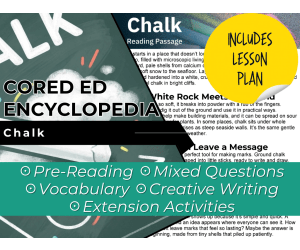
Chalk Reading Comprehension Passage - Cored Ed Encyclopedia
ELA, Language Development, Reading Comprehension, Reading, Pre-Reading, Life Sciences, Science, Social Studies, Earth and Environmental Sciences, Geography, Grade 2, 3, 4, 5, Worksheets & Printables, Worksheets, Teacher Tools, Centers, Activities, Writing Prompts, Assessments, Quizzes and Tests, Quizzes, Lesson Plans
This chalk reading comprehension with lesson plan includes: Visualization (on the front cover) Start your lesson by taking a minute to think and share something about the topic. Read the script aloud (slowly), perhaps prepare some music or sound effects. Student close their eyes and let their imaginations wander. Students open their eyes, read the question aloud and give them a few minutes to complete. Ask a few students to share or keep answers until the end to compare with what they learn in the passage. Quick pause—thousands of Cored Education products are included with your TeachSimple membership. Download links and encyclopedia index available here. Pre-Reading Trivia Students will write down one thing they already know about the subject and then read five more facts and discuss. These facts are fun, and the students will enjoy learning about the subject before reading more. Give 1 minute for students to write what they already know (no pressure—best guess is fine). Read the five facts together. After each fact, do ask a student for their opinion, was it surprising? Set a purpose by asking students to highlight/underline one fact they want to learn more about during the reading. Reading Passage The text is a high-interest reading passage with set paragraphs, roughly three to four paragraphs long. It contains a variety of themes about the topic, anywhere from history to technology. The passage is between 250 and 350 words in length. First, ask students to look at the headings and see what they’ll learn about today. What do they know about the topic/heading? First read options: Teacher read-aloud (best for support). Partner reading (paragraph by paragraph). While reading, students underline important details, and vocabulary words they think may come up in the questions section. Mixed Questions The first question page contains four multiple-choice questions, each with a choice of four answers, and three written response questions that require a sentence or two from the student. Students complete the mcqs first independently, then review quickly as a class. For the 3 written responses, try to get students giving the answer with some form of evidence: “I think ___ because the text says ___.” If students get stuck, send them back to check the passage. Vocabulary Questions Practice seven key words from the text in this section across two activities. First section is scrambled words where students will unscramble three words given a clue for each. The second section is a word to meaning matching activity. Before starting, have some students read out words they underlined in the passage. Ask students to say the word and read aloud the sentence(s) around each word. Ask students to do scrambled words and the matching exercise in pairs then go through answers as a class. For the scrambled spelling task, get four pairs to come up to the board and write the words for extra practice with the other student reading out the clue. For the matching task, prompt students to give full sentences: “I matched ___ with ___ because ___.” Creative Writing In this question, the student will be required to write a five to eight sentence paragraph on a question related to the topic. Before starting, ask students write down 3 key ideas they are going to include in their piece. Ask students for ideas to share around the class to help those struggling. Pro writing expectations: 5–8 sentences At least 2 facts or details from the passage At least 2 vocabulary words from the previous page Students read their paragraphs while classmates listen for facts and vocabulary words. Extension Activities This page is optional for fast finishers or to take home. There are several activities, each one requiring a different skill. Do some, do none, do all, completely optional - but you will feel reassured knowing every possibility is planned for. Includes summary writting question and additional facts. Answer Key There are answers for the multiple-choice questions, written response questions have sample answers, vocabulary answers and if there is a summary question then a sample summary will be provided as well. Lesson Plan Included Customized lesson plan for this lesson is included. Lesson Snapshot Title: Chalk Genre: Nonfiction (informational text with headings) Subject: Life Science / Earth Science / Reading (Informational Text) Primary Topic: How chalk forms and how people use it Estimated Guided Reading Level (A–Z): O What This Lesson Teaches Best Explains chalk’s origin: microscopic ocean life made calcium carbonate shells that piled up, hardened, and became chalk. Uses cause-and-effect to show how pressure, time, and weather change materials (shells → rock; waves/wind reveal cliffs). Connects a natural material to human uses (building materials, improving sour soil, writing and drawing). Builds understanding of properties of materials (chalk is soft, rubs into powder, leaves visible marks on dark boards). Highlights how tools and surfaces change over time (dark boards, colored chalk experiments, sidewalk chalk, whiteboards). Learning Goals Students will explain how chalk forms over a long time using details from the text. Students will identify what chalk is made from in the beginning of its story (shells of microscopic living things). Students will describe at least two practical uses of chalk named in the text. Students will explain why chalk worked well on dark boards, using evidence from the passage. Students will compare chalk rock and gypsum “chalk” as described in the passage. Key Vocabulary From the Text microscopic — too tiny to see without help. carbonate — part of a mineral in many shells. crumbly — easy to break into small pieces. gypsum — a mineral used to make some board “chalk.” pavement — the hard surface of a sidewalk or road. FULL CATALOG OF DOWNLOAD LINKS AND ENCYCLOPEDIA INDEX HERE
Author Cored Education
Rating
Tags Vocabulary, Reading Comprehension, Reading Passages, Lesson Plans, Ela Lesson Plans, Reading Comprehension Lesson Plans, Pre-reading, Science Lesson Plans, Earth Science, Geography
Informative Essay Introduction Paragraph
ELA, Strategies, Writing, Grade 6, 7, 8, Worksheets & Printables, Worksheets, Lesson Plans
This Informative Essay Introduction Paragraph is a week-long set of activities to help students develop a deeper understanding of the introduction paragraph. Included: - Notes and word bank - Bell work and student pages - Assessment - Answer keys - Digital version
Author Mrs. Spangler in the Middle
Tags Informative Essay, Essay Writing, Introduction Paragraph, Writing Process, Google Classroom, How To Write An Introductory Paragraph For An Informative Essay, Intro For Informative Essay, Introduction Informative Essay, How To Write An Intro Paragraph For An Informative Essay, Introduction Paragraph Informative Essay, How To Write An Introduction Paragraph For An Informative Essay, Informative Introduction, Essay, Introduction, Guided Notes, Paragraph Writing
Down on the Farm Curriculum Pack
Creative Arts, Art, Social Studies, ELA, Math, Early Math, Language Development, Vocabulary, Science, Basic Science, Kindergarten, Lesson Plans, Teacher Tools
If your students are studying farm animals or are about to begin a farm unit, I have just the resource to provide you with everything you need and more! This is a Down on the Farm Curriculum Pack complete with an abundance of printable resources and engaging activities for students to complete. This curriculum was designed for your preschool students. The curriculum goal is to develop an awareness and appreciation for farming and agriculture, and the products that are derived from the farming process. The vocabulary that students will focus on is field, planting, acres, crops, combine, country, tractor, barn, silo, harvest, plow, and produce. This curriculum will come with a color of the week (red) and a letter of the week (F). This curriculum pack includes: --Sensory Table Ideas --Art Activities --Cooking Experience --Community Time --Math Activities --Home/School Connection Ideas --Science Table Enrichments --Science Concepts/Activities --Prop Box Ideas/Dramatic Play Enrichments --Movement and Motor --Playground/Walk Activities --Transition/Waiting Ideas --Block Area Enrichments --Flannel Board --Teacher Made Enrichment Ideas --Field Trip Ideas --Supplemental Learning Ideas/Activities At the start of this pack, you will receive a list of supplies needed for activities and projects. The worksheets, activities, and tasks included in this pack are intended to be completed in a variety of formats – whole group, small group, and independent work. I hope you enjoy!
Author Learning Foundations
Tags Preschool Curriculum, Down On The Farm, Farm Animals, Science Concepts, Art Activities, Vocabulary, Color Of The Week, Learning Foundations

Identifying Genres Mini Lesson
ELA, Strategies, Grade 3, 4, Teacher Tools, Lesson Plans
This is an Identifying Genres Mini Lesson for your 3rd and 4th grade reading students. These worksheets are great practice for students when learning about genres. Students can use the definition sheet to help them read a title of a story and then predict what the genre might be. Pages 4-7 can be printed back to back.
Author The Kinder Lady
Tags Reading Mini Lesson, Reading Strategies, Genres, Graphic Organizer, Cause And Effect
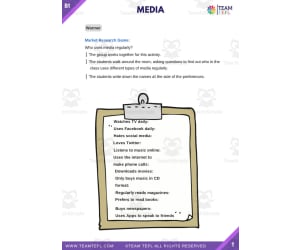
Media | Intermediate Lesson Plan
ELA, Language Development, ESL, Not Grade Specific, Teacher Tools, Lesson Plans
Discover our comprehensive Media Intermediate Lesson Plan, carefully designed for educators seeking to enrich their media lessons and inspire their students to new heights. This thoughtfully crafted resource is perfect for delving deeper into the world of media while ensuring students sharpen their grammar skills along the way. The package includes 3 PDFs with 10 ready-to-print pages and one digital access file, providing an array of high-quality content followed by stimulating exercises. These activities assess student comprehension of various media-related topics while catering to different learning styles. Our lesson plan features an engaging audio exercise in MP3 format that auditory learners will undoubtedly love. Our resources are designed with the modern classroom in mind - they can be seamlessly integrated into Google Apps for smooth access during your lessons. To make your life as a teacher easier, we include a detailed answer key as well. With our Media Intermediate Lesson Plan, you'll appreciate how simple yet effective it is to elevate your teaching while imparting essential media knowledge to your curious young learners. Don't miss the opportunity; add this invaluable resource to your educational arsenal today!
Author TEAM TEFL
Tags Media, ESL Lesson, Research, Audio, Language Arts

Critical Thinking: Keys to Problem Solving - FLASH-PC
ELA, Strategies, Grade 5, 6, 7, 8, Teacher Tools, Lesson Plans
Critical Thinking: Keys to Problem Solving - FLASH-PC This is a valuable teaching resource with curriculum -based content crafted specifically for honing critical thinking skills and problem-solving strategies—mainly geared towards Grades 5 through 8. It integrates comfortably within the framework of Language Arts instruction. Main Components: Reading Passages: Captivating texts designed to ignite intellectual curiosity, induce reflection, and promote incisive thought processes via 'Before You Read' and 'After You Read' question prompts. Printables: Solid reinforcement tools for concepts learnt during the session, helpful when dealing with an entire class or smaller groups alike --> tangible lesson reminders. Vocabulary Flash Cards: Useful during whole group sessions or as homework assignments where students can associate words with meanings at their own pace - aids easier recall later on. Graphic Organizers: Tools known for enhancing thinking skills by visually organizing ideas. Adaptable for full-class engagement or small group collaborations, aiding clarity of thought flow. Interactive Activities: Encourages active student involvement both in collaborative work sessions between classmates and focused one-on-one time between teacher and student. The package comes in a straightforward-to-use Software (PC) file format that makes access easy across different educational scenarios-be it at large public schools or intimate homeschool settings. Each component aims at fostering critical analysis among learners as they venture into more complex academic landscapes.
Author Classroom Complete Press
Tags Software (PC)

Ignorance is Bliss | Figurative Language Activity | Micro-Learning Deck
ELA, Reading, Reading Comprehension, Grade 2, 3, 4, 5, Teacher Tools, Lesson Plans
This resource allows students to explore figurative learning in a fun way. The figurative language term for this learning deck is "Ignorance is Bliss." Through close reading and a reading passage with audio, your students will better comprehend figurative language! Included: -Video lesson on language concept -Reading passage w/ audio Comprehension -Quick write
Author Teach Me This
Tags Figurative, Language, Learning Deck, Ignorance Is Bliss, Comprehension

Creative Writing Workshop: Precise and Concise Language Mini Lesson
ELA, Writing, Grade 9, 10, 11, 12, Lesson Plans, Teacher Tools
Show your students how to write concisely and with precision using this mini lesson! If you're sick of reading pages and pages of vague or wordy sentences, then this lesson is a must-have for your classroom! This lesson will create awareness within your students so that they can strengthen their own writing. Students will first learn what it means to write concisely, precisely, and how these traits strengthen writing. With the included handout, they'll have some handy writing tips at all times. Then, they'll practice editing for word choice and simplicity with an editing worksheet .
Author It's Lit Teaching
Tags Creative Writing, Word Choice, Diction, Mini Lesson, Writing Workshop, Concise Vs Precise, Precise Vs Concise, Microsoft Word Concise Language, Concise And Precise
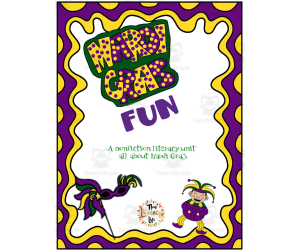
Mardi Gras Fun | A Non-Fiction Literacy Unit
ELA, Reading, Grade 2, 3, 4, 5, Lesson Plans, Teacher Tools
This resource is a Mardi Gras Literacy Unit. This Mardi Gras Unit can be used to help children understand the concept of the holiday. Included: - An easy to understand non-fiction passage - Before, during, and after reading activities - Word cards for challenging words - Main idea and details board game
Author Literacy Life
Tags Mardi Gras, March, Main Idea, Celebration, Literacy Unit
Liberty: Full Lesson Plan w/ PowerPoints & Graphic Organizers
ELA, Reading, Grade 7, 8, 9, 10, Lesson Plans, Teacher Tools
Liberty: Full Lesson Plan with PowerPoints & Graphic Organizers Ready to engage your students in a comprehensive study of Julia Alvarez's text, Liberty? Our educational resource comes equipped with everything necessary to carry out a thorough reading lesson plan. This multifaceted resource pack provides teachers like you with a complete toolkit, helping students delve deep into the layered nuances of the text. Included in this pack are detailed lesson plans for Liberty, as well as complementary worksheets to help bolster student understanding. For your convenience, these files are offered in both PDF and Word document formats. Whether you need whole group activities or homework assignments, these ready-to-print resources can smoothly integrate into any teaching style. In order to cultivate a more profound understanding of the literature, our package includes an array of graphic organizers that target various literary elements such as: Charts for decoding author’s purpose, Analyzing characters and figurative language, Understanding historical context and symbolization methods used by the author. Additionally available are sheets dedicated to peer evaluation and various diagrams concerning plot details and themes. Detailed PowerPoints To Catalyze Discussions An inclusive set of eight PowerPoints comes accompanying each area discussed within the graphic organizers - from characterization through theme interpretation. These informative presentations catalyze discussion among students aiding their comprehension on complex topics such as Plot Structure Symbolism & Allegory Irony & Ambiguity Narrator & Voice Imagery Voice Persona Theme. Aimed towards Grade 7-10 Language Arts Classes Focusing on Reading Subsubject This meticulously curated lesson plan aids educators enhance their teaching trajectory while instilling beneficial learning experiences amongst learners. Bonus Thank You Gift To wrap up our product offering is a bonus thank you gift designed especially keeping educators like you! A single zip file containing all printable materials including PowerPoints PDFs Word documents - carefully combined cater diverse learning needs strategies classroom scenarios home schooling environments alike making this all-inclusive tool indispensable addition your teaching resources.
Author Quality Teaching Products
Tags Lesson Plans, Graphic Organizers, PowerPoints, Reading Comprehension, Literary Analysis
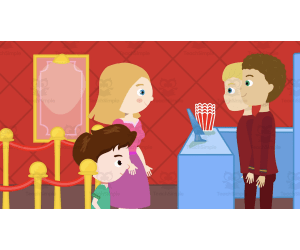
In The Cinema | English Conversations Video Lesson
ELA, Language Development, ESL, Not Grade Specific, Lesson Plans, Teacher Tools
This animated video lesson is all about English conversations. Students will love this engaging and interactive video as they learn more about being in the cinema. This video serves as a great introduction or review video for your learners. This is a 6-minute video lesson.
Author Educational Voice
Tags English, Conversations, Video Lesson, Language Arts, Cinema

Elephant in the Room | Figurative Language Activity | Micro-Learning Deck
ELA, Reading, Reading Comprehension, Grade 4, 5, 6, 7, Teacher Tools, Lesson Plans
Engaging Elephant in the Room Figurative Language Lesson This informative PowerPoint resource allows educators to teach students about the figurative language term “Elephant in the Room” in an engaging way. Through close reading of a passage with audio support, students will strengthen literal and inferential comprehension abilities. The deck includes a video lesson explaining the key language concept, a reading passage with audio recording, reading comprehension questions, and a quick write activity. Teachers can utilize this versatile resource in various settings such as whole group instruction, small group, independent practice, or even as a homework supplement. Providing exposure to grade-appropriate figurative language terms assists learners in building a stronger foundation for literacy development.
Author Teach Me This
Tags Elephant In The Room, Figurative, Language, Learning Deck, Comprehension Lesson, Micro Elephant
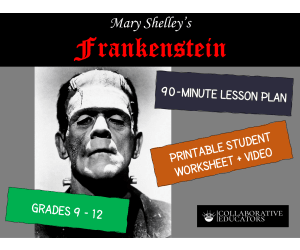
Lesson Plan on Mary Shelley's Frankenstein
Literature, ELA, Reading, Grade 9, 10, 11, 12, Lesson Plans, Teacher Tools, Activities, Worksheets & Printables
This is a lesson plan lasting 90 minutes focused on the classic book Frankenstein, authored by Mary Shelley. Shelley composed Frankenstein at the age of 19, and it was released the next year in 1818. The novel narrates the tale of Victor Frankenstein, a young scientist seeking the key to life who produces the hideous being in a clandestine experiment. The lesson plan incorporates the video summary of Mary Shelley's Frankenstein by Video SparkNotes. A separate printable worksheet for students contains numerous questions. The responses are given individually at the conclusion. The lesson is perfect for students in Grades 9 through 12. Frankenstein is full of meanings. It implies that social isolation is the main source of evil as well as its consequence. The Monster clearly states that his separation from humanity has led him to become a killer: “My guardians had left, severing the sole connection that tied me to the world.
Author Bright Classroom Ideas Marketplace
Rating
Tags Frankenstein, Mary, Shelley, Classic, Literature, Reading, Lesson, Plan

The First 21 Days | Day 4: Making Predictions | Reading Instruction
ELA, Reading, Preschool, Grade 1, 2, 3, Teacher Tools, Lesson Plans
This resource is Day 4: Making Predictions in the First 21 Days lesson set. This presentation is full of comprehension and reading strategies, anchor charts , interactive activities and so much more.
Author First in Line
Tags Reading Books, Reading Instruction, Making Predictions, Anchor Chart, Sequencing

Scientific Developments Advanced ESL Lesson Plan
ELA, Language Development, ESL, Vocabulary, Not Grade Specific, Adult Education, High School, Middle School, Teacher Tools, Lesson Plans, Worksheets & Printables
This is an advancedESL ELA ELL and TEFL lesson plan worksheet set for Scientific Developments. In this class the students will take a look at some of the greatest scientific developments in recent years from the creation of the Covid 19 vaccine to Nanotechnology and Artificial Intelligence. We dive further into successful missions to Mars, the development of solar panels and The Human Genome Project. Students will learn more about these topics and then complete the exercises to follow, which will assess their comprehension and implement grammar skills. This resource can also be accessed through Google Apps. Answer key included. An audio exercise is included. The ESL ELA ELL and TEFL lesson plan includes flashcards, a warmer, grammar rules, exercises, role-play, conversation, writing drill, activity, answers and an extra study that would be good to set as homework. There are 31+ pages and there are teachers notes to guide the teacher.
Author TEAM TEFL
Tags Inventions, Science, ESL, Comprehension, Technology

Toucan Unit Study (Rainforest Animals Lesson Plan, Videos, Activities)
ELA, Reading, Reading Comprehension, Grammar, Language Development, Spelling, Writing, Science, Life Sciences, Animals, Research, Grade 1, 2, 3, Lesson Plans, Teacher Tools
Toucan Unit Study (Rainforest Animals Lesson Plan, Videos, Activities) offers a ready-to-use, comprehensive resource for teaching elementary students about the magnificent toucan. This 5-day course entices learners into the rainforest, piquing curiosity and encouraging in-depth understanding of this vibrant bird’s fundamental aspects: Description Diet Habitat Life cycle Predators. This product spans a variety of disciplines including Language Arts to Science and even Art classes, integrating various activities catered to different learning types. The activities include: Videos for visual and auditory learners. Reading passages. Research report pages. Interactive notebook pieces and other hands-on experiences for kinesthetic learners. Incorporation With Existing Curriculum The unit study can be seamlessly linked with your existing curriculum during fun-time or academic sessions focusing on Toucans, rainforest animal units studies or general writing lessons or science class hours. The resource delivered as a 53-page PDF ensures quick access from any device used by teachers or educators at home. It includes: - Well-structured teacher instructions ensuring seamless incorporation into any teaching day plans - Five days’ worth lesson plans integrating videos and myriad activities promoting active engagement. - Optional nonfiction supplements adding depth to understanding of toucans while introducing advanced comprehension strategies offering more detailed research materials. > This package serves as an ideal platform for group instruction but flexible enough for small group discussions fostering peer sharing /input while still robust enough serve as independent work assignments including homework tasks. Project-Based Activity & Enhancements An optional project-based activity is included in this package, along with daily worksheets and interactive notebook pieces. Also included are coloring pages, and bookmarks to bring color and fun to the learning process! Thoroughly explore the realm of toucans through this dynamic learning resource that uniquely combines academics and creativity for effective education.
Author Heather Huhman
Tags Toucans, Rainforest Animals, Unit Study, Cross-curricular, Interactive Activities

High School The Outsiders 4-Week Unit Study (Growing Bundle)
ELA, Literature, Reading, Writing, Research, High School, Homeschool Resources, Teacher Tools, Assessments, Graphic Organizers, Lesson Plans, Outlines, Presentations, Quizzes and Tests, Rubrics, Worksheets & Printables, Writing Prompts
Homeschooling a high schooler is a completely different ballgame, isn’t it? I quickly realized that my teenager could spot pointless busywork a mile away—and honestly, they just do not tolerate it. I needed something that fulfilled those necessary high school academic requirements but actually got my teen talking. That frustration is exactly why I built this f our-week unit study for The Outsiders . I originally designed it to take the planning pressure off my own shoulders while offering the kind of mature, respectful academic challenge that older kids appreciate. We skip the repetitive, surface-level comprehension questions here. Instead, this unit targets the messy, real-world themes that high schoolers actually care about: class divides, identity, and the intense pressure to belong. Because the daily layout is already completely organized for you, you can stop stressing over Sunday night lesson planning. Instead, you get to just sit down at the table and dive into great book discussions with your student. This High School The Outsiders Unit Study study was a genuine labor of love in our own home. My hope is that it gives you back your prep time and turns your literature hours into something you both actually look forward to each day. INCLUDED IN THIS RESOURCE: Daily roadmap for structured learning. 6-part test, rubrics, and grading keys. 20 deep-thinking prompts and essay topics. Note-taking sheets, projects, and progress trackers. TOPICS COVERED: Greasers vs. Socs class analysis. Exploring adolescent pressure and growth. Symbolism, narrative voice, and theme. Investigating self-concept and belonging. Whether you need a solid foundation for a high school literature credit or a meaningful supplemental deep dive, this growing bundle bridges the gap between academic rigor and true heart. It challenges older students/homeschoolers to think critically and dissect the complexities of Hinton’s iconic narrative, while giving you back hours of your precious weekly prep time. If you and your students/homeschoolers enjoyed this unit study, please leave a review. Thank you for your continued support! Tina - Big Easy Homeschooling Mom
Author Homeschool with Big Easy Homeschooling Mom
Rating
Tags The Outsiders Study Guide, S.E. Hinton Unit, Literature Analysis Materials, High School Novel Study, Greasers And Socs Analysis, English Literature Deep Dive, Dolescent Identity Literature, Sociopolitical Literature Unit, English Study Guide, Thematic Analysis

English Starter Pack | Beginner Lesson Plan
ELA, Language Development, ESL, Grade 2, 3, 4, 5, Teacher Tools, Lesson Plans
This is a beginner lesson plan worksheet set for English Starter Pack. Start your English students on their journey to English proficiency with this basic starter pack. The starter pack is an early introduction to topics like greetings and introductions, telling the time, food and cooking, numbers, clothes, parts of the human body, family, countries, nationalities and home furniture and rooms. Students will learn more about these and then complete the exercises to follow, which will assess their comprehension and understanding. Exercises include closed and open activities, matching words with images, writing drills and conversation prompts. This starter pack ESL and TEFL worksheet is a great pre A1 resource to let your students get ahead before they begin the A1 course. Everyone has to start somewhere, right? Start to put the blocks in place right here as you introduce your students to lots of very basic words for vocabulary building. Very little prep is necessary, allowing you more time to focus your energy on your students. This resource can also be accessed through Google Apps. Answer key included. It includes 24 ready to print PDF pages. The different topics can be taught at the same time or they can be divided up to teach in separate classes.
Author TEAM TEFL
Tags About Me, Graphic Organizer, ESL Activity, Cardinal Numbers, Calendars
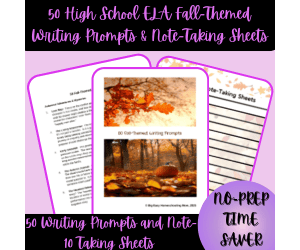
50 High School ELA Fall-Themed Writing Prompts & Note-Taking Sheets
ELA, Writing, Holiday & Seasonal, Seasons, Fall, Resources for Teachers, High School, Teacher Tools, Assessments, Lesson Plans, Quizzes and Tests, Worksheets & Printables, Writing Prompts
As a homeschool mom of a high schooler, I have found that autumn is the perfect time to spark creativity and reflection in writing. These 50 High School ELA Fall-Themed Writing Prompts were designed with high school students/homeschoolers in mind—rich in imagery, emotion, and thought-provoking ideas that encourage both analytical and creative expression. Whether your teen enjoys journaling, fiction, or reflective essays, these 50 High School ELA Fall-Themed Writing Prompts help them connect the beauty and mystery of fall to their own personal growth as writers. This 50 High School ELA Fall-Themed Writing Prompts resource was created to make writing feel inspiring, not forced, even on those cooler, sleepy fall mornings. INCLUDED IN THIS RESOURCE: 50 high school-level fall-themed writing prompts 10 note-taking or brainstorming sheets Simple to integrate into any writing routine, whether for daily journaling or themed assignments Versatile enough to fit into morning warm-ups, creative lessons, or reflective writing days TOPICS COVERED: Autumn symbolism and transformation Personal reflection and emotional growth Mystery, creativity, and speculative storytelling Nature-inspired and philosophical writing themes These 50 High School ELA Fall-Themed Writing Prompts set is more than just a list—it is a seasonal writing journey. It is designed to draw out thoughtful responses, rich vocabulary, and emotional depth in your student’s/homeschooler’s writing. With each page, they will discover the beauty of fall not just in nature, but within themselves as growing writers. This 50 High School ELA Fall-Themed Writing Prompts resource turns the simple act of writing into an exploration of character, perspective, and creativity that lasts well beyond the autumn season. It encourages teens to slow down, reflect, and see their words as a meaningful expression of who they are becoming. If you and your students/homeschoolers enjoyed this resource, please leave a review. Thank you for your support! Tina - Big Easy Homeschooling Mom
Author Homeschool with Big Easy Homeschooling Mom
Rating
Tags Fall Writing Prompts For High School Homeschoolers, Creative Autumn Essay Prompts For Teens, Fall-themed ELA Resources For Homeschool, Reflective Fall Writing Journal For Teens, Fall Creative Writing Exercises For Homeschool, Fall Writing Packet For High School ELA, High School Fall Writing Prompts, Homeschool ELA Fall Ideas, High School Creative Writing Lessons, Fall Journaling Prompts

All About Me Curriculum Pack
Creative Arts, Art, Social Studies, ELA, Language Development, Vocabulary, Math, Early Math, Science, Basic Science, Kindergarten, Lesson Plans, Teacher Tools
If your students are learning about themselves or are about to begin an All About Me unit, I have just the resource to provide you with everything you need and more! This is an All About Me Curriculum Pack complete with an abundance of printable resources and engaging activities for students to complete. This curriculum was designed for your preschool students. The curriculum goal is to increase children’s self-awareness and esteem, and assist in defining the individual, unique attributes they possess – and build upon them. The vocabulary that students will focus on is personal, personality, individual, special, favorite, resemblance, genetics, male, female, features, unique, and preferences. There is a letter of the week (M) and colors of the week (skin-tone colors). This curriculum pack includes: --Sensory Table Ideas --Art Activities --Cooking Experience --Community Time --Math Activities --Home/School Connection Ideas --Science Table Enrichments --Science Concepts/Activities --Prop Box Ideas/Dramatic Play Enrichments --Movement and Motor --Playground/Walk Activities --Transition/Waiting Ideas --Block Area Enrichments --Flannel Board --Teacher Made Enrichment Ideas --Field Trip Ideas --Supplemental Learning Ideas/Activities At the start of this pack, you will receive a list of supplies needed for activities and projects. The worksheets, activities, and tasks included in this pack are intended to be completed in a variety of formats – whole group, small group, and independent work. I hope you enjoy!
Author Learning Foundations
Tags Preschool Curriculum, All About Me, Art Activities, Science Skills, Self-esteem, Social Skills, Learning Foundations, Transition Ideas, Math

Yogurt Reading Comprehension Passage - Cored Ed Encyclopedia
ELA, Language Development, Reading Comprehension, Reading, Life Sciences, Science, Physics, Social Studies, History, Technology, Grade 2, 3, 4, 5, Worksheets & Printables, Worksheets, Teacher Tools, Centers, Activities, Writing Prompts, Assessments, Quizzes and Tests, Quizzes, Lesson Plans
This yogurt reading comprehension with lesson plan includes: Visualization (on the front cover) Start your lesson by taking a minute to think and share something about the topic. Read the script aloud (slowly), perhaps prepare some music or sound effects. Student close their eyes and let their imaginations wander. Students open their eyes, read the question aloud and give them a few minutes to complete. Ask a few students to share or keep answers until the end to compare with what they learn in the passage. Quick pause—thousands of Cored Education products are included with your TeachSimple membership. Download links and encyclopedia index available here. Pre-Reading Trivia Students will write down one thing they already know about the subject and then read five more facts and discuss. These facts are fun, and the students will enjoy learning about the subject before reading more. Give 1 minute for students to write what they already know (no pressure—best guess is fine). Read the five facts together. After each fact, do ask a student for their opinion, was it surprising? Set a purpose by asking students to highlight/underline one fact they want to learn more about during the reading. Reading Passage The text is a high-interest reading passage with set paragraphs, roughly three to four paragraphs long. It contains a variety of themes about the topic, anywhere from history to technology. The passage is between 250 and 350 words in length. First, ask students to look at the headings and see what they’ll learn about today. What do they know about the topic/heading? First read options: Teacher read-aloud (best for support). Partner reading (paragraph by paragraph). While reading, students underline important details, and vocabulary words they think may come up in the questions section. Mixed Questions The first question page contains four multiple-choice questions, each with a choice of four answers, and three written response questions that require a sentence or two from the student. Students complete the mcqs first independently, then review quickly as a class. For the 3 written responses, try to get students giving the answer with some form of evidence: “I think ___ because the text says ___.” If students get stuck, send them back to check the passage. Vocabulary Questions Practice seven key words from the text in this section across two activities. First section is scrambled words where students will unscramble three words given a clue for each. The second section is a word to meaning matching activity. Before starting, have some students read out words they underlined in the passage. Ask students to say the word and read aloud the sentence(s) around each word. Ask students to do scrambled words and the matching exercise in pairs then go through answers as a class. For the scrambled spelling task, get four pairs to come up to the board and write the words for extra practice with the other student reading out the clue. For the matching task, prompt students to give full sentences: “I matched ___ with ___ because ___.” Creative Writing In this question, the student will be required to write a five to eight sentence paragraph on a question related to the topic. Before starting, ask students write down 3 key ideas they are going to include in their piece. Ask students for ideas to share around the class to help those struggling. Pro writing expectations: 5–8 sentences At least 2 facts or details from the passage At least 2 vocabulary words from the previous page Students read their paragraphs while classmates listen for facts and vocabulary words. Extension Activities This page is optional for fast finishers or to take home. There are several activities, each one requiring a different skill. Do some, do none, do all, completely optional - but you will feel reassured knowing every possibility is planned for. Includes summary writting question. Answer Key There are answers for the multiple-choice questions, written response questions have sample answers, vocabulary answers and if there is a summary question then a sample summary will be provided as well. Lesson Plan Included Customized lesson plan for this lesson is included. Lesson Snapshot Title: Yogurt Genre: Nonfiction (informational text) Subject: Science (food science/microbiology) & Informational Reading Primary Topic: How yogurt forms, bacteria “helpers,” and history Estimated Guided Reading Level (A–Z): R What This Lesson Teaches Best Explains that warm milk can change during travel , becoming thicker and a little sour, and people learned this new food could last longer than fresh milk. Teaches the science of yogurt-making: tiny bacteria eat sugar in milk and make lactic acid , which helps milk proteins clump so yogurt turns thick and creamy. Shows why warmth matters : keeping milk warm for several hours gives the tiny workers time to do their job. Builds a brief history of how yogurt was studied and spread, including a 1905 observation by Stamen Grigorov and later interest from Ilya Metchnikov that helped it become better known in Europe. Connects history to modern life by describing how Isaac Carasso began selling yogurt in Barcelona and how yogurt comes in many styles today, including fruit-mixed cups and thick strained kinds. Learning Goals Students will describe how yogurt may have been discovered when milk changed during a journey. Students will explain how bacteria help milk turn thick and creamy, using details from the passage. Students will identify why keeping milk warm is important for making yogurt, according to the text. Students will describe what the passage says happened in 1905 that helped people understand yogurt better. Students will sequence key events about yogurt over time (long ago, 1905, 1919) using information from the text. Students will describe a simple home method for making yogurt that is stated in the passage. Key Vocabulary From the Text bacteria — tiny helpers you cannot see without a microscope. lactic acid — an acid bacteria make that changes milk. proteins — milk parts that clump together as yogurt thickens. microscope — a tool used to see tiny living things. cultures — live helpers added to start yogurt thickening. FULL CATALOG OF DOWNLOAD LINKS AND ENCYCLOPEDIA INDEX HERE
Author Cored Education
Rating
Tags Vocabulary, Reading Comprehension, Reading Passages, Lesson Plans, Ela Lesson Plans, Reading Comprehension Lesson Plans, Pre-reading, Life Science, Science Lesson Plans, History

Word Families: Long Vowels - Digital Lesson Plan Gr. PK-2 | PC Software
ELA, Language Development, Vocabulary, Kindergarten, Preschool, Grade 1, 2, Teacher Tools, Lesson Plans
Word Families: Long Vowels - Digital Lesson Plan Gr. PK-2 | PC Software This dynamic and engaging teaching resource is designed to heighten vocabulary skills, sight word recognition, and comprehension among preschool through second grade students. A user-friendly program contains an 80 screen-page digital lesson plan aimed at strengthening students' grasp of phonetics using real-life imagery. Core Focus & Lessons The core focus is on the pronunciation of long vowel phonograms or word families. Learners delve into lessons, acquainting with the onset and rhyme connection found in word families. This promotes faster reading abilities by perceiving words as recognizable language segments or chunks. Included Interactive Activities Memory match game: It amuses while reinforcing lesson content simultaneously. Crossword puzzles and word search activities: Simulate cognitive skills in a playlike ambiance—a fun space where education thrives subtly yet substantially. Evaluation & Assessment The Comprehension Quiz included challenges learners' retention of current lessons while revisiting past topics briefly enhancing focus on areas needing attention along confirming mastered skills. Note: This resource aligns perfectly with state standardized academic guidelines emphasizing Bloom's Taxonomy's cognitive learning principles enhancing higher-order thinking skills essential for wholesome educational development. User Groups: Who can benefit? An entire classroom setting Tailored especially for educators juggling multiple responsibilities among diverse student groups. //Can be used in small study groups seeking intensive focus on particular aspects //Can assist individual students with homework assignments at home Why Choose This Resource? Delivered as a single zip file, all you need is a PC to employ this impactful teaching resource. Catered for language arts instruction, specifically vocabulary enhancement among Preschool through second grade students, This is not just a lesson plan—it's an act of simplifying education itself!
Author Classroom Complete Press
Tags Digital Lesson Plan, Word Families, Long Vowels Activity, Reading Lesson Plan, Reading Vocabulary
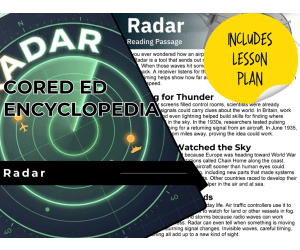
Radar Reading Comprehension Passage - Cored Ed Encyclopedia
ELA, Language Development, Reading Comprehension, Reading, Pre-Reading, Writing, History, Social Studies, Technology, Science, Grade 2, 3, 4, 5, Worksheets & Printables, Worksheets, Teacher Tools, Centers, Activities, Writing Prompts, Assessments, Quizzes and Tests, Quizzes, Lesson Plans
This radar reading comprehension includes: Visualization (on the front cover) Start your lesson by taking a minute to think and share something about the topic. Read the script aloud (slowly), perhaps prepare some music or sound effects. Student close their eyes and let their imaginations wander. Students open their eyes, read the question aloud and give them a few minutes to complete. Ask a few students to share or keep answers until the end to compare with what they learn in the passage. Quick pause—thousands of Cored Education products are included with your TeachSimple membership. Download links and encyclopedia index available here. Pre-Reading Trivia Students will write down one thing they already know about the subject and then read five more facts and discuss. These facts are fun, and the students will enjoy learning about the subject before reading more. Give 1 minute for students to write what they already know (no pressure—best guess is fine). Read the five facts together. After each fact, do ask a student for their opinion, was it surprising? Set a purpose by asking students to highlight/underline one fact they want to learn more about during the reading. Reading Passage The text is a high-interest reading passage with set paragraphs, roughly three to four paragraphs long. It contains a variety of themes about the topic, anywhere from history to technology. The passage is between 250 and 350 words in length. First, ask students to look at the headings and see what they’ll learn about today. What do they know about the topic/heading? First read options: Teacher read-aloud (best for support). Partner reading (paragraph by paragraph). While reading, students underline important details, and vocabulary words they think may come up in the questions section. Mixed Questions The first question page contains four multiple-choice questions, each with a choice of four answers, and three written response questions that require a sentence or two from the student. Students complete the mcqs first independently, then review quickly as a class. For the 3 written responses, try to get students giving the answer with some form of evidence: “I think ___ because the text says ___.” If students get stuck, send them back to check the passage. Vocabulary Questions Practice seven key words from the text in this section across two activities. First section is scrambled words where students will unscramble three words given a clue for each. The second section is a word to meaning matching activity. Before starting, have some students read out words they underlined in the passage. Ask students to say the word and read aloud the sentence(s) around each word. Ask students to do scrambled words and the matching exercise in pairs then go through answers as a class. For the scrambled spelling task, get four pairs to come up to the board and write the words for extra practice with the other student reading out the clue. For the matching task, prompt students to give full sentences: “I matched ___ with ___ because ___.” Creative Writing In this question, the student will be required to write a five to eight sentence paragraph on a question related to the topic. Before starting, ask students write down 3 key ideas they are going to include in their piece. Ask students for ideas to share around the class to help those struggling. Pro writing expectations: 5–8 sentences At least 2 facts or details from the passage At least 2 vocabulary words from the previous page Students read their paragraphs while classmates listen for facts and vocabulary words. Extension Activities This page is optional for fast finishers or to take home. There are several activities, each one requiring a different skill. Do some, do none, do all, completely optional - but you will feel reassured knowing every possibility is planned for. Includes summary writting question. Answer Key There are answers for the multiple-choice questions, written response questions have sample answers, vocabulary answers and if there is a summary question then a sample summary will be provided as well. Lesson Plan Included Customized lesson plan for this lesson is included. Lesson Snapshot Title: Radar Genre: Nonfiction (informational text with support pages) Subject: Science (Physical Science/Technology) Primary Topic: Using radio waves to find objects Estimated Guided Reading Level (A–Z): R What This Lesson Teaches Best Explains how radar works using radio waves, an “echo,” and a receiver that measures return time. Connects timing to distance (how long the trip takes helps show how far away something is). Builds background knowledge about radar’s development before World War II (tests in the 1930s; June 1935 detection; Chain Home stations). Shows real-world uses after the war (air traffic control, ships in fog, weather radar tracking rain and storms). Includes support pages that match the passage content (questions, vocabulary, writing, and extension activities focus on radio waves, echoes, Chain Home, and the 1935 test). Learning Goals Students can describe radar as a tool that sends out radio waves and listens for the waves that bounce back. Students can explain how a receiver uses the echo’s return time to show distance. Students can describe one early step in radar’s development mentioned in the passage (1930s tests or the June 1935 detection). Students can explain why early-warning stations mattered as World War II was getting closer. Students can identify at least two ways radar is used in everyday life after the war (planes, ships, or weather). Key Vocabulary From the Text receiver — device that listens for the returning signal echo — a returning signal that bounces back pulsing — sending waves in repeated bursts detected — found or noticed something was there vessels — boats or ships FULL CATALOG OF DOWNLOAD LINKS AND ENCYCLOPEDIA INDEX HERE
Author Cored Education
Rating
Tags Vocabulary, Reading Comprehension, Reading Passages, Reading, Creative Writing, Reading Strategies, Writing Prompts, Lesson Plans, History, Radar