



3,931 products added recently
Page 22 - ELA Lesson Plans
Elevate your ELA instruction with lesson plans that cover reading, writing, speaking, and listening skills. These resources provide diverse texts and engaging activities to improve literacy. Integrate these plans to enrich your language arts curriculum and support student achievement.

 Show filters

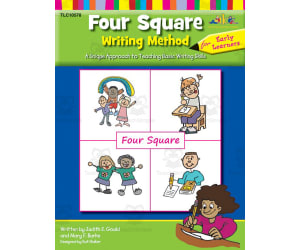
Four Square: Writing Method for Early Learners: A Unique Approach to Teaching Basic Writing Skills
ELA, Writing, Kindergarten, Preschool, Teacher Tools, Lesson Plans
Teach writing skills using the Four Square method, which has been proven to work in classrooms just like yours. The Four Square method can be used with all forms of writing and will fit any reading or language arts program. This step-by-step approach is built around a simple graphic organizer that first shows students how to collect ideas and then helps them use those ideas to create clear and polished prose. Open-ended reproducibles make the technique accessible to writers of all ability ranges. Also great for content area writing.
Author Classroom Complete Press
Tags Writing Method, Writing Activity, Four Square, Creative Writing, Early Learners

Guided Reading Activities and Lesson Plans Nonfiction Set 2 Nutrition
ELA, Reading, Reading Comprehension, Common Core, ESL, Language Development, Pre-Reading, Vocabulary, Resources for Teachers, Grade 2, 3, Worksheets & Printables, Worksheets, Lesson Plans, Teacher Tools, Activities
Guided Reading Activities with Lesson Plans Nonfiction Set 2 Note: This download DOES NOT include the passages themselves. If you have not already done so, download in a format of your choice in the "reading links" section below. Overview The perfect companion materials for Cored Education reading comprehension downloads. This collection of guided reading lessons includes a wide array of engaging themes that aim to foster comprehension, vocabulary development, and creative thinking. Each lesson is crafted to be interactive and immersive, making learning enjoyable while promoting essential literacy skills. The lessons are designed for students to actively engage with both the material and the world around them, creating connections to their personal experiences while developing key skills. Includes Guided Reading Materials For: 1.Proteins 2.Carbohydrates 3.Fats 4.Milk 5.Potatoes 6.Composting Reading Links: This is the guided reading materials version and DOES NOT include the passages themselves. The passages related to this download are available here in GOOGLE Docs, GOOGLE Forms, GOOGLE Slides. PDF, PPT, WORD. Google Docs Google Forms Google Slides PDF PPT Word Details Pre-reading Discussions Each lesson begins with pre-reading questions that help activate prior knowledge and engage students in the theme of the lesson. This allows students to make personal connections with the content before diving into the reading material. Vocabulary Development Every lesson includes vocabulary exploration that introduces key terms students will encounter in the reading. These words are essential for understanding the passage, and activities encourage students to apply the new vocabulary in context. Comprehension Check After the reading, the lessons provide comprehension questions (typically multiple-choice) that assess students’ understanding of the story. These questions help students reflect on key events, characters, and concepts within the text, reinforcing their comprehension. Creative Writing Prompts To foster creativity, the lessons include writing activities that challenge students to apply what they've learned in imaginative ways. These prompts allow students to practice creative expression while reinforcing the lesson’s theme. Discussion Topics Each lesson ends with wrap-up discussion questions that encourage students to think critically and engage in group conversations. These discussions can enhance social learning and deepen understanding by connecting the lesson's content to broader real-world applications. Theme-Based Learning The themes (e.g., winter, nature walks, photography, flowers) are universally appealing and offer opportunities for cross-curricular connections with science, art, and environmental studies. This makes the lessons versatile for a wide range of teaching contexts. Student-Centered Approach The activities are designed to be interactive and student-driven, allowing them to explore the content through discussions, hands-on vocabulary practice, and personal reflections. This promotes active learning and keeps students engaged. FULL CATALOG OF DOWNLOAD LINKS HERE Grade 2/3 Links Fiction Set 1 - Nature Google Docs Google Forms Google Slides PDF PPT Word Guided Reading Materials Fiction Set 2 - Animals Google Docs Google Forms Google Slides PDF PPT Word Guided Reading Materials Fiction Set 3 - Food Google Docs Google Forms Google Slides PDF PPT Word Guided Reading Materials Fiction Set 4 - School Google Docs Google Forms Google Slides PDF PPT Word Guided Reading Materials Fiction Set 5 - Friends Google Docs Google Forms Google Slides PDF PPT Word Guided Reading Materials Fiction Set 6 - Family Google Docs Google Forms Google Slides PDF PPT Word Guided Reading Materials Fiction Set 7 - Sports Google Docs Google Forms Google Slides PDF PPT Word Guided Reading Materials Nonfiction Set 1 - Technology Google Docs Google Forms Google Slides PDF PPT Word Guided Reading Materials Nonfiction Set 2 - Nutrition Google Docs Google Forms Google Slides PDF PPT Word Guided Reading Materials Nonfiction Set 3 - Animals Google Docs Google Forms Google Slides PDF PPT Word Guided Reading Materials Reading Passages Overview Each passage is especially written for Grade 2-3 students, including key vocabulary required for this age group. Topics are varied and are accompanied by colorful graphics. Topics are meant to educate, yet entertain the modern student. These passages are perfect for the modern classroom. Whereas textbooks can become outdated in no time, any changes to technology or the world will result in updates to this product. Mixed Questions The mixed questions section of each lesson includes a variation of fivecomprehension, vocabulary and math questions. In addition, key reading strategies are frequently covered including cause & effect, summarizing, compare & contrast and making conclusions. Three of the questions will be MCQs and two will require a written response of some kind. Full answers and example responses appear at the end of the lesson. Spelling & Vocab Each reading passage contains a variety of words and phrases designed for Grade 2-3 students. Spelling and vocab activities provide the opportunity to build fluency with these words. As it can become quite mundane doing the same activities over and over, each lesson in a set will contain a different spelling and vocab activity . Writing Prompts Writing prompts are designed to continue the theme or lessons learned in the story. Students are persuaded to write in a variety of ways and each prompt includes several cues to help. As with the spelling/vocab section, writing prompts will vary. This includes research pieces, reading responses, poetry and creative writing prompts. Full Answer Keys Full answer keys and sample responses are provided so no matter how busy you are, you know you're covered! Mixed question answers provide evidence from the text, math questions contain the relevant workings. Answers are designed for use by the teacher, but also suitable as a handout to the student. Additional File One lesson will have an additional file. This is something fun to extend the lesson with. For similar downloads and other frees, do check out Cored Group on TeachSimple.
Author Cored Education
Tags Elementary, Reading, Comprehension, Vocabulary, Answers, Ccss, Guided Reading, Guided Reading Activity, Guided Reading Lesson Plans, Guided Reading Lesson Plan

Conjunctions Supplementary Materials Grades 3-4 (PDF)
ELA, Language Development, ESL, Grammar, Common Core, Resources for Teachers, Grade 3, 4, Worksheets & Printables, Worksheets, Quizzes and Tests, Teacher Tools, Tests, Assessments, Lesson Plans, Activities
Conjunctions Supplementary Materials Note: This download DOES NOT include the tests themselves. You can still make use of these materials without them but they are recommended. Download in a format of your choice in the "Links" section below. Outline Ice Breaker (5-10 minutes) Engaging, interactive activity to introduce the lesson’s theme. Examples: Matching games, sentence races, charades, or storytelling challenges. Guided Practice (10-15 minutes) Teacher-led exercises to reinforce the concept. Examples: Sorting sentences by tense, sentence transformations, or fill-in-the-gap exercises. Group or Partner Task (15 minutes) Collaborative activity to practice the lesson’s focus in a fun and engaging way. Examples: Role-play, storytelling, sentence-building games, or small-group discussions. Independent Worksheet (15 minutes) Individual written activity to solidify understanding. Examples: Sentence corrections, verb conjugation drills, or tense identification exercises. Exit Task (5 minutes) Quick reflective activity to assess understanding before students leave. Examples: Writing a sentence using the target concept, identifying a tense, or explaining a rule. Links: Includes: Correlative Conjunctions Coordinating Conjunctions Subordinating Conjunctions Mistake Finding Google Docs Google Forms Google Slides PDF PPT Word FULL CATALOG OF DOWNLOAD LINKS HERE Grade 3/4 Links: Adjectives Google Docs Google Forms Google Slides PDF PPT Word Free Supplementary Materials Pack Adverbs Google Docs Google Forms Google Slides PDF PPT Word Free Supplementary Materials Pack Conjunctions Google Docs Google Forms Google Slides PDF PPT Word Free Supplementary Materials Pack Nouns Google Docs Google Forms Google Slides PDF PPT Word Free Supplementary Materials Pack Pronouns Google Docs Google Forms Google Slides PDF PPT Word Free Supplementary Materials Pack Verbs Google Docs Google Forms Google Slides PDF PPT Word Free Supplementary Materials Pack Sentence Structure Google Docs Google Forms Google Slides PDF PPT Word Free Supplementary Materials Pack Present Tense Google Docs Google Forms Google Slides PDF PPT Word Free Supplementary Materials Pack Past Tense Google Docs Google Forms Google Slides PDF PPT Word Free Supplementary Materials Pack Future Tense Google Docs Google Forms Google Slides PDF PPT Word Free Supplementary Materials Pack Context Clues Google Docs Google Forms Google Slides PDF PPT Word Free Supplementary Materials Pack Defining Words Google Docs Google Forms Google Slides PDF PPT Word Free Supplementary Materials Pack Fill the Blanks Google Docs Google Forms Google Slides PDF PPT Word Free Supplementary Materials Pack Homophones Google Docs Google Forms Google Slides PDF PPT Word Free Supplementary Materials Pack Synonyms Google Docs Google Forms Google Slides PDF PPT Word Free Supplementary Materials Pack ELA Review Questions Overview Questions have three answer choices. There are a handful of pictures on each test for aesthetic purposes, as well as a review sheet covering most of the topics covered in the product. Introduction or Example Sheet Each topic will include an introduction or example sheet to go through first with your students. Full Answer Keys Full answer keys and sample responses are provided so no matter how busy you are, you know you're covered! In the Supplementary Pack Interactive Ice Breakers: Fun, hands-on activities that get students thinking about adjectives right from the start. Guided Practice: Teacher-led exercises that reinforce the day’s lesson, ensuring students can confidently identify and use adjectives. Group and Partner Tasks: Collaborative activities that allow students to work together to solve problems, categorize adjectives, and create descriptive sentences. Independent Worksheets: Structured worksheets that provide individual practice and help solidify understanding of key concepts. Exit Tasks: Quick, reflective activities at the end of each lesson that assess understanding and encourage students to apply what they’ve learned. For similar downloads and other frees, do check out Cored Group on TeachSimple.
Author Cored Education
Tags Elementary, Answers, Ccss, Common Core, Grammar, Tests, Test Prep, Grade 3, Grade 4, Lesson Plan

2nd Grade Grammar Curriculum | Second Grade Year-Long Grammar Curricul
ELA, Grammar, Grade 2, Lesson Plans, Teacher Tools
This second-grade grammar program is ready to print and easy to use! It's a thorough, year-long resource designed to cover all key grammar concepts based on Common Core standards. Each week introduces a new grammar concept, complete with everything you need to teach and assess student progress. The teacher packet includes all the essential materials, and students receive a packet with five practice worksheets plus a quiz at the end of each week. We've added plenty of variety to keep things engaging throughout the year! At the end, there's a comprehensive test to review everything your students have learned. With over 350 pages of material, this resource covers 30 weeks of instruction. That breaks down to just about $1.00 per week! What's Included: Teacher Packet: (Cover sheet, concept map, example page, and answer keys) Student Packet: (5 practice worksheets and a weekly quiz) End-of-year cumulative test Grammar Concepts by Week: Week 1: Capitalizing holidays Week 2: Capitalizing product names Week 3: Capitalizing geographic names Week 4: End punctuation Week 5: Review Week 6: Declarative and imperative sentences Week 7: Interrogative and exclamatory sentences Week 8: Creating simple sentences Week 9: Collective nouns Week 10: Review Week 11: Irregular plural nouns Week 12: Reflexive pronouns Week 13: Irregular past tense verbs Week 14: Adjectives Week 15: Review Week 16: Adverbs Week 17: Adjectives vs. adverbs Week 19: Rearranging simple sentences Week 20: Review Week 21: Coordinating conjunctions Week 22: Creating compound sentences Week 23: Rearranging compound sentences Week 24: Expanding compound sentences Week 25: Review Week 26: Apostrophes in possessives Week 27: Apostrophes in contractions Week 28: Commas in greetings and closings Week 29: Formal vs. informal English Week 30: Review
Author Simply Schoolgirl
Tags Grammar, Grammar Curriculum, Second Grade Grammar, Second Grade ELA

Miss Awful: Full Lesson Plan w/ PowerPoints & Graphic Organizers
ELA, Reading, Grade 7, 8, 9, 10, Lesson Plans, Teacher Tools
Miss Awful Full Lesson Bundle This comprehensive reading lesson plan bundle for the short story "Miss Awful" provides educators with everything needed to teach the text. The bundle contains a complete lesson plan outlining standards-based activities, as well as a worksheet and answer key. Additionally, the bundle includes 15 useful graphic organizers covering key literary elements like theme, plot, characterization, and more. These visual tools help scaffold student learning. There are also 8 PowerPoint presentations expanding on topics like irony, theme interpretation, imagery, and symbolism. With multiple file types offered, the lesson plan can be implemented in whole group, small group, or independent settings. The resources help students analyze the story, practice close reading skills, and meet key language arts standards. They are designed for grades 7-10.
Author Quality Teaching Products
Tags Reading Lesson Plan, Miss Awful Text, Short Story, Venn Diagram, Symbol Chart

Left is All Right: A Story about Left-Handedness: Emergency Lesson Plan
ELA, Reading, Grade 3, 4, Teacher Tools, Lesson Plans
Left is All Right: A Story about Left-Handedness: Emergency Lesson Plan This invaluable resource serves as an exceptional tool for educators requiring immediate but substantive teaching solutions, particularly for Grade 3 and Grade 4 students. It beautifully integrates Language Arts and Reading through an engaging narrative about left-handedness. The lesson plan focuses on exploring how being left-handed impacts everyday life. This stimulates engaging discussions amongst students while promoting understanding and empathy. The real-world connections bring to light exciting facts about numerous well-known left-handed individuals - a fun approach to learning the concept. The lesson plan, available in a reliable PDF format, doesn't merely focus on rote reading but also encourages active student participation with designed worksheets included. These additional materials enhance reinforcement and better absorption of ideas discussed during the lesson. Extension activities: Opportunities for further exploration of the topic outside regular classroom hours, acting as homework tasks or group projects according to your class's requirements. These activities facilitate enrichment while ensuring continuity in learning even during unforeseen schedule changes or teacher absences. Versatile usage: Remarkably flexible deployment possibilities; fits effortlessly into any part of your school day because of its standalone nature - excellent solution for those ‘I just can’t teach right now’ moments. In conclusion, this cross-curricular unit offers fascinating insights into language arts while reinforcing empirical knowledge through diverse learning strategies - making it an indispensable part of any educator's toolkit.</p
Author Classroom Complete Press
Tags PDF
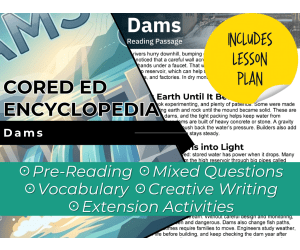
Dams Reading Comprehension Passage - Cored Ed Encyclopedia
ELA, Language Development, Reading Comprehension, Reading, Pre-Reading, Science, Technology, Physics, Earth and Environmental Sciences, Life Sciences, Grade 2, 3, 4, 5, Worksheets & Printables, Worksheets, Teacher Tools, Centers, Activities, Writing Prompts, Assessments, Quizzes and Tests, Quizzes, Lesson Plans
This dams reading comprehension with lesson plan includes: Visualization (on the front cover) Start your lesson by taking a minute to think and share something about the topic. Read the script aloud (slowly), perhaps prepare some music or sound effects. Student close their eyes and let their imaginations wander. Students open their eyes, read the question aloud and give them a few minutes to complete. Ask a few students to share or keep answers until the end to compare with what they learn in the passage. Quick pause—thousands of Cored Education products are included with your TeachSimple membership. Download links and encyclopedia index available here. Pre-Reading Trivia Students will write down one thing they already know about the subject and then read five more facts and discuss. These facts are fun, and the students will enjoy learning about the subject before reading more. Give 1 minute for students to write what they already know (no pressure—best guess is fine). Read the five facts together. After each fact, do ask a student for their opinion, was it surprising? Set a purpose by asking students to highlight/underline one fact they want to learn more about during the reading. Reading Passage The text is a high-interest reading passage with set paragraphs, roughly three to four paragraphs long. It contains a variety of themes about the topic, anywhere from history to technology. The passage is between 250 and 350 words in length. First, ask students to look at the headings and see what they’ll learn about today. What do they know about the topic/heading? First read options: Teacher read-aloud (best for support). Partner reading (paragraph by paragraph). While reading, students underline important details, and vocabulary words they think may come up in the questions section. Mixed Questions The first question page contains four multiple-choice questions, each with a choice of four answers, and three written response questions that require a sentence or two from the student. Students complete the mcqs first independently, then review quickly as a class. For the 3 written responses, try to get students giving the answer with some form of evidence: “I think ___ because the text says ___.” If students get stuck, send them back to check the passage. Vocabulary Questions Practice seven key words from the text in this section across two activities. First section is scrambled words where students will unscramble three words given a clue for each. The second section is a word to meaning matching activity. Before starting, have some students read out words they underlined in the passage. Ask students to say the word and read aloud the sentence(s) around each word. Ask students to do scrambled words and the matching exercise in pairs then go through answers as a class. For the scrambled spelling task, get four pairs to come up to the board and write the words for extra practice with the other student reading out the clue. For the matching task, prompt students to give full sentences: “I matched ___ with ___ because ___.” Creative Writing In this question, the student will be required to write a five to eight sentence paragraph on a question related to the topic. Before starting, ask students write down 3 key ideas they are going to include in their piece. Ask students for ideas to share around the class to help those struggling. Pro writing expectations: 5–8 sentences At least 2 facts or details from the passage At least 2 vocabulary words from the previous page Students read their paragraphs while classmates listen for facts and vocabulary words. Extension Activities This page is optional for fast finishers or to take home. There are several activities, each one requiring a different skill. Do some, do none, do all, completely optional - but you will feel reassured knowing every possibility is planned for. Includes summary writting question and additional facts. Answer Key There are answers for the multiple-choice questions, written response questions have sample answers, vocabulary answers and if there is a summary question then a sample summary will be provided as well. Lesson Plan Included Customized lesson plan for this lesson is included. Lesson Snapshot Title: Dams Genre: Nonfiction (informational text with headings) Subject: Science (Engineering) / Reading (Informational Text) Primary Topic: How dams store water, make electricity, and release water safely Estimated Guided Reading Level (A–Z): P What This Lesson Teaches Best Explains what a dam does by describing how a wall can hold back river water into a deep reservoir. Teaches types of dams and how they stay strong (embankment dams packed tight; gravity dams using weight; layers and drains for stability). Shows how stored water can generate electricity using penstocks, turbines, and generators. Highlights safety and trade-offs, including controlled release through a spillway, the danger of failure, and impacts on fish paths and river mud. Uses headings to organize information into clear sections (building, electricity, and safe water release). Learning Goals Students will explain how a dam changes a river’s flow and creates a reservoir. Students will describe how embankment dams are built and why tight packing matters. Students will identify the role of penstocks, turbines, and generators in making electricity. Students will explain why spillways are needed and how they help release extra water safely. Students will describe at least one cost or concern the passage connects to dams. Key Vocabulary From the Text reservoir — deep stored water behind a dam. embankment — packed earth-and-rock mound used to build a dam. penstocks — big pipes that send water down from a reservoir. turbines — spinning machines turned by rushing water. spillway — safe path for extra water to leave a reservoir. FULL CATALOG OF DOWNLOAD LINKS AND ENCYCLOPEDIA INDEX HERE
Author Cored Education
Rating
Tags Vocabulary, Reading Comprehension, Reading Passages, Lesson Plans, Ela Lesson Plans, Reading Comprehension Lesson Plans, Pre-reading, Science Lesson Plans, Physics, Technology
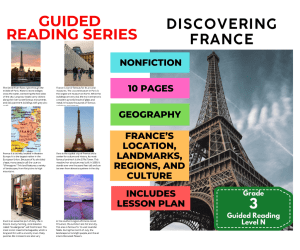
Discovering France: Guided Reading Level N with Lesson Plan
ELA, Resources for Teachers, Reading Comprehension, Reading, Science, Language Development, Vocabulary, Geography, Social Studies, Technology, Grade 2, 3, 4, Worksheets & Printables, Worksheets, Teacher Tools, Centers, Activities, Literacy Readers, Quizzes, Quizzes and Tests, Assessments, Lesson Plans
This Discovering France (level n) guided reading book with lesson plan includes: Guided Reading Color Label (front cover x1) This is a quick way to match the book’s demands to what students can generally handle.. The overall goal is to use the level/color to pick books for several smaller groups. To qualify for a certain level, a student is expected to read a book from that level with about 90–94% accuracy. If a student is consistently accurate and understands, move up a level. If the student is struggling at that level, drop down and add more support. Each student will improve at completely different rates, but it is generally one of the best ways to check progress across the class. DOWNLOAD THE CATALOG TO VIEW ALL GUIDED READING BOOKS AVAILABLE (SORTED LEVELS A-Z) Pre-Reading Question (x1) Teacher asks the prompt aloud, can be while showing the cover or first page. Students share what they already know, or make educated guesses from the cover. Prompt them to use the target vocabulary. Write some of their responses on the board to look back at during the reading. Vocabulary Words (x5) Introduce the five words, best doing it one at a time. Start by saying it, while students repeat and then see if anyone knows what it means before reading further. Read through the meaning and try to briefly connect each word to a picture or gesture so it’s meaningful. Ask students to flip through the book pages and point to where they see each of the vocabulary words. While reading the book pause upon coming across one of the vocab words or read the sentence twice to make sure students understand the word has appeared. Optional: Ask students to raise hands whenever they see/hear one of the new words. Guided Reading Pages (x10) Check the book snapshot (below) for: primary topic - do you need to prep extra reading or intro materials on this? what is taught best - decide on 1-2 bullets to focus on, use the prompt or words provided here for best results. learning goals - what you are checking for students to be able to do after the session, elicit answers using prompts or words provided. key vocabulary (see section above). questions overview - so you know what is coming up and if you need to prep extra materials to assist understanding. Run the lesson You may have already looked at a few of the pages together, but you can show them some of the pictures again first to set meaning. Depending on how much time you have and how familiar your students are with guided reading class, you may want to read the book aloud first with the group first. Students whisper or partner read, while you listen in. If time, do it as a group, one student reading a page each. Use the guided page’s prompts to coach: “Check the picture / does it make sense?” “Point under the words / try the first sound” “Reread the sentence smoothly”. Try to focus more on one student per session (rotating every time), so you can work out if they are ready to move up or need to move down a level. Comprehension Questions (back cover x3) This is your way to check that students didn’t just say the words, but actually understood the text. First, let students answer by pointing to the page/picture and saying a short sentence. After any answer, follow with: “Show me where you found that in the text.” In bigger groups, have partners answer first (10–20 seconds), then call on 2–3 students to share. Differentiation tips: Emerging speakers/struggling readers: oral + pointing On-level: oral in a full sentence Higher: one written sentence or draw + label Book Snapshot Title: Discovering France Genre: Nonfiction Subject: Social Studies (Geography/Culture) Primary Topic: France’s location, landmarks, regions, and culture Estimated Guided Reading Level (A–Z): N What This Book Teaches Best Geography basics about France , including where it is located and how its shape leads to a nickname. Key places and landmarks in Paris , such as the Eiffel Tower, the Seine River, and the Louvre Museum. Regional features of France by describing Provence, the French Alps, the French Riviera, and the Loire Valley. French culture and daily life , especially food traditions like boulangeries, baguettes, and croissants. Modern transportation in France , focusing on the TGV high-speed train and what it allows people to do. Learning Goals Students will identify where France is located and explain why it is called “L’Hexagone.” Students will describe at least two facts about Paris, including details about the Eiffel Tower. Students will explain how the Seine River is described and what people can see from boats on the river. Students will describe characteristics of at least two French regions (Provence, the Alps, the Riviera, or the Loire Valley) using details from the text. Students will describe examples of French culture from the text, including food and museums. Students will explain what the TGV is and how it changes travel across France. Key Vocabulary From the Text landmark — a famous place many people recognize. massive — very big. coastline — the land’s edge next to the sea. lavender — a purple plant/flower that can smell sweet. transportation — ways people travel from place to place. Discussion Prompts Pre-reading question: What do you already know about France, and what would you like to learn? Comprehension questions: Where does the text say France is located, and what nickname do some people give it because of its shape? Comprehension questions: What does the text tell you about the Eiffel Tower (such as when it was built or how tall it is)? Comprehension questions: Choose one region from the book (Provence, the French Alps, the French Riviera, or the Loire Valley) and describe two details the text gives about it. Printing Tips 1. Best Printing Method (Recommended) “Booklet” Printing (Best if Available) If your printer or PDF viewer supports Booklet Printing , use this. Settings to use: Print mode: Booklet Paper size: Letter or A4 (either works) Orientation: Landscape Print on both sides: Yes Flip on: Short edge Scaling: Fit to printable area Booklet subset: First test: Front sides only Then: Back sides only This will automatically: Pair pages correctly Put the cover on the outside Align everything for folding After printing, fold in half and staple along the spine . 2. If “Booklet” Printing Is NOT Available You can still print this correctly with manual duplex printing . Step-by-step: Open the PDF. Choose Print . Set: Orientation: Landscape Pages per sheet: 1 Print on both sides: Yes Flip on: Short edge Print all pages . Because each PDF page already contains two facing book pages, the result will still fold cleanly into a book. Thousands of Cored Education products are included with your TeachSimple membership. Download links and encyclopedia index available here.
Author Cored Education
Rating
Tags Reading Comprehension, Reading Passages, Reading, Guided Reading, Guided Reading Lesson Plan, Guided Reading Activity, Pre-reading, Social Studies, Geography, Technology
Ice Cream Curriculum Pack
Creative Arts, Art, Social Studies, ELA, Language Development, Vocabulary, Math, Early Math, Science, Basic Science, Kindergarten, Lesson Plans, Teacher Tools
If your students are learning about seasonal activities or are about to begin a ice cream unit, I have just the resource to provide you with everything you need and more! This is an Ice Cream Curriculum Pack complete with an abundance of printable resources and engaging activities for students to complete. This curriculum was designed for your preschool students. The curriculum goal is to impart new and expanded knowledge and experiences on a subject that children are familiar with and have a frame of reference on – while building skills in a fun way. The vocabulary that students will focus on is ice cream, frozen, dairy, flavors, parlor, sherbet, freezing, vanilla, chocolate, strawberry, sundae, scoop, banana split, and udders. There is a letter of the week (I) and colors of the week (white, brown, and pink). This curriculum pack includes: --Sensory Table Ideas --Art Activities --Cooking Experience --Community Time --Math Activities --Home/School Connection Ideas --Science Table Enrichments --Science Concepts/Activities --Prop Box Ideas/Dramatic Play Enrichments --Movement and Motor --Playground/Walk Activities --Transition/Waiting Ideas --Block Area Enrichments --Flannel Board --Teacher Made Enrichment Ideas --Field Trip Ideas --Supplemental Learning Ideas/Activities At the start of this pack, you will receive a list of supplies needed for activities and projects. The worksheets, activities, and tasks included in this pack are intended to be completed in a variety of formats – whole group, small group, and independent work. I hope you enjoy!
Author Learning Foundations
Tags Ice Cream Curriculum, Learning Foundations, Sensory Table Ideas, Prop Box Ideas, Summer Activity, Nature Walk, Preschool, Cross-curricular
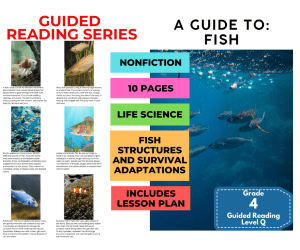
A Guide to Fish: Guided Reading Level Q with Lesson Plan
ELA, Resources for Teachers, Reading Comprehension, Reading, Science, Language Development, Life Sciences, Earth and Environmental Sciences, Pre-Reading, Vocabulary, Grade 3, 4, 5, Worksheets & Printables, Worksheets, Teacher Tools, Centers, Activities, Literacy Readers, Quizzes, Quizzes and Tests, Assessments, Lesson Plans
This A Guide to Fish (level q) guided reading book with lesson plan includes: Guided Reading Color Label (front cover x1) This is a quick way to match the book’s demands to what students can generally handle.. The overall goal is to use the level/color to pick books for several smaller groups. To qualify for a certain level, a student is expected to read a book from that level with about 90–94% accuracy. If a student is consistently accurate and understands, move up a level. If the student is struggling at that level, drop down and add more support. Each student will improve at completely different rates, but it is generally one of the best ways to check progress across the class. DOWNLOAD THE CATALOG TO VIEW ALL GUIDED READING BOOKS AVAILABLE (SORTED LEVELS A-Z) Pre-Reading Question (x1) Teacher asks the prompt aloud, can be while showing the cover or first page. Students share what they already know, or make educated guesses from the cover. Prompt them to use the target vocabulary. Write some of their responses on the board to look back at during the reading. Vocabulary Words (x5) Introduce the five words, best doing it one at a time. Start by saying it, while students repeat and then see if anyone knows what it means before reading further. Read through the meaning and try to briefly connect each word to a picture or gesture so it’s meaningful. Ask students to flip through the book pages and point to where they see each of the vocabulary words. While reading the book pause upon coming across one of the vocab words or read the sentence twice to make sure students understand the word has appeared. Optional: Ask students to raise hands whenever they see/hear one of the new words. Guided Reading Pages (x10) Check the book snapshot (below) for: primary topic - do you need to prep extra reading or intro materials on this? what is taught best - decide on 1-2 bullets to focus on, use the prompt or words provided here for best results. learning goals - what you are checking for students to be able to do after the session, elicit answers using prompts or words provided. key vocabulary (see section above). questions overview - so you know what is coming up and if you need to prep extra materials to assist understanding. Run the lesson You may have already looked at a few of the pages together, but you can show them some of the pictures again first to set meaning. Depending on how much time you have and how familiar your students are with guided reading class, you may want to read the book aloud first with the group first. Students whisper or partner read, while you listen in. If time, do it as a group, one student reading a page each. Use the guided page’s prompts to coach: “Check the picture / does it make sense?” “Point under the words / try the first sound” “Reread the sentence smoothly”. Try to focus more on one student per session (rotating every time), so you can work out if they are ready to move up or need to move down a level. Comprehension Questions (back cover x3) This is your way to check that students didn’t just say the words, but actually understood the text. First, let students answer by pointing to the page/picture and saying a short sentence. After any answer, follow with: “Show me where you found that in the text.” In bigger groups, have partners answer first (10–20 seconds), then call on 2–3 students to share. Differentiation tips: Emerging speakers/struggling readers: oral + pointing On-level: oral in a full sentence Higher: one written sentence or draw + label Book Snapshot Title: A Guide to: Fish Genre: Nonfiction (informational) Subject: Life Science Primary Topic: Fish structures and survival adaptations Estimated Guided Reading Level (A–Z): Q What This Book Teaches Best Explains how gills help fish breathe by extracting oxygen from water and releasing carbon dioxide. Describes how a fish’s streamlined shape and fins support efficient movement, stability, steering, and turning. Introduces the lateral line as a sensory system that detects vibrations and pressure changes to help fish navigate and find prey. Compares freshwater and saltwater habitats and explains how fish maintain the right internal balance of salt and water. Shows multiple survival strategies such as bioluminescence, camouflage, cartilaginous skeletons, and schooling (“safety in numbers”). Learning Goals Explain how fish breathe using gills and what happens as water passes over gill filaments. Describe how fins and a streamlined body shape help fish move, steer, and turn in water. Identify what the lateral line does and how it helps fish survive (navigation and finding prey). Compare how freshwater fish and saltwater fish manage water and salt in their bodies. Explain at least two survival adaptations described in the text (camouflage, bioluminescence, schooling). Describe what “cartilaginous fish” are and what the text says cartilage allows them to do. Key Vocabulary From the Text vertebrates — animals that have a backbone. specialized — made for a specific job or purpose. filaments — thin, threadlike parts of the gills. bioluminescence — the ability to make your own light. cartilaginous — having a skeleton made of cartilage, not hard bone. Discussion Prompts Pre-reading question: What body parts or behaviors might help fish survive in different kinds of water? Comprehension questions: What does the text explain that gills do for a fish? Comprehension questions: How does the lateral line help fish, according to the text? Comprehension questions: Why does the text say swimming in a school can help fish survive? Printing Tips 1. Best Printing Method (Recommended) “Booklet” Printing (Best if Available) If your printer or PDF viewer supports Booklet Printing , use this. Settings to use: Print mode: Booklet Paper size: Letter or A4 (either works) Orientation: Landscape Print on both sides: Yes Flip on: Short edge Scaling: Fit to printable area Booklet subset: First test: Front sides only Then: Back sides only This will automatically: Pair pages correctly Put the cover on the outside Align everything for folding After printing, fold in half and staple along the spine . 2. If “Booklet” Printing Is NOT Available You can still print this correctly with manual duplex printing . Step-by-step: Open the PDF. Choose Print . Set: Orientation: Landscape Pages per sheet: 1 Print on both sides: Yes Flip on: Short edge Print all pages . Because each PDF page already contains two facing book pages, the result will still fold cleanly into a book. Thousands of Cored Education products are included with your TeachSimple membership. Download links and encyclopedia index available here.
Author Cored Education
Rating
Tags Reading Comprehension, Reading Passages, Reading, Guided Reading, Guided Reading Lesson Plan, Guided Reading Activity, Pre-reading, Science Lesson Plans, Life Science, Earth Science

How to Write a Paragraph: Revising Your Paragraph - FLASH-MAC
ELA, Writing, Common Core, Grade 5, 6, 7, 8, Teacher Tools, Lesson Plans
How to Write a Paragraph: Revising Your Paragraph - FLASH-MAC The How to Write a Paragraph: Revising Your Paragraph - FLASH-MAC teaching resource is an invaluable tool for educators. It's primarily designed for grade levels five through eight and focuses on the important skill of revising written paragraphs. This resource provides valuable information through curriculum -based content. Uniquely, this tool uses before and after reading questions to facilitate comprehension, encourage active learning, and offer practice opportunities. Educational Aids Printable materials, Vocabulary flashcards, Interactive activities for hands-on experience, Blooms Taxonomy principles. This product is thoughtfully designed to meet Common Core State Standards in education. Focused Instruction & Homework Practice The components offer flexibility adapted for varied instruction scenarios. They can be used in full group sessions or small groups, tailored based on individual needs. The provided resources also make effective homework assignments. Digital Accessibility & Graphic Organizers Advantage Inclusion of graphic organizers simplifies idea organization when writing paragraphs. An added advantage is its compatibility with any Mac software making it user-friendly where teachers can easily navigate lessons without technical fusses. In essence, "How to Write a Paragraph: Revising Your Paragraph - FLASH-MAC" specifically aids language arts teachers aiming at developing proficient writers from grades five through eight.
Author Classroom Complete Press
Tags Software (Mac)

I WONDER - What Is A Shape Poem | Animated Video Lesson
Poetry, Literature, ELA, Grade 6, 7, 8, 9, 10, 11, 12, Lesson Plans, Teacher Tools
Video Introduction An amazing video designed for the students to learn more about famous poetry in different countries. I WONDER - What Is A Shape Poem | Animated Video Lesson Do you like reading poetry? If yes, what is your favorite poem? Do you have a favorite poet? If yes, tell us more about him/her. What are the types of poetry? Have you ever tried to write a poem before? If yes, tell us more about it. What is acrostic poem? Dow you know who is the first writer to write it? Can you write one? What is limerick? Dow you know who is the first writer to write it? Can you write one? What is sonnet? Dow you know who is the first writer to write it? Can you write one? What is haiku? Dow you know who is the first writer to write it? Can you write one? I WONDER - What Is A Shape Poem | Animated Video Lesson The video is perfect for encouraging the researching skills for the students, while learning more about this fantastic poetry. I WONDER - What Is A Shape Poem | Animated Video Lesson This friendly designed video is suitable for students at school, homeschooling, and as a group activity. Format Available in MP4 format.
Author Educational Voice
Rating
Tags What Is A Shape Poem, What Is A Shape Poem Video, Shape Poem, Shape Poem Facts, Shape Poem Video, Shape Poem Facts For Kids, Shape Poem Video For Kids, Poetry, Poem, Poems

Literary Devices: Plot
ELA, Literature, Common Core, Grade 5, 6, 7, 8, Teacher Tools, Lesson Plans
Literary Devices: Plot A vital teaching tool for educators at various grade levels ranging from fifth to eighth grades. It's a valuable resource designed to enhance Language Arts instruction, particularly in Literature. This educational aid delves into core aspects of storytelling language: Characterization Setting Plot theme Point of view etc. Moreover, it expands on foreshadowing and flashback techniques, symbolism and irony - offering definitions of key terms that both teachers and students will find beneficial. User-friendly Presentation & Bloom’s Taxonomy The presentation not only consists of detailed explanation but also multiple opportunities for students to apply what they've learned. Implementing Bloom’s Taxonomy ensures that the objectives officiated within are educationally appropriate, ultimately catering towards making interaction with literature more engaging for young learners regardless of their reading proclivity. Educational Format & Advantages In its format, buildable aspects meant to introduce students effectively to literary devices through narration complemented by age-appropriate learning activities are included. One significant advantage is that all content provided aligns with the Common Core State Standards providing relief for teachers who wish adhere curriculum requirements keenly while providing high-quality education. In Conclusion Literacy Devices: Plot offers itself as an indispensable resource capable of illuminating the world of literature. Its aim is not merely to impart knowledge – rather it's designed as an instrument which can engage inspire connect illuminate a genre that can seem difficult making it delightful and fascinating!
Author Classroom Complete Press
Tags PDF

English Starter Pack | Beginner Lesson Plan
ELA, Language Development, ESL, Grade 2, 3, 4, 5, Teacher Tools, Lesson Plans
This is a beginner lesson plan worksheet set for English Starter Pack. Start your English students on their journey to English proficiency with this basic starter pack. The starter pack is an early introduction to topics like greetings and introductions, telling the time, food and cooking, numbers, clothes, parts of the human body, family, countries, nationalities and home furniture and rooms. Students will learn more about these and then complete the exercises to follow, which will assess their comprehension and understanding. Exercises include closed and open activities, matching words with images, writing drills and conversation prompts. This starter pack ESL and TEFL worksheet is a great pre A1 resource to let your students get ahead before they begin the A1 course. Everyone has to start somewhere, right? Start to put the blocks in place right here as you introduce your students to lots of very basic words for vocabulary building. Very little prep is necessary, allowing you more time to focus your energy on your students. This resource can also be accessed through Google Apps. Answer key included. It includes 24 ready to print PDF pages. The different topics can be taught at the same time or they can be divided up to teach in separate classes.
Author TEAM TEFL
Tags About Me, Graphic Organizer, ESL Activity, Cardinal Numbers, Calendars
Born Worker: Full Lesson Plan w/ PowerPoints & Graphic Organizers
ELA, Reading, Grade 5, 6, 7, 8, Lesson Plans, Teacher Tools
Born Worker: Comprehensive Reading Lesson Plan This resource provides educators with everything needed to teach a complete reading lesson on the Gary Soto text Born Worker. The pack includes a full lesson plan, graphic organizers , worksheets, answer keys, PowerPoint presentations, and more. Teachers can use the materials for whole-group instruction, small reading groups, or as independent practice. The supplemental resources help students analyze plot, characterization, figurative language, theme, and other literary elements. Written for grades 5-8, all materials are offered as customizable Word and PDF files.
Author Quality Teaching Products
Tags Born Worker, Reading Lesson Plan, Graphic Organizer, Reading Worksheet, Fiction Text, Born Worker By Gary Soto Summary

Bubbles Fun Curriculum Pack
Creative Arts, Art, Social Studies, ELA, Math, Early Math, Numbers, Measurements, Kindergarten, Lesson Plans, Teacher Tools
If your students are studying new science concepts or are about to begin a bubbles unit, I have just the resource to provide you with everything you need and more! This is a Bubbles Fun Curriculum Pack complete with an abundance of printable resources and engaging activities for students to complete. This curriculum was designed for your preschool students. The curriculum goal is to explore and experience related scientific concepts, and build skills utilizing the thematic framework – reinforced by having fun. The vocabulary that students will focus on is bubble, soap, float, air, effervescent, solution, transparent, burst, humidity, and sphere. This curriculum will come with a letter of the week (B), shape of the week (circle), and color of the week (blue). This curriculum pack includes: --Sensory Table Ideas --Art Activities --Cooking Experience --Community Time --Math Activities --Home/School Connection Ideas --Science Table Enrichments --Science Concepts/Activities --Prop Box Ideas/Dramatic Play Enrichments --Movement and Motor --Playground/Walk Activities --Transition/Waiting Ideas --Block Area Enrichments --Flannel Board --Teacher Made Enrichment Ideas --Field Trip Ideas --Supplemental Learning Ideas/Activities At the start of this pack, you will receive a list of supplies needed for activities and projects. The worksheets, activities, and tasks included in this pack are intended to be completed in a variety of formats – whole group, small group, and independent work. I hope you enjoy!
Author Learning Foundations
Tags Bubbles Fun, Scientific Concepts, Science Vocabulary, Letter Of The Week, Shape Of The Week, Art Activities, Math Activities, Learning Foundations

Pronouns Supplementary Materials Grade 5-6 (PDF)
ELA, Language Development, ESL, Grammar, Common Core, Resources for Teachers, Grade 5, 6, 7, Worksheets & Printables, Worksheets, Quizzes and Tests, Teacher Tools, Tests, Assessments, Lesson Plans
Verbs Supplementary Materials Note: This download DOES NOT include the tests themselves. You can still make use of these materials without them but they are recommended. Download in a format of your choice in the "Links" section below. In the Supplementary Pack Interactive Ice Breakers: Engaging warm-up activities that introduce students to key ELA concepts, such as quick capitalization corrections and punctuation challenges. Guided Practice: Structured teacher-led exercises that reinforce grammar and punctuation rules, helping students identify and apply them correctly in sentences. Group and Partner Tasks: Collaborative activities where students work together to edit sentences, correct capitalization, and improve punctuation through peer discussion and teamwork. Independent Worksheets: Carefully designed worksheets that provide focused practice, allowing students to apply learned concepts and refine their skills independently. Exit Tasks: Quick assessments at the end of each lesson, prompting students to reflect on what they’ve learned and apply their knowledge in writing and editing tasks. Links Indefinite Pronouns Intensive Pronouns Interrogative Pronouns Reflexive Pronouns Relative Pronouns Google Docs Google Forms Google Slides PDF PPT Word FULL CATALOG OF DOWNLOAD LINKS HERE Grade 5/6 Links: Capitalization & Punctuation Google Docs Google Forms Google Slides PDF PPT Word Free Supplementary Materials Pack Adjectives Google Docs Google Forms Google Slides PDF PPT Word Free Supplementary Materials Pack Nouns Google Docs Google Forms Google Slides PDF PPT Word Free Supplementary Materials Pack Pronouns Google Docs Google Forms Google Slides PDF PPT Word Free Supplementary Materials Pack Verbs Google Docs Google Forms Google Slides PDF PPT Word Free Supplementary Materials Pack Prefixes & Suffixes Google Docs Google Forms Google Slides PDF PPT Word Free Supplementary Materials Pack Sentence Structure Google Docs Google Forms Google Slides PDF PPT Word Free Supplementary Materials Pack Subject Verb Agreement Google Docs Google Forms Google Slides PDF PPT Word Free Supplementary Materials Pack Tenses Google Docs Google Forms Google Slides PDF PPT Word Free Supplementary Materials Pack Context Clues Google Docs Google Forms Google Slides PDF PPT Word Free Supplementary Materials Pack Defining Words Google Docs Google Forms Google Slides PDF PPT Word Free Supplementary Materials Pack Fill in the Blanks Google Docs Google Forms Google Slides PDF PPT Word Free Supplementary Materials Pack Homophones Google Docs Google Forms Google Slides PDF PPT Word Free Supplementary Materials Pack Synonyms Google Docs Google Forms Google Slides PDF PPT Word Free Supplementary Materials Pack ELA Review Questions Overview Questions have three answer choices. There are a handful of pictures on each test for aesthetic purposes, as well as a review sheet covering most of the topics covered in the product. Introduction or Example Sheet Each topic will include an introduction or example sheet to go through first with your students. Full Answer Keys Full answer keys and sample responses are provided so no matter how busy you are, you know you're covered! For More Like This For similar downloads and other frees, do check out Cored Group on TeachSimple.
Author Cored Education
Tags Elementary, Answers, Ccss, Common Core, Grammar, Tests, Test Prep, Assessment, Grade 5, Grade 6

Emergency Sub Plans for ELA! 5 full days of no prep lessons
ELA, Language Development, Literature, Reading, Writing, Grade 3, 4, 5, Worksheets, Worksheets & Printables, Workbooks, Lesson Plans, Teacher Tools, Writing Prompts
Ready to make substitute days smoother? Grab this ELA sub plan set, print it out, save it for those surprise moments, and know you’ve got excellent ELA work ready to go. Get 1 full week of engaging ELA content ready to use! Having no-prep emergency sub plans on hand is honestly one of the best things you can have ready as a teacher! You never know when you’ll wake up sick, have a family situation pop up, or just need a mental health day, and the last thing you want to do is throw together a pile of random worksheets. This resource takes that stress completely off your plate. Everything in this set is already organized, purposeful, and aligned with real ELA standards, so students stay engaged and on track even when you’re out. If you’re feeling like you might get hit with a substitute day and want to be ready without scrambling, this is your go-to. Inside you’ll find five days of animal-themed reading passages paired with four different ELA activity sheets each day. So one day is a full set: a short nonfiction text, comprehension questions, vocab practice, research, and a creative writing extension. You just print (or upload digitally) and you’re set. I kept everything simple so a substitute teacher can walk in and confidently lead the class — no stress, no piles of notes, no frantic prepping the night before. There’s a teaching guide included, directions are clear, and both printable PDF and digital Easel versions are included. The passages are about unique animals (like axolotls, pangolins, and narwhals) which means students are more likely to stay engaged. My students love anything animal-related! They’ll practice highlighting key details, answering meaningful questions, and writing with purpose. If you’re newer to teaching (or even if you’re a veteran who just wants less prep on an unpredictable days), this pack gives you peace of mind. You’ll walk into the classroom knowing the students will stay on track with reading and writing. Wishing you calm, prepared, and totally in-control sub days ahead! Enjoy Stephanie
Author The Language of Learning
Rating
Tags Sub Plans, Writing Prompts, Vocab, Reading, Close Reading, Substitute Plans, ELA Lessons, Emergency Sub Plans
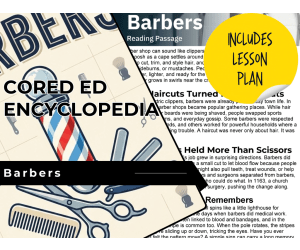
Barbers Reading Comprehension Passage - Cored Ed Encyclopedia
ELA, Language Development, Reading Comprehension, Reading, Social Studies, Writing, Vocabulary, History, Pre-Reading, Spelling, Grade 2, 3, 4, 5, Worksheets & Printables, Worksheets, Teacher Tools, Centers, Activities, Writing Prompts, Assessments, Quizzes and Tests, Quizzes, Lesson Plans
This barbers reading comprehension with lesson plan includes: Visualization (on the front cover) Start your lesson by taking a minute to think and share something about the topic. Read the script aloud (slowly), perhaps prepare some music or sound effects. Student close their eyes and let their imaginations wander. Students open their eyes, read the question aloud and give them a few minutes to complete. Ask a few students to share or keep answers until the end to compare with what they learn in the passage. Quick pause—thousands of Cored Education products are included with your TeachSimple membership. Download links and encyclopedia index available here. Pre-Reading Trivia Students will write down one thing they already know about the subject and then read five more facts and discuss. These facts are fun, and the students will enjoy learning about the subject before reading more. Give 1 minute for students to write what they already know (no pressure—best guess is fine). Read the five facts together. After each fact, do ask a student for their opinion, was it surprising? Set a purpose by asking students to highlight/underline one fact they want to learn more about during the reading. Reading Passage The text is a high-interest reading passage with set paragraphs, roughly three to four paragraphs long. It contains a variety of themes about the topic, anywhere from history to technology. The passage is between 250 and 350 words in length. First, ask students to look at the headings and see what they’ll learn about today. What do they know about the topic/heading? First read options: Teacher read-aloud (best for support). Partner reading (paragraph by paragraph). While reading, students underline important details, and vocabulary words they think may come up in the questions section. Mixed Questions The first question page contains four multiple-choice questions, each with a choice of four answers, and three written response questions that require a sentence or two from the student. Students complete the mcqs first independently, then review quickly as a class. For the 3 written responses, try to get students giving the answer with some form of evidence: “I think ___ because the text says ___.” If students get stuck, send them back to check the passage. Vocabulary Questions Practice seven key words from the text in this section across two activities. First section is scrambled words where students will unscramble three words given a clue for each. The second section is a word to meaning matching activity. Before starting, have some students read out words they underlined in the passage. Ask students to say the word and read aloud the sentence(s) around each word. Ask students to do scrambled words and the matching exercise in pairs then go through answers as a class. For the scrambled spelling task, get four pairs to come up to the board and write the words for extra practice with the other student reading out the clue. For the matching task, prompt students to give full sentences: “I matched ___ with ___ because ___.” Creative Writing In this question, the student will be required to write a five to eight sentence paragraph on a question related to the topic. Before starting, ask students write down 3 key ideas they are going to include in their piece. Ask students for ideas to share around the class to help those struggling. Pro writing expectations: 5–8 sentences At least 2 facts or details from the passage At least 2 vocabulary words from the previous page Students read their paragraphs while classmates listen for facts and vocabulary words. Extension Activities This page is optional for fast finishers or to take home. There are several activities, each one requiring a different skill. Do some, do none, do all, completely optional - but you will feel reassured knowing every possibility is planned for. Includes summary writting question and additional facts. Answer Key There are answers for the multiple-choice questions, written response questions have sample answers, vocabulary answers and if there is a summary question then a sample summary will be provided as well. Lesson Plan Included Customized lesson plan for this lesson is included. Lesson Snapshot Title: Barbers Genre: Nonfiction (informational passage) Subject: Social Studies / Careers & Community Primary Topic: What barbers do and how barbering changed over time Estimated Guided Reading Level (A–Z): S Support pages noted in the PDF: visualize prompt, pre-reading trivia, mixed questions, vocabulary activity, creative writing prompt, extension activities + “final facts,” and an answer key. What This Lesson Teaches Best What barbers do: cut, trim, and style hair, and often shave or shape facial hair. How places like barber shops can be about community (talking and sharing news) as well as haircuts. How a job can change over time, including barbers doing medical tasks in the Middle Ages and later separating from doctors and surgeons. How symbols communicate meaning: the spinning striped barber pole connects to earlier work (red/white linked to blood and bandages; a blue stripe is common in the United States). Reading for precise details (e.g., hair “swirls” near the crown; how rotating stripes create an illusion). Learning Goals Students will identify at least two services the passage says many barbers provide. Students will explain why barber shops became popular gathering places in Greece, using details from the text. Students will describe how the barber’s job “grew in surprising directions” during the Middle Ages, based on the passage. Students will describe what “bloodletting” means in the passage. Students will explain what the red and white stripes on a barber pole are often linked to and how the spinning pole can trick the eyes. Students will describe how the passage connects a simple shop sign to a long history (“a simple sign can carry a long memory”). Key Vocabulary From the Text clippers — electric tools that cut hair. mustaches — hair above the upper lip. swirls — curved patterns that twist around. bloodletting — making a small cut to let blood flow. bandages — cloth used to cover a wound. FULL CATALOG OF DOWNLOAD LINKS AND ENCYCLOPEDIA INDEX HERE
Author Cored Education
Rating
Tags Vocabulary, Reading Comprehension, Reading Passages, Lesson Plans, Ela Lesson Plans, Reading Comprehension Lesson Plans, Pre-reading, History, History Lesson Plans, Social Studies Lesson Plans

Hamlet: A Facing-Pages Translation into Contemporary English
ELA, Literature, Grade 7, 8, 9, 10, 11, 12, Teacher Tools, Lesson Plans
The Hamlet: A Facing-Pages Translation into Contemporary English The Hamlet: A Facing-Pages Translation into Contemporary English is a resource specifically designed for educators desiring to make Shakespeare's plays more accessible. It provides a line-for-line translation in modern, easy-to-understand English. Main Highlights: This educational material conveys the complex plot, characters and themes of Hamlet seamlessly. A dual-language format with original text and modern translation on facing pages ensures clarity of understanding. This tool aids teachers dealing with the challenges posed by Shakespearian linguistic intricacies. Suitable For Grades 7-12: In providing its offerings as a PDF type lesson plan file, it broadens its applicability to age groups as diverse as grade 7 through 12 curricula requirements. This spans across multiple comprehension levels and literature sub-topics within language arts curriculum guidelines. Multifaceted Classroom Application: Whole Group Instruction: Promote open discussions about scenes while reading lines in both original and translated formats for better student understanding. Small Study Circles or Pair-ups: Leverage peer learning alongside teacher-led guidance with this easy-to-understand text transformation. Homeschooling Assignments: Foster individual reading skills. Let students themselves distinguish between truth and disguise just like Shakespeare's initial audiences! To Enhance Learning Further: Educators can pair this version along with the full-fledged "Hamlet Manual". Expect your classroom engagement rates to surge as your pupils navigate the themes such as duty versus conscience or love versus remembrance more easily than ever before!
Author Classroom Complete Press
Tags PDF, Hamlet Translation To Modern English, Hamlet English Translation, Hamlet Activities High School

Short vowel 'a': Phonics Lessons for Struggling Readers + Books
ELA, Language Development, Pre-Reading, Phonics, Spelling, Kindergarten, Preschool, Grade 1, 2, Literacy Readers, Teacher Tools, Presentations, Lesson Plans
Short Vowel 'a' Reading Program for Struggling Readers This comprehensive phonics program focuses on the short vowel 'a' sound and is designed for struggling readers who need additional support in developing reading fluency. The package includes two decodable reading books, two matching PowerPoint presentations, four video lessons and over twenty supporting activities spread across two weeks of instruction. The program uses a systematic, incremental approach that teaches just 10 words from the same phonics family over two weeks. This focused method allows students to thoroughly master each word through repeated practice in reading and writing exercises. The multisensory activities address common challenges such as poor word recall, letter confusion, difficulty recognising previously decoded words, and text tracking problems. Order, Outline and Steps Each lesson strengthens phonemic awareness while gradually moving students from individual word recognition to sentence reading and longer paragraphs. Video lessons are simple with no distractions to prevent cognitive overload The worksheets are intentionally brief to prevent fatigue and maintain concentration in students with processing difficulties. The reading books exclusively use studied words along with carefully selected sight words, ensuring students encounter familiar vocabulary that builds confidence. Supporting activities include tracking exercises, phonemic awareness practice, rhyming activities, sentence building, and two educational games. Words learned in previous lessons carry over to subsequent books, helping students develop fluent reading skills. The program also introduces a wider vocabulary of decodable words at a controlled pace, allowing reading skills to progress while maintaining student success. Who is the Short Vowel 'a' Reading Program for Struggling Readers for? This resource is particularly beneficial for students with dyslexia, general learning difficulties, cerebral palsy, or other conditions affecting phonological processing and word recall. The structured, cumulative nature of the lessons reduces mental overload while building essential reading skills. With this programme, you can help a non-reader today! What is included: Full teaching instructions 4 teaching videos (2 per week) Flashcards 10 packs of activities and worksheets 10 reading books 10 games Full teaching instructions What next? This is a sample of the first five vowels lesson. The next four vowels should be studied before moving on to the 'Jack Stories', starting with CK.
Author Lilibette's Resources
Rating
Tags Learn To Read Programme, Fluency, Struggling Readers, Dyslexia, Special Needs, Poor Auditory Processing, Auditory Prcoessing, Phonics, Decodable Reading Books, Homeschool Curriculum
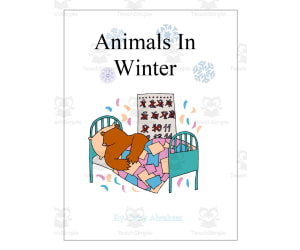
Animals in Winter Curriculum Pack
ELA, Math, Early Math, Language Development, Vocabulary, Science, Basic Science, Kindergarten, Lesson Plans, Teacher Tools
If your students are studying hibernation or are about to begin an animal unit, I have just the resource to provide you with everything you need and more! This is an Animals in Winter Curriculum Pack complete with an abundance of printable resources and engaging activities for students to complete. This curriculum was designed for your preschool students. The curriculum goal is to present the concept of hibernation, and how various animals live and survive during the winter and adapt to seasonal changes. The vocabulary that students will focus on is hibernation, cave, migrate, South, climate, Artic, dormant, mammal, and torpor. This curriculum will come with a letter of the week (B) and a color of the week (gray). This curriculum pack includes: --Sensory Table Ideas --Art Activities --Cooking Experience --Community Time --Math Activities --Home/School Connection Ideas --Science Table Enrichments --Science Concepts/Activities --Prop Box Ideas/Dramatic Play Enrichments --Movement and Motor --Playground/Walk Activities --Transition/Waiting Ideas --Block Area Enrichments --Flannel Board --Teacher Made Enrichment Ideas --Field Trip Ideas --Supplemental Learning Ideas/Activities At the start of this pack, you will receive a list of supplies needed for activities and projects. The worksheets, activities, and tasks included in this pack are intended to be completed in a variety of formats – whole group, small group, and independent work. I hope you enjoy! I can be contacted for questions and concerns at childcarediva@aol.com .
Author Learning Foundations
Tags Animals In Winter, Reading Curriculum, Math Curriculum, Language Arts, Sensory Tables, Field Trip Ideas, Hibernation, Vocabulary, Dramatic Play

High Frequency Sight Words: Match and Print - FLASH-MAC
ELA, Language Development, Vocabulary, Grade 1, 2, Teacher Tools, Lesson Plans
High Frequency Sight Words: Match and Print- Flash-Mac Unlock the world of literacy for young learners with the High Frequency Sight Words: Match and Print- Flash-Mac. This teaching resource is meticulously tailored for grade 1 and grade 2 students, infused with engaging activities to kick-start their journey in language arts; specifically in developing vocabulary. Providing an easy yet effective approach to understanding Dolch Sight Words, this tool encompasses interactive curriculum -based content packaged as a single Mac software file. Match and Print Activities: Embedded in this resource are valuable learning components such as Match and Print activities that weave intensive practice with fun, ensuring students' keen participation while advancing their reading skills. Printables:An integral part of the package are printable materials designed to bridge the classroom instruction with self-paced learning at home or any supportive environment. Among these auxiliary tools are Dolch sight word flashcards that can be seamlessly used by educators for whole group instruction or homework assignments aimed at reinforcing retention of high-frequency words outside school hours. Visual Aids:In addition to printables, visual aids are also furnished in the form of graphic organizers that schematically highlight relationships between concepts; making it a perfect accessory within small group instructions or one-on-one lessons where teachers can focus on individual student progress. Rounding up its contents are stimulating interactive activities carefully curated based on educational standards set forth for strengthening vocabulary mastery amongst early learners. Easy navigation coupled with user-friendly interface make it an ideal companion not only within formal education settings but proves advantageous amongst homeschoolers who seek top-tier instructional materials right at their fingertips. The High Frequency Sight Words: Match and Print – Flash-Mac takes fundamental sight-word instruction into a new dimension combining technology-rich features with hands-on engagement resulting in accelerated comprehension while fostering enduring love for reading among young minds.
Author Classroom Complete Press
Tags Software (Mac)
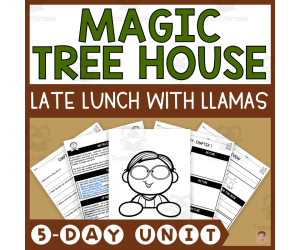
Late Lunch with Llamas (Magic Tree House #34 Lesson Plan)
ELA, Social Studies, Reading, Reading Comprehension, Grammar, Literature, Language Development, Spelling, Vocabulary, Writing, History, History: Ancient, Geography, Grade 1, 2, 3, Lesson Plans, Teacher Tools
Title: Late Lunch with Llamas (Magic Tree House #34 Lesson Plan) This resource provides a comprehensive 5-day lesson plan for Grades 1 to 3, structured around the enchanting story of Late Lunch with Llamas. Blending Language Arts and Social Studies, this educational tool also sparks students' curiosity and encourages active learning through related activities. An easy-to-use teaching aid, it aligns teaching objectives with chapter comprehension questions, vocabulary practice and includes links to relevant video materials. Group discussions can be tailored according to each day's tasks, accommodating diverse learner interests and styles due to its customizable nature depending on student age or reading level. Multidisciplinary Learning Objectives: Arts: Engage students through drawing and coloring exercises. Comprehension Skills & English Language Arts: Enhance grammar, spelling and writing abilities Social Studies & History: Integration of geography lessons inspires holistic understanding. The material places an emphasis on developing research skills for a strong foundation in critical thinking. Make use of pre-reading activities to prepare young learners; try our comprehensive chapter quizzes for reinforcement; assign worksheets based on story elements that focus on literature-driven vocabulary expansion. Fostering Deep Analysis: Carefully curated character analysis materials guide students throughout their discovery journey. Post-reading project-based tasks boost experiential learning—an integral element in modern education practices. Sustainable Teaching Methods: The worksheets provided are versatile— they can be used traditionally or transformed into interactive digital exercises reducing print usage—a sustainable teaching practice we all aim for today. Use this brilliant tool crafted meticulously intertwining fun elements practical along with pedagogic methodology into learning— there's no better way to deepen students' love for the Magic Tree House collection. Nurture inquiring minds through a journey that not only transforms them into confident readers but also critical thinkers and enthusiastic learners.
Author Heather Huhman
Tags Lesson Plan, Magic Tree House, Comprehension, Vocabulary, Geography