



3,928 products added recently
Page 3 - ELA Lesson Plans
Elevate your ELA instruction with lesson plans that cover reading, writing, speaking, and listening skills. These resources provide diverse texts and engaging activities to improve literacy. Integrate these plans to enrich your language arts curriculum and support student achievement.

 Show filters


Zoo Animal Research Writing Project on HIPPOS for K-2nd Grade
Life Studies, ELA, Writing, Creative Writing, Reading, Science, Life Sciences, Animals, Research, Kindergarten, Grade 1, 2, Teacher Tools, Lesson Plans, Presentations, Worksheets & Printables, Worksheets, Coloring Pages, Writing Prompts
Animal Research Writing Project on Hippos for K-2. The Animal Research Writing Project on Hippos provides differentiated materials to guide K-2 students through reading informational text, collecting data, and writing about hippos. Students begin by examining real-life photos of hippos to color and give a creative title for the cover page of their report. They read age-appropriate information about habitat, diet, appearance, behavior, and other hippo facts. A color-coded key helps young learners organize the information into categories. After reading, students draw and color the hippo habitat based on what they learned. Two options for graphic organizers allow them to sort facts before writing. Differentiated writing pages scaffold the writing process for emerging writers. A self-checking writing page helps beginning writers reflect on their work. When complete, the project can be compiled into an engaging book that displays student creativity. It promotes reading comprehension, information sorting, and writing skills in an interactive way. The 19-page unit also encourage drawing, coloring, and imagination inspired by the unique traits of hippos. Teachers can implement this versatile resource whole-group, small-group, or as an independent writing activity. It bundles an entire animal research writing unit into one differentiated package. Teachers appreciate the ready-to-use animal units covering reading, note-taking, drafting, illustrating, and publishing. Engage your class in meaningful informational writing with this standards-based project on monkeys. Plus, there are many more zoo animals to research as well in my store: K-5 Treasures! For additional Zoo Animal reports, click on the following links below: Animal Research Writing Project on TIGERS for K-2nd Grade Animal Research Writing Project on MONKEYS for K-2nd Grade Animal Research Writing Project on PANDAS for K-2nd Grade Animal Research Writing Project on HIPPOS for K-2nd Grade Animal Research Writing Project on ELEPHANTS for K-2nd Grade Animal Research Writing Project on GIRAFFES for K-2nd Grade Here are even more informational resources on report writing for OCEAN ANIMALS. Click on the links below: Animal Research Writing Project on WHALES for K-2nd Grade Animal Research Writing Project on the OCTOPUS for K-2nd Grade Animal Research Writing Project on SEA TURTLES for K-2nd Grade Animal Research Writing Project on ORCAS for K-2nd Grade Animal Research Writing Project on the SHELLFISH for K-2nd Grade Animal Research Writing Project on DOLPHINS for K-2nd Grade Animal Research Writing Project on SEALS for K-2nd Grade
Author K-5 Treasures
Tags Animal Research, Informational Writing, Writing Report, Zoo Animals, Report On Animals, Report On Zoo Animals, 1st Grade Writing, 2nd Grade Writing, Hippos, Report On Hippos

All About Nouns | Interactive Literacy Video Lesson
ELA, Grammar, Grade 1, 2, 3, Lesson Plans, Teacher Tools
This animated video is a literacy lesson all about nouns. Students will love this engaging and interactive video. This video serves as a great introduction or review video for your learners. This is a 3-minute video lesson.
Author Educational Voice
Tags Nouns, Grammar Lesson, Language Arts, Video, Literacy

Guided Reading Activities with Lesson Plans: Fiction Set 7 - Sports
ELA, Reading, Reading Comprehension, Common Core, ESL, Language Development, Pre-Reading, Vocabulary, Resources for Teachers, Grade 2, 3, Worksheets & Printables, Worksheets, Teacher Tools, Lesson Plans, Activities
Guided Reading Activities with Lesson Plans Fiction Set 7 Note: This download DOES NOT include the passages themselves. If you have not already done so, download in a format of your choice in the "reading links" section below. Overview The perfect companion materials for Cored Education reading comprehension downloads. This collection of guided reading lessons includes a wide array of engaging themes that aim to foster comprehension, vocabulary development, and creative thinking. Each lesson is crafted to be interactive and immersive, making learning enjoyable while promoting essential literacy skills. The lessons are designed for students to actively engage with both the material and the world around them, creating connections to their personal experiences while developing key skills. Includes Guided Reading Materials For: 1.Catch It, Dan 2.Feeling Left Out 3.Ian's Friday Nights 4.Aimee's Dilemma 5.A Great Team 6.Ana's Swimming Party 7.Touchdown Pythons 8.Sam's Passion 9.Where's My Board 10.Lacey the Runner Reading Links: This is the guided reading materials version and DOES NOT include the passages themselves. The passages related to this download are available here in GOOGLE Docs, GOOGLE Forms, GOOGLE Slides. PDF, PPT, WORD. Google Docs Google Forms Google Slides PDF PPT Word Details Pre-reading Discussions Each lesson begins with pre-reading questions that help activate prior knowledge and engage students in the theme of the lesson. This allows students to make personal connections with the content before diving into the reading material. Vocabulary Development Every lesson includes vocabulary exploration that introduces key terms students will encounter in the reading. These words are essential for understanding the passage, and activities encourage students to apply the new vocabulary in context. Comprehension Check After the reading, the lessons provide comprehension questions (typically multiple-choice) that assess students’ understanding of the story. These questions help students reflect on key events, characters, and concepts within the text, reinforcing their comprehension. Creative Writing Prompts To foster creativity, the lessons include writing activities that challenge students to apply what they've learned in imaginative ways. These prompts allow students to practice creative expression while reinforcing the lesson’s theme. Discussion Topics Each lesson ends with wrap-up discussion questions that encourage students to think critically and engage in group conversations. These discussions can enhance social learning and deepen understanding by connecting the lesson's content to broader real-world applications. Theme-Based Learning The themes (e.g., winter, nature walks, photography, flowers) are universally appealing and offer opportunities for cross-curricular connections with science, art, and environmental studies. This makes the lessons versatile for a wide range of teaching contexts. Student-Centered Approach The activities are designed to be interactive and student-driven, allowing them to explore the content through discussions, hands-on vocabulary practice, and personal reflections. This promotes active learning and keeps students engaged. FULL CATALOG OF DOWNLOAD LINKS HERE Grade 2/3 Links Fiction Set 1 - Nature Google Docs Google Forms Google Slides PDF PPT Word Guided Reading Materials Fiction Set 2 - Animals Google Docs Google Forms Google Slides PDF PPT Word Guided Reading Materials Fiction Set 3 - Food Google Docs Google Forms Google Slides PDF PPT Word Guided Reading Materials Fiction Set 4 - School Google Docs Google Forms Google Slides PDF PPT Word Guided Reading Materials Fiction Set 5 - Friends Google Docs Google Forms Google Slides PDF PPT Word Guided Reading Materials Fiction Set 6 - Family Google Docs Google Forms Google Slides PDF PPT Word Guided Reading Materials Fiction Set 7 - Sports Google Docs Google Forms Google Slides PDF PPT Word Guided Reading Materials Nonfiction Set 1 - Technology Google Docs Google Forms Google Slides PDF PPT Word Guided Reading Materials Nonfiction Set 2 - Nutrition Google Docs Google Forms Google Slides PDF PPT Word Guided Reading Materials Nonfiction Set 3 - Animals Google Docs Google Forms Google Slides PDF PPT Word Guided Reading Materials Reading Passages Overview Each passage is especially written for Grade 2-3 students, including key vocabulary required for this age group. Topics are varied and are accompanied by colorful graphics. Topics are meant to educate, yet entertain the modern student. These passages are perfect for the modern classroom. Whereas textbooks can become outdated in no time, any changes to technology or the world will result in updates to this product. Mixed Questions The mixed questions section of each lesson includes a variation of fivecomprehension, vocabulary and math questions. In addition, key reading strategies are frequently covered including cause & effect, summarizing, compare & contrast and making conclusions. Three of the questions will be MCQs and two will require a written response of some kind. Full answers and example responses appear at the end of the lesson. Spelling & Vocab Each reading passage contains a variety of words and phrases designed for Grade 2-3 students. Spelling and vocab activities provide the opportunity to build fluency with these words. As it can become quite mundane doing the same activities over and over, each lesson in a set will contain a different spelling and vocab activity . Writing Prompts Writing prompts are designed to continue the theme or lessons learned in the story. Students are persuaded to write in a variety of ways and each prompt includes several cues to help. As with the spelling/vocab section, writing prompts will vary. This includes research pieces, reading responses, poetry and creative writing prompts. Full Answer Keys Full answer keys and sample responses are provided so no matter how busy you are, you know you're covered! Mixed question answers provide evidence from the text, math questions contain the relevant workings. Answers are designed for use by the teacher, but also suitable as a handout to the student. Additional File One lesson will have an additional file. This is something fun to extend the lesson with. For similar downloads and other frees, do check out Cored Group on TeachSimple.
Author Cored Education
Tags Elementary, Reading, Comprehension, Vocabulary, Answers, Ccss, Guided Reading, Guided Reading Activity, Guided Reading Lesson Plans, Guided Reading Lesson Plan

Guided Reading Activities with Lesson Plans: Fiction Set 6 - Family
ELA, Reading, Reading Comprehension, Common Core, ESL, Language Development, Pre-Reading, Vocabulary, Resources for Teachers, Grade 2, 3, Worksheets & Printables, Worksheets, Lesson Plans, Teacher Tools
Guided Reading Activities with Lesson Plans Fiction Set 6 Note: This download DOES NOT include the passages themselves. If you have not already done so, download in a format of your choice in the "reading links" section below. Overview The perfect companion materials for Cored Education reading comprehension downloads. This collection of guided reading lessons includes a wide array of engaging themes that aim to foster comprehension, vocabulary development, and creative thinking. Each lesson is crafted to be interactive and immersive, making learning enjoyable while promoting essential literacy skills. The lessons are designed for students to actively engage with both the material and the world around them, creating connections to their personal experiences while developing key skills. Includes Guided Reading Materials For: 1.Molly's Home Carnival 2.Big Bro's Big Idea 3.Denny's Car Wash 4.Tessa's Grandma 5.Tom's Canadian Mom 6.Big Brother Woes 7.Tell Us a Story, Grandpa 8.My Weekend 9.All in the Picture 10.California 'Coaster Reading Links: This is the guided reading materials version and DOES NOT include the passages themselves. The passages related to this download are available here in GOOGLE Docs, GOOGLE Forms, GOOGLE Slides. PDF, PPT, WORD. Google Docs Google Forms Google Slides PDF PPT Word Details Pre-reading Discussions Each lesson begins with pre-reading questions that help activate prior knowledge and engage students in the theme of the lesson. This allows students to make personal connections with the content before diving into the reading material. Vocabulary Development Every lesson includes vocabulary exploration that introduces key terms students will encounter in the reading. These words are essential for understanding the passage, and activities encourage students to apply the new vocabulary in context. Comprehension Check After the reading, the lessons provide comprehension questions (typically multiple-choice) that assess students’ understanding of the story. These questions help students reflect on key events, characters, and concepts within the text, reinforcing their comprehension. Creative Writing Prompts To foster creativity, the lessons include writing activities that challenge students to apply what they've learned in imaginative ways. These prompts allow students to practice creative expression while reinforcing the lesson’s theme. Discussion Topics Each lesson ends with wrap-up discussion questions that encourage students to think critically and engage in group conversations. These discussions can enhance social learning and deepen understanding by connecting the lesson's content to broader real-world applications. Theme-Based Learning The themes (e.g., winter, nature walks, photography, flowers) are universally appealing and offer opportunities for cross-curricular connections with science, art, and environmental studies. This makes the lessons versatile for a wide range of teaching contexts. Student-Centered Approach The activities are designed to be interactive and student-driven, allowing them to explore the content through discussions, hands-on vocabulary practice, and personal reflections. This promotes active learning and keeps students engaged. FULL CATALOG OF DOWNLOAD LINKS HERE Grade 2/3 Links Fiction Set 1 - Nature Google Docs Google Forms Google Slides PDF PPT Word Guided Reading Materials Fiction Set 2 - Animals Google Docs Google Forms Google Slides PDF PPT Word Guided Reading Materials Fiction Set 3 - Food Google Docs Google Forms Google Slides PDF PPT Word Guided Reading Materials Fiction Set 4 - School Google Docs Google Forms Google Slides PDF PPT Word Guided Reading Materials Fiction Set 5 - Friends Google Docs Google Forms Google Slides PDF PPT Word Guided Reading Materials Fiction Set 6 - Family Google Docs Google Forms Google Slides PDF PPT Word Guided Reading Materials Fiction Set 7 - Sports Google Docs Google Forms Google Slides PDF PPT Word Guided Reading Materials Nonfiction Set 1 - Technology Google Docs Google Forms Google Slides PDF PPT Word Guided Reading Materials Nonfiction Set 2 - Nutrition Google Docs Google Forms Google Slides PDF PPT Word Guided Reading Materials Nonfiction Set 3 - Animals Google Docs Google Forms Google Slides PDF PPT Word Guided Reading Materials Reading Passages Overview Each passage is especially written for Grade 2-3 students, including key vocabulary required for this age group. Topics are varied and are accompanied by colorful graphics. Topics are meant to educate, yet entertain the modern student. These passages are perfect for the modern classroom. Whereas textbooks can become outdated in no time, any changes to technology or the world will result in updates to this product. Mixed Questions The mixed questions section of each lesson includes a variation of fivecomprehension, vocabulary and math questions. In addition, key reading strategies are frequently covered including cause & effect, summarizing, compare & contrast and making conclusions. Three of the questions will be MCQs and two will require a written response of some kind. Full answers and example responses appear at the end of the lesson. Spelling & Vocab Each reading passage contains a variety of words and phrases designed for Grade 2-3 students. Spelling and vocab activities provide the opportunity to build fluency with these words. As it can become quite mundane doing the same activities over and over, each lesson in a set will contain a different spelling and vocab activity . Writing Prompts Writing prompts are designed to continue the theme or lessons learned in the story. Students are persuaded to write in a variety of ways and each prompt includes several cues to help. As with the spelling/vocab section, writing prompts will vary. This includes research pieces, reading responses, poetry and creative writing prompts. Full Answer Keys Full answer keys and sample responses are provided so no matter how busy you are, you know you're covered! Mixed question answers provide evidence from the text, math questions contain the relevant workings. Answers are designed for use by the teacher, but also suitable as a handout to the student. Additional File One lesson will have an additional file. This is something fun to extend the lesson with. For similar downloads and other frees, do check out Cored Group on TeachSimple.
Author Cored Education
Tags Elementary, Reading, Comprehension, Vocabulary, Answers, Ccss, Guided Reading, Guided Reading Activity, Guided Reading Lesson Plans, Guided Reading Lesson Plan
Guided Reading Activities and Lesson Plans Fiction Set 2
ELA, Reading, Reading Comprehension, Common Core, Vocabulary, Language Development, Spelling, ESL, Resources for Teachers, Pre-Reading, Grade 6, 7, Worksheets & Printables, Worksheets, Teacher Tools, Lesson Plans
Guided Reading Activities with Lesson Plans Fiction Set 2 Note: This download DOES NOT include the passages themselves. If you have not already done so, download in a format of your choice in the "reading links" section below. Overview The perfect companion materials for Cored Education reading comprehension downloads. Each lesson is centered around a particular theme or story, with accompanying activities designed to deepen understanding and engage students. The lesson plans include pre-reading questions to stimulate thought, reading activities to keep students engaged, vocabulary exercises to build language skills, and creative writing prompts to foster imagination. Additionally, there are discussion topics that encourage students to think critically and reflect on the themes presented in the text. Includes Guided Reading Materials For: 1.Cooking Camp 2.Graduation 3.No Internet 4.School Musical 5.My Key 6.Creepy Well 7.Bug Trip 8.Solo Flight 9.Summer at Gran's 10.Wild Wild West 11.Danger Mountain 12.Math Queen Reading Links: This is the guided reading materials version and DOES NOT include the passages themselves. The passages related to this download are available here in GOOGLE Docs, GOOGLE Forms, GOOGLE Slides. PDF, PPT, WORD. Google Docs Google Forms Google Slides PDF PPT Word FULL CATALOG OF DOWNLOAD LINKS HERE Grade 6/7 Links Fiction Set 1 Google Docs Google Forms Google Slides PDF PPT Word Guided Reading Materials Fiction Set 2 Google Docs Google Forms Google Slides PDF PPT Word Guided Reading Materials Nonfiction Set 1 Google Docs Google Forms Google Slides PDF PPT Word Guided Reading Materials Nonfiction Set 2 Google Docs Google Forms Google Slides PDF PPT Word Guided Reading Materials Outline: Pre-reading Questions: These are designed to activate prior knowledge, stimulate curiosity, and encourage predictions about the story. They help set the stage for the reading and engage students from the start. Reading Activities: During the reading, students are prompted to focus on key elements such as character development, emotions, relationships, and the main message of the story. These activities guide students through the text and allow them to track changes in characters’ thoughts and feelings. Vocabulary Development: Each lesson introduces new words and clarifies their meanings through examples. The vocabulary section includes activities that help students apply the terms in context, reinforcing their understanding and expanding their vocabulary. Comprehension and Reflection: After reading, students are asked reflective questions about the text. These questions help assess their understanding and deepen their connection to the material by encouraging them to think critically about the story’s themes and characters. Creative Writing Prompts: These exercises encourage students to use their imagination and write creatively, often asking them to relate the story to their own experiences or to invent new scenarios based on the lesson’s theme. Discussion Topics: At the end of each lesson, discussion topics allow students to share their thoughts, consider different viewpoints, and engage in meaningful conversations. This encourages social learning and reinforces the themes of the lesson. Additional Activities: Some lessons include supplementary activities like role-plays or debates that help students apply what they've learned in a practical, hands-on way. These activities promote collaboration, problem-solving, and public speaking skills. For More Like This For similar downloads and other frees, do check out Cored Group on TeachSimple.
Author Cored Education
Tags Elementary, Reading, Comprehension, Vocabulary, Answers, Ccss, Guided Reading, Guided Reading Activity, Guided Reading Lesson Plans, Guided Reading Lesson Plan

'Leo' Lesson Plan, Worksheets & PowerPoint | Grades 2 - 7
ELA, Social Emotional Learning (SEL), Special Resources, Grade 2, 3, 4, 5, 6, 7, Lesson Plans, Teacher Tools, Worksheets & Printables
Bring meaningful life lessons, laughter, and literacy learning into your classroom with this engaging Leo Movie Study! Inspired by the popular Netflix musical, this resource helps students explore themes of friendship, confidence, kindness, growing up, and self-discovery while strengthening reading comprehension, vocabulary, critical thinking, and social-emotional learning skills. With 30 ready-to-use activities, students connect deeply with Leo’s journey as they analyze characters, explore life lessons, and reflect on their own experiences. This comprehensive resource includes a printable student workbook, teacher guide, complete answer key, PowerPoint extension materials, comprehension questions, vocabulary activities, creative writing tasks, SEL reflections, and cross-curricular math connections. Students practice character analysis, vocabulary development, fact versus opinion, synonyms and antonyms, figurative language, and theme exploration while building empathy, resilience, and self-awareness. Creative activities such as poetry writing, song creation, advice columns, interviews, and letter writing encourage students to think critically and express themselves in meaningful ways. Math-based activities incorporate number lines, age calculations, pictographs, and data interpretation for added cross-curricular learning. Perfect for English Language Arts, Social-Emotional Learning, character education, homeschool instruction, substitute plans, literacy centers, and enrichment activities, this flexible resource can be used as a single lesson or expanded into a multi-day unit. Help students strengthen academic skills while exploring important lessons about friendship, confidence, kindness, and personal growth. This Leo Movie Study transforms movie day into a fun, thoughtful, and meaningful learning experience students will remember long after the credits roll.
Author Bright Classroom Ideas Marketplace
Rating
Tags Leo, Movie, Film, Guide, Lesson, Plan, Worksheet

Digital Product Layout Wireframing
Technology, Science, Computer Science, Engineering, Research, Resources for Teachers, Classroom Management, Community Building, Language Development, ELA, Grade 6, 7, 8, 9, 10, 11, 12, Worksheets & Printables, Workbooks, Worksheets, Word Searches, Teacher Tools, Assessments, Lesson Plans, Quizzes and Tests, Quizzes, Tests
Unlock the world of digital design for your students with this complete, no-prep UI/UX Wireframing Curriculum! Are you looking for a dynamic, project-based learning (PBL) unit that teaches relevant, real-world STEM and CTE skills? This comprehensive resource transforms students from passive tech consumers into thoughtful digital architects. With zero software required, this pencil-and-paper curriculum is an accessible and powerful way to introduce the core principles of User Interface (UI) and User Experience (UX) design. Students will embark on a journey through the "architecture of digital space," learning how to structure mobile apps, simple websites, and interactive digital planners. This unit is meticulously designed to build skills from the ground up, blending foundational theory with hands-on, practical application. WHAT'S INCLUDED IN THIS 46-PAGE UNIT: PHASE 1: Core Content & Theory (10 Pages): An engaging student-facing textbook that clearly explains the "why" behind digital design. Topics include: The Anatomy of a Grid System (Columns, Rows, Gutters, Margins) Designing for Different Screens: Apps vs. Websites vs. Digital Planners Mastering Visual Hierarchy and creating intuitive User Flow Real-world case studies and professional vocabulary. PHASE 2: Student Workbook (21 Pages): A collection of 10 rigorous worksheets that challenge students to apply their knowledge. Activities include: Analytical questions and vocabulary reinforcement. Grid-based math and layout calculations. Hands-on drafting exercises for mobile apps, websites, and digital planners. A final "Master Project" to design a complete app wireframe from scratch. PHASE 3: Visuals & Teacher Resources (15 Pages): Everything you need to teach with confidence and save valuable prep time! Conceptual Vector Graphics: Clear, projectable diagrams for direct instruction (Anatomy of a Grid, Eye-Tracking Patterns, Typology of Wireframes). Comprehensive Answer Key: Complete, detailed answers for all 10 worksheets. Teacher Implementation Guide: A pedagogical philosophy, a full 2-week (10-day) pacing guide , and milestone suggestions. Differentiated Instruction & Accessibility Guide: Strategies for supporting students with fine motor challenges, advanced learners, and those needing cognitive scaffolding. Summative Grading Rubric: A detailed 4-point rubric to easily and objectively assess student wireframe projects on Grid Application, Visual Hierarchy, User Flow, and Clarity. Keywords: UI/UX Design, Wireframing, Web Design, App Design, Graphic Design, Digital Design, STEM, CTE, Project-Based Learning (PBL), Computer Science, Technology, Middle School, High School, No-Prep, Printable Worksheets, Answer Key, Rubric. Why Parents/Schools Love It: Teaches In-Demand, Real-World Skills: This unit goes beyond basic computer literacy, introducing students to the highly sought-after field of UI/UX design. It equips them with the language and thinking skills used by professionals at companies like Apple, Google, and Spotify. Completely Turnkey & No-Prep: This is a full curriculum in a box. With a detailed 2-week pacing guide, student-facing texts, worksheets, answer keys, and a grading rubric, it saves teachers dozens of hours of planning and prep time. 100% Accessible, No Software Needed: The "pencil-and-paper first" approach is pedagogically sound and equitable. It ensures that every student can participate without the need for expensive computer software, licenses, or high-spec devices. It focuses on critical thinking, not tech skills. Fosters Critical Thinking & Problem Solving: Students don't just draw boxes; they use mathematical reasoning to build grids, apply psychological principles to guide users, and practice empathy to create intuitive, frustration-free digital experiences. Target Student Classes & Grade Levels : Based on the vocabulary, concepts, and explicit mentions in the teacher's guide ("seventh-grade students"), target the following: Primary Target: Middle School (Grades 7-9) Technology / Computer Applications Classes STEM or STEAM Labs Introduction to Graphic Design or Coding Classes Secondary Target: High School (Grades 10-12) Introductory Web Design or Graphic Design Courses Computer Science Principles (as a design-focused unit) Career and Technical Education (CTE) pathways Homeschool students with an interest in technology and art. Copyright/Terms of Use: This Book was copyrighted by Syed Hammad Rizvi. This resource is for personal and single classroom use only. You may not alter, redistribute, or sell any part of this resource. In other words, you may not put it on the Internet where it could be publicly found and downloaded. If you want to share this resource with colleagues, please purchase additional licenses from Teachsimple. Thank you for respecting these terms of use. This product is happily brought to you by Syed Hammad Rizvi
Author Creative Book Store
Rating
Tags UIUX, Wireframing, WebDesign, AppDesign, GraphicDesign, UserInterface, UserExperience, UIDesign, UXDesign, DesignThinking

High School Science Weather and the Seasons Reading Passage
ELA, Reading, Writing, Research, Resources for Teachers, Science, Earth and Environmental Sciences, High School, Homeschool Resources, Teacher Tools, Worksheets & Printables, Writing Prompts, Assessments, Lesson Plans, Quizzes and Tests
As a homeschool mom with a 9th grader, I completely get it. Because of my daughter's frustrations with science curriculum that was not rigorous enough, I poured my experience into creating this complete High School Science Weather and the Seasons Reading Passage, Q & A, and Note-Taking Sheets unit. We move way past simple definitions here; your homeschooler will explore the intricate systems that truly govern our planet's climate, from the subtle astronomical forces like Earth’s tilt to the complex impacts of modern human activity. When creating this unit, my goal is simple: to build real critical thinking and analytical muscles, ensuring your student/homeschooler is not just memorizing facts, but truly mastering the dynamic science behind our world. INCLUDED IN THIS RESOURCE: Comprehensive reading passage 20 analytical, question prompts. Full answer key with detailed model responses for all questions. Ten (10) note-taking templates for active learning. TOPICS COVERED: The astronomical foundation (Axial Tilt and Orbit). Distinguishing weather vs. climate. Seasonal weather patterns and atmospheric circulation. Ecosystem reesponses and human adaptation to seasonal change. Beyond just ticking off a high school science credit, my deepest goal with this unit is to equip our kids with the critical scientific literacy they absolutely need for whatever the future holds. When your student/homeschooler digs into the fundamental connections between astronomical physics, atmospheric dynamics, and how our ecosystems respond, they will no't just be learning facts—they will genuinely see the profound, often delicate, interconnectedness of all Earth's systems. As a fellow homeschool mom and resource creator, I truly believe this material provides a strong foundation not just in essential Earth science, but in essential, informed global citizenship. If you and your students/homeschoolers enjoyed this resource, please leave a review. Thank you for your support! Tina - Big Easy Homeschooling Mom
Author Homeschool with Big Easy Homeschooling Mom
Rating
Tags Climate Change Adaptation, Ecosystem Stability, High School Earth Science, Difference Between Weather And Climate, Homeschool Earth Science, Homeschool Science Curriculum, High School Meteorology, Extreme Weather Events Analysis, Seasonal Ecosystem Adaptation, Axial Tilt
Robert Burns Poetry Study | Poetry Lesson | Scottish Poetry |
ELA, Literature, Poetry, Not Grade Specific, Lesson Plans, Teacher Tools
Robert Burns Poetry Study | Poetry Lesson | Scottish Poetry This teaching resource is an integration of the element of poetry into Language Arts instruction, with particular focus on the work of Scotland's beloved poet Robert Burns. Available for use in a whole group setting, small group sessions or individual homework, it blends educational proficiency and artistry through printable learning material beautifully illustrated with hand-painted watercolors. What does this package include? A visually striking Robert Burns poster Inspiring quote prints directly from his poetic verses Illustrated selections of Burn’s poetry for deep engagement Handwriting tracing boards featuring quotes from Burn’s verses promoting handwriting mastery Beyond Basic Literacy Skills - Innovative Inclusions: The pack doesn't just stop at honing basic literacy skills but goes a step further offering six anatomy prints showcasing Scottish culture illustrations such as: Rose Roe Deer Bagpipes The national flower Thistle, The hardy plant Heather and , The iconic Highland cow, , In addition, a journal background page has been designed to spur creative thinking during writing tasks. These materials could also be used as props in Science classes while discussing plant or animal biology or in Social Studies while examining Scotland’s culture! The potential application possibilities are unbound in nature hence extremely flexible! All these are now available to you as a single downloadable PDF file! Get ready to immerse your students in the enchanting world of Robert Burns with this all-encompassing Poetry Study pack!
Author Fiddleticks Education
Tags Robert Burns, Poetry Study, Scottish Poetry, Language Arts, Handwriting Mastery

Nouns Supplementary Materials Grade 5-6 (PDF)
ELA, Language Development, ESL, Grammar, Common Core, Resources for Teachers, Grade 5, 6, 7, Worksheets & Printables, Worksheets, Quizzes and Tests, Teacher Tools, Tests, Assessments, Lesson Plans
Verbs Supplementary Materials Note: This download DOES NOT include the tests themselves. You can still make use of these materials without them but they are recommended. Download in a format of your choice in the "Links" section below. In the Supplementary Pack Interactive Ice Breakers: Engaging warm-up activities that introduce students to key ELA concepts, such as quick capitalization corrections and punctuation challenges. Guided Practice: Structured teacher-led exercises that reinforce grammar and punctuation rules, helping students identify and apply them correctly in sentences. Group and Partner Tasks: Collaborative activities where students work together to edit sentences, correct capitalization, and improve punctuation through peer discussion and teamwork. Independent Worksheets: Carefully designed worksheets that provide focused practice, allowing students to apply learned concepts and refine their skills independently. Exit Tasks: Quick assessments at the end of each lesson, prompting students to reflect on what they’ve learned and apply their knowledge in writing and editing tasks. Links Abstract Nouns Concrete Nouns Compound Nouns Collective Nouns Possessive Nouns Google Docs Google Forms Google Slides PDF PPT Word FULL CATALOG OF DOWNLOAD LINKS HERE Grade 5/6 Links: Capitalization & Punctuation Google Docs Google Forms Google Slides PDF PPT Word Free Supplementary Materials Pack Adjectives Google Docs Google Forms Google Slides PDF PPT Word Free Supplementary Materials Pack Nouns Google Docs Google Forms Google Slides PDF PPT Word Free Supplementary Materials Pack Pronouns Google Docs Google Forms Google Slides PDF PPT Word Free Supplementary Materials Pack Verbs Google Docs Google Forms Google Slides PDF PPT Word Free Supplementary Materials Pack Prefixes & Suffixes Google Docs Google Forms Google Slides PDF PPT Word Free Supplementary Materials Pack Sentence Structure Google Docs Google Forms Google Slides PDF PPT Word Free Supplementary Materials Pack Subject Verb Agreement Google Docs Google Forms Google Slides PDF PPT Word Free Supplementary Materials Pack Tenses Google Docs Google Forms Google Slides PDF PPT Word Free Supplementary Materials Pack Context Clues Google Docs Google Forms Google Slides PDF PPT Word Free Supplementary Materials Pack Defining Words Google Docs Google Forms Google Slides PDF PPT Word Free Supplementary Materials Pack Fill in the Blanks Google Docs Google Forms Google Slides PDF PPT Word Free Supplementary Materials Pack Homophones Google Docs Google Forms Google Slides PDF PPT Word Free Supplementary Materials Pack Synonyms Google Docs Google Forms Google Slides PDF PPT Word Free Supplementary Materials Pack ELA Review Questions Overview Questions have three answer choices. There are a handful of pictures on each test for aesthetic purposes, as well as a review sheet covering most of the topics covered in the product. Introduction or Example Sheet Each topic will include an introduction or example sheet to go through first with your students. Full Answer Keys Full answer keys and sample responses are provided so no matter how busy you are, you know you're covered! For More Like This For similar downloads and other frees, do check out Cored Group on TeachSimple.
Author Cored Education
Tags Elementary, Answers, Ccss, Common Core, Grammar, Tests, Test Prep, Assessment, Grade 5, Grade 6

Adaptive Executive Functioning Mastery: A K-Adult Scaffolding Frame
ELA, Resources for Teachers, Classroom Management, Community Building, Social Emotional Learning (SEL), Special Resources, Life Skills, Social Skills, Special Education Needs (SEN), Speech Therapy, Grade 1, 2, 3, 4, 5, 10, 11, Worksheets & Printables, Worksheets, Workbooks, Teacher Tools, Assessments, Diagrams, Lesson Plans, Presentations, Outlines, Literacy Readers
The Adaptive Executive Functioning Mastery: A K-Adult Scaffolding Framework contains everything needed for educators to implement effective executive functioning (working memory, inhibitory control, cognitive flexibility, task initiation, time blindness, metacognition, etc.) in all levels of education from kindergarten through adult. The workbook comprises: • In-depth theory chapters on cognitive load, dynamic scaffolding, and the function of the prefrontal cortex. • 10 fillable student worksheets with real life case studies. • Teacher/facilitator implementation guide with teacher supports such as fading protocols. • Printable visuals (Neuro-Developmental Continuum; Adaptive Scaffolding Matrix; Emotional Regulation Loop). • Answer Key for assessments. An essential part of this workbook is that it will help to reduce environmental friction and support the autonomous development of exobrains that fade into an internal mastery. It is suitable for use in special education, general education, homeschooling, college support programs, and/or in the coaching of adults. This digital download is immediately available via PDF format as well as in a format that may be accessed using Notion. No preparation required. Why Parents and Schools Are Fans : Evidence-based but usable immediately: Break down the latest neuroscience (prefrontal cortex, cognitive load theory, Vygotsky ZPD) into zero-prep, easy-to-use worksheets and visuals for teachers to use on Monday. Neuro-affirmative and compassionate: Replace "laziness" and "try harder" with practical scaffolding that respects how the brain is wired so that the number of meltdowns, anxiety, and learned helplessness decreases. Built-in fading and autonomy: The Bridge-and-Fade Protocol has 4 phases with clearly defined transitional points will reduce dependence on the scaffolding of adults for each student to develop independence and report the skill as internalized. Saves time in planning: Diagnostic answer keys, visual resources, and Notion/PDF hybrid options will save teachers hours of planning for busy IEPs, 504s, and RTI meetings. Versatile across the lifespan: One purchase will allow the entire school to utilize the tools (PreK-12 and adult transitions) or a family will be able to use the tools with their child from kindergarten through college and into their career. Target Audiences and Student Classifications : This Framework has been purposely created for life cycle growth from beginning of time with K-Adult. This Framework identifies all target audiences as follows: Early Childhood/Primary (ages 4-9): Pre-K-3 Special ed., and needs-based learning support. Elementary to Middle Schools (Ages 6-13): 4-8 Special Needs, RtI 2nd/3rd Tier (Academic Interventions) Classrooms, ADHD/Autism support classrooms. High Schools (Ages 14-18): 9-12 Intervention Support Classrooms, Study Skills classrooms, Transition to College programs. Adults & College Students (ages 19+) - Univesity Disability Services, Adult ADHD Coaches, Workplace Executive Skill Training, Homeschool High School/College Preparation. Cross-setting Users: Special Needs and General Education Teachers working with Neurodivergent Students, School Guidance Counselors, Occupational/Physical Therapists, Parents of Neurodivergent Students, Corporate Neurodiversity Trainers/Service Providers. Copyright / Terms of Use: Syed Hammad Rizvi holds copyrights to this book. This resource is for personal use only and may only be used in one classroom at a time. You may not modify, redistribute or sell any part of this resource. In other words, you cannot upload this resource to the Internet for others to find and download publicly. If you would like to share this resource with other educators, you must purchase additional licenses through Teachsimple. Thank you for being respectful of these terms of use. Syed Hammad Rizvi is excited to offer this product.
Author Creative Book Store
Rating
Tags ExecutiveFunctioning, ADHDResources, Neurodivergent, SpecialEducation, ExecutiveFunction, ADHDWorksheets, TeacherResources, IEPTools, 504Plan, Neurodiversity
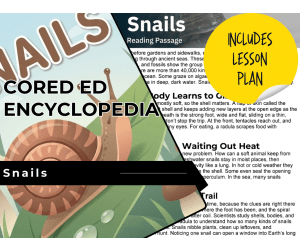
Snails Reading Comprehension Passage - Cored Ed Encyclopedia
ELA, Language Development, Reading Comprehension, Reading, Pre-Reading, Writing, Science, Animals, Life Sciences, Strategies, Grade 2, 3, 4, 5, Worksheets & Printables, Worksheets, Teacher Tools, Centers, Activities, Writing Prompts, Assessments, Quizzes and Tests, Quizzes, Lesson Plans
This snails reading comprehension includes: Visualization (on the front cover) Start your lesson by taking a minute to think and share something about the topic. Read the script aloud (slowly), perhaps prepare some music or sound effects. Student close their eyes and let their imaginations wander. Students open their eyes, read the question aloud and give them a few minutes to complete. Ask a few students to share or keep answers until the end to compare with what they learn in the passage. Quick pause—thousands of Cored Education products are included with your TeachSimple membership. Download links and encyclopedia index available here. Pre-Reading Trivia Students will write down one thing they already know about the subject and then read five more facts and discuss. These facts are fun, and the students will enjoy learning about the subject before reading more. Give 1 minute for students to write what they already know (no pressure—best guess is fine). Read the five facts together. After each fact, do ask a student for their opinion, was it surprising? Set a purpose by asking students to highlight/underline one fact they want to learn more about during the reading. Reading Passage The text is a high-interest reading passage with set paragraphs, roughly three to four paragraphs long. It contains a variety of themes about the topic, anywhere from history to technology. The passage is between 250 and 350 words in length. First, ask students to look at the headings and see what they’ll learn about today. What do they know about the topic/heading? First read options: Teacher read-aloud (best for support). Partner reading (paragraph by paragraph). While reading, students underline important details, and vocabulary words they think may come up in the questions section. Mixed Questions The first question page contains four multiple-choice questions, each with a choice of four answers, and three written response questions that require a sentence or two from the student. Students complete the mcqs first independently, then review quickly as a class. For the 3 written responses, try to get students giving the answer with some form of evidence: “I think ___ because the text says ___.” If students get stuck, send them back to check the passage. Vocabulary Questions Practice seven key words from the text in this section across two activities. First section is scrambled words where students will unscramble three words given a clue for each. The second section is a word to meaning matching activity. Before starting, have some students read out words they underlined in the passage. Ask students to say the word and read aloud the sentence(s) around each word. Ask students to do scrambled words and the matching exercise in pairs then go through answers as a class. For the scrambled spelling task, get four pairs to come up to the board and write the words for extra practice with the other student reading out the clue. For the matching task, prompt students to give full sentences: “I matched ___ with ___ because ___.” Creative Writing In this question, the student will be required to write a five to eight sentence paragraph on a question related to the topic. Before starting, ask students write down 3 key ideas they are going to include in their piece. Ask students for ideas to share around the class to help those struggling. Pro writing expectations: 5–8 sentences At least 2 facts or details from the passage At least 2 vocabulary words from the previous page Students read their paragraphs while classmates listen for facts and vocabulary words. Extension Activities This page is optional for fast finishers or to take home. There are several activities, each one requiring a different skill. Do some, do none, do all, completely optional - but you will feel reassured knowing every possibility is planned for. Includes summary writting question. Answer Key There are answers for the multiple-choice questions, written response questions have sample answers, vocabulary answers and if there is a summary question then a sample summary will be provided as well. Lesson Plan Included Customized lesson plan for this lesson is included. Lesson Snapshot Title: Snails Genre: Nonfiction (informational text with support pages) Subject: Science (Life Science) Primary Topic: Snail traits, habitats, and how they survive Estimated Guided Reading Level (A–Z): S What This Lesson Teaches Best What snails are (gastropods, “belly-footed” mollusks) and how they move using a strong foot on the bottom of their bodies. How snail body parts work, including the mantle making the shell, tentacles with tiny eyes, and a radula that scrapes food with many tiny teeth. How snails live in many habitats (mostly ocean; also land and freshwater), including near shore, on reefs, and in deep, dark water. How snails stay safe and survive tough conditions by pulling into their shell, becoming dormant, and sometimes sealing the opening with mucus or an operculum. How scientists use evidence (shell growth spirals and silvery trails) to study snails and understand how they live in so many places. Learning Goals Explain what “gastropods” means and how snails move using a strong foot. Describe how a snail’s mantle helps make and grow its shell. Identify what a radula is and how it helps a snail eat. Describe how land and freshwater snails avoid drying out and handle hot or cold weather. Use details from the passage to describe where snails live (near shore, reefs, deep water, and moist land places). Key Vocabulary From the Text gastropods — “belly-footed” animals that move using a strong foot. mantle — a flap of skin that makes the shell. radula — a scraper with many tiny teeth for eating. dormant — resting and not active for a while. operculum — a little door that can seal a shell opening. FULL CATALOG OF DOWNLOAD LINKS AND ENCYCLOPEDIA INDEX HERE
Author Cored Education
Rating
Tags Vocabulary, Reading Comprehension, Reading Passages, Reading, Creative Writing, Reading Strategies, Writing Prompts, Lesson Plans, Snails, Life Science

Future Tense Supplementary Materials Grades 3-4 (PDF)
ELA, Language Development, ESL, Grammar, Common Core, Resources for Teachers, Grade 3, 4, Worksheets & Printables, Worksheets, Quizzes and Tests, Teacher Tools, Tests, Assessments, Lesson Plans, Activities
Future Tense Supplementary Materials Note: This download DOES NOT include the tests themselves. You can still make use of these materials without them but they are recommended. Download in a format of your choice in the "Links" section below. Outline Ice Breaker (5-10 minutes) Engaging, interactive activity to introduce the lesson’s theme. Examples: Matching games, sentence races, charades, or storytelling challenges. Guided Practice (10-15 minutes) Teacher-led exercises to reinforce the concept. Examples: Sorting sentences by tense, sentence transformations, or fill-in-the-gap exercises. Group or Partner Task (15 minutes) Collaborative activity to practice the lesson’s focus in a fun and engaging way. Examples: Role-play, storytelling, sentence-building games, or small-group discussions. Independent Worksheet (15 minutes) Individual written activity to solidify understanding. Examples: Sentence corrections, verb conjugation drills, or tense identification exercises. Exit Task (5 minutes) Quick reflective activity to assess understanding before students leave. Examples: Writing a sentence using the target concept, identifying a tense, or explaining a rule. Links: Includes: Future Simple Future Continuous Future Perfect Mistake Finding Google Docs Google Forms Google Slides PDF PPT Word FULL CATALOG OF DOWNLOAD LINKS HERE Grade 3/4 Links: Adjectives Google Docs Google Forms Google Slides PDF PPT Word Free Supplementary Materials Pack Adverbs Google Docs Google Forms Google Slides PDF PPT Word Free Supplementary Materials Pack Conjunctions Google Docs Google Forms Google Slides PDF PPT Word Free Supplementary Materials Pack Nouns Google Docs Google Forms Google Slides PDF PPT Word Free Supplementary Materials Pack Pronouns Google Docs Google Forms Google Slides PDF PPT Word Free Supplementary Materials Pack Verbs Google Docs Google Forms Google Slides PDF PPT Word Free Supplementary Materials Pack Sentence Structure Google Docs Google Forms Google Slides PDF PPT Word Free Supplementary Materials Pack Present Tense Google Docs Google Forms Google Slides PDF PPT Word Free Supplementary Materials Pack Past Tense Google Docs Google Forms Google Slides PDF PPT Word Free Supplementary Materials Pack Future Tense Google Docs Google Forms Google Slides PDF PPT Word Free Supplementary Materials Pack Context Clues Google Docs Google Forms Google Slides PDF PPT Word Free Supplementary Materials Pack Defining Words Google Docs Google Forms Google Slides PDF PPT Word Free Supplementary Materials Pack Fill the Blanks Google Docs Google Forms Google Slides PDF PPT Word Free Supplementary Materials Pack Homophones Google Docs Google Forms Google Slides PDF PPT Word Free Supplementary Materials Pack Synonyms Google Docs Google Forms Google Slides PDF PPT Word Free Supplementary Materials Pack ELA Review Questions Overview Questions have three answer choices. There are a handful of pictures on each test for aesthetic purposes, as well as a review sheet covering most of the topics covered in the product. Introduction or Example Sheet Each topic will include an introduction or example sheet to go through first with your students. Full Answer Keys Full answer keys and sample responses are provided so no matter how busy you are, you know you're covered! In the Supplementary Pack Interactive Ice Breakers: Fun, hands-on activities that get students thinking about adjectives right from the start. Guided Practice: Teacher-led exercises that reinforce the day’s lesson, ensuring students can confidently identify and use adjectives. Group and Partner Tasks: Collaborative activities that allow students to work together to solve problems, categorize adjectives, and create descriptive sentences. Independent Worksheets: Structured worksheets that provide individual practice and help solidify understanding of key concepts. Exit Tasks: Quick, reflective activities at the end of each lesson that assess understanding and encourage students to apply what they’ve learned. For similar downloads and other frees, do check out Cored Group on TeachSimple.
Author Cored Education
Tags Elementary, Answers, Ccss, Common Core, Grammar, Tests, Test Prep, Grade 3, Grade 4, Lesson Plan

KG Morning Work | 180 Days of Spiral Review | Math & ELA | 2nd Quarter
ELA, Math, Kindergarten, Centers, Activities, Lesson Plans, Teacher Tools, Worksheets & Printables
Kindergarten Morning Work | 2nd Quarter Student Pages + Full-Year Teacher Resources Keep your kindergarten mornings calm, consistent, and purposeful with 45 days of Kindergarten morning work for Quarter 2 . This resource includes ALL teacher resources for the complete 180-day program , while the student practice pages in this pack are specifically for 2nd Quarter: Days 46–90 . What’s Included ⭐ FULL-YEAR TEACHER RESOURCES You receive the complete teacher toolkit for planning, organizing, differentiating, and tracking the entire 180-day Kindergarten morning work program : Teacher Guide 36-week planning support Skills Checklist Standards Alignment Fully Editable Morning Work Schedule Year-at-a-Glance Planner Complete Answer Key for Days 1–180 Student Progress Tracker Bonus morning routine resources Classroom organization and implementation guidance 📚 STUDENT PAGES INCLUDED: 2ND QUARTER The student portion of this product includes Days 46–90 , providing 45 days of ready-to-use Kindergarten morning work . Each daily page includes five short, developmentally appropriate activities : Early Literacy — letters, sounds, rhyming, phonics, or sight words Handwriting — letters, numbers, names, and words Math — counting, number sense, addition, shapes, or color-by-code Fine Motor — tracing, mazes, dot-to-dot, or drawing Thinking Skills — patterns, matching, visual discrimination, or “Which One Does Not Belong?” Important: The student practice pages included in this product are Days 46–90 only . The teacher resources and complete Answer Key cover all 180 days . How It Works in the Classroom Use this Kindergarten morning work as a daily morning routine, independent practice, early finisher activity, or beginning-of-day skill review. Each page is designed for approximately 10–15 minutes . Short directions, large print, and plenty of white space make the routine manageable for young learners. The routine follows a predictable weekly rotation: Monday: Letters, counting, tracing, and shapes Tuesday: Beginning sounds, number sense, and patterns Wednesday: Sight words, addition, and fine motor practice Thursday: Rhyming, shapes, and matching Friday: Weekly review, color-by-code, puzzle, and draw-and-write For the first few weeks, complete the pages together. As students learn the routine, they can complete more sections independently. Use the pages for: Morning work Bell ringers Independent practice Early finishers Literacy centers Math warm-ups Fine motor practice Spiral review Sub plans At-home practice The editable schedule also makes it easy to adjust the routine to your classroom schedule and small-group needs. Standards & Learning Goals This Kindergarten morning work resource provides daily practice across early literacy, handwriting, math, fine motor development, and thinking skills. Quarter 2 moves students from foundational skills toward CVC words, rhyming, number comparisons, blends, simple addition, and increasingly independent written work . 📖 Early Literacy & Writing Students practice: Letter recognition Beginning sounds Ending sounds CVC words Word families Rhyming Sight words Phonics Name writing Handwriting Word writing Early sentence development The monthly progression moves from CVC words and comparing numbers in November to blends, simple addition, and name writing in December , with the beginning of the next skill progression appearing as students approach January. 🔢 Math Students practice: Counting Number sense Number formation Comparing numbers More, less, and equal Number bonds Addition Shapes Color-by-code Patterns Visual math reasoning The standards alignment includes Kindergarten expectations for number writing, quantities, counting, comparing groups and numbers, addition and subtraction representations, teen numbers, measurement, and shapes. ✏️ Fine Motor & Thinking Skills Students also develop: Pencil control Tracing Visual discrimination Pattern recognition Matching Drawing Mazes Dot-to-dots “Which one does not belong?” reasoning These skills appear every day because they are important kindergarten readiness skills. Why Teachers Love It ✨ You get ALL the teacher resources for the entire year. The teacher materials support the complete 180-day program , not just Quarter 2. ✨ Students get exactly what they need for Quarter 2. Days 46–90 provide a complete 45-day student set. ✨ Designed specifically for kindergarten. Large print, short directions, and simple visual tasks help young learners understand what to do. ✨ Build independence gradually. Students begin with teacher support and gradually take ownership of the routine. ✨ Zero prep. Everything students need is already on the page. No extra manipulatives are required. ✨ A real developmental progression. Quarter 2 moves students into CVC words, rhyming, number comparisons, blends, simple addition, and more sight-word practice . ✨ Practice multiple skills every day. Literacy, handwriting, math, fine motor, and thinking skills are all built into the daily routine. ✨ Keep students engaged. Tracing, patterns, picture counting, color-by-code activities, puzzles, drawing, matching, and visual challenges provide variety. ✨ Track student growth. The Student Progress Tracker includes literacy, writing, number sense, counting, comparison, addition, shapes, patterns, fine motor, and thinking skills. ✨ Differentiate easily. Read directions aloud, model a section, reduce the number of tasks, or provide additional support as needed. ✨ Support small groups. Use individual sections as quick literacy, math, or fine motor warm-ups. ✨ Keep your classroom routine organized. The editable schedule includes spaces for daily times, focus skills, small-group notes, and a 36-week planner. ✨ Make mornings more engaging. The included bonus materials provide classroom tools such as visual schedule cards, calendar pieces, weather materials, alphabet resources, sight word supports, and early-finisher activities. Looking for Kindergarten morning work for Quarter 2 that saves prep time and builds essential early learning skills? This pack includes 45 days of student practice (Days 46–90) PLUS ALL teacher resources for the full 180-day program . Give your kindergarteners a predictable, engaging morning routine that strengthens literacy, handwriting, math, fine motor skills, and independence! Print it, prep it, and make your kindergarten mornings easier! 💛
Author Bright Classroom Ideas Marketplace
Rating
Tags Math, Ela, Morning Work, Back To School

Structured Literacy Programme: RMS Levels 1 and 2
Special Resources, ELA, Language Development, Phonics, Reading, Vocabulary, Spelling, Kindergarten, Preschool, Grade 1, 2, Teacher Tools, Outlines, Lesson Plans
A spelling programme suitable for dyslexics and those needing a slower, more systematic approach. This is a bundle of the first and second levels in the Reading Made Simple programme of phonics instruction with all the accompanying resources needed to teach these levels. It mainly teaches reading, but while doing so can help to strengthen a weak reader. Reading Made Simple is a programme of phonics instruction that aims to make reading easier for everyone. This programme will give you all the tools you need to help a child gain confidence as a reader and/or writer, using phonics instruction. It is popular amongst homeschooling families, but can equally be used by private tutors and is simple enough to be used to supplement school work by parents. About Reading Made Simple The programme is Very simple to teach: One basic lesson format and no complicated phonics language to learn Flexible - no one-size-fits-all all. You can choose the path that is right for your child. Systematic: Each lesson builds on the one before, creating a seamless learning experience. Many pupils do not even realise how much they have learnt, as it seems so easy! Who is this reading and writing programme for? Children who are just starting to read and write Older children who can already read but need help with spelling and writing Children with special needs who have failed with other phonics programmes Anyone of any age and ability who needs to learn to read and/or write! What is included in the pack? The complete teaching programme for Levels 1 and 2, 99 lessons and full instructions for teaching the lessons Word lists for each of the 99 phonics families taught across both levels. 164 matching worksheets teaching spelling, reading comprehension, editing/proofreading skills, grammar and punctuation relevant to this level of instruction. Which phonics sounds are taught? The lessons cover the most common phonics patterns: ck, oo, ee, sh, ch, nd/nt ending, nk endings, th, ng, ing, ar, or, a-e, i-e, o-e, u-e, ai, ea, oa, high, it, ay, ou, aw, oi, ur, al, er, y ending both ee and eye, ea saying/e/, ow as in cow, a saying /ar/, long vowels with no 'e', ow saying oe, ew, oy and rules concerning 'wa' words, air, au, ou (u), tion, ph, are (care), ear (earth/bear), ough, war. About the lessons: Pupils study a set of around ten to fifteen words per week, all with a common sound. The lessons are simple, following a set format and taking one week each to give sufficient practice. Weekly dictations help the child to apply new knowledge while revising previously taught sounds. Word lists Accompanying word lists are provided. These can be used in multiple ways: Pinned up to allow daily revision of the current sound being taught Put in a folder for review work To have on hand to remind a pupil of a sound family and the words within it Who is this spelling programme for: Any child or adult Those with a processing difficulty Which grade: It is not grade-specific but can be used by any pupil once they have completed Level 1. Who can use it? Parents Teachers Home educators Private tutors
Author Lilibette's Resources
Rating
Tags Remedial Spelling, Phonics, Speling, Writing, Spelling Intervention, Spelling Course, Dyslexia, Special Needs, Structured Literacy, Literacy Programme
First Week of School Grade 12 | No-Prep Worksheets
ELA, Math, Grade 12, Lesson Plans, Teacher Tools, Worksheets & Printables
First Week of School Grade 12 | No-Prep Worksheets Celebrate the final year of high school with this First Week of School Activities for 12th Grade resource! This engaging, no-prep back-to-school packet helps seniors build classroom community while reviewing essential Precalculus concepts, strengthening literacy skills, and setting meaningful goals for life after graduation. Through five structured days of academic review, collaboration, and reflection, students begin senior year focused, motivated, and prepared for future success. What’s Included ✅ 30-page student workbook ✅ 5 ready-to-teach themed learning days ✅ Comprehensive Teacher Guide ✅ Complete Answer Key ✅ Student introduction activities ✅ Summer narrative writing ✅ SMART goal-setting activities ✅ After-graduation planning reflections ✅ Function composition activities ✅ Function inverses practice ✅ Logarithms and trigonometric review ✅ Classroom community-building activities ✅ Polynomial and rational function analysis ✅ Transformations and graphing activities ✅ Argument writing prompts ✅ Student interviews ✅ Collaboration and conflict-resolution activities ✅ Unit circle review ✅ Trigonometric identities and equations ✅ Exponential and logarithmic models ✅ Graphing sine functions ✅ Sequences, series, and limits activities ✅ Syntax and precision writing activities ✅ Sophisticated vocabulary practice ✅ Argument synthesis and analysis ✅ End-of-week certificate ✅ No-prep print-and-go format How It Works in the Classroom This 12th Grade First Week of School Packet is organized into five engaging instructional days designed to help seniors reconnect with academic skills while preparing for graduation and future goals. Day 1: Welcome & Goals Student introductions Summer narrative writing SMART goal setting After-graduation planning Function composition Logarithms and trigonometric review Day 2: Classroom & Community Classroom expectations and values Function composition and inverses Polynomial functions Rational functions Graphing transformed functions Day 3: Collaboration Argument writing Student interviews Team-building activities Conflict resolution Communication and leadership skills Day 4: Precalculus Essentials Unit circle review Trigonometric identities Solving trig equations Exponential and logarithmic models Graphing sine functions Sequences, series, and limits Day 5: Language & Literacy Syntax and precision writing Sophisticated vocabulary Analogies and word relationships Connotation and nuance Argument synthesis Critical reading and analysis Perfect for: Back-to-school lessons Senior advisory activities Precalculus review Independent practice Whole-group instruction Small-group learning Skill review Informal assessments Early finisher activities The included teacher guide provides lesson plans, pacing suggestions, discussion prompts, differentiation strategies, and implementation support for every day of instruction. Standards & Learning Goals Students will practice: ⭐ Narrative writing ⭐ Argument writing ⭐ SMART goal setting ⭐ College and career readiness reflection ⭐ Function composition and evaluation ⭐ Function inverses ⭐ Polynomial and rational function analysis ⭐ Graph transformations ⭐ Collaboration and leadership skills ⭐ Conflict resolution ⭐ Unit circle applications ⭐ Trigonometric identities ⭐ Solving trigonometric equations ⭐ Exponential and logarithmic reasoning ⭐ Graphing trigonometric functions ⭐ Infinite geometric series ⭐ Limits and mathematical reasoning ⭐ Sophisticated vocabulary development ⭐ Argument synthesis and evaluation ⭐ Critical thinking and analytical skills This resource reviews essential Precalculus concepts while strengthening literacy, communication, and college-readiness skills that support students during their final year of high school and beyond. Why Teachers Love It ❤️ No prep required ❤️ Designed specifically for senior-level students ❤️ Covers the entire first week of school ❤️ Integrates Precalculus, literacy, writing, and SEL ❤️ Encourages reflection on future goals and graduation plans ❤️ Builds classroom culture and positive relationships ❤️ Includes teacher guide and answer key ❤️ Reviews prerequisite Precalculus skills ❤️ Provides opportunities for informal assessment ❤️ Supports classroom routines and expectations ❤️ Includes built-in differentiation strategies ❤️ Promotes college, career, and life-readiness skills Created specifically for twelfth-grade students, this resource balances academic review with relationship-building and future-planning activities to help teachers establish a positive classroom environment while preparing students for success beyond high school. Start senior year with purpose and confidence using this First Week of School Activities for 12th Grade packet! Build classroom community, reinforce essential Precalculus and literacy skills, and help students set meaningful goals as they prepare for graduation and the exciting opportunities ahead.
Author Bright Classroom Ideas Marketplace
Rating
Tags Back To School, First Week, Ela, Math, Lesson, Plan, Worksheet

'We Can Be Heroes' Lesson Plan & Worksheets | Grades 2 - 7
ELA, Social Emotional Learning (SEL), Special Resources, Grade 2, 3, 4, 5, 6, 7, Lesson Plans, Teacher Tools, Worksheets & Printables
We Can Be Heroes Movie Study | Superheroes, Teamwork, Leadership, SEL & Critical Thinking Activities | Grades 2–7 Save movie day with an action-packed learning experience using this engaging We Can Be Heroes Movie Study ! Based on the exciting Netflix superhero adventure, this resource helps students explore themes of teamwork, leadership, courage, problem-solving, and perseverance while strengthening reading comprehension, vocabulary, writing, math, critical thinking, and social-emotional learning skills. Through 30 interactive activities, students discover that true heroes are defined by character, determination, and working together—not just superpowers. What's Included 30 student activities Printable student workbook Comprehensive teacher guide Complete answer key Vocabulary-building activities Hero-themed crossword puzzle Word search activities Reading comprehension questions Story sequencing and mission map activities Character analysis tasks Leadership and teamwork discussions Critical-thinking questions Real-life hero reflection activities Creative writing prompts Hero trading card project Superhero design challenges Movie poster creation activity Motto and slogan writing News headline writing activity Tally chart and survey activities Coordinate grid practice Superhero-themed math word problems Students will explore: Leadership and responsibility Teamwork and collaboration Courage and perseverance Problem-solving skills Friendship and trust Real-life heroism Helping others Confidence and self-belief Working toward a common goal The idea that anyone can be a hero How It Works in the Classroom This We Can Be Heroes movie guide is designed for flexible classroom use and works well for: English Language Arts lessons Social-Emotional Learning (SEL) Character education units Independent work Homeschool learning Substitute plans Small-group discussions Movie day enrichment Cross-curricular learning STEM and math connections Students complete activities before, during, and after viewing the film. Lessons include vocabulary practice, comprehension checks, character studies, leadership discussions, teamwork reflections, math challenges, creative projects, and real-world hero connections. The included teacher guide provides a complete 90-minute lesson plan with differentiation strategies and extension opportunities. Standards & Learning Goals Students will: Build superhero-themed vocabulary and language skills Recall and sequence key events from the story Analyze characters and their unique strengths Explore leadership and teamwork through discussion Examine how Missy leads despite having no superpowers Reflect on what makes someone a real-life hero Strengthen critical-thinking and problem-solving abilities Solve math problems and interpret data Create original heroes and imaginative writing pieces Express opinions and support ideas with examples Supports instruction in: English Language Arts Social-Emotional Learning (SEL) Character Education Mathematics Critical Thinking Speaking and Listening Creative Writing Vocabulary Development Why Teachers Love It ✅ No-prep printable resource ✅ Includes teacher guide and complete answer key ✅ Strong focus on teamwork and leadership ✅ Encourages positive character development ✅ Integrates literacy, math, and SEL learning ✅ Appeals to superhero fans and reluctant learners ✅ Includes engaging creative and hands-on activities ✅ Flexible for classroom, homeschool, and enrichment settings ✅ Promotes meaningful discussions about courage and responsibility ✅ Reinforces the message that everyone can make a difference Teachers love how this resource transforms a fun superhero movie into a meaningful educational experience. Students build literacy, math, and social-emotional skills while learning that leadership, kindness, and teamwork are often more powerful than superpowers. Add this We Can Be Heroes Movie Study to your classroom today and help students explore leadership, teamwork, courage, and real-life heroism through engaging activities that turn movie day into an unforgettable learning adventure.
Author Bright Classroom Ideas Marketplace
Rating
Tags We Can Be Heroes, Film, Movie, Guide, Worksheet, Ela, Sel, Lesson, Plan

Morphology Matrix Builders
Science, Basic Science, Inventors, Theories, ELA, Reading, Reading Comprehension, Writing, Creative Writing, Handwriting, Homeschool Curriculum, Homeschool Templates, Grade 3, 4, 5, 6, 7, Worksheets & Printables, Worksheets, Workbooks, Word Searches, Teacher Tools, Lesson Plans, Quizzes and Tests, Quizzes, Tests, Assessments
Tired of vocabulary lists that are memorized on Thursday and forgotten by Monday? It's time to transform your students from passive memorizers into active "word architects"! Introducing Morphology Matrix Builders —a comprehensive, no-prep resource designed to revolutionize vocabulary instruction in your 3rd, 4th, or 5th-grade classroom. Based on the science of reading and structured literacy principles, this unit shifts the focus from rote learning to deep structural analysis of words. Students will learn that English isn't random; it's a fascinating system waiting to be decoded. By mastering a core set of Greek and Latin roots, prefixes, and suffixes, your students will gain the power to decipher thousands of unfamiliar academic words independently. Watch their confidence, reading comprehension, and test scores soar across all subject areas—from ELA to science and social studies! What's Inside This All-in-One Resource? Part 1: Comprehensive Teacher's Guide (11 Pages): A robust theoretical framework that explains the "why" behind morphological instruction. It covers free vs. bound morphemes, prefix functions (including chameleon prefixes), the power of Greek and Latin roots, derivational vs. inflectional suffixes, and key orthographic rules. This guide will empower you to teach with confidence and expertise. Part 2: Student Workbook (15 Pages): Ten engaging, ready-to-print worksheets that guide students from foundational concepts to complex synthesis. Activities include morphological matching, sentence synthesis, word deconstruction, and creative construction. Worksheets Cover: Prefixes, Suffixes, Greek Roots (bio, phon, graph, photo), Latin Roots (port, tract, spect, struct), Number Prefixes, Elemental Roots, Suffixes of Profession, and more! Includes a final Master Morphologist Assessment to evaluate student mastery. Part 3: Visuals & Teacher Resources (7 Pages): Everything you need to implement this unit seamlessly. Pedagogical Visuals: Three high-quality, printable/projectable anchor charts (Morphology Matrix, Structural Word Anatomy, Greek Root Word Web) to make abstract concepts concrete. Comprehensive Answer Key: Fast, easy grading for all 10 worksheets. 4-Day Pacing & Implementation Guide: A step-by-step, week-long plan ("Matrix Monday," "Word Web Wednesday," etc.) to integrate this unit perfectly into your literacy block. Stop teaching one word at a time. Hand your students the master key to the English language and watch them unlock a world of vocabulary! Keywords: Morphology, Greek and Latin Roots, Prefixes and Suffixes, Vocabulary Instruction, Word Study, ELA, English Language Arts, 3rd Grade, 4th Grade, 5th Grade, Upper Elementary, Reading Comprehension, Structured Literacy, Science of Reading, Orton-Gillingham Aligned, Word Building, Etymology, Printable Worksheets, Digital Download, No Prep, Homeschool. Why Parents/Schools Love It: Goes Beyond Rote Memorization: It teaches students a transferable system for decoding words, fostering true understanding and critical thinking instead of just memorizing for a test. Exponential Vocabulary Growth: By learning one root liketract, students don't just learn one word; they unlock the meaning ofattract,distract,extract,tractor,retract, and dozens more. Boosts Reading Comprehension: When students can break down complex, multi-syllabic words in science and history texts, their overall comprehension and academic performance across all subjects improve dramatically. Comprehensive & "Done-For-You": This isn't just a pack of worksheets. It's a complete instructional unit with a teacher's guide, student activities, visual aids, an answer key, and a pacing guide, saving educators valuable prep time. Builds Academic Independence: It empowers students to become confident "word detectives," equipping them with the skills to tackle challenging new vocabulary without relying on a teacher or a dictionary for every word. Target Student Classes : Based on the explicit text on pages 1, 3, 27, and 33, and the complexity of the concepts, should target: Upper Elementary School: 3rd Grade, 4th Grade, and 5th Grade. The resource is also perfect for Middle School intervention groups who need foundational vocabulary skills, as well as Homeschool parents teaching these grade levels. Copyright/Terms of Use: This Book was copyrighted by Syed Hammad Rizvi. This resource is for personal and single classroom use only. You may not alter, redistribute, or sell any part of this resource. In other words, you may not put it on the Internet where it could be publicly found and downloaded. If you want to share this resource with colleagues, please purchase additional licenses from Teachsimple. Thank you for respecting these terms of use. This product is happily brought to you by Syed Hammad Rizvi
Author Creative Book Store
Rating
Tags Morphology, Vocabulary, WordStudy, ELA, EnglishLanguageArts, Literacy, Reading, Teaching, Teacher, GreekAndLatinRoots
Chalk Reading Comprehension Passage - Cored Ed Encyclopedia
ELA, Language Development, Reading Comprehension, Reading, Pre-Reading, Life Sciences, Science, Social Studies, Earth and Environmental Sciences, Geography, Grade 2, 3, 4, 5, Worksheets & Printables, Worksheets, Teacher Tools, Centers, Activities, Writing Prompts, Assessments, Quizzes and Tests, Quizzes, Lesson Plans
This chalk reading comprehension with lesson plan includes: Visualization (on the front cover) Start your lesson by taking a minute to think and share something about the topic. Read the script aloud (slowly), perhaps prepare some music or sound effects. Student close their eyes and let their imaginations wander. Students open their eyes, read the question aloud and give them a few minutes to complete. Ask a few students to share or keep answers until the end to compare with what they learn in the passage. Quick pause—thousands of Cored Education products are included with your TeachSimple membership. Download links and encyclopedia index available here. Pre-Reading Trivia Students will write down one thing they already know about the subject and then read five more facts and discuss. These facts are fun, and the students will enjoy learning about the subject before reading more. Give 1 minute for students to write what they already know (no pressure—best guess is fine). Read the five facts together. After each fact, do ask a student for their opinion, was it surprising? Set a purpose by asking students to highlight/underline one fact they want to learn more about during the reading. Reading Passage The text is a high-interest reading passage with set paragraphs, roughly three to four paragraphs long. It contains a variety of themes about the topic, anywhere from history to technology. The passage is between 250 and 350 words in length. First, ask students to look at the headings and see what they’ll learn about today. What do they know about the topic/heading? First read options: Teacher read-aloud (best for support). Partner reading (paragraph by paragraph). While reading, students underline important details, and vocabulary words they think may come up in the questions section. Mixed Questions The first question page contains four multiple-choice questions, each with a choice of four answers, and three written response questions that require a sentence or two from the student. Students complete the mcqs first independently, then review quickly as a class. For the 3 written responses, try to get students giving the answer with some form of evidence: “I think ___ because the text says ___.” If students get stuck, send them back to check the passage. Vocabulary Questions Practice seven key words from the text in this section across two activities. First section is scrambled words where students will unscramble three words given a clue for each. The second section is a word to meaning matching activity. Before starting, have some students read out words they underlined in the passage. Ask students to say the word and read aloud the sentence(s) around each word. Ask students to do scrambled words and the matching exercise in pairs then go through answers as a class. For the scrambled spelling task, get four pairs to come up to the board and write the words for extra practice with the other student reading out the clue. For the matching task, prompt students to give full sentences: “I matched ___ with ___ because ___.” Creative Writing In this question, the student will be required to write a five to eight sentence paragraph on a question related to the topic. Before starting, ask students write down 3 key ideas they are going to include in their piece. Ask students for ideas to share around the class to help those struggling. Pro writing expectations: 5–8 sentences At least 2 facts or details from the passage At least 2 vocabulary words from the previous page Students read their paragraphs while classmates listen for facts and vocabulary words. Extension Activities This page is optional for fast finishers or to take home. There are several activities, each one requiring a different skill. Do some, do none, do all, completely optional - but you will feel reassured knowing every possibility is planned for. Includes summary writting question and additional facts. Answer Key There are answers for the multiple-choice questions, written response questions have sample answers, vocabulary answers and if there is a summary question then a sample summary will be provided as well. Lesson Plan Included Customized lesson plan for this lesson is included. Lesson Snapshot Title: Chalk Genre: Nonfiction (informational text with headings) Subject: Life Science / Earth Science / Reading (Informational Text) Primary Topic: How chalk forms and how people use it Estimated Guided Reading Level (A–Z): O What This Lesson Teaches Best Explains chalk’s origin: microscopic ocean life made calcium carbonate shells that piled up, hardened, and became chalk. Uses cause-and-effect to show how pressure, time, and weather change materials (shells → rock; waves/wind reveal cliffs). Connects a natural material to human uses (building materials, improving sour soil, writing and drawing). Builds understanding of properties of materials (chalk is soft, rubs into powder, leaves visible marks on dark boards). Highlights how tools and surfaces change over time (dark boards, colored chalk experiments, sidewalk chalk, whiteboards). Learning Goals Students will explain how chalk forms over a long time using details from the text. Students will identify what chalk is made from in the beginning of its story (shells of microscopic living things). Students will describe at least two practical uses of chalk named in the text. Students will explain why chalk worked well on dark boards, using evidence from the passage. Students will compare chalk rock and gypsum “chalk” as described in the passage. Key Vocabulary From the Text microscopic — too tiny to see without help. carbonate — part of a mineral in many shells. crumbly — easy to break into small pieces. gypsum — a mineral used to make some board “chalk.” pavement — the hard surface of a sidewalk or road. FULL CATALOG OF DOWNLOAD LINKS AND ENCYCLOPEDIA INDEX HERE
Author Cored Education
Rating
Tags Vocabulary, Reading Comprehension, Reading Passages, Lesson Plans, Ela Lesson Plans, Reading Comprehension Lesson Plans, Pre-reading, Science Lesson Plans, Earth Science, Geography

Qatar Reading Comprehension Passage - Cored Ed Encyclopedia
ELA, Language Development, Resources for Teachers, Reading Comprehension, Reading, Pre-Reading, Writing, Geography, Social Studies, History, Grade 2, 3, 4, 5, Worksheets & Printables, Worksheets, Teacher Tools, Centers, Activities, Writing Prompts, Assessments, Quizzes and Tests, Quizzes, Lesson Plans
This Qatar reading comprehension includes: Visualization (on the front cover) Start your lesson by taking a minute to think and share something about the topic. Read the script aloud (slowly), perhaps prepare some music or sound effects. Student close their eyes and let their imaginations wander. Students open their eyes, read the question aloud and give them a few minutes to complete. Ask a few students to share or keep answers until the end to compare with what they learn in the passage. Quick pause—thousands of Cored Education products are included with your TeachSimple membership. Download links and encyclopedia index available here. Pre-Reading Trivia Students will write down one thing they already know about the subject and then read five more facts and discuss. These facts are fun, and the students will enjoy learning about the subject before reading more. Give 1 minute for students to write what they already know (no pressure—best guess is fine). Read the five facts together. After each fact, do ask a student for their opinion, was it surprising? Set a purpose by asking students to highlight/underline one fact they want to learn more about during the reading. Reading Passage The text is a high-interest reading passage with set paragraphs, roughly three to four paragraphs long. It contains a variety of themes about the topic, anywhere from history to technology. The passage is between 250 and 350 words in length. First, ask students to look at the headings and see what they’ll learn about today. What do they know about the topic/heading? First read options: Teacher read-aloud (best for support). Partner reading (paragraph by paragraph). While reading, students underline important details, and vocabulary words they think may come up in the questions section. Mixed Questions The first question page contains four multiple-choice questions, each with a choice of four answers, and three written response questions that require a sentence or two from the student. Students complete the mcqs first independently, then review quickly as a class. For the 3 written responses, try to get students giving the answer with some form of evidence: “I think ___ because the text says ___.” If students get stuck, send them back to check the passage. Vocabulary Questions Practice seven key words from the text in this section across two activities. First section is scrambled words where students will unscramble three words given a clue for each. The second section is a word to meaning matching activity. Before starting, have some students read out words they underlined in the passage. Ask students to say the word and read aloud the sentence(s) around each word. Ask students to do scrambled words and the matching exercise in pairs then go through answers as a class. For the scrambled spelling task, get four pairs to come up to the board and write the words for extra practice with the other student reading out the clue. For the matching task, prompt students to give full sentences: “I matched ___ with ___ because ___.” Creative Writing In this question, the student will be required to write a five to eight sentence paragraph on a question related to the topic. Before starting, ask students write down 3 key ideas they are going to include in their piece. Ask students for ideas to share around the class to help those struggling. Pro writing expectations: 5–8 sentences At least 2 facts or details from the passage At least 2 vocabulary words from the previous page Students read their paragraphs while classmates listen for facts and vocabulary words. Extension Activities This page is optional for fast finishers or to take home. There are several activities, each one requiring a different skill. Do some, do none, do all, completely optional - but you will feel reassured knowing every possibility is planned for. Includes summary writting question. Answer Key There are answers for the multiple-choice questions, written response questions have sample answers, vocabulary answers and if there is a summary question then a sample summary will be provided as well. Lesson Plan Included Customized lesson plan for this lesson is included. Lesson Snapshot Title: Qatar Genre: Nonfiction (informational reading passage) Subject: Social Studies (Geography/History/Economics) Primary Topic: Qatar’s geography and change over time Estimated Guided Reading Level (A–Z): R What This Lesson Teaches Best How location and landforms shape a place (peninsula in the Persian Gulf; sea on three sides; sand dunes; an inlet called the Inland Sea). How a country’s economy can change over time (from pearling to oil and natural gas). Cause-and-effect in history (cultured pearls spread → pearling trade collapsed; oil/gas money → schools, hospitals, ports, neighborhoods). Connecting past and present in one place (pearl boats and tall towers sharing the same shoreline; Doha’s modern landmarks). Built-in comprehension practice (pre-reading trivia, mixed questions, vocabulary work, writing and extension activities align to passage details). Learning Goals I can describe Qatar’s location and what surrounds it using details from the passage. I can explain how pearl diving worked and why the pearling trade collapsed. I can identify how oil and natural gas changed Qatar and name what was built with that money. I can sequence key changes over time mentioned in the passage (pearling, oil discovery/exporting, independence, World Cup). I can use passage vocabulary (like peninsula, inlet, emirate) when talking about Qatar. Key Vocabulary From the Text peninsula — land with water on most sides inlet — water cutting into land from the sea seafloor — the bottom of the sea cultured — made or grown with human help emirate — a place led by an emir FULL CATALOG OF DOWNLOAD LINKS AND ENCYCLOPEDIA INDEX HERE
Author Cored Education
Rating
Tags Vocabulary, Reading Comprehension, Reading Passages, Reading, Creative Writing, Reading Strategies, Writing Prompts, Lesson Plans, Geography, Qatar

Ocean Animal Research Writing Project on SEA TURTLES for K-2nd Grade
Life Studies, ELA, Writing, Creative Writing, Reading, Science, Life Sciences, Animals, Research, Kindergarten, Grade 1, 2, Lesson Plans, Teacher Tools, Presentations, Worksheets & Printables, Worksheets, Writing Prompts
Sea Turtle Animal Research Writing Project for K-2. Engage your K-2 students in learning about sea turtles with this 19-page animal research writing project. Students will read age-appropriate information about sea turtles, examine real-life photos, color pictures, draw a sea turtle habitat, organize facts using writing organizers, and write an informational report on sea turtles. This unit is differentiated for various abilities and for ages K-2nd grade. This project promotes reading, creativity, and early research and writing skills. Use it for whole-class instruction, small groups, or individual assignments. With fun borders and opportunities for students to be creative while building knowledge, this packet offers multi-day engagement to learn about the amazing sea turtle! Here are even more informational resources on report writing for OCEAN ANIMALS. Click on the links below: Animal Research Writing Project on WHALES for K-2nd Grade Animal Research Writing Project on the OCTOPUS for K-2nd Grade Animal Research Writing Project on SEA TURTLES for K-2nd Grade Animal Research Writing Project on ORCAS for K-2nd Grade Animal Research Writing Project on the SHELLFISH for K-2nd Grade Animal Research Writing Project on DOLPHINS for K-2nd Grade Animal Research Writing Project on SEALS for K-2nd Grade Want to teach your students all about Zoo Animals? Check out all these interesting facts about these favorite zoo animals. With the same great photos, facts, habitat drawings, and more. It is a great way to help students to get interested in writing. For Zoo Animal reports, click on the following links below: Animal Research Writing Project on TIGERS for K-2nd Grade Animal Research Writing Project on MONKEYS for K-2nd Grade Animal Research Writing Project on PANDAS for K-2nd Grade Animal Research Writing Project on HIPPOS for K-2nd Grade Animal Research Writing Project on ELEPHANTS for K-2nd Grade Animal Research Writing Project on GIRAFFES for K-2nd Grade
Author K-5 Treasures
Tags Animal Research, Informational Writing, Writing Report, Report On Animals, 1st Grade Writing, 2nd Grade Writing, Ocean Animals, Sea Turtles, Report Of Sea Turtles, Ocean Animal Report
Tennis Reading Comprehension Passage - Cored Ed Encyclopedia
ELA, Language Development, Reading Comprehension, Reading, Pre-Reading, Science, Technology, Engineering, History, Social Studies, Grade 2, 3, 4, 5, Worksheets & Printables, Worksheets, Teacher Tools, Centers, Activities, Writing Prompts, Assessments, Quizzes and Tests, Quizzes, Lesson Plans
This tennis reading comprehension includes: Visualization (on the front cover) Start your lesson by taking a minute to think and share something about the topic. Read the script aloud (slowly), perhaps prepare some music or sound effects. Student close their eyes and let their imaginations wander. Students open their eyes, read the question aloud and give them a few minutes to complete. Ask a few students to share or keep answers until the end to compare with what they learn in the passage. Quick pause—thousands of Cored Education products are included with your TeachSimple membership. Download links and encyclopedia index available here. Pre-Reading Trivia Students will write down one thing they already know about the subject and then read five more facts and discuss. These facts are fun, and the students will enjoy learning about the subject before reading more. Give 1 minute for students to write what they already know (no pressure—best guess is fine). Read the five facts together. After each fact, do ask a student for their opinion, was it surprising? Set a purpose by asking students to highlight/underline one fact they want to learn more about during the reading. Reading Passage The text is a high-interest reading passage with set paragraphs, roughly three to four paragraphs long. It contains a variety of themes about the topic, anywhere from history to technology. The passage is between 250 and 350 words in length. First, ask students to look at the headings and see what they’ll learn about today. What do they know about the topic/heading? First read options: Teacher read-aloud (best for support). Partner reading (paragraph by paragraph). While reading, students underline important details, and vocabulary words they think may come up in the questions section. Mixed Questions The first question page contains four multiple-choice questions, each with a choice of four answers, and three written response questions that require a sentence or two from the student. Students complete the mcqs first independently, then review quickly as a class. For the 3 written responses, try to get students giving the answer with some form of evidence: “I think ___ because the text says ___.” If students get stuck, send them back to check the passage. Vocabulary Questions Practice seven key words from the text in this section across two activities. First section is scrambled words where students will unscramble three words given a clue for each. The second section is a word to meaning matching activity. Before starting, have some students read out words they underlined in the passage. Ask students to say the word and read aloud the sentence(s) around each word. Ask students to do scrambled words and the matching exercise in pairs then go through answers as a class. For the scrambled spelling task, get four pairs to come up to the board and write the words for extra practice with the other student reading out the clue. For the matching task, prompt students to give full sentences: “I matched ___ with ___ because ___.” Creative Writing In this question, the student will be required to write a five to eight sentence paragraph on a question related to the topic. Before starting, ask students write down 3 key ideas they are going to include in their piece. Ask students for ideas to share around the class to help those struggling. Pro writing expectations: 5–8 sentences At least 2 facts or details from the passage At least 2 vocabulary words from the previous page Students read their paragraphs while classmates listen for facts and vocabulary words. Extension Activities This page is optional for fast finishers or to take home. There are several activities, each one requiring a different skill. Do some, do none, do all, completely optional - but you will feel reassured knowing every possibility is planned for. Includes summary writting question. Answer Key There are answers for the multiple-choice questions, written response questions have sample answers, vocabulary answers and if there is a summary question then a sample summary will be provided as well. Lesson Plan Included Customized lesson plan for this lesson is included. Lesson Snapshot Title: Tennis Genre: Nonfiction (informational text) Subject: Social Studies (History of Sports) Primary Topic: How tennis changed over time Estimated Guided Reading Level (A–Z): Q What This Lesson Teaches Best How tennis began as jeu de paume (“game of the palm”) and shifted from hands to gloves and then rackets. How indoor courts with hard walls and slanted roofs changed play by creating surprising angles. How tennis moved outdoors in the 1800s when rubber balls bounced well outside and lawns made smooth courts. Key moments that helped standardize and spread the sport (1873 rules book, 1877 Wimbledon). How tournaments changed when the Open Era began in 1968, allowing professionals and amateurs to compete together. Learning Goals Students will explain why the early game was called jeu de paume using details from the text. Students will describe how playing spaces changed from courtyards to enclosed indoor courts. Students will identify how walls and slanted roofs affected play in real tennis. Students will summarize two changes in the 1800s that helped tennis move outdoors. Students will describe why the 1873 rulebook and the 1877 Wimbledon championship mattered for tennis. Students will explain what changed in 1968 when the Open Era began. Key Vocabulary From the Text monastery — a place where monks live and work. cloisters — covered walkways around a courtyard. boundary — a line that shows where play must stay. enclosed — closed in by walls; not open outside. amateurs — people who play for fun, not as paid work. FULL CATALOG OF DOWNLOAD LINKS AND ENCYCLOPEDIA INDEX HERE
Author Cored Education
Rating
Tags Vocabulary, Reading Comprehension, Reading Passages, Lesson Plans, Ela Lesson Plans, Reading Comprehension Lesson Plans, Pre-reading, History, History Lesson Plans, Sports

'Hidden Figures' Lesson Plan & Worksheets | Grades 6 - 12
ELA, Social Emotional Learning (SEL), Special Resources, Grade 6, 7, 8, 9, 10, 11, 12, Lesson Plans, Teacher Tools, Worksheets & Printables
'Hidden Figures' Lesson Plan & Worksheets | Grades 6 - 12 Inspire students with the powerful true story behind Hidden Figures while building critical thinking, historical understanding, STEM awareness, and literacy skills. This engaging Hidden Figures Movie Study explores the remarkable achievements of Katherine Johnson, Dorothy Vaughan, and Mary Jackson as students examine themes of perseverance, equality, innovation, and breaking barriers. With 30 rigorous and meaningful activities, this resource transforms movie day into a rich cross-curricular learning experience. What's Included 30 student activities Printable student workbook Comprehensive teacher guide Complete answer key Reading comprehension questions Character analysis activities Historical context investigations Civil Rights Movement connections STEM and mathematics activities Space Race timeline activities Vocabulary development exercises Cause-and-effect analysis Media literacy discussions Data graphing and interpretation tasks Creative writing activities Reflection and discussion prompts Career exploration activities Art and design extension projects Students will explore: The Space Race NASA history Civil Rights and segregation Equality and opportunity Perseverance and resilience Women in STEM Mathematical problem-solving Engineering and computer science Historical analysis Media literacy and true-story adaptations How It Works in the Classroom This Hidden Figures movie guide is designed for flexible implementation across multiple subject areas: English Language Arts STEM lessons History classes Social Studies units Civil Rights instruction Career exploration lessons Independent learning Homeschool settings Substitute plans Cross-curricular projects Students complete activities before, during, and after viewing the film. Lessons include comprehension work, historical investigations, STEM challenges, graphing activities, discussion prompts, character analysis, and reflective writing. The included teacher guide provides a complete 90-minute lesson plan with differentiation strategies for Grades 6–12. Standards & Learning Goals Students will: Recall and sequence key events from the film Analyze the achievements of Katherine Johnson, Dorothy Vaughan, and Mary Jackson Explore the historical context of segregation and the Civil Rights Movement Examine the Space Race and NASA's role in scientific advancement Interpret and create data graphs Strengthen reading comprehension and vocabulary skills Evaluate themes of equality, perseverance, and recognition Practice critical-thinking and evidence-based reasoning Explore STEM careers and opportunities Develop reflective and analytical writing skills Supports instruction in: English Language Arts STEM Education Mathematics History Civics and Social Studies Media Literacy Career Readiness Social-Emotional Learning (SEL) Why Teachers Love It ✅ No-prep printable resource ✅ Includes teacher guide and complete answer key ✅ Meaningful integration of STEM, history, and literacy ✅ Encourages critical thinking and historical analysis ✅ Promotes important conversations about equality and perseverance ✅ Features engaging graphing and data-analysis activities ✅ Introduces students to inspiring STEM role models ✅ Supports a wide grade range (Grades 6–12) ✅ Includes creative, analytical, and reflective learning opportunities ✅ Perfect for Black History Month, Women's History Month, STEM units, and Civil Rights studies Teachers love how this resource helps students connect historical events to modern issues while celebrating the achievements of groundbreaking women whose contributions changed history. Add this Hidden Figures Movie Study to your classroom today and inspire students through a powerful true story of courage, perseverance, innovation, and achievement. Perfect for integrating STEM, history, literacy, and critical thinking into one unforgettable learning experience.
Author Bright Classroom Ideas Marketplace
Rating
Tags Hidden Figures, Lesson, Plan, Worksheet, Movie, Film, Guide
Ancient Egypt Reading Comprehension Passage - Cored Ed Encyclopedia
ELA, Language Development, Reading Comprehension, Reading, Social Studies, History, History: Ancient, Writing, Pre-Reading, Vocabulary, Grade 2, 3, 4, 5, Worksheets & Printables, Worksheets, Teacher Tools, Centers, Activities, Writing Prompts, Assessments, Quizzes and Tests, Quizzes, Lesson Plans
This ancient Egypt reading comprehension with lesson plan includes: Visualization (on the front cover) Start your lesson by taking a minute to think and share something about the topic. Read the script aloud (slowly), perhaps prepare some music or sound effects. Student close their eyes and let their imaginations wander. Students open their eyes, read the question aloud and give them a few minutes to complete. Ask a few students to share or keep answers until the end to compare with what they learn in the passage. Quick pause—thousands of Cored Education products are included with your TeachSimple membership. Download links and encyclopedia index available here. Pre-Reading Trivia Students will write down one thing they already know about the subject and then read five more facts and discuss. These facts are fun, and the students will enjoy learning about the subject before reading more. Give 1 minute for students to write what they already know (no pressure—best guess is fine). Read the five facts together. After each fact, do ask a student for their opinion, was it surprising? Set a purpose by asking students to highlight/underline one fact they want to learn more about during the reading. Reading Passage The text is a high-interest reading passage with set paragraphs, roughly three to four paragraphs long. It contains a variety of themes about the topic, anywhere from history to technology. The passage is between 250 and 350 words in length. First, ask students to look at the headings and see what they’ll learn about today. What do they know about the topic/heading? First read options: Teacher read-aloud (best for support). Partner reading (paragraph by paragraph). While reading, students underline important details, and vocabulary words they think may come up in the questions section. Mixed Questions The first question page contains four multiple-choice questions, each with a choice of four answers, and three written response questions that require a sentence or two from the student. Students complete the mcqs first independently, then review quickly as a class. For the 3 written responses, try to get students giving the answer with some form of evidence: “I think ___ because the text says ___.” If students get stuck, send them back to check the passage. Vocabulary Questions Practice seven key words from the text in this section across two activities. First section is scrambled words where students will unscramble three words given a clue for each. The second section is a word to meaning matching activity. Before starting, have some students read out words they underlined in the passage. Ask students to say the word and read aloud the sentence(s) around each word. Ask students to do scrambled words and the matching exercise in pairs then go through answers as a class. For the scrambled spelling task, get four pairs to come up to the board and write the words for extra practice with the other student reading out the clue. For the matching task, prompt students to give full sentences: “I matched ___ with ___ because ___.” Creative Writing In this question, the student will be required to write a five to eight sentence paragraph on a question related to the topic. Before starting, ask students write down 3 key ideas they are going to include in their piece. Ask students for ideas to share around the class to help those struggling. Pro writing expectations: 5–8 sentences At least 2 facts or details from the passage At least 2 vocabulary words from the previous page Students read their paragraphs while classmates listen for facts and vocabulary words. Extension Activities This page is optional for fast finishers or to take home. There are several activities, each one requiring a different skill. Do some, do none, do all, completely optional - but you will feel reassured knowing every possibility is planned for. Includes summary writting question and additional facts. Answer Key There are answers for the multiple-choice questions, written response questions have sample answers, vocabulary answers and if there is a summary question then a sample summary will be provided as well. Lesson Plan Included Customized lesson plan for this lesson is included. Lesson Snapshot Title: Ancient Egypt Genre: Nonfiction (informational passage) Subject: Social Studies Primary Topic: Nile flooding, kingdoms, pyramids, and writing Estimated Guided Reading Level (A–Z): T What This Lesson Teaches Best How the Nile River flooding left dark mud that helped farming and food growth. The meaning of Kemet (“black land”) and why it described the fertile farming strip. How leaders joined Upper Egypt and Lower Egypt into one kingdom, with the pharaoh as a symbol of unity. Key achievements in building and record-keeping (pyramids, scribes, hieroglyphs, papyrus, grain and taxes). How the Rosetta Stone helped scholars decode hieroglyphs by showing the same text in three kinds of writing. Learning Goals Explain how the Nile River’s yearly flooding helped people grow food. Describe why people called the fertile farm area Kemet, or “black land.” Identify ways ancient Egyptians organized and strengthened their kingdom (sharing water, one ruler, a capital). Describe how pyramids changed over time (step pyramid for Djoser and later pyramids at Giza). Explain how scribes used hieroglyphs and papyrus to keep records of grain and taxes. Describe how the Rosetta Stone led to reading hieroglyphs again. Key Vocabulary From the Text fertile — able to grow lots of plants. pharaoh — ruler of ancient Egypt. hieroglyphs — picture symbols used for writing. papyrus — plant paper used for writing. decree — an official order from leaders. FULL CATALOG OF DOWNLOAD LINKS AND ENCYCLOPEDIA INDEX HERE
Author Cored Education
Rating
Tags Vocabulary, Reading Comprehension, Reading Passages, Lesson Plans, Ela Lesson Plans, Reading Comprehension Lesson Plans, Pre-reading, History, Ancient History Lesson Plans, History Lesson Plans