



3,917 products added recently
Page 7 - History Lesson Plans
Transport your students through time with history lesson plans that vividly illustrate past events and societies. These resources include primary sources, discussions, and projects. Implement them to foster critical thinking and a deeper understanding of our world's history.

 Show filters


Alamo: Remember the Alamo: Historic Monuments Series
Social Studies, History, History: USA, Grade 4, 5, 6, 7, 8, Teacher Tools, Lesson Plans
Alamo: Remember the Alamo: Historic Monuments Series A comprehensive teaching resource designed for educators focusing on Grade 4 to Grade 8 students. This material serves as a unique guide capturing key elements of American history while also providing an engaging foundation for social studies education. The Alamo Saga This teaching tool embeds captivating stories, original documents, timelines, and letters that detail the illustrious saga of Texas revolution. It presents an accessible blend of fact-finding missions and historical unraveling around famous battles, daring heroes, and pivotal causes related to Texas fight for independence. Educational Application Educators can utilize this detailed resource as a cornerstone for their lesson plans in Social Studies or specifically American history subtopics. The material helps ignite curiosity among students while offering opportunities to develop critical thinking skills through understanding historical contexts. New Learning Horizons: Student Activities The Alamo series includes numerous student-friendly activities that aim at: Enhancing knowledge retention by reinforcing key terms center >-and- center > Broadening cognitive appreciation of historic events context. In addition these activities assist learners in exploring why events from centuries ago still hold relevance today - adding an extra layer of interest towards their educational journey. Versatility For Teachers and Learning Environments This versatile teaching resource can be incorporated into various learning environments such as: Whole group discussions about key battles or heroes, Small group sessions focusing on analyzing specific documents or timelines, Individual homework assignments correlated with provided learning points etc. This approach effectively and efficiently caters to the diverse needs of all learners. Easy Access: PDF Format All contents are available via PDF format ensuring convenience and ease-of-use. This can be displayed during verbal instruction sessions or digitally distributed among students. This practical focus emphasizes how seamlessly this tool can integrate into any educator's toolbox, making it indispensable for studying USA History at Ischool level.
Author Classroom Complete Press
Tags PDF
I WONDER - Who Was Odin | Animated Video Lesson
History: Ancient, History, Social Studies, History: Europe, Grade 3, 4, 5, 6, 7, 8, 9, Lesson Plans, Teacher Tools
Video Introduction An amazing video designed for the students to learn more about mythological creatures in different cultures. I WONDER - Who Was Odin | Animated Video Lesson Do you know who are mermaids and what they look like? How do you think they have been created and in which mythology we can find them? Have you ever read about Cerberus the dog with three faces? If yes, tell us where it lived and what was its job? How did Minotaur look like? Did it has a unique story to tell from the Greek mythology? Why do people love to put gnomes in their gardens? In which mythology we can find them? Do you know that not all dragons are same some dragons are really scary and some can bring good luck. So let's discover the difference between the western dragons and Chinese dragons. Tell us which ones do you prefer? I WONDER - Who Was Odin | Animated Video Lesson The video is perfect for encouraging the creativity skills for the students, while learning more about this fantastic mythical creature. I WONDER - Who Was Odin | Animated Video Lesson This friendly designed video is suitable for students at school, homeschooling, and as a group activity. Format Available in MP4 format.
Author Educational Voice
Rating
Tags Who Was Odin, Odin, Odin Facts, Facts About Odin, Odin Video, Odin Video For Kids, Odin Facts For Kids, Viking Gods, Viking Gods Facts, Viking Gods Facts For Kids
I WONDER - How Did The Parasaurolophus Eat | Animated Video Lesson
History: Ancient, History, Social Studies, History: World, Animals, Life Sciences, Science, Grade 4, 5, 6, 7, 8, 9, 10, Lesson Plans, Teacher Tools
Video Introduction An amazing video designed for the students to learn more about dinosaurs in different countries. I WONDER - How Did The Parasaurolophus Eat | Animated Video Lesson Do you like dinosaurs? what is your favorite one? Do you own a pet? If yes, tell us more about it, like what its name? And what do you like most about it? Do you think that your pet has been evolved from a dinosaur? Can you write down the characteristics of your favourite dinosaur like it's shape, their rivals, where did it use to live and what was their favourite food? What is the largest and the smallest dinosaur that ever found? Why is the T-rex is so famous? Have you ever read any interesting facts about it? Can you name any of the carnivores or herbivores dinosaurs? I WONDER - How Did The Parasaurolophus Eat | Animated Video Lesson The video is perfect for encouraging the researching skills for the students, while learning more about dinosaurs. I WONDER - How Did The Parasaurolophus Eat | Animated Video Lesson This friendly designed video is suitable for students at school, homeschooling, and as a group activity. Format Available in MP4 format.
Author Educational Voice
Rating
Tags How Did The Parasaurolophus Eat, How Did The Parasaurolophus Eat Video, Parasaurolophus, Parasaurolophus Video, Parasaurolophus Facts, Parasaurolophus Facts For Kids, Parasaurolophus Video For Kids

I WONDER - What Type Of Weapons Did Roman Soldiers Have
History: Ancient, History, Social Studies, History: Europe, Grade 6, 7, 8, 9, 10, 11, 12, Lesson Plans, Teacher Tools
Video Introduction An amazing video designed for the students to learn more about history. I WONDER - What Type Of Weapons Did Roman Soldiers Have | Animated Video Lesson Do you like history? Which topic do you really enjoy about history? Have you ever read an interesting fact about the Vikings? If yes, can you mention them? What do you like most about the Victorian era? Can you name all the Tudors? Have you ever wondered how people used to live in ancient Japan and ancient China? Do you know any interesting facts about ancient Egyptians and the Pharaohs? Have you ever visited South America? What do you know about Incas and Aztecs? Celtic culture was really one of a kind, can you name any of the places that Celts used to live in? Imagine yourself living during the ancient Roman empire, how your life will look like? Ancient Greece was an amazing place to live in. What do you know about ancient Greek life? I WONDER - What Type Of Weapons Did Roman Soldiers Have | Animated Video Lesson The video is perfect for encouraging the researching skills for the students, while learning more about history. I WONDER - What Type Of Weapons Did Roman Soldiers Have | Animated Video Lesson This friendly designed video is suitable for students at school, homeschooling, and as a group activity. Format Available in MP4 format.
Author Educational Voice
Tags What Type Of Weapons Did Roman Soldiers Have , What Type Of Weapons Did Roman Soldiers Have Video, Roman Soldiers, Roman Soldiers Facts, Roman Soldiers Video, Roman Soldiers Video For Kids, Roman Soldiers Facts For Kids

Saskatchewan: First 100 Years Gr. K-2
Social Studies, History, History: Canada, Grade 1, Teacher Tools, Lesson Plans
Saskatchewan: First 100 Years Gr. K-2 Offering comprehensive content and versatile applications, this valuable resource allows educators to explore the rich history of Saskatchewan over its first hundred years since its provincial birth on September 1, 2005. Resource Contents: Activity Sheets: Including poems, songs, and rebus chants that are perfect for hands-on centre activities or a whole group learning experience. Black Line Masters: Facilitating visual engagement while absorbing information. Student Bookmaking: Encouraging creativity while imparting historical facts upon students. A storyboard story named "The Welcome Basket": Promotes understanding by adding narrative structure to lessons. Inclusive Follow-Up Section     For reinforcement of class teachings, this section suggests activities for both classroom instruction or personal study at home. Bibliography and Resource Guide:     Offers additional support materials such as visuals (pictures of Saskatchewan's flag or other provincial emblems) found online. This guide also encompasses an extensive list recommending engaging storybooks by authors based in Saskatchewan for further reading too! An Effective Teaching Tool This excellent resource equips public school teachers and homeschoolers alike with interactive lesson plans suitable for grade one level Social Studies course focusing on History: Canada as its primary subject subset. The whole package is available in an easy-to-use PDF format that can be seamlessly integrated into any type of pre-existing curricula ensuring each child has equal opportunity at fully grasping both the history content and creative learning techniques implemented within these lessons. Boldly, like no other teaching resource before it, this top-notch tool efficiently combines education and creativity resulting in highly engaging content about ‘Saskatchewan: First 100 Years Gr. K-2' for educating young learners. It’s great!
Author Classroom Complete Press
Tags PDF

I WONDER - Are There Any Famous Dragons | Animated Video Lesson
History, Social Studies, Common Core, Grade 4, 5, 6, 7, 8, 9, 10, Lesson Plans, Teacher Tools
Video Introduction An amazing video designed for the students to learn more about mythological creatures in different cultures. I WONDER - Are There Any Famous Dragons | Animated Video Lesson Mythology is full of wonders and spectacular stories. Ancient civilizations were trying to explore every aspect of life, while they search for new technologies, they wanted to believe in something big and can change the world, so they created mythical creatures and mythical stories. Let's hear about them! What do you know about these creatures? Cyclops, Centaurs, Selkies, Phoenix, Gnomes, Dragons, Gorgons, Orcs, Cerberus, Trolls, Minotaur, Griffins, Mermaids, Elves, Polyphemus, Pegasus, and Ogres. I WONDER - Are There Any Famous Dragons | Animated Video Lesson The video is perfect for encouraging the creativity skills for the students, while learning more about this fantastic mythical creature. I WONDER - Are There Any Famous Dragons | Animated Video Lesson This friendly designed video is suitable for students at school, homeschooling, and as a group activity. Format Available in MP4 format.
Author Educational Voice
Rating
Tags Are There Any Famous Dragons, Are There Any Famous Dragons Video, Famous Dragons, Famous Dragons Video, Famous Dragons Facts, Famous Dragons Facts For Kids, Famous Dragons Video For Kids

South America Gr. 5-8
Social Studies, History, History: World, Grade 5, 6, 7, 8, Teacher Tools, Lesson Plans
South America Gr. 5-8 Teaching Resource This resource is comprehensive and age-appropriate, exploring South America's environmental issues, wildlife, geography, and cultural history. Designed specifically for learners in grades 5 through 8, it covers a range of topics within disciplines like Social Studies and World History. Main Features: Endangered Environments: Research projects on the Amazon River or unique ecosystems such as the Andes Mountains or Pampas regions. Cultural Exploration: Comparisons of ancient societies against modern ones using graphic organizers to show regional changes. Mastery of Geography: Use of map extracts to engage with geographical themes e.g., describing Chile's physical environment. Humann-made landscapes: A focus on urbanization with examples from subway systems in cities like Venezuela's Caracas or Brazil's Rio de Janeiro. A Few More Highlights : In addition to these thematic activities suitable for group instruction or homework assignments; reinforcement tools such as crosswords and word searches ensure mastering along with traditional teaching methods. Note : All content aligns with common State Standards meeting mandatory curriculum needs without compromise. A comprehensive answer key is included providing educators all needed solutions. Ideal for public schools and homeschooling setups, these materials encourage knowledge-based fun in creating globally aware citizens! Your geographical awareness PDF download!</B
Author Classroom Complete Press
Tags PDF

I WONDER - Did The Oviraptor Have Feathers | Animated Video Lesson
History: Ancient, History, Social Studies, History: World, Animals, Life Sciences, Science, Grade 4, 5, 6, 7, 8, 9, 10, Lesson Plans, Teacher Tools
Video Introduction An amazing video designed for the students to learn more about dinosaurs in different countries. I WONDER - Did The Oviraptor Have Feathers | Animated Video Lesson Do you like dinosaurs? what is your favorite one? Do you own a pet? If yes, tell us more about it, like what its name? And what do you like most about it? Do you think that your pet has been evolved from a dinosaur? Can you write down the characteristics of your favourite dinosaur like it's shape, their rivals, where did it use to live and what was their favourite food? What is the largest and the smallest dinosaur that ever found? Why is the T-rex is so famous? Have you ever read any interesting facts about it? Can you name any of the carnivores or herbivores dinosaurs? I WONDER - Did The Oviraptor Have Feathers | Animated Video Lesson The video is perfect for encouraging the researching skills for the students, while learning more about dinosaurs. I WONDER - Did The Oviraptor Have Feathers | Animated Video Lesson This friendly designed video is suitable for students at school, homeschooling, and as a group activity. Format Available in MP4 format.
Author Educational Voice
Rating
Tags Did The Oviraptor Have Feathers, Did The Oviraptor Have Feathers Video, Oviraptor, Oviraptor Facts, Oviraptor Video, Oviraptor Video For Kids, Oviraptor Facts For Kids, Dinosaur, Dinosaurs

Persian Gulf War (1990-1991): Aftermath Gr. 5-8
Social Studies, History, History: USA, Grade 5, 6, 7, 8, Teacher Tools, Lesson Plans
Persian Gulf War (1990-1991): Aftermath Gr. 5-8 This is a comprehensive teaching resource designed to help educators convey crucial aspects of the Persian Gulf War to students from Grade 5 to Grade 8. The resource focuses on the chapter titled "Aftermath Gr. 5-8", which concentrates on key events in U.S.-led Operation Desert Storm from 1990-1991 following Iraq's invasion of Kuwait. The package, made up of twenty-seven ready-to-print pages, provides materials for various teaching scenarios, including group activities during class hours, individual reading at home, small study groups or homework assignments. Included Information: Saddam Hussein’s background and role within the Baath Party Iraq’s invasion on Kuwait and world reactions The response from other countries and the UN Educational Activities: Equipped with hands-on activities that are created according to Bloom's Taxonomy such as: Crosswords and word search games for knowledge retention. Quizzes for testing comprehension about Persian Gulf War events. Main Subject Focus: This PDF file targets primarily USA History in Social Studies domain making it an invaluable aid for teachers addressing seminal moments American history while maintaining high engagement levels in classrooms. Persian Gulf War (1990 - 1991): Aftermath Gr . A must-have staple every educator should include in their pedagogical arsenal if instilling informed historical awareness among students is a top educational goal The Persian Gulf War (1990-1991): Aftermath Gr. 5-8 prompts knowledge gain with depth, context, and interactivity - your go-to resource for teaching related history lessons with depth.
Author Classroom Complete Press
Tags Persian Gulf War, Social Studies, History Quiz, History Word Search, U.S. History
I WONDER - How Are Elves Portrayed | Animated Video Lesson
History, Social Studies, Common Core, Grade 4, 5, 6, 7, 8, 9, 10, Lesson Plans, Teacher Tools
Video Introduction An amazing video designed for the students to learn more about mythological creatures in different cultures. I WONDER - How Are Elves Portrayed | Animated Video Lesson Mythology is full of wonders and spectacular stories. Ancient civilizations were trying to explore every aspect of life, while they search for new technologies, they wanted to believe in something big and can change the world, so they created mythical creatures and mythical stories. Let's hear about them! What do you know about these creatures? Cyclops, Centaurs, Selkies, Phoenix, Gnomes, Dragons, Gorgons, Orcs, Cerberus, Trolls, Minotaur, Griffins, Mermaids, Elves, Polyphemus, Pegasus, and Ogres. I WONDER - How Are Elves Portrayed | Animated Video Lesson The video is perfect for encouraging the creativity skills for the students, while learning more about this fantastic mythical creature. I WONDER - How Are Elves Portrayed | Animated Video Lesson This friendly designed video is suitable for students at school, homeschooling, and as a group activity. Format Available in MP4 format.
Author Educational Voice
Rating
Tags How Are Elves Portrayed, How Are Elves Portrayed Video, Elves, Elves Facts, Elves Video, Elves Video For Kids, Elves Facts For Kids, Mythology, Mythology Video, Mythology Facts

Chief Joseph Surrenders: History Speaks . . .
Social Studies, History, History: USA, Grade 4, 5, 6, 7, 8, Teacher Tools, Lesson Plans
Chief Joseph Surrenders: History Speaks Teaching Resource The Chief Joseph Surrenders: History Speaks teaching resource offers a compelling educational tool for teaching U.S. history, specifically designed for Grades 4 through 8 focusing on Social Studies. Focusing on Chief Joseph's Poignant Story The resource narrows down to the captivating story of Chief Joseph and his Nez Perce tribe. It intricately tells the detailed account of their brave stand against government forces aiming at displacing them from their ancestral land, culminating in Chief Joseph's touching surrender speech - a pure masterpiece in American history. Detailed Historical Context: The lesson is rich in historical details providing an immersive learning experience. Different Perspectives: Students see through the eyes of a noble leader during times of significant adversity. Captivating Episode: Dive into an unforgettable episode with timeless lessons about survival and dignity during challenging times. A Unique Teaching Resource Beyond Lesson Plan This effective education tool assists educators to create intriguing learning environments that ignite curiosity about past events while enhancing learners' understanding and appreciation for U.S. history by offering: Suitable for whole-group activities or small group discussions promoting collaborative learning and critical thinking skills development. Presentation as PDF file for easy accessibility whenever needed within your curriculum timeline. Possibility to be part of classroom instruction or homework reading assignment encouraging deeper knowledge acquisition at self-paced intervals. In conclusion, "Chief Joseph Surrenders: History Speaks" stands out as an invaluable addition to any Social Studies class aimed at engaging young minds on significant historical occurrences.
Author Classroom Complete Press
Tags PDF
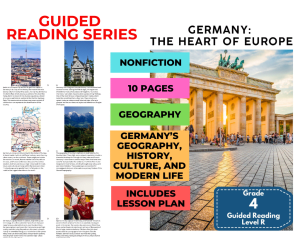
Germany: The Heart of Europe: Guided Reading Level R with Lesson Plan
ELA, Resources for Teachers, Reading Comprehension, Reading, Science, Geography, Social Studies, History, Earth and Environmental Sciences, Technology, Grade 3, 4, 5, Worksheets & Printables, Worksheets, Teacher Tools, Centers, Activities, Literacy Readers, Quizzes, Quizzes and Tests, Assessments, Lesson Plans
This Germany: The Heart of Europe (level r) guided reading book with lesson plan includes: Guided Reading Color Label (front cover x1) This is a quick way to match the book’s demands to what students can generally handle.. The overall goal is to use the level/color to pick books for several smaller groups. To qualify for a certain level, a student is expected to read a book from that level with about 90–94% accuracy. If a student is consistently accurate and understands, move up a level. If the student is struggling at that level, drop down and add more support. Each student will improve at completely different rates, but it is generally one of the best ways to check progress across the class. DOWNLOAD THE CATALOG TO VIEW ALL GUIDED READING BOOKS AVAILABLE (SORTED LEVELS A-Z) Pre-Reading Question (x1) Teacher asks the prompt aloud, can be while showing the cover or first page. Students share what they already know, or make educated guesses from the cover. Prompt them to use the target vocabulary. Write some of their responses on the board to look back at during the reading. Vocabulary Words (x5) Introduce the five words, best doing it one at a time. Start by saying it, while students repeat and then see if anyone knows what it means before reading further. Read through the meaning and try to briefly connect each word to a picture or gesture so it’s meaningful. Ask students to flip through the book pages and point to where they see each of the vocabulary words. While reading the book pause upon coming across one of the vocab words or read the sentence twice to make sure students understand the word has appeared. Optional: Ask students to raise hands whenever they see/hear one of the new words. Guided Reading Pages (x10) Check the book snapshot (below) for: primary topic - do you need to prep extra reading or intro materials on this? what is taught best - decide on 1-2 bullets to focus on, use the prompt or words provided here for best results. learning goals - what you are checking for students to be able to do after the session, elicit answers using prompts or words provided. key vocabulary (see section above). questions overview - so you know what is coming up and if you need to prep extra materials to assist understanding. Run the lesson You may have already looked at a few of the pages together, but you can show them some of the pictures again first to set meaning. Depending on how much time you have and how familiar your students are with guided reading class, you may want to read the book aloud first with the group first. Students whisper or partner read, while you listen in. If time, do it as a group, one student reading a page each. Use the guided page’s prompts to coach: “Check the picture / does it make sense?” “Point under the words / try the first sound” “Reread the sentence smoothly”. Try to focus more on one student per session (rotating every time), so you can work out if they are ready to move up or need to move down a level. Comprehension Questions (back cover x3) This is your way to check that students didn’t just say the words, but actually understood the text. First, let students answer by pointing to the page/picture and saying a short sentence. After any answer, follow with: “Show me where you found that in the text.” In bigger groups, have partners answer first (10–20 seconds), then call on 2–3 students to share. Differentiation tips: Emerging speakers/struggling readers: oral + pointing On-level: oral in a full sentence Higher: one written sentence or draw + label Book Snapshot Title: Germany: The Heart of Europe Genre: Nonfiction Subject: Social Studies (Geography/Culture/History) Primary Topic: Germany’s geography, history, culture, and modern life Estimated Guided Reading Level (A–Z): R What This Book Teaches Best Germany’s central location in Europe and how that makes it a crossroads for trade, travel, and cultural exchange. Physical geography and waterways , including the Bavarian Alps and the Rhine River’s role in transportation. History meeting modern life through Berlin’s past division (Berlin Wall) and the Brandenburg Gate as a symbol of reunification. Cultural traditions , including long-held festivals, music (Bach and Beethoven), and traditional clothing like lederhosen and dirndls. Modern strengths and priorities , such as engineering/technology, renewable energy, public transportation, and environmental conservation. Learning Goals Students will describe where Germany is located in Europe and explain why its location matters in the text. Students will identify major physical features of Germany (plains, mountains, or the Bavarian Alps) using details from the text. Students will explain why the text says rivers like the Rhine are important for moving goods between cities. Students will describe Berlin as the capital and explain one way the text shows history and modern life together there. Students will describe what the text says about castles from the Middle Ages and what they are used for today. Students will identify examples of Germany today (technology/engineering, renewable energy, conservation, education, or democracy) using text evidence. Key Vocabulary From the Text crossroads — central meeting place where routes and people connect. metropolis — a very large, busy city. reunification — joining back together after being separated. renewable — energy source replaced naturally, like wind or sun. conservation — protecting nature so it stays healthy for the future. Discussion Prompts Pre-reading question: What kinds of facts do you think a book about Germany might teach you? Comprehension questions: Why does the text say Germany is a major crossroads within the European Union? Comprehension questions: What does the text say the Brandenburg Gate represents today? Comprehension questions: What is one way the text says Germany works to protect the climate? Printing Tips 1. Best Printing Method (Recommended) “Booklet” Printing (Best if Available) If your printer or PDF viewer supports Booklet Printing , use this. Settings to use: Print mode: Booklet Paper size: Letter or A4 (either works) Orientation: Landscape Print on both sides: Yes Flip on: Short edge Scaling: Fit to printable area Booklet subset: First test: Front sides only Then: Back sides only This will automatically: Pair pages correctly Put the cover on the outside Align everything for folding After printing, fold in half and staple along the spine . 2. If “Booklet” Printing Is NOT Available You can still print this correctly with manual duplex printing . Step-by-step: Open the PDF. Choose Print . Set: Orientation: Landscape Pages per sheet: 1 Print on both sides: Yes Flip on: Short edge Print all pages . Because each PDF page already contains two facing book pages, the result will still fold cleanly into a book. Thousands of Cored Education products are included with your TeachSimple membership. Download links and encyclopedia index available here.
Author Cored Education
Rating
Tags Reading Comprehension, Reading Passages, Reading, Guided Reading, Guided Reading Lesson Plan, Guided Reading Activity, Pre-reading, Social Studies, Geography, History

I WONDER - Where Do Ogres Come From | Animated Video Lesson
History, Social Studies, Common Core, Grade 4, 5, 6, 7, 8, 9, 10, Lesson Plans, Teacher Tools
Video Introduction An amazing video designed for the students to learn more about mythological creatures in different cultures. I WONDER - Where Do Ogres Come From | Animated Video Lesson Mythology is full of wonders and spectacular stories. Ancient civilizations were trying to explore every aspect of life, while they search for new technologies, they wanted to believe in something big and can change the world, so they created mythical creatures and mythical stories. Let's hear about them! What do you know about these creatures? Cyclops, Centaurs, Selkies, Phoenix, Gnomes, Dragons, Gorgons, Orcs, Cerberus, Trolls, Minotaur, Griffins, Mermaids, Elves, Polyphemus, Pegasus, and Ogres. I WONDER - Where Do Ogres Come From | Animated Video Lesson The video is perfect for encouraging the creativity skills for the students, while learning more about this fantastic mythical creature. I WONDER - Where Do Ogres Come From | Animated Video Lesson This friendly designed video is suitable for students at school, homeschooling, and as a group activity. Format Available in MP4 format.
Author Educational Voice
Rating
Tags Where Do Ogres Come From, Where Do Ogres Come From Video, Ogres, Ogres Facts, Ogres Video, Ogres Video For Kids, Ogres Facts For Kids, Mythology, Mythology Video, Mythology Facts

World War I: Major Battles Gr. 5-8
Social Studies, History, History: World, Grade 5, 6, 7, 8, Teacher Tools, Lesson Plans
World War I: Major Battles Gr. 5-8 A comprehensive teaching resource ideal for grade 5 to grade 8 educators. This educational tool provides critical insights into the global conflict of World War I, which lasted from 1914 to 1918. Main Concepts: Nationalism, imperialism, and militarism as causes of war during this historical period. The assassination of Archduke Franz Ferdinand leading up to major conflicts such as the one at Somme. Insignificant tensions in Europe culminating in a prominent Soviet conflict. Alliances: This resource includes lessons detailing alliances during this time-period - specifically, the roles of the Triple Alliance and Triple Entente. America's Participation: Students will be introduced to key events responsible for America's participation in war from Lusitania’s sinking to decoded plans involving mainland attacks. President Woodrow Wilson’s Peace Program: A critical aspect emphasized within this resource involves President Woodrow Wilson’s Fourteen Point peace program presented before Congress—an essential turning point towards peace after years of warfare. Influence by Industrial Era & Geographic Changes: The impact by industrial era on weaponry production and battling methodologies used during this period is explored extensively. Learners can understand how Europe changed geographically following Versailles Treaty implementation—an event directly shaping modern Europe today geographically.. Educational Flexibility & Alignments: The package is perfectly suited for various modes of teaching facilitation due its flexibility. It aligns with state standards and incorporates Bloom's Taxonomy. Additional Educational Elements: The resources also include engaging elements such as crosswords, word searches, a comprehension quiz, and an answer key for reinforcing knowledge retention among students. The teaching resource packet comes as a single accessible PDF file for efficient utilization by educators.
Author Classroom Complete Press
Tags PDF, World War 1 Famous Battles

I WONDER - What Did Rich Ancient Greeks Wear | Animated Video Lesson
History: Ancient, History, Social Studies, History: Europe, Grade 4, 5, 6, 7, 8, 9, 10, Lesson Plans, Teacher Tools
Video Introduction An amazing video designed for the students to learn more about history. I WONDER - What Did Rich Ancient Greeks Wear | Animated Video Lesson Do you like history? Which topic do you really enjoy about history? Have you ever read an interesting fact about the Vikings? If yes, can you mention them? What do you like most about the Victorian era? Can you name all the Tudors? Have you ever wondered how people used to live in ancient Japan and ancient China? Do you know any interesting facts about ancient Egyptians and the Pharaohs? Have you ever visited South America? What do you know about Incas and Aztecs? Celtic culture was really one of a kind, can you name any of the places that Celts used to live in? Imagine yourself living during the ancient Roman empire, how your life will look like? Ancient Greece was an amazing place to live in. What do you know about ancient Greek life? I WONDER - What Did Rich Ancient Greeks Wear | Animated Video Lesson The video is perfect for encouraging the researching skills for the students, while learning more about history. I WONDER - What Did Rich Ancient Greeks Wear | Animated Video Lesson This friendly designed video is suitable for students at school, homeschooling, and as a group activity. Format Available in MP4 format.
Author Educational Voice
Tags What Did Rich Ancient Greeks Wear, What Did Rich Ancient Greeks Wear Video, Ancient Greeks, Ancient Rich Greeks, Ancient Rich Greeks Facts, Ancient Rich Greeks Video, Ancient Rich Greeks Video For Kids
I WONDER - How Do Trolls Interact With Humans | Animated Video Lesson
History, Social Studies, Common Core, Grade 4, 5, 6, 7, 8, 9, 10, Lesson Plans, Teacher Tools
Video Introduction An amazing video designed for the students to learn more about mythological creatures in different cultures. I WONDER - How Do Trolls Interact With Humans | Animated Video Lesson Mythology is full of wonders and spectacular stories. Ancient civilizations were trying to explore every aspect of life, while they search for new technologies, they wanted to believe in something big and can change the world, so they created mythical creatures and mythical stories. Let's hear about them! What do you know about these creatures? Cyclops, Centaurs, Selkies, Phoenix, Gnomes, Dragons, Gorgons, Orcs, Cerberus, Trolls, Minotaur, Griffins, Mermaids, Elves, Polyphemus, Pegasus, and Ogres. I WONDER - How Do Trolls Interact With Humans | Animated Video Lesson The video is perfect for encouraging the creativity skills for the students, while learning more about this fantastic mythical creature. I WONDER - How Do Trolls Interact With Humans | Animated Video Lesson This friendly designed video is suitable for students at school, homeschooling, and as a group activity. Format Available in MP4 format.
Author Educational Voice
Rating
Tags How Do Trolls Interact With Humans, How Do Trolls Interact With Humans Video, Trolls, Trolls Facts, Trolls Video, Trolls Video For Kids, Trolls Facts For Kids, Trolls And Humans, Mythical Creatures

Xylophones Reading Comprehension Passage - Cored Ed Encyclopedia
ELA, Language Development, Reading Comprehension, Reading, Science, Physics, History, Social Studies, Music, Creative Arts, Grade 2, 3, 4, 5, Worksheets & Printables, Worksheets, Teacher Tools, Centers, Activities, Writing Prompts, Assessments, Quizzes and Tests, Quizzes, Lesson Plans
This xylophones reading comprehension with lesson plan includes: Visualization (on the front cover) Start your lesson by taking a minute to think and share something about the topic. Read the script aloud (slowly), perhaps prepare some music or sound effects. Student close their eyes and let their imaginations wander. Students open their eyes, read the question aloud and give them a few minutes to complete. Ask a few students to share or keep answers until the end to compare with what they learn in the passage. Quick pause—thousands of Cored Education products are included with your TeachSimple membership. Download links and encyclopedia index available here. Pre-Reading Trivia Students will write down one thing they already know about the subject and then read five more facts and discuss. These facts are fun, and the students will enjoy learning about the subject before reading more. Give 1 minute for students to write what they already know (no pressure—best guess is fine). Read the five facts together. After each fact, do ask a student for their opinion, was it surprising? Set a purpose by asking students to highlight/underline one fact they want to learn more about during the reading. Reading Passage The text is a high-interest reading passage with set paragraphs, roughly three to four paragraphs long. It contains a variety of themes about the topic, anywhere from history to technology. The passage is between 250 and 350 words in length. First, ask students to look at the headings and see what they’ll learn about today. What do they know about the topic/heading? First read options: Teacher read-aloud (best for support). Partner reading (paragraph by paragraph). While reading, students underline important details, and vocabulary words they think may come up in the questions section. Mixed Questions The first question page contains four multiple-choice questions, each with a choice of four answers, and three written response questions that require a sentence or two from the student. Students complete the mcqs first independently, then review quickly as a class. For the 3 written responses, try to get students giving the answer with some form of evidence: “I think ___ because the text says ___.” If students get stuck, send them back to check the passage. Vocabulary Questions Practice seven key words from the text in this section across two activities. First section is scrambled words where students will unscramble three words given a clue for each. The second section is a word to meaning matching activity. Before starting, have some students read out words they underlined in the passage. Ask students to say the word and read aloud the sentence(s) around each word. Ask students to do scrambled words and the matching exercise in pairs then go through answers as a class. For the scrambled spelling task, get four pairs to come up to the board and write the words for extra practice with the other student reading out the clue. For the matching task, prompt students to give full sentences: “I matched ___ with ___ because ___.” Creative Writing In this question, the student will be required to write a five to eight sentence paragraph on a question related to the topic. Before starting, ask students write down 3 key ideas they are going to include in their piece. Ask students for ideas to share around the class to help those struggling. Pro writing expectations: 5–8 sentences At least 2 facts or details from the passage At least 2 vocabulary words from the previous page Students read their paragraphs while classmates listen for facts and vocabulary words. Extension Activities This page is optional for fast finishers or to take home. There are several activities, each one requiring a different skill. Do some, do none, do all, completely optional - but you will feel reassured knowing every possibility is planned for. Includes summary writting question. Answer Key There are answers for the multiple-choice questions, written response questions have sample answers, vocabulary answers and if there is a summary question then a sample summary will be provided as well. Lesson Plan Included Customized lesson plan for this lesson is included. Lesson Snapshot Title: Xylophones Genre: Nonfiction (informational text) Subject: Music / Science of Sound (Informational Reading) Primary Topic: How xylophones make sound and their history Estimated Guided Reading Level (A–Z): Q Support pages present: Visualization prompt, pre-reading trivia, mixed questions, vocabulary activities, creative writing, extension activities, and an answer key. What This Lesson Teaches Best Explains how a xylophone’s “keys” are wooden bars that make notes when tapped with a mallet . Teaches the relationship between bar length and pitch (long bars = low sounds; short bars = high sounds). Shows a core sound concept: the wood vibrates to create the note, and resonators underneath help the sound carry. Builds historical understanding of xylophone-like instruments across Africa and Asia, including early designs using logs, pits, and gourds to boost sound. Connects music history and school use: the xylophone spread into Europe, appears in orchestras (including Camille Saint-Saëns and Danse Macabre), and is used in classrooms to learn melody and rhythm (including Orff-Schulwerk). Learning Goals Students will describe how tapping a bar with a mallet makes a xylophone note. Students will explain how bar length changes pitch using details from the text. Students will identify what resonators do and where they are located on some xylophones. Students will summarize how xylophone-like instruments were made long ago and how sound was boosted. Students will sequence key points in the xylophone’s timeline (early instruments, later written descriptions, and later orchestra use). Key Vocabulary From the Text resonators — tubes/shapes under bars that help sound carry. vibrates — shakes back and forth to make sound. documented — recorded in writing. orchestra — a large group of musicians playing together. octave — a set of notes from one pitch to next. FULL CATALOG OF DOWNLOAD LINKS AND ENCYCLOPEDIA INDEX HERE
Author Cored Education
Rating
Tags Vocabulary, Reading Comprehension, Reading Passages, Lesson Plans, Ela Lesson Plans, Reading Comprehension Lesson Plans, Pre-reading, History Lesson Plans, Physics, Music Lesson Plans
I WONDER - How Many Eggs Did The Diplodocus Lay | Animated Video
History: Ancient, History, Social Studies, History: World, Animals, Life Sciences, Science, Grade 4, 5, 6, 7, 8, 9, 10, Lesson Plans, Teacher Tools
Video Introduction An amazing video designed for the students to learn more about dinosaurs in different countries. I WONDER - How Many Eggs Did The Diplodocus Lay | Animated Video Lesson Do you like dinosaurs? what is your favorite one? Do you own a pet? If yes, tell us more about it, like what its name? And what do you like most about it? Do you think that your pet has been evolved from a dinosaur? Can you write down the characteristics of your favourite dinosaur like it's shape, their rivals, where did it use to live and what was their favourite food? What is the largest and the smallest dinosaur that ever found? Why is the T-rex is so famous? Have you ever read any interesting facts about it? Can you name any of the carnivores or herbivores dinosaurs? I WONDER - How Many Eggs Did The Diplodocus Lay | Animated Video Lesson The video is perfect for encouraging the researching skills for the students, while learning more about dinosaurs. I WONDER - How Many Eggs Did The Diplodocus Lay | Animated Video Lesson This friendly designed video is suitable for students at school, homeschooling, and as a group activity. Format Available in MP4 format.
Author Educational Voice
Rating
Tags How Many Eggs Did The Diplodocus Lay, How Many Eggs Did The Diplodocus Lay Video, Diplodocus, Diplodocus Video, Diplodocus Facts, Diplodocus Eggs, Diplodocus Eggs Video, Diplodocus Eggs Facts

US State Presentation on California
Social Studies, Economics, Geography, History: USA, History, Middle School, Not Grade Specific, High School, Teacher Tools, Lesson Plans, Presentations
US State Presentation on California Bring the United States to life in your classroom with this engaging US State Presentation on California , a ready-to-use digital resource designed for Geography, Social Studies, and US History classes from 7th grade through 12th grade . This presentation provides students with a clear, structured introduction to one US state while combining essential geographical, historical, economic, and cultural information in an accessible format. This US State Presentation on California , includes: The resource begins with a general introduction to the state , helping students understand its location, identity, and importance within the United States. Students then explore the state's borders and neighboring states , making it easier to place it within the broader geography of the country. A general data section introduces key facts such as population, area, population density, capital city, and other essential statistics , providing a useful foundation for further study. A paragraph that explores the history of this US state , highlighting important events, periods, people, and developments that have shaped its identity. This section is particularly useful for US History lessons because it allows students to connect state-level history with major events and themes in American history. A Geography section examines the state's physical characteristics, including its territory, landscapes, natural features, environment, and climate. Students can discover how mountains, rivers, plains, forests, coastlines, deserts, or other geographical characteristics have influenced settlement and human activity. A presentation also introduces the state's economy , explaining its major economic sectors, industries, natural resources, agricultural activities, and other economic strengths. This provides an excellent opportunity to connect geography with economics and understand why particular industries have developed in different parts of the United States. A dedicated section focuses on the capital city , introducing its importance as a political and administrative center. Students can also learn about other important cities , discovering major urban centers and their roles in business, transportation, education, culture, tourism, or industry. A paragraoh that explores culture , giving students an opportunity to learn about traditions, food, music, celebrations, landmarks, historical heritage, and other characteristics that contribute to the state's unique identity. This digital US State Presentation on California is ideal for classroom instruction, student research, geography units, US History lessons, Social Studies activities, state studies, homework, review activities, and independent learning. Its organized structure makes it suitable for middle school and high school students , while its broad range of topics encourages students to view a state from multiple perspectives. Whether you are teaching a unit on the United States, American Geography, US History, state studies, or regional culture , this resource offers a convenient and engaging way to help students explore the diversity and complexity of the United States. Perfect for: Geography Classes, Social Studies Classes, US History Classes, Middle School, High School, Grades 7–12, State Studies, American Studies, Homeschooling, Student Research, and Digital Learning. Learning with Alan is an educational resource store created to help teachers, educators, and tutors reach their teaching goals while building a fun, engaging, and stimulating learning environment . Because learning should always be meaningful—and fun! 🎓✨ If you want to browse more of my Teaching Resources, click here Learning with Alan!!
Author Learning with Alan
Rating
Tags Social Studies, Geography, California, US History, USA, United States Of America, Lesson, Introduction, Presentation, History

I WONDER - Why Were Cats Important To Egyptians | Animated Video
History: African, History, Social Studies, History: Ancient, Animals, Life Sciences, Science, Grade 4, 5, 6, 7, 8, 9, 10, Lesson Plans, Teacher Tools
Video Introduction An amazing video designed for the students to learn more about history. I WONDER - Why Were Cats Important To Egyptians | Animated Video Lesson Do you like history? Which topic do you really enjoy about history? Have you ever read an interesting fact about the Vikings? If yes, can you mention them? What do you like most about the Victorian era? Can you name all the Tudors? Have you ever wondered how people used to live in ancient Japan and ancient China? Do you know any interesting facts about ancient Egyptians and the Pharaohs? Have you ever visited South America? What do you know about Incas and Aztecs? Celtic culture was really one of a kind, can you name any of the places that Celts used to live in? Imagine yourself living during the ancient Roman empire, how your life will look like? Ancient Greece was an amazing place to live in. What do you know about ancient Greek life? I WONDER - Why Were Cats Important To Egyptians | Animated Video Lesson The video is perfect for encouraging the researching skills for the students, while learning more about history. I WONDER - Why Were Cats Important To Egyptians | Animated Video Lesson This friendly designed video is suitable for students at school, homeschooling, and as a group activity. Format Available in MP4 format.
Author Educational Voice
Tags Why Were Cats Important To Egyptians, Why Were Cats Important To Egyptians Video, Ancient Egyptians, Ancient Egyptians Facts, Ancient Egyptians Facts For Kids, Ancient Egyptians Video, Ancient Egyptians Video For Kids

The Romans
Social Studies, History, History: Europe, Grade 7, 8, 9, 10, 11, 12, Teacher Tools, Lesson Plans
The Romans: An In-Depth Educational Resource for Ancient Rome The Romans is an expansive, meticulously-crafted teaching resource that enhances the classroom experience for teachers and students fascinated by the captivating history of Ancient Rome. Whether applied in whole group lessons, small group studies, or individual homework assignments, this versatile resource offers a comprehensive overview of Roman history from 500 B.C. to 500 A.D., documenting its evolution from rural commune to colossal empire. What distinguishes this offering is its concentrated evaluation of sociological elements within Roman civilization. The materials delve into the existences of elementary citizens—women, children, families and soldiers—and paint an illuminating depiction of their lives during ancient times. Lives and Culture Amidst Political Turns In addition to shedding light on quotidian life in Rome, The Romans also navigates through key political transitions and cultural milestones encountered by the empire over centuries which enables students to grasp historical periods as complex phenomena impacting both individuals and entire societies. Rise of Christianity & Lives of Emperors This resource elaborates on significant topics such as burgeoning Christianity against Rome's vibrant backdrop along with outlining detailed biographies of emperors ruling this boundless empire. Tumultuous Events Leading to Decline The often volatile internal events predicated upon external pressures culminating in Rome's gradual downfall are also presented comprehensively within these materials. Educational Engagement: For those educators seeking constructive engagement among their pupils will appreciate challenging map exercises embedded within sections along with stimulating review questions designed to evoke reflective thought around historical interpretation—a crucial skill spanning all secondary grade levels—from Grade 7 through Grade 12. Examination Resources: Included are tests and answer keys, further enhancing the resource's practicality for teachers seeking a wholesome tool without necessitating supplemental materials. In essence, The Romans offers a comprehensive, research-based study of European history—specifically social studies within the ambit of Ancient Rome. All content is supplied in PDF format ensuring easy access and usage.
Author Classroom Complete Press
Tags PDF

I WONDER - When Was The Ankylosaurus First Discovered | Animated Video
History: Ancient, History, Social Studies, History: World, Animals, Life Sciences, Science, Grade 4, 5, 6, 7, 8, 9, 10, Lesson Plans, Teacher Tools
Video Introduction An amazing video designed for the students to learn more about dinosaurs in different countries. I WONDER - When Was The Ankylosaurus First Discovered | Animated Video Lesson Do you like dinosaurs? what is your favorite one? Do you own a pet? If yes, tell us more about it, like what its name? And what do you like most about it? Do you think that your pet has been evolved from a dinosaur? Can you write down the characteristics of your favourite dinosaur like it's shape, their rivals, where did it use to live and what was their favourite food? What is the largest and the smallest dinosaur that ever found? Why is the T-rex is so famous? Have you ever read any interesting facts about it? Can you name any of the carnivores or herbivores dinosaurs? I WONDER - When Was The Ankylosaurus First Discovered | Animated Video Lesson The video is perfect for encouraging the researching skills for the students, while learning more about dinosaurs. I WONDER - When Was The Ankylosaurus First Discovered | Animated Video Lesson This friendly designed video is suitable for students at school, homeschooling, and as a group activity. Format Available in MP4 format.
Author Educational Voice
Rating
Tags When Was The Ankylosaurus First Discovered, When Was The Ankylosaurus First Discovered Video, Ankylosaurus, Ankylosaurus Video, Ankylosaurus Facts, Ankylosaurus Video For Kids, Ankylosaurus Facts For Kids

I WONDER - Who Built The City Of Petra | Animated Video Lesson
Geography, Social Studies, History: Ancient, History, History: Asian, Grade 4, 5, 6, 7, 8, 9, 10, Lesson Plans, Teacher Tools
Video Introduction An amazing video designed for the students to learn more about famous places in different countries. I WONDER - Who Built The City Of Petra | Animated Video Lesson What do you know about this place? Do you know in which part of the world it is? Have you ever visited this place? If yes, can you tell us more about your adventure, and what do you like the most about this place? Do you like reading about Geography? What is your favorite country in the whole world? If you are going on a trip where it will be? Which country? What you are going to see there? Does this country has a famous place to visit? I WONDER - Who Built The City Of Petra | Animated Video Lesson The activity is perfect for encouraging the researching skills for the students, while learning more about this fantastic place. I WONDER - Who Built The City Of Petra | Animated Video Lesson This friendly designed video is suitable for students at school, homeschooling, and as a group activity. Format Available in MP4 format.
Author Educational Voice
Rating
Tags Who Built The City Of Petra, Who Built The City Of Petra Video, Who Built The City Of Petra Facts, The City Of Petra, The City Of Petra Video, The City Of Petra Facts, The City Of Petra Video For Kids
I WONDER - What Did Omnivore Dinosaurs Eat | Animated Video Lesson
History: Ancient, History, Social Studies, History: World, Animals, Life Sciences, Science, Grade 2, 3, 4, 5, 6, 7, 8, Lesson Plans, Teacher Tools
Video Introduction An amazing video designed for the students to learn more about dinosaurs in different countries. I WONDER - What Did Omnivore Dinosaurs Eat | Animated Video Lesson Do you like dinosaurs? what is your favorite one? Do you own a pet? If yes, tell us more about it, like what its name? And what do you like most about it? Do you think that your pet has been evolved from a dinosaur? Can you write down the characteristics of your favourite dinosaur like it's shape, their rivals, where did it use to live and what was their favourite food? What is the largest and the smallest dinosaur that ever found? Why is the T-rex is so famous? Have you ever read any interesting facts about it? Can you name any of the carnivores or herbivores dinosaurs? I WONDER - What Did Omnivore Dinosaurs Eat | Animated Video Lesson The video is perfect for encouraging the researching skills for the students, while learning more about dinosaurs. I WONDER - What Did Omnivore Dinosaurs Eat | Animated Video Lesson This friendly designed video is suitable for students at school, homeschooling, and as a group activity. Format Available in MP4 format.
Author Educational Voice
Rating
Tags What Did Omnivore Dinosaurs Eat, What Did Omnivore Dinosaurs Eat Video, Omnivore Dinosaurs, Omnivore Dinosaurs Facts, Omnivore Dinosaurs Video, Omnivore Dinosaurs Video For Kids, Omnivore Dinosaurs Facts For Kids