



3,935 products added recently
Page 53 - ELA Lesson Plans
Elevate your ELA instruction with lesson plans that cover reading, writing, speaking, and listening skills. These resources provide diverse texts and engaging activities to improve literacy. Integrate these plans to enrich your language arts curriculum and support student achievement.

 Show filters

Book Reports
ELA, Writing, Grade 5, 6, 7, 8, Teacher Tools, Lesson Plans
Book Reports: A Dynamic Teaching Resource Book Reports is a dynamic, practical teaching resource designed to motivate and nurture students' reading and literary analysis skills in grades 5 through 8. This workbook consists of book report forms covering twelve diverse categories, spanning genres from Adventure to Sports and Hobbies, offering a wide range of themes for young learners. Different Levels of Comprehension This carefully put together resource offers questions at three distinct levels of comprehension – literal, interpretive, and creative – allowing educators to cater to various learning styles in their classrooms. This inclusive teaching resource can be used for group discussions or individual assignments, meeting the diverse needs of heterogeneous groups. Advancing Beyond Surface Level Comprehension: Learners are encouraged not just to understand text on the surface but also dive deeper into interpretive thinking—discovering meanings that aren't immediately apparent. Creative-level questions provoke imaginative reasoning and interpretation—an integral part of Language Arts—underlining the significance this workbook places on enhancing higher-order thinking skills. Much More Than Just Book Report Forms: Included within this pack are not just comprehensive book report forms but also recommendations for silent readings coupled with strategies healthily promoting proactive oral presentations by students — all boosting confident communication skills alongside textual understanding. Additionally, An invaluable section provides tips for choosing appropriate books, assisting hard-pressed educators juggling multiple syllabi demands. Bonus Feature : A simple PDF format ensures seamless incorporation into any lesson plan routine without special software or platforms—it's a ready-to-use "out-of-the-box" solution! To Conclude Book Reports provides an impactful, engaging way of transforming the typically daunting task of book report-building into a fascinating exploration of literary worlds.
Author Classroom Complete Press
Tags PDF
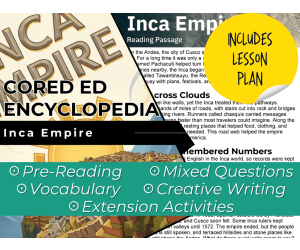
Inca Empire Reading Comprehension Passage - Cored Ed Encyclopedia
ELA, Reading Comprehension, Reading, History, Social Studies, Science, Geography, Technology, Pre-Reading, Language Development, Grade 2, 3, 4, 5, Worksheets & Printables, Worksheets, Teacher Tools, Centers, Activities, Writing Prompts, Assessments, Quizzes and Tests, Quizzes, Lesson Plans
This Inca Empire reading comprehension with lesson plan includes: Visualization (on the front cover) Start your lesson by taking a minute to think and share something about the topic. Read the script aloud (slowly), perhaps prepare some music or sound effects. Student close their eyes and let their imaginations wander. Students open their eyes, read the question aloud and give them a few minutes to complete. Ask a few students to share or keep answers until the end to compare with what they learn in the passage. Quick pause—thousands of Cored Education products are included with your TeachSimple membership. Download links and encyclopedia index available here. Pre-Reading Trivia Students will write down one thing they already know about the subject and then read five more facts and discuss. These facts are fun, and the students will enjoy learning about the subject before reading more. Give 1 minute for students to write what they already know (no pressure—best guess is fine). Read the five facts together. After each fact, do ask a student for their opinion, was it surprising? Set a purpose by asking students to highlight/underline one fact they want to learn more about during the reading. Reading Passage The text is a high-interest reading passage with set paragraphs, roughly three to four paragraphs long. It contains a variety of themes about the topic, anywhere from history to technology. The passage is between 250 and 350 words in length. First, ask students to look at the headings and see what they’ll learn about today. What do they know about the topic/heading? First read options: Teacher read-aloud (best for support). Partner reading (paragraph by paragraph). While reading, students underline important details, and vocabulary words they think may come up in the questions section. Mixed Questions The first question page contains four multiple-choice questions, each with a choice of four answers, and three written response questions that require a sentence or two from the student. Students complete the mcqs first independently, then review quickly as a class. For the 3 written responses, try to get students giving the answer with some form of evidence: “I think ___ because the text says ___.” If students get stuck, send them back to check the passage. Vocabulary Questions Practice seven key words from the text in this section across two activities. First section is scrambled words where students will unscramble three words given a clue for each. The second section is a word to meaning matching activity. Before starting, have some students read out words they underlined in the passage. Ask students to say the word and read aloud the sentence(s) around each word. Ask students to do scrambled words and the matching exercise in pairs then go through answers as a class. For the scrambled spelling task, get four pairs to come up to the board and write the words for extra practice with the other student reading out the clue. For the matching task, prompt students to give full sentences: “I matched ___ with ___ because ___.” Creative Writing In this question, the student will be required to write a five to eight sentence paragraph on a question related to the topic. Before starting, ask students write down 3 key ideas they are going to include in their piece. Ask students for ideas to share around the class to help those struggling. Pro writing expectations: 5–8 sentences At least 2 facts or details from the passage At least 2 vocabulary words from the previous page Students read their paragraphs while classmates listen for facts and vocabulary words. Extension Activities This page is optional for fast finishers or to take home. There are several activities, each one requiring a different skill. Do some, do none, do all, completely optional - but you will feel reassured knowing every possibility is planned for. Includes summary writting question and additional facts. Answer Key There are answers for the multiple-choice questions, written response questions have sample answers, vocabulary answers and if there is a summary question then a sample summary will be provided as well. Lesson Plan Included Customized lesson plan for this lesson is included. Lesson Snapshot Title: Inca Empire Genre: Nonfiction (informational passage) Subject: Social Studies (History) / Reading (Informational Text) Primary Topic: Cusco, roads, quipu records, terraces, legacy Estimated Guided Reading Level (A–Z): S What This Lesson Teaches Best How Cusco grew from a small kingdom into a larger Inca state in the 1400s under a leader named Pachacuti, and how the state was called Tawantinsuyu (the Realm of the Four Parts). How Inca engineers built a wide road system with stairs cut into rock and bridges, plus storehouses and resting places that helped the empire spread across western South America. How the Inca kept records without an English-like alphabet by using a quipu (cords with knots and colors for counts and notes). How terraces were used on hillsides to hold soil and water for crops like potatoes and corn, and how work was organized by the state as a kind of tax. How the empire ended after conflict and Spanish conquest, while people and culture continued (Quechua still spoken; terraces and stone places remain). Learning Goals Describe how Cusco changed in the 1400s and name the Inca state described in the passage. Explain how roads, bridges, and storehouses helped the Inca move messages, supplies, and armies. Explain what a quipu is and what it could record, based on the text. Describe what terraces are used for and how they helped farming on hillsides. Identify what happened in the 1500s that led to the end of the empire and one way Inca life continued afterward. Key Vocabulary From the Text Tawantinsuyu — the Inca state called the Realm of the Four Parts. chasquis — runners who carried messages from stop to stop. quipu — cords with knots and colors for records. terraces — flat steps that hold soil and water. storehouses — places along routes that kept needed supplies. FULL CATALOG OF DOWNLOAD LINKS AND ENCYCLOPEDIA INDEX HERE
Author Cored Education
Rating
Tags Vocabulary, Reading Comprehension, Reading Passages, Lesson Plans, Ela Lesson Plans, Reading Comprehension Lesson Plans, Pre-reading, History, Social Studies Lesson Plans, Geography

Critical Thinking Gr. 5-8
ELA, Strategies, Grade 5, 6, 7, 8, Teacher Tools, Lesson Plans
Critical Thinking Gr. 5-8: An Invaluable Teaching Resource This teaching resource is specially designed for students from grades 5 to 8. It aims to equip them with essential critical thinking skills that promote academic success and lifelong learning. This tool transcends mere comprehension, pushing learners for more profound interaction with their knowledge. Critical Thinking Skills and Independence The resource starts by introducing the crux of critical thinking skills. It highlights their significance in problem-solving tasks. Students are taught the value of being independent thinkers. Fostering individuality is highlighted as a way to make students stand out within a group. Develop Organization Techniques The material provides lessons on developing effective organization techniques that help students manage their academic obligations seamlessly. Additionally, it helps differentiate facts from opinions, paving the way towards improved inference-making and insightful interpretations. Foresight Development Further refining its focus, this tool also educates on developing foresight - equipping learners not only with meticulous planning skills but anticipatory abilities as well. Plus' : Pupils get exposure to typical questions asked by adept critical thinkers - thereby enriching their problem-solving capabilities. The rationale behind these elaborate discussions aligns meticulously with state-specific educational standards while acknowledging Bloom's Taxonomy renowned for its detailed attention to higher-order cognitive objectives within education spheres. Supporting Materials Included: Reproducible writing tasks Puzzles including word search exercises and crosswords comprehension quizzes equipped with answer keys. Finding its home under the 'Strategies' subcategory in the 'Lesson Plans in Language Arts' section, Critical Thinking Gr. 5-8 ensures constructive alignment in content teaching — making it functional for whole group lessons, focused small group discussions or insightful homework assignments.
Author Classroom Complete Press
Tags PDF
Pirate Fun Curriculum Pack
Creative Arts, Art, Social Studies, ELA, Math, Early Math, Numbers, Writing, Handwriting, Kindergarten, Lesson Plans, Teacher Tools
If your students are studying pirates or are about to begin an imagination unit, I have just the resource to provide you with everything you need and more! This is a Pirate Fun Curriculum Pack complete with an abundance of printable resources and engaging activities for students to complete. This curriculum was designed for your preschool students. The curriculum goal is to foster imagination and creativity. The vocabulary that students will focus on is ship, pirate, parrot, ocean, masts, waves, anchor, and jolly rancher. This curriculum will come with letters of the week (P and R) and colors of the week (black, white, and red). This curriculum pack includes: --Sensory Table Ideas --Art Activities --Cooking Experience --Community Time --Math Activities --Home/School Connection Ideas --Science Table Enrichments --Science Concepts/Activities --Prop Box Ideas/Dramatic Play Enrichments --Movement and Motor --Playground/Walk Activities --Transition/Waiting Ideas --Block Area Enrichments --Flannel Board --Teacher Made Enrichment Ideas --Field Trip Ideas --Supplemental Learning Ideas/Activities At the start of this pack, you will receive a list of supplies needed for activities and projects. The worksheets, activities, and tasks included in this pack are intended to be completed in a variety of formats – whole group, small group, and independent work. I hope you enjoy! You can find more resources at my storefront here: https://teachsimple.com/contributor/learning-foundations Here are other similar resources for you to enjoy: https://teachsimple.com/product/gingerbread-man-curriculum-pack https://teachsimple.com/product/jungle-love-curriculum-pack https://teachsimple.com/product/friendship-curriculum-pack https://teachsimple.com/product/kings-queens-and-dragons-curriculum-pack https://teachsimple.com/product/fire-safety-curriculum-pack
Author Learning Foundations
Tags Pirates Fun, Preschool Curriculum, Vocabulary, Colors Of The Week, Letter Of The Week, Spelling Activity, Sensory Table, Counting, Treasure Hunt
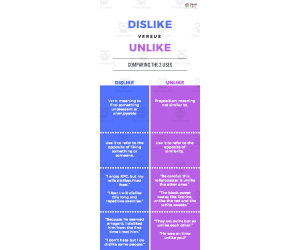
Dislike vs. Unlike | Pre-Intermediate Lesson Plan
ELA, Grammar, Grade 8, 9, 10, 11, 12, Lesson Plans, Teacher Tools
Dislike vs. Unlike Pre-Intermediate Lesson Plan This pre-intermediate English grammar lesson plan helps students learn the difference between "dislike" and "unlike" and when to use each word appropriately. The informative packet begins by clearly explaining the definitions and uses of these commonly confused words. Students then apply their understanding by completing targeted exercises assessing their comprehension and grammar skills. This versatile resource can be used for whole-group grammar instruction, small group remediation, or as a homework assignment for individual practice. Implement digitally or print the engaging worksheet. An answer key is included, making this lesson plan a teacher-friendly resource for promoting student grammar growth. This lesson will show us how to use dislike to show that you don't like something and unlike to emphasise the opposite of similar to. 3 PDFs with 3 ready to print pages. Digital Compatibility & Reflective Feedback A noteworthy feature is its integration with Google Apps that injects digital vibrance into traditional classroom practices. Additionally, keeping the importance of feedback in mind during learning progressions - an answer key provision allows immediate reflection. A solution crafted by teachers themselves - The It's vs Its | Beginner Lesson Plan correlates seamlessly within any curriculum focusing on developing strong foundational knowledge in Language Art amongst learners.
Author TEAM TEFL
Tags Grammar Lesson, Language Arts, Verbs, Prepositions, ESL
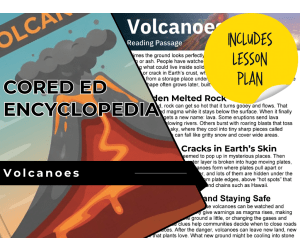
Volcanoes Reading Comprehension Passage - Cored Ed Encyclopedia
ELA, Language Development, Reading Comprehension, Reading, Pre-Reading, Earth Sciences, Earth and Environmental Sciences, Science, Geography, Social Studies, Grade 2, 3, 4, 5, Worksheets & Printables, Worksheets, Teacher Tools, Centers, Activities, Writing Prompts, Assessments, Quizzes and Tests, Quizzes, Lesson Plans
This volcanoes reading comprehension with lesson plan includes: Visualization (on the front cover) Start your lesson by taking a minute to think and share something about the topic. Read the script aloud (slowly), perhaps prepare some music or sound effects. Student close their eyes and let their imaginations wander. Students open their eyes, read the question aloud and give them a few minutes to complete. Ask a few students to share or keep answers until the end to compare with what they learn in the passage. Quick pause—thousands of Cored Education products are included with your TeachSimple membership. Download links and encyclopedia index available here. Pre-Reading Trivia Students will write down one thing they already know about the subject and then read five more facts and discuss. These facts are fun, and the students will enjoy learning about the subject before reading more. Give 1 minute for students to write what they already know (no pressure—best guess is fine). Read the five facts together. After each fact, do ask a student for their opinion, was it surprising? Set a purpose by asking students to highlight/underline one fact they want to learn more about during the reading. Reading Passage The text is a high-interest reading passage with set paragraphs, roughly three to four paragraphs long. It contains a variety of themes about the topic, anywhere from history to technology. The passage is between 250 and 350 words in length. First, ask students to look at the headings and see what they’ll learn about today. What do they know about the topic/heading? First read options: Teacher read-aloud (best for support). Partner reading (paragraph by paragraph). While reading, students underline important details, and vocabulary words they think may come up in the questions section. Mixed Questions The first question page contains four multiple-choice questions, each with a choice of four answers, and three written response questions that require a sentence or two from the student. Students complete the mcqs first independently, then review quickly as a class. For the 3 written responses, try to get students giving the answer with some form of evidence: “I think ___ because the text says ___.” If students get stuck, send them back to check the passage. Vocabulary Questions Practice seven key words from the text in this section across two activities. First section is scrambled words where students will unscramble three words given a clue for each. The second section is a word to meaning matching activity. Before starting, have some students read out words they underlined in the passage. Ask students to say the word and read aloud the sentence(s) around each word. Ask students to do scrambled words and the matching exercise in pairs then go through answers as a class. For the scrambled spelling task, get four pairs to come up to the board and write the words for extra practice with the other student reading out the clue. For the matching task, prompt students to give full sentences: “I matched ___ with ___ because ___.” Creative Writing In this question, the student will be required to write a five to eight sentence paragraph on a question related to the topic. Before starting, ask students write down 3 key ideas they are going to include in their piece. Ask students for ideas to share around the class to help those struggling. Pro writing expectations: 5–8 sentences At least 2 facts or details from the passage At least 2 vocabulary words from the previous page Students read their paragraphs while classmates listen for facts and vocabulary words. Extension Activities This page is optional for fast finishers or to take home. There are several activities, each one requiring a different skill. Do some, do none, do all, completely optional - but you will feel reassured knowing every possibility is planned for. Includes summary writting question. Answer Key There are answers for the multiple-choice questions, written response questions have sample answers, vocabulary answers and if there is a summary question then a sample summary will be provided as well. Lesson Plan Included Customized lesson plan for this lesson is included. Lesson Snapshot Title: Volcanoes Genre: Nonfiction (Informational text) Subject: Science (Earth Science) Primary Topic: What volcanoes are, how they form, and safety clues Estimated Guided Reading Level (A–Z): P What This Lesson Teaches Best What a volcano is (more than a “mountain”): Explains a volcano as an opening/vent or crack in Earth’s crust where hot melted rock, ash, and gases escape from an underground storage place called a magma chamber. Magma vs. lava: Defines melted rock as magma underground and lava once it reaches open air. How volcanic ash forms and spreads: Describes eruptions that toss bits of magma into the sky, cooling into tiny sharp pieces called volcanic ash that can fall like gritty snow and cover wide areas. Why volcanoes form where they do: Connects volcano locations to Earth’s outer layer being broken into huge moving plates (pulling apart or sliding under another), and also to “hot spots” that can form island chains such as Hawaii. Warning signs and community safety: Notes that rising magma can cause small earthquakes, ground swelling, or changes in gases and heat, and that these clues help communities decide when to close roads or move to safer places. Learning Goals Students will explain what the text says a volcano is and where the material comes from. Students will describe the difference between magma and lava using the passage’s definitions. Students will identify one way volcanic ash forms and describe what it is like when it falls. Students will describe how moving plates and hot spots help explain where volcanoes form. Students will list warning signs in the passage that may happen as magma rises. Students will explain how scientists’ observations can help communities stay safer. Key Vocabulary From the Text crust — Earth’s hard outer layer. magma — melted rock below Earth’s surface. lava — melted rock after it reaches open air. eruptions — times when a volcano sends material out. plates — huge moving pieces of Earth’s outer layer. FULL CATALOG OF DOWNLOAD LINKS AND ENCYCLOPEDIA INDEX HERE
Author Cored Education
Rating
Tags Vocabulary, Reading Comprehension, Reading Passages, Lesson Plans, Ela Lesson Plans, Reading Comprehension Lesson Plans, Pre-reading, Science Lesson Plans, Earth Science, Social Studies Lesson Plans

Homophones Supplementary Materials Grades 3-4 (PDF)
ELA, Language Development, ESL, Common Core, Resources for Teachers, Vocabulary, Grade 3, 4, Worksheets & Printables, Worksheets, Quizzes and Tests, Teacher Tools, Tests, Assessments, Activities, Lesson Plans
Homophones Supplementary Materials Note: This download DOES NOT include the tests themselves. You can still make use of these materials without them but they are recommended. Download in a format of your choice in the "Links" section below. Outline Ice Breaker (5-10 minutes) Engaging, interactive activity to introduce the lesson’s theme. Examples: Matching games, sentence races, charades, or storytelling challenges. Guided Practice (10-15 minutes) Teacher-led exercises to reinforce the concept. Examples: Sorting sentences by tense, sentence transformations, or fill-in-the-gap exercises. Group or Partner Task (15 minutes) Collaborative activity to practice the lesson’s focus in a fun and engaging way. Examples: Role-play, storytelling, sentence-building games, or small-group discussions. Independent Worksheet (15 minutes) Individual written activity to solidify understanding. Examples: Sentence corrections, verb conjugation drills, or tense identification exercises. Exit Task (5 minutes) Quick reflective activity to assess understanding before students leave. Examples: Writing a sentence using the target concept, identifying a tense, or explaining a rule. Links: Homophones include: sent, scent, cent for, four, fore wear, where, were raise, rays, raze vane, vein, vain they're, their, there two, too, to, than, then, van Google Docs Google Forms Google Slides PDF PPT Word FULL CATALOG OF DOWNLOAD LINKS HERE Grade 3/4 Links: Adjectives Google Docs Google Forms Google Slides PDF PPT Word Free Supplementary Materials Pack Adverbs Google Docs Google Forms Google Slides PDF PPT Word Free Supplementary Materials Pack Conjunctions Google Docs Google Forms Google Slides PDF PPT Word Free Supplementary Materials Pack Nouns Google Docs Google Forms Google Slides PDF PPT Word Free Supplementary Materials Pack Pronouns Google Docs Google Forms Google Slides PDF PPT Word Free Supplementary Materials Pack Verbs Google Docs Google Forms Google Slides PDF PPT Word Free Supplementary Materials Pack Sentence Structure Google Docs Google Forms Google Slides PDF PPT Word Free Supplementary Materials Pack Present Tense Google Docs Google Forms Google Slides PDF PPT Word Free Supplementary Materials Pack Past Tense Google Docs Google Forms Google Slides PDF PPT Word Free Supplementary Materials Pack Future Tense Google Docs Google Forms Google Slides PDF PPT Word Free Supplementary Materials Pack Context Clues Google Docs Google Forms Google Slides PDF PPT Word Free Supplementary Materials Pack Defining Words Google Docs Google Forms Google Slides PDF PPT Word Free Supplementary Materials Pack Fill the Blanks Google Docs Google Forms Google Slides PDF PPT Word Free Supplementary Materials Pack Homophones Google Docs Google Forms Google Slides PDF PPT Word Free Supplementary Materials Pack Synonyms Google Docs Google Forms Google Slides PDF PPT Word Free Supplementary Materials Pack ELA Review Questions Overview Questions have three answer choices. There are a handful of pictures on each test for aesthetic purposes, as well as a review sheet covering most of the topics covered in the product. Introduction or Example Sheet Each topic will include an introduction or example sheet to go through first with your students. Full Answer Keys Full answer keys and sample responses are provided so no matter how busy you are, you know you're covered! In the Supplementary Pack Interactive Ice Breakers: Fun, hands-on activities that get students thinking about adjectives right from the start. Guided Practice: Teacher-led exercises that reinforce the day’s lesson, ensuring students can confidently identify and use adjectives. Group and Partner Tasks: Collaborative activities that allow students to work together to solve problems, categorize adjectives, and create descriptive sentences. Independent Worksheets: Structured worksheets that provide individual practice and help solidify understanding of key concepts. Exit Tasks: Quick, reflective activities at the end of each lesson that assess understanding and encourage students to apply what they’ve learned. For similar downloads and other frees, do check out Cored Group on TeachSimple.
Author Cored Education
Tags Elementary, Answers, Ccss, Common Core, Tests, Test Prep, Assessment, Grade 3, Grade 4, Lesson Plan

1st Grade Unit R - Reading Street Stories Set
ELA, Reading, Grade 1, Lesson Plans, Teacher Tools
The 1st Grade Unit R Reading Street Stories Set provides six one-page stories for educators to use with students during Reading Street instruction. The stories correspond to the six weeks in Unit R of the 1st grade Reading Street curriculum. These engaging stories expose early elementary students to literacy concepts and high-frequency vocabulary words. Teachers can implement the stories in various ways - as whole group readings, small group instruction, or as printable take-home texts for students to read independently. The resources also include a list of high-frequency words from each story printed at the bottom of the page for students to practice. The 1st Grade Unit R Reading Street Stories Set offers a supplemental reading resource for 1st grade reading teachers seeking additional texts aligned to their Reading Street curriculum. The practical printables allow flexible implementation methods across different instructional contexts.
Author Sarah Sorensen
Tags Reading Street, Curriculum, Short Stories, Literacy Center, Homework

The Adventures of Tom Sawyer: Exploring Literature Teaching Unit
ELA, Literature, Grade 3, 4, 5, 6, Teacher Tools, Lesson Plans
Exploring Literature is a complete teaching unit designed to give you everything needed to help students understand and appreciate fine literature. This exciting approach includes classroom-tested activities sure to save you hours of valuable preparation time.
Author Classroom Complete Press
Tags The Adventures Of Tom Sawyer, Teacher Unit, Reading Comprehension, Lesson Plan, Literature, The Adventures Of Tom Sawyer Lesson Plans Middle School

Community Helpers Curriculum Pack
Creative Arts, Art, Social Studies, ELA, Math, Early Math, Science, Basic Science, Language Development, Vocabulary, Kindergarten, Lesson Plans, Teacher Tools
If your students are studying community helpers or are about to begin a careers unit, I have just the resource to provide you with everything you need and more! This is a Community Helpers Curriculum Pack complete with an abundance of printable resources and engaging activities for students to complete. This curriculum was designed for your preschool students. The curriculum goal is to expand upon the knowledge children possess about jobs, careers, and the world around them, and to promote optimism about their future and the many diverse opportunities available to them. The vocabulary that students will focus on is occupation, retail, vocation, college, training, career, paycheck, income, schedule, uniform, business and job. This curriculum will come with a color of the week (purple) and a letter of the week (W). This curriculum pack includes: --Sensory Table Ideas --Art Activities --Cooking Experience --Community Time --Math Activities --Home/School Connection Ideas --Science Table Enrichments --Science Concepts/Activities --Prop Box Ideas/Dramatic Play Enrichments --Movement and Motor --Playground/Walk Activities --Transition/Waiting Ideas --Block Area Enrichments --Flannel Board --Teacher Made Enrichment Ideas --Field Trip Ideas --Supplemental Learning Ideas/Activities At the start of this pack, you will receive a list of supplies needed for activities and projects. The worksheets, activities, and tasks included in this pack are intended to be completed in a variety of formats – whole group, small group, and independent work. I hope you enjoy!
Author Learning Foundations
Tags Learning Foundations, Community Helpers, Social Studies Curriculum, Sensory Table, Art Activities, Color Of The Week, Cross-curricular, Literacy

All Summer in a Day: Full Lesson Plan w/ PowerPoints & Graphic Organizers
ELA, Reading, Grade 5, 6, 7, 8, 9, 10, 11, 12, Lesson Plans, Teacher Tools
Bring Ray Bradbury's classic sci-fi story "All Summer in a Day" to life for your students with this comprehensive teaching resource. This packet includes a complete standards-aligned lesson plan to guide students through the text, analyzing the plot, characters, themes, and literary devices Bradbury employs. Engaging graphic organizers and PowerPoint presentations are included to support whole-class instruction, small group discussion, or independent analysis. Whether you're looking for a full two-week unit or just a quick text excerpt to teach imagery and mood, this resource has everything you need to immerse students in Bradbury's stark vision of life on stormy Venus. This versatile materials can flexibly support learning in grades 5-12.
Author Quality Teaching Products
Tags Reading Lesson Plan, Graphic Organizers, Fiction Text, Short Story, All Summer Day, Tone Of All Summer In A Day, Symbolism Graphic Organizer

Alaska State Unit Study (Capital, Bird, Flower, Flag, Animal)
ELA, Social Studies, Reading, Reading Comprehension, Language Development, Spelling, Writing, History, History: USA, Geography, Research, Grade 2, 3, 4, Lesson Plans, Teacher Tools
Alaska State Unit Study (Capital, Bird, Flower ,Flag ,Animal) An interactive teaching tool designed for educators who wish to enlighten their students about the State of Alaska. This low-prep 5-day unit study covers five significant emblems—capital city, bird species, indigenous flower type, official flag design and native fauna. It ensures easy facilitation with a comprehensively planned lesson plan format. This resource is adaptable for homework assignments, large group or small group sessions across multiple grade levels such as Grade 2-4. Broadly subtended subjects include Language Arts and Social Studies. Daily Activities and Learning Tools Curated videos that enhance visual learning Literature passages for reading enthusiasts A combination of research tasks with interactive notebook activities that make learning immersive Kinesthetic-friendly resources to encourage experiential learning among students by facilitating a practice-led approach If you are exploring topics on USA History or Geography then don't miss out on this tool as it provides in-depth knowledge of iconic Alaska symbols which will add value to your lessons. Additive Benefits: Serves great during writing lessons or social studies period due its compelling mix-and-match research report pages catering student's interest. Inclusion of teacher instructions along with student discussions guide makes teaching less complicated offering seamless experience. So go ahead confidently use this one-stop solution that caters not only informative content but doubles-up as exciting hands-on projects posing indispensable values throughout learner's journey into the state of Alaska's rich history and geography. its resources promises to keep learners engaged, foster academic growth and kindle an enduring love for learning! File Format: The Alaska State Unit Study resource comes in a PDF format, promising excellent functionality. The content lays emphasis on providing a color-filled educational experience through enjoyable coloring pages and other engaging activities.
Author Heather Huhman
Tags Alaska, State Unit Study, Capital City, Bird Species, Flower Type

Personal Information | Beginner Lesson Plan
ELA, Language Development, ESL, Grade 8, 9, 10, 11, 12, Teacher Tools, Lesson Plans
Beginner A1 ESL EFL TEFL lesson plan worksheet set for Personal information. Personal Information lesson plan for A1 Beginner ELL and ELA learners focusing on giving and receiving information for beginner English students. This TEFL resource is ready-to-go with minimal prep necessary, encompassing a variety of materials ranging from flashcards to activities, along with conversation topics and writing drills. Formulated to enhance language proficiency, this engaging lesson plan addresses fundamental concepts and offers practical exercises to facilitate discussions about giving and receiving information in formal and informal scenarios. Focusing on areas such as giving and asking for names, dates of birth, address, phone numbers and work titles, our lesson plan empowers ESL learners with the knowledge and confidence to communicate effectively in situations where you have to inform someone about your personal details. Components of this lesson plan include: Flash cards A warm-up activity Main usage exploration Construction details Rules, along with any exceptions Illustrative examples Two closed exercises One open exercise Listening exercise Revision exercise Writing exercises Chatterbox, a recurring feature in our course books encouraging conversation Activity , such as a game, quiz, puzzle, etc., to conclude the class The lesson plan is available in PDF with 30+ ready to print pages and one digital access file. One MP3 file included. A part of it is on Google Apps. The answer key is also included for reference.
Author TEAM TEFL
Tags ESL Exercises, Vocabulary, True Or False, Antonyms, Role Play
Guided Reading Activities and Lesson Plans Nonfiction Set 1
ELA, Reading, Reading Comprehension, Common Core, ESL, Language Development, Pre-Reading, Vocabulary, Resources for Teachers, Grade 6, 7, Worksheets & Printables, Worksheets, Lesson Plans, Teacher Tools
Guided Reading Activities with Lesson Plans Nonfiction Set 1 Note: This download DOES NOT include the passages themselves. If you have not already done so, download in a format of your choice in the "reading links" section below. Overview The perfect companion materials for Cored Education reading comprehension downloads. Each lesson is centered around a particular theme or story, with accompanying activities designed to deepen understanding and engage students. The lesson plans include pre-reading questions to stimulate thought, reading activities to keep students engaged, vocabulary exercises to build language skills, and creative writing prompts to foster imagination. Additionally, there are discussion topics that encourage students to think critically and reflect on the themes presented in the text. Includes Guided Reading Materials For: 1.American Bison 2.Brown Bears 3.Elephant Seals 4.Visayan Pigs 5.Seahorses 6.Pandas 7.Wolves 8.Blue Jays 9.Iceland 10.Yogurt 11.Karate 12.Clean Air Reading Links: This is the guided reading materials version and DOES NOT include the passages themselves. The passages related to this download are available here in GOOGLE Docs, GOOGLE Forms, GOOGLE Slides. PDF, PPT, WORD. Google Docs Google Forms Google Slides PDF PPT Word FULL CATALOG OF DOWNLOAD LINKS HERE Grade 6/7 Links Fiction Set 1 Google Docs Google Forms Google Slides PDF PPT Word Guided Reading Materials Fiction Set 2 Google Docs Google Forms Google Slides PDF PPT Word Guided Reading Materials Nonfiction Set 1 Google Docs Google Forms Google Slides PDF PPT Word Guided Reading Materials Nonfiction Set 2 Google Docs Google Forms Google Slides PDF PPT Word Guided Reading Materials Outline: Pre-reading Questions: These are designed to activate prior knowledge, stimulate curiosity, and encourage predictions about the story. They help set the stage for the reading and engage students from the start. Reading Activities: During the reading, students are prompted to focus on key elements such as character development, emotions, relationships, and the main message of the story. These activities guide students through the text and allow them to track changes in characters’ thoughts and feelings. Vocabulary Development: Each lesson introduces new words and clarifies their meanings through examples. The vocabulary section includes activities that help students apply the terms in context, reinforcing their understanding and expanding their vocabulary. Comprehension and Reflection: After reading, students are asked reflective questions about the text. These questions help assess their understanding and deepen their connection to the material by encouraging them to think critically about the story’s themes and characters. Creative Writing Prompts: These exercises encourage students to use their imagination and write creatively, often asking them to relate the story to their own experiences or to invent new scenarios based on the lesson’s theme. Discussion Topics: At the end of each lesson, discussion topics allow students to share their thoughts, consider different viewpoints, and engage in meaningful conversations. This encourages social learning and reinforces the themes of the lesson. Additional Activities: Some lessons include supplementary activities like role-plays or debates that help students apply what they've learned in a practical, hands-on way. These activities promote collaboration, problem-solving, and public speaking skills. For More Like This For similar downloads and other frees, do check out Cored Group on TeachSimple.
Author Cored Education
Tags Elementary, Reading, Comprehension, Vocabulary, Answers, Ccss, Guided Reading, Guided Reading Activity, Guided Reading Lesson Plans, Guided Reading Lesson Plan

Weather Curriculum Pack
ELA, Writing, Handwriting, Science, Earth and Environmental Sciences, Environmental Science, Math, Early Math, Kindergarten, Lesson Plans, Teacher Tools
If your students are studying seasons or are about to begin a nature unit, I have just the resource to provide you with everything you need and more! This is aWeather Curriculum Packcomplete with an abundance of printable resources and engaging activities for students to complete. This curriculum was designed for your preschool students. The curriculum goal is to heighten the awareness and working knowledge of the world around them and give children insight as to how weather impacts people, places and things – as well as daily life. The vocabulary that students will focus on ishumidity, seasons, temperature, degree, weatherman, prediction, forecast, and meteorologist. This curriculum will come with a letter of the week(U) and a color of the week (yellow). This curriculum pack includes: --Sensory Table Ideas --Art Activities --Cooking Experience --Community Time --Math Activities --Home/School Connection Ideas --Science Table Enrichments --Science Concepts/Activities --Prop Box Ideas/Dramatic Play Enrichments --Movement and Motor --Playground/Walk Activities --Transition/Waiting Ideas --Block Area Enrichments --Flannel Board --Teacher Made Enrichment Ideas --Field Trip Ideas --Supplemental Learning Ideas/Activities At the start of this pack, you will receive a list of supplies needed for activities and projects. The worksheets, activities, and tasks included in this pack are intended to be completed in a variety of formats – whole group, small group, and independent work. I hope you enjoy! Take A Look At More Of My Best Sellers: The Great Outdoors Curriculum Pack Holidays Around the World Curriculum Pack Fire Safety Curriculum Pack Our Feathered Friends Curriculum Pack Planting and Gardening Curriculum Pack Spiders and Bats Curriculum Pack Enjoy More From My Store Here: https://teachsimple.com/contributor/learning-foundations
Author Learning Foundations
Tags Weather Worksheets, Preschool Curriculum, Environment Unit, Color Of The Week, Transition Ideas, Graphing, Counting Math Game, Science Table

Walkie-Talkies Reading Comprehension Passage - Cored Ed Encyclopedia
ELA, Language Development, Reading Comprehension, Reading, Pre-Reading, Science, Social Studies, History, Technology, Physics, Grade 2, 3, 4, 5, Worksheets & Printables, Worksheets, Teacher Tools, Centers, Activities, Writing Prompts, Assessments, Quizzes and Tests, Quizzes, Lesson Plans
This walkie-talkies reading comprehension with lesson plan includes: Visualization (on the front cover) Start your lesson by taking a minute to think and share something about the topic. Read the script aloud (slowly), perhaps prepare some music or sound effects. Student close their eyes and let their imaginations wander. Students open their eyes, read the question aloud and give them a few minutes to complete. Ask a few students to share or keep answers until the end to compare with what they learn in the passage. Quick pause—thousands of Cored Education products are included with your TeachSimple membership. Download links and encyclopedia index available here. Pre-Reading Trivia Students will write down one thing they already know about the subject and then read five more facts and discuss. These facts are fun, and the students will enjoy learning about the subject before reading more. Give 1 minute for students to write what they already know (no pressure—best guess is fine). Read the five facts together. After each fact, do ask a student for their opinion, was it surprising? Set a purpose by asking students to highlight/underline one fact they want to learn more about during the reading. Reading Passage The text is a high-interest reading passage with set paragraphs, roughly three to four paragraphs long. It contains a variety of themes about the topic, anywhere from history to technology. The passage is between 250 and 350 words in length. First, ask students to look at the headings and see what they’ll learn about today. What do they know about the topic/heading? First read options: Teacher read-aloud (best for support). Partner reading (paragraph by paragraph). While reading, students underline important details, and vocabulary words they think may come up in the questions section. Mixed Questions The first question page contains four multiple-choice questions, each with a choice of four answers, and three written response questions that require a sentence or two from the student. Students complete the mcqs first independently, then review quickly as a class. For the 3 written responses, try to get students giving the answer with some form of evidence: “I think ___ because the text says ___.” If students get stuck, send them back to check the passage. Vocabulary Questions Practice seven key words from the text in this section across two activities. First section is scrambled words where students will unscramble three words given a clue for each. The second section is a word to meaning matching activity. Before starting, have some students read out words they underlined in the passage. Ask students to say the word and read aloud the sentence(s) around each word. Ask students to do scrambled words and the matching exercise in pairs then go through answers as a class. For the scrambled spelling task, get four pairs to come up to the board and write the words for extra practice with the other student reading out the clue. For the matching task, prompt students to give full sentences: “I matched ___ with ___ because ___.” Creative Writing In this question, the student will be required to write a five to eight sentence paragraph on a question related to the topic. Before starting, ask students write down 3 key ideas they are going to include in their piece. Ask students for ideas to share around the class to help those struggling. Pro writing expectations: 5–8 sentences At least 2 facts or details from the passage At least 2 vocabulary words from the previous page Students read their paragraphs while classmates listen for facts and vocabulary words. Extension Activities This page is optional for fast finishers or to take home. There are several activities, each one requiring a different skill. Do some, do none, do all, completely optional - but you will feel reassured knowing every possibility is planned for. Includes summary writting question. Answer Key There are answers for the multiple-choice questions, written response questions have sample answers, vocabulary answers and if there is a summary question then a sample summary will be provided as well. Lesson Plan Included Customized lesson plan for this lesson is included. Lesson Snapshot Title: Walkie-Talkies Genre: Nonfiction (informational text) Subject: Science & Technology (Informational Reading) Primary Topic: How walkie-talkies work, history, and clear communication Estimated Guided Reading Level (A–Z): P What This Lesson Teaches Best Explains how a walkie-talkie works as a handheld two-way radio that switches from listening to sending when the talk button is pressed. Builds understanding of shared communication rules , including that only one radio can transmit at a time and messages stay “short and clear.” Introduces a simple history of portable radios , from early military use (including a “packset” and the Motorola SCR-300) to later helpers on job sites. Highlights how word choice matters when people share the air, connecting clear/kind words to teamwork and getting things done. Uses comparisons and descriptive language (e.g., “scratchy,” “like a distant whisper,” “lighter than a deck of cards”) to help readers picture sound and size. Learning Goals Students will describe what a walkie-talkie is and what it can do (send and receive messages). Students will explain what happens when the talk button is pressed and why the radio listens most of the time. Students will identify at least two ways early walkie-talkies differed from many walkie-talkies today. Students will describe why teams keep messages short and clear when using walkie-talkies. Students will use evidence from the text to explain what “over” means in walkie-talkie talk. Key Vocabulary From the Text antenna — the part that sticks up to help signals travel. channel — a shared path where people hear the same messages. portable — easy to carry from place to place. transmit — send a message through the air. rugged — strong and built to last. FULL CATALOG OF DOWNLOAD LINKS AND ENCYCLOPEDIA INDEX HERE
Author Cored Education
Rating
Tags Vocabulary, Reading Comprehension, Reading Passages, Lesson Plans, Ela Lesson Plans, Reading Comprehension Lesson Plans, Pre-reading, Science Lesson Plans, History Lesson Plans, Technology

Catch a Cold | English Conversations Video Lesson
ELA, Language Development, ESL, Not Grade Specific, Lesson Plans, Teacher Tools
Catch a Cold | English Conversations Video Lesson A delightful learning tool, the Catch a Cold | English Conversations Video Lesson, enables educators to cover everyday English conversations in an interesting manner. This animated video lesson is built around the engaging theme of 'catching a cold' and spans five minutes. Key Features: Format: Rendered in MP4 format with enjoyable animation for immersion learning. Duration: Short five-minute stimulus that easily fits into any curriculum plan. Purpose: Beneficial for ESL training; provides comprehensible dialogues and scenarios for non-native speakers. Versatility: Suitable for whole group learning, small interactive sessions, individual assignments or digital classrooms. Potential Users: Homeschoolers, special education teachers and online tutors can use it effectively. . In-depth Learning through Creative Methods The lesson not only upholds conventional language instruction specificity of the ESL curriculum but also facilitates natural conversational instinct development. It helps to build foundational skills like attentiveness to auditory cues denoting tone and intentions which are often missed in textbook readings. In Summary: Unparalleled Versatility & Rich Engagement : . The Catch a Cold | English Conversations Video Lesson offers itself as an extremely beneficial asset in every educator's teaching toolkit making the learning of English conversations an engaging and comprehensive experience.
Author Educational Voice
Tags English Conversations, ESL, Animated Video, Dialogues, Everyday English

It's vs. Its | Beginner Lesson Plan
ELA, Grammar, Grade 1, 2, 3, 4, 5, 8, 9, 10, 11, 12, Teacher Tools, Lesson Plans
It's vs. Its | Beginner Worksheet The "It's vs. Its | Beginner Lesson Plan" provides an essential resource for teaching students effective grammar skills, particularly, the often confused 'It's' and 'Its'. This resource is presented as a fully structured lesson plan accompanied by worksheet sets, purposed for A1 Beginner English ESL ELA It includes three PDFs – two print-and-use pages brimming with engaging content and an accessible digital copy adding to its adaptability. An Enriching Language Arts Resource Beyond being a regular lesson plan, this resource takes kids on a rewarding interactive journey in Language Arts. The worksheets serve as practical arenas where students can test out their learning about 'It's' and 'Its', while evaluating their own understanding or working collaboratively. Suitable for educators conducting group activities or individual sessions or homeschooling parents wanting reliable resources for at-home lessons – it has been designed to fluently adapt to varied learning environments. Inculcating the competency of correctly using ‘It’s’ vs ‘Its’. Fostering enhanced overall grammar skills which uplift their competency in Language Arts. Digital Compatibility & Reflective Feedback A noteworthy feature is its integration with Google Apps that injects digital vibrance into traditional classroom practices. Additionally, keeping the importance of feedback in mind during learning progressions - an answer key provision allows immediate reflection. A solution crafted by teachers themselves - The It's vs Its | Beginner Lesson Plan correlates seamlessly within any curriculum focusing on developing strong foundational knowledge in Language Art amongst learners.
Author TEAM TEFL
Tags Grammar Skills, Language Arts, Lesson Plan, Worksheet Set, Interactive Learning
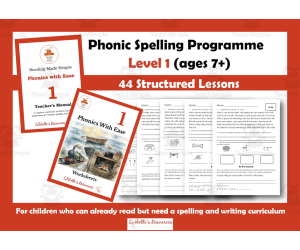
Phonic Spelling Programme Level 1 Ages 7+
Special Resources, ELA, Special Education Needs (SEN), Language Development, Phonics, Reading, Spelling, Preschool, Grade 1, 2, 3, Lesson Plans, Teacher Tools, Outlines, Worksheets & Printables, Flashcards, Workbooks
This is a Phonic spelling programme. Not only will it teach a child to spell, but also to write. Just add a good handwriting programme. The spelling programme can be used with all ages from 5 to 99, however, if used with a young learner I strongly advise using the programme to teach both reading and spelling at the same time. See the website for more information and resources to teach young children. The spelling programme can be used: with children who have learnt to read, but need a spelling/writing programme with children who have tried another phonic programme and not made much progress with reading and/or spelling/writing with a special needs child who needs a very structured approach to learning by home educators by parents wishing to help their child at home About the programme The programme is very flexible and can be made to fit the child, rather than the child to fit the programme. Being highly structured, each new lesson builds on the one before, constantly revising the previously taught material The spelling programme will take 41 weeks to teach. One new sound is taught each week. What is included? The teacher's manual with full lesson plans and helpful teaching tips A list of the keywords for each lesson with the phonic sound highlighted - for practice and revision 39 spelling worksheets The Reading Made Simple Phonic flashcards The Odd Word flashcards About the worksheets The worksheets use time-honoured exercises to help pupils to become familiar with the new sound and revise previously taught ones. They include such exercises as tracking the new sound in words, proofreading as well as comprehension questions. Children generally find them fun because they are so easy due to the way learning is structured throughout the programme. More information If you would like more information about the spelling programme, then please visit the Reading Made Simple website. The same programme and set of worksheets can also be used to help an older child read, one who has some phonic knowledge but needs the gaps filled in a systematic manner.
Author Lilibette's Resources
Rating
Tags Phonics, Spelling, Phonic Intervention, Reading Made Simple, Reading, Special Needs, Worksheets, Learning To Spell, Learning To Write
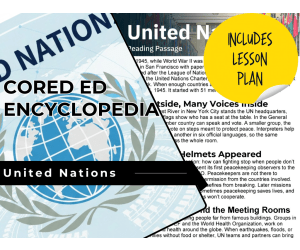
United Nations Reading Comprehension Passage - Cored Ed Encyclopedia
ELA, Language Development, Reading Comprehension, Reading, Pre-Reading, Vocabulary, History, Social Studies, Government, Writing, Grade 2, 3, 4, 5, Worksheets & Printables, Worksheets, Teacher Tools, Centers, Activities, Writing Prompts, Assessments, Quizzes and Tests, Quizzes, Lesson Plans
This United Nations reading comprehension with lesson plan includes: Visualization (on the front cover) Start your lesson by taking a minute to think and share something about the topic. Read the script aloud (slowly), perhaps prepare some music or sound effects. Student close their eyes and let their imaginations wander. Students open their eyes, read the question aloud and give them a few minutes to complete. Ask a few students to share or keep answers until the end to compare with what they learn in the passage. Quick pause—thousands of Cored Education products are included with your TeachSimple membership. Download links and encyclopedia index available here. Pre-Reading Trivia Students will write down one thing they already know about the subject and then read five more facts and discuss. These facts are fun, and the students will enjoy learning about the subject before reading more. Give 1 minute for students to write what they already know (no pressure—best guess is fine). Read the five facts together. After each fact, do ask a student for their opinion, was it surprising? Set a purpose by asking students to highlight/underline one fact they want to learn more about during the reading. Reading Passage The text is a high-interest reading passage with set paragraphs, roughly three to four paragraphs long. It contains a variety of themes about the topic, anywhere from history to technology. The passage is between 250 and 350 words in length. First, ask students to look at the headings and see what they’ll learn about today. What do they know about the topic/heading? First read options: Teacher read-aloud (best for support). Partner reading (paragraph by paragraph). While reading, students underline important details, and vocabulary words they think may come up in the questions section. Mixed Questions The first question page contains four multiple-choice questions, each with a choice of four answers, and three written response questions that require a sentence or two from the student. Students complete the mcqs first independently, then review quickly as a class. For the 3 written responses, try to get students giving the answer with some form of evidence: “I think ___ because the text says ___.” If students get stuck, send them back to check the passage. Vocabulary Questions Practice seven key words from the text in this section across two activities. First section is scrambled words where students will unscramble three words given a clue for each. The second section is a word to meaning matching activity. Before starting, have some students read out words they underlined in the passage. Ask students to say the word and read aloud the sentence(s) around each word. Ask students to do scrambled words and the matching exercise in pairs then go through answers as a class. For the scrambled spelling task, get four pairs to come up to the board and write the words for extra practice with the other student reading out the clue. For the matching task, prompt students to give full sentences: “I matched ___ with ___ because ___.” Creative Writing In this question, the student will be required to write a five to eight sentence paragraph on a question related to the topic. Before starting, ask students write down 3 key ideas they are going to include in their piece. Ask students for ideas to share around the class to help those struggling. Pro writing expectations: 5–8 sentences At least 2 facts or details from the passage At least 2 vocabulary words from the previous page Students read their paragraphs while classmates listen for facts and vocabulary words. Extension Activities This page is optional for fast finishers or to take home. There are several activities, each one requiring a different skill. Do some, do none, do all, completely optional - but you will feel reassured knowing every possibility is planned for. Includes summary writting question. Answer Key There are answers for the multiple-choice questions, written response questions have sample answers, vocabulary answers and if there is a summary question then a sample summary will be provided as well. Lesson Plan Included Customized lesson plan for this lesson is included. Lesson Snapshot Title: United Nations Genre: Nonfiction (Informational text) Subject: Social Studies (Civics/Global Studies) Primary Topic: How the UN began and works for peace Estimated Guided Reading Level (A–Z): P What This Lesson Teaches Best Origins and purpose of the UN: Explains that delegates from 50 countries met in San Francisco in 1945 and signed the United Nations Charter, leading to the UN officially beginning on October 24, 1945. How countries work together in the UN: Describes the UN headquarters in New York City and how member countries speak and vote in the General Assembly, while a smaller group (the Security Council) votes on steps meant to protect peace. Peacekeeping basics: Introduces UN peacekeeping observers (UNTSO) and explains that peacekeepers watch, report, and help keep ceasefires from breaking (and are not there to conquer). Communication across languages: Shows why interpreters matter by explaining that leaders use interpreters in six official languages so the same message can travel across the room. UN help beyond meetings: Notes that UN groups like UNICEF and the World Health Organization work on children’s needs, health, and bringing supplies after earthquakes, floods, or wars. Learning Goals Students will identify key dates and events that led to the UN officially beginning in 1945. Students will describe how the General Assembly and the Security Council are different, using details from the text. Students will explain what the United Nations Charter is and what it was meant to help countries do. Students will summarize what peacekeepers do and why peacekeeping can be hard when countries won’t cooperate. Students will use context clues to determine the meaning of key words such as interpreters and ceasefires . Key Vocabulary From the Text delegates — people chosen to represent a country at a meeting. Charter — a written promise that explains a group’s goals. headquarters — the main building where an organization works. interpreters — people who change speech into another language. ceasefires — times when fighting stops for a while. FULL CATALOG OF DOWNLOAD LINKS AND ENCYCLOPEDIA INDEX HERE
Author Cored Education
Rating
Tags Vocabulary, Reading Comprehension, Reading Passages, Lesson Plans, Ela Lesson Plans, Reading Comprehension Lesson Plans, Pre-reading, Social Studies Lesson Plans, Social Studies, Government

SIXSPELL (JUNIOR) Gr. 4-6
ELA, Language Development, Spelling, Grade 4, 5, Teacher Tools, Lesson Plans
SIXSPELL (JUNIOR) Gr. 4-6 A comprehensive spelling program meticulously developed for students in Grade 4-6. A innovative fusion of pedagogical expertise and digital technology. User-Friendly Teaching Tools This product comprises 58 informative PDF pages. Each page represents an intricate understanding of modern educational research trends and time-tested practices. A Nuanced Approach to Education The main aspect separating Sixspell Junior from many typical resources is its adaptation to the student's world. It aligns words relevant to their interests, integrating learning outcomes— a nuanced approach toward language arts education! Fosters Integration Across Learning Areas Eases integration across subject areas without repeating word usage in different lessons or disciplines. Saves instructional time and promotes efficient education delivery - a tremendous value for educators planning curricula. Basis laid on sound-symbol relationships, holding relevance if students can read the prescribed words independently - personalized learning for each student's unique needs. Possibilities are Endless! No matter if you use it as part of your whole classroom instruction or in smaller focus groups, our solution adapts easily within your style. Effective even as homework assignments under some scenarios! Redefine traditional teaching methods with SIXSPELL (JUNIOR) Gr. 4-6 within your curriculum today! Encourage enthusiasm and proficiency among young learners through this intuitive design coupled with comprehensive content!
Author Classroom Complete Press
Tags Language Arts, Spelling Program, Spelling Words, Alphabetical Order, Spelling Activities

Story Squares for Grades 3-4: Multiple Learning Styles for Reading Comprehension
ELA, Reading, Reading Comprehension, Grade 3, 4, Teacher Tools, Lesson Plans
Story Squares for Grades 3-4: Multiple Learning Styles for Reading Comprehension Story Squares for Grades 3-4: Multiple Learning Styles for Reading Comprehension is a captivating teaching resource that metamorphoses reading comprehension into an interactive and exciting journey. This unique tool beautifully integrates Language Arts, Writing, Higher-Order Thinking, and Creative Arts methods. Exclusively crafted keeping third and fourth-grade students in mind who ready to explore deeper levels of reading and critical thinking; this product cultivates a bridge between text analysis and innovative responses. Its goal being to help students comprehend concepts effortlessly while still maintaining their curiosities. Complete with content specifically centered around six famous children's novels "Class President," "Charlotte’s Web," "How to Eat Fried Worms," “The Hundred Dress,” “Bunnicula,” and "The Whipping Boy.” This product accompanies each story with 20 activity alternatives that stimulate multiple learning styles. This resource goes beyond simply supplying lesson plans —it includes essential teacher hints aiding educators to enhance their approach during lessons based on best practices. An easy-to-comprehend rubric is provided – allowing teachers individually measure student work based on objective grading standards while promoting learner progression. Incorporated within the package you also find a glossary of terms - removing language arts instruction barriers by simplifying vocabulary-related doubts. Story Squares™ excels at adaptability— it can fit effortlessly into either large group formats or small focused groups urging collaborative learning efforts or one-on-one focuses respectively. It affirms itself when designated as homework—supplying chances for ongoing parental involvement in monitoring their child's educational progression. The resource file comes in a PDF format, ensuring effortless download on any device. In conclusion, Story Squares introduces innovation into your classrooms by implementing a novel yet highly-effective approach towards developing reading comprehension skills amongst learners.
Author Classroom Complete Press
Tags PDF
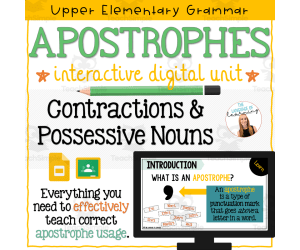
Digital Grammar Activities: Apostrophe Usage Interactive Unit
ELA, Grammar, Grade 4, 5, 6, 7, Lesson Plans, Teacher Tools
This resource is an Apostrophe Usage Interactive Unit. This unit is filled with digital grammar activities for students to engage with. This resource can be used as literacy centers , homework or in-class work. Just assign it to students' Google Classroom and they're ready to go! Within this unit, students will learn about apostrophes and the two ways to use apostrophes. There are practice slides for students to apply their knowledge!
Author The Language of Learning
Tags Contractions, Possessive Nouns, Digital Grammar, Apostrophes, Language Arts

Introduction to AI Agents – Simple Task Automation Worksheets
Science, Technology, Computer Science, Engineering, STEM, Resources for Teachers, Classroom Management, Community Building, Research, ELA, Homeschool Curriculum, Homeschool Templates, Grade 6, 7, 8, 9, 10, Worksheets & Printables, Writing Prompts, Worksheets, Word Searches, Dot To Dots, Workbooks, Teacher Tools, Lesson Plans, Quizzes and Tests, Tests
"AI Agents: An Introduction to Simple Automated Task Worksheets for Middle-Grade Students" consists of a total of 34 pages in one downloadable PDF file. In this workbook, students will learn about digital agents and task automation, and will gain insight into the basics of A.I. This workbook is ideally suited for STEM, computer science and technology education classes with no coding required. The agent-oriented design framework will be introduced to students as they learn how to break complex tasks down into components (sensors, logic processors, actuators). In doing so, students will also gain a greater understanding of how to decompose tasks, create algorithms, utilize loops, use branching paths and interact in multi-agent environments by completing ten exciting student worksheets that have a variety of scenarios (e.g., digital backpack organizer, community garden irrigation aid, library return kiosk, drone delivery, wildlife rescue, etc.). In addition to the ten worksheets, teachers will be able to use various templates, conceptual diagrams (automation cycle, feasibility filter, logic trees), comprehensive answer keys, and visual organization charts/projects for presentation and/or printing purposes. No prior coding skills will be required to participate in this activity; therefore, it is an excellent means to develop critical thinking, problem-solving, and technology literacy in this A.I. age. Reasons Schools & Families are Crazed for It : •Incredible hands-on activities and experiences with real-world examples create connections to complex ideas about AI. •No-preparation necessary for educators- All materials ready to go in a few minutes. •Future readiness through foundational skills e.g. computational thinking, logical reasoning & AI literacy. •Support for all students and challenging activities for advanced learners through differentiated formats. •Unbeatable value for 1 PDF filled with meaningful STEM experiences, the extent of which can provide anywhere from weeks to years of STEM aligned content and reflect the 21st century standards. Audience : Target Audience Grade Level This resource is formatted for grades of 5 to 8 specifically and is written/designed with middle school student ages using appropriate language, characteristics, and structure as developed by the cognitive scaffolding framework for middle school students. It is designed to be effective for: Grade 5 and 6 (introduction of automation concepts) Grade 7 and 8 (additional logic/concepts/logical branches/multitudes of agents) classrooms of various levels of ability, students identified as gifted,; students homeschooled; students participating in after school or summer STEM oriented programs. Copyright/Terms of Use: This Book represents a copyright owned by Syed Hammad Rizvi and is provided to you for personal use and for use only in one classroom. You are NOT PERMITTED to modify, redistribute, or sell any part of this resource (i.e. you are NOT PERMITTED to post it onto the internet where it will be publicly available to be found and downloaded). If you would like to share this resource with other educators, please purchase an additional license from Teachsimple. Thank you! This product is happily provided by Syed Hammad Rizvi
Author Creative Book Store
Rating
Tags AIAgents, TaskAutomation, DigitalAgents, AIForKids, IntroductionToAI, AIWorksheets, Ages10to14, 10to14YearsOld, MiddleSchoolAges, Grades5to8