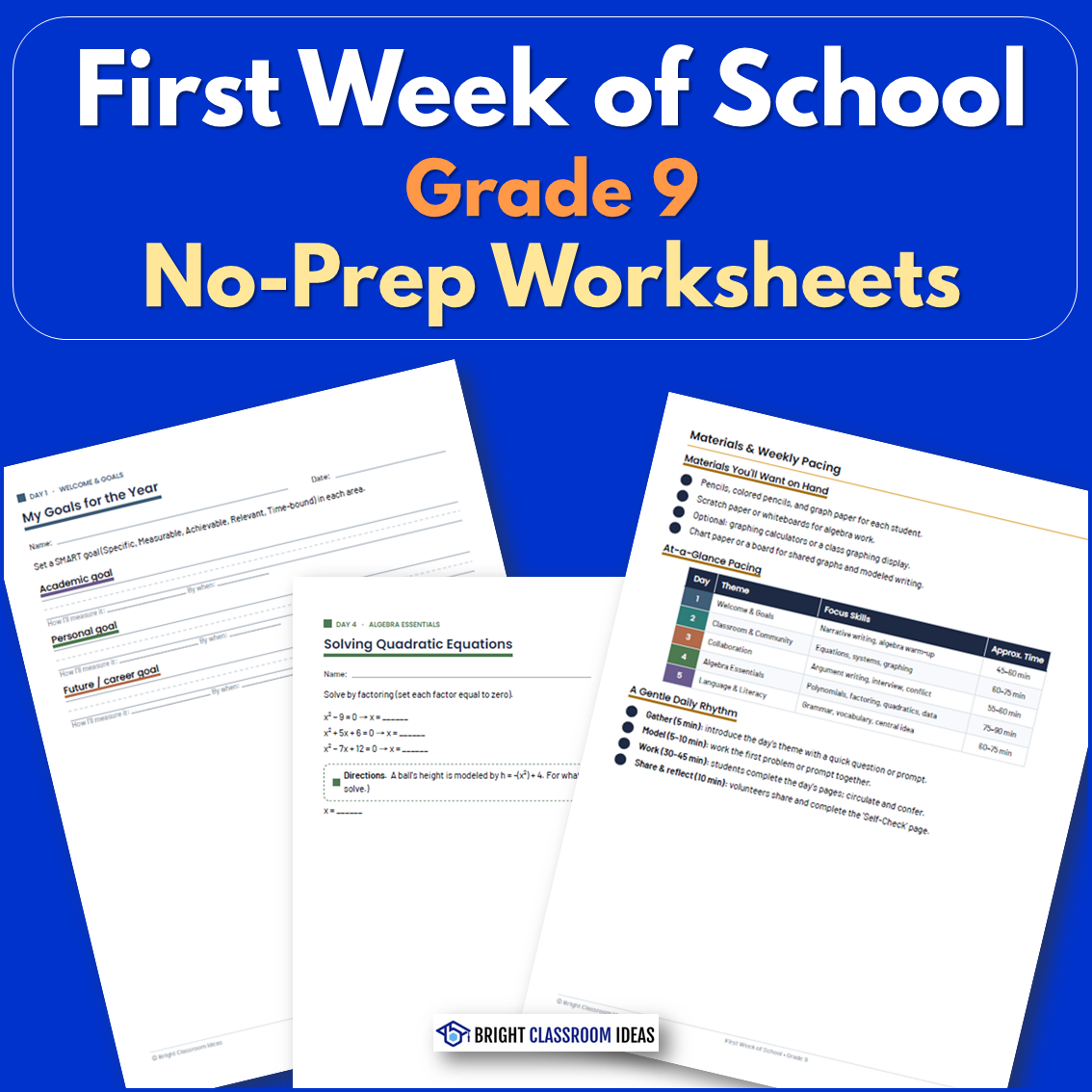
First Week of School Grade 9 | No-Prep Worksheets
A five-day, no-prep back-to-school packet for Grade 9 combining math and ELA activities to build classroom routines and community at the start of the school year.
Answers included


5,599 resources
Explore sub-categories
27 sub-categories · 5,599 resources
A five-day, no-prep back-to-school packet for Grade 9 combining math and ELA activities to build classroom routines and community at the start of the school year.
This is a great way to help your students improve their math skills.

Math notes-and-practice packet teaching how to identify characteristics of linear equations from graphs, addressing CCSS.MATH.CONTENT.8.EE.B.6 and 8.F.B.5.

Build addition fact fluency within 10 by evaluating whether addition equations are true or false.
Drill multiplication facts (1x through at least 13x tables) and the commutative/repeated-groups relationship, building toward word-problem application.
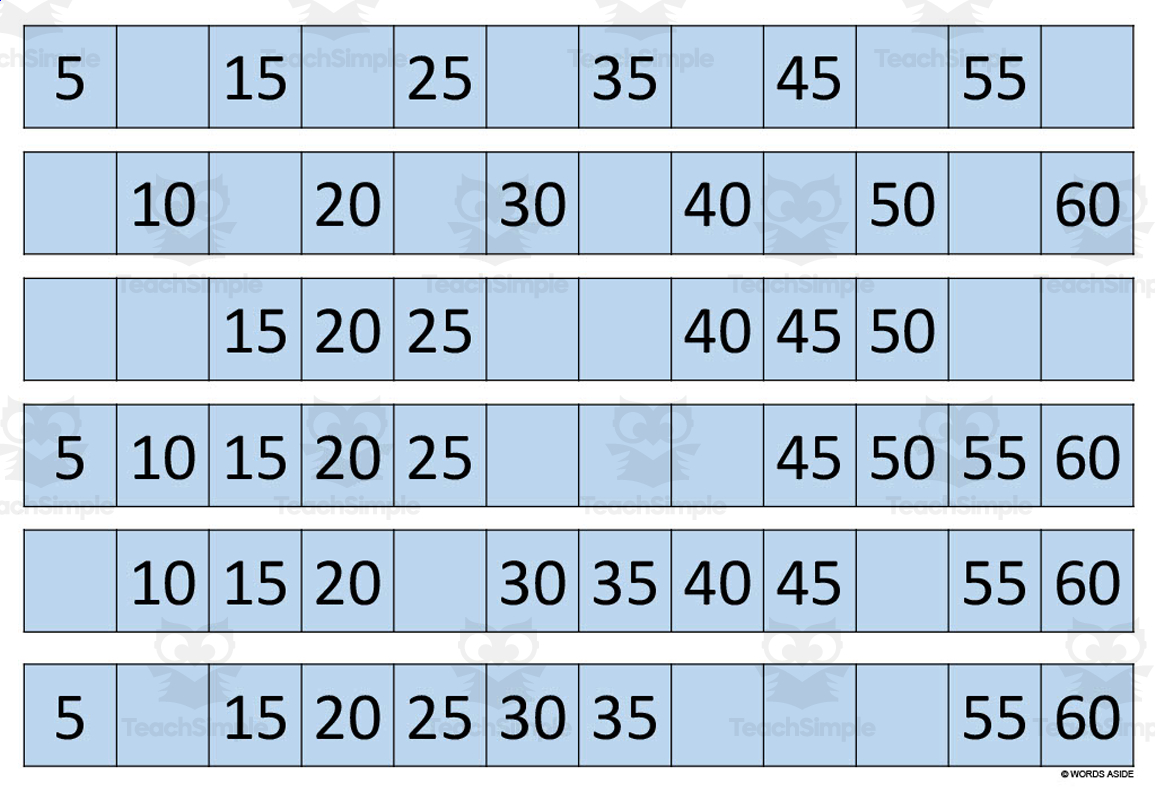
Practice sheet for reinforcing multiplication facts of 5 by filling in missing multiples on ruled strip lines (fill-in-the-blank skip-counting format).

A single worksheet giving practice completing number bonds (part-part-whole relationships) up to 10, using a bee theme.
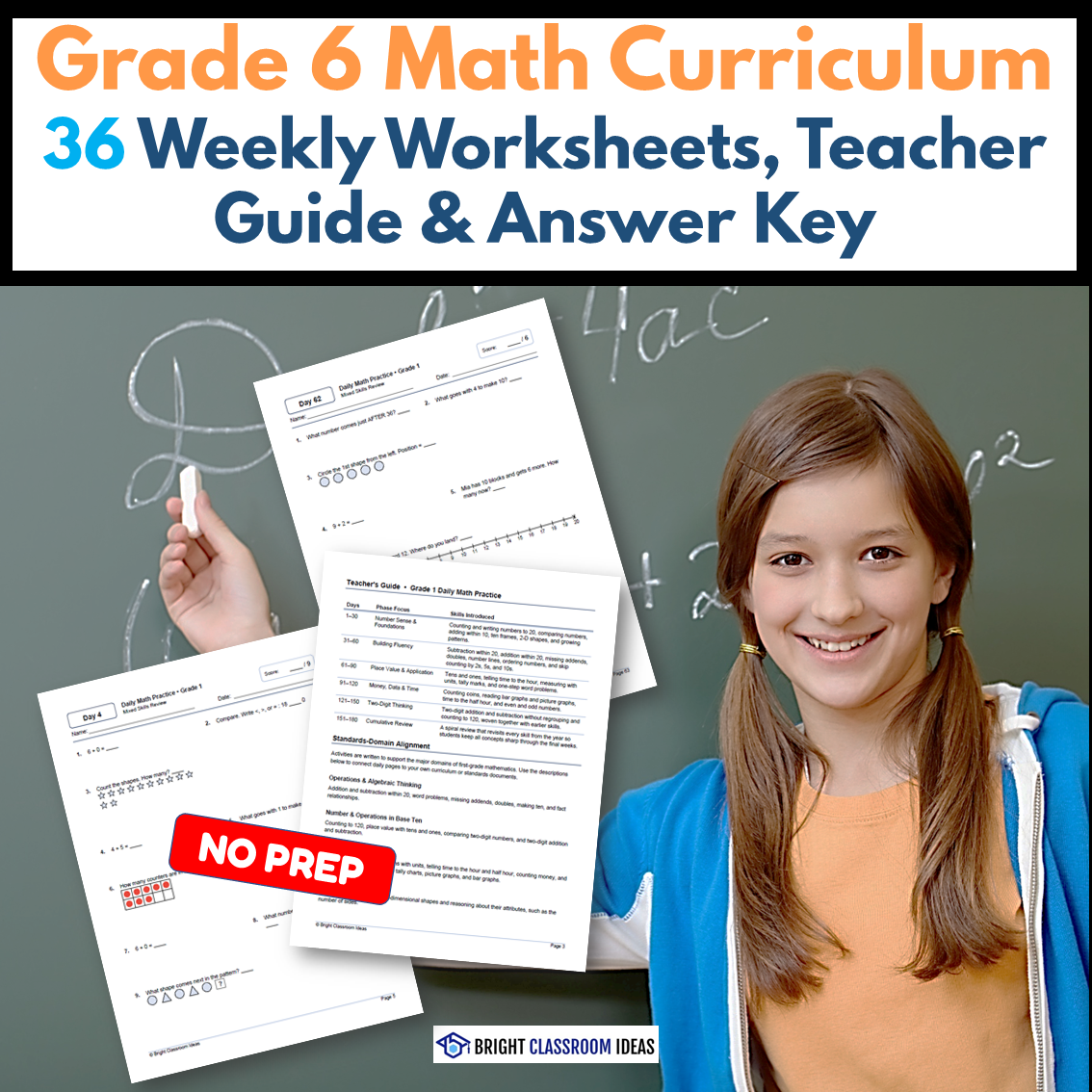
A full-year (36-week) Grade 6 math curriculum providing one skill-focused worksheet per week, covering ratios/rates/percents, the number system, expressions/equations, and geometry/statistics, with a teacher's guide and answer key.
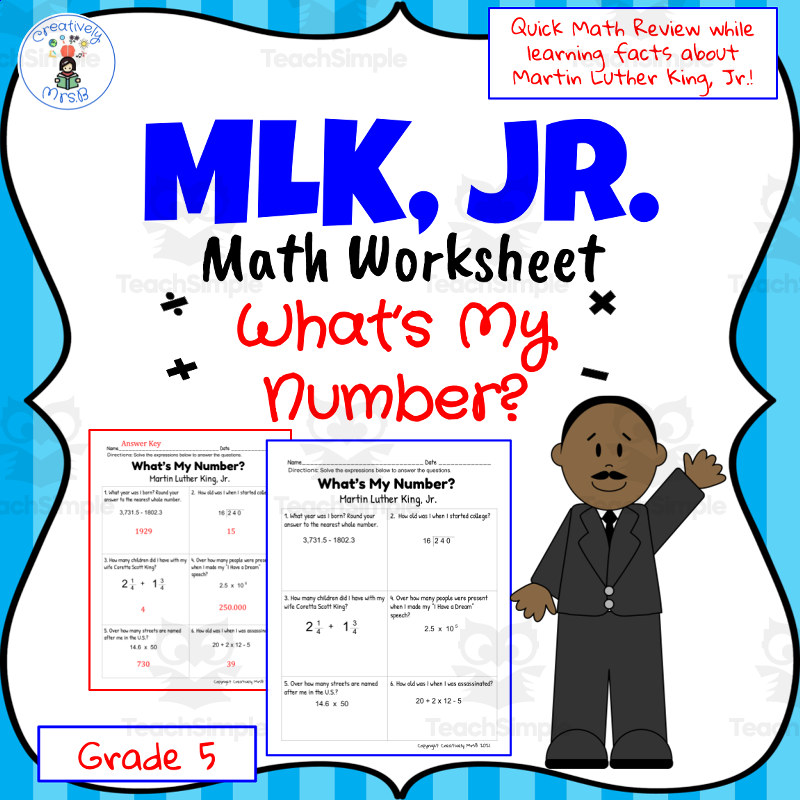
A math practice worksheet that has students solve arithmetic expressions to reveal trivia facts about Martin Luther King Jr.

This worksheet is a great way for students to practice finding the perimeter of two-dimensional shapes. It is a helpful tool for teachers who want to provide extra practice for their students.
Teach and build number sense around the number 11 ('Eleven') through a mix of hands-on manipulatives and printable practice pages covering recognition, formation, and counting.
A student notes packet reviewing pre-algebra fundamentals (translating verbal phrases, square roots/absolute value, order of operations, evaluating expressions, distributive property/like terms) to prepare students for Algebra 1.

Printable practice mats for skip counting by 3s from 3 to 36, for early math number-sequence recognition
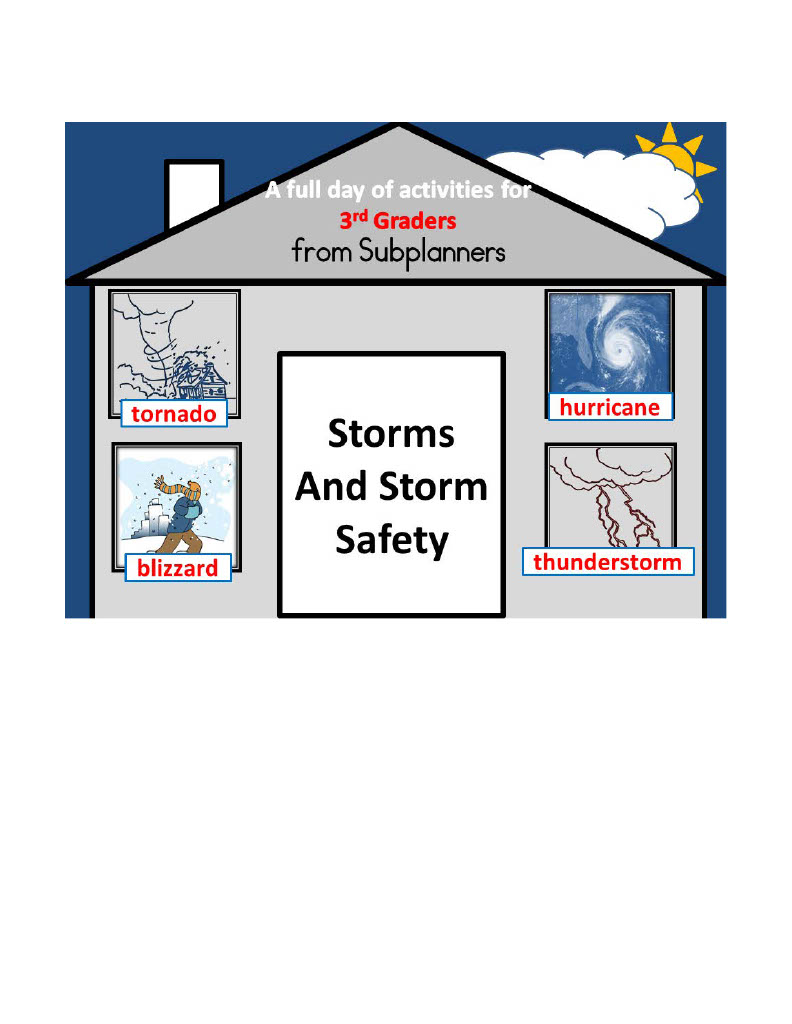
A full-day, ready-to-use substitute teacher plan for a 3rd-grade class on the theme of storms and storm safety, integrating reading, science, writing, and math.

Provide partner-check practice solving systems of two linear equations by elimination.

A Cinderella-themed telling-time matching activity tied to story events.

Skyscraper windows turn rectangular arrays into a visible connection between skip counting and multiplication. On the first worksheet, students count by threes, fours, and fives and draw their own equal-row buildings. The second asks for row and column equations and window arrays with given totals. Each worksheet has a matching answer key.
Multiplication practice workbook progressing from basic facts (1-9) through 2-digit by 3-digit multiplication with regrouping, intended as post-instruction reinforcement.

Break 1 Addend Apart Whole Number Addition Strategy Extra Practice Struggling to find enough time to build students' mental math skills? This teaching resource provides ample opportunities for practicing the "Break 1 Addend Apart" addition strategy.
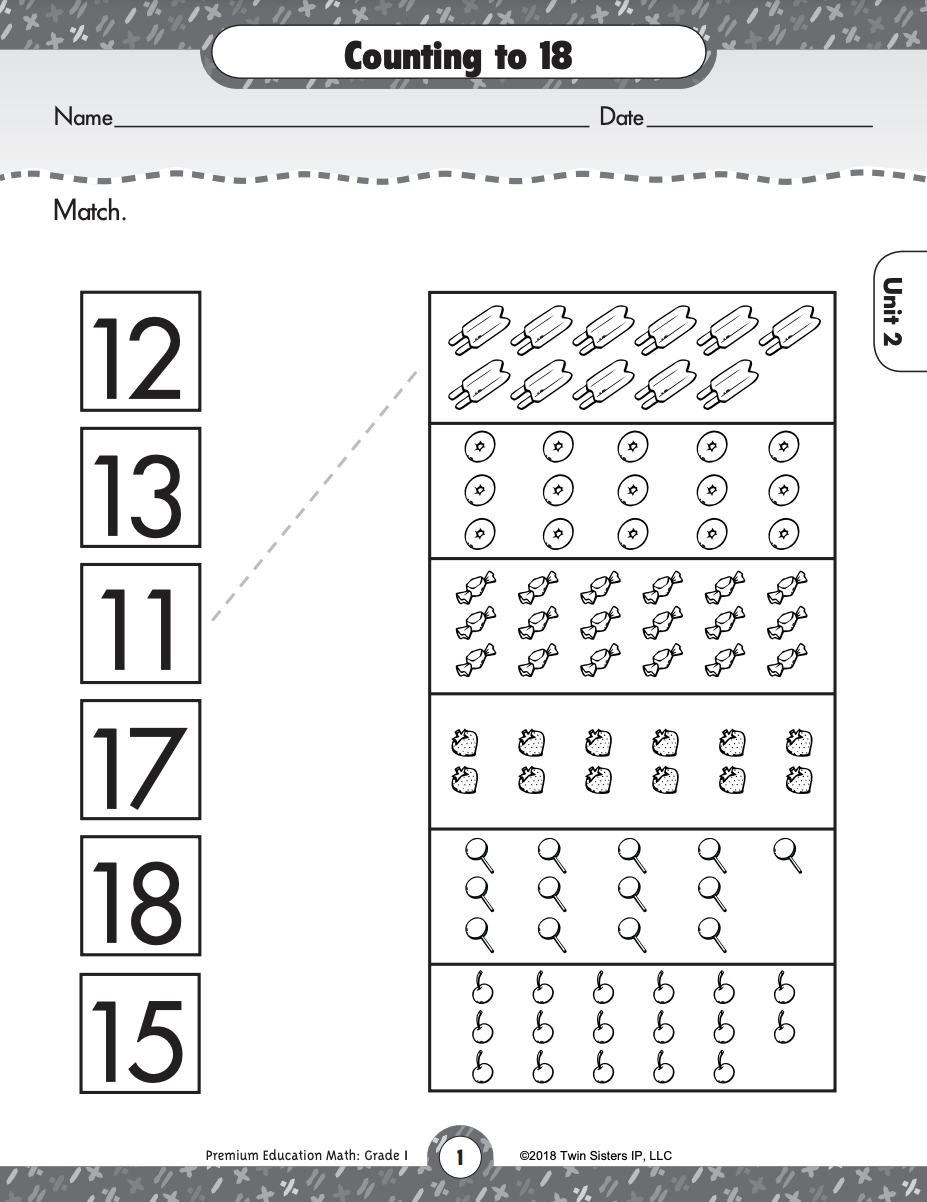
Addition and subtraction facts through 18 build from counting and picture-set addition up to word problems where students write their own number sentences. Early pages introduce facts through missing-number practice and picture-based sets, then move into three-addend addition and a color-by-code quilt page for subtraction facts. A 'Checking Subtraction' page has students subtract, then write the matching addition equation to verify their answer, and a review page asks them to judge whether a solved equation is correct and fix it if it is not. The workbook closes with five pages of addition and subtraction word problems, ending in a mixed page where students write and solve their own number sentences.

Four student pages guide learners from perfect squares and simplified radicals to side-length patterns in 45–45–90 and 30–60–90 triangles. Students apply the Pythagorean theorem, label diagrams, bisect an equilateral triangle and explain the resulting shortcuts. Printed summary boxes state the relationships, and three embedded handwritten answer pages follow. The seven-page Word file combines editable student content with image-based answers.

This finding area of irregular shapes worksheet is a great resource for students to use to find the area of rectangles on a grid. By counting squares or using a formula, students will be able to find the area more easily. This is a great resource for teachers who want to help their students learn more about finding area.
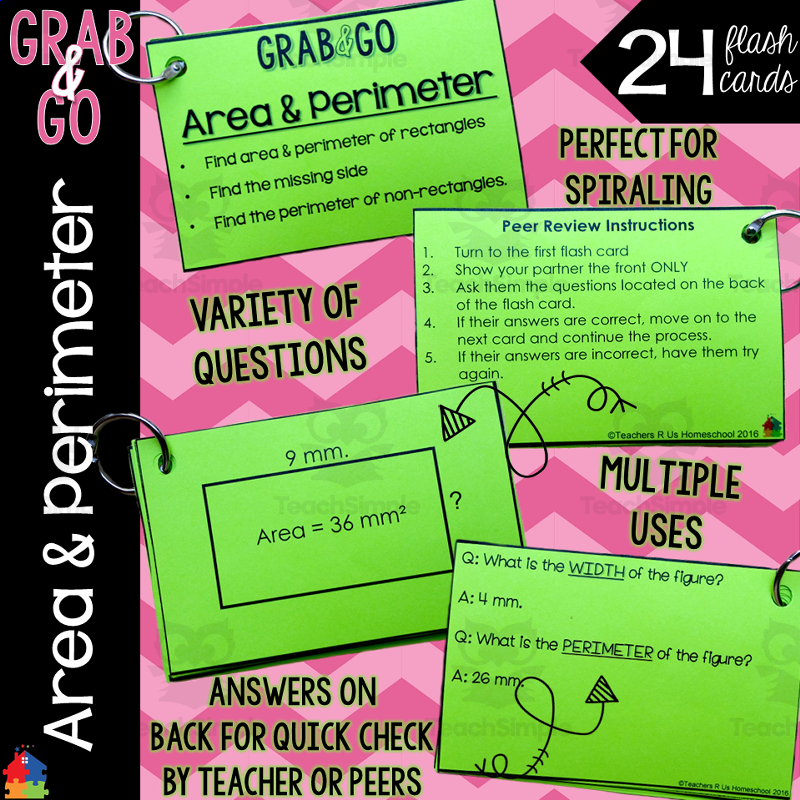
A set of 24 double-sided 'Grab & Go' flash cards for practicing area and perimeter calculations of rectangles and non-rectangular figures, including finding a missing side.
Practice creating and analyzing bar graphs using summer-themed data sets.