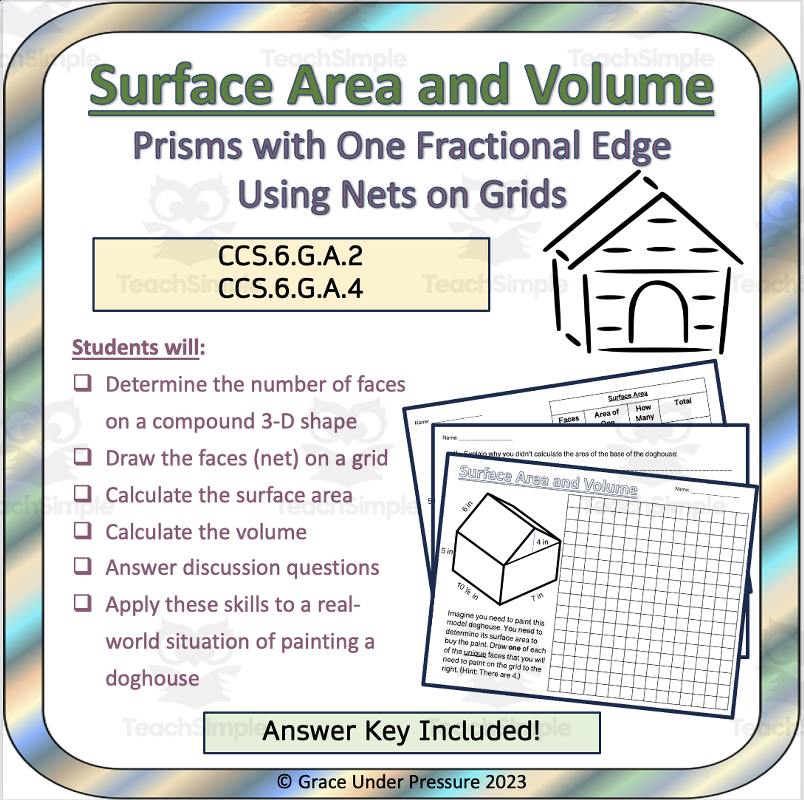
A model doghouse, drawn as a combined rectangular-and-triangular prism with labeled dimensions, gives students a real-world reason to calculate surface area (to determine how much paint to buy) and volume (to reason about what could fit inside). Students first sketch the shape's four unique faces on a grid, accounting for a length of ten and one-half inches, then use a table to calculate the area of each face type, multiply by how many of each face the doghouse has, and sum them for a grand total; a second table walks through the volume of the rectangular and triangular prism sections separately. Five closing discussion questions ask students to explain why the base isn't painted, calculate how many paint containers to buy given a coverage rate, and justify which formula they used for each volume calculation. A complete answer key follows with every calculated area, the total volume in cubic inches, and model responses to all five discussion questions.
Answers included